PTC: $590.7 Million in Quarterly Profit — and $462.6 Million of It Came From a Sale
PTC earned more in the quarter ended March 31, 2026 than ever before: $590.7 million, $4.98 per diluted share, up 270 percent. The 10-Q filed on May 7, 2026 also names the source: $462.6 million came from selling the Kepware and ThingWorx businesses to a private equity firm. That single item is what pushes the price-to-earnings ratio down to roughly 11 — and it never repeats. Let us do the math on what is left once you take it out.
 Thomas Mücke
Founder & Publisher
Thomas Mücke
Founder & Publisher
Chart
Interactive price chart (TradingView).
Note: pure fact-based analysis, not investment advice and not a solicitation to buy or sell. All figures without guarantee.
There is an investor trap that springs precisely when you are being careful: the one-time trap. You ignore the headlines and look at the numbers. You see a price-to-earnings ratio of roughly 11 on a software company with an 84 percent gross margin, and you think you have found something everyone else missed. Here is the catch: a profit that arrives exactly once looks, in every ratio, identical to a profit that arrives every year. At PTC Inc. (Nasdaq: PTC) that is not a theoretical problem. So let us make a deal: before we talk about price, we read together what the company itself reported to the U.S. securities regulator, the SEC — the annual report (10-K) for fiscal year 2025, filed November 21, 2025, and the quarterly report (10-Q) for the quarter ended March 31, 2026, filed May 7, 2026. A filing to the SEC is honest under penalty of law. And this one describes a record profit of $590.7 million, of which $462.6 million came from a single sale.
What PTC actually does — the software behind the things that get built
PTC is an industrial software company headquartered at 121 Seaport Boulevard in Boston. As of September 30, 2025 it employed 7,642 people full time; the filing cites more than 30,000 customers. Neil Barua runs the company, and Jennifer DiRico has been chief financial officer since January 1, 2026. There is a single operating segment.
Two families of programs pay the bills. The first is CAD — design on screen. With Creo and the cloud tool Onshape, engineers draw parts, test them in simulation and revise them before any metal is cut. The second is PLM, product lifecycle management. Windchill is the flagship, joined by Codebeamer and pure::variants for products stuffed with embedded software, ServiceMax and Servigistics for field service, and Arena as the cloud-native option.
Picture it this way: CAD is the drafting table, PLM is the archive that keeps every drawing, every revision and every spare part findable for twenty years. Both are sold on subscription — 95 percent of fiscal 2025 revenue was recurring. The filing names Autodesk, Dassault Systèmes and Siemens as competitors in CAD and PLM, and Oracle, SAP, Microsoft and Salesforce in the service products.
One note on the calendar, because it shifts every figure otherwise: PTC’s fiscal year ends September 30. Fiscal 2025 ran from October 1, 2024 to September 30, 2025, and the second fiscal quarter of 2026 is the quarter from January 1 to March 31, 2026.
That frames the central tension of this analysis, and it runs through every chapter: PTC is earning more than ever — but the profit that makes the stock look cheap came from selling a business, and a meaningful share of the growth that accompanies it comes from a revenue recognition rule. We took apart how subscription software should really be measured in our ServiceNow analysis.
Where the stock showed up in our scanner
The hook is not a price move but a list of ratios. Our in-house stock scanner carries PTC in the U.S. selection of the “Fundamental Rank (A / A+)” screen — the list that scores every stock against all others on the quality of its numbers: earnings and revenue growth, earnings surprises, margin and margin expansion, balance sheet safety, return on equity, earnings stability. PTC sits there with a fundamental rating of 52 points on a scale from −100 to +100, which is grade A (as of July 26, 2026; the lists are recomputed daily). On the same date the scanner counted 38 U.S. hits in that list, of which the page shows the first 25 rows.
How to get there yourself: on minnowstreet.com open the “Scanner” menu → select “Fundamental Rank (A / A+)” → market U.S. → find the PTC row.
The confluence is what stands out: on July 26, 2026 PTC appeared in ten lists at once — alongside the fundamental rank, among others quality growth, EPS acceleration, professional ownership above 80 percent, big earnings surprise, the Altman-Z balance sheet screen and quality stocks. In fairness: the EBIT margin ranking is a pure ranking filter that lists nearly every stock, so it does not count as a genuine hit.
Two figures from the July 26, 2026 data cut deserve to be rated, not just listed. A return on equity of 34.4 percent means the company earns 34 cents a year on every dollar of equity — anything above 15 percent is very good, and 34 percent is top tier. And the earnings surprises: in each of the last eight quarters results beat expectations, most recently by 28.1 percent. That explains why the stock clears this filter. It does not yet explain where the profit comes from.
The numbers over the years — honestly appraised
First, what genuinely impresses. Revenue rose to $2,739.2 million in fiscal 2025, after $2,298.5 million (2024) and $2,097.1 million (2023). More important than the top line is what reaches the bottom: operating income climbed to $982.4 million from $588.1 million, lifting the operating margin from 26 to 36 percent. Net income rose to $734.0 million, or $6.08 per diluted share, after $376.3 million ($3.12) and $245.5 million ($2.06).
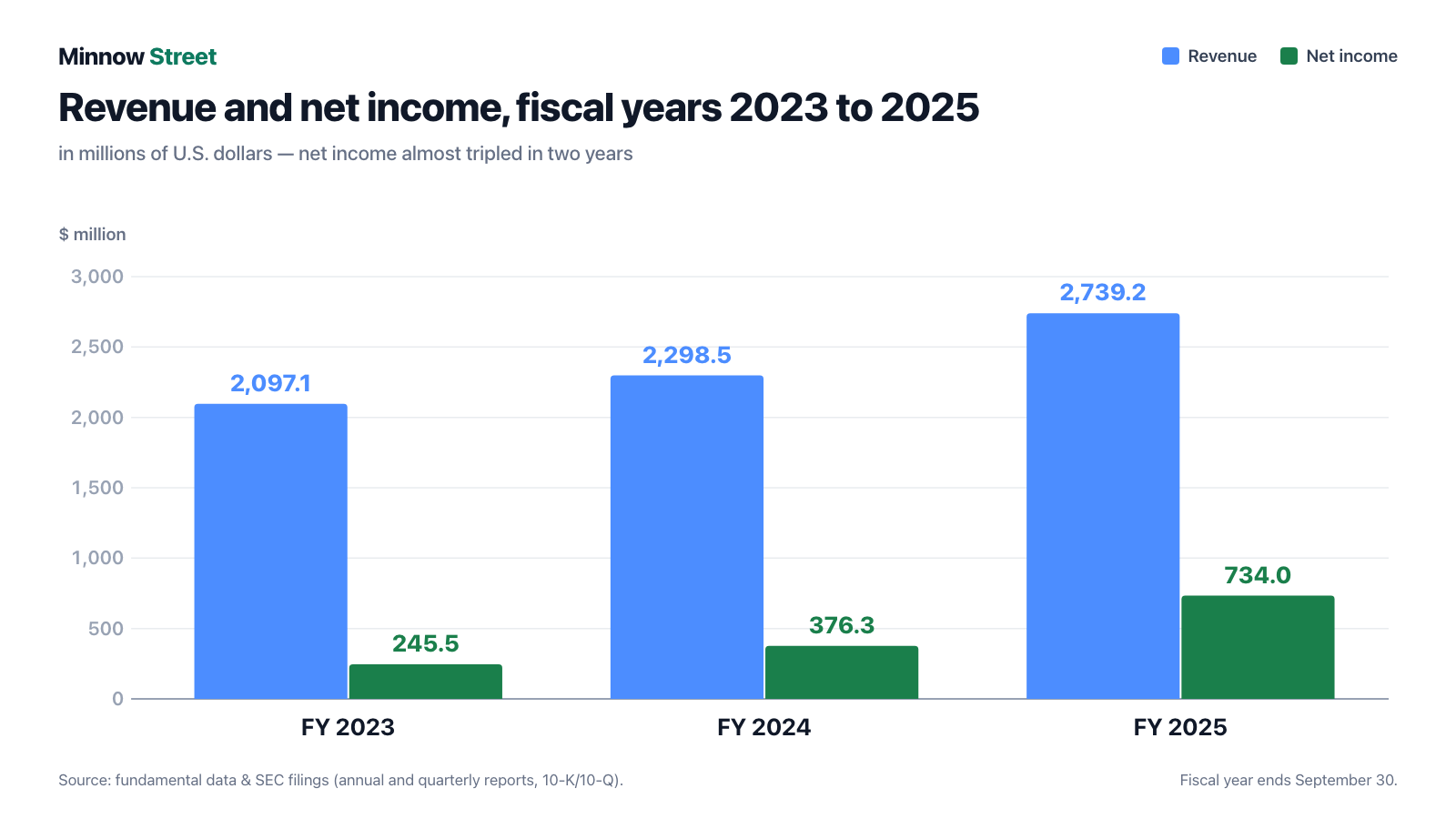
The cash follows the profit, which is by no means automatic in software. Operating cash flow reached $867.7 million in fiscal 2025 after $750.0 million; with capital expenditures of only $11.0 million, free cash flow was $856.7 million (2024: $735.6 million). Remember the magnitude: PTC converts almost every third revenue dollar into free cash.
Fiscal 2026 started the same way. In the first half (through March 31, 2026) revenue rose 22 percent to $1,460.1 million from $1,201.5 million, and operating income rose 52 percent to $516.9 million. Free cash flow reached $585.7 million after $514.2 million.
And the contract base? The annualized value of all active contracts (ARR) — the run rate of what customers currently subscribe to — stood at $2,478.5 million as of September 30, 2025, up 10 percent (8 percent in constant currency). PLM and CAD each grew 10 percent. Solid, unspectacular, honest.
What the filings say — the uncomfortable truths
Uncomfortable truth no. 1: three fifths of the record profit came from a sale
The quarter ended March 31, 2026 was the best PTC has ever reported: $590.7 million in net income, $4.98 per diluted share, up 270 percent from $1.35 a year earlier. Read only that line and you see a company that nearly quadrupled its profit.
The bridge tells a different story. The operating business contributed $295.8 million in operating income. From that, $15.3 million of interest expense came off. Then comes the line called other income, at $466.3 million — in a normal quarter that line carries a single-digit million figure. After $156.1 million of income taxes, the $590.7 million remains.
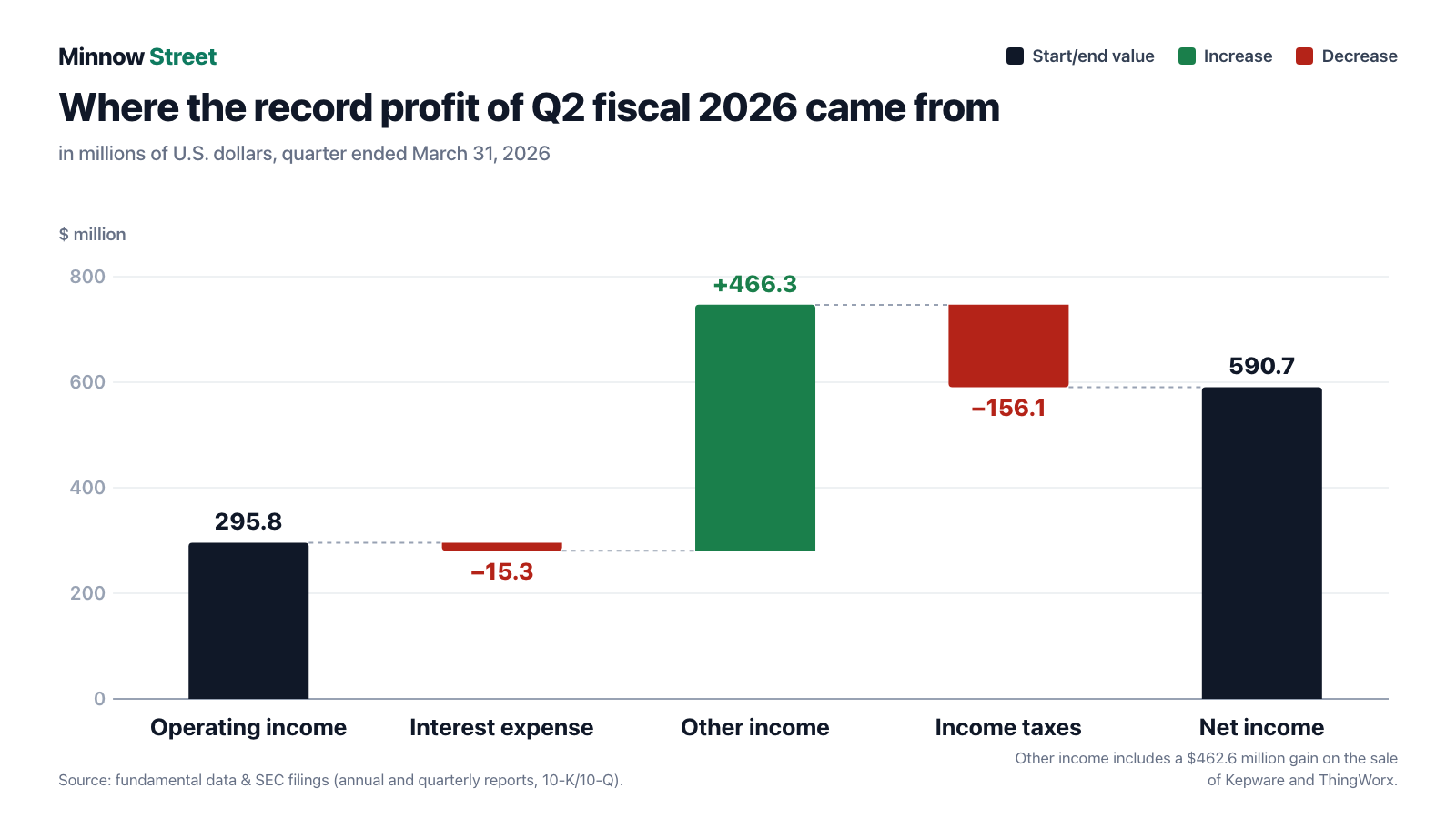
PTC spells out what sits inside that column:
“We completed the divestiture of our Kepware and ThingWorx businesses on March 13, 2026. We received $523 million upon closing of the transaction and recognized a $463 million gain on the sale.”
— PTC Inc., SEC quarterly report 10-Q for the quarter ended March 31, 2026, MD&A

The notes are more precise: net assets sold amounted to $68.2 million, the book gain to $462.6 million, and tax expense on it to $102.4 million. Roughly $360 million is left net — the figure PTC itself uses in the MD&A. Spread across the 118.553 million diluted shares of the quarter, that is $3.04 per share of the reported $4.98. Without the sale the quarter would have produced about $1.94 per share — well above the $1.35 of the prior year, but no record. PTC’s own non-GAAP figure for the same quarter is $2.69, less than half the reported $4.98.
Picture it this way: if you sell your car and therefore have more money in your account this month than ever before, you have not earned more — you have sold something.
Uncomfortable truth no. 2: what was sold is yesterday’s growth story
What PTC handed over is not a side business. ThingWorx was the platform that let machines feed data into software; Kepware was the translator between controllers from different manufacturers. Together they were PTC’s industrial internet showcase for years. One detail stands out: the phrase “Internet of Things” does not appear once in the fiscal 2025 annual report. The story had already left the filing before the businesses left the balance sheet.
The sequence is in the filings. On November 5, 2025 PTC signed an asset purchase agreement with Parrot US Buyer, L.P., an entity controlled by private equity firm TPG Global. The annual report described total consideration of up to $725 million at the time: up to $600 million at closing — reducible by $35 million if growth targets were missed — and up to $125 million later if TPG itself resells the business. The deal closed on March 13, 2026. Actual consideration: $530.8 million, of which $523.3 million in cash during the quarter and $7.5 million expected later, all still subject to final adjustments.
There were costs on top: $27 million of transaction-related charges in the quarter and $37 million in the half year, booked in general and administrative expenses. And a tail: PTC provides transition services to the buyer for up to twelve months.
Two things matter for you here. First, the sale shrank the contract base — the numbers follow below. Second, PTC has narrowed itself to two product families, CAD and PLM, which is a legitimate strategic choice. But remember the mechanism: selling a business books the gain today and gives up the revenue tomorrow.
Uncomfortable truth no. 3: revenue grew 22 percent, contract value grew 3
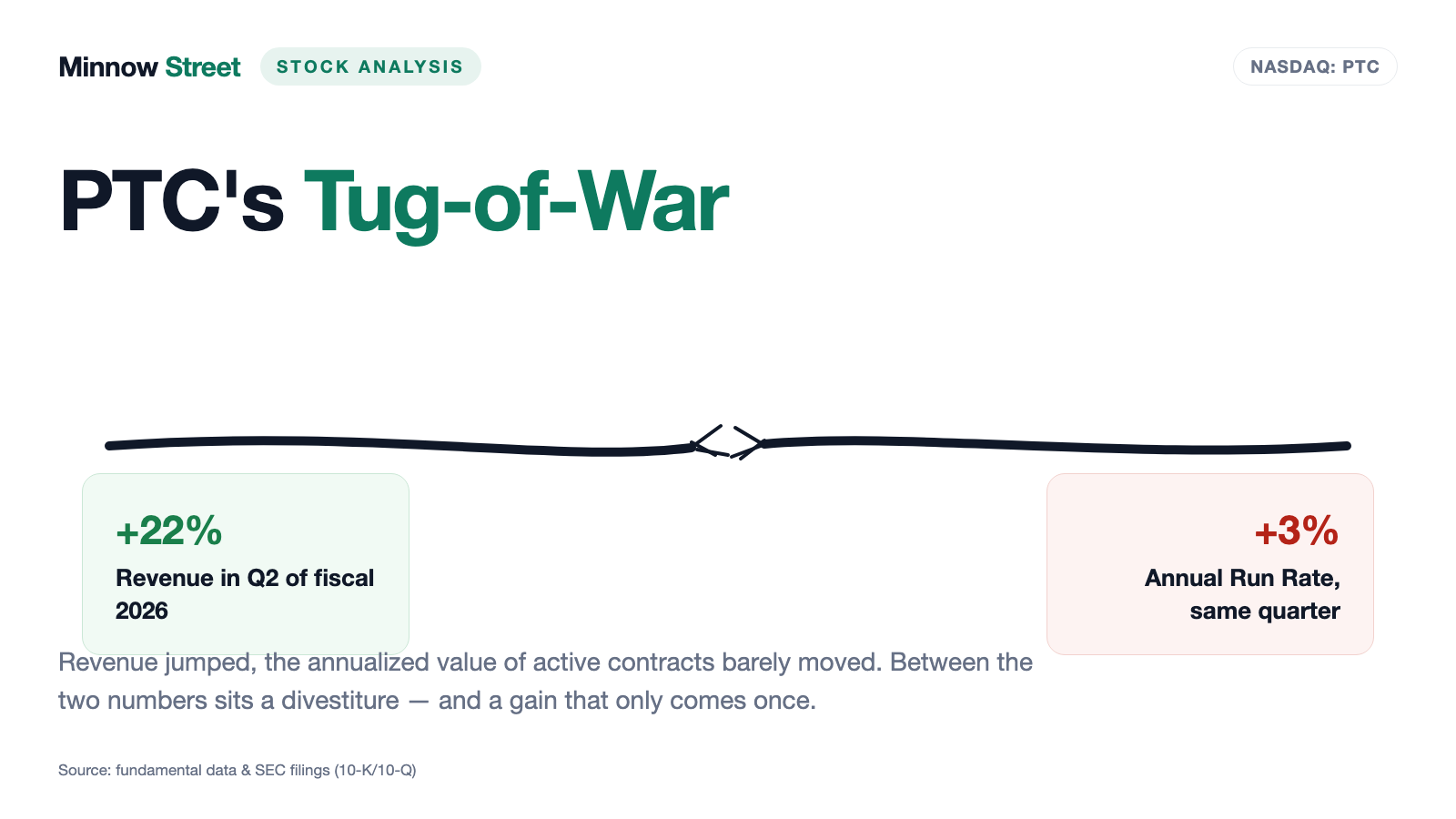
This is where the arithmetic gets interesting. In the quarter ended March 31, 2026, revenue rose 22 percent to $774.3 million (15 percent in constant currency). Over the same period the annualized value of active contracts rose 3 percent to $2,364.7 million. Two numbers, one company, one quarter — with a factor of seven between them.
“ARR grew 3% (1% constant currency) to $2.36 billion as of the end of Q2’26 compared to Q2’25, with growth impacted by the Q2’26 divestiture of Kepware and ThingWorx. Excluding the divested businesses from Q2’25 ARR, ARR growth would have been 11% (8.5% constant currency).”
— PTC Inc., SEC quarterly report 10-Q for the quarter ended March 31, 2026, MD&A

So the divestiture explains part of the gap: 11 percent adjusted instead of 3. But even 11 percent of contract growth sits against 22 percent of revenue growth. The remainder comes from an accounting rule PTC explains openly: under ASC 606, the license portion of a multi-year on-premises subscription is recognized immediately on delivery, while the support portion is spread over the term.
Picture it this way: if a gym starts selling three-year memberships instead of one-year memberships, this month’s revenue looks magnificent — even though exactly the same number of people are working out. That is precisely what PTC describes for fiscal 2025: larger contracts with a “notably longer average duration” drove license revenue and pushed long-term receivables up by $179 million, or 89 percent. Remaining performance obligations stood at $2,514.5 million as of March 31, 2026, of which $1,743.4 million is not yet on the balance sheet; roughly 53 percent converts to revenue within twelve months.
None of this is improper, and PTC itself warns that year-over-year revenue comparisons can therefore vary significantly. For you it means one thing: at this company, contract value is the more honest number than revenue. And it grew 11 percent, not 22.
Uncomfortable truth no. 4: equity consists entirely of goodwill on paper
The balance sheet as of March 31, 2026 looks reassuring at first glance: $6,537.3 million of total assets, of which $3,859.9 million is equity — an equity ratio of 59.0 percent. Plus $439.1 million of cash.
On the asset side, though, two items are not money: goodwill of $3,403.0 million and $783.2 million of acquired intangible assets — together $4,186.2 million, or 108 percent of equity. Goodwill arises when a buyer pays more for a company than its separately identifiable assets are worth. Picture it this way: it is the premium paid for hope, and it stays on the balance sheet until the auditor says the hope has shrunk.
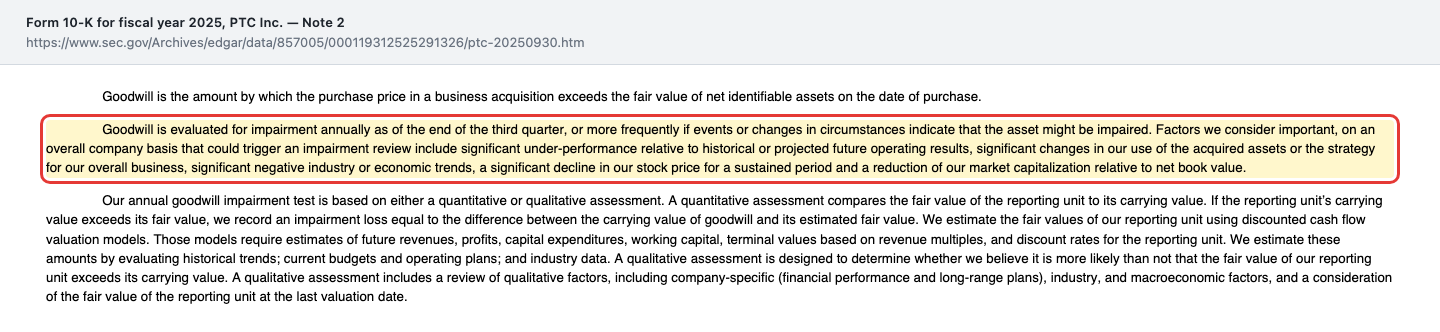
PTC describes exactly when that moment arrives:
“Goodwill is evaluated for impairment annually as of the end of the third quarter, or more frequently if events or changes in circumstances indicate that the asset might be impaired. Factors we consider important … include significant under-performance relative to historical or projected future operating results, … a significant decline in our stock price for a sustained period and a reduction of our market capitalization relative to net book value.”
— PTC Inc., SEC annual report 10-K for fiscal year 2025, Note 2
The fiscal 2025 test found no impairment, and on paper there is still plenty of headroom: a market value of roughly $13.7 billion (data as of July 26, 2026) sits far above a book value of $3.86 billion. But the test date is June 30 — that is, the quarter right after the share price slide. The result lands in the next quarterly report, and it is a line worth reading.
A second point on funding: debt of $1,200.0 million is comfortable against quarterly operating income of $295.8 million. It does, however, have a clustering problem — $500.0 million of 4.000 percent senior notes come due in 2028, and the credit facility covering the term loan ($456.3 million) and the drawn revolver ($243.8 million) matures on January 3, 2028. Practically the entire debt stack comes up for refinancing in a single year, most recently at a 5.1 percent rate.
What happened to the money — and how long the clock runs
PTC deserves explicit credit here. The proceeds did not go into an expensive acquisition; they went back to the owners. In the quarter ended March 31, 2026 alone, PTC repurchased $626 million of its own shares — including a $375 million accelerated share repurchase entered into on March 17, 2026, under which the bank immediately delivered 1.9 million shares. In total the quarter retired 3,540,131 shares at an average of $155.36. Shares outstanding fell from 119,536,000 on September 30, 2025 to 115,505,791 on May 4, 2026, a decline of 3.4 percent in a little over seven months. Whoever stays invested owns a larger slice of the same company.
And now the line that is easy to miss — it sits in a footnote below the repurchase table:

In November 2024 the board authorized $2 billion of repurchases for the period October 1, 2024 through September 30, 2027. In the third fiscal quarter of 2026 it shortened that window to September 30, 2026 and separately approved another $2 billion for October 1, 2026 through September 30, 2028. As of March 31, 2026, $950.0 million of the current authorization was still open — roughly 7 percent of the market value, to be deployed within two quarters or forfeited. That is not a forecast, it is a calendar entry.
Valuation — why a P/E of 11 means something else here
As of July 26, 2026, market value stood at roughly $13.7 billion. Against the 115,505,791 shares the 10-Q reports as of May 4, 2026, that implies about $118.50 per share. For context on how far the picture has moved: in February and March 2026 PTC bought back its own shares at an average of $155.36. That produces these orders of magnitude:
- Price-to-earnings ratio: about 11 on trailing twelve-month earnings of $10.41 per share.
- Price-to-earnings excluding the divestiture gain: take out the $3.04 per share from the Kepware and ThingWorx sale and about $7.37 remains — a P/E of roughly 16.
- Price-to-sales ratio: about 4.6 on trailing revenue of $2,997.9 million.
- Price-to-book ratio: about 3.5 — on a book value that consists entirely of goodwill and intangibles.
“Conspicuously cheap” therefore becomes “fairly priced.” For a company with an 84 percent gross margin, 95 percent recurring revenue and $856.7 million of free cash flow, a P/E of 16 is not a high price — but it is not the kind of dislocation you have to seize immediately either.
And the professionals? As of July 26, 2026, 20 analysts follow the stock: ten at the highest buy rating, three at buy, seven at hold, none at sell. The mean price target is $175.35 — roughly 48 percent above the implied price. A gap that wide is rare, and it says two things: the analysts consider the slide overdone, and they have not yet adjusted their targets to the new picture. On the other side, 8.3 percent of the float was sold short on the same date. We described a similar split between the ratios and the price in our Electromed analysis, a name that sits in the same scanner list.
What do the professionals expect going forward? Consensus estimates run at roughly $8.07 per share for the current fiscal year and $8.63 for the next (data as of July 26, 2026) — below the reported $10.41 of the trailing twelve months. The professionals are stripping out the one-time item too.
Opportunities and risks at a glance
What speaks for PTC:
- A high-margin subscription business: an 84 percent gross margin and a 36 percent operating margin in fiscal 2025, 95 percent recurring revenue, more than 30,000 customers.
- Profit grows faster than revenue: operating income of $982.4 million (2024: $588.1; 2023: $458.5) on revenue of $2,739.2 million.
- The cash is real: $856.7 million of free cash flow in fiscal 2025 and $585.7 million in the first half of fiscal 2026 alone.
- Adjusted contract growth is solid: 11 percent in the quarter ended March 31, 2026 excluding the divested businesses, carried by Windchill, Codebeamer and Creo.
- Disciplined capital allocation: $626 million of buybacks in one quarter, share count down 3.4 percent, no expensive acquisition with the proceeds.
- The balance sheet holds: a 59.0 percent equity ratio, $439.1 million of cash, $1,006.3 million of unused revolver capacity, all covenants met.
What speaks against it:
- The record profit is mostly one-time: $462.6 million of the $590.7 million in the quarter ended March 31, 2026 came from a sale, roughly $360 million after tax.
- Revenue and contract value diverge: 22 percent against 3 percent (11 percent adjusted) — part of the growth is contract duration, not new business.
- Long-term receivables rose $179 million, or 89 percent, in fiscal 2025: revenue today, cash later.
- Goodwill ($3,403.0 million) and intangibles ($783.2 million) amount to 108 percent of equity of $3,859.9 million; the annual impairment test falls on June 30.
- A 2028 maturity cluster: $500.0 million of senior notes and a credit facility of roughly $700 million more mature in the same year.
- The sale removes revenue — the divested businesses still accounted for about $154 million of annualized contract value in the comparison quarter.
- The competition is first class: Autodesk, Dassault Systèmes and Siemens in CAD and PLM, plus Oracle, SAP, Microsoft and Salesforce in the service products.
A human conclusion
Back to the one-time trap from the opening. Its problem is not that it leads you to bad companies — PTC is a good company. It keeps 84 cents of every revenue dollar as gross profit, it lifted its operating margin from 26 to 36 percent in two years, it generates genuine free cash and returns it with discipline. The problem with the trap is that it hides the origin of a number. A price-to-earnings ratio does not ask whether the earnings came from selling software or from selling a division.
At PTC the answer is in the filing, and it reads: three fifths from selling a division. Take it out and a P/E of 11 turns into one of about 16 — and a supposedly overlooked bargain turns into a fairly priced software company with one open question. That question is not “is this cheap?” but: how much of the reported revenue growth is new business, and how much is simply the duration of the contracts that happened to be signed?
The good news is that PTC hands you the answer every quarter. Contract value is in every report, the non-GAAP earnings line as well, the impairment test result arrives with June 30, and the remaining buyback authorization sits in the same table. If contract value grows at double digits for three quarters running, your thesis is confirmed. If it does not, it is refuted just as clearly. What you make of it is your decision. And that is exactly as it should be.
Sources
Every original document used in this analysis — for you to read yourself:
- PTC Inc. — SEC Form 10-Q for the quarter ended March 31, 2026 (filed May 7, 2026)
- PTC Inc. — SEC Form 10-K for fiscal year 2025 (filed November 21, 2025)
- PTC Inc. — Form 8-K dated March 16, 2026 (closing of the Kepware and ThingWorx divestiture)
- PTC Inc. — Form 8-K dated December 4, 2025 (appointment of CFO Jennifer DiRico) and the Form 8-K dated November 5, 2025 on the asset purchase agreement
- Full filing history: EDGAR overview for CIK 0000857005 (sec.gov)
- Fundamental data (metrics, valuation, analyst estimates; data as of July 26, 2026), reconciled with the SEC filings.
- Scanner lists: our in-house stock scanner, as of July 26, 2026; the lists are recomputed daily.
Transparency & disclaimer: this analysis is a journalistic contextualization of publicly available information. It is not investment advice, not a regulated financial analysis and not a solicitation to buy or sell securities. Equity investments carry substantial risk up to total loss. All information without warranty; the data cut-off is noted in the text. The author holds no position in PTC shares at the time of publication.
Our Bottom Line at a Glance
- Business model and earning power positive
- PTC earns its money on subscriptions: 95 percent of fiscal 2025 revenue was recurring, gross margin was 84 percent, and operating income reached $982.4 million, or 36 percent of revenue, up from 26 percent a year earlier. Free cash flow rose to $856.7 million (2024: $735.6 million). This is not a revenue story, it is an earnings machine.
- Where the record profit came from negative
- Of the $590.7 million in net income for the quarter ended March 31, 2026, $462.6 million came from selling Kepware and ThingWorx — roughly $360 million after $102.4 million of tax. That is $3.04 of the reported $4.98 per diluted share. Without it the quarter would have delivered about $1.94 per share: more than the $1.35 a year earlier, but no record.
- Quality of growth neutral
- Revenue in the quarter ended March 31, 2026 rose 22 percent to $774.3 million, while the annualized value of active contracts grew only 3 percent to $2,364.7 million — 11 percent excluding the divested businesses. The gap comes from ASC 606: the license portion of multi-year contracts is recognized up front. In fiscal 2025 that pushed long-term receivables up by $179 million, or 89 percent.
- Balance sheet and funding neutral
- As of March 31, 2026, equity of $3,859.9 million (59.0 percent of total assets) and $439.1 million of cash stand against $1,200.0 million of debt — comfortable against quarterly operating income of $295.8 million. Two things dim the picture: goodwill and intangibles add up to $4,186.2 million, or 108 percent of equity, and virtually the entire debt stack matures in 2028.
- Capital allocation positive
- The divestiture proceeds went to shareholders rather than into an expensive acquisition: $626 million of buybacks in the quarter ended March 31, 2026, including $375 million through an accelerated share repurchase entered into on March 17, 2026. Shares outstanding fell from 119,536,000 on September 30, 2025 to 115,505,791 on May 4, 2026. As of March 31, 2026, $950.0 million of the authorization running to September 30, 2026 was still open.
- Valuation neutral
- At a market value of roughly $13.7 billion (data as of July 26, 2026), trailing earnings of $10.41 per share imply a price-to-earnings ratio of about 11. Strip out the divestiture gain and about $7.37 per share remains, for a P/E near 16 — not expensive for a company with an 84 percent gross margin, but not a bargain either. The mean price target of 20 analysts stood at $175.35, roughly 48 percent above the implied price.
PTC is a good company with a misleading headline number. The business works: $2,739.2 million of revenue and $734.0 million of net income in fiscal 2025, an 84 percent gross margin, $856.7 million of free cash flow, 95 percent recurring revenue. But three fifths of the record profit in the quarter ended March 31, 2026 came from selling Kepware and ThingWorx, and that same item is what pushes the price-to-earnings ratio down to roughly 11. Take it out and you are left with a solid, fairly priced software company and one open question: how much of the reported revenue growth is contract duration, and how much is new business? Not investment advice.
What Our Rating Means
Open questions
The business works in principle, but one material question is open. As long as it stays open, our findings do not carry a quality verdict.
There is little to argue with on substance: an 84 percent gross margin, a 36 percent operating margin in fiscal 2025, $856.7 million of free cash flow, 95 percent recurring revenue, more than 30,000 customers and a 59.0 percent equity ratio. No going-concern language, no existential dependence on a single counterparty, nothing unusual about the auditor or the leadership. What remains open is a material operating question, and it is measurable in the filings: reported revenue grew 22 percent in the quarter ended March 31, 2026 while contract value grew 3 percent — 11 percent adjusted for the divested businesses. As long as ASC 606 pulls the license portion of long contracts forward and long-term receivables are up 89 percent in fiscal 2025, it is impossible to separate cleanly how much of the growth is timing. On top of that sits a balance sheet whose equity consists entirely of goodwill and intangibles. That is not a break in substance, but it is more than a formality. Hence yellow: proven quality, unproven growth base. The decision is yours.
A journalistic assessment by our editorial team at the time of the deep dive, based on public sources — not investment advice and not a solicitation to buy or sell. Your personal circumstances (investment goals, risk capacity, taxes) cannot be taken into account. What our levels mean, how verdicts are formed, and what conflicts of interest exist →
Worth Noting
- PTC reached our research list through our in-house stock scanner: the stock sits in the U.S. selection of the “Fundamental Rank (A / A+)” list, which sorts companies by the quality of their numbers — with a fundamental rating of 52 points and therefore grade A (as of July 26, 2026; 38 U.S. names meet the criteria and the page shows the first 25). On the same date PTC appeared in ten lists at once, among them quality growth, EPS acceleration, professional ownership above 80 percent and the Altman-Z balance sheet screen. The lists are recomputed daily.
- Recency: this analysis reflects the Form 10-K for fiscal year 2025 (November 21, 2025), the Form 10-Q for the quarter ended March 31, 2026 (May 7, 2026), and every document filed since. After May 7, 2026 only insider reports (Form 4), a proposed sale notice (Form 144) and a SCHEDULE 13G/A dated May 15, 2026 followed — none of which changes the figures used here.
- Valuation figures are dated and evergreen: the implied price of about $118.50 comes from a market value of roughly $13.7 billion (data as of July 26, 2026) divided by the 115,505,791 shares the 10-Q reports as of May 4, 2026. For context: in February and March 2026 PTC repurchased its own shares at an average of $155.36. Analyses are evergreen; daily prices are not a buy argument.
- Possible confusion: PTC Inc. (Nasdaq: PTC, CIK 0000857005, software from Boston, called Parametric Technology Corporation until January 2013) has nothing to do with PTC Therapeutics (Nasdaq: PTCT).
Frequently Asked Questions
PTC Inc. (Nasdaq: PTC), based in Boston, sells software to industrial companies on subscription. Two families: design tools that let engineers draw and simulate parts on screen (CAD — Creo and Onshape), and systems that manage every piece of data about a product across its life (PLM — Windchill, Codebeamer, ServiceMax, Arena, Servigistics). Revenue in fiscal 2025 was $2,739.2 million, of which 95 percent was recurring.
No, and the mix-up is common. PTC Inc. (Nasdaq: PTC, SEC file number CIK 0000857005) is a software company in Boston that was called Parametric Technology Corporation until January 2013. PTC Therapeutics (Nasdaq: PTCT) is a New Jersey pharmaceutical company with its own SEC file number. The two have nothing to do with each other.
Because the trailing twelve-month profit contains a one-time item. On March 13, 2026 PTC sold its Kepware and ThingWorx businesses and booked a $462.6 million gain, roughly $360 million net of $102.4 million in tax. Strip it out and trailing earnings per share fall from $10.41 to about $7.37 — turning a P/E of roughly 11 into one of about 16 (data as of July 26, 2026).
They were PTC's industrial internet building blocks: ThingWorx connected machines to software, Kepware translated between controllers from different manufacturers. On November 5, 2025 PTC agreed to sell them to an entity controlled by private equity firm TPG; the deal closed on March 13, 2026 for total consideration of $530.8 million. The proceeds went into share repurchases, according to the filing.
Two reasons. First, ARR — the annualized value of all active contracts — no longer includes the divested businesses after March 13, 2026; adjusted growth would have been 11 percent. Second, under ASC 606 PTC recognizes the license portion of multi-year on-premises contracts up front on delivery. Longer contracts therefore inflate reported revenue in a quarter without lifting ARR to the same degree.
On September 30. Fiscal year 2025 ran from October 1, 2024 through September 30, 2025, so it largely covers calendar 2025 up to the autumn. The second fiscal quarter of 2026 is therefore the quarter from January 1 to March 31, 2026. The annual goodwill impairment test falls at the end of the third fiscal quarter, meaning June 30.
As of March 31, 2026 the balance sheet showed $1,200.0 million of debt: $500.0 million of 4.000 percent senior notes due 2028, a $456.3 million term loan and $243.8 million drawn on the revolver. Cash stood at $439.1 million. The credit facility matures on January 3, 2028, and PTC was in compliance with all covenants at the reporting date.
No. As of July 26, 2026 the stock carries no dividend and the payout ratio is zero. PTC returns capital exclusively through buybacks: $626 million in the quarter ended March 31, 2026 alone, including $375 million through an accelerated share repurchase entered into on March 17, 2026. As of March 31, 2026, $950.0 million of the current authorization remained.
Found an error?
Did you spot a factual error, an outdated number, or a typo in this deep dive? Let us know briefly — your report goes straight to the editorial team.