Electromed: A 78 Percent Gross Margin, Zero Debt — and Thirteen Months Before the Money Arrives
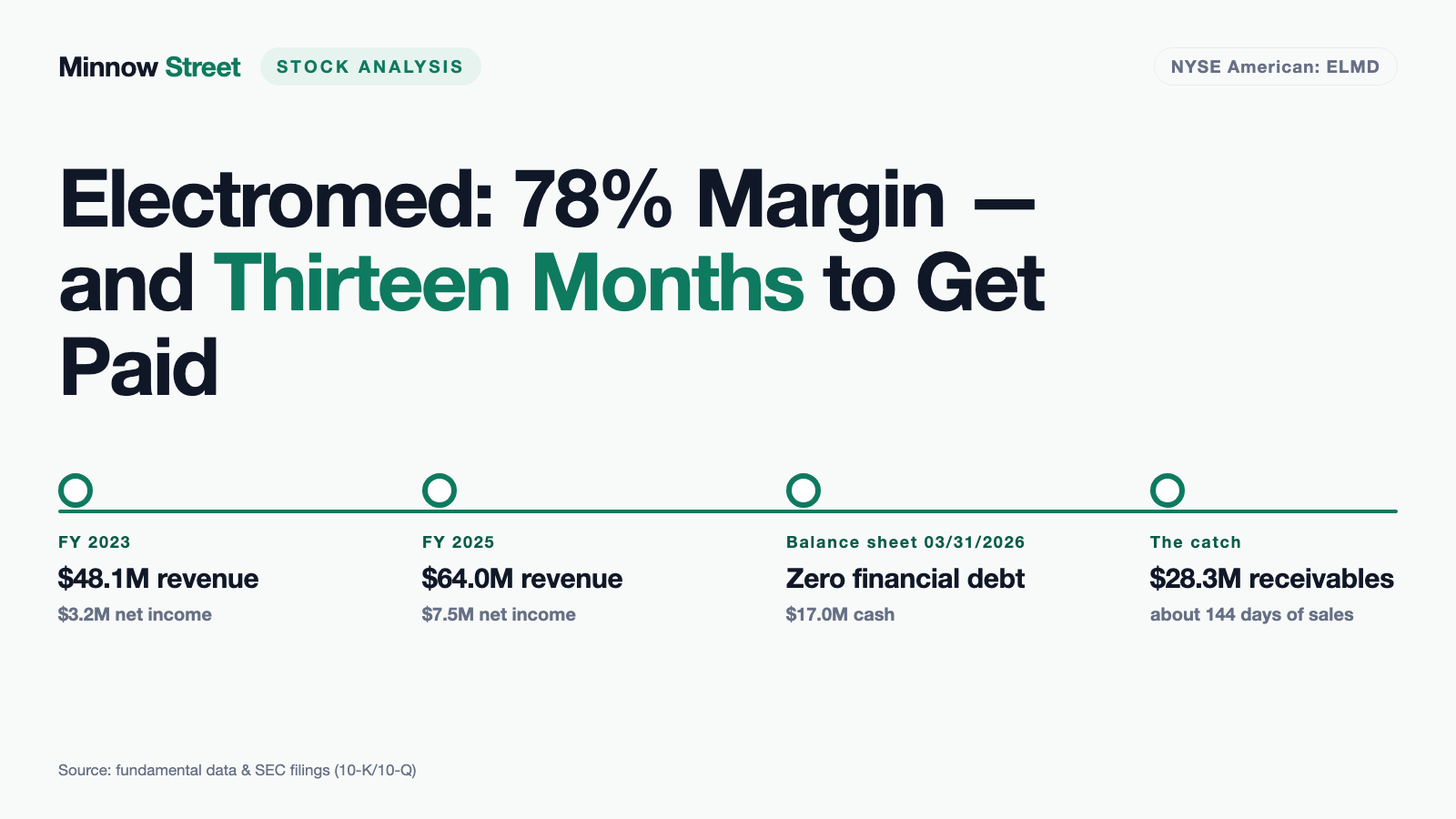
Some companies check every box. Electromed has sold the same vest since 2000 — a device that shakes mucus loose from the lungs of chronically ill patients — at a gross margin of 78.5 percent for the nine months ended March 31, 2026, without a dollar of financial debt, while lifting revenue from $48.1 million to $64.0 million in two fiscal years. The quarterly report filed May 12, 2026, also carries the line no ratio displays: $28,251,000 of receivables, and a normal operating cycle of roughly thirteen months, because approximately 96 percent of homecare revenue comes from capped installment arrangements with health insurers. Not investment advice — just the question of how long a company can wait for its own money before the waiting becomes the business model.
 Thomas Mücke
Founder & Publisher
Thomas Mücke
Founder & Publisher
Chart
Interactive price chart (TradingView).
Note: pure fact-based analysis, not investment advice and not a solicitation to buy or sell. All figures without guarantee.
There is a mental shortcut we all learn long before we buy a single share: the receipt illusion. When the register prints the slip, the transaction feels finished. Goods out, money in, done. We carry that feeling straight into company filings. A line reads "revenue of $64.0 million," and a cash register rings somewhere in our head. But booked revenue is not money in the bank — it is a promise of money. At Electromed, Inc. (NYSE American: ELMD) that distinction is not a footnote. It is the business model. So let us make a deal: before a very tidy set of ratios lulls you to sleep, we read together what this company told the U.S. securities regulator, the SEC — the annual report (Form 10-K) for fiscal 2025, filed August 26, 2025, and above all the quarterly report (Form 10-Q) as of March 31, 2026, filed May 12, 2026. A filing carries criminal liability behind it. And this one describes a small, genuinely healthy company with one product, a 78 percent gross margin — and roughly thirteen months between the sale and the cash. What you make of that is your call.
What Electromed Actually Does — the Vest That Coughs for You
Imagine your lungs produce too much thick mucus and you cannot get it out. That is life with bronchiectasis (permanently widened, damaged airways), with cystic fibrosis and with neuromuscular conditions such as ALS or cerebral palsy: the mucus stays put, bacteria settle in, and infections, antibiotics and hospital stays follow. The traditional treatment is physical therapy in which a therapist rhythmically claps the chest. Electromed builds the machine that takes over: the SmartVest System — a programmable air pulse generator, a hose and an inflatable garment that squeezes and releases the chest wall several times per second. The clinical term is HFCWO, high frequency chest wall oscillation. In plain language: the vest coughs for you, at home, without anyone else in the room.
This is not a device you pick off a shelf. It requires a physician's prescription, and the real work starts after that: Electromed handles the paperwork, files the claim with the insurer, bills, ships the system and trains the patient at home. The annual report calls this a direct-to-patient and provider model — the company cuts out the traditional home medical equipment channel and captures both the manufacturer and the distributor margin. That is the reason for the striking gross margin. It is also the reason for everything else in this analysis.
Just how narrow this business is, the company states itself in a sentence worth reading twice:
"We have a single active product and engage in the single business activity of selling and supporting that single product."
— Electromed, Inc., SEC quarterly report 10-Q as of March 31, 2026, Note 10 (Segment Reporting)

The device comes in two versions: the older SmartVest SQL (in the home market since 2014) and the SmartVest Clearway, which received FDA clearance in November 2022 under the 510(k) pathway — the simplified U.S. route for devices substantially equivalent to one already cleared. Everything is assembled at company headquarters in New Prague, Minnesota, in a dedicated plant of more than 14,000 square feet, certified to ISO 13485. As of June 30, 2025, Electromed had 180 employees, 177 of them full time, spread across 31 states, plus roughly 176 independent respiratory therapists who train patients in their homes.
Which brings us to the central tension of this analysis, and it runs through every chapter that follows: Electromed is about as financially healthy as a micro-cap can be — debt free, profitable, growing. And still, virtually every dollar of revenue rests on an estimate and on payers who take about thirteen months.
How the Stock Reached Our Desk
Electromed came onto the research list through our in-house stock scanner. On July 26, 2026, ELMD appeared in the U.S. selection of the "Fundamental Rank (A / A+)" screen — a list that ranks every stock against every other on earnings and revenue growth, earnings surprises, margin and margin expansion, balance sheet safety, return on equity and earnings stability. As of that date the screen held 38 U.S. hits; the page displays the first 25 rows, and Electromed is among them.
The notable part is not the single hit but the company it keeps. On July 26, 2026, ELMD showed up on twelve screens at once, and they split cleanly into two camps. On the quality side, alongside Fundamental Rank, sit "Quality Growth" and "Professionals 80%". On the trend side stand "Stan Weinstein: Stage 2" (the phase after a base in which an uptrend is running), "Power Trend", "ATH" and "Near 52-Week High", plus "Above 50- and 200-day SMA", "21-EMA Trend" and "High ADR (>=5%)". Two caveats belong right here: these screens are recalculated daily, so what held on July 26, 2026, may look different a week later. And a stock that sits on quality screens and momentum screens at the same time is exactly the setup in which the receipt illusion works best — the price appears to confirm what the ratios promise.
How to get there yourself: on minnowstreet.com open the "Scanner" menu, choose "Fundamental Rank (A / A+)" and look for the ELMD row.
The hard scores back the picture up. As of July 24, 2026, the Piotroski F-Score stood at 7 out of 9 — a nine-point checklist for balance sheet health where 7 is solid but not the top mark. The Altman Z-Score, an early-warning measure for bankruptcy risk, came in at 15.58; anything above 3 counts as safe, and 15 is essentially off the scale, a direct consequence of having no debt. The Beneish M-Score, which flags patterns typical of manipulated accounts, sat at -2.77, comfortably in the unremarkable range. Return on equity was 21.7 percent and return on assets 14.9 percent. Hold on to that picture — it is real. The question is only what it does not measure.
The Numbers Over the Years — Given Their Due
First, what genuinely impresses. And with Electromed that is a lot. One thing to keep straight: the fiscal year ends June 30. "Fiscal 2025" therefore covers July 1, 2024, through June 30, 2025.
Revenue rose from $48.067 million in fiscal 2023 to $54.716 million in fiscal 2024 and $64.000 million in fiscal 2025 — growth of 13.8 and 17.0 percent. Net income grew faster than revenue over the same stretch: from $3.166 million to $5.150 million to $7.537 million. That kind of run is rare at this size, and it did not come from acquisitions. It came from more sales representatives and higher net revenue per approval.
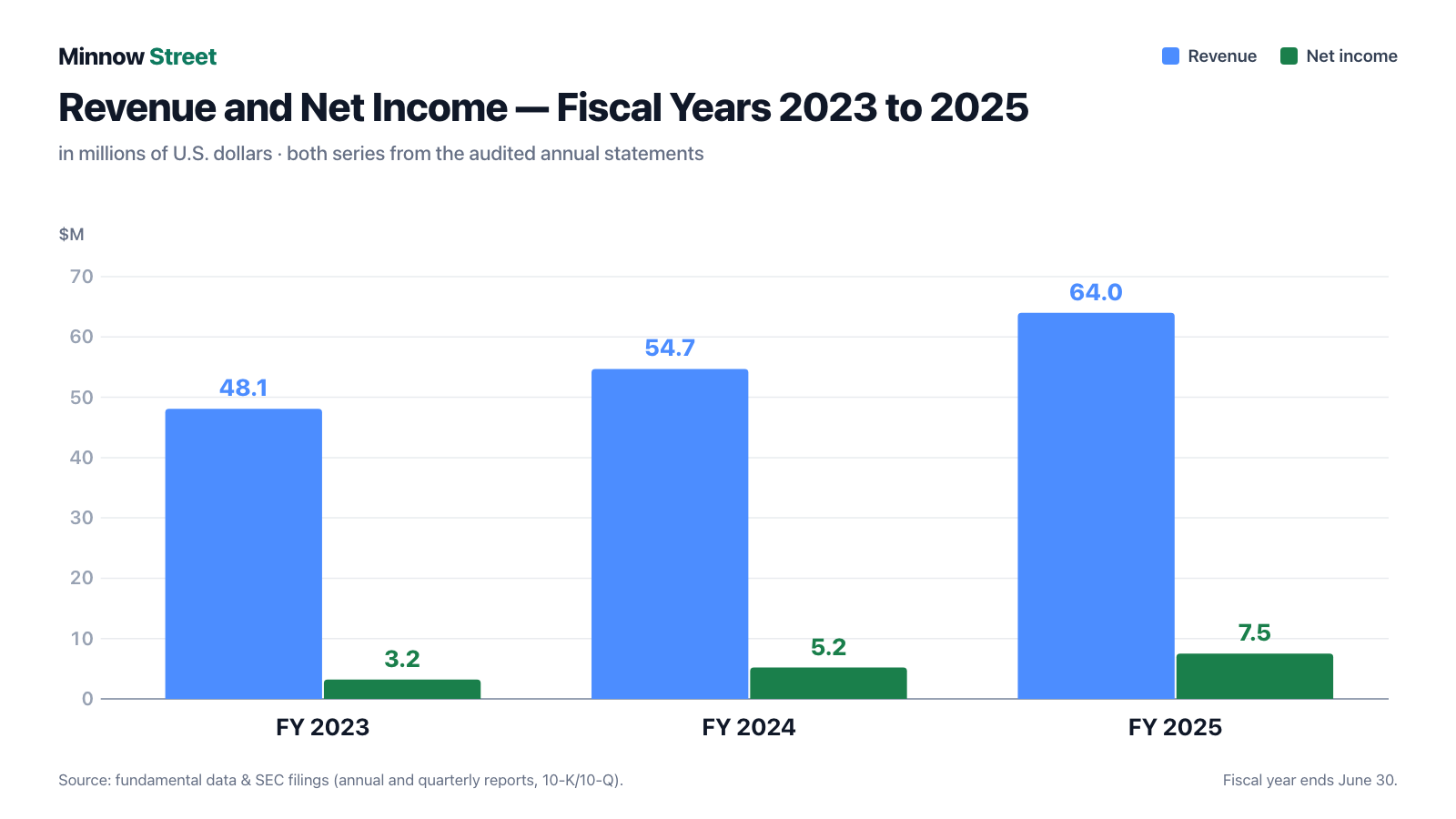
The trend did not merely continue in fiscal 2026, it accelerated. Over the nine months ended March 31, 2026, revenue rose 16.6 percent to $54.359 million and net income 48.1 percent to $7.900 million — already more in nine months than in the entire prior year. The third quarter alone (January through March 2026) contributed $18.575 million of revenue, up 18.4 percent, and $3.003 million of profit, up 58.8 percent.
The margin tells the sharper story. Gross margin — the share of revenue left after direct production costs — climbed from 76.0 percent in fiscal 2023 through 76.3 and 78.1 percent to 78.5 percent in the first nine months of fiscal 2026. For comparison, an ordinary manufacturer lands between 25 and 35 percent. That number is the financial proof that cutting out the middleman works. Operating margin — what remains after all costs — moved from 8.3 percent in fiscal 2023 through 12.0 and 15.1 percent to 18.5 percent. That is not cost cutting, it is operating leverage: the sales apparatus grows more slowly than the revenue it brings in.
And the balance sheet? It is almost boring, which is a compliment. As of March 31, 2026, total assets of $59.474 million faced total liabilities of just $10.307 million — supplier invoices, accrued compensation, warranty reserves. Not one dollar of interest-bearing debt. Cash stood at $16.985 million, shareholders' equity at $49.167 million and working capital at $40.002 million. If you were wondering why the Altman Z-Score reads 15.58, that is the answer.
What the Filings Say — Four Uncomfortable Truths
Now turn the picture around. None of what follows makes Electromed a bad company. But every one of these four lines sits in a mandatory filing, and not one of them shows up in a ratio.
Uncomfortable Truth No. 1: Almost All of the Revenue Is an Estimate
When a baker sells a loaf, the price is fixed. Not here. The quarterly report as of March 31, 2026, spells out how it really works:
"Capped installment payment arrangements represent the majority of Electromed's variable consideration. For the periods presented, amounts subject to capped installment payment arrangements represented a significant portion of net revenues, accounting for approximately 96% of net revenues in the homecare market."
— Electromed, Inc., SEC quarterly report 10-Q as of March 31, 2026, Note 2 (Revenues)
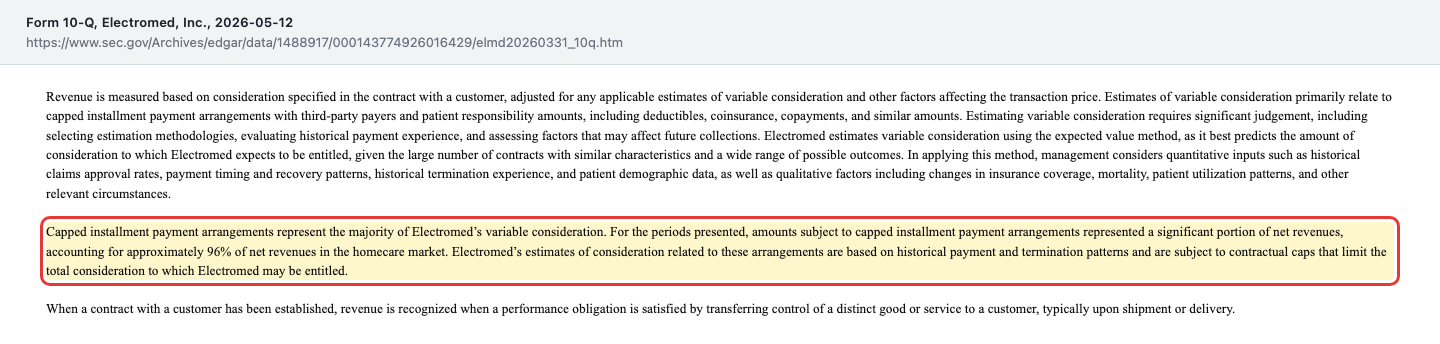
In plain terms: the insurer does not pay for the device in one go. It pays in installments over months, and only for as long as the patient keeps using the system and stays covered. If the patient dies, changes plans or stops therapy, the installments stop. Electromed does not get the device back either — the filing states explicitly that the patient is "under no obligation to return the SmartVest System." So the company books the entire expected amount at delivery, and to do that it has to estimate how much will actually arrive. The inputs are historical claims approval rates, payment and termination patterns and patient demographics.
Homecare accounted for $16.732 million of the $18.575 million of third-quarter fiscal 2026 revenue, or 90.1 percent. Apply the 96 percent to that and roughly 86 percent of total company revenue rests on an estimate. Fairness requires the counter-check, and it comes out well: the fiscal 2025 annual report notes that payment patterns have stayed consistent over five years and that revenue recognized from prior-period estimate changes was immaterial in fiscal 2025 and 2024. The estimate has worked so far. It remains an estimate — and it is the lever on which this company's earnings could turn fastest.
Uncomfortable Truth No. 2: Thirteen Months Before the Money Arrives
Here the receipt illusion turns concrete. As of March 31, 2026, receivables stood at $28.251 million, after $24.660 million at June 30, 2025, and $23.333 million at June 30, 2024. That is nearly 48 percent of total assets and more than one and a half times a quarter's revenue. The filing explains why:
"Under certain payer programs, cash collection occurs through interim payments and final settlement over a period greater than one year, generally approximating thirteen months. The Company has determined that this collection period represents its normal operating cycle."
— Electromed, Inc., SEC quarterly report 10-Q as of March 31, 2026, Note 2 (Contract balances)
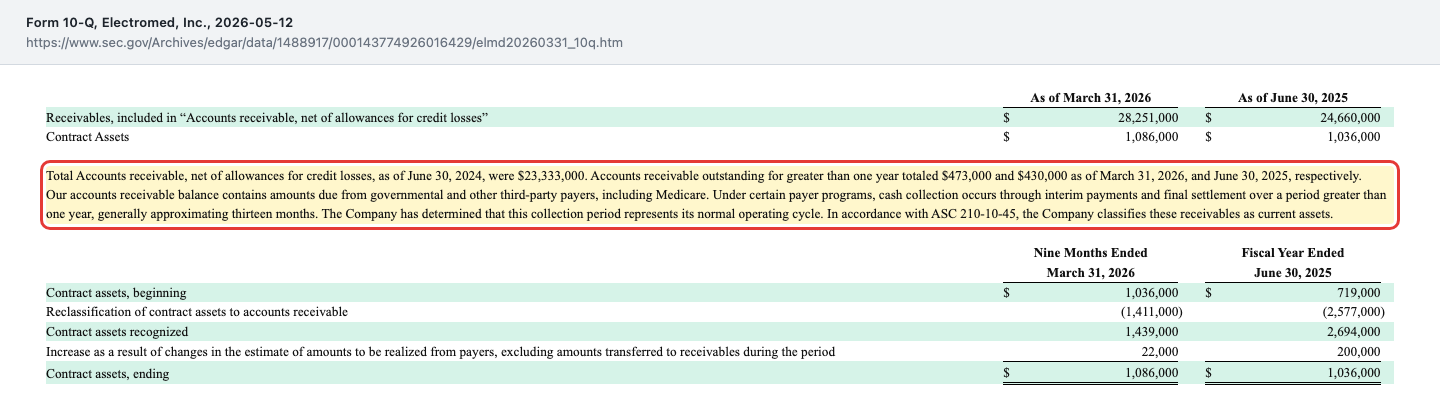
That is the crux. Because the operating cycle officially runs thirteen months, Electromed may report these receivables as current assets under ASC 210-10-45, even though part of the balance takes longer than a year to collect. This is entirely proper and entirely legal. It simply means one thing: the line "working capital of $40.0 million" sounds more liquid than it is.
Translate it into something tangible. Measured against the revenue of the preceding twelve months, receivables equal 183 days at June 30, 2023, 156 days at June 30, 2024, 141 days at June 30, 2025, and 144 days at March 31, 2026 (own calculation).
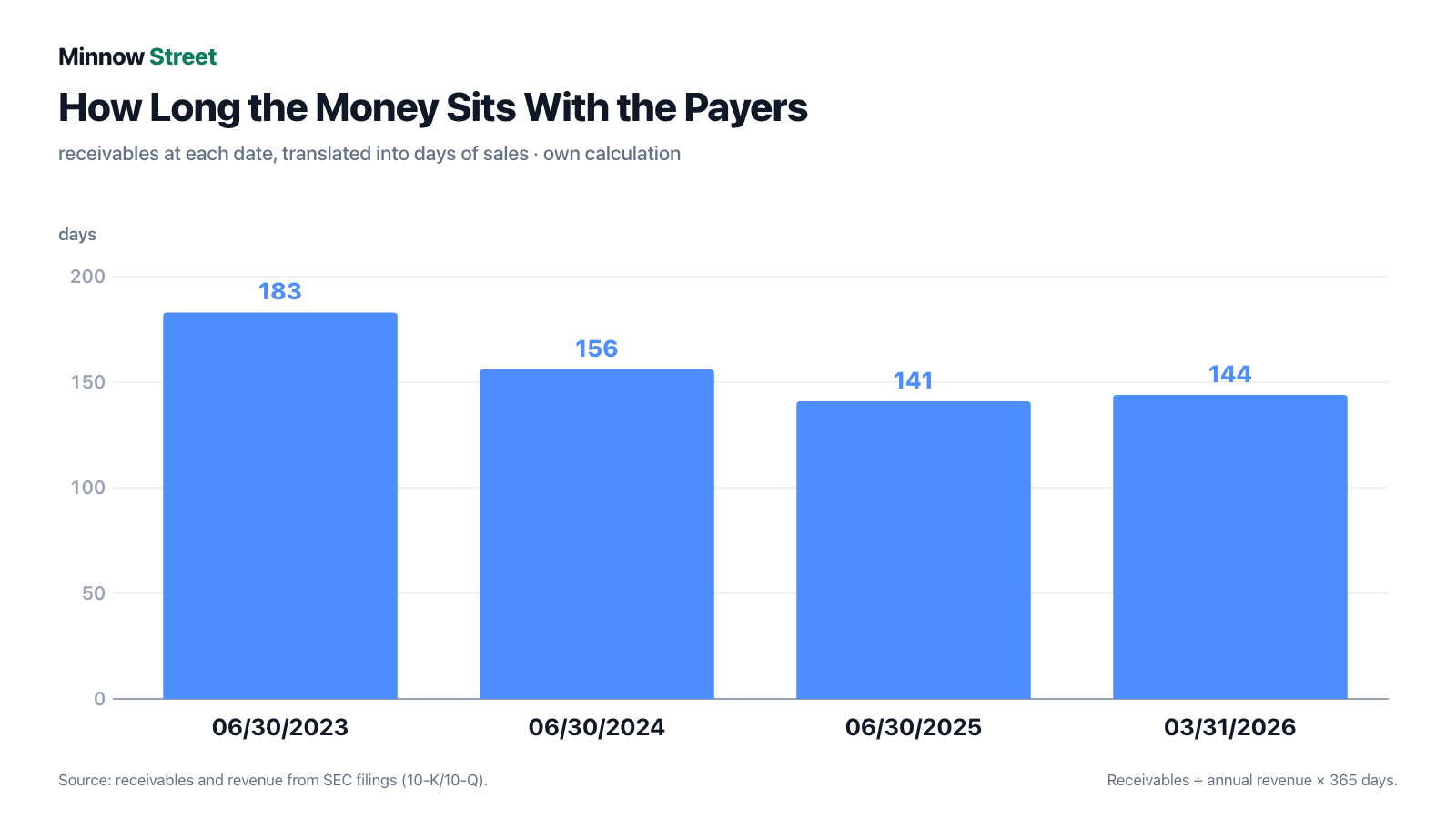
That is a real improvement and speaks well of the reimbursement department: only $473,000 of receivables were more than one year old at March 31, 2026 — 1.7 percent of the balance. The money does arrive; it simply arrives late. Even so, the effect shows up immediately in cash. Over the nine months ended March 31, 2026, Electromed earned $7.900 million but generated only $6.671 million of operating cash — in the prior-year period it was the other way round ($5.333 million of profit, $7.534 million of cash). Almost all of the gap sits in one line: receivables rose $3.591 million over the nine months. Rule of thumb: at this company, growth costs money first, because every new patient has to be financed for thirteen months.
Uncomfortable Truth No. 3: One Product, One Code, One Price
Electromed has no second leg. The quarterly report concedes it (see the quote above), and it has a very concrete consequence: all U.S. homecare revenue hangs on a single billing key. The annual report names it — HCPCS code E0483, assigned by the U.S. health agency CMS. The maximum amount Medicare reimburses under it is, per the filing, approximately $15,000 per device; state Medicaid programs pay between $8,000 and $15,000, and commercial payers take their cue from those numbers.
Which means: the price of this company's only product is not set by the company but by an agency. If reimbursement for E0483 is cut, or the medical indication narrowed, it does not hit one segment — it hits everything. For context, a hospital operator cannot set its own prices either; how deeply that dependence shapes a business model is something we took apart in our Encompass Health analysis.
The competition, meanwhile, is not a collection of minnows. According to the annual report, the same market holds Baxter International (with "The Vest," the original HFCWO technology from the former Hill-Rom business), Philips (with "inCourage," from its RespirTech acquisition) and Tactile Medical (with "AffloVest"). Two global groups and one listed specialist against a company with 180 employees. That Electromed grows against them is remarkable; that it will keep doing so is not guaranteed.
One decision buried in the fine print is worth noting too. As of June 30, 2025, Electromed held 13 U.S. and 46 foreign issued patents, plus 13 U.S. and 112 foreign trademark registrations. Since the fourth quarter of fiscal 2025 the company no longer maintains or renews patents outside the United States and Mexico. That fits the revenue split — only 0.4 percent of fiscal 2025 revenue came from outside the U.S., down from 1.0 percent the year before. But it also means: this company has deliberately written off the rest of the world. It saves money today and closes a growth door for tomorrow.
Uncomfortable Truth No. 4: Nearly Half the Money Comes From the Government — in a Year of Cuts
Who pays the bill? In the third quarter of fiscal 2026, the $16.732 million of homecare revenue broke down as follows: $8.190 million from commercial payers (49.0 percent), $6.447 million from Medicare (38.5 percent), $1.559 million from Medicare Supplemental plans (9.3 percent), $0.256 million from Medicaid (1.5 percent) and $0.280 million from other sources. Added up, 49.4 percent of homecare revenue rests on government-funded or government-derived programs, after 47.3 percent in all of fiscal 2025. Dependence on the government has not been shrinking. It has been growing.
In calm times that would be a footnote. These are not calm times. The fiscal 2025 annual report devotes several pages to U.S. legislation and turns unusually blunt: the package signed into law on July 4, 2025 (the One Big Beautiful Bill Act) pairs tax cuts with budget reductions and tighter requirements for Medicaid, Medicare and the Affordable Care Act — the estimates cited put the resulting increase in the uninsured at 11.8 million people by 2034. The same law also has a pleasant side for Electromed: accelerated deductibility of research expenditures is expected to reduce cash taxes paid in 2026 by roughly $428,000. Both effects sit in the same filing — the small one is quantified, the large one is not. How strongly reimbursement policy shapes a home-based care business also shows in our Aveanna Healthcare analysis.
Valuation — What the Market Asks for This Business
Because daily prices say nothing about the worth of a company, we work with dated anchors. As of July 24, 2026, Electromed's market capitalization was roughly $333 million. Cross-check: the cover page of the quarterly report shows 8,280,064 shares outstanding as of May 5, 2026, and an insider filing (Form 4) dated June 30, 2026, documents a price of $42.30. Multiply the two and you get $350 million — about five percent from the data-feed figure. The order of magnitude holds.
Three ratios follow, each as a range rather than a point:
- Price to sales of roughly 4.6 — against trailing twelve-month revenue of $71.752 million (as of March 31, 2026).
- Price to earnings of roughly 35 — trailing twelve-month profit was $10.1 million, or $1.17 per diluted share.
- Price to book of roughly 6.7 — against shareholders' equity of $49.167 million as of March 31, 2026.
The honest reading: this is no bargain. A price to earnings multiple of 35 assumes that profit keeps growing at something like the 48 percent nine-month pace, or at least does not stop abruptly. On the other side you are buying a business with a 78 percent gross margin, a 21.7 percent return on equity and no debt at all. And one more point for anyone comparing valuation measures: because $16.985 million sits in cash with nothing owed against it, enterprise value (market capitalization less net cash) is roughly $316 million, slightly below market capitalization — a detail at this company, the whole story at a levered one.
The professional view helps only so much here. As of July 24, 2026, the average price target stood at $40.33, roughly 0.7 percent above the prevailing valuation level — effectively at the price. At a company with $333 million of market value and a float of only 6.8 million shares, targets like that tend to follow the price rather than anticipate it. And the price had run: as of July 24, 2026, the stock stood 0.4 percent below its all-time high and 84 percent higher than twelve months earlier.
What the Insiders Did — and What the Company Did Not
Three documented insider sales fall squarely into that advance. On May 15, 2026, Kathleen Skarvan exercised 40,000 options at $3.82 and sold the same number of shares at prices between $34.36 and $37.33. On June 4, 2026, Chief Financial Officer Bradley M. Nagel did the same on a smaller scale: 9,601 options exercised at $10.25 and $10.71, 11,801 shares sold at $36.34 and $37.11. On June 8, 2026, President and CEO James L. Cunniff followed with 9,700 options at $17.25 and the sale of 9,700 shares between $36.25 and $37.77. Sales immediately after an option exercise are routine and not an alarm signal; they are, however, dated evidence of the price people with full inside knowledge found acceptable.
More interesting is what the company had already stopped doing in the months before that. On September 9, 2025, the board approved a share repurchase authorization of up to $10,000,000, explicitly without an expiration date. Through March 31, 2026, 151,911 shares had been repurchased and retired for $3,918,000, an average of $25.79 per share.
"As of March 31, 2026, a total of 151,911 shares have been repurchased and retired under this authorization for a total cost of $3,918,000, or an average of $25.79 per share."
— Electromed, Inc., SEC quarterly report 10-Q as of March 31, 2026, Note 7 (Common Stock)

The monthly table in the same filing is more revealing still. In January 2026 the company bought 5,470 shares at $27.72. In February 2026 and March 2026 it bought nothing. That left $6,082,000 of the authorization undrawn. The table goes no further: the quarterly report ends on March 31, 2026, and whether buying resumed in the spring will only show up in the annual report. No prophecy is required — but the observation is cleanly documented: the same company that bought its own stock in size between $20 and $26 stopped once the price moved up — weeks before its executives sold between $34 and $38 in May and June 2026. In fiscal 2025 it had spent $10.025 million on repurchases, more than its entire annual profit.
On dilution — the effect that shrinks your slice when new slices get cut — Electromed compares well. As of March 31, 2026, there were 632,151 options outstanding (weighted-average exercise price $10.95), 65,374 unvested restricted shares and 94,891 restricted stock units. Together that is 792,416 potential shares, or roughly 9.6 percent of the 8,279,845 outstanding — meaningful, but far from the levels common at loss-making micro-caps. And on balance the share count fell: from 8,637,883 at June 30, 2024, to 8,279,845 at March 31, 2026.
Opportunities and Risks at a Glance
What speaks for Electromed:
- A very clean earnings record: revenue from $48.067 million in fiscal 2023 to $54.716 million and $64.000 million in fiscal 2025, net income from $3.166 million to $7.537 million; the nine months ended March 31, 2026, added another 16.6 percent of revenue growth and 48.1 percent of profit growth.
- Exceptional and still-rising margins: gross margin from 76.0 to 78.5 percent, operating margin from 8.3 to 18.5 percent — the payoff of a direct model that captures manufacturer and distributor margin in one hand.
- A balance sheet with no financial debt whatsoever: $59.474 million of total assets, $10.307 million of total liabilities, $16.985 million of cash and $49.167 million of equity as of March 31, 2026. Altman Z-Score of 15.58, Piotroski 7 out of 9 (data as of July 24, 2026).
- An underpenetrated market: per the third-party research cited in the annual report, the U.S. homecare HFCWO market was roughly $245 million in calendar 2024 and grows at about 8 percent a year; the diagnosed bronchiectasis population of roughly 923,000 grows at about 12 percent annually, and only about 16 percent of those patients receive HFCWO.
- Growth funded from its own cash: no equity raise, and instead $10.025 million of buybacks in fiscal 2025 plus $3.918 million through March 31, 2026 — the share count fell from 8,637,883 to 8,279,845.
- The receivable burden has improved: from 183 days of sales at June 30, 2023, to 144 days at March 31, 2026, with only $473,000 of receivables older than one year.
What speaks against it:
- One active product and one segment, by the company's own account. There is no second business to absorb a setback.
- Approximately 96 percent of homecare revenue comes from capped installment arrangements whose amount is estimated; homecare itself was 90.1 percent of third-quarter fiscal 2026 revenue.
- An operating cycle of roughly thirteen months permanently ties up capital: $28.251 million of receivables as of March 31, 2026, nearly half of total assets. That is why nine-month operating cash of $6.671 million trailed net income of $7.900 million.
- The price of the only product is effectively set by a health agency: reimbursement runs through code E0483, with a Medicare allowable of roughly $15,000. Government programs accounted for 49.4 percent of third-quarter fiscal 2026 homecare revenue — more than a year earlier.
- Political risk with a date attached: the law enacted July 4, 2025, cuts Medicaid and Medicare spending; the annual report itself cites an expected increase of 11.8 million uninsured by 2034 and warns the impact could be "material and adverse."
- Competitors with very deep pockets: Baxter, Philips and Tactile Medical work the same market; Electromed has 180 employees and spent just $996,000 on research and development in fiscal 2025 — 1.6 percent of revenue.
- A valuation without a cushion: roughly 33 times earnings and 4.6 times revenue (data as of July 24, 2026) for a stock sitting 0.4 percent below its all-time high. The company's own buyback went quiet in February and March 2026 while executives sold between $34 and $38 in May and June 2026.
- The $10 million credit line matures on December 16, 2026, unless renewed — and essentially all company assets are pledged as first-priority security for it.
A Human Conclusion
Back to the receipt illusion. Its problem is not that it leads you to bad companies — Electromed is a good company. It grows, it earns, it owes nothing, and it helps people who would otherwise breathe worse. The problem is that the illusion skips the one question that matters most in exactly this business model: when does the money actually arrive?
The answer sits in black and white in the quarterly report: after roughly thirteen months, in installments, in an estimated amount, mostly from payers whose budgets are currently being negotiated in Washington. That is not a scandal. It is the price of a 78 percent gross margin — cut out the middleman and you inherit his work, and in medical devices that work consists of forms and waiting. But it does mean two figures say less than they appear to: working capital of $40.0 million, which only becomes liquid over thirteen months, and revenue itself, much of which is a well-founded forecast.
So the honest question is not "is 33 times earnings too expensive?" It is: do you trust a company with one product, one reimbursement code and a thirteen-month collection cycle to sustain its pace in a year when Washington is cutting exactly its largest payers? If yes, you have a thesis, and the filings give you clear checkpoints: receivables in days of sales, the share of government payers, and whether operating cash flow climbs back above net income. If no, what you had was a very pretty table of ratios. What you make of it is your decision. And that is exactly as it should be.
Sources
Every original document used in this analysis, for you to read yourself:
- Electromed, Inc. — SEC quarterly report 10-Q as of March 31, 2026 (filed May 12, 2026)
- Electromed, Inc. — SEC annual report 10-K for the fiscal year ended June 30, 2025 (filed August 26, 2025)
- Electromed, Inc. — SEC annual report 10-K for the fiscal year ended June 30, 2024 (filed August 27, 2024), source of the fiscal 2023 comparatives
- Current report 8-K dated May 12, 2026 (quarterly results and updated investor presentation), insider filings (Form 4) dated May 19, June 8, June 9 and July 2, 2026, and notices of proposed sale (Form 144) dated May 15, June 4 and June 8, 2026: EDGAR filing index for CIK 0001488917 (sec.gov)
- Fundamental data (metrics, valuation, scores; data as of July 24, 2026), reconciled against the SEC filings.
- Screen memberships: our in-house stock scanner, as of July 26, 2026; the lists are recalculated daily.
Transparency & disclaimer: this analysis is journalistic commentary on publicly available information. It is not investment advice, not a regulated financial analysis and not a solicitation to buy or sell securities. Equity investments carry substantial risk up to total loss. All figures without warranty; the as-of date of each data point is stated in the text. The author holds no position in Electromed shares at the time of publication.
Our Bottom Line at a Glance
- Business and growth positive
- Revenue rose from $48.067 million in fiscal 2023 to $54.716 million in fiscal 2024 and $64.000 million in fiscal 2025, then added another 16.6 percent to $54.359 million over the nine months ended March 31, 2026. The driver is not acquisitions but more sales representatives and higher net revenue per approval — of the $2.630 million of additional third-quarter homecare revenue, $1.959 million came from higher volume.
- Balance sheet positive
- As of March 31, 2026, total assets of $59.474 million faced only $10.307 million of liabilities, none of it interest-bearing. Cash stood at $16.985 million and shareholders' equity at $49.167 million. An Altman Z-Score of 15.58 and a Piotroski score of 7 out of 9 (data as of July 24, 2026) confirm the picture. The $10 million credit line was undrawn.
- Earnings quality and cash conversion neutral
- Margins have improved for years — gross margin from 76.0 to 78.5 percent, operating margin from 8.3 to 18.5 percent. Cash has not kept pace: over the nine months ended March 31, 2026, $7.900 million of net income produced only $6.671 million of operating cash, because receivables rose $3.591 million. In the prior-year period the relationship ran the other way ($5.333 million against $7.534 million).
- Dependence on one product and one reimbursement code negative
- The quarterly report as of March 31, 2026, states that Electromed has one active product and one business segment. In the U.S. home market the price of that product is effectively set through billing code E0483; the Medicare allowable was approximately $15,000 per device per the annual report. In the third quarter of fiscal 2026, 49.4 percent of homecare revenue rested on government programs, up from 47.3 percent in fiscal 2025.
- Revenue built on estimates negative
- Approximately 96 percent of homecare revenue comes from capped installment arrangements whose final amount is estimated — with homecare at 90.1 percent of revenue, that is roughly 86 percent of company revenue. The fiscal 2025 annual report notes that payment patterns held steady over five years and that prior-period estimate revisions were immaterial. That reduces the risk. It does not remove it.
- Valuation neutral
- As of July 24, 2026, market capitalization of roughly $333 million equaled about 4.6 times trailing twelve-month revenue and roughly 33 times earnings, with the stock 0.4 percent below its all-time high. Worth noting alongside it: the company's own buying history. Repurchases ran through January 2026 at an average of $25.79 and then stopped — $6.082 million of the authorization stayed undrawn.
Electromed has one of the cleanest small balance sheets on a U.S. exchange: no financial debt, a 78.5 percent gross margin, three years of rising profit, $16.985 million of cash and a product that demonstrably helps patients. The price of that model sits in the same balance sheet: $28.251 million of receivables, a normal operating cycle of roughly thirteen months and approximately 96 percent of homecare revenue from capped installment arrangements whose amount is estimated. Add one product, one reimbursement code and 49.4 percent of homecare revenue from government programs in a year when those programs are being cut. Buy this and you are buying quality with a very long wire between revenue and cash. Not investment advice.
What Our Rating Means
Open questions
The business works in principle, but one material question is open. As long as it stays open, our findings do not carry a quality verdict.
First, so there is no misunderstanding: this rating has nothing to do with the share price. The stock has run hard and at roughly 33 times earnings it is not cheap, but price is not a quality attribute. A great deal argues for the company itself — no financial debt, a 78.5 percent gross margin, three years of rising profit, an Altman Z-Score of 15.58 and a receivable burden that has improved from 183 to 144 days of sales. What stays open is a core operating question, and it comes straight from the filings: Electromed says it has one active product, whose home market price is set through a single reimbursement code, and approximately 96 percent of homecare revenue rests on capped installment arrangements whose amount is estimated. On top of that, 49.4 percent of third-quarter fiscal 2026 homecare revenue came from government programs — in a year in which the annual report itself warns about cuts. This is not an existential question; the balance sheet carries it easily. But it is more than housekeeping, and in doubt the more cautious grade applies. Hence yellow: documented quality, one open concentration. The decision is yours.
A journalistic assessment by our editorial team at the time of the deep dive, based on public sources — not investment advice and not a solicitation to buy or sell. Your personal circumstances (investment goals, risk capacity, taxes) cannot be taken into account. What our levels mean, how verdicts are formed, and what conflicts of interest exist →
Worth Noting
- Electromed reached our research list through our in-house stock scanner: on July 26, 2026, the stock appeared in the U.S. selection of the "Fundamental Rank (A / A+)" screen (38 U.S. hits, 25 of them listed on the page) and on twelve screens in total, including "Quality Growth", "Professionals 80%", "Stan Weinstein: Stage 2", "Power Trend" and "Near 52-Week High". These lists are recalculated daily.
- Timing note: Electromed's fiscal year ends June 30. "Fiscal 2025" means July 1, 2024, through June 30, 2025; the most recent interim report evaluated here is the third quarter of fiscal 2026, as of March 31, 2026, filed May 12, 2026. All filings through July 2, 2026, were reviewed; after the quarterly report there were only insider filings (Form 4), notices of proposed sale (Form 144) and the annual conflict minerals disclosure (Form SD dated May 29, 2026).
- Valuation anchors are dated and evergreen: the $42.30 reference is not a daily quote but the price documented in an insider filing (Form 4) dated June 30, 2026. For comparison, the CFO sold between $36.34 and $37.11 on June 4, 2026, and the CEO between $36.25 and $37.77 on June 8, 2026. The company itself last repurchased shares in January 2026 at $27.72. This analysis is evergreen; daily prices are not an investment case.
Frequently Asked Questions
Electromed, Inc. (NYSE American: ELMD), based in New Prague, Minnesota, builds and sells the SmartVest System: an inflatable garment driven by an air pulse generator that oscillates the chest wall at high frequency and loosens trapped mucus from the airways. It is used for bronchiectasis, cystic fibrosis and neuromuscular conditions. Per the quarterly report it is the company's only active product; fiscal 2025 revenue was $64.0 million.
It is a legacy choice and not unusual in the United States. What matters for investors: "fiscal 2025" at Electromed covers July 1, 2024, through June 30, 2025. The quarterly report as of March 31, 2026, is therefore the third quarter of fiscal 2026, not the first quarter of a calendar year. The annual report lands each year in late summer.
Because insurers pay in installments. The quarterly report as of March 31, 2026, describes a normal operating cycle of roughly thirteen months: interim payments and a final settlement stretch beyond one year. That is why $28.251 million of receivables sat on the balance sheet at the reporting date — nearly half of total assets, and about 144 days of sales.
HFCWO stands for high frequency chest wall oscillation. A garment compresses the chest several times per second and releases. That shears thick mucus off the bronchial walls and moves it upward, where it can be coughed out. The advantage over traditional chest physiotherapy: the patient can run the therapy alone at home, without a therapist present.
Substantially. In the third quarter of fiscal 2026, $6.447 million of homecare revenue came from Medicare, $1.559 million from Medicare Supplemental plans and $0.256 million from Medicaid — 49.4 percent combined, up from 47.3 percent in fiscal 2025. Commercial insurers add to that indirectly, because they take their cue from Medicare rules for billing code E0483.
None that bears interest. As of March 31, 2026, total assets of $59.474 million faced only $10.307 million of liabilities, and none of it is financial debt. There is a $10 million revolving line of credit with BMO Bank N.A. signed December 16, 2025, which was undrawn at the reporting date. It matures on December 16, 2026, unless renewed beforehand.
No. The company retains earnings and returns cash through buybacks instead: $10.025 million in fiscal 2025 and a further $3.918 million through March 31, 2026. The new credit agreement explicitly does not restrict dividends or repurchases as long as no default exists — but no dividend has been announced.
The annual report names three: Baxter International with "The Vest" (the original HFCWO technology from the former Hill-Rom business), Philips with "inCourage" from its RespirTech acquisition, and Tactile Medical with "AffloVest." With roughly 180 employees, Electromed is the smallest of the group — and it is still taking share.
Found an error?
Did you spot a factual error, an outdated number, or a typo in this deep dive? Let us know briefly — your report goes straight to the editorial team.