Encompass Health: Whoever Pays 82 Percent of the Bills Also Sets the Price
Our in-house stock scanner lists Encompass Health on the U.S. side of its Piotroski screen: 8 of 9 points on the balance-sheet test, an Altman Z of 5.75, a 25.2 percent return on equity, and 2025 revenue up to $5,935.2 million. The stock still lost roughly 14 percent over twelve months. The reason is not in the balance sheet but in the annual report: Medicare and Medicare Advantage supply about 82 percent of revenue — and in January 2026 the advisory commission to Congress recommended cutting the base payment rate for rehabilitation hospitals by 7 percent. Not investment advice — just a sober look at who actually sets this company's prices, and it is not the company.
 Thomas Mücke
Founder & Publisher
Thomas Mücke
Founder & Publisher
Chart
Interactive price chart (TradingView).
Note: pure fact-based analysis, not investment advice and not a solicitation to buy or sell. All figures without guarantee.
There is an investor trap that feels exactly like common sense: the demographics reflex. You read that the population aged 75 and over in the United States is expected to grow by about four percent a year through 2030, that the average age of a Medicare patient is roughly 77 — and something clicks: "demand simply cannot go away." The reflex is seductive because it is correct. Demand really is not going away. It just does not answer the question that decides this stock. Because at Encompass Health Corporation (NYSE: EHC), what a rehabilitation stay costs is not negotiated with a customer. It is set by an agency. So let us make a deal: we park the demographics for a moment and read together what the company itself filed with the U.S. securities regulator, the SEC — the annual report (10-K) for 2025, filed February 26, 2026, and the quarterly report (10-Q) as of March 31, 2026, filed May 1, 2026. An SEC filing is honest under penalty of law. And this one describes an unusually well-run business, 82 percent of revenue from a single source, a quarter of profit that belongs to someone else — and half a line in which the advisory commission to Congress asks for seven percent less. What you make of it is up to you.
What Encompass Health actually does — the ward after the hospital
Picture someone in your family having a stroke. The acute-care hospital saves the life, stabilizes the patient, prevents the worst — and then discharges. Except that walking, speaking, swallowing, getting dressed unaided: none of that has been restored. That is precisely where Encompass Health's business begins. The company operates inpatient rehabilitation hospitals, where people recover after serious illness and injury — strokes, hip fractures, brain injuries, spinal cord injuries, degenerative neurological conditions. In plain terms: Encompass Health is not the emergency room. It is the workshop that comes after.
The scale is considerable. As of March 31, 2026, the company ran 174 rehabilitation hospitals across 39 states and Puerto Rico, concentrated in Florida and Texas. At the end of 2025 it operated 173 hospitals with 11,465 licensed beds, discharging 263,299 patients over the course of the year — up from 248,498 in 2024 and 229,480 in 2023. Headcount exceeded 42,000: 24,611 full-time, 3,322 part-time and 14,367 pool or per-diem employees. The company describes itself as the nation's largest owner and operator of inpatient rehabilitation hospitals by patients treated, revenues and number of hospitals.
Two features of the model are unusual and matter. First, where patients come from: 92 percent are admitted from acute-care hospitals on a physician referral. Encompass therefore does not market to customers; it markets to referrers. Second, who owns the hospitals: of those 174, the company owns only 108 outright. In the remaining 66 it holds between 50.0 and 97.5 percent, with the local acute-care hospital owning the rest and co-operating the facility. That secures the patient flow and splits the profit. Remember this structure; we will come back to it when the question becomes who the earnings actually belong to.

That frames the central tension of this analysis, and it runs through every chapter: the Encompass Health balance sheet is healthy by any conventional measure — but the price of the service it sells is not decided in that balance sheet. It is decided in Washington.
Why the SEC file carries two names
Open the EDGAR file under number CIK 785161 and something odd shows up: the older documents sit under a different name. Until December 12, 2017, the company appeared in the regulator's registers as HealthSouth Corporation. The annual report says so itself, with a remarkably practical instruction to the reader:
"Effective as of January 1, 2018, we changed our name to Encompass Health Corporation. By operation of law, any reference to “HealthSouth” in these exhibits should be read as “Encompass Health” as set forth in the Exhibit List below."
— Encompass Health Corporation, SEC annual report 10-K for 2025, Exhibit List

Two practical consequences for you. First: if you go looking for this company in archives, old sell-side research or court records, you need both names. Same file number, same legal person, the same corporation formed in Delaware in 1984. Second: the shape of the business changed too. The home health and hospice operation was spun off on July 1, 2022, and appears in the income statement only as a discontinued operation. What trades today as Encompass Health is a pure inpatient rehabilitation operator — and no series in this analysis blends the two perimeters.
How the stock landed on our desk
The trigger was not a breakout but a balance-sheet filter. Our in-house stock scanner runs a screen called Piotroski F-Score (7–9). A company qualifies only with at least seven of nine points on the Piotroski F-Score, the nine-point test devised by accounting professor Joseph Piotroski to check whether a company's books are healthy: is it profitable? Does real cash come in, or only book earnings? Is leverage falling? Are margins and asset turnover improving? Is the company issuing new shares? Encompass Health scores 8 of 9 (data as of July 24, 2026). To put that in context: six of nine is okay, not good. Seven is solid. Eight is about as high as profitable growth companies get in practice — the ninth point usually fails simply because such firms take on debt or issue stock for employee plans.
To replicate it: open the stock scanner, pick the "Piotroski F-Score (7–9)" screen and filter to the U.S. market. Encompass Health appears in the U.S. selection (as of July 26, 2026, with 16 U.S. hits; the list is recalculated daily). More interesting than the ranking is the confluence: on the same day EHC showed up on six screens in total. Alongside the Piotroski filter those were EPS Acceleration (earnings per share growing faster than before), P/CF Ranking (price to cash flow in the cheap band), Pros 80% (institutions hold the bulk of the shares), Power Trend and Pocket Pivot (both price-behavior patterns).
And now the contradiction that makes this analysis worth writing. The same fundamental data set gives Encompass Health a relative strength score of 26 out of 99 — meaning the stock trailed roughly three quarters of the market over twelve months and sat about 14 percent below where it stood a year earlier, roughly 22 percent below its 52-week high (data as of July 24, 2026). A company with 8 of 9 balance-sheet points, a 25.2 percent return on equity and an Altman Z score of 5.75 — a bankruptcy early-warning measure where anything above 3.0 counts as safe — is being treated by the market like a problem case. To understand that gap you have to stop reading the balance sheet and start reading who pays the bills.
The numbers over the years — honestly appraised
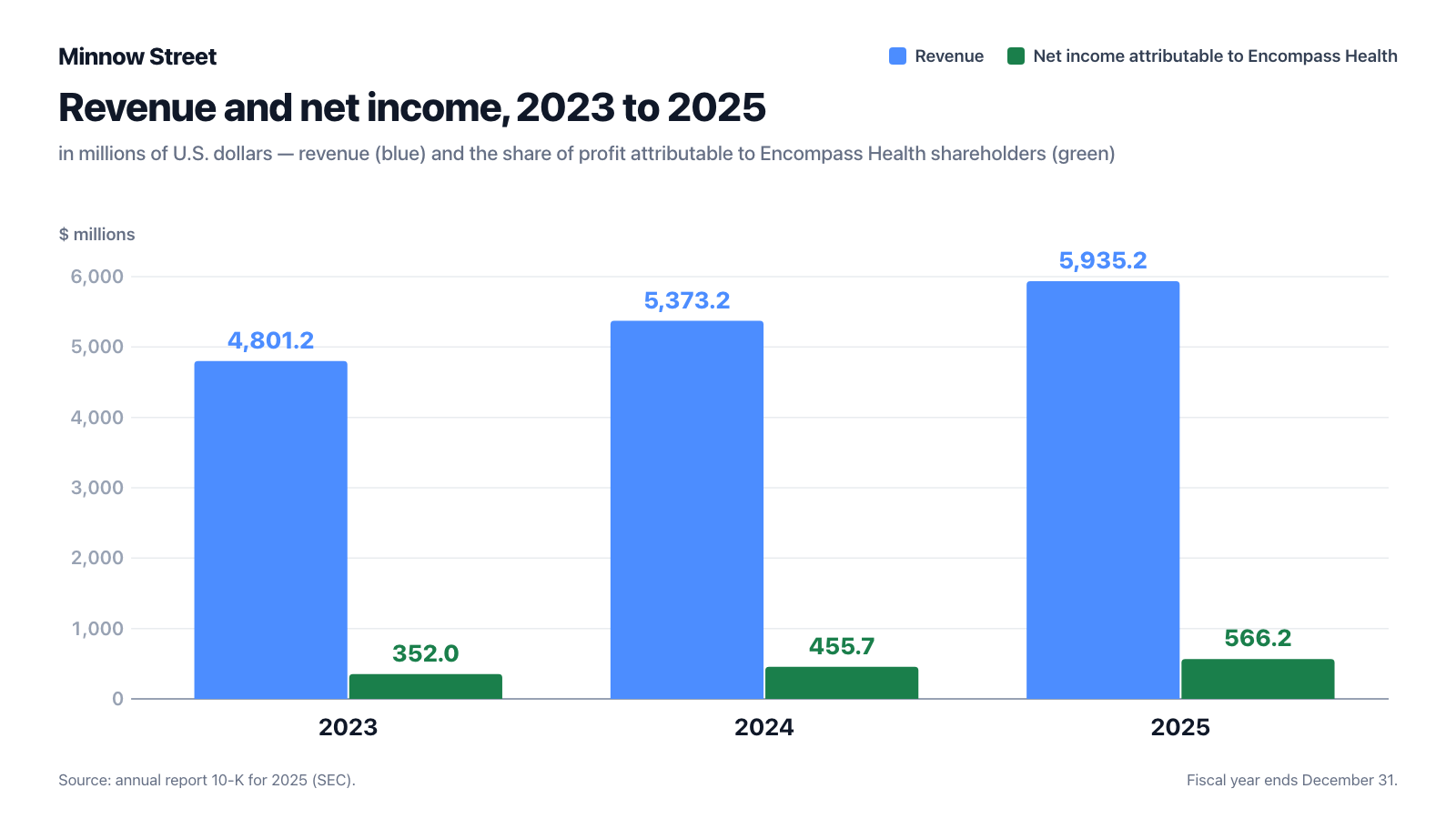
First, what genuinely impresses. With Encompass Health that is the consistency. Revenue rose from $4,801.2 million in 2023 to $5,373.2 million in 2024 and $5,935.2 million in 2025 — two consecutive years of roughly twelve and ten percent growth, with no outliers and no acquisition fireworks. Net income attributable to shareholders grew over the same period from $352.0 million to $455.7 million and then $566.2 million, and diluted earnings per share from $3.47 to $4.46 and then $5.54. If you are looking for growth that does not cost you sleep, this is a textbook case.
The growth comes from two verifiable sources. One is more beds: since 2012 the company says it has opened or acquired 78 hospitals and increased its licensed bed count by roughly 72 percent, or 4,809 beds. The other is higher payment per case. In the first quarter of 2026 revenue rose 9.0 percent to $1,586.6 million; the filing attributes that to higher volumes — same-store discharges were up 1.6 percent — and to higher reimbursement rates. Adjusted EBITDA climbed to $348.8 million from $313.6 million a year earlier.
The staffing side deserves attention too, because it is the bottleneck in this industry. Turnover in 2025 ran at 7.8 percent for therapists and 20.2 percent for nurses — both essentially unchanged from 2024, and the quarterly report names lower contract labor costs as one reason salaries and benefits fell as a share of revenue in the first quarter of 2026. What the opposite case costs, when hospitals have to fall back on expensive temporary staffing, we described from the other side of the table in our AMN Healthcare analysis.
And the balance sheet? As of March 31, 2026, total assets of $7,313.2 million carried $2,573.8 million of debt against $3,308.4 million of equity. The credit agreement requires a leverage ratio no higher than 4.50x and interest coverage of at least 3.0x — both were met, and the filing explicitly calculates that the covenants would still hold even if the billion-dollar revolving facility had been fully drawn for the entire quarter. Roughly 79 percent of the hospital real estate was owned outright as of December 31, 2025. This is not a company on the edge; it is a company with a cushion.
What the filings say — the uncomfortable truths
Now we turn the page. Nothing that follows is hidden or improper — it is all in the mandatory filings. It just is not on the cover.
Uncomfortable truth no. 1: one payer supplies 82 percent
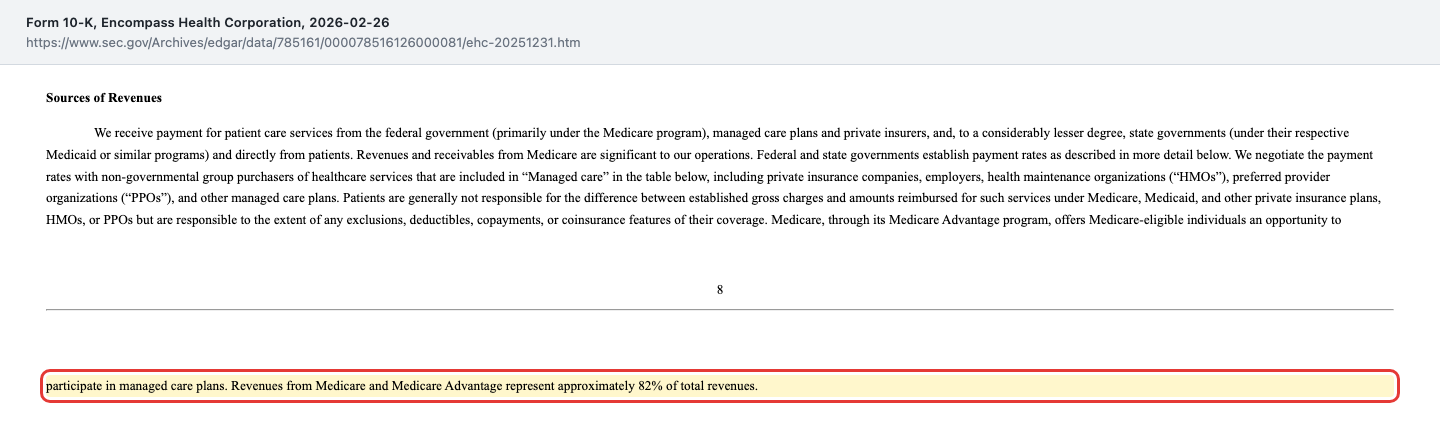
Encompass Health does not have customer concentration. It has payer concentration. The 2025 payor mix reads as follows: Medicare 65.4 percent, Medicare Advantage 16.4 percent, managed care 10.7 percent, Medicaid 3.1 percent, and the rest is rounding. In dollars: of $5,935.2 million in revenue, $3,886.9 million came directly from Medicare and another $974.4 million from Medicare Advantage plans. The annual report puts it in a single sentence:
"Revenues from Medicare and Medicare Advantage represent approximately 82% of total revenues."
— Encompass Health Corporation, SEC annual report 10-K for 2025, Item 1 "Sources of Revenues"
An everyday image for it: picture a contractor who does excellent work, controls his costs and grows every year — but four of every five invoices go to the same client, and that client sets the hourly rate unilaterally. That is the situation. Encompass does not negotiate its most important prices; it is told what they are. To be fair, the system does reward efficiency: under the prospective payment system the company keeps the difference between the fixed payment and its own costs. But the size of that payment is out of its hands.
A second trend runs in the background. The share of Medicare beneficiaries choosing a privately administered Medicare Advantage plan over traditional Medicare was around 54 percent in 2025 and, on the Congressional Budget Office's projection cited in the filing, will rise to about 64 percent by 2034. The report notes plainly that Medicare Advantage plans typically reimburse less than traditional Medicare for the same care and patient — even though that gap has been narrowing. How Medicare Advantage plays out on the provider side is something we unpacked in detail in our Astrana Health analysis.
Uncomfortable truth no. 2: the advisory commission wants 7 percent less
Here it gets concrete. Payment rates are adjusted annually through a kind of official cost basket (the market basket update) intended to track hospitals' rising costs. The rule published on August 1, 2025, for federal fiscal year 2026 delivered a net increase of 2.6 percent — a 3.3 percent market basket update reduced by a 0.7 percentage point productivity adjustment — applying to discharges between October 1, 2025, and September 30, 2026. Encompass expects roughly 2.9 percent on its own rates after running its own analysis.
The next step is already quantified — and it sits in the quarterly report, not the annual one. On April 2, 2026, CMS released its proposed rule for federal fiscal year 2027. It would deliver a net 2.4 percent — a 3.2 percent market basket update reduced by a 0.8 percentage point productivity adjustment — for discharges between October 1, 2026, and September 30, 2027:
"The 2027 Proposed IRF Rule would implement a net 2.4% market basket increase (market basket update of 3.2% reduced by a productivity adjustment of 0.8%) effective for discharges between October 1, 2026 and September 30, 2027."
— Encompass Health Corporation, SEC quarterly report 10-Q for the period ended March 31, 2026, "Executive Overview — Key Challenges"
The proposal also moves the hospital-by-hospital base rate through the wage index, outlier payments, case-mix group weights and average lengths of stay. Encompass ran that through its own book — using patient acuity over the twelve months ended February 28, 2026 — and likewise expects roughly 2.4 percent more from October 1, 2026. Two caveats belong with it: a proposed rule is not a final rule, and the final version, usually published in late summer, can still shift the components. And the increase is smaller than the year before — 2.4 instead of 2.6 percent. So far, the good news.
The other news sits three paragraphs later. MedPAC, the independent commission advising Congress on Medicare, resolved at its January 2026 meeting to recommend a statutory cut — and not a cosmetic one:
"For example, at its January 2026 meeting, MedPAC approved recommending to Congress, among other things, legislative changes to reduce by 7% the base payment rate under IRF-PPS."
— Encompass Health Corporation, SEC annual report 10-K for 2025, Item 1A "Reimbursement Risks"

Let us size that on an annual basis, not by scaling a single quarter. Roughly 82 percent of $5,935.2 million in revenue is about $4,861 million. Seven percent of that would be roughly $340 million a year. Profit attributable to shareholders in 2025 was $566.2 million. A cut of that size, if it passed through without offsetting action, would therefore cost well over half of annual earnings.
Before anyone panics, three pieces of context belong here. First: MedPAC recommends, Congress decides — and the same paragraph in the annual report records that MedPAC has recommended either a freeze or a cut in every single year since 2008. It has not happened; actual rates have risen. Second: a separate automatic 2 percent reduction of all Medicare payments, known as sequestration, has applied since April 2013 and under current law runs into federal fiscal year 2033 — it is already inside these numbers. Third: there is another lever that works on approval rather than on price. Under the review choice demonstration, selected hospitals must have every Medicare claim reviewed in advance. In Alabama, every participating hospital cleared the 80 percent threshold in the first cycle, which ended in February 2024; in the second and third cycles, ending in October 2024 and June 2025, none of them reached the opt-out rate, by then raised to 85 and 90 percent. The more recent quarterly report, for the period ended March 31, 2026, puts it more cautiously: the affirmation rate has varied across the four completed cycles, the company has voluntarily kept the pre-claim option for every participating hospital — including those that met or exceeded the opt-out rate — and has appealed many of the denials. With the program expanding to Texas on March 2, 2026, and California on May 1, 2026, the company expects 33 hospitals, or roughly 11.9 percent of its Medicare claims, to be covered. The filing says outright that it cannot predict the effect.
Remember the pattern: at this company, the biggest risk is not a balance-sheet risk. It is a calendar risk in the Federal Register.
Uncomfortable truth no. 3: a quarter of the profit is not yours
Remember the 66 jointly owned hospitals? This is where the structure gets expensive. The company consolidates those hospitals in full — all of their revenue sits inside the $5,935.2 million. The profit, however, belongs proportionally to the partners. And that share is growing faster than earnings: of the $759.1 million of consolidated net income in 2025, $192.9 million was attributable to noncontrolling interests — up from $140.9 million in 2024 and $111.0 million in 2023. That is a 74 percent increase in two years, while total profit rose 64 percent. What was left for shareholders was $566.2 million, roughly three quarters.
This is not an accounting nicety but real money: cash distributions to those partners came to $152.1 million in 2025 (2024: $125.0 million; 2023: $114.7 million). And of the $3,308.4 million of equity as of March 31, 2026, $786.7 million belongs to the minority partners. So any ratio that sets consolidated revenue or consolidated equity against the market value of Encompass shares is measuring a slice that is not yours. In plain terms: you are buying into a restaurant where a co-owner takes a cut at every third table.
Uncomfortable truth no. 4: the strong start to 2026 contains two one-offs
The first quarter of 2026 looks superb at first glance: $194.5 million of profit attributable to shareholders against $151.5 million a year earlier, or $1.93 per diluted share against $1.48 — a jump of roughly 30 percent. Two items explain a meaningful part of that, and neither repeats.
The first is a ghost from the past. Encompass Health has been litigating for years against former executive officers of the home health and hospice business spun off on July 1, 2022. In 2023 alone that fight cost $15.8 million in legal fees. In January 2026 the parties settled over previously awarded attorneys' fees and mitigation damages; in February 2026 the company collected $21.9 million, booking a $16.3 million after-tax gain in the first quarter — reported inside discontinued operations.
The second is a sale. Effective January 1, 2026, the company sold its 50 percent membership interest in a gamma knife joint venture back to its partner for $17.9 million and recorded a $17.5 million pre-tax gain in other income. That is precisely why that line jumps from $2.5 million to $18.7 million year over year.
Applying the effective tax rate of 19.5 percent disclosed for the same quarter, the two items together come to roughly $30 million after tax — that is our own back-of-the-envelope calculation, not a company figure. Against $194.5 million of quarterly profit, that is about one sixth. The rest of the improvement is real and operational; but anyone who simply multiplies $1.93 per share by four is flattering themselves.
Uncomfortable truth no. 5: almost nothing is left of operating cash flow
Operating cash flow — the money the business actually puts in the till — is excellent: $1,175.6 million in 2025 after $1,002.8 million in 2024 and $850.8 million in 2023. But growth in this business is expensive. New hospitals have to be built and existing ones expanded. $736.4 million went into property, equipment and intangible assets in 2025, nearly two of every three dollars of inflow. Then come the partners ($152.1 million), the dividend ($71.1 million) and the buybacks ($158.0 million).
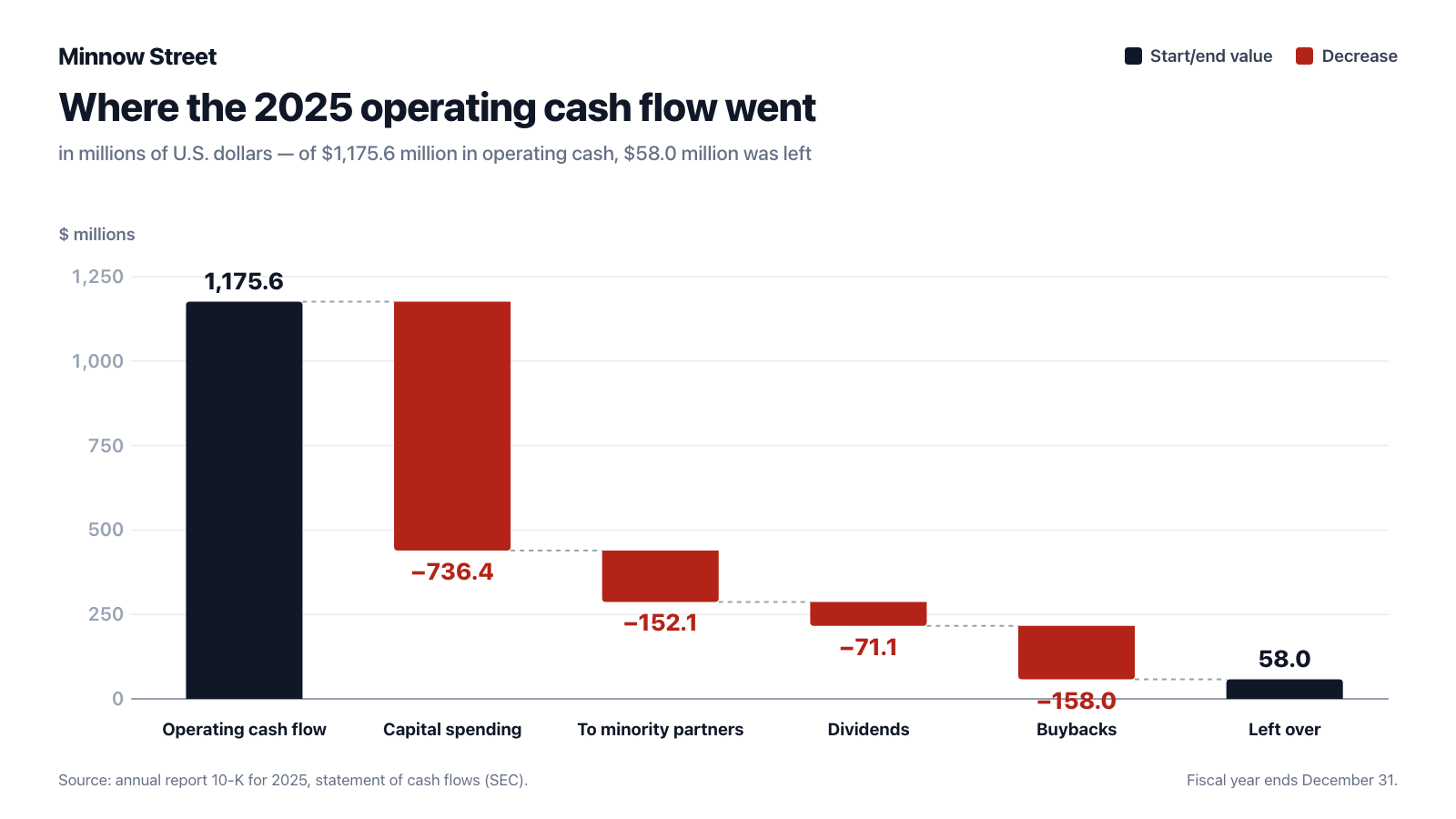
The bottom line was $58.0 million. That is not weakness — it is a deliberate choice: the company reinvests essentially everything it earns into new beds and funds buybacks and dividends from cash on hand and the revolver. But it also means: if payment rates ever stop rising, the buffer is thinner than the earnings line suggests.
One more number arrived after the quarterly report and is therefore easy to miss. On May 29, 2026, Encompass Health issued $500 million of senior notes at 5.875 percent maturing June 1, 2034, for net proceeds of roughly $491.2 million. The money redeems $400 million of the $800 million still outstanding on the old 4.500 percent notes due 2028 at par and repays $100 million on the revolving credit facility. The maturity wall is being spread out — at a coupon nearly 1.4 percentage points above the old one. Refinancing in a higher-rate world is not a disaster, but it is not free either.
Valuation — what the market pays for this balance sheet
And here the contradiction from the scanner chapter resolves. As of July 24, 2026, market capitalization stood at roughly $9.9 billion. Against the 99,199,080 shares outstanding as of April 24, 2026 (per the quarterly report cover page), that implies about $99.70 per share — we cite it only as a dated valuation anchor, not as a buy or sell level.
From that the orders of magnitude follow: a price/earnings ratio of about 17 on the trailing twelve months (about 18 on the 2025 figure of $5.54 per share), a price/sales ratio of a little over 1.6, a price/book ratio of 3.9 and an enterprise value near nine times operating earnings before depreciation. For a company that has grown earnings by double digits two years running, earns a 25.2 percent return on equity and reports a 19.0 percent operating margin, that is not a fantasy price — it is what the market pays for a solid but politically dependent business.
The professionals' view is considerably friendlier than the share price. Twelve analysts carry the stock at the best available consensus rating with an average price target of $140.50, which against the valuation anchor implies roughly 41 percent of headroom (data as of July 24, 2026). That unanimity cuts both ways: where everyone says the same thing, no second opinion is left in the price. It is also notable that only 3.6 percent of the float is sold short — barely anyone is actively betting against the company either. The market does not doubt the business. It doubts who sets the price.
For income-minded readers: the dividend most recently ran at $0.19 per share per quarter (paid July 1, 2026, roughly 11.8 percent above the prior-year level), an annualized yield of about 0.7 percent on a payout ratio of only around 13 percent of earnings. The larger return of capital runs through buybacks: of the authorization reset to $500 million in July 2024, roughly $261 million remained as of March 31, 2026, and 0.7 million shares were repurchased for $71.6 million in the first quarter of 2026.
Opportunities and risks at a glance
What speaks for Encompass Health:
- Market leadership in a niche with barriers to entry. The number of inpatient rehabilitation facilities in the United States barely moved between 2010 and 2024, from 1,179 to 1,170, while demand grew — new competitors hardly appear.
- A balance sheet without findings. Piotroski 8 of 9, Altman Z of 5.75, every credit covenant met with room to spare as of March 31, 2026, roughly $726 million of undrawn revolver capacity and about 79 percent of the hospital real estate owned outright as of December 31, 2025.
- Demonstrated growth mechanics. Since 2012 the company has opened or acquired 78 hospitals and added 4,809 beds; in the first quarter of 2026 same-store discharges alone rose 1.6 percent.
- Demographic tailwind. The average Medicare patient is about 77 years old, and the company cites roughly four percent annual growth through 2030 in the population aged 75 and over.
- Shareholder-friendly capital allocation. $158.0 million of buybacks and $71.1 million of dividends in 2025, on a payout ratio of only about 13 percent — the roughly 11.8 percent dividend increase is comfortably covered.
What speaks against it:
- 82 percent of revenue rides on Medicare and Medicare Advantage. The price is administered, not negotiated — and in January 2026 MedPAC recommended to Congress a 7 percent cut in the base rate, worth roughly $340 million a year.
- A quarter of consolidated profit belongs to others. $192.9 million of $759.1 million was attributable to minority partners in 2025, with $152.1 million paid out in cash.
- Claims are under review pressure. No Alabama hospital reached the opt-out validation rate in the second and third cycles, ending in October 2024 and June 2025; across the four completed cycles the rate has varied, per the quarterly report for the period ended March 31, 2026. With the expansion to Texas and California, roughly 11.9 percent of Medicare claims are covered.
- Barely any free cash left. Of $1,175.6 million in operating cash flow, $58.0 million remained in 2025 after all uses; the May 29, 2026, refinancing costs 5.875 percent instead of the previous 4.500 percent.
- One-offs inside the quarterly picture. Roughly one sixth of first-quarter 2026 profit came from a litigation settlement and a joint-venture sale — extrapolating the quarter is misleading.
A human conclusion
Back to the demographics reflex we started with. It is right — and it aims at the wrong target. People do get older, strokes and hip fractures are not going away, and Encompass Health is the company that gets those people back on their feet: 263,299 discharges in 2025, 174 hospitals, more than 42,000 employees, and a balance sheet that scores 8 on a nine-point test. If you are looking for operational quality, it is here.
But none of that answers one question: what is a course of treatment worth? That answer comes neither from the patient nor from the market, but from an agency and its advisory commission. That commission has said "less" every year since 2008 and has been overruled every year since. Therein lies the actual bet: not that the company executes well — it demonstrably does — but that this streak holds.
If you hold the stock, you are betting that rates keep rising annually and that hospital growth outruns the cut risk. If you buy in today, you are buying a very clean company at a middling price — plus a political risk you can neither model nor diversify away. Both are legitimate positions. What you make of it is your decision. And that is exactly as it should be.
Sources
Every original document used in this analysis, so you can read it yourself:
- Encompass Health Corporation — SEC quarterly report 10-Q as of March 31, 2026 (filed May 1, 2026)
- Encompass Health Corporation — SEC annual report 10-K for 2025 (filed February 26, 2026)
- Encompass Health Corporation — SEC annual report 10-K for 2024 (filed February 28, 2025)
- Current reports 8-K dated May 11, 2026 (annual meeting), May 15, 2026 (pricing of the notes offering) and June 1, 2026 (closing of the $500 million issue of 5.875% notes due 2034): EDGAR filing index for CIK 0000785161 (sec.gov)
- Former name: the same file was maintained under the name HealthSouth Corporation until December 12, 2017; older documents sit in the same EDGAR index.
- Fundamental data (metrics, valuation; data as of July 24, 2026), reconciled against the SEC filings.
- Screen membership: our in-house stock scanner, as of July 26, 2026; the lists are recalculated daily.
Transparency & disclaimer: This analysis is a journalistic contextualization of publicly available information. It is not investment advice, not a regulated financial analysis and not a solicitation to buy or sell securities. Equity investments carry substantial risk up to and including total loss. All information without warranty; the as-of date for each figure is stated in the text. The author holds no position in Encompass Health shares at the time of publication.
Our Bottom Line at a Glance
- Business model and market position positive
- Encompass Health describes itself as the largest operator of inpatient rehabilitation hospitals in the United States: 174 hospitals across 39 states and Puerto Rico as of March 31, 2026, and 263,299 discharges in 2025. The market is tight — the annual report notes that the number of U.S. rehabilitation facilities fell only from 1,179 in 2010 to 1,170 in 2024 while demand grew. Ninety-two percent of patients arrive on referral from acute-care hospitals.
- Growth and earnings quality positive
- Revenue rose from $4,801.2 million in 2023 to $5,373.2 million in 2024 and $5,935.2 million in 2025, with profit attributable to shareholders climbing from $352.0 million to $566.2 million. Operating cash flow grew from $850.8 million to $1,175.6 million over the same period. In the first quarter of 2026 revenue rose 9.0 percent to $1,586.6 million and same-store discharges 1.6 percent. This is grown, not bought, earning power.
- Balance sheet and funding positive
- As of March 31, 2026, $2,573.8 million of debt sat against $3,308.4 million of equity; the covenants (leverage no higher than 4.50x, interest coverage at least 3.0x) were met, roughly $726 million of the revolver was undrawn and about 79 percent of the hospital real estate is owned. The May 29, 2026, issue of $500 million of 5.875 percent notes due 2034 spreads out the maturity wall — but costs more than the 4.500 percent notes it redeems.
- Payer concentration negative
- Per the 2025 annual report, roughly 82 percent of revenue comes from Medicare and Medicare Advantage — $3,886.9 million directly from Medicare plus $974.4 million from Medicare Advantage plans. The price is not negotiated but set by annual rulemaking. The mix is also shifting: about 54 percent of Medicare beneficiaries were in Medicare Advantage plans in 2025, projected by the Congressional Budget Office to reach roughly 64 percent by 2034 — and those plans typically pay less.
- Regulatory cut risk negative
- MedPAC resolved in January 2026 to recommend to Congress a 7 percent cut in the base payment rate for rehabilitation hospitals; against roughly $4,861 million of Medicare revenue that would be about $340 million a year — more than half the $566.2 million of shareholder profit. Nothing has been enacted, and MedPAC has recommended freezes or cuts every year since 2008; actual rates keep rising, and for fiscal 2027 the CMS proposed rule of April 2, 2026, would add a net 2.4 percent from October 1, 2026, after 2.6 percent in fiscal 2026. Review pressure adds to it: no Alabama hospital reached the opt-out validation rate in the second and third cycles, and the rate has varied across the four completed cycles as of the quarterly report for the period ended March 31, 2026.
- Who owns the profit neutral
- Of $759.1 million in 2025 consolidated net income, $192.9 million was attributable to the minority partners in the 66 jointly operated hospitals, up from $111.0 million in 2023 — that share is growing faster than profit. It is the price of secured patient flow and has worked for years, but it distorts every ratio that sets consolidated revenue or consolidated equity against the market value of Encompass shares.
Encompass Health is an unusually cleanly run company in a niche with high barriers to entry: 8 of 9 points on the balance-sheet test, an Altman Z of 5.75, a 25.2 percent return on equity, three years of rising revenue to $5,935.2 million, and every credit covenant met with room to spare as of March 31, 2026. Against that stands not a balance-sheet problem but a dependency: roughly 82 percent of revenue comes from Medicare and Medicare Advantage, the advisory commission to Congress recommended a 7 percent cut in the base rate in January 2026, and a quarter of consolidated profit belongs to the hospital partners. Buying here means buying operational quality and political risk in the same package. Not investment advice.
What Our Rating Means
Open questions
The business works in principle, but one material question is open. As long as it stays open, our findings do not carry a quality verdict.
The substance is documented and not in dispute: the business works, the cash flow is real, the balance sheet is healthy, there is no going-concern flag, no accounting or governance breach and no liquidity question. What tips this to the more cautious grade is the structure of the revenue side: roughly 82 percent of sales hang on a single payer whose price is set administratively — and whose advisory commission recommended a 7 percent cut in January 2026 that would cost more than half of annual shareholder profit. This is not an existential question; interest coverage, roughly $726 million of undrawn revolver capacity and the owned real estate argue clearly against that. But it is a concentration the company cannot resolve on its own. Hence yellow: first-class execution, externally determined price. The decision is yours.
A journalistic assessment by our editorial team at the time of the deep dive, based on public sources — not investment advice and not a solicitation to buy or sell. Your personal circumstances (investment goals, risk capacity, taxes) cannot be taken into account. What our levels mean, how verdicts are formed, and what conflicts of interest exist →
Worth Noting
- Encompass Health reached our research list through the U.S. selection of the "Piotroski F-Score (7–9)" screen in our in-house stock scanner (16 U.S. hits, as of July 26, 2026). On the same day the stock also appeared on the EPS Acceleration, P/CF Ranking, Pros 80%, Power Trend and Pocket Pivot screens. These lists are recalculated daily.
- Identity note: SEC file CIK 785161 was maintained under the name HealthSouth Corporation until December 12, 2017; the change of name to Encompass Health Corporation took effect January 1, 2018. The home health and hospice business was spun off on July 1, 2022, and appears only as a discontinued operation since — the series in this analysis do not blend the two perimeters.
- Valuation figures are dated and evergreen: the anchor of roughly $99.70 per share is not a daily price but the arithmetic result of the roughly $9.9 billion market capitalization (data as of July 24, 2026) and the 99,199,080 shares reported on the cover page of the quarterly report as of April 24, 2026. Analyses are evergreen; daily prices are not a buy argument.
Frequently Asked Questions
Encompass Health (NYSE: EHC) operates inpatient rehabilitation hospitals in the United States — the ward after the acute-care hospital, where people relearn to walk and speak after strokes, hip fractures or neurological conditions. As of March 31, 2026, it ran 174 hospitals across 39 states and Puerto Rico. In 2025 it discharged 263,299 patients on revenue of $5,935.2 million.
Heavily. The 2025 annual report states the figure itself: Medicare and Medicare Advantage account for roughly 82 percent of total revenues. In dollars that is $3,886.9 million directly from Medicare plus $974.4 million from Medicare Advantage plans. Managed care contributed 10.7 percent and Medicaid 3.1 percent. Payment rates are not negotiated but set annually by regulation.
The Piotroski F-Score asks nine yes-or-no questions about the health of a company's books: profitability, real cash inflow, falling leverage, improving margins, no dilution pressure. Six of nine is okay, not good; seven is solid. Encompass Health scores 8 (data as of July 24, 2026) — about as high as profitable growth companies get in practice.
Because it is the same company. The SEC file under number CIK 785161 was maintained as HealthSouth Corporation until December 12, 2017; the annual report records that the change of name to Encompass Health Corporation took effect January 1, 2018. Searching archives requires both names. The home health and hospice business was spun off on July 1, 2022.
Partly operationally, partly on one-offs. Revenue rose 9.0 percent to $1,586.6 million. But the $194.5 million of profit also contains a $16.3 million after-tax settlement gain — the company collected $21.9 million in February 2026 — plus a $17.5 million pre-tax gain on the sale of a 50 percent joint-venture interest. Together roughly one sixth of the quarter.
MedPAC is the independent commission advising the U.S. Congress on Medicare. In January 2026 it resolved to recommend cutting the base payment rate for inpatient rehabilitation hospitals by 7 percent. On roughly $4,861 million of 2025 Medicare revenue that would be about $340 million a year — more than half the $566.2 million of shareholder profit. The filing also notes MedPAC has urged cuts every year since 2008 without Congress following.
Yes, quarterly. The most recent payment was $0.19 per share (paid July 1, 2026, roughly 11.8 percent above the prior year), an annualized yield of about 0.7 percent on a payout ratio of around 13 percent. The larger return of capital runs through buybacks: $158.0 million in 2025, with roughly $261 million of authorization still open as of March 31, 2026.
Not Encompass shareholders alone. Of 174 hospitals the company owns 108 outright; in the other 66 it holds between 50.0 and 97.5 percent alongside acute-care hospitals. Their revenue is fully consolidated but the profit is shared: of $759.1 million in 2025 consolidated net income, $192.9 million went to those partners (2023: $111.0 million), with $152.1 million paid out in cash.
Found an error?
Did you spot a factual error, an outdated number, or a typo in this deep dive? Let us know briefly — your report goes straight to the editorial team.