Bumble: $238.7 million of free cash flow — and the cash pile still ended the year smaller
Bumble sits near the top of our in-house P/FCF ranking: the market values the company at barely more than one and a half years of its own free cash flow. Filings with the U.S. securities regulator, the SEC, show why that number tells half the story. Market capitalization counts 130.4 million Class A shares — the cash flow belongs to a group with 151.6 million units. The $341.9 million of net debt never enters the ratio at all. And in 2025 some $185.7 million went to Blackstone, the founder and other pre-IPO owners, so the cash pile shrank despite $238.7 million of free cash flow. Since April 2026 the new loan costs Term SOFR plus 8.00 percentage points and amortizes at 12.5 percent a year instead of 1.0. Not investment advice — just the question of who actually owns this cash flow.
 Thomas Mücke
Founder & Publisher
Thomas Mücke
Founder & Publisher
Chart
Interactive price chart (TradingView).
Note: pure fact-based analysis, not investment advice and not a solicitation to buy or sell. All figures without guarantee.
There is an investor trap that feels especially fitting for a dating company: the swipe-right reflex. In a dating app you decide in less than a second — the first photo looks good, thumb goes right, you read the bio later. Stock screening works the same way. A number like "P/FCF 1.6" appears, your brain translates it into "this company earns its own market value back in about eighteen months," and you have an opinion before reading a single footnote. Bumble Inc. (NASDAQ: BMBL) of Austin, Texas, is exactly that kind of profile: a very attractive first photo attached to a very long bio. So let us make a deal — before you swipe, we read the bio to the end. Not the press-release version, but the filings made with the U.S. securities regulator, the SEC: the annual report on Form 10-K for 2025, the quarterly report on Form 10-Q as of March 31, 2026, and the mandatory disclosures filed since. Those documents are honest under penalty of law. What you do with them is your call.
What Bumble actually does — three apps, one subscription model
Bumble sells dates — more precisely, the promise that dates will happen. The business model is as simple as a magazine subscription: the apps are free, but anyone who wants to be faster, more visible or more targeted pays monthly or buys extras inside the app. Three brands sit under the roof. The Bumble app (launched 2014) is the best known; its signature feature was long that in heterosexual matches the woman makes the first move. Badoo (launched 2006) is the older, broader, globally scattered sibling, strong across Europe and Latin America. And since September 2025 the United States has BFF, an app for finding friends and groups that deliberately generates no revenue yet and is therefore excluded from the key user metrics. Two smaller brands are gone: Official was shut down in the second quarter of 2025 and Fruitz was sold in July 2025.
Two figures describe this business most honestly. First, paying users, which Bumble reports as a monthly average across a period. Second, average revenue per paying user, or ARPPU — how much each payer leaves behind in a month. Revenue in 2025 came to $965.7 million (2024: $1,071.6 million), split into $783.0 million from the Bumble app and $182.6 million from Badoo and other. One detail worth knowing: 55.9 percent of 2025 revenue arose outside the United States, mostly in British pounds and euros, so currency swings feed straight through. And with that the central tension of this analysis is already on the table, running through every chapter: the free cash flow is real and large — but the queue of claimants standing ahead of shareholders is long.
How the stock landed on our desk
Bumble did not reach us through a news story but through a sort. Our in-house stock scanner runs a P/FCF ranking that collects every stock with positive free cash flow and a price-to-free-cash-flow ratio of at most 10, then sorts them upward — the arithmetically cheapest first. The metric itself is a division: market capitalization divided by free cash flow. Free cash flow is what lands in the bank after all investment. A reading of 10 means ten years of that cash stream equal today's price. A reading below 2 means barely two years. That sounds like a glitch in the matrix — which is precisely why we looked.
On July 27, 2026 we counted for ourselves: the English list showed 544 hits, last recalculated on July 26, 2026. Set the market filter to the United States and the page displays 25 rows — and Bumble is not among them. The stock ranks 29th in the U.S. selection, four rows below the visible cut; the last displayed row carried a value of 1.4 that day, Bumble a value of 1.6. To repeat it yourself: open the "Scanner" menu on minnowstreet.com, choose the P/FCF ranking, set the market filter at the top of the results list to the United States — and for a single stock read the value on the BMBL stock page, where it appears under "Price/FCF." The lists are recalculated daily, so the placement is a dated snapshot from July 27, 2026, not a permanent state.
What else marks the stock we read off the same page on the same day: Bumble passes four of our verified strategy scanners — EPS acceleration, Professionals 80%, Strong DCR (80 or above) and Power Trend. Pure metric rankings such as the P/FCF list deliberately do not count as hits there, because they sort the whole universe instead of testing a condition. Our in-house fundamental rating, by contrast, sits at only C, at minus 5 out of 100, dragged down by the growth side. Remember that contradiction, because it runs through the whole analysis: the momentum and cash-flow signals are good, the business signals are not. One more note in our own interest: standard balance-sheet scores such as the Piotroski count or the Altman Z-score are not a usable yardstick for this stock. They sit next to an accumulated deficit of $1,349.0 million as of March 31, 2026 and an operating loss of $805.8 million for 2025, both consequences of the impairments. Anyone testing balance-sheet strength should use the figures from the filings themselves, and those come in the next chapter.
The numbers over the years — given their due
First the genuinely impressive part. Bumble is a high-margin cash machine. Gross margin ran at roughly 72 percent recently, meaning about 72 cents of every dollar taken in survives before marketing, development and administration begin. Adjusted EBITDA rose three years running: $275.6 million in 2023, $304.1 million in 2024, $313.6 million in 2025 — and it did so on falling revenue, which speaks to cost discipline. The balance sheet is not stretched: as of March 31, 2026 the company held $245.6 million in cash against $587.5 million of debt, with total equity of $735.2 million ($617.1 million attributable to Bumble Inc. and $118.1 million to noncontrolling interests). And the first quarter of 2026 was clearly profitable under GAAP: net earnings of $52.6 million, of which $45.2 million belonged to Bumble Inc. shareholders, or $0.35 per share.
Free cash flow — the number this whole story turns on — more than doubled:
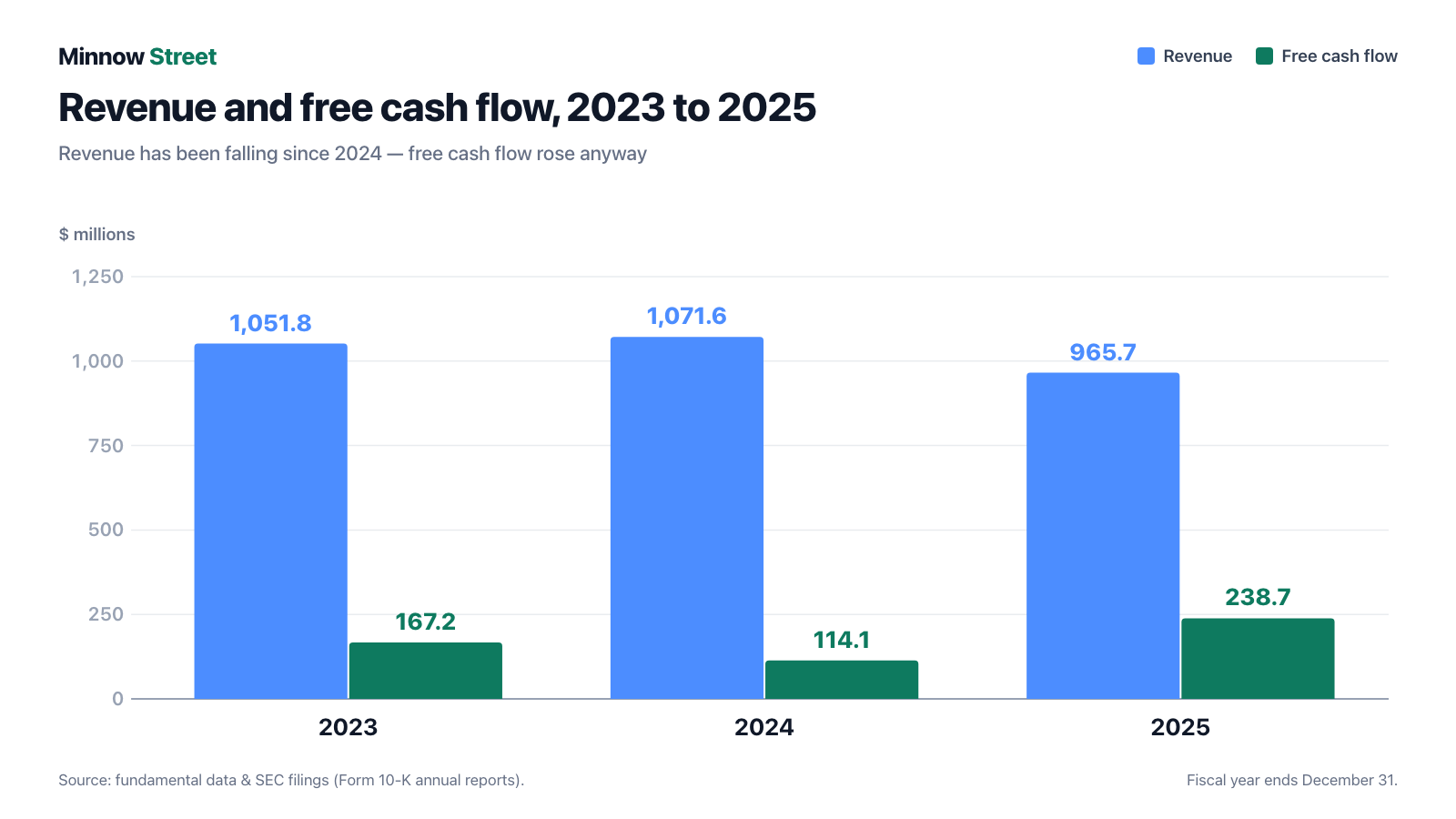
That gap is the real reason for the low ranking value. It is not faked — the cash flow is money that actually arrived. But it is not what it looks like either. From here it gets uncomfortable.
What the filings say — the uncomfortable truths
Uncomfortable truth no. 1: market capitalization counts one share class, the cash flow belongs to the whole group
Bumble is built as an Up-C structure, short for umbrella partnership C-corporation. The everyday picture: imagine an apartment building owned by a partnership. What is listed is not the building but a management company that holds part of the partnership and runs the business for the remaining co-owners. At Bumble the building is Buzz Holdings L.P.; the listed Bumble Inc. is the management company. The remaining co-owners hold Common Units they may exchange one-for-one into Class A shares at any time.
Why that decides our metric: the market capitalization in the ranking multiplies the price by the 130.4 million Class A shares (as of April 30, 2026). Free cash flow, however, arises in the whole building and belongs proportionally to the co-owners too. Bumble states the size of that claim itself:
"Assuming the exchange of all outstanding Common Units for shares of Class A common stock on a one-for-one basis under the exchange agreement entered into by holders of Common Units, there would be 151,638,183 shares of Class A common stock outstanding … as of March 31, 2026."
— Bumble Inc., Form 10-Q for the quarter ended March 31, 2026, Note 1

Run the arithmetic, using the closing price of $2.80 on July 24, 2026 as a dated valuation anchor. With 130.4 million Class A shares that is roughly $365 million of market value and a ratio of about 1.5. With the 151.6 million shares that would exist after full exchange it is roughly $425 million and a ratio of about 1.8. The cross-check sits in the income statement: of $52.6 million in first-quarter 2026 net earnings, $7.4 million was attributable to noncontrolling interests — exactly 14.1 percent, and 130.4 divided by 151.6 is that same 86 percent. So the markup is real but contained: the Up-C structure makes the stock roughly one sixth more expensive; it does not explain the low reading. What really does comes next.
Uncomfortable truth no. 2: the ranking knows nothing about debt — and since April 2026 the cash is spoken for
Price-to-free-cash-flow has a built-in blind spot: it uses market capitalization, not enterprise value. A buyer of the whole company also assumes the debt and receives the cash. As of March 31, 2026, $587.5 million of debt stood against $245.6 million of cash, leaving $341.9 million of net debt. Add that to the $425 million of equity value on the full share count and the business costs roughly $767 million — pushing the ratio to free cash flow up to about 3.2. Honestly calculated, "1.6" becomes roughly double. Still not expensive, but a different order of magnitude.
The harder part is that this debt has drawn far more cash since April 24, 2026. On that day Bumble repaid the 2020 credit agreement — a $575.0 million original term loan plus a $275.0 million incremental term loan, amortizing at 1.00 percent a year, carrying rates of 6.52 and 7.02 percent as of March 31, 2026. In its place came a $475.0 million term loan administered by Guggenheim Credit Services. The new terms read best in the original:
"The Term Loan Facility amortizes in equal monthly installments … in aggregate annual amounts equal to (x) 12.5% per annum of the original principal amount of the Term Loan Facility, with respect to the first twelve payments occurring after the Closing Date, and (y) 15.0% per annum … with the balance payable on April 24, 2030."
— Bumble Inc., Form 8-K filed April 24, 2026, Item 1.01

Translated into money: 12.5 percent of $475.0 million is roughly $59.4 million of mandatory amortization in the first year, rising to roughly $71.3 million thereafter. In 2025 the figure was $5.8 million. The interest rate went from 6.52 and 7.02 percent to a spread of 8.00 percentage points over the reference rate — that is no longer bank pricing, that is private-credit pricing. On top come mandatory prepayments out of excess cash flow, a make-whole premium through the second anniversary and a total leverage covenant of 3.00:1.00 that steps down to 2.00:1.00 by June 30, 2028. The rule of thumb: free cash flow that is contractually promised to someone else is not free. For the same mechanic at another shrinking software company, see our analysis of Upland Software, where the debt load is exactly why a low P/FCF is not a bargain.
Uncomfortable truth no. 3: $185.7 million went to Blackstone, the founder and other pre-IPO owners in 2025
Now to the most important number in this analysis, and the biggest weakness of the metric. Free cash flow by definition stops after investment. Everything after that sits under financing and never touches the number. In 2025 quite a lot sat there. The 2021 initial public offering left behind a tax receivable agreement: Bumble had promised pre-IPO owners 85 percent of certain future tax benefits. On November 5, 2025 that agreement was terminated for a one-time payment:
"The TRA Amendment provided for one-time settlement payments of approximately $186.0 million as consideration for the complete and full termination of the Company's payment obligations … Immediately prior to the TRA Amendment, Blackstone elected to exchange all of its Common Units for the Company's Class A common stock. We made cash settlement payments of $185.7 million to Blackstone, the Founder and certain other pre-IPO owners in connection with the TRA Buyout."
— Bumble Inc., Form 10-K for 2025, Item 7 (Liquidity and Capital Resources)

Together with the regular installments, the tax receivable agreement cost $194.7 million in 2025. Add $28.7 million of share buybacks, $30.8 million of debt repayment ($5.8 million scheduled and a $25.0 million voluntary payment in August 2025) and $14.0 million of employee tax withholding and distributions to noncontrolling holders. What was left is shown here:
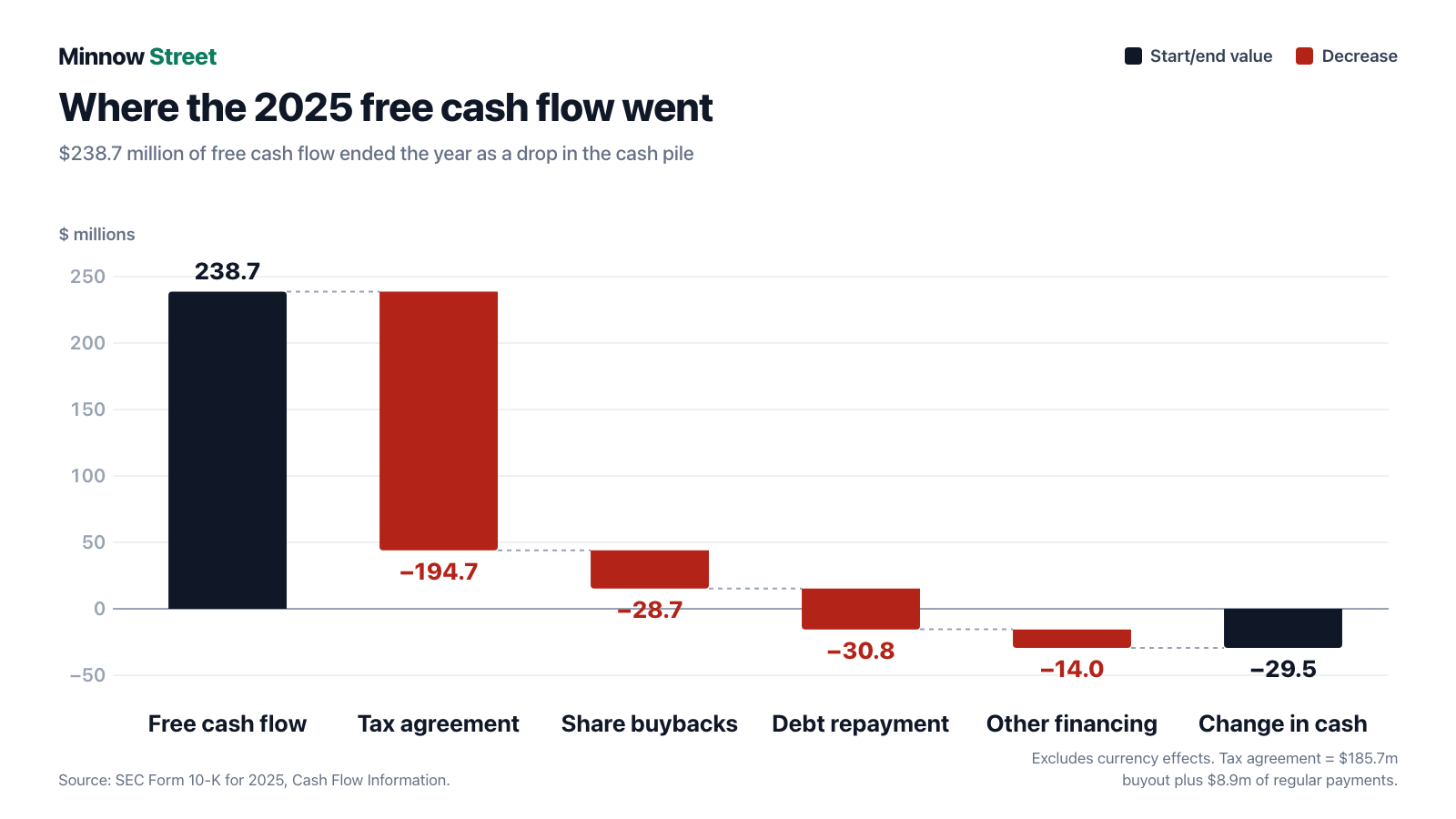
That is the heart of the matter. A ranking that divides market capitalization by free cash flow would have flagged Bumble as extremely cheap in 2025 — during a year in which the cash pile actually shrank. In fairness: the $185.7 million was a one-time buyout that permanently removes future obligations. It will not recur. But it exposes a property of the metric worth remembering forever: free cash flow tells you how much money comes in, not who gets it.
Uncomfortable truth no. 4: the jump in cash flow came from the marketing knife
So where did the rise from $114.1 million to $238.7 million come from? Not from more revenue, which fell. The answer sits in the cost line: selling and marketing expense dropped from $270.4 million in 2023 through $261.2 million in 2024 to $165.5 million in 2025. The first quarter of 2026 pushed further: $27.0 million instead of $59.7 million, down 54.9 percent year on year. Bumble describes this as strategy — shifting away from paid member acquisition toward brand and organic investment, alongside a quality reset of the membership base. The headcount followed: in June 2025 the company cut roughly 240 roles, about 30 percent of its employees, after cutting some 350 roles in February 2024. Roughly 580 full-time employees remained as of December 31, 2025.
The flip side sits in the same filings. Paying users fell to 3.17 million in the first quarter of 2026, from 4.01 million a year earlier — a decline of 21.1 percent. The Bumble app lost 23.1 percent of its payers (2.08 million versus 2.71 million) and Badoo 17.0 percent (1.08 million versus 1.31 million). Revenue per payer did rise to $22.04 a month from $20.24, but that only cushions part of it: quarterly revenue still fell 14.1 percent to $212.4 million. And the company itself has written the value down — impairments totalled $892.2 million in 2024 and $1,039.0 million in 2025; for the fourth quarter of 2025 Bumble named the trigger as a sustained decline in its stock price and the resulting decrease in market capitalization. Translated: management has marked its own brands down by more than a billion dollars. Anyone confronting that with a cash-flow ranking should know what they are doing.
Uncomfortable truth no. 5: Blackstone is selling — in scheduled quarterly slices through 2027
Bumble came to market in 2021 out of Blackstone ownership. The private-equity firm has stayed on the register ever since — and is now leaving on a schedule. On November 26, 2025 seven Blackstone entities entered forward transactions with UBS AG, London Branch:
"… entered into averaging share forward transactions (the 'Forward Transactions') with UBS AG, London Branch … with respect to all of the 37,387,500 shares of Class A Common Stock beneficially owned by the Stockholders in the aggregate … The maturity date for the Forward Transactions is scheduled to occur in the first half of 2027 …"
— Blackstone entities, Schedule 13D/A filed December 1, 2025, Item 4
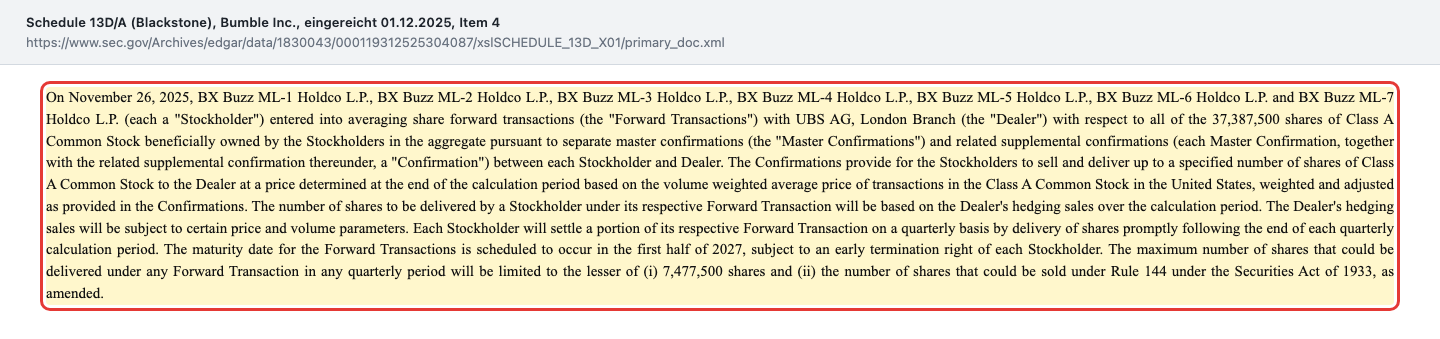
The results are on the public record quarter by quarter: the first period ended on March 17, 2026 at $3.51 per share, the second on June 16, 2026 at $3.7751. The seven entities went from 29,909,996 shares (filing of March 19, 2026) to 22,432,496 shares as of June 18, 2026 — still 17.2 percent of the Class A stock. A few days later, on June 29, 2026, Blackstone board representative Jonathan C. Korngold resigned effective June 30; the filing attributes it to his previously announced departure from Blackstone and states expressly that there was no disagreement. For investors that yields two sober findings: there is a predictable supply overhang through 2027, and there is a documented price four times a year at which the largest legacy holder actually sells. A takeover, a take-private or a merger, by contrast, is not in play: through July 27, 2026 the filings contain no merger agreement and no Rule 13e-3 transaction statement.
Valuation — what the number carries and what it does not
Here is the arithmetic in one place, all based on the closing price of $2.80 on July 24, 2026 and free cash flow of $238.7 million for 2025:
- About 1.5 — market value of the 130.4 million Class A shares divided by free cash flow. This is the number that lands in the ranking.
- About 1.8 — the same calculation using the 151.6 million shares that would exist after full exchange of the Common Units. More honest, because the cash flow belongs to the whole group.
- About 3.2 — enterprise value ($425 million of equity plus $341.9 million of net debt) divided by free cash flow. This is what a buyer of the whole business would pay.
For context, the other valuation anchors read off on July 27, 2026: price-to-sales 0.5, enterprise value to adjusted EBITDA 5.7, forward price-to-earnings 6.0. There is no trailing price-to-earnings ratio, because 2025 closed with a net loss of $895.3 million — overwhelmingly non-cash impairments. The professional view: the mean analyst target price stood at roughly $4.34 as of the July 26, 2026 data date, above the price at the time — an opinion, not proof, and target prices are the first thing to be cut after a weak quarter. More important than any of these multiples is whether the cash flow holds if revenue keeps falling at 14 percent a year and the marketing brake can no longer be pulled harder. A comparable case from the same list sits in our analysis of TTEC Holdings: another low multiple attached to a shrinking business carrying debt.
Opportunities and risks at a glance
Opportunities
- High margins and real cash generation: gross margin around 72 percent, adjusted EBITDA of $313.6 million in 2025 at a 32.5% margin, and 38.9% in the first quarter of 2026.
- The most expensive legacy item is gone: the tax receivable agreement from the IPO was fully terminated on November 5, 2025, permanently removing future obligations under it.
- Two strong, widely recognized brands plus a second leg outside dating (BFF) that generates no revenue yet — and therefore cannot lose any.
- Covenants are met with room to spare: the $475.0 million term loan stands against adjusted EBITDA of $313.6 million for 2025 — roughly one and a half times, against a ceiling of 3.00:1.00 — and the $245.6 million of cash as of March 31, 2026 dwarfs the minimum liquidity covenant of $25.0 million, rising to $50.0 million from the autumn of 2026.
- The buyback authorization still has $50.1 million available (December 31, 2025), although nothing was repurchased in the first quarter of 2026.
Risks
- The business is shrinking at its core: paying users down 21.1 percent and revenue down 14.1 percent in the first quarter of 2026. A subscription business without new payers is an expiring contract.
- The new financing is expensive and amortizes fast: Term SOFR plus 8.00 percentage points, roughly $59.4 million of mandatory amortization in the first year and roughly $71.3 million thereafter, plus prepayments out of excess cash flow.
- Supply overhang through 2027: Blackstone still held 22,432,496 shares, or 17.2%, as of June 18, 2026 and delivers them quarterly to the dealer.
- Dilution: 16,038,715 potentially dilutive securities (1,463,705 options and 14,575,010 restricted stock units) were excluded from diluted earnings per share as of March 31, 2026 because they were anti-dilutive — they still exist.
- Competitors are arming themselves with artificial intelligence. Bumble names this in its own annual report as a risk to its business model.
- Currency exposure: 55.9% of 2025 revenue arose outside the United States, mostly in pounds and euros.
A human conclusion
Back to the swipe-right reflex. Bumble's profile photo really is good: a company with 72 percent gross margins that generated nearly $240 million of free cash in 2025 and trades at a fraction of it. Anyone who sees only that photo swipes right. The bio underneath tells a different story. The market capitalization in the ranking counts one of two ownership classes. The debt never appears in the metric at all, yet since April 2026 it costs a spread of eight percentage points and demands amortization twelve and a half times faster than before. And in the very year the pretty number was produced, $185.7 million left for Blackstone, the founder and other pre-IPO owners while the cash pile shrank.
None of that makes Bumble a bad company. It only makes the number a different number than it first appears — roughly 3.2 rather than 1.6, attached to a business that has just lost a fifth of its payers. Whether that is a bargain or a value trap hangs on exactly one question: does the shrinking stop before the marketing brake can no longer be pulled harder? No ranking answers that, and neither does an analysis — the next few quarterly reports will. What you do with it is your decision. And that is exactly as it should be.
Sources
- Form 10-K for 2025, Bumble Inc. (CIK 0001830043), filed March 16, 2026
- Form 10-Q for the quarter ended March 31, 2026, filed May 6, 2026 — most recent periodic report
- Form 8-K filed April 24, 2026 (new term loan, repayment of the 2020 credit agreement)
- Form 8-K filed July 2, 2026 (resignation of Jonathan C. Korngold from the board effective June 30, 2026)
- Schedule 13D/A filed December 1, 2025 (Blackstone: forward transactions covering 37,387,500 shares)
- Schedule 13D/A filed March 19, 2026 (first settlement at $3.51) and Schedule 13D/A filed June 18, 2026 (second settlement at $3.7751)
- Screening and valuation data: our in-house stock scanner and fundamental data (data as of July 26, 2026), including the P/FCF ranking — measured by us on July 27, 2026: 544 hits in the English list, 25 rows displayed with the U.S. market filter, Bumble not among them but ranked 29th at a ratio of 1.6; the list had last been recalculated on July 26, 2026
This analysis is journalistic commentary on publicly available company filings. It is expressly not investment advice, not a recommendation to buy or sell, and not a solicitation to buy or sell securities. Stocks can lose their entire value. All figures come from the primary sources linked above and carry their respective reporting dates; they may change with the next report. The author holds no position in Bumble Inc. at the time of publication.
Our Bottom Line at a Glance
- Earnings power and cash flow positive
- Free cash flow rose to $238.7 million in 2025 (2024: $114.1 million) and adjusted EBITDA to $313.6 million at a 32.5% margin. The first quarter of 2026 added $73.8 million of free cash flow and $52.6 million of net earnings. The money is real and it arrives.
- Business trajectory negative
- Paying users fell 21.1 percent to 3.17 million in the first quarter of 2026 and revenue fell 14.1 percent to $212.4 million. The jump in cash flow came from the cost knife: selling and marketing expense of $165.5 million against $261.2 million (2025 versus 2024) and $27.0 million against $59.7 million in the first quarter. A subscription business without new payers is an expiring contract.
- Reliability of the valuation metric negative
- The P/FCF of 1.6 in the ranking (as of July 27, 2026) counts only 130.4 million Class A shares and ignores $341.9 million of net debt. Using all 151,638,183 units and adding the debt, the ratio is roughly 3.2 — double. Buying on that number alone means buying half a calculation.
- Financing negative
- Since April 24, 2026 the $475.0 million term loan costs Term SOFR plus 8.00 percentage points instead of 6.52 and 7.02 percent, and mandatory amortization jumps from 1.00 percent a year to 12.5 percent, then 15.0 percent. Roughly $59.4 million of annual amortization stands against $238.7 million of free cash flow, plus prepayments out of excess cash flow.
- Ownership negative
- Blackstone is selling its remaining 22,432,496 shares (17.2% as of June 18, 2026) through forward transactions with UBS running to the first half of 2027 at the latest; the first two quarterly settlements priced at $3.51 and $3.7751. The Blackstone board representative resigned effective June 30, 2026. A predictable supply overhang remains.
- Balance sheet neutral
- As of March 31, 2026, $245.6 million of cash stands against $587.5 million of debt, with total equity of $735.2 million. The new $475.0 million of borrowings equals roughly one and a half times adjusted EBITDA of $313.6 million against a 3.00:1.00 covenant. The $732.7 million of goodwill, however, is what survived impairments of $892.2 million in 2024 and $1,039.0 million in 2025, and the accumulated deficit stands at $1,349.0 million.
Bumble is a textbook case of what a single valuation metric leaves out. The $238.7 million of free cash flow in 2025 is real, the margins are high and the balance-sheet lights are green. But the market capitalization in the ranking counts one of two ownership classes, the $341.9 million of net debt never enters the ratio, and in the same year $185.7 million left for Blackstone, the founder and other pre-IPO owners while the cash pile shrank. Honestly calculated the ratio is roughly 3.2 rather than 1.6 — attached to a business that lost a fifth of its paying users in the first quarter of 2026 and whose new financing has priced eight percentage points over the reference rate since April 2026. Not investment advice.
What Our Rating Means
Substance risk
We found at least one documented issue that threatens the company itself — regardless of how the stock is currently valued.
Red here expressly does not signal a payment problem — $245.6 million of cash as of March 31, 2026, total equity of $735.2 million and leverage of roughly one and a half times adjusted EBITDA against a 3.00:1.00 covenant all argue otherwise. Red stands for three documented findings about the substance of the business. Paying users fell 21.1 percent to 3.17 million in the first quarter of 2026 while selling and marketing expense had already been cut by more than half. The company itself wrote down its goodwill and brand assets by $1,931.2 million over two years ($892.2 million in 2024 and $1,039.0 million in 2025). And the credit market repriced the borrower: on April 24, 2026 rates of 6.52 and 7.02 percent became a spread of 8.00 percentage points over the reference rate, with amortization of 12.5 percent a year instead of 1.00 percent. The business is not worthless — it throws off cash and carries a decent balance sheet. But the question of substance has been documented, and in case of doubt the more cautious level applies. The decision is yours.
A journalistic assessment by our editorial team at the time of the deep dive, based on public sources — not investment advice and not a solicitation to buy or sell. Your personal circumstances (investment goals, risk capacity, taxes) cannot be taken into account. What our levels mean, how verdicts are formed, and what conflicts of interest exist →
Worth Noting
- The hook for this analysis is our in-house stock scanner, specifically the P/FCF ranking. Measured by us on July 27, 2026: 544 hits in the English list, last recalculated on July 26, 2026. With the U.S. market filter the page shows 25 rows; Bumble is not among them but ranks 29th at a ratio of 1.6. The lists are recalculated daily, so the placement is a snapshot rather than a permanent state.
- Data basis: annual figures from the Form 10-K for 2025 (filed March 16, 2026), quarterly figures from the Form 10-Q as of March 31, 2026 (filed May 6, 2026), financing terms from the Form 8-K of April 24, 2026, and ownership data from the Schedule 13D amendments of December 1, 2025, March 19, 2026 and June 18, 2026. The valuation anchor is the closing price of $2.80 on July 24, 2026 — a dated anchor, not a reason to buy.
- Easily confused: Bumble Inc. is the listed managing entity, while the operating business sits in Buzz Holdings L.P. Free cash flow arises there and belongs proportionally to the noncontrolling holders as well — 14.1 percent of net earnings in the first quarter of 2026. No takeover, take-private or merger was pending through July 27, 2026.
Frequently Asked Questions
Because the ranking divides market capitalization by free cash flow, and at Bumble the two are unusually far apart: $238.7 million of cash flow in 2025 against roughly $365 million of market value at the July 24, 2026 closing price. On July 27, 2026 that produced rank 29 in the U.S. selection at a ratio of 1.6.
Two things. Market capitalization counts only the 130.4 million Class A shares, while the cash flow belongs to a group with 151,638,183 units. And the metric ignores debt: adding the $341.9 million of net debt as of March 31, 2026 lifts the ratio from roughly 1.5 to roughly 3.2.
The listed Bumble Inc. manages the operating partnership Buzz Holdings L.P. but does not own all of it. The remaining holders own Common Units exchangeable one-for-one into Class A shares. That is why $7.4 million of the $52.6 million first-quarter 2026 net earnings was attributable to noncontrolling interests, or 14.1 percent.
The $475.0 million term loan carries the base rate plus 7.00 percent or Term SOFR plus 8.00 percentage points. The previous loans carried 6.52 and 7.02 percent. Mandatory amortization rose at the same time from 1.00 percent a year to 12.5 percent, and 15.0 percent thereafter — roughly $59.4 million instead of $5.8 million a year.
Yes, on a schedule. Since November 26, 2025 forward transactions with UBS have covered all 37,387,500 Class A shares then held, settled quarterly with at most 7,477,500 shares per period and maturing in the first half of 2027. As of June 18, 2026, 22,432,496 shares remained, or 17.2 percent.
No. Through July 27, 2026 the filings show no merger agreement, no Rule 13e-3 transaction statement and no Rule 425 communication. Blackstone Schedule 13D describes selling into the market, not acquiring control. The stock continues to trade on Nasdaq.
Almost entirely because of $1,039.0 million of impairments on goodwill and brand assets. The triggers were a lowered outlook in the second quarter of 2025 and, in the fourth quarter, a sustained decline in the stock price and the resulting drop in market capitalization. Those charges cost no cash, and free cash flow stayed positive.
In the first quarter of 2026 the monthly average was 3.17 million, down from 4.01 million a year earlier, a decline of 21.1 percent. The Bumble app accounted for 2.08 million and Badoo and other for 1.08 million. Revenue per payer rose over the same period from $20.24 to $22.04 a month.
Found an error?
Did you spot a factual error, an outdated number, or a typo in this deep dive? Let us know briefly — your report goes straight to the editorial team.