Prenetics: The Revenue Growth Is Real — the Profit Is Borrowed
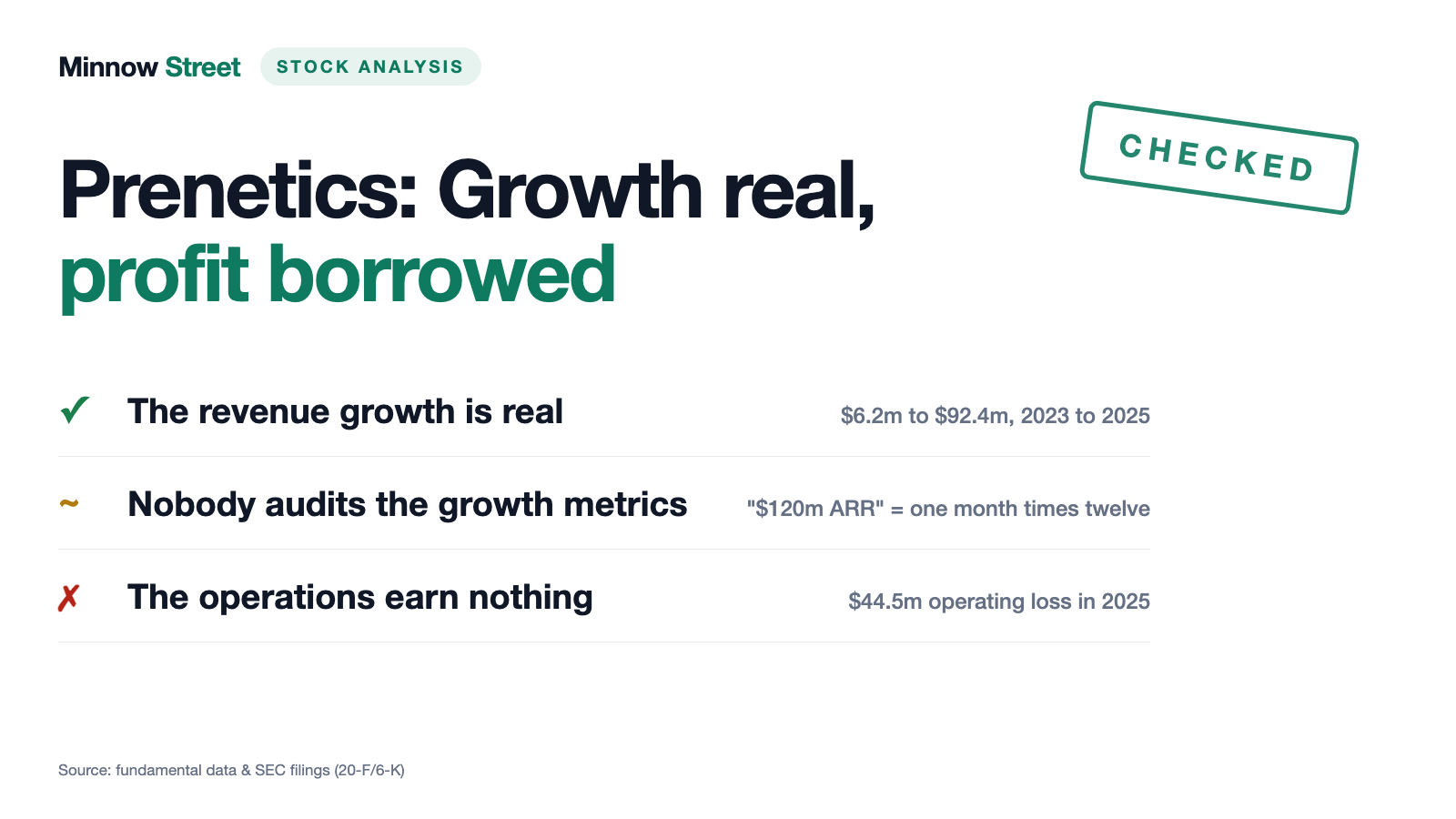
A COVID testing lab in Hong Kong turned itself into a consumer health brand in two years, with David Beckham as co-founder. And the growth is genuine: revenue from continuing operations rose from $6.2 million in 2023 to $15.9 million in 2024 and $92.4 million in 2025. The trouble is that the business earns nothing along the way — the operating loss widened to $44.5 million over the same period. The reason the bottom line shows only $40.0 million of net loss is a one-off warrant exchange that added $36.7 million. And the number carrying the whole story, the famous $120 million of ARR, is by the annual report's own footnote the revenue of a single month multiplied by twelve. Not investment advice — just a look at which figure here was actually earned.
 Thomas Mücke
Founder & Publisher
Thomas Mücke
Founder & Publisher
Chart
Interactive price chart (TradingView).
Note: pure fact-based analysis, not investment advice and not a solicitation to buy or sell. All figures without guarantee.
There is one piece of arithmetic our brains adore, because it feels so wonderfully simple — and it costs investors money with great regularity: take the best month and multiply it by twelve. Call it the extrapolation trap. It works so well because it does not feel like speculation. It feels like maths. A company reports $10 million of revenue in December, and suddenly the number everyone repeats is $120 million. Nobody lied. It is also true that nobody collected $120 million. Prenetics Global Limited (NASDAQ: PRE) is the textbook case — and at the same time a company whose growth you cannot wave away. A testing lab that worked for the Hong Kong government during the pandemic turned itself, in two years, into a supplement brand co-founded with David Beckham. Revenue rose from $6.2 million in 2023 to $15.9 million in 2024 and $92.4 million in 2025. That part is real, and it sits in an audited annual report. So here is the deal: before you decide whether this is a rocket or a mirage, let us read together what Prenetics itself told the U.S. securities regulator, the SEC — the annual report on Form 20-F for 2025, its amendment dated July 2, 2026, and the interim disclosures on Form 6-K up to July 14, 2026. Filings like these are honest under threat of penalty. And this one tells a story about real growth, about a profit that is borrowed, about a headline metric nobody outside the company checks — and about one man who holds two thirds of the votes.
What Prenetics actually does — from testing lab to powder tub
Prenetics sells two things today. The big one is IM8, and it is, unromantically, nutritional supplements on subscription: a daily powder you stir into water, plus capsules, sold straight to consumers online with no pharmacy and no supermarket shelf in between. The brand was co-founded with David Beckham; the roster of ambassadors adds tennis player Aryna Sabalenka, basketball player Giannis Antetokounmpo and racing driver Ollie Bearman, all of them equity-aligned according to the annual report. The second business is CircleDNA, a consumer genetic test: you send in a saliva sample and get an analysis back. In the segment accounts the two go by Consumer Health (IM8, $79.4 million of revenue in 2025 at a 47.6 percent gross margin) and Prevention (CircleDNA, $12.9 million at an 84.9 percent margin). The gap explains itself: a digitally delivered genetic report costs almost nothing to produce, while a tub of powder has to be manufactured, packed and shipped halfway around the world.
One thing matters for reading the numbers: Prenetics today is a different company from three years ago. During 2025 and early 2026 it disposed of the cancer diagnostics business ACT Genomics, the European logistics operation and the Insighta stake. That is why prior-year figures in the report are restated under the accounting standard IFRS 5 — the comparison runs only across continuing operations. Anyone carrying older Prenetics revenue figures in their head will otherwise compare apples with oranges.
The stock market has plenty of business-model cousins: brands that acquire customers through paid advertising and hold them on subscription — from the medical apparel brand we examined in our FIGS analysis to established healthcare groups like the one in our Biogen analysis. What differs here is the sheer speed. And that frames the central tension of this analysis, which runs through every chapter that follows: the revenue growth at Prenetics is real and audited — but the reported profit is borrowed, and the metric that carries the growth into the headlines is defined by the company itself and checked by nobody.
How this stock landed on our desk
The prompt came from a forum, not a balance sheet. Our daily Reddit hype scan flagged Prenetics for the first time on July 25, 2026: 2 mentions, at a market capitalization of $330.1 million at the time of the scan. Two mentions are not a storm, more a clearing of the throat — and quiet cases like this are often the more interesting ones, because nobody has chewed them over yet. The hype scan says nothing about the quality of a company, though. It says only that people are talking. Whether there is substance behind it is decided by the filings.
It got interesting when we checked, the same day, which lists of our in-house stock scanner Prenetics appeared on. The result was unusually split. On one side, nine screens from the momentum and growth camp — on July 25, 2026 the stock sat simultaneously on Stan Weinstein: Stage 2, Strength on stress days, High ADR (5 percent or more), Above the 50- and 200-day moving average, 21-EMA trend, Bullish reversal bar, High revenue growth, Gary Antonacci: Dual Momentum (equity adaptation) and Mark Minervini: Trend Criteria — 1 Month. Translated: the price is trending, it trades above its moving averages, it moves briskly day to day, and revenue growth is above average for its peer group. Nine hits from one corner is a loud statement — that overlap is what people mean by confluence, when several independent filters point the same way.
On the other side sat a single entry from the risk category: Beneish M-Score. That one is not a buy signal but the opposite — a balance-sheet warning indicator. The M-Score is a formula devised by accounting professor Messod Beneish that uses eight balance-sheet ratios to gauge how closely a set of accounts resembles the patterns of companies that have massaged their numbers. It needs the right framing: an M-Score hit proves nothing. Fast-growing companies land there regularly and entirely innocently, because rapidly rising receivables, inventories and accruals leave the same statistical footprints as window dressing. The hit is an invitation to look closer — no more than that, but no less either.
Nine momentum screens against one balance-sheet warning: that tension is the actual reason we opened the filings. One caveat if you want to repeat this at home: all of these lists are recalculated daily. What held on July 25, 2026 may look different a week later — the line-up above is a snapshot, not a standing condition.
The numbers across the years — fairly credited
Let us start with what genuinely impresses, and there is plenty of it. Revenue from continuing operations rose from $6.2 million in 2023 to $15.9 million in 2024 and $92.4 million in 2025. That is close to fifteenfold in two years — and it is not an extrapolation but the audited revenue line of a set of accounts. IM8 carries it: the brand alone turned over $60.1 million in 2025, with CircleDNA adding $12.9 million. More telling than the annual figure is the path within the year, which the annual report describes itself: in January 2025 IM8 made $1 million of monthly revenue; by December 2025 it was $10 million. Hold on to those two numbers — we will need them again shortly.
The quality of that revenue improved too. The gross margin — the share of revenue left after the pure cost of making the product, before advertising, salaries and administration — climbed from 19.1 percent in 2023 to 58.2 percent in 2024 and 52.8 percent in 2025; in absolute terms from $1.2 million through $9.3 million to $48.8 million of gross profit. In the first quarter of 2026 it rose further, to 65 percent on $35.95 million of revenue. That is notable because it follows the ordinary physics of a consumer goods business: the more tubs you make, the cheaper each one gets. Prenetics credits scale efficiencies in manufacturing, renegotiated terms with contract manufacturers and a product mix shifting toward higher-margin lines.
And the pace held. IM8 turned over roughly $14.0 million in April 2026, $16.7 million in May and, on preliminary figures, around $17 million in June 2026 — the strongest month in company history. By the end of the first quarter of 2026 IM8 shipped to 43 countries, with more than 60 percent of revenue generated outside the United States. If you are looking for genuine product-market fit, this looks like it. Except — and here comes the curve that frames everything — the company earns nothing while doing it.
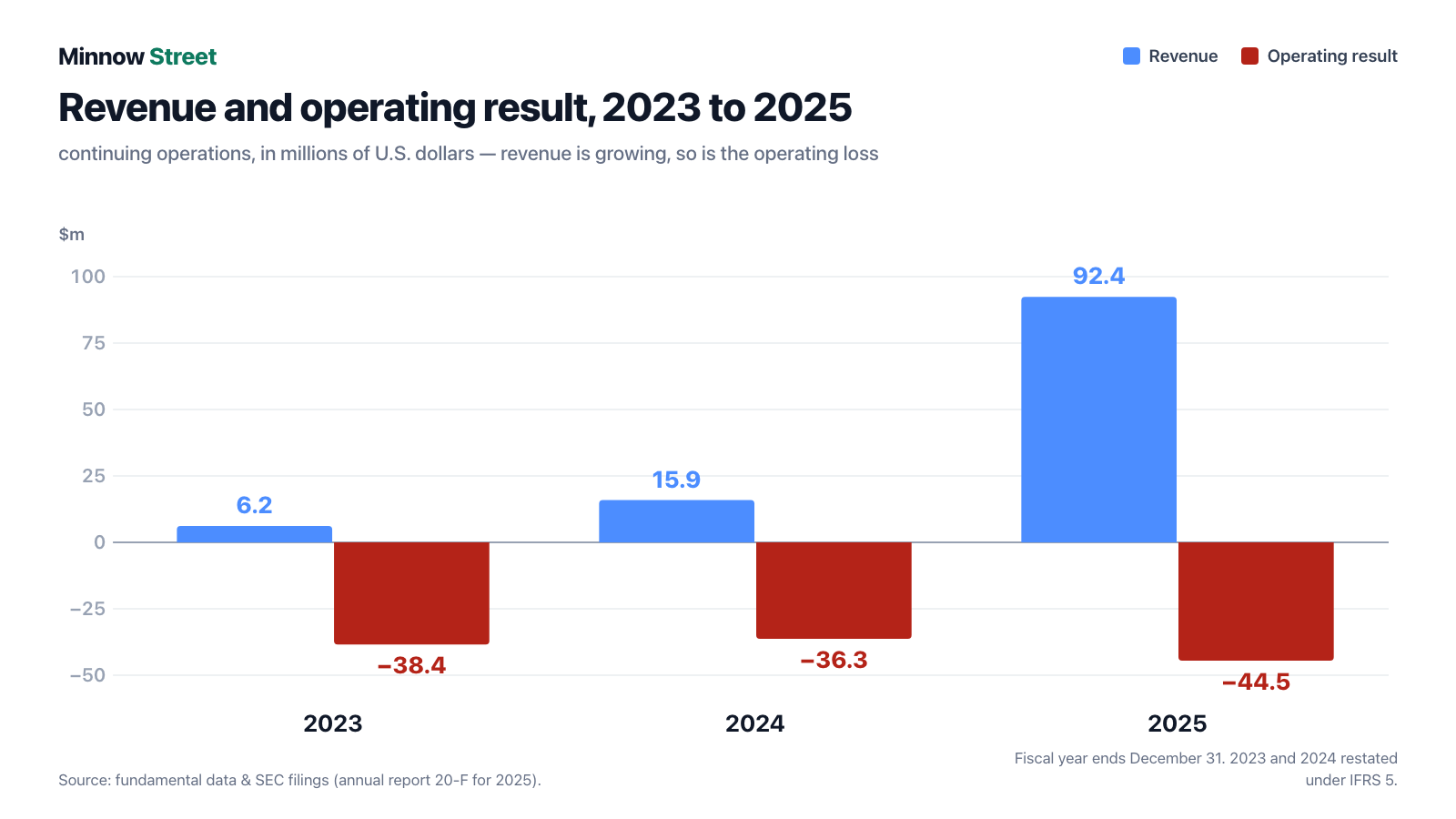
That is the finding on which everything else turns: the operating loss grew right along with revenue. $38.4 million in 2023, $36.3 million in 2024, $44.5 million in 2025 — on fifteen times the revenue. The first quarter of 2026 added another $8.9 million. The cash account feels it too: operations consumed $21.8 million in 2025 and $12.1 million in the first quarter of 2026 alone. Keep this picture in mind: Prenetics sells more and more — and so far has to spend more than a dollar to earn each additional dollar of revenue. Which brings us to the uncomfortable truths.
What the filings say — the uncomfortable truths
Uncomfortable truth no. 1: The profit is borrowed — it comes from warrants, not from the business
This is where it gets interesting. The operating loss for 2025 was $44.5 million. The net loss — the very last line, the one that ends up in every headline — was only $40.0 million. In other words, the bottom line looked better than the business. That is unusual: interest and tax normally make results worse on the way down, not better. The answer sits in the income statement of the annual report, and it has a name: the warrant exchange.
A quick explanation of what a warrant is: a voucher that lets its holder buy a share later at a price fixed in advance. Such vouchers are created in bulk when companies list through shell vehicles, and for the company they are an obligation that sits on the balance sheet and gets revalued every quarter. In December 2025 Prenetics offered holders an exchange. In accounting terms part of that obligation disappeared — and that produced a gain of $36.7 million. No goods moved, no customer paid anything. It is a bookkeeping event. Against it, the same year charged the revaluation of the remaining warrants at −$17.9 million, the bitcoin write-down at −$9.7 million, and other finance items, tax and discontinued operations at a combined −$4.5 million. Here is the bridge:
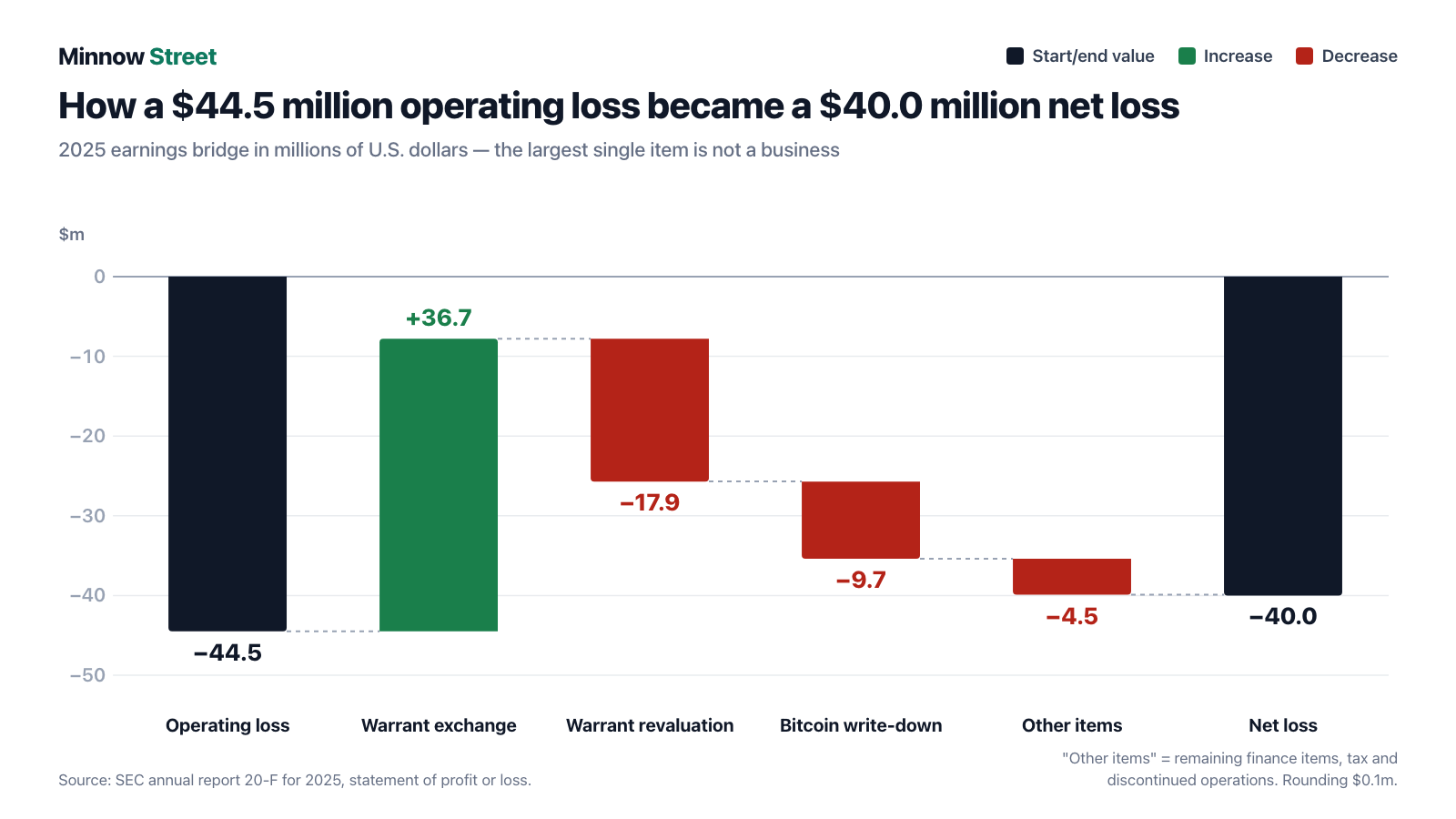
What does that mean in practice? The prettier bottom line is a one-time gift. A warrant exchange cannot be repeated next year — the vouchers are gone. For judging earnings power, the line above is the one that counts, and it reads minus $44.5 million, worse than 2023 and 2024. Put it in everyday terms: picture someone who spends $1,000 a month more than he earns, and whose year-end statement nonetheless looks better because the bank wrote off an old debt just once. The write-off is real. So is the hole in the day-to-day budget.
Uncomfortable truth no. 2: The famous $120 million of ARR is one single month times twelve
Now we return to the extrapolation trap from the opening. The number that appears in every report about Prenetics is $120 million of ARR. ARR stands for annualized recurring revenue. At software companies it is a sensible measure, because customers there sign annual licences — you know fairly precisely what next year will bring. At Prenetics the definition is different, and it sits as a footnote on the very page where the number is celebrated:
„The Company uses annualized recurring revenue (“ARR”) as a key operating metric and is calculated by multiplying the monthly revenue from the last month of a given period by 12.“
— Prenetics Global Limited, annual report on Form 20-F for fiscal 2025, footnote on the ARR metric, filed April 30, 2026 (sec.gov)
There it is. IM8 revenue in December 2025 was $10 million. Times twelve is $120 million. That is not a forecast, not an order book and certainly not contracted revenue — it is the best month, written out twelve times. For comparison, the figure that was actually earned: IM8 turned over $60.1 million across the whole of 2025. The headline number is therefore twice the brand’s real annual revenue. In fairness: the company does not hide the definition, it prints it right underneath. It would be equally unfair to leave out that almost nobody repeating the $120 million reads the footnote with it.
The word „recurring“ deserves its own moment. There is a subscription business at IM8, and it is not small. But a supplement subscription can be cancelled at any time; it is a very different animal from a signed twelve-month contract. If customers cancel in droves in January, the „recurring“ revenue is gone. And whether that happens, and how fast, cannot be checked from outside — which brings us to the second half of this truth. Prenetics writes with remarkable candour about how sturdy its own metrics are:
„Our metrics and key performance indicators (“KPIs”) are calculated using internal company data, definitions and methodologies that have not been independently verified by any third party and are not based on any standardized industry methodology.“
— Prenetics Global Limited, annual report on Form 20-F for fiscal 2025, risk factors on business metrics, filed April 30, 2026 (sec.gov)
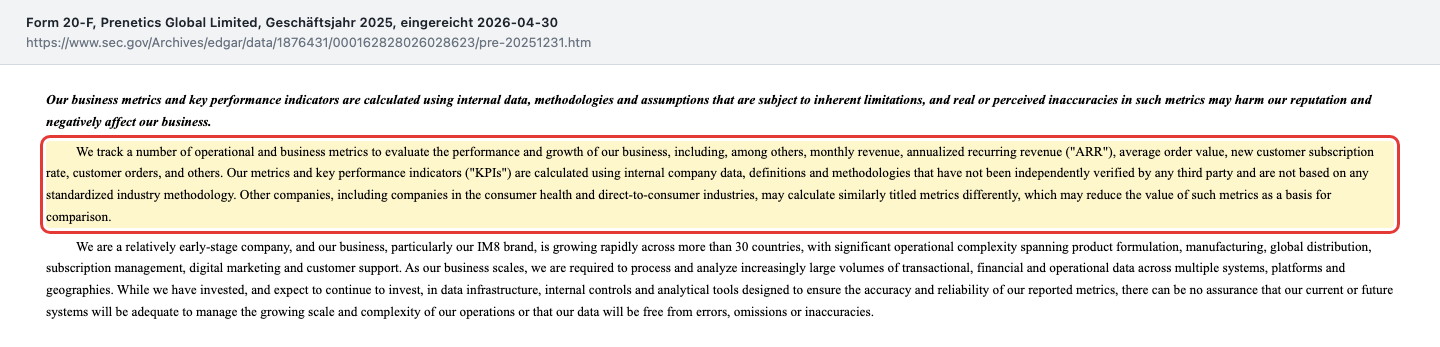
This is not an accusation but a gap worth naming: the audited part of the filing is the revenue line. The growth metrics that move the share price are not. And this is exactly where the finding meets the warning indicator from chapter three — the Beneish M-Score looks for precisely this kind of constellation. Anyone investing should know which part of the document an auditor has lent his name to, and which part he has not.
Uncomfortable truth no. 3: Half a year of bitcoin — and roughly $13 million in tuition
This one needs a moment to sink in. A company that urgently needs money for advertising, production and staff, and that burns tens of millions every year in its operations, bought bitcoin in the summer of 2025. Not a token amount: 510.03 coins for $54.4 million, an average of roughly $106,570 apiece. The annual report describes the episode and its end in its own words:
„Between June and December 2025, we pursued a digital asset treasury strategy under which we acquired approximately 510 Bitcoin as of the date of this Annual Report. On December 4, 2025, we ceased all further digital asset acquisitions, and on December 30, 2025, the board of directors determined that the Company would not allocate any existing or new capital for the purpose of acquiring additional digital assets.“
— Prenetics Global Limited, annual report on Form 20-F for fiscal 2025, risk factor on digital assets, filed April 30, 2026 (sec.gov)

The rest is arithmetic. By December 31, 2025 the holding was carried at just $44.6 million — the write-down of $9.7 million is one of the items you saw in the earnings bridge above. On May 1, 2026 the board resolved to sell the position in full; it raised $41.3 million, or roughly $80,980 apiece. Bought at $106,570, sold at $80,980: the six-month excursion cost around $13 million — a good tenth of the entire equity base of $121.0 million as of March 31, 2026. Further purchases of digital assets have since been ruled out by board resolution.
You can read this charitably: the mistake was recognised, corrected and the correction publicly documented — which is more than many boards manage. You can also read it strictly, and we lean that way: when a loss-making growth company puts half its war chest into a cryptocurrency, it is making a statement about how it treats shareholders’ money. That exact question comes up again in a moment, when a billion dollars of marketing money enters the picture.
Uncomfortable truth no. 4: One man holds 10 percent of the company and 68 percent of the votes
Who actually owns Prenetics? Formally, a broad shareholder base. In practice, one person decides. Danny Yeung — founder, chief executive and chairman of the board in one — held 1,749,744 shares as of the annual report. That is 10.19 percent of the capital but 67.72 percent of the voting power, made possible by a second share class with multiple votes. In everyday terms: picture a building where one owner holds one apartment out of ten but casts seven of the ten votes at every meeting. He can pass anything, and nothing can be passed against him. Prenetics spells out the consequence itself:
„We are a “controlled company” as defined under the Nasdaq rules because Mr. Yeung, chairman of our board of directors and our chief executive officer, owns more than 50% of the total voting power of all of our issued and outstanding ordinary shares. For so long as we remain a controlled company under that definition, we are permitted to elect to rely, and may rely, on certain exemptions from Nasdaq corporate governance rules.“
— Prenetics Global Limited, annual report on Form 20-F for fiscal 2025, risk factors on corporate governance, filed April 30, 2026 (sec.gov)
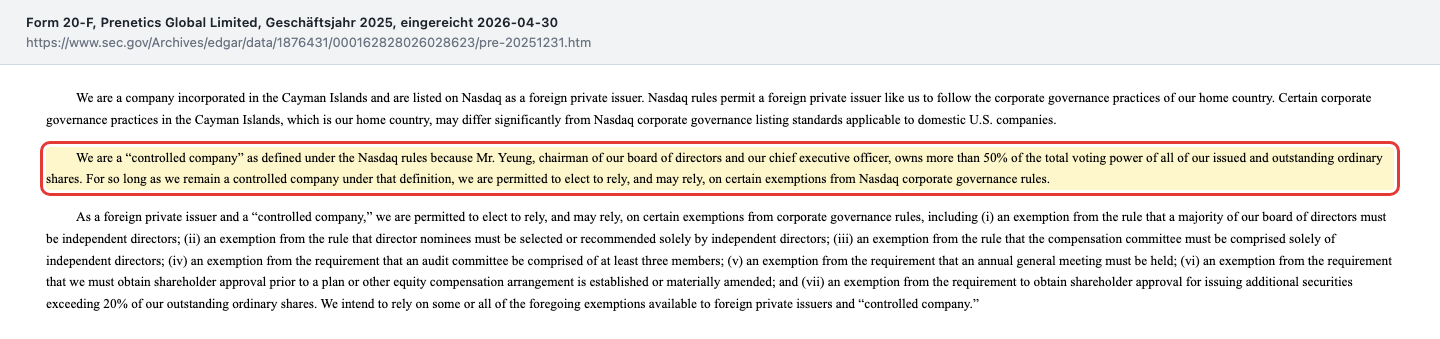
The report then lists which exemptions those are — among them that a majority of the board need not be independent, that the compensation committee need not consist solely of independent directors, and that shareholder approval is not required before issuing new shares exceeding 20 percent of the outstanding count. How that plays out in practice shows up in one plain number: the board has four members, two of whom qualify as independent. For comparison, a U.S. company of similar size without a controlling shareholder would typically show three of five or four of seven.
Uncomfortable truth no. 5: There are no quarterly reports — and no duty to file current reports
This truth is the least conspicuous and, day to day, perhaps the most consequential. The U.S. securities regulator, the SEC, classifies Prenetics as a foreign private issuer. That status brings relief from obligations worth knowing about before you buy:
„Because we qualify as a foreign private issuer under the Exchange Act, we are exempt from certain provisions of the securities rules and regulations in the United States that are applicable to U.S. domestic issuers, including: (i) the rules under the Exchange Act requiring the filing of quarterly reports on Form 10-Q or current reports on Form 8-K with the SEC […]“
— Prenetics Global Limited, annual report on Form 20-F for fiscal 2025, risk factors on foreign private issuer status, filed April 30, 2026 (sec.gov)
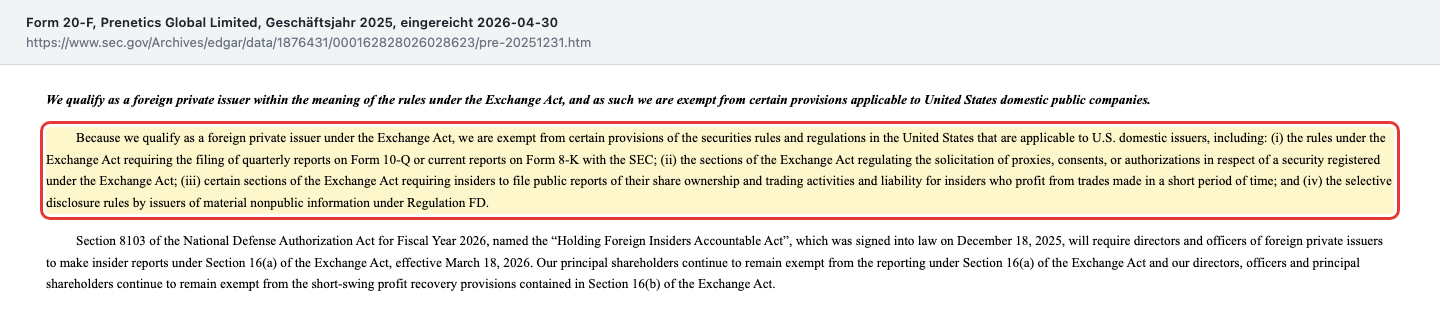
What does that mean in daily life? The quarterly report (Form 10-Q) is the standard filing through which U.S. companies deliver complete figures every three months in a fixed format. The current report (Form 8-K) forces prompt disclosure of material events — a change of chief executive, a large contract, the loss of a customer. Neither applies here. Instead Prenetics publishes interim disclosures on Form 6-K, and does so quite diligently: 2026 alone brought filings on annual results, a share buyback, the bitcoin sale, preliminary quarterly figures, final quarterly figures and the funding agreement. The catch is not the volume but the discretion and the format: what goes into a 6-K is up to the company. A 10-Q has a fixed structure, a fixed deadline and a review by auditors.
Combined with truth no. 2, a pattern emerges worth keeping in mind: the company defines its own metrics, largely sets its own disclosure rhythm — and the voting majority rests with one person. None of these three points is a scandal on its own. All three together mean that outsiders have to rely on the company’s word to an unusually high degree.
Uncomfortable truth no. 6: A billion for advertising — and its price sits below the line
On July 14, 2026 Prenetics announced the largest financing in its history: the U.S. venture capital firm General Catalyst is providing up to $1 billion through its Customer Value Fund, funding up to 70 percent of IM8 marketing spend. Start with the good news, and it is substantial: no new shares and no warrants are issued for it. For existing shareholders that means no smaller slice of the pie, no dilution. There is no fixed repayment obligation, no maturity date and no financial covenants; the funder recovers its money solely from the revenue of the customer cohorts its capital helped win, and its share is capped. For a company burning tens of millions a year, that is a remarkably gentle source of money.
And now the fine print, which deserves a second reading:
„Prenetics will classify the arrangement as a financial liability on its consolidated balance sheet, with the return component recognized as interest expense below operating income; meaning the arrangement introduces no new operating expense and has no impact on gross margin.“
— Prenetics Global Limited, interim disclosure on Form 6-K dated July 14, 2026 (sec.gov)
In plain terms: the cost of this money shows up where most investors do not look — below operating income. Metrics such as adjusted EBITDA, which Prenetics reports itself and which relate to the operating layer, do not see that expense. The operating result is not artificially flattered — the full marketing spend explicitly stays in sales and marketing expense — but the price of the financing moves into a line that is rarely quoted. And there is one more thing inside the announcement: a company that lets outsiders fund 70 percent of its marketing is also saying it cannot fuel that engine on its own.
The expectations attached to it are large. With the same announcement Prenetics raised its IM8 revenue guidance for 2026 to $210 million to $220 million — the second raise of the year, up from $190 million to $210 million. By the end of 2026 it targets $300 million of ARR, and for 2027 it points to revenue above $400 million. Remember the footnote from truth no. 2 when you read that: $300 million of ARR means, in the first instance, only that a single month is expected to bring in $25 million.
What the stock costs — valuation in orders of magnitude
Valuation at Prenetics is quickly explained, because half the usual measures drop out. A price-to-earnings ratio cannot be formed — there are no earnings to divide by. That leaves the price-to-sales ratio. As of the date of our hype scan on July 25, 2026, the market capitalization stood at $330.1 million. Trailing twelve-month revenue was $120.1 million. That makes a price-to-sales ratio of roughly 2.7. Against book value — the accounting equity per share, here $7.13 — the stock also trades at about 2.7 times.
How should that be read? Honestly: not as an excess. A company that grows revenue fifteenfold in two years while lifting its gross margin to 65 percent routinely commands four to eight times revenue in the market. Against that, 2.7 times is sober. Except — and this is the point — that price already assumes the company’s own guidance holds. Applied to the $210 million to $220 million of IM8 revenue projected for 2026, the ratio drops below 1.5 on paper. If the numbers do not arrive, the arithmetic turns just as quickly the other way, because there is no profit to cushion the fall.
The professionals’ view, to be taken with the usual pinch of salt: the average analyst price target stood at $34.20 and the earnings estimate for 2027 at −$0.95 per share (as of July 26, 2026). Translated, even the optimists do not expect black figures in 2027. On the other side, 4.58 percent of the float was sold short — bets on a falling price. That is visible but not dramatic; hotly contested stocks show double-digit readings. Remember this: the price is not the problem at Prenetics. The open question is whether revenue ever turns into profit.
Opportunities and risks at a glance
Both deserve equal weight — here are the two lists side by side.
What speaks for Prenetics:
- Real, audited revenue growth: from $6.2 million in 2023 to $15.9 million in 2024 and $92.4 million in 2025, with another $35.95 million in the first quarter of 2026. That is not an extrapolation but an audited line in a set of accounts.
- A rising gross margin: from 19.1 percent in 2023 to 52.8 percent in 2025 and 65 percent in the first quarter of 2026 — exactly the trajectory a scaling consumer goods business needs to show.
- A brand that reaches people: IM8 shipped to 43 countries by the end of the first quarter of 2026, with more than 60 percent of revenue generated outside the United States; June 2026 brought roughly $17 million, the strongest month in company history.
- Funding without dilution: up to $1 billion from General Catalyst (July 14, 2026) with no new shares issued, no fixed maturity and no financial covenants.
- A solid balance sheet: $56.0 million of cash and $50.0 million of securities as of March 31, 2026, plus $41.3 million from the bitcoin sale, $121.0 million of equity and, by the company’s own account, no debt.
What speaks against it:
- No operating profit, and the loss is widening: an operating loss of $44.5 million in 2025 after $36.3 million in 2024 and $38.4 million in 2023; $21.8 million of cash consumed in operations during 2025 and $12.1 million in the first quarter of 2026 alone.
- The friendlier bottom line is a one-off: the net loss of $40.0 million contains a warrant exchange worth plus $36.7 million that cannot be repeated.
- The headline metric is self-defined: ARR is monthly revenue times twelve, and Prenetics states that its metrics have not been independently verified by any third party.
- Control in one pair of hands: 67.72 percent of the votes against a 10.19 percent capital stake, controlled company status, four directors of whom two are independent.
- Fewer reporting duties: as a foreign private issuer, no quarterly reports (10-Q) and no current reports (8-K).
- Capital allocation with a question mark: the bitcoin detour between June and December 2025 cost around $13 million.
- Dependence on the advertising channel: the business lives and dies by paid reach on social platforms — if that gets more expensive, it hits the accounts immediately.
A human conclusion
Let us return to the extrapolation trap from the opening. It is so effective because it does not look like speculation; it looks like diligence. Ten million times twelve is one hundred and twenty million — arithmetically there is nothing wrong with that. It goes wrong the moment the product of that multiplication becomes a fact that gets passed along without the route that produced it. That is what happens with Prenetics, and honestly not only there: all of us would rather carry away the one shiny number than the footnote beneath it.
So what remains after reading the filings? A company that has pulled off something remarkable. Building a brand out of a dying testing business in two years, shipping to 43 countries and turning over roughly $17 million in a single month by June 2026 — not many manage that. The jump from $6.2 million to $92.4 million is audited, the rising gross margin is real, and bringing in a billion dollars of growth capital without issuing a single new share is genuinely good news for anyone already on board. You can acknowledge all of that without being naive.
And alongside it stands the rest. The operating loss did not shrink in 2025; it grew. The prettier bottom line came from a bookkeeping event, not from customers. The metric everyone quotes is defined by the company and verified by nobody. One man decides with two thirds of the votes on a tenth of the capital. And that same leadership put half the treasury into bitcoin a year ago and pulled it back out at a loss of roughly $13 million. None of that proves this will end badly. All of it is a reason to read the next filings yourself — and to read the line above the operating result, not the one below it.
If you take away a single question, make it this one: will the revenue ever become cheaper than the marketing that produces it? As long as the answer is open, what you are buying here is growth on the credit of a story. If the answer one day turns out to be yes, this year will be described as the moment it became visible. What you make of that is your decision. And that is exactly as it should be.
Sources
Every original document used in this analysis — for you to read yourself:
- Prenetics Global Limited — SEC annual report on Form 20-F for fiscal 2025 (filed April 30, 2026)
- Prenetics Global Limited — SEC amendment on Form 20-F/A for fiscal 2025 (filed July 2, 2026, Rule 3-09 financial statements for the Insighta investment)
- Prenetics Global Limited — SEC interim disclosure on Form 6-K dated February 18, 2026 (fiscal 2025 results)
- Prenetics Global Limited — SEC interim disclosure on Form 6-K dated March 6, 2026 ($40 million share repurchase program)
- Prenetics Global Limited — SEC interim disclosure on Form 6-K dated May 4, 2026 (resolution to divest the entire bitcoin holding)
- Prenetics Global Limited — SEC interim disclosure on Form 6-K dated May 14, 2026 (preliminary first-quarter 2026 figures)
- Prenetics Global Limited — SEC interim disclosure on Form 6-K dated June 10, 2026 (first-quarter 2026 figures)
- Prenetics Global Limited — SEC interim disclosure on Form 6-K dated July 14, 2026 (General Catalyst funding agreement, raised guidance)
- Complete SEC filing history of Prenetics Global Limited: EDGAR overview (sec.gov)
- Source: fundamental data & SEC filings (annual reports 20-F, current reports 6-K) — metrics and valuation as of July 26, 2026, reconciled against the original documents linked above.
- Origin and screen data: daily Reddit hype scan and our in-house stock scanner, as of July 25, 2026. All lists are recalculated daily.
Transparency & disclaimer: this analysis is journalistic commentary on publicly available information. It is not investment advice, not a regulated financial analysis and not a solicitation to buy or sell securities. Equity investments carry substantial risk up to and including total loss. All information is provided without warranty; the as-of date of the data is noted in the text. The author holds no position in Prenetics shares at the time of publication.
Our Bottom Line at a Glance
- Growth and demand positive
- The growth is real and cannot be argued away: revenue from continuing operations rose from $6.2 million in 2023 to $15.9 million in 2024 and $92.4 million in 2025, with another $35.95 million in the first quarter of 2026. The gross margin improved from 19.1 percent in 2023 to 52.8 percent in 2025 and 65 percent in the quarter. IM8 shipped to more than 30 countries in 2025 and to 43 by the end of the first quarter of 2026.
- Earnings power negative
- The operations earn nothing. The operating loss grew alongside revenue: $38.4 million in 2023, $36.3 million in 2024 and $44.5 million in 2025, plus $8.9 million in the first quarter of 2026. Cash burn stayed heavy too, at $21.8 million in 2025 and $12.1 million in the first quarter of 2026 alone. In its current shape this company has never delivered a year of operating profit.
- Quality of earnings and metrics negative
- The 2025 net loss of $40.0 million only looks better than the operating loss of $44.5 million because a one-off warrant exchange added $36.7 million. The headline metric ARR is, by the annual report's own footnote, one month of revenue multiplied by twelve, and Prenetics states that its metrics have not been independently verified by any third party. Our in-house balance-sheet warning screen, the Beneish M-Score, listed the stock on July 25, 2026.
- Balance sheet and funding neutral
- For a loss-making company the balance sheet is comfortable: $56.0 million of cash and $50.0 million of financial assets as of March 31, 2026, plus $41.3 million from the bitcoin sale, $121.0 million of equity and, by the company's own account, no debt. The General Catalyst facility of up to $1 billion (July 14, 2026) dilutes nobody — but it sits on the balance sheet as a financial liability, and its price lands as interest expense below operating income.
- Control and capital allocation negative
- Founder Danny Yeung holds 10.19 percent of the capital and 67.72 percent of the voting power (annual report 20-F for 2025). As a controlled company and foreign private issuer, Prenetics is exempt from quarterly reports (10-Q), current reports (8-K) and several Nasdaq governance requirements; the board has four members, two of them independent. The bitcoin detour between June and December 2025 cost around $13 million and shows how quickly capital changes direction here.
- Valuation neutral
- As of July 25, 2026 the market capitalization stood at $330.1 million, or roughly 2.7 times trailing twelve-month revenue of $120.1 million. For a company that has grown revenue fifteenfold in two years that is not excessive — but the price already assumes the company's own guidance holds, namely $210 million to $220 million of IM8 revenue in 2026. A price-to-earnings ratio does not exist for want of earnings.
Prenetics is the rare case where the growth story checks out and caution is still warranted. Revenue genuinely climbed from $6.2 million to $92.4 million in two years and the gross margin reached 65 percent in the first quarter of 2026 — yet the operating loss grew with it, to $44.5 million in 2025, and the friendlier net loss of $40.0 million owes itself to a one-off warrant exchange worth $36.7 million. The metric everyone quotes is an extrapolation: ARR is, by the company's own definition, one month of revenue times twelve, and nobody outside the company has verified those numbers. Add 67.72 percent of the votes in one pair of hands against a 10.19 percent capital stake, a loss-making bitcoin detour and a reporting status without quarterly filings. Anyone buying here gets a real brand with real revenue growth — and at the same time relies on figures the company defines itself. Not investment advice.
What Our Rating Means
Open questions
The business works in principle, but one material question is open. As long as it stays open, our findings do not carry a quality verdict.
The business works in principle: IM8 demonstrably sells, the gross margin carries, and with $121.0 million of equity, roughly $106 million in cash and securities as of March 31, 2026 and no debt, the balance sheet is not in danger — there is no documented threat to the substance of the company that would justify red. What is open is a decidedly weighty operational question: in its current shape Prenetics has not produced a single year of operating profit, and the operating loss grew in 2025 even as revenue rose sixfold. On top of that, the most important growth metric is defined by the company itself and verified by no third party, which makes progress harder to check than the headlines suggest. Anyone investing is betting that the marketing machine will one day cost less than the revenue it produces. That remains unproven. The decision is yours.
A journalistic assessment by our editorial team at the time of the deep dive, based on public sources — not investment advice and not a solicitation to buy or sell. Your personal circumstances (investment goals, risk capacity, taxes) cannot be taken into account. What our levels mean, how verdicts are formed, and what conflicts of interest exist →
Worth Noting
- Prenetics reached our research list through the daily Reddit hype scan: 2 mentions at a market capitalization of $330.1 million, as of July 25, 2026. On the same day the stock appeared on nine momentum and growth screens of our in-house stock scanner — and simultaneously on the risk screen named Beneish M-Score, a balance-sheet warning indicator. All of these lists are recalculated daily.
- All annual figures come from the 20-F annual report for 2025 (filed April 30, 2026) and refer to continuing operations; the 2023 and 2024 figures were restated under IFRS 5 after the disposals of ACT Genomics, the European logistics business and the Insighta stake. Quarterly figures as of March 31, 2026 are taken from the 6-K interim disclosure filed June 10, 2026.
- Do not confuse the terms: at Prenetics, ARR is not an audited revenue measure but monthly revenue multiplied by twelve. IM8 generated $60.1 million of revenue in the full year 2025 while the $120 million ARR figure was in circulation. Valuation figures are dated and meant to be evergreen; daily share prices are not a reason to buy.
Frequently Asked Questions
Prenetics Global Limited (NASDAQ: PRE) started out as a testing provider that worked for the Hong Kong government during the pandemic. Today it sells nutritional supplements under the IM8 brand, co-founded with David Beckham, and consumer genetic tests under CircleDNA. IM8 generated $60.1 million of revenue in 2025 and CircleDNA $12.9 million — $92.4 million in total including other income streams.
Because the U.S. securities regulator, the SEC, classifies Prenetics as a foreign private issuer. That status exempts a company from filing quarterly reports (Form 10-Q) and current reports (Form 8-K). All that remains is the annual report (Form 20-F) plus voluntary interim disclosures (Form 6-K). Investors therefore get figures less often, and in a less standardized format, than from a comparable U.S. company.
ARR stands for annualized recurring revenue. In its 20-F annual report for 2025 Prenetics defines the metric explicitly as the revenue of the final month of a period multiplied by twelve. IM8 monthly revenue in December 2025 was $10 million, which produces the $120 million ARR figure. For the full year 2025, IM8 actually generated $60.1 million.
No. The operating loss came to $44.5 million in 2025, wider than in the two prior years (2024: $36.3 million, 2023: $38.4 million). The reported net loss of $40.0 million looks smaller only because a one-off warrant exchange contributed $36.7 million to the finance result. The first quarter of 2026 again showed an operating loss, of $8.9 million.
Prenetics bought roughly 510 bitcoin between June and December 2025 for $54.4 million, an average of about $106,570 apiece. Purchases stopped on December 4, 2025, and on May 1, 2026 the board resolved to sell the entire position. It raised $41.3 million, roughly $80,980 apiece. Further purchases of digital assets are ruled out by board resolution.
Founder and chief executive Danny Yeung held 1,749,744 shares as of the annual report for 2025 — 10.19 percent of the capital, but 67.72 percent of the voting power. Prenetics therefore counts as a controlled company under Nasdaq rules and may opt out of several corporate governance requirements. The board consists of four directors, two of whom qualify as independent.
On July 14, 2026 Prenetics agreed a facility of up to $1 billion with the venture capital firm General Catalyst. It funds up to 70 percent of IM8 marketing spend without any new shares or warrants being issued. Prenetics records the arrangement as a financial liability, and the funder's return appears as interest expense below operating income.
As of the hype scan on July 25, 2026 the market capitalization stood at $330.1 million. Measured against trailing twelve-month revenue of $120.1 million, that is a price-to-sales ratio of roughly 2.7. A price-to-earnings ratio cannot be calculated because there are no earnings. Book value was $7.13 per share (as of July 26, 2026).
Found an error?
Did you spot a factual error, an outdated number, or a typo in this deep dive? Let us know briefly — your report goes straight to the editorial team.