Powell Industries Stock: Zero Bank Debt, a $1.8 Billion Backlog, Rank 5 on Buffett Criteria — and a Price Tag of 60 Times Earnings
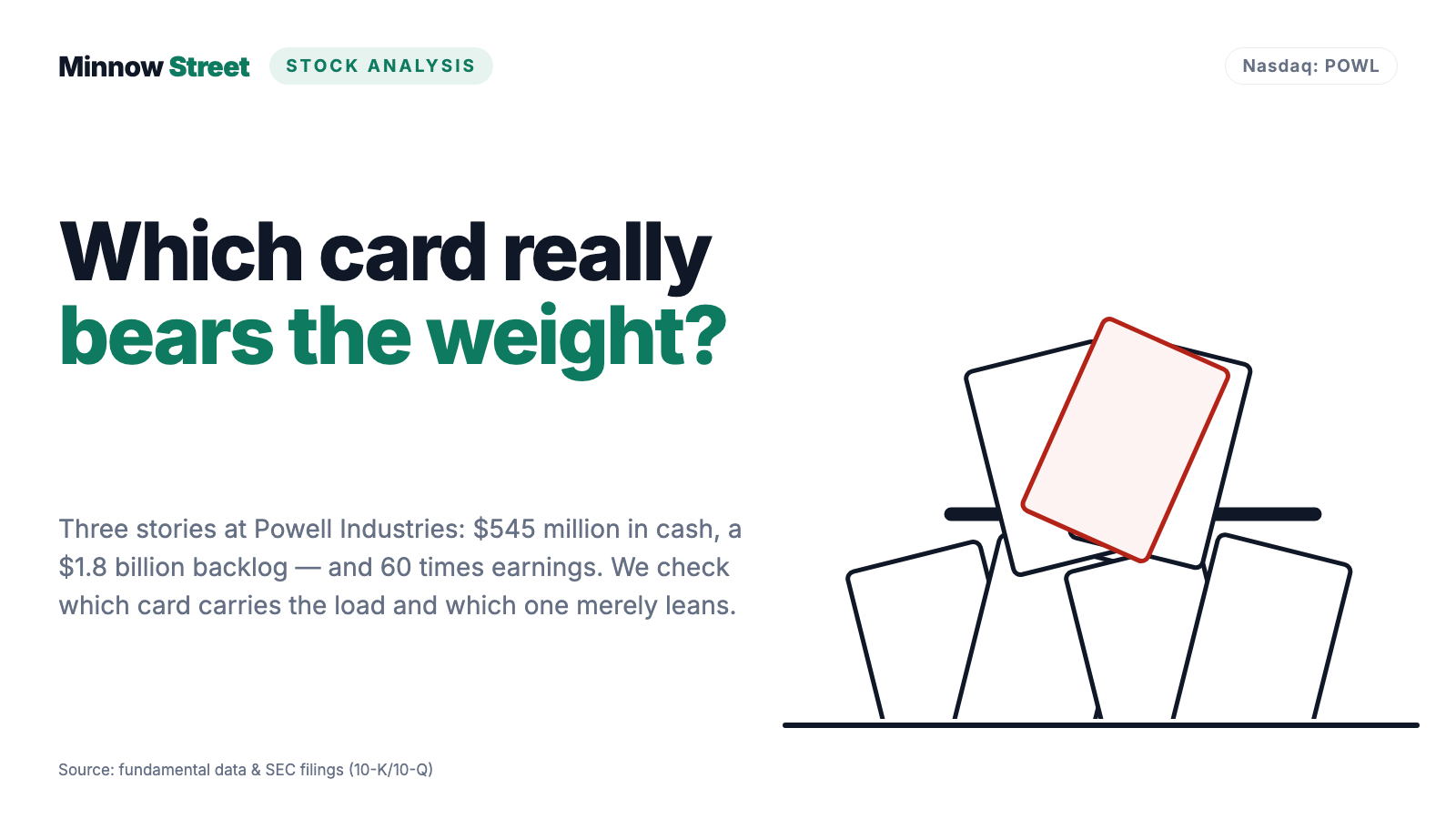
Powell Industries builds the switchgear that keeps refineries, power grids and, lately, AI data centers running — and it ranks no. 5 in the U.S. selection of our in-house Buffett criteria scanner (as of July 18, 2026). We read the annual reports (10-K) and quarterly reports (10-Q): a balance sheet with no drawn bank debt and $544.9 million in cash, a $1.8 billion backlog, and data center awards of more than $700 million within a few months — but also a quarter in which profit shrank despite record revenue, an oil and gas business that still carries half the revenue, and a valuation near 60 times earnings. Not investment advice — just a close look at which card in this house actually bears weight.
 Thomas Mücke
Founder & Publisher
Thomas Mücke
Founder & Publisher
Chart
Interactive price chart (TradingView).
Note: pure fact-based analysis, not investment advice and not a solicitation to buy or sell. All figures without guarantee.
There is an investor trap that is especially well camouflaged because it feels like diligence: the Buffett halo. It works like this: a filter carries the name of the most famous investor in the world, a stock passes it — and your brain books that as "vetted by Buffett." In truth, the filter has merely sorted ratios; the one question Warren Buffett opens and closes every examination with — what does the whole thing cost? — was never asked. Powell Industries, Inc. (Nasdaq: POWL) is a textbook case: the stock ranks no. 5 in the U.S. selection of our in-house Buffett criteria scanner (as of July 18, 2026), the balance sheet carries no drawn bank borrowings, return on equity runs near 30 percent. So let\'s make a deal: before the halo decides for you, we read together what Powell itself filed, under penalty of law, with the U.S. securities regulator, the SEC — the annual reports (10-K) for fiscal years 2024 and 2025 and the quarterly reports (10-Q) through March 31, 2026. Both things are in there: an order backlog of $1.8 billion, filled by the power appetite of AI data centers. And a price tag near 60 times earnings for a project manufacturer whose profit shrank in the most recent quarter despite record revenue. In the end, you decide what the halo is worth.
What Powell actually does — and why AI data centers are suddenly ordering switchgear
Powell Industries, founded in Houston by William E. Powell in 1947, builds what you would call a breaker panel in a family home — except that Powell\'s "breaker panels" are forty feet long, switch medium voltage and ship to refineries as complete, walk-in steel buildings ("power control rooms") on heavy-haul trucks. The company develops, manufactures and services custom-engineered switchgear, protection technology and control rooms that distribute, monitor and — in a fault — cut large flows of electrical energy within milliseconds. 3,143 full-time employees (plus 315 contract workers, as of September 30, 2025) do that work mostly in the United States, Canada and the United Kingdom. The customers come from five worlds, which the annual report (10-K) for fiscal 2025 (October 2024 through September 2025) lays out neatly: oil and gas ($406.6 million in revenue, 37 percent), electric utilities ($279.0 million, up 50 percent year over year), commercial and other industrial — this is where the data centers live — ($178.2 million, up 19 percent), petrochemical ($151.2 million, down 19 percent) and light rail traction power ($41.3 million, up 87 percent).
The market story of 2026 is quickly told: data centers for cloud and artificial intelligence need enormous amounts of power, and between the substation and the server hall there is always a switchgear lineup — often one from Powell. Sounds like marketing? Partly, it is — a good half of revenue still comes from oil, gas and petrochemicals. But the orders are real, as we will see in black and white shortly. Which brings us to the central tension of this analysis, running through every chapter: Powell has the balance sheet of a Buffett textbook and an order book from the AI boom — but the market now prices the project manufacturer like a tech stock, while profit has stalled and insiders have been doing nothing but selling. How capital-hungry the AI build-out is on the buyer side is something we dissected in our Nvidia analysis; that power generators earn on it too was the subject of our Caterpillar analysis. Powell is the third link in the same chain: no AI product, but the infrastructure for it.
Where the stock shows up in our scanner
Every day we run about 3,500 stocks through our scanners. As of the July 18, 2026 data cut-off, Powell appears on 17 lists — the occasion for this analysis is rank 5 in the Buffett criteria scanner (U.S. selection). To replicate it: open the scanner, set the country filter to "US" — Powell sits in the top 5. The scanner checks, roughly speaking, the textbook virtues: high return on equity (Powell: near 30 percent), a solid operating margin (near 19 percent), low leverage (debt to equity: practically zero — there are no drawn bank borrowings, only a credit facility used for letters of credit) and an equity ratio near 60 percent. On top of that comes confluence from two very different directions: quality lists such as the Levermann scanner and institutional accumulation carry the stock, as do half a dozen momentum lists (stage-2 leaders, relative-strength leaders above 90, trend criteria). But honesty belongs here too, twice over. First: the Piotroski F-Score — a nine-point quick test of whether the books are currently improving or deteriorating — stood at only 4 of 9 in the latest quarter. That is mediocre, not good; robust health starts at 8, and a year earlier Powell scored 9. Second: the Buffett numbers are young. As recently as fiscal 2022, Powell earned a meager $13.7 million — the 30 percent return on equity is three years old, not thirty. Remember the principle: a Buffett filter checks yesterday\'s numbers — neither the durability of the advantage nor today\'s price. Which is exactly why we now read the filings.
The numbers over the years — honestly appraised
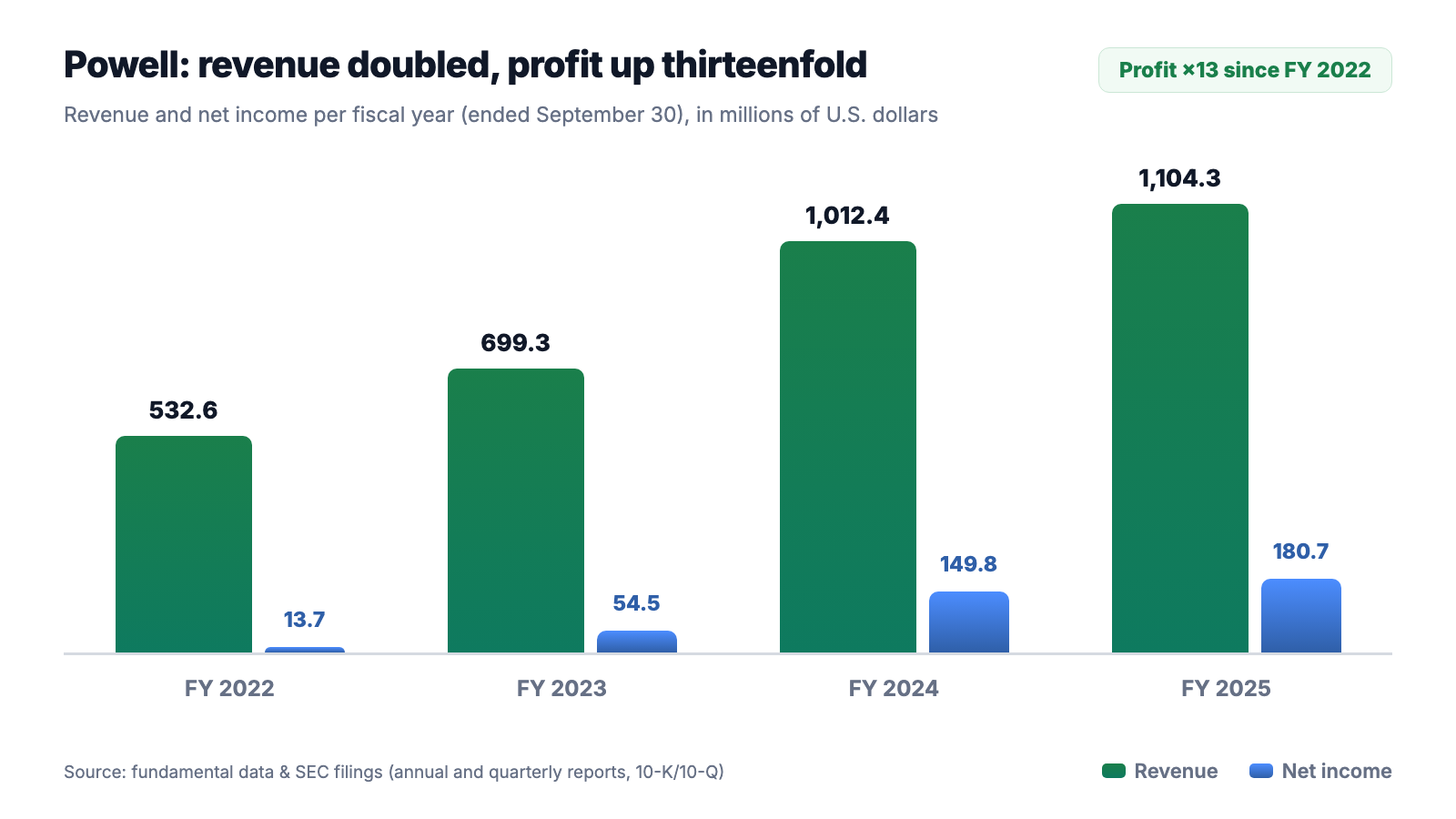
First, what genuinely impresses — and here that is quite a lot. Within three years, Powell made a leap that mature industrial companies rarely manage: revenue climbed from $532.6 million (fiscal 2022) via $699.3 million (2023) and $1,012.4 million (2024) to $1,104.3 million in fiscal 2025 — more than a doubling. Net income exploded over the same span from $13.7 million via $54.5 million and $149.8 million to $180.7 million — thirteen times the starting value, while the gross margin climbed from 16 to 29 percent. There is no accounting trick behind this, just utilization: the big oil and gas awards of 2022/2023 filled the factories, and full factories spread their fixed costs across more revenue. Operating cash flow rose to $167.9 million in fiscal 2025 (prior year: $108.7 million), cash and short-term investments grew to $475.5 million by September 30, 2025 — and further to $544.9 million as of March 31, 2026, without a single dollar of bank debt drawn.
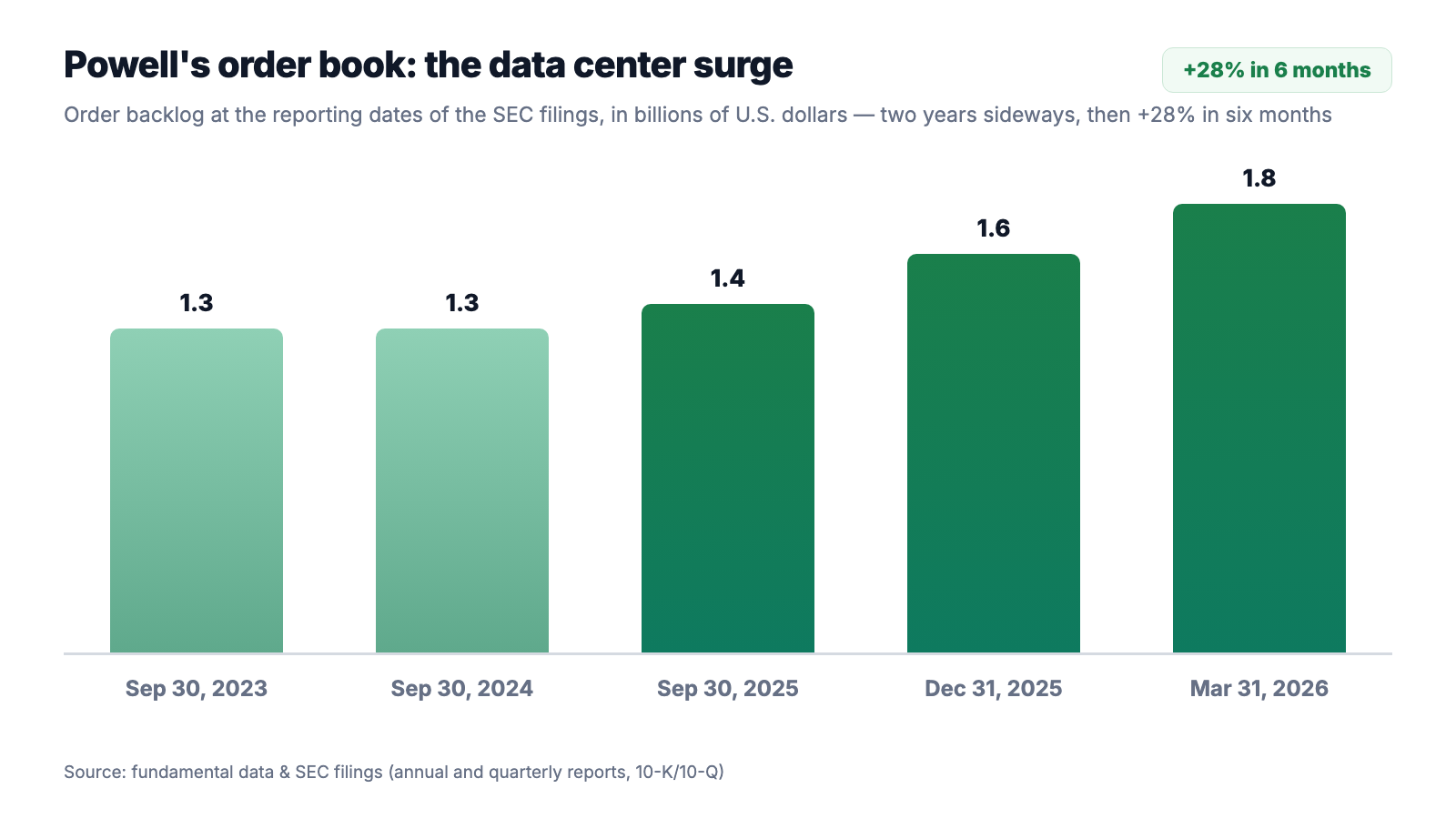
And the future? Sits in the order book. The backlog stood at roughly $1.3 billion at the end of September 2023 and again in 2024, at $1.4 billion at the end of September 2025 — and then it accelerated: $1.6 billion by December 31, 2025, $1.8 billion by March 31, 2026, a 28 percent increase in six months. The driver is spelled out verbatim in the quarterly report (10-Q):
"During the first half of Fiscal 2026, we were awarded projects related to data center infrastructure with a combined value exceeding $300 million, including two mega projects, each with an order value greater than $75 million. Subsequent to the second fiscal quarter, we secured an additional mega order in the data center market with a value in excess of $400 million."
— Powell Industries, Inc., SEC quarterly report 10-Q as of March 31, 2026, Item 2 "Management's Discussion and Analysis" (Commercial and other industrial markets)
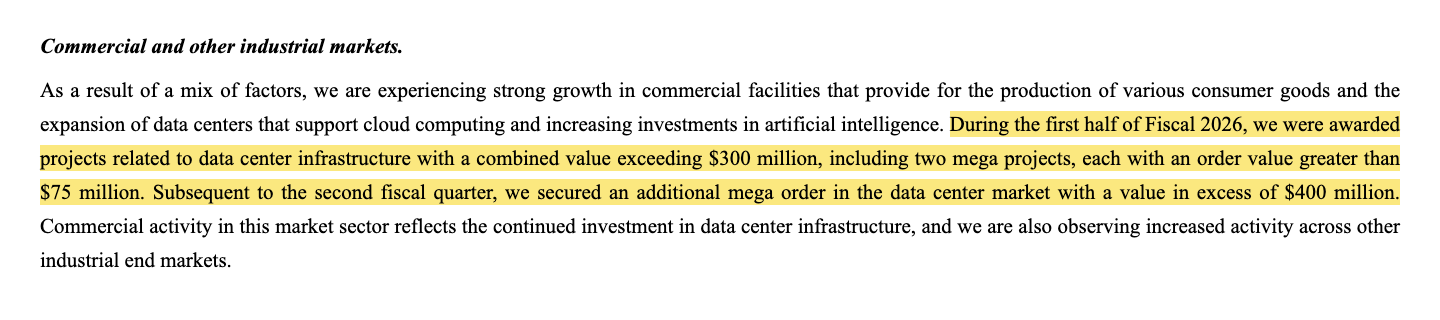
A single order worth more than $400 million — that is roughly a quarter and a half of revenue in one contract, in the company\'s own vocabulary a "mega" order (anything above $50 million). The report also mentions a $75 million utility mega order for grid modernization and generation capacity; back in fiscal 2025, Powell had already won the largest electric utility award in its history. As of March 31, 2026, the order book was remarkably balanced: 30 percent electric utilities, 29 percent each for oil and gas and for commercial and industrial. But pause for a moment before the number rush takes over: orders are not yet profit — what can happen on the way in between is the subject of the next chapter.
What the filings say — the uncomfortable truths
Uncomfortable truth no. 1: In the latest quarter, profit shrank — despite record revenue
The second quarter of fiscal 2026 (January through March 2026) delivered the highest quarterly revenue in company history, $296.6 million. And still, less was left at the bottom line than a year earlier. The quarterly report says it without hedging:
"In the second quarter of Fiscal 2026, we recorded net income of $45.9 million, or $1.25 per diluted share, compared to net income of $46.3 million, or $1.27 per diluted share (as adjusted for the Stock Split), in the second quarter of Fiscal 2025. The decrease in net income was primarily driven by higher selling, general and administrative expenses and increased research and development expenses, partially offset by higher gross profit in the second quarter of Fiscal 2026."
— Powell Industries, Inc., SEC quarterly report 10-Q as of March 31, 2026, Item 2 "Management's Discussion and Analysis"

The details: selling, general and administrative expenses rose 19 percent to $25.8 million, research and development spending jumped 56 percent to $4.3 million — Powell is hiring, expanding and developing while the gross margin held steady at 30 percent. Over the half year, profit still grew (up 8 percent to $87.3 million, or $2.39 per share), and capacity investment is exactly right for an order manufacturer with a full book. But for a stock trading near 60 times earnings, a quarter with minus one percent profit growth is uncomfortable news. Remember the tension: the order book grows at double-digit rates, earnings per share most recently did not grow at all. One quarter does not make a summer — but a P/E of 60 leaves no quarters to spare.
Uncomfortable truth no. 2: The backlog is not a promise — and half the business still hangs on oil
The prettiest backlog has a catch that Powell itself writes into its risk factors:
"Our backlog is subject to unexpected adjustments, cancellations and scope reductions and, therefore, may not be a reliable indicator of our future earnings."
— Powell Industries, Inc., SEC annual report 10-K for fiscal year 2025, Item 1A "Risk Factors"

Add three structural points, all from the same risk factors. First, industry concentration: no single customer accounted for more than 10 percent of revenue in fiscal 2024 or 2025 — but oil, gas and petrochemicals together delivered about 50 percent of fiscal 2025 revenue. Translated into an everyday image: the baker has many customers, but half the counter is bought by the same factory workforce — if the factory closes, half the revenue is a hope, not a number. An oil price crash like 2015 or 2020 would hit Powell\'s largest segment directly. Second, the fixed-price trap: material costs equaled about 45 percent of revenue in fiscal 2025 (steel, copper, engineered electrical components), and many contracts are fixed-price agreements that do not let Powell pass on cost increases — from tariffs, for instance — to the customer. Third, the capacity ceiling: Powell itself writes that the backlog growth "challenges" its manufacturing capacity and its ability to recruit qualified labor, raising the risk of missing delivery dates and contract obligations — with penalty provisions and liquidated damages as the consequence. The company is investing against it ($12.4 million for 62 percent more yard capacity at the Jacintoport facility, plus the August 2025 acquisition of the British protection-technology maker Remsdaq) — but a project manufacturer that sells faster than it can build earns doubly less on every mistake.
Uncomfortable truth no. 3: AI fills Powell's order book — and appears in Powell's risk factors at the same time
The finest irony in this file: the same technology that drives Powell\'s record orders shows up in the annual report as a threat — not as a stock phrase, but as its own, concretely worded risk factor:
"Technological innovations may make existing products and production methods obsolete. The development or use of Artificial Intelligence (AI) by our competitors or other third parties may impair our ability to compete effectively and adversely affect our business, financial condition and results of operations."
— Powell Industries, Inc., SEC annual report 10-K for fiscal year 2025, Item 1A "Risk Factors"
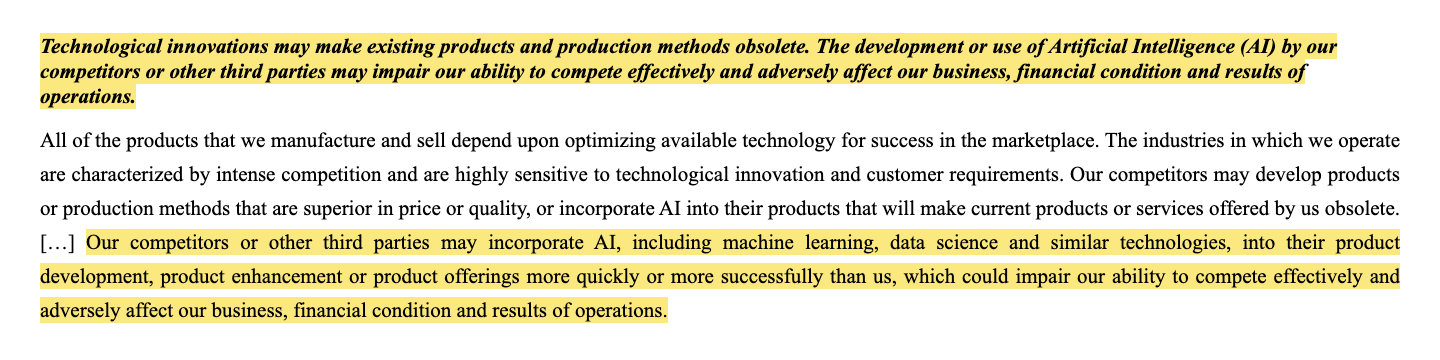
Concretely, the report says competitors could incorporate "AI, including machine learning, data science and similar technologies" into product development and product offerings faster or more successfully than Powell — and thereby render Powell\'s products obsolete; a second risk factor concedes that the company\'s own efforts could fall short ("We may not be successful in our AI initiatives"). This is no disaster bulletin — switchgear is certified, safety-critical hardware that nobody replaces with a software update. But it grounds the narrative: Powell is an AI beneficiary on the demand side and an AI laggard on the product side. If you are buying the stock as an "AI winner," know that the company itself puts it more carefully on the record — under penalty of law.
Valuation: what the market charges for the Buffett report card
Now to the price tag — and a chapter of price history you need to know. On April 2, 2026, Powell executed a 3-for-1 stock split (two additional shares for each one held; authorized shares rose from 30 million to 90 million) — the classic move of a stock whose price has outgrown its own company. Split-adjusted, the 52-week range ran from about $180 to about $610; at the July 18, 2026 data cut-off the stock traded near $309 — after a four-year gain of more than 3,600 percent, yet at the same time roughly half below its 52-week high. At a market value near $11.3 billion, that works out to: a price-earnings ratio near 60 (on trailing twelve-month earnings of a good $5 per share), a price-sales ratio near 10 and a price-book ratio near 16 (all data as of July 18, 2026). For perspective: that is the valuation of a software growth stock — for a project manufacturer whose analyst estimates (fundamental data, as of July 18, 2026) hover around $5 in earnings per share for fiscal 2026/2027, meaning no profit surge is on the books to grow into. Two footnotes belong to the honest picture. First, Powell now earns noticeably on its own cash pile — in the first half of fiscal 2026, net interest income contributed $8.5 million, close to 8 percent of pre-tax income; solid, but it is not switchgear. Second, the dividend: Powell has raised the annual rate by one cent per year for years ($1.0400 → $1.0475 → $1.0575 → $1.0675 across fiscal 2022–2025, pre-split); after the split it is $0.09 per quarter — about 0.1 percent at the current price. And the insiders? Per the SEC register, they filed nothing but sales between mid-May and mid-July 2026 — among them CEO Brett Cope himself, who sold 4,440 shares at $241.55 on July 9. The growth, the quality and the cash are real here. They are being paid for with a price that already contains three more record years.
Opportunities and risks at a glance
What speaks for Powell:
- A textbook balance sheet: no drawn bank borrowings, $544.9 million in cash and short-term investments (March 31, 2026), an equity ratio near 60 percent, an Altman Z-Score near 11 (an early-warning test for insolvency: the danger zone starts below 1.8) — plus a return on equity near 30 percent (data as of July 18, 2026).
- A record backlog: $1.8 billion (March 31, 2026, up 28 percent in six months), balanced across electric utilities (30 percent), oil and gas (29) and commercial/industrial (29) — including more than $700 million in data center awards since October 2025, one mega order alone in excess of $400 million.
- Structural tailwind: power demand from AI data centers, grid modernization (the largest electric utility award in company history in fiscal 2025) and re-industrialization — Powell earns on electrification no matter which chipmaker wins.
- Operating substance: revenue doubled and profit grew thirteenfold since fiscal 2022, gross margin up from 16 to 29 percent, operating cash flow of $167.9 million in fiscal 2025; capacity expansion (Jacintoport, up 62 percent) and the Remsdaq acquisition broaden the offering.
What speaks against it:
- The valuation pays for perfection: P/E near 60, price-sales near 10, price-book near 16, dividend yield near 0.1 percent (data as of July 18, 2026) — for a cyclical project manufacturer whose earnings estimates stagnate around $5 per share.
- Profit most recently without growth: record revenue in Q2 of fiscal 2026, yet net income slipped to $45.9 million (prior year: $46.3 million) on SG&A up 19 percent and R&D up 56 percent; the Piotroski F-Score is down to 4 of 9.
- The oil cluster: about 50 percent of fiscal 2025 revenue from oil, gas and petrochemicals — a commodity-price crash would hit the largest segment; the petrochemical business already shrank 19 percent.
- Project risks: fixed-price contracts with material costs at 45 percent of revenue (tariffs!), capacity and skilled-labor bottlenecks from the backlog growth, penalty clauses — and Powell\'s own warning that the backlog "may not be a reliable indicator" of future earnings.
- The insider one-way street: zero reported buys, eighteen sales (fundamental data, as of July 18, 2026); the CEO\'s July 9, 2026 sale at $241.55 — well below the July 18 price level.
A human conclusion
Back to the Buffett halo from the opening. Its core is not that the criteria are wrong — Powell\'s numbers pass every textbook test: the debt freedom is not a claim but a credit agreement with zero drawings; the half billion in cash sits on the balance sheet; the $1.8 billion backlog is in the quarterly reports. The halo deceives elsewhere: it lets you skip the one check its namesake never skipped — what does it cost, and what do I get for it? The honest answer from the documents: you get a superbly financed niche champion with genuine AI tailwind on the demand side — at 60 times a profit that most recently stalled, with an oil business as half the foundation, a self-certified AI gap on the product side and a management team that has stood on the sell side of its own ticker for months. In the house-of-cards image: the cash card and the order card stand firm — the valuation card merely leans, and it leans on the expectation of three more record years. Instead of the halo, read the quarterly reports (10-Q): the backlog (does it grow beyond $1.8 billion?), the cost ratios (does the build-out keep eating the profit?) and the insider filings (does anyone finally buy?). What you make of it is your decision. And that is exactly as it should be.
Sources
All original documents used in this analysis — for your own reading:
- Powell Industries, Inc. — SEC annual report 10-K for fiscal year 2025 (ended September 30, 2025; filed November 19, 2025)
- Powell Industries, Inc. — SEC annual report 10-K for fiscal year 2024 (filed November 20, 2024)
- Powell Industries, Inc. — SEC quarterly report 10-Q as of March 31, 2026 (filed May 5, 2026; contains the stock split note and the data center awards)
- Powell Industries, Inc. — SEC quarterly report 10-Q as of December 31, 2025 (filed February 4, 2026)
- Powell Industries, Inc. — SEC current report 8-K dated July 6, 2026 (special RSU award for the CEO)
- Complete SEC filing history of Powell Industries (incl. insider filings Form 4/144): EDGAR overview (sec.gov)
- Fundamental data (metrics, quarterly series, valuation, insider counters; data as of July 18, 2026), cross-checked against the SEC filings.
- Screener and rating data: in-house stock scanner (data as of July 18, 2026), including the Buffett criteria scanner (U.S. selection, rank 5).
Transparency & disclaimer: This analysis is a journalistic contextualization of publicly available information and is not investment advice, not a financial analysis in the regulatory sense and not a solicitation to buy or sell securities. Stock investments carry substantial risks up to and including total loss. All information without guarantee; the data cut-off is noted in the text. The author holds no position in Powell Industries shares at the time of publication.
Our Bottom Line at a Glance
- Balance sheet & financing positive
- No drawn bank borrowings, $544.9 million in cash and short-term investments (March 31, 2026, after $475.5 million as of September 30, 2025), an equity ratio near 60 percent, an Altman Z-Score near 11 — the Buffett criteria (rank 5 of the U.S. selection, as of July 18, 2026) rest on this foundation (10-K FY2025; 10-Q as of 03/31/2026).
- Order book & AI data centers positive
- Backlog up from $1.3 billion (09/30/2024) via $1.4 billion (09/30/2025) to $1.8 billion (03/31/2026); per the 10-Q, more than $300 million in data center awards in the first half of fiscal 2026 plus a mega order in excess of $400 million after quarter-end; the mix is balanced across utilities, oil and gas and industry.
- Earnings trajectory neutral
- Historically spectacular (net income up from $13.7 million to $180.7 million in three fiscal years, gross margin from 16 to 29 percent), but stalling of late: Q2 of fiscal 2026 delivered record revenue of $296.6 million yet slightly lower net income ($45.9 million after $46.3 million) on SG&A up 19 percent and R&D up 56 percent; the Piotroski F-Score is down to 4 of 9 (10-Q as of 03/31/2026; fundamental data 07/18/2026).
- Cyclicality & concentration negative
- Oil, gas and petrochemicals accounted for about 50 percent of fiscal 2025 revenue; fixed-price contracts with material costs near 45 percent of revenue (tariff risk), capacity and skilled-labor bottlenecks from the backlog growth — and the 10-K itself warns the backlog "may not be a reliable indicator" of future earnings (Item 1A).
- Valuation negative
- P/E near 60, price-sales near 10, price-book near 16, dividend yield near 0.1 percent (data as of July 18, 2026) against analyst estimates around $5 in earnings per share for fiscal 2026/2027 — the project manufacturer is priced like a software growth stock, even after trading roughly 50 percent below its 52-week high.
- Insiders & governance negative
- Zero reported insider buys against 18 sales (fundamental data, as of July 18, 2026); CEO Cope sold 4,440 shares at $241.55 on July 9, 2026 (Form 4), eight days after being granted a special RSU package of 36,000 shares as a stay incentive beyond retirement age 60 (8-K dated 07/06/2026) — key-person risk included.
Powell Industries is the rare case in which a Buffett filter and an AI boom point at the same stock: a debt-free balance sheet with half a billion in cash, a $1.8 billion order book that data center awards of more than $700 million filled within months, and a profit that has grown thirteenfold since fiscal 2022. Against that stand a quarterly profit that most recently shrank despite record revenue, an oil business as half the foundation, fixed-price and capacity risks, insiders who only sell — and a valuation near 60 times earnings on estimates that promise no profit surge. Whoever invests here is not buying yesterday's Buffett numbers but three more record years in advance. Not investment advice.
What Our Rating Means
- If you don't own the stock
- As long as the question raised in the bottom line stays open, we see no basis for an entry.
- If you hold it in your portfolio
- Our findings offer no acute reason to sell — the checkpoints named remain decisive.
A journalistic assessment by our editorial team at the time of the deep dive, based on public sources — not investment advice and not a solicitation to buy or sell. Your personal circumstances (investment goals, risk capacity, taxes) cannot be taken into account. What our categories mean, how verdicts are formed, and what conflicts of interest exist →
Worth Noting
- POWL made the research list as rank 5 of our in-house Buffett criteria scanner (U.S. selection, as of July 18, 2026) — part of our series on the top 20 of that selection.
- All share and per-share figures are adjusted for the 3-for-1 split effective April 2, 2026, as retroactively presented in the quarterly report 10-Q as of March 31, 2026 (36,431,649 shares as of 05/04/2026; pre-split 12,092,083 as of 11/17/2025).
- Scanner metrics (P/E, P/S, P/B, return on equity, Piotroski, Altman-Z) use trailing twelve-month figures at the July 18, 2026 data cut-off; the ~$11.3 billion market value is plausibility-checked against 36.4 million shares outstanding and a price near $309.
- The stock was extremely volatile in the summer of 2026 (split-adjusted 52-week range ~$180–$610); the CEO's July 9 sale price ($241.55 per Form 4) and the July 18 feed price (~$309) differ accordingly — both figures are dated. Analyses are evergreen; daily prices are not a buy argument.
Frequently Asked Questions
Powell Industries (Nasdaq: POWL, Houston, Texas, 3,143 full-time employees as of September 30, 2025) develops, manufactures and services custom-engineered switchgear, protection technology and complete power control rooms that distribute and safeguard large flows of electrical energy. In fiscal year 2025 (ended September 30, 2025), revenue was $1.104 billion: $406.6 million from oil and gas, $279.0 million from electric utilities (up 50 percent), $178.2 million from commercial and industrial customers including data centers, $151.2 million from petrochemicals and $41.3 million from light rail traction power.
Powell sells no AI — it sells the power infrastructure for it: between the grid and the server hall stand switchgear lineups and control rooms from Powell. Per the quarterly report (10-Q) as of March 31, 2026, the company won data center awards worth a combined $300+ million in the first half of fiscal 2026, followed by another mega order in excess of $400 million. The order backlog rose 28 percent in six months to $1.8 billion.
Powell ranks no. 5 in the U.S. selection of our in-house Buffett criteria scanner (as of July 18, 2026) because the textbook ratios check out: return on equity near 30 percent, an operating margin near 19 percent, practically no financial debt (no drawn bank borrowings as of March 31, 2026) and an equity ratio near 60 percent. The filter, however, checks neither the durability of these figures — they are only about three years old — nor the price: the stock costs roughly 60 times trailing earnings.
Exceptionally solid: as of March 31, 2026, Powell held $544.9 million in cash and short-term investments (September 30, 2025: $475.5 million; September 30, 2024: $358.4 million), nothing was drawn under the $150 million credit facility, and the Altman Z-Score stood near 11 (danger zone: below 1.8). Net interest income of $8.5 million in the first half of fiscal 2026 contributed close to 8 percent of pre-tax income.
Powell executed a 3-for-1 stock split effective April 2, 2026: every shareholder received two additional shares per share held, split-adjusted trading began on April 6, 2026, and authorized shares rose from 30 million to 90 million. A split changes nothing about the company's value — 12.1 million shares became about 36.4 million, and all per-share figures were retroactively adjusted (as shown in the quarterly report 10-Q as of March 31, 2026).
No — it is historically expensive: as of July 18, 2026, the stock traded at roughly 60 times trailing earnings, 10 times revenue and 16 times book value, with a dividend yield near 0.1 percent. At the same time, net income in the latest quarter (ended March 31, 2026) slipped to $45.9 million despite record revenue, and analyst estimates (fundamental data, as of July 18, 2026) hover around $5 in earnings per share for fiscal 2026/2027.
Yes, but a symbolic one: after the 3-for-1 split, the board declared a quarterly dividend of $0.09 per share on May 5, 2026 (annual rate $0.36) — about 0.1 percent at a price near $309 (data as of July 18, 2026). Before the split, the annual dividend rose by one cent per year for years: $1.0400 (fiscal 2022), $1.0475 (2023), $1.0575 (2024), $1.0675 (2025); the payout ratio is down to roughly 7 percent of earnings.
Found an error?
Did you spot a factual error, an outdated number, or a typo in this deep dive? Let us know briefly — your report goes straight to the editorial team.