Porsche Stock: A €3.1 Billion U-Turn — and a Dream Margin That Fell From 18 to 1.1 Percent
At its 2022 IPO, Dr. Ing. h.c. F. Porsche AG was the margin king of the car world: an 18 percent operating return on sales. In 2025, 1.1 percent was left — €413 million in operating profit after €5.6 billion the year before. We read the 2025 annual report and the Q1 2026 statement: roughly €3.1 billion in charges for the retreat back to combustion and hybrid cars, a China business that has more than halved since 2021, U.S. tariffs with no U.S. plant to hide behind — and a balance sheet that carries it all. Not investment advice — a test drive through the fine print, converting a myth into euros per share.
 Thomas Mücke
Founder & Publisher
Thomas Mücke
Founder & Publisher
Chart
Interactive price chart (TradingView).
Note: pure fact-based analysis, not investment advice and not a solicitation to buy or sell. All figures without guarantee.
Some stocks are not analyzed — they are loved. A 911 rolls past, the flat-six burbles, and something inside you whispers: this company cannot possibly be bad. Psychologists call it anchoring — Peter Lynch even turned it into an investing rule: "buy what you know." The rule becomes a trap the moment the thing you know is a myth: you end up buying the engine note, not the stock. That is exactly the trap waiting inside Dr. Ing. h.c. F. Porsche AG (Xetra: P911). So let's make a deal: we leave the myth in the parking lot and read what the sports car maker itself wrote into its audited 2025 annual report. One special note up front — Porsche is a German stock corporation and files no reports with the U.S. securities regulator, the SEC; the audited German annual report plays that role here, so every quote below is the German original followed by our translation. What those documents tell is the story of a dream margin reduced to 1.1 percent, a €3.1 billion reverse gear back to combustion engines — and a balance sheet strong enough to survive the maneuver. At the end, you decide what the burble is worth to you.
What Porsche AG actually does — and what it is not
First, the identity risk, because two "Porsches" trade on the exchange: Porsche AG (P911) builds the cars — 911, 718, Macan, Cayenne, Panamera, Taycan, plus automotive financial services. Porsche Automobil Holding SE (PAH3), by contrast, is the investment holding of the Porsche and Piëch families, whose main asset is the voting majority in Volkswagen. Anyone who wants to buy "the Porsche stock" should know which of the two they mean — this analysis covers the carmaker. Its business is, at heart, a luxury company wearing a car company's clothes: 279,449 vehicles delivered in 2025 — Toyota manages that in about a week — but at prices and (normally) margins mass manufacturers can only dream of. At the September 2022 IPO, that was precisely the pitch: a carmaker that earns like a luxury house, with an 18 percent operating return on sales. To this day the annual report quotes founder Ferry Porsche: "In the beginning I looked around and could not find the car I dreamt of. So I decided to build it myself." A beautiful sentence. The uncomfortable question of 2025, however, was: which car — combustion or electric? Answering it turned out to be expensive.
Where the stock shows up in our scanner
We run thousands of stocks through our in-house stock scanner every day, and P911 appears in two places — both of which need translating (data as of July 10, 2026). First, in the EPS acceleration scanner: it checks whether earnings-per-share growth in the latest quarter beat the quarter before. Sounds like an upswing — at Porsche it merely means that in the first quarter of 2026 profit fell "only" about 23 percent, after minus 63 percent in the closing quarter of 2025. Things are getting worse more slowly. That is, in fact, the textbook definition of an early turnaround — but it is not growth. Second, the stock sits in the Pros 80% scanner, which lists companies more than 80 percent owned by institutions and insiders. Translation needed again: at Porsche the "pros" are not accumulated smart money — they are simply the Volkswagen Group with 75.4 percent of the share capital. Remember this tension, it is the thread of the whole analysis: the brand is healthy, the balance sheet is strong — but 2025 was the weakest year since the IPO, and whoever buys the stock becomes a junior partner without a voice. To replicate: open either scanner on minnowstreet.com under "Scanner" and look for the P911.DE row.
The numbers: from margin king to the engine room
Praise first, because it is deserved. Porsche came to the market with record books and confirmed them for two years: revenue of about €37.6 billion with €6.8 billion operating profit in 2022, then €40.5 billion with €7.3 billion operating profit in 2023 — an 18.0 percent operating return on sales both times, a level only a handful of carmakers worldwide ever reach. Even in the crisis year the engine room shows substance: automotive net liquidity stood at €7.3 billion at the end of 2025, group operating cash flow at €3.6 billion — €4.8 billion in the automotive segment —, and the first quarter of 2026 produced an automotive net cash flow of €514 million (prior year: €198 million). Companies in financial distress look different.
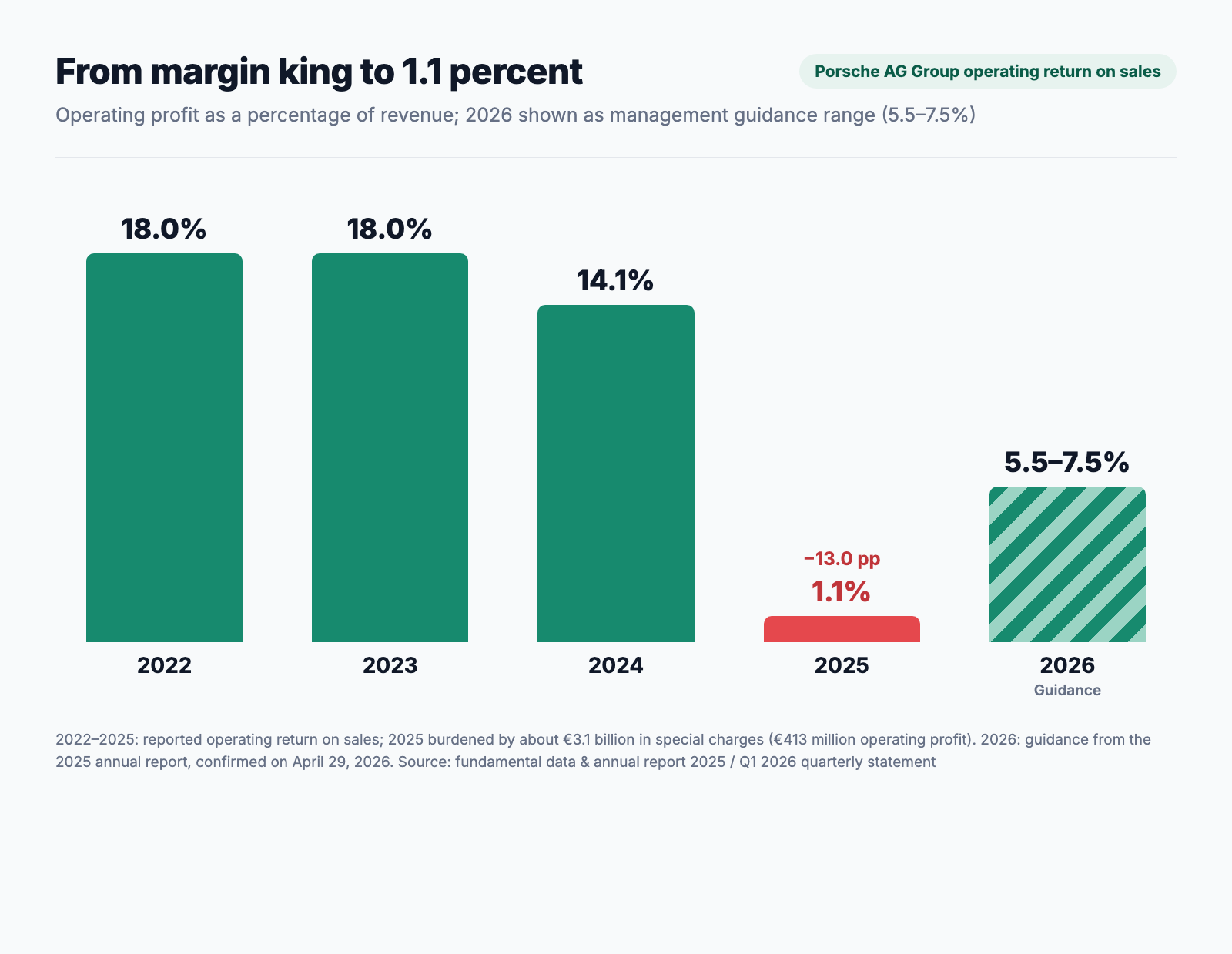
Then the break: the margin fell to 14.1 percent in 2024 and to 1.1 percent in 2025 — of €5,637 million in operating profit, €413 million remained; profit after tax shrank to €310 million and earnings per preferred share from €3.95 to €0.48. Revenue declined 9.5 percent to €36.3 billion; production, at 261,341 vehicles, was down 13.7 percent. A remarkable detail hides in the model table: of all things, the icon — the 911 — actually grew in 2025 (51,583 deliveries after 50,941), and so did the Macan (84,328) — the collapse happened at Cayenne (down 21.4 percent), Taycan (down 21.6 percent) and the 718 (down 21.4 percent), the latter partly because its combustion version had to leave the European market over cybersecurity regulations. The crisis, in other words, is not eating the core of the myth but the expansion around it. And the first quarter of 2026 points in the recovery's direction: €8.4 billion revenue (down 5.2 percent), €595 million operating profit, a 7.1 percent margin — far better than the 2025 average, clearly below the old world.
The uncomfortable truths
Uncomfortable truth no. 1: the reverse gear cost about €3.1 billion
2025 was not weak because nobody wanted a Porsche anymore — it was weak because management partially unwound its own EV strategy. In the third quarter of 2025 the company decided to launch certain electric models later and keep combustion and hybrid cars around longer. The annual report prices the decision without sentiment:
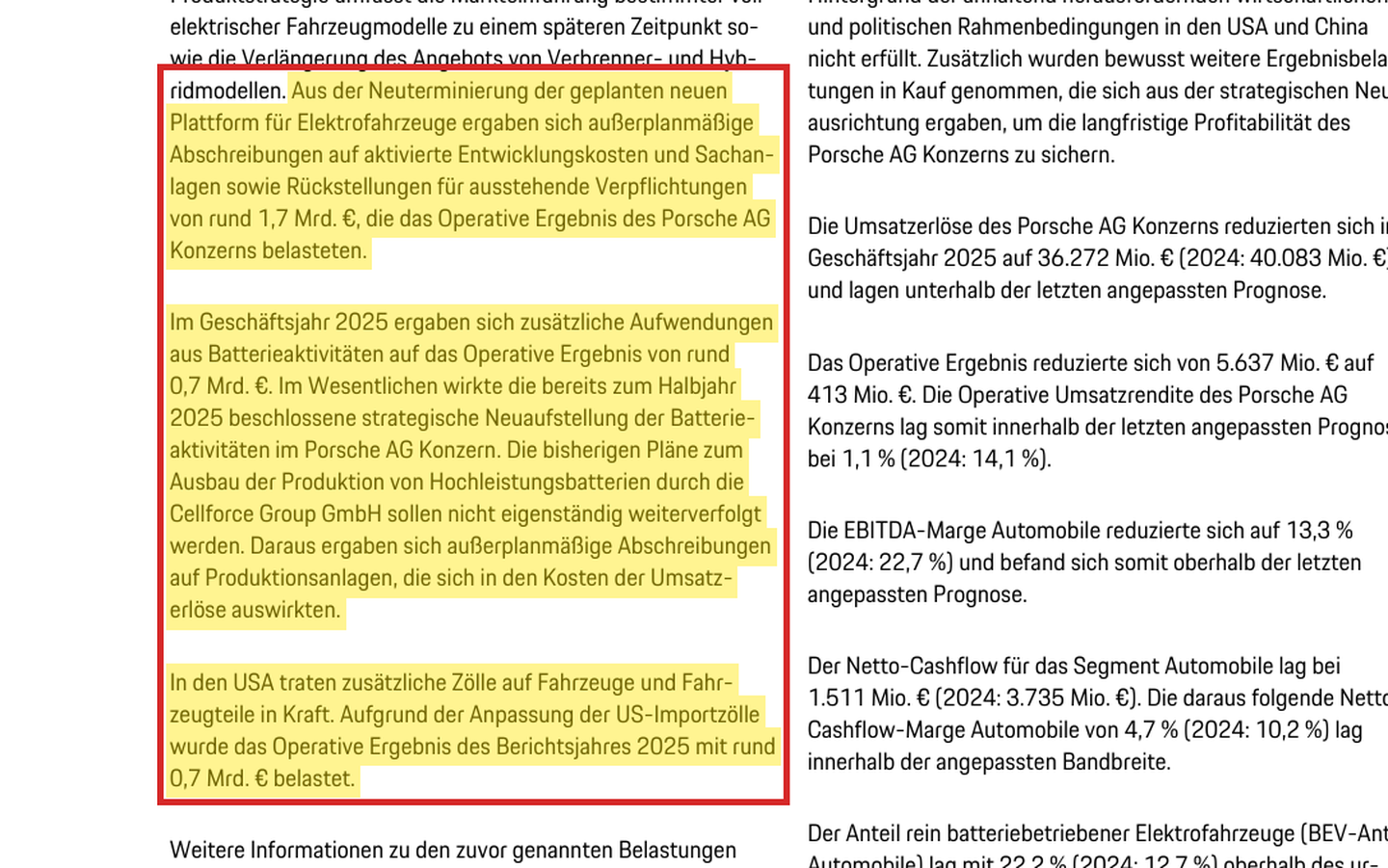
„Aus der Neuterminierung der geplanten neuen Plattform für Elektrofahrzeuge ergaben sich außerplanmäßige Abschreibungen auf aktivierte Entwicklungskosten und Sachanlagen sowie Rückstellungen für ausstehende Verpflichtungen von rund 1,7 Mrd. €, die das Operative Ergebnis des Porsche AG Konzerns belasteten."
Our translation: "The re-timing of the planned new platform for electric vehicles resulted in impairments on capitalized development costs and property, plant and equipment as well as provisions for outstanding obligations of around €1.7 billion, which weighed on the operating profit of the Porsche AG Group."
— Dr. Ing. h.c. F. Porsche AG, annual report 2025, combined management report — overall statement on business performance (p. 103)
Add the battery retreat — the subsidiary Cellforce was once meant to mass-produce high-performance cells:
„Die bisherigen Pläne zum Ausbau der Produktion von Hochleistungsbatterien durch die Cellforce Group GmbH sollen nicht eigenständig weiterverfolgt werden. Daraus ergaben sich außerplanmäßige Abschreibungen auf Produktionsanlagen, die sich in den Kosten der Umsatzerlöse auswirkten."
Our translation: "The previous plans to expand the production of high-performance batteries through Cellforce Group GmbH will not be pursued independently. This resulted in impairments on production facilities, which affected the cost of sales."
— Dr. Ing. h.c. F. Porsche AG, annual report 2025, combined management report — overall statement on business performance (p. 103)
Together with roughly €0.7 billion in tariff charges (more on that below), the three blocks add up to about €3.1 billion — more than Porsche's entire operating profit for 2025. You can read that positively: one-off costs disappear, the problem is priced, and the new CEO Michael Leiters — in office since January 1, 2026, previously McLaren CEO and Ferrari's technology chief — announced in March 2026: "Wir werden Porsche umfassend neu aufstellen, das Unternehmen schlanker, schneller und die Produkte noch begehrlicher machen." ("We will comprehensively reposition Porsche, make the company leaner, faster, and its products even more desirable.") But you must also read the second half of the truth: the CFO flagged further one-off effects "in the high three-digit millions" for 2026, and part of the written-off billions was simply tuition for an EV bet the market has not (yet) rewarded — the Taycan lost another 21.6 percent of its volume in 2025. How hard the electric pivot is even for pure sports car brands is something we dissected in our Lotus Technology analysis; the difference at Porsche: it can afford the reverse gear. Remember: an impairment is tuition already paid — the only question is whether the share price has learned the lesson yet.
Uncomfortable truth no. 2: China has more than halved since 2021
The deeper, structural reason for the crisis sits in the business performance chapter — and it does not vanish with the one-offs:
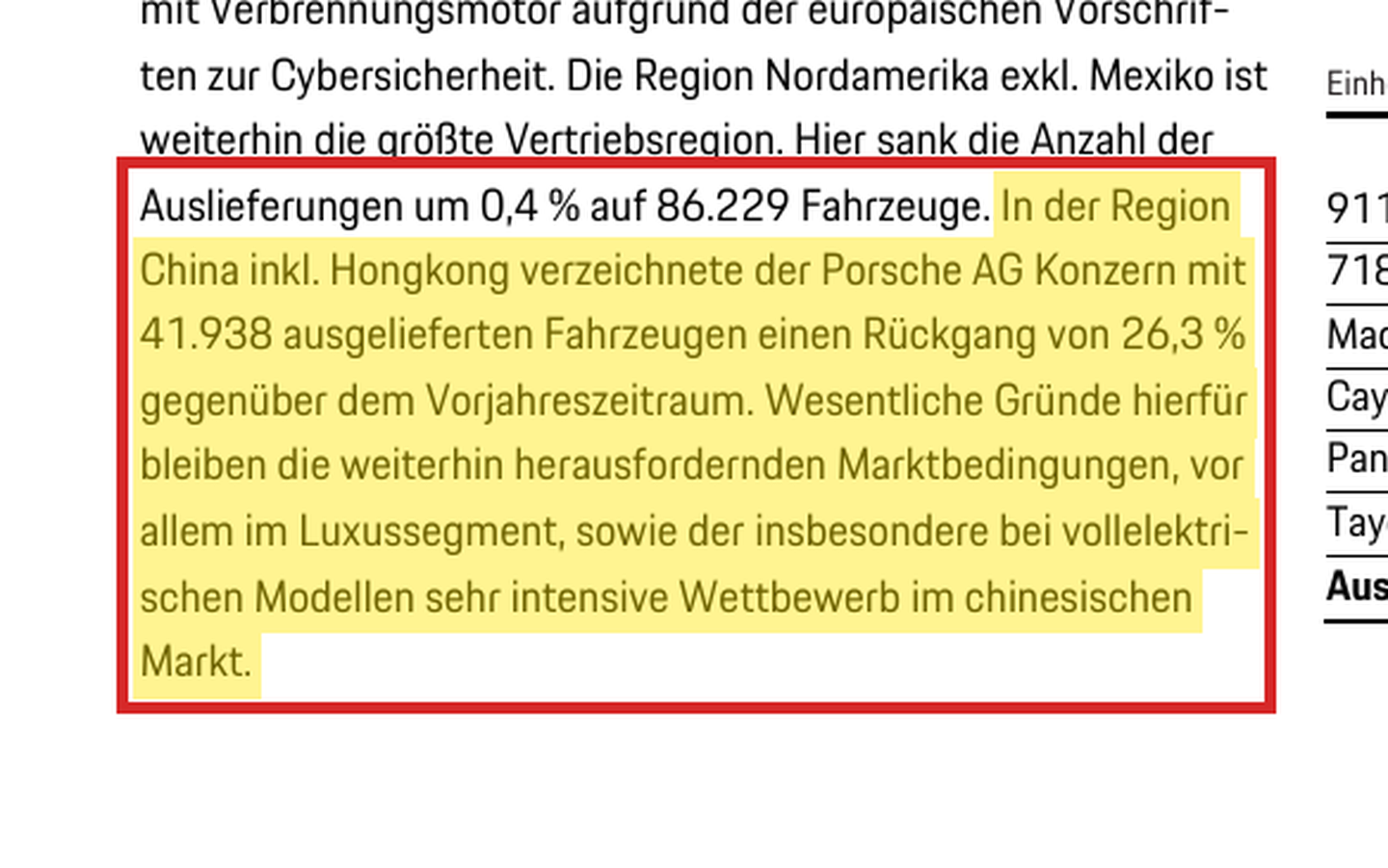
„In der Region China inkl. Hongkong verzeichnete der Porsche AG Konzern mit 41.938 ausgelieferten Fahrzeugen einen Rückgang von 26,3 % gegenüber dem Vorjahreszeitraum. Wesentliche Gründe hierfür bleiben die weiterhin herausfordernden Marktbedingungen, vor allem im Luxussegment, sowie der insbesondere bei vollelektrischen Modellen sehr intensive Wettbewerb im chinesischen Markt."
Our translation: "In the China region including Hong Kong, the Porsche AG Group recorded 41,938 vehicles delivered, a decline of 26.3 percent versus the prior-year period. The main reasons remain the persistently challenging market conditions, above all in the luxury segment, and the very intense competition in the Chinese market, particularly for all-electric models."
— Dr. Ing. h.c. F. Porsche AG, annual report 2025, combined management report — deliveries to customers (p. 100)
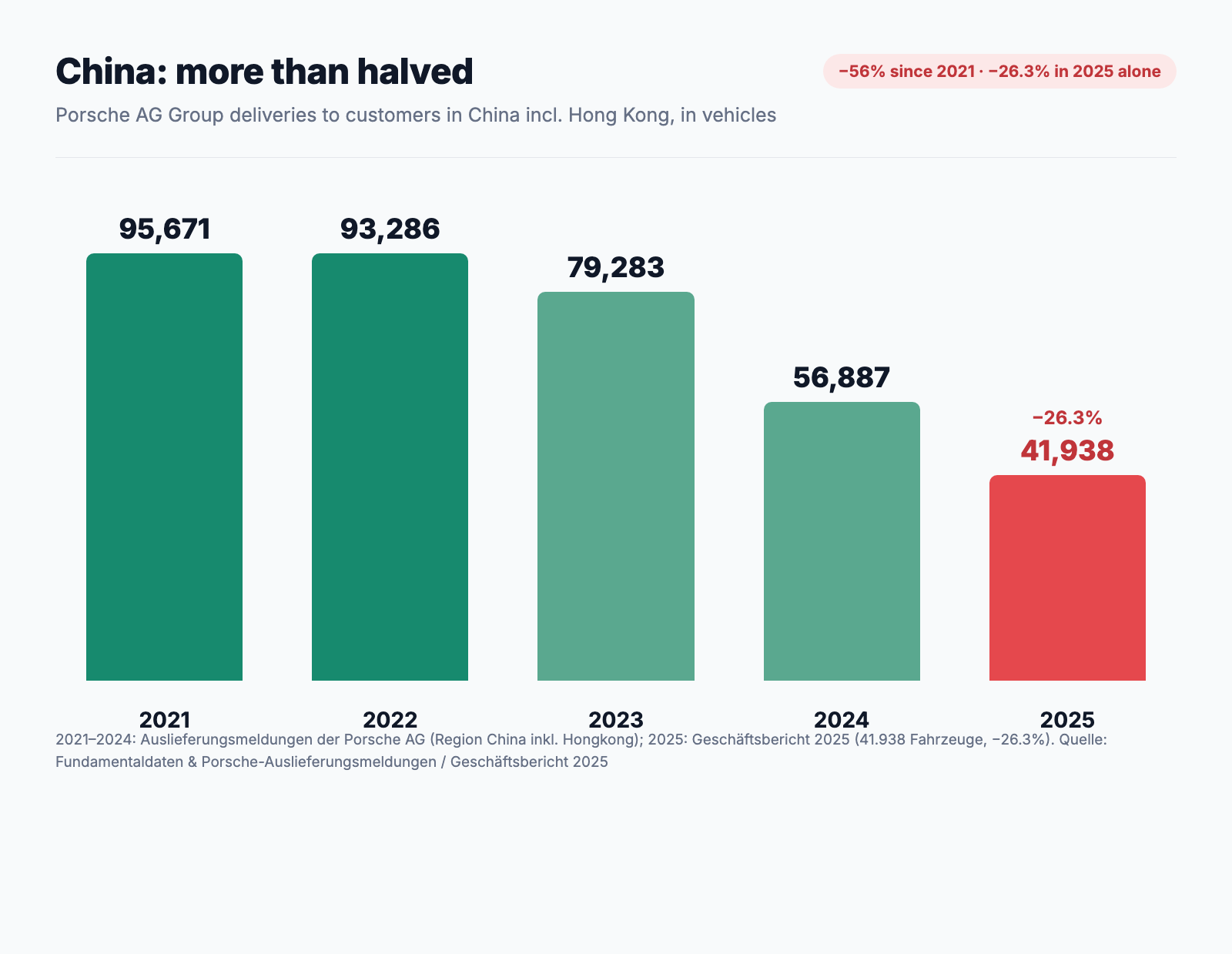
In 2021, China was the brand's largest single market with 95,671 vehicles — in 2025 it is 41,938, and the report offers little hope of a quick reversal: the price war rages precisely where Porsche wanted to compete electrically with the Taycan, against local manufacturers selling high-performance EVs at fractions of a Porsche's price. Porsche's answer is "value-oriented sales" — translated: fewer cars rather than lower prices, plus a slimmed-down dealer network. That protects the remaining margin and resale values, but costs volume, year after year. This region is also why you should not simply extrapolate the 2026 guidance: a luxury-segment comeback in China is an assumption Porsche itself did not make.
Uncomfortable truth no. 3: tariffs hit Porsche harder than almost any competitor
Porsche's largest sales region is now North America — 86,229 deliveries in 2025, nearly stable (down 0.4 percent). Reassuring, until you read the catch the annual report records in two dry sentences:
„In den USA traten zusätzliche Zölle auf Fahrzeuge und Fahrzeugteile in Kraft. Aufgrund der Anpassung der US-Importzölle wurde das Operative Ergebnis des Berichtsjahres 2025 mit rund 0,7 Mrd. € belastet."
Our translation: "In the USA, additional tariffs on vehicles and vehicle parts came into force. Due to the adjustment of U.S. import tariffs, the operating profit of the 2025 reporting year was burdened by around €0.7 billion."
— Dr. Ing. h.c. F. Porsche AG, annual report 2025, combined management report — overall statement on business performance (p. 103)
The catch is: Porsche has no U.S. plant. Every 911, every Macan, every Cayenne for American customers is built in Zuffenhausen, Leipzig or Bratislava and shipped across the Atlantic — BMW and Mercedes, by contrast, build their U.S. SUVs in South Carolina and Alabama. An import tariff therefore works like a special tax on 100 percent of Porsche's U.S. business — in exactly the region that is supposed to plug the China hole. Short term, the only remedies are price increases, cost discipline and trade diplomacy; a U.S. plant would be the structural answer but sits years and billions away — at a brand whose customers pay a premium for "Made in Germany." For the supplier's-side view of the same tariff arithmetic, see our Garrett Motion analysis — the pain travels the whole value chain. Not an acute danger, but a permanent brake pad on the margin, and since 2025 shareholders get it quantified in black and white.
Uncomfortable truth no. 4: your share has no vote — and that is why it left the DAX
Finally, the truth that is written not in the income statement but in a chapter heading called "share capital and shareholder structure":
„Der Anteil der Volkswagen AG, die mittelbar über die Porsche Holding Stuttgart GmbH 75,0 % der Stammaktien abzüglich einer Stammaktie hält, blieb im Berichtsjahr ebenso unverändert wie der Anteil der Porsche Automobil Holding SE, die unmittelbar 25,0 % der Stammaktien zuzüglich einer Stammaktie hält. Von den stimmrechtslosen Vorzugsaktien befinden sich mittelbar über die Porsche Holding Stuttgart GmbH rund 75,8 % im Besitz der Volkswagen AG und rund 24,2 % im Streubesitz (Stand: 31. Dezember 2025)."
Our translation: "The stake of Volkswagen AG, which indirectly holds 75.0 percent of the ordinary shares minus one ordinary share via Porsche Holding Stuttgart GmbH, remained unchanged in the reporting year, as did the stake of Porsche Automobil Holding SE, which directly holds 25.0 percent of the ordinary shares plus one ordinary share. Of the non-voting preferred shares, around 75.8 percent are owned by Volkswagen AG indirectly via Porsche Holding Stuttgart GmbH and around 24.2 percent are in free float (as of December 31, 2025)."
— Dr. Ing. h.c. F. Porsche AG, annual report 2025, "To our shareholders" — Porsche on the capital market (p. 34)
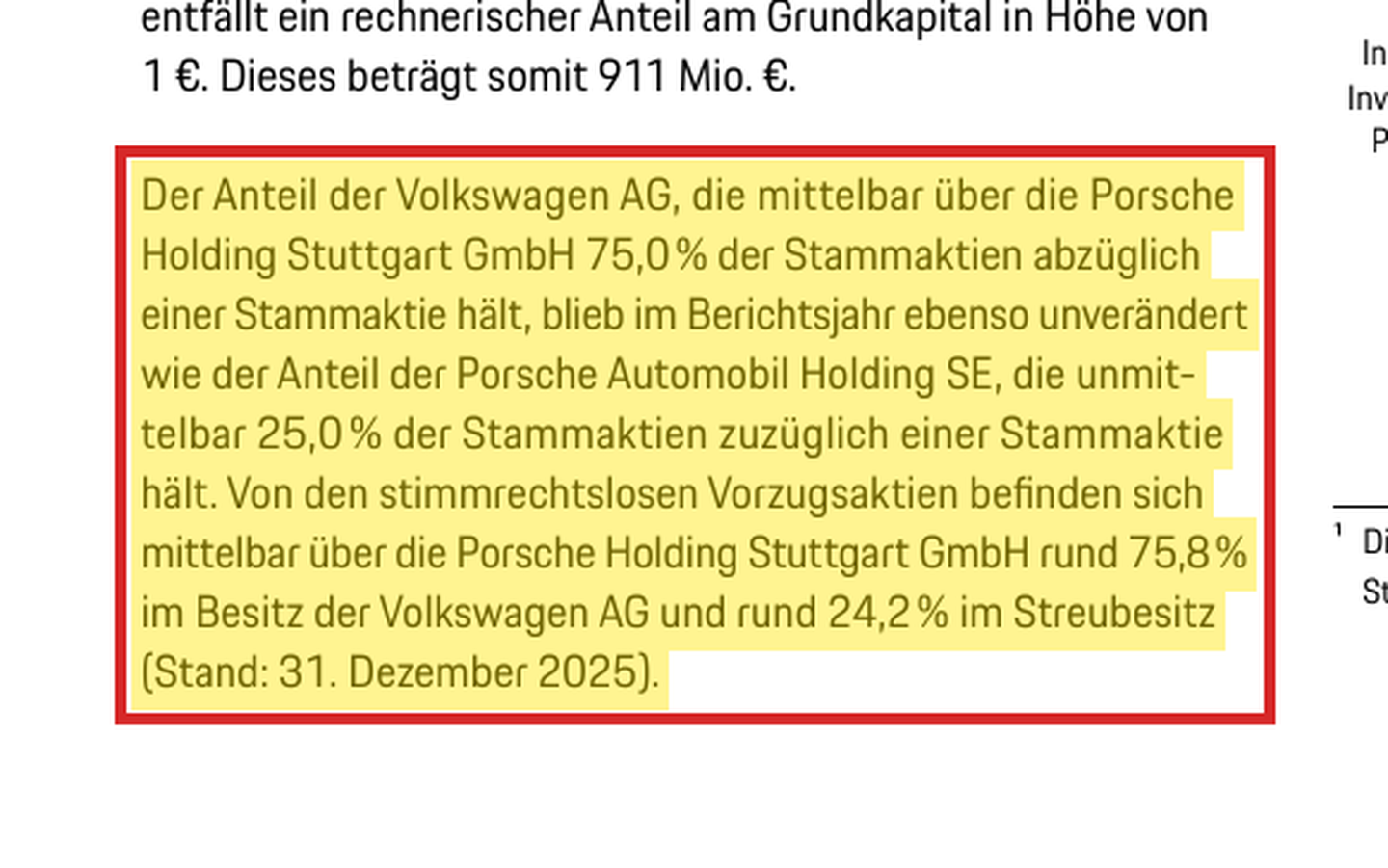
Translated: the voting ordinary shares are split entirely between Volkswagen and Porsche SE — what trades on the exchange are exclusively preferred shares without voting rights, and even of those Volkswagen keeps three quarters. Measured against total share capital: 75.4 percent Volkswagen, 12.5 percent Porsche SE, 12.1 percent genuine free float. Whoever buys P911 rides shotgun in the literal sense: fully exposed to the risk, never touching the steering wheel. The same arithmetic produced a very visible consequence in September 2025: "Im September 2025 passte die Deutsche Börse die Zusammensetzung der deutschen Aktienindizes an. In diesem Zuge wechselte die Porsche AG vom DAX in den MDAX." ("In September 2025, Deutsche Börse adjusted the composition of the German stock indices. In the course of this, Porsche AG moved from the DAX to the MDAX.") — three years after a record IPO and the fastest DAX promotion in index history, the free-float market cap rule sent Porsche down, and DAX index funds had to sell. One more governance footnote belongs here: until the end of 2025, Oliver Blume ran Porsche and Volkswagen simultaneously — a double role investors criticized for years, ended only by the appointment of Michael Leiters effective January 1, 2026.
Valuation — what the market pays for the comeback
At the end of 2025 the preferred share stood at €45.62 — a market capitalization of about €41.6 billion (year high €62.80, year low €39.67). Against the 2025 result of €0.48 per share that is a P/E beyond 90 — but that number is less a valuation than a monument to the crisis year. The honest way is to look forward, and there management's bar sits at a 5.5 to 7.5 percent operating margin on €35–36 billion of revenue: roughly €2 to €2.7 billion of operating profit, after tax and per share in the order of €1.50 to €2 — analyst estimates captured in mid-July 2026 (fundamental data as of July 10, 2026) see about €1.80 for 2026. At a price of about €46 (same cut-off) you are paying roughly 25 times a profit that has yet to exist again — and about eleven times the old 2023 world (€3.95), which nobody expects back soon. Add the dividend, cut to €1.01 per preferred share (prior year: €2.31; approved by the annual general meeting on June 23, 2026) — a good 2 percent yield, at least a 50 percent payout of the German-GAAP distributable profit. The market, in other words, prices neither collapse nor comeback, but extends management credit for about half the promised recovery. Everything above that — the old 18 percent world — currently comes free, because hardly anyone believes in it. Which, incidentally, is exactly how the brand anchor creates both the opportunity and the trap.
Opportunities and risks at a glance
What speaks for Porsche AG:
- One of the world's most valuable car brands with an intact core: the 911 icon grew even in the crisis year 2025 (51,583 deliveries, up 1.3 percent) and the Macan gained too — pricing power almost no manufacturer has.
- A balance sheet with a seatbelt: €7.3 billion automotive net liquidity (December 31, 2025), €3.6 billion group operating cash flow in 2025 (€4.8 billion in the automotive segment), and €514 million automotive net cash flow already in the first quarter of 2026 (prior-year quarter: €198 million).
- The 2026 guidance (€35–36 billion revenue, 5.5–7.5 percent operating margin) was confirmed in the quarterly statement of April 29, 2026; Q1 delivered 7.1 percent — the upper end of the range.
- A restart without the double role: since January 2026, Michael Leiters (ex-McLaren CEO, ex-Ferrari technology chief) is the first full-time CEO in years; the model offensive (including the new electric Cayenne and the extended combustion line-up) serves both drivetrain worlds.
What speaks against it:
- The structural China problem: deliveries more than halved from 95,671 (2021) to 41,938 (2025), minus 26.3 percent in the last year alone — there is no quick answer to local EV competition at fractional prices.
- Full tariff exposure: no U.S. plant, around €0.7 billion in charges in 2025 — in precisely the largest and most stable sales region (86,229 deliveries).
- The recovery is promised, not delivered: 2026 brings further one-off effects "in the high three-digit millions" per the CFO, revenue is guided slightly below 2025, and a P/E of about 25 on hoped-for 2026 earnings leaves little room for disappointment.
- A minority shareholder without a voice: non-voting preferred shares, 75.4 percent Volkswagen, 12.1 percent free float, DAX relegation in September 2025 — the majority owner's interests (VW needs Porsche's dividends) need not always be yours; the 2025 dividend was cut from €2.31 to €1.01 regardless.
A human conclusion
Back to the anchor from the beginning — to the 911 at the curb. The myth is real: the brand grows exactly where it is most Porsche, the balance sheet is rock solid, and a company that can afford a €3.1 billion strategy reversal without wobbling has substance. But the stock is not the car. Whoever buys today buys a transition year: a halved China presence, a tariff brake with no U.S. plant, further announced one-off costs, a cut dividend — and a voting right they will never receive. The price for all this is roughly 25 times a profit management still has to earn back.
What you make of it is your decision. And that is exactly as it should be. The next reality check has a precise date: with the half-year financial report due at the end of July 2026, we will see whether the 5.5 to 7.5 percent margin holds, how expensive the additional restructuring steps really get — and whether China finds a floor. Listen less to the flat-six and more to three numbers: China deliveries, operating margin, net cash flow. The brand anchor inside you will tug again at the next 911. Now you know what to ask it first: how much of the myth is already in the price?
Sources
- Dr. Ing. h.c. F. Porsche AG — Annual and Sustainability Report 2025 (IFRS consolidated financial statements, signed February 22, 2026; German), in particular the combined management report and "To our shareholders" (Porsche on the capital market)
- Quarterly statement Q1 2026 of the Porsche AG Group (April 29, 2026; German) — including the guidance confirmation and the planned sale of the Rimac/Bugatti stakes
- Porsche Newsroom: Annual General Meeting 2026 — dividend of €1.00/€1.01 approved (June 23, 2026) and CEO change to Dr. Michael Leiters (announcement of October 17, 2025)
- Porsche Newsroom: deliveries 2024 (regional data, January 13, 2025) and annual press conference on fiscal year 2023 (revenue/profit 2022–2023)
- Fundamental data (metrics, valuation, analyst estimates); in-house stock scanner, data as of July 10, 2026.
Disclaimer: This analysis is a journalistic contextualization of publicly available information and is not investment advice. It is not a solicitation to buy or sell securities. Stocks are subject to price fluctuations; a total loss is possible. Make your investment decisions on your own responsibility and seek independent advice where in doubt.
Our Bottom Line at a Glance
- Brand & business model positive
- One of the strongest car brands in the world with luxury economics: small volumes, high prices, and in normal years a 14–18 percent operating margin. The core holds even in crisis — the 911 icon grew to 51,583 deliveries in 2025 (+1.3 percent), the Macan to 84,328.
- Balance sheet & cash flow positive
- Automotive net liquidity of €7.3 billion (December 31, 2025), €3.6 billion group operating cash flow in 2025 despite the crisis year (automotive segment: €4.8 billion), and €514 million automotive net cash flow in Q1 2026 (prior-year quarter: €198 million). The group can afford its own rebuild.
- Strategy & one-off costs negative
- The swing back to combustion/hybrid cost about €3.1 billion in 2025: ~€1.7 billion for re-timing the EV platform, ~€0.7 billion for the Cellforce stop, ~€0.7 billion in tariffs. For 2026, further one-off effects "in the high three-digit millions" are flagged — the rebuild is tuition paid, with no guarantee of graduation.
- China & volumes negative
- Total deliveries down 10.1 percent to 279,449; China more than halved from 95,671 (2021) to 41,938 (2025), down 26.3 percent in 2025 alone. The report cites luxury weakness and the EV price war as persistent causes — no quick reversal is assumed.
- Tariffs & cost level negative
- About €0.7 billion in U.S. tariff charges in 2025 with full import exposure (no U.S. plant) — in the largest sales region, North America (86,229 deliveries, −0.4 percent). Add a structurally high cost and depreciation level that the outlook itself names as a burden.
- Owners & governance neutral
- Non-voting preferred shares, 75.4 percent Volkswagen, 12.1 percent free float, DAX relegation in 09/2025 (free-float rule). On the plus side: the Blume double role ended; full-time CEO Michael Leiters has led since 01/01/2026. The dividend was cut responsibly but sharply (€1.01 after €2.31 per preferred share).
Porsche AG remains an exceptional brand with a fortress balance sheet — but 2025, at a 1.1 percent operating margin (€413 million instead of €5.6 billion), was the weakest year since the IPO: €3.1 billion in special charges for the EV-platform and battery U-turn, a halved China market, full U.S. tariff exposure without a local plant, and a cut dividend. For 2026 management promises a 5.5–7.5 percent margin; Q1 delivered 7.1 percent. Buyers pay about 25 times that hoped-for recovery — and receive no voting rights. Not investment advice.
What Our Rating Means
- If you don't own the stock
- As long as the question raised in the bottom line stays open, we see no basis for an entry.
- If you hold it in your portfolio
- Our findings offer no acute reason to sell — the checkpoints named remain decisive.
A journalistic assessment by our editorial team at the time of the deep dive, based on public sources — not investment advice and not a solicitation to buy or sell. Your personal circumstances (investment goals, risk capacity, taxes) cannot be taken into account. What our categories mean, how verdicts are formed, and what conflicts of interest exist →
Worth Noting
- Identity: this analysis covers Dr. Ing. h.c. F. Porsche AG (P911, the sports car manufacturer) — not Porsche Automobil Holding SE (PAH3), the family holding whose main asset is the Volkswagen voting majority.
- German stock corporation without SEC filings: all evidence quotes are German originals from the Annual and Sustainability Report 2025 (signed February 22, 2026) and the Q1 2026 quarterly statement (April 29, 2026), each followed by our English translation; analyst-expectation figures come from fundamental data as of July 10, 2026.
- Only non-voting preferred shares are listed (455.5 million of 911 million total shares); all price and valuation figures refer to the preferred share (2025 closing price: €45.62, market capitalization €41.6 billion).
Frequently Asked Questions
Dr. Ing. h.c. F. Porsche AG (Xetra: P911) is the Stuttgart sports car manufacturer — it builds the 911, 718, Macan, Cayenne, Panamera and Taycan. Porsche Automobil Holding SE (PAH3) is the investment holding of the Porsche/Piëch families; its main assets are the voting majority in Volkswagen and 12.5 percent of Porsche AG's share capital. Two different stocks, two entirely different investments.
Operating profit fell from €5,637 million to €413 million in 2025 (operating return on sales 1.1 percent after 14.1 percent). Main reasons per the annual report: around €1.7 billion in impairments and provisions from re-timing the EV platform, about €0.7 billion from stopping the Cellforce battery ramp-up, about €0.7 billion in U.S. import tariffs — plus 10.1 percent fewer deliveries, above all in China (down 26.3 percent).
The annual general meeting of June 23, 2026 approved €1.00 per ordinary and €1.01 per preferred share — €916 million in total and about 50 percent of the distributable profit under German GAAP. The prior year paid €2.30/€2.31 (€2,100 million). At a price of about €46 (data as of July 10, 2026) the new dividend yields a good 2 percent.
From the 2025 annual report: revenue of €35–36 billion and an operating return on sales of 5.5 to 7.5 percent (after 1.1 percent in 2025), plus a 15–17 percent automotive EBITDA margin and a battery-electric share of 24–26 percent. The quarterly statement of April 29, 2026 confirmed the guidance; the first quarter of 2026 already reached a 7.1 percent operating margin.
In September 2025, Deutsche Börse moved Porsche AG from the DAX to the MDAX. The deciding factor was free-float market capitalization: only 12.1 percent of the share capital trades freely (non-voting preferred shares), Volkswagen holds 75.4 percent and Porsche SE 12.5 percent — combined with the share price decline, the free-float market value fell below DAX requirements.
Against the 2025 crisis result (€0.48 per preferred share) the stock trades at a P/E beyond 90; against the expected 2026 recovery (about €1.80 per share per analyst estimates, data as of July 10, 2026) it is roughly 25 times earnings — at about €46 per share and a €41.6 billion market capitalization at the 2025 close (€45.62). The market is pre-paying part of the promised comeback, not the old 18 percent world.
Yes. In the third quarter of 2025 management decided to launch certain all-electric models later and to extend the combustion and hybrid line-up; the in-house battery cell ramp-up (Cellforce) will not be pursued independently. The electric Taycan and Macan stay in the program; the battery-electric share was 22.2 percent in 2025, with 24–26 percent expected for 2026.
Found an error?
Did you spot a factual error, an outdated number, or a typo in this deep dive? Let us know briefly — your report goes straight to the editorial team.