Lotus Technology Stock: A Legendary Badge, a $3.2 Billion Loss Hole — and Auditors Who Doubt It Can Carry On
The name Lotus conjures featherweight sports cars and racing glory — and that halo now hangs on a Nasdaq ticker: LOT. We read what Lotus Technology itself reported to the U.S. securities regulator — in the annual report for foreign private issuers (20-F) for 2025 and the interim reports (6-K) through June 2026: revenue down 44 percent, deliveries down 46 percent, an accumulated loss hole of $3.16 billion, an audited going-concern warning — and a majority owner named Geely that sits at every junction of the system as lender, manufacturer, chairman supplier and convertible-note buyer. Not investment advice — just the cash count behind a legendary badge.
 Thomas Mücke
Founder & Publisher
Thomas Mücke
Founder & Publisher
Chart
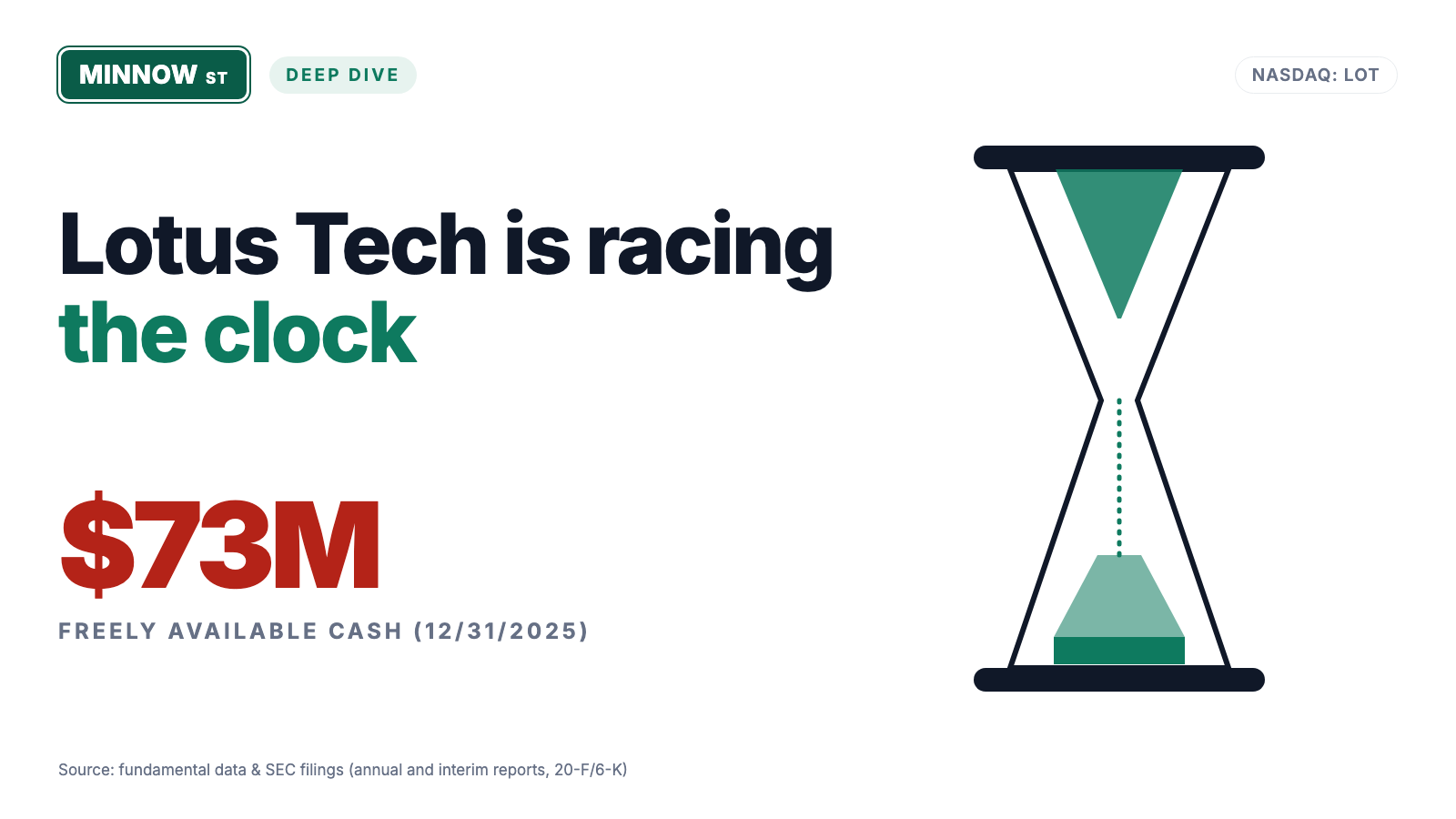
Interactive price chart (TradingView).
Note: pure fact-based analysis, not investment advice and not a solicitation to buy or sell. All figures without guarantee.
There are brand names the rational mind is not even allowed to discuss. Lotus is one of them: featherweight icons like the Elan and the Esprit, Formula 1 titles, Colin Chapman's "simplify, then add lightness" — if you have gasoline in your veins, you do not buy a stock at this name, you buy a memory. Psychologists call it the halo effect: the shine of a single attribute — here, a legendary badge — outshines everything standing next to it, including a balance sheet. And next to this badge, since February 2024, stands a Nasdaq ticker: LOT, Lotus Technology, brought public through a SPAC merger with L Catterton Asia Acquisition Corp. In our Reddit hype scanner, which counts every day which small U.S. tickers the forums are talking about, LOT surfaced on July 15, 2026 with 5 mentions within 24 hours (source: ApeWisdom) — quiet background hum, market value about $713 million. So let's make a deal: before the halo effect decides for you, we read together what Lotus Technology itself reported to the U.S. securities regulator, the SEC — honest under penalty of law. And because Lotus Tech is registered as a foreign private issuer, the documents here are not called 10-K and 10-Q but 20-F (the annual report for foreign private issuers, filed for 2025 on April 28, 2026) and 6-K (interim reports) — same penalty of law, different forms, looser rhythm: quarterly numbers are voluntary attachments, not an audited obligation. How loose that rhythm can get, you will see very concretely in this analysis. In the end, you decide for yourself.
What Lotus Technology actually does
First the org chart, because that is where understanding begins: Lotus Technology is not the sports car company from Hethel. The storied Lotus factory in England — home of the Emira and the Evija hypercar — belongs to Lotus Advance Technologies ("Lotus UK"), a sister company inside the Geely empire. Lotus Technology, the subject of this analysis, is the "lifestyle" arm set up in 2021: a Cayman Islands holding company headquartered in Shanghai that develops and markets the electric everyday Lotus models — the Eletre electric SUV (800-volt platform, deliveries since 2023), the Emeya electric sedan (since March 2024) and, since March 2026, the first plug-in hybrid, For Me (Eletre X in Europe), built on a 900-volt X-Hybrid architecture with, per the company, more than 1,400 kilometers of combined range. These vehicles are not built in factories of its own but by Geely — the Chinese group that also owns Volvo and Polestar. On top of that, Lotus Tech distributes the classic sports cars of its British sister through a network of more than 200 stores worldwide and sells technology services as a second leg: development work and licenses around its platform and driver-assistance technology (2025: $56.3 million of revenue, up 69 percent). The company employed 1,132 full-time staff at the end of 2025 — roughly half of them in research and development.
Note, right here, the central tension of this analysis: The badge is a century-class asset and the technology is real — but the company behind it has piled up $3.16 billion of losses since inception, its auditors formally doubt it can carry on, and every lifeline leads to the same group: Geely. It runs through every chapter. What such a foreign-private-issuer setup with a Cayman shell and a mighty majority owner feels like is something we recently dissected at China's streaming pioneer — in our analysis of iQIYI stock; at Lotus Tech, the Baidu entanglement is replaced by the Geely entanglement, and the debt wall by an audited going-concern warning.
Where the ticker comes from — and why our fundamental scanner does not know it
Honesty first: LOT appears in none of our fundamental stock scanners. That is no verdict, it is systematics — our in-house stock scanner works through the Russell 3000 universe, meaning U.S. companies; Lotus Technology is a Cayman holding based in Shanghai whose depositary shares (ADSs, one ordinary share each) trade in New York, and so it falls through the grid. The ticker landed on our desk through a different tool: our Reddit hype scanner, which evaluates daily which micro and small caps are suddenly the talk of the U.S. stock forums (data basis: ApeWisdom). On July 15, 2026 it counted 5 mentions within 24 hours for LOT — no storm, more like the quiet knocking with which forums discover "forgotten brand-name bargains." What happens when a community keeps trading a resonant story long after the numbers stopped cooperating is something we walked through at the meme-stock veteran Virgin Galactic — there, too, the brand's shine outlasted the balance sheet. For Lotus Tech the setup means: no scanner metrics as guardrails, no Piotroski score from the database — only the original documents. All the more important to actually read them.
The numbers over the years — honestly appraised
First, what genuinely has substance. Under its new frugality, Lotus Tech made measurable progress in 2025: gross margin swung from 3 to 9 percent (fourth quarter: 10 percent) as upgraded models ramped up and costs came under discipline. The operating loss shrank by 46 percent to $423.2 million, in the fourth quarter even by 65 percent year over year; the net loss fell from $1,107.3 million to $464.2 million. The service business — development work and technology licensing — grew 69 percent to $56.3 million and shows that the platform technology finds buyers beyond the company's own cars. And there was a genuine engineering win on top: in March 2026 the Eletre became the first China-built model certified under UN R171.01 (a UNECE driver-assistance standard); Lotus Tech is, by its own account, only the second globally operating automaker with that certification. A company that more than halves its losses in a single year is not a hopeless case. But the revenue base underneath is crumbling:
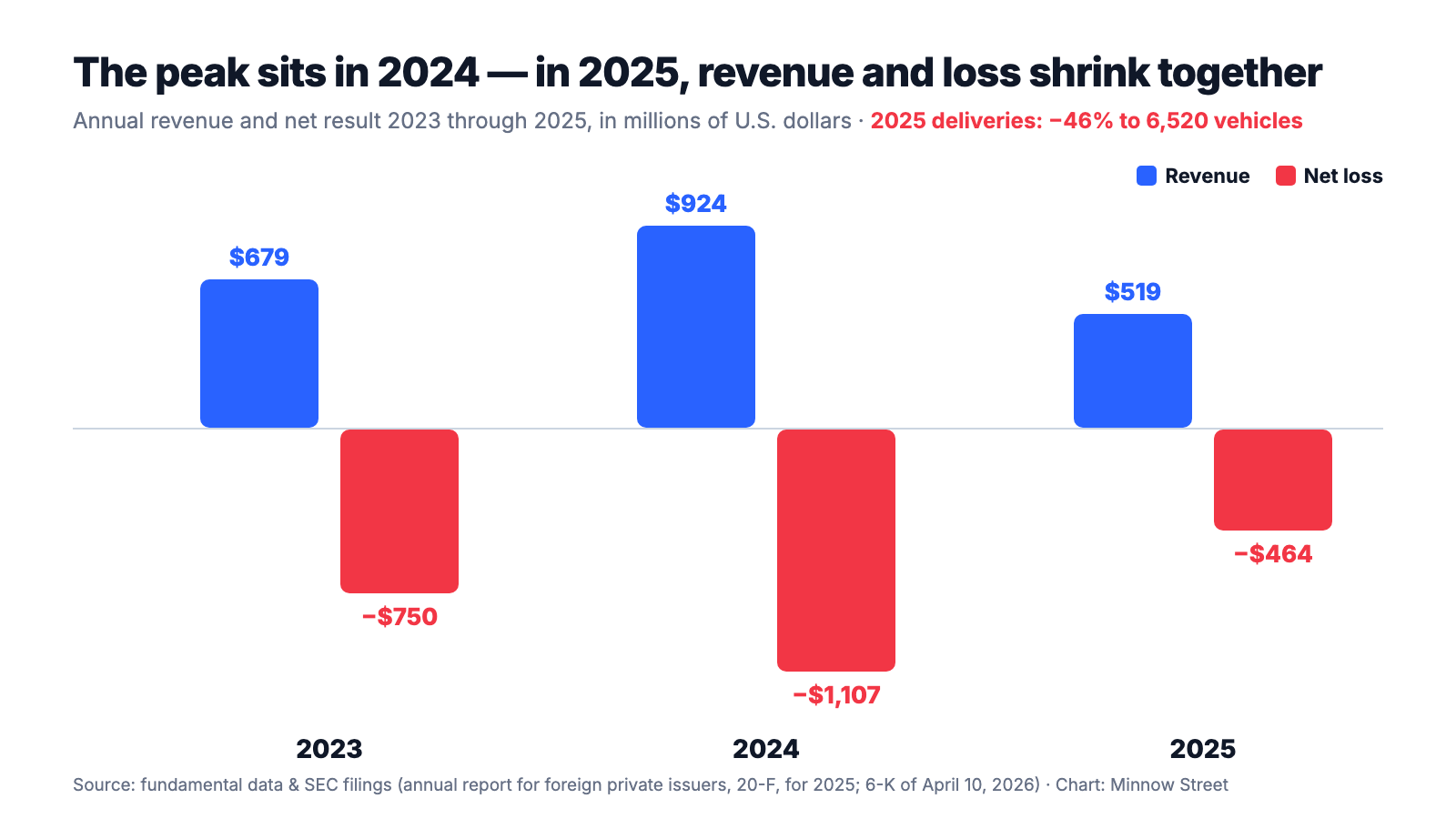
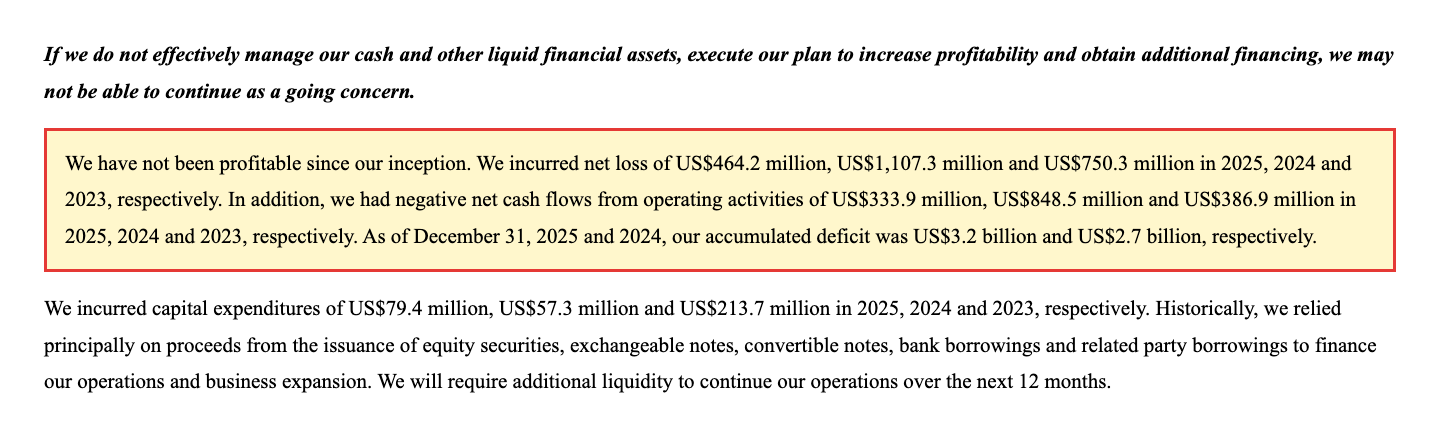
For the sales figures tell a hard story: 6,520 vehicles delivered in 2025 — down 46 percent from 11,984 in 2024. The lifestyle models (SUV and sedan) fell 33 percent to 4,552 units, the sports cars 62 percent to 1,968. North America collapsed under tariff burdens from 2,578 to 1,048 deliveries, Europe from 4,743 to 2,198; only China grew slightly, to 2,960 units, and now accounts for 45 percent of sales. Revenue followed, down 44 percent to $519.1 million — after $924.3 million in 2024 and $679.0 million in 2023. The company itself cites tariffs, inventory destocking and model changeovers, and points out that its China sales outperformed the premium segment overall. Maybe so. But a luxury carmaker with roughly 6,500 cars sold spreads its fixed costs across a boutique batch — and, despite all the progress, still burned $333.9 million of cash in operations in 2025. Remember this sentence: A loss that is getting smaller is still a loss — and a shrinking till does not ask about the growth rate. What that means in practice is spelled out in the risk chapter of the annual report, in black and white:
"We have not been profitable since our inception. We incurred net loss of US$464.2 million, US$1,107.3 million and US$750.3 million in 2025, 2024 and 2023, respectively. In addition, we had negative net cash flows from operating activities of US$333.9 million, US$848.5 million and US$386.9 million in 2025, 2024 and 2023, respectively. As of December 31, 2025 and 2024, our accumulated deficit was US$3.2 billion and US$2.7 billion, respectively."
— Lotus Technology Inc., SEC annual report 20-F for 2025, Item 3D "Risk Factors"
What the filings say — the uncomfortable truths
Uncomfortable truth no. 1: the company's own auditors formally doubt it can carry on
A going-concern qualification is the most formal warning accounting knows: the independent auditor writes into the audit opinion that substantial doubt exists as to whether the company can make it through the next twelve months on its own. At Lotus Tech it does not sit in the fine print of some footnote but in the opinion of the new auditor, Grant Thornton, on the 2025 financial statements:
"As discussed in Note 2(a) to the consolidated financial statements, the Company has incurred losses since its inception, and as of December 31, 2025, the Company had an accumulated deficit of US$3,158 million and current liabilities exceeded current assets in the amount of US$1,487 million. In addition, the Company recorded net cash used in operating activities in the amount of US$334 million for the year ended December 31, 2025. These conditions raise substantial doubt about the Company's ability to continue as a going concern."
— Grant Thornton Zhitong, report of independent registered public accounting firm, in the SEC annual report 20-F for 2025
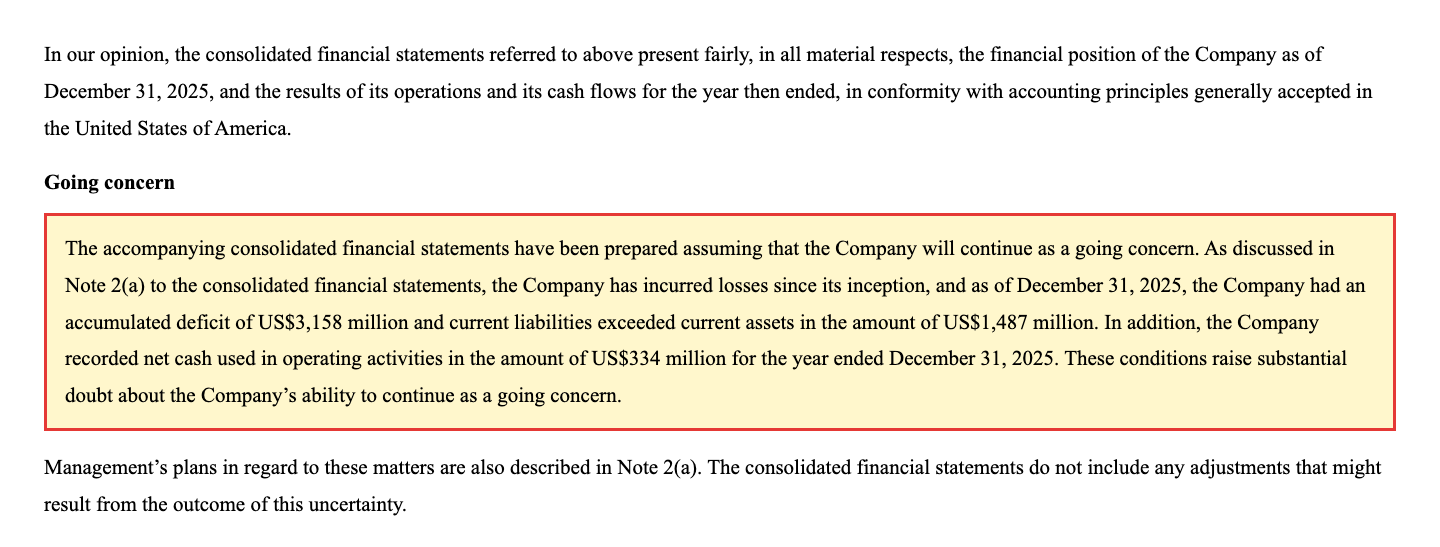
Important context, in both directions: a going-concern qualification is not an insolvency verdict — it is a documented statement of probability, and many companies have lived for years with this qualification as long as a financier kept feeding the till. Nor is it new at Lotus Tech: predecessor auditor KPMG had already written it into the opinions for 2023 and 2024. But that is exactly the second half of the truth: as of December 31, 2025 — in the middle of this situation — Lotus Tech switched auditors from KPMG to Grant Thornton. Per the mandatory filing, the change involved no disagreement over accounting matters, and the new auditor wrote the same warning as the old one. Still: whoever entrusts money to a company with going-concern doubt should know what its survival rests on. Note 2(a) of the financial statements lists the crutches: restructuring the business, cutting costs, "obtaining additional loans from banks or related parties" including rolling over maturing loans — and possibly further equity raises. Translated, "related parties" almost always means: Geely. Which brings us to the core.
Uncomfortable truth no. 2: of $550 million of "cash," only $73 million is free — and equity is deeply negative
At first glance, liquidity looks orderly: $550.3 million of cash and restricted cash stood on the balance sheet at the end of 2025, more even than a year earlier ($484.9 million). The second glance takes the number apart: freely available cash: $73.4 million. The rest — $375.9 million current plus $101.0 million non-current restricted cash — sits with banks as collateral, pledged for credit lines, acceptance notes and leases. A particularly fine specimen of this construction: in 2025, Lotus Tech took out a two-year loan of $98.2 million, secured by $99.0 million of restricted cash — borrowing 98 million and posting 99 for the privilege. On the other side stand $2,398.1 million of current liabilities, including $479.4 million of bank borrowings and $784.3 million of related-party borrowings, all due within twelve months. The difference is the audited hole of $1,487 million. And the bottom line of the balance sheet has carried a number since the SPAC merger that you would not expect at a "luxury asset": total shareholders' equity of minus $1,330.2 million — on paper the company owes more than it owns, and the accumulated loss hole of $3,157.9 million exceeds all capital ever paid in. This is what the ratio looks like:
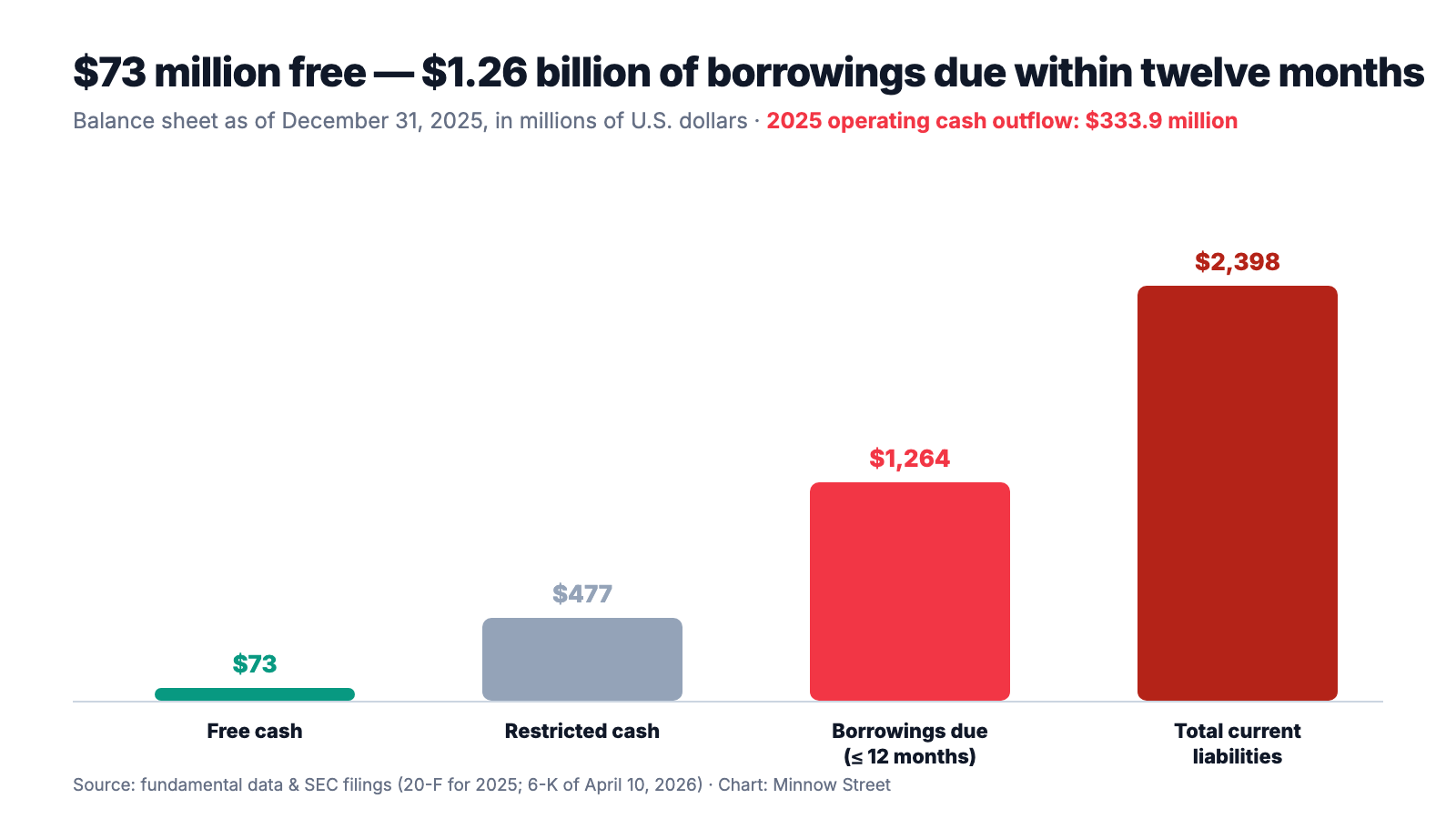
How does such a balance sheet survive? Through a permanent drip. In 2025, Lotus Tech borrowed $720.2 million from related parties (at 3.45 to 7.91 percent interest) and $587.8 million from Chinese banks; add $23 million of fresh equity from technology partner ECARX (December 2025, at $1.37 per share) and a convertible note program of up to $300 million with U.S. investment firm ATW (only $10 million drawn so far, at SOFR plus 6.75 percent, conversion price $2.19). Dilution here is not a risk, it is the operating mode: 642.1 million shares at the end of 2025 had already become 647.3 million by the end of February 2026. In an everyday image: the house is standing, but it is mortgaged to the rafters, the overdraft is blown — and every month the uncle comes by and puts money on the kitchen table. The uncle's name is Geely, and he earns his own chapter in this analysis.
Uncomfortable truth no. 3: Geely sits on both sides of almost every contract
Whoever buys the LOT ADSs becomes a minority shareholder in a system whose center is not in Shanghai but in Hangzhou, with Geely founder Shufu Li. The annual report says it without ceremony:
"We are a “controlled company” as defined under the Nasdaq corporate governance rules because Mr. Shufu Li owns more than 50% of our total voting power."
— Lotus Technology Inc., SEC annual report 20-F for 2025, Item 6C "Board Practices"
And the dependence reaches much deeper than the votes, down to every bolt:
"We currently rely and expect to continue to rely on Geely Holding, in terms of research and development, procurement, manufacturing, and engineering with regard to our vehicles."
— Lotus Technology Inc., SEC annual report 20-F for 2025, Item 3D "Risk Factors"
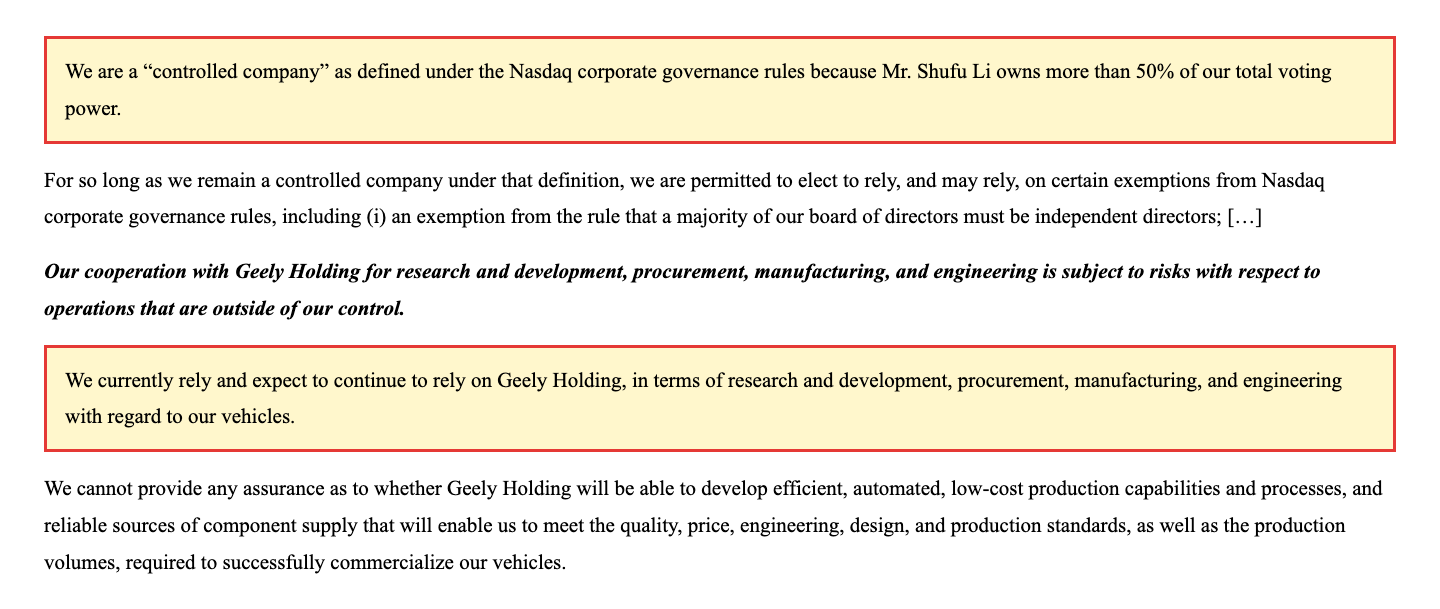
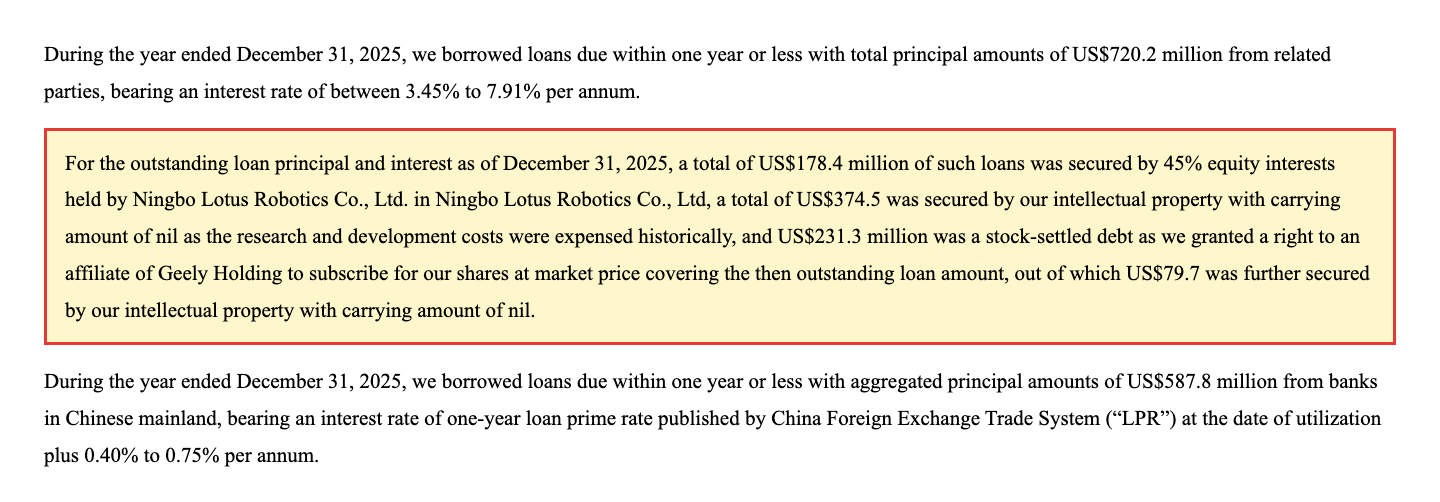
Count along how often the same name appears. Ownership: the LATLP partnership (28.8 percent of the shares) acts in concert, per the report, with a company owned by Shufu Li, and Geely's investment vehicle LTIIL holds another 16.8 percent (as of February 28, 2026). Manufacturing and development: without Geely, no assembly line moves. Credit: a facility of RMB 1.6 billion, of which RMB 1.58 billion had already been drawn by the end of 2025 — secured, among other things, by the company's intellectual property, which sits on the balance sheet at nil; in an event of default, Geely may subscribe for fresh shares at market price instead. Convertible notes: $70 million (February 2025, due April 2027), $119.3 million (June 2025, due June 18, 2026) — and four days before that maturity, on June 12, 2026, Geely signed the next one at $128.3 million (364-day term, SOFR plus 3.35 percent). All three convert into shares at the volume-weighted average price of the last ten trading days — with no premium, which means: Geely can swap its loans into equity at almost no loss at any time, however low the price stands. Leadership: since June 3, 2026, the chairman of the board is Joe Quan Zhang — in his day job the CFO of Zhejiang Geely Holding; he succeeds Daniel Donghui Li, also Geely. In fairness: without this group there would be neither the cars nor the company, and the fact that Geely keeps feeding the till is also the strongest argument for Lotus Tech's survival. Just call the construction what it is: you are not buying an independent automaker here, but a minority slip on a Geely satellite whose survival, production and dilution pace are steered by the same majority owner. Whoever holds the votes, the factory and the credit line does not need your consent.
Uncomfortable truth no. 4: the company is buying its own sister — and switching off the quarterly reports to do it
2026 is becoming a rebuild year for Lotus Tech, and an involuntarily thorough one. In order: Geely and the Malaysian co-owner Etika held put options entitling them to tender their stakes in the sports car parent Lotus Advance Technologies ("Lotus UK") to Lotus Tech at a pre-agreed price — the condition being that Lotus UK sold more than 5,000 vehicles in 2024, which happened. Geely exercised its option on April 14, 2025 (51 percent), Etika on June 30, 2025 (49 percent). Since then, Lotus Tech must acquire 100 percent of Lotus UK — "through non-cash transactions," essentially against its own equity; closing is expected in 2026. On June 10, 2026, as part of the settlement, a share block of the intermediate holding LGIL was distributed: 24.5 million shares went to Geely, 23.5 million to Etika, which per its Schedule 13D thereby reached 27.8 percent. Strategically, "One Lotus" makes genuine sense — one brand, one distribution network, synergies in development and purchasing. But it also means: the electric-vehicle company with going-concern doubt is additionally taking over the storied, capital-hungry sports car business including the factory in England. And then came June 12, 2026:
"The Company temporarily suspends the release of financial results for the first and third quarters in 2026 to prioritize acquisition-related compliance work."
— Lotus Technology Inc., SEC interim report 6-K of June 12, 2026, Exhibit 99.1
As a foreign private issuer, Lotus Tech is allowed to do this — quarterly reports are voluntary for foreign issuers. But hold the constellation side by side for a moment: an audited going-concern qualification, $73.4 million of free cash, a mandatory acquisition in execution — and precisely now, two of four quarters without numbers. The next unaudited interim update is the half-year report; the next audited set of accounts arrives with the 20-F for 2026, on schedule not before spring 2027, then for the first time including Lotus UK. Until then, the investor drives in fog. A fitting footnote from the Q4 release: there, Lotus Tech corrected a plain addition error ("mathematical error") in the previously published Q3 figures — classified as immaterial, but no confidence-builder for a reporting apparatus that, per the annual report, still showed five "material weaknesses" in the internal controls of the UK and EU subsidiaries in 2023/2024 (reported as remediated since).
Valuation: $713 million for a legend — cheap it is not
Let's sum up the price question. About $713 million of market value (as of July 15, 2026, a little over a dollar per ADS) stands against $519.1 million of 2025 revenue — a price-to-sales ratio around 1.4. That sounds like little for "luxury," but it is more expensive than it looks: a price-to-earnings ratio does not exist and is not in sight for years ($464.2 million net loss in 2025; adjusted, $461.9 million), book equity is minus $1,330.2 million, and whoever buys today practically pre-orders the next dilution round: the ATW program of up to $300 million at a $2.19 conversion price, Geely notes convertible at the average market price, default clauses that turn debt into shares. For scale: the accumulated loss hole of $3,157.9 million equals more than four times today's market value — that is how much capital building this company has already consumed. On the plus side stand a brand name of rare radiance, genuinely improved margins, a growing technology services business, the UN R171.01 certification and, after the Lotus UK takeover, the whole brand under one roof for the first time. This is not an empty shell — but it is no bargain either. It is a turnaround case wearing a world-famous badge, and its math only works if sales turn, the integration succeeds and Geely keeps paying without diluting the free shareholders into the wallpaper.
Opportunities and risks at a glance
What speaks for Lotus Technology:
- A world brand with decades of racing and lightweight-engineering heritage as its carrier — and, once the Lotus UK acquisition closes (expected in 2026), the lifestyle and sports car businesses under one roof for the first time ("One Lotus").
- Operating progress in 2025: gross margin swung from 3 to 9 percent (Q4: 10 percent), operating loss cut 46 percent to $423.2 million, net loss more than halved from $1,107.3 million to $464.2 million, adjusted EBITDA improved 63 percent (6-K of April 10, 2026).
- A second leg with substance: service revenue (development, technology licensing) up 69 percent to $56.3 million; the Eletre certified under UN R171.01 as the first China-built model — per the company, only the second automaker worldwide (March 2026).
- Product offensive instead of standstill: the first PHEV, For Me/Eletre X, delivering in China since March 2026, the Eletre's Canada market entry (April 2026), the "Focus 2030" strategy including an announced hybrid V8 supercar (May 2026).
- A majority owner that delivers: Geely demonstrably kept providing funds through 2025/2026 (RMB 1.6 billion facility, convertible notes of $70, $119.3 and $128.3 million), plus $23 million of equity from ECARX — the system's willingness to pay is documented so far.
What speaks against it:
- An audited going-concern qualification in the 2025 accounts (as in 2023 and 2024): accumulated deficit of $3,157.9 million, a $1,487 million working-capital hole, $333.9 million of operating cash outflow — against only $73.4 million of freely available cash (December 31, 2025).
- Sales in reverse: 2025 deliveries down 46 percent to 6,520 vehicles (sports cars down 62 percent, North America down 59 percent), revenue down 44 percent to $519.1 million — the fixed costs of a global automaker rest on a boutique batch.
- Total Geely dependence: more than 50 percent of the votes with Shufu Li (controlled company), manufacturing/development/procurement at Geely, the chairman from Geely, loans and convertible notes from Geely — convertible at the 10-day average price with no premium, with default clauses that swap debt into fresh shares.
- Dilution as the operating mode: a $300 million program with ATW (conversion price $2.19), the ECARX placement at $1.37, perpetually convertible Geely paper; the share count rose from 642.1 million to 647.3 million between the end of 2025 and the end of February 2026 alone.
- An information blackout in the most delicate year: Q1 and Q3 2026 reports suspended (6-K of June 12, 2026), the mandatory takeover of capital-hungry Lotus UK in execution, plus a corrected arithmetic error in the Q3 2025 release, five only recently remediated material weaknesses and the KPMG-to-Grant-Thornton auditor change as of December 31, 2025.
A human conclusion
Back to the halo effect from the beginning. It does not lie about the brand — Lotus is a legend, and the engineers in Shanghai and Hethel build serious cars; the UN certification and the growing technology revenue are not marketing vapor. The halo effect lies about the conclusion your gut draws from it: something carrying a name like this surely cannot go under. The filings answer coolly: the company behind the badge has burned $3.16 billion of capital, its auditors have doubted its ability to carry on for the third year running, $73 million of the cash is free, and survival rests on the willingness of a majority owner who charges for every rescue in convertible claims on fresh shares. Maybe sales turn, maybe "One Lotus" lifts the synergies, maybe Geely carries the company through — the group has done so every time so far, and then the math looks entirely different in two years. But that would be a bet on the financier, not on the badge. The 5 Reddit mentions of July 15, 2026 will turn all of this into a simpler story; simple stories are the core business of forums and brand legends alike. Your task is the less comfortable one: unscrew the badge in your mind and look at what is driving underneath. Never buy the hood ornament without having seen the engine. What you make of it is your decision. And that is exactly as it should be.
Sources
All original documents used in this analysis — to read for yourself. Note: Lotus Technology is registered as a "foreign private issuer" and therefore files the annual report for foreign private issuers (20-F) and interim reports (6-K) instead of the U.S. forms 10-K/10-Q:
- Lotus Technology Inc. — SEC annual report 20-F for 2025 (filed April 28, 2026)
- Lotus Technology Inc. — SEC annual report 20-F for 2024 (filed April 30, 2025)
- Lotus Technology Inc. — SEC interim report 6-K of April 10, 2026: fourth-quarter and full-year 2025 results (Exhibit 99.1)
- Lotus Technology Inc. — SEC interim report 6-K of June 12, 2026: Lotus UK acquisition and suspension of the Q1/Q3 2026 reports (Exhibit 99.1)
- Lotus Technology Inc. — SEC interim report 6-K of June 15, 2026: Geely convertible note of $128.3 million
- Lotus Technology Inc. — SEC interim report 6-K of June 3, 2026: new chairman Joe Quan Zhang (Exhibit 99.1)
- Lotus Technology Inc. — SEC interim report 6-K of December 31, 2025: change of certifying accountant (KPMG to Grant Thornton)
- Lotus Technology Inc. — SEC interim report 6-K of December 29, 2025: $23 million investment from ECARX
- Etika Automotive Sdn Bhd — Schedule 13D of June 24, 2026 (put option settlement, 27.8 percent)
- Lotus Technology's complete SEC filing history: EDGAR overview (sec.gov)
- Reddit mentions: in-house Reddit hype scanner based on ApeWisdom data (5 mentions in 24 hours, as of July 15, 2026); market value about $713 million as of the same date.
- Fundamental data (metrics, valuation; data as of July 15, 2026), reconciled with the SEC filings.
Transparency & disclaimer: This analysis is a journalistic contextualization of publicly available information and is not investment advice, not a financial analysis in the regulatory sense, and not a solicitation to buy or sell securities. A going-concern qualification is a documented risk statement by the auditors, not an insolvency verdict. Stock investments — especially in foreign depositary shares of companies with going-concern doubt — carry substantial risks up to total loss. All information without guarantee; the data cut-off is noted in the text in each case. The author holds no position in Lotus Technology securities at the time of publication.
Our Bottom Line at a Glance
- Business model & brand neutral
- A world brand with real technology: the Eletre electric SUV (certified under UN R171.01 as the first China-built model, March 2026), the Emeya electric sedan, the first PHEV For Me (since March 2026), plus a technology services business up 69 percent ($56.3 million) — but only 6,520 vehicles delivered in 2025 carry the fixed costs of a global automaker.
- Trajectory of the numbers negative
- Deliveries down 46 percent in 2025, revenue down 44 percent to $519.1 million; gross margin did swing from 3 to 9 percent and the net loss more than halved from $1,107.3 million to $464.2 million (6-K of April 10, 2026) — but operations still bled $333.9 million of cash, and there has never been a profitable year since inception.
- Balance sheet & going concern negative
- An audited going-concern qualification for the third year running (20-F for 2025): accumulated deficit of $3,157.9 million, a $1,487 million working-capital hole, equity of minus $1,330.2 million; of $550.3 million of cash, only $73.4 million is free, while $1,263.7 million of borrowings come due within twelve months (December 31, 2025).
- Ownership & governance negative
- Controlled company: Geely founder Shufu Li holds more than 50 percent of the votes, Geely builds the cars, has supplied the chairman since June 3, 2026 (Joe Quan Zhang, CFO of Geely Holding) and is at once the biggest lender; add the KPMG-to-Grant-Thornton auditor change (December 31, 2025), five only recently remediated material weaknesses and a corrected arithmetic error in the Q3 2025 release.
- Dilution & financing negative
- Geely convertible notes of $70, $119.3 and $128.3 million convert at the 10-day average price with no premium, the ATW program runs up to $300 million (conversion price $2.19), default clauses swap debt into shares at market price, and $374.5 million of loans is secured by intellectual property carried at nil — the next dilution round is built into the structure (20-F for 2025, 6-K of June 15, 2026).
- Strategy & momentum neutral
- The mandatory acquisition of Lotus UK (put options of Geely and Etika, closing expected in 2026) unites the whole brand for the first time ("One Lotus"), and Geely demonstrably keeps injecting funds — at the same time, the Q1 and Q3 2026 reports are suspended (6-K of June 12, 2026), so investors accompany the integration largely blind.
Lotus Technology is no empty shell: real cars, measurably better margins, growing technology revenue and a brand no startup could buy. But the market value of about $713 million (July 15, 2026) pays for a company with an audited going-concern qualification in its third year, $3.16 billion of accumulated losses, negative equity, $73.4 million of free cash — and a majority owner who delivers every rescue against convertible claims on fresh shares. Whoever invests here bets on Geely's patience and against their own dilution. Not investment advice.
What Our Rating Means
- If you don't own the stock
- In our view, the documented risks clearly outweigh — we see no basis for an entry.
- If you hold it in your portfolio
- In our view, the findings carry enough weight to warrant a critical look at your own position.
A journalistic assessment by our editorial team at the time of the deep dive, based on public sources — not investment advice and not a solicitation to buy or sell. Your personal circumstances (investment goals, risk capacity, taxes) cannot be taken into account. What our categories mean, how verdicts are formed, and what conflicts of interest exist →
Worth Noting
- LOT landed on our research list through our Reddit hype scanner (ApeWisdom data): 5 mentions in 24 hours as of July 15, 2026. Forum mentions are sentiment signals, not quality signals. Our fundamental scanners (Russell 3000 universe) do not cover the foreign ADS by design.
- Lotus Technology is registered as a foreign private issuer and files Forms 20-F (annual report, filed for 2025 on April 28, 2026) and 6-K (interim reports) instead of 10-K/10-Q; the Q1 and Q3 2026 releases were suspended per the 6-K of June 12, 2026.
- A going-concern qualification is a documented risk statement by the auditors, not an insolvency verdict. The market value figure is dated July 15, 2026 (about $713 million); analyses are evergreen, daily prices are not a buy argument.
Frequently Asked Questions
Lotus Technology (NASDAQ: LOT), headquartered in Shanghai, develops and markets the "lifestyle" vehicles of the British sports car brand Lotus — the Eletre electric SUV, the Emeya electric sedan and, since March 2026, the For Me (Eletre X) plug-in hybrid —, distributes the classic Lotus sports cars through more than 200 stores, and sells technology services. Manufacturing sits with Geely. Revenue in 2025: $519.1 million (down 44 percent), with 6,520 vehicles delivered.
No. The storied sports car factory in Hethel (Emira, Evija) belongs to Lotus Advance Technologies ("Lotus UK"), a sister company. Lotus Technology is the electric and lifestyle arm founded in 2021. The two are currently merging, though: Geely and Etika exercised put options in 2025 that oblige Lotus Tech to acquire 100 percent of Lotus UK — closing is expected in 2026 ("One Lotus").
The audit opinion on the 2025 financial statements names three reasons: an accumulated deficit of $3,157.9 million, current liabilities exceeding current assets by $1,487 million, and $333.9 million of operating cash outflow in 2025. Per auditor Grant Thornton, these conditions raise "substantial doubt" about the ability to continue as a going concern. KPMG had already written the same qualification into the opinions for 2023 and 2024.
Effectively yes: per the annual report 20-F for 2025, Geely founder Shufu Li controls more than 50 percent of the voting power, making Lotus Tech a "controlled company" under Nasdaq rules. Geely builds the vehicles, has supplied the chairman since June 2026 in Joe Quan Zhang (CFO of Geely Holding), and finances the company through a RMB 1.6 billion credit facility and convertible notes of $70, $119.3 and $128.3 million.
As of December 31, 2025, the balance sheet showed $550.3 million of cash and restricted cash — but only $73.4 million of it was freely available; $476.8 million is pledged as collateral for loans and acceptance notes. Against that stand $2,398.1 million of current liabilities, including $1,263.7 million of bank and related-party borrowings due within twelve months. In 2025, $333.9 million flowed out of operations.
On June 12, 2026, Lotus Tech temporarily suspended its earnings releases for the first and third quarters of 2026 to prioritize the compliance work on the Lotus UK acquisition. As a foreign private issuer it is allowed to do so — quarterly reports are voluntary for foreign issuers. The next audited set of accounts is the annual report 20-F for 2026, on schedule in spring 2027, then for the first time including Lotus UK.
An American depositary share (ADS) representing exactly one ordinary share of Lotus Technology Inc. — a holding company in the Cayman Islands headquartered in Shanghai, listed on the Nasdaq since February 2024 via a SPAC merger with L Catterton Asia Acquisition Corp. Book equity was negative at $1,330.2 million as of December 31, 2025; the voting majority sits with Geely founder Shufu Li, leaving free shareholders as minority holders without control rights.
Optically moderate, substantively expensive: about $713 million of market value (July 15, 2026) equals roughly 1.4 times the 2025 revenue of $519.1 million. Behind it stand negative equity of $1,330.2 million, an annual loss of $464.2 million, an audited going-concern qualification and ongoing dilution from Geely and ATW convertible notes. A price-to-earnings ratio does not exist.
Found an error?
Did you spot a factual error, an outdated number, or a typo in this deep dive? Let us know briefly — your report goes straight to the editorial team.