Planet Fitness Stock: $220 Million in Profit — and Minus $483 Million in Equity
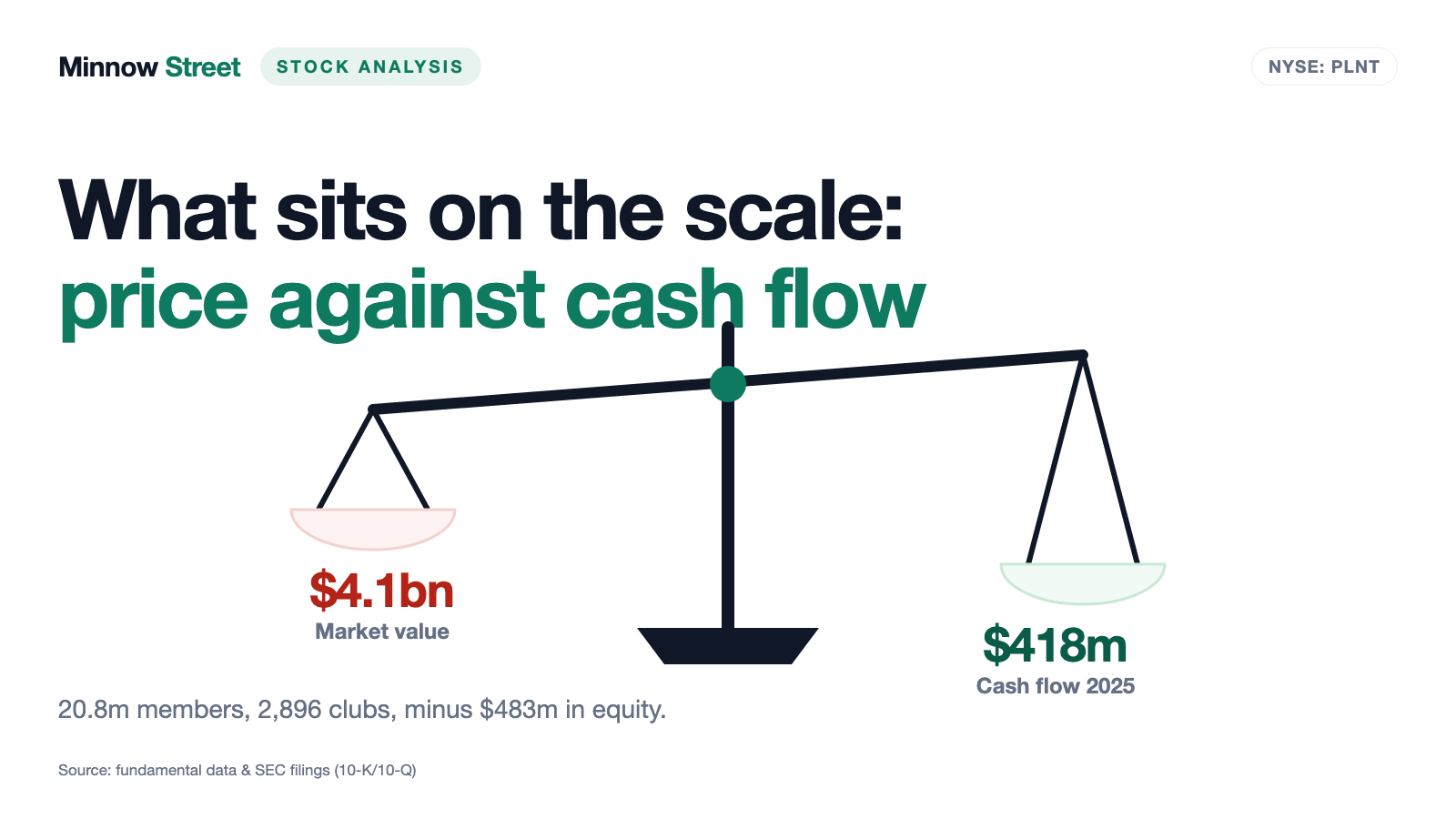
Planet Fitness earns money like clockwork: $1,324.1 million of revenue in 2025, $220.3 million of net income, $418.4 million of operating cash flow. Yet the balance sheet as of December 31, 2025, shows stockholders' equity of minus $483.4 million. The annual report says why: two accelerated share repurchases alone were booked straight into the accumulated deficit for $630.0 million — most recently at an average price of $108.76 per share, while the whole company was worth about $4.1 billion in late July 2026. Not investment advice — just the question of what is left of a company that bought itself back.
 Thomas Mücke
Founder & Publisher
Thomas Mücke
Founder & Publisher
Chart
Interactive price chart (TradingView).
Note: pure fact-based analysis, not investment advice and not a solicitation to buy or sell. All figures without guarantee.
There is an investor trap that Planet Fitness understands better than almost any company on earth — because it lives off it: the dormant-membership trap. Millions of people pay $15 a month for a gym they last set foot in sometime in February. They do not cancel, because cancelling would mean admitting the good intention came to nothing. You keep paying for something you never look at. Investors do exactly the same thing with stocks: we hold positions whose filings we have never read — or we avoid companies because of a single number we have never worked through.
At Planet Fitness, Inc. (NYSE: PLNT) that number is stockholders' equity, and it is negative: minus $483.4 million as of December 31, 2025. For many investors that is an instant disqualifier — balance sheet broken, move on. Our in-house stock scanner disagrees: it lists PLNT in the U.S. selection of the Piotroski screen, meaning the books score unusually well on a nine-part health test. Both at once? Let us make a deal: we read together what the company itself told the U.S. securities regulator, the SEC — the annual report (10-K) for 2025 filed February 25, 2026, and the quarterly report (10-Q) as of March 31, 2026, filed May 7, 2026. An SEC filing is honest under penalty of law. You decide at the end.
What Planet Fitness actually does — a toll booth with a bench press
Planet Fitness sells cheap gyms, but it does not operate most of them. Of 2,909 clubs as of March 31, 2026, 2,617 belonged to franchisees and only 292 to the company itself. The everyday image: Planet Fitness is the toll booth, not the carmaker. Outside entrepreneurs build and pay for the studios; Planet Fitness supplies the brand, the operating manual and the advertising — and collects a fee on every dollar taken in.
That is why this company has two revenue numbers, and confusing them is the most common beginner's error. System-wide sales — all monthly dues and annual fees billed across the entire network — came to $5.3 billion in 2025. Of that, $4.7 billion ran through franchisee-owned clubs and $552.2 million through corporate-owned clubs. Only $1,324.1 million shows up in the consolidated accounts. Remember the rule of thumb: the network bills $5.3 billion, the company books a quarter of it — franchisees see the rest.
Those $1,324.1 million split across four lines in 2025: franchise revenue of $381.0 million (royalties of $314.6 million at its core), national advertising fund revenue of $87.0 million, corporate-owned clubs of $546.1 million and equipment sales of $310.1 million. That last line is the unusual one: Planet Fitness sells its franchisees the training equipment — and requires them to replace it on a schedule. So it is licensor, operator and equipment dealer at the same time. Keep the equipment business in mind; it matters later.
Price is the actual product. The annual report cites $15 per month for the standard Classic Card membership and $24.99 for the PF Black Card with access to every club — against an industry average of $69 in 2024 (a figure from the Health & Fitness Association quoted in the 10-K for 2025). Add the positioning as a "Judgement Free Zone": no classes, no pool, no posing — a gym for people who find gyms uncomfortable. Average monthly dues per member rose from $17.63 (12/31/2021) to $19.51 (12/31/2025), and the share of the pricier Black Card from 62.6 to 66.5 percent.
That sets up the tension running through this analysis, and it shows up in every chapter: the business is a cash machine with a 29.8 percent operating margin — but the company handed back every dollar of profit and more, consuming its own equity in the process. What remains is a cash stream with no balance-sheet cushion.
How the stock reached our desk
The trigger was the Piotroski F-Score — a test of nine yes-or-no questions about a company's books: does it earn money, does cash come in, is leverage falling, is the margin rising? Each yes scores a point. Planet Fitness scores 7 of 9 (data as of July 24, 2026). For context: 7 is good but not spotless — a genuinely clean company sits at 8 or 9, and below 4 things get uncomfortable. That puts the stock in the U.S. selection of our Piotroski screen, which held 16 U.S. names as of July 26, 2026.
You can repeat this in two clicks: open the "Piotroski F-Score (7–9)" screen in our in-house stock scanner and filter for the U.S. market. One caveat applies to every scanner statement in this piece: these lists are recomputed daily. What held on July 26, 2026, may look different a week later.
More interesting than the single hit is the confluence — several independent filters landing on the same name. As of July 26, 2026, PLNT sat on nine of the scanner's lists at once, and the mix already tells this story. On the quality side: Piotroski F-Score (7–9), Quality Growth, EPS Acceleration (earnings per share growing faster than before) and the price-to-cash-flow ranking. On the price side, almost nothing but reversal patterns: Bullish Reversal Bar and Oops Reversal show up after a sell-off, not inside an intact uptrend. Translated: the books say "solid", the chart says "I am coming up off the floor".
Two more metrics from the same data set (July 24, 2026) round out the picture, and both deserve to be rated rather than just quoted. The Altman Z-score of 3.64 measures distance from insolvency; anything above 3 counts as the safe zone — negative equity notwithstanding. And the price-to-book ratio of 139 is not a valuation but an artifact: when book value is effectively zero, that ratio can be any size at all, which makes it useless. Remember: at companies without equity, every metric that divides by book value is garbage.
The numbers over the years — credit where it is due
First, what genuinely impresses. And with Planet Fitness that is quite a lot. Revenue grew almost a quarter in three years: from $1,071.3 million (2023) through $1,181.7 million (2024) to $1,324.1 million (2025) — up 12.1 percent in the latest year. Profit grew faster than revenue: $147.0 million (2023), $174.2 million (2024), $220.3 million (2025), or 26.4 percent in the latest year.
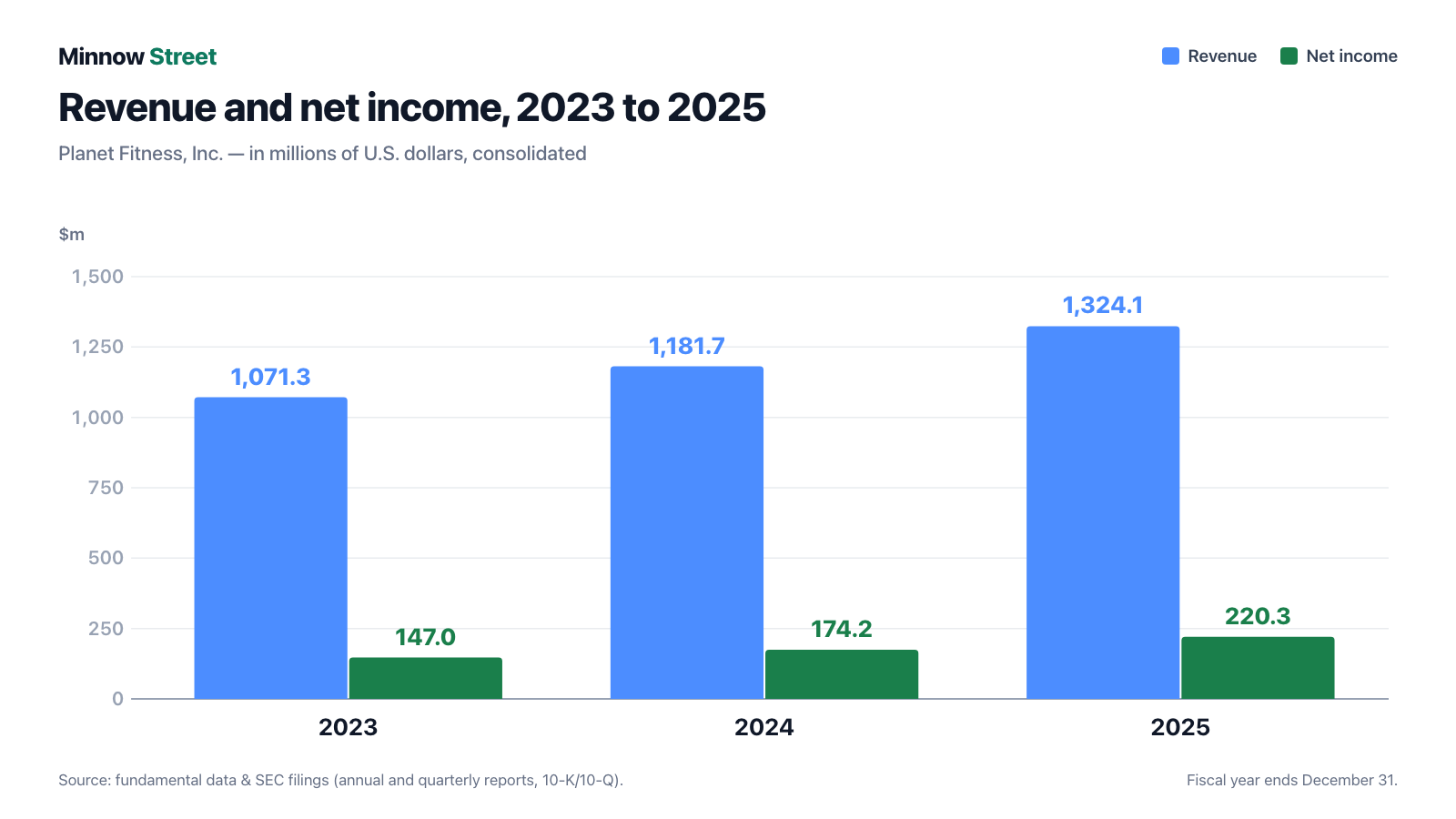
The margin says even more. Of every $100 of revenue in 2025, $29.80 remained as operating profit ($394.7 million of $1,324.1 million). Few consumer businesses get anywhere near that; it works because royalty income carries almost no running cost. For a sense of how differently restaurant and leisure economics behave, our analysis of The Cheesecake Factory shows the same revenue scale living on a single-digit margin.
And the business produces real cash, not just book profit: $418.4 million of operating cash flow in 2025 (2024: $343.9 million). Of that, $163.7 million went into capital expenditures — mostly new and existing corporate-owned clubs. Roughly $254.7 million of free cash was left over. That is the number this whole analysis turns on: it explains why a company with no equity can still work.
The start of 2026 looked better still, at first glance. First-quarter revenue rose 21.9 percent to $337.2 million (prior-year quarter: $276.7 million), net income to $51.8 million (prior-year quarter: $42.1 million), and diluted earnings per share from $0.50 to $0.65. Membership climbed to roughly 21.5 million, the club count to 2,909, and as of March 31, 2026, the company held contractual commitments to open about 750 more clubs. Why that strong quarter still comes with a catch is Truth No. 4.
What the filings say — the uncomfortable truths
Now the other side. Everything that follows comes from mandatory SEC filings, not from press coverage.
Truth No. 1: the equity is gone — and shareholders spent it themselves
The consolidated balance sheet as of December 31, 2025, shows stockholders’ equity of minus $483.4 million, after minus $215.4 million a year earlier. As of March 31, 2026, it stood at minus $482.8 million. Translated: subtract every liability from everything the company owns and a hole is left.
Except the hole here does not come from losses — Planet Fitness earned a profit in each of the past three years. It comes from the line "accumulated deficit" of $1,107.4 million, against which all share repurchases are charged. Paid-in capital of $623.3 million sits on the other side; the rest — par value, currency translation and non-controlling interests — adds up to $0.7 million. The arithmetic works out like this:
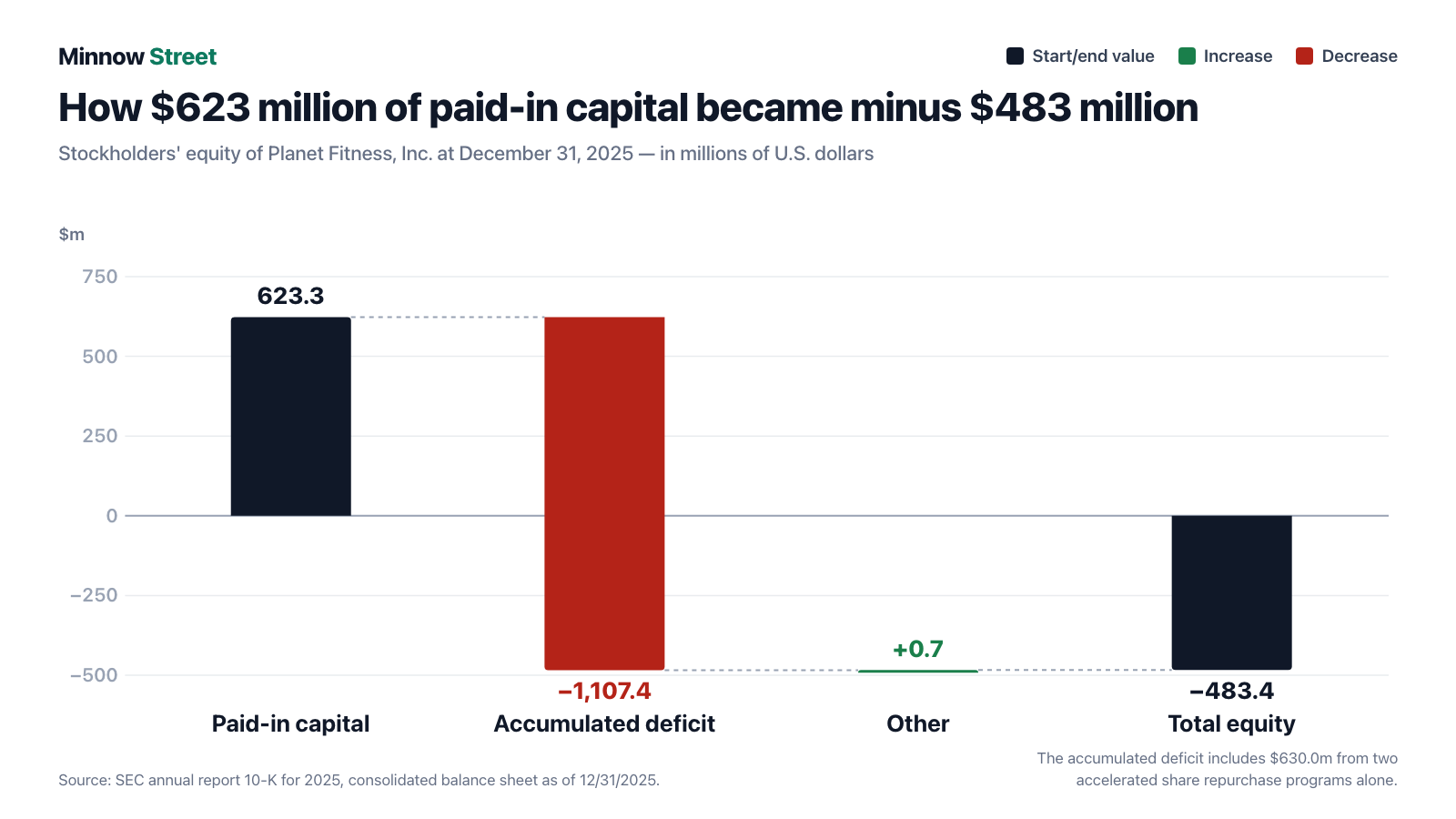
How does a deficit like that build up at a profitable company? The annual report spells out the mechanism for the most recent large repurchase:
"On December 12, 2025, the Company entered into a $350.0 million accelerated share repurchase agreement (the “2025 ASR Agreement”) with the Bank. Pursuant to the terms of the 2025 ASR Agreement, on December 16, 2025, the Company paid the Bank $350.0 million in cash and received 2,548,234 shares of the Company’s Class A common stock, which were retired, and the Company recorded an increase to accumulated deficit of $280.0 million, representing 80% of the total 2025 ASR Agreement value based on the closing price of the Company’s Class A common stock on the commencement date of the transaction."
— Planet Fitness, Inc., SEC annual report 10-K for 2025, "Share Repurchase Program"

The $280.0 million quoted above is only the portion the report recognizes on the spot — 80 percent of the program. For the remaining 20 percent the notes add: "The remaining 20% of the total 2025 ASR Agreement value has been evaluated as an unsettled forward contract indexed to our Class A common stock, with $70.0 million classified as an increase to accumulated deficit." (10-K for 2025, Note 13 “Stockholders’ equity”) So the December transaction hit the deficit for its full $350.0 million. The identical program from June 2024 worked the same way: $224.0 million immediately, $56.0 million as the remaining 20 percent — $280.0 million in total.
Across the two accelerated repurchases that is $630.0 million charged straight against the accumulated deficit. You can check it against the statement of stockholders’ equity: the deficit grew from $822.2 million to $1,107.4 million in 2025, an increase of $285.3 million — and that is after $219.1 million of net income had reduced it. So the charges came to roughly $504 million, exactly the sum of the $350.0 million accelerated repurchase, $150.0 million of open-market purchases and $4.2 million of repurchase excise tax. Add the rest and Planet Fitness spent roughly $925 million on its own shares in three years: $125.0 million (2023), $300.0 million (2024) and $500.0 million (2025). The share count fell from 84.3 million (12/31/2024) to 79.1 million (03/31/2026) — a little over six percent fewer shares in fifteen months. This is not a balance-sheet catastrophe; it is a decision. The company preferred buying itself to building a cushion.
Truth No. 2: those buybacks were expensive
A buyback only helps you if the company buys below value. Here you can check, because every price sits in the filings. For the December program the annual report names a volume-weighted average price of $108.76 per share. In the first quarter of 2026 Planet Fitness bought another 613,725 shares for $50.0 million — about $81 apiece. As of July 24, 2026, the whole company was worth roughly $4.1 billion; with 79,126,649 Class A shares outstanding (as of May 4, 2026, from the cover page of the quarterly report), that works out to about $52 per share.

Be fair about this: nobody forecasts prices, boards included. But the sequence stays awkward — $350 million spent at $108.76, then $50 million at roughly $81, and the stock kept falling afterwards. On top of that came $4.2 million of excise tax on repurchases in 2025 alone. Remember the sentence: a buyback is not a gift, it is a purchase — and as with any purchase, the price decides.
Truth No. 3: almost the entire U.S. business is pledged
The $2,514.2 million of debt outstanding as of December 31, 2025, is not ordinary bank borrowing. It runs through a securitization — in plain terms, the company moved its most important income streams into separate, legally ring-fenced subsidiaries and borrowed against exactly those streams. The everyday image: it is not the building that is mortgaged, it is the lease. The annual report describes the scope unusually plainly:
"The Notes were issued in securitization transactions pursuant to which most of the Company’s domestic revenue-generating assets, consisting principally of franchise-related agreements, certain corporate-owned club assets, equipment supply agreements and intellectual property and license agreements for the use of intellectual property, were assigned to the Master Issuer and certain other limited-purpose, bankruptcy remote, wholly-owned indirect subsidiaries of the Company that act as guarantors of the outstanding Securitized Senior Notes and that have pledged substantially all of their assets to secure the Securitized Senior Notes."
— Planet Fitness, Inc., SEC annual report 10-K for 2025, Note 10 "Long-term debt"

What this means in practice: the notes carry fixed coupons between 3.858 and 6.237 percent and are not amortized in the usual way but refinanced at so-called anticipated repayment dates — December 2029 for the 2019 notes, December 2030 and December 2032 for the 2025 notes. Miss a refinancing and the indenture switches into rapid amortization: cash then goes to creditors before the group sees any of it. The same applies if certain ratios break. As of March 31, 2026, all covenants were met, and both $75 million variable funding facilities were undrawn. The cost of the structure sits in the income statement: $108.2 million of interest expense in 2025 alone (2024: $100.0 million), against income from operations of $394.7 million. Interest is covered 3.6 times over — comfortable, but not lavish.
Truth No. 4: the strong quarter came from the wrong place
Revenue up 21.9 percent in the first quarter of 2026 sounds like acceleration. Look at where the increase came from and the picture turns. Of $60.6 million of added revenue, $34.3 million came from the equipment segment, which jumped from $27.8 million to $62.1 million — more than half of the entire increase. Equipment revenue means franchisees replacing their benches and treadmills. That is a replacement cycle, not a subscription — it arrives in waves and recedes again.
Meanwhile, the very number that determines what a franchise chain is worth slowed down. Same club sales growth — revenue growth at studios open for more than twelve months — fell system-wide from 6.1 percent in the first quarter of 2025 to 3.5 percent in the first quarter of 2026. Franchisee-owned clubs went from 6.2 to 3.5 percent, corporate-owned clubs from 5.1 to 3.5 percent. For full-year 2025 the annual report still showed 6.8 percent (franchise) and 6.0 percent (corporate). Remember the pattern: the loud number accelerates, the quiet number brakes. Which of the two matters for the coming years will be decided in the next quarterly reports.
Truth No. 5: $415.8 million already belongs to somebody else
The balance sheet carries a line you will not find at ordinary companies: "Payable pursuant to tax benefit arrangements" of $415.8 million as of December 31, 2025 ($55.5 million current, $360.3 million non-current; unchanged as of March 31, 2026). Behind it lies an agreement dating back to the IPO structure: Planet Fitness must pay 85 percent of certain tax benefits it actually realizes to former equity holders. The everyday image: part of the tax saving you count as profit is really a pass-through. For scale, net income in 2025 was $220.3 million — the obligation is nearly twice that. For a different flavor of how founding structures can outweigh the operating business, see our analysis of Biglari Holdings.
One personnel note belongs here too, because it covers the reporting period: the quarterly report as of March 31, 2026, was still signed off with an interim chief financial officer. Only on June 25, 2026, did Planet Fitness report in a current filing (8-K, Item 5.02) the appointment of Sudhanshu Priyadarshi as Chief Financial Officer and President, International, effective the same day. The search cost $0.8 million in the first quarter of 2026.
Valuation — what you pay for the cash stream
Because book value tells you nothing here, price-to-book comparisons are useless. Only earnings, cash flow and enterprise-value measures work. As of July 24, 2026 — every valuation figure below carries that date and should be read as an order of magnitude — the picture looks like this: market value of roughly $4.1 billion, a price-to-earnings ratio of about 19 on the trailing twelve months and about 17 on the current-year estimate. The price-to-sales ratio is about 3.
Enterprise value says more, because it includes the debt: roughly $6.6 billion, or 11.2 times earnings before interest, taxes, depreciation and amortization. For a franchise chain with a 29.8 percent operating margin that is no fire sale, but no bubble either. The gap between the two numbers is the striking part: of every dollar of enterprise value, about 38 cents belong to creditors rather than shareholders.
The professional view: 20 analysts carried an average price target of $66.64 as of July 24, 2026 — roughly 28 percent above the level at the time. At the same moment, about 12 percent of the float was sold short, meaning borrowed and sold by investors betting on a decline. Together those two facts describe the situation precisely: the professionals disagree, and both camps draw their arguments from the same filing.
Opportunities and risks at a glance
What speaks for Planet Fitness:
- A model with a 29.8 percent operating margin (2025) and recurring royalties of $314.6 million — franchisees carry the construction and lease risk.
- $418.4 million of operating cash flow in 2025 against $163.7 million of capital expenditures; interest of $108.2 million is covered 3.6 times by income from operations.
- Price leadership: $15 and $24.99 per month against an industry average of $69 (2024) — a model that tends to gain rather than lose when consumers tighten up.
- A visible growth pipeline: about 750 contractually committed new clubs as of March 31, 2026, plus a rising share of the pricier Black Card (66.5 percent as of 12/31/2025, up from 62.6 percent at the end of 2021).
- An Altman Z-score of 3.64 (data as of July 24, 2026) inside the zone considered safe and a Piotroski F-Score of 7 of 9 — current reporting shows no red flags.
What speaks against it:
- No balance-sheet cushion: minus $483.4 million of equity as of 12/31/2025. Any setback has to be absorbed out of current cash flow, not out of substance.
- $2,514.2 million of debt inside a securitization for which practically all domestic income streams are pledged — with refinancing dates starting December 2029.
- Core growth is slowing: system-wide same club sales up only 3.5 percent in the first quarter of 2026, after 6.1 percent a year earlier.
- Expensive own shares: an average of $108.76 in the December program against a market value that equated to about $52 per share as of July 24, 2026 — and $450.0 million of the program is still open.
- $415.8 million of obligations under the tax benefit arrangements, routing 85 percent of future tax savings to former equity holders.
- Goodwill and intangibles of $998.9 million combined make up almost a third of the $3,103.4 million balance sheet — a write-down would deepen the hole further.
A human conclusion
Back to the dormant-membership trap. Planet Fitness makes money because people pay for something they never look at. The honest punchline of this analysis is that investors can make the same mistake in reverse: you can also reject a company over a number you have never looked at. "Negative equity" sounds like distress. Here it is the result of a decision — $925 million of share buybacks in three years, charged against a deficit that grew larger than all the capital ever paid in.
That does not make it harmless. A company without book value has no buffer: it must deliver every year, because there is nothing to fall back on. And it has pledged its income streams to creditors, which narrows the room to maneuver in a crisis. As long as $418 million a year flows through the business and interest is covered 3.6 times, that holds. As long.
So the honest question is not "is minus $483 million bad?" but: do you trust a business with no reserve to be as reliable over the next ten years as it was over the last three — when same club sales growth has just halved? If yes, you have a thesis, and the quarterly reports give you two clean measuring points: same club sales growth and the remaining balance of the repurchase program. If no, you had a reflex. What you do with that is your call. And that is exactly as it should be.
Sources
Every original document used in this analysis, for you to read yourself:
- Planet Fitness, Inc. — SEC quarterly report 10-Q as of 03/31/2026 (filed May 7, 2026)
- Planet Fitness, Inc. — SEC annual report 10-K for 2025 (filed February 25, 2026)
- Planet Fitness, Inc. — SEC current report 8-K dated June 25, 2026, Item 5.02 (CFO appointment)
- Planet Fitness, Inc. — SEC annual report 10-K for 2024, the quarterly reports 10-Q as of 03/31, 06/30 and 09/30/2025, and the current reports 8-K dated May 7, 2026 (results) and May 11, 2026 (annual meeting): EDGAR overview for CIK 0001637207 (sec.gov)
- Fundamental data (metrics, valuation, Piotroski F-Score, Altman Z; data as of July 24, 2026), reconciled against the SEC filings.
- Screen memberships: our in-house stock scanner, as of July 26, 2026; the lists are recomputed daily.
Transparency & disclaimer: this analysis is a journalistic contextualization of publicly available information. It is not investment advice, not a regulated financial analysis and not a solicitation to buy or sell securities. Equity investments carry substantial risk up to total loss. All information without warranty; the as-of date for each figure is stated in the text. The author holds no position in Planet Fitness shares at the time of publication.
Our Bottom Line at a Glance
- Business model positive
- Of 2,909 clubs as of March 31, 2026, 2,617 belong to franchisees — construction, rent and payroll are somebody else's problem. That produced a 29.8 percent operating margin in 2025 ($394.7 million of $1,324.1 million) and recurring royalties of $314.6 million. At $15 and $24.99 per month against an industry average of $69 (2024), the brand sits at the bottom of the price range, where consumer slowdowns hurt least.
- Earnings power and cash flow positive
- Net income rose three years running: $147.0 million (2023), $174.2 million (2024), $220.3 million (2025). Operating cash flow reached $418.4 million in 2025 against $163.7 million of capital expenditures, and $147.5 million in the first quarter of 2026. Interest of $108.2 million is covered 3.6 times by income from operations.
- Balance sheet and capital structure negative
- As of December 31, 2025, the balance sheet showed stockholders' equity of minus $483.4 million (12/31/2024: minus $215.4 million), and minus $482.8 million as of March 31, 2026. The cause is not losses but buybacks: $630.0 million from two accelerated programs alone ($280.0 million in 2024, $350.0 million in 2025) were charged against the accumulated deficit of $1,107.4 million. There is no substance buffer for a weak year.
- Debt and pledged assets negative
- $2,514.2 million of notes run through a securitization into which, per the annual report, most domestic income streams were transferred and pledged to bankruptcy-remote subsidiaries. All covenants were met as of March 31, 2026, and both $75 million facilities were undrawn — but the refinancing dates from December 2029 onward are not automatic.
- Capital allocation negative
- Roughly $925 million went into own shares in three years: $125.0 million (2023), $300.0 million (2024), $500.0 million (2025), plus $50.0 million in the first quarter of 2026. The December program averaged $108.76 per share, while market value as of July 24, 2026, equated to about $52 per share. $450.0 million of the program remained open as of March 31, 2026.
- Quality of growth neutral
- The first quarter of 2026 delivered 21.9 percent revenue growth — but $34.3 million of the $60.6 million increase came from equipment sales to franchisees, a replacement cycle. Same club sales growth fell system-wide from 6.1 to 3.5 percent. Against that stand about 750 contractually committed new clubs as of March 31, 2026, and a Black Card share of 66.5 percent.
Planet Fitness is a highly profitable franchise business with no balance-sheet cushion. In its favor: a 29.8 percent operating margin, $220.3 million of net income and $418.4 million of operating cash flow in 2025, interest covered 3.6 times, and about 750 committed new clubs. Against it: stockholders' equity of minus $483.4 million, $2,514.2 million of securitized debt backed by the income streams themselves, $415.8 million of obligations under the tax benefit arrangements, and core growth that halved from 6.1 to 3.5 percent in the first quarter of 2026. Buying here means buying a cash stream, not substance. Not investment advice.
What Our Rating Means
Open questions
The business works in principle, but one material question is open. As long as it stays open, our findings do not carry a quality verdict.
Stockholders' equity of minus $483.4 million looks like a red light, but it is not a substance finding here: it stems from share buybacks charged against the accumulated deficit, not from losses. The company has been profitable for years, covers its interest 3.6 times, met every covenant as of March 31, 2026, has both credit facilities undrawn and sits at 3.64 on the Altman Z-score, inside the safe zone. There is no going-concern flag and no accounting breach. Green it is not, either: with no equity cushion, every year has to be financed out of the operating business, the income streams are pledged to creditors, and the decisive operating question is open — same club sales growth halved from 6.1 to 3.5 percent in the first quarter of 2026 while the revenue jump came from an equipment replacement cycle. Hence yellow: proven earnings power, open growth question, no buffer. The decision is yours.
A journalistic assessment by our editorial team at the time of the deep dive, based on public sources — not investment advice and not a solicitation to buy or sell. Your personal circumstances (investment goals, risk capacity, taxes) cannot be taken into account. What our levels mean, how verdicts are formed, and what conflicts of interest exist →
Worth Noting
- The hook was our in-house stock scanner: Planet Fitness appears in the U.S. selection of the "Piotroski F-Score (7–9)" screen with a score of 7 of 9 (16 U.S. hits as of July 26, 2026). On the same day the stock also sat on eight further lists — Quality Growth, EPS Acceleration and the price-to-cash-flow ranking on the fundamental side, Bullish Reversal Bar and Oops Reversal on the price side. These lists are recomputed daily.
- All valuation figures carry a data cut-off of July 24, 2026, and should be read as orders of magnitude; analyses are evergreen and daily prices are not a buy argument. The $108.76 anchor is not a market price but the volume-weighted average repurchase price of the December 2025 program as documented in the annual report.
- Metric trap: the price-to-book ratio of 139 (data as of July 24, 2026) is meaningless with negative equity, as is return on equity. Only earnings, cash flow and enterprise-value measures carry information here.
Frequently Asked Questions
Planet Fitness, Inc. (NYSE: PLNT), based in Hampton, New Hampshire, is primarily a franchisor of fitness clubs. Of 2,909 clubs as of March 31, 2026, 2,617 belonged to franchisees and 292 to the company. It earns money from royalties, from running its own clubs and from selling training equipment to franchisees. Revenue reached $1,324.1 million in 2025.
Not because of losses — the company has been profitable for years. The cause is share repurchases: they are charged against the accumulated deficit, which stood at $1,107.4 million as of December 31, 2025. Two accelerated repurchase programs from 2024 and 2025 alone account for $630.0 million. Against that sits only $623.3 million of paid-in capital, leaving minus $483.4 million.
No, it depends on the cause. If it comes from losses, it is dangerous. If it comes from buybacks at a profitable company, it is a capital allocation choice. At Planet Fitness, income from operations of $394.7 million covered interest of $108.2 million 3.6 times in 2025, and the Altman Z-score stood at 3.64 (data as of July 24, 2026). The missing cushion is real all the same.
Considerably more than the consolidated accounts show. System-wide member dues and annual fees reached $5.3 billion in 2025 — $4.7 billion in franchisee-owned clubs and $552.2 million in corporate-owned clubs. Planet Fitness itself booked $1,324.1 million of that; the rest stays with franchisees, who pay rent, payroll and buildout.
The annual report for 2025 cites $15 per month for the standard Classic Card membership and $24.99 for the PF Black Card, which adds access to all clubs and extra amenities. The industry average was $69 in 2024, per the trade body quoted in the filing. Actual average monthly dues per member were $19.51 as of December 31, 2025.
Because the growth came from the least recurring part. Of $60.6 million in added revenue, $34.3 million came from equipment sales to franchisees, which jumped from $27.8 million to $62.1 million. At the same time system-wide same club sales growth fell from 6.1 percent a year earlier to 3.5 percent — the metric that determines what a franchise chain is worth.
Planet Fitness transferred most of its domestic income streams — franchise agreements, club assets, equipment supply agreements and intellectual property — to bankruptcy-remote subsidiaries that secure $2,514.2 million of notes. If a refinancing is missed or a ratio breaks, cash goes to creditors first. All covenants were met as of March 31, 2026.
No. The company returns capital exclusively through share repurchases: $125.0 million in 2023, $300.0 million in 2024 and $500.0 million in 2025. As of March 31, 2026, $450.0 million of the 2025 program remained. The share count fell from 84.3 million at the end of 2024 to 79.1 million as of March 31, 2026.
Found an error?
Did you spot a factual error, an outdated number, or a typo in this deep dive? Let us know briefly — your report goes straight to the editorial team.