An Entire Island Fills Up at One Family’s Pumps: Petrolina Buys Out Exxon Below Value — and Doesn’t Earn Its Money at the Pump
Petrolina dominates Cyprus’s fuel-station market — since January 31, 2026 also with the 68 Esso stations bought from ExxonMobil, acquired below the fair value of the net assets, with a €7.27 million paper gain on day one. The stock trades at 0.69 times book value, a P/E of 12.7 and a 3.5 percent dividend yield — and still hardly anyone reaches for it. Because the profit is not made at the pump but in aircraft-fueling stakes, net debt exceeds the entire market value, the Lefkaritis family holds more than 55 percent plus six of nine board seats — and on a normal trading day about €6,400 worth of shares changes hands. Not investment advice — just the question of what a bargain is worth when you can hardly sell it back.
 Thomas Mücke
Founder & Publisher
Thomas Mücke
Founder & Publisher
Chart
Interactive price chart (TradingView).
Note: pure fact-based analysis, not investment advice and not a solicitation to buy or sell. All figures without guarantee.
There is a reflex every bargain hunter knows: a surveyor values a house at a million, it is offered at 690,000 — and the head starts calculating. Thirty percent below value! Grab it before someone else does! Call it the book-value trap. Because whoever looks only at the price tag misses three things printed small in the brochure: a large family already sits at the kitchen table and has no intention of moving out. The mortgage on the house is bigger than the purchase price. And the front door jams — whoever gets in will not get out quickly. Exactly such a house stands on the Nicosia stock exchange: Petrolina (Holdings) Public Ltd (CSE: PHL), Cyprus’s largest oil company, on offer at 0.69 times book value, a P/E of 12.7 and a 3.5 percent dividend yield (all valuation figures as of July 24, 2026). So let us make a deal: we will not compute the discount — we will read the small print, in the audited annual accounts, in Greek, all 127 pages. In the end you decide.
Why there is no SEC filing from Petrolina — and where the numbers come from instead
One point first, because it shapes this whole analysis: there is no 10-K, no 10-Q, no 20-F from Petrolina. The company is not a U.S. reporting company; the EDGAR company search for "petrolina" returns exactly one hit — a Texas private fund of the same name with no connection whatsoever to the Cypriot firm. Petrolina’s mandatory reports live elsewhere: at the Cyprus Stock Exchange (Greek ΧΑΚ), where the share has been listed since December 19, 2000 — on the alternative market, the segment with the lightest obligations. There the company publishes its audited IFRS consolidated statements (127 pages for 2025, opinion signed by KPMG on April 29, 2026) and its mandatory announcements, all in Greek, reporting currency euro.
What does that mean for you? The narrative logic we usually lean on — "a filing to the SEC is honest under penalty of law" — applies in spirit here too: an audited IFRS report is a certified, liability-bearing document, not a brochure. But two things differ. First, the source: every figure in this analysis is therefore captioned "Source: fundamental data & company reports (CSE/annual reports)", not "SEC filings." Second, the environment: on the CSE alternative market there are no analyst calls, no coverage, no quarterly reports — only annual and half-year figures plus whatever the company must announce. We read the originals, marked the decisive passages and translated them. This kind of darkness is not unique, by the way: our Helios Towers analysis — also a company with no SEC filings — ran on original documents alone.
What Petrolina actually does — the fuel pump of an entire island
The business model fits in one sentence: Petrolina buys fuel on the world market, ships it to Cyprus, stores it in its own terminal and sells it — to drivers through one of the island’s largest station networks (brands Petrolina, Eni, Agip, plus 68 Esso stations since January 2026), to commercial customers, as heating oil, as LPG, as marine and aviation fuel. The roots reach back to 1946, when the five Lefkaritis brothers founded a trading business; the operation has been called Petrolina since 1959, the holding has been listed since 2000 — and the family runs it to this day. The backbone is infrastructure nobody rebuilds overnight: the group’s own fuel terminal at Vasilikos (since January 2020; 18 tanks, 113,000 cubic metres), an LPG terminal in a joint venture, plus depots in Greece (Volos, Samos, Chania).
And then there is the part easily missed from outside: the equity stakes. Petrolina holds 50 percent of PPT Aviation Services (aircraft fueling at Larnaca and Paphos airports), 40 percent of the Larnaca airport fuel depot and 24.5 percent of Greece’s HAFCO (aircraft fueling, Athens among others). These companies never show up in revenue — under the equity method only their proportionate profit appears, in a single line of the income statement. Remember that line. It is about to matter.
Where the fuel comes from is in the report too — and it is the first sentence that makes you swallow:
„Ο Όμιλος δεν έχει οποιαδήποτε άμεση εξάρτηση από πελάτες που προέρχονται από τα εμπλεκόμενα μέρη, ούτε έχει επηρεαστεί η υφιστάμενη εφοδιαστική του αλυσίδα παρά το γεγονός ότι διυλιστήριο στο Ισραήλ αποτελεί διαχρονικά κύριο προμηθευτή προϊόντων."
Translation: "The Group has no direct dependence on customers from the parties involved [in the war], nor has its existing supply chain been affected — despite the fact that a refinery in Israel has always been a main supplier of products."
— Petrolina (Holdings) Public Ltd, 2025 annual report, management report (Έκθεση Διαχείρισης), p. 7
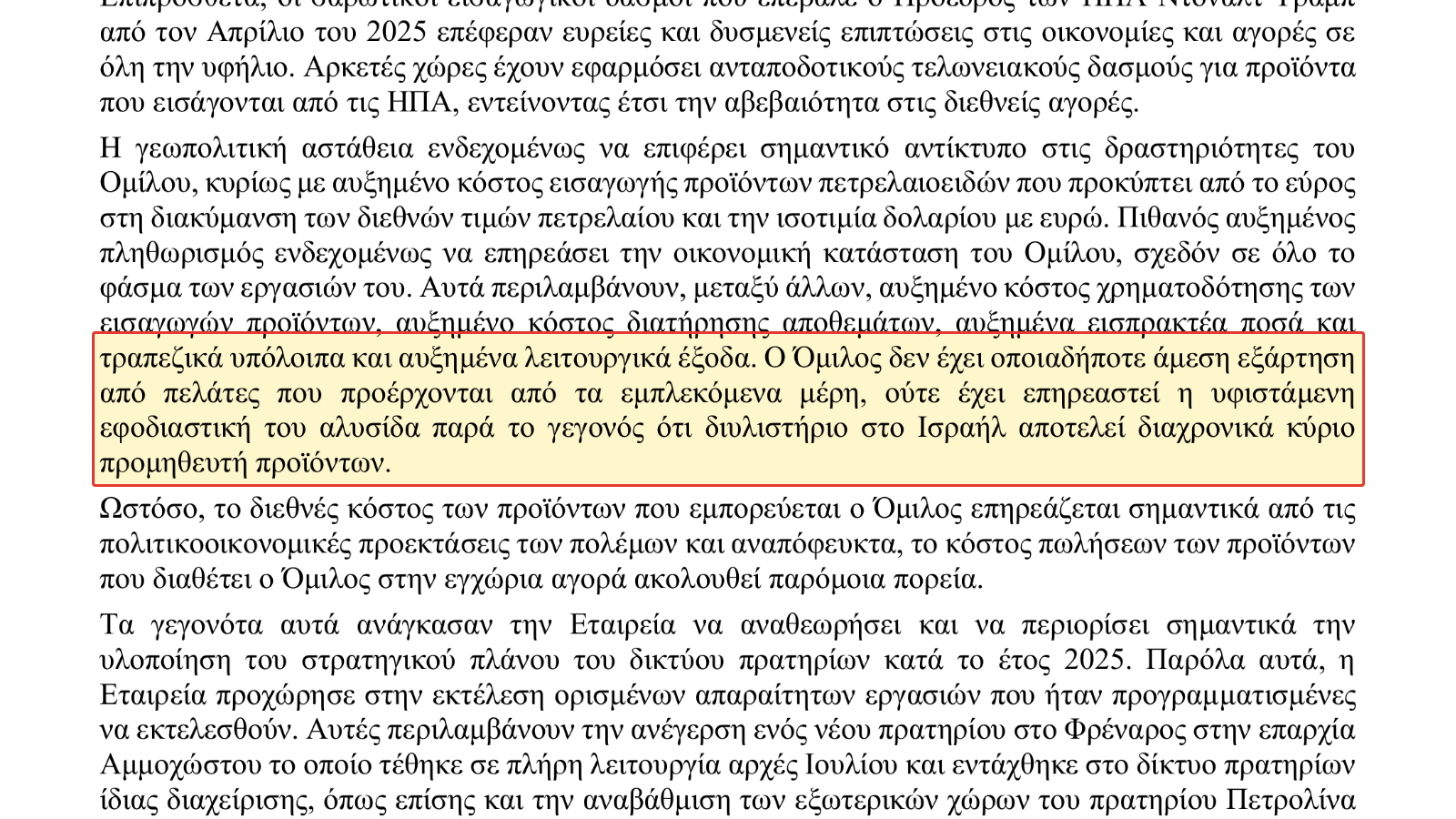
Since the war between the US/Israel and Iran escalated on February 28, 2026 — disrupting, per the report, the Strait of Hormuz and driving energy prices sharply higher — Petrolina has been sourcing more via Greece and the Eastern Mediterranean. In an everyday image: the island’s baker has always bought his flour from a mill that stands in a storm zone — every delivery has arrived so far, but the surcharge for detours comes out of the margin. And the other side squeezes too: Cyprus’s government cut fuel excise duty (minus 8.33 cents per litre of petrol, extended to mid-September 2026), monitors pump prices publicly, and the island’s fuel sales fell 5.1 percent year on year in May 2026. An importer caught between rising purchase prices and capped selling prices — that is this company’s daily business.
Why our scanner is silent here — and how the stock landed on our desk
Honesty first: our in-house stock scanner did not find Petrolina — and could not have. The scanner universe covers U.S.-listed names; a Cypriot share on the CSE alternative market, with no U.S. listing and no machine-readable metric series, simply does not appear in it. No Piotroski history, no momentum signal, no confluence — not because the company is bad, but because this radar does not sweep that sea. The stock landed on our desk through a headline you cannot miss if you follow takeovers: ExxonMobil, one of the largest companies in the world, sells its entire Cyprus business — and the buyer is the local champion from the island. When a global giant exits a country and a €106 million micro cap absorbs it, we want to know what is in that buyer’s books.
The numbers over the years — lots of revenue, little profit, one jump
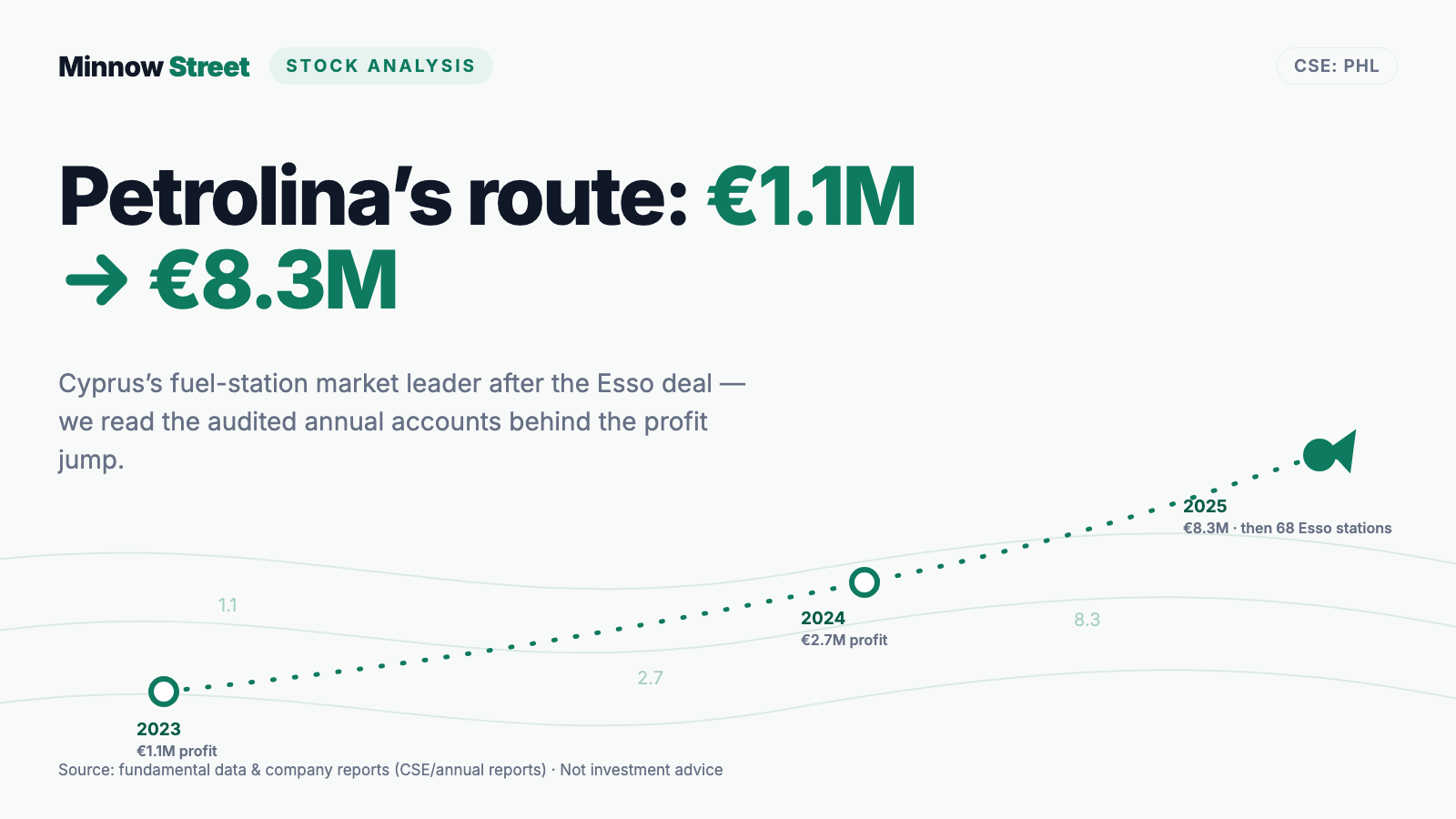
First what impresses, honestly appraised. Petrolina turns over more than half a billion euros every year: €559.9 million (2023), €570.1 million (2024), €559.4 million (2025) — after €644.4 million in the exceptional energy year 2022. Revenue is a wall that barely moves. Underneath it, though, something happened in 2025: net profit tripled to €8.3 million (2024: €2.7 million; 2023: €1.1 million), earnings per share jumped to 9.49 euro cents. Over three years profit has risen more than sevenfold — on practically unchanged revenue. The dividend follows: for 2025 a total of 4.2 cents per share was declared (€3.675 million), after 2.0 cents for 2024; the 2.0 cent final dividend is payable on July 28, 2026, and a 1.0 cent interim dividend for 2026 has already been declared (ex-date July 29, 2026).
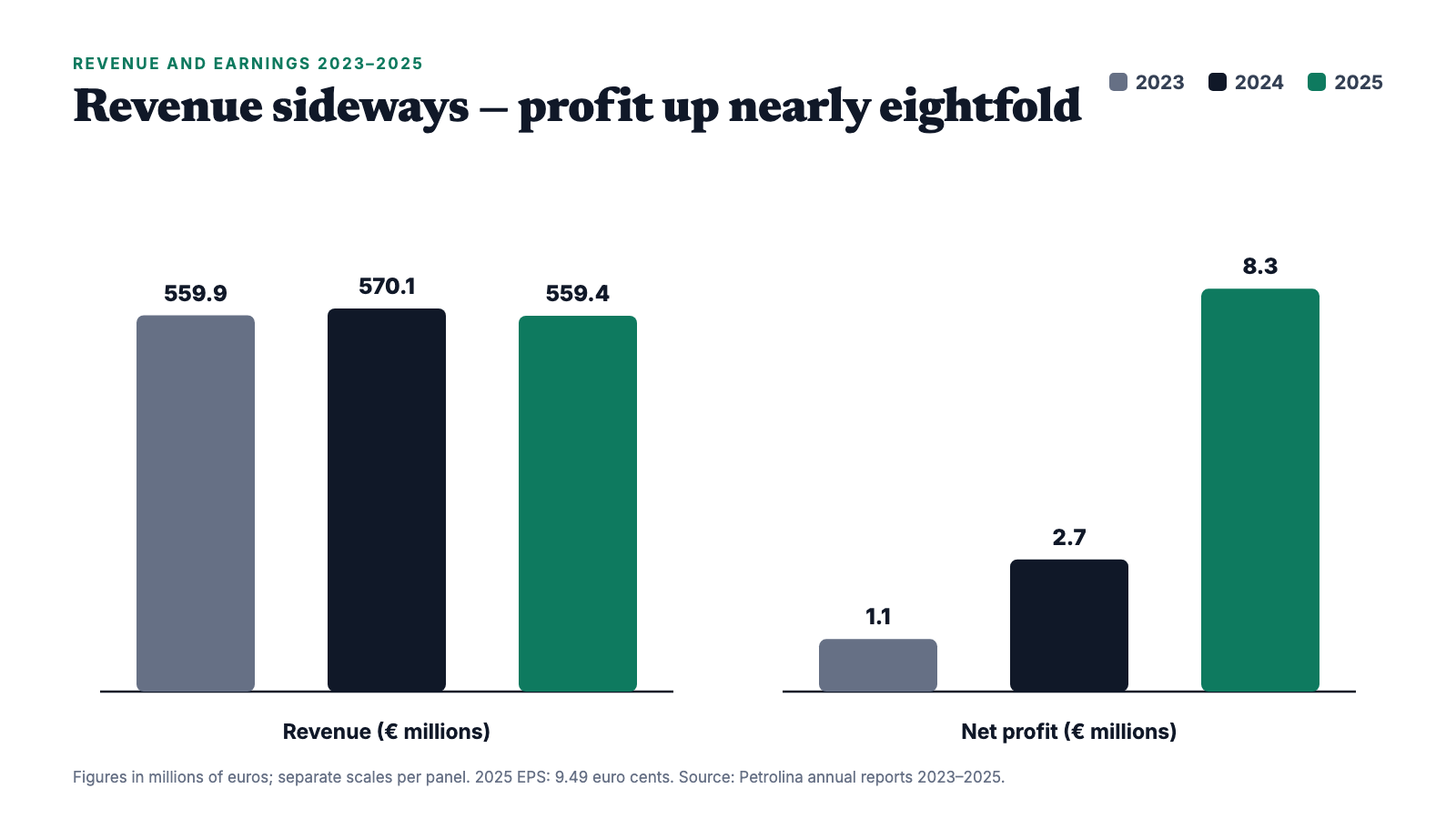
The half-years tell the turn as well: in the first half of 2024 Petrolina still posted a loss of €0.7 million; in the first half of 2025, €3.0 million of profit again (the H1 figures come from the CSE release, documented via the Cyprus Mail report of September 25, 2025 — the original is available only as a scan). For the first half of 2026 the company announced a "significant improvement" on June 26, 2026. Sounds like a streak. And exactly here begins the duty to read the small print — because part of that improvement is, as we are about to see, a one-off, and the profit itself is not made where the revenue is.
What the filings say — the uncomfortable truths
Uncomfortable truth no. 1: the profit is not made at the pump — the core business runs at zero
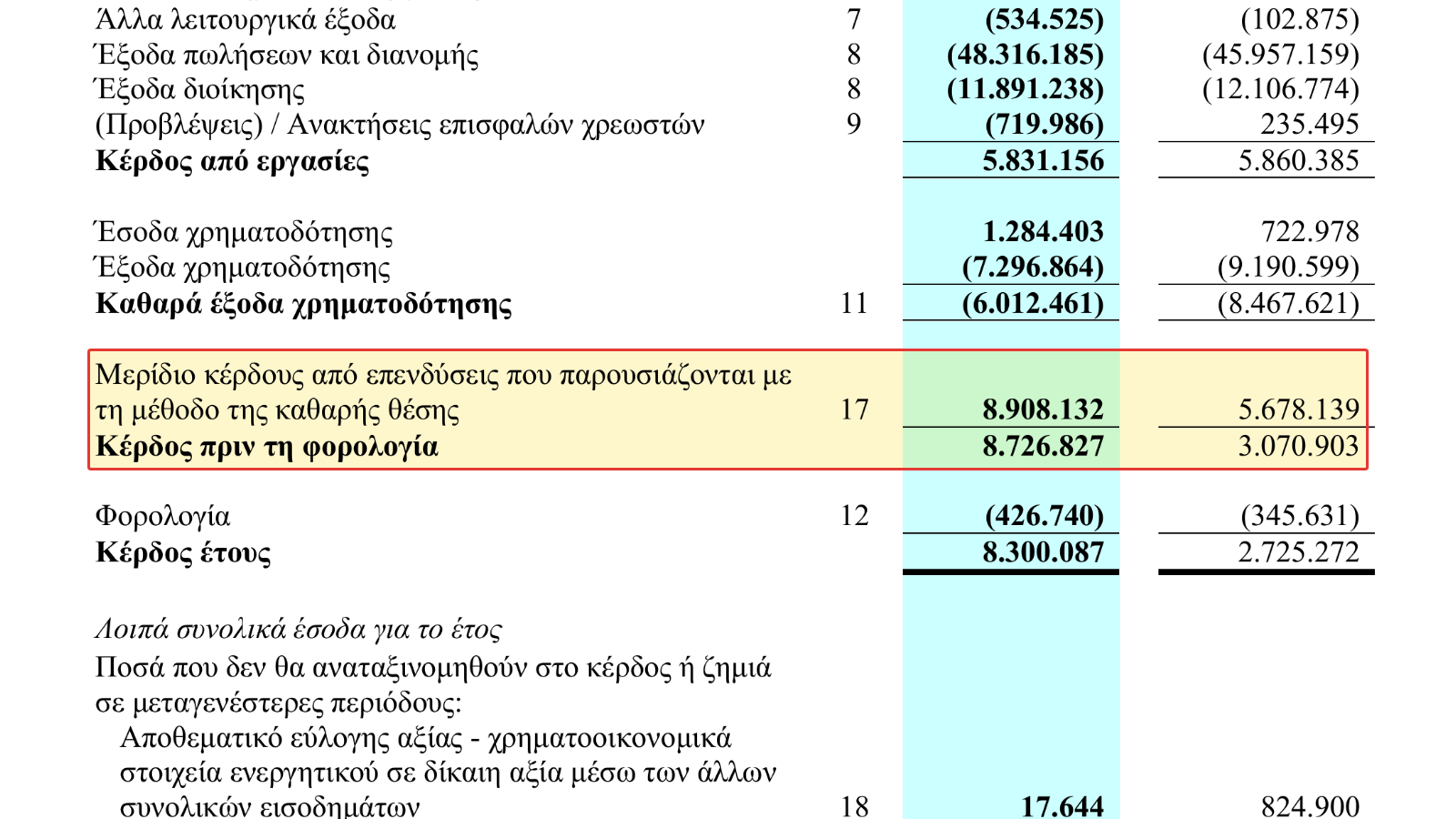
Now to the line you should remember. The 2025 income statement reads like this: out of €559.4 million in revenue, after all operating costs, remain €5.8 million of operating profit — an operating margin of about one percent. Interest eats almost all of it: net finance costs of €6.0 million. The core business — importing, storing, selling — thus lands at minus €0.2 million. And then comes the one line that flips everything: "share of profit of equity-accounted investees: €8.9 million" — more than the entire pre-tax profit of €8.7 million. The aircraft-fueling stake PPT Aviation alone contributed €7.1 million, and the stakes paid €7.6 million of cash dividends up to the holding.
„Μερίδιο κέρδους από επενδύσεις που παρουσιάζονται με τη μέθοδο της καθαρής θέσης: 8.908.132 — Κέρδος πριν τη φορολογία: 8.726.827."
Translation: "Share of profit of investments accounted for using the equity method: €8,908,132 — profit before tax: €8,726,827."
— Petrolina (Holdings) Public Ltd, 2025 annual report, consolidated statement of comprehensive income, p. 38
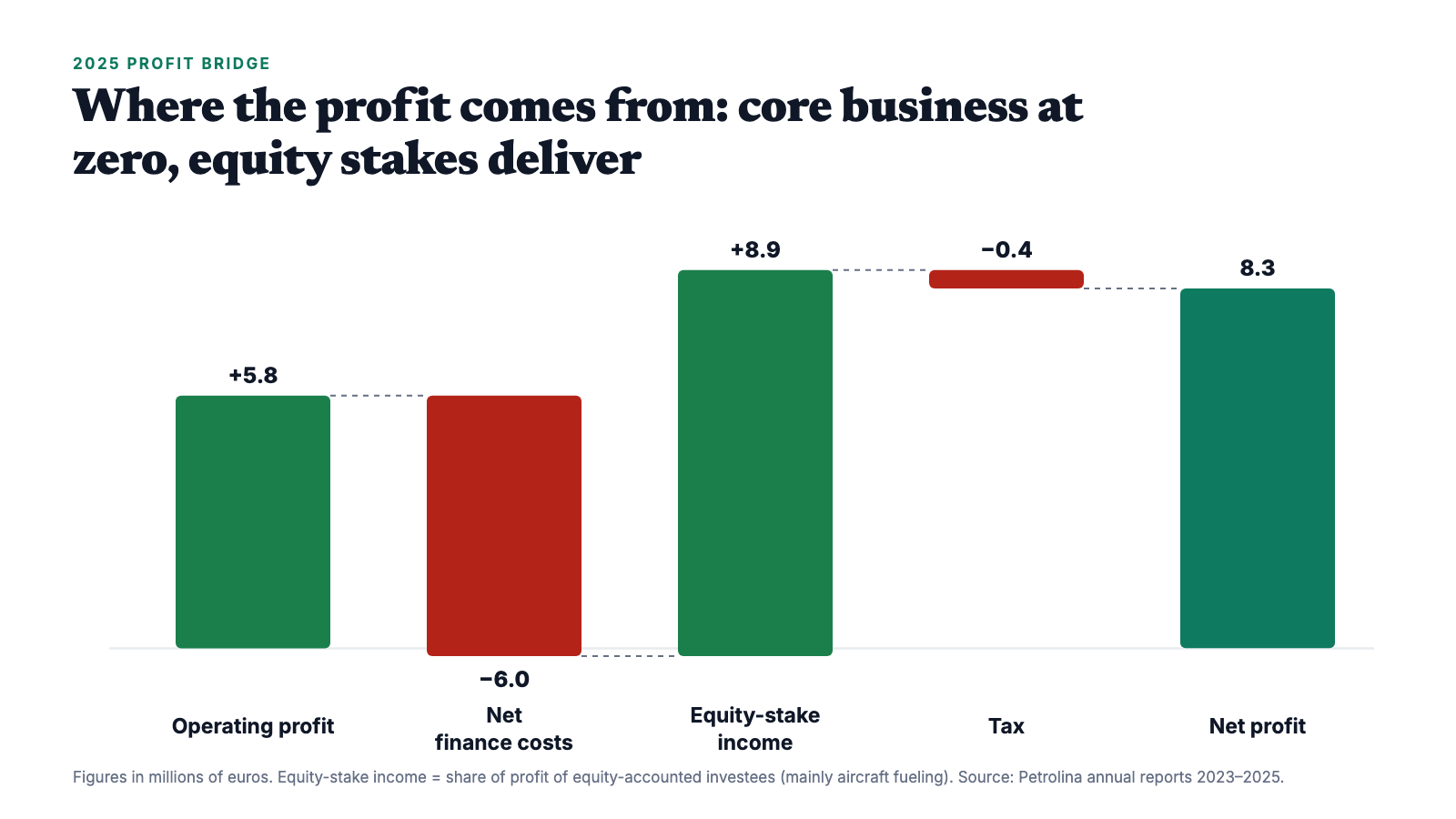
Is that bad? It is honestly accounted for, and the stakes are no paper profit — their dividends arrive in real cash. But it changes what you are buying: whoever buys Petrolina is not buying a fuel retailer with a profit engine, but a heavily indebted trading platform plus a parcel of quiet airport stakes on which the profit hangs. Their driver is Cyprus’s tourism and air traffic — not the petrol price. Remember the sentence: a one percent operating margin is not a moat, it is a weather condition. For how quickly such a balance tips, see our NGL Energy Partners analysis — there, too, debt service eats what the business earns.
Uncomfortable truth no. 2: net debt exceeds the market value — and the cash position is negative if you count honestly
The balance sheet as of December 31, 2025 shows plenty of substance on the asset side: €138.3 million of property, plant and equipment, €83.8 million of investment property, €20.7 million of equity stakes — total assets €404.5 million, equity €152.7 million. But the liability side carries bank debt of €175.3 million in total: €42.5 million of long-term loans, €6.3 million of current instalments, €51.8 million of short-term loans — and €74.7 million of bank overdrafts, i.e. permanently overdrawn accounts. Against that stand all of €7.8 million in cash. Net, excluding leases, that is roughly €167.5 million of debt — more than the entire market capitalization of €105.9 million. By the report’s own cash flow definition, cash including overdrafts stands at minus €118.7 million. In 2025 the group paid €6.9 million of interest — more than it paid out in dividends.
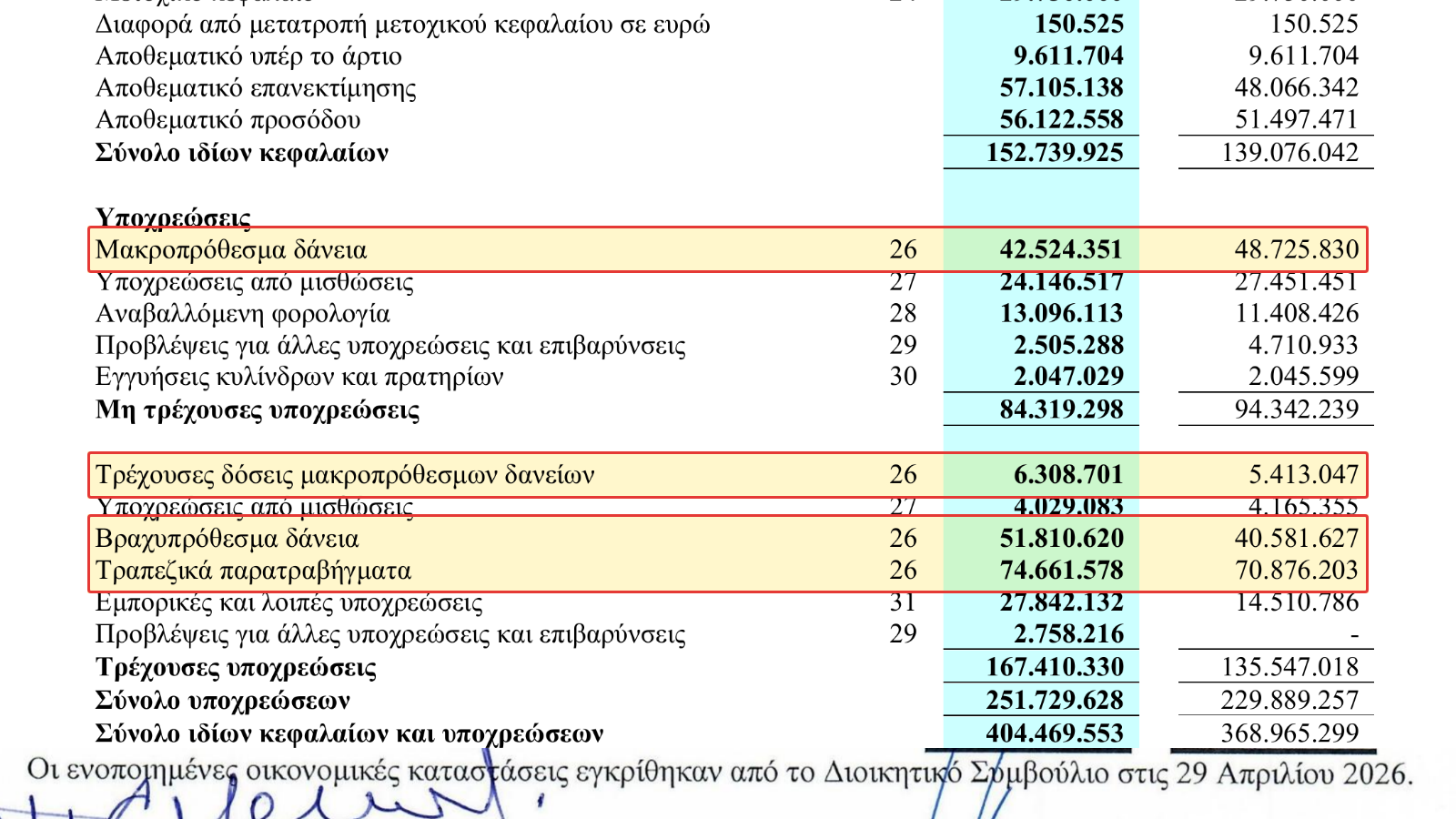
Both halves of the context belong here. First: this business model carries such credit lines better than most — a fuel importer finances tanker cargoes and inventories on a rolling basis, and operating cash flow has been reliably positive for years (€17.3 / €16.1 / €19.6 million in 2023/2024/2025). Second: measured against self-calculated EBITDA of about €18.8 million, net debt equals roughly nine times — and the €45.1 million Esso purchase price was additionally bank-funded. Add a footnote on equity: of the €152.7 million, €57.1 million is revaluation reserve — property write-ups, not distributable, €9.0 million added in 2025 alone. The book value behind the tempting 0.69 P/B is thus more than a third surveyor’s value. Below book value does not mean undervalued — it means, first of all: the market has reasons.
Uncomfortable truth no. 3: six of nine seats belong to the family — and the governance code is deliberately not applied
Whoever buys into Petrolina sits down at the Lefkaritis family’s kitchen table. The reported major shareholdings together bind about 55 percent of the 87.5 million shares — CEO Dinos Lefkaritis alone is attributed 44.03 percent, including the family vehicle Petrolina Ltd with 34.48 percent. On the nine-member board the family provides six members, five of them executive; Marios Lefkaritis has been executive chairman since November 2025. And on the question of which rules this board plays by, the company itself writes:
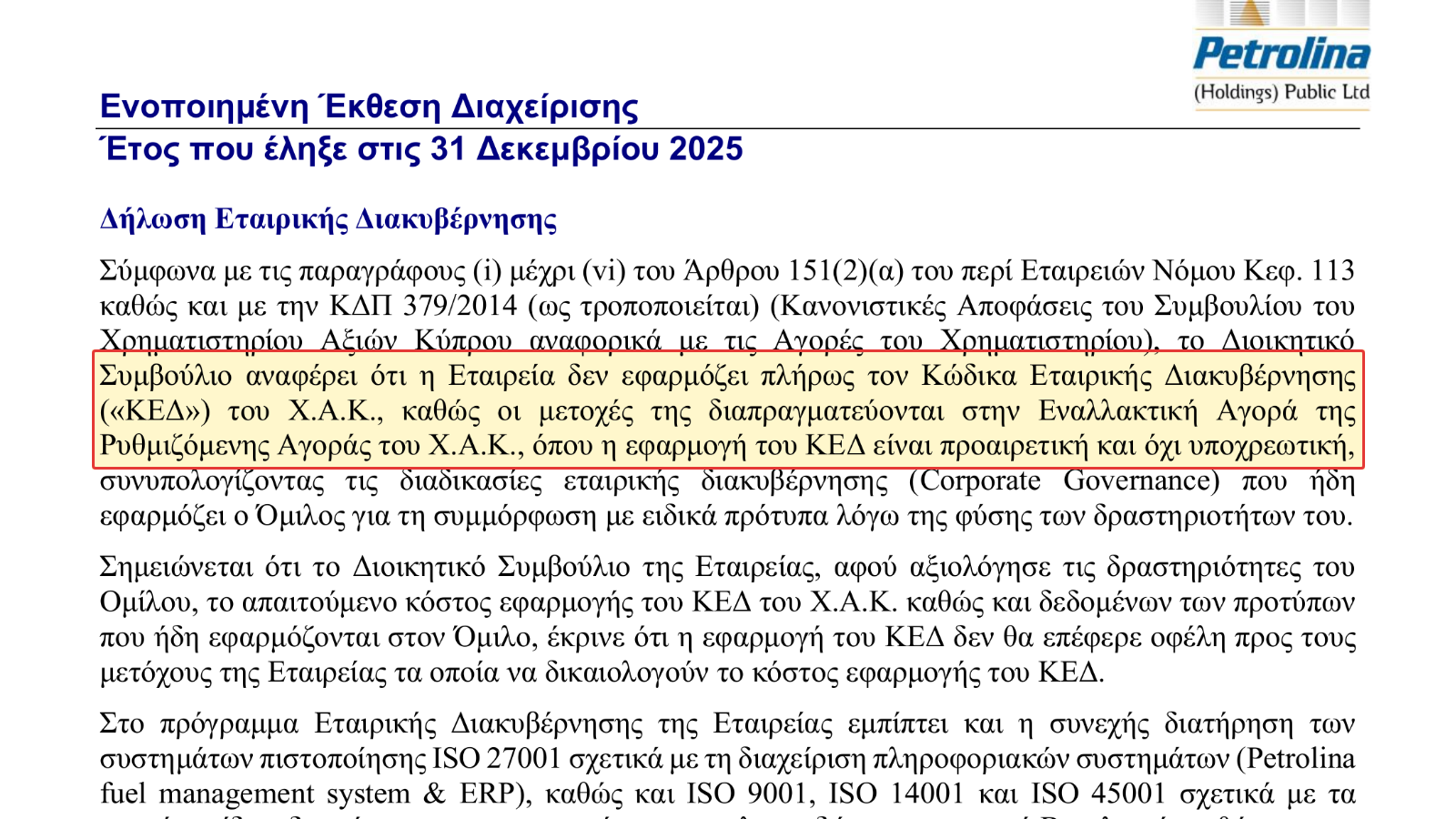
„…το Διοικητικό Συμβούλιο αναφέρει ότι η Εταιρεία δεν εφαρμόζει πλήρως τον Κώδικα Εταιρικής Διακυβέρνησης («ΚΕΔ») του Χ.Α.Κ., καθώς οι μετοχές της διαπραγματεύονται στην Εναλλακτική Αγορά της Ρυθμιζόμενης Αγοράς του Χ.Α.Κ., όπου η εφαρμογή του ΚΕΔ είναι προαιρετική και όχι υποχρεωτική."
Translation: "…the Board of Directors states that the Company does not fully apply the Corporate Governance Code («CGC») of the Cyprus Stock Exchange, since its shares trade on the Alternative Market of the Regulated Market of the CSE, where application of the CGC is optional and not mandatory."
— Petrolina (Holdings) Public Ltd, 2025 annual report, corporate governance statement, p. 20
Then there is the jamming front door: over the past year an average of about €6,400 worth of shares — roughly 5,400 shares — changed hands per trading day. Whoever wants to invest even €20,000 moves the price; whoever must sell in a crisis may not find a buyer at the quoted price for days. A stock you cannot sell is not an investment — it is a silent partnership. In fairness, there are counter-moves: after long-serving chairman Kostakis Lefkaritis passed away in October 2025, Demetra Kalogerou Antoniadou — former head of the Cypriot securities regulator — joined the board as an independent member in March 2026. A start; no more than that yet.
The two stories: the Esso deal and the "Land of Tomorrow"
Against those three weights stand two stories, and the first one is genuinely good. In late November 2024 Petrolina signed the purchase of ExxonMobil Cyprus Ltd — 68 Esso fuel stations, an airport fueling business, a lubricants trade. The competition authority reviewed for 13 months; completion came on January 31, 2026. That makes Petrolina the clear leader of Cyprus’s fuel-station market — ahead of EKO (99 stations) and Coral’s Shell-licensed network (41). The company framed it like this at signing:
„Η Συμφωνία Εξαγοράς αναμένεται να επηρεάσει θετικά τις προοπτικές και τα αποτελέσματα του Ομίλου Petrolina λόγω των οικονομιών κλίμακος και συνεργειών που δύναται να δημιουργηθούν στη βάση της πολυετούς πείρας που διαθέτει η PHL στον τομέα των πετρελαιοειδών."
Translation: "The Acquisition Agreement is expected to positively affect the prospects and results of the Petrolina Group, thanks to economies of scale and synergies that can be created on the basis of PHL’s many years of experience in the petroleum sector."
— Petrolina (Holdings) Public Ltd, CSE announcement "Εξαγορά ExxonMobil Cyprus Limited", November 28, 2024, p. 1
The price is the remarkable part. The annual report quantifies it in the subsequent-events note:
„Η τελική τιμή εξαγοράς ανήλθε σε €45,1εκ. και καταβλήθηκε εξ ολοκλήρου σε μετρητά. […] Κέρδος από ευνοϊκή αγορά (7.271.221)."
Translation: "The final acquisition price amounted to €45.1 million and was paid entirely in cash. […] Gain from bargain purchase: €7,271,221."
— Petrolina (Holdings) Public Ltd, 2025 annual report, note 38 "Events after the reporting period", pp. 123–124
Translated: Petrolina paid €45.1 million for net assets its own valuers preliminarily put at €52.4 million — a purchase below net asset value that creates €7.27 million of book profit on day one, plus €37.6 million of acquired cash. Why would Exxon sell like that? Because a global company that wants out of a small market accepts the discount — and because on an island with four competitors there was only one buyer able to truly integrate the network. The catch: the bargain gain is a one-off in the 2026 half-year, the added revenue (the acquired company last published €272.4 million, for 2023) comes with the familiar one-percent margins, and the price was bank-funded — so more lands on the debt pile from truth no. 2 before synergies work it off.
The second story is slower but bigger in ambition: "Land of Tomorrow" — roughly 300,000 square metres of former tank-farm land on the Larnaca coast, master plan by Foster + Partners, execution over 12 to 15 years; on July 21, 2026 Petrolina announced the formation of five project companies, with phase 1 to start with developer bbf in late 2026 / early 2027. The balance sheet already carries €83.8 million of investment property. If industrial brownfield really becomes coastal building land, this is where the value hinted at by the 0.69 P/B sleeps — but a 15-year project of a family holding is not a catalyst you can set a calendar by.
Valuation: what the market pays — and what it is saying
The bare numbers as of July 24, 2026: price €1.21, market capitalization €105.9 million, P/E 12.7 on the record 2025 result, P/B 0.69 on a book value of €1.746 per share, dividend yield 3.5 percent, price-to-sales 0.19. The share is up 21 percent over one year (52-week low €1.00 on July 24, 2025, high €1.28 in April 2026) and has recovered 57 percent from its three-year low of €0.77 (November 2024). But honest arithmetic puts the capital structure next to the P/E: whoever adds market value and net debt pays about €273 million for the whole company — roughly fourteen times the self-calculated EBITDA of €18.8 million. Only the equity is cheap here, not the firm.
And the 12.7 P/E stands on the best year in recent history: on the 2024 result it would be 39, on 2023 beyond 90. The earnings series €1.1 → €2.7 → €8.3 million is not a staircase but a spike — carried by stake income and lower interest costs. From 2026 a small, certain headwind is added: Cyprus’s corporate tax rate rises from 12.5 to 15 percent. All valuation figures dated; analyses are evergreen, daily prices are not a buy argument.
Opportunities and risks at a glance
What speaks for Petrolina:
- Market leadership with moat-like elements: the island’s largest station network plus 68 Esso stations, its own Vasilikos terminal (18 tanks, 113,000 cubic metres) — infrastructure no newcomer rebuilds.
- The Esso deal creates value: €45.1 million in cash for a preliminary net asset fair value of €52.4 million (bargain gain €7.27 million), €37.6 million of cash acquired, pro forma group revenue above €800 million.
- Reliably positive operating cash flow (2023–2025: €17.3 / €16.1 / €19.6 million) and cash-effective stake dividends (€7.6 million in 2025) from Cyprus’s booming air traffic.
- Substance: equity of €152.7 million (P/B 0.69), investment property of €83.8 million, plus the long-term "Land of Tomorrow" option (300,000 square metres of coastline, Foster + Partners master plan).
- Shareholder returns are back: the 2025 dividend was raised to 4.2 cents (3.5 percent yield), a first 2026 interim dividend is already declared; 65+ years of family business that stayed profitable through every crisis.
What speaks against it:
- Earnings quality: equity-stake income (€8.9 million) exceeds pre-tax profit (€8.7 million); the core business after interest sits at roughly zero, and the first half of 2024 was loss-making.
- Balance-sheet load: net debt of about €167.5 million excluding leases (€195.7 million including) against a €105.9 million market value; cash including overdrafts at minus €118.7 million; the Esso price bank-funded.
- Manor-house governance: more than 55 percent with the family and reporting persons, six of nine board seats, the corporate governance code deliberately not applied, a generational transition under way.
- Extreme market narrowness: about €6,400 of daily turnover, no analyst coverage, alternative market — positions are hard to build and harder to unwind, prices jumpy.
- Operating environment: an Israeli refinery as the traditional main supplier inside a conflict zone, falling fuel sales in Cyprus (May 2026: minus 5.1 percent), state pressure on prices, corporate tax up to 15 percent from 2026, and electric mobility long term (just six own fast chargers so far).
A human conclusion
Back to the book-value trap from the opening. The house is real, and the discount is real: 0.69 times substance, a P/E of 12.7, a company without which an entire island neither drives, heats nor flies — plus an acquisition that was literally worth more than it cost. But the discount has reasons, and they are all in the brochure: the profit is made in equity stakes, not in a core business that nets out to zero after interest. The mortgage — €167.5 million net — is bigger than the price of all the shares combined. At the kitchen table sits a family with 55 percent and six of nine chairs, which expressly does not apply the exchange’s code of conduct. And the front door jams: €6,400 of daily turnover means your exit is the price. So the honest question is not "is Petrolina cheap?" — it is, by almost every metric. The question is: do you want to be a minority guest in an indebted family business whose profit is made at the airport and whose stock on some days cannot be traded at all — just because the entry price is 31 percent below book value? If yes, you have a thesis and a lot of patience. If no, you were looking at a discount that was never yours. What you make of it is your decision. And that is exactly as it should be.
Sources
Every original document used in this analysis — for you to read yourself:
- Petrolina (Holdings) Public Ltd — 2025 annual report (audited IFRS consolidated statements, Greek, 127 pages; KPMG opinion of April 29, 2026)
- Petrolina (Holdings) Public Ltd — 2024 annual report and 2023 annual report
- CSE announcement — acquisition agreement for ExxonMobil Cyprus Limited (November 28, 2024)
- CSE announcement — clearance by the Commission for the Protection of Competition (December 18, 2025) and completion of the acquisition, renaming to eWise Cyprus Ltd (February 2, 2026)
- CSE announcement — 2026 interim dividend of 1.0 cent (July 20, 2026) and "Land of Tomorrow": start of the five project companies (July 21, 2026)
- Petrolina — investor relations overview (all CSE filings) and company profile/history
- SEC EDGAR — company search "petrolina": no SEC filer named Petrolina (Holdings)
- StockWatch Cyprus — price, market capitalization and trading statistics for PHL (data as of July 24, 2026)
- Cyprus Mail — H1 2025 figures (September 25, 2025), full-year 2025 figures (April 30, 2026), H1 2026 outlook (June 26, 2026) and Cyprus fuel sales/excise duty (June 26, 2026)
- Fundamental data (metrics; data as of July 24, 2026), reconciled with the company reports filed with the CSE.
Transparency & disclaimer: This analysis is a journalistic contextualization of publicly available information. It is not investment advice, not a financial analysis in any regulatory sense and not an invitation to buy or sell securities. Equity investments carry substantial risk up to and including total loss; in stocks with very low trading volume there is the added risk of being unable to sell positions at times, or only at steep discounts. Information on ongoing matters (acquisition integration, the real-estate project, state price interventions) can change at any time. All information without warranty; data cut-offs are noted in the text. The author holds no position in Petrolina shares at the time of publication.
Our Bottom Line at a Glance
- Market position & substance positive
- Since completing the Esso acquisition on January 31, 2026, Petrolina is the clear leader of Cyprus’s fuel-station market (its own network plus 68 Esso stations; competitors EKO 99, Coral/Shell 41 stations) — with its own Vasilikos terminal (18 tanks, 113,000 cubic metres) and 65+ years of family history without a loss-making year through the crises of 2013, 2020 and 2022. Equity of €152.7 million, investment property of €83.8 million: substance is plentiful.
- Earnings quality negative
- The record 2025 profit (€8.3 million, EPS 9.49 euro cents) comes almost entirely from equity stakes: their income (€8.9 million) exceeds the entire pre-tax profit (€8.7 million), while the core business after interest sits at roughly minus €0.2 million. The first half of 2024 was loss-making; on 2024 earnings the P/E would be 39. The profit jump is real but narrowly based — its driver is Cyprus’s air traffic, not the pump.
- Balance sheet & debt negative
- Net debt of about €167.5 million excluding leases (cash including overdrafts: minus €118.7 million) exceeds the market value of €105.9 million and equals roughly nine times the self-calculated EBITDA of €18.8 million. Operating cash flow is reliably positive (€19.6 million in 2025), but the bank-funded €45.1 million Esso price adds to the load, and €57.1 million of the €152.7 million equity is a non-distributable revaluation reserve.
- Governance & tradability negative
- More than 55 percent of the shares sit with the family and reporting persons, six of nine board seats with the Lefkaritis family, and per the 2025 annual report (p. 20) the company deliberately does not fully apply the exchange’s corporate governance code. Add about €6,400 of average daily turnover: minority shareholders have little voice and hardly a door out. The arrival of former regulator chief Demetra Kalogerou Antoniadou (March 2026) is a first counterpoint.
- Esso deal & real-estate option positive
- Buying ExxonMobil Cyprus for €45.1 million, below the preliminary net asset fair value of €52.4 million, creates a €7.27 million bargain-purchase gain and brought €37.6 million of cash — a visibly value-creating deal that lifts the group past €800 million of pro forma revenue. On top sits the long-term "Land of Tomorrow" option: 300,000 square metres of coastline with a Foster + Partners master plan, phase 1 from late 2026/early 2027 — across 12 to 15 years.
Petrolina is the book-value trap as a case study: cheap by almost every metric (P/B 0.69, P/E 12.7, 3.5 percent dividend yield, as of July 24, 2026), market leader of an entire island, plus an Esso acquisition below net asset value. But the profit hangs on aircraft-fueling stakes rather than the core business, net debt (€167.5 million) exceeds the market value, the family holds more than 55 percent plus six of nine board seats with the governance code deliberately not applied — and with about €6,400 of daily turnover, even the exit is a price question. Not investment advice.
What Our Rating Means
Open questions
The business works in principle, but one material question is open. As long as it stays open, our findings do not carry a quality verdict.
Whoever buys today buys three things: an island market position with a thin margin, a parcel of airport stakes as the real profit source, and family rule without a governance code — at 0.69 times book value, but with net debt above the market value and a stock that can hardly be traded on normal days. Whoever holds is betting that Cyprus’s air traffic keeps carrying the stake income, that the Esso integration lifts the one-percent margin and that the family keeps sharing via dividends. Whoever waits checks the 2026 half-year report (~September): profit excluding the €7.27 million one-off, net debt after the Esso price, and the "Land of Tomorrow" construction start. The decision is yours.
A journalistic assessment by our editorial team at the time of the deep dive, based on public sources — not investment advice and not a solicitation to buy or sell. Your personal circumstances (investment goals, risk capacity, taxes) cannot be taken into account. What our levels mean, how verdicts are formed, and what conflicts of interest exist →
Worth Noting
- Petrolina is not an SEC filer: no 10-K, no 10-Q, no 20-F — EDGAR contains only an unrelated Texas private fund of the same name. This analysis rests on the audited IFRS consolidated statements for 2023–2025 (Greek, KPMG opinion of April 29, 2026) and the mandatory announcements of the Cyprus Stock Exchange; the share trades on the alternative market, where the governance code is voluntary. Quotes were verified verbatim against the original PDFs and translated.
- Petrolina did not reach the research list through a scanner hit — Cypriot names are not part of the scanner universe — but through the takeover of ExxonMobil’s Cyprus business by a micro cap: agreement in late November 2024, 13 months of competition review, completion on January 31, 2026, price €45.1 million below the preliminary net asset fair value of €52.4 million (bargain-purchase gain of €7.27 million, 2025 annual report, note 38).
- Valuation figures dated and evergreen: the €1.21 price, €105.9 million market capitalization, P/E 12.7, P/B 0.69 and 3.5 percent dividend yield are as of July 24, 2026 (stockwatch.com.cy) and serve as an order of magnitude, not a daily-price recommendation. The 2025 figures reflect the group before Esso consolidation; the first consolidation of eWise Cyprus Ltd appears in the 2026 half-year report (expected around September 2026) and includes the one-off bargain-purchase gain.
Frequently Asked Questions
Petrolina (Holdings) Public Ltd (CSE: PHL, headquartered in Larnaca) is Cyprus’s largest oil company: importing, storing and distributing fuels, heating oil, LPG and lubricants, one of the island’s largest fuel-station networks (Petrolina, Eni, Agip, plus 68 Esso stations since January 31, 2026) and stakes in the aircraft-fueling operations of Larnaca, Paphos and Greek airports. In 2025 the group turned over €559.4 million and earned €8.3 million net.
Because Petrolina is not a U.S. reporting company: the share trades only on the alternative market of the Cyprus Stock Exchange. There is no 10-K, no 10-Q and no 20-F; the EDGAR search returns only an unrelated Texas fund of the same name. This analysis rests on the audited IFRS consolidated statements (Greek, auditor KPMG, opinion dated April 29, 2026) and the CSE mandatory announcements; the reporting currency is the euro.
Not from the fuel-station business: operating profit (€5.8 million) barely covered net finance costs (€6.0 million) in 2025. The swing came from equity-accounted stake income of €8.9 million — more than the entire pre-tax profit of €8.7 million. The largest driver was the aircraft-fueling stake PPT Aviation Services with a €7.1 million profit contribution; the stakes paid €7.6 million of dividends in cash.
€45.1 million, entirely in cash and bank-funded — for a company whose identifiable net assets carried a preliminary fair value of €52.4 million. IFRS books the €7.27 million difference as a bargain-purchase gain in the first half of 2026; the acquired eWise Cyprus Ltd also brought €37.6 million of cash. Agreement in late November 2024, competition clearance on December 18, 2025, completion on January 31, 2026.
As of December 31, 2025 the balance sheet carried €175.3 million of bank debt (including €74.7 million of permanently used overdrafts) against €7.8 million of cash — net about €167.5 million excluding leases, which is more than the market capitalization of €105.9 million (July 24, 2026). Measured against self-calculated EBITDA of about €18.8 million, that is roughly nine times; in 2025 the group paid €6.9 million of interest.
The reported major shareholdings bind about 55 percent of the 87.5 million shares; CEO Dinos Lefkaritis alone is attributed 44.03 percent including Petrolina Ltd. The Lefkaritis family provides six of the nine board members, five of them executive. Per the 2025 annual report the company deliberately does not fully apply the exchange’s corporate governance code — on the alternative market it is voluntary. Since March 2026 Demetra Kalogerou Antoniadou, former head of the securities regulator, sits on the board as an independent member.
It is cheaply valued (P/B 0.69, P/E 12.7, dividend yield 3.5 percent — as of July 24, 2026), but the discount has reasons: net debt above market value, profit almost entirely from equity stakes, more than a third of equity is a non-distributable revaluation reserve, and average trading is about €6,400 per day — positions are hard to build and even harder to unwind. Cheap here does not mean risk-free; it means hard to trade.
Found an error?
Did you spot a factual error, an outdated number, or a typo in this deep dive? Let us know briefly — your report goes straight to the editorial team.