Perimeter Solutions: A Superb Fire Safety Business — and Five Founders Who Own 18 Percent of Every Share Price Gain
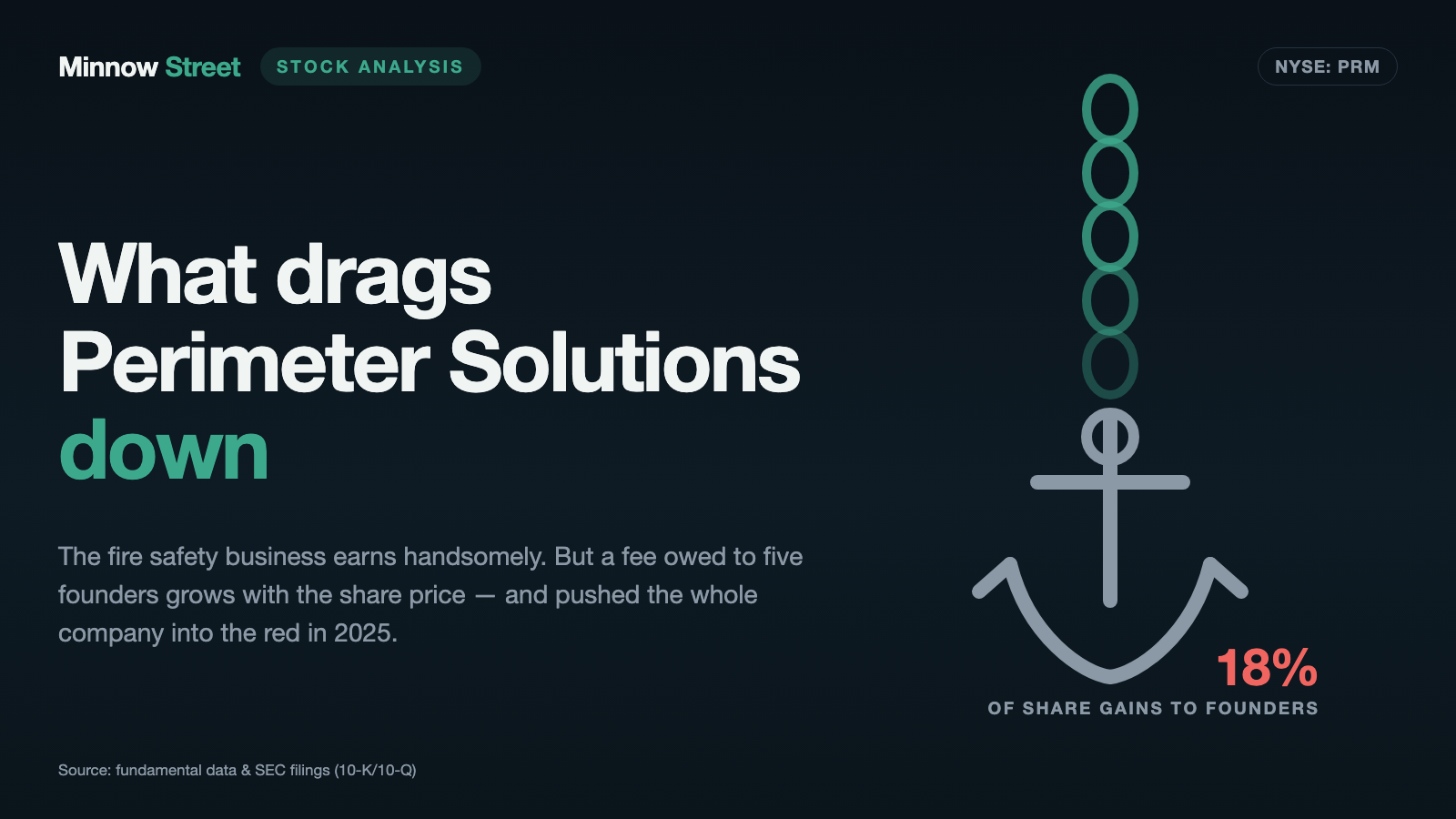
Perimeter Solutions drops the red slurry that stops wildfires from the air, and it earns handsomely doing so: $652.9 million of revenue in 2025 and a 59.4 percent segment margin in fire safety. The year still ended with a $206.4 million net loss. The reason sits in the notes to the SEC filings: an agreement dating from 2019 hands five founders 18 percent of the annual share price increase on 157,137,410 shares. For 2025 that came to $469.1 million, settled with 13.4 million new shares and $95.7 million in cash. Our in-house stock scanner ranks the stock 12th in the U.S. selection of its Big Earnings Surprise list (as of July 25, 2026). Not investment advice — just the invoice that sits in the notes.
 Thomas Mücke
Founder & Publisher
Thomas Mücke
Founder & Publisher
Chart
Interactive price chart (TradingView).
Note: pure fact-based analysis, not investment advice and not a solicitation to buy or sell. All figures without guarantee.
There is an investor trap that springs precisely when you are doing everything right: the alignment trap. It works like this. You read that the people running a company only get paid when the share price rises. Your head nods immediately: "At last, they are in the same boat as me." The question you do not ask in that moment is the one that matters: how big is their share of what the boat brings in? That question is unavoidable at Perimeter Solutions (NYSE: PRM) of Clayton, Missouri. The company mixes the red slurry that air tankers drop over burning hillsides — a business with remarkable margins. It also inherited an agreement under which five founders receive 18 percent of the annual share price increase, calculated on 157,137,410 shares. So let us make a deal: before you buy the label "perfectly aligned incentives", we read together what the company itself told the U.S. securities regulator, the SEC — the annual report (Form 10-K) for 2025 and the quarterly report (Form 10-Q) for the quarter ended March 31, 2026. An SEC filing is honest under penalty of law. And this one describes a superb business, a loss that is not really a loss, a profit that is not really a profit — and an invoice that came due in February 2026.
What Perimeter Solutions actually does — red slurry and yellow chemistry
Perimeter Solutions sells through two segments, and they are different enough that you have to look at them one at a time.
Fire Safety is the familiar business: long-term fire retardants and firefighting foams, plus the specialized equipment and services at the air tanker bases the aircraft fly from. When you see a red line laid across a burning slope on the evening news, that is this product. It is not sold to consumers but to government: to the federal forest service, to states, to municipalities. In 2025 the segment produced $488.9 million of revenue and Segment Adjusted EBITDA of $290.5 million — a margin of 59.4 percent. Translated: nearly sixty cents of every dollar of segment revenue remains before interest, taxes, depreciation and amortization. That is software economics inside a chemical plant.
Specialty Products is the unfamiliar business: phosphorus pentasulfide, a base chemical used in lubricant additives for engine oils, with applications in agricultural and mining chemicals and in battery technology. In 2025 it delivered $163.9 million of revenue and $41.2 million of Segment Adjusted EBITDA (a 25.1 percent margin) — solid, not spectacular. Since January 22, 2026 it also contains something entirely new: Perimeter bought Medical Manufacturing Technologies, LLC (MMT) of Charlotte, North Carolina, a supplier of automated medical device manufacturing systems, for $682.3 million in cash. The segment more than doubled in the first quarter of 2026 ($79.6 million against $34.9 million) and for the first time exceeded fire safety ($45.4 million) in a single quarter — on a full-year basis Fire Safety, at $488.9 million in 2025, remains by far the larger business. Headcount moved too: on top of the 356 full-time employees at the end of 2025, MMT added another 356.
One more point about identity, because data vendors tend to sleep through it. Until November 20, 2024 the company was named Perimeter Solutions, SA and was registered in Luxembourg. On that date it converted into a corporation under the laws of the State of Delaware and has been Perimeter Solutions, Inc. ever since. The SEC still carries the old name as a "formerName" in its master data — the reporting obligations (10-K, 10-Q) never changed, and the fiscal year is the calendar year. Which brings us to the central tension of this analysis, and it runs through every chapter: the operating business at Perimeter Solutions is exceptionally profitable — but whether the year ends in profit or loss is decided not by revenue but by the company’s own share price.
Where the stock landed on our desk — and what the scanner cannot see
We run roughly 3,500 stocks through our scanners every day. As of July 25, 2026, Perimeter Solutions sits at rank 12 in the U.S. selection of our Big Earnings Surprise scanner (81 hits), with a relative strength rating of 91. The criterion is strict: reported earnings per share must have exceeded the analyst estimate by at least 20 percent in each of the last four completed quarters. For Perimeter those readings were plus 39.3 percent (second quarter of 2025), plus 20.6 percent (third quarter), plus 44.4 percent (fourth quarter) and plus 200.0 percent (first quarter of 2026; fundamental data, as of July 25, 2026). To reproduce it yourself: open the scanner, set the country filter to "US" — the list shows the serial surprisers in scanner order. Remember that these lists are recalculated daily; the ranking is a dated snapshot, not a property of the company.
Now the catch, and at this company it is larger than usual. The number analysts are measured against is not the profit the accounts report. In the first quarter of 2026 Perimeter Solutions reported $0.47 per share under U.S. accounting rules ($0.44 diluted) — the comparison used by the scanner was $0.06 against an estimate of $0.02. Both sides of that comparison are adjusted figures that strip out precisely the item this analysis is about. The company is entirely open about it in its own segment metrics: Segment Adjusted EBITDA is adjusted for "founder advisory fee expenses", the quarterly report says. Remember the principle: a surprise scanner measures the deviation from an expectation — and expectation and report can share the same blind spot. That is exactly why we now read the filings. How quickly a scanner label can mislead was on display at Sphere Entertainment, where the surprises came from a debt exchange, a write-down and a tax benefit.
The numbers over the years — given their due
First the case for Perimeter, and it is a strong one. Revenue grew from $322.1 million in 2023 through $561.0 million in 2024 to $652.9 million in 2025 — more than a doubling in two years. Gross profit rose from $128.3 million through $317.1 million to $375.2 million, and the gross margin from 39.8 percent to 57.5 percent. That is not a price increase, that is a different business: the 2024 and 2025 wildfire seasons were severe, and the combination of product, equipment and on-base service is hard to copy. Cash followed: $238.1 million of operating cash flow in 2025 (2024: $188.4 million; 2023: just $0.2 million), against $29.6 million of capital expenditure and $15.2 million spent on intangible assets.
The first quarter of 2026 continued the trend: $125.1 million of revenue against $72.0 million a year earlier, up 73.6 percent. Segment Adjusted EBITDA of both segments combined rose from $18.1 million to $41.2 million. Fire Safety grew from $37.2 million to $45.4 million of revenue, Specialty Products from $34.9 million to $79.6 million, the latter mainly thanks to MMT.
One quirk you need to know, or every quarterly report will startle you:
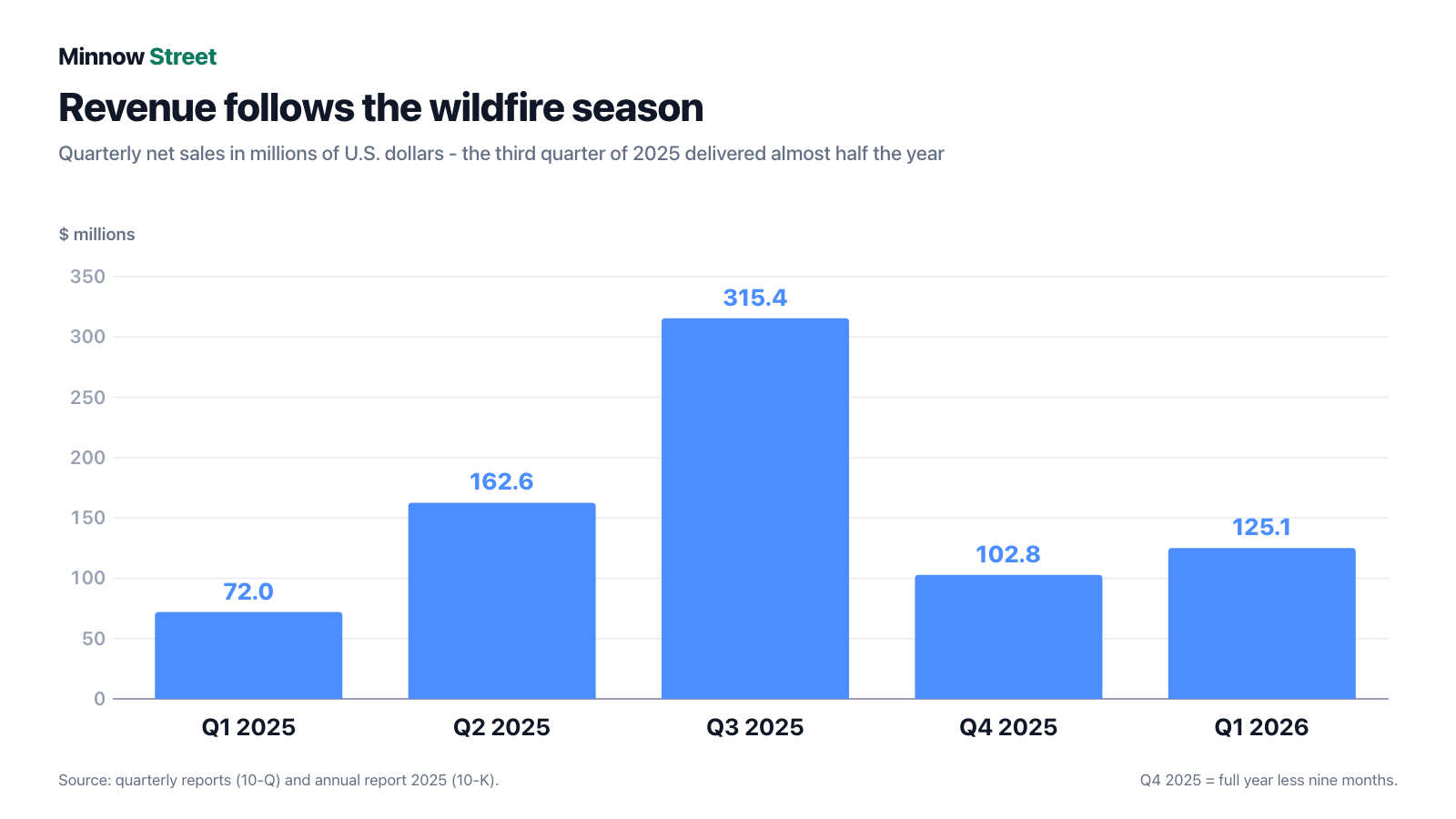
Forty-eight percent of annual revenue in a single quarter — anyone looking at a weak first quarter at Perimeter is usually just looking at winter. The reverse holds too: annualizing a summer quarter is nonsense. Remember the image — at this company the year counts, not the quarter.
And yet, for all that growth, 2025 ended with a net loss of $206.4 million, after −$5.9 million in 2024 and +$67.5 million in 2023. Per share: −$1.37. The next chart shows why.
What the filings say — the uncomfortable truths
Uncomfortable truth no. 1: the 2025 loss is a fee, not a business problem
Let us take 2025 apart, from gross profit down to operating income:
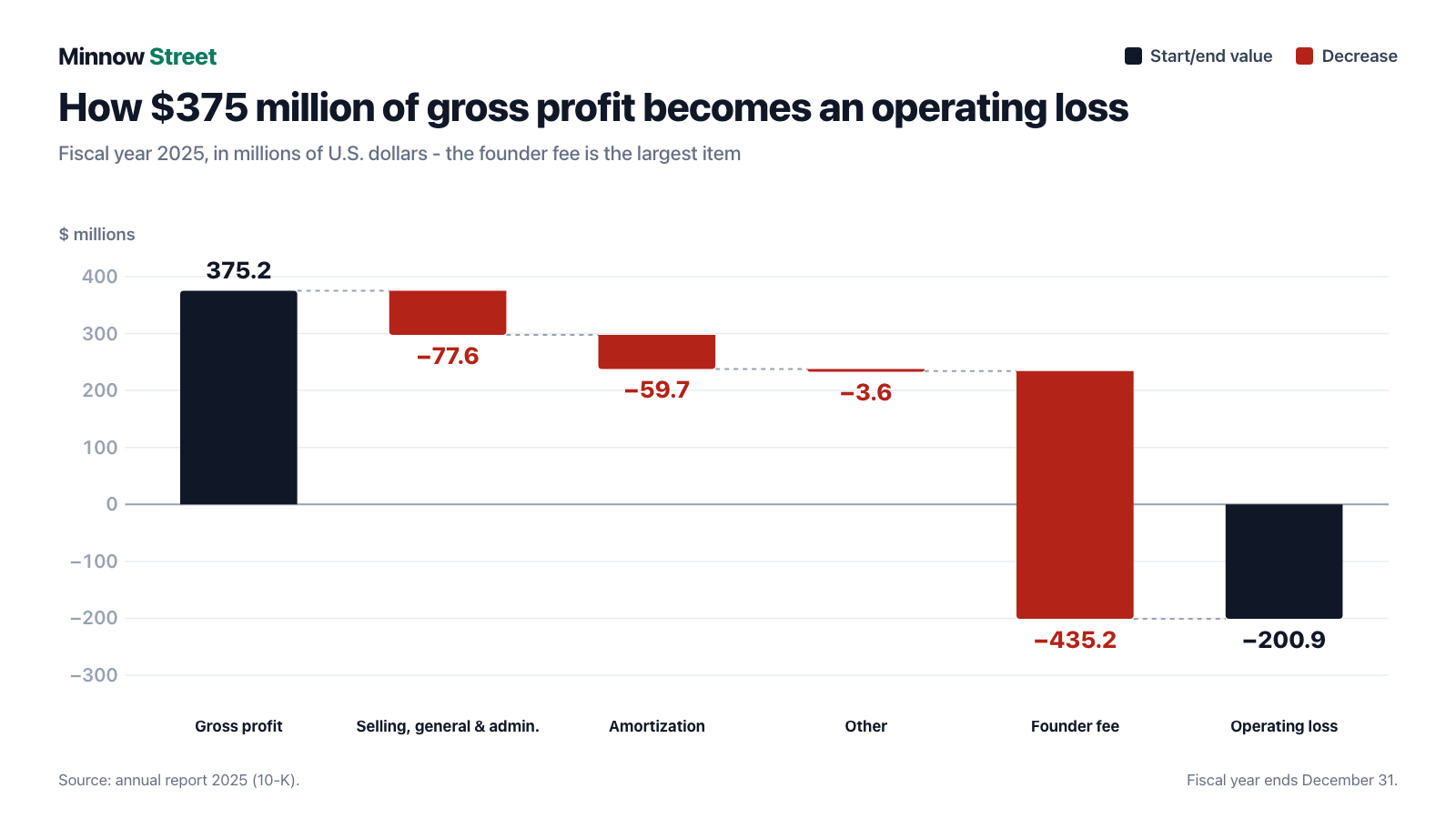
Do the arithmetic yourself: $375.2 million less $77.6 million (selling, general and administrative expense), less $59.7 million (amortization of intangible assets), less $3.6 million (other) leaves $234.2 million. Only the line "Founders advisory fees - related party" at $435.2 million flips the sign to −$200.9 million. After other expense of $35.3 million net (mainly $39.1 million of interest) and a $29.9 million tax benefit, the net loss was $206.4 million.
What kind of fee is this? It stems from an agreement dated December 12, 2019, entered into by the predecessor company EverArc Holdings with the vehicle EverArc Founders, LLC and assumed by Perimeter Solutions on November 9, 2021. It has two parts. The fixed part is exactly 2,357,061 shares every year through the end of 2027 — 1.5 percent of the 157,137,410 shares outstanding on November 9, 2021. The variable part runs through the end of 2031 and is the real lever:
"in the following years in which the Variable Annual Advisory Amount may be payable (if at all), (x) 18% of the increase in Payment Price over the previous year Payment Price multiplied by (y) 157,137,410 shares of Common Stock, the Founder Advisory Agreement Calculation Number."
— Perimeter Solutions, Inc., Form 10-K for 2025, Note 13 "Related Parties" (SEC EDGAR)

Translated into an everyday picture: imagine buying an apartment building together with five partners. The partners do not work in the building, they advise. The deal is that every time the appraised value rises above the prior year, they receive 18 percent of the increase — in shares of the building or in cash, at their choice. If the value falls, they pay nothing back; they simply wait until it clears the old mark again. That is exactly how this agreement works. And because half the obligation is carried as a liability and remeasured at every reporting date, the reverse also holds: when the share price rises, expense rises; when the share price falls, a book gain appears. In 2023, when the stock was weak, the line showed minus $108.5 million and lifted operating income to $94.5 million. In 2024 it cost $198.3 million, in 2025 $435.2 million.
And in the first quarter of 2026 it flipped once more. The ten-day average closing price fell from $27.89 (December 31, 2025) to $21.93 (March 31, 2026); the fair value of the fixed portion dropped from $131.3 million to $103.3 million and the variable portion from $750.1 million to $625.3 million. The result: a $76.4 million gain in the income statement. Without it, the first quarter of 2026 would have shown an operating loss of $3.9 million instead of $72.5 million of operating income ($50.8 million gross profit less $23.1 million of selling, general and administrative expense, less $22.6 million of amortization, less $9.0 million of other operating expense). Remember the sentence: at Perimeter Solutions the earnings line measures the company’s own share price as much as its business.
Uncomfortable truth no. 2: the 2025 bill was paid in shares and in cash — both hurt
A fair value line on the balance sheet is one thing. Payment is another, and it happened in February 2026:
"The EverArc Founder Entity elected to receive approximately 79.6% of the 2025 Advisory Amounts in shares of Common Stock (13,387,002 Common Shares) and approximately 20.4% of the 2025 Advisory Amounts in cash ($95.7 million). To satisfy the 2025 Advisory Amounts, the Company paid $95.7 million in cash on February 19, 2026 and expects to issue 13,387,002 shares of Common Stock in the first quarter of 2026."
— Perimeter Solutions, Inc., Form 10-K for 2025, Note 13 "Related Parties" (SEC EDGAR)

Hold on to the order of magnitude: $469.1 million for one year of advice at a company with $652.9 million of revenue. That is 71.9 percent of annual revenue. For context, the prior year triggered only the fixed portion ($30.3 million, 1,837,304 shares plus $6.7 million in cash), because the 2024 average price of $12.85 sat below the $13.63 mark established in 2021. The agreement pays only at new highs — but then it pays generously.
For a shareholder that has two consequences. First, dilution — your slice of the cake gets smaller without the cake getting bigger. Shares outstanding rose from 149,440,060 (December 31, 2025) to 163,127,063 (March 31, 2026), up 9.2 percent in three months; 13,387,003 of those shares went to the founder fee and 300,000 to option exercises. The company puts it in its own risk factors:
"Our stockholders will experience dilution as a consequence of the issuance of our Common Stock as payment for the Advisory Amounts payable to the EverArc Founder Entity."
— Perimeter Solutions, Inc., Form 10-K for 2025, Item 1A Risk Factors (SEC EDGAR)
Second, the cash outflow. The $95.7 million is real money, and it lands exactly where you would want to read off earning power: in the cash flow statement. Operating cash flow in the first quarter of 2026 was negative $89.0 million, against positive $23.7 million a year earlier. Cash fell from $325.9 million to $91.6 million. This is the moment the alignment trap becomes visible: the earnings line showed a $76.4 million gain while the bank account showed a $95.7 million outflow — the same fee, the same quarter, opposite directions. The remaining liability for future years stood at $364.3 million on March 31, 2026.
Fairness demands the other side. The five founders — according to the 2025 annual report William N. Thorndike Jr., W. Nicholas Howley, Tracy Britt Cool, Vivek Raj and Haitham Khouri, all directors of the company — receive nothing unless the share price clears the prior-year mark. There is no base fee on assets, no payment in reverse. If you like the structure, you call it consistent. If you do not, you note that roughly a fifth of the share price appreciation permanently goes to five people who sit on the board. A related question — how much of the success reaches the capital provider and how much stays with the person allocating it — came up at Biglari Holdings, where two separate 25 percent compensation layers sit side by side. One more data point: on March 10, 2026, William N. Thorndike Jr. filed a Schedule 13D reporting 9,309,341 shares, or 5.7 percent — he crossed the threshold because the founder entity distributed shares pro rata to its members. A Form 144 dated June 12, 2026 shows the other side of that distribution: former director Vivek Raj reported the sale of 78,569 shares worth $2,753,843, acquired via a "Pro-rata distribution from EverArc Founders, LLC to its members".
Uncomfortable truth no. 3: 43 percent of revenue depends on two U.S. agencies
The fire safety business has dreamlike margins — and a very short customer list:
"For fiscal year 2025, our two largest customers, the USDA Forest Service and the U.S. Bureau of Land Management accounted for 32% and 11%, respectively, of our consolidated revenues. No other customer individually represented more than 10% of our 2025 consolidated revenues."
— Perimeter Solutions, Inc., Form 10-K for 2025, Item 1 "Significant Customers" (SEC EDGAR)
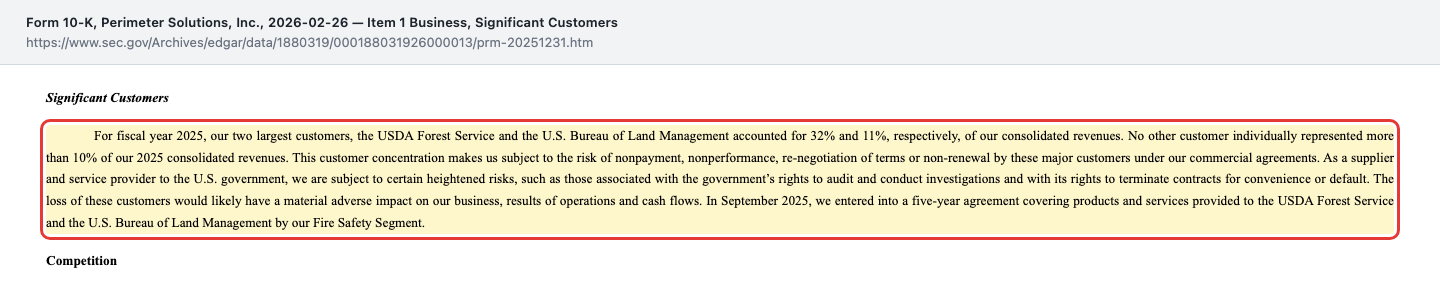
Forty-three percent of revenue from two addresses is textbook concentration risk. The good news: a five-year agreement with both was signed in September 2025, and in April 2026 the quarterly report disclosed two further five-year agreements, including one with the U.S. Defense Logistics Agency for fire suppression foam with a maximum contract value of approximately $500 million and one with the California Department of Forestry for long-term fire retardant. The less good news: a maximum contract value is not a purchase guarantee, and the U.S. government may terminate contracts for convenience at any time, as the annual report notes. Add the weather: in the first quarter of 2026, 62 percent of revenue came from the United States against 68 percent a year earlier — and demand for retardant depends on whether things burn.
Uncomfortable truth no. 4: after the $682 million deal, 83 percent of the balance sheet is goodwill and contracts
The MMT acquisition was the largest step in company history:
"On January 22, 2026, the Company acquired 100% of the shares of Medical Manufacturing Technologies, LLC ("MMT”), which is included within the Company’s Specialty Products segment. … The consideration transferred consisted of $682.3 million in cash, net of cash acquired.“
— Perimeter Solutions, Inc., Form 10-Q for the quarter ended March 31, 2026, Note 4 "Business Combinations" (SEC EDGAR)
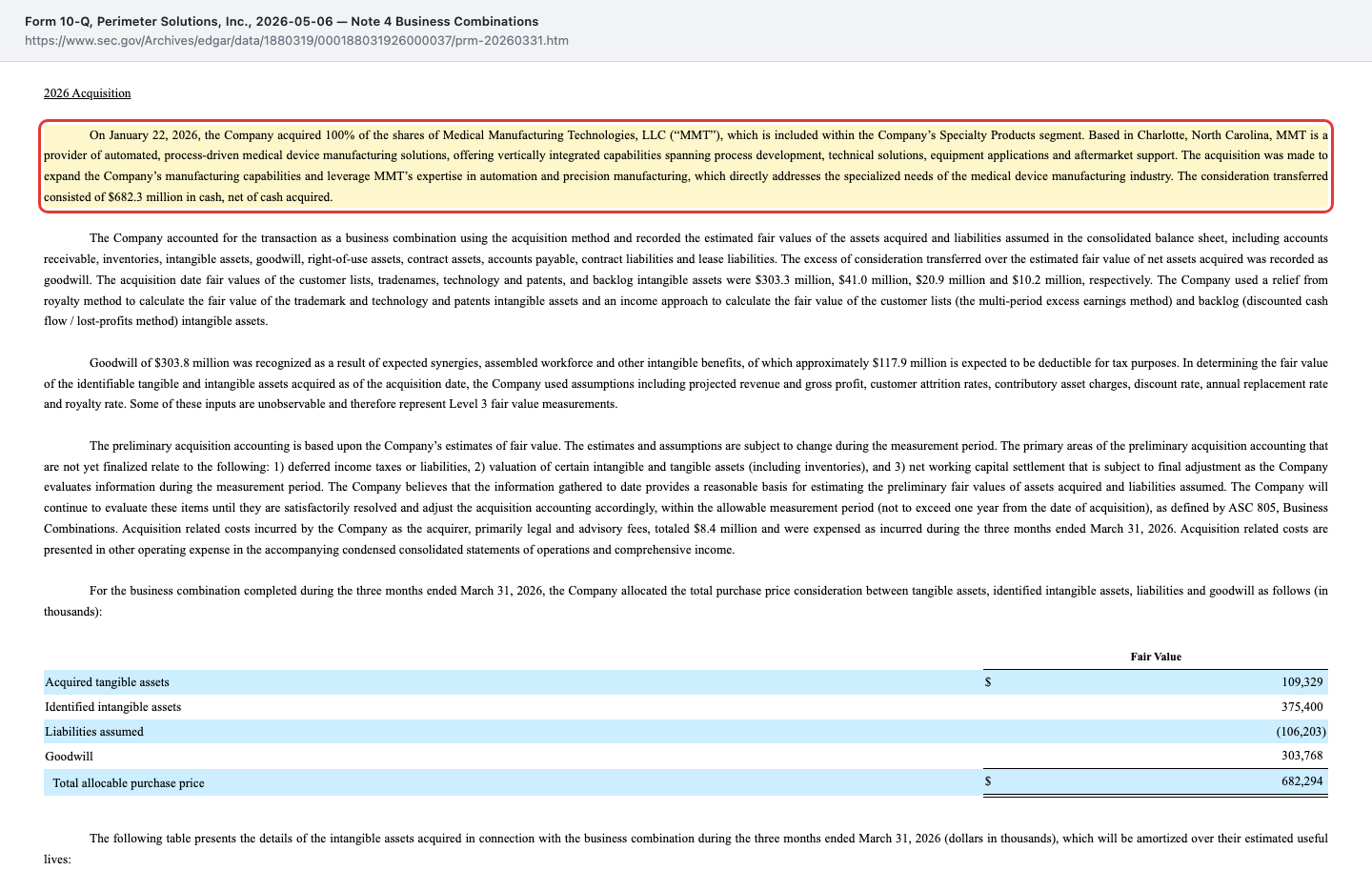
Of the $682.3 million, $303.8 million was booked as goodwill and $375.4 million as intangible assets — split into customer lists ($303.3 million, amortized over 16 years), tradenames ($41.0 million, 20 years), technology and patents ($20.9 million, 14 years) and backlog ($10.2 million, 1 year). Only $109.3 million was tangible, with $106.2 million of liabilities assumed; roughly $117.9 million of the goodwill is expected to be tax deductible. Add $8.4 million of acquisition costs expensed as incurred. Goodwill, in everyday terms, is the premium over the value of the parts — the belief that the whole is worth more than the sum. If the assumptions do not hold, it gets written down; Perimeter did exactly that once before, in 2023, with a $40.7 million intangible impairment.
After the deal the balance sheet at March 31, 2026 looks like this. Of $3,164.4 million of total assets, $1,365.4 million is goodwill and $1,250.0 million sits in customer lists ($924.4 million), technology and patents ($200.3 million) and tradenames ($125.3 million) — $2,615.4 million, or 82.7 percent. Against that stand $1,204.8 million of stockholders equity and an accumulated deficit of $720.2 million. The deal was funded with new debt: $550.0 million at 6.250 percent due January 15, 2034, issued on January 2, 2026, on top of the existing $675.0 million at 5.00 percent due 2029. Interest expense in the first quarter of 2026 accordingly rose from $9.6 million to $24.4 million. As of March 31, 2026 the company stated it was in compliance with all covenants. Put plainly: Perimeter has traded a very profitable niche against a mountain of paid-for future promises and a heavier interest bill.
Valuation — order of magnitude, not the daily quote
Let us do it roughly but honestly. At roughly $5.6 billion of market capitalization (data as of July 25, 2026) and 163,127,063 shares outstanding (March 31, 2026), the implied price is in the region of $34 per share. Cross-check from an original document: the Form 144 dated June 12, 2026 reports an aggregate market value of $2,753,843 for 78,569 shares sold — roughly $35 per share, implying a market capitalization of $5.7 billion. The deviation is three percent, so the order of magnitude holds.
Against trailing twelve-month revenue of $705.9 million (second quarter of 2025 through first quarter of 2026), that is a price-to-sales ratio of roughly 7.9. For a specialty chemicals company that is a lot — the market is paying for the margin, not the size. A price-to-earnings ratio for 2025 cannot be formed for lack of earnings; analyst consensus expects roughly $1.61 per share for 2026 and roughly $1.89 for 2027 (data as of July 25, 2026), which corresponds to about 21 times (2026) and 18 times (2027) expected earnings. Measured against book value of roughly $7.39 per share, the stock trades at about 4.6 times.
The most telling measure at this company is enterprise value against adjusted segment earnings. Net debt: $1,225.0 million of notes less $91.6 million of cash, or roughly $1.13 billion. Adding the founder advisory liability ($364.3 million) and the preferred stock ($118.3 million), enterprise value comes to roughly $7.2 billion — some 21 to 22 times the $331.7 million of Segment Adjusted EBITDA reported for 2025. The professional view: the average analyst price target stood at $45 (data as of July 25, 2026), and the 52-week range ran from $15.43 to $38.17, a factor of 2.5 between low and high. Which is the point of this analysis: every dollar by which the relevant annual average price exceeds the prior-year mark triggers 18 cents of fee — multiplied by 157,137,410 shares.
Opportunities and risks at a glance
What speaks for Perimeter Solutions:
- The Fire Safety segment earned Segment Adjusted EBITDA of $290.5 million on $488.9 million of revenue in 2025 — a 59.4 percent margin. Product approvals, equipment and on-base service are a high barrier to entry.
- Long-term contracts: a five-year agreement with the USDA Forest Service and the Bureau of Land Management (September 2025) and two further five-year agreements in April 2026, including the Defense Logistics Agency deal with a maximum value of roughly $500 million.
- Growth is real: revenue rose from $322.1 million in 2023 to $652.9 million in 2025, and another 73.6 percent in the first quarter of 2026.
- The business generates cash: $238.1 million of operating cash flow in 2025 against $44.8 million invested in property, equipment and intangible assets.
- MMT broadens the base: Specialty Products doubled to $79.6 million of revenue in the first quarter of 2026 and is far less weather-dependent.
What speaks against it:
- The founder fee runs to the end of 2027 in its fixed form (2,357,061 shares a year) and to the end of 2031 in its variable form (18 percent of the share price increase on 157,137,410 shares) — $469.1 million for 2025, or 71.9 percent of annual revenue.
- Dilution: shares outstanding up 9.2 percent in one quarter (149,440,060 to 163,127,063), with a remaining liability of $364.3 million on March 31, 2026.
- Concentration: 43 percent of 2025 revenue from two U.S. agencies that may terminate contracts for convenience.
- Balance sheet structure: 82.7 percent of total assets is goodwill and intangibles; a $40.7 million intangible impairment already occurred in 2023.
- Leverage: $1,225.0 million of notes (5.00 percent to 2029, 6.250 percent to 2034), interest expense up from $9.6 million to $24.4 million in the first quarter of 2026, cash down from $325.9 million to $91.6 million.
- Seasonality: 48 percent of 2025 revenue fell in the third quarter — single quarters say little, and a mild fire season hits directly.
- Governance: at the annual meeting on May 28, 2026, director Tracy Britt Cool received 81,334,482 votes for against 55,806,283 votes withheld — roughly 41 percent opposition for a person who is also part of the founder entity.
A human verdict
Back to the alignment trap. It is treacherous because it starts from a correct observation: at Perimeter Solutions the founders really do earn only when the share price rises. No fixed fee on assets, no payment in reverse, no bonus for merely getting bigger. If you are looking for incentive hygiene, there is more of it here than in most executive contracts.
The trap springs one step later — at the size. Eighteen percent of the share price increase on 157 million shares, reset every year, through 2031. That is not a bonus, it is a participation in the appreciation of your own investment that gets served before you do. In 2025 it came to $469.1 million against $652.9 million of revenue. And it was paid in exactly the currency that belongs to you: new shares and cash from your company’s bank account.
What remains is an unusually clear picture. There is a business you would want to own: high margins, hard regulatory barriers, demand that a warming climate is more likely to grow than shrink, now broadened by a medical device manufacturing arm. And there is a contract from 2019 that siphons off a meaningful share of the success before it reaches you — fully disclosed, quotable word for word, known since the listing. Both are true. The rest is a question of the price you pay and the years you are willing to wait: the fixed portion ends after 2027, the variable one after 2031. As with the building and the five advisers, the workshop is running. The only question is how much of the output ends up with you. What you make of that is your decision. And that is exactly as it should be.
Sources
- Perimeter Solutions, Inc., Form 10-K for the year 2025 (filed February 26, 2026) — Item 1 Business and "Significant Customers", Item 1A Risk Factors, Note 11 "Stock-Based Compensation", Note 12 "Fair Value Measurements", Note 13 "Related Parties", segment disclosures.
- Perimeter Solutions, Inc., Form 10-Q for the quarter ended March 31, 2026 (filed May 6, 2026, most recent periodic report) — balance sheet, statement of operations, statement of cash flows, statement of stockholders equity, Note 4 "Business Combinations", Note 8 "Debt", Note 16 "Segment Information", Note 17 "Subsequent Events".
- Perimeter Solutions, Inc., Form 10-K for the year 2024 (filed February 20, 2025) — prior-year comparison.
- Perimeter Solutions, Inc., Forms 10-Q for the quarters ended March 31, 2025, June 30, 2025 and September 30, 2025 — quarterly revenue.
- Perimeter Solutions, Inc., Form 8-K dated May 28, 2026, Item 5.07 — voting results of the 2026 annual meeting, ratification of KPMG LLP as auditor.
- William N. Thorndike, Jr., Schedule 13D dated March 10, 2026 (event date March 3, 2026) — 9,309,341 shares, 5.7 percent.
- Vivek Raj, Form 144 dated June 12, 2026 — 78,569 shares, aggregate market value $2,753,843.
- SEC master data for CIK 0001880319 (company name, former name "Perimeter Solutions, SA", NYSE listing, filing history).
- Screener and rating data: our in-house stock scanner (data as of July 25, 2026), including the Big Earnings Surprise scanner (U.S. selection, rank 12 of 81 hits, RS rating 91).
- Fundamental data (metrics, analyst consensus, price ranges; data as of July 25, 2026).
Disclaimer: This article is journalistic commentary on publicly available company filings. It is not investment advice, not a recommendation to buy or sell, and not a solicitation to buy or sell securities. Share prices can move sharply; a total loss of invested capital is possible. All figures come from the sources named above and carry the as-of dates stated there; valuation figures are orders of magnitude as of the stated data date, not price forecasts. The author holds no position in Perimeter Solutions at the time of publication.
Our Bottom Line at a Glance
- Operating earning power positive
- The Fire Safety segment earned Segment Adjusted EBITDA of $290.5 million on $488.9 million of revenue in 2025 — a 59.4 percent margin. Group revenue grew from $322.1 million in 2023 to $652.9 million in 2025 and by a further 73.6 percent to $125.1 million in the first quarter of 2026. Without the founder fee, 2025 operating income would have been $234.2 million.
- Founder compensation and dilution negative
- The 2019 agreement pays a fixed 2,357,061 shares a year through the end of 2027 and, through the end of 2031, 18 percent of the share price increase on 157,137,410 shares. For 2025 that was $469.1 million, or 71.9 percent of annual revenue, settled with 13,387,002 shares and $95.7 million in cash. Shares outstanding rose 9.2 percent in one quarter, and the remaining liability stood at $364.3 million on March 31, 2026.
- Earnings quality negative
- The earnings line measures the company’s own share price: in 2023 the founder fee lifted operating income by $108.5 million, in 2024 it cost $198.3 million, in 2025 $435.2 million, and in the first quarter of 2026 it added back $76.4 million. Without it, the first quarter of 2026 would have shown an operating loss of $3.9 million rather than $72.5 million of operating income.
- Balance sheet and leverage negative
- After the $682.3 million MMT acquisition, 82.7 percent of total assets consists of goodwill ($1,365.4 million) and intangible assets ($1,250.0 million). Senior notes total $1,225.0 million, interest expense rose from $9.6 million to $24.4 million in the first quarter of 2026, and cash fell from $325.9 million to $91.6 million as of March 31, 2026.
- Customer base neutral
- Forty-three percent of 2025 revenue came from two U.S. agencies (USDA Forest Service 32 percent, Bureau of Land Management 11 percent). Against that stands unusually long contractual cover: a five-year agreement with both since September 2025 and two further five-year agreements in April 2026, including the Defense Logistics Agency deal worth up to roughly $500 million.
- Valuation neutral
- Roughly $5.6 billion of market capitalization (data as of July 25, 2026) equals 7.9 times trailing twelve-month revenue of $705.9 million and 4.6 times book value; enterprise value sits at 21 to 22 times the $331.7 million of Segment Adjusted EBITDA reported for 2025. Defensible for the margin, but little slack for a stock carrying this fee structure.
Perimeter Solutions is the alignment trap in its purest form: five founders earn only when the share price rises — but they earn 18 percent of that rise on 157,137,410 shares, reset every year through 2031. For 2025 that came to $469.1 million against $652.9 million of group revenue; the $435.2 million fair value charge turned a notional $234.2 million operating profit into a $200.9 million operating loss and a $206.4 million net loss. The bill was settled with 13,387,002 new shares and $95.7 million in cash, pushing first-quarter 2026 operating cash flow to −$89.0 million. Underneath sits a genuinely good business with a 59.4 percent fire safety segment margin, long government contracts and a freshly acquired medical device manufacturing arm — funded with $550 million of new debt. Not investment advice.
What Our Rating Means
Open questions
The business works in principle, but one material question is open. As long as it stays open, our findings do not carry a quality verdict.
Anyone buying today buys an excellent niche business carrying a mortgage that runs to 2031 and gets expensive precisely when the stock does what you bought it for. Caution here does not mean bad company; it means price the fee into your return expectation before you buy — 18 percent of every increase over the prior-year mark goes to five directors, plus a fixed 2,357,061 shares a year through 2027. If you wait, check three things in every filing: how high is the line "Founders advisory fees payable" ($364.3 million on March 31, 2026)? How many shares are outstanding (163,127,063 on March 31, 2026)? And how much cash comes in from operations after the fee has been paid? Add the question of whether the $682.3 million spent on MMT translates into revenue and margin. The decision is yours.
A journalistic assessment by our editorial team at the time of the deep dive, based on public sources — not investment advice and not a solicitation to buy or sell. Your personal circumstances (investment goals, risk capacity, taxes) cannot be taken into account. What our levels mean, how verdicts are formed, and what conflicts of interest exist →
Worth Noting
- Perimeter Solutions reached our research list via our in-house stock scanner: rank 12 in the U.S. selection of the Big Earnings Surprise list (81 hits), RS rating 91, as of July 25, 2026. Scanner lists are recalculated daily, so the ranking is a dated snapshot. The criterion measures the deviation of reported from estimated earnings per share — both figures are adjusted and leave the founder fee out.
- Identity risk: the company was named "Perimeter Solutions, SA" and registered in Luxembourg until November 20, 2024; since then it has been a Delaware corporation called "Perimeter Solutions, Inc." (SEC CIK 1880319, filing Forms 10-K and 10-Q). The ticker PRM belonged to a different company before the listing on November 9, 2021 — price histories before that date do not belong to this business.
- Data status and recency: the most recent periodic report is the Form 10-Q for the quarter ended March 31, 2026, filed May 6, 2026. Every filing submitted afterwards was reviewed (Form 8-K of May 28, 2026 on the annual meeting, Forms 4 and 144 on insider transactions); no newer periodic report existed on July 25, 2026. Valuation figures are orders of magnitude as of July 25, 2026, not daily quotes.
Stock Watch
This analysis is as of July 25, 2026. Stock Watch will tell you what's changed at PRM since then.
Later $1 a month per stock — signing up is free, and you'll be the first to know when it launches.
Frequently Asked Questions
Because of the founder advisory fee. Revenue rose 16.4 percent to $652.9 million in 2025 and gross profit to $375.2 million. But the line "Founders advisory fees - related party" cost $435.2 million and turned a notional operating profit of $234.2 million into an operating loss of $200.9 million, leaving a net loss of $206.4 million. The item is a fair value change: when the share price rises, the expense rises.
An advisory agreement dated December 12, 2019 that Perimeter Solutions assumed from EverArc Holdings on November 9, 2021. The vehicle EverArc Founders, LLC receives a fixed 2,357,061 shares a year through the end of 2027 and, through the end of 2031, 18 percent of the share price increase over the prior-year mark, calculated on 157,137,410 shares. At least half is paid in stock, the rest in cash. Five directors of the company stand behind the vehicle.
For 2025 the company issued 13,387,002 shares and paid $95.7 million in cash on February 19, 2026. Together with 300,000 shares from option exercises, shares outstanding rose from 149,440,060 on December 31, 2025 to 163,127,063 on March 31, 2026 — up 9.2 percent in a single quarter. For 2024 the figure was only 1,837,304 shares, because the average price sat below the prior mark.
On January 22, 2026 Perimeter acquired 100 percent of Medical Manufacturing Technologies, LLC of Charlotte, North Carolina, for $682.3 million in cash. MMT builds automated manufacturing systems for medical devices and sits in the Specialty Products segment. Of the purchase price, $303.8 million was booked as goodwill and $375.4 million as intangible assets. The deal was funded with a $550.0 million note issue at 6.250 percent.
The USDA Forest Service and the U.S. Bureau of Land Management. In fiscal 2025 they accounted for 32 percent and 11 percent of consolidated revenue, 43 percent combined. No other customer reached 10 percent. A five-year agreement with both was signed in September 2025; two further five-year agreements followed in April 2026, including one with the Defense Logistics Agency with a maximum contract value of roughly $500 million.
Because demand for fire retardant follows the wildfire season. In 2025 revenue split into $72.0 million (first quarter), $162.6 million (second), $315.4 million (third) and $102.8 million (fourth). The third quarter alone delivered 48 percent of annual revenue. Single quarters are therefore useless for annualizing; only full-year or trailing twelve-month figures are meaningful.
Cheap looks different. At roughly $5.6 billion of market capitalization (data as of July 25, 2026) and $705.9 million of trailing twelve-month revenue, the price-to-sales ratio is about 7.9 and book value is paid at about 4.6 times. There is no 2025 price-to-earnings ratio for lack of earnings; against the 2026 analyst consensus of roughly $1.61 per share the stock trades at about 21 times. Enterprise value sits at 21 to 22 times the $331.7 million of Segment Adjusted EBITDA reported for 2025.
Because the company moved from Luxembourg to Delaware on November 20, 2024. Until then it was registered as Perimeter Solutions, SA in the Luxembourg trade register under B 256.548; since then it has traded as Perimeter Solutions, Inc. With the SEC it remains CIK 1880319 and continues to file Forms 10-K and 10-Q. Some data vendors still carry the old name.
Found an error?
Did you spot a factual error, an outdated number, or a typo in this deep dive? Let us know briefly — your report goes straight to the editorial team.