Penguin Solutions Stock: A 307 Percent Rally on the AI Story — While the AI Computing Segment Earns Almost Nothing
Penguin Solutions is the momentum rocket of summer 2026: rank 3 in our in-house Qullamaggie Top Gainers 3M scanner, up roughly 307 percent in three months (as of July 18, 2026), a record quarter with 48 percent revenue growth and a full-year outlook raised twice. We read the annual report (10-K), the quarterly report (10-Q) as of May 29, 2026, and the Q3 release — and found what the rally headlines leave out: the profit surge comes almost entirely from the cyclical memory business, the actual AI computing segment earned just $3.9 million last quarter, operating cash flow collapsed from $179.5 million to $11.2 million in nine months — and two convertible instruments sit deep in the money. Not investment advice — just a close look at what fuel this rocket actually burns.
 Thomas Mücke
Founder & Publisher
Thomas Mücke
Founder & Publisher
Chart
Interactive price chart (TradingView).
Note: pure fact-based analysis, not investment advice and not a solicitation to buy or sell. All figures without guarantee.
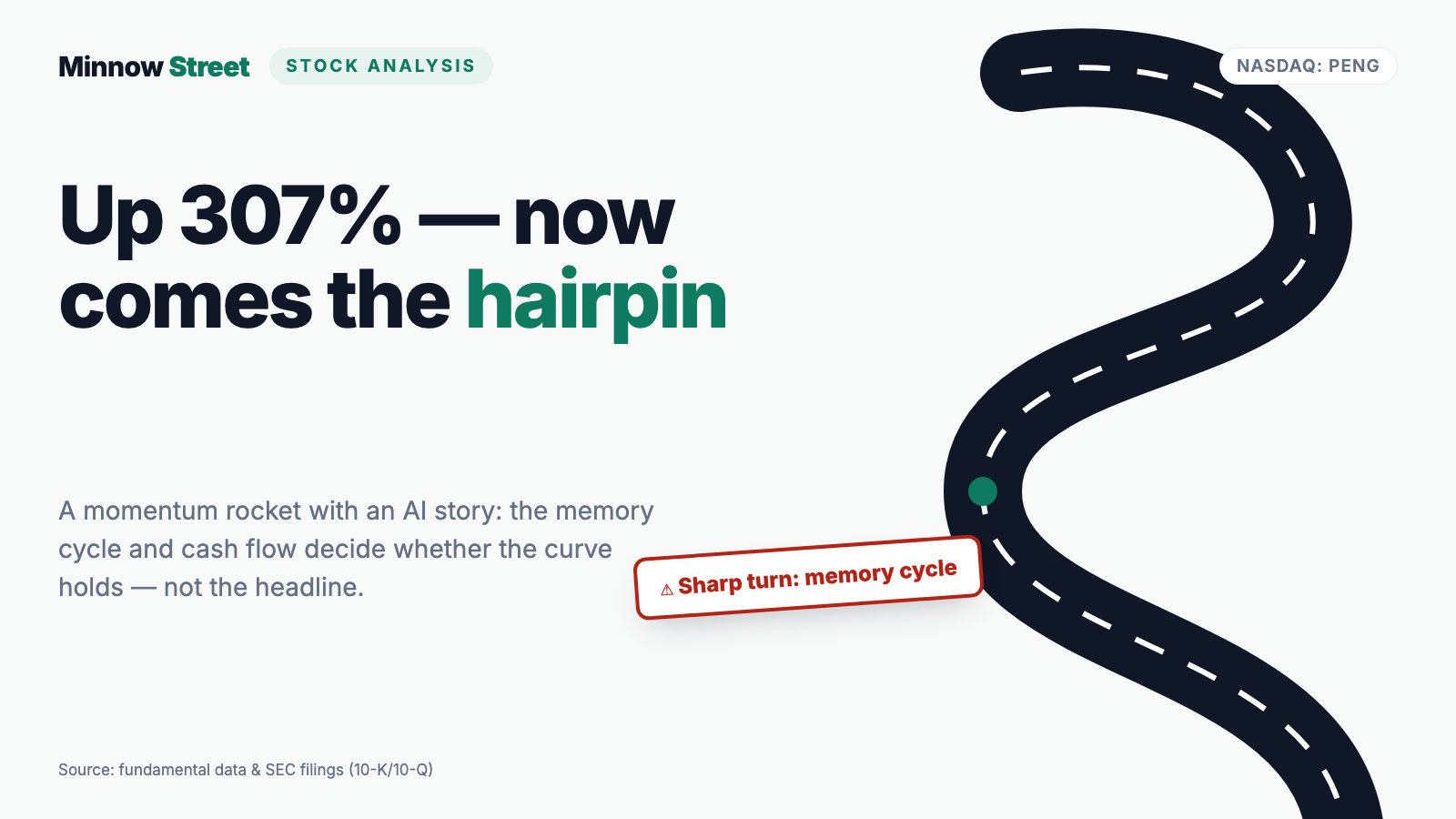
There is a moment when an investor turns into a passenger: the stock he does not own has tripled — and suddenly the FOMO passenger is riding shotgun, pointing at the runaway price and shouting, "Step on it, or the mountain gets climbed without you!" Penguin Solutions, Inc. (Nasdaq: PENG) is exactly that kind of stock in the summer of 2026: up roughly 307 percent in three months, rank 3 in our in-house Qullamaggie Top Gainers 3M scanner (as of July 18, 2026), a record quarter, an outlook raised yet again. So let\'s make a deal: before you step on the gas, we read together what the company itself filed, under penalty of law, with the U.S. securities regulator, the SEC — the annual report (10-K) for the fiscal year ended in late August 2025, the quarterly report (10-Q) as of May 29, 2026, and the earnings release of July 7, 2026. Both things are in there: a record that is real. And a mountain road with a tight hairpin that no rally chart bothers to draw. In the end, you decide who drives — you or the passenger.
What Penguin Solutions actually does — and why this company has three past lives
Penguin Solutions of Fremont, California — about 2,900 employees at the end of fiscal 2025 — describes itself in the annual report as an "end-to-end technology company" for computing, memory and LED solutions. Translated: the company designs, builds, deploys and manages AI and high-performance computing infrastructure for enterprises — hardware, software and managed services from one hand, under brands like Penguin Computing and Stratus — and, alongside that, sells specialty memory modules (SMART Modular brand) and LED chips (Cree LED brand). That produces three reporting segments: Advanced Computing (the AI computing business, $648.4 million of revenue in fiscal 2025), Integrated Memory ($464.2 million) and Optimized LED ($256.1 million). One calendar quirk matters: the fiscal year ends on the last Friday of August — "fiscal 2026" essentially runs from September 2025 through late August 2026.
What is remarkable is how young this identity is: until October 2024 the company was registered with the SEC as SMART Global Holdings — a memory-module maker that rebuilt itself into an AI infrastructure company through acquisitions (Penguin Computing, Cree LED, Stratus) and divestitures (SMART Brazil, 2023, with a $195.4 million loss from the discontinued operation). On June 30, 2025, the parent also formally moved from the Cayman Islands to Delaware (via a court-sanctioned scheme of arrangement). Sounds like a footnote? It is not: if you buy this stock as an "AI pure play since forever," you are actually buying a freshly rebuilt conglomerate in which the old memory business is alive and kicking. Which brings us to the central tension of this analysis, running through every chapter: The records are real and the outlook keeps rising — but the rally\'s fuel comes from the cyclical memory business, while the AI computing segment that gives the stock its name and its imagination earned almost nothing last quarter.
Where the stock shows up in our scanner
Every day we run roughly 3,500 stocks through our scanners. As of July 18, 2026, Penguin Solutions ranks no. 3 in the Qullamaggie Top Gainers 3M scanner (U.S. selection). The scanner hunts for the setup of the Swedish momentum trader Qullamaggie: stocks with extreme three-month relative strength (PENG: 99th percentile), a wide daily range (about 11.8 percent on average — that is a roller coaster, not an elevator) and enough trading volume (about $206 million of dollar volume per day). To replicate it yourself: open the scanner, set the country filter to "US" — Penguin sits in the top group. The fundamental lens of the same scanner shows a solid but not stellar picture: a Piotroski F-Score of 7 out of 9 (a nine-point test of the direction of the books — 7 is decent, rock-solid starts at 8), an Altman Z-Score around 6.7 (a bankruptcy early-warning gauge — the danger zone starts below 1.8, miles away here) and debt-to-equity around 0.9. Remember the principle: a momentum scanner measures how fast the car is climbing — not what is in the tank. Which is exactly why we now read the filings.
The numbers over the years — honestly appraised
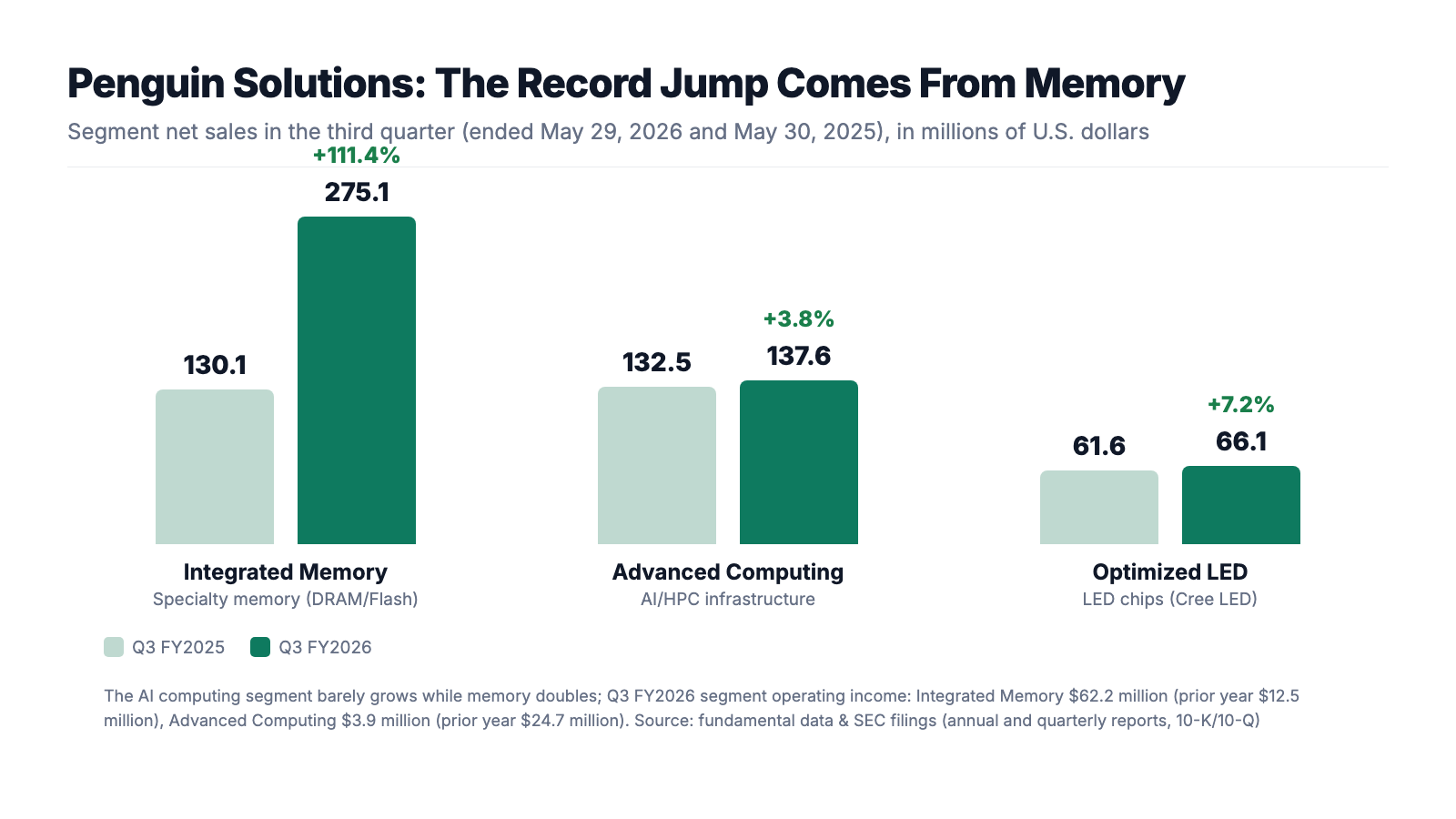
First, what genuinely impresses. After two loss years — a $187.5 million net loss in fiscal 2023 (almost entirely from the SMART Brazil divestiture), a $52.5 million loss in fiscal 2024 — the company swung back to profit in fiscal 2025: net sales of $1,368.8 million (up 16.9 percent), net income of $25.4 million, $0.29 per share. And fiscal 2026 is piling on at a pace you rarely see: in the third quarter (ended May 29, 2026), net sales jumped 48 percent to a record $478.7 million, operating income more than quadrupled to $50.9 million (up 417 percent), and diluted GAAP earnings per share swung from $(0.01) to $0.68. Nine months in, the tally stands at $1,164.8 million of net sales (up 13 percent) and $1.29 per share. On July 7, 2026, the company raised its full-year outlook again: revenue growth of about 22 percent (plus or minus 2 points), GAAP EPS of $1.97 (plus or minus 5 cents), non-GAAP EPS of $2.60 (plus or minus 5 cents). This is not hot air — these are audited-grade numbers with a raised bar. The question is where the jump comes from — and only the segment view answers that.
What the filings say — the uncomfortable truths
Uncomfortable truth no. 1: The profit surge comes from the memory cycle — the AI segment earns almost nothing anymore
The rally tells an AI story. The quarterly report tells a more precise one:
"Integrated Memory net sales increased by $144.9 million, or 111.4%, and $251.1 million, or 75.6%, in the third quarter and first nine months of 2026, respectively, compared to the same periods in the prior year, primarily driven by strong momentum across DRAM and Flash, as accelerating AI-driven demand drove favorable pricing and increased volume."
— Penguin Solutions, Inc., SEC quarterly report 10-Q as of May 29, 2026, Item 2 "Management's Discussion and Analysis"
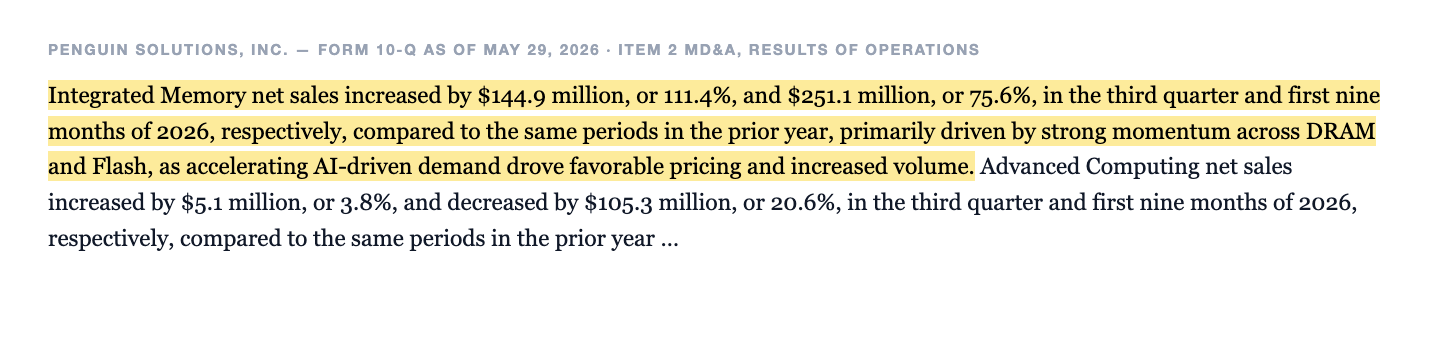
"AI-driven demand" is in the sentence, yes — but it works through the memory price: DRAM and Flash prices are climbing because AI data centers are buying the market empty. That is the same mechanism memory giant Micron lives off, whose cycles we dissected in our Micron analysis — and it is why Integrated Memory\'s segment operating income exploded from $12.5 million to $62.2 million in the quarter. The actual AI computing segment, Advanced Computing, grew only 3.8 percent — and its segment operating income collapsed from $24.7 million to $3.9 million, weighed down by the wind-down of the legacy Penguin Edge business and prior-year hyperscale orders that did not recur; nine months in, the segment sits 20.6 percent below the prior year. Put into an everyday image: the rocket carries the lettering "AI factory," but the tank is filled with memory-price fuel — and on the stock market, that has always been a cycle, never a steady state. How capital-hungry and how moody this AI substructure is, we examined from the other side in our Nvidia analysis.
Uncomfortable truth no. 2: The record profit is not arriving as money (yet)
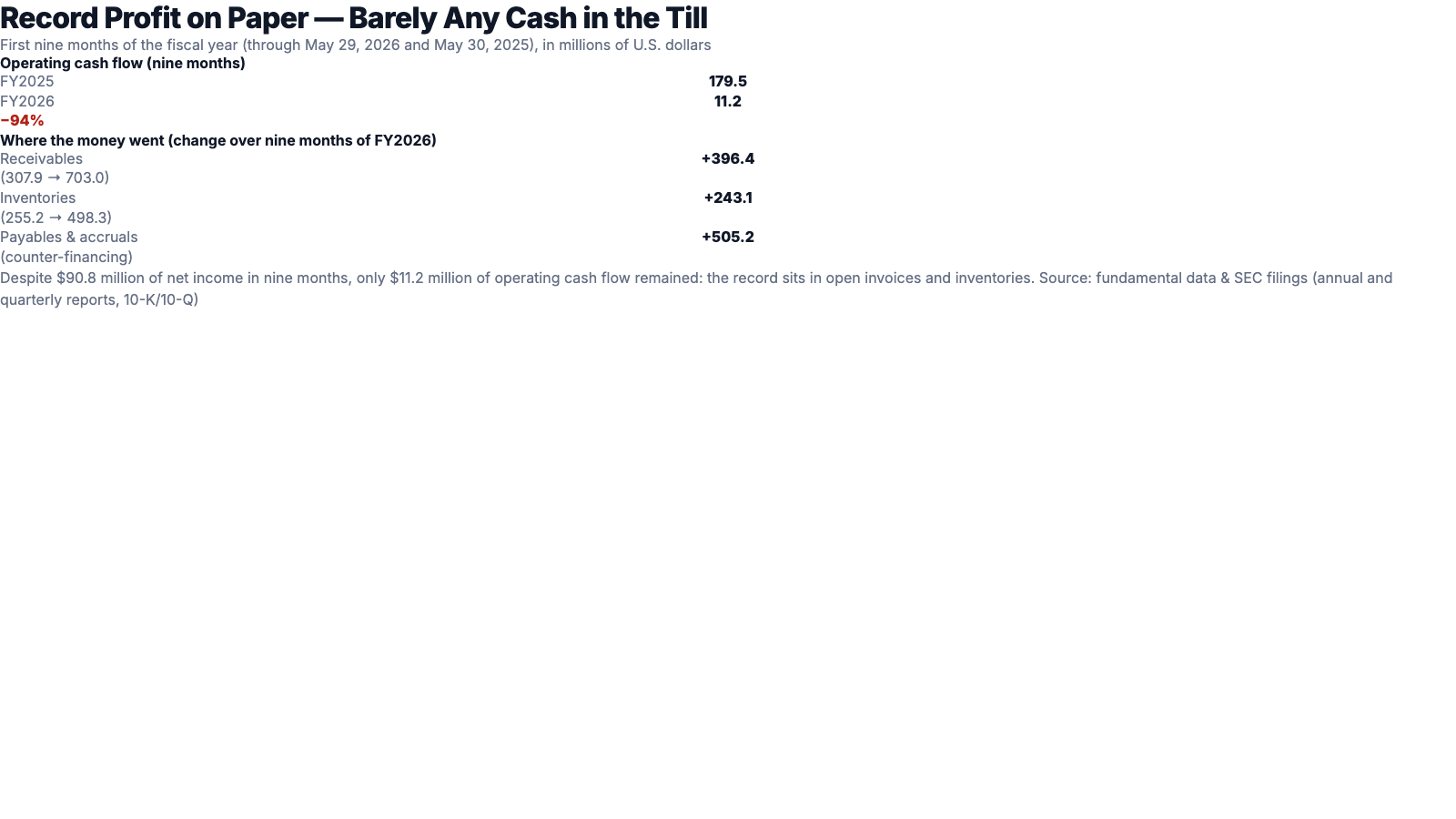
$90.8 million of net income in nine months — but how much of it landed in the till as cash? The report does the math without mercy:
"Operating cash flows were negatively affected by a $124.4 million net change in our operating assets and liabilities, primarily from the effects of an increase of $396.4 million in accounts receivable, driven by increased Integrated Memory sales, and $243.1 million in inventories to support future demand across all business units, partially offset by an increase of $505.2 million in accounts payable and accrued expenses and other liabilities primarily due to an increase in trade purchasing activities as well as an increase in deferred revenue from customer services."
— Penguin Solutions, Inc., SEC quarterly report 10-Q as of May 29, 2026, Item 2 "Management's Discussion and Analysis" (Liquidity and Capital Resources)
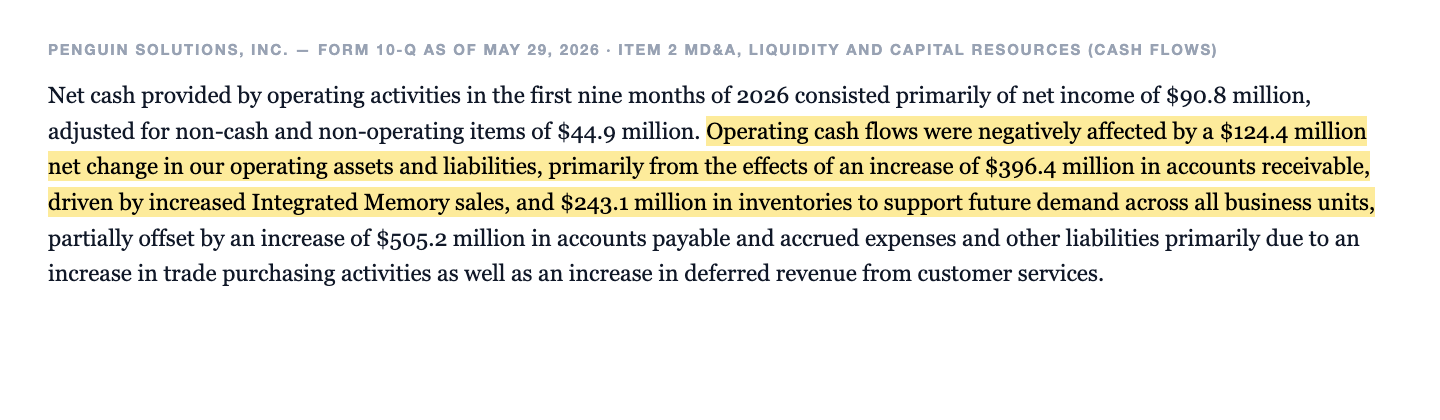
Bottom line: nine months of record business left just $11.2 million of operating cash flow — after $179.5 million in the prior-year period. Accounts receivable have more than doubled since late August 2025, from $307.9 million to $703.0 million; inventories nearly doubled, from $255.2 million to $498.3 million. Translated: Penguin sells on invoice and buys on stock — the profit sits on paper, the money sits in warehouse racks and open invoices. In a memory boom that is partly normal (whoever does not secure chips today has none tomorrow), but it makes the quality of the record more cyclical than the income statement looks: if the memory price turns, high inventories and receivables suddenly stand on the wrong side. To be fair: the cash position is comfortable at $440.3 million (May 29, 2026), a $20 million debt repayment was made, and the company still bought back $55.7 million of its own stock in nine months.
Uncomfortable truth no. 3: Two convertible instruments sit deep in the money — and the anchor investor sits on every side of the table
When a stock triples, footnotes become facts. Footnote one: in December 2024 the company sold $200 million of convertible preferred stock to a vehicle of SK Telecom — carrying a 6 percent cumulative preferred dividend (about $3 million per quarter, paid before common stockholders see anything) and a conversion price that looks like a bargain from today\'s vantage point:
"The shares of Issued CPS are convertible into common stock at an initial conversion price of $32.81, subject to customary adjustment upon the occurrence of certain events (including share subdivision and consolidation, certain dividends and distributions, and any reclassification or share exchange)."
— Penguin Solutions, Inc., SEC quarterly report 10-Q as of May 29, 2026, note "Temporary Equity — Convertible Preferred Stock"
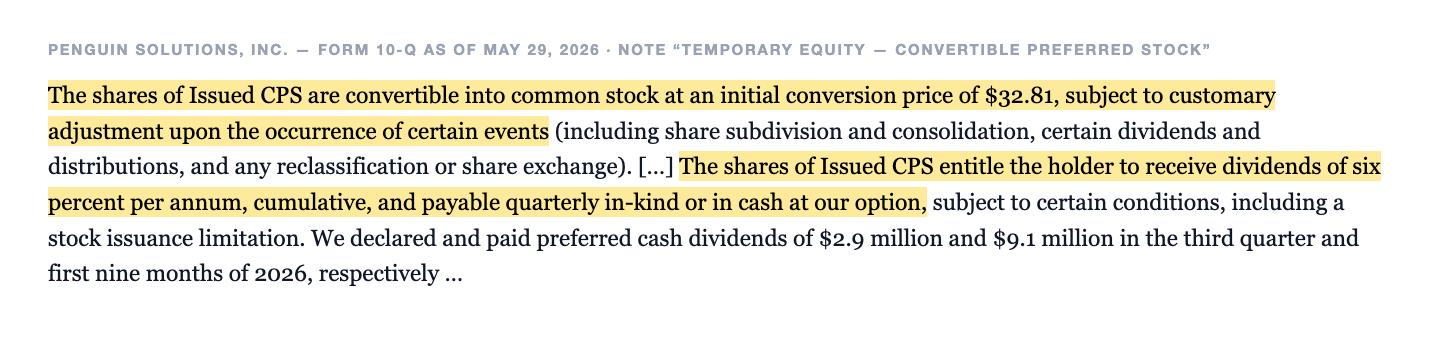
At a share price around $67 (as of July 18, 2026), conversion is deep in the money: $200 million of preferred would become a good 6.1 million new shares — roughly 12 percent dilution on about 51 million shares outstanding; your slice of the cake shrinks noticeably the day conversion happens. Footnote two: the 2.00% convertible notes due 2029 have also been convertible by holders since the third quarter, because the stock closed above 130 percent of the conversion price for the required stretch — which is why the company now classifies them as a current liability. And SK Telecom is not just a preferred holder: through its vehicle it holds more than 10 percent of the voting interest, an SKT executive sits on the board, and since May 2025 SKT is also a customer — $33.9 million of revenue from AI data center solutions in nine months ran as related-party business. All disclosed, all routed through the audit committee — but remember the image: an investor who is major shareholder, board presence and customer at once sits on every side of the table — and his preferred shares get paid before your common stock.
Uncomfortable truth no. 4: Two thirds of revenue hangs on ten customers
The annual report makes no secret of the dependence:
"Sales to our ten largest customers were 66%, 58% and 60% of total net sales in each of 2025, 2024 and 2023, respectively. […] Net sales to an Advanced Computing customer were 18.2%, 18.4% and 23.3% of total net sales in 2025, 2024 and 2023, respectively. Net sales to an Integrated Memory customer was 14.1% of total net sales in 2025."
— Penguin Solutions, Inc., SEC annual report 10-K for fiscal year 2025, notes "Concentrations"
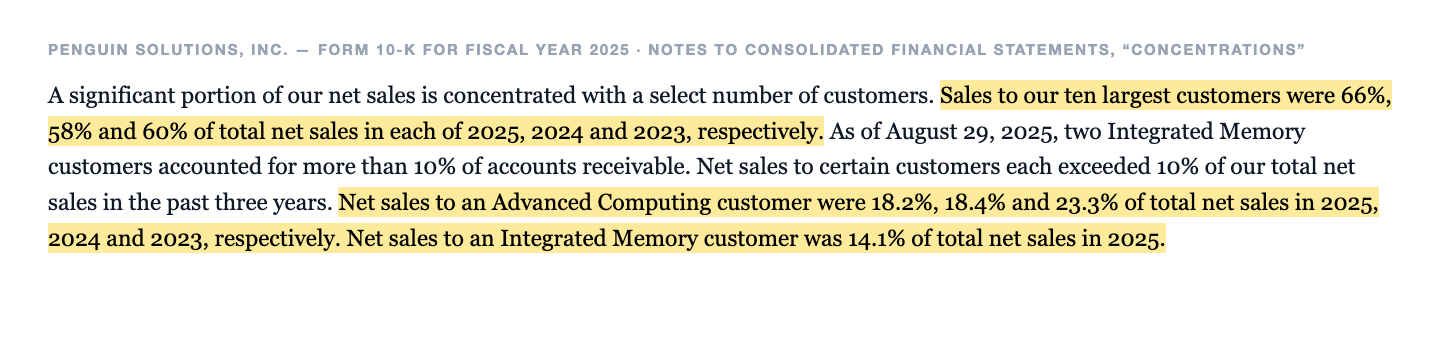
Picture a baker whose shop sells two of every three rolls to the same ten regulars — with the biggest one alone buying almost every fifth roll. That is what Penguin Solutions\' customer base looks like, and the concentration is rising with the boom (from 58 to 66 percent within a year). Add the supply side: the memory unit buys from the industry giants Samsung, Micron and SK hynix — the two largest suppliers alone accounted for roughly $0.6 billion of purchasing volume in fiscal 2025. Large-project business is inherently lumpy on top; the company itself cites the "unpredictable nature of large project engagements" as the reason Advanced Computing revenue swings from year to year. Revenue that hangs on a few large customers and volatile projects can shrink faster than a momentum chart prices in.
Valuation: What the market charges for the rocket
Now for the price tag. In mid-July 2026 the stock cost about $67 and the market value stood near $3.4 billion (all valuation figures: data as of July 18, 2026) — after a roughly 307 percent gain in three months and about 242 percent year to date. That works out to: a P/E around 48 on trailing twelve-month GAAP earnings (about $1.39 per share), roughly 34 times the midpoint of the company\'s own GAAP guidance for fiscal 2026 ($1.97) and roughly 26 times the non-GAAP guidance ($2.60); the price-to-sales ratio sits around 2.3 (trailing twelve months: about $1.50 billion of net sales). For context: that is no moonshot price for an infrastructure-and-memory conglomerate — but it is a price that already assumes the memory boom continues and the AI computing unit delivers. The professionals\' view is benign: eight analysts tracked by the data feed stand at a consensus near "buy" (data as of July 18, 2026) — though with a stock that has just tripled, analyst consensus tends to follow the rally rather than lead it. Penguin Solutions pays no dividend on its common stock and does not intend to for the foreseeable future — the only dividend in the house flows to the SKT preferred.
Opportunities and risks at a glance
What speaks for Penguin Solutions:
- A record quarter with a raised bar: net sales up 48 percent to $478.7 million, operating income up 417 percent, GAAP EPS from $(0.01) to $0.68 (Q3 of fiscal 2026) — and a full-year outlook raised again on July 7, 2026 (about 22 percent revenue growth, $1.97 GAAP and $2.60 non-GAAP EPS).
- Genuine AI-era tailwind on both rails: memory prices (DRAM/Flash) are rising on AI data center demand, and the infrastructure business is winning customers — 13 new AI Infrastructure logos in four quarters, named Dell Technologies Global Alliances Americas AI Partner of the Year and an NVIDIA AI Factory Specialized Partner (Q3 release of July 7, 2026).
- A solid balance-sheet base: $440.3 million in cash (May 29, 2026), a Piotroski F-Score of 7 out of 9, Altman Z around 6.7, plus share buybacks ($55.7 million in nine months) and a $20 million debt repayment.
- A documented turnaround: from loss-maker ($187.5 million net loss in fiscal 2023, $52.5 million in fiscal 2024) back to profit ($25.4 million in fiscal 2025, $87.4 million in just nine months of fiscal 2026).
What speaks against it:
- The profit surge is memory cycle: Integrated Memory up 111.4 percent with segment operating income up fivefold — while the AI computing segment Advanced Computing delivered only $3.9 million of segment operating income (prior year: $24.7 million) and sits 20.6 percent below the prior year after nine months.
- Cash conversion collapsed: $11.2 million of operating cash flow in nine months (prior year: $179.5 million); receivables up $396.4 million, inventories up $243.1 million — a record built on invoices and stockpiles.
- A dilution overhang: SKT convertible preferred ($200 million, conversion price $32.81 — about half the price, roughly 6.1 million potential new shares) plus 2029 convertible notes that are convertible by holders since Q3; on top, a 6 percent cumulative preferred dividend ahead of common stockholders.
- Concentration risk on both sides: top-ten customers account for 66 percent of net sales (and rising), one customer for 18.2 percent; purchasing is concentrated with Samsung, Micron and SK hynix; large projects are, per the company\'s own filing, "unpredictable."
- Momentum risk: an average daily range around 11.8 percent and a 307 percent three-month gain (as of July 18, 2026) — curves like that attract traders, not holders; if the memory price or the story turns, there is no valuation net below.
A human conclusion
Back to the FOMO passenger from the opening. His trick is not lying — the rally is real, the record quarter is filed under penalty of law, the outlook was raised twice, and a company that steered 2,900 people, three segments and a turnaround through two loss years is no shell game. His trick is making you read the label instead of the list of ingredients. The label says "AI infrastructure." The ingredients say: the profit surge comes from DRAM and Flash prices (Integrated Memory, segment operating income up fivefold), the AI computing segment earned $3.9 million last quarter, the record sits in receivables and warehouses rather than in the till, and at a $32.81 conversion price a major shareholder — who is also customer and board presence — waits for his slice of the cake. The honest math looks like this: you get a genuinely improved company with a double AI tailwind — priced for the continuation of a memory cycle, with built-in dilution and a daily range that is more roller coaster than elevator. Whether the tight hairpin — the next swing in memory prices — is taken cleanly will be decided not by the story but by three lines in the coming quarterly reports (10-Q): Advanced Computing\'s segment operating income, operating cash flow against net income, and the level of receivables and inventories. Read them before the passenger gets louder. What you make of it is your decision. And that is exactly as it should be.
Sources
All original documents used in this analysis — for your own reading:
- Penguin Solutions, Inc. — SEC annual report 10-K for fiscal year 2025 (ended August 29, 2025; filed October 21, 2025)
- Penguin Solutions, Inc. — SEC quarterly report 10-Q as of May 29, 2026 (filed July 7, 2026)
- Penguin Solutions, Inc. — SEC Form 8-K dated July 7, 2026, Exhibit 99.1 (Q3 results and raised full-year outlook)
- Penguin Solutions, Inc. — SEC Form 8-K12B dated June 30, 2025 (redomiciliation Cayman Islands → Delaware)
- Full SEC filing history of Penguin Solutions (incl. former name SMART Global Holdings): EDGAR overview (sec.gov)
- Fundamental data (metrics, quarterly series, valuation; data as of July 18, 2026), reconciled against the SEC filings.
- Screener and rating data: in-house stock scanner (data as of July 18, 2026), including the Qullamaggie Top Gainers 3M scanner (U.S. selection, rank 3).
Transparency & disclaimer: This analysis is a journalistic contextualization of publicly available information and is not investment advice, not a financial analysis in the regulatory sense and not a solicitation to buy or sell securities. Stock investments carry substantial risks up to and including total loss. All information without guarantee; the data cut-off is noted in the text. The author holds no position in Penguin Solutions shares at the time of publication.
Our Bottom Line at a Glance
- Momentum & record quarter positive
- Rank 3 in the Qullamaggie Top Gainers 3M scanner (U.S. selection, as of July 18, 2026), up roughly 307 percent in three months — backed by real numbers: Q3 FY2026 with record net sales of $478.7 million (up 48 percent), operating income up 417 percent and GAAP EPS of $0.68 after $(0.01) (10-Q as of 05/29/2026; 8-K dated 07/07/2026).
- Outlook & AI tailwind positive
- Full-year outlook raised again on July 7, 2026 (~22 percent revenue growth, GAAP EPS $1.97, non-GAAP $2.60); 13 new AI Infrastructure customer logos in four quarters, Dell Technologies Global Alliances Americas AI Partner of the Year and NVIDIA AI Factory Specialized Partner (Exhibit 99.1).
- Profit source & segment mix negative
- The profit surge comes from the cyclical memory business: Integrated Memory up 111.4 percent with segment operating income up fivefold to $62.2 million — while Advanced Computing, the AI flagship, delivered only $3.9 million of segment operating income (prior year: $24.7 million) and sits 20.6 percent below the prior year after nine months (10-Q as of 05/29/2026).
- Cash conversion negative
- Operating cash flow of just $11.2 million in 9M FY2026 (prior year: $179.5 million): receivables up $396.4 million, inventories up $243.1 million, counter-financed by $505.2 million more payables — the record is built on invoices and stockpiles (10-Q as of 05/29/2026). Cash comfortable at $440.3 million.
- Dilution & governance negative
- SKT convertible preferred ($200 million, conversion price $32.81 — about half the July 18, 2026 price, ~6.1 million potential new shares, 6 percent cumulative dividend) plus 2029 convertible notes convertible since Q3; SK Telecom is at once a holder of more than 10 percent of the voting interest, board-represented and a customer ($33.9 million of revenue in 9M).
- Balance sheet & customer base neutral
- Piotroski 7 out of 9, Altman Z around 6.7, $440.3 million in cash, buybacks and debt repayment — but top-ten customers account for 66 percent of net sales (rising), one customer for 18.2 percent, and purchasing is concentrated with Samsung, Micron and SK hynix (10-K FY2025).
Penguin Solutions is the rare case of a momentum rocket with an audited substructure: a record quarter, a twice-raised outlook, a turnaround after two loss years — and still the label misleads. The profit surge comes almost entirely from the cyclical memory business, while the AI computing segment that gives the stock its name earned almost nothing last quarter; operating cash flow collapsed to $11.2 million, and with the SKT preferred (conversion price $32.81) plus the convertible 2029 notes, a dilution overhang of a good tenth is waiting. Whoever buys here buys the continuation of the memory cycle at 34 times GAAP guidance — not the AI factory from the headline. Not investment advice.
What Our Rating Means
- If you don't own the stock
- As long as the question raised in the bottom line stays open, we see no basis for an entry.
- If you hold it in your portfolio
- Our findings offer no acute reason to sell — the checkpoints named remain decisive.
A journalistic assessment by our editorial team at the time of the deep dive, based on public sources — not investment advice and not a solicitation to buy or sell. Your personal circumstances (investment goals, risk capacity, taxes) cannot be taken into account. What our categories mean, how verdicts are formed, and what conflicts of interest exist →
Worth Noting
- PENG made the research list as rank 3 of our in-house Qullamaggie Top Gainers 3M scanner (U.S. selection, as of July 18, 2026) — part of our series on this momentum scanner's hits.
- Identity verified against EDGAR: former name "SMART Global Holdings, Inc." (until 10/03/2024), fiscal year ending on the last Friday of August (fiscalYearEnd 0829), Delaware incorporation since 06/30/2025 (Form 8-K12B), Nasdaq: PENG, CIK 0001616533.
- Price and market-value figures (~$67, ~$3.4 billion) from the July 18, 2026 feed, sanity-checked against roughly 51 million weighted shares per the quarterly report 10-Q as of May 29, 2026; trailing P/E based on TTM GAAP EPS of about $1.39 (Q4 FY2025 + 9M FY2026); analyses are evergreen, daily prices are not a buy argument.
Frequently Asked Questions
Penguin Solutions, Inc. (Nasdaq: PENG, Fremont, California, about 2,900 employees) designs, builds and manages AI and high-performance computing infrastructure (Advanced Computing segment, Penguin Computing and Stratus brands), sells specialty memory modules (Integrated Memory, SMART Modular brand) and LED chips (Optimized LED, Cree LED brand). In fiscal 2025 (ended August 29, 2025) the company generated $1,368.8 million of net sales: $648.4 million in Advanced Computing, $464.2 million in Integrated Memory, $256.1 million in Optimized LED.
As of July 18, 2026, the stock stood roughly 307 percent above its level three months earlier (rank 3 in our in-house Qullamaggie Top Gainers 3M scanner). The drivers were a record quarter (Q3 ended May 29, 2026: net sales up 48 percent to $478.7 million, GAAP EPS of $0.68 after $(0.01)) and the full-year outlook raised again on July 7, 2026. The biggest profit lever, however, was the memory-price boom in the Integrated Memory segment (up 111.4 percent) — not the AI computing business.
Yes. Per the SEC register (EDGAR), the company was named SMART Global Holdings, Inc. until October 3, 2024; since then it has operated as Penguin Solutions, Inc. On June 30, 2025, the parent additionally moved its legal home from the Cayman Islands to Delaware (U.S. Domestication via a court-sanctioned scheme of arrangement, Form 8-K12B). The PENG ticker and the Nasdaq listing remained unchanged.
SK Telecom holds three roles at once: through its vehicle Astra AI Infra, the Korean carrier owns $200 million of convertible preferred stock (closed December 13, 2024; 6 percent cumulative dividend; conversion price $32.81) and with it more than 10 percent of the voting interest; an SKT executive (Min Yong Ha) sits on the board; and since May 2025 SKT is also a customer for AI data center solutions — $33.9 million of revenue in the first nine months of fiscal 2026 (quarterly report 10-Q as of May 29, 2026).
Two instruments sit deep in the money (data as of July 18, 2026, share price around $67): the SKT convertible preferred of $200 million at a $32.81 conversion price would translate into a good 6.1 million new shares — roughly 12 percent on about 51 million shares outstanding. In addition, the 2.00% convertible notes due 2029 have been convertible by holders since the third quarter of fiscal 2026, because the stock closed above 130 percent of the conversion price (10-Q as of May 29, 2026).
Strained: in the first nine months of fiscal 2026 (through May 29, 2026), despite $90.8 million of net income, only $11.2 million of operating cash flow remained (prior-year period: $179.5 million). The reason is working capital: receivables rose $396.4 million and inventories $243.1 million, partly funded by $505.2 million more payables and accruals. The cash position was still comfortable at $440.3 million.
As of July 18, 2026 (share price around $67, market value around $3.4 billion), the stock traded at about 48 times trailing GAAP earnings, 34 times the midpoint of the company's own GAAP guidance for fiscal 2026 ($1.97) and 26 times the non-GAAP guidance ($2.60); price-to-sales stood around 2.3. That is no moonshot price, but it assumes the memory boom continues — if the cycle turns, there is no valuation net below.
Found an error?
Did you spot a factual error, an outdated number, or a typo in this deep dive? Let us know briefly — your report goes straight to the editorial team.