Sweetgreen Stock: The Market Trades a Comeback — the Only Quarterly Profit in Company History Came From Selling the Kitchen Robot
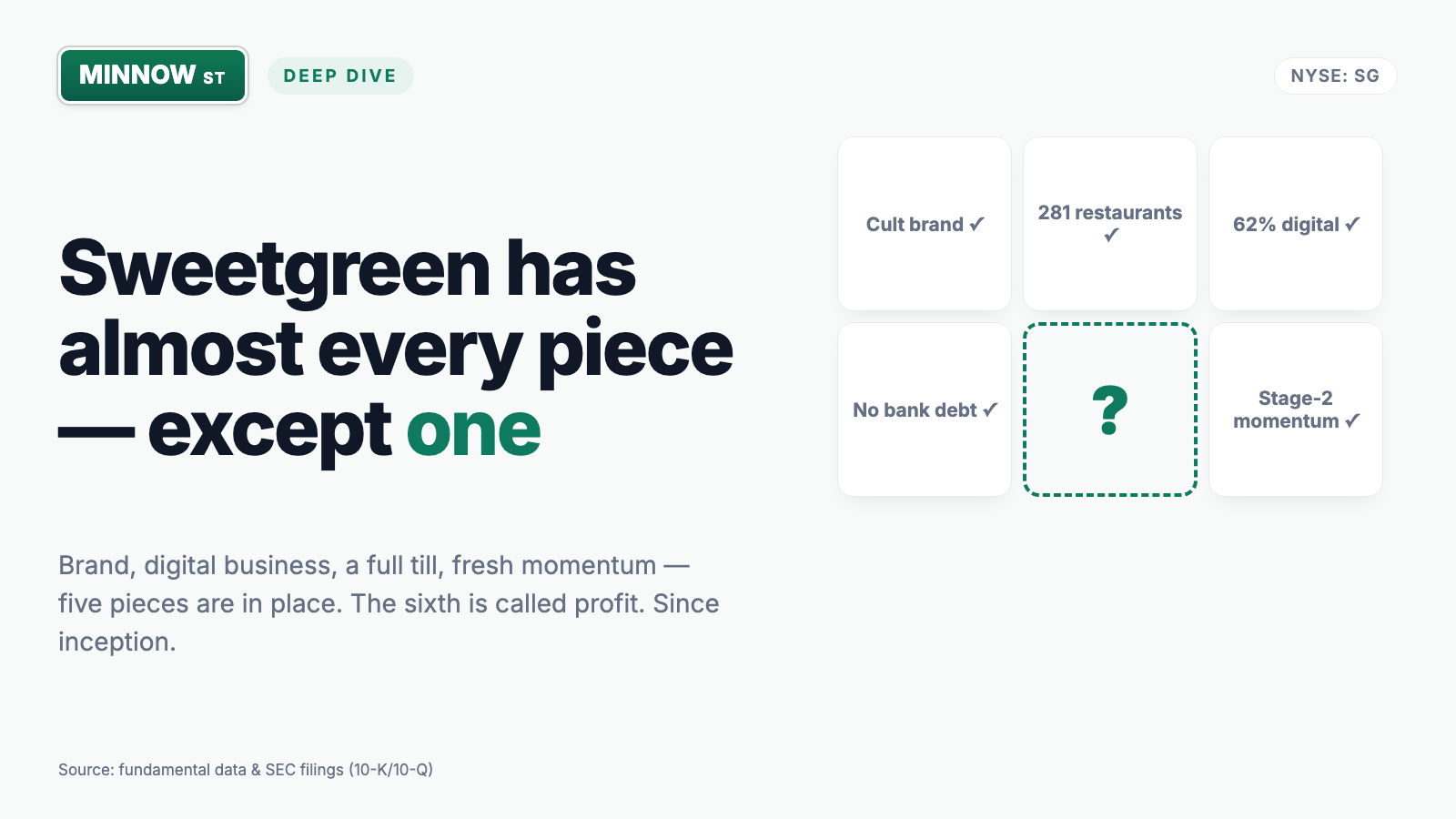
Sweetgreen shows up in our Reddit hype scanner — just 3 mentions in 24 hours (as of July 15, 2026), not a storm, more of a first knock. The stock market is far ahead: up 82 percent in three months, a stage-2 uptrend, the CEO buying his own shares (data as of July 10, 2026). We read the annual reports (10-K) for 2024 and 2025 and the quarterly report (10-Q) as of March 29, 2026: same-store sales down 12.8 percent, a $134.1 million annual loss, more than a billion dollars of cumulative losses — and a first quarterly profit that came not from salad but from selling the company's own kitchen robots. Not investment advice — just the ingredient list before you order the comeback story.
 Thomas Mücke
Founder & Publisher
Thomas Mücke
Founder & Publisher
Chart
Interactive price chart (TradingView).
Note: pure fact-based analysis, not investment advice and not a solicitation to buy or sell. All figures without guarantee.
There is a number that lodges itself in the investor brain like a ship's anchor in the seabed: the old all-time high. Psychologists call it anchoring — we judge not what something is worth, but how far it sits from a number we once saw. Hardly any stock feeds that reflex in the summer of 2026 as reliably as Sweetgreen, Inc. (NYSE: SG): shortly after its November 2021 IPO, the fast-casual salad chain briefly cost more than $50 per share — the market valued it at over $5 billion. Today it is about $9 and $1.1 billion, 83 percent below the high (data as of July 10, 2026). And now something is moving: up 82 percent in three months, the chief executive buying his own shares, the ticker resurfacing in our Reddit hype scanner — with 3 mentions in 24 hours (as of July 15, 2026) more of a knock than a storm, but the anchor is already whispering: "It used to trade at fifty. There's room." So let's make a deal: before you follow the anchor, we read together what the company itself has filed — honest under penalty of law — with the U.S. securities regulator, the SEC: the annual reports (10-K) for 2024 and 2025 and the quarterly report (10-Q) as of March 29, 2026. They tell a story that appears on no menu. In the end, you decide for yourself.
What Sweetgreen actually does — and why nobody collects royalties here
Sweetgreen was founded in November 2006 — three college friends, one salad shop in Washington — and is today a chain of 281 company-owned restaurants across 24 U.S. states and Washington, D.C. (end of fiscal year 2025; as of March 29, 2026 it was 285). It sells salads and bowls at the premium end: fresh, seasonal, with kitchens that actually cook — and with prices closer to a restaurant than to fast food. Important for context, especially next to classic restaurant franchisors: Sweetgreen operates every single location itself. No franchising, no royalties, no rental income from partners — how different that model can look is something we just dissected at Wendy's, where 94 percent of restaurants belong to franchisees. At Sweetgreen, every register dollar lands in company revenue — $679.5 million in 2025 (up 0.4 percent) — but so does every labor hour, every lease and every avocado purchase. The business is remarkably digital on top: 61.8 percent of 2025 revenue ran through the app, website and delivery platforms, and 67.2 percent in the first quarter of 2026. Then there is the narrative that turned a salad chain into a tech story: the "Infinite Kitchen," a robotic kitchen line that assembles bowls automatically — faster, more precise, with less labor. Sounds like the future? Maybe it is. But right here begins the central tension of this analysis, and it runs through every chapter: the market is trading a comeback — a stage-2 uptrend, buying insiders, up 82 percent in three months. The SEC filings show a company whose guests are disappearing faster than ever, that has posted losses since inception, and that has just sold its future technology.
Where the stock shows up in our scanner
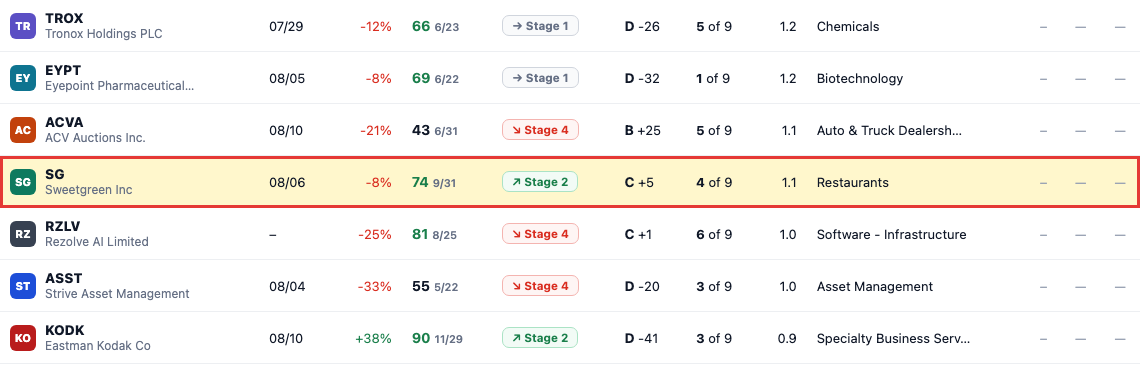
Every day we run about 3,500 stocks through our scanners. Sweetgreen reached our research list through the Reddit hype scanner — 3 mentions in 24 hours (ApeWisdom, as of July 15, 2026) is no hype, but after months of radio silence it is a first sign of life from the tavern. In our metrics scanners, by contrast, the stock lights up in 9 filters as of the July 10, 2026 data cut-off, and the list reads like a comeback script: a stage-2 uptrend in the Weinstein framework, price above the 50- and 200-day moving averages, membership in "top performers 3-6 months" with plus 81.9 percent in three months and plus 22.6 percent year to date. Add the chapter comeback hunters love most: CEO buying — chief executive and co-founder Jonathan Neman bought shares himself within the last twelve months, and in total four insider purchases stood against just one sale — plus institutional accumulation: 12 institutions added, 5 trimmed, roughly 84 percent of the shares sit in professional hands, led by Baillie Gifford (8.7 percent), Vanguard (8.0 percent) and BlackRock (6.5 percent; all data as of July 10, 2026). Whoever sees only this list buys. But the same scanner delivers the counter-opinions in the same breath: the Piotroski F-Score — a nine-point test of balance-sheet quality — stands at a meager 4 of 9; a thoroughly healthy company scores 8 or 9. The Altman Z-score, a classic insolvency early-warning built from several balance-sheet ratios, sits at 1.92 — the historical danger zone begins below 1.8; that is not an alarm, but it is the gray zone, not the green shore. And over twelve months the stock remains a loser at minus 30.6 percent, its recovery young: the one-month decline of 16.3 percent shows how nervously this comeback still trembles (all data as of July 10, 2026). Remember the fingerprint: momentum is buying a turnaround here that has not yet arrived anywhere in the business numbers.
The numbers over the years — honestly appraised
First, what genuinely impresses — and it exists. Sweetgreen grew revenue from $584.0 million to $679.5 million between 2023 and 2025, up 16 percent in two years, and built a digital business classic chains dream of: nearly two of every three dollars run through its own channels or delivery platforms, and the SG Rewards loyalty program launched in 2025. General and administrative expenses fell 4.4 percent to $143.4 million in 2025 — cost discipline is visible, and the new austerity program carries the pretty name "Sweet Growth Transformation Plan." And the balance sheet is solid in a way you would not expect from a loss-maker: no bank debt (the liabilities are essentially lease obligations), and $161.0 million sat in the till as of March 29, 2026. Whoever reads only this paragraph understands the comeback immediately. Now turn the bowl over:
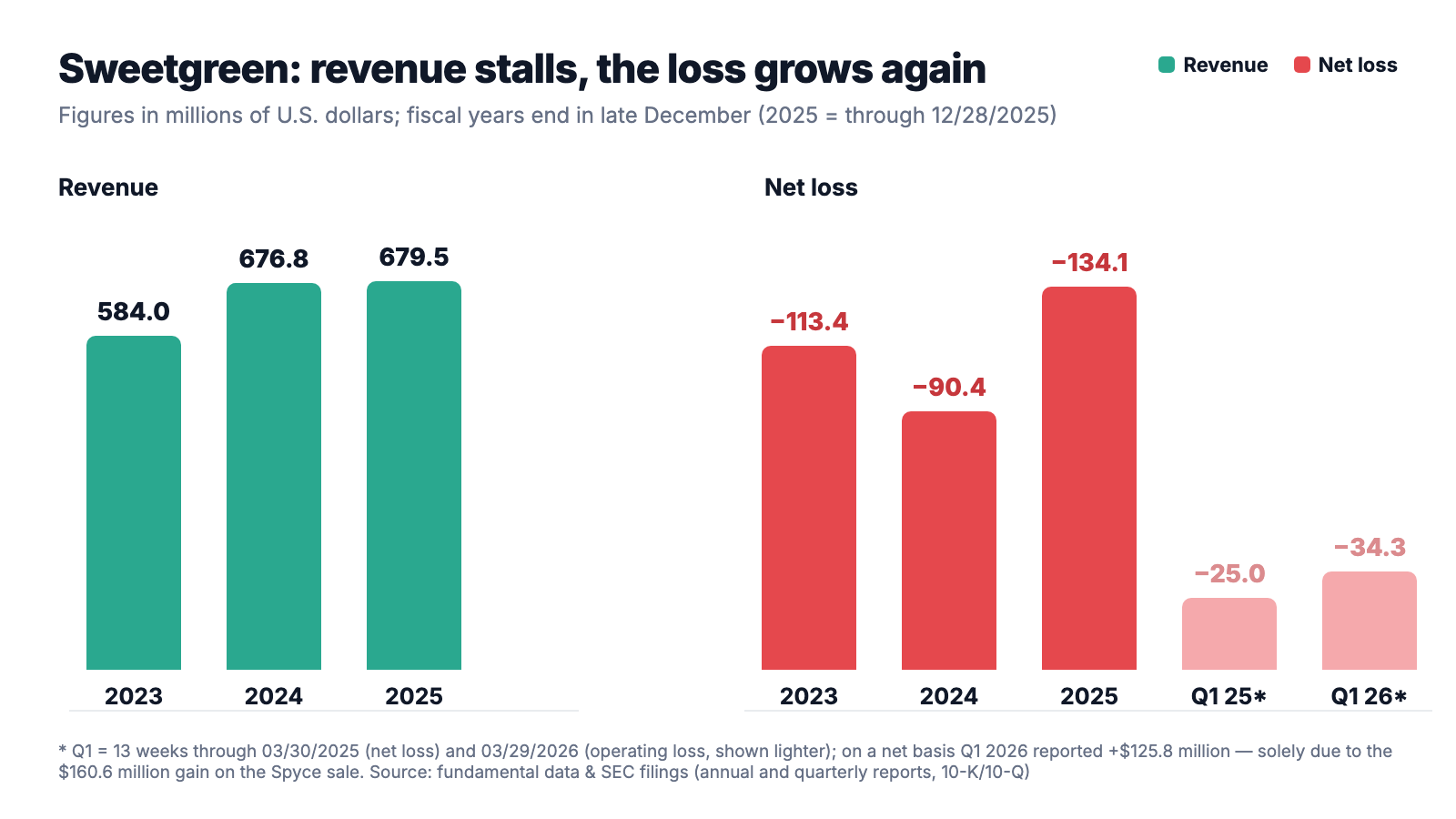
Revenue essentially stalled in 2025 (up 0.4 percent after up 15.9 percent in 2024) even though 35 net new restaurants were added — the new stores merely filled the hole the existing ones tore open. The net loss grew from $90.4 million to $134.1 million, operating cash flow flipped from plus $43.4 million to minus $12.7 million, and cash melted from $214.8 million to $89.2 million within a year — before the Wonder check refilled it in early 2026. Average unit volume, perhaps the most honest metric of a company-operated chain, fell from $2.924 million (2024) to $2.677 million (2025), and further to $2.572 million in the first quarter of 2026 (trailing four-quarter basis). Remember the sentence: when every store belongs to you, there is nobody to delegate weak locations to — every lost guest eats straight out of your own till. Which brings us to the uncomfortable truths.
What the filings say — the uncomfortable truths
Uncomfortable truth no. 1: the guests are leaving — and it is getting faster, not slower
The most important metric of any restaurant chain is same-store sales: what do the same restaurants ring up compared with a year ago? In 2023 Sweetgreen still grew 4.4 percent here, in 2024 6.2 percent. Then the curve flipped: minus 7.9 percent in fiscal year 2025 — and the first quarter of 2026 turned that into a plunge:
"Revenue decreased for the thirteen weeks ended March 29, 2026 compared to the thirteen weeks ended March 30, 2025, primarily due to a decrease in Comparable Restaurant Base revenue of $20.7 million, resulting in a negative Same-Store Sales Change of 12.8%, primarily driven by an 11.2% decrease in traffic and a 2.3% decrease in product mix, partially offset by a 0.7% benefit from menu price increases that were implemented subsequent to the thirteen weeks ended March 30, 2025."
— Sweetgreen, Inc., SEC quarterly report 10-Q as of March 29, 2026, Item 2 "Revenue"

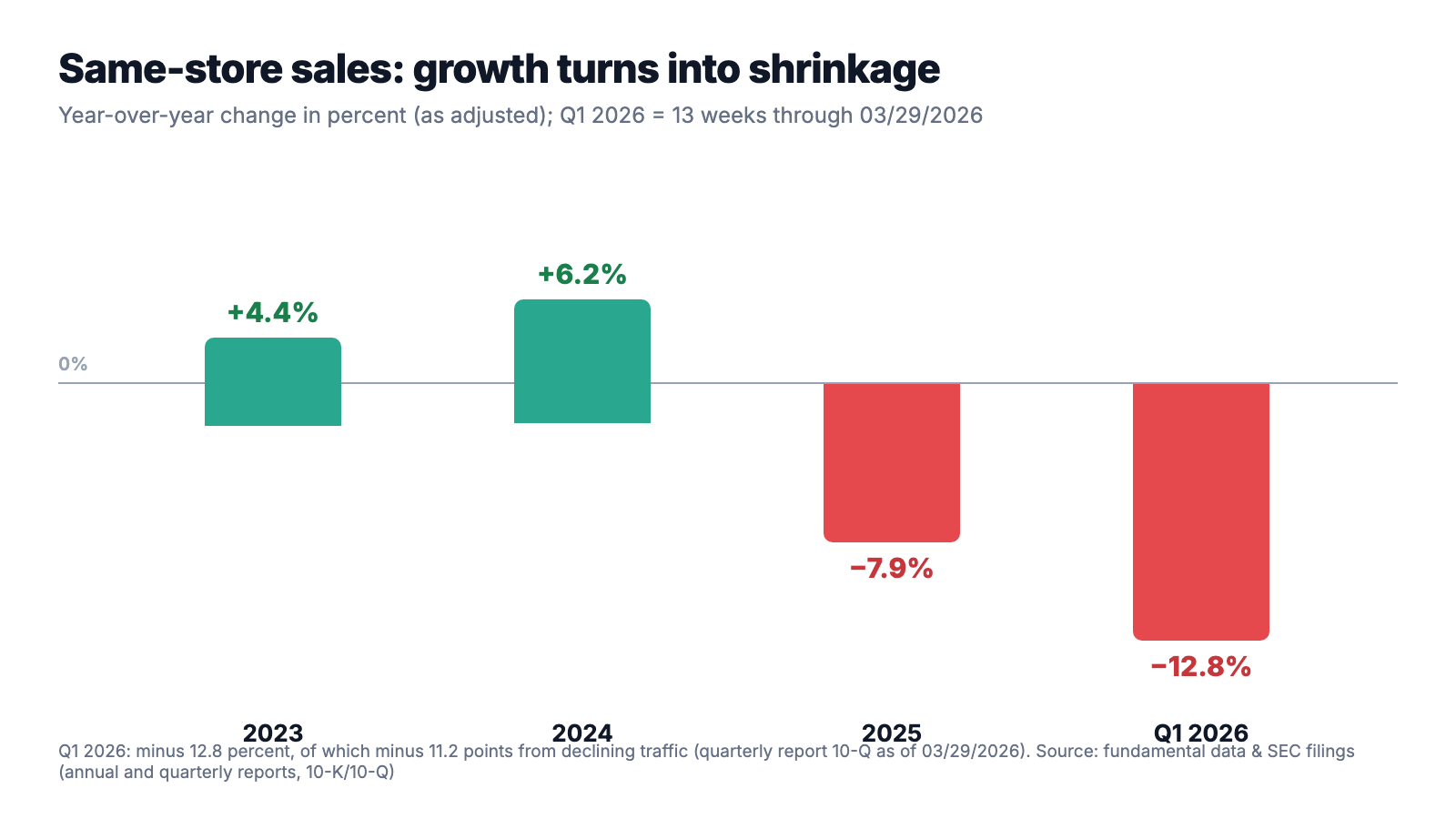
Honesty requires the mitigating circumstances the report itself names: the prior-year quarter was artificially strong thanks to the launch of Ripple Fries — the first fries in company history —, the 2026 winter weather was unusually harsh, and the entire fast-casual industry battled thrifty customers who cut back on premium prices first. But an 11.2 percent decline in traffic is more than industry weather — at $15 for a salad, it is the admission that the target audience is doing the math. And because Sweetgreen operates everything itself, the shrinkage eats through the income statement unchecked: food, labor and occupancy costs all rose as a share of revenue in the first quarter of 2026 — fixed costs stay when guests leave. Five restaurants were permanently closed during the quarter, nine more temporarily; impairment and closure costs for fiscal year 2025 had already quintupled to $12.1 million. A comeback on the stock exchange is one thing. At the salad bar, none is happening yet.
Uncomfortable truth no. 2: losses since inception — more than a billion dollars already burned
Sweetgreen has never delivered a profitable fiscal year in almost twenty years of corporate history. That is not a malicious exaggeration but the first sentence of a risk factor in the annual report:
"We have incurred significant net losses since inception. We expect our net losses to continue in the foreseeable future, and we may not achieve profitability. We incurred net losses of $(134.1) million in fiscal year 2025 and $(90.4) million fiscal year 2024. We expect net losses to continue in the foreseeable future."
— Sweetgreen, Inc., SEC annual report 10-K 2025, Item 1A "Risk Factors"

The balance sheet translates that sentence into a number you cannot walk past: the accumulated deficit reached exactly $1,009.4 million as of December 28, 2025 — of the $1,365.4 million investors have ever paid in as capital, almost three quarters is arithmetically used up. And the store-level economics explain why it stays that way: in 2025, ingredients, labor, occupancy and other restaurant operating costs alone consumed $575.9 million — leaving roughly $103.5 million at store level, a restaurant-level spread of about 15 percent (after roughly 20 percent in 2024; our own calculation from the annual report). Above that, however, sits the corporate overhead: $143.4 million of general and administrative expenses — 21.1 percent of revenue, including $36.5 million of stock-based compensation — plus $71.5 million of depreciation and $10.8 million of pre-opening costs. The stores make money, the head office eats it, and what remains is a $139.3 million operating loss. In an everyday image: every store throws its contribution into a well that is deeper than all the stores stacked on top of each other. That is why management let go of the growth button for 2026: only about 15 net new openings instead of 35 — less expansion, more discipline. Sensible. But it simultaneously takes away the stock's old argument that it would simply outgrow its fixed costs.
Uncomfortable truth no. 3: the future technology is sold — and the only profit in company history comes from that very sale
The "Infinite Kitchen" was the narrative meant to separate Sweetgreen from every other salad chain: in 2021 the company bought the Boston robotics start-up Spyce, and from 2023 the machines assembled bowls in the first locations — faster service, lower labor costs, the fantasy of a scalable robot chain. At the end of 2025 the technology sat in exactly 30 of 281 restaurants. And then, on December 29, 2025 — one day after the fiscal year ended — Sweetgreen sold the whole thing: Spyce and the Infinite Kitchen technology went to Wonder Group for $186.4 million — $100 million in cash, $86.4 million in untradeable preferred shares of privately held Wonder. Sweetgreen keeps a perpetual, royalty-free license and may keep deploying the robots; supplying, maintaining and developing them is now Wonder's job. The annual report states the new dependency without decoration:
"We now depend upon Wonder for the continued supply, commissioning, support, maintenance, and upgrades with respect to the Infinite Kitchen technology."
— Sweetgreen, Inc., SEC annual report 10-K 2025, Item 1A "Risk Factors"

You can defend this deal soberly: $186.4 million for a technology sitting in 30 stores refills the till of a company with negative operating cash flow — and the license back comes free. But three things belong on the table. First: almost half the purchase price consists of illiquid shares in an unlisted start-up whose value, per the quarterly report, "is not readily determinable." Second: Wonder may — within contractual limits — license the technology to third parties too, expressly including competitors; unit costs are expected to rise going forward, and tariffs already made the units about 5 percent more expensive in 2025. And third, the punchline that sits in the first-quarter 2026 income statement: the sale produced a $160.6 million book gain — and with it the first quarterly net profit Sweetgreen has ever reported. The quarterly report itself puts it in its place:
"During the first quarter of fiscal year 2026, the Company reported net income, primarily reflecting the impact of the $160.6 million gain on disposal of business from the Spyce sale. The Company reported a loss from operations for the period."
— Sweetgreen, Inc., SEC quarterly report 10-Q as of March 29, 2026, Item 2 "Results of Operations"

Operationally the quarterly loss even widened — from $28.5 million to $34.3 million. Translated: Sweetgreen did not earn a profitable quarter; it sold one. Whoever reads only the "first profit" headline should know what it is baked from. For research and development — the pipeline of home-grown technology substance — the company spent exactly $1.0 million in 2025, 0.15 percent of revenue. The tech story now lives at Wonder's place, paying rent.
Valuation: a $1.1 billion market value — the anchor does not help with the math
In early July 2026 the Sweetgreen stock cost about $9, for a market value of roughly $1.1 billion (data as of July 10, 2026). An honest price-to-earnings ratio does not exist — the reported trailing profit consists of the Spyce one-off, and operationally the company loses money. That leaves revenue as the yardstick: the price-to-sales ratio sits around 1.6. Subtract the $161.0 million of cash (March 29, 2026) and — with all due caution — the $86.4 million of Wonder shares carried at cost, and the market pays roughly 1.2 times annual revenue for the operating business. For comparison: at the valuation peak after the November 2021 IPO, the market briefly paid — measured against the 2022 revenue of $470.1 million — more than ten times. The old anchor is therefore not a valuation reference but a memorial — minus 83 percent from the high is not an argument, it is a backstory. The professionals have not left, though: roughly 84 percent sits with institutions, the CEO bought recently himself, and the buyers' bet is clearly drawn — 15 disciplined openings in 2026 (about half with the robot kitchen), falling overhead, a Wonder-funded till without bank debt, and guest counts that eventually turn. That is not an absurd bet. It is just one that currently lives on trust alone: every number that is already in the books points down; everything pointing up is expectation (all price and valuation figures: data as of July 10, 2026). You can find more metrics and ratings in the Sweetgreen company profile of our scanner.
Opportunities and risks at a glance
What speaks for Sweetgreen:
- A balance sheet without bank debt: $161.0 million of cash (March 29, 2026) after the $100 million cash inflow from the Spyce sale, plus $86.4 million of Wonder shares at carrying value; liabilities are essentially lease obligations (quarterly report 10-Q as of March 29, 2026).
- A genuine digital business: 61.8 percent of 2025 revenue through digital channels (Q1 2026: 67.2 percent), its own loyalty program since 2025 — a data base classic chains are far away from (annual report 10-K for 2025).
- Cost discipline instead of growth frenzy: general and administrative expenses cut 4.4 percent in 2025, only about 15 net new openings planned for 2026 (about half with the Infinite Kitchen) — the "Sweet Growth Transformation Plan" prioritizes average unit volumes over footprint.
- Insiders and institutions on the buy side: CEO purchases within twelve months, four insider buys against one sale, 12 adding versus 5 trimming institutions, roughly 84 percent institutional ownership (data as of July 10, 2026).
- Fresh momentum: a stage-2 uptrend, price above the 50- and 200-day moving averages, up 81.9 percent in three months and 22.6 percent year to date (data as of July 10, 2026) — the market is beginning to price the transformation story.
What speaks against it:
- The core is shrinking at an accelerating pace: same-store sales minus 7.9 percent (2025) and minus 12.8 percent (Q1 2026), driven by an 11.2 percent traffic decline; average unit volume down from $2.907 million to $2.572 million; five permanent store closures in the first quarter of 2026 alone.
- Losses without a visible end: a $134.1 million net loss in 2025 (up 48 percent), a $1,009.4 million accumulated deficit; the annual report expects losses "in the foreseeable future"; operating cash flow negative in 2025 (minus $12.7 million), cash melted from $214.8 million to $89.2 million during 2025.
- Corporate overhead against store economics: $143.4 million of general and administrative expenses (21.1 percent of revenue) stand against a calculated restaurant-level contribution of roughly $103.5 million — the head office costs more than all the stores earn combined (fiscal year 2025).
- The future technology now belongs to Wonder: supply, maintenance and development of the Infinite Kitchen hang on the new owner, who may — within limits — offer the technology to competitors as well; $86.4 million of the purchase price sits in illiquid shares; tariffs made the units about 5 percent more expensive in 2025, and the report expects further cost increases.
- Weak substance signals: a Piotroski F-Score of 4 of 9, an Altman Z-score of 1.92 (gray zone), minus 30.6 percent over twelve months, minus 83 percent from the high — and 3 Reddit mentions in 24 hours (July 15, 2026) are attention, not revenue.
A human conclusion
Back to the anchor from the opening. It has a true core: Sweetgreen is no empty shell — the brand has pull, the digital business is real, the till is full, there is no bank debt, and with the Spyce sale management bought itself time that many loss-makers do not have. But check what your anchor is actually fastened to: a valuation from November 2021, when money cost nothing and every growth story was allowed to be worth more than ten times its revenue. The company that sits in the SEC filings today loses 11.2 percent of its guests within a year, has posted losses since inception, has burned through more than a billion dollars of capital — and its only quarterly profit comes from selling the very technology that was once supposed to be the future. The comeback on the stock exchange is real, measured in price and momentum. The comeback in the business still has to happen, measured in guests who return and pay $15 for a bowl. Only when same-store sales turn and the restaurant-level spread covers the corporate overhead again does 1.6 times revenue become an entry price — until then, it is an advance on a turnaround that so far only the share price asserts. The salad is as fresh as ever. The stock is a different dish. What you make of it is your decision. And that is exactly as it should be.
Sources
All original documents used in this analysis — to read for yourself:
- Sweetgreen, Inc. — SEC annual report 10-K for 2025 (filed February 27, 2026)
- Sweetgreen, Inc. — SEC annual report 10-K for 2024 (filed February 27, 2025)
- Sweetgreen, Inc. — SEC quarterly report 10-Q as of March 29, 2026 (filed May 8, 2026)
- Sweetgreen, Inc. — SEC quarterly report 10-Q as of September 28, 2025 (filed November 7, 2025)
- Sweetgreen, Inc. — SEC quarterly report 10-Q as of June 29, 2025 (filed August 8, 2025)
- Sweetgreen, Inc. — SEC quarterly report 10-Q as of March 30, 2025 (filed May 8, 2025)
- Sweetgreen, Inc.'s complete SEC filing history: EDGAR overview (sec.gov)
- Fundamental data (metrics, quarterly series, valuation; data as of July 10, 2026), reconciled with the SEC filings.
- Screener and rating data: in-house stock scanner (data as of July 10, 2026); Reddit mentions: ApeWisdom (as of July 15, 2026).
Transparency & disclaimer: This analysis is a journalistic contextualization of publicly available information and is not investment advice, not a financial analysis in the regulatory sense, and not a solicitation to buy or sell securities. Stock investments carry substantial risks up to total loss. All information without guarantee; the data cut-off is noted in the text in each case. The author holds no position in Sweetgreen stock at the time of publication.
Our Bottom Line at a Glance
- Balance sheet & liquidity positive
- No bank debt, $161.0 million of cash as of March 29, 2026 (after the $100 million cash inflow from the Spyce sale), plus $86.4 million of Wonder shares at carrying value — the company has bought itself time (quarterly report 10-Q as of March 29, 2026).
- Core business & demand negative
- Same-store sales minus 7.9 percent (2025) and minus 12.8 percent (Q1 2026), per the quarterly report primarily driven by an 11.2 percent traffic decline; average unit volume down from $2.907 million to $2.572 million; five permanent closures in the first quarter of 2026 alone.
- Profitability & cost structure negative
- Net loss 2025: $134.1 million (up 48 percent), losses since inception, $1,009.4 million accumulated; general and administrative expenses of 21.1 percent of revenue stand against a calculated restaurant-level spread of roughly 15 percent — the overhead costs more than the stores earn; operating cash flow negative in 2025.
- Automation bet (Infinite Kitchen) neutral
- The Spyce sale ($186.4 million, December 29, 2025) brought liquidity and a royalty-free perpetual license, but turned the in-house future technology into a vendor relationship: supply, maintenance and development hang on Wonder, $86.4 million of the proceeds are illiquid shares, and unit costs are expected to rise per the annual report (2025 tariffs: roughly plus 5 percent).
- Momentum & ownership signals neutral
- A stage-2 uptrend, price above the 50- and 200-day moving averages, up 81.9 percent in three months, CEO purchases and 12 adding institutions — against a Piotroski score of 4 of 9, an Altman Z of 1.92 and minus 30.6 percent over twelve months (data as of July 10, 2026): momentum is pricing a turnaround the business numbers do not yet show.
Sweetgreen is no bankruptcy candidate, but it is not a proven turnaround either: the till is full thanks to the robot sale ($161.0 million, no bank debt), the brand and the digital business are real — but the guests are disappearing faster (minus 12.8 percent same-store in Q1 2026), losses are growing again, and the only quarterly profit in company history comes from selling the future technology, not from the business. The stock market comeback (up 82 percent in three months) is an advance on a turnaround that has not yet appeared in the SEC numbers. Not investment advice.
What Our Rating Means
- If you don't own the stock
- As long as the question raised in the bottom line stays open, we see no basis for an entry.
- If you hold it in your portfolio
- Our findings offer no acute reason to sell — the checkpoints named remain decisive.
A journalistic assessment by our editorial team at the time of the deep dive, based on public sources — not investment advice and not a solicitation to buy or sell. Your personal circumstances (investment goals, risk capacity, taxes) cannot be taken into account. What our categories mean, how verdicts are formed, and what conflicts of interest exist →
Worth Noting
- SG reached our research list via the Reddit hype scanner (ApeWisdom, 3 mentions in 24 hours, as of July 15, 2026); that is attention measurement, not a quality verdict. The 9 hits in our in-house stock scanner carry the July 10, 2026 data cut-off and rotate daily.
- Scanner metrics (Piotroski, Altman Z, price-to-sales, trend stages) are computed from trailing twelve-month figures; the Spyce one-off gain from the first quarter of 2026 inflates earnings-based metrics such as the P/E — which is why we did not use them.
- Price and valuation figures are dated to July 10, 2026 (about $9, market value roughly $1.1 billion); analyses are evergreen, daily prices are not a buy argument.
Frequently Asked Questions
Sweetgreen, Inc. (NYSE: SG) operates 281 company-owned fast-casual restaurants across 24 U.S. states and Washington, D.C. (end of 2025) and sells salads and bowls at the premium end — no franchising, so all revenue and all costs run through its own books. Revenue in 2025 was $679.5 million; 61.8 percent of it came through the app, website and delivery platforms. The company has never been profitable.
As of July 10, 2026, the stock traded about 83 percent below its high from the period after the November 2021 IPO, when the market briefly valued the chain at over $5 billion. Behind the decline are persistent losses ($134.1 million in 2025), a core business shrinking since 2025 (same-store sales minus 7.9 percent in 2025 and minus 12.8 percent in the first quarter of 2026) and the broad repricing of growth stocks since 2022.
No. Per its annual report (10-K), Sweetgreen has never posted an annual profit since inception; the 2025 net loss was $134.1 million, and the accumulated deficit reached $1,009.4 million (December 28, 2025). The $125.8 million net income in the first quarter of 2026 is a one-off from selling the Infinite Kitchen unit; the operating loss for the quarter was $34.3 million.
The Infinite Kitchen is a robotic kitchen line that assembles bowls automatically; at the end of 2025 it sat in 30 of the 281 Sweetgreen restaurants. On December 29, 2025, Sweetgreen sold the technology and its Spyce subsidiary to Wonder Group for $186.4 million — $100 million in cash, $86.4 million in illiquid Wonder preferred shares. Sweetgreen keeps a perpetual license but now depends on Wonder for supply and maintenance. The sale refilled the till and produced a $160.6 million book gain.
Sweetgreen has no bank debt; its liabilities consist essentially of lease obligations for the restaurants. As of March 29, 2026, $161.0 million sat in cash — refilled by the $100 million from the Spyce sale after cash had melted from $214.8 million to $89.2 million during 2025. Operating cash flow was negative in 2025 at minus $12.7 million.
About 84 percent of the shares sit with institutional investors, led by Baillie Gifford (8.7 percent), Vanguard (8.0 percent) and BlackRock (6.5 percent; data as of July 10, 2026). Control, however, rests with the three founders Jonathan Neman, Nicolas Jammet, and Nathaniel Ru: their Class B shares carry ten votes each and, per the annual report, secure them the majority of the voting power.
A price-to-earnings ratio does not exist for lack of operating profits; the price-to-sales ratio stood around 1.6 on July 10, 2026 (market value roughly $1.1 billion). Net of $161 million in cash and the $86.4 million of Wonder shares at carrying value, the market pays roughly 1.2 times annual revenue — far less than the more-than-ten-times revenue valuation of the 2021 IPO era, but still an advance on a turnaround that is not yet visible in the numbers.
Found an error?
Did you spot a factual error, an outdated number, or a typo in this deep dive? Let us know briefly — your report goes straight to the editorial team.