Cohu Stock: Up 245 Percent Without a Profit — the Market Is Paying the AI Test Cycle in Advance
Cohu builds the machines that test, sort and inspect finished computer chips — and lights up 22 filters in our in-house stock scanner, including a stage-2 trend and a relative strength of 97 (data as of July 17, 2026). We read the annual reports (10-K) for 2024 and 2025 and the quarterly report (10-Q) as of March 28, 2026: revenue that fell from a record $887 million to $402 million and is now recovering to $453 million, a third straight year of losses, an ongoing restructuring — and a $287.5 million convertible note struck at $27.18 while the stock trades near $67. Neither a buy nor a sell call — we simply count how much future is already built into those $67.
 Thomas Mücke
Founder & Publisher
Thomas Mücke
Founder & Publisher
Chart
Interactive price chart (TradingView).
Note: pure fact-based analysis, not investment advice and not a solicitation to buy or sell. All figures without guarantee.
There is an investor trap that likes to nest in strong charts in particular: the advance-payment trap. It works like this: a stock has multiplied, every trend light is green, and your head concludes that the business must be booming accordingly. It confuses two things — what the market has paid and what the company has delivered. A rally is not a report card; it is an advance. Hardly any stock illustrates that as cleanly in the summer of 2026 as Cohu, Inc. (Nasdaq: COHU) from Poway near San Diego, a supplier of equipment for testing and inspecting computer chips: the stock gained roughly 245 percent in twelve months and lights up 22 hits in our in-house stock scanner (data as of July 17, 2026) — while the company has reported three straight years of losses, is overhauling its footprint, and placed a convertible note far below today’s price. So let’s make a deal: before you chase the chart, we read together what Cohu itself reported, under penalty of law, to the U.S. securities regulator, the SEC — the annual reports (10-K) for 2024 and 2025 and the quarterly report (10-Q) as of March 28, 2026. These filings tell both stories: a genuine turn — and its price. In the end, you decide for yourself.
What Cohu actually does — and for whom
When a computer chip leaves the fab, it is not yet a product but a promise: nobody knows whether this particular unit works flawlessly. Cohu builds the machines that find out — think of the company as the chip industry’s equivalent of a vehicle-inspection outfitter. Concretely, Cohu supplies handlers (robots that pick up each individual chip, bring it to operating temperature and feed it to the test station), test systems, contactors (the wear-and-tear interfaces between chip and test electronics) and optical inspection systems, plus data analytics software — since January 2025 including the AI process control of software provider Tignis, acquired for $36.6 million. Customers are semiconductor manufacturers and test subcontractors worldwide; the end markets, per the annual report (10-K) for 2025, run from automotive through industrial and mobile to computing and AI. Two traits of the business model are worth keeping in mind for everything that follows. First: 60 percent of 2025 revenue was recurring — contactors, spares, kits and services that track the utilization of the installed machines and dampen the cycle (in 2023, at the peak of system sales, the share was 49 percent). Second, the calendar: Cohu’s fiscal year ends on the last Saturday of December — "fiscal 2025" here means the period through December 27, 2025, nearly congruent with the calendar year. Which brings us to the central tension of this analysis, and it runs through every chapter: the market already trades Cohu as the winner of the next test cycle — the books show only the beginning of a recovery, still without a profit. How closely Cohu’s world is related to our other coverage shows in bonder maker Kulicke & Soffa from the same test-and-assembly corner, and in process-control heavyweight KLA, which guards the front end of the very production line whose back end Cohu tests.
Where the stock shows up in our scanner
Every day we run about 3,500 stocks through our scanners. Cohu reached the research list through the momentum run of July 17, 2026 — with 22 hits, one of the broadest confluences of that run. The stock sits in a Stan Weinstein stage-2 uptrend (price above a rising 200-day average — the stretch of a price cycle in which trend followers engage at all), belongs with a relative strength of 97 to the RS leaders above 90 (it beat 97 percent of all stocks over the trailing twelve months), meets the Minervini trend criteria, trades above both the 50- and the 200-day lines, and shows institutional accumulation — most recently 10 funds added while 7 trimmed. Behind that stand plus 127 percent in three months, plus 189 percent in six and plus 245 percent in twelve, at roughly 9 percent below the all-time high (data as of July 17, 2026). The second lens of the very same scanner is the remarkable part: the fundamental grade of B is respectable for a momentum runner, the Piotroski F-score of 6 of 9 (a nine-point test of the direction of the books; 6 means more metrics improving than deteriorating) shows the turn, and the Altman Z-score around 8.6 (an early-warning gauge of insolvency risk; the danger zone historically starts below 1.8) signals all-clear. But one number is missing from this list, and its absence is the heart of the case: a price-to-earnings ratio cannot be computed, because there were no earnings over the trailing twelve months. To replicate: open the Cohu stock page or browse the stage-2 scanner. Remember this sentence for everything that follows: a scanner measures how the stock is running — the filings show what it still has to deliver for it.
The numbers over the years — honestly appraised
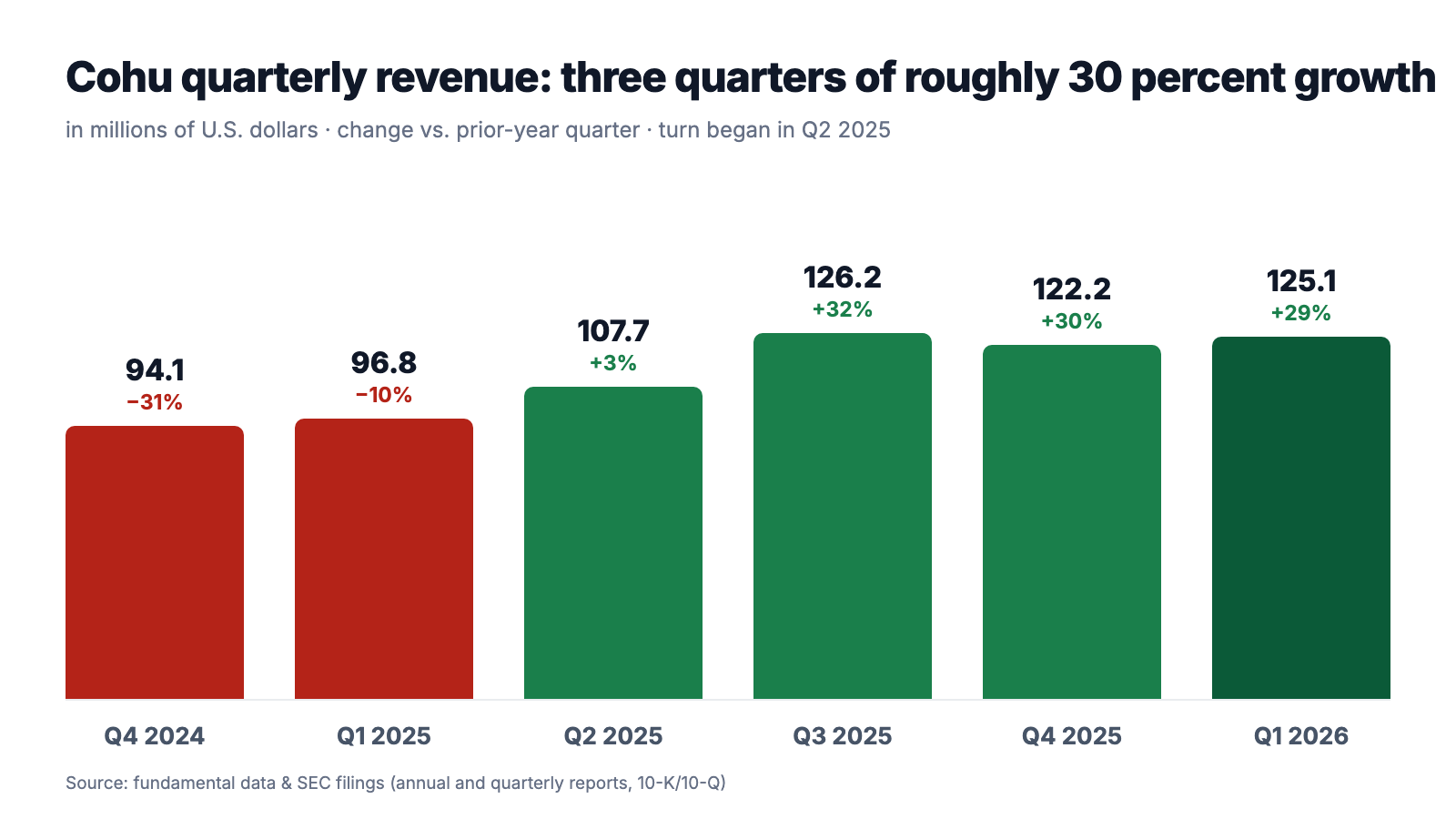
First, what genuinely impresses. Cohu has a complete semiconductor cycle behind it and survived it without damaging the substance: the record year 2021 with $887.2 million of revenue was followed by three down years — $812.8, then $636.3, finally $401.8 million in 2024, a 55 percent drop from the peak that the annual report soberly attributes to weakness in automotive, industrial and mobile demand. In 2025 came the turn: up 12.7 percent to $453.0 million, per the report driven by stronger demand for AI-based computing applications, which more than offset the ongoing slump in automotive and industrial markets. The recovery has found a rhythm: after minus 10 percent in the first quarter of 2025 came plus 3, plus 32, plus 30 — and most recently plus 29.3 percent to $125.1 million in the first quarter of 2026, with gross margin rising from 43.7 to 46.3 percent. Order backlog grew 20 percent to $165.1 million by year-end 2025, operating cash flow reached $31.7 million in 2025 (after a meager $2.8 million in 2024), and the war chest is comfortably filled with $488.7 million in cash and short-term investments (March 28, 2026). Read only these paragraphs and you see a cyclical that has crossed the trough. Now look at the whole mountain:
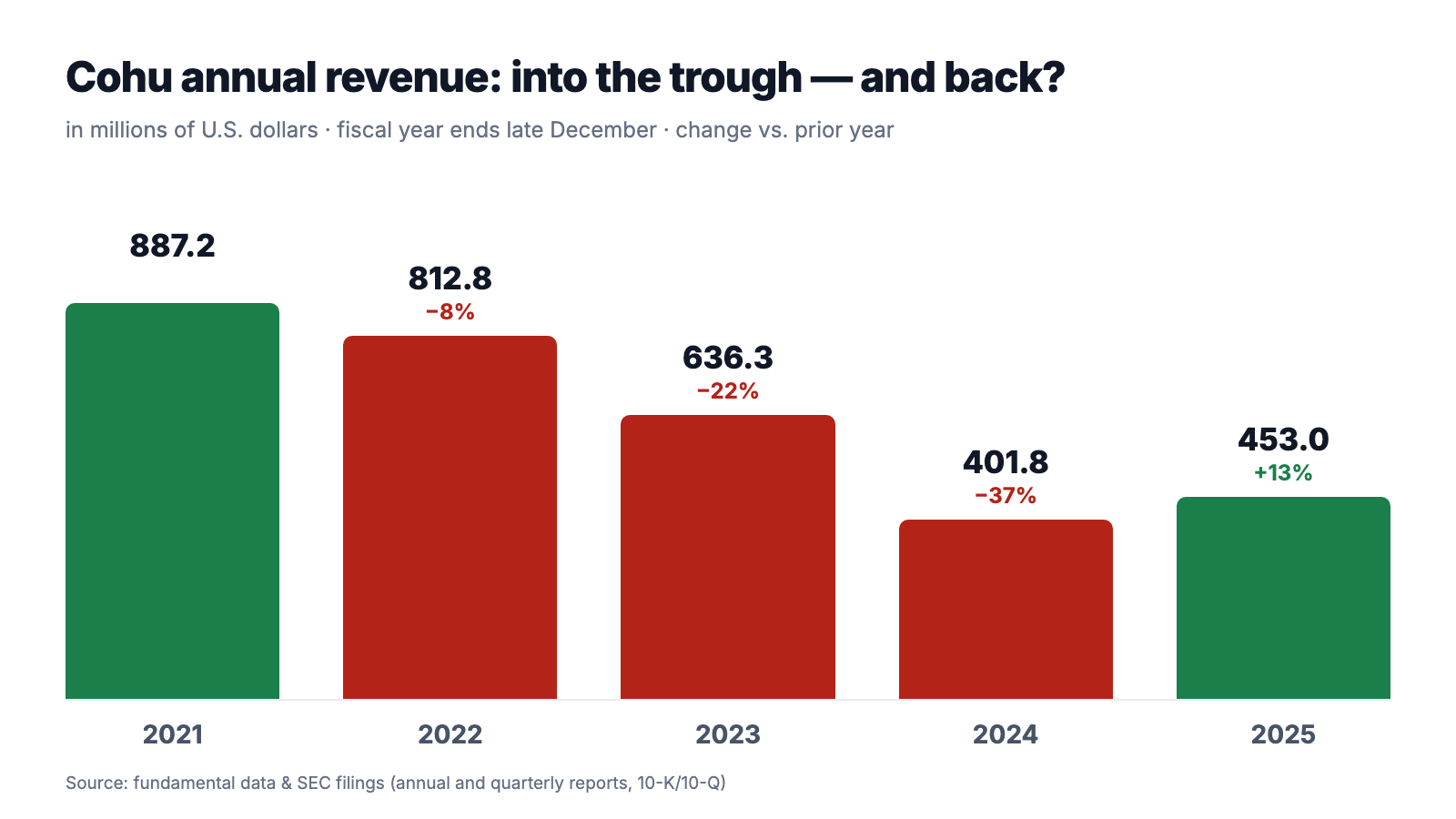
The mountain shows what the chart conceals: the 2025 recovery has covered barely half the way back — $453 million of revenue is a third less than 2022 and roughly half the 2021 record, and the bottom line for 2025 was once again a net loss of $74.3 million. Remember the order of events: first came the share price; the earnings are supposed to follow — not the other way around. Which brings us to the uncomfortable truths.
What the filings say — the uncomfortable truths
Uncomfortable truth no. 1: three straight loss years — even the turnaround year 2025 stayed red
The rally tells a comeback story. The income statement tells it more slowly. After an operating profit of $43.3 million in 2023, Cohu slid into the red in 2024 — and stayed there through the recovery year 2025. The annual report sums it up in a single sentence:
“As a result of the factors set forth above, our net loss was $74.3 million in fiscal 2025 and $69.8 million in fiscal 2024.”
— Cohu, Inc., SEC annual report 10-K for fiscal year 2025, Item 7 “Management’s Discussion and Analysis”

Fairness requires the anatomy of that loss: a large part is non-cash — $37.5 million of amortization on acquired intangibles from earlier deals and $10.1 million of restructuring charges weighed on the result, while operating cash flow was positive at $31.7 million. And the direction is right: in the first quarter of 2026 the net loss shrank from $30.8 million to $12.1 million, and gross margin rose to 46.3 percent. But a smaller loss is not a profit — and a valuation of roughly $3.2 billion (data as of July 17, 2026) eventually wants to be justified out of earnings, not out of their prospect. Meanwhile, the restructuring meant to help is still running: the program of February 2025 — consolidating the sites in La Chaux-de-Fonds, Switzerland, and Kolbermoor, Germany, into lower-cost regions — was expanded on January 13, 2026 with further actions in the U.S. and Asia. An overhaul is no flaw, but it is not a closed chapter either.
Uncomfortable truth no. 2: the cyclicality is a system property — the filing says so itself
Why does a world leader in test equipment lose more than half its revenue in three years? Because its customers buy capital goods: test machines are ordered when chip factories add capacity — and cancelled as soon as utilization tips over. Cohu’s risk section describes its own business with a candor you could frame:
“The semiconductor industry is highly cyclical and unpredictable. Capital equipment providers in the semiconductor industry, such as Cohu, have, in the past, been negatively impacted by both sudden slowdowns in global economies and recurring cyclicality within the markets we serve.”
— Cohu, Inc., SEC annual report 10-K for fiscal year 2025, Item 1A “Risk Factors”
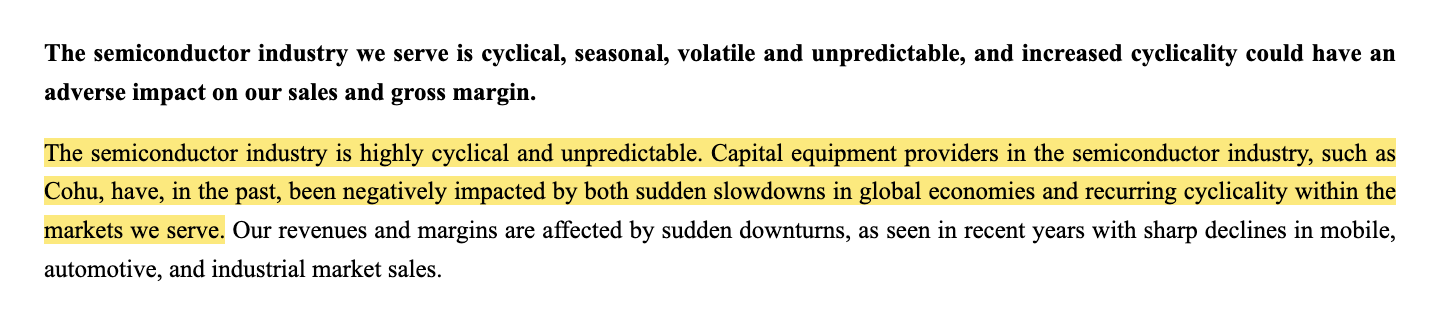
That sentence is not boilerplate; it is Cohu’s biography: minus 55 percent of revenue from 2021 to 2024, the boom before that, the previous downturn before the boom. To be fair — and this belongs to the honest picture — the company has strengthened its lever against its own cyclicality: the recurring revenue share from contactors, spares and services stood at 60 percent in 2025 and cushions the troughs, because consumables are needed even when no new machines are ordered. But be careful with the comfort: the share is this high partly because system sales were on the floor — when machine sales pick up again, the share falls (it was 49 percent in 2023), and with it the old volatility rotates back into the numbers. Whoever buys Cohu buys the cyclicality — in both directions. The current driver is AI: the quarterly report as of March 28, 2026 explicitly attributes the growth to “increased customer activity associated with AI-driven computing applications”, while automotive, industrial and consumer electronics remain weak. For now, the turn stands on one leg — the most sentiment-driven leg of the industry.
Uncomfortable truth no. 3: the convertible — $287.5 million on terms the stock has long overtaken
On September 29, 2025 — the stock stood at $20.51 — Cohu raised fresh capital: a convertible note (a bond whose holder can demand repayment in shares instead of cash) of $287.5 million at a meager 1.50 percent coupon, due January 2031. The price of the mini-coupon sits in the conversion right:
“The initial conversion rate for the Notes is 36.7975 shares of common stock per $1,000 principal amount of Notes (equivalent to an initial conversion price of approximately $27.18 per share of common stock), which represents an approximately 32.5% conversion premium over the last reported sale price of $20.51 per share of our common stock on The Nasdaq Stock Market on September 24, 2025.”
— Cohu, Inc., SEC annual report 10-K for fiscal year 2025, Note 3 “Borrowings and Credit Agreements”
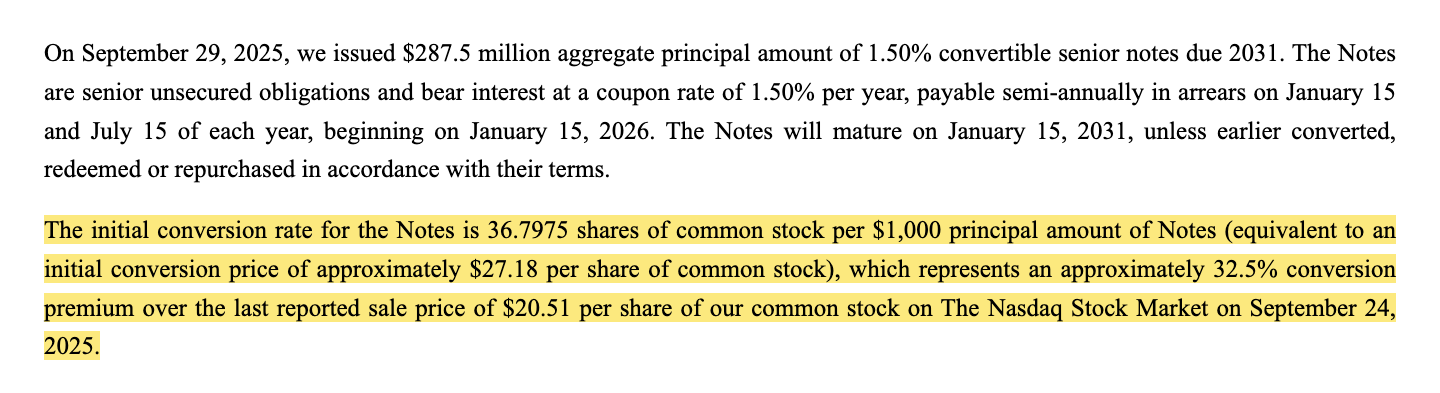
Let’s translate that into investor arithmetic. Dilution means: your slice of the cake shrinks when new slices are cut. The note can convert into up to 10.6 million shares — against roughly 47.2 million shares outstanding (March 28, 2026), that would be more than a fifth more slices. With the stock near $67, that conversion right is deep in the money: the September 2025 buyers sit on an exchange right worth roughly two and a half times the principal. Cohu did buy a counter-insurance for $31.4 million (capped call options that soften the dilution) — but its protection ends, per the filing, at a price of approximately $41.02. Everything above that is unhedged, and the stock trades a good 60 percent above it. To be fair: the note is no accident but cheap money at the right time — a 1.50 percent coupon, no bank covenants, the cash pile grew to $488.7 million, and conversion is regularly possible only at maturity or under defined conditions. But for you as a (prospective) shareholder, the fact stands: more than a fifth of the future slices of cake is already spoken for, at a fixed price of $27.18 — no matter how much higher the stock climbs. Any earnings-per-share math that leaves those slices out is flattering itself.
Uncomfortable truth no. 4: $283 million of goodwill — and one unit with “limited headroom”
Cohu has grown by acquisition — Xcerra, MCT, Equiptest, most recently Tignis. That leaves traces on the balance sheet: $283.0 million of goodwill (the premium over book value of acquired companies that stays on the books as an asset for as long as those businesses meet expectations) — nearly a quarter of total assets. The annual impairment test in October 2025 came back green, but with a remarkably candid qualifier:
“For fiscal 2025, our IS reporting unit had limited headroom, meaning fair value only narrowly exceeded carrying value; as a result, even modest adverse changes in valuation assumptions, operating results, or market conditions could result in a future goodwill impairment charge.”
— Cohu, Inc., SEC annual report 10-K for fiscal year 2025, Item 7 “Critical Accounting Estimates”
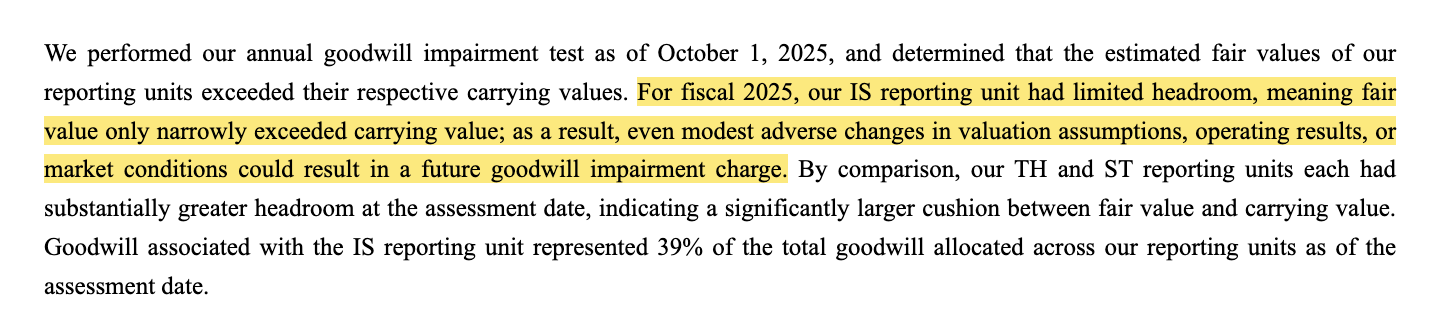
“IS” is the reporting unit around interface solutions — of all things, the contactor business that feeds the stabilizing recurring revenue; per the filing, 39 percent of total goodwill sits in this unit, and parts of IS and ST have additionally been on the restructuring list since January 2026. A goodwill impairment costs no liquidity — the cash pile would be untouched — but it would hit book value (equity stood at $769.0 million on March 28, 2026, with the stock already at about 4 times book) and would be the written admission that part of the acquisition spree has not earned its keep. The filing does not say it will happen. It says that not much is missing.
Valuation: a $3.2 billion market value — what is being paid for is 2027
In mid-July 2026 the Cohu share cost about $67, making for roughly $3.2 billion of market value (data as of July 17, 2026). The classic yardsticks are sobering: no computable price-to-earnings ratio (twelve months of losses), a price-to-sales ratio around 6.6 and about 4 times book — for a cyclical that most recently generated $453 million in revenue, that is a statement. The market’s actual math sits in the estimates: analysts — only a handful of firms cover the stock — expect roughly $0.58 of earnings per share for 2026 and about $1.48 for 2027 (data as of July 17, 2026). If that comes true, today’s price pays 116 times the current and still 46 times the coming year — what is priced in is not the recovery, but its success across at least two more years. And that math is calculated before dilution: add the 10.6 million conversion shares and every future dollar of profit spreads across more than a fifth more slices. Against this stands the balance-sheet quality: $488.7 million in cash and short-term investments versus $285.0 million of note debt — a net cushion of a good $200 million — plus share buybacks of $8.6 million in 2025 (after $27.1 million in 2024; since the note placement, the program has become noticeably quieter). Insiders most recently held about 2.9 percent — and reported two sales and no purchase over the past months (data as of July 17, 2026).
Opportunities and risks at a glance
What speaks for Cohu:
- The turn is measured, not asserted: three straight quarters of roughly 30 percent revenue growth (Q3 2025 through Q1 2026), gross margin up from 43.7 to 46.3 percent, order backlog up 20 percent to $165.1 million (12/27/2025), operating cash flow up tenfold to $31.7 million in 2025.
- Structural tailwind: the annual report explicitly names AI computing as the growth driver; more complex chips (AI accelerators, HBM memory, silicon carbide) need more and more demanding testing — Cohu’s home turf of thermal control, inspection and machine-learning process control.
- The cushion against the cycle is growing: 60 percent recurring revenue in 2025 (contactors, spares, services), plus the Tignis software acquisition (AI process control) as a building block of a higher-margin mix.
- A solid balance sheet despite the losses: $488.7 million in cash and short-term investments against $285.0 million of note debt (03/28/2026), an Altman Z around 8.6, a Piotroski F-score of 6 of 9, fundamental grade B (data as of July 17, 2026).
- First-class technicals: a Stan Weinstein stage-2 trend, relative strength 97, Minervini trend criteria met, 22 scanner hits, roughly 9 percent below the all-time high (data as of July 17, 2026).
What speaks against it:
- Three straight loss years: a net loss of $74.3 million in 2025 and $69.8 million in 2024; Q1 2026 still red at −$12.1 million — the roughly $3.2 billion valuation lives entirely on the future.
- Dilution overhang: $287.5 million of convertible notes with a $27.18 conversion price — up to 10.6 million new shares (more than a fifth of the count) are deep in the money with the stock near $67; the capped-call protection ends at $41.02.
- Cyclicality as a system property: minus 55 percent of revenue from 2021 to 2024 per the company’s own filings; the current recovery hangs one-sidedly on AI computing while automotive, industrial and consumer markets stay weak.
- Balance-sheet caveat: $283.0 million of goodwill, 39 percent of it in the IS unit with “limited headroom” — modest deteriorations could trigger an impairment per the 10-K; parts of IS/ST have been on the restructuring list since January 2026.
- A sporty valuation on a thin analyst base: P/S around 6.6, about 4 times book, 46 times a 2027 estimate carried by only a handful of analysts; most recently two insider sales and no purchase (data as of July 17, 2026).
A human conclusion
Back to the advance-payment trap from the opening. It does not claim the market is wrong — markets that buy cyclicals before the earnings turn are often right, and Cohu’s turn is real: three quarters of roughly 30 percent growth, rising margins, a growing backlog, and a cash pile that easily carries the overhaul. The trap sits elsewhere: it makes you mistake the advance that was paid for work that was delivered. What Cohu has delivered so far is a smaller red number — minus 12 million instead of minus 31 in the latest quarter. What the market has already paid for is the year 2027: 46 times an earnings estimate that still has to be earned, in an industry that calls itself “highly cyclical and unpredictable”, with more than a fifth of the future shares already committed at a fixed price. So the honest question for you is not “is the trend right?” (it is, as of July 17, 2026), but: would you still hold this company if the advance were called back — if an AI budget cycle pauses, the IS unit fails its next goodwill test, and the conversion shares move into the earnings math? If yes, you know your stake. If no, the chart has decided for you — and that is rarely the best division of labor. What you make of it is your decision. And that is exactly as it should be.
Sources
All original documents used in this analysis — for your own reading:
- Cohu, Inc. — SEC annual report 10-K for fiscal year 2025 (ended December 27, 2025; filed February 17, 2026)
- Cohu, Inc. — SEC annual report 10-K for fiscal year 2024 (ended December 28, 2024; filed February 20, 2025)
- Cohu, Inc. — SEC annual report 10-K for fiscal year 2022 (ended December 24, 2022; filed February 17, 2023; revenue history 2021/2022)
- Cohu, Inc. — SEC quarterly report 10-Q as of 03/28/2026 (filed May 1, 2026)
- Cohu, Inc. — SEC quarterly report 10-Q as of 09/27/2025 (filed October 30, 2025; context of the convertible note placement)
- Cohu, Inc.’s complete SEC filing history: EDGAR overview (sec.gov)
- Fundamental data (metrics, quarterly series, valuation, estimates; data as of July 17, 2026), reconciled with the SEC filings.
- Screener and rating data: in-house stock scanner, momentum run of July 17, 2026.
Transparency & disclaimer: This analysis is a journalistic contextualization of publicly available information and is not investment advice, not a financial analysis in the regulatory sense, and not a solicitation to buy or sell securities. Stock investments carry substantial risks up to and including total loss. All information without guarantee; the data cut-off is noted in the text. The author holds no position in Cohu shares at the time of publication.
Our Bottom Line at a Glance
- Operational turn positive
- Three straight quarters of roughly 30 percent revenue growth (Q3 2025 through Q1 2026, most recently $125.1 million), gross margin up from 43.7 to 46.3 percent, order backlog up 20 percent to $165.1 million (12/27/2025), operating cash flow up tenfold to $31.7 million in 2025 — the recovery is documented in the filings, not just in the chart (10-K FY 2025, 10-Q as of 03/28/2026).
- Earnings picture negative
- A third straight loss year: −$74.3 million net in 2025 (2024: −$69.8 million), and Q1 2026 still red at −$12.1 million; a trailing P/E does not exist. The roughly $3.2 billion valuation rests entirely on estimates ($0.58/$1.48 per share for 2026/2027) carried by only a handful of analysts.
- Dilution & capital structure negative
- $287.5 million of convertible notes (1.50%, due 2031) with a $27.18 conversion price — deep in the money with the stock near $67; up to 10.6 million new shares (more than a fifth of the count), capped-call protection only to $41.02. The offset: $488.7 million in cash and short-term investments, a net cushion of a good $200 million (03/28/2026).
- Cyclicality & goodwill neutral
- The 10-K itself calls the industry "highly cyclical and unpredictable" (−55 percent of revenue 2021–2024); the recovery currently hangs one-sidedly on AI computing. $283.0 million of goodwill, 39 percent of it in the IS unit with "limited headroom" — an impairment would not touch liquidity but would hit book value and the acquisition record; 60 percent recurring revenue dampens the swings.
- Technicals & valuation neutral
- A stage-2 trend, relative strength 97, Minervini criteria, 22 scanner hits and roughly 9 percent below the all-time high meet a P/S of 6.6, about 4 times book, and 46 times the 2027 estimate (data as of July 17, 2026) — first-class momentum at a price that presupposes two more good years; most recently two insider sales, no purchase.
Cohu delivers a documented turn — three quarters of roughly 30 percent growth, rising margins, a full order book and a cash pile that carries both overhaul and note. But the market has already paid for that turn several times over: roughly $3.2 billion of market value for a company in its third loss year, at 46 times the 2027 earnings estimate, while a convertible note holds up to 10.6 million additional shares ready at a fixed $27.18 and the IS unit defends its goodwill only narrowly. Whoever invests here buys a well-financed cyclical on advance payment. Not investment advice.
What Our Rating Means
- If you don't own the stock
- As long as the question raised in the bottom line stays open, we see no basis for an entry.
- If you hold it in your portfolio
- Our findings offer no acute reason to sell — the checkpoints named remain decisive.
A journalistic assessment by our editorial team at the time of the deep dive, based on public sources — not investment advice and not a solicitation to buy or sell. Your personal circumstances (investment goals, risk capacity, taxes) cannot be taken into account. What our categories mean, how verdicts are formed, and what conflicts of interest exist →
Worth Noting
- COHU reached the research list via the momentum run of our in-house stock scanner of July 17, 2026 (22 hits, incl. Stan Weinstein stage 2, RS leaders ≥90, Minervini trend criteria); scanner metrics are computed on trailing twelve-month figures.
- Loss and margin figures contain non-cash items ($37.5 million of amortization on acquired intangibles in 2025, $10.1 million of restructuring); operating cash flow was positive at +$31.7 million in 2025. The earnings estimates of $0.58/$1.48 (2026/2027) come from only a handful of analysts.
- Price and valuation figures dated July 17, 2026 (about $67 per share, roughly $3.2 billion market value); analyses are evergreen, daily prices are not a buy argument. Cohu’s fiscal year ends on the last Saturday of December — annual figures nearly match the calendar year.
Frequently Asked Questions
Cohu, Inc. (Nasdaq: COHU) of Poway, California, supplies test and inspection equipment for finished semiconductors: handlers that pick and temperature-condition chips, test systems, contactors and optical inspection, plus analytics software including AI process control (the Tignis acquisition, January 2025). Customers are chipmakers and test subcontractors; 60 percent of 2025 revenue ($453.0 million) was recurring — consumables, spares and services.
The market is playing the turn in the semiconductor test cycle: revenue has been growing again since the second quarter of 2025, most recently three quarters in a row at roughly 30 percent year over year, driven per the quarterly report (10-Q) by AI computing demand. The stock gained about 245 percent in twelve months and meets 22 filters of our in-house stock scanner, including a stage-2 trend and a relative strength of 97 (data as of July 17, 2026). Profits, however, Cohu is not yet writing.
On the bottom line, currently no: 2025 ended with a net loss of $74.3 million (2024: $69.8 million), and the first quarter of 2026 stayed red at −$12.1 million — the main drivers are amortization of acquired intangibles ($37.5 million in 2025) and restructuring charges. Operating cash flow, however, turned clearly positive in 2025 (+$31.7 million), and gross margin rose to 46.3 percent in the first quarter of 2026.
On September 29, 2025, Cohu placed $287.5 million of convertible senior notes at a 1.50 percent coupon, due January 2031. The conversion price is approximately $27.18 per share — with the stock near $67 (data as of July 17, 2026) the conversion right is deep in the money; up to 10.6 million new shares (more than a fifth of the count) could be created. The capped call bought as a hedge protects only up to a price of approximately $41.02.
Very: the company’s own annual report (10-K for 2025) calls the semiconductor industry "highly cyclical and unpredictable". Cohu’s revenue fell from the record $887.2 million (2021) via $812.8 and $636.3 to $401.8 million (2024) — minus 55 percent from the peak — before 2025 brought the turn with plus 12.7 percent to $453.0 million. The 60 percent recurring revenue share (2025) dampens the swings but does not remove them.
Decent, with one caveat: as of March 28, 2026, $488.7 million in cash and short-term investments stood against $285.0 million of note debt; equity was $769.0 million on total assets of $1.24 billion, with an Altman Z-score around 8.6 (data as of July 17, 2026). The caveat: $283.0 million of goodwill, where the IS reporting unit (39 percent of goodwill) has only "limited headroom" per the 10-K — a future impairment is expressly possible.
By classic yardsticks, no: no computable price-to-earnings ratio (twelve months of losses), a price-to-sales ratio around 6.6, about 4 times book value (data as of July 17, 2026). Measured against the estimates — $0.58 of earnings per share for 2026, $1.48 for 2027 — the price near $67 pays 116 and 46 times, respectively; the potential dilution from up to 10.6 million conversion shares is not yet included in that math.
Found an error?
Did you spot a factual error, an outdated number, or a typo in this deep dive? Let us know briefly — your report goes straight to the editorial team.