Arrow Financial Stock: A Quiet Dividend Streak from the Adirondacks — and Its Fine Print
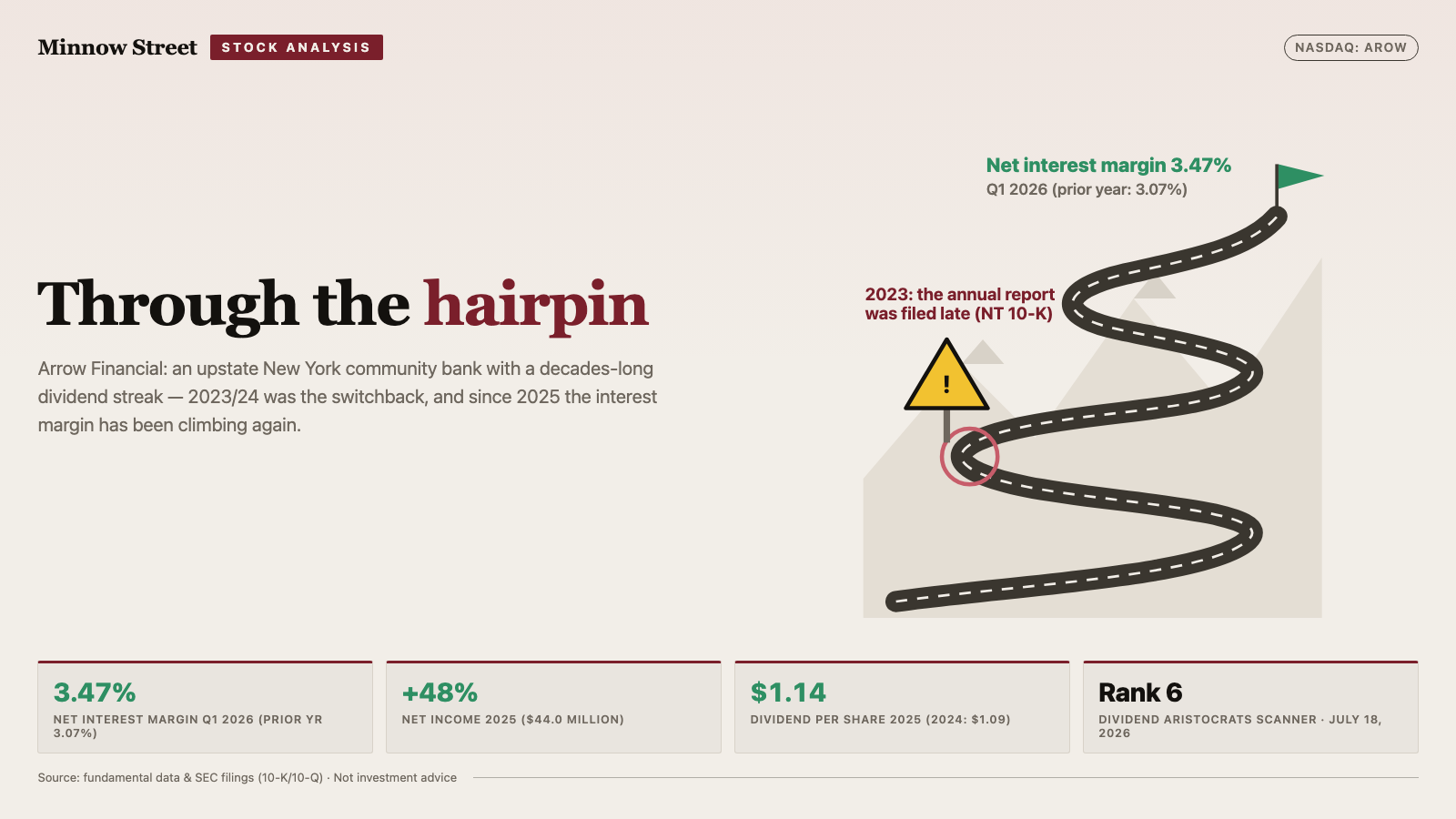
Arrow Financial is a $4.5 billion community bank from Glens Falls in upstate New York — and it sits at rank 6 of our in-house Dividend Aristocrats scanner (U.S. selection, as of July 18, 2026). We read the annual report (10-K), the quarterly report (10-Q) and three years of mandatory filings: a net interest margin climbing back to 3.47 percent after the 2023/24 switchback, a dividend that kept rising straight through an earnings dip — though partly via 3 percent stock dividends —, an annual report that showed up late in 2023, and a freshly closed acquisition. Not investment advice — just a dividend streak read against its own fine print.
 Thomas Mücke
Founder & Publisher
Thomas Mücke
Founder & Publisher
Chart
Interactive price chart (TradingView).
Note: pure fact-based analysis, not investment advice and not a solicitation to buy or sell. All figures without guarantee.
There is an investor trap that catches precisely the careful ones: the label autopilot. It works like this: a stock carries a seal of quality — "Dividend Aristocrat," 25-plus years of rising payouts — and from that moment your brain stops checking the company and only checks the label. Anyone who has delivered that long must be solid. Usually that is even true. But "usually" is not a seat belt. Arrow Financial Corporation (Nasdaq: AROW), a community-bank holding company from Glens Falls in upstate New York, sits at rank 6 of our in-house Dividend Aristocrats scanner (U.S. selection, as of July 18, 2026) — and it is a textbook case for why looking behind the label pays. So let\'s make a deal: together we read what the bank itself filed, under penalty of law, with the U.S. securities regulator, the SEC — the annual report (10-K) for 2025, the quarterly report (10-Q) as of March 31, 2026, and three years of mandatory filings. Inside are three things hardly any aristocrat buyer has on the radar: a dividend streak that was partly extended via stock dividends, an annual report that showed up late in 2023, and a net interest margin that is only now climbing out of its switchback. At the end, you decide whether the label holds.
What Arrow Financial actually does — and what it is not
First, the name mix-up: Arrow Financial (AROW) has nothing to do with the electronics distributor Arrow Electronics (NYSE: ARW) — same first name, entirely different business. Our Arrow is a bank, and deliberately a small one: the holding company from Glens Falls — a town of about 15,000 on the edge of the Adirondack Mountains, some 200 miles north of Manhattan — owns exactly one bank, Arrow Bank National Association. Until the end of 2024 it owned two (Glens Falls National Bank, with roots in the 1850s, and Saratoga National Bank); effective December 31, 2024, both were unified under a single charter. The business model is banking straight from the textbook: gather deposits from households, businesses and municipalities across the region, and lend them back out as real-estate, consumer and commercial loans — as of March 31, 2026, $4.01 billion in deposits stood against $3.44 billion in loans, on $4.52 billion of total assets. On top come a trust and wealth-management business and — surprising for a bank this size — an in-house insurance agency (Upstate Agency, 9 offices) plus its own REIT. The company employs 578 full-time equivalents across 38 branches (December 31, 2025).
The money is made on the spread: a bank pays less interest on deposits than it collects on loans — that difference, measured against average earning assets, is the net interest margin. Picture a greengrocer\'s markup: purchase price deposits, selling price loans. At Arrow, roughly four-fifths of revenue comes from that spread; the rest is fees, fiduciary income and insurance commissions. Which brings us to the central tension of this analysis, and it runs through every chapter: the dividend streak is real and currently well covered — but it hangs on the trading spread of a small bank that does not make the rate environment, it takes it. In 2023/24 exactly that nearly halved earnings; the streak kept running anyway, partly thanks to a mechanism almost nobody knows. For a look at what a genuinely deteriorating loan business reads like, see our deep dive into subprime installment lender World Acceptance — Arrow is a different, far more conservative animal, but the contrast sharpens the eye.
Where the stock shows up in our scanner
Every day we run roughly 3,500 stocks through our scanners. As of July 18, 2026, Arrow sits at rank 6 of the U.S. selection of our Dividend Aristocrats scanner. The entry bar is strict: at least 25 consecutive years of a dividend per share raised EVERY year — computed from the actual payout history as calendar-year totals, adjusted for splits and stock dividends, and supplemented by the curated S&P 500 aristocrats list. Arrow qualifies computationally from its own payment history; the small bank is not in the S&P 500. To replicate it yourself: open the scanner, set the country filter to USA, find the AROW row — or go straight to the Arrow Financial stock page and check the hits section. The fundamental lens of the same scanner assigns a grade of B and a Piotroski F-Score of 9 out of 9 (a nine-point health check of the books\' direction — 9 means every single test improves, which few companies manage); that is the tailwind of the rate turnaround we are about to examine. One caveat belongs here: classic screener metrics like revenue growth or gross margin fit banks about as well as a fever thermometer fits a fish — for a lender, what counts are net interest margin, deposits, credit quality and capital ratios. Those are exactly what we look at next. Remember this up front: a seal of quality is no substitute for a look into the engine room.
The numbers over the years — honestly appraised
First, what genuinely impresses. For decades Arrow was the picture of a boring-good bank: diluted earnings per share of $2.50 (2018), $2.64 (2020), peaking at $3.10 (2021) — with a reliably double-digit return on equity and credit quality most big banks can only envy. Then came the rate shock, and the textbook model showed its Achilles heel: as the Federal Reserve raised rates at record speed from 2022, Arrow had to pay up for deposits quickly, while the loan book — full of long-dated, low-rate real-estate loans — repriced only sluggishly. Interest expense ballooned from $57.7 million to $83.3 million (2024), the net interest margin was squeezed to 2.65 percent (2023), and net income buckled from $48.8 million (2022) to $30.1 million (2023) and $29.7 million (2024) — down 38 percent in two years, with earnings per share of $1.77 in both dip years. That is the switchback on our title image.
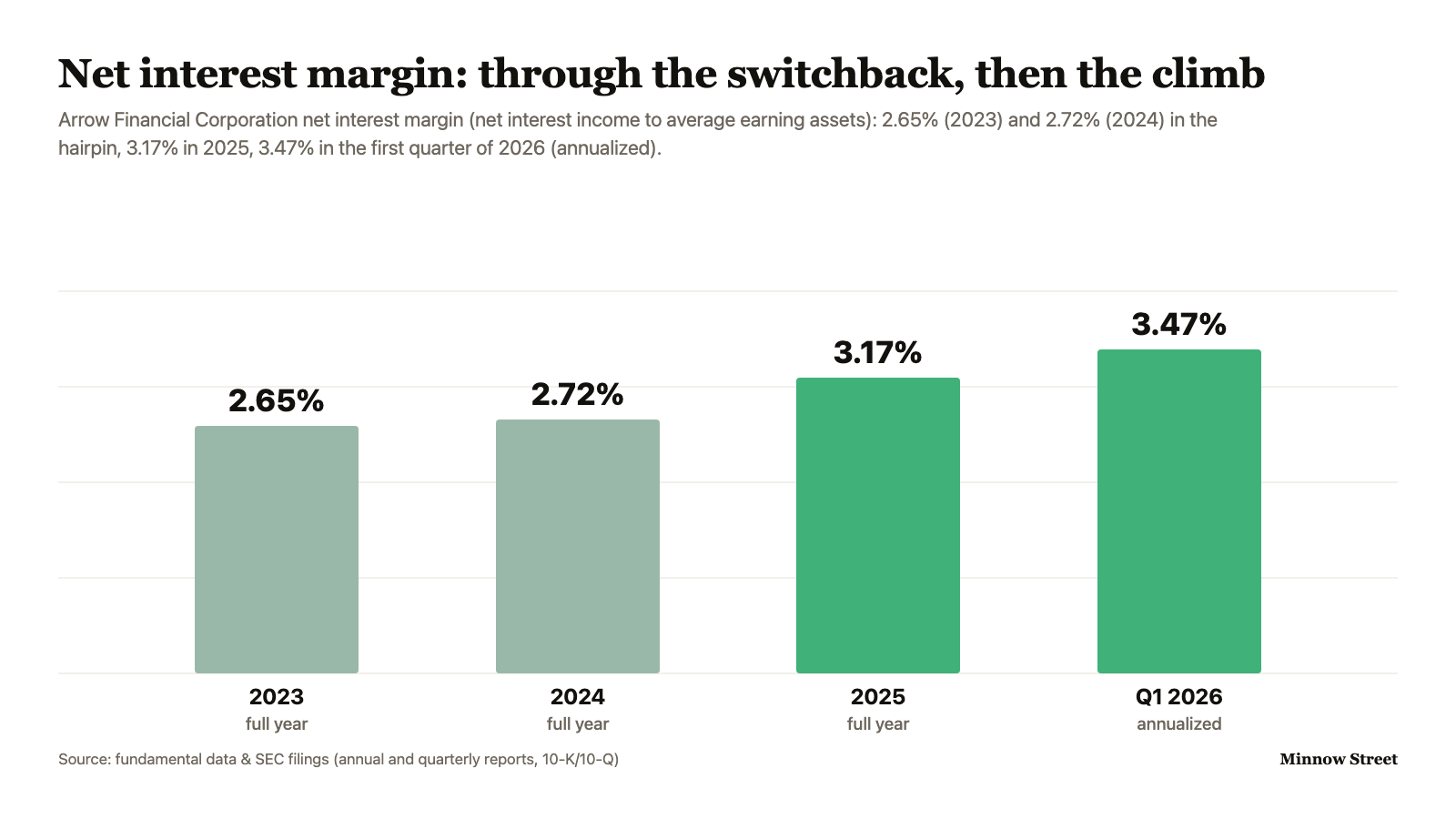
Since 2025 the bank has been climbing again — powered by the balance sheet\'s own mechanics: old low-rate loans mature and are re-lent at today\'s rates, while deposit rates are actively managed down. Net interest income jumped 19 percent to $133.2 million in 2025, the margin to 3.17 percent, net income to $44.0 million (up 48 percent) — earnings per share of $2.65, a 1.00 percent return on average assets, roughly 11 percent return on equity. The first quarter of 2026 kept going, and the quarterly report puts a precise number on it:
"Net interest margin increased 40 basis points in the first quarter of 2026 to 3.47%, from 3.07% during the first quarter of 2025."
— Arrow Financial Corporation, SEC quarterly report 10-Q as of March 31, 2026, Item 2 "Management\'s Discussion and Analysis"
The bottom line for the quarter: $13.5 million of net income — more than double the $6.3 million of the prior-year quarter, which, to be fair, was depressed by a $5.0 million credit-loss provision for a handful of problem loans (Q1 2026: just $0.5 million). That construction site has been cleared too: nonperforming loans — loans whose borrowers no longer pay reliably — fell from $21.1 million (0.62 percent of the loan book, year-end 2024) to $8.5 million, or 0.24 percent, at December 31, 2025. Honesty requires the caveat: part of the comeback is simple normalization after a weak prior year, and a net interest margin remains a bet on the rate landscape. For a bank, the margin is not a product decision — it is weather. Management can trim the sails, but it cannot turn the wind.
And since July 1, 2026, there is a new, self-chosen construction site: on that day Arrow closed the acquisition of Adirondack Bancorp — parent of Adirondack Bank of Utica, with 19 branches, $942 million in assets, $848 million in deposits and $624 million in loans (as of December 31, 2025). The mandatory filing records the closing:
"On July 1, 2026, Arrow Financial Corporation (the “Company”) closed its previously announced acquisition of Adirondack Bancorp, Inc. (“Adirondack”) and its banking subsidiary Adirondack Bank, which was merged with and into Arrow Bank pursuant to the terms of the Agreement and Plan of Merger (the “Agreement”) dated February 25, 2026."
— Arrow Financial Corporation, SEC current report 8-K dated July 1, 2026, Item 2.01
The price: 1.8610 Arrow shares plus $18.72 in cash per Adirondack share; combined assets rise to roughly $5.4 billion, and Adirondack\'s long-time CEO Rocco Arcuri joins Arrow\'s board. The systems conversion follows "later in 2026" — integration work whose costs and friction will surface in the coming quarterly reports.
The dividend streak, X-rayed
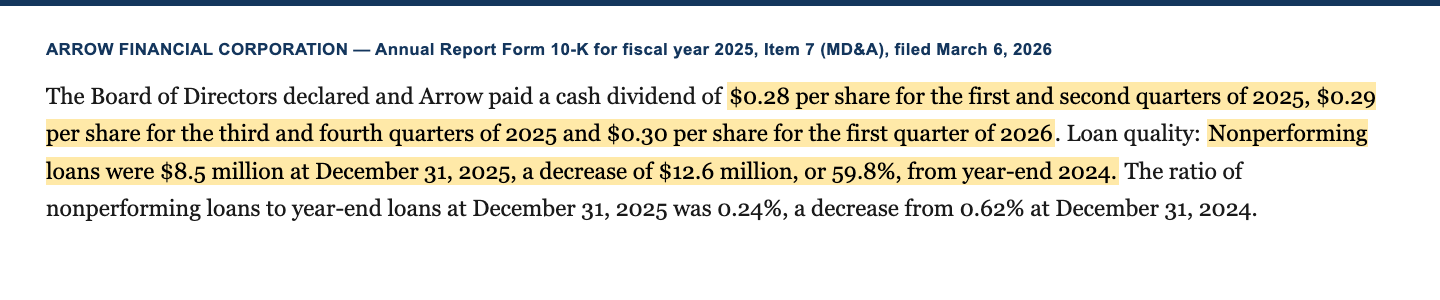
Now to the label itself. The recent history from the annual reports: a cash dividend per share of $1.03 (2022), $1.06 (2023), $1.09 (2024), $1.14 (2025) — and for the current year the board has raised the quarterly rate again:
"The Board of Directors declared and Arrow paid a cash dividend of $0.28 per share for the first and second quarters of 2025, $0.29 per share for the third and fourth quarters of 2025 and $0.30 per share for the first quarter of 2026."
— Arrow Financial Corporation, SEC annual report 10-K for 2025, Item 7 "Management\'s Discussion and Analysis"
How safe is it? The math is short: $18.9 million of cash dividends stood against $44.0 million of 2025 net income — a payout ratio of 43 percent. Even in the dip years 2023/2024, when earnings per share fell to $1.77, the dividend stayed covered at a ratio of roughly 60 percent — tighter, but without eating the substance, while the company simultaneously bought back $10 million of its own stock. The payout\'s plumbing comes with a built-in regulator: the holding company gets its money essentially as dividends from Arrow Bank, and the bank may only distribute what capital rules and supervisors allow — a seat belt that stays invisible in good times.
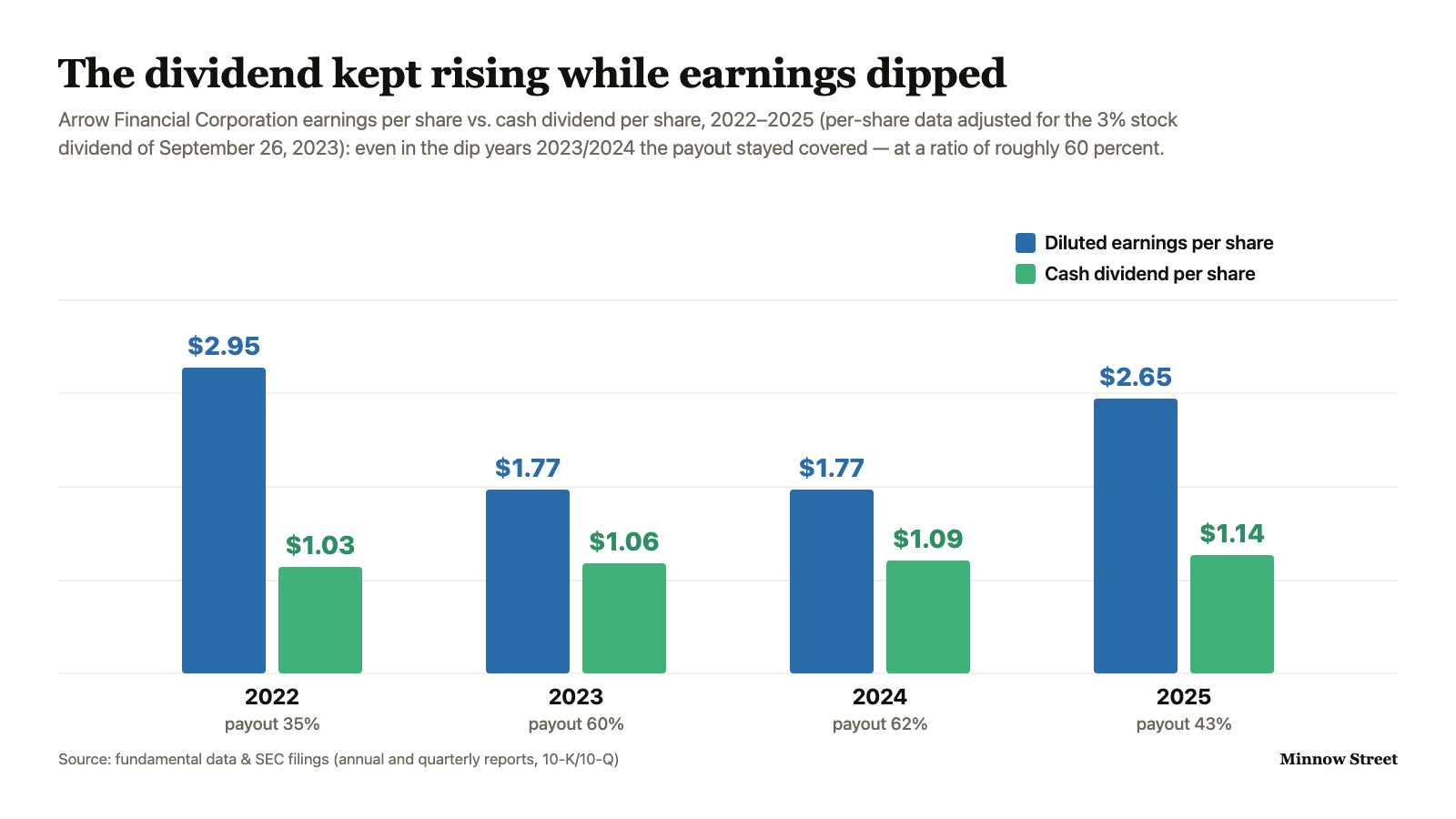
And now the fine print that turns the label into a lesson: Arrow has repeatedly extended its dividend record via stock dividends — most recently 3 percent each in 2022 (623,848 new shares) and 2023 (642,567 new shares). A stock dividend means: instead of cash you receive additional shares — three extra for every 100 held. If the cash rate per share then stays flat, a shareholder still collects about 3 percent more dollars, because they hold more shares; in the adjusted statistics that shows up as a raise. The annual report states it dryly:
"When applicable, share and per share data have been adjusted for the September 26, 2023 3% stock dividend."
— Arrow Financial Corporation, SEC annual report 10-K for 2025, notes (stock-based compensation)

Is that a gimmick? No — the dollars really arrive, and the latest steps ($0.28 → $0.29 → $0.30 in the cash rate) are classic cash raises with no stock dividend involved. But it is fine mechanics you need to know: a streak that in some years grows only via extra shares is softer than one that lifts the cash rate year after year. Remember the sentence: not every dividend raise is carved from the same wood — read what this one is carved from. Notably, Arrow itself claims no specific streak length in its filings; the 25-plus years come from the adjusted payout history our scanner computes.
What the filings say — the uncomfortable truths
Uncomfortable truth no. 1: in 2023 the annual report was late — at a bank, that is an alarm bell
On March 16, 2023, Arrow had to notify the SEC on Form NT 10-K that its annual report for 2022 would not be ready on time — and the reason had substance:
"Arrow Financial Corporation […] is unable to file its Annual Report on Form 10-K for the fiscal year ended December 31, 2022 […] within the time period prescribed without unreasonable effort or expense. The Company requires additional time to complete the assessment of the effectiveness of internal controls over financial reporting as of December 31, 2022."
— Arrow Financial Corporation, SEC notification of late filing NT 10-K (Form 12b-25), March 16, 2023
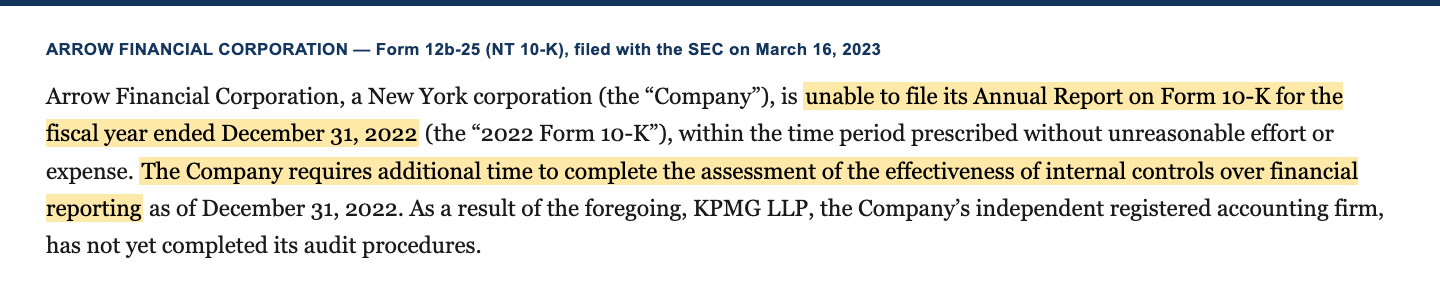
Internal controls are the spine of every bank balance sheet — when their assessment stalls, supervisors and investors sit up. In May 2023 a late-filing notice for the quarterly report (NT 10-Q) followed. Important context: there was no restatement — the notification itself stressed that no material changes versus the pre-announced results were expected, and none materialized. But the episode had a price: a shareholder derivative suit that wound through the filings for 18 months before the court granted final approval of the settlement on January 22, 2026 — per the 10-K "without material financial impact." Arrow\'s auditor today is Crowe LLP; in 2023, the season of the jam, it was KPMG. The meta-lesson for you as a reader: even with a Dividend Aristocrat, a glance at the filing register is part of the job — in 2023 the streak was never in doubt because of the numbers, but because of trust.
Uncomfortable truth no. 2: a fifth of the deposits belongs to municipalities — and nearly a billion sits above the insurance limit
Since the collapse of Silicon Valley Bank in 2023, every bank shareholder knows: deposits are not all alike. Arrow\'s decisive numbers sit in the deposits chapter of the annual report:
"Municipal deposits were $787.1 million and $684.8 million at December 31, 2025 and 2024, respectively. […] Estimated uninsured deposits as reported in the Call Report were $917.6 million at December 31, 2025, which includes intercompany account balances of $57.5 million, and collateralized deposits of $276.1 million."
— Arrow Financial Corporation, SEC annual report 10-K for 2025, Item 7, section "Deposits"
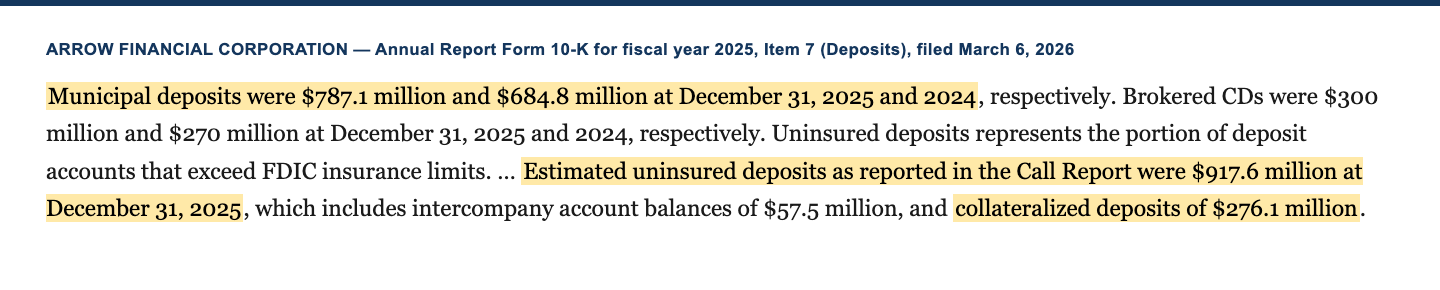
Translated into a picture: nearly a quarter of the $3.94 billion in deposits sits above the FDIC insurance limit — that is the money that runs first when trust wobbles. A fifth belongs to towns, counties and school districts across upstate New York — municipal treasurers are loyal but price-conscious customers with very large balances. Fairness requires the offsets: $276.1 million of the uninsured money is secured with pledged securities (mandatory for municipal deposits in New York), $57.5 million is intercompany, and with $300 million of brokered CDs Arrow buys itself additional stability — at the cost of margin. The risk here is not credit risk but concentration and confidence risk: small on ordinary days, large on the one day it matters.
Uncomfortable truth no. 3: the streak hangs on a margin Arrow does not control — and, from now on, on an integration
The years 2023/2024 demonstrated what happens to this bank when the rate landscape tilts: interest expense rose by roughly $26 million within two years, and because a $4 billion balance sheet full of long-dated real-estate loans reprices only slowly, earnings nearly halved — without anyone making a mistake. The very same mechanics are now running in reverse and producing the pretty quarters you saw above. Anyone buying the stock for the dividend should know both directions. Added to that, since July 1, 2026, is the Adirondack integration: 19 branches, a foreign systems landscape (conversion "later in 2026"), new loan books from the Utica area — plus freshly issued Arrow shares as acquisition currency, which spread earnings per share across more shares before the promised synergies are earned. Community-bank mergers are routine work, but not self-executing; the next quarterly reports will show integration costs, purchase-price allocation and the combined deposit base for the first time. An aristocrat that acquires makes two promises at once: the streak and the synergy.
Valuation: what the market pays for the streak
At mid-year 2026 the market values Arrow at roughly $650 million (data as of mid-July 2026). Against 2025 earnings of $2.65 per share that is a trailing price-to-earnings ratio of about 15 — no bargain for a community bank, but no euphoria price either; the quarterly report shows tangible book value (excluding goodwill) of $25.09 per share (March 31, 2026), so the market pays about 1.6 times hard substance — on which the bank earned an annualized 13.2 percent in the first quarter. The dividend yield stands around 3 percent (quarterly rate $0.30, data as of mid-July 2026). The professionals\' view here is a quiet one: a $650 million bank from Glens Falls commands no analyst orchestra — the B grade and the perfect Piotroski score from our scanner are mechanical verdicts, not opinions. Which also means: fewer eyes on the stock, more responsibility for yours. And a reminder from the evergreen department: analyses age well, daily prices do not — recompute the ratios at your own purchase date.
Opportunities and risks at a glance
What speaks for Arrow Financial:
- A dividend streak of 25-plus years (adjusted payout history, scanner criterion), covered comfortably in 2025 at 43 percent of net income; the quarterly rate was raised three times in a row ($0.28 → $0.29 → $0.30), alongside $10 million of share buybacks (2025).
- The rate turnaround is running: net interest margin 2.65 → 3.17 → 3.47 percent (2023 / 2025 / Q1 2026), net income up 48 percent in 2025 and more than doubled in Q1 2026 — carried by maturing low-rate loans repricing upward and actively lowered deposit rates.
- Credit quality and capital: nonperforming loans at just 0.24 percent of the book (12/31/2025), CET1 ratio 13.01 percent, total risk-based capital 14.76 percent — well above "well capitalized."
- The Adirondack acquisition (closed July 1, 2026) brings $848 million in deposits and the Utica/Mohawk Valley growth area — for a deposit-funded bank the most valuable currency there is.
- Small-scale diversification: trust, insurance and fee businesses (including an in-house insurance agency) cushion revenue against rate swings.
What speaks against it:
- The margin is weather: the same rate mechanics driving earnings in 2025/26 nearly halved them in 2023/24 — another rate turn would again hit the balance sheet with a lag.
- Deposit concentration: $787 million of municipal money (roughly a fifth), an estimated $917.6 million above FDIC insurance (partly collateralized/intercompany) — the most sensitive link in a confidence stress.
- The 2023 history file: a late 10-K and 10-Q over an unfinished internal-control assessment, 18 months of shareholder litigation (settled January 22, 2026, no material impact) — cleaned up, but too fresh to forget.
- Integration risk: Adirondack converts to Arrow\'s systems only "later in 2026"; shares as acquisition currency dilute earnings per share until synergies are earned.
- Part of the dividend history ran via 3 percent stock dividends (most recently 2022/2023) — the streak is softer than the label suggests; on top, a small, thinly followed stock with limited trading volume.
A human conclusion
Back to the label autopilot from the opening. At Arrow it would have failed twice — in both directions: in 2023, when the seal was gleaming while the annual report sat in a jam and the margin in a hairpin; and in 2025, when the prejudice "sleepy small-town bank" would have missed one of the cleanest rate turnarounds around — Piotroski 9 of 9, problem loans nearly gone, the dividend raised three times. The truth of this stock is not in the label but in the engine room: a trading spread the bank does not set, a deposit book full of municipal money, a streak you have to read with its stock-dividend mechanics — and a management that, through all of it, has paid out a little more every year for decades. Whether 3 percent yield plus streak discipline is worth the rate and integration risk of a small bank depends on which of the two stories you consider the headline. What you make of it is your decision. And that is exactly as it should be.
Sources
- Arrow Financial Corporation — SEC annual report 10-K for 2025 (filed March 6, 2026)
- Arrow Financial Corporation — SEC annual report 10-K for 2024 (filed March 14, 2025)
- Arrow Financial Corporation — SEC quarterly report 10-Q as of March 31, 2026 (filed May 8, 2026)
- Arrow Financial Corporation — SEC notification of late filing NT 10-K (Form 12b-25), March 16, 2023
- Arrow Financial Corporation — SEC current report 8-K dated July 1, 2026 (closing of the Adirondack acquisition)
- Arrow Financial Corporation — SEC current report 8-K dated June 11, 2026 (merger approvals)
- Complete SEC filing history of Arrow Financial: EDGAR overview (sec.gov)
- Fundamental data (metrics, quarterly series, valuation; data as of mid-July 2026), reconciled against the SEC filings.
- Screener and rating data: in-house stock scanner, Dividend Aristocrats ranking (U.S. selection) as of July 18, 2026.
Transparency & disclaimer: This analysis is a journalistic contextualization of publicly available information and is not investment advice, not a financial analysis in the regulatory sense and not a solicitation to buy or sell securities. Stock investments carry substantial risks up to and including total loss. All information without guarantee; the data cut-off is noted in the text. The author holds no position in Arrow Financial shares at the time of publication.
Our Bottom Line at a Glance
- Dividend streak & coverage positive
- At least 25 years of annually raised dividends per share (adjusted payout history, scanner criterion); covered in 2025 at a 43 percent payout ratio ($18.9 of $44.0 million), quarterly rate lifted three times in a row to $0.30 (Q1 2026); plus $10 million of buybacks in 2025 (10-K 2025).
- Rate turnaround positive
- Net interest margin 2.65 → 3.17 → 3.47 percent (2023 / 2025 / Q1 2026), net interest income up 19 percent to $133.2 million in 2025, net income up 48 percent to $44.0 million, Q1 2026 more than doubled to $13.5 million — driven by repricing loans and lowered deposit costs (10-K 2025, 10-Q as of 03/31/2026).
- Credit quality & capital positive
- Nonperforming loans at just 0.24 percent of the loan book ($8.5 million, 12/31/2025, after 0.62 percent at year-end 2024), provision normalized to $0.5 million in Q1 2026; CET1 ratio of 13.01 percent and total capital ratio of 14.76 percent well above "well capitalized" thresholds (10-K 2025).
- Deposit structure negative
- Roughly a fifth of deposits are large municipal balances ($787.1 million), an estimated $917.6 million sits above FDIC insurance (of which $276.1 million collateralized, $57.5 million intercompany), plus $300 million of purchased brokered CDs — the balance sheet's most sensitive link in a confidence stress (10-K 2025, "Deposits").
- Governance & history neutral
- In 2023 the 10-K and a 10-Q were filed late because the internal-control assessment was unfinished (NT 10-K of 03/16/2023); the derivative suit ended on 01/22/2026 per the 10-K without material financial impact, and the auditor changed (today Crowe LLP) — cleaned up, but too fresh to tick off.
- Valuation & integration neutral
- A trailing P/E around 15 and roughly 1.6 times tangible book value ($25.09 per share, 03/31/2026) at a dividend yield around 3 percent (data as of mid-July 2026) — fair for the quality shown, but without a margin of safety; the Adirondack acquisition closed 07/01/2026 ($942 million in assets, stock plus cash as consideration) still has to prove integration and synergies (8-K of 07/01/2026).
Arrow Financial is the rare Dividend Aristocrat whose label you only appreciate properly after reading the fine print: the streak is real and was covered at a comfortable 43 percent ratio in 2025, the net interest margin is through its 2023/24 hairpin (3.47 percent in Q1 2026), and loan book and capital are among the most solid a community bank can show. Against that stand a margin that hangs on the rate landscape, a deposit book with a municipal cluster, the memory of the 2023 filing jam and a freshly swallowed acquisition. Whoever invests here buys 3 percent yield plus streak discipline — and carries the rate, concentration and integration risk of a small bank in return. Not investment advice.
What Our Rating Means
- If you don't own the stock
- As long as the question raised in the bottom line stays open, we see no basis for an entry.
- If you hold it in your portfolio
- Our findings offer no acute reason to sell — the checkpoints named remain decisive.
A journalistic assessment by our editorial team at the time of the deep dive, based on public sources — not investment advice and not a solicitation to buy or sell. Your personal circumstances (investment goals, risk capacity, taxes) cannot be taken into account. What our categories mean, how verdicts are formed, and what conflicts of interest exist →
Worth Noting
- AROW made the research list via rank 6 of the in-house Dividend Aristocrats scanner (U.S. selection, as of July 18, 2026); the entry criterion — at least 25 consecutive years of raised calendar-year dividends per share — is computed from the split- and stock-dividend-adjusted payout history.
- Bank specifics: classic screener metrics (revenue growth, gross margin, Altman-Z) do not fit lenders; what matters are net interest margin, deposit structure, credit quality and capital ratios — all figures are taken from the 10-K 2025 and the 10-Q as of 03/31/2026.
- Market-value figure (~$650 million) and valuation ratios from the mid-July 2026 feed; the shares issued on 07/01/2026 for the Adirondack acquisition are not yet included in the per-share figures through Q1 2026. Analyses are evergreen; daily prices are not a buy argument.
Frequently Asked Questions
Arrow Financial Corporation (Nasdaq: AROW) of Glens Falls, New York, is the holding company of Arrow Bank National Association — a community bank with 38 branches and 578 full-time equivalent employees (12/31/2025) serving the region between Albany and the Adirondack Mountains. It gathers deposits ($4.01 billion as of March 31, 2026) and makes real-estate, consumer and commercial loans ($3.44 billion); on top come a trust business and an in-house insurance agency. Since July 1, 2026, Adirondack Bank of Utica is part of the group.
No. Arrow Financial Corporation (Nasdaq: AROW) is a community-bank holding company from Glens Falls, New York, with a market value around $650 million (mid-July 2026). Arrow Electronics (NYSE: ARW) is a global electronics distributor from Colorado with tens of billions in revenue. Beyond the name, nothing connects the two — when comparing metrics, check the ticker symbol carefully.
Our in-house Dividend Aristocrats scanner computes a streak of at least 25 years of annually raised dividends per share from the split- and stock-dividend-adjusted payout history; Arrow itself claims no specific streak length in its SEC filings. The most recent steps: $1.03 / $1.06 / $1.09 / $1.14 per share (2022–2025), and the quarterly rate has been $0.30 since the first quarter of 2026. Important: part of the historical raises came via 3 percent stock dividends (most recently 2022 and 2023).
With a stock dividend, shareholders receive additional shares instead of cash — at Arrow's 3 percent stock dividends, three new shares per 100 held (2022: 623,848 shares; 09/26/2023: 642,567 shares). If the cash rate per share then stays flat, a holder still collects about 3 percent more dollars because they own more shares; adjusted statistics record that as a raise. The latest increases of the quarterly rate ($0.28 to $0.29 to $0.30) are, by contrast, classic cash raises.
Measured against the 2025 numbers: well covered. $18.9 million of cash dividends stood against $44.0 million of net income — a payout ratio of 43 percent. Even in the weak years 2023/2024 (earnings per share of $1.77 each) the ratio stayed near 60 percent. Add a CET1 capital ratio of 13.01 percent and nonperforming loans of just 0.24 percent (12/31/2025). There are no guarantees: the payout is funded by bank dividends that capital rules and supervisors can restrict.
Per the late-filing notification NT 10-K of March 16, 2023, Arrow needed additional time to complete the assessment of the effectiveness of its internal controls over financial reporting; auditor KPMG had not finished its audit procedures either. There was no restatement. The subsequent shareholder derivative suit was settled with final court approval on January 22, 2026 — per the 10-K for 2025 with no material financial impact. Today's auditor is Crowe LLP.
On July 1, 2026, Arrow closed the acquisition of Adirondack Bancorp of Utica: 19 branches, $942 million in assets, $848 million in deposits, $624 million in loans (12/31/2025). The price per Adirondack share was 1.8610 Arrow shares plus $18.72 in cash; combined assets rise to roughly $5.4 billion. The systems conversion follows later in 2026 — integration costs and potential synergies will only show up in the coming quarterly reports.
Found an error?
Did you spot a factual error, an outdated number, or a typo in this deep dive? Let us know briefly — your report goes straight to the editorial team.