Park Dental Stock: A 50-Year-Old Dental Manager That Owns None of Its Practices
Park Dental Partners (Nasdaq: PARK) takes the paperwork off dentists' hands and collects practices along the way — a business running since 1972 that only reached the stock market in December 2025, at $13.00 a share. We read the first annual report (10-K) and the IPO prospectus: $244 million in revenue, but earnings that flipped into a loss in 2025, almost every practice inside a single state, and a company that legally does not own its own dental offices. Not investment advice — just a sober look at a micro cap whose oldest asset is its business and whose youngest is its share price.
 Thomas Mücke
Founder & Publisher
Thomas Mücke
Founder & Publisher
Chart
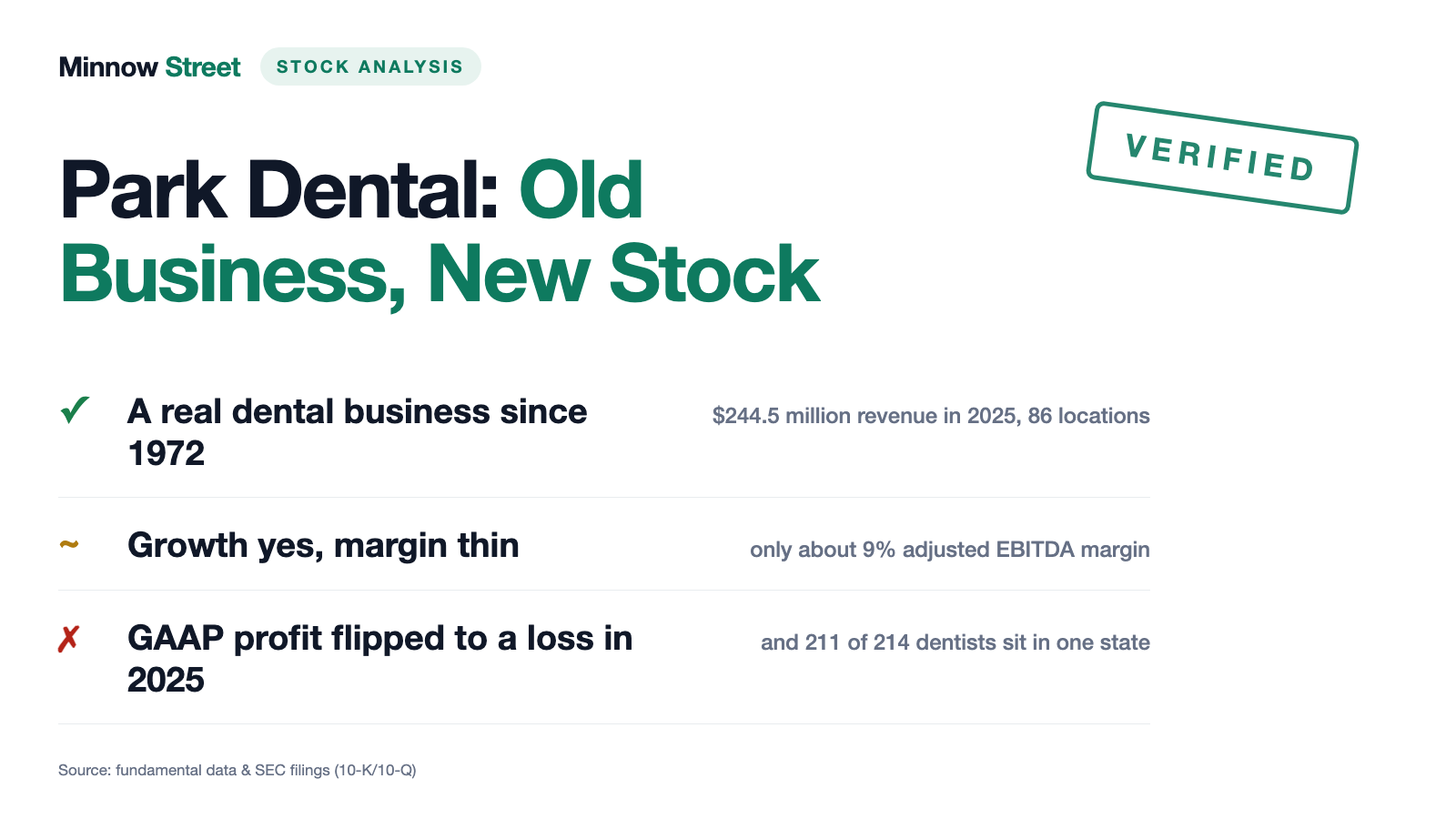
Interactive price chart (TradingView).
Note: pure fact-based analysis, not investment advice and not a solicitation to buy or sell. All figures without guarantee.
There is one thrill investors find hard to resist: the feeling of having found something before everyone else. A tiny newcomer, just listed, barely an analyst covering it, not a word in any forum — and already a voice whispers: "this is your secret, before the crowd catches on." Call that impulse the finder's thrill. It is dangerous because it confuses two very different things: unknown and undervalued. A stock nobody knows is not automatically a treasure — sometimes it is simply small, narrow and unproven. At Park Dental Partners (Nasdaq: PARK) the finder's thrill runs especially high, because so much here sounds solid: a business that has been running for more than 50 years, real revenue, real patients. That is exactly why we make a deal. Before you buy the fresh micro cap because it feels like a secret, let's read together what Park Dental had to file honestly, under penalty of law, with the U.S. securities regulator, the SEC — the first annual report (10-K) and the IPO prospectus. What you make of it at the end is your decision.
What Park Dental actually does
Think of Park Dental as the company that takes the paperwork off dentists' hands — and collects practices along the way. It does not drill or fill anything itself. Instead it delivers to the affiliated practices everything that is not the treatment: human resources, scheduling, billing, marketing, purchasing, IT, premises and equipment. The industry calls that a dental support organization (DSO) or, as Park Dental prefers, a "dental resource organization" — an administration and services company for dental offices. The bargain behind it: the dentist looks after the teeth, Park Dental after everything else, and both share the benefits of scale (cheaper purchasing, joint marketing, shared technology).
The business is anything but new. The first practice group ("Park Dental") was founded back in 1972; today the company supports 86 practice locations with 214 dentists and roughly 990 hygienists, assistants and patient coordinators, serving more than 719,000 patient visits in 2025. It grew on two tracks: through acquisitions (43 practices taken over in the past ten years) and through practices opened from scratch ("de novo", 12 of them). That is the classic pattern of a roll-up — a company that grows by gathering many small operations under one roof. The only new thing is the listing: Park Dental went public on the Nasdaq on December 3/4, 2025 at an offering price of $13.00 per share. An old business, a young stock. Remember that tension — it runs through this entire analysis.
One detail sets Park Dental apart from many competitors, and it is genuinely likeable: unlike most DSOs, which are financed by private equity, a good part of Park Dental belongs to the dentists themselves — they hold the majority of the organization and may appoint three directors to the board. That explains why insiders hold roughly a fifth of the shares. Whether that advantage is worth the price is the next question.
Where the stock shows up in our scanner
Every day we run thousands of stocks through our in-house stock scanner. For PARK the harvest is thin — only four hits (data as of July 9, 2026), and they deserve an honest reading. One is an early trend filter ("Stan Weinstein: stage 2", meaning a beginning uptrend — no surprise, the stock has risen since the IPO). The other three are pure cheapness rankings: the price-to-sales ranking, the price-to-cash-flow ranking and the price-to-free-cash-flow ranking. Translated, all that says is: measured against revenue and cash flow, this stock looks optically cheap.
But careful — cheap is not the same as good value. A company lands on those lists when its market value is small relative to revenue and cash flow. That is exactly the case at Park Dental, and for a reason: the market is already pricing in the thin margin, the narrow geography and the tiny size. Four weak hits, three of them value rankings, are not a seal of quality — they say "statistically cheap", not "good". Here is how to get there yourself: on minnowstreet.com, open the "Scanner" menu, pick one of the filters and look for the PARK row.
The numbers: revenue grows, earnings flip
Let's start with what is solid. Park Dental generates real revenue — and not a little of it: $244.5 million in 2025, up 6.4 percent from $229.8 million the year before. The growth does not come only from acquisitions: revenue per existing practice ("same practice") rose 5.8 percent, and patient retention stood at a respectable 89.9 percent. So far the good half of the story. The other half sits one line further down.
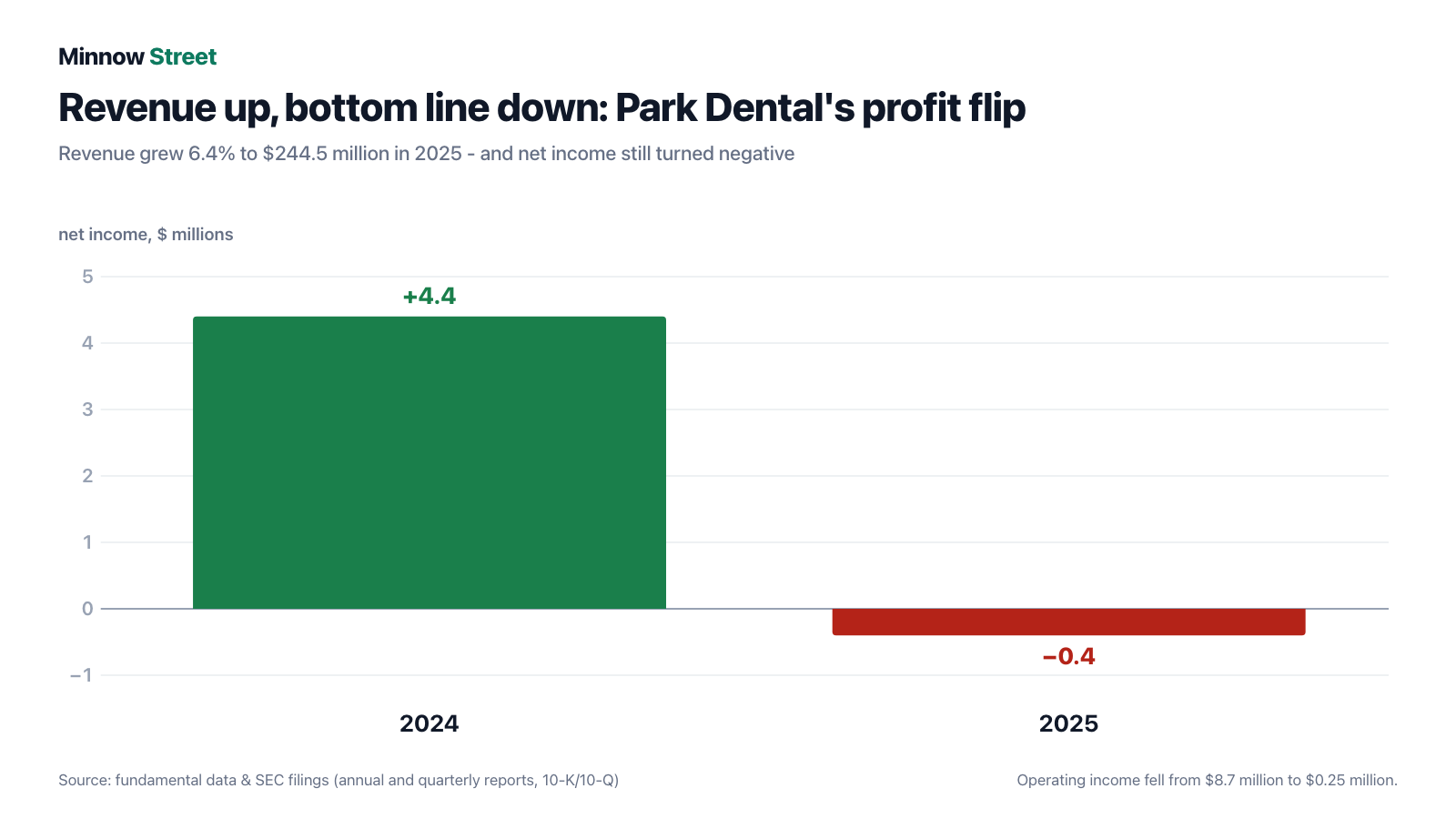
Operating income collapsed in 2025 from $8.7 million to $0.25 million, and the bottom line showed a small net loss of $0.4 million (after a profit of $4.4 million in 2024). That sounds more dramatic than it is — and fairness demands saying so: the lion's share of the drop was one-off cost around the listing, above all $8.8 million of stock compensation (shares that vested for employees and dentists at the IPO) and $2.7 million of restructuring. Strip those items out and the adjusted result ("adjusted EBITDA") actually edged up to $22.0 million. The catch: that puts the adjusted margin at only about 9 percent — thin for a service provider whose biggest cost block is dentists' pay. And the first quarter of 2026 continued in the same direction: another small net loss ($0.4 million), with the adjusted margin sliding to 7.6 percent. Remember the mechanism: a company can grow and still lose earning power when costs rise faster than revenue.
The uncomfortable truths
Uncomfortable truth no. 1: Park Dental does not own its own practices
That sounds absurd, but it is the core of the business — and a genuine legal peculiarity. In practically every U.S. state the corporate practice of dentistry rules apply: an ordinary company may not practice dentistry and may not own a dental office; only licensed dentists may. Park Dental does not dodge that rule, it works with it — through a clever but delicate construction: the practices formally belong to individual dentists, Park Dental supplies only the administration and pulls the practices into its accounts as so-called "variable interest entities" (VIEs). Picture it as a lease by detour: Park Dental steers and books the business without being its official owner. The annual report is unusually candid about it:
“The legality of our business or our relationships with dentists or affiliated dental practices may be challenged in the future and the enforceability of the provisions of any administrative resources agreement could be limited.”
— Park Dental Partners, Inc., SEC annual report 10-K for fiscal year 2025, Item 1 "Business" — Government Regulation
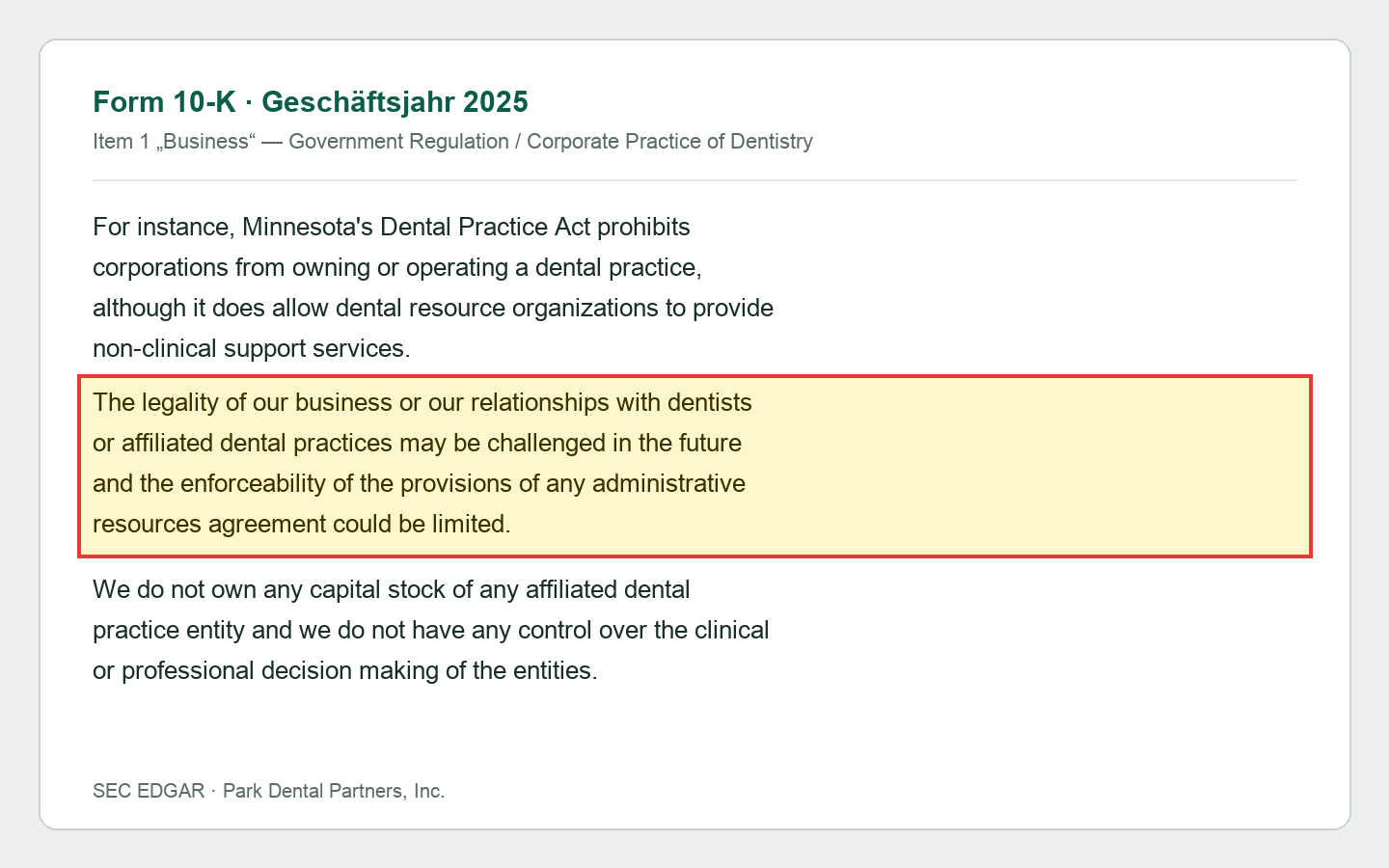
For context, fairly stated: this model is decades old in the industry and explicitly regulated in Minnesota — the state's Dental Practice Act allows "dental resource organizations" to provide non-clinical support. So this is not an acute emergency. But it is a structural risk that carries the entire group: if a state changed its interpretation, or a court took the view that the agreements are unenforceable, it would not be one customer at stake but the whole foundation. For the finder's thrill, that is the first cold shower: what you are buying is not a practice owner, but an administrator on a contract.
Uncomfortable truth no. 2: one state, one man
Customer concentration is like a neighbor who tells you business is booming — and then mentions in passing that nearly all of it hangs on one location and one person. At Park Dental that applies twice over. First, the geography: of 214 dentists, 211 work in Minnesota, most of them in the Minneapolis/St. Paul area. Wisconsin and Arizona are barely more than footnotes so far. A regulatory, economic or competitive shock in one state would therefore hit practically the entire company.
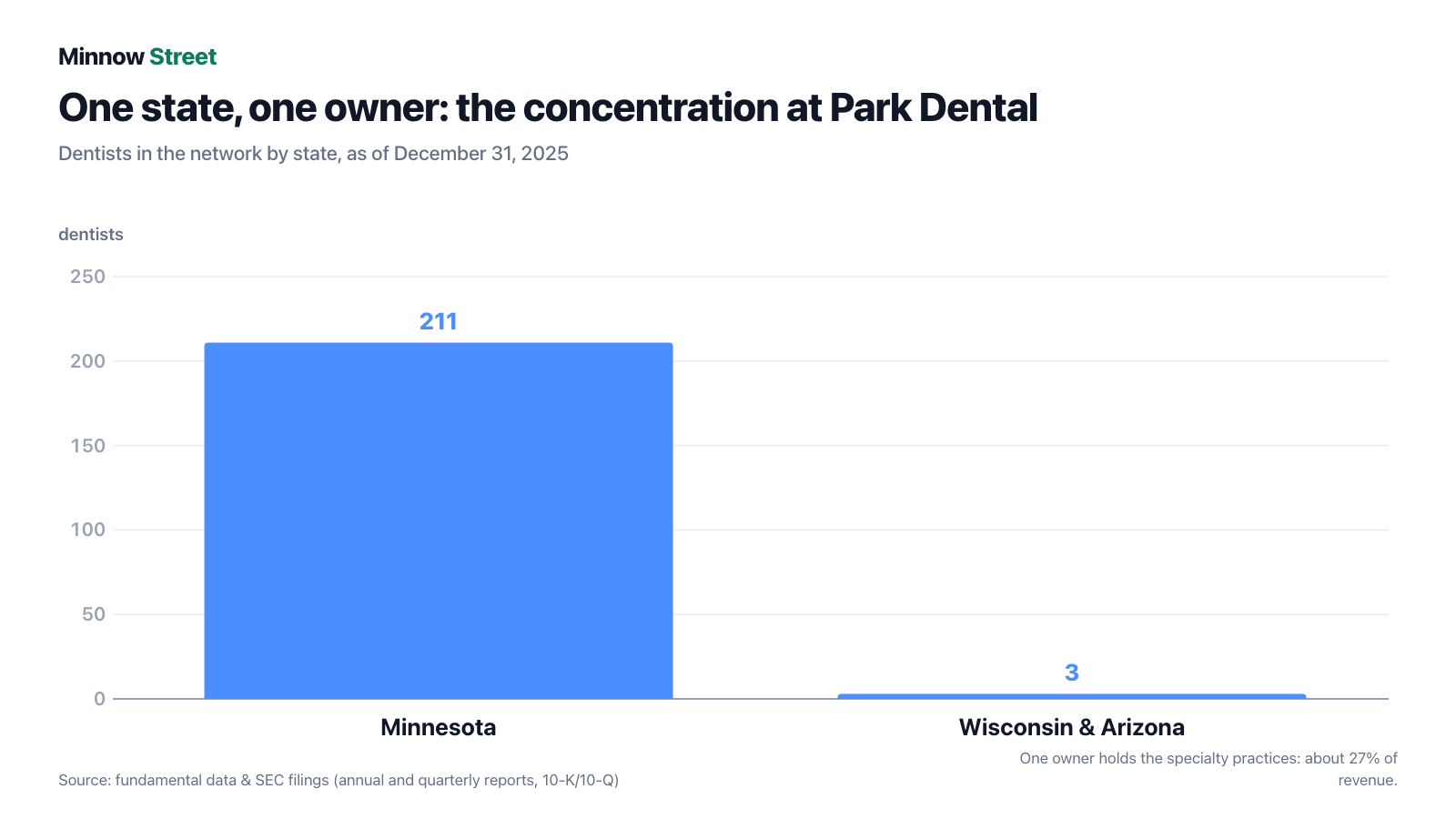
Second, the ownership concentration — and this one is a lesson in itself. Revenue splits into general dentistry (roughly 73 percent) and specialty practices such as oral surgery, orthodontics and endodontics (roughly 27 percent). Yet all of the specialty practices formally belong to one single person: the chief clinical officer for specialty practices, Dr. Alan Law. The report says so plainly:
“…our chief clinical officer, specialty practices, Dr. Alan Law, is the holder of the capital stock of Dental Specialists of Minnesota, PLLC … and Orthodontic Specialists of Minnesota PLLC … which provide dental specialty services at 31 dental practice locations as of December 31, 2025, representing approximately 27% and 26% of our total revenues for the years ended December 31, 2025 and 2024, respectively.”
— Park Dental Partners, Inc., SEC annual report 10-K for fiscal year 2025, Item 1 "Business"
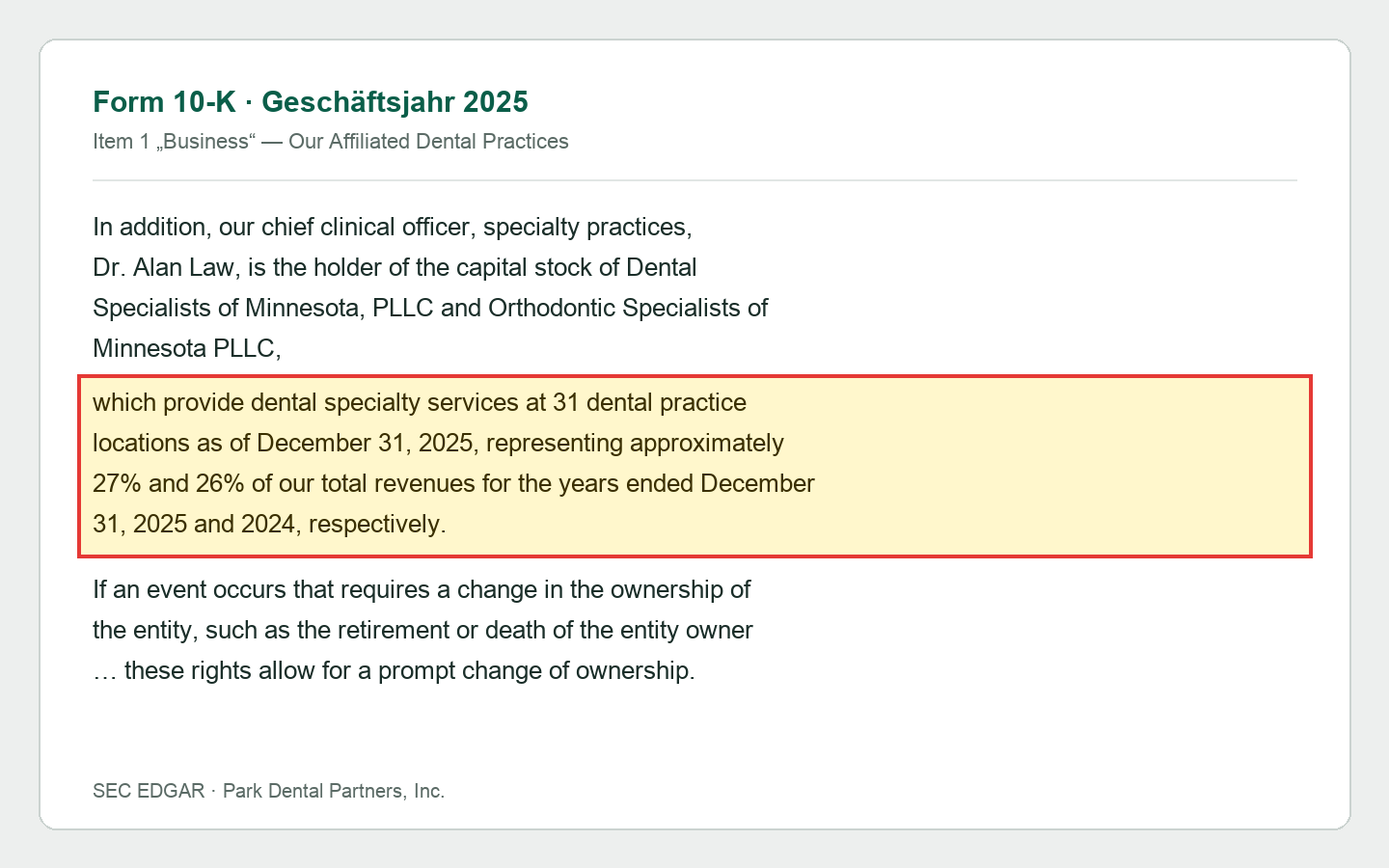
Park Dental has planned for the event: contractually, the company secures the right to install a new owner quickly on retirement, death or departure. Even so, it remains a cluster risk with a face — a good quarter of group revenue hangs on the practices of a single person. How growth, concentration and valuation interlock at a young serial acquirer is something we also saw at the construction spin-off Everus Construction, where a single customer already supplies 17 percent of revenue.
Uncomfortable truth no. 3: the most expensive raw material is the dentists themselves
A service business lives off its skilled people — and they are getting more expensive. Park Dental's largest cost block is by far wages: in 2025, salaries and benefits rose 10.3 percent to $155.2 million, almost twice as fast as revenue (up 6.4 percent). That is the real cause of the thinning margin — and the company names it itself in the risk section:
“Competition for qualified dental professionals and staff has intensified, and we have experienced increased labor costs as market compensation rates have risen.”
— Park Dental Partners, Inc., SEC annual report 10-K for fiscal year 2025, Item 1A "Risk Factors"
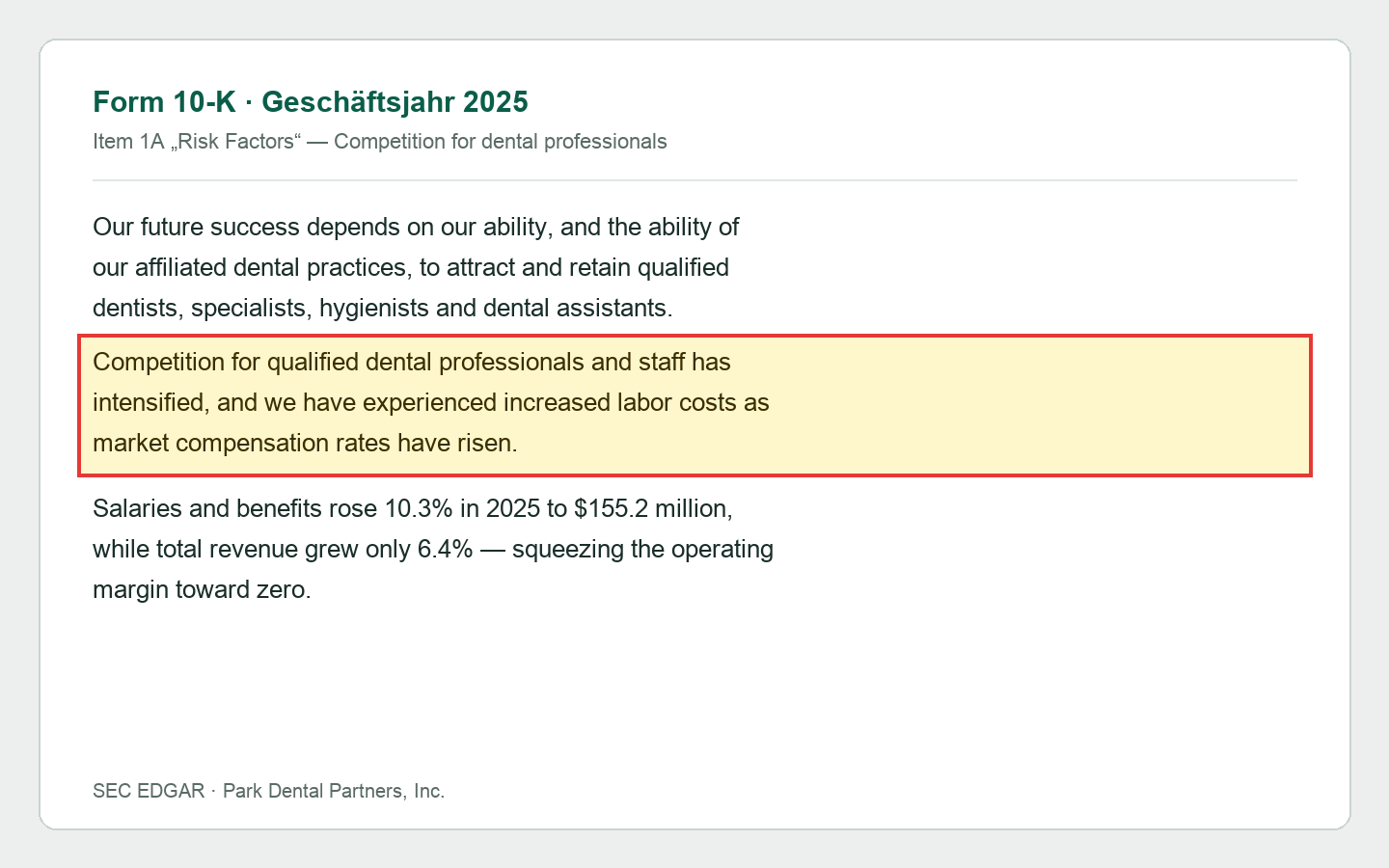
This is the structural flip side of the dentist shortage that supposedly drives the whole DSO industry: because qualified dentists are scarce, Park Dental finds it easier to gather practices — but has to pay ever more to keep them. For a company with an already thin margin, every percentage point of labor cost is felt. Which is why the question is not whether Park Dental grows, but whether more profit is left at the end, or only more revenue.
Valuation — what "statistically cheap" really means here
Now back to the finder's thrill. Optically, Park Dental is a bargain: as of mid-2026 the company is worth only about $90 to $95 million on the market, against $244.5 million of revenue — that puts the price-to-sales ratio at roughly 0.4, with enterprise value around half of one year's revenue. It sounds like a gift, and that is exactly why the stock shows up in our cheapness rankings. But there is a flip side: a low price-to-sales ratio is perfectly normal for a company with a roughly 9 percent margin — little of each revenue dollar sticks. Measured against the adjusted result, the stock is no longer conspicuously cheap.
Two more things should slow you down. First, the stock has already roughly doubled from its $13.00 IPO price by mid-2026 — so a good deal of the optimism is already in the price. Second, professional coverage is extremely thin; the only tangible price target sits in the region of $23, but it comes from a single house — little coverage, little counter-opinion. Remember the mechanism: a low price-to-sales ratio is no substitute for a margin. How brutally that gap can open up in healthcare services is on display at Astrana Health, which quadrupled revenue to $3,181.8 million by 2025 and still kept only $22.5 million of it as net income attributable to shareholders — less than a cent per revenue dollar.
Opportunities and risks at a glance
What speaks for Park Dental:
- A real, 50-year-old business with recurring patients: $244.5 million of revenue (up 6.4 percent), 5.8 percent growth per existing practice, 89.9 percent patient retention, a leading market position in Minnesota.
- A solid, conservatively financed balance sheet: $25.2 million in cash against just $9.8 million of bank debt (net cash), positive operating cash flow of $17.6 million — unlike many debt-financed roll-ups.
- An unusual ownership model: the dentists themselves hold the majority and appoint three directors — that can bind skilled people and align interests.
- Structural tailwind: the U.S. dental market is huge (roughly $189 billion) and highly fragmented; the dentist shortage and practice costs push more offices toward DSO models.
What speaks against it:
- Extreme concentration: 211 of 214 dentists in Minnesota, and a single owner (Dr. Alan Law) holds the specialty practices behind roughly 27 percent of revenue.
- Structural risk: Park Dental does not own its practices; the entire model rests on administrative agreements whose legality, per the annual report, "may be challenged".
- Thin and recently shrinking earning power: a small net loss in both 2025 and the first quarter of 2026, an adjusted margin of only around 9 percent and falling, because wages rise faster than revenue.
- A young stock with pitfalls: less than twelve months of trading history, a tiny free float, a 180-day lock-up for pre-IPO holders that expired in early June 2026 — and a share price that has already doubled from the $13 IPO.
A human conclusion
Remember the finder's thrill from the opening — the impulse to smell a secret in a fresh, unknown micro cap? After the trip through the filings you can answer it more soberly. Park Dental is no castle in the air: a real, old business, a clean balance sheet with net cash, a likeable ownership model and a market that values the company at less than half of one year's revenue. That is one half of the truth, and it is worth more than at many a hot IPO.
The other half is in the fine print: a company that legally does not own its own practices; almost everything in a single state; a quarter of revenue tied to one person; a margin that is thin and got thinner; and a stock market history not yet twelve months old that has nevertheless already doubled. Our company-specific AI rating adds a warning too: we classify Park Dental as "threatened", because the annual report explicitly names artificial intelligence as a competitive risk for the dental business — not as a revenue source of its own. None of these points is a knockout by itself. Together, though, they mean this: too much is still open to call this a proven winner.
What you make of it is your decision. And that is exactly as it should be. What matters is only that you do not buy out of the thrill of the new, but because you know the arithmetic — the solid foundation and the open questions. We see no acute danger at Park Dental, but no basis yet either for treating the fresh micro cap as a sure thing. A few more quarters of proof — on the margin, on the concentration, on executing the roll-up outside Minnesota — would turn an interesting newcomer into an assessable one. Until then: an unknown stock is not a cheap stock. Only an unproven one.
Sources
- Park Dental Partners, Inc. — SEC annual report 10-K, fiscal year 2025 (as of December 31, 2025, filed March 25, 2026)
- Park Dental Partners, Inc. — SEC quarterly report 10-Q (as of March 31, 2026, filed May 14, 2026)
- Park Dental Partners, Inc. — SEC IPO prospectus 424B4 (IPO at $13.00, December 3, 2025)
- Park Dental Partners, Inc. — SEC proxy statement (DEF 14A, April 10, 2026, ownership)
- Fundamental data (metrics, valuation, share and float count, ISIN US7004021009); in-house stock scanner, data as of July 9, 2026.
Disclaimer: This article is a journalistic analysis and not investment advice. It is not a solicitation to buy or sell securities. Share prices fluctuate; a total loss is possible. Make your investment decisions on your own responsibility and seek independent advice when in doubt.
Our Bottom Line at a Glance
- Business model & substance positive
- A real business running since 1972: 86 practice locations, $244.5 million of revenue (up 6.4 percent), 5.8 percent growth per existing practice, 89.9 percent patient retention, a leading market position in Minnesota. A DSO roll-up with genuine, recurring patient business — not a story stock.
- Balance sheet & financing positive
- Conservatively financed: $25.2 million in cash against just $9.8 million of bank debt (net cash), positive operating cash flow of $17.6 million, equity positive again after the IPO. Unlike many debt-financed roll-ups there is no mountain of debt here — the leverage one might expect in this business model is deliberately absent.
- Earning power & margin negative
- GAAP earnings flipped into a small loss in 2025 (minus $0.4 million, after plus $4.4 million), and the first quarter of 2026 was negative too. Many of the costs are one-off IPO items ($8.8 million of stock compensation), yet the adjusted margin is only around 9 percent and has been falling, because wages (up 10.3 percent) rise faster than revenue.
- Concentration & structure negative
- 211 of 214 dentists in Minnesota, and a single owner (Dr. Alan Law) holds the specialty practices behind roughly 27 percent of revenue. On top of that comes the structural risk of the corporate practice of dentistry rules: Park Dental does not own the practices but consolidates them through administrative agreements whose legality, per the annual report, "may be challenged".
- Market maturity & valuation neutral
- Optically cheap (price-to-sales ratio around 0.4), but that reflects the thin margin, not a bargain. The trading history is not yet twelve months old, the free float is tiny, the 180-day lock-up expired in early June 2026, and the stock has already roughly doubled from the $13 IPO. Analyst coverage is extremely thin.
Park Dental Partners is a solid but still unproven newcomer to the stock market: a dental practice management business (DSO) running since 1972, with $244.5 million of revenue, a clean net-cash balance sheet and a likeable, dentist-dominated ownership model — but with a thin and recently falling margin, extreme concentration on a single state and a single owner of the specialty practices, a legal structural risk (the company does not own its practices at all) and a stock that has already doubled from the $13 IPO. Statistically cheap, but not proven. Not investment advice.
What Our Rating Means
Open questions
The business works in principle, but one material question is open. As long as it stays open, our findings do not carry a quality verdict.
The foundation holds (net cash, positive cash flow, genuine patient business), yet too much is still open to speak of a proven winner: a thin and recently shrinking margin, extreme concentration on Minnesota and on a single owner, the structural risk of the administrative agreements, and a trading history of less than twelve months. We see no acute danger, but no solid basis yet for treating the fresh micro cap as a sure thing — the decision is yours.
A journalistic assessment by our editorial team at the time of the deep dive, based on public sources — not investment advice and not a solicitation to buy or sell. Your personal circumstances (investment goals, risk capacity, taxes) cannot be taken into account. What our levels mean, how verdicts are formed, and what conflicts of interest exist →
Worth Noting
- Materiality gate (as of July 10, 2026): the negative findings were quantified and typed. (1) Structural risk from the corporate practice of dentistry rules: in the extreme case it touches 100 percent of consolidated revenue, but it is an industry-standard, decades-old model explicitly regulated in Minnesota — a chronic structural finding, not an acute threat to existence. (2) Concentration: 211 of 214 dentists in Minnesota (virtually the entire operation) plus one owner with 27 percent of revenue — a material structural/cluster finding. (3) Earning power: a GAAP loss in 2025 (minus $0.4 million) and in the first quarter of 2026 (minus $0.4 million), an adjusted EBITDA margin of only about 9 percent and falling — a quality/earnings finding, largely amplified by one-off IPO costs but with genuine margin pressure from wages. No existential finding: the balance sheet is net-cash positive, operating cash flow is positive, debt is low — the debt-financed roll-up one might have suspected is explicitly NOT what this is. Result: no substance finding (no acute danger, solid balance sheet), but given the cluster of structural findings and the missing stock market history, quality is not proven but open, which is the "open questions" rating. The rating says nothing about the entry price — that is what the metric scanners are for.
- Valuation metrics are orders of magnitude as of mid-2026 (market value roughly $90–95 million, price/sales about 0.4, enterprise value/sales about 0.5); annual figures refer to fiscal year 2025 (as of December 31, 2025), quarterly figures to the first quarter of 2026 (as of March 31, 2026). Analyses are evergreen, daily prices are not a buy argument; the reference to the doubling relates to the IPO offering price of $13.00.
- Special situation: the 180-day lock-up for pre-IPO holders expired 180 days after the IPO closing of December 4, 2025 (early June 2026); several insider filings (Form 4) followed in June 2026. Eleven dentist shareholders (176,852 shares) extended their lock-up by 185 days in January 2026 in exchange for short-term promissory notes from the company to cover tax liabilities from IPO vesting. Roughly 698,056 affiliate shares remain subject to Rule 144 restrictions.
- AI rating: "threatened" (assessed July 10, 2026). Item 1A of the 10-K carries a dedicated risk factor stating that the growing spread of artificial intelligence in the dental market creates competitive pressure and regulatory uncertainty; competitors are integrating AI, the FDA is clearing more AI dental devices, and a failure to adopt could leave Park Dental behind. AI is not a revenue source for the company. Supporting quotes are in the AI dossier.
Stock Watch
This analysis is as of July 27, 2026. Stock Watch will tell you what's changed at PARK since then.
Later $1 a month per stock — signing up is free, and you'll be the first to know when it launches.
Frequently Asked Questions
Park Dental Partners (Nasdaq: PARK) is a dental — or resource — support organization (DSO) based in Roseville, Minnesota. It does not treat patients itself; it takes the administration off dental practices' hands — staffing, scheduling, billing, marketing, purchasing, IT, premises and equipment — and grows by acquiring practices and opening new ones. It supports 86 locations with 214 dentists; the business has been running since 1972, the stock has been listed since December 2025.
Park Dental listed on the Nasdaq on December 3/4, 2025 — at an offering price of $13.00 per share, with 1,535,000 new shares and net proceeds of roughly $18.1 million. The operating business is more than 50 years old, but the trading history is not yet twelve months long — an old business with a young stock.
Revenue rose 6.4 percent in 2025 to $244.5 million, yet the bottom line showed a small net loss of $0.4 million (2024: a profit of $4.4 million). The main reason was one-off cost around the listing, above all $8.8 million of stock compensation and $2.7 million of restructuring. Adjusted, the result (adjusted EBITDA) came to $22.0 million — but at roughly 9 percent the margin is thin and has been falling.
It is high. Of 214 dentists, 211 work in Minnesota, most of them in the Minneapolis/St. Paul area — a shock in one single state would hit almost the entire company. On top of that, a single person, chief clinical officer Dr. Alan Law, owns the specialty practices that account for roughly 27 percent of group revenue.
No. Under the U.S. corporate practice of dentistry rules, only licensed dentists may own practices. Park Dental therefore supplies only the administration and pulls the practices into its accounts through long-term agreements (as variable interest entities, VIEs). The company itself writes that the legality and enforceability of these agreements may be challenged in the future — a structural risk that carries the entire group.
Optically, yes: with a market value of roughly $90 to $95 million against $244.5 million of revenue, the price-to-sales ratio sits at about 0.4 (as of mid-2026). But that is normal at a margin of around 9 percent — measured against earnings, the stock is no longer conspicuously cheap. It has also roughly doubled from the $13 IPO price, and analyst coverage is extremely thin.
Our company-specific AI rating reads "threatened". The annual report (10-K) explicitly names artificial intelligence as a competitive risk for the dental business: competitors are integrating AI into their offerings, the FDA is clearing more and more AI-supported dental devices, and a failure to adopt could, per the report, leave Park Dental behind. AI is not a revenue source of its own at Park Dental.
Found an error?
Did you spot a factual error, an outdated number, or a typo in this deep dive? Let us know briefly — your report goes straight to the editorial team.