Everus Stock: What the Data-Center Winner Costs After the Rally
Everus Construction (NYSE: ECG), the spin-off of MDU Resources, wires data centers and builds the grids that feed them: 2025 revenue up 31 percent to $3.75 billion, 19 hits in our in-house stock scanner, price near record. We read the annual report (10-K) and the latest quarterly report (10-Q): a single customer already supplies 17 percent of revenue, half the revenue hangs on fixed-price contracts, and the company has been independent for less than two years. Not investment advice — just the honest question of what a chart winner may still cost after the rally.
 Thomas Mücke
Founder & Publisher
Thomas Mücke
Founder & Publisher
Chart
Interactive price chart (TradingView).
Note: pure fact-based analysis, not investment advice and not a solicitation to buy or sell. All figures without guarantee.
There is a feeling that costs more at the stock market than any crash: the fear of missing the train that is already rolling. You see a stock near its record high, one green check mark after another in the scanner — and a quiet voice whispers: "Everyone is making money here right now, only you are still standing on the platform." Psychologists call it FOMO, the "fear of missing out". It is strongest after a rally — and most dangerous then, because it skips exactly one question: is the quality that drove the price still worth the price it now costs? At Everus Construction Group (NYSE: ECG) the temptation is especially strong, because much here is genuinely right: a profitable company at the heart of the data-center boom, 19 hits in the scanner, price near record. Which is exactly why we make a deal: we do not buy out of FOMO — we first read what Everus must honestly file, under penalty of law, with the U.S. securities regulator, the SEC: the annual report (10-K) and the latest quarterly report (10-Q). What they describe is a strong company. And a few shadows that never show up in the chart. Remember this tension — it is the thread of this whole analysis. In the end, you decide.
What Everus actually does
Think of Everus as the company that wires the data center — and builds the lines that bring the power there. It does not build the servers and not the power plant, but everything in between: the electrical and mechanical innards of large buildings, and the electric, gas and communications networks in the ground and on the poles. Until October 2024 this was a division of the utility MDU Resources called "MDU Construction Services Group"; since the tax-free spin-off it has operated as the independent, publicly listed Everus Construction Group, headquartered in Bismarck, North Dakota. The business splits into two segments:
- Electrical & Mechanical (E&M) — roughly four-fifths of revenue: electrical and communications wiring, fire protection, mechanical and piping work. The growth engine sits here, in the data-center submarket.
- Transmission & Distribution (T&D) — construction and maintenance of overhead and underground electric, gas and communications infrastructure for utilities, plus traffic signalization.
How closely the largest segment leans on the data-center theme is something the annual report says itself:
"Our work within the commercial end market leverages our deep expertise within the data center submarket, as well as hospitality and entertainment projects, in addition to more standard commercial projects."
— Everus Construction Group, Inc., SEC annual report 10-K for fiscal year 2025, Item 1 "Business"
Sounds like a marketing story riding the AI megatrend? In part it is. But unlike many "story stocks", there is real, profitable construction work behind it — with an order book you can actually check. So that is what we do next.
Where the stock shows up in our scanner
Every day we run about 3,500 stocks through our scanners. Everus fires in 19 filters (data as of July 9, 2026) — an unusually dense confluence of strength. Among them are the demanding ones: "Best of All", "Near 52-Week High", "RS Leader (≥90)", plus the trend filters of Stan Weinstein, Mark Minervini and Oliver Kell. When many independent filters fire at once, that is no coincidence but a genuine momentum signal. You can replicate it yourself: on minnowstreet.com, open any filter in the "Scanner" menu and look for the ECG row.
One row deserves a second look: "insiders buying (net)". Insider purchases are considered a strong signal — whoever knows the company best is betting their own money. But look closely here. Behind the check mark sits a single open-market purchase: director Helena Hernandez — formerly a smart-grid manager at the utility Florida Power & Light — bought, per an insider filing (Form 4), exactly 250 shares at $92.18 apiece on December 8, 2025, about $23,000 in total. Net one purchase, zero sales — formally positive. But it is a small, symbolic order by one director, not a broad commitment by management. And the bigger picture matches: officers and directors together hold less than 1 percent of the shares; the say on the capital side belongs to institutional investors at roughly 87 percent. Remember: a check mark in a scanner is a starting point for research, not a substitute for it.
The numbers over the years
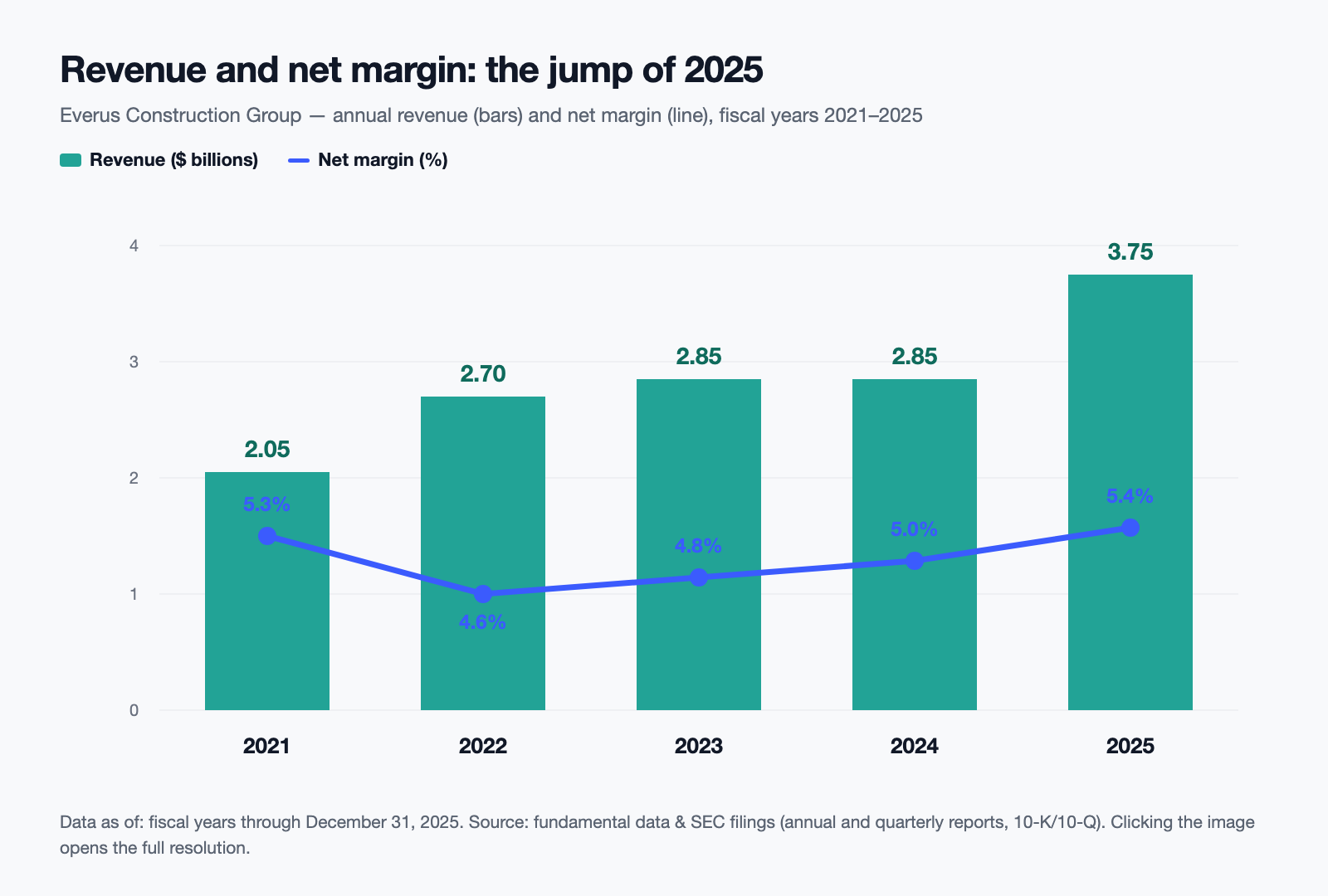
And now what genuinely impresses — honestly appraised. Everus is not growing on one boom year but across the whole series: revenue climbed from $2.05 billion (2021) to $3.75 billion (2025), 31 percent in 2025 alone. The net margin is stable and gently rising for a construction services firm — not a spectacular figure, but a reliable one around 5 percent.
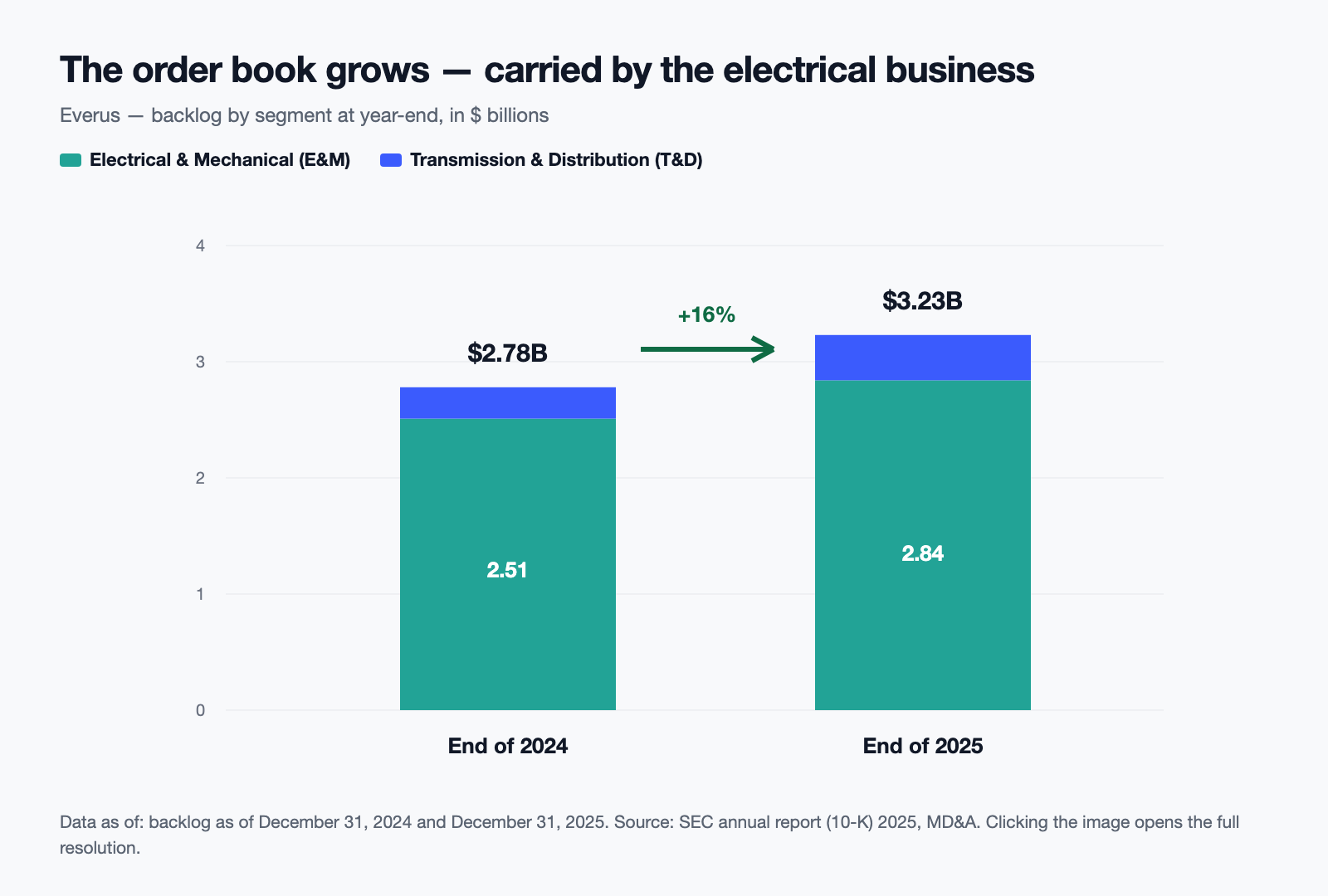
The second piece of evidence for the substance is the order book (in industry jargon, the "backlog") — the sum of contracts already awarded but not yet worked off. Picture a craftsman's fully booked calendar: the fuller it is, the more predictable the coming months. Everus' backlog grew to $3.23 billion by year-end 2025 — up 16 percent from the prior year, with almost the entire increase coming from the electrical segment with its data centers.
A full order book at a stable margin and roughly 39 percent return on equity — that is the good half of the story. Now for the other one.
The uncomfortable truths
Uncomfortable truth no. 1: One customer, 17 percent — the data-center boom is also a concentration risk
Customer concentration is like a neighbor telling you his business is booming — and then mentioning in passing that a single client provides a sixth of his revenue. You swallow for a second. That is exactly what happened at Everus in 2025: one single customer accounted for roughly 17 percent of total revenue, the ten largest customers for 43 percent. The remarkable part: a year earlier, in 2024, not a single customer had crossed the 10-percent mark. So the data-center boom brings not only growth but dependence — and Everus names it in its own risk factors:
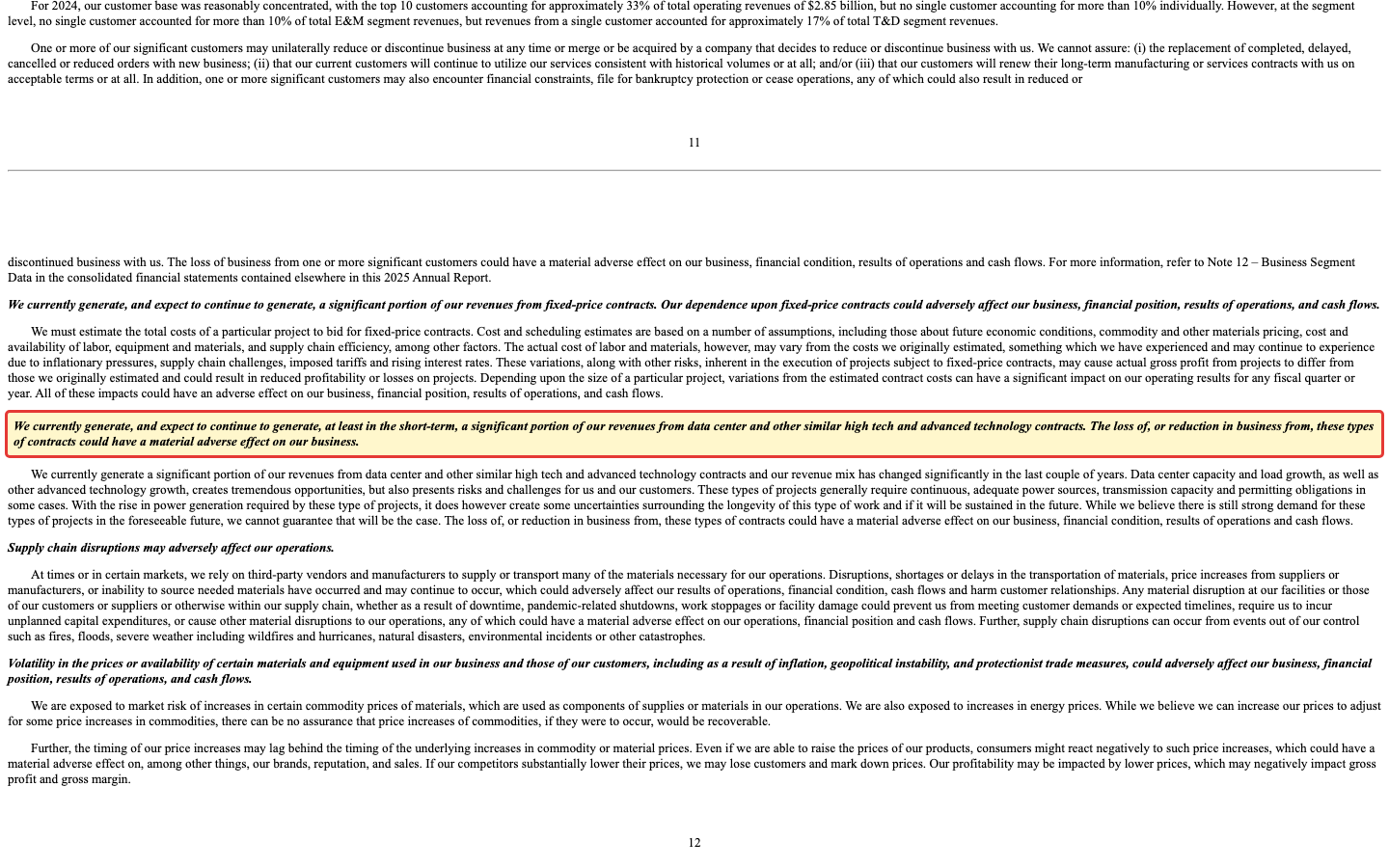
"We currently generate, and expect to continue to generate, at least in the short-term, a significant portion of our revenues from data center and other similar high tech and advanced technology contracts. The loss of, or reduction in business from, these types of contracts could have a material adverse effect on our business."
— Everus Construction Group, Inc., SEC annual report 10-K for fiscal year 2025, Item 1A "Risk Factors"
For context, and to be fair: the customers behind the big data centers are mostly deep-pocketed technology giants (the "hyperscalers") with excellent credit — a payment default is unlikely. The real risk is not a customer going broke but the investment cycle: if the data-center build-out ever slows, it hits Everus exactly where its growth sits today.
Uncomfortable truth no. 2: Half the revenue hangs on fixed-price contracts
A fixed-price contract is a bet on your own estimating: Everus names a price for a finished project up front — and itself carries the risk if materials, labor or delays end up costlier than planned. In 2025, roughly 52 percent of revenue ran through such fixed-price contracts. On the larger, more complex projects — precisely the data centers — this contract type is the most common. The annual report is unusually candid about it:
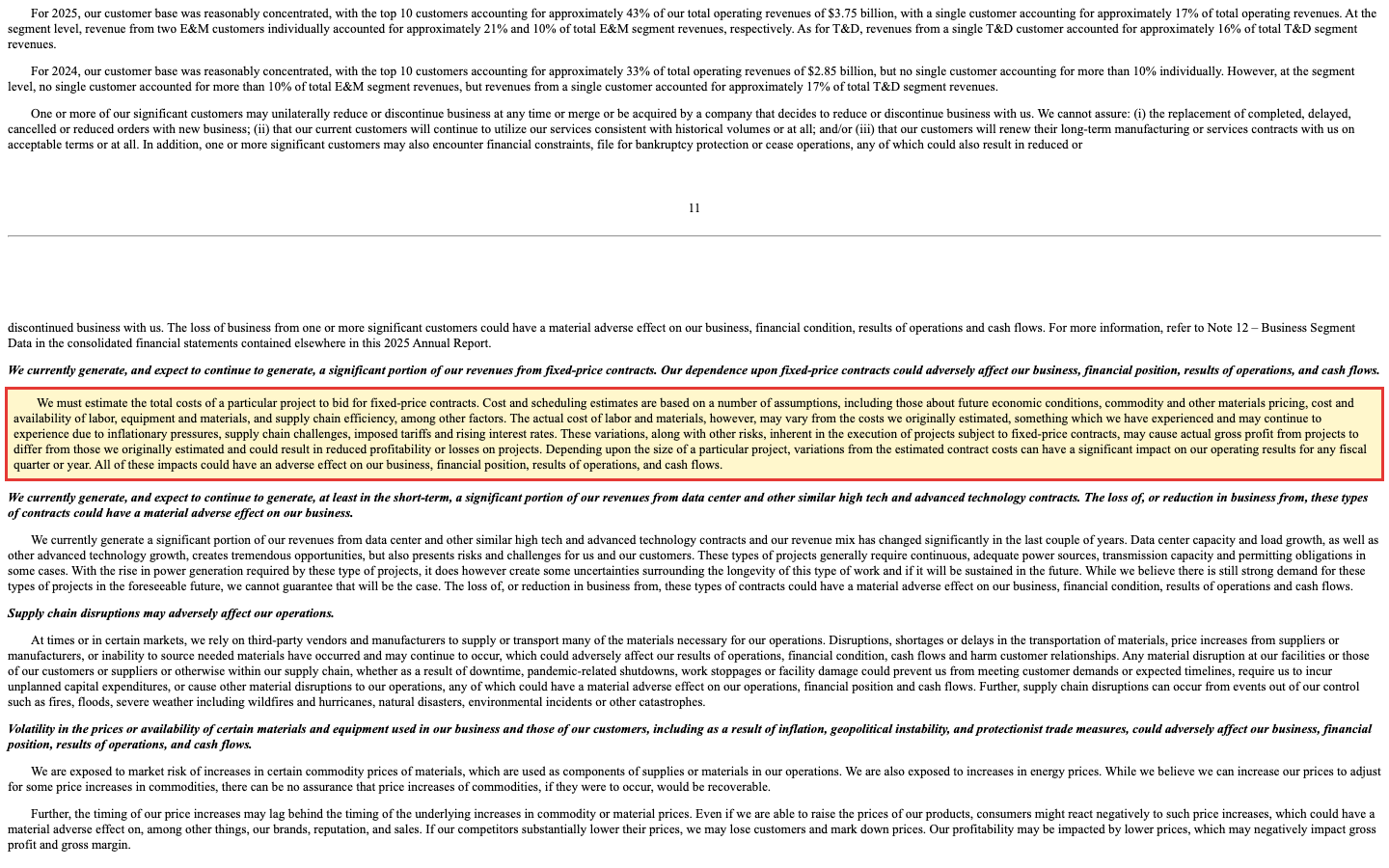
"We must estimate the total costs of a particular project to bid for fixed-price contracts. […] The actual cost of labor and materials, however, may vary from the costs we originally estimated, something which we have experienced and may continue to experience due to inflationary pressures, supply chain challenges, imposed tariffs and rising interest rates."
— Everus Construction Group, Inc., SEC annual report 10-K for fiscal year 2025, Item 1A "Risk Factors"
To be fair: Everus accounts for its projects mostly under the percentage-of-completion method and has held its margin — the estimating risk is evidently well managed. But it is real, and it sits exactly in the large contracts that fuel the share price. A single badly underestimated megaproject can ruin a quarter.
Uncomfortable truth no. 3: Barely two years on its own — and carrying debt from the separation
Everus looks more seasoned than it is. As an independent stock, the company has existed only since October 28, 2024 — the entire trading history is not yet two years old, and the impressive chart formed almost entirely after the separation. The company itself says how little experience the market has with this stock:
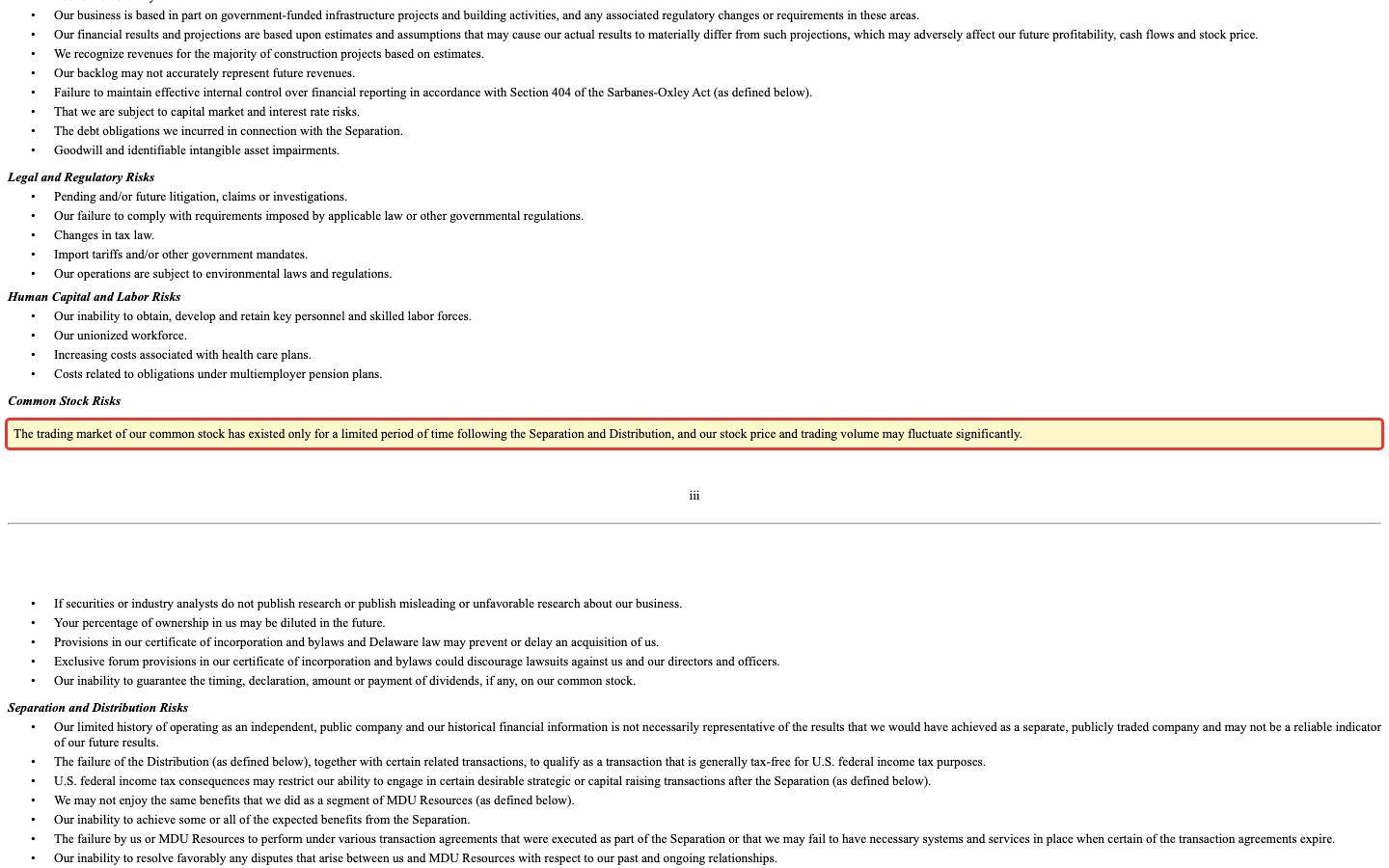
"The trading market of our common stock has existed only for a limited period of time following the Separation and Distribution, and our stock price and trading volume may fluctuate significantly."
— Everus Construction Group, Inc., SEC annual report 10-K for fiscal year 2025, Item 1A "Risk Factors"
On top of that: as a division of MDU Resources, Everus carried practically no financial debt of its own. For independence it took on a $525 million credit facility (a $300 million term loan plus a $225 million revolver) — which pushed interest expense up by more than half in 2025. And a few threads still run back to the former parent: key administrative and insurance functions were arranged through separation agreements whose smooth functioning Everus itself lists as a risk. None of this is dramatic — but it is the difference between a well-worn company and one just learning to walk.
Valuation — what the optimism costs
Now back to the FOMO from the beginning. Everus is that rare combination of real growth and real profitability — and the market knows it. Which is exactly why the stock is no bargain. The valuation sits (orders of magnitude, mid-2026, deliberately without a daily price) at a price-to-earnings ratio around 31, an enterprise value of roughly 21 times operating earnings (EV/EBITDA) and a price-to-sales ratio around 1.7. For a construction services firm with a net margin of roughly 5.4 percent, that is ambitious — multiples like these usually belong to technology companies. You are not paying for the construction site here, but for the expectation that the data-center boom runs on for a long time.
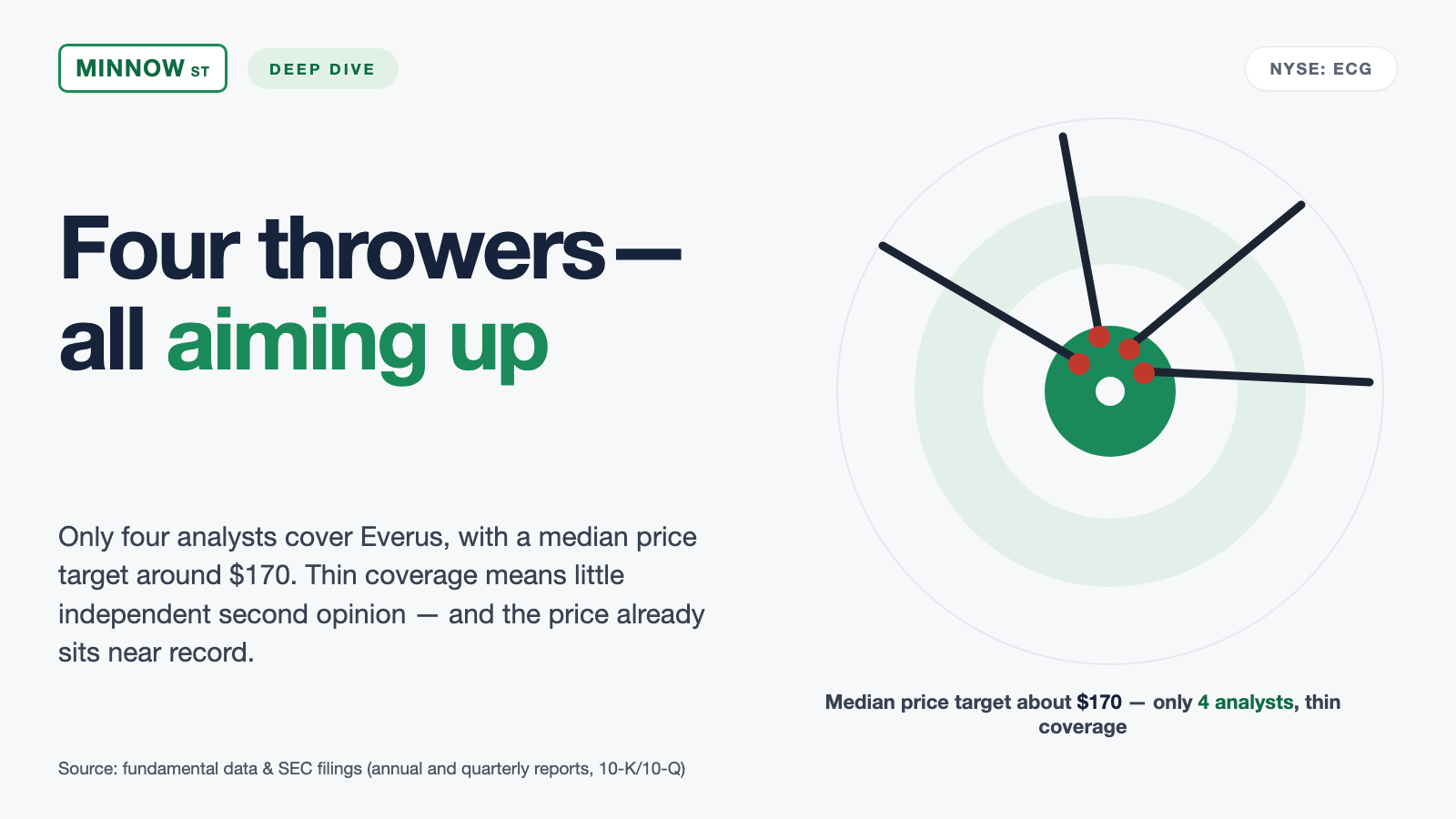
And the professionals' view? It is thin and optimistic at once: only four analysts cover the young stock at all, and their median price target sits on the order of $170. Little coverage means little independent second opinion. Remember: a high price is not an argument against a good company — but it shrinks the safety cushion if something ever goes off script.
Opportunities and risks at a glance
What speaks for Everus:
- Real, broad growth: revenue up 31 percent to $3.75 billion (2025), net income of $201.8 million, roughly 39 percent return on equity — and an order book growing to $3.23 billion.
- Structural tailwind: the data-center build-out is driving precisely the higher-margin electrical segment; Everus sits in the middle of that end market with deep expertise.
- A solid, though no longer debt-free, balance sheet; a predominantly institutional shareholder base; the margin held steady despite fixed-price risks.
- Net one insider purchase, no sale — and an unusually dense confluence of strength in the scanner (19 hits).
What speaks against it:
- Customer concentration: a single customer at 17 percent, the top 10 together at 43 percent of revenue — in 2024 no customer had crossed the 10-percent mark.
- Dependence on a single end market (data centers) and its investment cycle; 52 percent of revenue through fixed-price contracts with estimating risk.
- Short independence (trading start October 2024), debt from the separation ($525 million credit facility) and continuing entanglements with former parent MDU.
- An ambitious post-rally valuation (P/E around 31, EV/EBITDA around 21) with only four analysts and thin insider ownership (officers and directors under 1 percent).
A human conclusion
Remember the FOMO from the beginning — the fear of missing the departing train? After reading the filings, you can answer it differently now. Everus is no castle in the air: the company earns real money, the order book is full, the data-center tailwind is real. That is one half of the truth, and it explains why the chart looks so good.
The other half sits in the fine print: one customer already carrying 17 percent; a dependence on a single boom; half the revenue as a fixed-price bet; a company that has barely learned to walk, whose stock is nevertheless priced like a technology name. None of this makes Everus a bad business. But together they mean: the price leaves little room for error. Whoever buys here buys a winner — but one that already carries its good news largely in the price.
What you make of it is your decision. And that is exactly as it should be. What matters is only that you do not buy out of fear of the missed train, but because you know the full bill — the good company and its price. How the market rewards an electrical-grid builder for the same momentum, by the way, is something we examined at MYR Group, and how far expectations can run ahead of the power-for-AI story at FuelCell Energy.
Sources
- Everus Construction Group, Inc. — SEC annual report 10-K, fiscal year 2025 (as of December 31, 2025; filed February 25, 2026)
- Everus Construction Group, Inc. — SEC quarterly report 10-Q (as of March 31, 2026; filed May 6, 2026)
- Everus Construction Group, Inc. — SEC proxy statement (DEF 14A, March 27, 2026; ownership figures)
- Everus Construction Group, Inc. — SEC current report 8-K on the change of auditor (January 21, 2026)
- Fundamental data (metrics, valuation, analyst consensus, quarterly and annual series); in-house stock scanner, data as of July 9, 2026.
Transparency & disclaimer: This analysis is a journalistic contextualization of publicly available information and is not investment advice, not a financial analysis in the regulatory sense, and not a solicitation to buy or sell securities. Stocks are subject to price fluctuations; a total loss is possible. Make your investment decisions on your own responsibility and seek independent advice when in doubt.
Our Bottom Line at a Glance
- Growth & business positive
- Broad, real growth: revenue from $2.05 billion (2021) to $3.75 billion (2025, up 31 percent year over year), net income of $201.8 million, roughly 39 percent return on equity. Structural tailwind from the data-center build-out in the higher-margin electrical segment.
- Order book & balance sheet positive
- Backlog of $3.23 billion at year-end 2025 (up 16 percent), a stable net margin around 5 percent despite fixed-price risks. The balance sheet is solid but no longer debt-free since the separation ($525 million credit facility); interest expense rose by more than half in 2025.
- Customer concentration negative
- A single customer supplied roughly 17 percent of 2025 revenue, the top 10 together 43 percent — in 2024 no customer had crossed the 10-percent mark. Strong dependence on a single end market (data centers) and its investment cycle; 52 percent of revenue through fixed-price contracts with estimating risk.
- Independence & governance neutral
- A trading history under two years (start October 2024), continuing separation agreements with former parent MDU, and a change of auditor (Deloitte to KPMG) already in the first full year. Net a single small insider purchase (about $23,000); officers and directors hold under 1 percent, institutions roughly 87 percent.
- Valuation & momentum negative
- An ambitious post-rally valuation: P/E around 31, EV/EBITDA around 21, P/S around 1.7 for a net margin of roughly 5.4 percent — technology multiples for a construction services firm. Against that stand 19 scanner hits and a price near record; only four analysts cover the stock, with a median price target around $170.
Everus Construction is a genuine strength name: profitable, growing broadly, with a full order book and structural tailwind from the data-center boom. But the quality has its price — and a few shadows the chart does not show: a single customer at 17 percent of revenue, dependence on one boom, fixed-price risks, a trading history of barely two years, and a valuation carrying technology multiples. A winner that already carries its good news largely in the price. Not investment advice.
What Our Rating Means
- If you don't own the stock
- At the current price level, we don't see a sufficient margin of safety for an entry.
- If you hold it in your portfolio
- Our findings offer no reason to sell.
A journalistic assessment by our editorial team at the time of the deep dive, based on public sources — not investment advice and not a solicitation to buy or sell. Your personal circumstances (investment goals, risk capacity, taxes) cannot be taken into account. What our categories mean, how verdicts are formed, and what conflicts of interest exist →
Worth Noting
- Valuation metrics are orders of magnitude as of mid-2026 (P/E ~31, EV/EBITDA ~21, P/S ~1.7); annual figures refer to fiscal year 2025 (as of December 31, 2025). Analyses are evergreen; daily prices are not a buy argument.
- The insider tally ("1 purchase / 0 sales") comes from scanner and fundamental data and was cross-checked against the insider filing (Form 4) of December 8, 2025 (director Hernandez, 250 shares). A conflicting fundamental-data figure on insider ownership was discarded in favor of the documented DEF 14A number (officers and directors together under 1 percent).
- AI dossier: category "neutral" (rated July 10, 2026) — artificial intelligence appears in the filings only as an end-market demand driver for data centers and as a generic data-security risk, not as a revenue source or an operating tool of its own. Everus sells construction work, not AI.
Frequently Asked Questions
Everus is a U.S. construction services firm with two segments: Electrical & Mechanical (E&M) builds electrical and mechanical systems inside buildings, including data centers; Transmission & Distribution (T&D) builds and maintains electric, gas and communications networks for utilities. Put simply: the company that wires the data center and builds the grids that feed it.
Until October 2024, Everus was the construction division of the utility MDU Resources, operating as MDU Construction Services Group. On October 28, 2024 it was distributed to MDU shareholders as a tax-free spin-off and has since traded independently on the New York Stock Exchange (ticker ECG). Some administrative and insurance functions still run through separation agreements with MDU.
Everus hits 19 filters of our in-house stock scanner (as of July 9, 2026), among them Best of All, Near 52-Week High and RS Leader (≥90). This dense confluence reflects strong price momentum and real growth: revenue rose 31 percent in 2025 and the backlog reached $3.23 billion. A momentum signal, however, is no substitute for looking at valuation and risks.
In 2025 a single customer accounted for roughly 17 percent of total revenue and the ten largest customers for 43 percent — in 2024 no customer had crossed the 10-percent mark. Everus itself warns that a significant portion of revenue hangs on data-center contracts. The main risk is not the creditworthiness of the deep-pocketed tech customers but a cooling of the data-center investment cycle.
After the rally it is ambitiously valued: price-to-earnings ratio around 31, EV/EBITDA around 21, price-to-sales around 1.7 (orders of magnitude, mid-2026). For a construction services firm with a net margin of roughly 5.4 percent, those are multiples usually seen on technology names. The price leaves little room for disappointment.
Net yes, but very thinly: the scanner hit "insiders buying (net)" rests on a single open-market purchase — director Helena Hernandez bought 250 shares for about $23,000 on December 8, 2025, per an insider filing (Form 4), with not a single sale against it. Officers and directors together hold less than 1 percent; institutions roughly 87 percent.
Found an error?
Did you spot a factual error, an outdated number, or a typo in this deep dive? Let us know briefly — your report goes straight to the editorial team.