Organon: The Turnaround Candidate That Is Already Sold — $14.00 in Cash, and the Rest Is Waiting
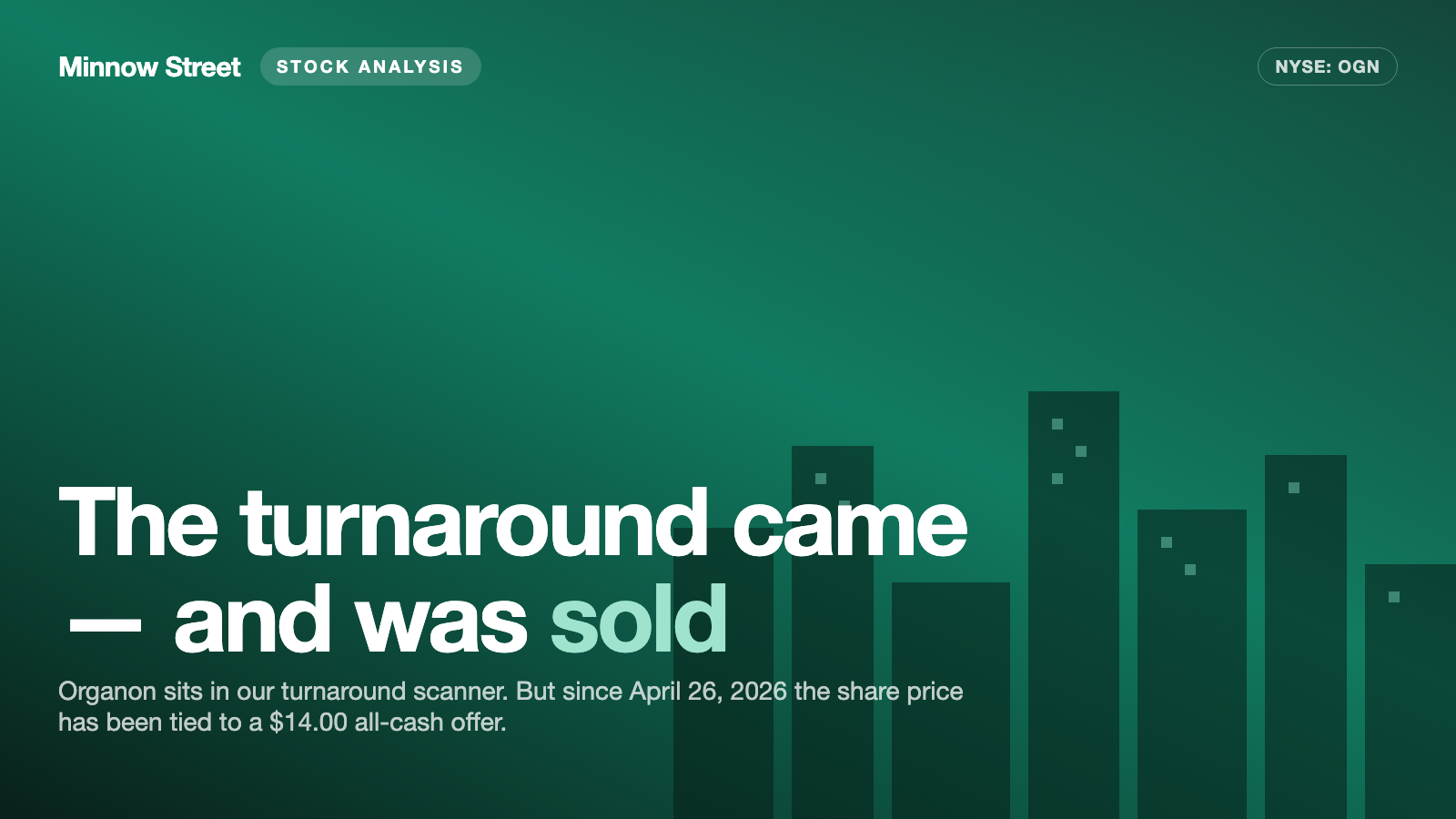
The stock has more than doubled from its March 30, 2026 low, it sits in our turnaround scanner, and the balance sheet really is healing: after three years of negative shareholders' equity, $903 million was back on the right side of the ledger at March 31, 2026. Except the rally has nothing to do with the turnaround. On April 26, 2026 Organon signed a merger agreement with Sun Pharmaceutical Industries: $14.00 per share in cash, a 103 percent premium to the April 9 close. Shareholders approved on July 23, 2026. What the filings with the U.S. securities regulator, the SEC, say alongside that is less comfortable: channel loading at Nexplanon, internal controls judged not effective two years running — and a valuation from the company's own adviser that tops out at $13.90. Anyone buying now is no longer buying a company. They are buying a calendar.
 Thomas Mücke
Founder & Publisher
Thomas Mücke
Founder & Publisher
Chart
Interactive price chart (TradingView).
Note: pure fact-based analysis, not investment advice and not a solicitation to buy or sell. All figures without guarantee.
The chart-pattern trap: when the curve looks right and the story is something else entirely
There is a move every one of us makes when we look at a price chart. We see a deep crash, then a base, then a steep climb — and our brain writes the word underneath that it has been trained to write: turnaround.
Organon shows exactly that pattern. On March 30, 2026 the stock closed at $5.70, its low for the year. On July 24, 2026 it stood at $13.52. That is roughly 137 percent in barely four months. The chart looks like a textbook illustration.
It is not one. The climb has nothing to do with an operating turnaround and everything to do with a date: April 26, 2026. That day Organon signed a merger agreement with the Indian pharmaceutical group Sun Pharmaceutical Industries. The price: $14.00 per share in cash. Ever since, the stock has hovered just below it, like a balloon against a ceiling.
That is the trap this analysis is about: a chart pattern tells you that something happened — never why. And whoever does not know the why may be buying a story that has already been told to the end. The deal is the thread running through every chapter here: what Organon actually earns, what the filings with the U.S. securities regulator, the SEC, say — and whether $14.00 per share even matches the business underneath.
What is ahead
- What Organon sells — and to whom
- How the stock landed on our desk
- The case in one sentence: $14.00, cash
- The numbers over the years — fairly credited
- Uncomfortable truth No. 1: a third of the quarterly profit came from a sale
- Uncomfortable truth No. 2: the revenue pulled forward from the future
- Uncomfortable truth No. 3: two years of ineffective controls
- Uncomfortable truth No. 4: the company's own adviser never got to $14
- What the stock costs
- Opportunities and risks at a glance
- A human conclusion
- Sources
What Organon sells — and to whom
Organon & Co. is based in Jersey City, New Jersey, across the water from Manhattan, and has only been listed since June 2, 2021. It is not a start-up but a spin-off: Merck & Co. carved out its women's health business and a large slice of its off-patent brands and floated them on the New York Stock Exchange as a separate company. The parting gift came to roughly $9.1 billion of debt. More on that shortly.
The business has three parts. This is how they looked in 2025 (revenue in millions of dollars):
- Women's Health — $1,752 million. Contraception and fertility. The lead product is Nexplanon, a thin plastic rod a clinician inserts under the skin of the upper arm that prevents pregnancy for years. Alongside it sit the vaginal ring NuvaRing and the fertility treatment Follistim AQ.
- Biosimilars — $691 million. Follow-on versions of biologic medicines whose patents have expired: Renflexis, Hadlima, Ontruzant, Brenzys. The only growing part.
- Established Brands — $3,691 million. The Merck inheritance: cholesterol drugs (Zetia, Atozet, Vytorin), blood pressure treatments (Cozaar), respiratory medicines (Singulair, Nasonex, Dulera). Almost all off patent and in slow decline.
One term up front, because it explains the whole balance sheet: a biosimilar is not a generic. A generic is a chemically identical copy of a small molecule; a biosimilar is grown in living cells and can only resemble the original, never match it exactly. Approval is therefore more expensive and competition thinner — but prices still fall.
Organon sells in more than 140 countries, with roughly 74 percent of 2025 revenue — $4.6 billion — earned outside the United States. Manufacturing runs at six owned sites: Belgium, Brazil, Indonesia, Mexico, the Netherlands and the United Kingdom. At December 31, 2025 the company employed more than 10,000 people, about 1,500 of them (15 percent) in the United States including Puerto Rico.
Remember one number for the rest of this piece: Nexplanon generated $921 million in 2025, roughly 15 percent of group revenue. It is the only product with real patent protection and the justification for almost every growth story here. The case hangs on it.
How the stock landed on our desk
We run several thousand stocks through our scanners every day. Organon came in through the Turnaround Candidates list: rank 36 of 60 U.S. hits, turnaround check 6 of 8 points, measured on July 27, 2026 (list computed July 26, 2026).
One caveat straight away, so nobody searches in vain: the scanner page only displays the 25 strongest hits. Organon sits at rank 36 and does not appear on the page itself — we measured the position directly in the data. These lists are recalculated daily; rank and score are a dated snapshot, not a permanent state.
The list has two mandatory pillars. Fail either one and you are out, however good the rest looks:
- Pillar 1 — the crash: at least 50 percent below the all-time high. Organon clears this comfortably. The highest close in the company's history was $39.36 on March 2, 2022; on July 24, 2026 the stock closed at $13.52, roughly 66 percent lower. Our data set measures on a distribution-adjusted basis and shows minus 59.01 percent. Both readings sit far beyond the hurdle; this is not a misplaced figure.
- Pillar 2 — survival: the Altman Z-score must be at least 1.1. It condenses several balance sheet ratios into a single number estimating how far a company is from insolvency. Organon stands at 5.40 — comfortable. Add no more than one balance sheet warning flag (Organon has one) and positive equity ($903 million at March 31, 2026).
On top sits the turnaround check, an eight-point list: four for the operating turn (revenue stabilizing, net margin turning, cash flow turning, balance sheet healing) and four for market confirmation (price above the 50-day line, three-month relative strength beating twelve-month, net insider buying, institutions adding). A stock is displayed with at least six points. Organon scores exactly six — the minimum. Translated into school grades: a pass, not a good one.
And here is the honest part. Two of those six points came from the takeover price itself: the stock trades above its 50-day line, and three-month strength beats twelve-month strength. That is not the market forming a view on the business — that is an offer price pulling the stock up. The scanner measures a pattern that in this case was created by the deal. Which is exactly why the deal gets the next chapter rather than a footnote at the end.
The case in one sentence: $14.00, cash
On April 26, 2026 Organon signed a merger agreement with Sun Pharmaceutical Holdings USA and its subsidiary Sun Pharma America; the Indian parent, Sun Pharmaceutical Industries Limited, backs certain covenants. The terms are set out verbatim in the current report:
“… will be converted into the right to receive $14.00 in cash, without interest (the ‘Per Share Merger Consideration’), which represents a 103% premium to the Company’s closing Share price on April 9, 2026 (the unaffected trading date prior to the April 10, 2026 publication in a media report speculating about a potential transaction with India Parent).”
— Organon & Co., SEC Form 8-K filed April 27, 2026, Item 1.01

What that means in numbers: the unaffected close on April 9, 2026 was $6.91. A day later, after the media report, the stock jumped to $8.83 on nearly 40 million shares. On the first trading day after signing, April 27, 2026, it closed at $13.16 on 134 million shares — by far the heaviest volume of the year.
The key terms, all from the same current report:
- Shareholder vote: done. At the special meeting on July 23, 2026, 192,776,552 shares voted in favor, 2,573,118 against and 326,189 abstained. As of the June 15, 2026 record date, 262,609,433 shares were outstanding and entitled to vote — so the approval represents roughly 73 percent of all shares outstanding.
- Regulators are still open: the U.S. waiting period under the Hart-Scott-Rodino Act plus antitrust and foreign direct investment clearances outside the United States. Filings were made on May 21, 2026.
- Outside date: January 26, 2027 at 5:00 p.m. New York time — extendable if only regulatory conditions remain outstanding.
- Termination fee: $120 million, payable by Organon, including if the company walks away to accept a superior proposal.
- Afterwards: the shares will be delisted from the New York Stock Exchange and deregistered within ten days.
- Financing: Sun Pharma has committed debt financing — enough for the purchase price and to refinance or repay existing Organon debt.
April 26, 2026 also made Joseph Morrissey permanent chief executive; he had held the role on an interim basis since October 26, 2025. Carrie S. Cox became permanent executive chair. Why that matters becomes clear in truths No. 2 and 3.
The numbers over the years — fairly credited
Start with what genuinely speaks for Organon. Revenue has been remarkably stable over five years: $6,304 million (2021), $6,174 million (2022), $6,263 million (2023), $6,403 million (2024) and $6,216 million (2025). For a portfolio that is 59 percent off-patent brands, that is not a given — such revenue usually melts faster. And the group reliably throws off cash: $858 million, $799 million, $939 million and $700 million of operating cash flow from 2022 through 2025.
Earnings tell a different story.
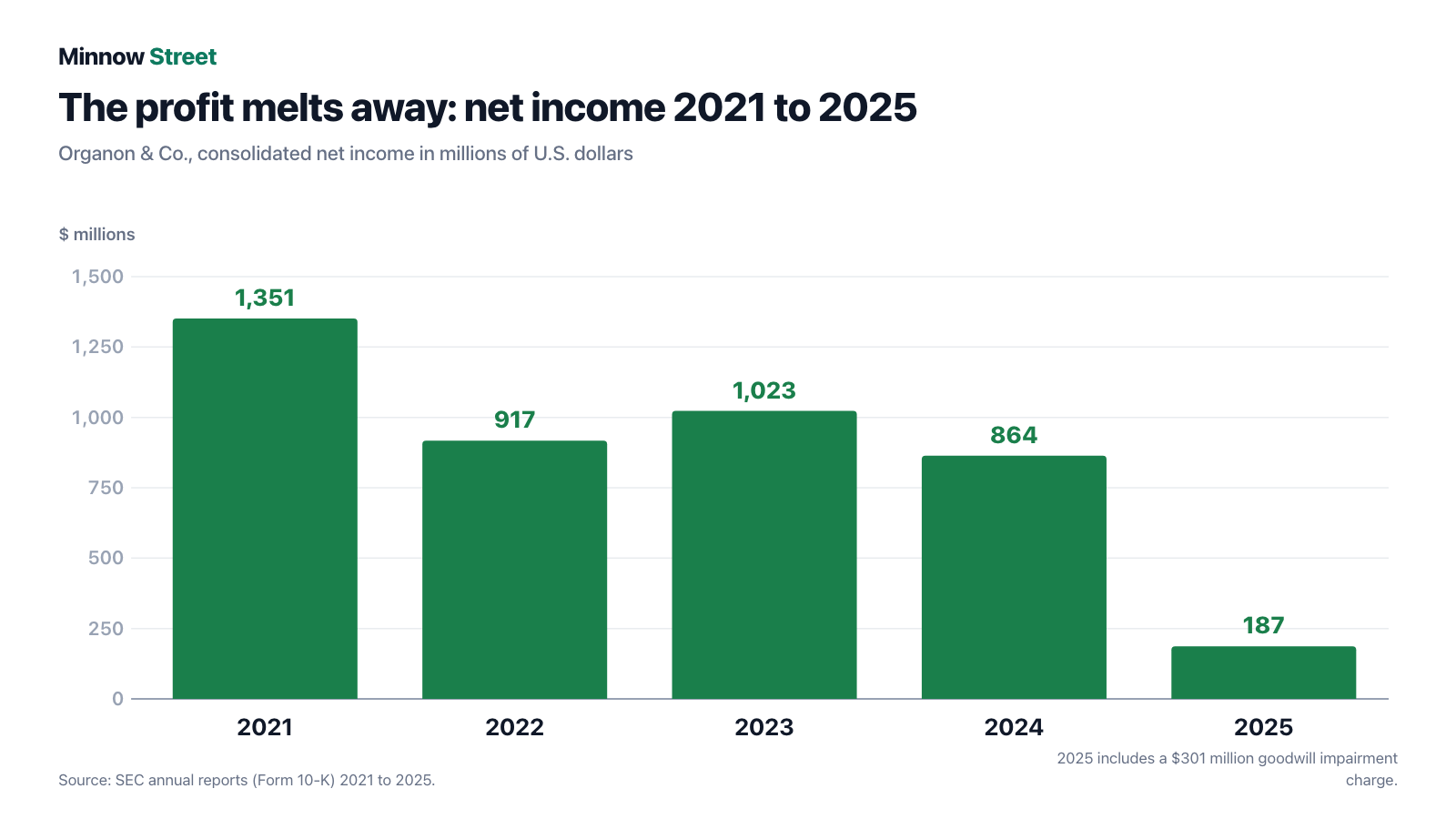
A word on goodwill impairment: when a company pays more for a business than its net assets are worth, the difference sits on the balance sheet as goodwill. If the earnings outlook weakens, the figure has to be written down. That is what happened in 2025 to the tune of $301 million, explicitly because of "lower-than-expected financial performance" in the U.S. reporting unit. No cash leaves the building, but it is an admission: yesterday's expectations were too high.
The second chart shows what the Merck spin-off left behind.
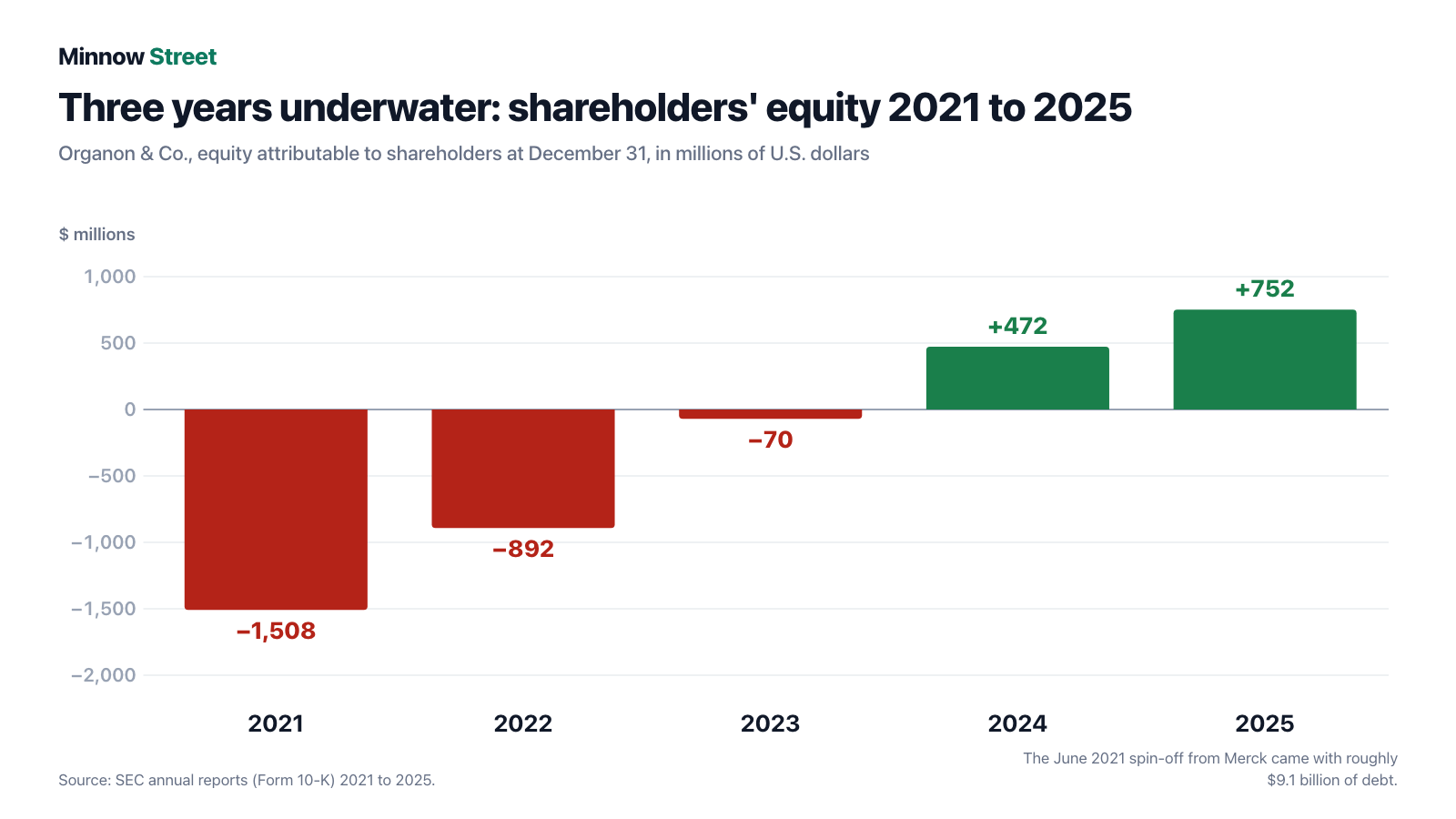
Negative equity in plain language means the debts are larger than everything the company owns. With a house it would be a mortgage worth more than the property. Organon sat exactly there from 2021 through 2023 — not through its own mistakes, but because Merck handed the new company the debt it used to pay itself out. At March 31, 2026, equity is back to $903 million. That is genuine healing — but against total assets of $12,996 million it works out to an equity ratio of barely 7 percent. For comparison, a soundly financed industrial group runs at 30 to 50 percent.
The debt itself: $8,553 million long term at March 31, 2026, with an average maturity of roughly 4.3 years and a weighted average interest rate of 4.9 percent. About $3.6 billion falls due in 2028. The revolving credit facility was undrawn at the reporting date and cash stood at $1,116 million, the highest ever. One comparison shows how heavy the interest burden is: in the first quarter of 2026, interest expense came to $111 million against net income of $146 million. The specialty pharma company Collegium Pharmaceutical runs a similarly debt-heavy model, and its analysis shows how tightly such a structure hangs on rates.
What the filings say — the uncomfortable truths
Uncomfortable truth No. 1: a third of the quarterly profit came from a sale
The first quarter of 2026 is the number every turnaround narrative rests on: $146 million of net income against $87 million a year earlier, up two thirds. Operating cash flow tripled to $225 million from $75 million. Both look like a turn.
The notes explain why. The line "Other (income) expense, net" shows $96 million of income, against $12 million of expense a year earlier. Of that, $81 million is a gain on sale: in January 2026 Organon sold the Jada System, a device used to treat severe postpartum bleeding, to Laborie Medical Technologies. Roughly 100 employees moved across, and $226 million of goodwill plus $164 million of intangible assets left the balance sheet.
Do the arithmetic: pre-tax income was $213 million. Without the Jada gain it would be $132 million — still ahead of the prior year's $101 million, but a step rather than a leap. Remember the pattern: a profit that comes from selling part of the business arrives exactly once. And the part that was sold is then missing from revenue — Jada contributed just $5 million in the first quarter of 2026, down from $15 million.
Uncomfortable truth No. 2: the revenue pulled forward from the future
Now the part that explains why Organon has had a new chief executive since October 2025. In the fourth quarter of 2025 the board's Audit Committee had the Nexplanon sales practice investigated. The finding is in the annual report:
“The investigation found that we asked two wholesalers in the United States to purchase greater quantities of Nexplanon during the fourth quarter of 2022, the third and fourth quarters of 2024 and the first, second and third quarters of 2025 (collectively, the ‘Relevant Periods’) than they otherwise would have purchased based on wholesaler demand.”
— Organon & Co., SEC Form 10-K for 2025, Item 9A "Controls and Procedures"
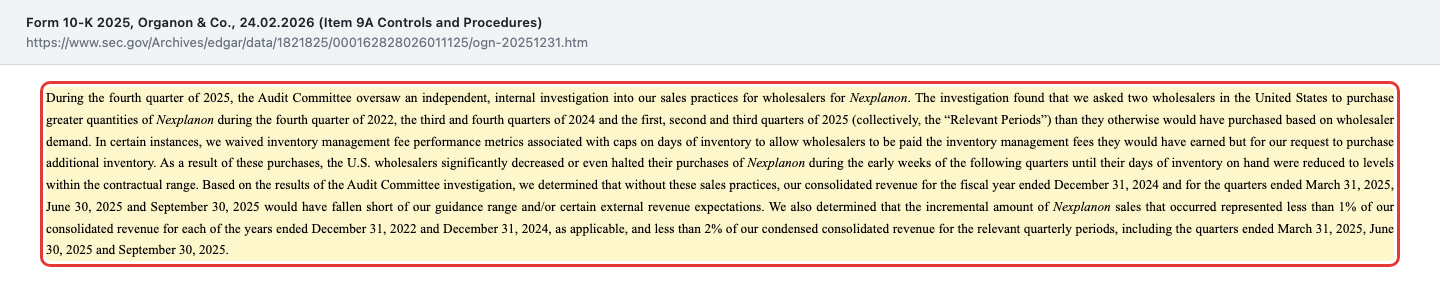
The industry term is channel loading. In everyday terms: a baker asks his biggest customer to take another two hundred loaves on December 30 so the annual figure works out — and is then surprised when nothing is ordered in January. That is exactly how the report describes it: in the following quarters the wholesalers "significantly decreased or even halted" their purchases until their days of inventory fell back inside the contractual range. Organon also waived inventory management fee metrics in certain cases so the wholesalers would still collect their fees despite the excess stock.
Two findings from the report belong together — one damning, one mitigating. Damning: without the practice, Organon would have fallen short of its own revenue guidance or external expectations in 2024 and in the first three quarters of 2025. Mitigating: the incremental Nexplanon sales represented less than 1 percent of consolidated revenue in each affected year and less than 2 percent in each affected quarter, and the published financial statements did not have to be restated.
On October 26, 2025 Organon made a voluntary self-disclosure to the SEC. The agency opened its own investigation, which is ongoing as of the data date. Shareholders are suing in parallel: class actions covering purchases between November 3, 2022 and April 30, 2025 allege materially false statements about capital allocation — particularly the quarterly dividend — and the debt reduction strategy, alongside two derivative suits brought on behalf of the company.
And the bill is already arriving. In the first quarter of 2026, worldwide Nexplanon revenue fell 19 percent to $201 million (from $248 million), with the U.S. share dropping from $176 million to $127 million. The report gives a second, almost tragicomic reason: the FDA approved the five-year duration label for Nexplanon in January 2026. The rod may now stay in the arm two years longer — so reinsertions slide two years to the right. The company's own regulatory success is eating its own near-term revenue.
Uncomfortable truth No. 3: two years of ineffective controls
The investigation led to a conclusion that rarely appears this plainly in an annual report:
“Based on this evaluation, the Interim CEO and the CFO concluded that our disclosure controls and procedures were not effective as of December 31, 2025 due to the material weaknesses in internal control over financial reporting as described below.”
— Organon & Co., SEC Form 10-K for 2025, Item 9A "Controls and Procedures"

The report names two material weaknesses. First, tone at the top: the former chief executive and the leader of the U.S. commercial organization applied inappropriate pressure to hit sales targets through the two wholesalers and engaged in conduct that violated the company's own code of conduct. Second, information flow: senior people did not fully inform the Disclosure Committee and the financial reporting group. Auditor PricewaterhouseCoopers issued its own attestation report.
In everyday terms: the books are right, but the lock on the door is broken. Management explicitly states that the 2023 through 2025 financial statements fairly present the company's position — but that the weaknesses could have allowed a misstatement to pass unnoticed. A remediation plan is running, complete with a dedicated project office and outside advisers. It was not finished as of the annual report date.
For the takeover this means: Sun Pharma is buying a company whose internal controls have been judged not effective two years running. The buyer knows — it spent months on diligence. For an investor the warning goes further: in a company whose sales organization could pull quarterly revenue forward without the controls stopping it, every past quarterly figure needs a little explaining.
Uncomfortable truth No. 4: the company's own adviser never got to $14
Before a takeover, the board has the price tested for fairness. At Organon that job went to Morgan Stanley. The decisive calculation is the discounted cash flow analysis: you estimate how much free cash the business generates over the coming years and discount those future amounts back to today. It is the only one of the analyses the fairness opinion actually rests on — all the others are expressly "for reference only".
“Morgan Stanley’s analysis resulted in an implied value per share of our Common Stock of $6.80 to $13.90, rounded to the nearest $0.10. Morgan Stanley compared this range to the Per Share Merger Consideration of $14.00 per share of our Common Stock.”
— Organon & Co., SEC Form DEFM14A filed June 17, 2026, "Opinion of Morgan Stanley & Co. LLC"

And the reference calculations? Analyst price targets before the deal ranged from $5.00 to $12.00, or $4.40 to $10.60 discounted by one year. The premia paid analysis (24 percent to 67 percent premiums in comparable all-cash deals between $1 billion and $15 billion since 2020) produced $8.60 to $11.50. The public comparables — Morgan Stanley found exactly two, Bausch Health and Viatris — span a wide $7.30 to $19.70. Only the precedent transactions (Mallinckrodt/Endo in March 2025 and Upjohn/Mylan in July 2019, at roughly 6.2 to 6.5 times trailing adjusted EBITDA) land above the offer, at $13.40 to $15.30.
Fairness requires saying this: a takeover price above the standalone cash flow value is normal, because the buyer is also buying synergies. The merger proxy names a figure — Organon presented Sun Pharma with roughly $700 million of cost synergies on January 22, 2026. And the board did negotiate: on February 3, 2026 it explicitly refused $13.50 per share.
Two details still linger. First, every stock option held by the five named executive officers carries an exercise price at or above $14.00 — they will be cancelled for no consideration at closing. Even after a 103 percent premium, management's own options are underwater; that says more about the price history than any chart. Second, the five executives will collectively receive roughly $69.8 million in severance and accelerated equity — $18.7 million for chief executive Joseph Morrissey and $19.2 million for finance chief Matthew Walsh. Shareholders approved that compensation on an advisory basis on July 23, 2026, though with far more dissent than the deal itself (9.55 million votes against versus 2.57 million).
What the stock costs
For a stock pinned to a cash offer, the classic valuation question is half suspended. It is still worth asking, because it measures the fallback.
At the July 24, 2026 data date the stock closed at $13.52. That gives a market value of roughly $3.6 billion — against trailing twelve-month revenue of $6.2 billion, a price-to-sales ratio of about 0.6. The trailing price-to-earnings ratio is around 14.5, or about 5 against expected earnings for the current year. Price to operating cash flow is roughly 4.2. On paper, that is cheap.
The more honest yardstick is enterprise value. Apply the offer price to all 284.9 million fully diluted shares (as of April 24, 2026) and add net debt of $7,530 million (March 31, 2026) and you arrive at roughly $11.5 billion. Measured against trailing adjusted EBITDA of $1,832 million, that is about 6.3 times — precisely the range Morgan Stanley derived from the two precedent deals. The price is industry-standard, not generous.
Important for context: roughly two thirds of enterprise value sits in the debt, not the equity. And with 22.3 million additional shares from employee programs between the basic count (262.6 million) and the diluted count (284.9 million), a further 8 percent of dilution follows — your slice of the cake is smaller than the headline share count suggests.
Management's own projections, prepared in March 2026 and published in the merger proxy, run as follows (revenue in millions of dollars): $6,252 for 2026, $6,475 for 2027, $6,693 for 2028, $6,822 for 2029 — and then $6,470 for 2030. The kink at the end is no accident: the U.S. rod patent for Nexplanon expires in 2027 and the applicator is protected until 2030. Organon has been suing Xiromed Pharma España over a generic application since April 2, 2025; the suit blocks approval for up to 30 months. Value the company without a takeover and you are valuing an earnings stream with a visible expiry date — the same pattern that dominates the entire valuation debate at Biogen.
And the professionals' view? The consensus of the seven analysts in our data set carried a price target of $11.25 at the data date — well below the offer price. In other words: no analyst expects the stock to sit where it sits today without the deal.
Opportunities and risks at a glance
What speaks for Organon:
- A signed all-cash agreement at $14.00 per share with committed financing, shareholder approval on July 23, 2026 (192,776,552 votes to 2,573,118) and a clear end date of January 26, 2027.
- A surprisingly stable core business: revenue has stayed inside a band of $6,174 million to $6,403 million since 2021 despite almost 60 percent of it coming from off-patent brands; more than 140 markets and 74 percent international exposure spread the risk.
- The balance sheet is visibly healing: equity from minus $1,508 million (2021) to plus $903 million (March 31, 2026), an Altman Z-score of 5.40, a Piotroski score of 7 out of 9, $1,116 million of cash and an undrawn revolving credit facility.
- The operating direction is right: first-quarter 2026 net income of $146 million against $87 million, operating cash flow of $225 million against $75 million, restructuring costs down from $86 million to $31 million.
- Nexplanon keeps U.S. applicator protection until 2030, gained the five-year label in January 2026 and in the United Kingdom in April 2026 — and Miudella, a hormone-free copper intrauterine device, joined the portfolio in February 2026 ($27.5 million at closing, up to $505 million in milestones).
What speaks against it:
- The share price hangs on closing, not on the business: antitrust and foreign investment clearances are still outstanding at the data date. If the deal breaks, the fallback is the adviser's own discounted cash flow range — $6.80 to $13.90 per share — and an analyst consensus of $11.25.
- Earnings power has collapsed: net income fell from $1,351 million (2021) to $187 million (2025), including a $301 million goodwill impairment on the U.S. reporting unit. First-quarter 2026 interest expense of $111 million stands against $146 million of net income.
- The turnaround evidence is propped up: $81 million of the $213 million in first-quarter 2026 pre-tax income came from the Jada divestiture, and two of the six turnaround-check points come from a share price driven by the offer.
- Governance and oversight: the Audit Committee investigation into Nexplanon channel loading, an SEC investigation opened after the voluntary self-disclosure of October 26, 2025, class actions covering November 3, 2022 to April 30, 2025, two derivative suits — and internal controls judged not effective at December 31, 2024 and December 31, 2025.
- The core product is shrinking and the calendar is pressing: Nexplanon down 19 percent to $201 million in the first quarter of 2026 (U.S. from $176 million to $127 million), the U.S. rod patent expiring in 2027, the Xiromed generic application pending — and management's own projections show group revenue falling back to $6,470 million in 2030. The dividend was cut from $0.28 to $0.02 per quarter; the 2025 payout was $0.34 per share.
A human conclusion
Back to the chart-pattern trap from the opening. Its core is not that Organon is a bad company. The group sells real medicines to real patients in more than 140 countries, earns reliable money doing it, and has hauled its balance sheet out of a deep hole. Its core is that the price move which caught our attention has nothing to do with any of that.
Anyone buying today is no longer buying a company. They are buying a bet on a regulatory calendar: if the clearances come through, there is $14.00 per share and the case is closed. If something goes wrong, what is left is a group with $8.6 billion of debt, an equity ratio of 7 percent, an open SEC investigation, controls judged not effective for two consecutive years and a core product whose patent lapses in 2027. Between the July 24, 2026 close and the offer price there was less than 4 percent — that is the return on offer against all of it.
So the honest question is not "is Organon a good turnaround?" but: are you being paid enough for the remaining few percent to carry the residual risk that something intervenes between today and January 26, 2027? That is no longer an analytical question. It is a question about your own pain threshold. And only you know that.
What you make of it is up to you. And that is exactly as it should be.
Sources
Every original document used in this analysis, for you to read yourself:
- Organon & Co. — SEC Form 10-K for 2025 (filed February 24, 2026)
- Organon & Co. — SEC Form 10-Q for the quarter ended March 31, 2026 (filed May 4, 2026)
- Organon & Co. — SEC Form 10-K for 2024 (filed February 28, 2025)
- Organon & Co. — SEC Form 8-K filed April 27, 2026 (merger agreement, officer appointments)
- Organon & Co. — SEC Form DEFM14A filed June 17, 2026 (background, fairness opinion, projections, golden parachutes)
- Organon & Co. — SEC Form 8-K filed July 17, 2026 (merger litigation, supplemental disclosures)
- Organon & Co. — SEC Form 8-K filed July 23, 2026 (special meeting voting results)
- Organon & Co. — SEC Form 8-K filed February 20, 2026 (completion of the second review into biosimilar purchases)
- Complete SEC filing history for Organon & Co.: EDGAR overview (sec.gov)
- Fundamental data (metrics, price history, analyst consensus; data date July 24 to 27, 2026), reconciled with the SEC filings and the SEC XBRL company facts.
- Scanner rank: our in-house Turnaround Candidates scanner, U.S. selection, measured July 27, 2026 (list computed July 26, 2026).
Transparency & disclaimer: this analysis is journalistic commentary on publicly available information. It is not investment advice, not a research report in any regulatory sense, and not a solicitation to buy or sell securities. Equity investments carry substantial risk up to total loss. All information without warranty; the data date is noted in the text. The author holds no position in Organon shares at the time of publication.
Our Bottom Line at a Glance
- Takeover status positive
- A signed merger agreement dated April 26, 2026 for $14.00 per share in cash with committed financing; the special meeting approved it on July 23, 2026 by 192,776,552 votes to 2,573,118. Only regulatory clearances remain outstanding, with an outside date of January 26, 2027.
- Earnings power negative
- Net income fell from $1,351 million (2021) to $187 million (2025), weighed down by a $301 million goodwill impairment on the U.S. reporting unit. In the first quarter of 2026, $81 million of the $213 million in pre-tax income came from the Jada divestiture, and interest expense of $111 million stands against $146 million of net income.
- Balance sheet neutral
- Visible healing: equity from minus $1,508 million (December 31, 2021) to plus $903 million (March 31, 2026), an Altman Z-score of 5.40, cash of $1,116 million and an undrawn revolver. But the equity ratio is only about 7 percent against $8,553 million of long-term debt, roughly $3.6 billion of which matures in 2028.
- Governance and oversight negative
- The Audit Committee investigation documented channel loading at Nexplanon across six quarters between 2022 and 2025; the SEC has been investigating since the voluntary self-disclosure of October 26, 2025. Internal control over financial reporting was judged not effective at December 31, 2024 and December 31, 2025; class actions and two derivative suits are pending.
- Core product and patent position negative
- Nexplanon contributed $921 million in 2025, roughly 15 percent of revenue, but fell 19 percent to $201 million in the first quarter of 2026 (U.S. from $176 million to $127 million). The U.S. rod patent expires in 2027, a Xiromed generic application is pending — and management's own projections show group revenue falling back to $6,470 million in 2030.
- Level of the offer neutral
- The $14.00 sits above the adviser's discounted cash flow range ($6.80 to $13.90 per share as of April 24, 2026), above analyst targets ($5.00 to $12.00) and above the premia paid analysis ($8.60 to $11.50) — but within the range of comparable pharma deals ($13.40 to $15.30) and, at roughly 6.3 times adjusted EBITDA, industry-standard rather than generous.
Organon shows up in the turnaround scanner because the stock trades far below its all-time high, the balance sheet is healing and the price has been rising — but the rise comes from a cash offer, not from the business. Since April 26, 2026 Sun Pharma has been paying $14.00 per share, shareholders approved on July 23, 2026, and only regulators remain. Alongside that, the SEC filings document channel loading at Nexplanon across six quarters, internal controls judged not effective two years running, an open SEC investigation and a core product whose U.S. patent lapses in 2027. Anyone buying today is no longer acquiring a company but the spread between the share price and the offer — plus the risk that closing fails. Not investment advice.
What Our Rating Means
Open questions
The business works in principle, but one material question is open. As long as it stays open, our findings do not carry a quality verdict.
Yellow here stands for earnings and oversight risk, not for a solvency risk. Against red sits the documented position: revenue stable between $6,174 million and $6,403 million since 2021 across more than 140 countries, $700 million of operating cash flow in 2025, an Altman Z-score of 5.40, a Piotroski score of 7 out of 9, $1,116 million of cash and equity that has climbed back from minus $1,508 million to plus $903 million. Too much is missing for green: net income down from $1,351 million to $187 million, an equity ratio of roughly 7 percent against $8,553 million of debt, channel loading at Nexplanon across six quarters documented by the Audit Committee, an open SEC investigation, internal controls judged not effective at December 31, 2024 and 2025, and a core product whose U.S. rod patent expires in 2027. The decision is yours.
A journalistic assessment by our editorial team at the time of the deep dive, based on public sources — not investment advice and not a solicitation to buy or sell. Your personal circumstances (investment goals, risk capacity, taxes) cannot be taken into account. What our levels mean, how verdicts are formed, and what conflicts of interest exist →
Worth Noting
- Hook: in-house stock scanner "Turnaround Candidates", U.S. selection, rank 36 of 60 hits, turnaround check 6 of 8, measured July 27, 2026 (list computed July 26, 2026). The scanner page only shows the 25 strongest hits, so Organon does not appear on it. The lists are recalculated daily; rank and score are a snapshot.
- Cross-check on the mandatory pillar "at least 50 percent below the all-time high": our data set carries minus 59.01 percent on a distribution-adjusted basis. The price history confirms the order of magnitude: highest close $39.36 on March 2, 2022 against a $13.52 close on July 24, 2026 — minus 65.7 percent on the raw price. Not a figure misplaced by a factor of 1,000.
- Takeover check before writing: no Form 15, no Form 25, no Schedule 14D-9; the stock was still listed on the NYSE at the data date. The transaction is a Delaware merger approved by shareholder vote, not a tender offer.
- Data date: Form 10-K for 2025 filed February 24, 2026, Form 10-K for 2024 filed February 28, 2025, Form 10-Q for March 31, 2026 filed May 4, 2026, Forms 10-Q for September 30, 2025, June 30, 2025 and March 31, 2025, Form DEFM14A filed June 17, 2026, Forms 8-K dated February 20, April 27, April 30, July 17 and July 23, 2026; metrics and price history July 24 to 27, 2026.
- Not to be confused: Organon & Co. (NYSE: OGN) is not the Dutch Organon company that existed before the Schering-Plough and Merck acquisitions, nor is it the same as Merck & Co., from which it was spun off in 2021. The buyer, Sun Pharmaceutical Industries Limited, is listed in India, not in the United States.
- The quality rating in this analysis judges the company, not the entry point. A scanner rank is an invitation to research, not a buy signal.
Frequently Asked Questions
Yes. On April 26, 2026 Organon & Co. signed a merger agreement with Sun Pharmaceutical Holdings USA. At closing each common share converts into the right to receive $14.00 in cash, without interest. That is a 103 percent premium to the $6.91 close on April 9, 2026. Shareholders approved on July 23, 2026 by 192,776,552 votes to 2,573,118. The shares will then be delisted from the New York Stock Exchange.
As of the data date, regulatory clearances are outstanding: the U.S. waiting period under the Hart-Scott-Rodino Act plus antitrust and foreign direct investment approvals outside the United States. Filings were made on May 21, 2026. Other conditions include the absence of a company material adverse effect and no legal restraint. The outside date is January 26, 2027, extendable while only regulatory conditions remain. If Organon walks away for a superior proposal, a $120 million termination fee applies.
Organon & Co. was spun off from Merck & Co. in June 2021 and sells medicines in more than 140 countries across three areas. Women's health ($1,752 million of 2025 revenue) with the Nexplanon contraceptive implant, the NuvaRing vaginal ring and the fertility treatment Follistim AQ. Biosimilars ($691 million), follow-on versions of biologic medicines. And established brands ($3,691 million) such as Zetia, Singulair and Nasonex. Roughly 74 percent of revenue is earned outside the United States.
The board's Audit Committee investigated the sales practice in the fourth quarter of 2025. It found that Organon had asked two U.S. wholesalers to buy more Nexplanon than their demand warranted — in the fourth quarter of 2022, the third and fourth quarters of 2024 and the first three quarters of 2025. Without the practice the company would have missed its own guidance in 2024 and in three quarters of 2025. A voluntary self-disclosure to the SEC followed on October 26, 2025, and the agency opened an investigation.
At March 31, 2026 long-term debt stood at $8,553 million against cash of $1,116 million. The merger proxy puts net debt at $7,530 million on the same date. Average maturity is about 4.3 years and the weighted average interest rate 4.9 percent; roughly $3.6 billion falls due in 2028. The debt stems largely from the June 2021 spin-off from Merck, which loaded Organon with about $9.1 billion.
It sits above most of the adviser's own comparisons. Morgan Stanley's discounted cash flow analysis — the only one its fairness opinion rests on — produced $6.80 to $13.90 per share. Analyst price targets ran from $5.00 to $12.00 and the premia paid analysis from $8.60 to $11.50. Only the precedent transactions comparison reaches $13.40 to $15.30. On an enterprise value basis the price equals roughly 6.3 times trailing adjusted EBITDA — industry-standard rather than generous.
Because the scanner measures patterns, not causes. Organon clears both mandatory pillars: the stock trades roughly 66 percent below its highest close of $39.36 on March 2, 2022, and its Altman Z-score of 5.40 sits far outside the distress zone. On the turnaround check it scores exactly 6 of 8, the minimum — two of those points solely because the takeover offer lifted the price above its 50-day line. Measured on July 27, 2026 it ranked 36 of 60 U.S. hits; the list is recalculated daily.
It was cut sharply on May 1, 2025 — from $0.28 to $0.02 per share per quarter. For full-year 2025 Organon paid $0.34 per share. On February 12, 2026 the board again declared $0.02 per share, payable March 12, 2026. That took the first-quarter 2026 payout to $2 million, against $71 million a year earlier. The cut is one subject of the pending shareholder class actions.
Found an error?
Did you spot a factual error, an outdated number, or a typo in this deep dive? Let us know briefly — your report goes straight to the editorial team.