Collegium Stock: A 30 Percent Cash Flow Yield — Earned With Drugs That Have Expiration Dates
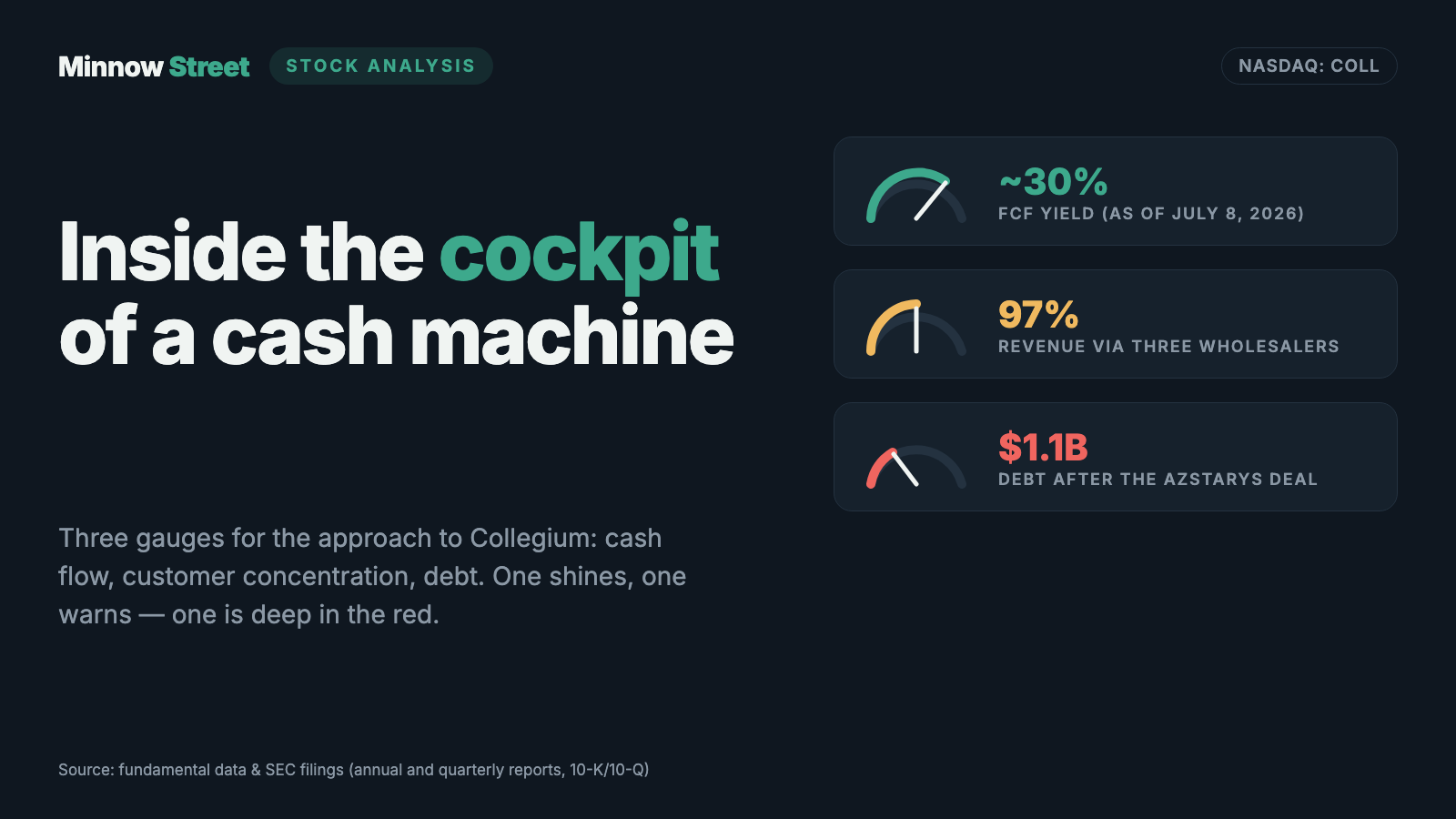
Collegium Pharmaceutical earns so much money with five acquired medicines for pain and ADHD that our FCF/market-cap scanner lists the stock near the top: roughly 30 percent free cash flow measured against the market value (data as of July 8, 2026). We worked through the annual reports (10-K) for 2024 and 2025, the quarterly report (10-Q) as of March 31, 2026 and the latest current reports (8-K): three wholesalers account for 97 percent of revenue, the opioid Nucynta has faced generic competition since early 2026, and the company has just bought a drug on credit for the fourth time in six years — for $650 million. Not investment advice — just a look at the expiration dates a screener never shows.
 Thomas Mücke
Founder & Publisher
Thomas Mücke
Founder & Publisher
Chart
Interactive price chart (TradingView).
Note: pure fact-based analysis, not investment advice and not a solicitation to buy or sell. All figures without guarantee.
There is an investor trap that strikes with particular relish when the numbers are solid: the ruler trap. It works like this: you see a company with growing revenue and fat cash flow, you mentally lay a ruler along the last four years — and extend the line into the future. The brain loves straight lines. Exactly such a line is what our in-house stock scanner shows for Collegium Pharmaceutical (Nasdaq: COLL): $329.3 million of operating cash flow in 2025 against a market value of about $1.1 billion — roughly 30 percent free cash flow measured against the market cap, rank 17 in our FCF/market-cap ranking (as of July 18, 2026; scanner data as of July 8, 2026). The problem: at a pharmaceutical company, revenues carry a legal expiration date. It is not printed on the package — it sits in patent registers and court dockets, and whoever lays the ruler without knowing those dates is extending a line that at some point simply breaks off. So let's make a deal: we read together what Collegium itself reported, under penalty of law, to the U.S. securities regulator, the SEC — the annual reports (10-K) for 2024 and 2025, the quarterly report (10-Q) as of March 31, 2026 and the most recent current reports (8-K). By the end you will know where the expiration dates lie — and decide for yourself whether the cash flow yield is worth the risk to you.
What Collegium Pharmaceutical actually does
Collegium is a specialty pharma company — and here that means: not a research factory with labs full of hopefuls, but a marketing machine for acquired medicines. The company from Stoughton, near Boston (423 employees at the end of 2025), buys finished, approved drugs and sells them to U.S. physicians with two specialized field forces: roughly 105 pain reps and roughly 200 ADHD reps. The portfolio as of mid-2026: Belbuca (a buprenorphine film for the inside of the cheek, for severe chronic pain; $221.7 million of 2025 revenue), Xtampza ER (an abuse-deterrent oxycodone formulation; $199.3 million), the Nucynta family (tapentadol tablets, licensed from the German pharma group Grünenthal; $196.3 million), the constipation drug Symproic ($14.5 million) — and, as the newest building block, the ADHD segment: Jornay PM, a methylphenidate product taken in the evening that starts working in the morning ($148.9 million; added through the Ironshore acquisition in September 2024), plus, since May 12, 2026, Azstarys, another ADHD stimulant, acquired for $650 million in cash. The pattern behind it is the actual strategy: Collegium buys a new drug on credit every two years — Nucynta in 2020, Belbuca parent BDSI in 2022, Ironshore in 2024, Azstarys in 2026. Which brings us to the central tension of this analysis, and it runs through every chapter: Collegium is a genuine cash machine — but every one of its revenue sources has an expiration date, and the company must keep pouring the cash flow into new, debt-financed acquisitions before the old sources run dry. What a pharma business model that hangs on a single drug looks like is something we dissected at gastrointestinal specialist Ironwood — and why an addiction-medicine maker, of all companies, benefits from the opioid issue, in our Indivior analysis.
Where the stock shows up in our scanner — and what the discount reveals
Every day we run about 3,500 stocks through our scanners. As of the July 8, 2026 data cut-off, COLL delivered 7 hits — and the mix is telling. On the cheap side: the price-to-cash-flow and price-to-free-cash-flow rankings plus the FCF/market-cap ranking, where COLL stood at roughly 30 percent, rank 17 (as of July 18, 2026). On the quality side: EPS acceleration, a tight weekly range, the institutional-buying scanner and a Power Trend signal. To replicate it yourself: open the COLL stock page or browse the FCF/market-cap scanner. The fundamental lens of the same scanner shows a split picture: a Piotroski F-score of 8 of 9 (a nine-point test of the direction of the books — 8 is strong) and an Altman Z-score of about 5.7 (far from distress territory) — but an EPS rating of only 16 and relative strength around 30, because the stock traded roughly a quarter below its level at the start of the year and about 29 percent below its high (all data as of July 8, 2026). Translated: the market is not offering you an undiscovered treasure here, but a deliberately granted discount. A 30 percent cash flow yield is never given away on the stock exchange — it is the premium paid to whoever carries the expiration dates. Which ones those are is what the next chapters sort out. Remember the image: a screener measures the height of the water jet — not how long the spring will keep flowing.
The numbers over the years — honestly appraised
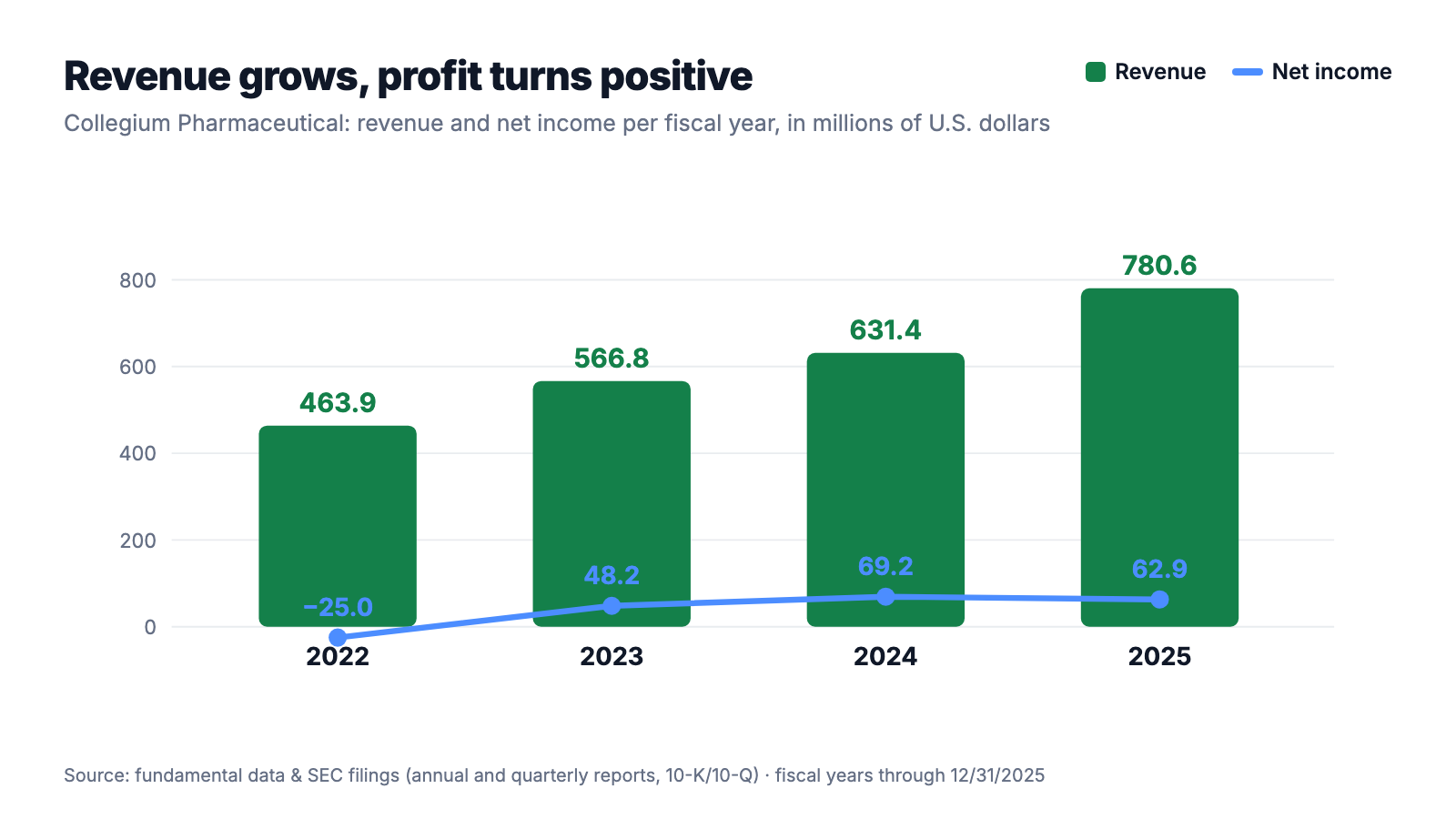
First, what genuinely impresses. Collegium is growing briskly: revenue climbed from $463.9 million (2022) through $566.8 million and $631.4 million to $780.6 million in 2025 (+23.6 percent), and the first quarter of 2026 added $193.5 million (+8.9 percent). The Jornay PM acquisition is delivering exactly what it was bought for: $148.9 million of revenue in its first full year 2025, and another 36 percent growth to $38.9 million in the first quarter of 2026. The earnings turnaround is done, too: after a loss of $25.0 million in 2022, Collegium earned $48.2 million (2023), $69.2 million (2024) and $62.9 million (2025); the first quarter of 2026 brought $14.5 million after $2.4 million in the prior-year quarter — diluted $0.40 per share (+471 percent, albeit from a low base, because acquisition costs weighed on early 2025). The most important number for our scanner hit, however, sits in the cash flow statement: $329.3 million of operating cash flow in 2025 (2024: $205.0 million; 2023: $274.7 million), plus another $57.1 million in the first quarter of 2026 — against capital expenditures of under $5 million a year, because a marketer barely needs factories. Here is what that looks like:
Now the context the scanner does not supply: why is cash flow five times as high as net income? The answer sits in a single line of the income statement: $221.9 million of amortization on intangible assets in 2025 alone — that is the purchase price of the acquired drug rights ($1.59 billion of acquisition cost in total), spread over their useful life, depressing the paper profit while costing no cash. That is why Collegium reports, alongside GAAP net income, adjusted EBITDA of $460.5 million (2025). Both views have their justification — and their trap: GAAP net income understates current earning power, while adjusted EBITDA pretends the amortization is air. It is not: it is the price of revenues already bought — and it is the reminder that those revenues have expiration dates and must be replaced. The second chart shows the triangle of cash, profit and amortization:
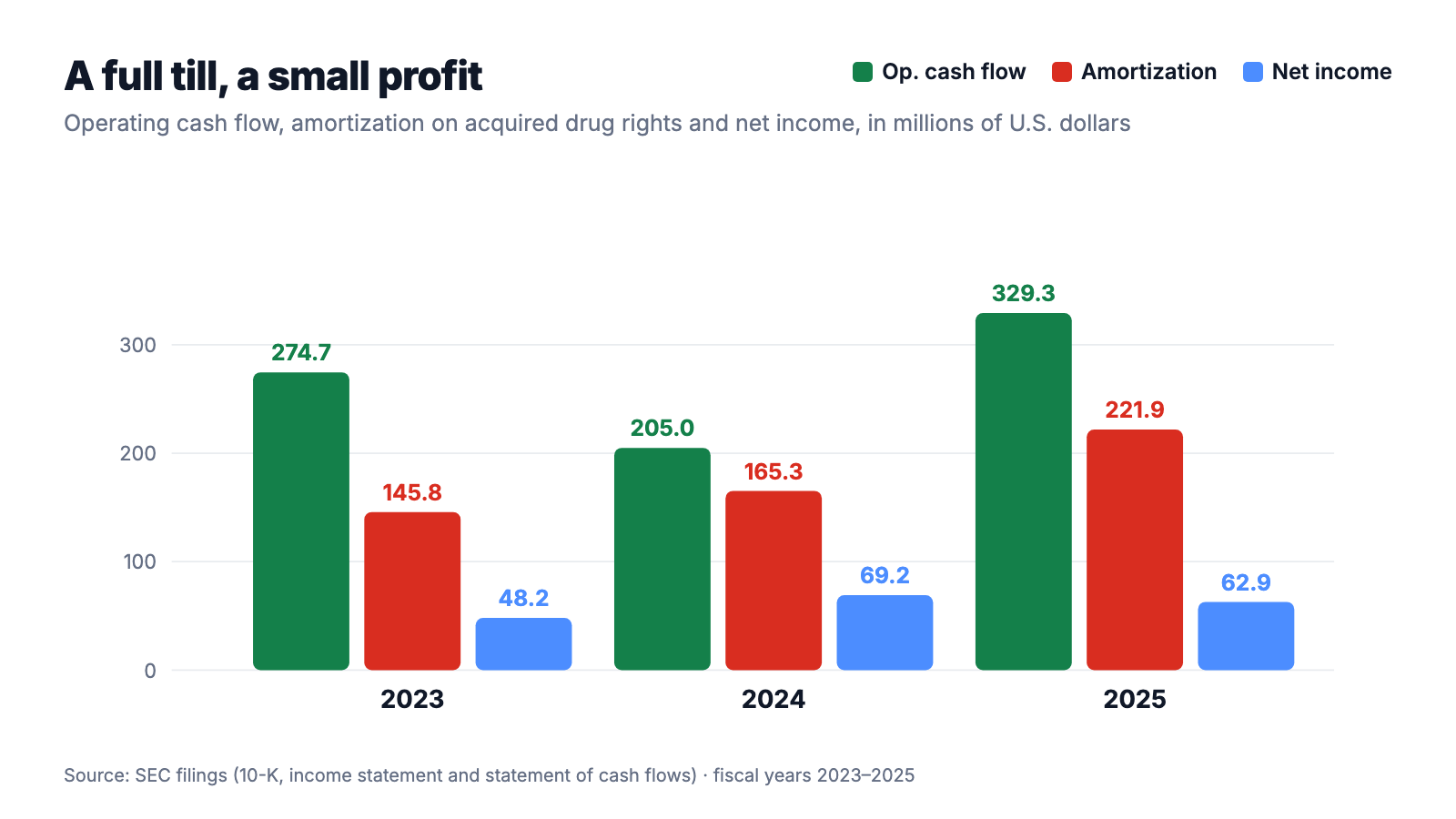
Remember this pattern: at an acquisition-driven pharma company, the cash flow is the present, the amortization is the past — and the patent register is the future. Which brings us to the uncomfortable truths.
What the filings say — the uncomfortable truths
Uncomfortable truth no. 1: Five product families, three customers — 97 percent of revenue runs through three wholesalers
Collegium's revenue has two choke points, and both are in the annual report in black and white. The first: there is no cushion of dozens of products. The 10-K says so itself:
"Since we expect to rely on sales generated by Jornay PM, Belbuca, Xtampza ER, the Nucynta Products, and Symproic for substantially all of our revenues for the foreseeable future, the failure of these products to maintain market acceptance would harm our business prospects."
— Collegium Pharmaceutical, Inc., SEC annual report 10-K for fiscal year 2025, Item 1A "Risk Factors"
The second choke point sits one level deeper, in the distribution channel — and it is even narrower:
"These same three customers comprised 34 %, 34 %, and 29 % of revenue during the year ended December 31, 2025; 33 %, 33 %, and 31 % during the year ended December 31, 2024; and 33 %, 32 %, and 32 % during the year ended December 31, 2023."
— Collegium Pharmaceutical, Inc., SEC annual report 10-K for fiscal year 2025, Note 2 "Summary of Significant Accounting Policies — Concentrations of Credit Risk"
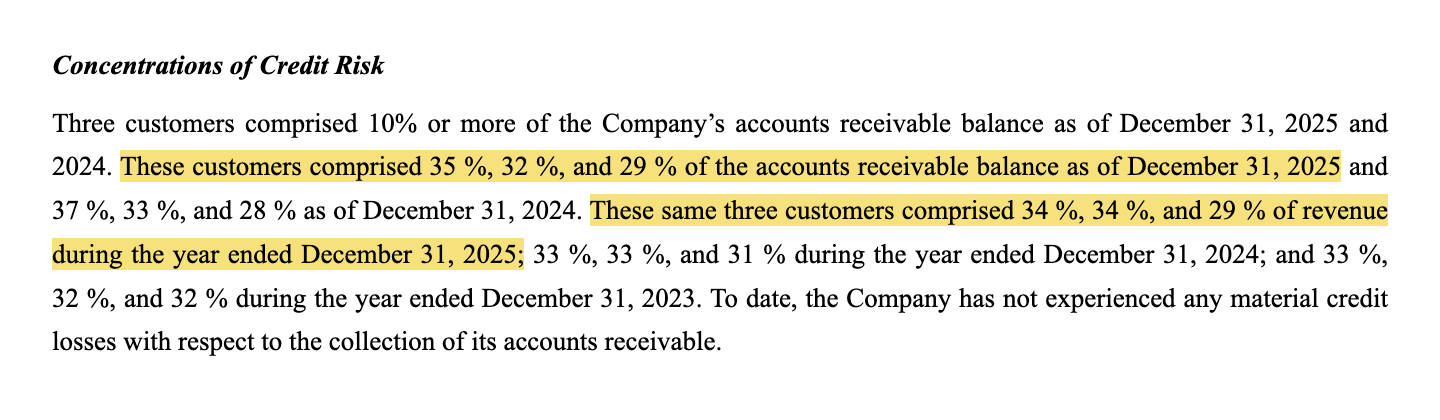
Context requires fairness: in the United States, medicines flowing through three national wholesalers is the industry standard — practically every U.S. pharma company carries this footnote. But it has consequences: the three buyers together also hold 96 percent of receivables (35, 32 and 29 percent as of December 31, 2025), and whoever has only three customers does not negotiate terms, inventory levels and returns from a position of strength. Picture it like this: Collegium runs five market stalls — but all the goods travel on three trucking companies. If one drops out or changes its terms, it is not a fifth that wobbles, but a third.
Uncomfortable truth no. 2: The expiration dates are not a theory — the Nucynta generic has been on the market since February 2026
What happens when a patent falls is something the annual report describes with disarming clarity:
"Thus, after the introduction of a generic competitor, a significant percentage of the sales of any branded product are typically lost to the generic product."
— Collegium Pharmaceutical, Inc., SEC annual report 10-K for fiscal year 2025, Item 1A "Risk Factors"
And at Collegium that is no distant scenario — it has been reality since early 2026, and the quarterly report documents the sequence precisely:
"Hikma launched a generic version of Nucynta IR on February 25, 2026 and a generic version of Nucynta ER on March 11, 2026."
— Collegium Pharmaceutical, Inc., SEC quarterly report 10-Q as of March 31, 2026, Item 2 MD&A "Overview"
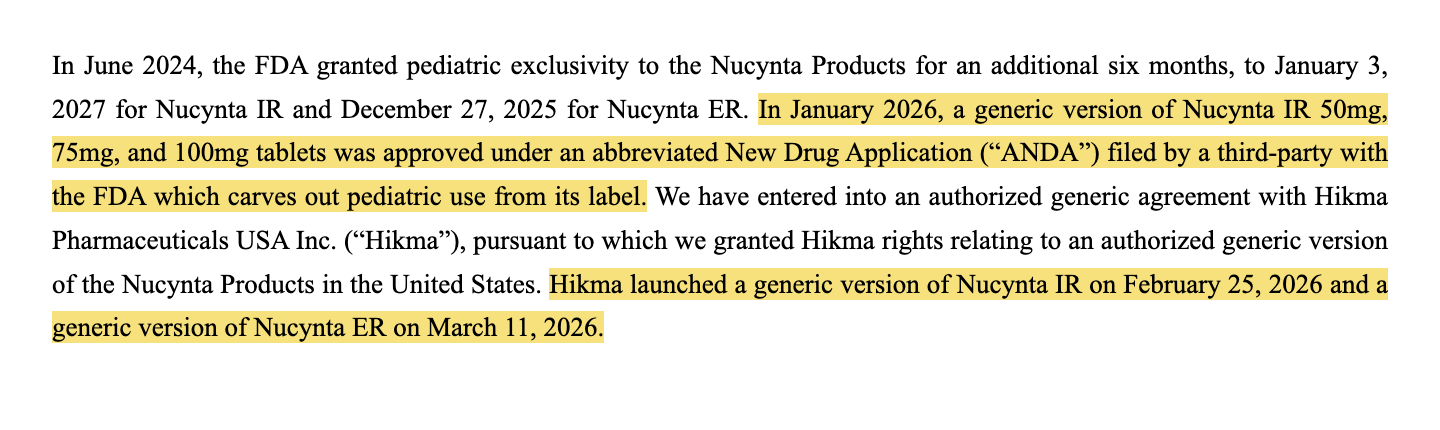
Let's sort the portfolio's expiration dates, all from the SEC filings. Nucynta ($196.3 million of 2025 revenue, a quarter of sales): regular exclusivity for Nucynta IR runs through July 3, 2026 (pediatric through January 2027), a third-party generic with the pediatric indication carved out was already approved in January 2026, and Collegium itself has launched "authorized generics" through Hikma — the company's own brand is being cannibalized by design so it at least earns something in the generic market. Belbuca ($221.7 million, the largest product): a years-long patent war against generic maker Alvogen is running here — one patent protects through 2027, the second through December 2032; Alvogen disputes the latter, a new trial is scheduled for April 12, 2027, and a further ANDA suit against Chemo/Insud runs in parallel. Xtampza ER ($199.3 million): patents through 2030 and 2036 — this is where the wall is most solid; challenger Chemo has already collected five FDA rejection letters. Jornay PM: 16 patents through 2032, but a fresh warning of a different kind — in July 2025 the FDA announced it would add a warning about weight loss in children under six to all extended-release ADHD medicines; whether that slows prescriptions is open, as the 10-K itself concedes. The verdict of this inventory: roughly a quarter of revenue is already in the generic transition, the largest product hangs on a court date in April 2027 — and the most stable part of the portfolio is, of all things, the newest, most expensive acquisition.
Uncomfortable truth no. 3: The treadmill runs on credit — a good $1.1 billion of debt, and the next installment is already booked
If every revenue source expires, replacements must keep coming — and Collegium traditionally buys them on credit. The dependence on the portfolio is named by the annual report itself, in a remarkably sober sentence:
"We are primarily dependent on the commercial success of Jornay PM, Belbuca, Xtampza ER, and the Nucynta Products."
— Collegium Pharmaceutical, Inc., SEC annual report 10-K for fiscal year 2025, Item 7 MD&A "Liquidity and Capital Resources"
The debt chronicle reads like the treadmill's ticket stub: a convertible and a loan for the Nucynta purchase in 2020, a $650 million term loan from pharma credit fund Pharmakon for the BDSI acquisition (Belbuca) in 2022, upsized to $645.8 million in 2024 for Ironshore (Jornay PM), replaced at the end of 2025 by a bank facility led by Truist — a $580 million term loan, a $300 million delayed-draw tranche, a $100 million revolver, at an initial effective rate of 6.9 percent. On top come the 2029 convertible notes of $241.5 million (conversion price roughly $36.56) and a royalty obligation of $121.6 million assumed with Ironshore, which routes 9.7 percent of Jornay revenues through 2032 to former Ironshore backers — effective interest rate: 11.8 percent. Then, on May 12, 2026, the next installment was booked:
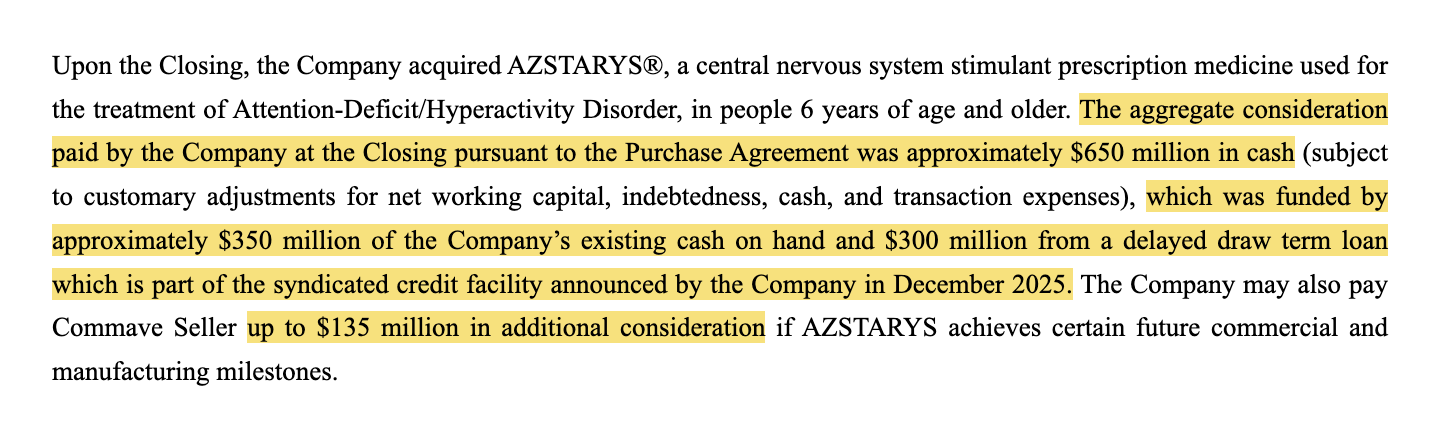
"The aggregate consideration paid by the Company at the Closing pursuant to the Purchase Agreement was approximately $650 million in cash […], which was funded by approximately $350 million of the Company's existing cash on hand and $300 million from a delayed draw term loan which is part of the syndicated credit facility announced by the Company in December 2025."
— Collegium Pharmaceutical, Inc., SEC current report 8-K of May 12, 2026, Item 2.01 (closing of the Azstarys acquisition)
Let's add it up, as of the Azstarys closing: roughly $573 million of remaining term loan plus $300 million of delayed draw plus $241.5 million of convertible notes — a good $1.1 billion of borrowings, plus the royalty obligation and up to $135 million of potential Azstarys milestone payments. Interest expense already ran at $82.3 million in 2025 — more than net income. In fairness: the till is well filled ($268.6 million plus $153.1 million of marketable securities as of March 31, 2026, before the $350 million payment), the cash flow services the debt comfortably, and the credit agreements are market standard. But two footnotes deserve a look. First, the new facility carries a springing maturity clause — if more than $50 million of the convertible is still outstanding in November 2028 and liquidity is below $350 million, the entire bank loan comes due two years early. Second, Jornay PM missed its agreed revenue milestone from the Ironshore deal in 2025 — the $25 million top-up payment lapsed without replacement. Good for the till, but a quiet reminder that even acquisitions do not automatically deliver what the deal model promises.
Uncomfortable truth no. 4: Four fifths of revenue is opioids — regulated, litigated, socially mined terrain
Which leaves the elephant in the room. Belbuca, Xtampza ER and Nucynta are opioids; together with the opioid-side-effect drug Symproic they accounted for roughly 81 percent of 2025 revenue. The annual report names the environment without varnish:
"These effects contribute to the attractiveness of opioids for abuse and, indeed, the U.S. Centers for Disease Control and Prevention (“CDC”) has described abuse of prescription drugs in the United States as a vast and deadly epidemic."
— Collegium Pharmaceutical, Inc., SEC annual report 10-K for fiscal year 2025, Item 1 "Business — Government Regulation"
What that means concretely, sorted soberly. Regulation: Xtampza ER, Nucynta and Jornay PM are DEA Schedule II substances (the highest control tier for marketable medicines), Belbuca is Schedule III; manufacturing, shipping and dispensing are subject to quotas and documentation duties, and all opioid products additionally to a mandatory risk program (REMS). Legal history: from 2018 Collegium was sued by municipalities — like practically every opioid maker — but resolved it comparatively lightly: a March 2022 settlement ended 27 suits for a payment of $2.75 million; three cases filed later in 2023 were dismissed as to Collegium. Open are information requests from four state attorneys general (Washington, New Hampshire, Maryland; an assurance of discontinuance was signed with Massachusetts in 2021). Business logic: Collegium deliberately positions itself as a maker of abuse-deterrent formulations — Xtampza ER is hardened against crushing and snorting, Belbuca sits in the lower Schedule III. That is a legitimate, medically sensible business serving real pain patients. But as an investor you buy the environment along with it: falling opioid prescription volumes across the market, politically intended pressure, litigation risk as a permanent condition — and a reputation discount the stock market is unlikely to erase any time soon. Which is exactly why management is building the second leg, ADHD, with Jornay PM and Azstarys: a growth market without the opioid stigma — though with pitfalls of its own, from the FDA labeling initiative to DEA regulation, because stimulants are Schedule II too.
Valuation: 17 times earnings, 3.4 times cash flow — the discount has a calendar
As of the July 8, 2026 data cut-off, COLL stock cost about $34.80, for a market value of roughly $1.1 billion on 32.4 million shares outstanding (April 30, 2026). Measured against GAAP earnings of the last four quarters (roughly $2.06 per diluted share), that is about 17 times earnings; measured against operating cash flow, roughly 3.4 times — and you now know the gap between those two numbers: it is the amortization of the acquisitions. Add the debt and the whole company (enterprise value) costs roughly twice the market cap — still moderate against adjusted EBITDA of $460.5 million (2025), but no longer a gift. Meanwhile a second lever works for shareholders: buybacks. In 2023 Collegium repurchased $75.0 million of its own stock (average $24.29), from 2024 through mid-2025 another $85.0 million (average $31.43); since July 2025 a new $150 million program through the end of 2026 is authorized, still fully unused as of March 31, 2026 — understandably, since $650 million came due for Azstarys at the same time. Set against that is quiet dilution: the diluted share count of 40.1 million includes 6.6 million shares from the convertible (conversion price $36.56) plus employee stock programs — a gap of a good 20 percent between basic and diluted. So why the discount? You know the answer: the market is not pricing the present, it is pricing the calendar — Nucynta generics since February 2026, the Alvogen trial in April 2027, the convertible in 2029, the springing maturity in 2028, Jornay patents through 2032. The stock is measurably cheap — as a bet that management restocks the treadmill faster than it empties.
Opportunities and risks at a glance
What speaks for COLL:
- A genuine cash machine: $329.3 million of operating cash flow in 2025 on minimal capital expenditures, roughly 30 percent FCF yield on the market cap (data as of July 8, 2026) — and a Piotroski F-score of 8 of 9.
- Growth with a plan: revenue up 68 percent in four years ($463.9 million to $780.6 million), Jornay PM grew 36 percent in the first quarter of 2026, and with Azstarys the second ADHD product is on board — the shift away from a pure opioid business is underway.
- Shareholder-friendly capital allocation alongside the acquisitions: $160 million of buybacks from 2023 through mid-2025, and a new $150 million program authorized through the end of 2026 (unused as of March 31, 2026).
- Xtampza ER as a stable anchor: patents through 2030/2036, generic challenger Chemo has already collected five FDA rejections — and the abuse-deterrent profile is a tailwind rather than a headwind in the opioid environment.
- The opioid legacy was settled cheaply so far: a $2.75 million settlement (2022) for 27 municipal suits — no comparison to the billion-dollar burdens of other makers.
What speaks against it:
- Extreme concentration: five product families, three wholesalers with 97 percent of revenue, roughly 81 percent opioid share — any disruption immediately hits the whole.
- The expiration dates are running: Nucynta (a quarter of 2025 revenue) has been in the generic transition since early 2026; Belbuca, the largest product, hangs on the outcome of the Alvogen trial (April 2027; patents 2027/2032).
- A debt treadmill: a good $1.1 billion of borrowings after the Azstarys purchase, $82.3 million of interest expense (2025), a royalty obligation at an 11.8 percent effective rate — plus a springing maturity clause that can push two maturities together in 2028.
- Acquisition risk as a permanent condition: the Ironshore revenue milestone for Jornay PM was missed in 2025, an arbitration from the Ironshore past demands more than $500 million, and every new purchase (Azstarys: $650 million plus up to $135 million of milestones) still has to prove itself.
- A regulated, stigmatized core business: DEA quotas, REMS obligations, open state attorney general inquiries, the FDA labeling initiative for extended-release ADHD drugs — the valuation discount has structural reasons.
A human conclusion
Back to the ruler trap from the beginning. Its point is not that the line is drawn wrong — Collegium's cash flow is real, audited and impressive. Its point is that the ruler does not know where the line ends. At a software house you may extrapolate; at an acquisition-driven pharma company you must set deadlines: Nucynta is already expiring, Belbuca gets its court date in April 2027, Xtampza carries into the 2030s, Jornay and Azstarys are the expensively purchased extensions. Collegium's business model is, looked at closely, a perpetual race: at the front, the company buys new revenue years with borrowed money; at the back, generics eat the old ones — and the 30 percent cash flow yield from the scanner is the price the market pays you for carrying that race. So the honest question to you is not "How can a profitable company be this cheap?" but rather: do you trust this management to buy the right drug at the right price every two years — with borrowed money, against ticking patent clocks? If yes, you are being paid above average here for a known, calculable risk. If no, the scanner hit has just shown you, free of charge, what a value trap looks like from the inside — before you stepped into it. What you make of it is your decision. And that is exactly as it should be.
Sources
All original documents used in this analysis — for your own reading:
- Collegium Pharmaceutical, Inc. — SEC annual report 10-K for fiscal year 2025 (filed February 26, 2026)
- Collegium Pharmaceutical, Inc. — SEC annual report 10-K for fiscal year 2024 (filed February 27, 2025)
- Collegium Pharmaceutical, Inc. — SEC quarterly report 10-Q as of March 31, 2026 (filed May 7, 2026)
- Collegium Pharmaceutical, Inc. — SEC current report 8-K of March 19, 2026 (Azstarys purchase agreement)
- Collegium Pharmaceutical, Inc. — SEC current report 8-K of May 12, 2026 (closing of the Azstarys acquisition)
- Complete SEC filing history of Collegium Pharmaceutical, Inc.: EDGAR overview (sec.gov)
- Fundamental data (metrics, quarterly series, valuation; data as of July 8, 2026), cross-checked against the SEC filings.
- Screener and rating data: in-house stock scanner (data as of July 8, 2026; FCF/market-cap rank verified on July 18, 2026).
Transparency & disclaimer: This analysis is a journalistic contextualization of publicly available information and is not investment advice, not a financial analysis in the regulatory sense and not a solicitation to buy or sell securities. Stock investments carry substantial risks up to and including total loss. All information without guarantee; the data cut-off is noted in the text. The author holds no position in COLL shares at the time of publication.
Our Bottom Line at a Glance
- Cash machine & growth positive
- Revenue up 68 percent in four years to $780.6 million (2025), operating cash flow of $329.3 million on minimal capital expenditures, adjusted EBITDA of $460.5 million, a Piotroski F-score of 8 of 9 — the marketing machine runs, and Jornay PM grew 36 percent in the first quarter of 2026 (10-K 2025, 10-Q Q1 2026).
- Scanner metric & valuation neutral
- Roughly a 30 percent FCF yield and 3.4 times operating cash flow (data as of July 8, 2026) are a real discount — but GAAP net income is only $62.9 million because $221.9 million of amortization reflects the purchased revenues, and with debt included the whole company costs roughly twice the market cap.
- Product, customer & patent concentration negative
- Five product families deliver essentially all revenue and three wholesalers 97 percent (2025); Nucynta (a quarter of sales) has been in the generic transition since February/March 2026, Belbuca hangs on the Alvogen trial (April 12, 2027; patents 2027/2032) — only Xtampza ER (2030/2036) and the ADHD products (through 2032) carry further (10-K 2025, 10-Q Q1 2026).
- Debt & the acquisition treadmill negative
- The fourth debt-financed acquisition in six years: after the Azstarys closing ($650 million, $300 million of it from a delayed-draw loan), a good $1.1 billion of borrowings plus a $121.6 million royalty obligation (11.8 percent effective rate) is outstanding; interest expense of $82.3 million (2025), a springing maturity clause as of November 2028; the 2025 Ironshore revenue milestone was missed (10-K 2025, 8-K 05/12/2026).
- Opioid & regulatory environment neutral
- Roughly 81 percent of 2025 revenue hangs on opioids (Schedule II/III, REMS, DEA quotas); the litigation wave was settled cheaply so far at $2.75 million (2022), four state attorneys general still have open inquiries — the ADHD build-out (Jornay PM, Azstarys) reduces the stigma risk but swaps it for FDA labeling and stimulant regulation risks (10-K 2025).
COLL is not an overlooked bargain but an openly priced race: a highly profitable marketing machine with roughly a 30 percent cash flow yield — and a portfolio whose revenue sources expire one after another and must be replaced on credit. Real are $329.3 million of operating cash flow and a working ADHD build-out; real too are three wholesalers with 97 percent of revenue, Nucynta generics since early 2026, a Belbuca trial in April 2027 and a good $1.1 billion of debt. Whoever buys the stock buys the calendar along with it. Not investment advice.
What Our Rating Means
- If you don't own the stock
- As long as the question raised in the bottom line stays open, we see no basis for an entry.
- If you hold it in your portfolio
- Our findings offer no acute reason to sell — the checkpoints named remain decisive.
A journalistic assessment by our editorial team at the time of the deep dive, based on public sources — not investment advice and not a solicitation to buy or sell. Your personal circumstances (investment goals, risk capacity, taxes) cannot be taken into account. What our categories mean, how verdicts are formed, and what conflicts of interest exist →
Worth Noting
- COLL reached our research list via rank 17 in the in-house FCF/market-cap scanner (as of July 18, 2026; scanner data as of July 8, 2026) — the analysis deliberately shows that a high FCF yield at pharma marketers is the compensation for patent and generic risks, not their absence.
- Pharma caveat: GAAP net income understates current earning power because amortization on acquired drug rights ($221.9 million in 2025) is non-cash; adjusted EBITDA overstates it because it ignores the required replacement of expiring products. What matters are cash flow, expiration dates and the debt structure.
- Price and valuation figures dated July 8, 2026 (about $34.80 per share, about $1.1 billion market cap); analyses are evergreen, daily prices are not a buy argument.
Frequently Asked Questions
Collegium Pharmaceutical (Nasdaq: COLL) buys finished, approved specialty medicines and markets them in the United States: the pain drugs Belbuca, Xtampza ER and Nucynta, the constipation drug Symproic, and the ADHD medicines Jornay PM (Ironshore acquisition, 2024) and Azstarys (acquired in May 2026 for $650 million). Revenue 2025: $780.6 million (+23.6 percent) with 423 employees; the company does hardly any research of its own in the classic sense.
Because operating cash flow ($329.3 million in 2025) is roughly five times GAAP net income ($62.9 million): $221.9 million of non-cash amortization on acquired drug rights depresses the paper profit but costs no cash. Against a market cap of about $1.1 billion (data as of July 8, 2026) that works out to roughly a 30 percent FCF yield — the discount reflects the patent, generic and concentration risks of the portfolio.
Very: five product families deliver "substantially all" revenues according to the annual report, and three wholesalers accounted for 97 percent of 2025 sales (34, 34 and 29 percent) as well as 96 percent of receivables. Roughly 81 percent of 2025 revenue came from opioids and the opioid companion drug Symproic; the ADHD segment (Jornay PM, plus Azstarys since May 2026) is meant to reduce that dependence.
The Nucynta family accounted for $196.3 million of 2025 revenue — a quarter of sales. A third-party generic of Nucynta IR was approved in January 2026; Collegium responded with "authorized generics" through Hikma (launched February 25 and March 11, 2026), which the company manufactures itself and earns on. By its own annual report, after generic entry "a significant percentage" of a branded product's sales is typically lost — the transition is priced in, but real.
After the Azstarys closing (May 12, 2026), roughly $573 million of remaining term loan, $300 million of delayed-draw tranche and $241.5 million of 2029 convertible notes add up to a good $1.1 billion, plus a Jornay royalty obligation of $121.6 million (11.8 percent effective rate). Interest expense in 2025 was $82.3 million. A springing maturity clause can pull the bank debt forward to November 2028 if the convertible is then still largely outstanding and liquidity is below $350 million.
Belbuca, Xtampza ER and Nucynta are opioids (DEA Schedule II and III) with REMS obligations and production quotas. Collegium resolved the post-2018 litigation wave comparatively cheaply: a $2.75 million settlement (March 2022) covering 27 municipal suits; information requests from four state attorneys general remain open. The company deliberately focuses on abuse-deterrent formulations and is building a second leg in the ADHD market with Jornay PM and Azstarys.
Optically yes: about $34.80 per share and roughly $1.1 billion of market cap (data as of July 8, 2026) — about 17 times trailing GAAP earnings, 3.4 times operating cash flow, and an enterprise value of roughly twice the market cap against adjusted EBITDA of $460.5 million (2025). But the discount has a calendar: Nucynta generics since early 2026, the Alvogen trial over Belbuca in April 2027, the 2029 convertible and a good $1.1 billion of debt.
Found an error?
Did you spot a factual error, an outdated number, or a typo in this deep dive? Let us know briefly — your report goes straight to the editorial team.