The Largest Position That Appears in No 13F: Helikon, Orezone Gold and the Blind Spot of the Quarterly Filing
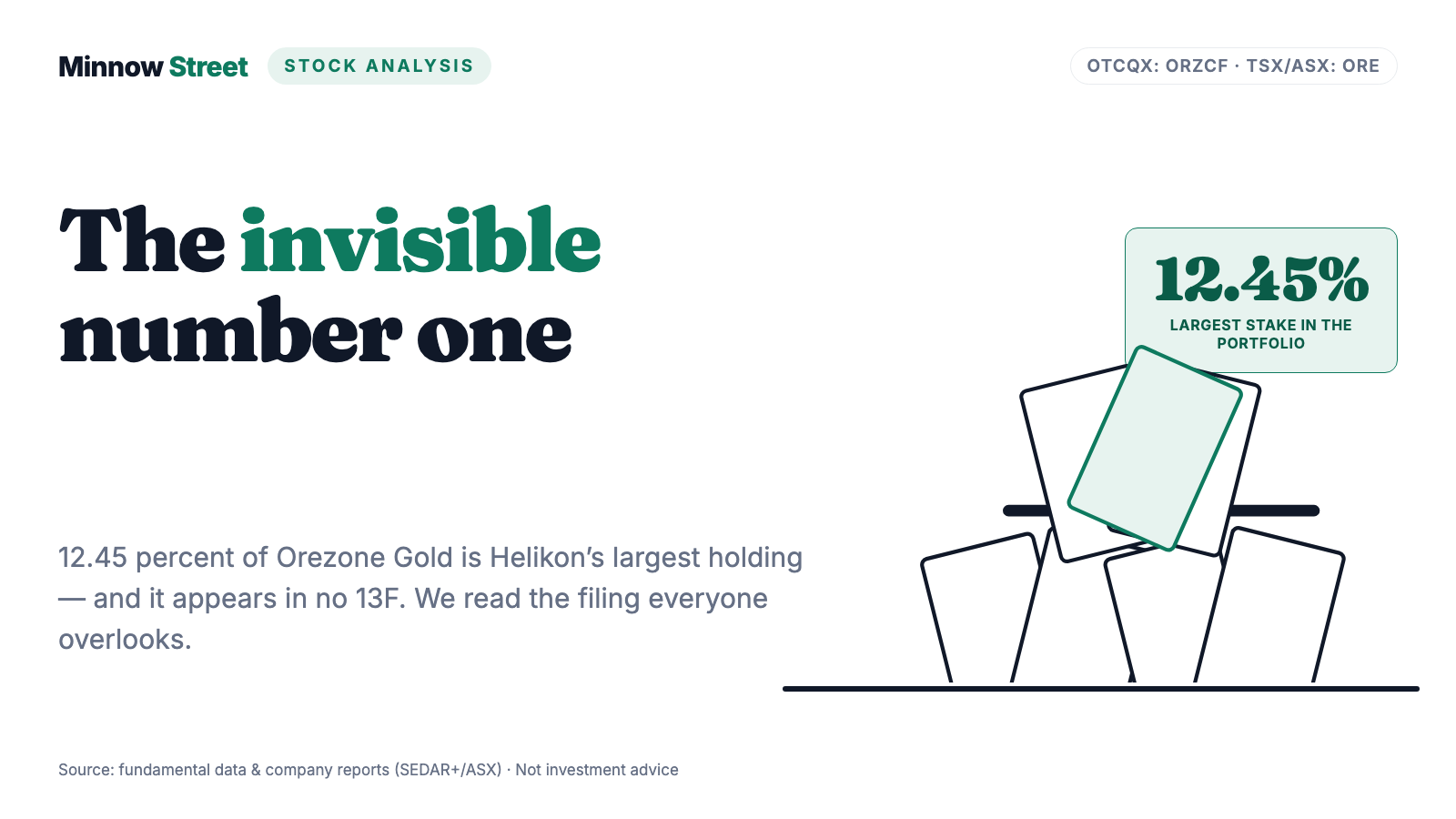
A 13F lists only what is listed in the United States. Orezone Gold trades in Toronto, Sydney and over-the-counter — and so falls through the mesh of the very filing everyone reads. There, in an eighteenth position that no quarterly report shows, sits the single largest holding in the entire Helikon portfolio at 12.45 percent; it surfaces only through a threshold filing. The gold producer behind it booked a record year in 2025 and still spent more than it took in; it remade itself from a single-mine operation in Burkina Faso into a two-country producer; and since August 2025 the state sits at the table with 15 percent instead of 10. Not investment advice — just the question of why a fund’s strongest conviction sits exactly where the metric-search shines its light least often.
 Thomas Mücke
Founder & Publisher
Thomas Mücke
Founder & Publisher
Chart
Interactive price chart (TradingView).
Note: pure fact-based analysis, not investment advice and not a solicitation to buy or sell. All figures without guarantee.
There is an old story about a man searching for his keys at night under a streetlight. A passer-by helps him; they search together and find nothing. Eventually the passer-by asks, "Are you sure you lost them here?" — "No," says the man, "over there in the dark. But this is where the light is." Call it the streetlight trap: we search not where the answer lies, but where it is easy to look. On the stock market the brightest streetlight is the 13F — the mandatory filing in which large U.S. asset managers disclose, every quarter, what they hold. Analysts read it, journalists read it, entire copycat portfolios are built on it. And precisely because of that, almost everyone misses that this streetlight has a dark rim. At London’s Helikon Investments Ltd, what sits in the dark is the fund’s single strongest conviction: 12.45 percent of Orezone Gold Corporation (TSX and ASX: ORE, OTCQX: ORZCF) — the highest percentage holding in the entire portfolio, and found in no 13F at all. So let us make a deal: we walk into the dark rim with a flashlight. We read the one filing that shows this position, and the reports Orezone itself files with the Canadian and Australian regulators. In the end you decide.
Why the largest position is invisible — and what a 13F actually shows
Start with the mechanics, because they are the whole trick. A 13F lists only U.S.-listed securities — in the jargon, "13(f) securities." Stocks listed on a U.S. exchange, options on them, some convertibles. Whatever is not listed on a U.S. exchange does not belong in it, however large the position. Orezone Gold trades in Toronto, in Sydney, and in the United States only over-the-counter under the ticker ORZCF — and over-the-counter OTC names do not count as 13(f) securities. The result: Helikon’s biggest bet falls through the mesh of the very filing everyone reads. It is an eighteenth position in a portfolio that the 13F shows with only seventeen.
It surfaces another way — through the threshold filing. Anyone holding more than 5 percent of a company must disclose it, regardless of where the stock is listed, as long as the company is registered in the United States. That filing is called Schedule 13G (the passive version) or 13D (the active one). And because Orezone is registered in the United States even though it is not regularly listed there, Helikon’s stake lands there — and only there. Remember this: a 13F is a rear-view mirror, and it has a blind spot. The threshold filing is the look into exactly that spot. Which names the central tension of this analysis: the fund’s strongest conviction sits precisely where the least attention is paid — and the company behind it is in the middle of remaking itself.
How this stock landed on our desk
This analysis does not begin with a hit in our in-house stock scanner — it begins with a form we found while going through Helikon’s filings. On July 9, 2026, Helikon Investments Ltd filed a Schedule 13G/A with the U.S. securities regulator, the SEC (accession 0001172661-26-002528, as of June 30, 2026). It states, in black and white: 83,054,336 Orezone shares, 12.45 percent of the class of "common shares without par value" (CUSIP 68616T109). Voting and dispositive power are solely "shared"; the reporting persons are Helikon Investments Limited and its principal, Federico Riggio, personally. The filing is made under Rule 13d-1(b) — the passive route open to institutional investors so long as they seek no control.
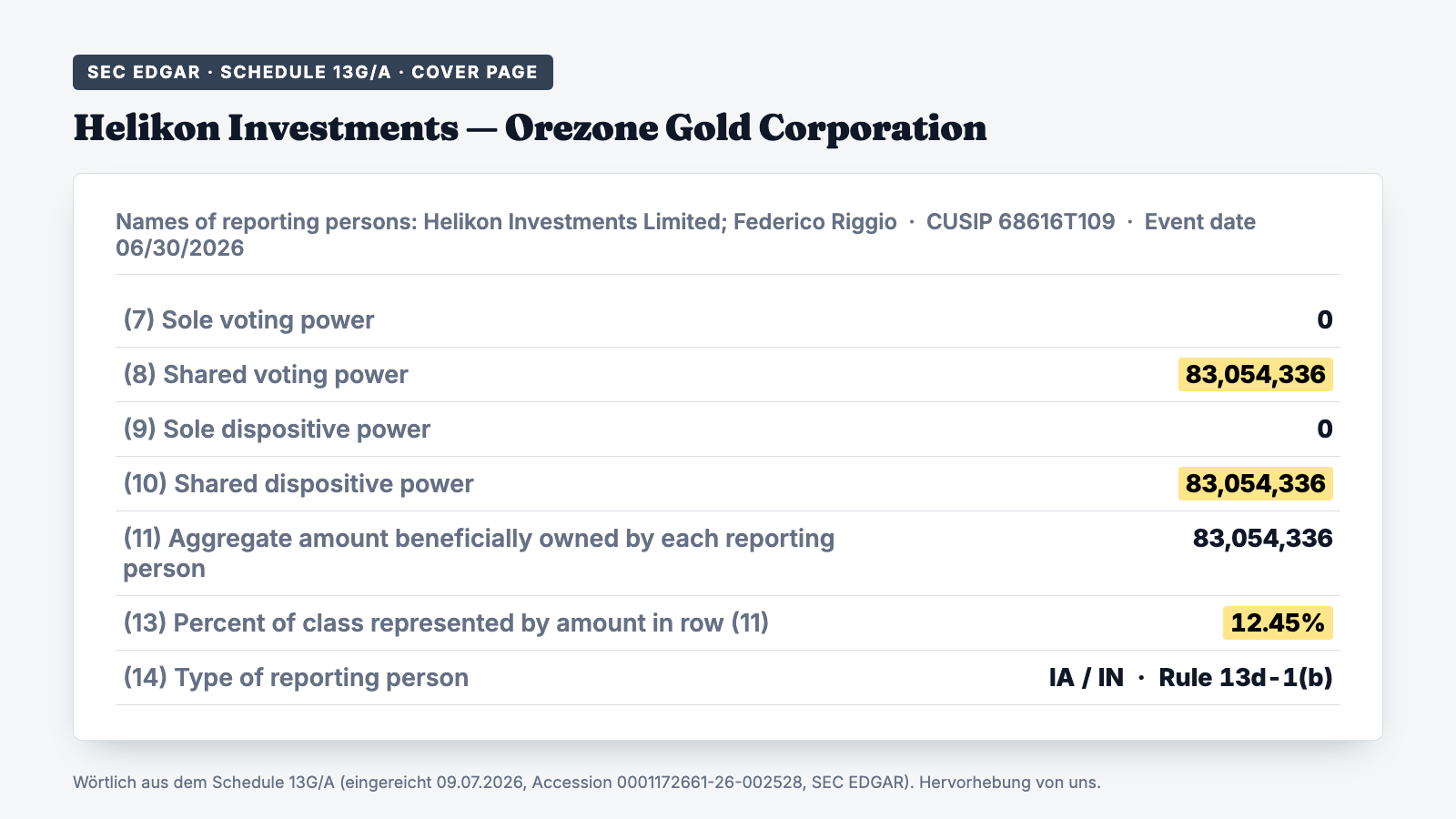
The history of this position is worth noting, because it is young. The first filing was a Schedule 13G on January 21, 2026, an amendment followed on April 7, 2026, and this second one on July 9, 2026. Built up and held over half a year — and above 12 percent, well beyond the 5 percent threshold. For a passive filer that is an unusually high stake; it is the real reason we are looking at this company so closely. And because honesty demands it: our in-house stock scanner did not push Orezone to the front. The name is Canadian, reports in U.S. dollars but trades outside the United States — the usual U.S. filters barely catch it, and our data set does not deliver a clean metric series for this OTC name. Orezone triggers neither a momentum nor a quality signal here. That gap is exactly what a filing sometimes fills.
Why there is no SEC filing from Orezone — and where the numbers come from instead
One point shapes the whole analysis: there is no 10-K, no 10-Q, no 40-F and no 20-F from Orezone. Orezone is not a U.S. reporting company; in the SEC’s EDGAR records the firm appears only as the subject of other parties’ threshold filings, never as a reporter itself. Its mandatory reports live elsewhere: on SEDAR+, the Canadian counterpart to the SEC, and at the Australian exchange, the ASX. There Orezone publishes its audited 2025 annual financial statements, the detailed management’s discussion and analysis (the Canadian MD&A), and, on February 28, 2026, an Appendix 4E, the Australian annual report. Accounting is under IFRS, reporting is in U.S. dollars — even though the mine is in West Africa and the stock trades in Toronto and Sydney.
What does that mean for you? The narrative logic we usually lean on — "a filing to the SEC is honest under penalty of law" — applies here to the Canadian and Australian mandatory statements: an audited IFRS report on SEDAR+ is a certified, liability-bearing document too, not a marketing text. But the source is a different one, which is why every figure in this analysis is captioned not "SEC filings" but "Source: fundamental data & company reports (SEDAR+/ASX)." Honesty also means this: to check this company you go to sedarplus.ca and the ASX, not sec.gov. That the single largest holding of a U.S.-reporting fund sits in a name you cannot even find as a reporter at the SEC is no accident — it is the same blind spot as the 13F, one layer deeper.
What Orezone actually does — from one mine in Burkina Faso to two countries
At its core Orezone is a gold producer, and until recently a single-mine one. Its heart is the Bombore mine in Burkina Faso, about 90 kilometres east of the capital Ouagadougou. Orezone holds it through the operating company Orezone Bombore S.A. at 85 percent since August 2025 (more on that shortly). The business model is as old as it is simple: take rock out of an open pit, crush it, leach out the gold, pour bars, sell. Profit is the gap between the gold price and the cost per ounce — the industry metric for which is AISC, all-in sustaining cost: everything it takes to produce an ounce and keep the mine running. In 2025 AISC was $1,776 per ounce. Remember the number: it is the height of the bar the gold price has to clear before anything is left over — and in 2025 it cleared it easily.
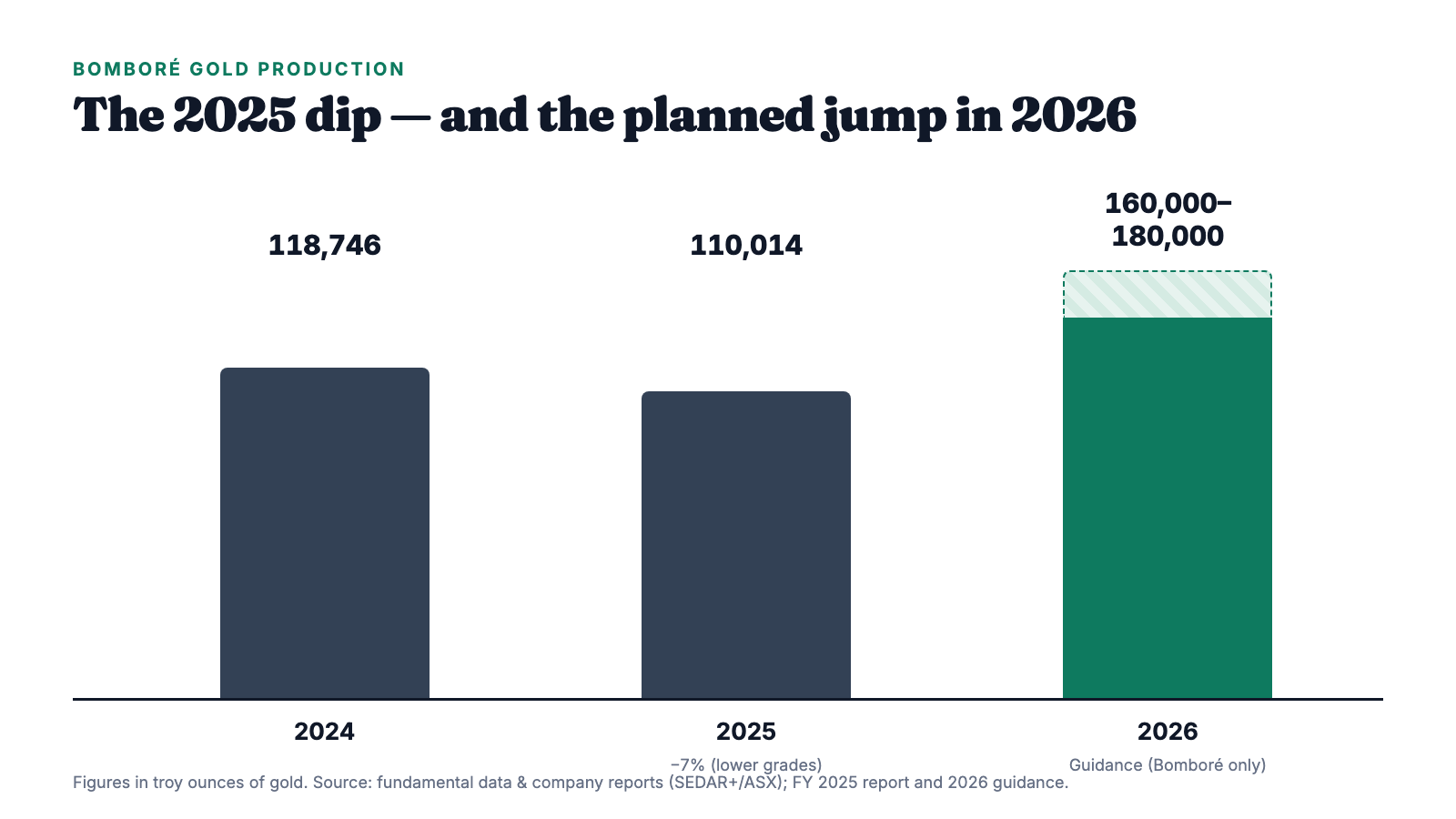
2025 was a year of reconstruction at Bombore. Orezone finished building the hard rock expansion (Stage 1, 2.5 million tonnes per year) — the step from an oxide-only mine (soft, near-surface ore) to an integrated operation that also processes the harder, deeper rock. First gold from hard rock flowed on December 15, 2025, commercial production was declared on January 16, 2026. That is why annual production in 2025 first fell 7 percent to 110,014 ounces (2024: 118,746) — lower ore grades, partly offset by higher throughput — and why 2026 guidance jumps to 160,000 to 180,000 ounces, up 45 to 64 percent.
And then came the second step, which turned a single-mine operation into something else. On March 25, 2026 Orezone completed the acquisition of the producing Casa Berardi mine in Quebec, along with a package of Canadian exploration properties. A gold producer with one mine in a single, politically demanding country became, overnight, a two-country company with a second, producing leg in one of the most stable mining jurisdictions in the world. The company has called itself a "diversified multi-asset producer" ever since. That is a genuine improvement in the risk profile — and it came at a price we will get to.
The numbers over the years — a record year with a flip side
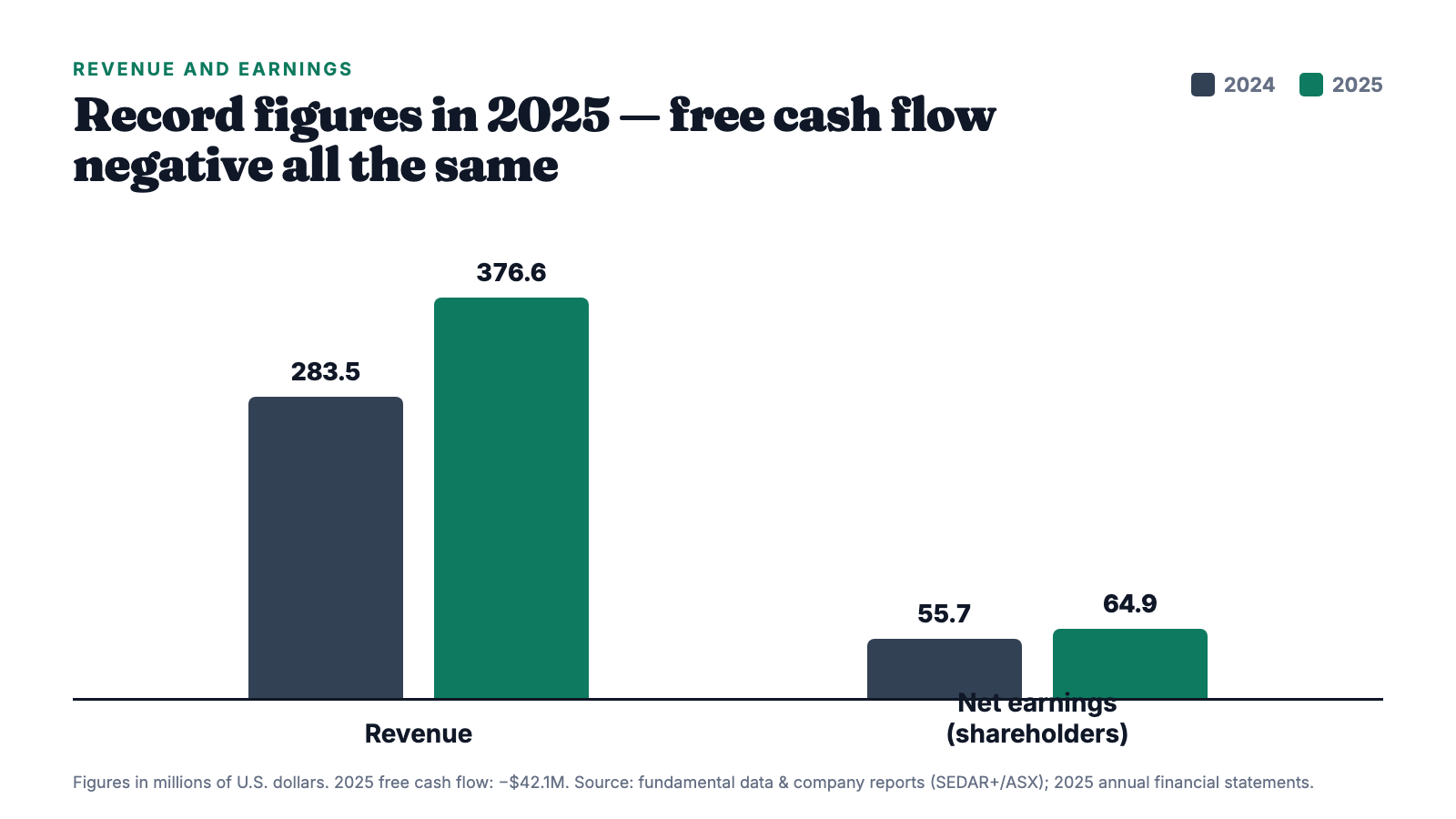
First what impresses. Revenue rose to $376.6 million in 2025 from $283.5 million in 2024 — up about a third, driven above all by the gold price: Orezone realized an average of $3,444 per ounce sold, up from $2,384 the year before. Net earnings attributable to shareholders climbed to $64.9 million (2024: $55.7 million), or $71.6 million adjusted. EBITDA reached $173.6 million (adjusted $181.1 million). Worth noting for context, and a difference from some peers: Orezone sells its gold largely at the market price — there is no large hedge book shearing off the top. The realized price is therefore close to the market price, not well below it as at some hedged producers.
Now the flip side, and it is the real finding. Despite the record profit, free cash flow in 2025 was negative: minus $42.1 million. Operating cash flow was $99.5 million — but the hard rock expansion consumed more than the business brought in. Cash fell to $98.0 million at year-end, and the expansion was largely funded with debt. That is not an alarm signal but the signature of an investment cycle — and it is the most important number that gets lost inside the word "record year."
What the reports say — the uncomfortable truths
Uncomfortable truth no. 1: since August 2025 the state sits at the table with 15 percent instead of 10
This is the core of the country risk, and it is stated explicitly in the annual report. Effective August 19, 2025, Orezone amended its mining convention with the State of Burkina Faso:
"Effective 19 August 2025, Orezone amended its mining convention with the State of Burkina Faso to increase the State's free carried interest in Orezone Bombore S.A. ('OBSA') from 10% to 15% in accordance with the new 2024 Mining Code, thereby reducing the Company's ownership interest from 90% to 85%. Concurrently, OBSA declared a dividend to its members in an amount equal to its accumulated earnings to 31 December 2024 as measured under OHADA accounting principles. The State's share of this dividend was XOF 7.4 billion ($13.2 million) which was subsequently paid by OBSA to the State on 25 August 2025."
— Orezone Gold Corporation, 2025 MD&A and ASX Appendix 4E (February 28, 2026)
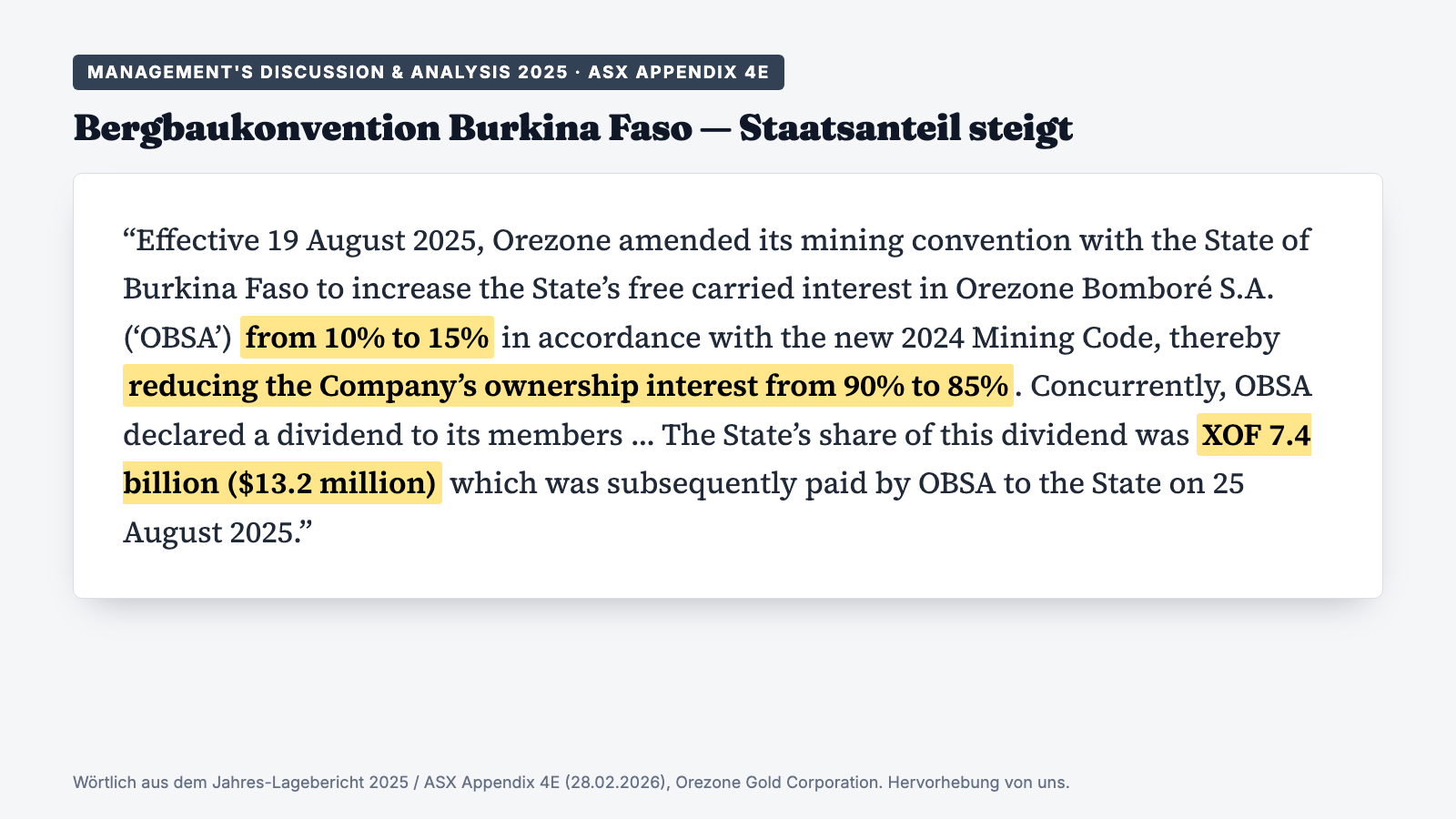
Translated into an everyday image: the silent partner who owned a tenth of the mine now gets a seventh — without paying a cent more. Five percentage points of a producing mine are a permanent diversion of part of every future profit. And it is a pattern, not a one-off: across the Sahel, governments keep raising their stakes in gold mines. There is at least a reassuring footnote — in September 2025 Orezone clarified that the government had "no intention to purchase an equity interest in the Bombore Gold Mine," meaning it did not plan to buy in beyond the 15 percent. Remember the pattern anyway: at mines in countries with state participation, the host country’s share often grows faster than the profit. And this is the strongest reason the second mine in Canada is more than a footnote.
Uncomfortable truth no. 2: in the most expensive gold year in history, Orezone spent more than it took in
Do the arithmetic. Operating cash flow 2025: $99.5 million. Free cash flow: minus $42.1 million. The roughly $142 million difference is capital spending — most of it on the Bombore hard rock expansion. This is the classic trap at growth producers: profit gleams because it spreads depreciation over years, but the money is already gone, into concrete, mills and earthmoving. For an investor, free cash flow is the more honest number than profit — it shows what is really left after all investment, and in 2025 nothing was left; there was even a shortfall.
The good news sits right beside it: this spending has an end. The expansion is built, first gold flowed on December 15, 2025, commercial production is running. 2026 guidance for Bombore alone is 45 to 64 percent above 2025. Whoever holds the stock is betting that free cash flow flips sign in the first full hard rock year — from minus to plus. How strongly a single investment cycle can distort a gold producer’s numbers also showed up in our Allied Gold analysis from the same Helikon portfolio. Remember this: a record profit with negative free cash flow is not a contradiction — it is a bet that the build pays off.
Uncomfortable truth no. 3: the diversification is real — but its bill is still to come
Casa Berardi solves the most dangerous problem of the old Orezone: dependence on a single mine in a single Sahel state. But that solution was not free. Completing it on March 25, 2026 cost:
"On closing, the Company paid $160M in cash and issued 65,757,265 common shares, representing 9.9% of the post-closing shares of Orezone. … the acquisition … positions Orezone as a diversified multi-asset producer, adding material scale, production and free cash flow."
— Orezone Gold Corporation, news release on completion of the Casa Berardi acquisition, March 25, 2026
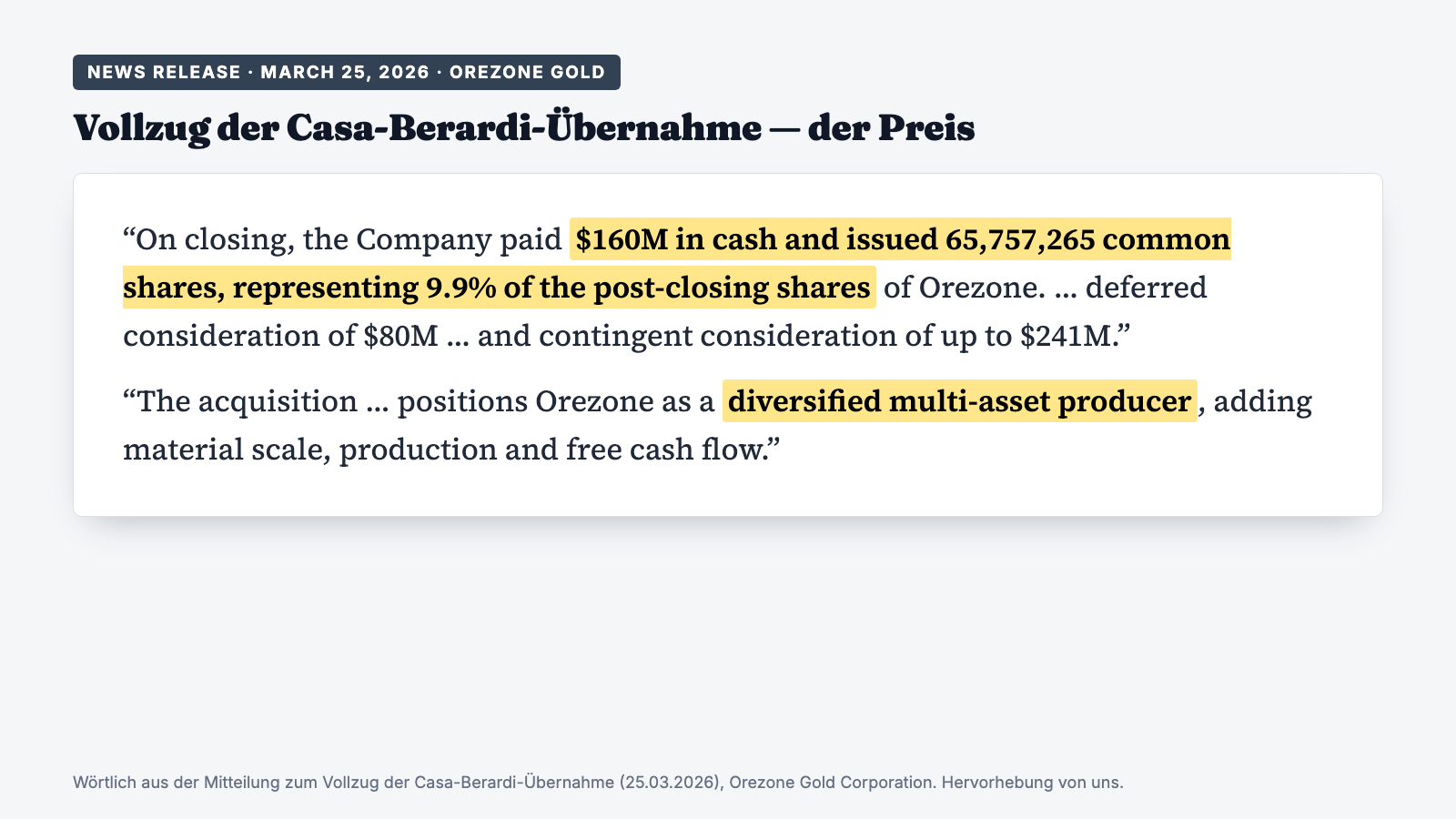
The invisible part sits only in the future: $80 million of deferred cash payments (due at 18 and 30 months) and contingent payments of up to $241 million — $10 million tied to the gold price, $231 million tied to permits and future production. In total, roughly $352 million of fixed and deferred purchase price plus up to $241 million contingent, or up to about $593 million, for an asset that has historically produced more than 3.2 million ounces of gold. Translated: dilution is the price of diversification. The 9.9 percent of new shares shrink every existing holder at once, and the contingent $241 million is a bill that surfaces exactly when the hoped-for thing happens — more production, a higher gold price. And, incidentally: Helikon’s 12.45 percent is already measured against the larger, diluted share pie — the 83 million shares are a slice of roughly 667 million, not of the smaller number from before the deal.
Valuation: what the market pays for the new Orezone
For an evergreen framing we need an order of magnitude, not a daily quote. As of May 15, 2026 the market valued the company at roughly C$1.1 billion (about $0.8 billion) on roughly 667 million shares. Against 2025 net earnings ($64.9 million) that is a price-to-earnings ratio in the order of about 13; against 2025 adjusted EBITDA ($181.1 million) an enterprise value of roughly five times — for a gold producer with a just-completed expansion and a second, producing leg in Canada, not an absurd price, but no bargain either. All valuation figures are dated to mid-2026; analyses are evergreen, daily prices are not a buy argument.
Two things are not in that order of magnitude. First, the up-to-$241 million contingent consideration for Casa Berardi — a potential liability of nearly a third of today’s market value, falling due depending on the gold price and permits. Second, the fact that trailing revenue after the deal already points toward $480 million, because Casa Berardi now counts — so the 2025 numbers are already the past of a smaller company. To value Orezone is to value a transformation in progress, not an end state. How completely a single structural or permitting question can overshadow a gold name showed up recently in another special case in this series — our Helios Towers analysis, also a company with no SEC filings.
Opportunities and risks at a glance
What speaks for Orezone:
- The investment cycle is turning: Bombore’s hard rock expansion is built (first gold December 15, 2025, commercial production January 16, 2026), and 2026 guidance for Bombore alone at 160,000 to 180,000 ounces is 45 to 64 percent above 2025.
- Record 2025 figures: revenue $376.6 million (2024: $283.5 million), net earnings attributable to shareholders $64.9 million (2024: $55.7 million), EBITDA $173.6 million; a realized price of $3,444 per ounce against AISC of $1,776 — a wide margin.
- Real diversification: with Casa Berardi in Quebec, since March 25, 2026 a second, producing leg stands beside the Sahel mine in one of the most stable mining jurisdictions in the world — the "one country, one mine" concentration risk is eased.
- Little price hedging: Orezone sells largely at the market price, without a large hedge book shearing off the top — at a high gold price more reaches the till than at heavily hedged peers.
- A convinced major holder: Helikon holds 12.45 percent, the highest stake in its entire portfolio, filed passively and held over half a year.
What speaks against it:
- Sahel country risk: the state’s free carried interest in OBSA rose from 10 to 15 percent effective August 19, 2025 (2024 Mining Code), and Orezone’s interest fell to 85 percent; Burkina Faso is exposed to the region’s security situation, even if the mine keeps producing.
- Negative free cash flow: despite the record profit, Orezone burned $42.1 million net in 2025; cash fell to $98.0 million and the expansion was largely debt-funded — the proof of the turn is still to come.
- The price of the acquisition comes later: 65,757,265 new shares (9.9 percent dilution) plus $80 million deferred and up to $241 million contingent for Casa Berardi weigh on the future share count and balance sheet.
- Thin, different disclosure: no 10-K, no 10-Q, no 40-F — to check the company you go to SEDAR+ and the ASX; U.S. filters and scanners barely capture the OTC name, and a clean metric series is missing.
- A young, integrated operation still has to prove itself: both hard rock at Bombore and the integration of Casa Berardi are new; ramp-up costs and ore grades can test the ambitious guidance.
A human conclusion
Back to the streetlight trap from the opening. Its core is not that the 13F lies — it is an honest, useful document. Its core is that it answers a narrower question than the one you actually mean to ask. It tells you what a fund holds in U.S.-listed stock. It does not tell you what it is most convinced by. At Helikon the strongest conviction — 12.45 percent, the highest stake in the whole portfolio — sits outside the cone of light, in a Canadian gold producer that appears in the U.S. records only as a shadow, via over-the-counter trading. And whoever walks in with a flashlight finds not a simple story but a transformation in progress: a record year that emptied the till; a mine in Burkina Faso where the state now gets five percentage points more; and a second mine in Canada whose bill partly falls due in 2027 and 2028. So the honest question is not "is Helikon’s biggest bet a hot tip?" — it is: do you want to follow a producer mid-transformation that has just swapped its concentration risk for dilution and contingent debt, and whose free cash flow has yet to prove the expansion pays off? If yes, you have a thesis. If no, you had an impression. What you make of it is your decision. And that is exactly as it should be.
Sources
Every original document used in this analysis — for you to read yourself:
- Helikon Investments Ltd — Schedule 13G/A on Orezone Gold, as of June 30, 2026 (filed July 9, 2026, accession 0001172661-26-002528, SEC EDGAR)
- Orezone Gold Corporation — fourth quarter and full-year 2025 results and 2026 guidance (March 25, 2026)
- Orezone Gold Corporation — announcement of the 2025 results and ASX Appendix 4E (February 28, 2026)
- Orezone Gold Corporation — completion of the acquisition of the Casa Berardi mine and Quebec exploration portfolio (March 25, 2026)
- Orezone Gold Corporation — Bombore project overview (Burkina Faso) and Casa Berardi (Quebec)
- Audited 2025 annual financial statements and MD&A — Orezone Gold Corporation, published on SEDAR+ (sedarplus.ca) and as an ASX Appendix 4E; IFRS accounting, U.S. dollar reporting currency.
- Fundamental data (metrics; data as of July 24, 2026), reconciled with the company reports on SEDAR+/ASX.
Transparency & disclaimer: This analysis is a journalistic contextualization of publicly available information. It is not investment advice, not a financial analysis in any regulatory sense and not an invitation to buy or sell securities. Equity investments carry substantial risk up to and including total loss. Information on ongoing matters (acquisitions, contingent payments, state participations) can change at any time. All information without warranty; the data cut-off is noted in the text. The author holds no position in Orezone Gold shares at the time of publication.
Our Bottom Line at a Glance
- Holding & visibility neutral
- At 12.45 percent (83,054,336 shares, as of June 30, 2026), Orezone is Helikon’s highest percentage holding anywhere — and its most invisible, because with no U.S. listing it appears in no 13F, only in the Schedule 13G/A. It is filed passively (Rule 13d-1(b)), with voting and dispositive power solely shared; the position has been built up and held since January 21, 2026. High conviction, but no control claim and no buy argument in itself.
- Operating business positive
- Bombore’s hard rock expansion is built (first gold December 15, 2025, commercial production January 16, 2026); 2026 guidance for Bombore alone at 160,000 to 180,000 ounces is 45 to 64 percent above the 110,014 ounces of 2025. In 2025 revenue rose to $376.6 million and net earnings to $64.9 million, with a realized price of $3,444 per ounce well above the $1,776 AISC. Casa Berardi adds a second, producing leg.
- Cash flow & balance sheet negative
- Despite the record profit, free cash flow in 2025 was negative at minus $42.1 million, because the expansion consumed more than the business brought in; cash fell to $98.0 million and the expansion was largely debt-funded. The proof that free cash flow flips sign in the first full hard rock year is still to come and is the most important point for the coming quarterly reports.
- Country risk & governance negative
- Effective August 19, 2025, under the 2024 Mining Code, the state’s free carried interest in the operating company OBSA rose from 10 to 15 percent and Orezone’s interest fell to 85 percent; at the same time a $13.2 million dividend went to the state. Burkina Faso sits in the uncertainty-prone Sahel. Orezone did clarify in September 2025 that the government does not intend to buy a further stake in Bombore — but the drift toward higher state stakes remains the region’s pattern.
- Transformation & diversification neutral
- Casa Berardi eases the most dangerous risk of the old Orezone — dependence on one mine in one country — and adds a second leg in Canada. Part of the price comes only later: 65,757,265 new shares (9.9 percent dilution) plus $80 million deferred and up to $241 million contingent. A sensible strategic step whose bill falls due in 2027 and 2028 and which weighs on the future share count and balance sheet.
Orezone is the special case of the series: Helikon’s biggest bet (12.45 percent) appears in no 13F, because the gold producer is not regularly listed in the United States — visible only through a threshold filing. Behind it is a transformation in progress: a record 2025 (revenue $376.6 million, net earnings $64.9 million) that ended with negative free cash flow of $42.1 million because the Bombore hard rock expansion emptied the till; a state that since August 2025 holds 15 percent of the mine instead of 10; and a second mine in Quebec that eases the concentration risk but is paid for with 9.9 percent dilution and up to $241 million of contingent consideration. Not investment advice.
What Our Rating Means
Open questions
The business works in principle, but one material question is open. As long as it stays open, our findings do not carry a quality verdict.
Whoever buys today is not buying a finished gold producer but a transformation. The market value was in the order of $0.8 billion in mid-2026, a P/E of roughly 13 on the record 2025 result — not expensive, but the up-to-$241 million contingent Casa Berardi payment is not in it. Whoever holds or buys the stock is betting on three things: that free cash flow turns positive in the first full hard rock year, that Casa Berardi delivers the promised scale and cash flow, and that the state in Burkina Faso leaves it at 15 percent. Whoever waits checks exactly that in the next quarterly report on SEDAR+: free cash flow, production against guidance, and the provision for the contingent consideration. The decision is yours.
A journalistic assessment by our editorial team at the time of the deep dive, based on public sources — not investment advice and not a solicitation to buy or sell. Your personal circumstances (investment goals, risk capacity, taxes) cannot be taken into account. What our levels mean, how verdicts are formed, and what conflicts of interest exist →
Worth Noting
- Orezone landed on the research list not through a scanner hit but through a Schedule 13G/A of Helikon Investments Ltd (London) as of June 30, 2026: 83,054,336 shares, 12.45 percent — the highest percentage holding in the entire Helikon portfolio. The position appears in no 13F, because Orezone is listed in the United States only over-the-counter (OTCQX: ORZCF) and regularly in Toronto and Sydney, and is therefore not a "13(f) security." A 13F is a rear-view mirror with a blind spot; the threshold filing is the look into it.
- Orezone is not an SEC filer: there is no 10-K, no 10-Q, no 40-F and no 20-F. This analysis rests on the Canadian mandatory disclosures on SEDAR+ (audited 2025 annual financial statements and MD&A), the ASX Appendix 4E of February 28, 2026 and the news releases on orezone.com. Accounting is under IFRS, reporting in U.S. dollars. Quotes were verified verbatim against the original texts.
- Valuation figures dated and evergreen: the market value of roughly C$1.1 billion (about $0.8 billion) on roughly 667 million shares is as of May 15, 2026 and serves as an order of magnitude, not a daily price. The 2025 figures reflect the smaller company before the Casa Berardi acquisition; after completion on March 25, 2026 trailing revenue already points toward $480 million. All information as of July 24, 2026.
Frequently Asked Questions
Because a 13F lists only U.S.-listed securities ("13(f) securities"). Orezone Gold trades in Toronto and Sydney (ORE) and in the United States only over-the-counter (ORZCF) — OTC names do not count. The 12.45 percent stake, Helikon’s highest anywhere, therefore surfaces only through the Schedule 13G/A threshold filing (as of June 30, 2026), not in the quarterly 13F.
Orezone Gold Corporation (TSX and ASX: ORE, OTCQX: ORZCF, headquartered in Ottawa) is a gold producer. Its core is the Bombore mine in Burkina Faso (an 85 percent interest in the operating company OBSA). Since March 25, 2026 it also owns the producing Casa Berardi mine in Quebec, Canada. In 2025 Bombore produced 110,014 ounces of gold; for 2026 Orezone guides 160,000 to 180,000 ounces at Bombore alone.
Because Orezone is not a U.S. reporting company. There is no 10-K, no 10-Q, no 40-F and no 20-F. Its mandatory reports appear on SEDAR+ (Canadian audited annual financial statements and MD&A) and at the Australian exchange, the ASX (Appendix 4E of February 28, 2026). Accounting is under IFRS, reporting is in U.S. dollars. In the SEC records Orezone appears only as the subject of other parties’ threshold filings.
Because the hard rock expansion of the Bombore mine drained the till. Operating cash flow in 2025 was $99.5 million, but free cash flow was minus $42.1 million — the difference was capital spending on the build-out. First gold from hard rock flowed on December 15, 2025, and commercial production was declared on January 16, 2026. The investment cycle is therefore largely complete.
Effective August 19, 2025, under the new 2024 Mining Code, the state’s free carried interest in the operating company Orezone Bombore S.A. rose from 10 to 15 percent; Orezone’s interest fell from 90 to 85 percent. At the same time a dividend was paid on earnings accumulated through the end of 2024, of which the state’s share was XOF 7.4 billion ($13.2 million), paid on August 25, 2025.
On completion on March 25, 2026 Orezone paid $160 million in cash and issued 65,757,265 new shares (9.9 percent of the post-closing share count). On top of that come $80 million of deferred cash payments (due at 18 and 30 months) and contingent payments of up to $241 million, tied to the gold price, permits and future production. Casa Berardi is a producing mine in Quebec and makes Orezone a multi-asset producer.
A Schedule 13G is the passive threshold filing: anyone holding more than 5 percent of a U.S.-registered company without seeking control must disclose it. Helikon Investments reported 83,054,336 Orezone shares, or 12.45 percent, as of June 30, 2026 — the highest percentage holding in its entire portfolio, with voting and dispositive power solely shared. The first filing dates from January 21, 2026; the position was held over half a year.
Found an error?
Did you spot a factual error, an outdated number, or a typo in this deep dive? Let us know briefly — your report goes straight to the editorial team.