Old Dominion Stock: 99 Percent On-Time, Three Shrinking Years — and a Price That Already Celebrates the Turn
Old Dominion Freight Line (Nasdaq: ODFL), the less-than-truckload specialist from North Carolina, ranks seventh in our in-house Terry Smith quality scanner (U.S. selection, as of July 18, 2026): 99 percent on-time service, almost no debt, an equity ratio around 79 percent. We read the annual report (10-K) for 2025 and the quarterly report (10-Q) as of March 31, 2026 — and they also tell the other story: revenue is shrinking for the third year in a row, the famous operating ratio deteriorates year after year, and the stock gained almost 40 percent in six months before the freight recovery showed up in the numbers. Not investment advice — just the question of whether quality can substitute for a cycle.
 Thomas Mücke
Founder & Publisher
Thomas Mücke
Founder & Publisher
Chart
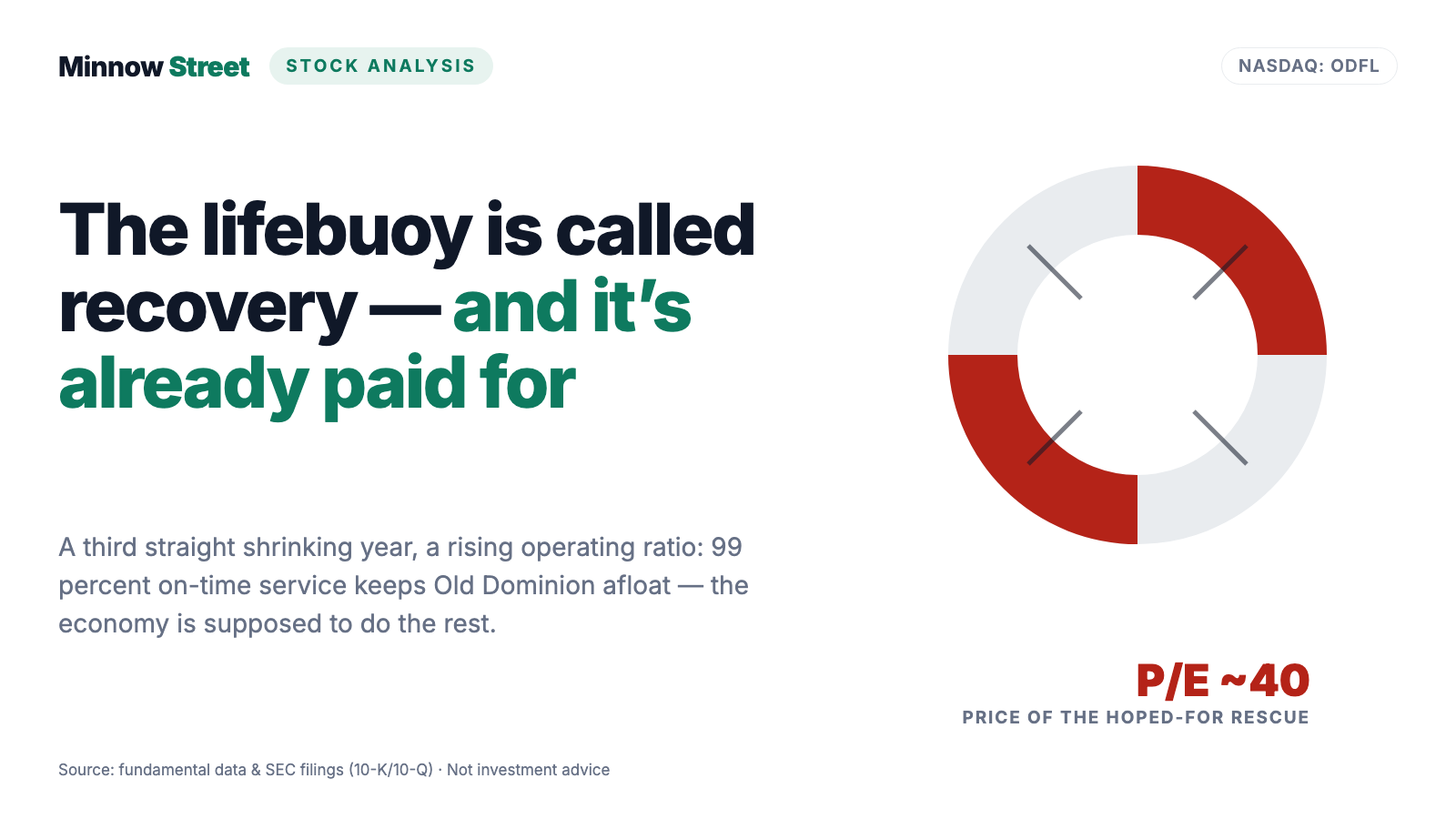
Interactive price chart (TradingView).
Note: pure fact-based analysis, not investment advice and not a solicitation to buy or sell. All figures without guarantee.
There is an investor trap that snaps shut whenever a downturn has lasted long enough: the false-start trap. It works like this: everyone knows cycles turn. Everyone wants to be in before the numbers prove it — because whoever waits for proof supposedly misses the first 30 percent. So at some point you hear the starting gun in every creak of the grandstand. Exactly this race is under way in the summer of 2026 at Old Dominion Freight Line, Inc. (Nasdaq: ODFL), the less-than-truckload specialist from North Carolina: the stock has gained roughly 38 percent in six months (as of July 18, 2026) — while revenue is shrinking for the third year in a row. At the same time, the company ranks seventh in our in-house Terry Smith quality scanner (U.S. selection, as of July 18, 2026). Quality meets recession meets anticipation. So let's make a deal: we ignore the supposed starting gun and read together what Old Dominion itself reported, under penalty of law, to the U.S. securities regulator, the SEC — the annual report (10-K) for fiscal year 2025 and the quarterly report (10-Q) as of March 31, 2026. And those documents tell both stories: that of one of the best transportation companies in North America — and that of a bet already running before its outcome is known. In the end, you decide.
What Old Dominion actually does — and why LTL is a special business
Old Dominion hauls consolidated freight. The industry shorthand is LTL — "less-than-truckload." If you have a full semi-trailer's worth of goods, you charter the whole truck (that is "truckload," a different business). But if you are shipping just six pallets, you need someone who bundles the pallets of many customers — like a city bus, where passengers share the ride instead of each taking a taxi. That is LTL: freight is picked up at the customer, cross-docked at the local service center onto linehaul trucks, driven through the network overnight and distributed again at the destination. This cross-docking makes LTL a network business with high barriers to entry: to compete, you need hundreds of terminals in the right places — Old Dominion operates 260 service centers, 240 of them owned, plus 10,184 company tractors (as of December 31, 2025). More than 98 percent of revenue comes from this LTL core business, whose demand, per the annual report, hangs directly on U.S. industrial production. The customer base is pleasingly broad: the largest customer accounted for roughly 4 percent of 2025 revenue, the top twenty combined for roughly 23 percent — customer concentration looks different. Two more peculiarities you should know: Old Dominion has been union-free since its founding in 1934 — more on that later — and the founding Congdon family still holds roughly 10 percent of the shares, with Executive Chairman David S. Congdon at the head of the board.
Which brings us to the central tension of this analysis, running through every chapter: operationally, Old Dominion is about as good as a freight carrier gets — 99 percent on-time service, a 0.1 percent claims ratio, a balance sheet nearly free of debt. But the best ship in the fleet has been sailing into the wind for three years: freight volume is shrinking, the margin is crumbling, and the stock price is pricing in a turn that so far exists in the numbers only as a hunch. For how another model student from the same scanner looks with built-in blemishes, see our Fortinet deep dive.
Where the stock shows up in our scanner
Every day we run roughly 3,500 stocks through our scanners. Old Dominion reached the research list via the Terry Smith quality scanner — rank 7 of the U.S. selection, as of July 18, 2026. This filter looks for what British fund manager Terry Smith calls "good companies": high returns on capital, high margins, reliable cash generation, little debt. Old Dominion delivers textbook values: a net margin of 17.9 percent in the first quarter of 2026 — of $100 in freight revenue, almost $18 remain as profit, in an industry where many competitors are happy with single digits —, an equity ratio around 78 percent, practically no debt (a debt-to-equity ratio near zero) and an Altman Z-score around 10 — the bankruptcy-risk metric where "safe" starts at 3. The Piotroski F-Score, a nine-point health check of the books, stands at just 6 of 9, however: okay, not brilliant — the shrinking years cost points on growth and margin trend. What stands out is the confluence: the same stock simultaneously shows up in our momentum filters — a stage-2 uptrend, price above all major moving averages, institutional accumulation. Translated: big money is buying the turn before it is here. For comparison: the insurer Globe Life makes the same quality filter with an entirely different business model — the scanner measures balance-sheet quality, not industry fates.
And exactly for that reason, the duty to cross-check applies here too. A quality scanner computes with what is in the financial statements: margins, returns, debt ratios. It does not see whether the underlying freight volume is growing or shrinking, and it does not know what a business cycle does to a fixed-cost network. Remember this sentence: a scanner answers the question "How good are the numbers?" — never the question "Which way are they heading right now?" Only the filings themselves answer the second question. So let's go.
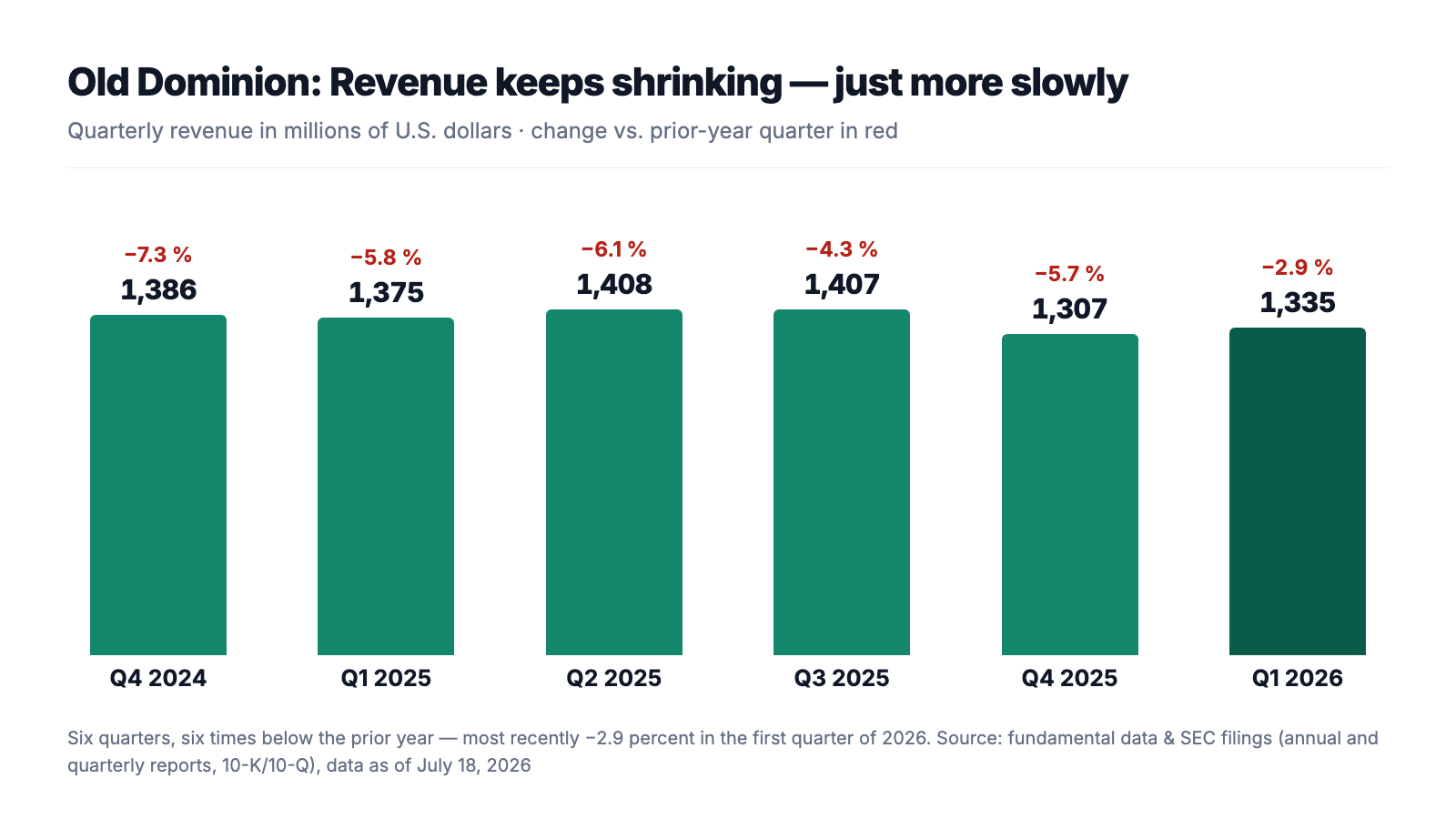
The numbers over the years — honestly appraised
First, what genuinely impresses — and at Old Dominion that is the resilience. Revenue fell from $6,260.1 million (2022) through $5,866.2 million (2023) and $5,814.8 million (2024) to $5,496.4 million in fiscal year 2025 — three shrinking years in a row, roughly 12 percent in total. And yet: the net margin stood at 18.6 percent in 2025, net income at $1,023.7 million, operating cash flow at $1,457.7 million. Hardly any transportation company in the world earns this much money in a downturn. The reason is in the annual report: while volume fell away, Old Dominion held its quality — and raised prices.
"Despite the decrease in our LTL tons, we maintained our commitment to superior customer service by providing our customers with 99% on-time service and a cargo claims ratio of 0.1% during the year."
— Old Dominion Freight Line, Inc., SEC annual report 10-K for fiscal year 2025, Item 7 "Management's Discussion and Analysis"
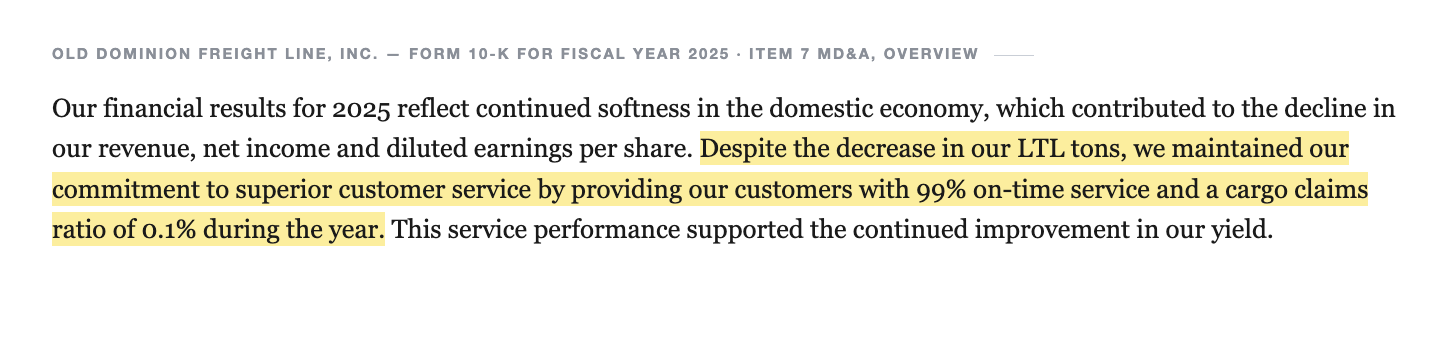
This feat — falling volume, rising prices — is the core of the business model. LTL revenue per hundredweight (the industry's pricing yardstick) rose 3.9 percent to $33.31 in 2025, and 4.8 percent excluding the fluctuating fuel surcharges; the first quarter of 2026 added another 4.4 percent ex-fuel. Whoever delivers at 99 percent on-time and damages practically nothing can charge prices the discounters cannot — and customers pay them, because a stalled assembly line costs more than a better carrier. Remember: pricing power is not built in the sales office, it is built at the loading dock. Honesty, however, requires looking at the volume side of the same table — and that side is sobering: in 2025 tonnage fell 9.1 percent, the number of shipments 7.8 percent. That is no longer a dent, that is a trend, and it has a name.
What the filings say — the uncomfortable truths
Uncomfortable truth no. 1: the third shrinking year — and January 2026 kept going
The annual report names the cause without hedging:
"Our financial results for 2025 reflect continued softness in the domestic economy, which contributed to the decline in our revenue, net income and diluted earnings per share."
— Old Dominion Freight Line, Inc., SEC annual report 10-K for fiscal year 2025, Item 7 "Management's Discussion and Analysis"
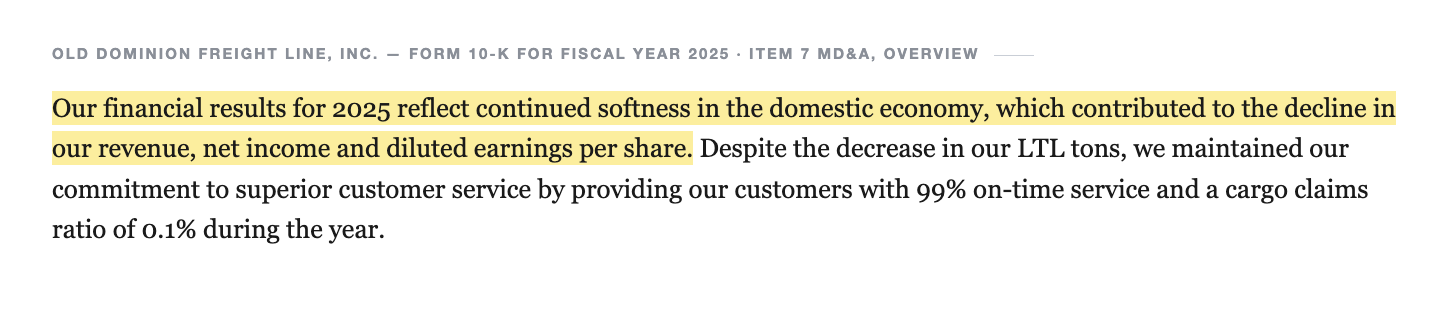
The facts, soberly sorted: revenue fell 6.3 percent in 2023, 0.9 percent in 2024, 5.5 percent in 2025. Earnings per share slid from $5.63 (2023) through $5.48 (2024) to $4.84 (2025). And the start of 2026 brought no all-clear at first: in January 2026, revenue per day was, per the 10-K, another 6.8 percent below the prior year, tonnage per day even 9.6 percent. Only over the course of the first quarter did the picture brighten — the quarterly report puts it cautiously: "While revenue declined year-over-year, demand trends improved as the first quarter of 2026 progressed." In April 2026, for the first time in a long while, revenue per working day carried a plus sign: +7.6 percent — driven, however, still by prices, not volume, because tonnage per day fell 6.1 percent in April as well. For you as a reader that means: the turn the stock price is betting on exists, so far, as one single better month — with freight volumes still falling. One quarter does not make a summer; one month makes even less of a cycle.
Uncomfortable truth no. 2: the benchmark metric is running the wrong way
In the LTL industry, operating quality is measured by a single number: the operating ratio — operating expenses divided by revenue. The lower, the better; below 80 counts as world class. Old Dominion was the yardstick here for years, at 72.0 percent in 2023. Since then the number has been running backwards: 73.4 percent (2024), 75.2 percent (2025) — and 76.2 percent in the first quarter of 2026. The quarterly report explains why:
"We also maintained our focus on operating efficiently and controlling discretionary spending during the quarter, although the deleveraging effect from the decrease in revenue and an increase in general supplies and expenses led to an increase in our operating ratio."
— Old Dominion Freight Line, Inc., SEC quarterly report 10-Q as of March 31, 2026, Item 2 "Management's Discussion and Analysis"
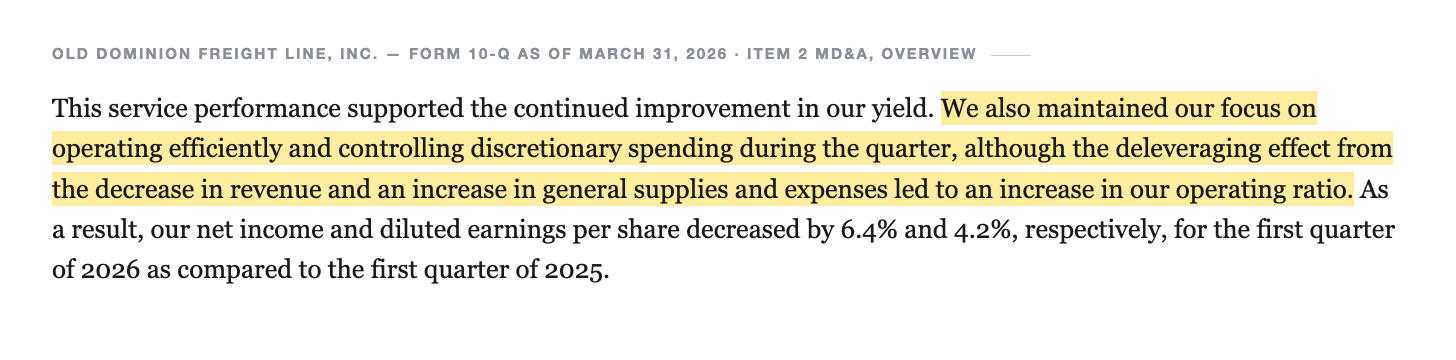
"Deleveraging" sounds technical but is simple: an LTL network is a fixed-cost machine. The 260 terminals, the depreciation on docks and trucks, the core workforce — all of that costs money whether the terminals are full or half empty. In 2025, depreciation alone rose to 6.6 percent of revenue (prior year 5.9), and labor costs climbed to 47.9 percent of revenue even though Old Dominion shrank its average headcount by 5.4 percent. That is the flip side of the quality promise: whoever keeps the team and the network together for the upturn — and even paid regular wage increases in September 2025 — bleeds margin as long as the upturn stays away. Four points of operating ratio in three years sounds small; on $5.5 billion of revenue it is more than $200 million of operating profit per year. Remember: fixed costs are a turbo in the upswing and an anchor in the slump — they are the same costs.
Uncomfortable truth no. 3: the whole model rests on one word — union-free
The third truth sits in the risk factors, and it concerns the foundation of the business model. Old Dominion employs 20,591 people — and not one of them is covered by a collective bargaining agreement. The annual report says with rare clarity what is at stake:
"If our employees were to unionize, our operating costs would increase and our ability to compete would be impaired. None of our employees are currently represented under a collective bargaining agreement."
— Old Dominion Freight Line, Inc., SEC annual report 10-K for fiscal year 2025, Item 1A "Risk Factors"
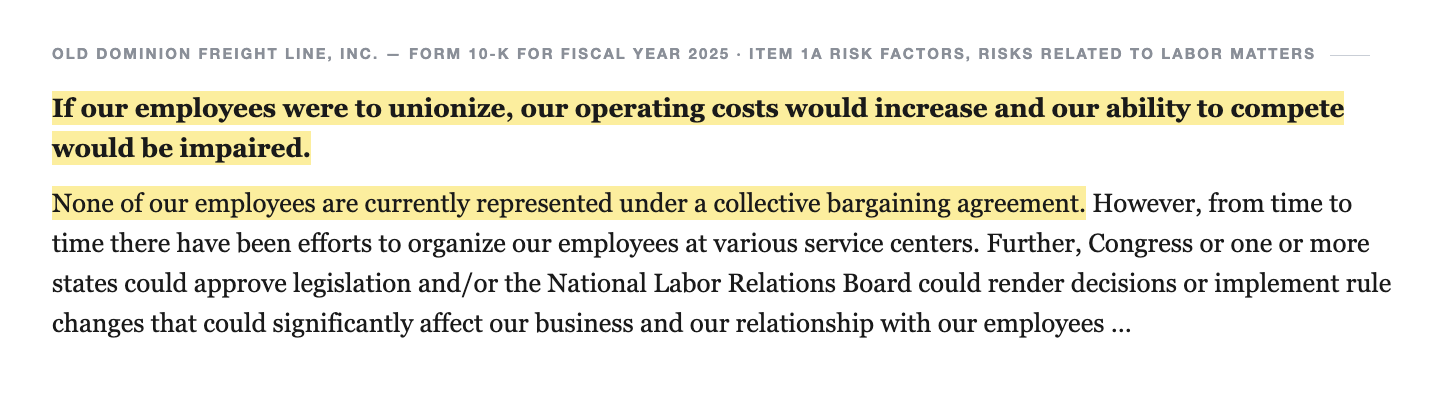
Why this is so central: the flexibility to switch drivers between pickup-and-delivery and linehaul at night, to adjust shifts on short notice and to plan without restrictive work rules is an essential part of the efficiency edge — the report itself lists that restrictive work rules could hamper efficiency and even the ability to provide next-day services. Old Dominion answers the risk in its own way: with a company culture the 10-K calls the "OD Family," with its own free driving school that by now supplies every third driver, and with driver turnover that is tiny by industry standards. That is lived risk management — but also a permanent task: the report explicitly notes that Congress or the U.S. labor board NLRB could change the rules for union organizing in the unions' favor at any time. A risk with a small probability and a large lever — the kind that appears in no metric.
Valuation: roughly $40 billion of market value — and a P/E around 40 in a shrinking year
What does all this cost? Based on the fundamental data as of the first quarter of 2026, Old Dominion weighed in at roughly $41 billion of market value. The company itself serves as the price anchor: in the first quarter of 2026, Old Dominion bought back its own shares for $88.9 million — roughly 480,000 of them, so about $185 per share on average. Measured against the earnings of the trailing four quarters ($4.78 per share), that corresponds to a price-to-earnings ratio around 39; based on the scanner data as of July 18, 2026 — the stock gained roughly 25 percent in the first quarter of 2026 alone and traded higher afterwards — it is roughly 46. The price-to-sales ratio sits between 7 and 8. For perspective: that is the valuation of a structural growth company — for a business whose revenue has been falling for three years. The math behind it sits in the analyst estimates: 25 firms expect a consensus of $5.46 in earnings per share for 2026 and $6.36 for 2027 (data as of July 18, 2026) — that is, the return of double-digit earnings growth starting now. The turn is not the hope behind this valuation, it is its precondition. The analyst consensus grade stands around 1.8 (on a scale where 1 means "strong buy") — favorable, no cheering.
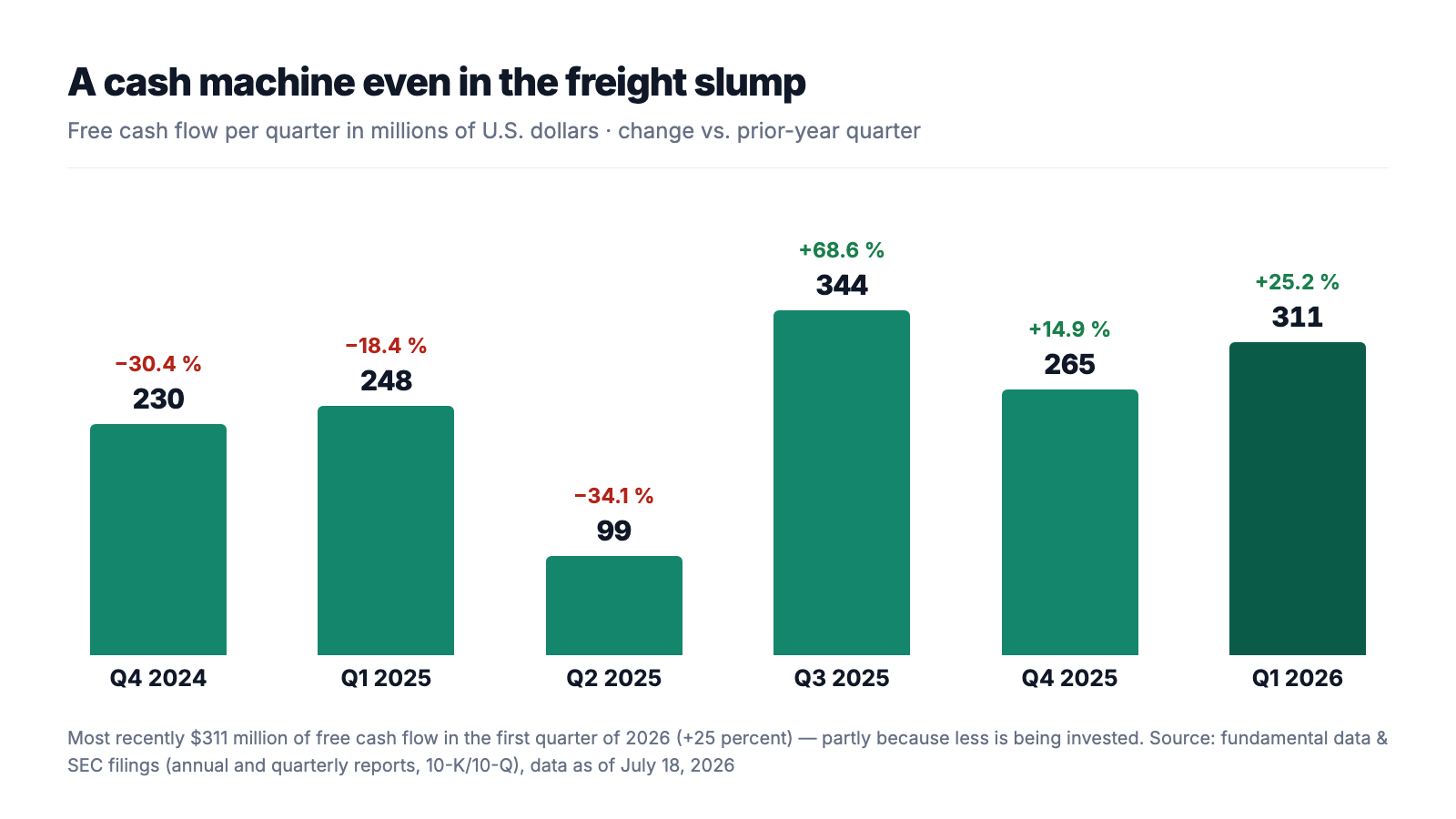
What is remarkable is where the recent cash flow increase came from. Old Dominion historically invests 10 to 15 percent of revenue per year in its network — land and terminals are bought, not rented (240 of the 260 service centers belong to the company; the "Land and structures" line sits at $3.5 billion on the books). In the slump, that tap was tightened: capital expenditures fell from $751.2 million (2024) through $366.5 million (2025) to a planned ~$265 million for 2026 — explicitly below the historical range, because the network has "available capacity." And exactly here the circle closes back to the operating ratio: the annual report itself warns that "prior capital investments based on our projections may contribute to excess capacity that could negatively impact our profitability." Old Dominion built the network for an upturn that has not arrived yet. Shareholders, meanwhile, kept getting paid handsomely: $730.3 million of buybacks plus $235.7 million of dividends in 2025 — together roughly 94 percent of the year's profit —, the quarterly dividend rose from $0.28 to $0.29 in early 2026, and $1.45 billion remained under the buyback authorization as of March 31, 2026. The share count fell from 213.0 to 208.1 million within a year. With only $40 million of debt and $4.4 billion of equity, all of this is soundly financed — just funded from the substance of a shrinking business, not from growth.
Opportunities and risks at a glance
What speaks for Old Dominion:
- Operating quality as a moat: 99 percent on-time service and a 0.1 percent cargo claims ratio in 2025 — the basis on which revenue per hundredweight rose even in the slump (+3.9 percent in 2025, +4.8 percent excluding fuel surcharges).
- Balance-sheet fortress: $4.4 billion of equity on $5.5 billion of total assets, just $40 million of debt, an Altman Z-score around 10 — no refinancing risk, full freedom of action in the downturn.
- An owned network with a built-in upturn reserve: 240 of 260 service centers belong to the company; in an upswing the existing spare capacity becomes operating leverage without major new investment — the effect currently weighing on the operating ratio then works in reverse.
- A people moat: a union-free, flexible organization, an in-house free driving school (every third driver is a graduate), driver turnover around 10 percent — in an industry that notoriously suffers from driver shortages.
- Reliable capital returns: $730 million of buybacks and $236 million of dividends in 2025, a rising quarterly dividend ($0.29 from Q1 2026), $1.45 billion remaining buyback authorization; first demand improvement over the course of Q1 and +7.6 percent revenue per working day in April 2026.
What speaks against it:
- Third shrinking year in a row: revenue down from $6,260.1 million (2022) to $5,496.4 million (2025), tonnage −9.1 percent in 2025, January 2026 another −9.6 percent per day — the turn so far exists mostly in prices, not volumes (April 2026: revenue per day +7.6 percent, tonnage −6.1 percent).
- The benchmark metric is running backwards: the operating ratio deteriorated from 72.0 (2023) through 73.4 (2024) and 75.2 (2025) to 76.2 percent in Q1 2026 — the fixed-cost machine deleverages as freight shrinks; four points equal more than $200 million of operating profit per year at this revenue level.
- Valuation without a margin of safety: a P/E around 39 to 46 and a P/S of 7 to 8 (as of Q1 2026 and July 18, 2026) — the consensus estimates ($5.46 EPS for 2026, $6.36 for 2027) already presuppose the earnings turn; after a 38 percent rally in six months there is no cushion if it fails to arrive.
- Structural union risk: the efficiency model rests on the union-free organization; the 10-K itself warns that organizing would raise costs, harden work rules and endanger the overnight network — and that Congress or the NLRB can change the rules of the game.
- Cycle instead of structure: more than 98 percent of revenue hangs on the U.S. LTL market and thus on the industrial economy — there is no second leg that would cushion an extended freight recession.
A human conclusion
Back to the false-start trap from the beginning. Its core is not that cycles never turn — they always do, and when this one does, a network with spare capacity, an operating ratio in the mid-70s with room to fall and 99 percent on-time service will be among the biggest winners. Its core is that the cost of arriving too early is invisible as long as everyone is running: whoever pays roughly 40 times earnings for Old Dominion today buys an outstanding company and a bet on timing — that a better April 2026 becomes a better year, and that price increases turn back into volume growth. Per the filings, both are possible and neither is proven: tonnage fell in April too, and the operating ratio rose in the first quarter too. So the honest question for you is not "Is Old Dominion a quality company?" — after everything in the filings: yes, one of the best in its industry. It is: do you want to pay a price for that quality which already includes the economic turn — or do you wait until tonnage and operating ratio fire the starting gun the stock price claims to have heard long ago? The measuring points are in every quarterly report: tonnage per day, revenue per hundredweight, operating ratio. What you make of it is your decision. And that is exactly as it should be.
Sources
All original documents used in this analysis — for reading up yourself:
- Old Dominion Freight Line, Inc. — SEC annual report 10-K for fiscal year 2025 (ended December 31, 2025; filed February 24, 2026)
- Old Dominion Freight Line, Inc. — SEC quarterly report 10-Q as of March 31, 2026 (filed May 6, 2026)
- Old Dominion Freight Line, Inc. — SEC annual report 10-K for fiscal year 2024 (ended December 31, 2024; filed February 25, 2025)
- Complete SEC filing history of Old Dominion Freight Line, Inc.: EDGAR overview (sec.gov)
- Fundamental data (metrics, quarterly series, valuation; data as of July 18, 2026 and Q1 2026), cross-checked against the SEC filings.
- Screener and rating data: in-house stock scanner, Terry Smith quality scanner (U.S. selection) and momentum filters (data as of July 18, 2026).
Transparency & disclaimer: This analysis is a journalistic contextualization of publicly available information and is not investment advice, not a financial analysis in the regulatory sense and not a solicitation to buy or sell securities. Stock investments carry substantial risks up to and including total loss. All information without guarantee; the data cut-off is noted in the text. The author holds no position in Old Dominion shares at the time of publication.
Our Bottom Line at a Glance
- Service quality & pricing power positive
- 99 percent on-time service and a 0.1 percent cargo claims ratio in fiscal year 2025 — on that basis, revenue per hundredweight rose 3.9 percent despite the slump (4.8 percent excluding fuel surcharges; Q1 2026: +4.4 percent). Pricing power is built at the loading dock, not in the sales office (10-K FY 2025, 10-Q as of 03/31/2026).
- Balance sheet & capital returns positive
- An equity ratio around 79 percent, only $40 million of debt, an Altman Z-score around 10; in 2025, $730.3 million went into buybacks and $235.7 million into dividends (together ~94 percent of profit), and the quarterly dividend rose to $0.29 in early 2026 (10-K FY 2025, 10-Q).
- Volume & cycle negative
- Third shrinking year in a row: revenue down from $6,260.1 million (2022) to $5,496.4 million (2025), tonnage −9.1 percent in 2025, January 2026 −9.6 percent per day; the improvement from spring 2026 (April: revenue/day +7.6 percent) came from prices, while tonnage kept falling (−6.1 percent) (10-K FY 2025, 10-Q).
- Margin / operating ratio negative
- The operating ratio deteriorated from 72.0 (2023) through 73.4 (2024) and 75.2 (2025) to 76.2 percent in Q1 2026 — deleveraging of the fixed-cost network plus rising depreciation (6.6 percent of revenue in 2025); the 10-K itself warns of excess capacity from prior investments (10-K FY 2025, Item 1A; 10-Q).
- Valuation negative
- A P/E around 39 to 46 and a P/S of 7 to 8 (buyback anchor ~$185, Q1 2026, and scanner data as of July 18, 2026) after a 38 percent six-month rally — the consensus estimates (EPS $5.46 for 2026, $6.36 for 2027) already presuppose the earnings turn; no cushion is priced in for a fourth year of freight recession.
By its SEC filings, Old Dominion is one of the best transportation companies in North America: 99 percent on-time service, price increases in the middle of a freight recession, a balance sheet practically free of debt and a network of 260 mostly owned terminals with a built-in upturn reserve. But the direction of the numbers has pointed down for three years: revenue and tonnage are shrinking, the operating ratio deteriorates year after year, and the valuation at roughly 40 times earnings already contains the economic turn as a precondition — evidenced, so far, by a single better month with freight volumes still falling. Not investment advice.
What Our Rating Means
- If you don't own the stock
- As long as the question raised in the bottom line stays open, we see no basis for an entry.
- If you hold it in your portfolio
- Our findings offer no acute reason to sell — the checkpoints named remain decisive.
A journalistic assessment by our editorial team at the time of the deep dive, based on public sources — not investment advice and not a solicitation to buy or sell. Your personal circumstances (investment goals, risk capacity, taxes) cannot be taken into account. What our categories mean, how verdicts are formed, and what conflicts of interest exist →
Worth Noting
- ODFL reached the research list via rank 7 in the in-house Terry Smith quality scanner (U.S. selection, as of July 18, 2026); additionally a hit in momentum filters (stage-2 trend, institutional accumulation). A quality scanner measures financial statements, not cycle direction — it never replaces the cross-check in the SEC filings.
- Valuation figures are deliberately anchored evergreen: the price anchor is Old Dominion's own Q1 2026 buyback reported in the 10-Q ($88.9 million for roughly 480,000 shares, about $185 on average); P/E and P/S computed from TTM figures as of 03/31/2026, supplemented by the scanner data cut-off of July 18, 2026. Analyses are evergreen, daily prices are not a buy argument.
- Identity verified via EDGAR submissions (CIK 0000878927, Virginia corporation, Nasdaq: ODFL, domestic filer 10-K/10-Q, no Form 15; the only former name is the styling variant "OLD DOMINION FREIGHT LINE INC/VA" until August 2019). Fiscal year ends December 31.
Frequently Asked Questions
Old Dominion Freight Line, Inc. (Nasdaq: ODFL) of Thomasville, North Carolina is one of the largest North American LTL carriers (less-than-truckload = consolidated freight): pallets from many customers are bundled, cross-docked through a network of 260 service centers (240 owned) and delivered nationwide. More than 98 percent of revenue comes from the LTL business. In fiscal year 2025 (ended December 31, 2025) the company generated $5,496.4 million in revenue (−5.5 percent) and earned $1,023.7 million net.
The filter measures quality, not direction: a 17.9 percent net margin in the first quarter of 2026, an equity ratio around 78 percent, practically no debt, an Altman Z-score around 10 — figures hardly any transportation company reaches. As of July 18, 2026 that yields rank 7 of the U.S. selection. What the scanner does not measure: revenue has fallen for the third year in a row, and the operating ratio has deteriorated since 2023 — the cross-check in the SEC filings remains mandatory.
The operating ratio is the LTL industry's benchmark metric: operating expenses divided by revenue — the lower, the better. Old Dominion stood at 72.0 percent in 2023, 73.4 in 2024, 75.2 in 2025 and 76.2 percent in the first quarter of 2026. The cause, per the 10-Q, is the "deleveraging effect": the terminal network and the workforce are fixed costs spread over less revenue as freight volume falls; in addition, depreciation rose to 6.6 percent of revenue (2025).
Exceptionally solid: as of December 31, 2025 there were $4,311.1 million of equity on $5,470.2 million of total assets (a ratio around 79 percent) and only $40 million of debt. The Altman Z-score sits around 10 (safe starts at 3). In 2025 the company spent $730.3 million on share buybacks and $235.7 million on dividends — together roughly 94 percent of the year's profit; the quarterly dividend rose to $0.29 per share in early 2026.
No — it is priced ambitiously: measured against the company's own reported buyback prices around $185 (Q1 2026) and trailing-four-quarter earnings ($4.78 per share), the price-to-earnings ratio is around 39, and around 46 based on scanner data as of July 18, 2026; price-to-sales sits at 7 to 8. Baked into that is the expected economic turn: 25 analyst firms project a consensus of $5.46 in earnings per share for 2026 and $6.36 for 2027 — after $4.84 in the shrinking year 2025.
A central one: all 20,591 full-time employees (12/31/2025) work without a collective bargaining agreement, which is what makes flexible shifts, drivers switching between local and linehaul work and the overnight network possible. The annual report explicitly lists possible unionization as a risk: operating costs would rise, competitiveness would suffer. Old Dominion counters with its "OD Family" culture, a free in-house driving school (a third of drivers are graduates) and low turnover around 10 percent.
Found an error?
Did you spot a factual error, an outdated number, or a typo in this deep dive? Let us know briefly — your report goes straight to the editorial team.