Okta Stock: From a $355 Million Loss to a $235 Million Profit in Two Years — Already Priced at 87 Times Earnings
Okta has disappointed investors twice: first with the crash after the 2021 hype, then with two security incidents at, of all companies, the guardian of digital access. Which is exactly why a second look pays: in our in-house turnaround scanner, the stock ranks no. 3 in the U.S. selection with a turnaround check of 7 out of 8 (as of July 18, 2026). We read the annual reports (10-K) and the quarterly report (10-Q) as of April 30, 2026: a genuine swing to profit from −$355 million (FY 2024) to +$235 million (FY 2026), a subscription business with a 77 percent gross margin and $863 million in free cash flow — but also growth at walking pace, slipping net retention, and a share price that already pays 87 times trailing earnings for the turnaround. Not investment advice — just a reminder that a grudge is not research.
 Thomas Mücke
Founder & Publisher
Thomas Mücke
Founder & Publisher
Chart
Interactive price chart (TradingView).
Note: pure fact-based analysis, not investment advice and not a solicitation to buy or sell. All figures without guarantee.
There is an investor trap that works more quietly than FOMO and more stubbornly than any fad: the burned-fingers trap. It goes like this: a stock hurt you (or your neighbor's portfolio) once — and from then on your brain stops checking the numbers and starts nursing the grudge. Okta, Inc. (Nasdaq: OKTA) is a textbook candidate: first the crash after the 2021 software mania, then — at the guardian of digital access, of all companies — two security incidents. If you muttered "never again," you had reasons. Except: exactly these stocks are what our turnaround scanner hunts, and there Okta ranks no. 3 in the U.S. selection with a turnaround check of 7 out of 8 (as of July 18, 2026). So let's make a deal: we park the grudge for fifteen minutes and read together what Okta itself filed, under penalty of law, with the U.S. securities regulator, the SEC — the annual reports (10-K) and the quarterly report (10-Q) as of April 30, 2026. In there is a swing to profit worth seeing: from a $355 million net loss (FY 2024) to $235 million in net income (FY 2026). Also in there is what the market now charges for it: roughly 87 times trailing earnings. In the end you decide for yourself whether your fingers still burn — or just your curiosity.
What Okta actually does — the bouncer of the digital office
Okta, founded in 2009 and headquartered in San Francisco, employs 6,366 people (January 31, 2026) and runs a business you can explain in one sentence: Okta is the bouncer of the digital world. When an employee opens a laptop in the morning, they want into dozens of programs — email, cloud storage, accounting, the customer database. Okta checks at one central door that you really are you, then unlocks every door behind it (in the trade: single sign-on and multi-factor authentication). The product for that is the Okta Platform, aimed at the workforce ("workforce identity"). The second leg, the Auth0 Platform acquired in 2021, is the same bouncer as a developer kit: whoever builds an app assembles login, password reset and fraud defense from ready-made blocks instead of coding them ("customer identity"). More than 20,000 customers use this, including 5,100 with annual contracts above $100,000, connected through more than 7,000 integrations; 98 percent of revenue is subscriptions. A maintenance contract for door locks, billed monthly — that is the business.
And the future story? It is — of course — about artificial intelligence, but from an unusual angle. If AI agents are soon to answer emails, book trips and reach into company data on their own (we measured the capital flood behind that build-out in our Nvidia analysis and the agent ambitions of the platform providers in our Alphabet analysis), then every one of those agents needs an ID card, permissions and a security desk — otherwise the diligent helper becomes a burglar with a master key. That is what Okta is aiming at with new products such as "Okta for AI Agents" and "Auth0 for AI Agents" (both in early access). The annual report words the hope remarkably soberly:
"We see a potential long-term opportunity for our platforms to serve as a unified, independent control plane for non-human identities (“NHIs”) and AI agents, a distinct class of identity that requires authenticated, secure access to sensitive resources at a scale and speed exceeding traditional security models designed for human users. While adoption is in its early stages, we believe the inherent challenges of governing NHIs and agentic identities may drive increased demand for our solutions as these technologies and customer adoption continue to mature."
— Okta, Inc., SEC annual report 10-K for fiscal year 2026, Item 1 "Business"
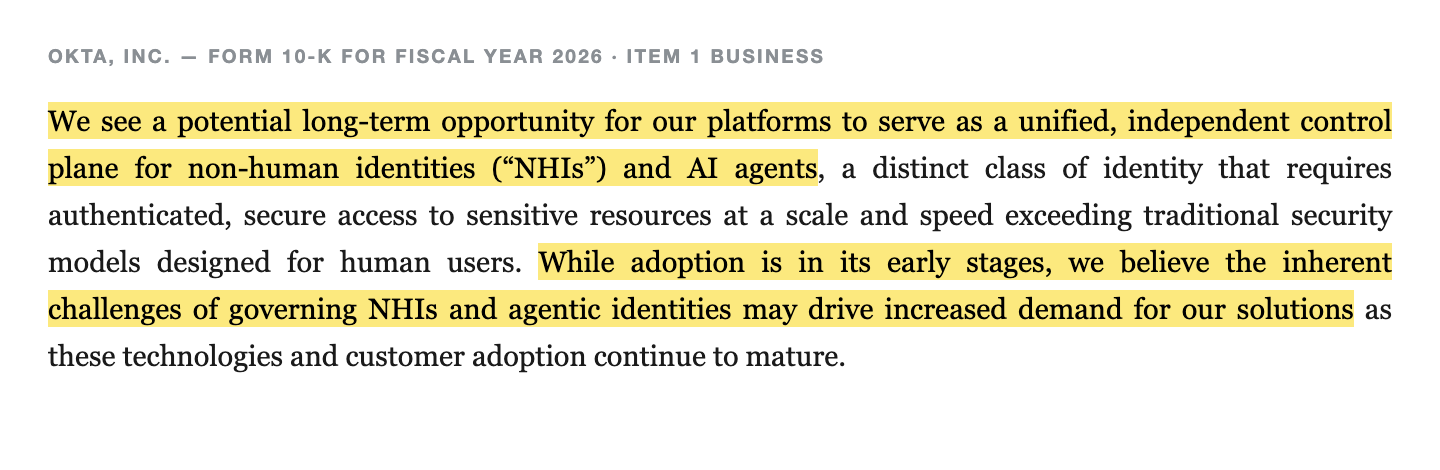
Remember the phrase "early stages": at Okta, AI agents are so far a product announcement with logic behind it, not a revenue line with receipts. Which brings us to the central tension of this analysis, running through every chapter: the swing to profit is real and sits in the books — but the stock is once again priced like a growth story, while growth itself is moving at walking pace.
Where the stock shows up in our scanner
Every day we run roughly 3,500 stocks through our scanners. As of July 18, 2026, Okta has two hits, and the first is the reason for this analysis: rank 3 in the turnaround scanner (U.S. selection). To replicate it: open the scanner, set the country filter to "US" — the list sorts by the turnaround check, and Okta sits near the top with 7 of 8 points. Behind it is a four-pillar model: first, two mandatory conditions must hold — a genuine crash (Okta: about 59 percent below its all-time high) and secured survival (an Altman Z-Score near 6; that insolvency early-warning gauge marks distress below 1.1 — Okta plays in the fortress league, hence its second hit in the Altman-Z fortress scanner). Then an eight-point checklist counts the turn: revenue stabilized? Yes. Margin turning? Yes. Cash flow positive? Yes. Balance sheet healing? Yes. Price above the 50-day line? Yes. Relative strength turning (3 months stronger than 12)? Yes. Institutions net buyers? Yes. The single missing point: insiders are not buying — the scanner counts 19 sales and exactly one purchase from the executive floor within twelve months. Remember the principle: a turnaround check measures the direction of the numbers — not whether the price of the turn is still fair. Which is exactly why we now read the filings.
The numbers over the years — honestly appraised
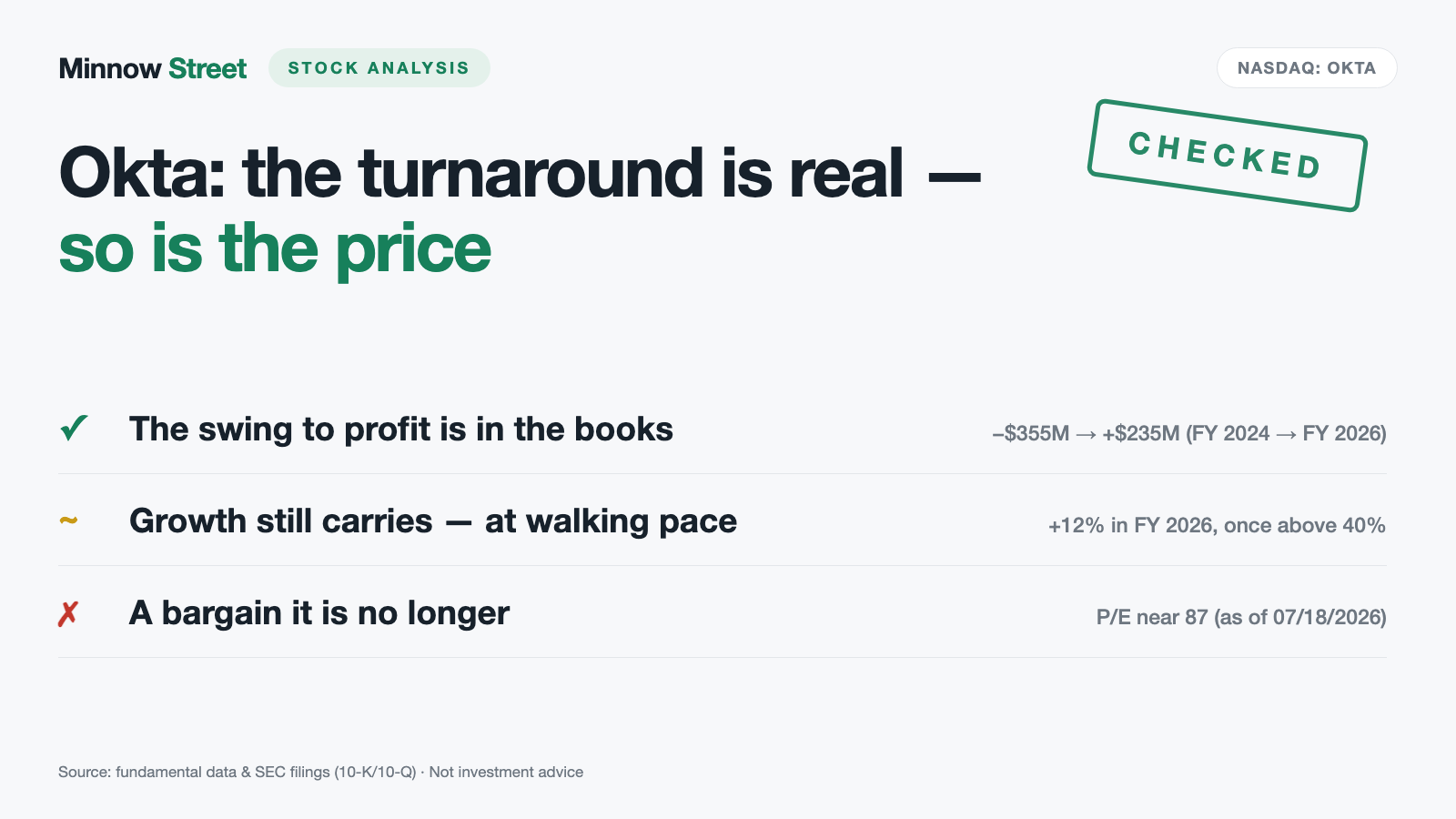
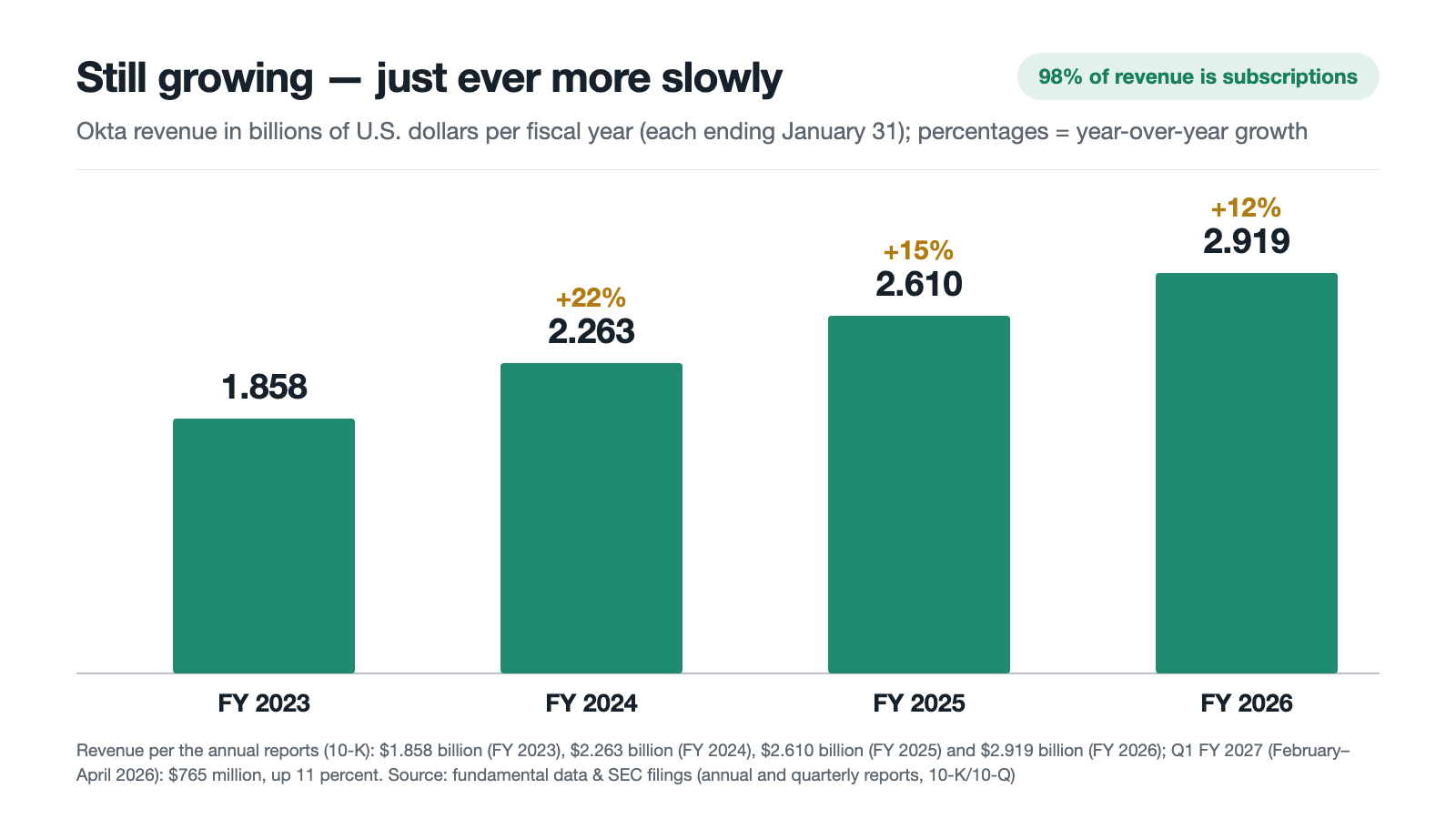
First, what genuinely impresses — and at Okta that is not growth but self-repair. For orientation: Okta's fiscal year ends January 31, so "FY 2026" essentially covers calendar 2025. Revenue climbed from $1.858 billion (FY 2023) through $2.263 billion (FY 2024) and $2.610 billion (FY 2025) to $2.919 billion in FY 2026 — solid, but with a flattening slope: +22, +15, +12 percent. The first quarter of FY 2027 (February through April 2026) brought $765 million (+11 percent).
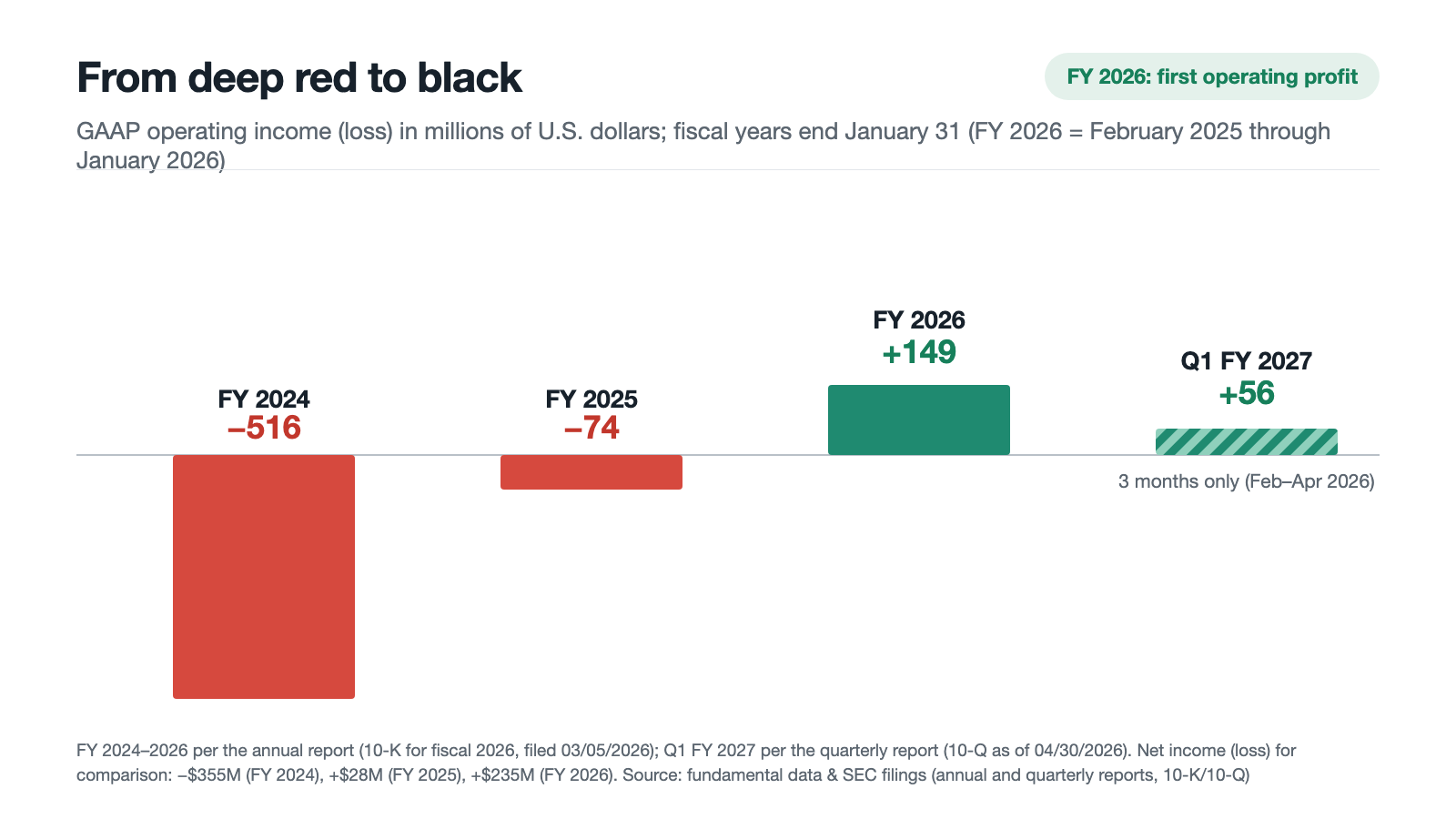
The real spectacle happened below the revenue line. The subscription model delivers a 77 percent gross margin, and once Okta tightened costs after 2023, the loss machine flipped within two years:
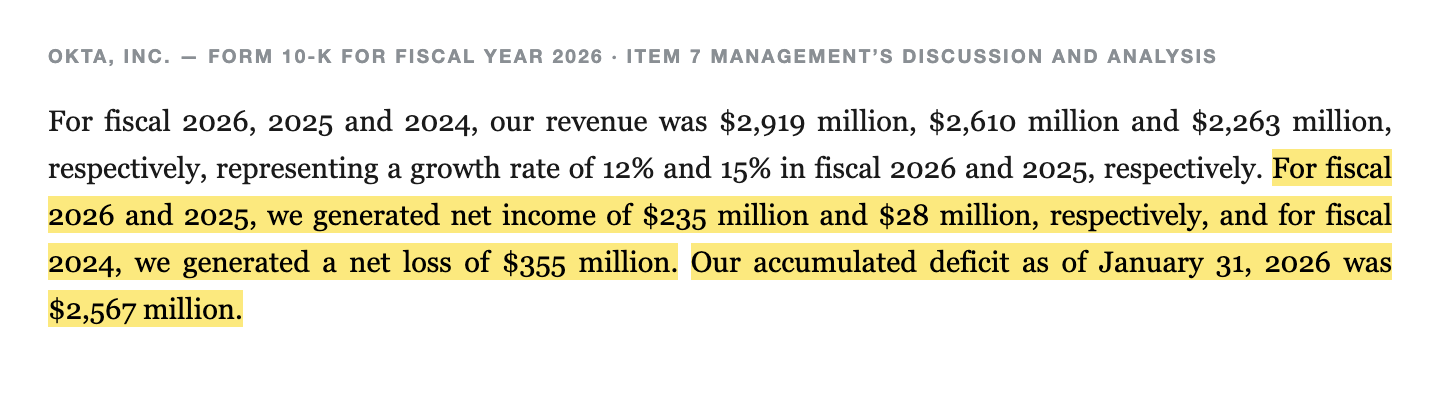
"For fiscal 2026 and 2025, we generated net income of $235 million and $28 million, respectively, and for fiscal 2024, we generated a net loss of $355 million. Our accumulated deficit as of January 31, 2026 was $2,567 million."
— Okta, Inc., SEC annual report 10-K for fiscal year 2026, Item 7 "Management's Discussion and Analysis"
On top sits a cash machine of the kind only subscription models build: $884 million in operating cash flow in FY 2026 (after $750 million and $512 million in the two years before), and with minimal capital spending roughly $863 million in free cash flow — about 30 percent of revenue. The first quarter of FY 2027 added another $277 million of operating cash flow. The order cushion is growing too: remaining performance obligations (RPO) reached $4.827 billion as of January 31, 2026 (up 15 percent). But pause before the turnaround rush takes over: a bouncer subscription is sold by the seat — and exactly there, in expanding existing customers, things are sticking. That is the next chapter.
What the filings say — the uncomfortable truths
Uncomfortable truth no. 1: growth is at walking pace — and existing customers add less and less
The annual report states the series drily:
"For fiscal 2026, 2025 and 2024, our revenue was $2,919 million, $2,610 million and $2,263 million, respectively, representing a growth rate of 12% and 15% in fiscal 2026 and 2025, respectively."
— Okta, Inc., SEC annual report 10-K for fiscal year 2026, Item 7 "Management's Discussion and Analysis"
Twelve percent is no flaw for a healthy software company — for one that grew above 40 percent in 2021 and whose valuation points back toward a growth story, it rather is. More telling is the second metric: the dollar-based net retention rate (DBNRR). In an everyday image: if last year's regulars now spend $106 for every old $100 bill, the rate stands at 106 percent — cancellations already netted in. At Okta it fell from 111 percent (FY 2024) through 107 to 106 percent (FY 2026); in the first quarter of FY 2027 it recovered slightly to 107. Meaning: existing customers are adding fewer seats and add-on modules than they used to — the report attributes this among other things to more cautious customer budgets. Current remaining performance obligations (cRPO, the next twelve months) most recently grew 12 percent. Remember: a subscription business whose regulars only add 6 percent has to buy every additional point of growth, expensively, from new customers.
Uncomfortable truth no. 2: the bouncer itself was robbed — twice, on the record in the annual report
It is the most awkward punchline in this file: the company that guards access had to report two break-ins through its own supply chain — in January 2022 via an external service provider, in October 2023 via the outsourced customer support system. The annual report for fiscal 2026 — more than two years later — records the consequences with remarkable bluntness:
"In the past we have experienced cybersecurity incidents, such as the January 2022 incident involving one of our third-party service providers and the October 2023 incident where a threat actor gained unauthorized access to and stole information from our third-party customer support system, that harmed our reputation and customer relations and adversely impacted our financial results. While we expect the impact of these security incidents to adversely affect our future financial performance, we cannot predict the extent of such impact with certainty."
— Okta, Inc., SEC annual report 10-K for fiscal year 2026, Item 7 MD&A, "Cybersecurity Incidents"
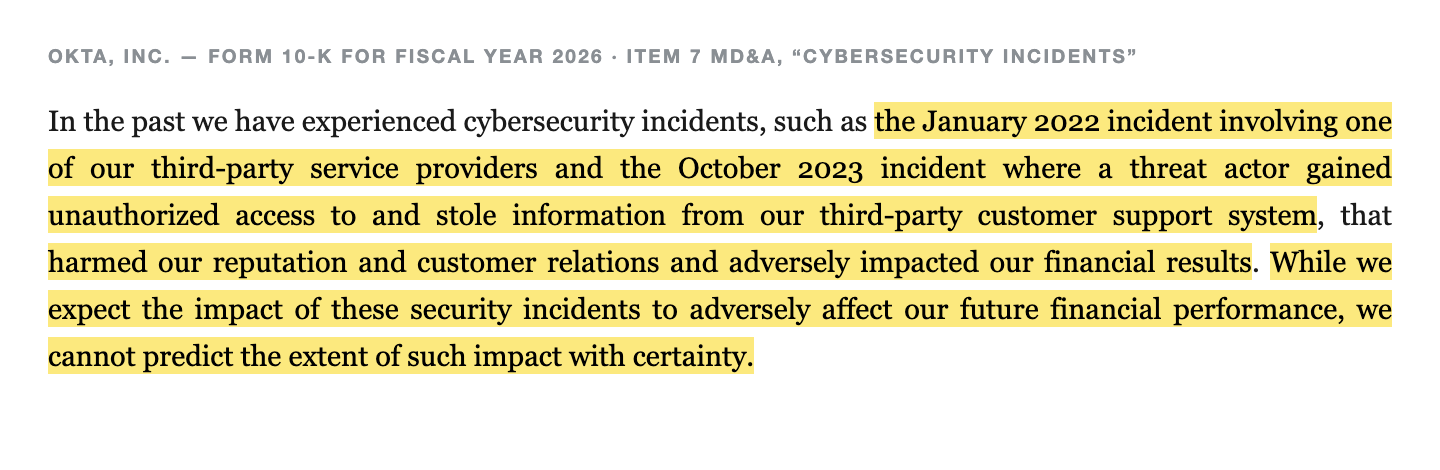
Fairness requires saying: no new incident of this kind has hit the record since October 2023, and the customer count has kept growing — trust is dented, not destroyed. But an identity vendor sells exactly one thing: trust. The report lists the incidents not as a closed episode but as an ongoing burden — including pending shareholder lawsuits over the 2022 incident. Remember the image: with a bouncer, what counts is not how often he checked correctly — but whom he let through.
Uncomfortable truth no. 3: the profit comes with an asterisk — $544 million in stock-based compensation, and the first profit was an interest profit
Two footnotes qualify the turnaround, and both are in the filings. First: the historic "first net profit" of FY 2025 (+$28 million) was not an operating profit — the business itself still lost $74 million that year; what lifted the bottom line above zero was $106 million of interest income on the cash pile and a $19 million gain from buying back its own convertible notes below face value. The turn only became genuinely operational in FY 2026 (+$149 million). Second: Okta still pays its people generously in stock — $544 million of stock-based compensation in FY 2026, about 19 percent of revenue (at least declining: after $565 million and $684 million in the years before). Translated: of the 77 percent gross margin, nearly a fifth of revenue walks out as share packages, and your slice of the cake shrinks when new slices keep being cut — the share count rose from 159.8 million (start of FY 2025) to 175.3 million (April 30, 2026). At last, though, the company is pushing back:
"On January 5, 2026, we announced that our board of directors (our “board”) approved a stock repurchase program with authorization to purchase up to $1 billion of our Class A common stock from time to time (the “Share Repurchase Program”). As of January 31, 2026, a total of $921 million remained available for repurchase under the Share Repurchase Program."
— Okta, Inc., SEC annual report 10-K for fiscal year 2026, Item 7 "Liquidity and Capital Resources"
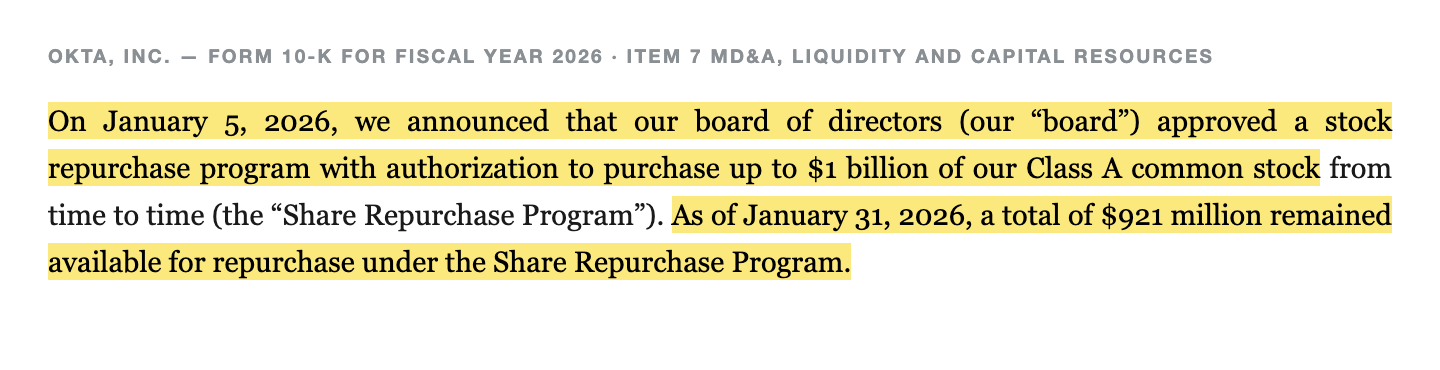
In the first quarter of FY 2027, Okta already repurchased a good 3 million shares for $242 million (about $80 apiece on average) — and for the first time the diluted share count fell year over year, from 181.8 to 177.7 million. The buyback is comfortably affordable out of $2,553 million in liquidity against $350 million of remaining convertible debt (as of January 31, 2026). Soberly viewed, though, it is for now a dilution stopper, not a gift: it clears away what stock-based compensation causes — nothing more yet.
Valuation: what the market charges for the turnaround
Now for the price tag. In mid-July 2026 the Okta share cost about $119 and the market value stood near $21 billion (all valuation figures: data as of July 18, 2026) — after a run of roughly 79 percent in three months, triggered not least by the strong opening quarter of FY 2027. That works out to: a price-earnings ratio near 87 on trailing twelve-month earnings, price-to-sales near 6.8, price-to-book near 3 and about 23 times free cash flow. For context: a trailing P/E is naturally high in a young turnaround, because the denominator has only just climbed above zero — on the analyst consensus for adjusted earnings ($3.84 per share for the current fiscal year, $4.28 for the next; source: fundamental data) the price relativizes to roughly 31 and 28 times. But even that is no bargain for 11 to 12 percent growth — it is an advance on trust that margins and buybacks keep delivering and that the AI-agent story eventually becomes revenue. The professionals' view, meanwhile, is strikingly unanimous: 45 analysts, average rating 1.4 on the five-point scale from buy (1) to sell (5) — for a stock that, despite the rally, still sits 59 percent below its early-2021 all-time high and has lost about half over five years. Then again, choral singing from analysts was audible in 2021 too — at prices nearly three times higher.
Opportunities and risks at a glance
What speaks for Okta:
- A documented swing to profit: net income (loss) from −$355 million (FY 2024) through +$28 million to +$235 million (FY 2026), operations positive for the first time at +$149 million; the opening quarter of FY 2027 added +$74 million.
- Subscription quality: 98 percent recurring revenue, a 77 percent gross margin, $863 million in free cash flow (~30 percent of revenue in FY 2026), an order cushion (RPO) of $4.827 billion (up 15 percent).
- A fortress balance sheet: $2,553 million in liquidity against $350 million of remaining convertible notes (January 31, 2026), an Altman Z-Score near 6 — plus a $1 billion repurchase program that reversed dilution for the first time.
- Structural tailwind: zero-trust security, more than 20,000 customers and 7,000 integrations — and with "Okta for AI Agents"/"Auth0 for AI Agents" a logical role as the ID check for AI agents, should their adoption mature.
What speaks against it:
- Growth at walking pace: +12 percent in FY 2026, +11 percent in the opening quarter of FY 2027 — and dollar-based net retention down from 111 to 106/107 percent.
- Trust damage with a long tail: per the annual report, the January 2022 and October 2023 incidents harmed reputation, customer relations and results — Okta explicitly expects further adverse impact; shareholder lawsuits are pending.
- Profit quality with an asterisk: $544 million of stock-based compensation (~19 percent of revenue) in FY 2026; without interest income on the cash pile, even the FY 2026 result would look considerably slimmer.
- The valuation has already paid for the turnaround: P/E near 87 trailing (roughly 31 times expected adjusted earnings), price-to-sales near 6.8 — after a 79 percent three-month rally (data as of July 18, 2026).
- Insiders are not co-signing: 19 sales, 1 purchase within twelve months (scanner data as of July 18, 2026); on top, Class B shares with ten votes apiece hand the executive circle 32 percent of the voting power.
A human conclusion
Back to the burned-fingers trap from the opening. Its core is not that the pain lies — the crash was real, the break-ins were real, and whoever bought the 2021 top is still deep underwater despite a 79 percent rally. Its core is that pain is not a measuring instrument: it carries no dates, keeps no books, reads no quarterly filings. Today the files say: the turnaround is real — operationally profitable, $863 million in free cash flow, a fortress balance sheet, buybacks against dilution. And the same files say: growth has fallen to 11–12 percent, the regulars only add 6 to 7 percent, the incidents still echo, the insiders are selling — and the market has already pre-paid half the reconciliation, at 87 times trailing earnings. Note the double trap: whoever refuses to look out of grudge misses turnarounds. Whoever, afraid of missing out yet again, jumps in after a 79 percent rally may be repeating precisely the 2021 mistake — just with better numbers in the background. What helps between the two traps is what you just did: reading instead of feeling. In the coming quarterly reports (10-Q), check three lines — the net retention rate (does it turn sustainably above 107?), revenue growth (does it hold double digits?) and the buybacks against the share count. What you make of it is your decision. And that is exactly as it should be.
Sources
All original documents used in this analysis — for reading along:
- Okta, Inc. — SEC annual report 10-K for fiscal year 2026, ended January 31, 2026 (filed March 5, 2026)
- Okta, Inc. — SEC annual report 10-K for fiscal year 2025 (filed March 5, 2025)
- Okta, Inc. — SEC quarterly report 10-Q as of April 30, 2026 (filed May 29, 2026)
- Okta, Inc. — SEC annual report 10-K for fiscal year 2022 (filed March 7, 2022; Auth0 acquisition)
- Okta's complete SEC filing history: EDGAR overview (sec.gov)
- Fundamental data (metrics, quarterly series, valuation, analyst consensus; data as of July 18, 2026), cross-checked against the SEC filings.
- Screener and rating data: our in-house stock scanner (data as of July 18, 2026), including the turnaround scanner (U.S. selection, rank 3) and the Altman-Z fortress scanner.
Transparency & disclaimer: This analysis is a journalistic contextualization of publicly available information and is not investment advice, not a financial analysis in the regulatory sense and not a solicitation to buy or sell securities. Stock investments carry substantial risks up to total loss. All information without guarantee; the data cut-off is noted in the text. The author holds no position in Okta shares at the time of publication.
Our Bottom Line at a Glance
- Swing to profit positive
- SEC-documented: net income (loss) of −$355M (FY 2024) → +$28M (FY 2025) → +$235M (FY 2026); operations turned positive for the first time in FY 2026 at +$149M, and the opening quarter of FY 2027 added +$74M net (10-K fiscal 2026; 10-Q as of 04/30/2026).
- Balance sheet & cash flow positive
- $884M operating and ~$863M free cash flow in FY 2026 (~30% of revenue), $2,553M in liquidity against $350M of remaining convertible notes, an Altman Z-Score near 6 — plus a $1 billion repurchase program that made the diluted share count fall for the first time in Q1 FY 2027.
- Growth & retention negative
- Revenue growth down to +12% (FY 2026) and +11% (Q1 FY 2027), dollar-based net retention fallen from 111% to 106/107%, cRPO +12% — solid numbers, but no longer a growth story; the AI-agent products are, per the 10-K, explicitly "in its early stages."
- Trust & security incidents negative
- Per the 10-K, the January 2022 and October 2023 incidents harmed reputation, customer relations and financial results; Okta explicitly expects further adverse impact and shareholder lawsuits are pending — for a vendor whose product is trust, this remains the most sensitive flank.
- Profit quality & dilution neutral
- Stock-based compensation of $544M (~19% of revenue, FY 2026, declining); the first net profit of FY 2025 only turned positive through interest income ($106M) and notes-repurchase gains ($19M); since January 2026, buybacks counter the dilution (Q1: $242M).
- Valuation negative
- P/E near 87 trailing, ~31 times expected adjusted earnings, P/S ~6.8, price/FCF ~23 after +79 percent in three months (as of 07/18/2026) — half the reconciliation is pre-paid; meanwhile 19 insider sales against 1 buy within twelve months.
Okta is the rare case of a turnaround built not on promises but on audited numbers: operationally profitable, ~$863M in free cash flow, a fortress balance sheet, buybacks against dilution. Against that stand growth at walking pace (+12 percent), net retention down to 106/107 percent, two security incidents with admitted long-tail effects — and a valuation that, after a 79 percent three-month rally, already pays 87 times trailing earnings. Whoever invests here buys the second half of the reconciliation, not the turnaround itself. Not investment advice.
What Our Rating Means
- If you don't own the stock
- As long as the question raised in the bottom line stays open, we see no basis for an entry.
- If you hold it in your portfolio
- Our findings offer no acute reason to sell — the checkpoints named remain decisive.
A journalistic assessment by our editorial team at the time of the deep dive, based on public sources — not investment advice and not a solicitation to buy or sell. Your personal circumstances (investment goals, risk capacity, taxes) cannot be taken into account. What our categories mean, how verdicts are formed, and what conflicts of interest exist →
Worth Noting
- OKTA made the research list as rank 3 of our in-house turnaround scanner (U.S. selection, turnaround check 7/8, as of July 18, 2026) — part of our series on the top 20 of that selection.
- Scanner metrics (P/E, P/S, P/B, Altman Z, relative strength, insider and institutional data) use trailing twelve-month figures as of July 18, 2026; the expected adjusted earnings ($3.84/$4.28 per share) are analyst consensus from the fundamental data, not GAAP figures.
- Price and market-value figures (~$119, ~$21 billion) from the July 18, 2026 feed, sanity-checked against 175.3 million shares outstanding per the quarterly report 10-Q as of April 30, 2026; analyses are evergreen, daily prices are not a buy argument.
Frequently Asked Questions
Okta, Inc. (Nasdaq: OKTA, San Francisco, 6,366 employees as of January 31, 2026) sells identity and access management as a subscription: the Okta Platform secures workforce logins (single sign-on, multi-factor authentication), while the Auth0 Platform gives developers ready-made login building blocks for their own apps. More than 20,000 customers use it; 98 percent of the $2.919 billion in revenue (fiscal 2026, ended January 31, 2026) is subscriptions.
Yes — recently: after a net loss of $355 million in fiscal 2024, Okta earned $28 million in net income in fiscal 2025 (then still carried by interest income) and $235 million in fiscal 2026; operations turned positive for the first time in fiscal 2026 (+$149 million). The first quarter of fiscal 2027 (February–April 2026) added another $74 million. Free cash flow reached roughly $863 million in fiscal 2026.
Our in-house turnaround scanner requires a genuine crash (Okta: about 59 percent below its all-time high), secured survival (Altman Z-Score near 6) and then measures eight turnaround criteria. As of July 18, 2026, Okta meets seven — revenue, margin, cash flow, balance sheet, price above the 50-day line, turning relative strength and institutional buying. Only the insiders are not buying: 19 sales stand against a single purchase within twelve months. Result: rank 3 of the U.S. selection with 7 of 8 points.
There were two incidents on the record: in January 2022, attackers gained access via an external service provider; in October 2023, a threat actor stole data from the outsourced customer support system. The annual report (10-K) for fiscal 2026 concedes that both incidents harmed reputation, customer relations and financial results, and explicitly expects further adverse impact; shareholder lawsuits over the 2022 incident are pending.
Okta positions itself as the ID check for artificial intelligence: new products such as "Okta for AI Agents" and "Auth0 for AI Agents" (both in early access) are meant to register, secure and govern AI agents — the annual report (10-K) for fiscal 2026 calls non-human identities a "potential long-term opportunity" while stressing that adoption is in its early stages. The field delivers no demonstrable revenue yet; AI-driven features such as threat detection, however, already sit inside paid products.
Richly for the growth on offer: as of July 18, 2026, at about $119 the stock traded near 87 times trailing earnings, 6.8 times revenue and 23 times free cash flow — after a roughly 79 percent rally in three months. On expected adjusted earnings ($3.84 per share for the current fiscal year) it is roughly 31 times, against 11 to 12 percent revenue growth. The stock still sits 59 percent below its early-2021 all-time high.
Okta's fiscal year ends January 31 and carries the year of its end date: "fiscal 2026" ran from February 1, 2025 through January 31, 2026 and thus essentially covers calendar 2025. The current "fiscal 2027" began in February 2026; its first quarter ended April 30, 2026. That is why every figure in this analysis names the fiscal year together with its end date.
Found an error?
Did you spot a factual error, an outdated number, or a typo in this deep dive? Let us know briefly — your report goes straight to the editorial team.