AES: The Turnaround Candidate Its Own Shareholders Already Sold
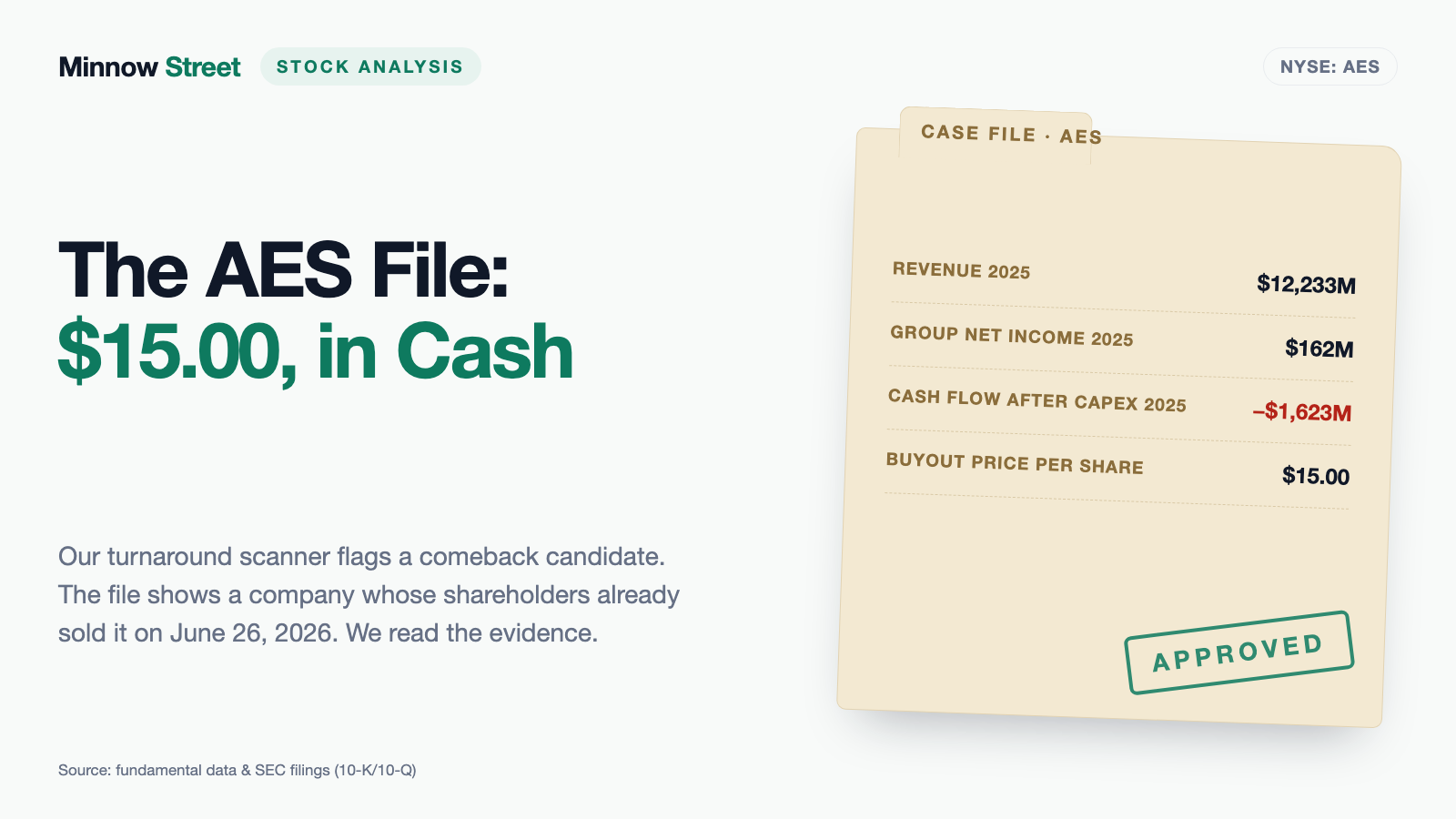
Power producer AES trades about 67 percent below its old high, which is why it shows up in our turnaround list. Except that on June 26, 2026 shareholders approved a buyout by GIP and EQT at $15.00 per share in cash. We read the annual report, the quarterly report filed on May 5, 2026 and the merger proxy, and we find earnings largely paid for by minority partners, four years of spending more than the business brought in, and a valuation range from the company's own adviser whose upper end sits a third above the offer. A share price that stands still is not a calm share price.
 Thomas Mücke
Founder & Publisher
Thomas Mücke
Founder & Publisher
Chart
Interactive price chart (TradingView).
Note: pure fact-based analysis, not investment advice and not a solicitation to buy or sell. All figures without guarantee.
The bargain-bin reflex: why "cheap" and "good value" are not the same thing
There is one thought that has cost every investor money at some point. It goes like this: this thing used to trade far higher, so it must be cheap now.
In a shop that logic sometimes works. In the market it is the most reliable trap there is, because a share price says nothing about what a company is worth. It only records what two people last agreed on. And sometimes they agreed on something entirely different from what we assume.
That is exactly the case on the table here. The AES Corporation trades roughly 67 percent below its old high, which is why it appears in our turnaround list. That sounds like a comeback candidate. It is not. Since March 1, 2026 this stock has had a fixed price — and shareholders accepted it on June 26, 2026.
So we do what we always do: open the file, read the original filings and check the arithmetic. Even when the answer is uncomfortable.
What this analysis covers
- What AES sells, and to whom
- How the stock landed on our desk
- The case in one sentence: $15.00, in cash
- The numbers over the years
- Uncomfortable truth no. 1: minority partners pay for the profit
- Uncomfortable truth no. 2: four years of spending more than it earned
- Uncomfortable truth no. 3: 8.4 percent equity
- Uncomfortable truth no. 4: the company's own adviser saw up to $20.25
- Data centers, AI and a robot called Maximo
- What the stock costs
- Opportunities and risks at a glance
- A human conclusion
- Sources
What AES sells, and to whom
AES is based in Arlington, Virginia, straight across the river from Washington, and it sells something very simple: electricity. The company owns and operates power plants totaling 34,740 megawatts — solar farms, wind parks, battery storage, hydro plants, gas turbines, liquefied natural gas terminals and some remaining coal. Those assets sit in roughly a dozen countries: the United States, Chile, Argentina, Colombia, Panama, the Dominican Republic, Mexico, Bulgaria, Jordan, Vietnam, El Salvador and the Netherlands.
The business has four parts, and they are very different in size:
- Energy Infrastructure — gas, liquefied natural gas, coal, diesel. Revenue in 2025: $5,402 million. This is the old world, and it is shrinking: down 13 percent from 2024.
- Utilities — the regulated utilities AES Indiana and AES Ohio plus four distributors in El Salvador. Revenue: $4,122 million, up 14 percent. Together the six utilities serve 2.7 million customers.
- Renewables — solar, wind, storage, hydro. Revenue: $2,913 million, up 11 percent. This is where the growth story lives.
- New Energy Technologies — stakes in Fluence, the Maximo robot, the AI Fund and others. Revenue in 2025: $1 million. That is not a typo.
Two terms matter for the balance sheet later. A PPA is a long-term power purchase agreement: a large customer commits to buying electricity at a fixed price for ten or twenty years. And a regulated utility is a grid operator granted an exclusive territory by the state, with prices approved by a commission — predictable, but capped.
The backlog — projects under contract but not yet operating — stood at 12.0 gigawatts as of December 31, 2025, of which 5.7 gigawatts were under construction. In 2025 AES signed or was awarded 4.0 gigawatts of new contracts. As of December 31, 2025 the company employed 8,336 people on a full-time basis.
How the stock landed on our desk
We run roughly 3,500 stocks through our scanners every day. AES came in through the Turnaround Candidates list: rank 29 of 60 U.S. hits, turnaround check 6 of 8, measured on July 27, 2026 (list computed July 26, 2026).
One caveat right away, so nobody searches in vain: the scanner page shows only the 25 strongest hits. AES ranks 29th and therefore does not appear on the page at all. We measured the placement directly in the database, on both brands, with the same result. These lists are recalculated daily — rank and score are a dated snapshot, not a permanent state.
The list has two mandatory pillars. Fail either one and you are out, no matter how good everything else looks:
- Pillar 1 — the crash: the stock must trade at least 50 percent below its all-time high. No real crash, no turnaround.
- Pillar 2 — survival: the Altman Z score must be at least 1.1. That score compresses several balance-sheet ratios into a single number estimating how far a company sits from insolvency. On top of that: at most one balance-sheet warning flag and positive equity.
Pillar 2 is clear: the Altman Z stood at 3.42 on July 27, 2026, about three times the threshold. This is not a bankruptcy case.
Pillar 1 we checked against the price history, because roughly 60 names in this data set carry an all-time high slipped by a factor of 1,000. For AES the value holds: the highest split- and dividend-adjusted close was $44.53 on October 2, 2000, against a close of $14.84 on July 24, 2026. That is minus 66.7 percent; the data set carries −67.03 percent, essentially the same. How badly such a figure can miss, we disclosed in our Moody’s analysis, where the same data set carried an all-time high the price history did not confirm.
One honest objection remains: that reference point is 26 years old. It comes from the energy boom of 2000, shortly before AES nearly went under in the Argentine and Californian crises. A price below a high set in 2000 says very little about the business of today. The scanner does the arithmetic correctly — the question is what the number means.
The turnaround check then awards eight points: four from the quarterly numbers (revenue direction, net margin, operating cash flow, balance-sheet healing) and four from market behavior (price above the 50-day line, three-month relative strength beating twelve-month, insider buying, institutional accumulation). Names with at least six are shown. AES sits at 6 of 8 — the minimum, with no cushion.
And here it gets interesting. Two of the four market points measure whether the price is rising and whether funds are buying. Both are true for AES — but not because the market believes in an operating recovery. It is because a buyer has offered $15.00 in cash. The scanner sees a line going up. It does not see why.
The case in one sentence: $15.00, in cash
On March 1, 2026 AES signed a merger agreement. The counterparty is Horizon Parent, L.P., a Delaware limited partnership jointly controlled by Global Infrastructure Management (GIP) — BlackRock’s infrastructure arm — and the Swedish fund EQT Infrastructure VI. The quarterly report puts it plainly:
“At the effective time of the Merger, each share of the Company’s common stock outstanding immediately before the effective time … will be converted automatically into the right to receive $15.00 in cash, without interest, per share.”
— The AES Corporation, SEC quarterly report 10-Q as of March 31, 2026, Note 1

The key terms, all from the original documents:
- Price: $15.00 per share in cash. Aggregate equity value roughly $10.7 billion.
- Premium: 35.5 percent over the unaffected closing price of July 8, 2025 — the last trading day before takeover rumors surfaced — and 40.3 percent over the 30-day volume-weighted average before that date.
- The vote: on June 26, 2026, 489,710,776 shares were represented, 68.66 percent of the outstanding stock. In favor: 479,072,642. Against: 10,131,991. Abstaining: 506,143.
- Financing: completion does not depend on the buyer raising money — the equity commitments cover the full purchase price.
- Still outstanding: approvals from the Public Utilities Commission of Ohio (PUCO), the New York regulator, the Federal Energy Regulatory Commission (FERC), the Committee on Foreign Investment in the United States (CFIUS), the antitrust agencies under the Hart-Scott-Rodino Act, the Federal Communications Commission and several non-U.S. authorities.
- Timing: closing expected in late 2026 or early 2027. The outside date is June 1, 2027, extendable by two successive three-month periods if only regulatory approvals remain outstanding.
- Break fees: if AES walks under specified circumstances it pays roughly $321 million. If the buyer walks, it pays $100 million or roughly $588 million, depending on the circumstances.
- Dividend: may continue until closing at no more than the customary rate, plus a stub payment for the quarter in which the merger completes.
What does that mean for you? Since March 1, 2026 the share price no longer reflects how well AES is run. It reflects how likely the market thinks a $15.00 closing is — and how long it will take. Everything that follows answers a different question: what exactly is being sold here?
The numbers over the years
Start with what genuinely impresses: this company builds. A lot.
Between 2022 and 2025 AES put $25,596 million into property, plant and equipment. The backlog of signed but not yet operating projects stands at 12.0 gigawatts — for scale, a large nuclear plant produces roughly one gigawatt. The U.S. development pipeline covers 46 gigawatts by the company’s own account. And the annual report notes that AES has consistently ranked among the two largest sellers of renewable power to corporations worldwide.
Revenue has been remarkably stable: $12,617 million in 2022, $12,668 million in 2023, $12,278 million in 2024, $12,233 million in 2025. Four years, barely any movement — a direct consequence of long-term supply contracts and regulated grids. The first quarter of 2026 then picked up noticeably: $3,180 million against $2,926 million a year earlier, up 8.7 percent.
Operating cash flow also ran well in 2025: $4,306 million after $2,752 million the year before, a jump of 56 percent. And operating margin in the first quarter of 2026 rose from $441 million to $640 million.
Worth remembering: anyone running 34,740 megawatts with 12 gigawatts under contract owns something that cannot be rebuilt in a year. That belongs on the credit side before we discuss the rest.
And now the part that appears in no brochure.
Uncomfortable truth no. 1: minority partners pay for the profit
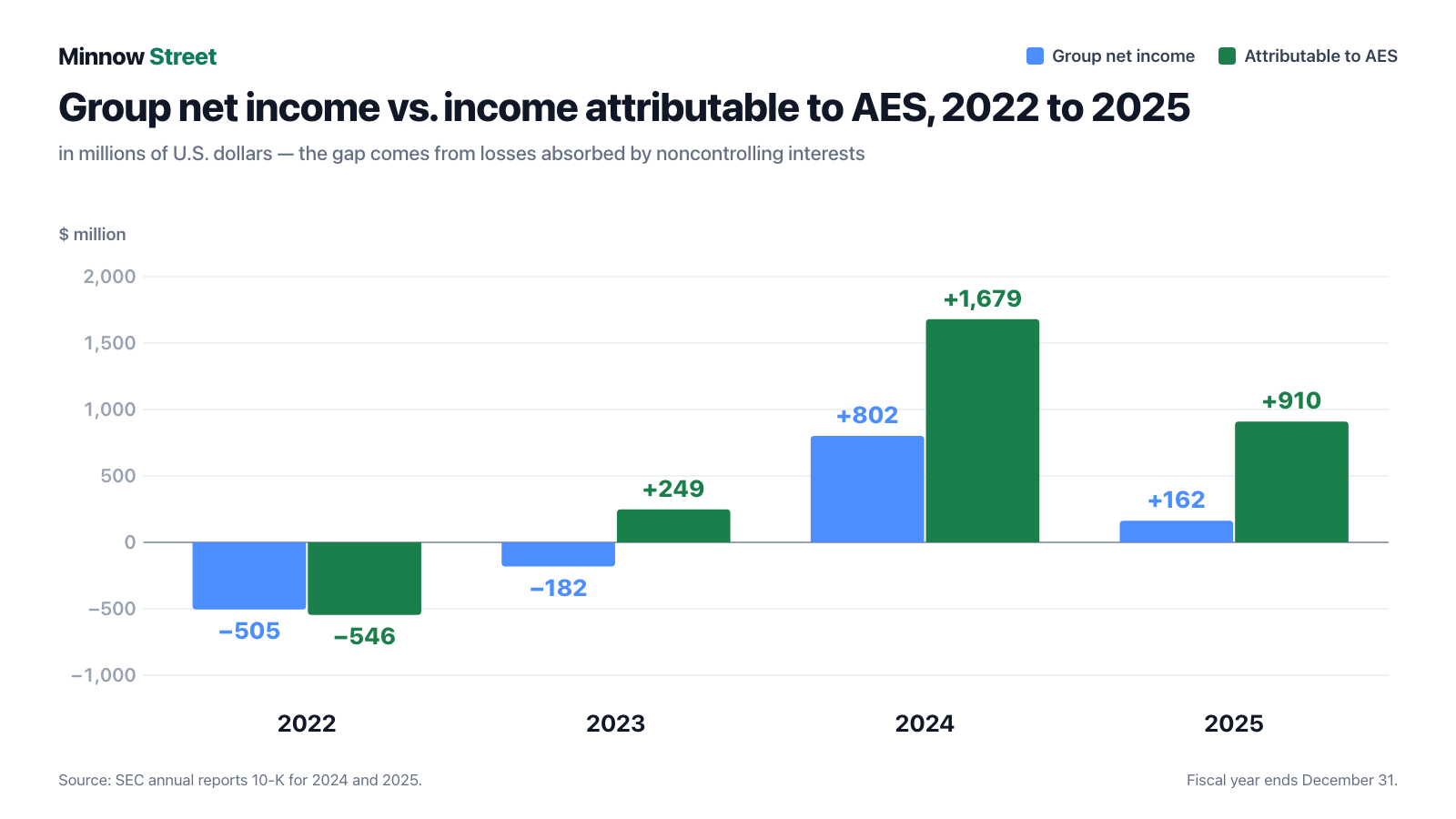
Almost every data summary shows AES with 2025 net income of $910 million and earnings per share of $1.26. Both are correct. Both are still misleading if you skip the line above.
The income statement in the annual report ends like this:
- Group net income 2025: $162 million. That is everything the group earned in total.
- Less the loss attributable to noncontrolling interests and redeemable stock of subsidiaries: $748 million.
- Net income attributable to AES: $910 million.
Reported profit is therefore 5.6 times group net income. And this is no one-off: in 2023 the group lost $182 million — and AES still reported a $249 million profit. In 2024 the group earned $802 million, AES $1,679 million. The first quarter of 2026 repeats the pattern: $275 million at group level, $487 million for AES.
“Net loss attributable to noncontrolling interests and redeemable stock of subsidiaries decreased $129 million, or 15%, to $748 million in 2025, compared to $877 million in 2024.”
— The AES Corporation, SEC annual report 10-K for 2025, MD&A

Where does it come from? AES funds its U.S. solar and battery projects with tax equity. In plain terms: an investor — usually a bank or a corporation with a large tax bill — puts money into a project and receives, above all, tax credits and depreciation rather than profit. In the consolidated accounts that shows up on their side as a loss. In 2025 alone $1,028 million of transferred tax credits were allocated to noncontrolling interests, after $220 million in 2024 and nothing in 2023.
All of this is perfectly legal, standard in the sector, and genuinely advantageous for AES — it is cheap construction capital. But it means one thing: earnings per share depend on the build cycle, not only on the business. If construction slows, less loss lands with the minorities — and reported profit shrinks without a single power plant running worse.
Uncomfortable truth no. 2: four years of spending more than it earned
A growing power company invests. That is normal. The question is how long and how much.
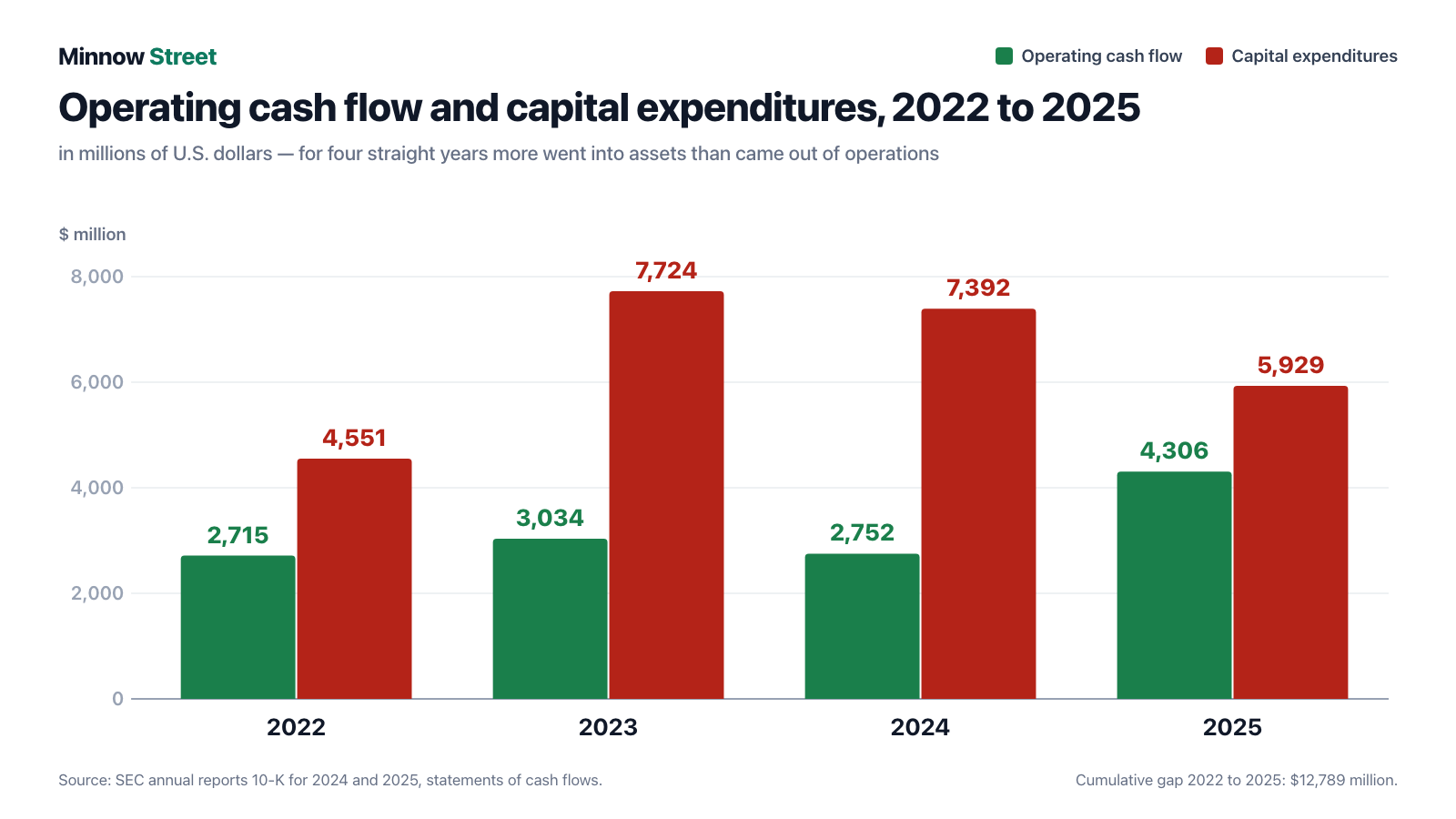
At AES the arithmetic for 2022 through 2025 looks like this: the operating business produced $12,807 million. Property, plant and equipment absorbed $25,596 million. That leaves a gap of $12,789 million — over four years, negative in every one of them.
It was closed the way infrastructure gaps usually are: with debt and with sales of stakes in its own subsidiaries. The cash-sources table in the 2025 annual report shows the scale — $5,866 million of new project debt, $3,865 million drawn on revolving credit facilities, $2,084 million from sales to noncontrolling interests, $992 million from issuing preferred shares in subsidiaries.
That also explains interest expense. It came to $1,407 million in 2025 — more than eight times group net income of $162 million. Put differently: of every dollar of operating margin, considerably more goes to lenders than to owners.
2025 did narrow the gap: operating cash flow rose 56 percent to $4,306 million while capital expenditures fell $1.5 billion to $5,929 million. The shortfall shrank from $4,640 million to $1,623 million. That is a genuine improvement — and precisely why the turnaround check awards points at all.
Uncomfortable truth no. 3: 8.4 percent equity
Now the balance sheet, and it is stranger than you would expect from a utility.
As of March 31, 2026 total assets stood at $52,819 million. Of that, AES Corporation stockholders’ equity — the shareholders this analysis is about — accounted for exactly $4,420 million. That is 8.4 percent.
The line below it reads: noncontrolling interests $4,936 million. The partners in the project companies own more of this group than its own shareholders do. And above that, between debt and equity, sits another $2,895 million of "redeemable stock of subsidiaries" — stakes a partner can hand back under defined conditions, which AES would then have to pay out.
Debt adds up to roughly $31.0 billion: $6,171 million with recourse to the parent, $24,828 million non-recourse — secured only against individual plants and subsidiaries. That distinction matters: if a project fails, AES loses the project in the worst case, not the group. It is exactly why the Altman Z holds at 3.42 even though the equity ratio looks like an emergency.
And then there is a sentence in the quarterly report that is easy to skip:
“As of March 31, 2026, certain consolidated VIEs have arrangements which may require the Company to contribute additional equity totaling $1.5 billion.”
— The AES Corporation, SEC quarterly report 10-Q as of March 31, 2026, Note 1
$1.5 billion of potential contributions against $4,420 million of equity: that is 34 percent. The amount appears in no debt line, only in the notes.
Uncomfortable truth no. 4: the company's own adviser saw up to $20.25
When a board approves a buyout it needs an opinion declaring the price fair. At AES that came from J.P. Morgan, and it is set out verbatim in the merger proxy of May 15, 2026. Three methods, three per-share ranges:
- Comparison with listed peers: $9.75 to $17.50
- Comparison with earlier sector transactions: $11.25 to $17.75
- Discounted cash flow, segment by segment: $10.50 to $20.25
“The analysis indicated an implied per share equity value for Company Common Stock, rounded to the nearest $0.25, of $10.50 to $20.25.”
— The AES Corporation, SEC merger proxy DEFM14A of May 15, 2026, Opinion of J.P. Morgan

Fairness in this context means "within the range", not "at the top of it". The gap to the top of the discounted cash flow range is $5.25 per share — roughly $3.7 billion across 713 million shares.
Holders who voted against the merger and observed the formalities may have the "fair value" of their shares determined by the Delaware Court of Chancery under Section 262 of the Delaware General Corporation Law. As of June 12, 2026, AES said it was aware of two lawsuits (Miller and Wright, New York Supreme Court) and fifteen demand letters — both routine in large mergers, and neither nothing.
The other side belongs in the picture too: the board explicitly weighed that the pre-announcement price already contained a takeover premium, given the rumors circulating since July 8, 2025, and that going it alone risked falling back below that level. That is a reasonable argument. It does not change the fact that the top of the company’s own range sits a good third above the offer.
Data centers, AI and a robot called Maximo
A power company in an analysis about artificial intelligence sounds like a bandwagon. Here it is not. The 2025 annual report says so itself, in its very first chapter:
“Our Renewables SBU is well-positioned to take advantage of the growth in data centers driven by the increase in power demand for generative artificial intelligence.”
— The AES Corporation, SEC annual report 10-K for 2025, Item 1 Business

AES deliberately hunts for sites near fiber, water and open land to enable new data centers, and sells shovel-ready projects on through so-called develop-transfer agreements. We looked at the same demand surge from the opposite direction in our Oracle analysis — there it is a capital spending program, here it is an order book.
Inside its own operations AES uses AI as well: as of December 31, 2025 it had five units of the Maximo robot in service, placing and fastening solar modules, among other things at the 2-gigawatt Bellefield project in California. On top of that comes a partnership with the AI Fund that produced two co-built software companies in 2025; AES says it was the first user of their products.
Our classification: AES uses artificial intelligence but does not sell it. The segment housing Maximo and the AI Fund generated exactly $1 million of revenue in 2025 — out of $12,233 million. What is sold is electricity. That the demand for that electricity comes from AI is a tailwind, not a business model.
What the stock costs
As of July 27, 2026, with 713,157,713 shares outstanding and a closing price of $14.84 on July 24, 2026, AES carries a market value of roughly $10.6 billion.
In orders of magnitude:
- Price/earnings about 12, on earnings per share of $1.26 for 2025 — measured against group net income of $162 million it would be about 65
- Price/sales about 0.87, on 2025 revenue
- Price/book about 2.4, on AES Corporation stockholders’ equity of $4,420 million
- Enterprise value roughly $40 billion — market value plus roughly $31.0 billion of debt less $1,600 million of cash. For an infrastructure group that is the number that counts: the buyer takes on the debt.
The important caveat sits above all of it: these ratios no longer value anything. While the merger agreement is alive, the share price is tethered to $15.00 — capped above by the offer, set below by the probability of failure.
What the professionals think: eleven analyst estimates produce a mean target price of exactly $15.00 — one strong buy, ten holds, no sells (data as of July 27, 2026). A consensus is normally a sentiment reading. Here it is something else: it simply copies the offer price. When every analyst names the same target as the buyer, nobody has a view on the company any more — only on the contract.
For completeness: the dividend of $0.17595 per share per quarter may continue until closing, plus a stub payment for the final quarter. Against the July 24, 2026 close that is a little over 4.7 percent a year — the only return this configuration can still produce, apart from the spread to the offer price.
Opportunities and risks at a glance
Opportunities
- A fixed price with broad approval: $15.00 in cash, accepted by 479,072,642 shares; closing carries no financing condition.
- Real substance if the deal fails: 34,740 megawatts of generating capacity, two regulated U.S. utilities, $39,290 million of property, plant and equipment.
- Contracted growth: a 12.0 gigawatt backlog, 5.7 of it under construction; a 46 gigawatt development pipeline in the United States alone.
- Demand tailwind from AI data centers, named explicitly as a driver in the annual report.
- Visible operating improvement: operating cash flow up 56 percent to $4,306 million in 2025, spending gap narrowed from $4,640 million to $1,623 million.
- The dividend continues until closing, plus a stub payment for the final quarter.
Risks
- Regulatory risk: PUCO, the New York regulator, FERC, CFIUS, the antitrust agencies, the FCC and several non-U.S. authorities are still outstanding. Outside date June 1, 2027.
- Capped upside: beyond $15.00 there is nothing if the deal completes — the 35.5 percent premium is already in the price.
- Weak group earning power: $162 million of income on $12,233 million of revenue, against $1,407 million of interest expense.
- Dependence on allocations: reported earnings per share arise in large part from $748 million of losses borne by minority partners.
- Thin equity: 8.4 percent of total assets, plus $1.5 billion of potential contributions to project entities and $2,895 million of redeemable stock of subsidiaries.
- Litigation over the price: two lawsuits and fifteen demand letters as of June 12, 2026; appraisal proceedings under Section 262 DGCL are possible.
- Country risk: a substantial part of the business sits in Argentina, Chile, Colombia, Panama, the Dominican Republic, Bulgaria and Vietnam — currencies, regulation and politics feed straight through.
A human conclusion
Back to the bargain-bin reflex. It says: what has fallen far must be cheap. It does not say why it fell, or whether anyone is still negotiating the price.
At AES nobody is negotiating any more. The price has stood since March 1, 2026 and it is $15.00. Shareholders accepted it on June 26, 2026. What our turnaround list reports as a comeback candidate is in truth a company in transit — from the stock exchange into the hands of two infrastructure funds.
That does not make the analysis pointless, quite the opposite. If the deal fails, the price falls back onto exactly what these filings describe: a group with impressive assets and a 12 gigawatt backlog — and with $162 million of annual earnings on $12.2 billion of revenue, $31 billion of debt, an 8.4 percent equity ratio and earnings per share that arise in large part from a loss allocation.
None of that is a doomsday scenario. It is the list of things worth knowing before mistaking a number on a screen for a bargain. A share price that stands still is not a calm share price — it is a share price waiting on a regulator.
What you make of that is your decision. And that is exactly as it should be.
Sources
- SEC annual report 10-K for 2025, The AES Corporation, filed March 2, 2026 (CIK 0000874761)
- SEC annual report 10-K for 2024, filed March 11, 2025 — supplies the comparative figures for 2022
- SEC quarterly report 10-Q as of March 31, 2026, filed May 5, 2026
- SEC quarterly report 10-Q as of September 30, 2025, filed November 4, 2025
- SEC quarterly report 10-Q as of June 30, 2025, filed August 1, 2025
- SEC quarterly report 10-Q as of March 31, 2025, filed May 1, 2025
- SEC merger proxy DEFM14A, filed May 15, 2026 — the board’s reasons, the J.P. Morgan opinion and management forecasts
- SEC current report 8-K of March 2, 2026 — merger agreement (Item 1.01) and appointment of the president (Item 5.02)
- SEC current report 8-K of June 12, 2026 — merger-related lawsuits and demand letters (Item 8.01)
- SEC current report 8-K of June 16, 2026 — $600 million and $400 million senior notes (Items 1.01/2.03)
- SEC current report 8-K of June 26, 2026 — results of the special meeting of stockholders (Item 5.07)
- Screening and metric data: our in-house stock scanner (data as of July 27, 2026), including the Turnaround Candidates scanner (U.S. selection, rank 29 of 60, turnaround check 6 of 8, measured July 27, 2026) — these lists are recalculated daily and display only the 25 strongest hits
- Metrics, price history and analyst estimates: fundamental data, as of July 24 to 27, 2026
Journalistic analysis, not investment advice and not a solicitation to buy or sell securities. Share prices can move sharply; a total loss is possible. All figures come from the original documents linked above and carry their own reporting dates. The author holds no position in The AES Corporation at the time of publication.
Our Bottom Line at a Glance
- Assets and market position positive
- AES owns real assets: 34,740 MW of generating capacity across roughly a dozen countries, two regulated U.S. utilities with statutory service territories, and grids serving 2.7 million customers. Property, plant and equipment stood at $39,290 million as of March 31, 2026. The 12.0 gigawatt backlog is contracted, not estimated.
- Tailwind from data centers positive
- The 2025 annual report names power demand from generative artificial intelligence explicitly as a growth driver for the Renewables segment. By its own account AES ranks among the two largest sellers of renewable power to corporations worldwide; the U.S. development pipeline covers 46 gigawatts and the U.S. backlog 7.6 gigawatts, with a construction budget of more than $12 billion.
- Group earning power negative
- Out of $12,233 million of revenue in 2025, the group kept $162 million — 1.3 percent. Interest expense alone was $1,407 million, more than eight times group net income. The $910 million reported for AES shareholders only arises because noncontrolling interests were allocated $748 million of losses.
- Cash flow and funding negative
- For four straight years more went into assets than the business produced: from 2022 through 2025, $12,807 million of operating cash flow faced $25,596 million of capital expenditures. The $12,789 million gap was closed with debt, stake sales and tax credits. Debt stood at roughly $31.0 billion as of March 31, 2026.
- Balance-sheet structure negative
- Of $52,819 million in total assets as of March 31, 2026, only $4,420 million was AES Corporation stockholders' equity — 8.4 percent. Noncontrolling interests held more at $4,936 million, plus $2,895 million of redeemable stock of subsidiaries. The Altman Z bankruptcy warning score nonetheless sits at 3.42, well clear of the danger zone.
- Merger and price formation neutral
- Since March 1, 2026 the market has been pricing the probability of a $15.00 closing rather than the business. Shareholders approved on June 26, 2026 and the offer carries no financing condition — but PUCO, the New York regulator, FERC, CFIUS and several non-U.S. authorities still have to sign off. If that fails, the valuation falls back onto the business this report describes.
The AES Corporation is an asset-heavy group with genuine substance: 34,740 megawatts of generating capacity, two regulated U.S. utilities, a contracted backlog of 12.0 gigawatts and, in the AI data center build-out, a demand surge its own annual report names. The earnings side does not keep up: $162 million of group net income on $12,233 million of revenue, $1,407 million of interest expense, four straight years of a gap between operating cash flow and capital spending — $12,789 million in total — and equity worth 8.4 percent of the balance sheet. Reported earnings for shareholders arise in large part from losses allocated to minority partners. Above all of it hangs a price tag: $15.00 per share in cash, accepted by shareholders on June 26, 2026. Anyone buying today is not buying a turnaround but a bet on regulators. Not investment advice.
What Our Rating Means
Open questions
The business works in principle, but one material question is open. As long as it stays open, our findings do not carry a quality verdict.
The business is real and hard to copy: 34,740 megawatts of generating capacity, two regulated utilities with statutory service territories, a signed backlog of 12.0 gigawatts, $4,306 million of operating cash flow in 2025 and an Altman Z of 3.42 far outside the danger zone. No sign of substance risk — hence no red. What is missing for green is earnings quality: a 1.3 percent margin after all costs, interest expense more than eight times group net income, four years with a cumulative spending gap of $12,789 million, and an equity ratio of 8.4 percent at which minority partners own more than shareholders do. Reported earnings per share also depend on a loss allocation that moves with the project cycle. The decision is yours.
A journalistic assessment by our editorial team at the time of the deep dive, based on public sources — not investment advice and not a solicitation to buy or sell. Your personal circumstances (investment goals, risk capacity, taxes) cannot be taken into account. What our levels mean, how verdicts are formed, and what conflicts of interest exist →
Worth Noting
- Hook: our in-house stock scanner "Turnaround Candidates", rank 29 of 60 U.S. hits, turnaround check 6 of 8, measured on both brands on July 27, 2026 (list computed July 26, 2026). The scanner page shows only the 25 strongest hits — AES ranks 29th and is not visible on the page itself. These lists are recalculated daily; rank and score are a snapshot.
- Cross-check on the mandatory pillar "at least 50 percent below the all-time high": the data set carries −67.03 percent and the price history confirms it. Highest split- and dividend-adjusted close $44.53 on October 2, 2000, close of $14.84 on July 24, 2026 — minus 66.7 percent. No value slipped by a factor of 1,000. The reference point does, however, come from the energy boom of 2000 and is therefore 26 years old.
- Takeover check before the analysis: no Form 15, no SC 14D9, no Form 25 for the common stock; the shares are still listed on the NYSE as of the data date. This is a Delaware statutory merger, not a public tender offer.
- Data as of: 10-K for 2025 filed March 2, 2026; 10-K for 2024 filed March 11, 2025 (supplies 2022); 10-Q as of March 31, 2026 filed May 5, 2026; 10-Q filings as of September 30, 2025, June 30, 2025 and March 31, 2025; merger proxy DEFM14A of May 15, 2026; current reports 8-K of March 2, June 12, June 16 and June 26, 2026; metrics and price history July 24 to 27, 2026.
- Risk of confusion: "AES" is also the name of a subsidiary of Astronics (ticker ATRO) and the abbreviation of an encryption standard. This analysis is exclusively about The AES Corporation, CIK 0000874761.
- The rating in this analysis judges the company, not the entry point. A scanner placement is an invitation to research, never a buy signal.
Frequently Asked Questions
AES generates and distributes electricity. The company operates power plants totaling 34,740 megawatts — solar, wind, battery storage, hydro, gas, liquefied natural gas and some remaining coal — across roughly a dozen countries. It also owns two regulated U.S. utilities in Indiana and Ohio plus grids in El Salvador, serving 2.7 million customers in total. Revenue in 2025: $12,233 million.
Yes. On March 1, 2026 AES entered into a merger agreement with Horizon Parent, L.P., controlled by Global Infrastructure Management (GIP) and the EQT Infrastructure VI fund. At closing each share converts into $15.00 in cash. Shareholders approved the deal on June 26, 2026. Still outstanding are approvals from PUCO, the New York regulator, FERC, CFIUS and several non-U.S. authorities.
The merger proxy says late 2026 or early 2027. The contractual outside date is June 1, 2027, extended by two successive three-month periods if only regulatory approvals remain outstanding. If the merger is not completed, AES says it will remain a publicly traded company and the stock will continue to trade on the New York Stock Exchange.
Because the scanner reads metrics, not news. AES clears both mandatory pillars: the stock trades about 67 percent below its all-time high, and the Altman Z bankruptcy warning score is 3.42 against a danger zone below 1.1. On the turnaround check it scores 6 of 8. Rank 29 of 60 U.S. hits, measured on July 27, 2026 — the page shows only the 25 strongest, so AES is not visible on it.
Because noncontrolling interests absorb losses. In 2025 the group earned $162 million; a loss of $748 million was attributable to minorities and redeemable stock of subsidiaries, leaving $910 million for AES shareholders. The reason is tax equity investors in U.S. solar and battery projects, who are allocated tax credits and depreciation — $1,028 million in 2025 alone.
Yes, and the merger agreement expressly permits it to continue until closing — at no more than the most recent quarterly rate, plus a stub dividend for the quarter in which the merger completes. The rate is $0.17595 per share per quarter. In fiscal 2025 that cost $501 million in cash, after $483 million in 2024 and $444 million in 2023.
Two things, and only one of them is revenue. First, demand: the 2025 annual report names data centers for generative AI as a growth driver for the Renewables segment. Second, internal use: AES runs five units of the AI-powered robot Maximo, which installs solar modules, and co-develops software with the AI Fund. What it sells is electricity, not AI — which is why we classify AES as a company that uses AI.
As of March 31, 2026 the balance sheet carried roughly $31.0 billion of debt: $6.2 billion with recourse to the parent and $24.8 billion non-recourse, secured only against individual projects. In June 2026 two new bonds were added: $600 million at 5.200 percent due 2029 and $400 million at 5.750 percent due 2033, issued on June 16, 2026 to repay existing indebtedness.
Found an error?
Did you spot a factual error, an outdated number, or a typo in this deep dive? Let us know briefly — your report goes straight to the editorial team.