Ashford Hospitality Trust: A Hotel REIT With No Employees — and an Exit Fee Named in the Going-Concern Warning
Our in-house stock scanner puts Ashford Hospitality Trust 16th in the price-to-free-cash-flow ranking of the U.S. selection on July 27, 2026, at a ratio of 0.9. Read the filings with the U.S. securities regulator, the SEC, and what sits behind that number is not earnings power but a collapsed numerator: roughly $21.7 million of common stock market value against $2.4 billion of debt, minus $695 million of equity and an audit opinion with a going-concern paragraph. The advisor running this company does not work inside it. It has extended its own contract to 2041, and its potential exit fee is one of the reasons the auditor gives for its doubt. Cheap is not a price here. It is a question.
 Thomas Mücke
Founder & Publisher
Thomas Mücke
Founder & Publisher
Chart
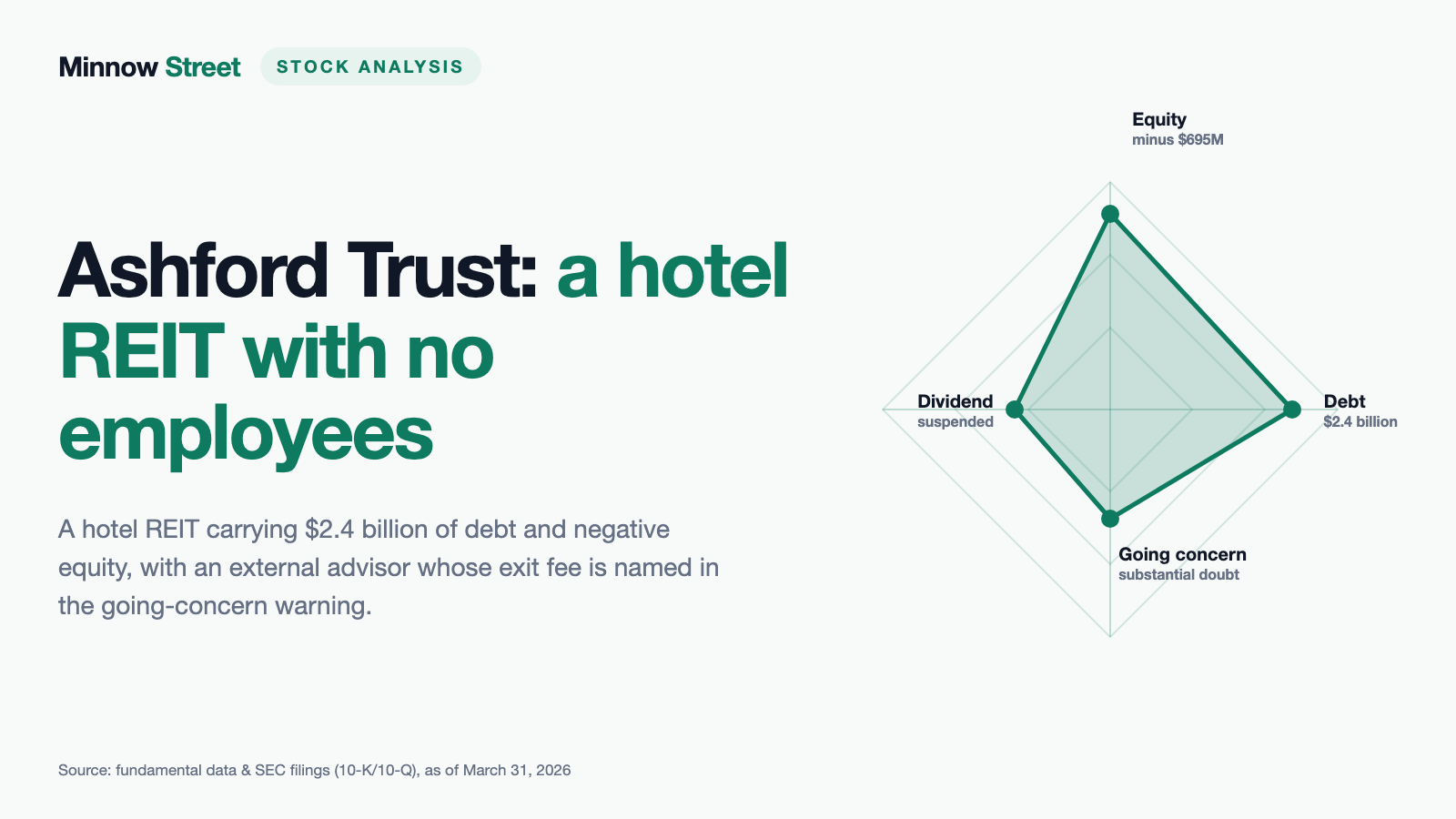
Interactive price chart (TradingView).
Note: pure fact-based analysis, not investment advice and not a solicitation to buy or sell. All figures without guarantee.
There is an investor trap that requires no expertise at all — in fact it works best on people who are good with numbers. Call it the price tag trap. It goes like this: you see a small number and your head silently adds the word "cheap". Two dollars for a loaf of bread is cheap, twenty is expensive — that is how we learned it, and in a grocery store it holds. On a stock exchange it does not, because next to the price stands something that appears on no label: what exactly you are buying. That is how Ashford Hospitality Trust, Inc. (NYSE: AHT) landed on our desk — through a ratio that looks like a bargain and, once taken apart, says the opposite.
So here is the deal. Before we celebrate the ratio, we read what it is built from. The sources are the filings the company submits to the U.S. securities regulator, the SEC — the annual report (Form 10-K) for 2025 filed March 23, 2026, the quarterly report (Form 10-Q) as of March 31, 2026 filed May 14, 2026, and the current reports (Form 8-K) in between. Those filings are honest under penalty of law. And they describe a portfolio of hotels, zero employees, and an auditor who signed with a caveat.
Contents
- What Ashford Hospitality Trust actually does
- Where the stock landed on our desk — and what a P/FCF of 0.9 means here
- The numbers over the years — fairly credited
- What the filings say — the uncomfortable truths
- Valuation: what a share of this REIT really is
- Opportunities and risks at a glance
- A human closing thought
- Sources
What Ashford Hospitality Trust actually does
Ashford Hospitality Trust is a REIT, a real estate investment trust: a company that owns property and must distribute almost all of its profits to shareholders, and in exchange pays almost no corporate income tax. Think of a property manager that is also the owner. It buys, holds, rents out and sells, and the surplus is meant to be passed straight through.
What this company owns is not apartment blocks but upscale and upper upscale hotels. As of December 31, 2025 there were 68 consolidated hotels with 16,633 rooms, all in the United States; 63 of them operated under franchise licenses or brand management agreements from Marriott, Hilton, Hyatt and others. One hotel is owned only 29.3 percent yet is still fully consolidated. The hotels are run not by the owner but by operators — among them Remington Hospitality, which belongs to a related party. Remember that name, it returns shortly. And the portfolio is shrinking fast: as of March 31, 2026 only 63 properties with 15,591 rooms were left, and through July 1, 2026 the company reported ten further completed sales. Every hotel count in this article therefore carries its own as-of date.
Now the peculiarity without which not a single number here makes sense. Ashford Hospitality Trust has no employees. Not few — none. The annual report states it in a sentence that reads like a formality and in fact describes the whole business model:
"We have no employees. Our appointed officers are provided by Ashford LLC, a subsidiary of Ashford Inc. (collectively, our "advisor"). Advisory services which would otherwise be provided by employees are provided by subsidiaries of Ashford Inc. and by our appointed officers. Subsidiaries of Ashford Inc. currently have approximately 82 full-time employees who provide advisory services to us."
— Ashford Hospitality Trust, Form 10-K for 2025, Item 1 Business
This is called an externally managed REIT. Shareholders own the hotels; another publicly traded company runs them for a fee. The structure is not unusual in this industry — but it carries a built-in tension, and that tension is the central conflict of this analysis: the advisor's fee is tied to the size of the company, not to its success. And when the company shrinks, the fee does not shrink with it — it is contractually protected on the downside. How strongly, we will see in black and white.
Where the stock landed on our desk — and what a P/FCF of 0.9 means here
Ashford Hospitality Trust caught our eye in our in-house stock scanner, specifically in the P/FCF ranking. That ranking collects every stock with positive free cash flow and a price-to-free-cash-flow ratio of at most 10, then sorts them ascending — cheapest first. On July 27, 2026 we counted: the list showed 544 hits and had last been recomputed on July 26, 2026. Set the market filter to the U.S. and the page displays 25 rows — and in that U.S. selection Ashford Hospitality Trust stood at rank 16 with a ratio of 0.9. To repeat it yourself: open the "Stocks" section, then "Scanner", pick the P/FCF ranking, set the market above the results table to "US" and look for the AHT row. The lists are recomputed daily, so the placement is a dated snapshot from July 27, 2026, not a permanent state.
Now the ratio itself, in plain language. Free cash flow is the money left after all running costs and investments. The price-to-free-cash-flow ratio divides market value by the sum of that amount over the last four quarters. A value of 20 means you pay twenty times one year of freely available cash. A value of 0.9 means, arithmetically: the company generated about as much free cash in four quarters as it costs on the stock market. At a healthy company that would be a sensation.
Here it is not. That is the single most important sentence in this analysis. A ratio has two sides, and a low ratio can have two entirely different causes. Either the denominator is large — the company earns a lot. Or the numerator is small — the company is worth almost nothing on the exchange. At Ashford Hospitality Trust the common stock market value is roughly $21.7 million (fundamental data as of July 26, 2026). That is not a corporate price tag; that is the order of magnitude of a single apartment building. Next to it, on the same balance sheet, sit $2.4 billion of debt. The stock is not cheap — it has become small.
And the other side of the ratio does not hold up either. Look at what the operating cash inflow of the first quarter of 2026 is actually made of — the very quarter that makes the placement possible:
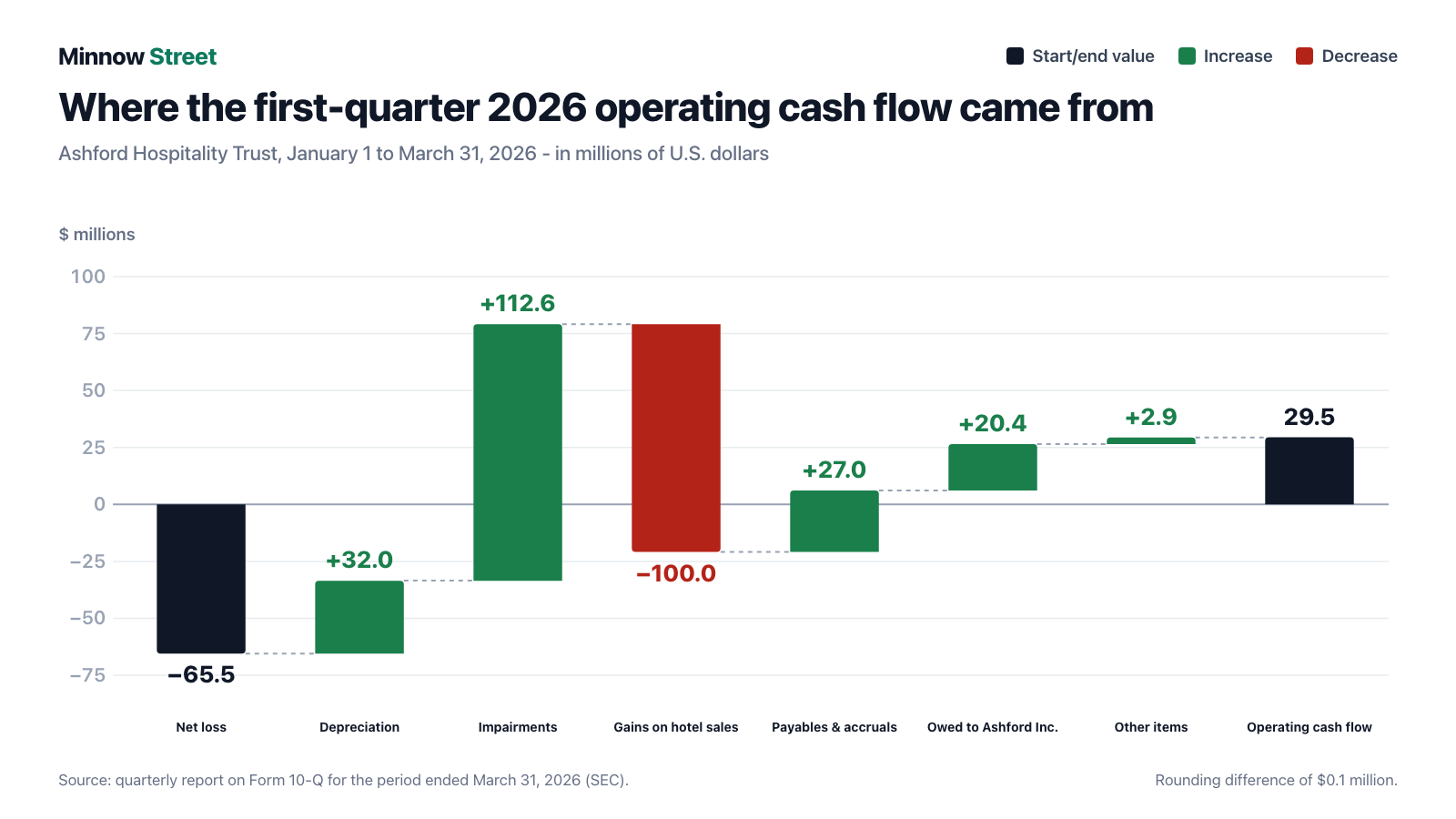
Read the chart from left to right. It starts with a net loss of $65.5 million. Then come the entries that cost no cash and are therefore added back: $32.0 million of depreciation and $112.6 million of impairments — hotels whose carrying value was written down. Next, $100.0 million is subtracted again because gains on hotel sales do not belong to operations. And then come the two items that matter: plus $27.0 million from payables and accruals and plus $20.4 million from the line "Due to/from Ashford Inc.". The remaining plus $2.9 million spreads across smaller items.
In plain terms: money that was not spent because bills stayed open — among them fees owed to the external advisor and not yet wired. In the cash flow statement that looks like inflow. On the balance sheet the same movement appears from the other side: the line "Due to Ashford Inc., net" rose from $40.6 million on December 31, 2025 to $65.6 million on March 31, 2026. An unpaid bill is not earnings. It is a delay.
A rule worth filing away: a low price-to-cash-flow ratio is not a gift but a question — namely, why the market trusts that cash flow so little. You know the same pattern from our analysis of Ready Capital, which stood at rank 7 in the very same list on the same day, nine places higher — there too, the apparent cheapness is mostly a statement about the numerator.
Incidentally, our own system says the same thing if you look closely: on the stock page, pure metric rankings expressly do not count as scanner hits. What was listed there as hits on July 27, 2026 were seven strategy lists — and four of them from the "Risk & Weakness" section: the insolvency study with stacked warning signals, the Stage 4 downtrend, and two Stan Weinstein variants (Stage 4 and Stage 4B−). The RS rating, which measures relative strength against every other stock, stood at 16 out of 99.
The numbers over the years — fairly credited
Let us start with what genuinely impresses, because there is such a thing. Ashford Hospitality Trust is not a castle in the air: this is a company that generated revenue of $1,104.4 million in 2025 — more than a billion dollars, from real hotel rooms, real restaurants and real parking. Revenue per available room (RevPAR in the industry, meaning revenue divided by all rooms, occupied or not) came in at $131.68 in 2025 after $132.87 the year before. That is remarkably stable for a company in this position: the hotels run, the guests show up.
And the sales of recent months show that the property market grants these hotels real prices. Between April 7 and July 1, 2026 the company reported ten completed hotel sales on Form 8-K — among them the Hyatt Regency Savannah for $158.0 million on June 30 and the Marriott Fremont Silicon Valley for $53.0 million on July 1, 2026. Those two properties alone sold for roughly ten times what the entire common stock is worth on the exchange. The real estate is there. That is not nothing.
Unfortunately the praise ends there. The three-year record shows a company that is shrinking, not growing:
- Revenue: $1,367.5 million (2023) to $1,172.5 million (2024) to $1,104.4 million (2025). The decline comes mostly from sold hotels and from two portfolios that went into receivership in 2024.
- Operating income: $130.4 million to $259.2 million to $116.4 million. Sounds solid — but the 2025 figure already contains $79.8 million of gains on hotel sales and $39.1 million from the accounting derecognition of the properties in receivership. Strip both out and operating income for 2025 is minus $2.5 million.
- Interest expense: $327.0 million to $273.4 million to $256.2 million, plus $39.2 million, $45.6 million and $39.0 million respectively on the hotels in receivership. That is $295.3 million of interest in 2025 against operating income of $116.4 million. Interest coverage is 0.4 — the business does not earn even half of its interest bill.
- Net loss attributable to common stockholders: minus $193.7 million to minus $82.5 million to minus $215.0 million. Per share: minus $56.11, minus $17.54, minus $35.99 (2025).
That last number deserves a second of thought: the loss per share in 2025 was roughly eleven times the price the stock traded at in July 2026. That is no longer a ratio; that is a statement.
And for a REIT there is a yardstick more meaningful than any earnings figure: FFO (funds from operations, meaning earnings excluding real estate depreciation and gains on sales) and the stricter Adjusted FFO. The company reports both itself — and they say the opposite of the P/FCF ranking:
- FFO available to common stockholders and OP unitholders: minus $19.1 million (2023), minus $131.2 million (2024), minus $130.5 million (2025); minus $35.5 million in the first quarter of 2026.
- Adjusted FFO: plus $26.4 million (2023), minus $23.1 million (2024), minus $34.4 million (2025); in the first quarter of 2026 exactly minus $22 thousand — a scratch below zero after a run of clear negatives.
A hotel REIT whose Adjusted FFO has been negative for two years is not earning the money it is supposed to pass on to its owners. Which is why there is nothing to pass on — more on that shortly.
What the filings say — the uncomfortable truths
Uncomfortable truth no. 1: the auditor doubts the company can continue
An audit opinion is normally a boring page. When it contains a section headed Going Concern Uncertainty, it is no longer boring. That is exactly what stands in the annual report for 2025, signed by BDO USA, P.C. in Dallas, the company's auditor since 2015:
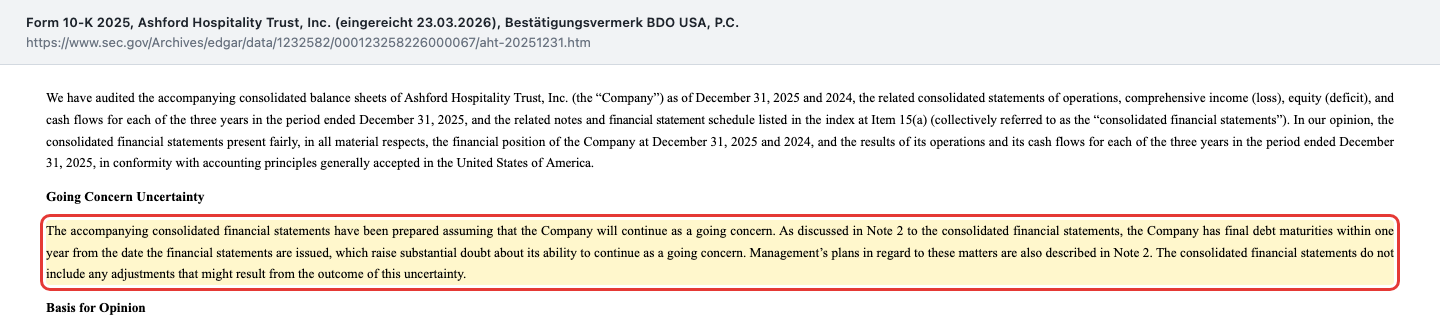
Why, the most recent quarterly report explains — and so precisely that the sentence deserves a second reading:
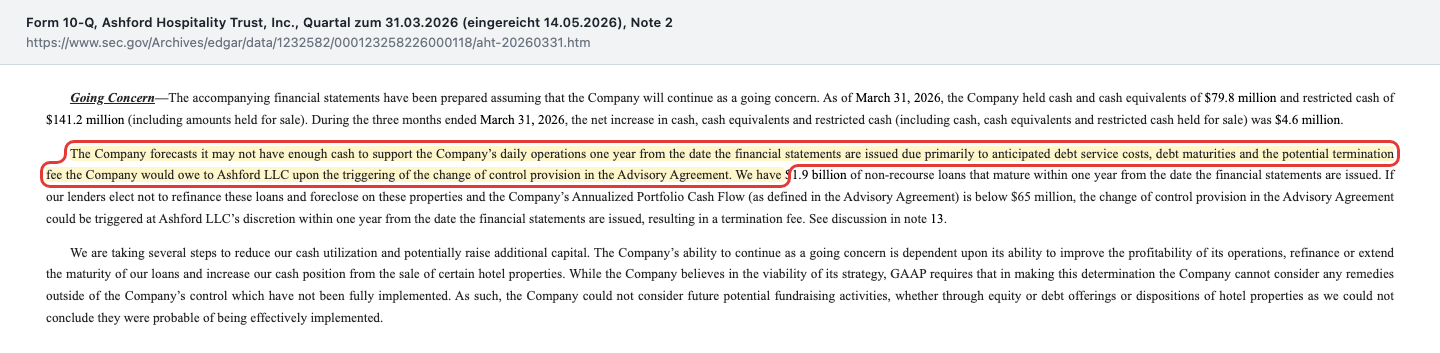
"The Company forecasts it may not have enough cash to support the Company's daily operations one year from the date the financial statements are issued due primarily to anticipated debt service costs, debt maturities and the potential termination fee the Company would owe to Ashford LLC upon the triggering of the change of control provision in the Advisory Agreement."
— Ashford Hospitality Trust, Form 10-Q as of March 31, 2026, Note 2
And the hard number from the same paragraph: $1.9 billion of non-recourse loans mature within twelve months. For comparison, cash on hand as of March 31, 2026 was $79.8 million, plus $141.2 million of restricted cash the company cannot freely use. Interest paid in the first quarter of 2026 alone came to $51.3 million — more than twice the entire market value of the common stock, in three months.
Uncomfortable truth no. 2: equity is negative — and gets more negative every quarter
Equity is what would be left if everything were sold and every debt repaid. When it is negative, nothing would be left — a hole would. At Ashford Hospitality Trust that hole looks like this (the portion attributable to the company, in millions of dollars):
- December 31, 2024: minus 419.2
- March 31, 2025: minus 446.1 · June 30, 2025: minus 485.5 · September 30, 2025: minus 548.7
- December 31, 2025: minus 626.4
- March 31, 2026: minus 695.2
Six consecutive quarters lower, $276.0 million of deterioration in fifteen months. The balance sheet as of March 31, 2026 sets total assets of $2,605.3 million against liabilities of $3,044.0 million. The story behind it sits two lines below: shareholders have paid in $2,402.0 million over the decades — against an accumulated deficit of $3,097.3 million.
One note for context, because our scanner displays it too: the Altman Z-score, an insolvency early-warning formula built from several balance sheet ratios, sat deep in negative territory for this stock as of the July 26, 2026 data. We still do not use it as an argument. The Altman Z was designed for industrial companies and carries no meaning for a property company whose business model deliberately runs on heavy leverage. What counts at a REIT is FFO, Adjusted FFO, leverage and the maturity schedule — and we have read those above.
Uncomfortable truth no. 3: the advisor costs more than the whole stock
Back to the central conflict. Advisory fees paid to Ashford Inc. were $48.9 million (2023), $58.6 million (2024) and $49.0 million (2025). The 2025 figure breaks down into a base advisory fee of $32.9 million, reimbursable expenses of $16.3 million, a credit of $0.8 million from equity-based compensation and $0.7 million from a second advisory agreement. Put that next to the other numbers of the same company:
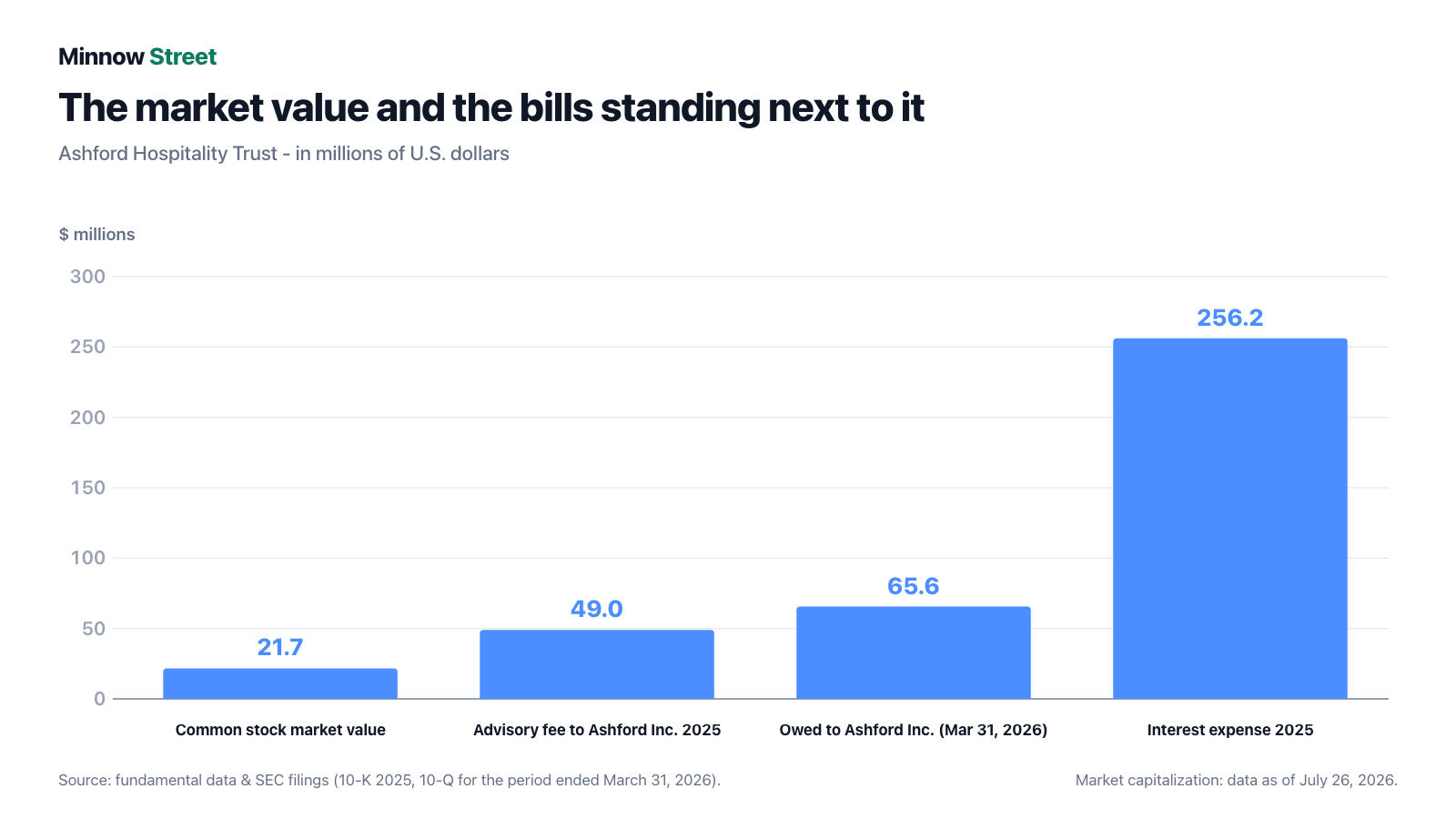
And now the detail that turns this relationship from an annoyance into a structure. The fee is calculated on total market capitalization — but it has a floor. The annual report says so in its own risk factor, verbatim:

"We are required to make minimum base advisory fee payments to our advisor, Ashford Inc., under our advisory agreement, which must be paid even if our total market capitalization and performance decline. Similarly, we are required to make minimum base hotel management fee payments under our hotel management agreements with Remington Hospitality, a subsidiary of Ashford Inc., which must be paid even if revenues at our hotels decline significantly."
— Ashford Hospitality Trust, Form 10-K for 2025, Item 1A Risk Factors
And the minimum is no token amount: it is at least 90 percent of the fee for the same month a year earlier. Translated: the advisor can lose at most a tenth per year, however fast the company shrinks. And both recipients, advisor and hotel manager, belong to the same house.
Uncomfortable truth no. 4: the exit fee the recipient calculates itself
On December 23, 2025, Ashford Inc. and Ashford Hospitality Advisors LLC notified the company in writing that they were extending the advisory agreement by another ten years — from January 14, 2031 to January 14, 2041. That was not a negotiation; it was an exercise, because the renewal right sits with the advisor. Three weeks earlier, on December 9, 2025, the board had suspended all redemptions of the non-traded preferred stock; three weeks later, on January 13, 2026, all preferred dividends.
On March 27, 2026 the agreement was then restated — and the decisive change concerns the fee payable on a change of control:
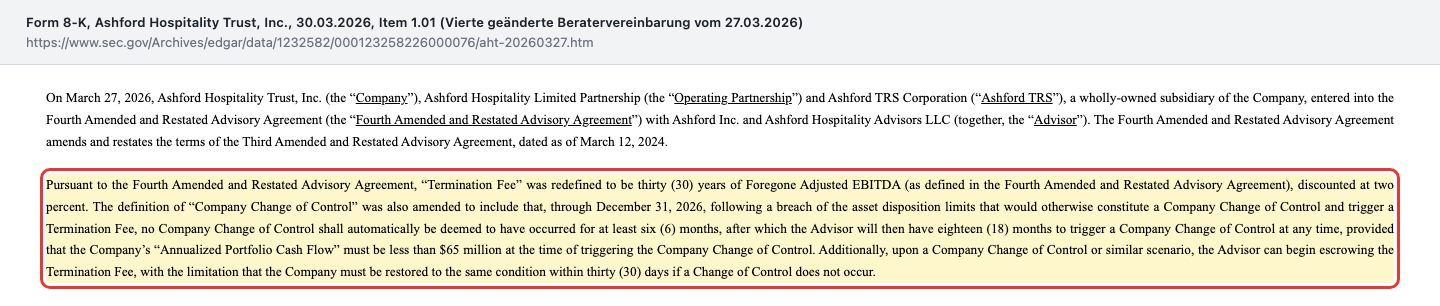
The quarterly report puts the same arrangement even more plainly — including the question of who does the arithmetic:
"If we terminate the Advisory Agreement without cause or upon a change of control, we will be required to pay on or before the termination date Ashford LLC a termination fee equal to the following: the present value of a payment stream calculated by assuming that Foregone Adjusted EBITDA (as defined in the Advisory Agreement) will be earned annually over a subsequent period of 30 years, discounted at two percent per annum, as reasonably calculated by Ashford LLC (the 'Termination Fee')."
— Ashford Hospitality Trust, Form 10-Q as of March 31, 2026, Note 13
Three things stand out. First, the 30-year horizon — at a company whose auditor doubts the next twelve months. Second, the two percent discount rate: the lower the rate, the higher the present value; at two percent over thirty years the multiplier comes to roughly twenty-two times an annual amount. Third, the phrase "as reasonably calculated by Ashford LLC" — the size is computed by the party receiving it.
The trigger is quantified too: through December 31, 2026, following a breach of the asset disposition limits, no change of control is deemed to have occurred for six months; after that the advisor has eighteen months to trigger one — provided the "Annualized Portfolio Cash Flow" is then below $65 million. And because the company keeps selling hotels, that very figure falls with every closing. This is the real clock ticking inside this balance sheet.
Uncomfortable truth no. 5: three one-for-ten splits — the price you see never existed
A reverse stock split turns many shares into few: at a ratio of one-for-ten, ten shares become one and the price multiplies by ten on paper. At that moment nothing changes in a shareholder's wealth — but everything changes in the optics. Ashford Hospitality Trust has done this three times since 2020, each at one-for-ten:
- effective at the close of business on July 15, 2020 (Form 8-K of July 1, 2020)
- effective after the close on July 16, 2021 (Form 8-K of July 16, 2021)
- effective after the close on October 25, 2024 (Form 8-K of October 25, 2024)
Cumulatively that is a ratio of one-for-1,000. Anyone who owned a thousand shares in early 2020 and never touched them holds exactly one today. Practically, that means: any chart or price series that has not adjusted retroactively for these three events is useless for this stock. We checked our own price series line by line. The result: the unadjusted closing price column breaks at all three dates — from $0.61 to $5.57 between July 15 and July 16, 2020, from $1.82 to $16.76 between July 16 and July 19, 2021, and from $0.56 to $6.10 between October 24 and October 28, 2024. The adjusted series runs smoothly through the same days (610 to 557, 182 to 168, 5.6 to 6.1) and correctly backs the consolidations out. Only that adjusted series is usable across years — and it shows a decline from $3,726.60 on January 2, 2019 to $3.24 on July 24, 2026, or 99.9 percent. Read the raw closing price instead and you see three jumps that never happened as gains.
And the splits did not stop dilution, they only made it invisible: the share count rose from 5,636,595 on December 31, 2024 to 6,476,491 on March 31, 2026 — up 14.9 percent in five quarters, even though a consolidation had just taken place in October 2024.
Uncomfortable truth no. 6: $372 million of preferred claims stand ahead of the common — and their dividends are suspended too
Alongside the common stock, Ashford Hospitality Trust has issued nine series of preferred stock: five listed on the NYSE (series D, F, G, H, I) and four non-traded (series J, K, L, M), sold largely to retail investors through distribution partners. Each of those shares carries a liquidation preference of $25.00. Added up, roughly 14.9 million preferred shares with a liquidation preference of about $372 million stand ahead of common stockholders as of March 31, 2026 — against a common stock market value of roughly $21.7 million.
Translated: before a common stockholder sees a cent in a wind-down, every debt and then those $372 million would have to be served first. And the preferred holders themselves are now waiting too:
"Further, to preserve the Company's liquidity position as it evaluates strategic alternatives, preferred dividends have been suspended, including dividends previously declared for recordholders of the Company's Series D, F, G, H, I, J, K, L and M preferred stock as of December 31, 2025, and payable on January 15, 2026."
— Ashford Hospitality Trust, Form 10-K for 2025, Item 5
The sequence is what stands out: the dividends had already been declared and were withdrawn two weeks before payday. As of March 31, 2026 they sat in the books as arrears — roughly $3.8 million for series J alone. The common dividend is dormant anyway: on December 15, 2025 the board resolved that no quarter of 2026 would see a payment either.
Valuation: what a share of this REIT really is
Now we can answer the opening question. What do you buy when you buy this stock?
You buy a residual. On one side stand hotels that fetch genuine nine-figure prices when sold. On the other stand $2.4 billion of debt, $252.0 million of loans on properties in receivership plus $84.0 million of accrued interest, an advisory contract running to 2041 and $372 million of preferred claims. What remains after all of that is the common stock — and the market prices that residual at roughly $21.7 million (fundamental data as of July 26, 2026).
The usual valuation anchors fail here one after another, each for a good reason:
- Price-to-earnings: not computable — there are no earnings. The loss per share in 2025 was $35.99.
- Price-to-book: not meaningful — book value per share is negative (minus $695.2 million spread over 6.48 million shares).
- Price-to-sales: roughly 0.02. It sounds spectacular but only says that revenue above a billion dollars sits inside a structure from which practically nothing reaches the shareholder.
- Enterprise value: this is the honest measure. Add market value and debt and you arrive at roughly $2.4 billion — at which point you can see that the common stock accounts for less than one percent of it. Buying this stock is not buying a hotel portfolio; it is buying the option premium on something being left after every creditor and every preferred holder.
The professional view is correspondingly thin: as of the July 26, 2026 data there was exactly one analyst estimate, rated hold, with a price target of $5. Institutions held roughly 15.9 percent of the shares and insiders roughly 1.1 percent — a remarkably empty shareholder register for a company with more than a billion dollars of revenue. And one detail from a current report dated March 26, 2026 completes the picture: to value the non-traded preferred stock, the company commissioned an opinion that expressly treats the market value of the common stock as coverage for the preferred claims. In that calculation the common stock is not the goal; it is the cushion.
One sentence to make sure the hook is not misread: the placement in the P/FCF ranking is calculated correctly — it simply does not measure what the word "cheap" suggests. As with America's Car-Mart, which stood at rank 9 in the same list on the same day, the rule holds: the list is where research begins, not where it ends.
Opportunities and risks at a glance
What speaks for the company:
- The real estate is real and sellable. Between April 7 and July 1, 2026, ten hotels were sold and closed, among them the Hyatt Regency Savannah for $158.0 million — at prices the market actually pays.
- The operating hotel business works. RevPAR of $131.68 in 2025 after $132.87 the year before; adjusted EBITDAre of $51.7 million in the first quarter of 2026.
- Deleveraging is progressing. Reported total indebtedness fell from $2,586.9 million on December 31, 2025 to $2,368.8 million on March 31, 2026 — $218.4 million repaid in the first quarter of 2026 alone.
- The loans have no recourse to the group. If the company loses a hotel to its lender, it loses the hotel — nothing more. That is exactly how two portfolios were given up in 2024, with their debt reported separately.
- A change of control would be the only way to end the advisory agreement — and the company itself writes that it is evaluating strategic alternatives.
What speaks against it:
- A going-concern paragraph in the audit opinion, grounded in $1.9 billion of maturities within twelve months (as of May 14, 2026).
- Negative equity of minus $695.2 million as of March 31, 2026, falling for six consecutive quarters.
- Interest coverage of 0.4 in 2025 — operating income does not cover even half of the interest bill; without gains on sales and derecognition it would have been negative.
- Adjusted FFO negative for two years (minus $23.1 million in 2024, minus $34.4 million in 2025) — the measure that counts at a REIT.
- An advisory contract running to 2041 with a minimum fee, a termination fee spanning 30 years and calculated by its recipient, and a trigger threshold that moves closer with every hotel sale.
- Every dividend suspended — the common since 2020, all nine preferred series since January 13, 2026, including amounts already declared.
- One loan was in default as of March 31, 2026, carrying 5.00 percent of default interest on top of the contract rate; a formal trustee notice arrived on February 11, 2026 for another loan (Form 8-K, Item 2.04).
- A market value of $21.7 million across 6.5 million shares means very thin trading and very large swings. That is not a substance argument, but it is a practical one.
A human closing thought
Back to the price tag trap from the beginning. It put this stock on our desk — and it even did the arithmetic correctly. A price-to-free-cash-flow ratio of 0.9 is not an invention: it is in the list, it is traceable, and you can check it yourself. The error happens afterwards, in your head, the moment "low number" silently becomes "cheap".
At Ashford Hospitality Trust the ratio is low because the numerator has shrunk, not because the denominator is large. A company with more than a billion dollars of revenue costs as much on the exchange as a single apartment building, because $2.4 billion of debt and $372 million of preferred claims stand in front of the common stockholders. The cash flow that feeds the list is in substantial part made of bills that are still open. And above all of it stands an auditor who signed silently for two decades and has now inserted a paragraph no shareholder wants to read.
What stayed with us longest is not the leverage — heavily indebted hotel REITs have existed before, and some recovered. It is the sentence that the exit fee of the company's own advisor is among the reasons the auditor doubts the company can continue. A company can fail on interest, on maturities, on a travel recession. That it might also fail on getting rid of its own management is a category of its own.
There is nevertheless a story that could speak for this stock: that hotel sales bring in money faster than interest burns it, that a refinancing succeeds, and that what remains is a smaller, healthier portfolio in which the few surviving common shares would have enormous leverage. Anyone buying that story is not buying real estate but a bet on residual value — and needs to know that the entire capital structure stands between them and that residual. What you make of it is your decision. And that is exactly as it should be.
Sources
- Ashford Hospitality Trust, Inc., annual report on Form 10-K for 2025 (filed March 23, 2026) — portfolio, advisory agreement, risk factors, BDO USA, P.C. audit opinion with going-concern section, 2026 dividend policy, FFO and Adjusted FFO reconciliation
- Quarterly report on Form 10-Q as of March 31, 2026 (filed May 14, 2026) — balance sheet, cash flow statement, Note 2 (going concern), Note 13 (advisory agreement), Note 16 (subsequent events)
- Current report on Form 8-K of March 30, 2026, Item 1.01 — Fourth Amended and Restated Advisory Agreement dated March 27, 2026, redefinition of the termination fee and the change-of-control threshold
- Current report on Form 8-K of February 18, 2026, Item 2.04 — trustee notice on the 2018 loan originally sized at $395.0 million
- Current report on Form 8-K of March 26, 2026, Item 8.01 — opinion on the liquidation value of the non-traded preferred stock
- Current report on Form 8-K of July 8, 2026, Item 2.01 — sale of the Marriott Fremont Silicon Valley for $53.0 million; matching reports on nine further sales since April 7, 2026
- Current report on Form 8-K of July 1, 2020, Form 8-K of July 16, 2021 and Form 8-K of October 25, 2024 — the three one-for-ten reverse stock splits
- Screening and valuation data: our in-house stock scanner and fundamental data (as of July 26, 2026), including the P/FCF ranking — measured on July 27, 2026: 544 hits in the list, 25 rows displayed with the U.S. market filter set, rank 16 at a ratio of 0.9; the list had last been recomputed on July 26, 2026
Disclosure: This article is journalistic analysis of publicly available documents and is not investment advice, and not a solicitation to buy or sell securities. Share prices can move sharply; at a company with a going-concern paragraph, negative equity and suspended dividends, a total loss is a realistic scenario. Every figure carries the as-of date of its source; market data are as of July 26, 2026. At the time of publication the author holds no position in Ashford Hospitality Trust, Inc. or in Ashford Inc.
Our Bottom Line at a Glance
- Business model and portfolio neutral
- A hotel REIT with 63 consolidated properties and 15,591 rooms in the United States (March 31, 2026), operated under brands such as Marriott, Hilton and Hyatt. The operating business works: RevPAR of $131.68 in 2025 after $132.87 the year before, adjusted EBITDAre of $51.7 million in the first quarter of 2026. The real estate sells at genuine prices — the Hyatt Regency Savannah alone brought $158.0 million on June 30, 2026.
- Balance sheet and going concern negative
- The BDO USA, P.C. audit opinion for 2025 contains a going-concern uncertainty section; the quarterly report as of March 31, 2026 names $1.9 billion of maturities within twelve months. Equity stood at minus $695.2 million and has fallen for six consecutive quarters; total assets of $2,605.3 million face liabilities of $3,044.0 million. Cash on hand: $79.8 million unrestricted, $141.2 million restricted.
- Earnings power and interest coverage negative
- Operating income of $116.4 million for 2025 contains $79.8 million of sale gains and $39.1 million of derecognition gains; without them a loss of $2.5 million remains. Against that stand $295.3 million of interest — coverage of 0.4. Adjusted FFO, the load-bearing REIT measure, was negative in 2024 at minus $23.1 million and in 2025 at minus $34.4 million; earnings per share came in at minus $35.99 in 2025.
- Governance and external management negative
- The company has no employees of its own. Fees to Ashford Inc. came to $49.0 million in 2025 — more than twice the market value of the common stock; the outstanding payable rose to $65.6 million (March 31, 2026). The advisor unilaterally extended the agreement to 2041 on December 23, 2025; since March 27, 2026 the termination fee equals the present value of 30 years of foregone adjusted EBITDA, discounted at two percent, calculated by the recipient.
- Capital structure and distributions negative
- Nine preferred series with a liquidation preference of roughly $372 million stand ahead of common stockholders. Their dividends were suspended on January 13, 2026, including amounts already declared; the common dividend has been dormant since 2020 and stays that way in 2026. Three one-for-ten reverse splits (July 15, 2020, July 16, 2021, October 25, 2024) compound to one-for-1,000, and the share count then rose from 5,636,595 to 6,476,491.
- Hook and data quality neutral
- Rank 16 in our in-house P/FCF ranking of the U.S. selection at a ratio of 0.9, measured on July 27, 2026 (544 hits in the list, 25 rows displayed with the U.S. market filter set; last recomputed July 26, 2026). The arithmetic holds, but here it mostly measures the shrunken market value: the first-quarter 2026 cash inflow of $29.5 million contains $27.0 million from unpaid bills and $20.4 million of advisory fees not yet wired. The stock page itself does not count metric rankings as strategy hits.
Ashford Hospitality Trust is not a cheap stock; it is a small one. Against more than a billion dollars of annual revenue and a hotel portfolio stand $2.4 billion of debt, equity of minus $695.2 million and an audit opinion with a going-concern paragraph; the common stock is worth roughly $21.7 million. The ratio that lifts the stock to rank 16 of the P/FCF ranking comes out of that shrunken market value and out of one quarter whose cash inflow is largely made of unpaid bills — including $20.4 million owed to the external advisor. The hotels and their sale proceeds are real. What stays open is whether anything is left for the common stock after $1.9 billion of maturities, $372 million of preferred claims and an advisory contract running to 2041. Not investment advice.
What Our Rating Means
Substance risk
We found at least one documented issue that threatens the company itself — regardless of how the stock is currently valued.
The red rating is not about a fallen share price but about documented findings on substance. The 2025 audit opinion contains a going-concern uncertainty section; stockholders' equity stood at minus $695.2 million on March 31, 2026 and has fallen for six consecutive quarters; interest coverage was roughly 0.4 in 2025, and without gains on sales and derecognition operating income would have been negative. Add $1.9 billion of maturities within twelve months against $79.8 million of unrestricted cash, one loan in default and suspended payments on all nine preferred series. Any one of those alone would justify the most cautious rating. What does not argue against it is that the hotel business works and the real estate is sellable — both are documented and credited in the article. It simply does not change the fact that the substance of the company itself is in question. The decision is yours.
A journalistic assessment by our editorial team at the time of the deep dive, based on public sources — not investment advice and not a solicitation to buy or sell. Your personal circumstances (investment goals, risk capacity, taxes) cannot be taken into account. What our levels mean, how verdicts are formed, and what conflicts of interest exist →
Worth Noting
- Hook and source: rank 16 in our in-house P/FCF ranking of the U.S. selection, measured on July 27, 2026 at a ratio of 0.9. The list showed 544 hits that day; with the U.S. market filter set the page displays 25 rows, and the stock sits 16th among them. The list had last been recomputed on July 26, 2026. The scanner lists are rebuilt daily, so the placement is a dated snapshot, not a permanent state.
- Where the low ratio comes from — checked, not assumed: the ranking divides market value by free cash flow over the last four quarters. The common stock market value is roughly $21.7 million (fundamental data as of July 26, 2026) while the same balance sheet carries $2.4 billion of debt — so the ratio is mostly a statement about the numerator. The denominator does not carry it either: full-year 2025 saw operating cash outflow (minus $15.7 million) and so did 2024 (minus $23.6 million). The positive first quarter of 2026 (plus $29.5 million) contains $27.0 million from payables and accruals plus $20.4 million from the line "Due to/from Ashford Inc.", meaning advisory fees not yet wired; the $218.4 million of repayments in that quarter, by contrast, were funded from hotel sales with $209.2 million of net proceeds, which sit in investing activities and never enter free cash flow.
- Reverse splits checked carefully: three one-for-ten consolidations, evidenced by the current reports of July 1, 2020 (effective July 15, 2020), July 16, 2021 (effective July 16, 2021) and October 25, 2024 (effective October 25, 2024) — one-for-1,000 cumulatively. The price series was reviewed line by line on July 27, 2026: the unadjusted closing price column breaks at all three dates ($0.61 to $5.57 on July 15/16, 2020; $1.82 to $16.76 on July 16/19, 2021; $0.56 to $6.10 on October 24/28, 2024) and is therefore useless for multi-year comparisons. The adjusted series runs through the same days (610 to 557; 182 to 168; 5.6 to 6.1) and is the only usable one; it shows a decline from $3,726.60 on January 2, 2019 to $3.24 on July 24, 2026, or 99.9 percent. All per-share figures in the filings are already restated retroactively.
- Metric selection at a REIT: FFO, Adjusted FFO, leverage and the maturity schedule are what matter. The Altman Z-score displayed by the scanner was designed for industrial companies and carries no meaning for a property company that runs on heavy leverage by design; it is therefore not used as an argument in this analysis. Book value per share is negative, which also rules out price-to-book as a sensible measure here.
- Merger check: none pending. The filing history since December 2017 contains no SC 13E-3, no DEFM14A, no Form 25 and no Form 15; the only S-4 dates from 2020 and concerned an exchange offer on preferred stock. The company states that it is evaluating "strategic alternatives"; no transaction had been announced as of July 27, 2026, and the most recent filing of any kind is a 424B3 dated July 8, 2026. The common stock and five preferred series remain listed on the NYSE.
- Possible confusion: Ashford Hospitality Trust, Inc. (AHT) is not the same as Ashford Inc. (AINC), the external management company, nor as Braemar Hotels & Resorts (BHR), which is managed by the same house. All three are separate registrants with their own SEC filings.
Frequently Asked Questions
Because the ranking divides market value by free cash flow over the last four quarters — and the common stock market value is tiny at roughly $21.7 million (fundamental data as of July 26, 2026). On July 27, 2026 that placed the stock at rank 16 of the U.S. selection at a ratio of 0.9, out of 544 hits in the list, of which 25 rows are displayed. The low ratio comes from the small numerator, not from a large cash inflow.
Yes. The annual report for 2025 says verbatim: "We have no employees." The company is run by Ashford Hospitality Advisors LLC, a subsidiary of the publicly traded Ashford Inc.; roughly 82 full-time employees of that manager provide the advisory services. The hotels themselves are run by external managers, among them Remington Hospitality, which also belongs to Ashford Inc.
The auditor, BDO USA, P.C., considers it substantially doubtful that the company can get through the next twelve months on its own. The quarterly report as of March 31, 2026 names the reasons: anticipated debt service costs, $1.9 billion of loans maturing within one year, and the potential termination fee owed to the external advisor. The financial statements were nevertheless prepared on a going-concern basis.
Three since 2020, each at a one-for-ten ratio — effective July 15, 2020, July 16, 2021 and October 25, 2024. Cumulatively, one share today equals 1,000 shares from early 2020. Price series that do not adjust retroactively for these events are useless for multi-year comparisons.
No. The common dividend has been suspended since 2020; on December 15, 2025 the board resolved not to pay in any quarter of 2026 either. On January 13, 2026 the dividends on all nine preferred series were suspended as well — including amounts already declared that would have been payable on January 15, 2026. The arrears keep accruing.
No, at least none announced. The SEC filing history since December 2017 contains no SC 13E-3, no merger proxy DEFM14A, no Form 25 and no Form 15. The company writes that it is evaluating "strategic alternatives" — no specific transaction had been reported as of July 27, 2026. The common stock and five preferred series remain listed on the NYSE.
Because it was designed for industrial companies and treats debt as a danger across the board. A property company, however, runs on heavy leverage by design. What is meaningful at a REIT is FFO and Adjusted FFO, leverage and the maturity schedule — and those paint a clear picture here: Adjusted FFO of minus $34.4 million in 2025.
Then, under the Fourth Amended and Restated Advisory Agreement dated March 27, 2026, the external advisor may trigger a change of control and demand the termination fee. That fee equals the present value of 30 years of foregone adjusted EBITDA, discounted at two percent — as calculated by the advisor itself. Through December 31, 2026 a six-month grace period applies, followed by an eighteen-month window.
Found an error?
Did you spot a factual error, an outdated number, or a typo in this deep dive? Let us know briefly — your report goes straight to the editorial team.