O-I Glass Stock: The Bottle Giant Buried Its Asbestos Ghost — Now the World Drinks Less, and $5 Billion of Debt Drinks Along
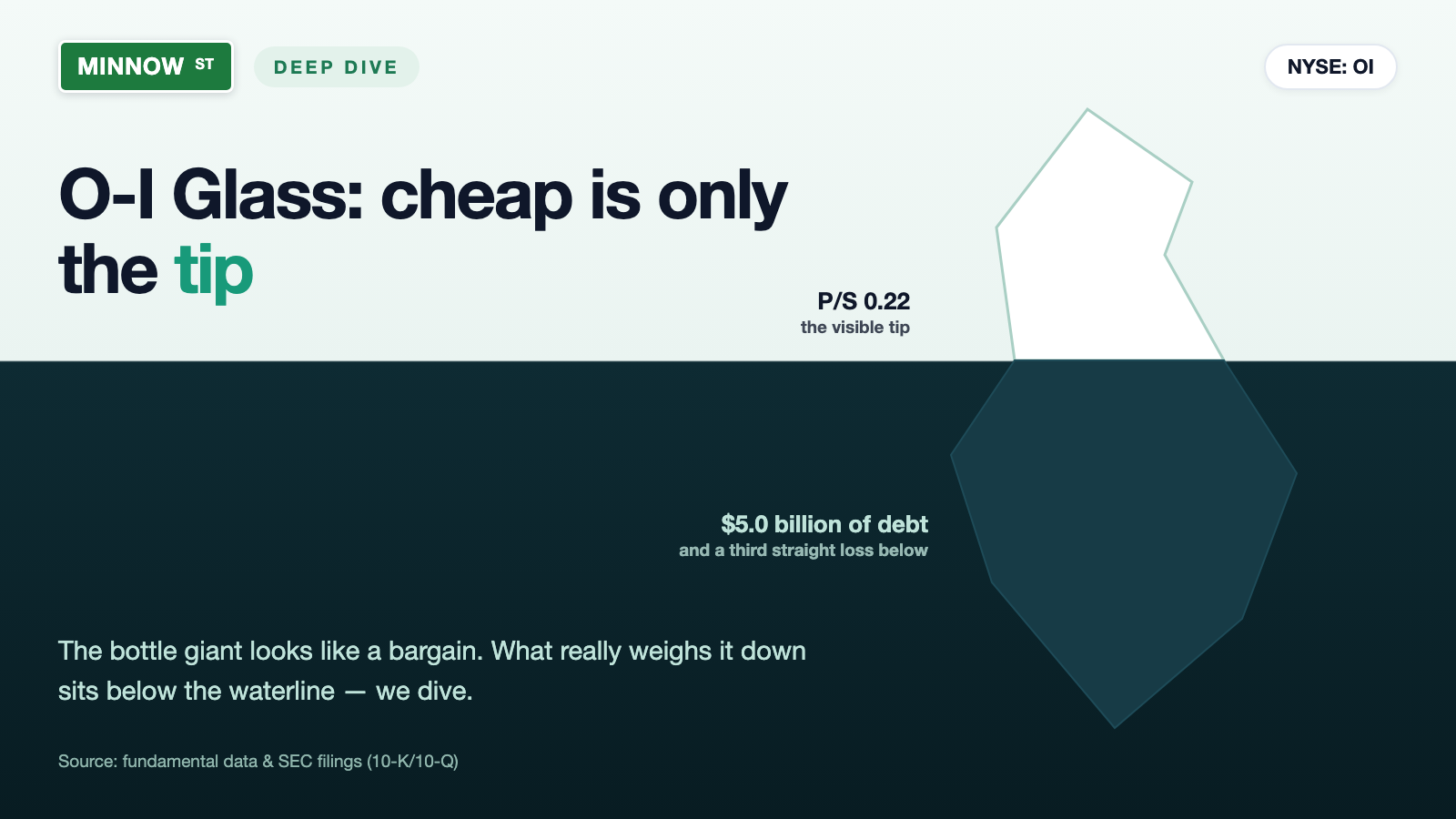
O-I Glass shows up in our Reddit hype scanner with 5 mentions in 24 hours (as of July 15, 2026) — no storm, more a recurring murmur about a 120-year-old market leader trading 84 percent below its all-time high and priced at a fifth of its annual revenue. We read the annual reports (10-K) for 2024 and 2025 and the quarterly report (10-Q) as of March 31, 2026: the asbestos legacy of predecessor Owens-Illinois really has been resolved for good since 2022 — but the company is posting its third straight annual loss, carries about $5.0 billion of debt, and demand for its core product is falling because the world drinks less beer, wine and spirits. Not investment advice — just a look through the glass, held up to the light.
 Thomas Mücke
Founder & Publisher
Thomas Mücke
Founder & Publisher
Chart
Interactive price chart (TradingView).
Note: pure fact-based analysis, not investment advice and not a solicitation to buy or sell. All figures without guarantee.
There is a reflex in the investor brain that feels like wisdom: "This company has been around for more than a hundred years. It survived two world wars. It is not going away." Call it the longevity bonus — we treat a company’s age as a safety net, when it is really just a number in a registry. Hardly any stock feeds that reflex in the summer of 2026 as reliably as O-I Glass (NYSE: OI): successor to a business established in 1903, one of the leading glass container makers in the world, 84 percent below its all-time high, available for a fifth of its annual revenue — and back in our Reddit hype scanner with 5 mentions in 24 hours (as of July 15, 2026). That is no hype storm, more a recurring murmur: ancient market leader, dirt cheap, has to be a bargain. So let’s make a deal: before you toast to 120 years of history, we read together what the company itself reports under penalty of law to the U.S. securities regulator, the SEC — the annual reports (10-K) for 2024 and 2025 and the quarterly report (10-Q) as of March 31, 2026. They contain one piece of good news hardly anyone knows. And several uncomfortable ones the murmur ignores. In the end, you decide for yourself.
What O-I Glass actually does — and what the company really hangs on
O-I Glass makes glass containers — above all bottles for beer, flavored malt beverages, spirits and wine, plus jars and bottles for food, soft drinks, teas, juices and pharmaceuticals. Per its own annual report, the company is one of the leading glass container manufacturers in the world and the number one in the glass segment of the packaging market in most of its manufacturing countries: 64 plants in 18 countries, roughly 19,000 employees, two reportable segments — Americas (30 plants from Canada to Peru) and Europe (33 plants from France to Estonia). The customers are the giants of the beverage aisle, named first in the annual report: Anheuser-Busch InBev, Brown-Forman, Campari. And here comes the translation the longevity bonus likes to skip: about 62 percent of segment net sales hang on alcoholic beverages — $3,910 million of $6,330 million in 2025. A glass bottle is a wonderful product: infinitely recyclable, taste-neutral, premium feel. But as an investment it has one design flaw: it is only needed when somebody drinks. Which brings us to the central tension of this analysis, and it runs through every chapter: the company’s turnaround is measurably working — but demand for the product itself is falling faster than the cost saw can cut, and underneath sit $5.0 billion of debt. What it looks like when a consumer company saves its way against falling traffic is something we just dissected at Wendy’s; what a debt pile does to a stock when the operating business wobbles, at Sabre.
Where the stock shows up in our scanner
Every day we run about 3,500 stocks through our scanners. O-I Glass reached our research list via the Reddit hype scanner (ApeWisdom, 5 mentions in 24 hours, as of July 15, 2026) — little noise, but conspicuous enough for a bottle maker with zero meme potential. In our metrics scanners the stock lights up in 11 filters as of the July 8, 2026 data cut-off, and the list reads like two expert opinions about two different companies. Opinion one, the insider-and-value lens: the CEO-buys and net-insider-buying filters — most recently two insider purchases stood against not a single sale, among them the chief executive himself — plus the institutions-and-CEO-buying screens: 13 institutions added to their positions, 5 reduced, with net inflows of roughly $32 million. The P/S ranking shows a price-to-sales ratio of 0.22 — the market pays just 22 cents for every dollar of revenue — and the P/CF ranking 3.0 times operating cash flow. Opinion two, the trend lens, judges mercilessly: a stage-4 downtrend in the Stan Weinstein framework (firing in three trend scanners at once), a weakness cluster, minus 36 percent in six months, minus 34 percent over twelve months, minus 84 percent below the all-time high — with a fresh bounce of plus 5 percent in one month (all data as of July 8, 2026). Cheap, bought by insiders, in a downtrend — this fingerprint appears when the market is arguing whether a stock is a bargain or a business model with a crack.
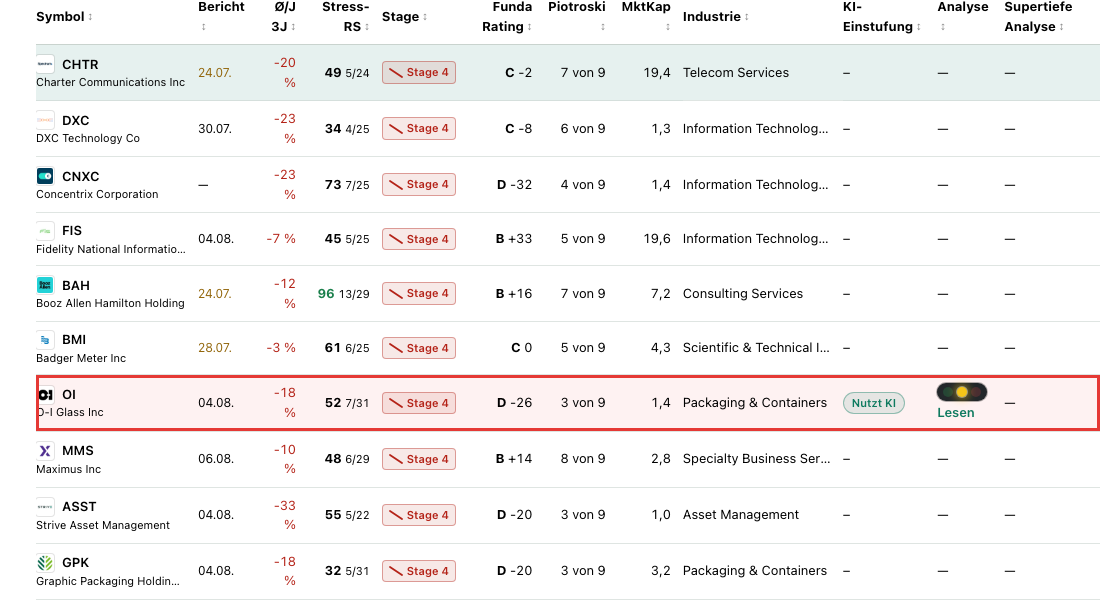
Two scanner readings belong on the table because they cloud the value picture: the Piotroski F-Score, a nine-point test of balance-sheet quality, stood at a meager 3 of 9 as of the first quarter of 2026 — a thoroughly healthy company scores 8 or 9. The Altman Z-score, a classic insolvency early warning built from several balance-sheet ratios, sat around 4.0 — outside the danger zone that historically begins below 1.8. And the professionals? The consensus of ten analysts stood at 1.3 as of July 8, 2026, on a scale where 1 means buy — while earnings estimates were cut by a good 20 percent within four weeks. An optimistic verdict on falling expectations: the professionals are arguing about this stock too.
The numbers over the years — honestly appraised
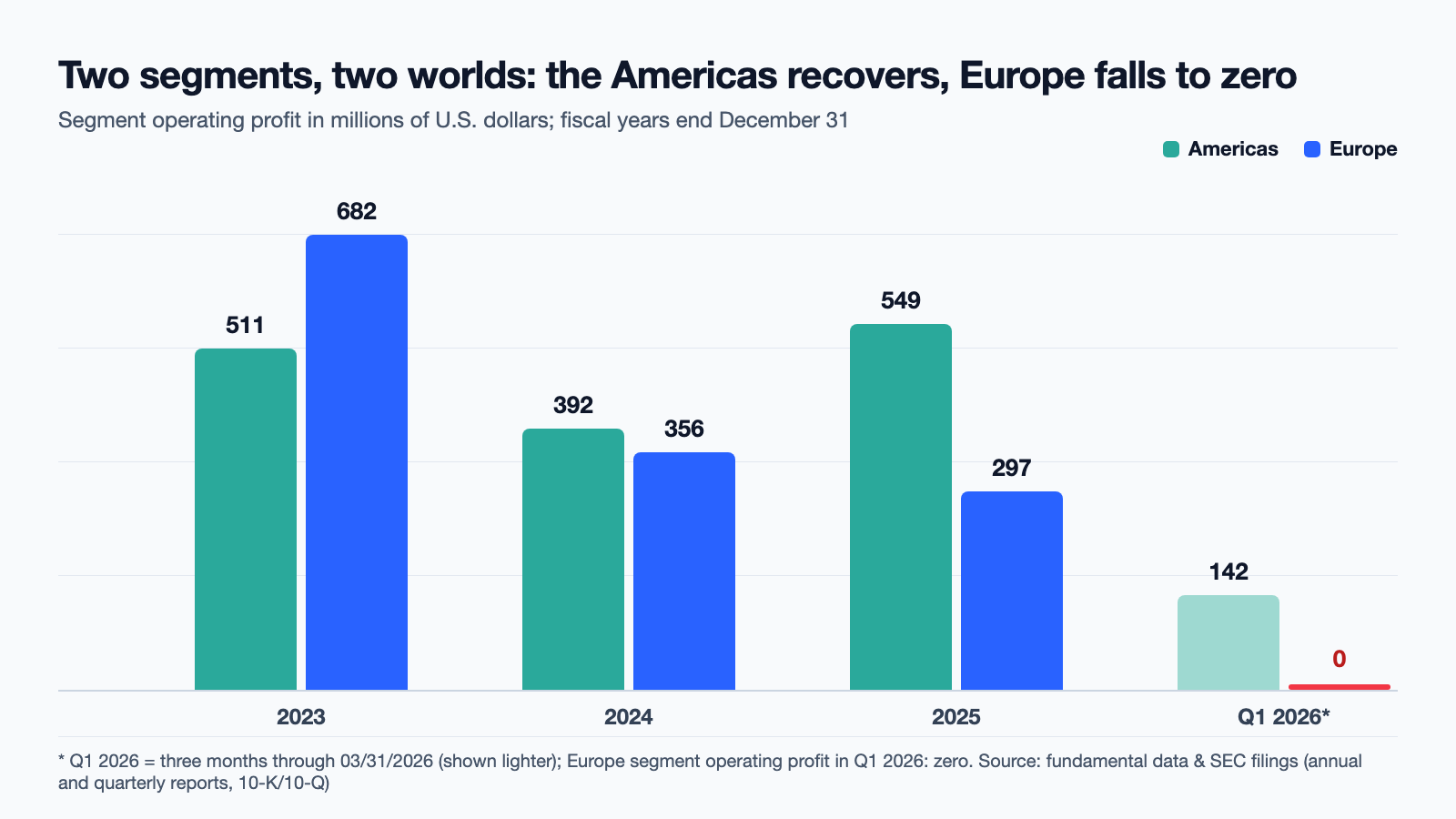
First, what genuinely impresses — and it is more than three loss years suggest. The turnaround named "Fit to Win" (launched in 2024) is delivering measurable results: combined segment operating profit rose from $748 million to $846 million in 2025, carried by a jump in the Americas from $392 million to $549 million — plus 40 percent. Operating cash flow climbed from $489 million to $600 million; after $432 million of capital expenditures, roughly $168 million of free cash flow remained — after a negative prior year (in 2024, capital spending of $617 million exceeded operating cash flow). Management promises at least $275 million of Fit to Win benefits for 2026 and at least $750 million cumulatively through 2027 (2024 baseline), expects about $650 million of operating cash flow for 2026 — and the cash position stood at a solid $759 million on December 31, 2025. Whoever reads only these paragraphs understands the Reddit murmur immediately. Now hold the glass up to the light:
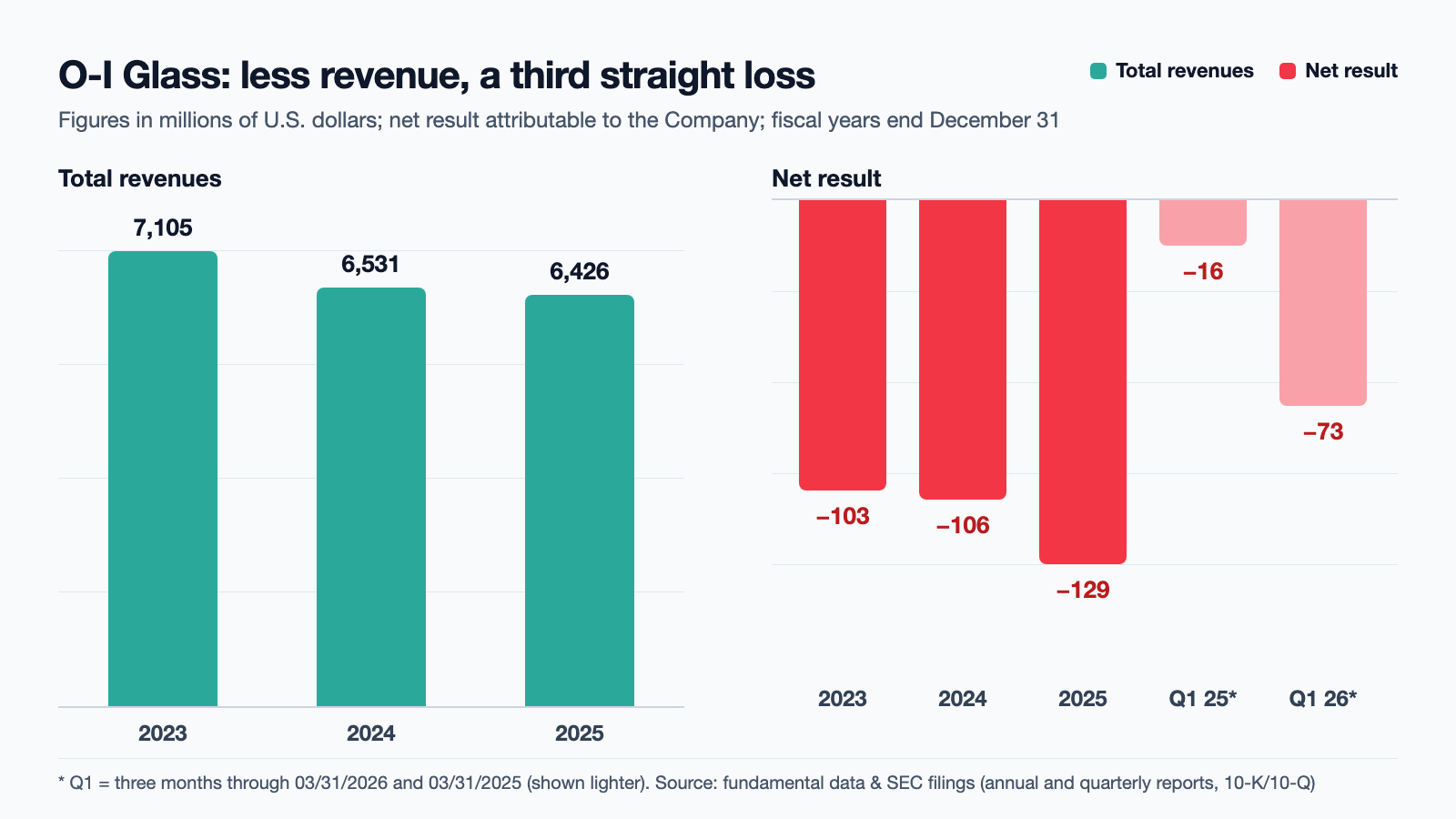
Total revenues fell from $7,105 million (2023) via $6,531 million (2024) to $6,426 million (2025). The bottom line showed a loss for the third year in a row: minus $103 million, minus $106 million, minus $129 million — and the first quarter of 2026 added another $73 million of losses after $16 million in the prior-year quarter. Honesty requires dissecting these losses: in 2025, items management considers not representative of ongoing operations depressed results by $378 million ($2.44 per share) — mostly restructuring charges; in 2023 it was a $445 million goodwill impairment. Operationally, the company does make money. But remember the difference: a loss from special items is only harmless if the special items eventually stop. At O-I they have been running for three years — and the debt, the interest and the shrinking demand will not wait that long. Which brings us to the story this company has genuinely put behind it — and to the ones still ahead.
The legacy that really is settled: asbestos, Chapter 11 — and a rare clean break
Whoever googles O-I Glass quickly hits the word asbestos — and many investors avoided the stock for decades because of it, rightly so: from 1948 to 1958, a former business unit of predecessor Owens-Illinois commercially produced a high-temperature insulation material containing asbestos; the unit was sold as early as April 1958, yet the personal injury claims kept coming — for decades. At the end of 2019 the company restructured: holding company O-I Glass became the new parent, the legacy moved into subsidiary Paddock Enterprises, and on January 6, 2020, Paddock filed for Chapter 11 to resolve all current and future asbestos claims once and for all. The result is in the annual report — and it is the kind of sentence that makes reading SEC filings worthwhile:
"Under the confirmed and effective Plan, the Paddock Trust was created pursuant to the provisions of section 524(g) of the Bankruptcy Code and was funded with $610 million in total consideration (‘Settlement Consideration’). In exchange for the Settlement Consideration, the Company, each of its current and former affiliates and certain other related parties (the ‘Company Protected Parties’) received the benefit of a release from Paddock, and Paddock and the Company Protected Parties received the benefit of an injunction under section 524(g) of the Bankruptcy Code channeling current and future asbestos-related personal injury claims to the Paddock Trust and permanently enjoining the assertion of asbestos-related personal injury claims against Paddock and the Company Protected Parties."
— O-I Glass, SEC annual report 10-K 2024, Note 15 "Contingencies"
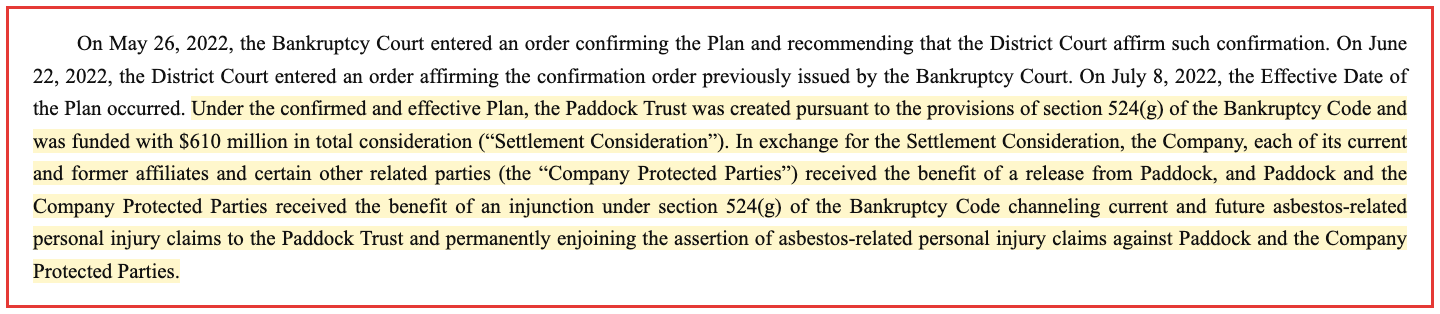
Translated into investor language: since July 8, 2022, the plan has been effective, the trust pays the claimants, and a permanent court order — the channeling injunction — shields O-I Glass and its subsidiaries from all current and future asbestos personal injury claims arising from this legacy. In the current annual report for 2025, the word asbestos simply no longer appears in the risk section. That deserves recognition: clean breaks like this are rare, and O-I paid $610 million for it. The predecessor’s ghost is buried — with a court seal. So the reason the stock trades 84 percent below its high lies elsewhere. Three of those reasons are in the current filings.
What the filings say — the uncomfortable truths
Uncomfortable truth no. 1: the world drinks less — and O-I sells thirst in glass form
The most important volume metric of a manufacturer is shipments in tons. In 2025 they fell about 3 percent (2.5 percent excluding divestitures), after a roughly 4 percent drop in 2024. And the first quarter of 2026 got steeper: minus 9 percent company-wide (minus 8 percent excluding a divestiture effect) — about minus 9 percent in the Americas, minus 7 percent in Europe, most pronounced there with wine customers across Southern Europe. The quarterly report names the causes with unusual clarity:
"The Company believes that several factors contributed to lower volumes in the first quarter of 2026, including softer demand in the beer, wine and spirits categories, tougher comparisons as the first quarter of 2025 likely benefitted from higher demand ahead of new U.S. tariffs and competitive pressures, primarily in Europe."
— O-I Glass, SEC quarterly report 10-Q as of March 31, 2026, Item 2 "Results of Operations — Net Sales"

This is not a quarterly hiccup but a trend the company itself has written into the risk section of its annual report — including the word beverage companies usually avoid:
"Examples of such changes include, but are not limited to, lower sales of major domestic beer brands, shifts from beer to wine or spirits that results in the use of fewer glass containers, lower alcohol consumption and customer destocking to adjust inventory management practices."
— O-I Glass, SEC annual report 10-K 2025, Item 1A "Risk Factors" (Lower Demand Levels)
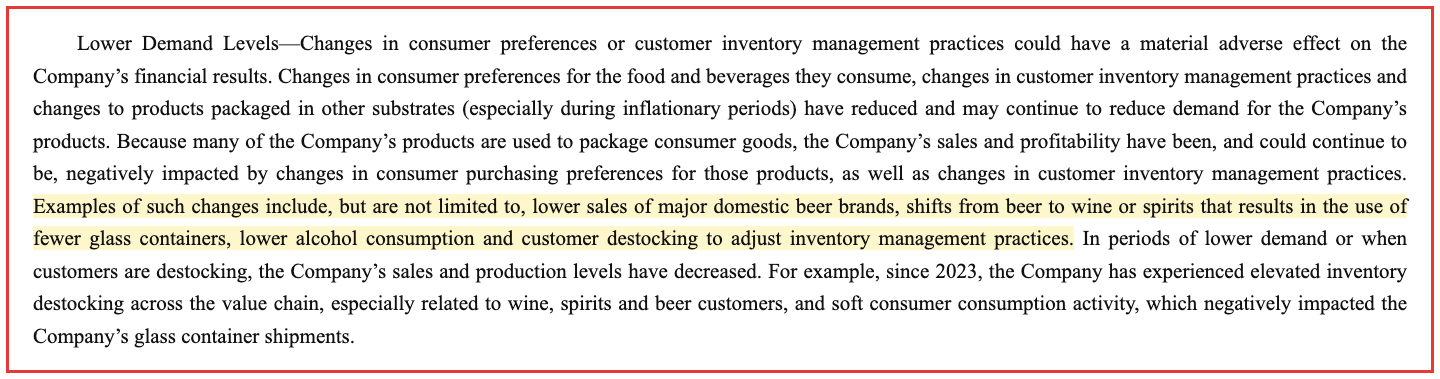
Since 2023, O-I has reported "elevated inventory destocking across the value chain, especially related to wine, spirits and beer customers" and soft consumer activity. On the positive side, management notes that shipments to higher-value categories — premium spirits, food, non-alcoholic beverages, ready-to-drink — outperformed mainstream beer and wine. But the mechanics stay uncomfortable: a plant full of melting furnaces is a mountain of fixed costs, and every missing ton of glass makes the remaining tons more expensive. That is exactly why the company is closing capacity — and exactly why the first quarter of 2026 hit the Europe segment with full force: Europe’s segment operating profit fell from $68 million to zero. Not to "less." To zero — weighed down by price pressure, falling volumes and the temporary costs of plant closures. Remember the sentence: for whoever runs fixed-cost factories, falling demand is not a revenue problem — it is a margin problem.
Uncomfortable truth no. 2: the future bet is buried — only plan thrift remains
For years, O-I Glass had an answer to the question of why this particular manufacturer would win the future: MAGMA — modular, smaller melting furnaces that switch on and off like a stove instead of burning like a blast furnace, less capital intensity, flexible response to seasonal peaks. In the second quarter of 2025, that story ended:
"The Company concluded that the MAGMA program had not met the operational and financial thresholds required. As a result of the decision to halt the MAGMA program, the Company recorded approximately $104 million of restructuring, asset impairment and other charges in the second quarter of 2025."
— O-I Glass, SEC annual report 10-K 2025, Item 1 "Research, Development and Engineering"

The halt is part of a bigger pattern. "Fit to Win" — the program of plant closures, capacity curtailments and job cuts running since 2024 — has cost a cumulative $646 million of restructuring, asset impairment and other charges through the end of 2025; management expects about $50 million more in 2026, roughly $700 million in total. Against that stand the promised savings: at least $275 million in 2026, at least $750 million cumulatively through 2027. To be fair: in the Americas you can already see the effect — a $157 million jump in segment profit in one year is no accident. But run the bet soberly: the company spends roughly $700 million to permanently save $750 million a year in costs — while about $150 million of higher energy costs roll toward Europe in 2026 (expiring legacy contracts) and demand keeps falling. Fit to Win is the right therapy — but it treats the costs, not the thirst. And with MAGMA’s demise, the company has scrapped the only bet that would have changed anything about the product itself: research spending, per the annual report, is expected to "significantly decline." Only plan thrift remains.
Uncomfortable truth no. 3: $5.0 billion of debt, no dividend — and from 2027 the creditors knock
That leaves the foundation on which the turnaround and the demand weakness rest at the same time. The risk section of the annual report says it in one sentence:
"As of both December 31, 2025 and December 31, 2024, the Company had approximately $5.0 billion of total debt outstanding."
— O-I Glass, SEC annual report 10-K 2025, Item 1A "Risk Factors" (Substantial Leverage)
Against that stand $759 million of cash and $1,294 million of equity — on a $9,243 million balance sheet. Net interest expense came to $341 million in 2025, more than double the roughly $168 million of free cash flow; about 30 percent of the debt carries variable rates. The maturities stack up exactly where the turnaround is supposed to be finished: $693 million in 2027, $781 million in 2028, $657 million in 2029, $1,086 million in 2030 — together roughly $3.2 billion within four years, refinanceable only at whatever rates prevail then (the outstanding notes carry coupons between 4.750 and 7.375 percent). And the shareholders? Have been going home empty-handed for years: the dividend has been suspended since 2020; there is only a $40 million-a-year anti-dilutive buyback program that offsets employee stock compensation. For fair balance: there is no acute liquidity squeeze — the cash position is solid, credit lines exist, the Altman Z-score sits around 4.0, outside the danger zone (data as of July 8, 2026), and only $66 million comes due in 2026. But the sequence is unforgiving: first the savings must overtake the special charges, then free cash flow must clearly beat the interest bill — all before the maturity wall rises from 2027. A company with shrinking demand always negotiates with creditors from the weaker position.
Artificial intelligence: what the filings actually say
Because in 2026 practically every company puts "AI" in the shop window, we check for every stock we analyze what the SEC filings really say about artificial intelligence — you can read the methodology here. At O-I Glass the finding is sober: the company writes in its annual report for 2025 that it is engaged in efforts to develop and deploy AI technologies "to improve the Company’s business operations, information systems, products, services and features" — operational use, not a revenue source. A glass bottle remains a glass bottle. O-I therefore carries our "Uses AI" badge — on the stock page you can see it along with the list of filings checked. For the investment case this is a footnote: tons, interest and savings targets decide this stock, not an algorithm.
Valuation: a $1.4 billion market value — the fifth of revenue is only half the math
As of the July 8, 2026 data cut-off, O-I Glass weighed in at roughly $1.4 billion of market value — against $6.4 billion of revenue a price-to-sales ratio of 0.22 and 3.0 times operating cash flow. A classic P/E does not exist, because there has been no profit for three years. Calculate instead like a buyer of the whole company: add about $5.0 billion of debt to the market value, subtract $759 million of cash, and you get an enterprise value around $5.6 billion — roughly 33 times the 2025 free cash flow ($168 million) and 6.6 times segment operating profit ($846 million). Suddenly O-I is no longer dirt cheap, but a leveraged turnaround at a fair price. That is exactly what explains the contradiction from the scanner chapter: the equity is the thin edge of a thick balance sheet — small improvements in the operating business can multiply the stock price, small deteriorations can halve it. The professionals read it constructively: the consensus of ten analysts stood at 1.3 as of July 8, 2026 (scale: 1 = buy), and for 2026 they expect roughly $1.19 of adjusted earnings per share — though estimates were cut by a good 20 percent within four weeks. And the insiders are buying, led by the CEO. That is not an absurd bet. It is just a bet with leverage — in both directions.
Opportunities and risks at a glance
What speaks for O-I Glass:
- Market leadership with substance: one of the leading glass container makers in the world, number one in most of its 18 manufacturing countries, 64 plants, customers like Anheuser-Busch InBev, Brown-Forman and Campari (annual report 10-K for 2025).
- The turnaround delivers measurably: Americas segment operating profit up 40 percent to $549 million in 2025, operating cash flow up from $489 million to $600 million, free cash flow back in positive territory at roughly $168 million; Fit to Win target: at least $275 million of benefits in 2026, at least $750 million cumulatively through 2027.
- The asbestos legacy is finally resolved: since July 8, 2022, a section 524(g) injunction permanently channels all current and future asbestos personal injury claims to the Paddock Trust, funded with $610 million — in the annual report for 2025, asbestos is no longer a risk topic.
- Ownership signals: most recently two insider purchases against not a single sale — among them the CEO —, 13 institutions adding versus 5 reducing, an analyst consensus of 1.3 from ten professionals (data as of July 8, 2026).
- An optically deep valuation with upside leverage: a price-to-sales ratio of 0.22 and 3.0 times operating cash flow — once savings overtake the special charges, every improvement works disproportionately on the stock price (data as of July 8, 2026).
What speaks against it:
- Demand is falling structurally: shipments in tons down about 4 percent in 2024 and 3 percent in 2025, and in the first quarter of 2026 down 9 percent in the Americas and 7 percent in Europe; the company explicitly names "lower alcohol consumption" as a business risk (10-K 2025, Item 1A).
- A third straight annual loss (minus $103 million, minus $106 million, minus $129 million), Q1 2026 minus $73 million; Europe’s segment operating profit fell to zero in the first quarter of 2026, and about $150 million of higher European energy costs press on 2026.
- A heavy balance sheet: about $5.0 billion of debt against $1,294 million of equity, $341 million of net interest expense in 2025, roughly 30 percent at variable rates; maturities of roughly $3.2 billion combined between 2027 and 2030.
- No payout story: the dividend has been suspended since 2020; the restructuring cost a cumulative $646 million through the end of 2025, with about $50 million more plus roughly $150 million of cash restructuring payments to follow in 2026.
- The future bet is gone: MAGMA was halted in the second quarter of 2025 (roughly $104 million of charges) and research spending is expected to "significantly decline" — leaving only the cost saw; a Piotroski F-Score most recently at 3 of 9, a stage-4 downtrend, minus 84 percent from the all-time high (data as of July 8, 2026).
A human conclusion
Back to the longevity bonus from the opening. At O-I Glass it has a true core that deserves acknowledgment: this company really has survived what would have buried others — most recently an asbestos legacy from the 1950s, which it laid to rest for good in 2022 with $610 million and a court seal. Whoever avoids the stock because of asbestos is living in the past. But flip the bonus over once: 120 years of history prove that a company can die without dying — they do not prove that its product is needed. The company in the SEC filings earns 62 percent of its segment sales selling thirst in glass form, and the world is measurably drinking less of it; it is posting its third straight annual loss, has scrapped its only technology bet and carries $5.0 billion of debt toward a maturity wall that begins in 2027. Against that stand a turnaround that demonstrably delivers in the Americas, a buying CEO and a valuation that asks just 22 cents for every dollar of revenue. The sequence belongs on the table: only when the tons stabilize and Europe earns money again does a fifth of revenue become a bargain — before that, it is the fair price for a leveraged overhaul against the thirst trend. The glass is neither half full nor half empty. It is simply refilled less often. What you make of it is your decision. And that is exactly as it should be.
Sources
All original documents used in this analysis — to read for yourself:
- O-I Glass, Inc. — SEC annual report 10-K for 2025 (filed February 12, 2026)
- O-I Glass, Inc. — SEC annual report 10-K for 2024 (filed February 12, 2025)
- O-I Glass, Inc. — SEC quarterly report 10-Q as of March 31, 2026 (filed April 29, 2026)
- O-I Glass, Inc. — SEC quarterly report 10-Q as of September 30, 2025 (filed November 5, 2025)
- O-I Glass, Inc. — SEC quarterly report 10-Q as of June 30, 2025 (filed July 30, 2025)
- O-I Glass, Inc. — SEC quarterly report 10-Q as of March 31, 2025 (filed April 30, 2025)
- O-I Glass’s complete SEC filing history: EDGAR overview (sec.gov)
- Fundamental data (metrics, quarterly series, valuation; data as of July 8, 2026), reconciled with the SEC filings.
- Screener and rating data: in-house stock scanner (data as of July 8, 2026); Reddit mentions: ApeWisdom (as of July 15, 2026).
Transparency & disclaimer: This analysis is a journalistic contextualization of publicly available information and is not investment advice, not a financial analysis in the regulatory sense, and not a solicitation to buy or sell securities. Stock investments carry substantial risks up to total loss. All information without guarantee; the data cut-off is noted in the text in each case. The author holds no position in O-I Glass stock at the time of publication.
Our Bottom Line at a Glance
- Market position & business model positive
- One of the leading glass container makers in the world, number one in most of its 18 manufacturing countries, 64 plants, customers like Anheuser-Busch InBev, Brown-Forman and Campari; the segment business still earned $846 million in 2025 (annual report 10-K for 2025).
- Demand & volumes negative
- Shipments in tons down about 4 percent in 2024 and 3 percent in 2025, and in Q1 2026 down 9 percent in the Americas and 7 percent in Europe; the company explicitly names "lower alcohol consumption" as a business risk, and about 62 percent of segment net sales hang on beer, wine and spirits; Europe segment profit at zero in Q1 2026.
- Fit to Win & the MAGMA halt neutral
- The turnaround delivers measurably (Americas segment profit up 40 percent to $549 million in 2025; target: at least $750 million of cumulative benefits through 2027), but cost a cumulative $646 million through the end of 2025 — and with the MAGMA halt ($104 million of charges in Q2 2025) the only technology bet was scrapped; research spending is expected to "significantly decline."
- Balance sheet & debt negative
- About $5.0 billion of debt against $1,294 million of equity (December 31, 2025), $341 million of net interest expense in 2025 against roughly $168 million of free cash flow, about 30 percent at variable rates; maturities of roughly $3.2 billion combined between 2027 and 2030; the dividend has been suspended since 2020.
- Asbestos legacy positive
- Finally resolved: the Chapter 11 plan of subsidiary Paddock Enterprises has been effective since July 8, 2022, the trust is funded with $610 million, and a section 524(g) injunction permanently channels all current and future asbestos personal injury claims to the trust (10-K 2024, Note 15) — in the 10-K for 2025, asbestos is no longer a risk topic.
- Valuation & ownership signals neutral
- A price-to-sales ratio of 0.22 and 3.0 times operating cash flow meet a stage-4 downtrend, minus 84 percent from the all-time high and a Piotroski score of 3 of 9; including debt, the company costs roughly 33 times its 2025 free cash flow. Against that: two insider purchases without a sale (among them the CEO), 13 institutions adding, an analyst consensus of 1.3 — with earnings estimates cut by a good 20 percent within four weeks (data as of July 8, 2026).
O-I Glass is no longer an asbestos case — that legacy was resolved with a court seal in 2022 — and no acute bankruptcy candidate: the cash position holds $759 million, the Altman Z-score sits around 4, and the turnaround demonstrably delivers in the Americas. But the company earns 62 percent of its segment sales selling thirst in glass form while the world drinks less: a third straight annual loss, Europe segment profit at zero in the first quarter of 2026, the only technology bet (MAGMA) scrapped — and $5.0 billion of debt in front of a maturity wall that begins in 2027. Optically dirt cheap (P/S 0.22); including debt, fairly priced for a leveraged overhaul against the demand trend. Not investment advice.
What Our Rating Means
- If you don't own the stock
- As long as the question raised in the bottom line stays open, we see no basis for an entry.
- If you hold it in your portfolio
- Our findings offer no acute reason to sell — the checkpoints named remain decisive.
A journalistic assessment by our editorial team at the time of the deep dive, based on public sources — not investment advice and not a solicitation to buy or sell. Your personal circumstances (investment goals, risk capacity, taxes) cannot be taken into account. What our categories mean, how verdicts are formed, and what conflicts of interest exist →
Worth Noting
- OI reached our research list via the Reddit hype scanner (ApeWisdom, 5 mentions in 24 hours, as of July 15, 2026); attention waves of this kind are snapshots, not a quality verdict. The 11 hits in our in-house stock scanner carry the July 8, 2026 data cut-off and rotate daily.
- Scanner metrics (P/S, P/CF, Piotroski, Altman Z, trend stages) are computed from trailing twelve-month figures; the Q1 2026 developments (Europe segment profit at zero, falling volumes) show up in them only with a lag.
- Valuation figures are dated to July 8, 2026 (market value roughly $1.4 billion); analyses are evergreen, daily prices are not a buy argument.
Frequently Asked Questions
O-I Glass (NYSE: OI, Perrysburg, Ohio) manufactures glass containers — above all bottles for beer, wine and spirits, plus glass for food, soft drinks and pharmaceuticals. The company operates 64 plants in 18 countries with roughly 19,000 employees and is, per its annual report, the market leader in the glass segment in most of its manufacturing countries. Revenue in 2025 was $6,426 million; about 62 percent of segment net sales came from glass for alcoholic beverages.
Mostly because of special items: in 2025, items management considers not representative depressed results by $378 million — predominantly restructuring charges from the "Fit to Win" overhaul (a cumulative $646 million through the end of 2025), including $104 million for halting the MAGMA program. In 2023 a $445 million goodwill impairment added to it. The bottom line showed minus $103 million (2023), minus $106 million (2024) and minus $129 million (2025) — while the segment business remained profitable.
Yes, legally and finally: the asbestos legacy of predecessor Owens-Illinois (insulation production 1948–1958) was resolved through the Chapter 11 case of subsidiary Paddock Enterprises. The plan has been effective since July 8, 2022: a trust funded with $610 million assumes all current and future asbestos personal injury claims, and an injunction under section 524(g) of the Bankruptcy Code permanently shields the company (10-K 2024, Note 15).
The turnaround program launched in 2024: reducing redundant production capacity, closing plants, cutting jobs and lowering administrative costs. Through the end of 2025 it cost a cumulative $646 million, with about $50 million more expected in 2026. Against that, management promises at least $275 million of benefits in 2026 and at least $750 million cumulatively through 2027. The effect is visible mainly in the Americas so far: segment operating profit up 40 percent to $549 million in 2025.
About $5.0 billion of total debt as of December 31, 2025 — against $759 million of cash and $1,294 million of equity. Net interest expense was $341 million in 2025, and roughly 30 percent of the debt carries variable rates. The maturities: $66 million (2026), $693 million (2027), $781 million (2028), $657 million (2029) and $1,086 million (2030).
No. The dividend has been suspended since 2020, and the annual report for 2025 only notes that future payouts remain at the discretion of the board. What runs instead is an anti-dilutive buyback program: $40 million in each of 2024 and 2025, with at least $40 million planned for 2026 — essentially offsetting employee stock compensation.
Optically yes: a price-to-sales ratio of 0.22, 3.0 times operating cash flow, a market value of roughly $1.4 billion (data as of July 8, 2026). But once you count the roughly $5.0 billion of debt, the enterprise value works out to about $5.6 billion — roughly 33 times the 2025 free cash flow. The stock only becomes cheap if shipment volumes stabilize and the Europe segment earns money again.
Found an error?
Did you spot a factual error, an outdated number, or a typo in this deep dive? Let us know briefly — your report goes straight to the editorial team.