NVE Stock: 42 Employees, a 58 Percent Net Margin — and a Dividend That Pays Out More Than the Company Earns
NVE of Minnesota builds spintronics chips for pacemakers and factory robots — and lights up eight filters in our in-house stock scanner at once, led by Stan Weinstein stage-2 momentum (data as of July 17, 2026). We read the annual reports (10-K) for fiscal years 2024 through 2026 and the quarterly report (10-Q) as of December 31, 2025: textbook margins, a debt-free balance sheet — but also revenue almost a third below the 2023 record, one customer carrying 37 percent of sales on a contract that expires at the end of 2027, and a dividend that has exceeded earnings for three straight years. Not investment advice — just the math of how long a company can hand out more than it earns.
 Thomas Mücke
Founder & Publisher
Thomas Mücke
Founder & Publisher
Chart
Interactive price chart (TradingView).
Note: pure fact-based analysis, not investment advice and not a solicitation to buy or sell. All figures without guarantee.
There is an investor trap that catches the sensible ones in particular: the dividend anchor trap. It works like this: a stock pays its distribution reliably, year after year — four dollars per share, one dollar every quarter, never a wobble. At some point your head stops asking what those dollars are actually paid from and starts treating the dividend like rent: the landlord wires the money on time, so the building must be fine. That the landlord may be paying part of the rent out of the maintenance reserve is something the wire transfer will never tell you. Hardly any small cap in the summer of 2026 teaches this lesson as neatly as NVE Corporation (Nasdaq: NVEC) from Minnesota: a semiconductor micro-cap with 42 employees, margins most corporations can only dream of, a dividend yield around 4 percent — and fresh momentum: the stock lights up eight filters in our in-house stock scanner at once, led by a Stan Weinstein stage-2 uptrend (data as of July 17, 2026). So let’s make a deal: before you grab hold of those four dollars, we read together what the company itself reported, under penalty of law, to the U.S. securities regulator, the SEC — the annual reports (10-K) for fiscal years 2024 through 2026 and the quarterly report (10-Q) as of December 31, 2025. And in these filings stands a sentence about the company’s own dividend that you will not find on any dividend fan page. In the end, you decide for yourself.
What NVE actually does — and for whom
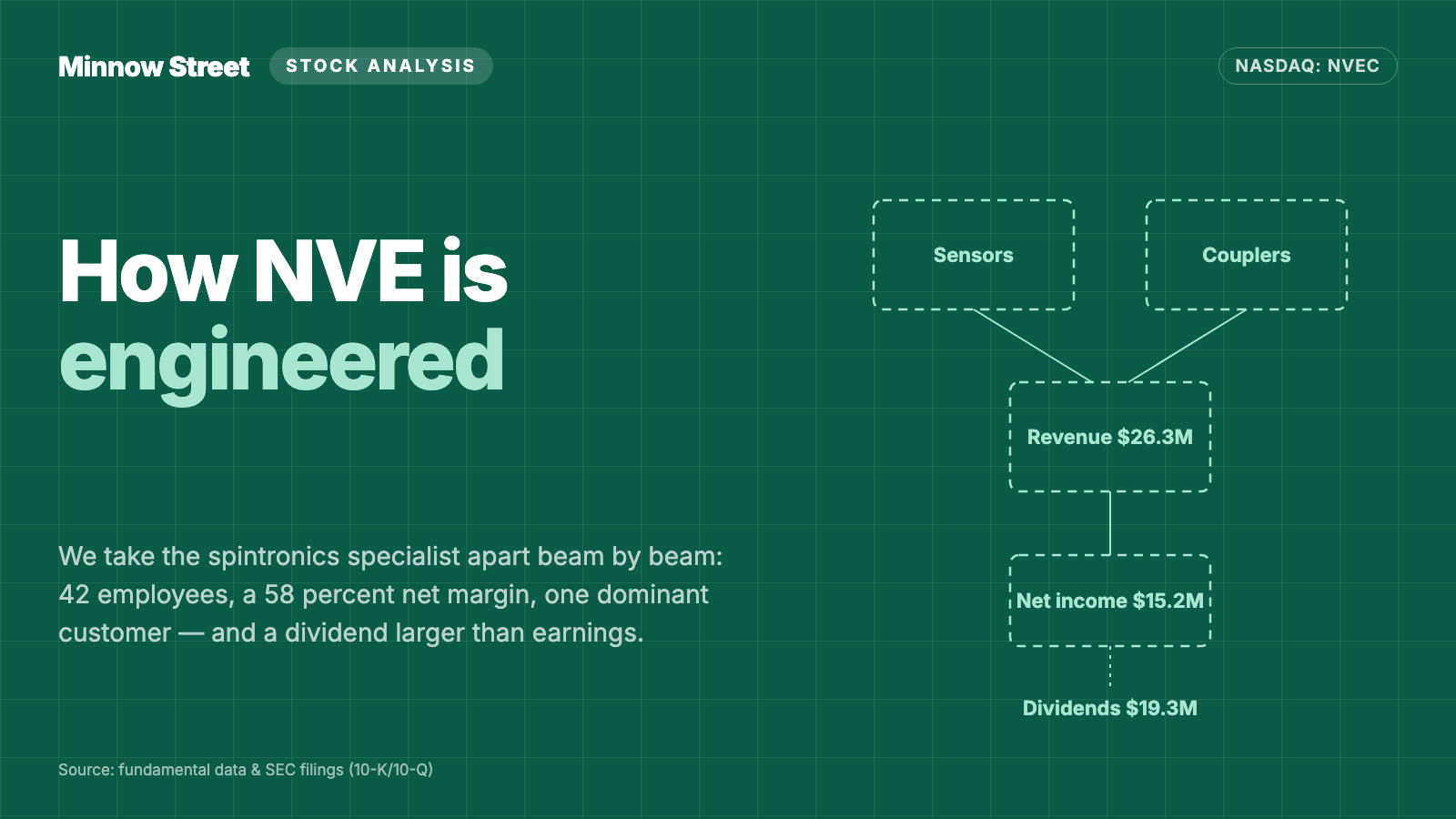
NVE builds chips that pull off a trick ordinary electronics cannot. Conventional semiconductors work with the electron’s charge — current on, current off. NVE’s technology is called spintronics and additionally uses the electron’s spin: tiny magnetic layers, some just two nanometers (five atomic layers) thin, change their electrical resistance depending on the magnetic field. From this NVE builds three product families, and the annual report itself supplies the best everyday image: “our technology can provide the eyes, nerves, and brains of electronic systems” (10-K for fiscal year 2026, Item 1). The sensors (the eyes) detect position, rotation or proximity — their signature specialty is tiny, ultra-reliable switches for implantable medical devices such as pacemakers and defibrillators, built under stringent medical device quality standards. The couplers (the nerves) move data between electrically isolated systems, for instance between robots and controllers in automated factories. And in memory, MRAM (the brain), NVE is mostly a licensor of its patents. Sales run through distributors such as Digi-Key into more than 75 countries; manufacturing happens in the company’s own cleanroom in Eden Prairie near Minneapolis, with chip packaging done by vendors in Asia. The company was founded in 1989 by spintronics pioneer James M. Daughton; it went public in 2000 through a reverse merger (the shell was called Premis Corp until August 2000) and has been Nasdaq-listed since 2003. One calendar quirk belongs right at the start because it trips up every casual reader of the numbers: NVE’s fiscal year ends on March 31. “Fiscal year 2026” therefore covers April 2025 through March 2026. Which brings us to the central tension of this analysis, and it runs through every chapter: NVE is one of the most profitable companies we have ever dissected — but it is not growing, it pays out more than it earns, and its largest customer sits on a contract with an expiration date. What a semiconductor small cap with genuine growth looks like is something we dissected at Lattice Semiconductor — and why a full cash box alone is not a buy case, at fiber-optic supplier Clearfield.
Where the stock shows up in our scanner
Every day we run about 3,500 stocks through our scanners. NVE did not reach the research list through headlines — the stock has practically no Reddit presence — but through a momentum run: 8 hits as of the July 17, 2026 data cut-off. The stock sits in a Stan Weinstein stage-2 uptrend (price above a rising 200-day average), trades above both the 50- and the 200-day lines, meets the Mark Minervini trend criteria, fired a Pradeep Bonde breakout signal and shows EPS acceleration (earnings per share growing faster quarter by quarter — most recently plus 27 percent in the March 2026 quarter). Add the Pros 80% filter (institutional investors hold roughly 89 percent of the shares) and High ADR — an average daily range of 7 to 8 percent that tells you how thin the trading in this micro-cap is. Behind it stand plus 52 percent in three months and plus 63 percent in six (data as of July 17, 2026) — though after a jump on the annual results the stock has been consolidating and still trades a good fifth below its 52-week high. What is remarkable is how well the fundamental lens of the very same scanner plays along: a fundamental grade of B, a Piotroski F-score of 6 of 9 (a nine-point test of the direction of the books — 6 means more metrics improving than deteriorating) and an Altman Z-score around 33 (an early-warning gauge of insolvency risk built from several balance-sheet ratios — the danger zone historically starts below 1.8; thanks to net cash and fat margins NVE plays in the “practically unbreakable” league). The package is expensive all the same: the trailing price-to-earnings ratio sits around 30, the price-to-sales ratio around 20. To replicate it yourself: open the NVE stock page or browse the stage-2 scanner. Remember this combination: when trend filters and quality filters cheer together, exactly one question is left — what exactly are you paying for?
The numbers over the years — honestly appraised
First, what genuinely impresses — and at NVE that is an entire floor of the accounts. In fiscal year 2026 (ended March 31, 2026), the company turned $26.3 million of revenue into $15.2 million of net income: a 79 percent gross margin, a 60 percent operating margin, a 58 percent net margin. For perspective: even big software names are considered money machines at a 30 percent net margin. NVE does this as a manufacturer — with its own wafer fab and exactly 42 employees, each of whom generates a computed $627,000 in revenue and $362,000 in profit. The balance sheet is a fortress in miniature: no bank debt, $58.2 million in equity against $60.4 million in total assets, plus $43.5 million in cash and fixed-income securities (March 31, 2026). Operating cash flow came to $16.7 million, capital expenditures to a modest $2.2 million — the business model barely needs fresh capital. Read only this paragraph and you see a perfect company. Now look at the direction of the curve:
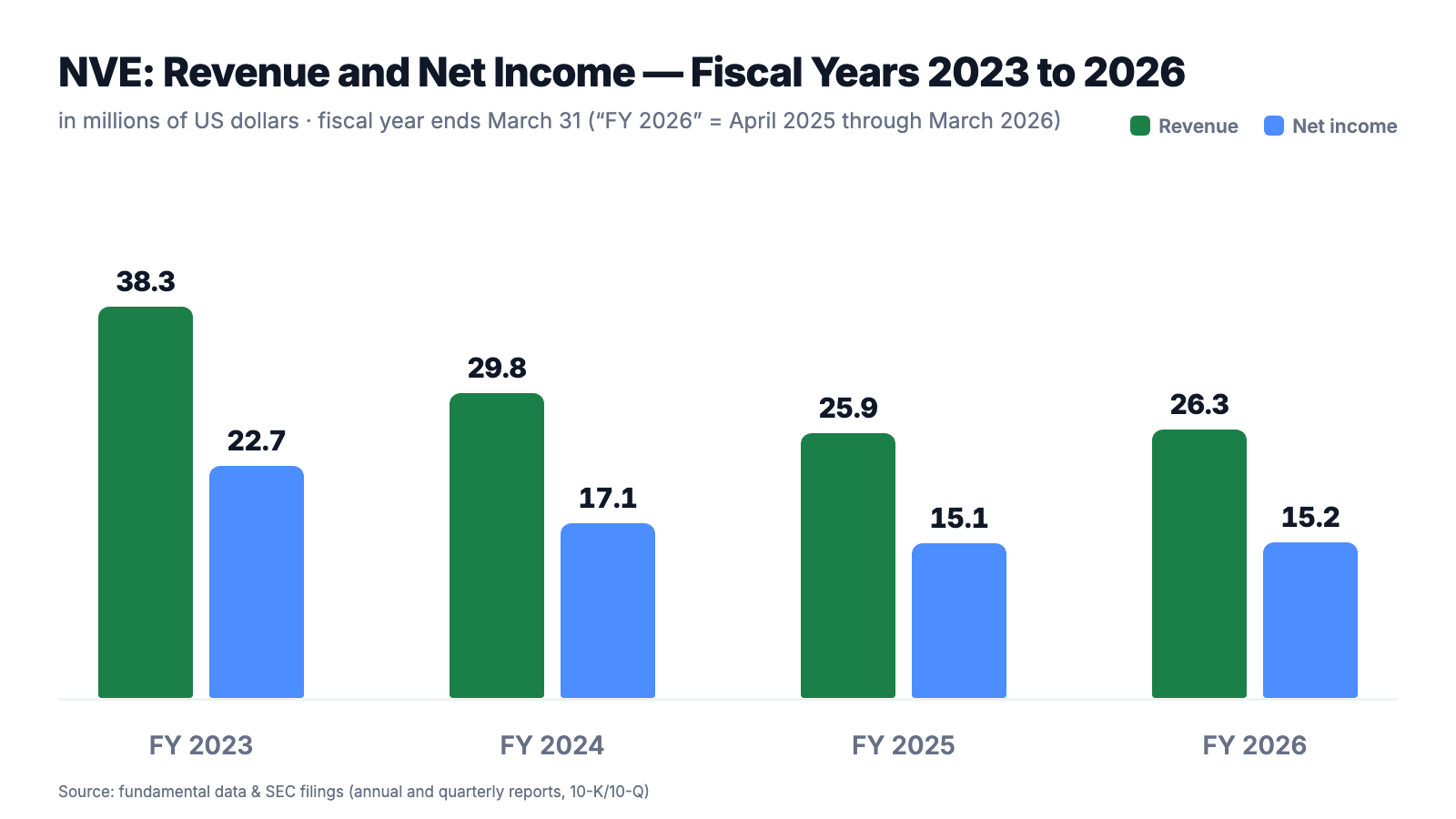
The record is three years old: in fiscal 2023, NVE booked $38.3 million in revenue and earned $22.7 million ($4.70 per share). Then came the semiconductor downturn: minus 22 percent in fiscal 2024 (“due to the downturn in the semiconductor industry,” per the report), another minus 13 percent in fiscal 2025. Fiscal 2026 delivered the turn in name only, at plus 1.8 percent — and the report is honest about where the increase came from: “primarily due to price increases and increased purchases by existing customers.” Revenue thus still sits almost a third below the record. To be fair, the year-end finish belongs in the appraisal too: the December 2025 quarter grew 23 percent — per the quarterly report on rising defense and non-defense sales plus new research contracts (contract R&D up 335 percent) — and the final quarter through March 2026 added 5 percent to $7.7 million, with earnings per share of $1.02 (plus 27 percent). Two better quarters do not make a recovery, but they explain the scanner momentum. Still, remember the floor plan: NVE is a margin machine on a revenue plateau — the quality is spectacular, the direction lately was not. Which brings us to the uncomfortable truths.
What the filings say — the uncomfortable truths
Uncomfortable truth no. 1: one customer carries 37 percent of revenue — and its contract expires at the end of 2027
The annual report names the name in the section “Dependence on Major Customers”:
“We rely on several large customers for a significant percentage of our revenue, including Abbott Laboratories, certain distributors, and certain other customers. The loss of one or more of these customers could have a material adverse effect on us.”
— NVE Corporation, SEC annual report 10-K for fiscal year 2026, Item 1 “Business”

How big “significant” is stands in the concentrations footnote: “Customer A” accounted for 37 percent of fiscal 2026 revenue, up from 35 percent the year before — and for 27 percent of accounts receivable (Note 10 “Concentrations”). Picture a bakery where every third dollar comes from a single regular. The relationship itself is a success story: since 2006, NVE has supplied sensors to pacemaker maker Pacesetter — then part of St. Jude Medical, part of Abbott since the 2017 takeover. The underlying supply agreement has been extended for two decades, most recently by Amendment No. 12 of December 12, 2025, which even locks in price increases for 2026 and 2027 (curiously documented in an 8-K report whose event date is still January 1, 2006). But that very contract now has a visible expiration date — and the risk section puts it bluntly:
“We have agreements with certain customers, including a Supplier Partnering Agreement, as amended, with Abbott Laboratories, which expires December 31, 2027. We cannot predict if these agreements will be renewed, or if renewed, under what terms.”
— NVE Corporation, SEC annual report 10-K for fiscal year 2026, Item 1A “Risk Factors”

Fairness requires saying: twelve contract extensions in twenty years speak for deep technical entrenchment — you do not swap out sensors in approved pacemakers via an order form; every change would have to pass medical qualification processes. And the latest amendment with higher prices is a sign of pricing power rather than weakness. But the mechanics remain: more than every third revenue dollar hangs on a single corporation that re-decides every year or two — and the next decision comes no later than the end of 2027.
Uncomfortable truth no. 2: the dividend is bigger than the profit — for the third year in a row
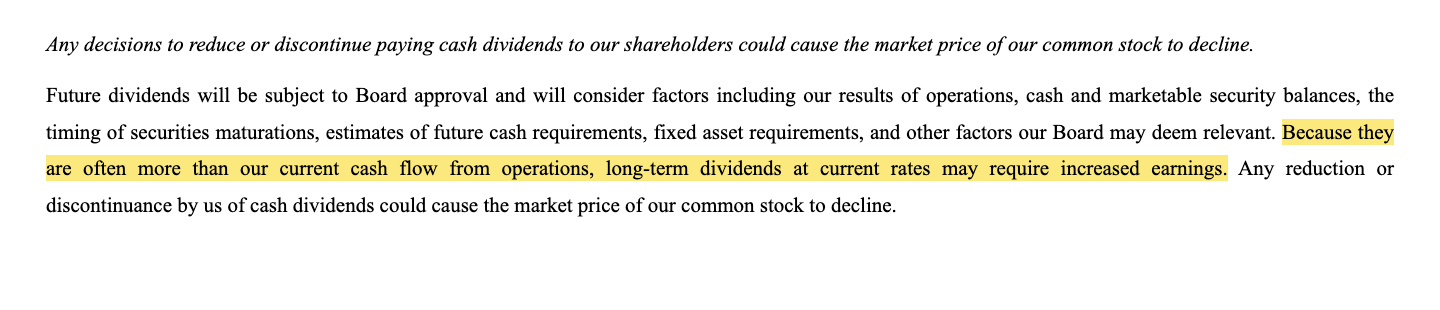
Now to the core of the dividend anchor trap. NVE pays $1.00 per share per quarter — $4.00 a year, which at 4.84 million shares makes a payout of $19.3 million per fiscal year. But the company has lately earned less than that: $17.1 million in fiscal 2024, $15.1 million in fiscal 2025, $15.2 million in fiscal 2026. For three consecutive years the payout exceeded the profit — cumulatively, roughly $58 million flowed to shareholders while $47.4 million was earned. This is no accounting trick and no scandal; it sits in plain sight in the numbers: retained earnings shrank from $46.7 million (March 2024) through $42.5 million to $38.3 million (March 2026), cash fell from $8.0 million to $1.7 million in the last fiscal year alone, and cash plus securities dropped from about $48 million to $43.5 million within a year. What is remarkable is that the annual report does this math itself — in the risk section on the company’s own stock:
“Because they are often more than our current cash flow from operations, long-term dividends at current rates may require increased earnings. Any reduction or discontinuance by us of cash dividends could cause the market price of our common stock to decline.”
— NVE Corporation, SEC annual report 10-K for fiscal year 2026, Item 1A “Risk Factors” (“Risks Related to Our Stock”)
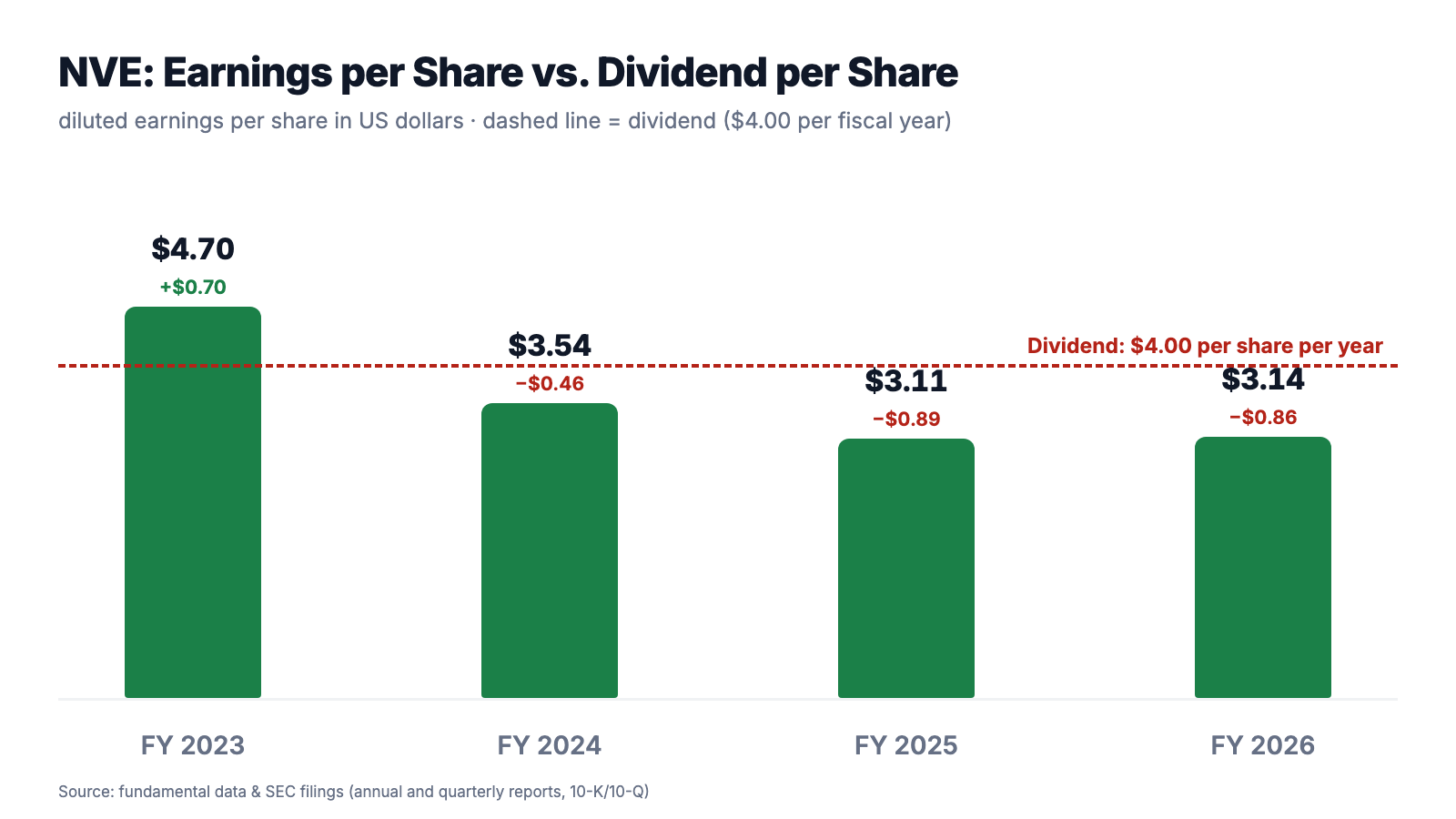
Here too, the fair counter-argument: NVE can afford this policy for quite a while yet. The $43.5 million in cash and securities covers more than two full annual dividends without a single dollar of profit; the gap between operating cash flow ($16.7 million) and payout ($19.3 million) was “only” $2.7 million in fiscal 2026, plugged from maturing bonds. This is not a company on life support but one deliberately returning substance to its owners — it explicitly considers share buybacks less efficient. But the direction is one-way as long as earnings do not rise: every year in this constellation shrinks the cushion that pays for the reliability. And a dividend paid out of the company’s own portfolio is, strictly speaking, your own substance taking a detour past the tax office.
Uncomfortable truth no. 3: half chip company, half bond fund — 69 percent of the balance sheet sits in securities
Whoever buys NVE stock buys two things: a fabulously profitable specialty chip business — and a bond portfolio. The risk section quantifies it itself:
“As of March 31, 2026, we held $41,803,512 in short-term and long-term marketable securities, representing approximately 69% of our total assets. […] Any impairments of our marketable securities could impact our financial condition, income, or cash flows, or our ability to pay dividends.”
— NVE Corporation, SEC annual report 10-K for fiscal year 2026, Item 1A “Risk Factors”
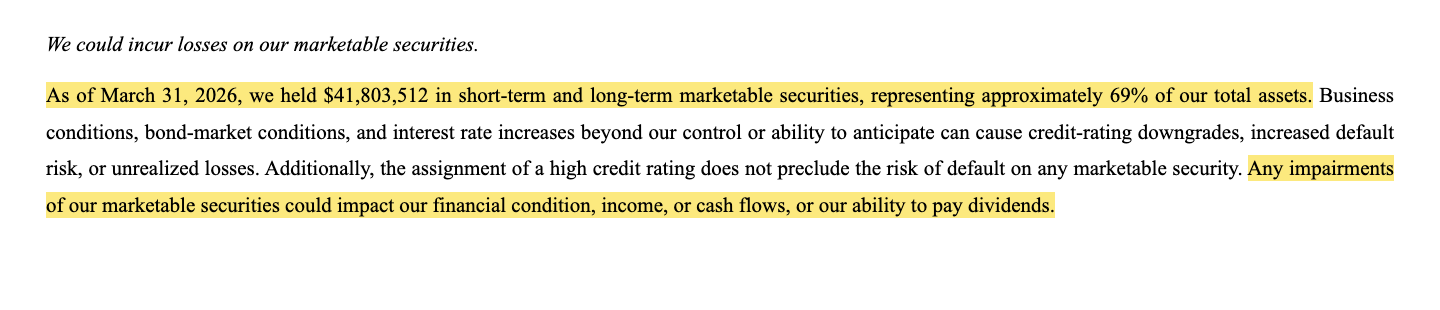
Concretely, $37.1 million sits in corporate bonds and $4.7 million in U.S. Treasuries, with remaining maturities of up to 37 months (Note 5). This portfolio is no idle pile: it is the reservoir from which the dividend gap is served — and it earns a healthy income of its own. The portfolio contributed $1.9 million in interest income in fiscal 2026; that is roughly 11 percent of pre-tax income that comes not from spintronics but from bond coupons. For valuing the stock this means two things. First: the celebrated capital discipline has a flip side — the company evidently finds no investments in its own business more attractive than parking the money in bonds and paying it out; research and development spending fell 13 percent to $3.2 million in fiscal 2026. Second: part of the earnings quality hangs on interest rates and credit quality, not on technology. Whoever values NVE as a pure tech company is silently valuing a small bond fund too — at technology multiples.
Valuation: 30 times a profit that is not growing
In mid-July 2026 the NVE stock cost about $94, for a market value of a good $460 million — roughly half a billion dollars for $26.3 million in revenue (data as of July 17, 2026). The trailing price-to-earnings ratio sits around 30, price-to-sales around 20, price-to-book around 8. Strip out the $43.5 million in cash and securities and the market still pays about 27 times earnings for the operating business — for a company whose revenue has not grown in three years. For perspective: in the last big semiconductor upswing, multiples like these were usually justified with double-digit growth rates. The dividend yield around 4.2 percent is the real reason many investors buy — but after everything in truth no. 2, it is not interest; it is a payout ratio of 127 percent of earnings. What carried the stock lately was hope for the turn: the strong December quarter (plus 23 percent), the solid final quarter (earnings per share plus 27 percent), plus defense demand and new product families (wafer-level chip-scale sensors, angle sensors). Institutions hold roughly 89 percent of the shares; most recently 10 funds added while 8 trimmed — insiders bought no shares and sold twice (data as of July 17, 2026). Translated: the market is paying for quality plus a dividend plus a growth hope of which, so far, two quarters exist.
Opportunities and risks at a glance
What speaks for NVE:
- Extreme profitability as a steady state: a 79 percent gross margin, 60 percent operating margin and 58 percent net margin in fiscal 2026 — with its own U.S. wafer fab and just 42 employees (annual report 10-K).
- A fortress balance sheet: no bank debt, $58.2 million in equity against $60.4 million in total assets, $43.5 million in cash and securities (March 31, 2026); Altman Z-score around 33 (data as of July 17, 2026).
- A deeply entrenched niche: sensors for implantable medical devices with a 20-year Abbott/St. Jude supply relationship, extended twelve times, most recently with price increases for 2026/2027 (Form 8-K/A of 12/17/2025); medical qualifications as a switching barrier.
- First signs of a turn: December 2025 quarter plus 23 percent (defense and non-defense, contract R&D plus 335 percent), March 2026 quarter plus 5 percent with earnings per share up 27 percent; new product lines in the market (10-K/10-Q).
- Momentum with a quality substructure: 8 scanner hits, stage-2 trend, plus 52 percent in three months, fundamental grade B, Piotroski 6 of 9, zero dilution (share count effectively constant for years; data as of July 17, 2026).
What speaks against it:
- The payout has exceeded earnings for three straight years ($19.3 million versus $15.1–17.1 million); the report itself names increased earnings as the precondition for the dividend at this level — retained earnings and liquidity are melting (10-K FY 2026, Item 1A).
- Concentration risk with a calendar date: Abbott/“Customer A” = 37 percent of fiscal 2026 revenue; the supply agreement expires December 31, 2027, and renewal is explicitly not guaranteed (10-K FY 2026, Note 10 and Item 1A).
- No growth: revenue almost a third below the fiscal 2023 record; the fiscal 2026 increase came “primarily due to price increases,” per the report; research and development spending declined.
- A demanding valuation for standstill: trailing P/E around 30, price-to-sales around 20 (data as of July 17, 2026) — while roughly 11 percent of pre-tax income comes from bond interest rather than the product business.
- Micro-cap mechanics: roughly $460 million in market value, thin trading with average daily ranges of 7 to 8 percent, post-earnings price jumps in both directions — and the tax credits that supported fiscal 2026 earnings are expected to decrease significantly, per the 10-K.
A human conclusion
Back to the dividend anchor trap from the opening. Its core is not that dividends are bad — it is that a reliable payment switches off the checking. At NVE, the checking reveals two truths at once. The first: this is one of the most remarkable small companies on the U.S. market — 42 people extracting 58 cents of profit from every revenue dollar with nanometer-thin magnetic layers, debt-free, with a product that ticks inside pacemakers and without which modern factories would communicate worse. The second: the four dollars of dividend that many investors hold on to have not been earned for three years; they are partly paid out of substance. The largest customer re-decides no later than the end of 2027, and at 30 times earnings the price of the stock assumes a future that so far consists of two good quarters. So the honest question for you is not “Is NVE a good company?” — it is; the filings leave little doubt. The question is: are you buying a margin machine with a growth option — or renting a 4 percent yield whose landlord is currently living off the reserve? If the turn from the December quarter holds, the Abbott contract is renewed on schedule and the new sensor lines sell, the dividend will earn its own keep again — the fab, the patents and the customers for that are in place. Until then: whoever anchors here should know what to. What you make of it is your decision. And that is exactly as it should be.
Sources
All original documents used in this analysis — for your own reading:
- NVE Corporation — SEC annual report 10-K for fiscal year 2026 (ended March 31, 2026; filed May 6, 2026)
- NVE Corporation — SEC annual report 10-K for fiscal year 2025 (ended March 31, 2025; filed May 7, 2025)
- NVE Corporation — SEC annual report 10-K for fiscal year 2024 (ended March 31, 2024; filed May 1, 2024)
- NVE Corporation — SEC quarterly report 10-Q as of December 31, 2025 (filed January 21, 2026)
- NVE Corporation — Form 8-K/A (Amendment No. 11) of December 17, 2025 — Amendment No. 12 to the Abbott Supplier Partnering Agreement
- Complete SEC filing history of NVE Corporation: EDGAR overview (sec.gov)
- Fundamental data (metrics, quarterly series, valuation; data as of July 17, 2026), reconciled with the SEC filings.
- Screener and rating data: in-house stock scanner (data as of July 17, 2026).
Transparency & disclaimer: This analysis is a journalistic contextualization of publicly available information and is not investment advice, not a financial analysis in the regulatory sense, and not a solicitation to buy or sell securities. Stock investments carry substantial risks up to and including total loss. All information without guarantee; the data cut-off is noted in the text. The author holds no position in NVE stock at the time of publication.
Our Bottom Line at a Glance
- Profitability & business quality positive
- A 79 percent gross margin, 60 percent operating margin and 58 percent net margin in fiscal 2026 — with an own U.S. wafer fab, 42 employees and a medical-device niche relationship with Abbott extended twelve times since 2006 (10-K FY 2026). Quality at this level is a rarity among micro-caps.
- Balance sheet & capital cushion positive
- No bank debt, $58.2 million in equity against $60.4 million in total assets, $43.5 million in cash and securities (March 31, 2026), Altman Z around 33; the share count has been effectively constant for years — zero dilution (data as of July 17, 2026).
- Growth negative
- Revenue sits almost a third below the fiscal 2023 record ($38.3 million → $26.3 million); the 1.8 percent increase in FY 2026 came "primarily due to price increases," per the report, and research spending fell 13 percent — two stronger quarters (Q3 +23 percent, Q4 +5 percent) are a start, not proof.
- Dividend policy & substance negative
- A payout of $19.3 million a year against $15.1–17.1 million in earnings — three years running; retained earnings melted from $46.7 million to $38.3 million (March 2024 to March 2026), cash from $8.0 million to $1.7 million. The 10-K itself names increased earnings as the precondition for the dividend at this level.
- Customer concentration negative
- "Customer A" (Abbott) = 37 percent of fiscal 2026 revenue and 27 percent of receivables; the supply agreement expires December 31, 2027, and the report states plainly: "We cannot predict if these agreements will be renewed" (10-K FY 2026, Note 10 and Item 1A).
- Valuation & technicals neutral
- A stage-2 trend, 8 scanner hits and plus 52 percent in three months meet a trailing P/E around 30 and a P/S around 20 (data as of July 17, 2026) — the market is paying for quality plus a dividend plus a growth hope built on two quarters; roughly 11 percent of pre-tax income is interest income, not chip business.
NVE is a margin machine in miniature: 42 employees, a 58 percent net margin, debt-free, zero dilution — quality of a kind rarely found among micro-caps. But the four dollars of dividend, the main anchor for many investors, have not been earned for three fiscal years and are partly paid out of substance; revenue sits almost a third below the 2023 record, more than every third revenue dollar hangs on an Abbott contract that expires December 31, 2027, and at 30 times trailing earnings all of that is already priced with confidence. Whoever invests here buys first-class substance with a built-in bet on a revenue turnaround. Not investment advice.
What Our Rating Means
- If you don't own the stock
- As long as the question raised in the bottom line stays open, we see no basis for an entry.
- If you hold it in your portfolio
- Our findings offer no acute reason to sell — the checkpoints named remain decisive.
A journalistic assessment by our editorial team at the time of the deep dive, based on public sources — not investment advice and not a solicitation to buy or sell. Your personal circumstances (investment goals, risk capacity, taxes) cannot be taken into account. What our categories mean, how verdicts are formed, and what conflicts of interest exist →
Worth Noting
- NVEC reached the research list through a momentum run in our in-house stock scanner (8 hits, including Stan Weinstein stage 2; data as of July 17, 2026) — not through Reddit or headlines; the stock has practically no social media presence.
- Scanner metrics (P/E, P/S, Piotroski, Altman Z, fundamental grade) use trailing twelve-month figures; they include $1.9 million in interest income and roughly $1.1 million in manufacturing tax credits that the 10-K expects to decrease significantly in fiscal 2027.
- Price and valuation figures dated July 17, 2026 (about $94, about $460 million market value); analyses are evergreen, daily prices are not a buy argument. NVE's fiscal year ends March 31 — all quarterly references carry the fiscal-year offset.
Frequently Asked Questions
NVE Corporation (Nasdaq: NVEC) of Eden Prairie, Minnesota, develops and manufactures spintronics devices: magnetic sensors (including for implantable medical devices such as pacemakers), data couplers for factory automation and power conversion, and MRAM memory technology that it mostly licenses. Revenue in fiscal year 2026 (ended March 31, 2026): $26.3 million with $15.2 million in net income — generated by 42 employees.
Spintronics is a nanotechnology that uses the electron's spin in addition to its electrical charge. In NVE's devices, magnetic layers — some just a few atomic layers thin — change their electrical resistance depending on the magnetic field (the GMR and TMR effects). That enables extremely small, precise and low-power magnetic sensors and data couplers — in NVE's own words, the "eyes, nerves, and brains" of electronic systems.
NVE pays $1.00 per share per quarter — about $19.3 million a year. In fiscal years 2024 through 2026 that payout exceeded net income each year ($17.1, $15.1 and $15.2 million). The annual report itself warns that long-term dividends at current rates may require increased earnings. A cushion exists: $43.5 million in cash and securities (March 31, 2026) covers more than two annual dividends.
The annual report (10-K) for fiscal year 2026 names Abbott Laboratories as a major customer; "Customer A" accounted for 37 percent of revenue (35 percent the year before). The pacemaker-sensor supply relationship dates back to 2006 (then St. Jude Medical/Pacesetter) and has been extended twelve times — most recently in December 2025 with price increases. The agreement expires December 31, 2027; renewal is not guaranteed, per NVE.
NVE's fiscal year ends March 31. "Fiscal year 2026" therefore covers April 2025 through March 2026, and the "third quarter of fiscal 2026" means October through December 2025. Anyone comparing NVE's numbers with calendar-year figures of other companies should keep that offset in mind.
Extraordinarily profitable: in fiscal 2026 the gross margin was 79 percent, the operating margin 60 percent and the net margin 58 percent — with the company's own U.S. wafer fab. Two caveats: roughly 11 percent of pre-tax income came from interest on the company's bond portfolio ($1.9 million), and manufacturing investment tax credits pushed the tax rate down to 14.7 percent.
By classic yardsticks, no: the trailing price-to-earnings ratio sits around 30 and price-to-sales around 20 (data as of July 17, 2026) — for a company whose revenue is almost a third below its fiscal 2023 record. The dividend yield around 4.2 percent is attractive but represents a payout ratio of 127 percent of earnings. The market is paying for quality plus a growth hope built, so far, on two stronger quarters.
Found an error?
Did you spot a factual error, an outdated number, or a typo in this deep dive? Let us know briefly — your report goes straight to the editorial team.