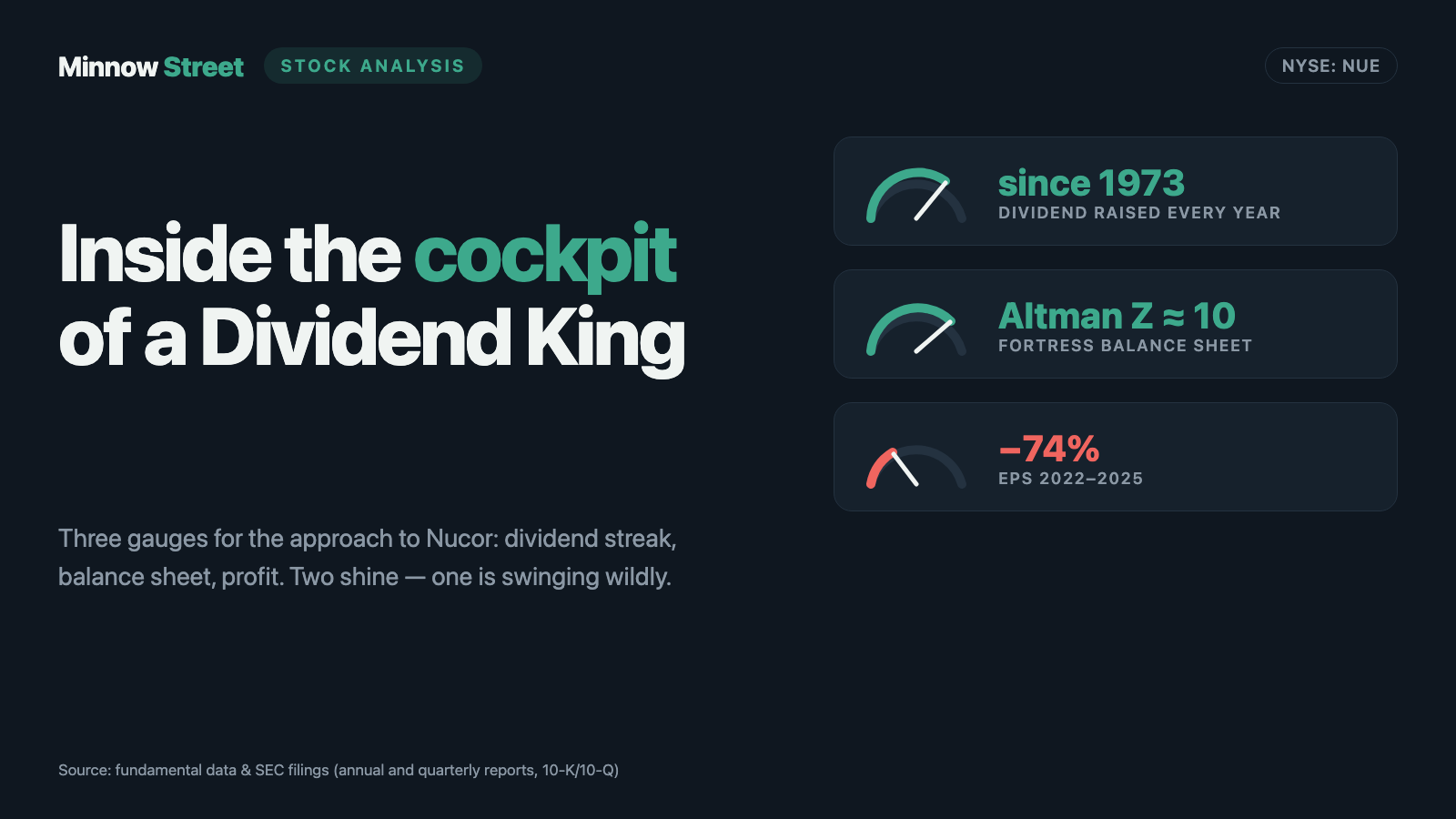
Nucor Stock: The Dividend Has Risen Every Year Since 1973 — Profit Fell 74 Percent in Three Years
Nucor is America's largest steelmaker — and a Dividend King: the base dividend has been raised in every single year since payments began in 1973, and February 2026 brought the 212th consecutive quarterly dividend. Our in-house Dividend Aristocrats scanner ranks the stock second in its U.S. selection (as of July 18, 2026). We read the annual reports (10-K) and the quarterly report (10-Q) as of April 4, 2026: earnings per share that melted from $28.79 to $7.52 before snapping back to $3.23 in a single quarter, global overcapacity worth eight times U.S. production, a cyberattack that idled mills — and a dividend that refuses to notice any of it. Not investment advice — just the owner's manual for a quality seal that is easy to misread.
 Thomas Mücke
Founder & Publisher
Thomas Mücke
Founder & Publisher
Chart
Interactive price chart (TradingView).
Note: pure fact-based analysis, not investment advice and not a solicitation to buy or sell. All figures without guarantee.
There is an investor trap that catches the careful ones in particular: the quality-seal reflex. It works like this: you hear "dividend raised every year for more than 50 years," and your head translates it into "as safe as a savings account." From that moment on you stop checking the company and only check the seal — the way nobody reads the ingredients list once they have seen the organic sticker. Nucor Corporation (NYSE: NUE) carries one of the oldest quality seals on the stock market: since payments began in 1973, America's largest steelmaker has raised its base dividend in every single year, and in February 2026 the board declared the 212th consecutive quarterly cash dividend. Our in-house Dividend Aristocrats scanner ranks the stock second in its U.S. selection (as of July 18, 2026). So let's make a deal: before the quality-seal reflex decides for you, we read together what Nucor itself reported, under penalty of law, to the U.S. securities regulator, the SEC — the annual reports (10-K) and the quarterly report (10-Q) as of April 4, 2026. Because next to the seal there is a second row of numbers: $28.79 → $18.00 → $8.46 → $7.52 in earnings per diluted share for 2022 through 2025. The dividend is an escalator. The profit underneath it is a roller coaster. How the two fit together — and what that means for you — is your call in the end.
What Nucor actually does: scrap in, steel out
Nucor is North America's largest steelmaker — and its largest recycler at the same time. The core of the business model is the electric arc furnace (EAF): picture an enormous crucible in which scrap metal — car wrecks, demolition steel, machine parts — is melted into new steel at over 2,900 degrees Fahrenheit using electricity instead of coking coal. These "minimills" are more flexible and lower-emission than traditional blast furnaces: they can be dialed up and down like a gas stove, while a blast furnace must burn like a campfire you can never let go out. Roughly 33,000 employees ("teammates" in company parlance) generated 2025 revenue of $32.5 billion (up 6 percent) across three segments: the steel mills ($20.0 billion in outside sales) roll sheet, beams, rebar and plate; the steel products segment ($10.3 billion) turns them into joists, decking, metal buildings and tubing — lately with growing demand from data center construction; raw materials ($2.2 billion) includes North America's leading ferrous scrap broker (DJJ), the company's own direct-reduced-iron plants in Louisiana and Trinidad — and, barely known, even its own natural gas production. A fifth of steel-mill output is consumed internally by the company's own downstream businesses.
Two peculiarities belong in the picture. First, the culture: Nucor pays comparatively low base wages plus a massive profit share — the profit-sharing plan received $611 million in the boom year 2023, but only $256 million in 2025, per the annual report (10-K). Payroll costs breathe with the cycle, which cushions downturns. Second, the central tension of this analysis, which runs through every chapter: Nucor sells a product whose price it does not set — and pays on top of it a dividend that has known only one direction since 1973. Steel is a global commodity with cycles, tariffs and overcapacity; the payout is a promise to shareholders that has to be kept through every one of those cycles. We recently dissected how cyclical industrials handle such swings at forklift maker Hyster-Yale and drivetrain specialist Twin Disc — Nucor is the same problem in its heavyweight class.
Where the stock shows up in our scanner
We run roughly 3,500 stocks through our scanners every day. As of July 18, 2026, Nucor sits at rank 2 of the U.S. selection in our Dividend Aristocrats scanner — the scanner lists companies that have raised their dividend every year for at least 25 consecutive years; it carries Nucor with 51 years of increases (as of June 2026). To replicate it yourself: open the scanner, set the country filter to "US," second row. More interesting than the rank is the confluence, because Nucor appears in two quality scanners at the same time: in "Martin Zweig: growth with discipline" (growth at a reasonable price) and in the "Altman-Z: fortress balance sheet" scanner — the Altman Z-score, an early-warning bankruptcy gauge built from several balance-sheet ratios, stands at about 10, where the danger zone historically begins below 1.8. A reading of 10 is not a good grade; it is an absurdly good one. Add a Piotroski F-score of 9 out of 9 (a nine-point test of the direction the books are moving — 9 means every signal is improving, though the strong latest quarter is doing some pushing here) and a fundamental grade of B. The trailing price-to-earnings ratio stands near 24 (data as of mid-July 2026). Remember the principle: a scanner hit describes the past — what you pay for is the future. Whether 51 years of streak predict the next ten is settled by the filings, not by the rank.
The numbers over the years — honestly appraised
First, what genuinely impresses — and at Nucor that is more than the dividend. Per the annual report (10-K), 2022 was "the most profitable year in the Company's history": $7.61 billion in net earnings, $28.79 per diluted share, on $41.5 billion of revenue. Return on equity still ran at 23 percent in 2023. The company carries the highest credit ratings of any steel producer headquartered in North America (A- from S&P and Fitch, A3 from Moody's), the funded-debt-to-capital ratio stood at a moderate 24.4 percent at the end of 2025, and current assets covered current liabilities 2.9 times. Capital returns are policy, not exception: Nucor has committed to returning a minimum of 40 percent of net earnings to shareholders through dividends and buybacks — about $1.22 billion flowed back in 2025, and in February 2026 the board approved a fresh $4.00 billion share repurchase program. Read only these paragraphs and you see the perfect sleep-well stock. Now look at the whole curve:
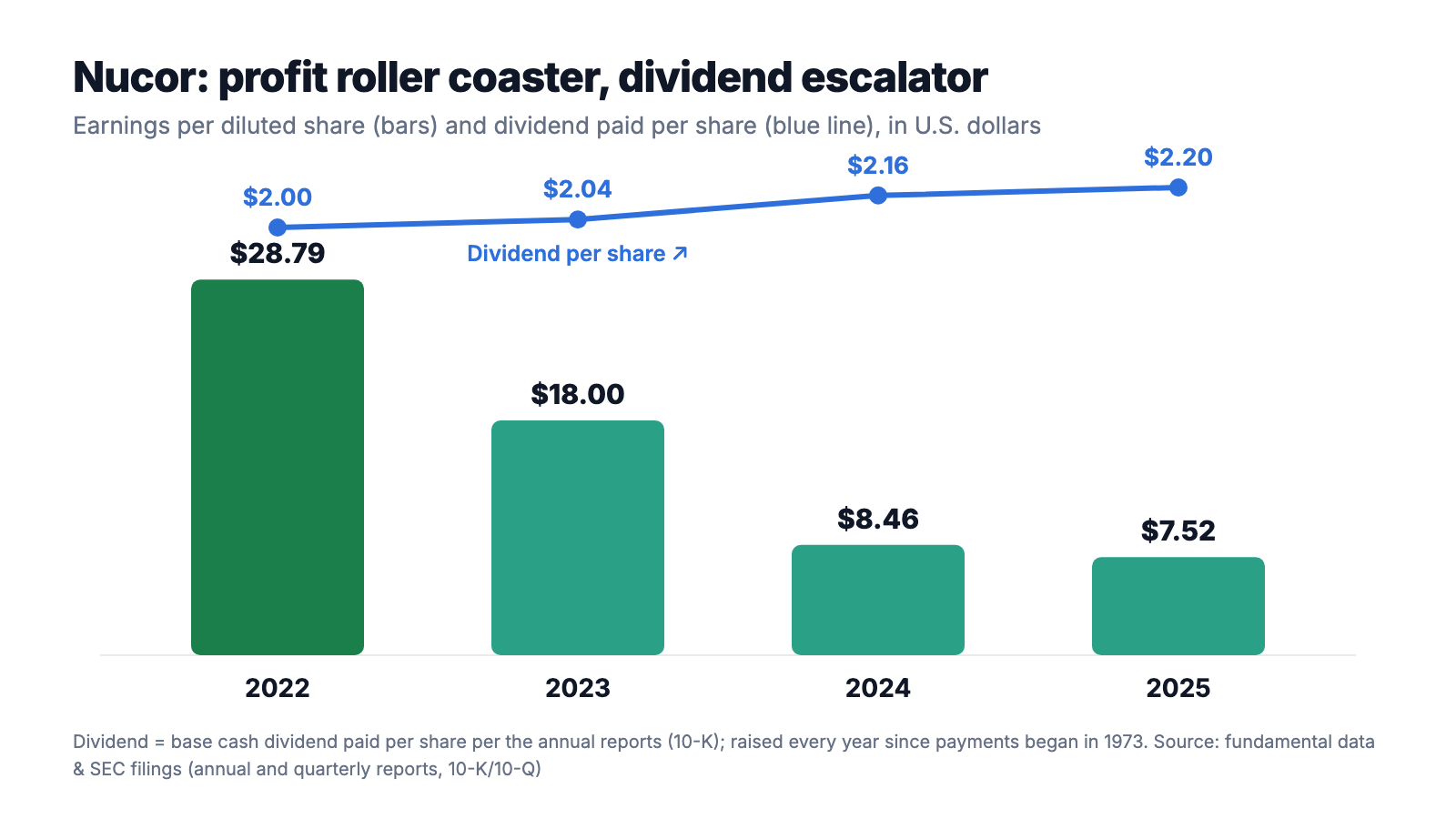
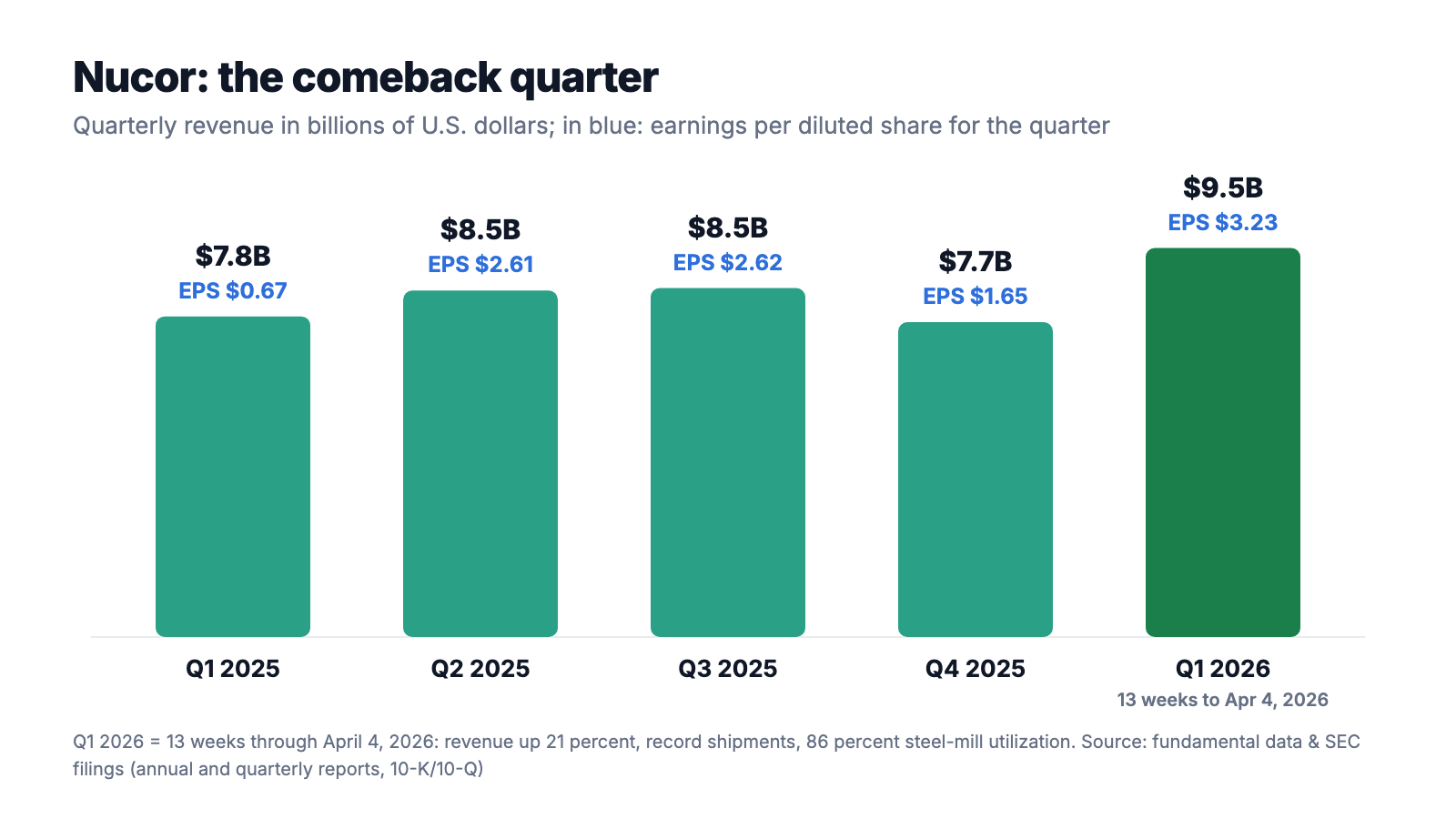
The series behind the curve: the record year 2022 was followed by $4.53 billion in net earnings in 2023 ($18.00 per share), $2.03 billion in 2024 ($8.46) and $1.74 billion in 2025 ($7.52) — revenue fell from $41.5 billion through $34.7 billion to $30.7 billion before recovering to $32.5 billion in 2025. Down 74 percent in earnings per share over three years, without management doing anything wrong: steel prices fell, the "metal margin" — the spread between the selling price of steel and the cost of scrap — compressed, and the steel products segment came down from historically unique price levels. Then the cycle turned again: in the first quarter of 2026, net earnings jumped to $743 million ($3.23 per diluted share) — more than four times the $156 million ($0.67) of the prior-year quarter — on $9.5 billion of revenue (up 21 percent), record steel-mill shipments, 86 percent utilization and $886 million of operating cash flow (prior year: $364 million). Remember the image: for a cyclical, the annual profit is not a report card — it is a weather report. The question is never what the weather is like right now, but whether the house can stand any weather.
The dividend streak: real, old — and deliberately kept small
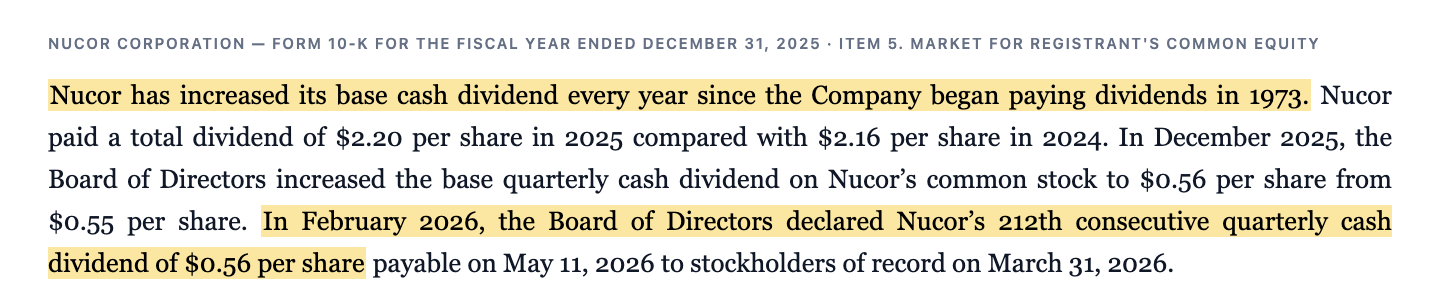
Now to the seal itself, because it does survive scrutiny — you just have to understand why. The annual report puts it dryly:
"Nucor has increased its base cash dividend every year since the Company began paying dividends in 1973. Nucor paid a total dividend of $2.20 per share in 2025 compared with $2.16 per share in 2024. In December 2025, the Board of Directors increased the base quarterly cash dividend on Nucor's common stock to $0.56 per share from $0.55 per share. In February 2026, the Board of Directors declared Nucor's 212th consecutive quarterly cash dividend of $0.56 per share payable on May 11, 2026 to stockholders of record on March 31, 2026."
— Nucor Corporation, SEC annual report 10-K for fiscal year 2025, Item 5 "Market for Registrant's Common Equity"
How does an every-year-more dividend survive a 74 percent earnings collapse? Through modesty. In 2025 Nucor paid $2.20 per share against $7.52 in earnings — a payout ratio of roughly 29 percent. In the record year 2022 it was just 7 percent of earnings ($2.00 of $28.79). That is the Dividend King's trick: the base dividend is calibrated so small that even a catastrophic steel year can carry it — even in the weak first quarter of 2025 ($0.67 in earnings per share), the $0.55 quarterly dividend was covered, if more tightly than usual at an 82 percent quarterly payout. You also get the flip side of that safety in plain figures: at a share price around $249 (data as of mid-July 2026), the $2.24 annual run rate works out to a dividend yield of roughly 0.9 percent. Remember the sentence: this dividend is a character reference, not an income. If you want to live off distributions, you are in the wrong place; if you want to know whether a management team can hold discipline for five decades, you get the rarest proof the stock market has to offer.
What the filings say — the uncomfortable truths
Uncomfortable truth no. 1: the world has eight times as much excess steel capacity as the U.S. produces
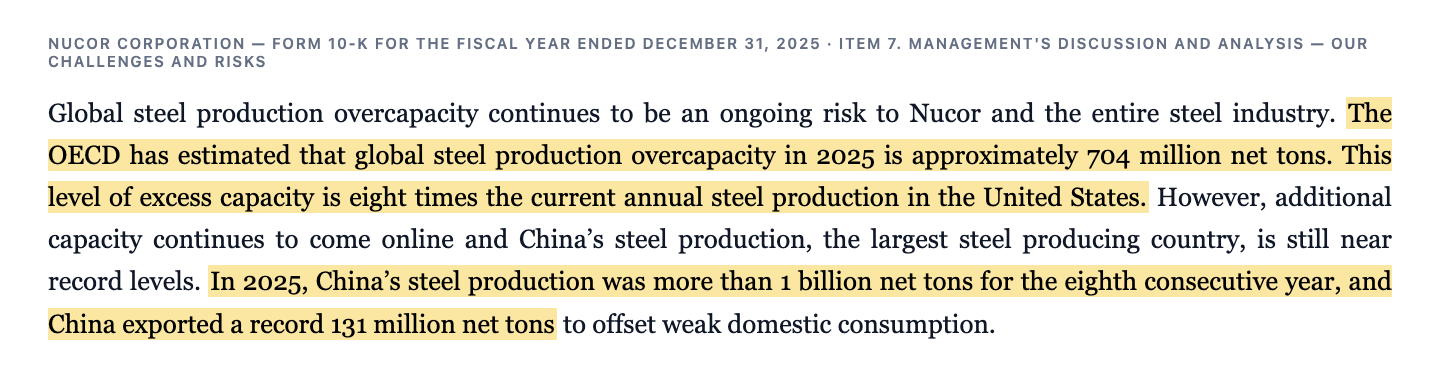
Nucor's biggest risk is not on Nucor's balance sheet but on China's. The annual report quantifies it with unusual precision:
"The OECD has estimated that global steel production overcapacity in 2025 is approximately 704 million net tons. This level of excess capacity is eight times the current annual steel production in the United States. […] In 2025, China's steel production was more than 1 billion net tons for the eighth consecutive year, and China exported a record 131 million net tons to offset weak domestic consumption."
— Nucor Corporation, SEC annual report 10-K for fiscal year 2025, Item 7 "Management's Discussion and Analysis — Our Challenges and Risks"
Translated into an everyday image: Nucor runs the best bakery in town — but just beyond the town line stand industrial bakeries that can bake eight times as much bread as the whole town eats, and that must offload their surplus below cost if need be. The report also names the next escalation stage: China is increasingly building steel capacity in third countries across Southeast Asia and Africa to route around tariffs. That Nucor's home market works anyway is owed to a protective wall of trade policy — which brings us to the second truth.
Uncomfortable truth no. 2: the comeback quarter has a political engine
The first quarter of 2026 was spectacular — and the quarterly report says honestly where part of the tailwind blows from:
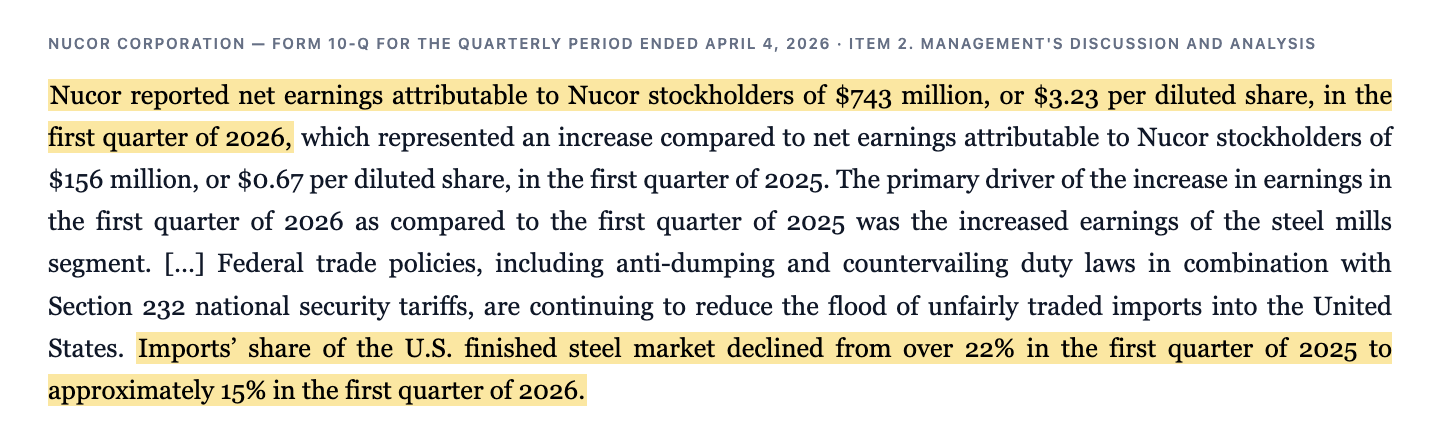
"Federal trade policies, including anti-dumping and countervailing duty laws in combination with Section 232 national security tariffs, are continuing to reduce the flood of unfairly traded imports into the United States. Imports' share of the U.S. finished steel market declined from over 22% in the first quarter of 2025 to approximately 15% in the first quarter of 2026."
— Nucor Corporation, SEC quarterly report 10-Q as of April 4, 2026, Item 2 "Management's Discussion and Analysis"
The mechanics behind it: fewer imports mean more volume and more pricing power for domestic mills — Nucor's average sales price per ton rose 12 percent to $1,279 in the first quarter of 2026, shipments rose 9 percent to 7.4 million tons, and steel-mill utilization climbed to 86 percent. That is genuinely earned money. But be honest with yourself: part of this margin is legislated margin. Section 232 tariffs can be tightened, softened or traded away by any administration — the same trade policy that suppresses the import share in 2026 can become a bargaining chip in tomorrow's agreement. A dividend that has been maintained through five decades of policy swings suggests Nucor can handle that. A profit jump that arrives in step with a tariff regime should still be extrapolated with care.
Uncomfortable truth no. 3: in May 2025, hackers halted parts of production
May 2025 showed how vulnerable even a fortress balance sheet is in day-to-day operations. Nucor reported a material cybersecurity incident to the SEC (8-K, Item 1.05) — and had to add detail in the amended filing:
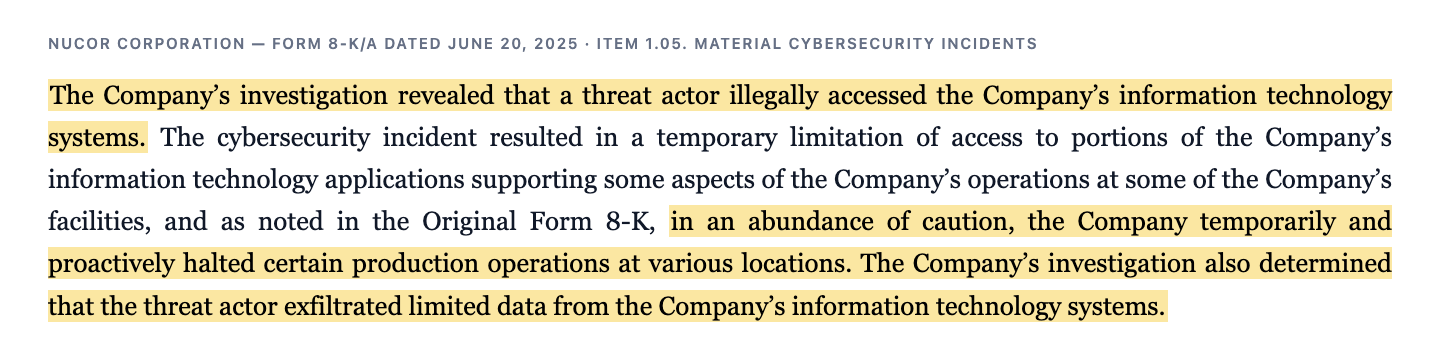
"The Company's investigation revealed that a threat actor illegally accessed the Company's information technology systems. […] in an abundance of caution, the Company temporarily and proactively halted certain production operations at various locations. The Company's investigation also determined that the threat actor exfiltrated limited data from the Company's information technology systems."
— Nucor Corporation, SEC current report 8-K/A dated June 20, 2025, Item 1.05 "Material Cybersecurity Incidents"
Context without alarmism: the incident was contained, data restored from backups, outside forensic experts and federal law enforcement brought in; the annual report (10-K) for 2025 no longer lists it as a drag on results. But a company that idles furnaces because of an IT breach shows you that "heavy industry" now also means software risk — and that the 212-quarter streak has to be defended every quarter against risks that did not even exist in 1973.
Uncomfortable truth no. 4: the buildout costs billions — and the cash pile has nearly halved
Nucor is investing more than ever: $8.90 billion of capital expenditures in the three years through 2025, $9.73 billion in total including acquisitions. The crown jewel is the new sheet mill in West Virginia — planned capacity of 3,000,000 tons, completion expected by the end of 2026, with modern galvanizing lines including automotive-grade capability. Except: the cost estimate rose to approximately $4 billion per the annual report (the State of West Virginia contributes $350 million; Nucor's net outlay: about $3.65 billion) — higher labor, material and equipment costs. In parallel, cash and short-term investments shrank from $4.14 billion (end of 2024) to $2.70 billion (end of 2025) and $2.48 billion as of April 4, 2026; in March 2025 the company raised $1 billion of fresh debt (notes at 4.650 and 5.100 percent), followed by $220 million of industrial development revenue bonds for West Virginia in November 2025. None of this is threatening — the 24.4 percent debt-to-capital ratio and the A ratings leave plenty of headroom, and a finished mill earns money instead of consuming it. But the equation should be clear to you: billions of capex, a $4.00 billion buyback program and an every-year-more dividend all draw on the same cyclical cash flow. In a long steel trough, one of those three pillars would have to give — history says it would not be the dividend, but history is not a contract.
Valuation: $58 billion for the Dividend King — after the comeback quarter
In mid-July 2026, Nucor weighed in at roughly $58 billion in market value (data as of July 18, 2026; share price around $249 on roughly 228 million shares outstanding per the quarterly report). The trailing price-to-earnings ratio stands near 24 — optically expensive for a steel company, but beware the optics: for cyclicals, the P/E is highest at the earnings trough and lowest at the peak (in 2022 it would have computed below 5). Analyst estimates assume close to $17 in earnings per share for 2026 (data as of mid-July 2026) — implying a forward P/E around 15; the consensus of 15 covering analysts sits at "buy." The price-to-sales ratio near 1.7 and the price-to-book ratio near 2.6 both sit at the upper end of the company's own history, and after gaining 47 percent year to date the stock traded only about 10 percent below its all-time high (all valuation figures: data as of mid-July 2026). Translated: the market has seen the comeback quarter and is already paying for it. Whoever buys today is not buying the beaten-down cyclical of 2025, but the expectation that tariffs, data center demand and the new West Virginia mill will set the next earnings peak higher than the last normal level — with the 0.9 percent dividend as a bonus, not an argument.
Opportunities and risks at a glance
What speaks for Nucor:
- The rarest dividend record on the market: raised every year since 1973, 212 consecutive quarterly dividends (February 2026), a 2025 payout ratio of only about 29 percent — the streak is armored against steel troughs, and a minimum of 40 percent of net earnings is committed to dividends and buybacks (10-K 2025).
- A fortress balance sheet with receipts: Altman Z-score near 10, 24.4 percent funded-debt-to-capital (end of 2025), $2.48 billion in cash and short-term investments (April 4, 2026), the highest credit ratings of any North American steel producer (A-/A3/A-).
- The comeback is under way: Q1 2026 with $9.5 billion in revenue (up 21 percent), $743 million in net earnings ($3.23 per share), record shipments, 86 percent utilization, $886 million in operating cash flow and historically high steel-mill backlogs (10-Q as of 04/04/2026, 10-K 2025).
- Structural demand tailwinds: infrastructure, data centers, energy and re-industrialization are pulling demand per the filings; the $4 billion West Virginia mill (3,000,000 tons, completion expected end of 2026) extends the lineup toward higher-value sheet.
- A business model with built-in shock absorbers: scrap-based electric arc furnaces can be run flexibly, the metal margin cushions raw-material swings, and workforce profit sharing ($611 million in 2023, $256 million in 2025) acts as an automatic cost buffer in downturns.
What speaks against it:
- Extreme cyclicality remains the law of the land: earnings per share went $28.79 → $7.52 (2022–2025), revenue $41.5 billion → $30.7 billion — no cost program decouples Nucor from the steel price.
- A world market with structural oversupply: roughly 704 million net tons of overcapacity (OECD estimate for 2025, eight times U.S. production), China's record exports of 131 million net tons, and capacity being built in third countries to circumvent tariffs (10-K 2025).
- Politics as a margin factor: imports' share fell from 22 to 15 percent thanks to Section 232 tariffs and trade cases — the same lever can become a bargaining chip in future agreements; there is no legal entitlement to protective tariffs.
- Valuation after the jump: trailing P/E near 24, price-to-book near 2.6, only about 10 percent below the all-time high after a 47 percent year-to-date gain (data as of mid-July 2026) — much of the comeback is paid for; a 0.9 percent dividend yield carries no valuation.
- Operational vulnerability: the May 2025 cyberattack temporarily halted production operations and cost data (8-K/A dated 06/20/2025); add billions of capex with a cost overrun in West Virginia (to roughly $4 billion) while the cash pile has nearly halved since the end of 2024.
A human conclusion
Back to the quality-seal reflex from the opening. Its flaw is not that it trusts seals — it is that it reads them as an answer to a question they never claimed to answer. Nucor's 50-year streak does not answer the question "Is this stock safe?" It answers the question "Does this management hold discipline when things get ugly?" — with the longest yes American industry has to offer. Nothing here is safe in the savings-account sense: profit can quarter itself in three years (it did), hackers can idle rolling mills (they did), and a good part of the current margin stands behind a tariff wall that is not a law of nature. The honest ledger reads like this: you get a superbly financed market leader with a genuine comeback quarter, built-in shock absorbers and a payout discipline that exists only a handful of times — at the price of 24 trailing earnings, near the all-time high, with a 0.9 percent yield and the full steel cycle riding shotgun. The quality-seal reflex would buy now. The numbers reader instead checks three lines in every quarterly report (10-Q): the metal margin and the sales price per ton, imports' share of the U.S. market — and whether the 213th consecutive quarterly dividend arrives on schedule. What you make of it is your decision. And that is exactly as it should be.
Sources
All original documents used in this analysis — for your own reading:
- Nucor Corporation — SEC annual report 10-K for fiscal year 2025 (filed February 25, 2026)
- Nucor Corporation — SEC annual report 10-K for fiscal year 2024 (filed February 27, 2025)
- Nucor Corporation — SEC annual report 10-K for fiscal year 2022 (filed March 1, 2023; record year)
- Nucor Corporation — SEC quarterly report 10-Q as of April 4, 2026 (filed May 13, 2026)
- Nucor Corporation — SEC current report 8-K dated May 14, 2025 (cybersecurity incident) and 8-K/A dated June 20, 2025 (amendment)
- Nucor's complete SEC filing history: EDGAR overview (sec.gov)
- Fundamental data (metrics, quarterly series, valuation; data as of mid-July 2026), reconciled with the SEC filings.
- Screener and rating data: in-house stock scanner, including the Dividend Aristocrats scanner (rank 2 of the U.S. selection, as of July 18, 2026).
Transparency & disclaimer: This analysis is a journalistic contextualization of publicly available information and is not investment advice, not a financial analysis in the regulatory sense, and not a solicitation to buy or sell securities. Stock investments carry substantial risks up to and including total loss. All information without guarantee; the data cut-off is noted in the text. The author holds no position in Nucor shares at the time of publication.
Our Bottom Line at a Glance
- Dividend discipline positive
- Base dividend raised every year since 1973, 212th consecutive quarterly dividend (February 2026), a 2025 payout ratio of only about 29 percent, and a commitment to return at least 40 percent of net earnings including buybacks — the streak is armored against steel troughs by a low ratio and balance-sheet strength (10-K 2025).
- Balance sheet & credit positive
- Funded debt to capital of 24.4 percent (end of 2025), current ratio of 2.9, $2.48 billion in cash and short-term investments (April 4, 2026), Altman Z near 10, the highest ratings of any North American steel producer (A-/A3/A-) — though the cash pile has nearly halved since the end of 2024 ($4.14 billion) under the capex supercycle.
- Cyclicality & earnings quality negative
- Earnings per share fell from $28.79 (2022) to $7.52 (2025) and revenue from $41.5 billion to $30.7 billion (2024) before 2025/Q1 2026 turned — Nucor's results hang on metal margin and steel prices it does not control; the OECD puts global overcapacity at eight times U.S. production.
- Comeback momentum positive
- Q1 2026: revenue up 21 percent to $9.5 billion, net earnings of $743 million ($3.23 per share) after $156 million a year earlier, record shipments, 86 percent utilization, $886 million in operating cash flow, historically high backlogs (10-Q as of 04/04/2026, 10-K 2025).
- Policy dependence of the margin neutral
- Imports' share of the U.S. finished steel market fell from over 22 to about 15 percent (Q1 2025 → Q1 2026) on Section 232 tariffs and trade cases — a real tailwind, but one that depends on political decisions that can change; China is shifting capacity to third countries to circumvent tariffs (10-K 2025, 10-Q).
- Valuation after the jump negative
- Trailing P/E near 24 (near 15 on 2026 estimates), price-to-book near 2.6, up 47 percent year to date and only about 10 percent below the all-time high (data as of mid-July 2026) — much of the comeback is priced in; a dividend yield of roughly 0.9 percent does not support the valuation.
Nucor is proof that Dividend Kingship and cyclicality are no contradiction: the base dividend has risen every year since 1973 because, at roughly 29 percent of 2025 earnings, it is deliberately kept small — while earnings per share fell 74 percent in three years and then quadrupled in a single quarter in early 2026. Against that stand a fortress balance sheet with A ratings, a capex supercycle around the $4 billion West Virginia mill, and a valuation that already largely pays for the comeback after a 47 percent year-to-date gain. Whoever buys here buys the discipline — and carries the cycle. Not investment advice.
What Our Rating Means
- If you don't own the stock
- As long as the question raised in the bottom line stays open, we see no basis for an entry.
- If you hold it in your portfolio
- Our findings offer no acute reason to sell — the checkpoints named remain decisive.
A journalistic assessment by our editorial team at the time of the deep dive, based on public sources — not investment advice and not a solicitation to buy or sell. Your personal circumstances (investment goals, risk capacity, taxes) cannot be taken into account. What our categories mean, how verdicts are formed, and what conflicts of interest exist →
Worth Noting
- NUE reached the research list through the in-house Dividend Aristocrats scanner: rank 2 of the U.S. selection (as of July 18, 2026); simultaneous hits in "Martin Zweig: growth with discipline" and "Altman-Z: fortress balance sheet" — quality and balance-sheet strength confirm each other across scanners.
- On counting the streak: the annual report (10-K) for 2025 states "increased its base cash dividend every year since the Company began paying dividends in 1973"; our scanner carries Nucor with 51 years of increases (curated list, as of June 2026). The dividend yield of roughly 0.9 percent refers to the $2.24 annual run rate at a share price around $249 (data as of mid-July 2026).
- Scanner metrics (P/E, P/S, Piotroski, Altman Z) use trailing twelve-month figures; the Q1 2026 earnings jump is included, the remaining 2026 quarters naturally are not. Analyses are evergreen; daily prices are not a buy argument.
Frequently Asked Questions
Nucor has paid dividends since 1973 and, per the annual report (10-K) for 2025, has raised its base cash dividend every year since — a good 50 consecutive years of increases depending on the count; our in-house stock scanner carries Nucor with 51 years (as of June 2026). In February 2026 the board declared the 212th consecutive quarterly cash dividend ($0.56 per share). Total 2025 payouts were $2.20 per share, after $2.16 in 2024.
The safety comes from the deliberately low ratio, not from stable profits: in 2025 Nucor paid $2.20 per share against $7.52 in earnings — a payout ratio of roughly 29 percent; in the record year 2022 it was only about 7 percent. Even in the weak first quarter of 2025 ($0.67 in earnings per share), the $0.55 quarterly dividend was covered. Add a 24.4 percent funded-debt-to-capital ratio (end of 2025) and the highest credit ratings of any North American steel producer.
Nucor Corporation (NYSE: NUE, Charlotte, North Carolina, roughly 33,000 teammates) is North America's largest steelmaker and largest steel recycler. Electric arc furnaces melt scrap into new steel; three segments — steel mills ($20.0 billion in 2025 outside sales), steel products ($10.3 billion, including data center components) and raw materials ($2.2 billion, including scrap broker DJJ and the company's own natural gas production) — produced combined 2025 revenue of $32.5 billion.
Steel is a global commodity: Nucor's earnings hang on the "metal margin," the spread between the selling price of steel and the cost of scrap. From the record year 2022 ($7.61 billion in net earnings, $28.79 per diluted share), profit fell to $1.74 billion ($7.52) by 2025 before the first quarter of 2026 snapped back with $743 million ($3.23). The OECD estimates 2025 global overcapacity at roughly 704 million net tons — eight times annual U.S. production.
On May 14, 2025, Nucor reported a material cybersecurity incident to the SEC (8-K, Item 1.05): a threat actor illegally accessed the IT systems, Nucor proactively halted certain production operations at various locations, and per the amended filing (8-K/A dated June 20, 2025) limited data was exfiltrated. The incident was contained (backups, outside forensic experts, federal law enforcement); the annual report (10-K) for 2025 no longer lists it as a drag on results.
After the comeback quarter, it is rather sporty: roughly $58 billion in market value, a trailing price-to-earnings ratio near 24, price-to-book near 2.6, only about 10 percent below the all-time high (data as of mid-July 2026). On analyst estimates of close to $17 in earnings per share for 2026, the forward P/E computes near 15. For cyclicals, remember: the P/E looks highest at the earnings trough — what matters is where in the cycle you buy, not any single ratio.
An electric arc furnace (EAF) melts scrap metal into new steel with electricity instead of coking coal — like an enormous crucible that can be dialed up and down like a gas stove, while a traditional blast furnace must burn continuously. That makes Nucor more flexible in downturns and lower-emission per ton; the feedstock is mostly recycled scrap, supplemented by direct reduced iron (DRI) from the company's own plants in Louisiana and Trinidad.
Found an error?
Did you spot a factual error, an outdated number, or a typo in this deep dive? Let us know briefly — your report goes straight to the editorial team.