Hyster-Yale Stock: A $100 Million Tariff Bill, a Nearly Halved Backlog — and a Family Holding 76 Percent of the Votes
Hyster-Yale has built forklifts under the Hyster and Yale brands for decades — and earned $142.3 million doing it as recently as 2024. Then came the tariffs: roughly $100 million in tariff-related costs pushed the company to a $60.1 million net loss in 2025, while the order backlog melted from $1.93 billion to $1.28 billion within a year. On Reddit the stock is a side note with 4 mentions in 24 hours (ApeWisdom, as of July 17, 2026) — but our in-house stock scanner lists it in two valuation rankings: price-to-sales ratio 0.18 (data as of July 10, 2026). We read the annual reports (10-K), the quarterly report (10-Q) as of March 31, 2026, and the proxy statement. Not investment advice — just the question of what a bargain is worth when its price tag was printed before the tariffs.
 Thomas Mücke
Founder & Publisher
Thomas Mücke
Founder & Publisher
Chart
Interactive price chart (TradingView).
Note: pure fact-based analysis, not investment advice and not a solicitation to buy or sell. All figures without guarantee.
There is an investor trap that catches the calculators among us in particular: the anchoring trap. It works like this: you see a stock at $36, you remember that the company earned $8 per share not long ago — and your head instantly computes "price-to-earnings ratio 4.5, dirt cheap!" The anchor is set: yesterday's profit. That the company is losing money today then feels like a mere footnote. Hardly any small cap feeds that trap in the summer of 2026 as cleanly as Hyster-Yale, Inc. (NYSE: HY) from Cleveland: one of the world's largest forklift manufacturers, record profit in 2024, net loss in 2025 — and lately available on the stock market for less than a fifth of one year's revenue (price-to-sales ratio 0.18, data as of July 10, 2026). On Reddit the stock is not a storm, more of a knock on the door: 4 mentions in 24 hours (ApeWisdom, as of July 17, 2026). So let's make a deal: before you drop that anchor, we read together what the company itself reported, under penalty of law, to the U.S. securities regulator, the SEC — the annual reports (10-K) for 2024 and 2025, the quarterly report (10-Q) as of March 31, 2026, and the proxy statement for the annual meeting. And these filings tell of a $100 million tariff bill, a backlog in descent with a late turn — and a family that always has the final word. In the end, you decide for yourself.
What Hyster-Yale actually does — and for whom
Hyster-Yale builds the workhorse of every warehouse, port and factory: the forklift — from the small warehouse pallet truck to the container handler that lifts entire sea-freight boxes. It sells under two heritage brands, Hyster and Yale, through a worldwide dealer network; add the Italian attachments specialist Bolzoni (forks, clamps, sideshifters) and a high-margin parts and service business. The annual report (10-K) for 2025 calls the company one of the market share leaders in the Americas and worldwide; it manufactures in eleven lift truck plants around the globe — in the United States, Mexico, Brazil, Europe and Asia, among others. As of January 31, 2026, the company employed roughly 7,500 people. Two things belong in the introduction. First, the history: Hyster-Yale was spun off from its former parent NACCO Industries in 2012 and was named "Hyster-Yale Materials Handling" until May 2024 — some price apps still list the stock under the old name. Second, the fine print of the business model: forklifts are classic capital goods. When the economy hums, logistics companies order fleets for years ahead; when it hesitates, the same customers simply run their old trucks longer. A manufacturer's revenue therefore swings far harder than the economy itself. Which brings us to the central tension of this analysis, and it runs through every chapter: on paper, Hyster-Yale is one of the cheapest industrial stocks on the board — but the profits that the cheapness math clings to come from a world before the tariffs. Whether they return is decided by Washington and by the customers' order pads, not by Cleveland. How hard the machinery cycle can shake a company, we recently dissected at barge operator Kirby — and what happens when a hyped energy technology keeps burning cash, at Eos Energy. Both will matter again shortly.
Where the stock shows up in our scanner
Every day we run about 3,500 stocks through our scanners. Hyster-Yale did not reach the research list through trend or momentum filters, but through the bargain corner: 2 hits as of the July 10, 2026 data cut-off, both in valuation rankings. In the P/S ranking the stock stands at a price-to-sales ratio of 0.18 — the market pays just 18 cents for every dollar of annual revenue. In the price-to-cash-flow ranking it comes in at a multiple of around 7, because despite the net loss the company still generated $86.1 million of operating cash flow in 2025. So much for the bargain lens. The fundamental lens of the very same scanner judges more coolly: a fundamental grade of D, a Piotroski F-score of 0 of 9 in the latest quarter (a nine-point test of the direction of the books — 0 means practically every metric is deteriorating), no price-to-earnings ratio for lack of earnings, and negative interest coverage — trailing-twelve-month operating results did not even cover the interest bill. On the plus side: the Altman Z-score (an early-warning gauge of insolvency risk built from several balance-sheet ratios) sits around 4.8, clearly outside the danger zone that historically starts below 1.8. About 60 percent of the shares sit with institutional investors, about 24 percent with insiders — more on that later, because these insiders are not ordinary ones. Remember the finding: when a stock shows up in the bargain rankings while its quality grades collapse, the market has rarely forgotten to price it — it is usually pricing something else: the risk.
The numbers over the years — honestly appraised
First, what genuinely impresses. Once the supply chains sorted themselves out after the pandemic and Hyster-Yale could work through its richly priced order mountain, the company delivered the best years of its stock market history: in 2023, revenue jumped 16 percent to $4.12 billion, followed by $4.31 billion in 2024 — with net income of $125.9 million and $142.3 million (diluted $7.24 and $8.04 per share). Capital discipline matched: the dividend was raised from $1.2975 (2023) to $1.375 (2024) to $1.43 per share (2025), most recently $0.36 per quarter (first quarter of 2026). And even in the loss year 2025, operating cash flow stayed positive at $86.1 million as the company worked down inventories and collected receivables. If you read only these paragraphs, you see a solid cyclical with a shareholder culture. Now look at the whole curve:
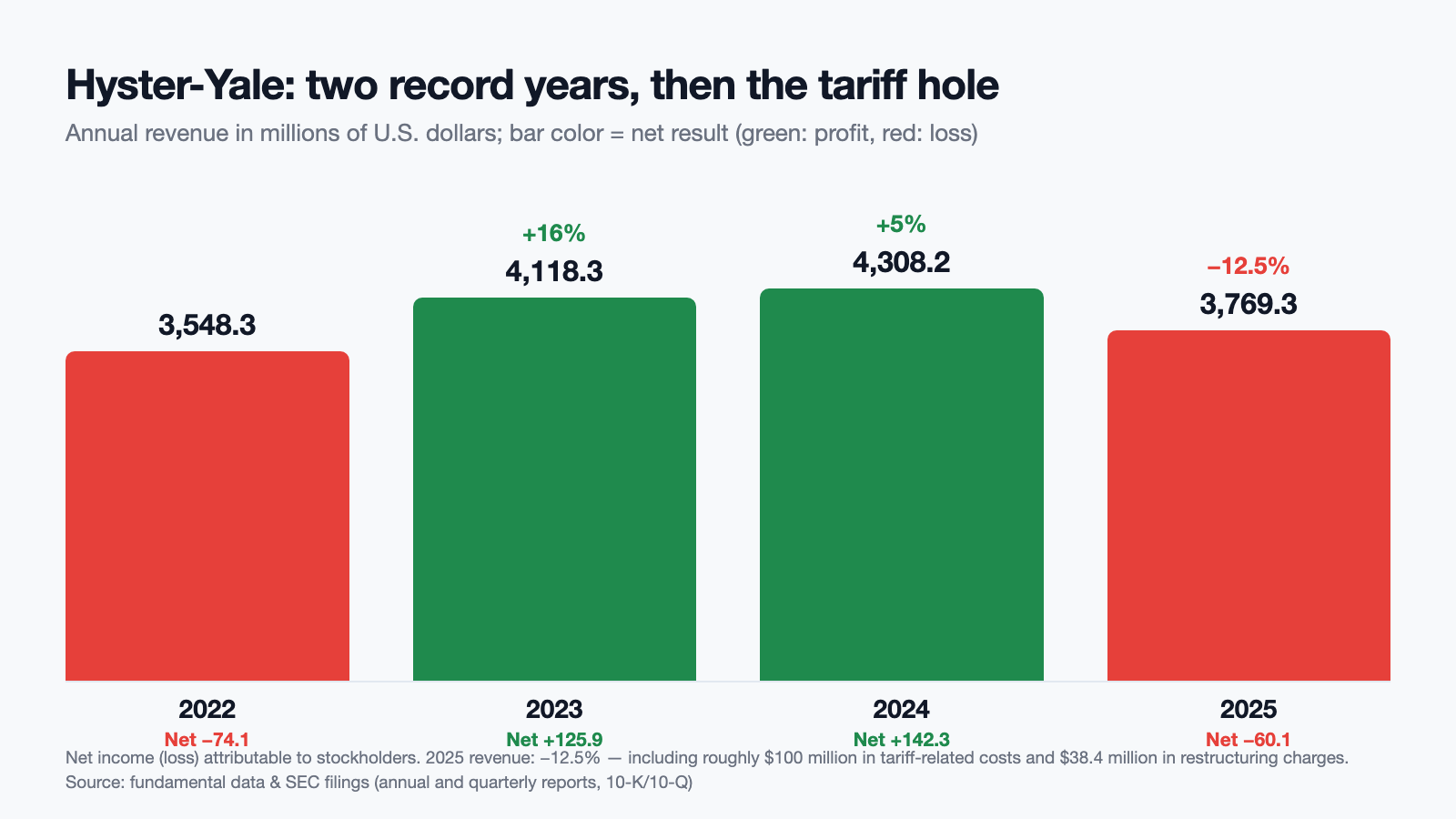
The curve shows both sides: 2022 ended with a net loss of $74.1 million — back then the company had to work through a backlog priced in the low-cost era while materials and freight exploded. Then came the two record years. And then 2025: revenue down 12.5 percent to $3.77 billion, operating results swinging from plus $244.8 million to a $22.1 million loss, a net loss of $60.1 million (−$3.40 per share). The first quarter of 2026 added to it: revenue down 12.7 percent to $795.2 million, a $30.5 million net loss. Remember the rhythm: at a forklift maker, the result is decided not by the current quarter but by the backlog from a year ago — at its prices, and at today's costs. That is exactly the scissor the tariffs drove into in 2025. Which brings us to the uncomfortable truths.
What the filings say — the uncomfortable truths
Uncomfortable truth no. 1: Roughly $100 million in tariff costs flipped the result — and 2026 starts with more of the same
Why does a company with almost $3.8 billion in revenue slide into a loss? The annual report answers with a number you should read twice:
"The Company's operating results were unfavorably affected by tariffs implemented in 2025 which led to the Company incurring approximately $100 million of various tariff-related costs on inventory purchases."
— Hyster-Yale, Inc., SEC annual report 10-K for 2025, Item 1A "Risk Factors"

One hundred million — that is more than the full 2025 net loss and nearly half the record operating profit of 2024. Hyster-Yale assembles in the United States, but it buys components and steel worldwide; Section 232 tariffs on steel and aluminum, Section 301 tariffs on Chinese goods and the blanket IEEPA tariffs hit procurement all at once, while higher selling prices only stick with a delay. And 2026 did not start any better: per the quarterly report (10-Q), roughly $30 million of additional tariff costs landed in the Americas business in the first quarter alone; for the second quarter, management expects a "significant increase in tariff expenses" from the expanded steel tariffs, with its own countermeasures still catching up. Two points in fairness. First: the problem hits the whole industry, not just Cleveland — but competitors with more manufacturing depth outside the tariff lines can dodge faster. Second: there is a remarkable twist that hardly anyone has on the radar — in February 2026 the U.S. Supreme Court declared part of these tariffs unlawful. What that could be worth, we sort out in the valuation chapter.
Uncomfortable truth no. 2: The backlog nearly halved within a year — customers simply run their old trucks longer
The second jaw of the vise, next to costs, is demand. The annual report soberly describes what happens to capital goods makers in uncertain times:
"Throughout 2025, many customers, particularly those still receiving trucks ordered when lead times were very high, deferred capital investments and extended equipment lifecycles, resulting in reduced order volumes."
— Hyster-Yale, Inc., SEC annual report 10-K for 2025, Item 7 "Management's Discussion and Analysis"
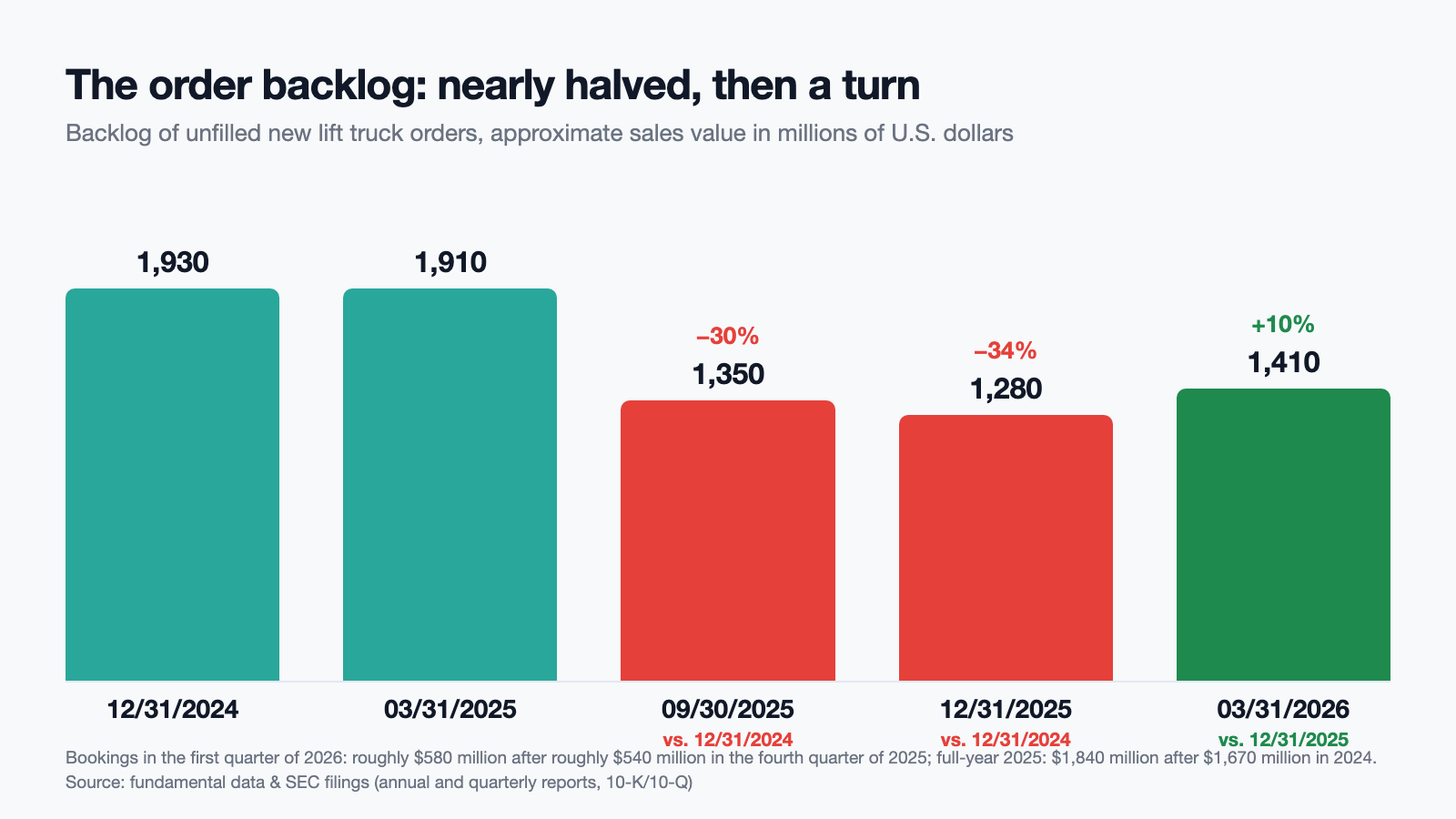
The chart shows the mechanics: the stock of unfilled forklift orders shrank from $1.93 billion at the end of 2024 to $1.28 billion at the end of 2025 — the plants delivered faster than new orders came in, and for a manufacturer, lower production also means underutilized plants and shrinking contribution per unit. Add a structural worry the report names openly: in Europe and South America, the market is shifting toward lighter-duty, lower-priced trucks, often aggressively priced by foreign competitors — a segment where Hyster-Yale has only recently begun offering competitive models; the EMEA segment posted a $66.2 million operating loss in 2025. Now the honest counter-argument: at the end of 2025, orders turned. The fourth quarter of 2025 brought a tangible push per the annual report (full-year bookings of $1.84 billion after $1.67 billion), the first quarter of 2026 followed with roughly $580 million — and the backlog grew for the first time in seven quarters, to $1.41 billion. Management reads aging fleets that now must be replaced into this, and per the quarterly report expects the second quarter of 2026 to be the financial low point. Only: three months earlier, the annual report had penciled that same low point in for the first quarter — the bottom here is a moving target.
Uncomfortable truth no. 3: The Nuvera fuel-cell unit burned $30–40 million a year for years — now it has been cut down to size
For years, Hyster-Yale ran a bet on the future alongside the forklift business: Nuvera Fuel Cells, a developer of hydrogen fuel-cell engines. The bet had a running price — operating losses of $36.4 million (2023) and $41.0 million (2024), booked against the core business's profits year after year. In 2025 the company pulled the ripcord; in filing prose it sounds like this:
"In connection with the strategic realignment of Nuvera, the Company identified indicators of impairment primarily related to the recoverability of long-lived assets, all of which negatively impacted the Company and arose from adverse developments in the geopolitical and hydrogen markets."
— Hyster-Yale, Inc., SEC annual report 10-K for 2025, Note 11 "Property, Plant and Equipment, Net"

The result of the "strategic realignment": in the second quarter of 2025, Nuvera was dissolved as a standalone segment and folded into the Americas business; the company booked $15.2 million in restructuring and impairment charges (including $9.6 million on fixed assets and $4.6 million on inventory) — and per the annual report already saves $15 million a year as of 2025. Translated: the bet was not officially buried, but demoted from racehorse to sideline pony; the remains now operate as an "integrated energy solutions program." For context, it is worth glancing at the pure-play energy technology space — at Eos Energy we walked through how hard it is even for specialists to turn new energy hardware into profits. That a forklift maker cross-subsidized this development was a chronic sore point of the stock story; ending the cross-subsidy is good news for the income statement — and at the same time an admission that a good decade of development money was bet on a market that has not (yet) arrived. On top, a company-wide workforce reduction has been running since the fourth quarter of 2025 ($21.5 million in severance charges), and the plant-footprint optimization is expected to cost another $13–18 million in 2026/2027.
Uncomfortable truth no. 4: Two share classes, tenfold voting rights — the founding family controls 76 percent of the votes
If you buy Hyster-Yale stock, you should know what you are buying: almost always the Class A share with one vote. Alongside it exists a non-listed Class B series with ten votes per share. The annual report does the math itself:
"As of December 31, 2025, certain members of the Company’s extended founding family held approximately 29 percent of the Company’s outstanding Class A common stock and approximately 96 percent of the Company’s outstanding Class B common stock. On the basis of this common stock ownership, certain members of the Company’s extended founding family could have exercised 76 percent of the Company’s total voting power."
— Hyster-Yale, Inc., SEC annual report 10-K for 2025, Item 1A "Risk Factors"

Behind this stand the Rankin and Taplin families, descendants of the founder of former parent NACCO. Alfred M. Rankin Jr. — grandson of the NACCO founder — chairs the board as Executive Chairman; day-to-day operations have been led by CEO Rajiv Prasad since 2023. Per the proxy statement, a stockholders' agreement additionally binds roughly 3.3 million Class B shares (67 percent of the total votes on their own) with mutual rights of first refusal — the shares are meant to stay in the family. The company classifies itself as a "controlled company" under NYSE rules and is therefore exempt from key board-independence requirements. Translated into an everyday image: you can become a co-owner here, but you are moving into a house where one family has written the house rules for generations. That cuts both ways. The friendly side: a family with a generational horizon rarely thinks in quarters, the dividend is worth the same to them as to you, and hostile takeovers at fire-sale prices are practically impossible. The unfriendly side: for exactly that reason there will never be a takeover premium here, activists bite on granite — and the report itself warns that this structure makes the stock unattractive as a takeover target, which can weigh on the share price. Part of the valuation discount is structure, not cycle.
Valuation: a $650 million market value — and a tariff wildcard from the Supreme Court
In early July 2026 the Hyster-Yale share cost about $36.40, which at 17.8 million shares makes a market value of roughly $650 million (data as of July 10, 2026) — for a company with $3.77 billion in revenue. The price-to-sales ratio of 0.18 and a price-to-book ratio around 1.4 ($450.9 million of equity as of March 31, 2026) tell the same story: the market is pricing a structurally thin-margin cyclical business here, not a growth jewel. A price-to-earnings ratio cannot be computed for lack of earnings; on 2025 operating cash flow the market pays about seven times, and the dividend — $1.44 annualized — works out to a yield of just under 4 percent. Against that stands a balance sheet you should not gloss over: $505.3 million of debt against only $81.8 million of cash (March 31, 2026), debt at 53 percent of capitalization — and a $300 million credit facility whose covenants permit dividends only while certain availability and coverage thresholds are met ($192.1 million was available as of December 31, 2025). The analyst estimates in our scanner assume a strong earnings recovery over the coming twelve months (data as of July 10, 2026) — which is exactly management's bet: second quarter of 2026 as the trough, then recovery via price increases, cost programs and the growing backlog, and a modest operating profit for the full year. And then there is the wildcard: in February 2026 the U.S. Supreme Court held the IEEPA tariffs not legally authorized, and in April the customs agency even published refund procedures. In the quarterly report it reads like this:
"In April 2026, the U.S. Customs and Border Protection agency issued procedures for IEEPA-related refunds. As of March 31, 2026, the Company has not recorded any impact for potential recovery of tariff-related costs as the amounts and timing of refunds are uncertain."
— Hyster-Yale, Inc., SEC quarterly report 10-Q as of March 31, 2026, Note 11 "Contingencies"

Important for context: the company does not break out how much of the roughly $100 million relates to the struck-down IEEPA tariffs, no refund timeline exists, and the 2026 outlook explicitly assumes zero recovery — while the IEEPA tariffs were replaced by a temporary import surcharge under Section 122 and the steel tariffs were even expanded. The wildcard is real, but it is no substitute for an earnings turn in the core business.
Opportunities and risks at a glance
What speaks for Hyster-Yale:
- Substance at a discount price: price-to-sales ratio 0.18, price-to-book around 1.4, price-to-cash-flow around 7 (data as of July 10, 2026) — for one of the market share leaders in lift trucks with $3.77 billion in revenue and a worldwide dealer and service network.
- The order turn is underway: 2025 bookings of $1.84 billion above the prior year ($1.67 billion), roughly $580 million in the first quarter of 2026 — backlog grew for the first time in seven quarters ($1.28 billion to $1.41 billion); management expects the second quarter of 2026 as the trough and a modest full-year operating profit (quarterly report 10-Q as of 03/31/2026).
- Self-repair initiated: the Nuvera realignment ($15 million of savings already in 2025), a company-wide workforce reduction and plant-footprint optimization lower the break-even point; despite the loss year, $86.1 million of operating cash flow remained.
- Shareholder culture with a family anchor: dividend raised three times in a row ($1.2975 → $1.375 → $1.43 per share; most recently $0.36 per quarter), yield just under 4 percent (data as of July 10, 2026); the founding family sits in the same boat and lives off the same payouts.
- A tariff wildcard without a price tag: the Supreme Court struck down the IEEPA tariffs (February 2026), refund procedures have existed since April 2026 — none of it is booked or planned for; any refund would be pure additional tailwind.
What speaks against it:
- The tariff hole is still open: roughly $100 million in tariff costs in 2025, roughly $30 million more in the first quarter of 2026 alone, a significant increase expected for the second quarter — and per the quarterly report, mitigation is not expected to fully offset the costs in 2026 either.
- The results are deep red: a $22.1 million operating loss (2025), net losses of $60.1 million (2025) and $30.5 million (Q1 2026); fundamental grade D, Piotroski F-score 0 of 9, negative interest coverage (data as of July 10, 2026).
- A balance sheet without a cushion: $505.3 million of debt against $81.8 million of cash, debt at 53 percent of capitalization (March 31, 2026); the credit facility ties dividends to availability thresholds — the payout is not a law of nature.
- Structural headwind in the product mix: a market shift toward lighter-duty, lower-priced trucks, aggressive pricing by foreign competitors in EMEA and a $66.2 million segment operating loss in 2025; the "trough" moved from the first to the second quarter of 2026 within three months.
- Dual-class structure: 76 percent of the votes with the extended founding family, "controlled company" status, a stockholders' agreement over the Class B shares — no takeover fantasy, limited influence for outside shareholders, a possible structural valuation discount.
A human conclusion
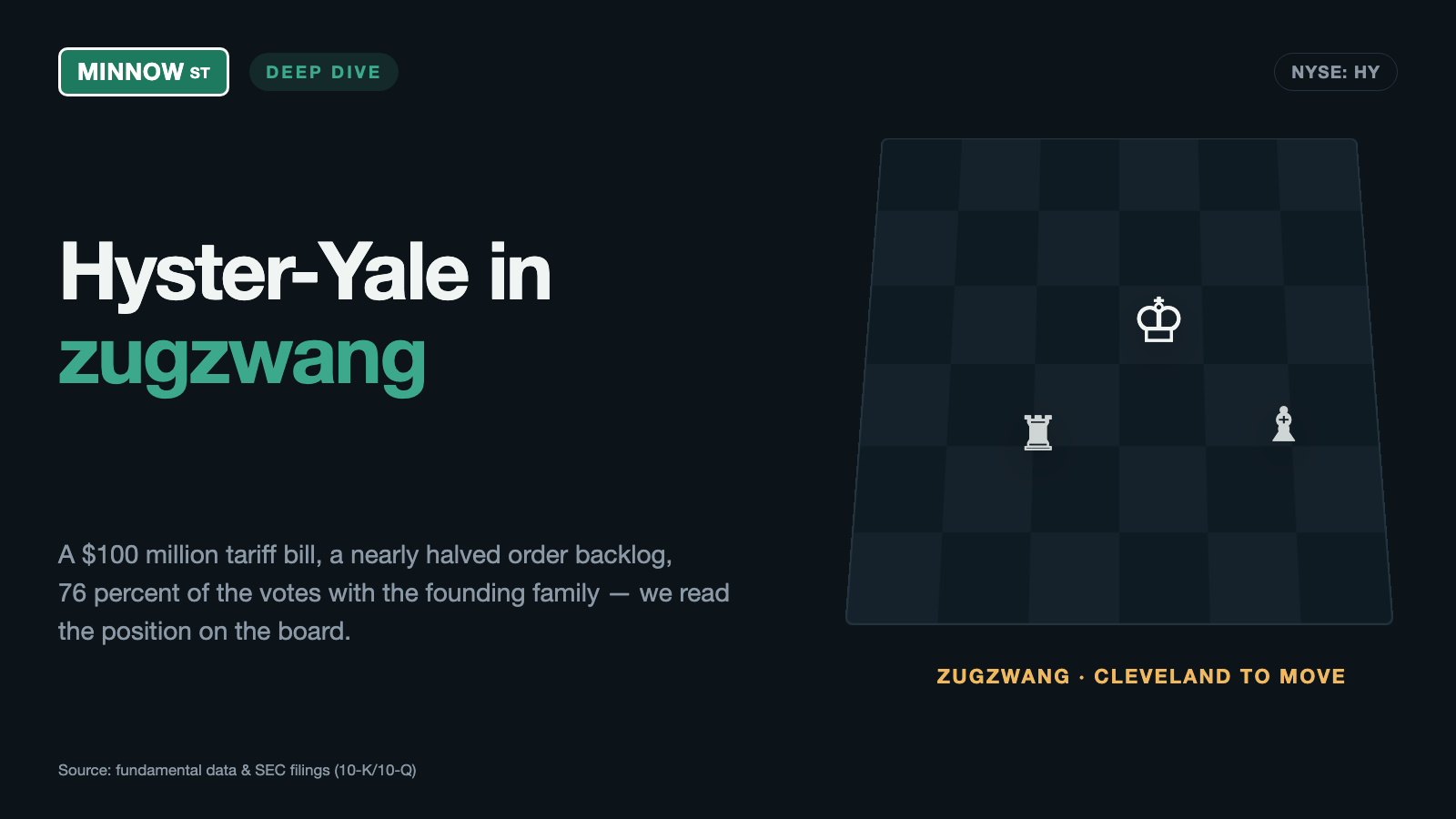
Back to the anchoring trap from the beginning. Its core is not that old profits mean nothing — they prove, after all, that this business can earn $140 million in good years. Its core is that the anchor makes you confuse the label with reality: the $8 of earnings per share from 2024 are not a promise, they are a memory. Between them and today lie a $100 million tariff bill, a backlog that nearly halved and has only been growing again for one quarter, and a balance sheet that — unlike some net-cash small cap — cannot afford to wait forever. So the honest question for you is not "Is Hyster-Yale cheap?" (by almost every metric except earnings: yes), but: do you believe the profits of 2023/2024 can find their way back into a world with tariffs — and do you trust a management you can never outvote as a Class A shareholder to get there? If you answer both with yes, you get a lot of substance, a near-4-percent dividend yield and an unpaid Supreme Court wildcard at a discount. If you hesitate, you have good reasons: the trough is officially not reached yet, and it has already been postponed once. On the chessboard this situation is called zugzwang — standing still worsens the position, and every move has a price. Cleveland has made its moves: restructuring, price increases, the Nuvera cutback. Now the customers have to move. What you make of it is your decision. And that is exactly as it should be.
Sources
All original documents used in this analysis — for your own reading:
- Hyster-Yale, Inc. — SEC annual report 10-K for 2025 (filed March 3, 2026)
- Hyster-Yale, Inc. — SEC annual report 10-K for 2024 (filed February 25, 2025)
- Hyster-Yale, Inc. — SEC quarterly report 10-Q as of 03/31/2026 (filed May 5, 2026)
- Hyster-Yale, Inc. — SEC proxy statement DEF 14A for the 2026 annual meeting (filed March 24, 2026; voting and ownership structure)
- Complete SEC filing history of Hyster-Yale, Inc.: EDGAR overview (sec.gov)
- Fundamental data (metrics, quarterly series, valuation; data as of July 10, 2026), reconciled with the SEC filings.
- Screener and rating data: in-house stock scanner (data as of July 10, 2026); Reddit mentions: ApeWisdom (as of July 17, 2026).
Transparency & disclaimer: This analysis is a journalistic contextualization of publicly available information and is not investment advice, not a financial analysis in the regulatory sense and not a solicitation to buy or sell securities. Stock investments carry substantial risks up to and including total loss. All information without guarantee; the data cut-off is noted in the text. The author holds no position in Hyster-Yale shares at the time of publication.
Our Bottom Line at a Glance
- Market position & substance positive
- One of the market share leaders in lift trucks in the Americas and worldwide (10-K 2025), $3.77 billion in revenue, a global dealer and service network, a dividend raised three times in a row and, despite the loss year, $86.1 million of operating cash flow in 2025 — the substance behind the 0.18 price-to-sales ratio is real.
- Tariffs & results negative
- Roughly $100 million in tariff costs flipped $244.8 million of operating profit into a $22.1 million loss in 2025; net −$60.1 million, another −$30.5 million in the first quarter of 2026 on roughly $30 million of additional tariff costs — and the quarterly report expects tariff expenses to rise again in Q2 2026, with mitigation not fully offsetting them.
- Cycle & backlog neutral
- Backlog fell from $1.93 billion (end of 2024) to $1.28 billion (end of 2025) but turned to $1.41 billion in the first quarter of 2026 on strengthening bookings; management expects Q2 2026 as the trough and a modest full-year operating profit — though three months earlier, that same trough was penciled in for the first quarter.
- Balance sheet & dividend neutral
- $505.3 million of debt against $81.8 million of cash and debt at 53 percent of capitalization (03/31/2026) stand against $192.1 million of unused credit availability and an Altman Z around 4.8; the near-4-percent dividend yield hangs on credit covenants with availability thresholds — sustainable as long as the expected earnings turn arrives.
- Governance & share structure negative
- Ten-vote Class B shares give the extended founding family 76 percent of the votes on roughly 24 percent of the shares (10-K 2025); "controlled company" status and a stockholders' agreement over the Class B shares all but rule out takeover fantasy — part of the valuation discount is structure, not cycle.
Hyster-Yale is the anchoring trap in its purest form: cheap by almost every substance metric (P/S 0.18, price-to-cash-flow around 7, a near-4-percent dividend yield), but the profits that set the anchor come from the record years 2023/2024 — before the roughly $100 million tariff bill, before the nearly halved backlog and before debt rose to 53 percent of capitalization. Against that stand strengthening bookings, a growing backlog again, running cost programs and an unpaid Supreme Court wildcard on tariff refunds. Whoever invests buys a cyclical turn at a discount — with a family at the wheel that can never be outvoted. Not investment advice.
What Our Rating Means
- If you don't own the stock
- As long as the question raised in the bottom line stays open, we see no basis for an entry.
- If you hold it in your portfolio
- Our findings offer no acute reason to sell — the checkpoints named remain decisive.
A journalistic assessment by our editorial team at the time of the deep dive, based on public sources — not investment advice and not a solicitation to buy or sell. Your personal circumstances (investment goals, risk capacity, taxes) cannot be taken into account. What our categories mean, how verdicts are formed, and what conflicts of interest exist →
Worth Noting
- HY reached the research list via the Reddit hype scanner (4 mentions in 24 hours, ApeWisdom, as of July 17, 2026) — in our in-house stock scanner, by contrast, the stock sits in two valuation rankings (P/S, price-to-cash-flow; data as of July 10, 2026): attention is no buy argument here, the bargain metrics are the real story.
- Scanner metrics (P/S, price-to-cash-flow, Piotroski, Altman Z, fundamental grade, interest coverage) are computed on trailing twelve-month figures; the 2025 tariff hole and the first quarter of 2026 are in them, a potential earnings turn in the second half of 2026 naturally is not.
- Price and valuation figures dated July 10, 2026 (about $36.40 per share, about $650 million market value); analyses are evergreen, daily prices are not a buy argument. The company was named "Hyster-Yale Materials Handling, Inc." until May 2024 — older data sources partly still list the stock under that name.
Frequently Asked Questions
Hyster-Yale, Inc. (NYSE: HY) of Cleveland, Ohio, is one of the world's leading forklift manufacturers — selling under the Hyster and Yale brands through a global dealer network, complemented by the Italian attachments maker Bolzoni and a parts and service business. The company was spun off from NACCO Industries in 2012 and employed roughly 7,500 people as of January 31, 2026. Revenue in 2025: $3.77 billion.
Two reasons: first, per the annual report (10-K), roughly $100 million in tariff-related costs hit inventory purchases; second, revenue fell 12.5 percent as customers deferred purchases and ran their old trucks longer — underutilized plants squeezed margins further. Add $38.4 million in restructuring charges. Result: a $22.1 million operating loss and a $60.1 million net loss after $142.3 million of net income in 2024.
In February 2026, the U.S. Supreme Court held that tariffs imposed under the International Emergency Economic Powers Act (IEEPA) are not legally authorized; in April 2026 the U.S. Customs and Border Protection agency issued refund procedures. Per the quarterly report (10-Q) as of March 31, 2026, Hyster-Yale has booked no potential recovery, as amounts and timing are uncertain — any refund would be pure, unplanned tailwind. At the same time, a Section 122 import surcharge replaced the IEEPA tariffs and the steel tariffs were expanded.
Nuvera Fuel Cells was Hyster-Yale's hydrogen fuel-cell subsidiary — with operating losses of $36.4 million (2023) and $41.0 million (2024). In the second quarter of 2025, Nuvera was strategically realigned and folded into the Americas segment: $15.2 million in restructuring and impairment charges (including $9.6 million on fixed assets), attributed to adverse developments in the geopolitical and hydrogen markets. Already in 2025, the realignment saved $15 million in costs per the annual report.
The extended founding family (the Rankin and Taplin families, descendants of the NACCO founder) held roughly 29 percent of the Class A and roughly 96 percent of the Class B shares as of December 31, 2025; since Class B carries ten votes per share, that added up to 76 percent of the voting power. Hyster-Yale classifies itself as a "controlled company" on the NYSE; Alfred M. Rankin Jr. is Executive Chairman, Rajiv Prasad is CEO. A stockholders' agreement additionally binds roughly 3.3 million Class B shares with rights of first refusal inside the family.
The dividend was raised three times in a row ($1.2975 → $1.375 → $1.43 per share; most recently $0.36 per quarter in the first quarter of 2026) and yields just under 4 percent (data as of July 10, 2026). But: the company posted losses in 2025 and in the first quarter of 2026, cash fell to $81.8 million against $505.3 million of debt, and the credit facility permits payouts only while certain availability thresholds are met — the dividend is not a given.
By asset and revenue metrics, yes: price-to-sales ratio 0.18, price-to-book around 1.4, price-to-cash-flow around 7 at a market value of roughly $650 million (data as of July 10, 2026). By earnings, no: 2025 and the first quarter of 2026 ended in net losses, and no price-to-earnings ratio exists for lack of earnings. The stock is only cheap if the profits of the record years 2023/2024 find their way back into the tariff world — that is precisely the bet.
Found an error?
Did you spot a factual error, an outdated number, or a typo in this deep dive? Let us know briefly — your report goes straight to the editorial team.