NRC Health Stock: A New Name, a $12 Million Captain, a Record Order Book — and a Profit That Just Got Cut in Half
For 45 years, NRC Health has asked patients at America's hospitals how it really went — a subscription business with 91 percent recurring revenue. But revenue has shrunk since 2022, and net income fell from $37.5 million (2021) to $11.6 million (2025). Now everything is new: a new name (it was "National Research Corporation" until 2026), a new CEO from Amazon One Medical — and contract value at an all-time high. On Reddit the stock is a whisper with 3 mentions in 24 hours (ApeWisdom, as of July 18, 2026); in our in-house stock scanner it is an eightfold trend hit (data as of July 10, 2026). We read the annual report (10-K), the quarterly report (10-Q), the proxy statement and the latest 8-Ks. Not investment advice — just the question of whether a new name and a record order book already make a turnaround.
 Thomas Mücke
Founder & Publisher
Thomas Mücke
Founder & Publisher
Chart
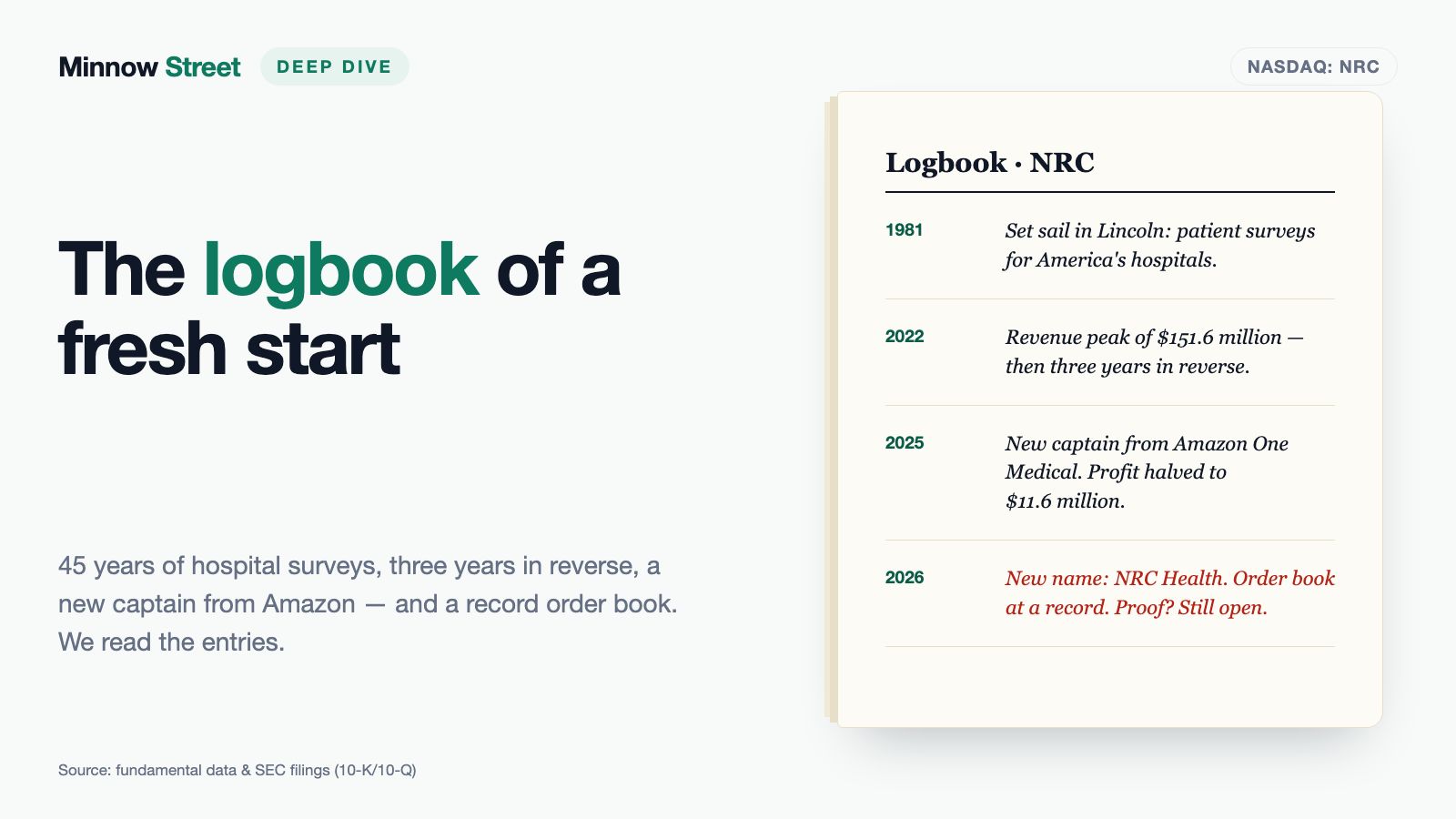
Interactive price chart (TradingView).
Note: pure fact-based analysis, not investment advice and not a solicitation to buy or sell. All figures without guarantee.
There is an investor trap that has its high season every January 1: the fresh-start effect. New year, new me — and in your portfolio the same reflex fires: new name, new boss, new logo, and your head buys the story along with the ticker: "From now on, everything will be different." Hardly any small-cap story feeds that reflex in the summer of 2026 as completely as NRC Health (Nasdaq: NRC) from Lincoln, Nebraska: the hospital-survey specialist just renamed itself from "National Research Corporation," hired a new CEO away from Amazon, raised its dividend — and reports an order book at an all-time high, while the stock climbed roughly 31 percent in two months (data as of July 10, 2026). On Reddit this is not a storm yet, more of a whisper: 3 mentions in 24 hours (ApeWisdom, as of July 18, 2026). Before the fresh-start effect votes on your behalf, let's make a deal: we read together what the company itself reported, under penalty of law, to the U.S. securities regulator, the SEC — the annual report (10-K) for 2025, the quarterly report (10-Q) as of March 31, 2026, the proxy statement for the annual meeting and the latest 8-K filings. And these documents tell both stories: a genuine turn in the order book — and a fresh start whose first invoice came to exactly one year's profit. In the end, you decide for yourself.
What NRC Health actually does — and for whom
NRC Health asks America's hospitals the most uncomfortable question there is: "How was it, really?" Since 1981, the company from Lincoln, Nebraska has systematically collected the experiences of patients, families and consumers — from the legally mandated patient survey (CAHPS, the compulsory questionnaire of the U.S. health agency CMS) to real-time feedback after a doctor's visit to review and reputation management for clinician profiles on the web. The results feed a subscription platform that shows hospital managers where things pinch; add The Governance Institute, a membership business for the boards of not-for-profit health systems, and most recently Huey, an in-house AI engine that takes over the analysis of the feedback data. The business model is what many software companies dream of: $125.6 of $137.4 million in 2025 revenue — 91 percent — was recurring subscription revenue, the customer base is broadly spread (the ten largest customers accounted for 20 percent of 2025 revenue), and payment comes via annual contracts. In everyday terms: NRC Health is the official inspection agency for the hospital experience — small (357 associates, most of them remote), highly specialized, 45 years in the market. Two things belong in the introduction. First: until 2026 the company was named "National Research Corporation" — price apps and databases partly still list the stock under the old name; the rename is documented in the SEC's EDGAR database. Second, the central tension of this analysis, and it runs through every chapter: the order book is already reporting the turnaround — the income statement is still paying for it. Contract value stands at an all-time high, but profit has just been cut in half, and the rebuild that explains both was expensive. How hard business models built around America's hospitals can be, we recently dissected at the physician network Astrana Health — and what it means for shareholders when a founding family bundles the votes, at forklift maker Hyster-Yale. Both will matter again shortly.
Where the stock shows up in our scanner
Every day we run about 3,500 stocks through our scanners. NRC did not reach the research list through the bargain corner but through the trend department — and unanimously so: 8 hits as of the July 10, 2026 data cut-off, all of them trend and momentum scanners. The stock sits in the Stan Weinstein Stage 2 list (the phase in which a price rises again after a long base), trades above its 50- and 200-day moving averages, holds the 21-day trend and appears in the Power Trend — plus tight trading ranges and above-average closing strength. Behind it stands a simple price story: up roughly 31 percent in two months, up roughly 26 percent over twelve months (data as of July 10, 2026). So much for the trend lens. The fundamental lens of the very same scanner is far cooler: a fundamental grade of C, an earnings-trend rating of just 16 of 99 (recent quarterly earnings fell rather than rose), a price-to-earnings ratio around 50 on trailing-twelve-month earnings, a Piotroski F-score of 5 of 9 (a nine-point test of the direction of the books — 5 is average), and an Altman Z-score in the grey zone around 2.3 to 3 (an early-warning gauge of insolvency risk; below 1.8 has historically been dangerous, above 3 counts as solid). And one number deserves its own sentence: despite the recent run, the stock still trades roughly 66 percent below its all-time high, with a three-year return of roughly minus 51 percent (data as of July 10, 2026). Remember the finding: the market is already trading the turnaround here — and it is paying an earnings multiple usually reserved for growth companies.
The numbers over the years — honestly appraised
First, what genuinely impresses. NRC Health is not the accidental product of a hype cycle but a specialty business grown over decades: from $57.7 million in revenue (2009) it climbed almost without interruption to the peak of $151.6 million (2022) — with operating margins above 25 percent in the best years. Even in the shrinking year 2025, the company earned $22.6 million in operating income, generated $26.5 million of operating cash flow, and paid a quarterly dividend that was even raised from 12 to 16 cents per share starting January 2026. That is the substance. Now look at the direction:
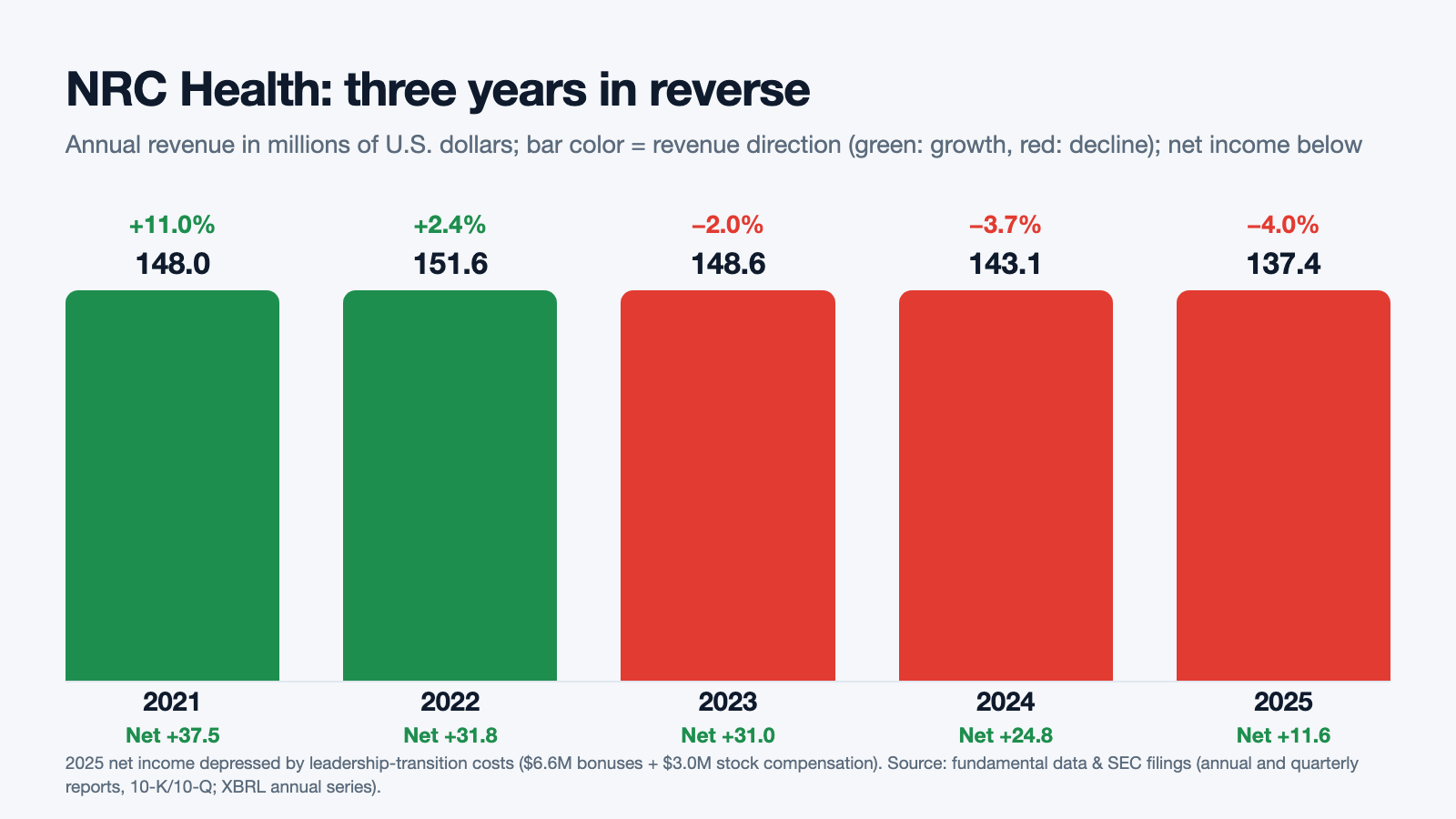
The curve shows a company that drove in reverse for three years: revenue $151.6 → $148.6 → $143.1 → $137.4 million (2022 through 2025), the operating margin from 27 percent (2023) to 16 percent (2025), net income from $37.5 million (2021) to $11.6 million (2025) — per share from $1.25 (2023) to $0.50 (2025). The first quarter of 2026 then brought the first glimmer of hope to the revenue line: $34.8 million, up 3.7 percent — the first growth after six consecutive declining quarters. Net, however, only $3.2 million remained, after $5.8 million in the prior-year quarter, because the rebuild keeps costing money (more on that shortly). Remember the rhythm: in a subscription business, it is not the current quarter that decides but the contract base — what is sold or cancelled today shows up in the revenue line only next year. Which is exactly why one metric deserves a look that hardly anyone has on their list. And that brings us to the uncomfortable — and one remarkably good — truths.
What the filings say — the uncomfortable truths
Uncomfortable truth no. 1: The shrinking was self-inflicted — the company says so itself
Why does a subscription business anchored by legally required surveys lose revenue three years in a row? The annual report answers with a candor rarely found in MD&A chapters:
"Our GAAP revenue and operating margin declined since 2023 primarily due to lower new sales and retention rates prior to 2025, which stemmed from sales force changes and less robust product innovation from 2020 through early 2024 as well as the non-recurring costs mentioned above."
— NRC Health, SEC annual report 10-K for 2025, Item 7 "Management's Discussion and Analysis"
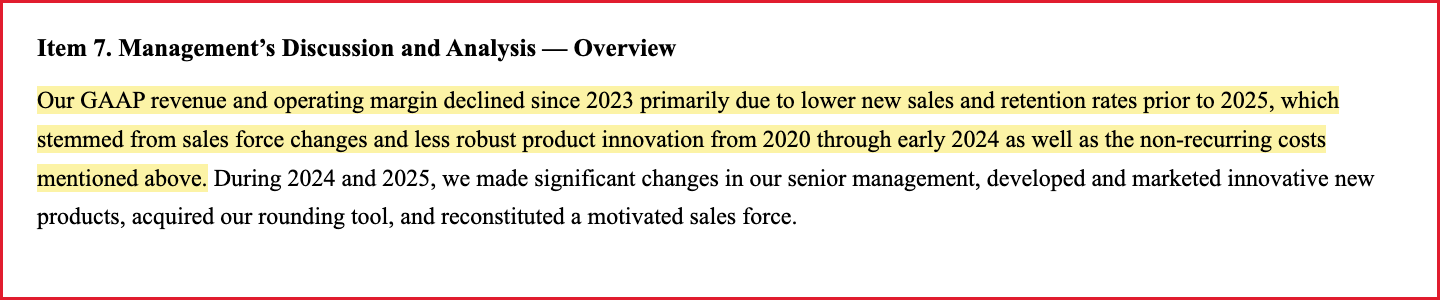
In everyday terms: the gym barely bought new equipment for four years and kept changing the trainers — at some point, the members stop renewing. That is the bad news. The good news sits in the same paragraph: the problem was homemade, not structural — the survey mandate has not disappeared, the customers are not broke, and no disruptor has cleared out the market. In 2024 and 2025, per the report, management was rebuilt, new products developed, a rounding tool acquired and the sales force reconstituted. Whether that works is measured by a single metric — and it is currently telling a different story than the revenue line:
"Since December 31, 2025, the Company's TRCV has increased from $144.1 million to $152.0 million at March 4, 2026, representing an all-time high for this metric."
— NRC Health, SEC annual report 10-K for 2025, Item 7 "Management's Discussion and Analysis"
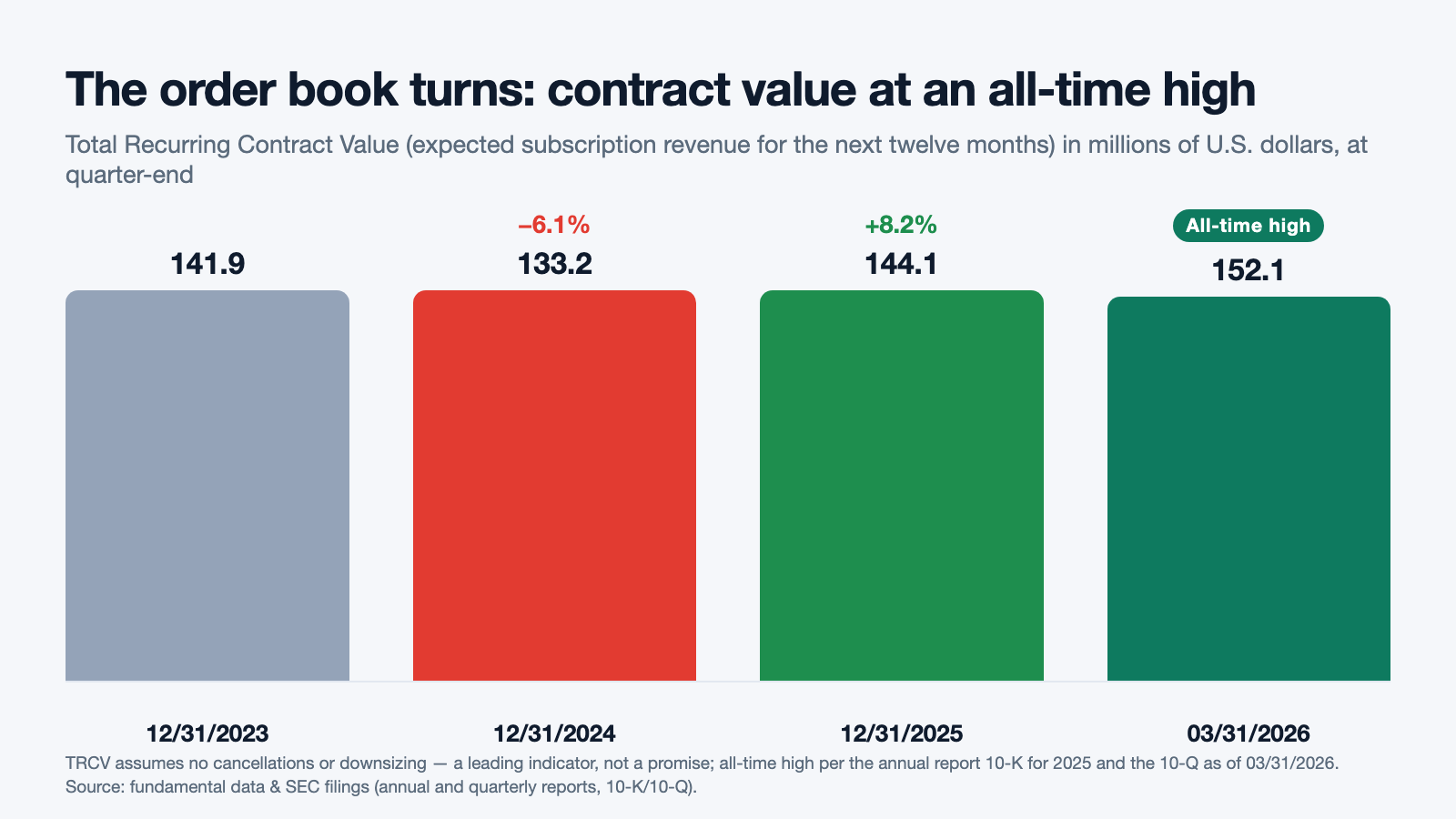
TRCV — "Total Recurring Contract Value" — is the revenue the existing annual contracts are expected to deliver over the next twelve months: the order book of a subscription business. $141.9 million (end of 2023) → $133.2 (end of 2024) → $144.1 (end of 2025) → $152.1 million (March 31, 2026) — first the slide that foreshadowed today's revenue decline, now the all-time high that is supposed to foreshadow the recovery. On this basis, management expects growing revenue, rising margins and more cash flow for 2026. Two honest footnotes belong here: the metric assumes nobody cancels and nobody downsizes — it is a leading indicator, not a promise. And it comes from the same management whose guidance hangs on it.
Uncomfortable truth no. 2: The fresh start cost a full year's profit — the CEO package weighed as much as 2025 net income
Whoever orders the rebuild also gets the invoice. In 2025, selling, general and administrative expenses rose by $9.9 million — per the annual report, primarily due to $6.6 million in bonuses for the leadership transition and $3.0 million in stock compensation from the new agreements. The proxy statement turns that into a number you read twice: CEO Trent Green — in office since June 1, 2025, previously the head of Amazon One Medical — received a total package of $11,961,900 for seven months of 2025 ($697,115 salary, $4,503,333 bonus, $6,755,000 in stock). The entire company's net income that same year was $11.6 million. One compensation package, one annual profit. Fairness requires three qualifications. First: a large part is stock compensation with multi-year vesting — not a check that left the till in 2025; in cash terms, the leadership change cost mainly the $6.6 million in bonuses. Second: whoever recruits an Amazon executive to a $137-million-revenue company in Nebraska pays market rates — and shareholders approved the say-on-pay vote at the 2026 annual meeting by a wide margin (with 2.9 million votes against). Third, the contrast that reveals the house's governance culture: founder Michael D. Hays has drawn an unchanged $127,400 annual salary since 2005, per the proxy:
"The Compensation Committee has not proposed an increase in his salary or overall compensation since 2005, which remains at $127,400."
— NRC Health, SEC proxy statement DEF 14A dated May 8, 2026, "Compensation of Mr. Hays"
The founder works almost for free, the newcomer costs a year's profit — both stand in the same proxy. Whether that was an investment or waste is decided by one question alone: does the turnaround hold? To keep this paragraph concrete: the bet is that a manager who ran Amazon's doctor's-office chain can turn a dusty survey house back into a growing data platform. So far, the order book argues for him. The income statement does not yet.
Uncomfortable truth no. 3: The balance sheet after the buyback decade — $153 million for its own shares, $14 million of equity, $4 million of cash
Now to the balance sheet — and it tells of a decade of very consistent, increasingly debt-financed shareholder care. NRC Health has bought back its own shares for years: 489,024 shares for $20.5 million (2023), 1,205,996 for $33.2 million (2024) and 1,340,224 for $20.7 million (2025); the program of 1.0 million shares authorized in April 2025 was exhausted by the end of September. The balance sheet now stacks $152.6 million of treasury stock — against which $14.0 million of stockholders' equity remains (December 31, 2025). The funding increasingly came on credit: in February 2025 the company signed a new credit agreement with a $110 million delayed-draw term loan plus a $30 million revolver; at year-end, $79.4 million was outstanding at SOFR plus a spread — most recently 6.22 percent — while cash shrank to $4.1 million (and to $2.5 million by March 31, 2026). Interest expense has moved accordingly: from $0.9 million (2023) to $2.6 million (2024) to $4.8 million (2025). And like every credit agreement, this one has fine print:
"Pursuant to the Credit Agreement, we are required to maintain a minimum fixed charge coverage ratio of 1.10x and a cash flow leverage ratio of 3.50x or less for all testing periods throughout the term of the Credit Facilities."
— NRC Health, SEC annual report 10-K for 2025, Item 7 "Liquidity and Capital Resources"
Both thresholds were met as of December 31, 2025, the loan is collateralized by substantially all assets, and amortization is running on schedule. But you should understand the construction: a company with falling profits took on debt to buy its own shares and raise the dividend — at 16 cents per quarter, the payout costs roughly $14 million a year, against $26.5 million of operating cash flow (2025) and ongoing loan amortization. The annual report itself notes dryly: "We may change our dividend policy at any time." Translated: this works as long as the turnaround arrives. It is the same leverage that accelerates turnarounds — in both directions. Per-share growth bought with debt-financed buybacks is never entirely free.
Uncomfortable truth no. 4: Nearly half the shares sit with family trusts — and AI is opportunity and threat at once
Two structural points remain. First, the question of control. Founder Michael D. Hays has moved his shares into family trusts over the years; the annual report does the math:
"As of February 28, 2026, approximately 37.5% of our outstanding common stock was owned by the Trust and approximately 46.8% of our outstanding common stock was held by the Trust and other entities controlled by trustees or special power holders for the benefit of members of Mr. Hays' family."
— NRC Health, SEC annual report 10-K for 2025, Item 1A "Risk Factors"
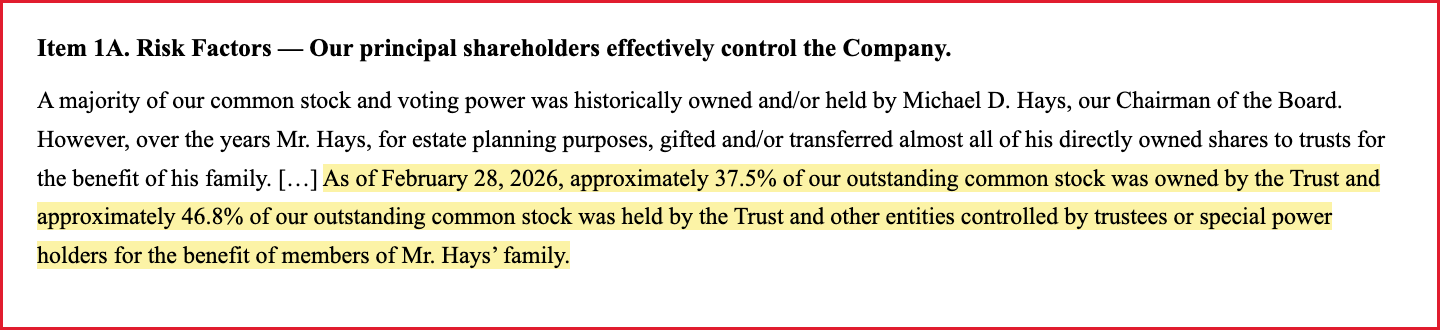
Unlike at Hyster-Yale there are no ten-vote share classes here — but 46.8 percent in allied hands effectively decides every election, and the report itself warns that this structure can prevent a change of control. To be fair: in June 2026, the annual meeting cleaned up the charter and struck the supermajority hurdles — formally a step toward the outside shareholders. Second, the technology question. NRC Health now sells AI itself — the platform advertises a "next-generation suite of Artificial Intelligence (‘AI’)-enabled products," and the in-house AI engine Huey takes over the analysis of the feedback data. At the same time, the risk chapter contains a sentence that a data-services provider's shareholders must take seriously:
"However, if we are unable to successfully anticipate, develop, implement, and utilize such emerging technologies as effectively as competitors or our customers are able to use AI as a replacement to our services, our results of operations may be negatively affected."
— NRC Health, SEC annual report 10-K for 2025, Item 1A "Risk Factors"
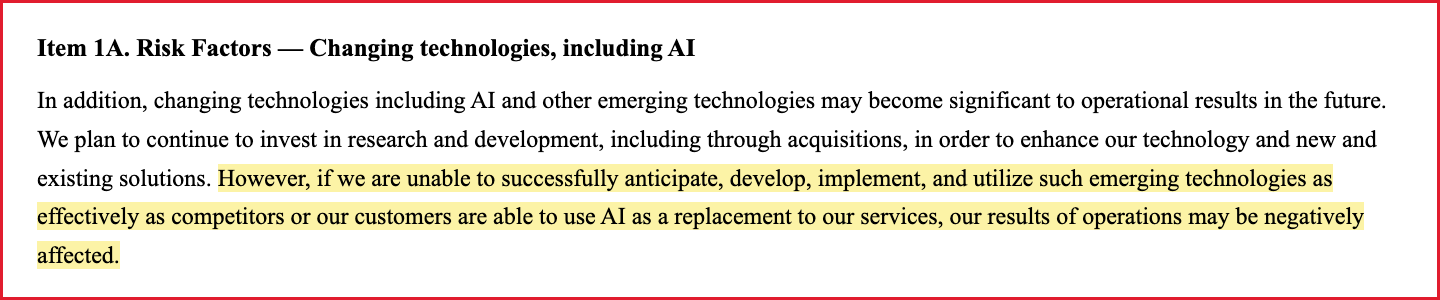
That is the double nature of every data-services provider in the AI age: the same language models that power Huey's analyses could one day let hospital chains run their own feedback data themselves. NRC's moat is 45 years of benchmark data, the required certification for CAHPS surveys, and the fact that hospitals need comparability with other institutions — which no one can get from their own data alone. That moat is not a law of nature.
Valuation: a $461 million market value — 50 times a halved profit
In early July 2026, NRC Health stock cost about $20.50, which at 22.5 million shares makes a market value of roughly $461 million (data as of July 10, 2026). Behind it stands a price-to-sales ratio around 3.3 and — on the halved trailing-twelve-month earnings — a price-to-earnings ratio around 50. For comparison: on adjusted 2025 earnings ($0.93 per share, excluding the one-time costs of the leadership transition) it would be about 22 times; on operating cash flow, about 17 times. The price-to-book ratio around 31, by contrast, is nearly meaningless — it only reflects the equity almost consumed by buybacks, not the value of the business. The dividend of 16 cents per quarter equals a yield of roughly 3.1 percent (data as of July 10, 2026). Translated: the market is not paying for the present here, but for the return of the old earnings power. If the company got back to the margins and profits of 2023 (roughly $31 million net), the P/E would stand around 15 — for a subscription business with 91 percent recurring revenue, not a demanding equation. If, however, profit stays at the 2025 level, the stock is priced at 50 times earnings like a growth stock that does not grow. Exactly between those two sentences runs the bet — and its most important leading indicator is the order book from truth no. 1:

Opportunities and risks at a glance
What speaks for NRC Health:
- A subscription business with substance: 91 percent subscription revenue, a broad customer base (top-10 customers only 20 percent of 2025 revenue), 45 years of market experience and benchmark data, mandated surveys (CAHPS) as the foundation — plus, even in the shrinking year 2025, a 16 percent operating margin and $26.5 million of operating cash flow.
- The leading indicator is turning: contract value (TRCV) at an all-time high of $152.1 million (March 31, 2026) after $133.2 million at the end of 2024; first revenue growth in six quarters in Q1 2026 (+3.7 percent); management expects growing revenue, margin and cash flow for 2026 (10-K 2025).
- Leadership with pull: CEO Trent Green (ex Amazon One Medical, ex COO of Legacy Health) since June 2025, a new executive team, new products, an acquired rounding tool, the AI engine Huey — the rebuild is ordered and paid for.
- A shareholder culture with history: quarterly dividend raised from 12 to 16 cents starting January 2026 (yield roughly 3.1 percent, data as of July 10, 2026), ongoing buybacks, the founder's salary frozen since 2005; in June 2026 the supermajority hurdles were struck from the charter.
- Eight trend hits in our in-house stock scanner (Stage 2, Power Trend, 50/200-day moving averages, among others; data as of July 10, 2026) — the market is beginning to trade the turnaround.
What speaks against it:
- The income statement lags the story: revenue down three years in a row ($151.6 → $137.4 million), net income cut to a third from $37.5 million (2021) to $11.6 million (2025), operating margin from 27 to 16 percent; Q1 2026 net income also weaker than a year earlier ($3.2 after $5.8 million).
- An expensive bet on one manager: an $11.96 million CEO package in 2025 — as much as the annual profit; $6.6 million in bonuses plus $3.0 million in stock compensation squeezed the margin, and further stock tranches burden the coming years (non-cash, but dilutive).
- A balance sheet without a cushion: $79.4 million term loan (6.22 percent interest) against $4.1 million cash (12/31/2025; $2.5 million as of 03/31/2026), only $14.0 million equity after $152.6 million of treasury stock; the covenants (fixed charge coverage 1.10x, leverage max 3.50x) and the "at any time" changeable dividend policy sit in the same chapter.
- The valuation already prices the turnaround: P/E around 50 on trailing earnings, P/S 3.3 on shrinking revenue, an earnings-trend rating of 16 of 99; despite a 31 percent two-month run the stock still sits 66 percent below its all-time high (data as of July 10, 2026) — this market has believed much more before.
- Structural risks: 46.8 percent of the shares with Hays family trusts (no takeover scenario, limited influence for outside shareholders); AI is product and threat at once — the report itself warns that customers may use AI "as a replacement to our services."
A human conclusion
Back to the fresh-start effect from the opening. Its core is not that fresh starts are worthless — sometimes the new trainer really is better. Its core is that your head books the label as a result: new name, new boss, record order book — the turnaround story is complete before a single quarterly statement has confirmed it. NRC Health's SEC filings tell it more precisely: a fundamentally sound subscription business that demonstrably caused its own crisis and is now repairing it with a lot of money and a prominent captain; a leading indicator at an all-time high that the revenue and profit lines can follow in 2026 at the earliest; and a balance sheet that borrowed for buybacks and dividends along the way and leaves the turnaround little room for delays. So the honest question for you is not "Is the turnaround real?" — the order book argues it is — but: do you want to pay 50 times a halved profit for the chance that a turnaround the market is already trading actually arrives in the income statement? If you believe it, you get a rare package: 91 percent recurring revenue, a record order book and a 3.1 percent dividend yield as waiting pay. If you hesitate, you have good reasons: the proof is outstanding, the till is thin, and the last logbook chapter of this 45-year-old ship has not been written. What you make of it is your decision. And that is exactly as it should be.
Sources
All original documents used in this analysis — for your own reading:
- NRC Health (until 2026: National Research Corporation) — SEC annual report 10-K for 2025 (filed March 5, 2026)
- NRC Health — SEC quarterly report 10-Q as of March 31, 2026 (filed May 6, 2026)
- NRC Health — SEC proxy statement DEF 14A for the 2026 annual meeting (filed May 8, 2026; compensation and ownership structure)
- NRC Health — SEC 8-K dated June 29, 2026 (annual meeting, charter amendments, new company name)
- Rename: EDGAR overview CIK 0000070487 (sec.gov) — registrant "NRC Health," former name "National Research Corp" through March 27, 2026
- Annual series for revenue/net income 2021-2025: SEC XBRL company data (data.sec.gov, CIK 0000070487), reconciled with the filings.
- Fundamental data (metrics, quarterly series, valuation; data as of July 10, 2026), reconciled with the SEC filings.
- Screener and rating data: in-house stock scanner (data as of July 10, 2026); Reddit mentions: ApeWisdom (as of July 18, 2026).
Transparency & disclaimer: This analysis is a journalistic contextualization of publicly available information and is not investment advice, not a financial analysis in the regulatory sense, and not a solicitation to buy or sell securities. Stock investments carry substantial risks up to total loss. All information without guarantee; the data cut-off is noted in the text. The author holds no position in NRC Health stock at the time of publication.
Our Bottom Line at a Glance
- Business model & market position positive
- 91 percent recurring subscription revenue, a broad customer base (top-10 customers only 20 percent of 2025 revenue), 45 years of benchmark data and CAHPS certification as the foundation — even in the third shrinking year, a 16 percent operating margin and $26.5 million of operating cash flow remained (10-K 2025).
- Growth & profit negative
- Revenue down three straight years since the 2022 peak ($151.6 → $137.4 million), net income cut to a third from $37.5 million (2021) to $11.6 million (2025), margin from 27 to 16 percent — self-inflicted per the 10-K through sales force changes and weak product innovation from 2020 through early 2024; Q1 2026 net income also below the prior year.
- Turnaround indicators neutral
- Contract value (TRCV) stands at an all-time high of $152.1 million (March 31, 2026), Q1 2026 delivered the first revenue growth in six quarters (+3.7 percent), and management expects growth in revenue, margin and cash flow for 2026 — the leading indicator is strong; the proof in the income statement is outstanding.
- Balance sheet & capital returns negative
- $79.4 million term loan (6.22 percent) against $4.1 million cash and $14.0 million equity after $152.6 million of treasury stock (12/31/2025): buybacks and the dividend raised to 16 cents were increasingly paid with debt; covenants met, but the dividend policy is changeable "at any time" per the 10-K.
- Governance & owners neutral
- 46.8 percent of the shares with Hays family trusts (02/28/2026), bundled with one trustee — no takeover scenario, limited influence for outside shareholders; on the other side: the founder's salary frozen since 2005, supermajority hurdles struck in June 2026, say-on-pay approved by a wide margin. The $11.96 million CEO package for 2025 remains the fresh start's most expensive line item.
NRC Health is the fresh-start effect in its purest form: a new name, a new CEO from Amazon One Medical, a raised dividend and an order book at an all-time high (TRCV $152.1 million as of March 31, 2026) — set against three years of shrinking revenue, a profit cut to a third at $11.6 million, a CEO package the size of exactly that annual profit, and a balance sheet with $79.4 million of debt against $4.1 million of cash. Whoever invests pays roughly 50 times trailing earnings for a turnaround the leading indicator reports but the income statement has yet to deliver. Not investment advice.
What Our Rating Means
- If you don't own the stock
- As long as the question raised in the bottom line stays open, we see no basis for an entry.
- If you hold it in your portfolio
- Our findings offer no acute reason to sell — the checkpoints named remain decisive.
A journalistic assessment by our editorial team at the time of the deep dive, based on public sources — not investment advice and not a solicitation to buy or sell. Your personal circumstances (investment goals, risk capacity, taxes) cannot be taken into account. What our categories mean, how verdicts are formed, and what conflicts of interest exist →
Worth Noting
- NRC reached the research list via the Reddit hype scanner (3 mentions in 24 hours, ApeWisdom, as of July 18, 2026) — in our in-house stock scanner, the stock instead shows 8 hits, all in trend and momentum scanners (data as of July 10, 2026): the market is trading the turnaround, not the fundamentals.
- Scanner metrics (P/E, P/S, Piotroski, Altman Z, fundamental grade, earnings-trend rating) are computed on trailing-twelve-month figures; the 2025 rebuild costs are in them, a potential earnings turn from 2026 onward naturally is not.
- Price and valuation figures dated July 10, 2026 (about $20.50, about $461 million market value); analyses are evergreen, daily prices are not a buy argument. The company was named "National Research Corporation" until 2026 — older data sources partly still list the stock under that name.
Frequently Asked Questions
NRC Health (Nasdaq: NRC) of Lincoln, Nebraska has measured patient and consumer experiences for U.S. health systems since 1981: mandated patient surveys (CAHPS), real-time feedback, review and reputation management, plus a membership business for hospital boards (The Governance Institute). 91 percent of 2025 revenue ($125.6 of $137.4 million) was recurring subscription revenue; the company employed 357 associates as of December 31, 2025.
The company traded as "National Research Corporation" since its 1997 listing and long used "NRC Health" as its brand. In 2026 the brand became the legal name: SEC EDGAR lists "NATIONAL RESEARCH CORP" as a former name through March 27, 2026, and the amended charter approved in June 2026 carries the name "NRC Health." For shareholders only the name changed — the ticker (NRC), the Nasdaq listing and the share count were unaffected.
Per the annual report (10-K) for 2025, the company itself was the cause: lower new sales and weaker contract renewals following sales force changes and "less robust product innovation from 2020 through early 2024." Revenue fell from $151.6 million (2022) to $137.4 million (2025), the operating margin from 27 to 16 percent. In 2024/2025, management, products and the sales force were rebuilt; in the first quarter of 2026, revenue grew again for the first time (+3.7 percent).
TRCV ("Total Recurring Contract Value") is the revenue the existing renewable contracts are expected to deliver over the next twelve months — the order book of the subscription business and, per management, the leading indicator for revenue. It fell from $141.9 million (end of 2023) to $133.2 million (end of 2024), then turned to $144.1 million (end of 2025) and $152.1 million as of March 31, 2026 — an all-time high per the annual report. The metric does assume that nobody cancels or downsizes.
Founder Michael D. Hays has transferred almost all shares to family trusts: as of February 28, 2026, the Common Property Trust owned roughly 37.5 percent, and together with further family entities roughly 46.8 percent of the shares (10-K 2025). Per the proxy statement, voting and dispositive power over these blocks is bundled with trustee Patrick E. Beans (46.9 percent beneficial ownership). Hays is Chairman; day-to-day management has been led by CEO Trent Green since June 2025; in June 2026 the supermajority hurdles were struck from the charter.
The quarterly dividend was raised from 12 to 16 cents per share starting January 2026 — a yield of roughly 3.1 percent (data as of July 10, 2026), costing about $14 million a year against $26.5 million of operating cash flow (2025). But: cash stood at just $4.1 million at the end of 2025, the term loan at $79.4 million with covenants, and the annual report states explicitly that the dividend policy may change "at any time" — the payout is not a given.
Not on trailing earnings: the price-to-earnings ratio stood around 50, the price-to-sales ratio around 3.3 at a market value of roughly $461 million (data as of July 10, 2026). On 2025 earnings adjusted for one-time costs ($0.93 per share) it would be about 22 times. The stock is only cheap if the profits from before the slump return — at the 2023 level ($31.0 million net), the P/E would be around 15. That is exactly the bet.
Found an error?
Did you spot a factual error, an outdated number, or a typo in this deep dive? Let us know briefly — your report goes straight to the editorial team.