NPK International Stock: The Mats Beneath the Grid Build-Out — a Strong Chart With a Proud Price
Out of oilfield-services provider Newpark Resources came NPK International: a lessor of recyclable composite mats that build temporary roads where excavators and transmission towers need to go. The continuing core grows briskly — 2025 revenue up 27 percent, operating margin almost 17 percent — and the stock fires in 14 of our scanners, from "Best of All" to "Power Trend". We read the annual and quarterly reports including the fine print: three customers carry 44 percent of revenue, roughly 60 percent of rental revenues hang on the grid build-out, indemnifications remain from the sold oilfield business — and after the rally the stock costs 34 times its earnings. Not investment advice — just the reminder that a strong business and a strong stock are not the same thing: the difference is the price.
 Thomas Mücke
Founder & Publisher
Thomas Mücke
Founder & Publisher
Chart
Interactive price chart (TradingView).
Note: pure fact-based analysis, not investment advice and not a solicitation to buy or sell. All figures without guarantee.
There is a thinking error that grabs us investors precisely with the big, obvious themes of the future: we consider a megatrend so inevitable that we stop examining the company behind it critically. "The grid build-out has to happen — data centers, electric cars, aging lines, this cannot go wrong." Call it megatrend blindness: the big trend is real, but it blinds you to the price, the dependencies and the risks of the individual stock. This is exactly the trap NPK International (NYSE: NPKI) lures you into — a company that quite literally lays the roads for the grid build-out, whose chart sits glued to the 52-week high and which lights up green in 14 of our scanners. So let's make a deal: before you chase the megatrend, we read together what sits in the filings with the U.S. securities regulator, the SEC. An SEC filing is honest under penalty of law. In the end, you decide.
So you know where this is heading, here is the central tension of this analysis right away: at NPK the quality is real — the transformation from oilfield-services provider to infrastructure lessor has worked, and the numbers point sharply upward. The question is not whether the business is good, but whether the price has already front-run the optimism — and how much of the pretty story hangs on very few customers and a single end market. Remember this sentence: a megatrend at your back does not automatically make a stock cheap.
What NPK International actually does
Picture a construction site in the middle of a wet meadow: an excavator is supposed to set a new transmission tower, but heavy vehicles would sink into the mud. The solution is composite mats — large, rugged, reusable panels that get laid out like puzzle pieces to build a temporary road for excavators and transmission towers. That is exactly NPK's business: the company rents and sells these recyclable access mats and delivers the full service around them — planning, logistics, installation, restoration of the site. In 2025, 66 percent of revenue came from rental plus services, 34 percent from sales of self-manufactured mats. Think of it as a car-rental company, except the "vehicles" are ground panels that go out, come back and get rented out again.
The fascinating part is the past: until recently, NPK was called Newpark Resources and was a services provider to the oil industry — more precisely, a supplier of drilling fluids. In September 2024 the company sold that oilfield fluids business to private-equity firm SCF Partners, and on December 9, 2024 it renamed itself NPK International. What remained is the clean, recurring mat-rental core. A cyclical oilfield supplier thus became an infrastructure lessor — a bit like looking at a construction group such as Everus Construction and focusing on the plannable service business instead of the swinging project world. And the demand increasingly comes from the power grid: from where utilities build new lines and reinforce old ones — the same investment wave that also carries grid contractors like MYR Group. Only NPK sells neither towers nor transmission lines, but the ground the excavators drive on to get there.
A fresh building block arrived in November 2025: NPK acquired the British company Grassform (ground protection and temporary roadways) for £34.9 million (roughly $46.0 million), anchoring a second leg in the United Kingdom. Remember that — it returns among the uncomfortable truths as goodwill.
Where the stock shows up in our scanner
Every day we run thousands of stocks through our in-house stock scanner. NPK International is an emphatic strength find: 14 filters fire at once (data as of July 10, 2026). It is a mix of trend, momentum and — remarkable for such a hot chart — one substance filter:
- "Best of All" — the collector filter for stocks that lead in an unusually large number of quality and trend criteria.
- "Power Trend" and "Stan Weinstein: Stage 2" — technically, the stock is in its uptrend phase, above its rising moving averages.
- "Pocket Pivot" and "Oops Reversal" — short-term entry signals from the momentum traders' handbook.
- "Gary Antonacci: Dual Momentum" and "Mark Minervini: Trend Criteria" — the stock is relatively stronger than the overall market.
- And — atypical for a chart at the high — the substance filter "Free cash flow to market cap": it measures how much free cash flow the company throws off relative to its market value. That NPK shows up here is a quality signal.
Translated, this means: the stock rose roughly 73 percent in twelve months and trades just below its 52-week high. How to get there yourself: on minnowstreet.com, open the "Best of All" filter in the "Scanner" menu and look for the NPKI row. But — and now comes the honest part that megatrend blindness likes to skip — scanner hits describe what was: a strong trend that has held until today. Whether it keeps holding is decided not by the chart but by the business. So let's look at the business.
The numbers over the years
Let's start with what genuinely impresses. Because NPK shed the large, swinging oilfield business, the numbers must be read cleanly: everything that follows refers to continuing operations — the mats division — not to the old billion-dollar revenues of the Newpark era, which drop out of the accounts as a "discontinued operation". And this core delivers: revenue climbed from $193.0 million (2022) via $207.6 million and $217.5 million to $277.0 million in 2025 — a gain of 27 percent in the last year alone, carried by a 39 percent jump in rental revenues. Even prettier is the margin: the operating margin rose from a meager 3.4 percent (2022) to 16.9 percent (2025), operating income to $46.8 million.
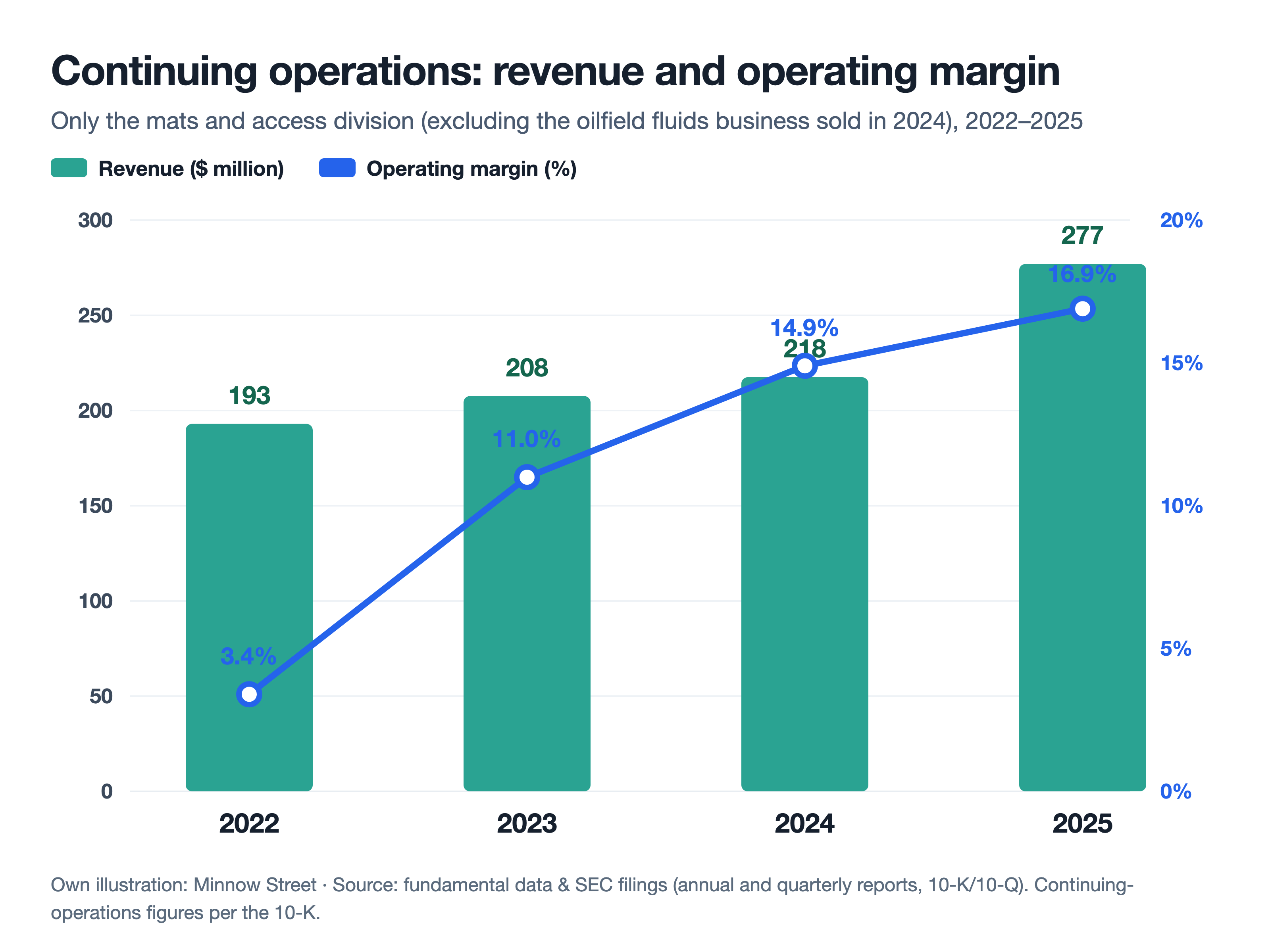
An honest interjection so no headline fools you: the 2024 bottom line showed a loss of $150.3 million — but that was almost entirely the book loss on the sale of the oilfield business (roughly $196 million pre-tax), a one-off effect from the discontinued operation. And one more subtlety: net income from continuing operations was almost flat in 2024 and 2025 at roughly $35.6 million and $35.9 million — not because the business did not grow, but because a tax benefit helped in 2024 while 2025 carried a normal tax charge of $11.7 million. Pre-tax, continuing income rose 65 percent. The first quarter of 2026 confirmed the momentum: revenue +16 percent to $75.1 million, net income $10.5 million. This is not a cycle illusion; it is operating substance. And that is exactly why we must look all the more closely at the flip side.
The uncomfortable truths
With a loss-making company the uncomfortable truths are obvious. With a winner they are quieter — but no less important. They are the shadow sides of a stock that has run well: the dependence on a few customers, the bet on a single end market, and the ghosts of the sold oilfield business.
Uncomfortable truth no. 1: Three customers carry 44 percent of revenue
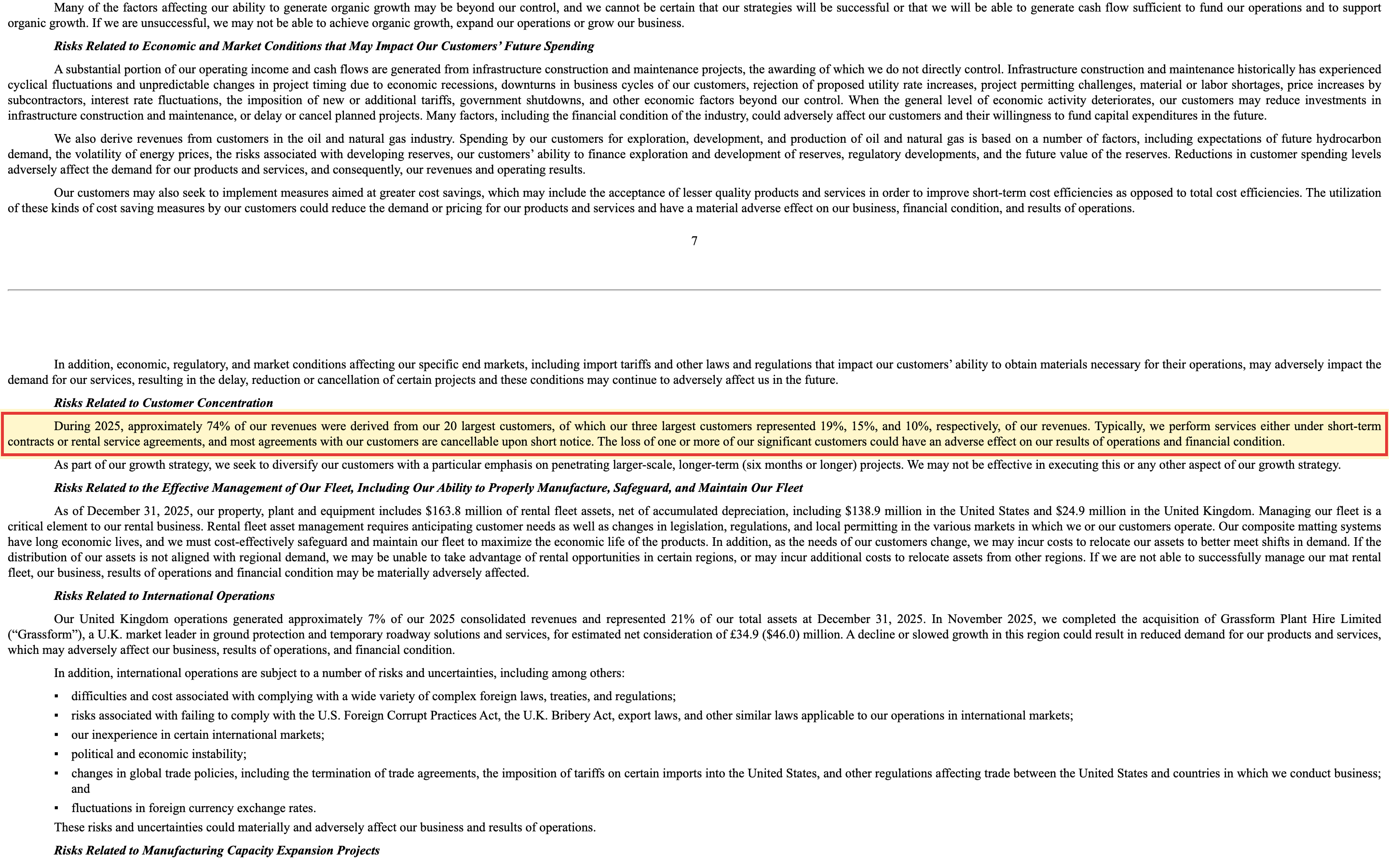
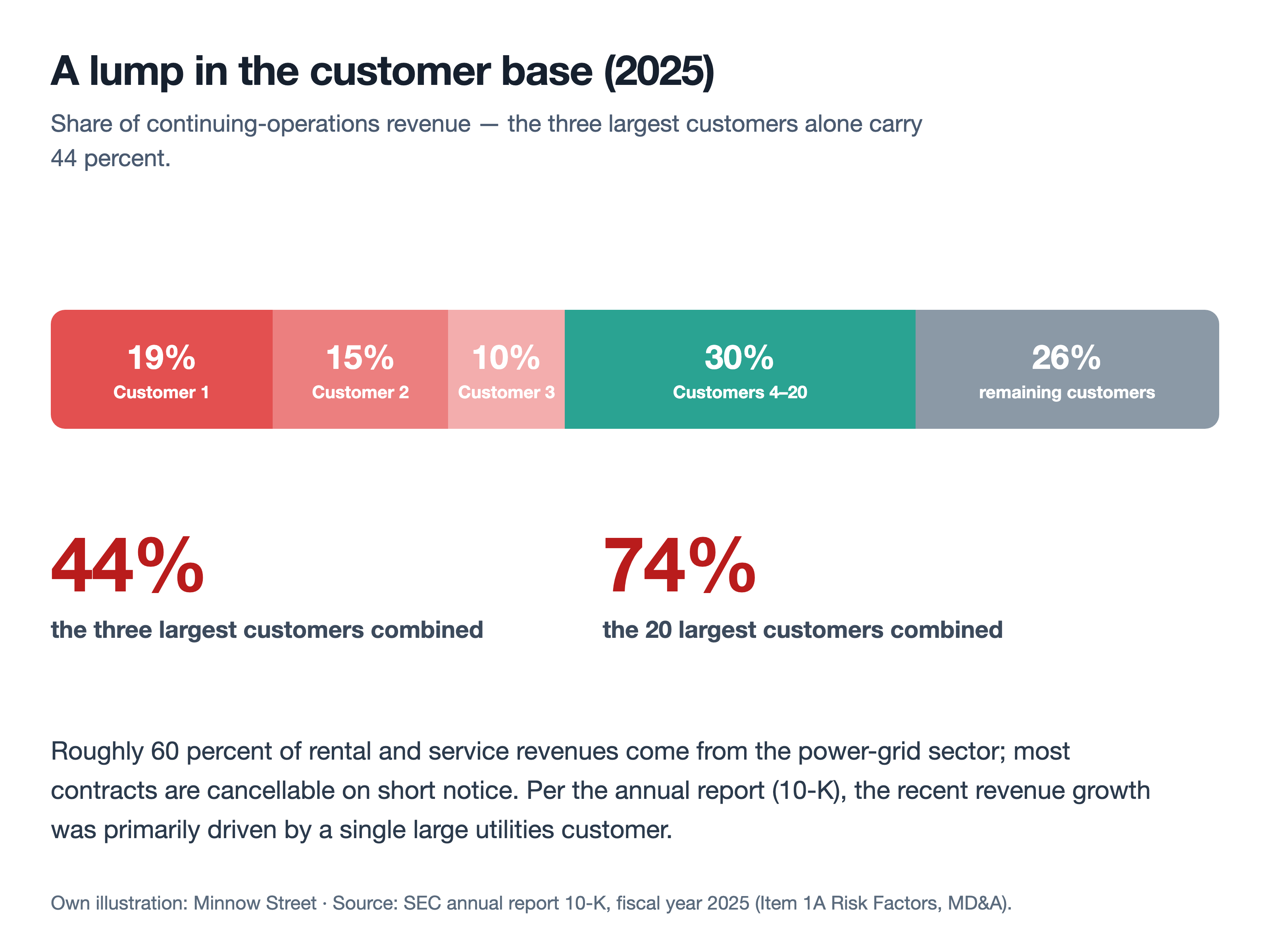
If your neighbor told you his business was doing great — but a single client provided a fifth of his revenue, and the contract could be canceled on short notice — you would briefly swallow. That is precisely NPK's situation. Customer concentration means: a large part of the business hangs on a few names; if one jumps ship, it tears a hole. NPK names it in the annual report with refreshing clarity:
"During 2025, approximately 74% of our revenues were derived from our 20 largest customers, of which our three largest customers represented 19%, 15%, and 10%, respectively, of our revenues. … most agreements with our customers are cancellable upon short notice. The loss of one or more of our significant customers could have an adverse effect on our results of operations and financial condition."
— NPK International Inc., SEC annual report 10-K for fiscal year 2025, Item 1A "Risk Factors" (customer concentration)
And there is one more ingredient you need to know: the 2025 growth spurt, per the annual report, was attributable above all to a single large utilities customer ("our success on larger-scale, longer-term projects with a key utilities customer"). That is the good and the risky news in one — the pretty growth rate hangs on a handful of relationships. The following chart makes the concentration visible:
Uncomfortable truth no. 2: Almost everything hangs on the power grid
Here the megatrend blindness from the opening returns — as opportunity and as risk. The grid build-out is NPK's strongest tailwind, but it is also an end-market lump: a single sector decides the company's fortunes. NPK writes it itself:
"Approximately 60% of our 2025 rental and service revenues were derived from customers in the power transmission sector and we expect customer activity in this sector will grow over the next several years, driven in part by the impacts of increasing energy demand and required investments in grid reliance initiatives, due to the aging grid infrastructure."
— NPK International Inc., SEC annual report 10-K for fiscal year 2025, Item 1 "Business" (Industry Fundamentals and Customers)
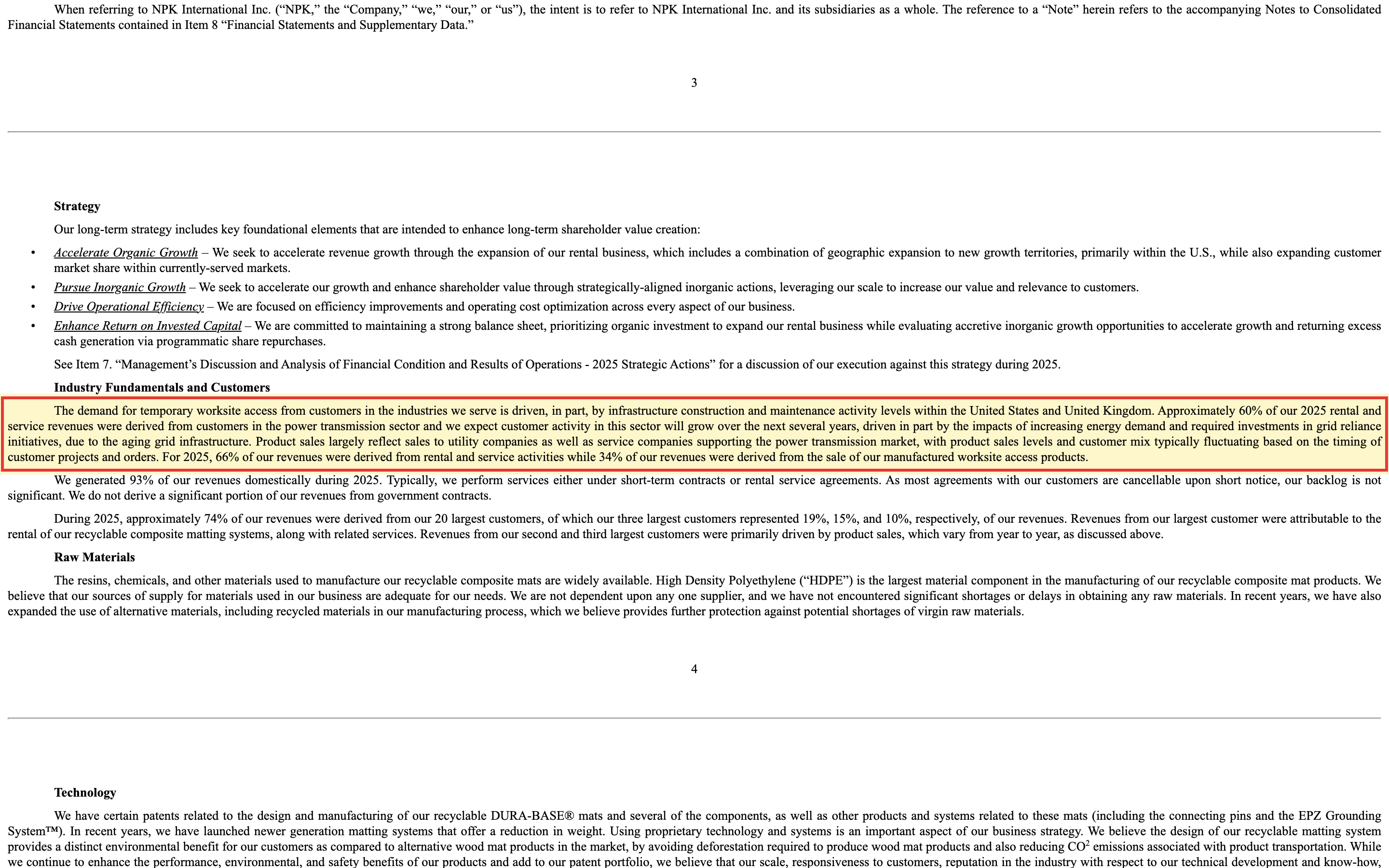
Read that correctly: the trend is credible — aging grids, rising power demand, data centers included. But an end market that carries 60 percent is a bet on the capital budgets of a few large utilities. If projects get postponed, permits delayed or grid fees capped — all things NPK itself lists as risks — it hits the heart of the business directly. The megatrend does not answer that question for you; it only makes it easier to overlook.
Uncomfortable truth no. 3: The ghosts of the oilfield business have not entirely left
A sold business is rarely gone without a trace right away. In selling the fluids division to SCF Partners, NPK promised the buyer certain indemnifications — simplified: commitments to stand in for legacy burdens and open risks from the time before the sale (taxes, environmental and other legacy obligations). Such commitments are normal, but they are a residual debt that still sits on the balance sheet:
"Estimated liabilities due to the Purchaser includes certain payables for pre-closing tax liabilities and obligations attributable to the Fluids Systems business, as well as an estimated liability for contractual indemnifications related to various pre-closing contingencies of the Fluids Systems business."
— NPK International Inc., SEC annual report 10-K for fiscal year 2025, Note 2 (Sale of Fluids Systems Business)
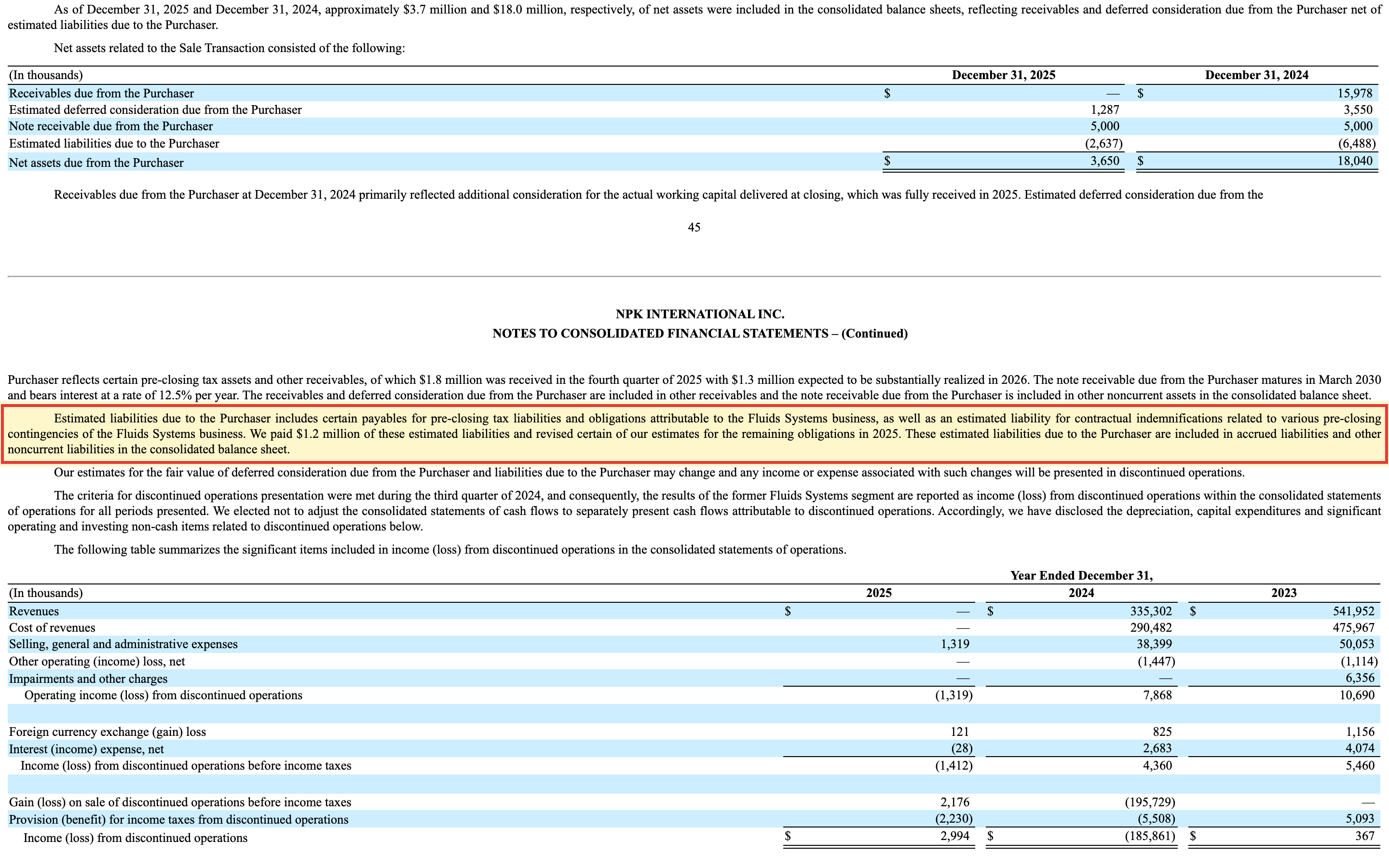
The good news about it: the amounts are manageable — at the end of 2025 roughly $3.7 million of net receivables and provisions vis-à-vis the buyer sat on the balance sheet, and $1.2 million of these obligations were paid during 2025. NPK even still holds an interest-bearing note ($5.0 million, 12.5 percent, due March 2030) from the buyer. This is no drama. But it is a reminder line: an oilfield legacy does not vanish by changing the name — tax and environmental liabilities can linger, and the final amount remains an estimate.
Valuation — what the optimism costs
Now to the core question that megatrend blindness so likes to skip: not "is NPK good?" (it is), but "is the price fair after the stock has risen roughly 73 percent?". At mid-2026 NPK brings roughly $1.2 billion to the market scale. On the earnings of the last twelve months that makes a price-to-earnings ratio of roughly 34; on this year's expected earnings, roughly 26. Enterprise value equals roughly 16 times operating earnings before depreciation (EV/EBITDA), price-to-sales sits around 4.2, price-to-book around 3.3. For a lessor with — admittedly strong — mid-range growth dynamics, that is no bargain; you are already paying for a good part of the grid build-out story.
How to put that in perspective? Part of the premium is justified by the operating margin of almost 17 percent, the EBITDA margin around 26 percent and the rock-solid balance sheet. And unlike at some overheated winners, the analysts here still see a little room: the average price target of the four covering analysts sits around $20 — slightly above the recent price level. Two things temper that, however. First, coverage by only four analysts is thin. Second — and this is the honest punchline of the valuation — the stock trades just below its 52-week high, yet still roughly 39 percent below the all-time high from the old Newpark oilfield era. Whoever reads the all-time high as a "return target" falls for a fallacy: that was a different, larger, more cyclical company. Today's NPK is smaller, cleaner — and already properly priced.
Opportunities and risks at a glance
What speaks for NPK International:
- A genuine, profitable rebuild: continuing-operations revenue +27 percent to $277.0 million, operating margin from 3.4 (2022) to 16.9 percent (2025), EBITDA margin around 26 percent; Q1 2026 confirmed it with +16 percent.
- A recurring rental model with tailwind: 66 percent rental/service share, demand driven by the grid build-out (aging grids, rising power demand), plus a fresh UK leg through the Grassform acquisition.
- A strong balance sheet and capital discipline: net debt of only $31.5 million, an equity ratio around 80 percent, positive free cash flow, share buybacks of $22.7 million in 2025 (the substance filter "Free cash flow to market cap" fires).
- A clean screening: no ongoing takeover, no activist, no rights plan; institutions hold roughly 94 percent — a name broadly held by professionals.
What speaks against it:
- Concentration risk in the customer base: three customers = 44 percent, 20 customers = 74 percent of revenue, contracts cancellable on short notice; the recent growth hangs on a single large utility.
- An end-market bet: roughly 60 percent of rental/service revenues from the power-grid sector — postponed projects or capped grid budgets would hit NPK directly.
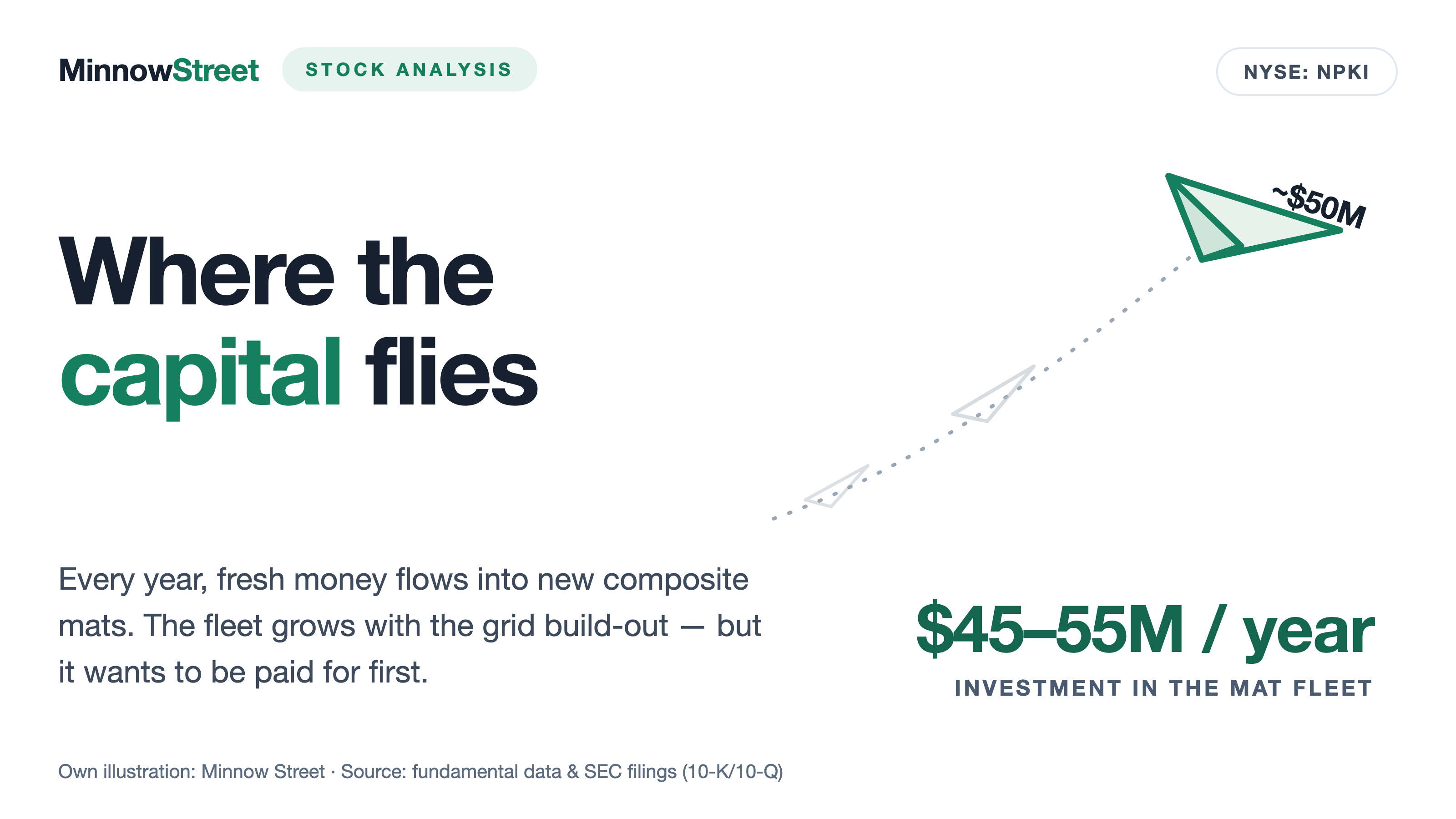
- Capital intensity and acquisitions: the mat fleet ($163.8 million book value) demands 2026 investments of $45 to $55 million; the Grassform purchase lifted goodwill to $76.3 million (impairment risk). Remaining oilfield indemnifications toward the buyer stay an estimate.
- An ambitious post-rally valuation: P/E roughly 34 (forward roughly 26), EV/EBITDA roughly 16, price-to-sales roughly 4.2; little buffer for disappointments. Beta roughly 1.2 — swing-prone.
A human conclusion
Remember the megatrend blindness from the opening — the reflex of considering a big theme of the future so inevitable that you stop examining the individual company? After the look into the filings you now know why it is especially treacherous here: not because NPK is weak, but precisely because the story sounds so good. The rebuild from oilfield-services provider to grid build-out lessor is real, the margin strong, the balance sheet healthy. All of that is true — and that is exactly why it is easy to overlook the price and the dependencies.
Because the other half of the truth is just as real: almost half of revenue hangs on three customers, 60 percent on a single end market, indemnifications remain from the sold oilfield business — and after the rally the stock costs 34 times its earnings. An excellent business and an excellent stock are simply not the same thing: the first hangs on the grid build-out, the second also on the entry price.
What you make of it is your decision. And that is exactly as it should be. But if we weigh the findings honestly, no existential risk remains: the largest single customer accounts for 19 percent of revenue — in the worst case a dent, not an existential question — and the substance of a strong margin and a healthy balance sheet carries. What remains is the price and the concentration: no reasons for caution, but good reasons not to chase the megatrend blindly at the 52-week high. A strong business you can hold — the open point is the entry price, not the quality. The megatrend shows you the direction. Whether it also justifies the price is decided not by the trend — but by the fine print you have just read.
Sources
- NPK International Inc. — SEC annual report 10-K for fiscal year 2025 (as of December 31, 2025; filed February 27, 2026)
- NPK International Inc. — SEC quarterly report 10-Q as of March 31, 2026 (filed May 1, 2026)
- NPK International Inc. (formerly Newpark Resources) — SEC annual report 10-K for fiscal year 2024 (discontinuity fluids/sale transaction)
- Fundamental data (metrics, valuation, annual and quarterly series); in-house stock scanner, data as of July 10, 2026.
Transparency & disclaimer: This analysis is a journalistic contextualization of publicly available information and is not investment advice, not a financial analysis in the regulatory sense, and not a solicitation to buy or sell securities. Stock investments carry substantial risks up to total loss. All information without guarantee; the data cut-off is noted in the text in each case. Make your investment decisions on your own responsibility and seek independent advice when in doubt.
Our Bottom Line at a Glance
- Operating quality & rebuild positive
- The transformation from oilfield-services provider to mat lessor has worked: continuing-operations revenue +27 percent to $277.0 million, operating margin from 3.4 (2022) to 16.9 percent (2025), EBITDA margin around 26 percent. Pre-tax, continuing income rose 65 percent in 2025; Q1 2026 confirmed the momentum with +16 percent revenue.
- Balance sheet & capital discipline positive
- Rock-solid: net debt of only $31.5 million, an equity ratio around 80 percent, positive free cash flow, share buybacks of $22.7 million in 2025. The substance filter "Free cash flow to market cap" fires — unusual for a chart at the high.
- Customer concentration & end market negative
- The central risk: three customers carry 44 percent, the 20 largest 74 percent of revenue, and most contracts are cancellable on short notice. Roughly 60 percent of rental/service revenues hang on the power-grid sector; the recent growth was primarily driven by a single large utility. A loss or a budget cut would hit the heart directly.
- Capital intensity & acquisitions neutral
- The rental model is capital-hungry: the mat fleet ($163.8 million book value) demands 2026 investments of $45 to $55 million. The Grassform acquisition ($46.0 million) lifted goodwill to $76.3 million (impairment risk). Indemnifications toward the buyer remain from the sold oilfield business — manageable, but an estimate.
- Valuation & price negative
- Ambitiously valued after a roughly 73 percent price gain: P/E roughly 34 (forward roughly 26), EV/EBITDA roughly 16, price-to-sales roughly 4.2. The four analysts still see a little room with a price target around $20, but coverage is thin and the price leaves little space for disappointments. The stock stands 39 percent below the all-time high of the old oilfield era — not a return target, but a different company.
NPK International is a genuine strength stock: out of oilfield-services provider Newpark Resources came a profitable lessor of access mats for the grid build-out (revenue +27 percent to $277.0 million, operating margin 16.9 percent, a strong balance sheet) that rightly fires in 14 scanners. The honest flip side is the price of that strength — and its dependencies: three customers carry 44 percent of revenue, roughly 60 percent of rental revenues hang on the power grid, indemnifications remain from the sold oilfield business, the mat fleet is capital-hungry — and after the rally the stock is ambitiously valued at a P/E of roughly 34 and EV/EBITDA of roughly 16. A very good business; the question is the entry price and the concentration. Not investment advice.
What Our Rating Means
- If you don't own the stock
- At the current price level, we don't see a sufficient margin of safety for an entry.
- If you hold it in your portfolio
- Our findings offer no reason to sell.
A journalistic assessment by our editorial team at the time of the deep dive, based on public sources — not investment advice and not a solicitation to buy or sell. Your personal circumstances (investment goals, risk capacity, taxes) cannot be taken into account. What our categories mean, how verdicts are formed, and what conflicts of interest exist →
Worth Noting
- Materiality gate (find typing): valuation of P/E roughly 34 / EV/EBITDA roughly 16 after a roughly 73 percent price gain = price find (weighs on the verdict, no operating damage). Customer concentration top 3 = 44 percent, largest single customer 19 percent (= the utility that carried the 2025 growth), contracts cancellable on short notice = a real but not existential risk: 19 percent sits below the dent threshold (~21 percent), and the company (equity ratio around 80 percent, barely any debt) survives losing a customer. End market power grid roughly 60 percent of rental revenues = cyclicality/price find in a growing sector. Capital intensity (fleet $163.8 million, capex $45–55 million), goodwill $76.3 million (roughly 22 percent of equity), oilfield indemnifications (roughly $3.7 million net, roughly 1 percent of equity) and the tax-driven flat net income (pre-tax +65 percent) = blemishes without a vote on the verdict. No existential find → no caution/sell; since the documented strengths carry the substance and only price and concentration damp a fresh purchase, the classification is hold instead of the reflexive watch.
- Price and valuation figures dated mid-2026; analyses are evergreen, daily prices are not a buy argument. The market value of roughly $1.2 billion refers to roughly 84.4 million shares outstanding.
- An important distinction: all operating figures (revenue, margin, income) refer to continuing operations (mats/access). The oilfield fluids business sold to SCF Partners in 2024 is reported as a discontinued operation; the 2024 loss (roughly $150 million net) stems almost entirely from the book loss on that sale and is not an operating loss.
- Net income from continuing operations was almost flat in 2024 and 2025 at roughly $35.6 million and $35.9 million because a tax benefit helped in 2024; pre-tax income rose 65 percent.
- Special-situations screening (EDGAR full index, CIK 71829): no ongoing takeover, no strategic review, no rights plan, no activist campaign. Institutional holders file exclusively passive SC 13G/A; one historical SC 13D lies in the past. Institutions hold roughly 94 percent.
Frequently Asked Questions
NPK International (NYSE: NPKI) rents and sells recyclable composite access mats that create temporary roads and working surfaces on construction sites — for instance for building transmission towers and power lines. In 2025, 66 percent of revenue came from rental and services, 34 percent from selling the mats. The most important end market is the power-grid sector; the company is headquartered in The Woodlands, Texas.
In September 2024 Newpark Resources sold its oilfield fluids business (drilling fluids) to private-equity firm SCF Partners, transforming itself from a cyclical oilfield-services provider into a provider of temporary access systems. As of December 9, 2024, the company was renamed NPK International Inc. The old billion-dollar revenues of the oilfield era appear in the filings as a discontinued operation and are not comparable to today's core.
Two things came together: a genuine operating upswing and a strong end-market trend. Continuing-operations revenue rose 27 percent in 2025, the operating margin reached 16.9 percent, carried by the grid build-out. In consequence the stock gained roughly 73 percent in twelve months and fires in 14 of our scanners, among them "Best of All", "Power Trend" and "FCF/Market Cap".
Considerably. Per the 2025 annual report (10-K), the three largest customers account for 19, 15 and 10 percent — together 44 percent — of revenue, the 20 largest for 74 percent. Roughly 60 percent of rental and service revenues come from the power-grid sector, and most contracts are cancellable on short notice. The recent growth was primarily driven by a single large utilities customer — a palpable concentration risk.
It is ambitiously valued. A price-to-earnings ratio of roughly 34 (forward P/E roughly 26), an EV/EBITDA of roughly 16 and a price-to-sales ratio of roughly 4.2 are high for a lessor with mid-range growth dynamics. Part of it is covered by margin and balance sheet; the four analysts still see a little room with a price target around $20. But the price leaves little space for disappointments — a statement about the valuation, not about the quality.
In selling the fluids division to SCF Partners, NPK granted the buyer contractual indemnifications for legacy risks — taxes and contingencies from the time before the sale. The amounts are manageable (roughly $3.7 million net at the end of 2025; $1.2 million was paid in 2025), and NPK holds an interest-bearing note of $5.0 million from the buyer. The final amount remains an estimate, though — a reminder item that does not vanish with a name change.
Found an error?
Did you spot a factual error, an outdated number, or a typo in this deep dive? Let us know briefly — your report goes straight to the editorial team.