Novavax Stock: Five Straight Earnings Beats — and More Than Half the Revenue Came From Cancelled Contracts
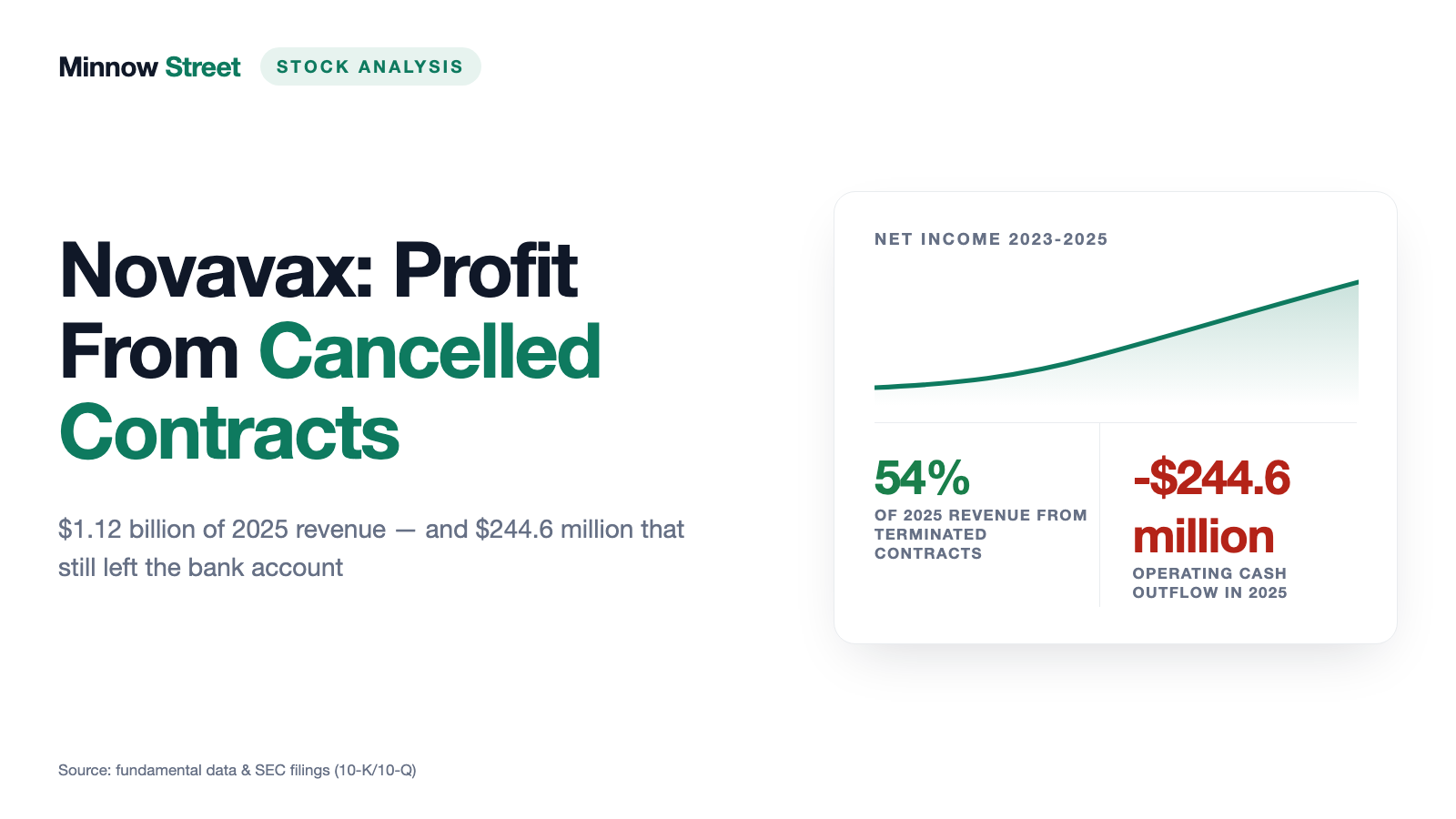
Novavax sits at rank 49 in our Big Earnings Surprise scanner (U.S. selection, 81 hits, data as of July 25, 2026): earnings per share beat the consensus estimate in five consecutive quarters, most recently by 84 percent. We read the 2025 annual report (10-K), the quarterly report for the period ended March 31, 2026, and every current report filed through July 24, 2026. The result: $1.12 billion of 2025 revenue — $603.0 million of it from two terminated supply agreements with Canada and New Zealand. In the same year $244.6 million left the operating business, and shareholders' equity has been negative for years. Anyone buying in here should know whose bill they are actually reading.
 Thomas Mücke
Founder & Publisher
Thomas Mücke
Founder & Publisher
Chart
Interactive price chart (TradingView).
Note: pure fact-based analysis, not investment advice and not a solicitation to buy or sell. All figures without guarantee.
There is a reflex that costs investors money: the beat trap. The moment a headline says a company "topped expectations", the brain switches from checking to celebrating. Yet an earnings surprise is first a statement about the estimators and only second a statement about the business. Novavax, Inc. (Nasdaq: NVAX) has triggered that reflex five quarters in a row, which is why it sits at rank 49 in our Big Earnings Surprise scanner (U.S. selection, 81 hits, data as of July 25, 2026). Before we let it infect us, let us make a deal: we read the primary documents together — the 2025 annual report (10-K), the quarterly report (10-Q) for the period ended March 31, 2026, and every current report (8-K) filed with the U.S. securities regulator, the SEC, through July 24, 2026. They contain the first annual profit in company history. They also contain where it came from: two contracts that were cancelled. Remember the sentence right at the start: a surprise is not an achievement, it is a difference.

What this analysis covers
- What Novavax actually does — from vaccine seller to licensor
- How the stock landed on our desk
- The numbers over the years — what genuinely impresses
- Uncomfortable truth no. 1: the profit came from cancelled contracts
- Uncomfortable truth no. 2: record profit, record cash outflow
- Uncomfortable truth no. 3: shareholders’ equity is negative
- Uncomfortable truth no. 4: pledged for the first time — the MidCap credit agreement
- Uncomfortable truth no. 5: Australia could claw back $92.5 million
- What the stock costs — orders of magnitude, not day prices
- Opportunities and risks at a glance
- A human conclusion
- Sources
What Novavax actually does — from vaccine seller to licensor
Novavax was founded in 1987, sits in Gaithersburg, Maryland, and employed roughly 749 people as of December 31, 2025. It became famous for its protein-based COVID-19 vaccine Nuvaxovid — the latecomer among coronavirus shots, built without mRNA. The real family silver, however, is something else: Matrix-M, an adjuvant derived from the bark of the Chilean soapbark tree. In everyday terms an adjuvant is the seasoning that makes a bland dish worth eating: it makes the immune system respond forcefully to an antigen that would otherwise be weak. Matrix-M sits inside the R21 malaria vaccine commercialized by the Serum Institute of India, among others.
Since May 2024 the business model has turned on its axis. Under the collaboration and license agreement with Sanofi, Novavax handed over commercialization of its own COVID-19 vaccine: Sanofi has led sales since the 2025-2026 season, while Novavax supplies and collects. In return came a $500 million upfront payment and, through the end of 2025, a further $275 million in milestones — $50 million for a clinical database lock, $175 million for U.S. approval of a pre-filled syringe presentation, and two payments of $25 million for transferring the European and U.S. marketing authorizations to Sanofi. On top of that come royalties which the quarterly report puts in the "high teens to low twenties percent" range on Sanofi’s sales of the licensed products.
In January 2026 a second licensee arrived. On January 15, 2026 Novavax signed a license and option agreement with Pfizer covering Matrix-M in up to two infectious disease fields: $30 million immediately, up to $500 million in milestones, and tiered royalties in the high mid-single digit percentage range. That completes the picture: Novavax today sells rights, not doses.
And that brings us to the central tension of this analysis, which runs through every chapter: the licensing model is real and potentially very lucrative — but the profits of 2025 and 2026 so far come from one-off payments and from contracts that were terminated. The ongoing business still burns cash.
How the stock landed on our desk
Our Big Earnings Surprise scanner looks for companies whose reported earnings per share came in at least 20 percent above the consensus estimate in each of the last four completed quarters. As of July 25, 2026 Novavax sits at rank 49 of 81 U.S. hits, with a relative strength reading of 52 — meaning the stock has performed roughly in line with the median of its comparison universe. To repeat the screen yourself: open the scanner, set the country filter to U.S., read the list by rank. One caveat: these lists are recalculated daily, so a rank is a snapshot, not a property of the company.
The streak itself is striking: plus 312.7 percent in the first quarter of 2025 ($2.93 reported against $0.71 expected), plus 933.3 percent in the second ($0.62 against $0.06), plus 58.4 percent in the third (-$0.47 against -$1.13), plus 116.7 percent in the fourth ($0.11 against -$0.66) and plus 83.8 percent in the first quarter of 2026 (-$0.06 against -$0.37); all figures as of July 25, 2026. Five quarters, five clear beats.
Yet the relative strength reading of 52 already tells you the market is not celebrating. The reason is the same as the reason for the streak: the surprises arise exactly where analysts cannot model. Nobody can seriously estimate in which quarter a government terminates a supply contract and pays for the privilege, or when a partner triggers a milestone. Those payments made the quarters. A streak born of unforecastability ends the moment the one-off payments stop — with nothing at all changing in the underlying business. Remember: the harder a number is to estimate, the bigger the surprise it produces, and the less it tells you.
The numbers over the years — what genuinely impresses
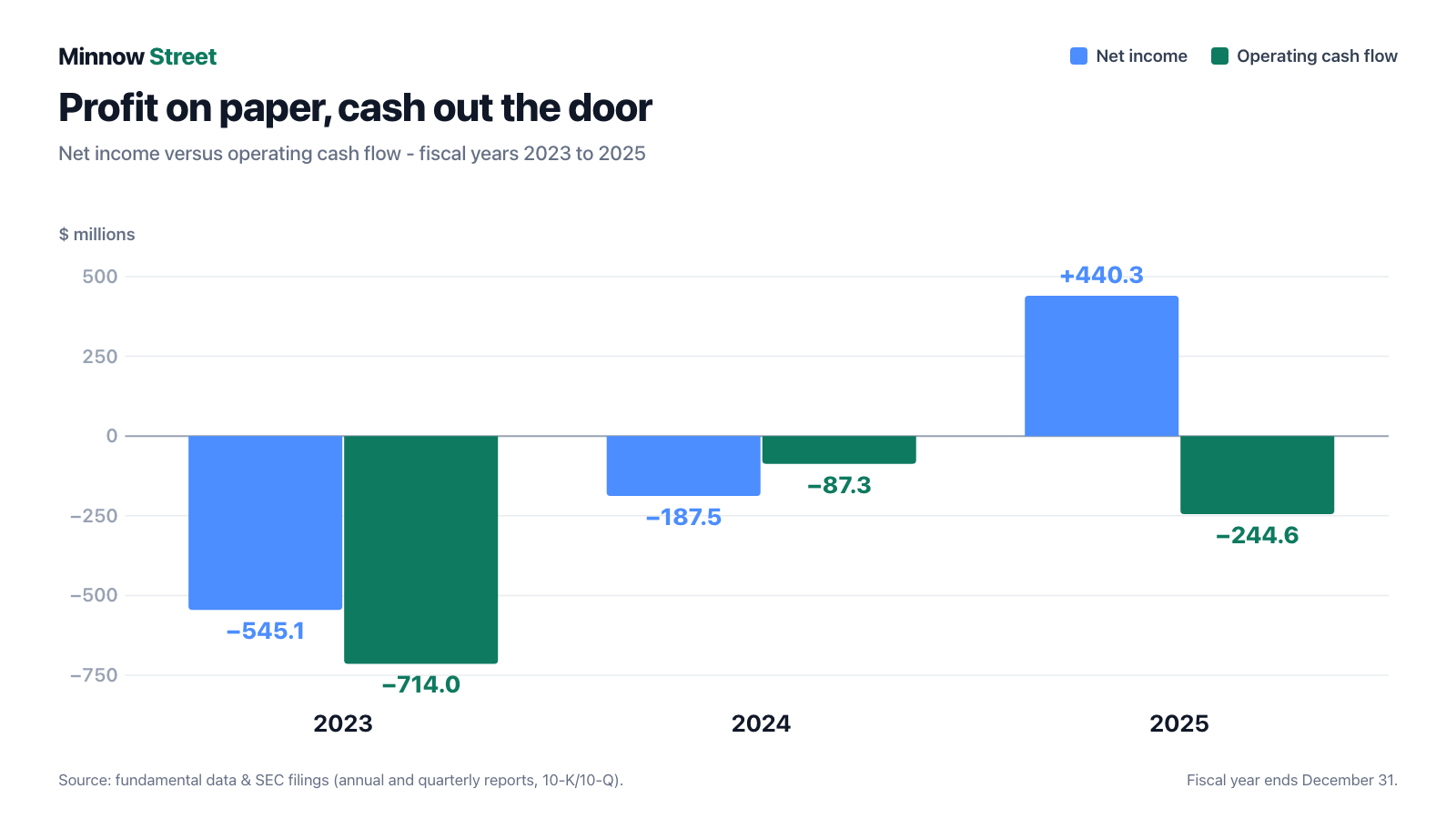
Start with what deserves respect. In two years Novavax rebuilt a company that in 2023 still lost $545.1 million and burned $714.0 million in operations. In 2024 the loss was $187.5 million and the operating cash outflow $87.3 million. In 2025 the books showed net income of $440.3 million for the first time, on revenue of $1,123.5 million — $2.72 per share basic, $2.58 diluted (all figures from the 2025 annual report, 10-K).
Behind that stands a hard restructuring. Selling, general and administrative expense fell from $468.9 million in 2023 through $337.2 million in 2024 to $157.5 million in 2025 — cut by two thirds in two years. Research and development spending went from $737.5 million to $342.3 million over the same period. The company announced a workforce reduction of roughly 25 percent in 2023 and added another 12 percent in January 2024; in 2025 it recorded $7.8 million of severance and $102.7 million of write-downs, including $97.8 million on assets held for sale.
The balance sheet improved too. Current liabilities fell from $1,635.1 million at the end of 2023 through $1,154.4 million at the end of 2024 to $459.9 million at the end of 2025, and stood at $342.5 million on March 31, 2026. The equity shortfall shrank from $716.9 million at the end of 2023 to $127.8 million at the end of 2025. Anyone looking at this company in 2023 saw a question of survival; anyone looking today sees a business with $794.9 million in cash, restricted cash and marketable securities (March 31, 2026) and working capital of $508.4 million. That is genuine progress and it deserves to be said out loud.
Uncomfortable truth no. 1: the profit came from cancelled contracts
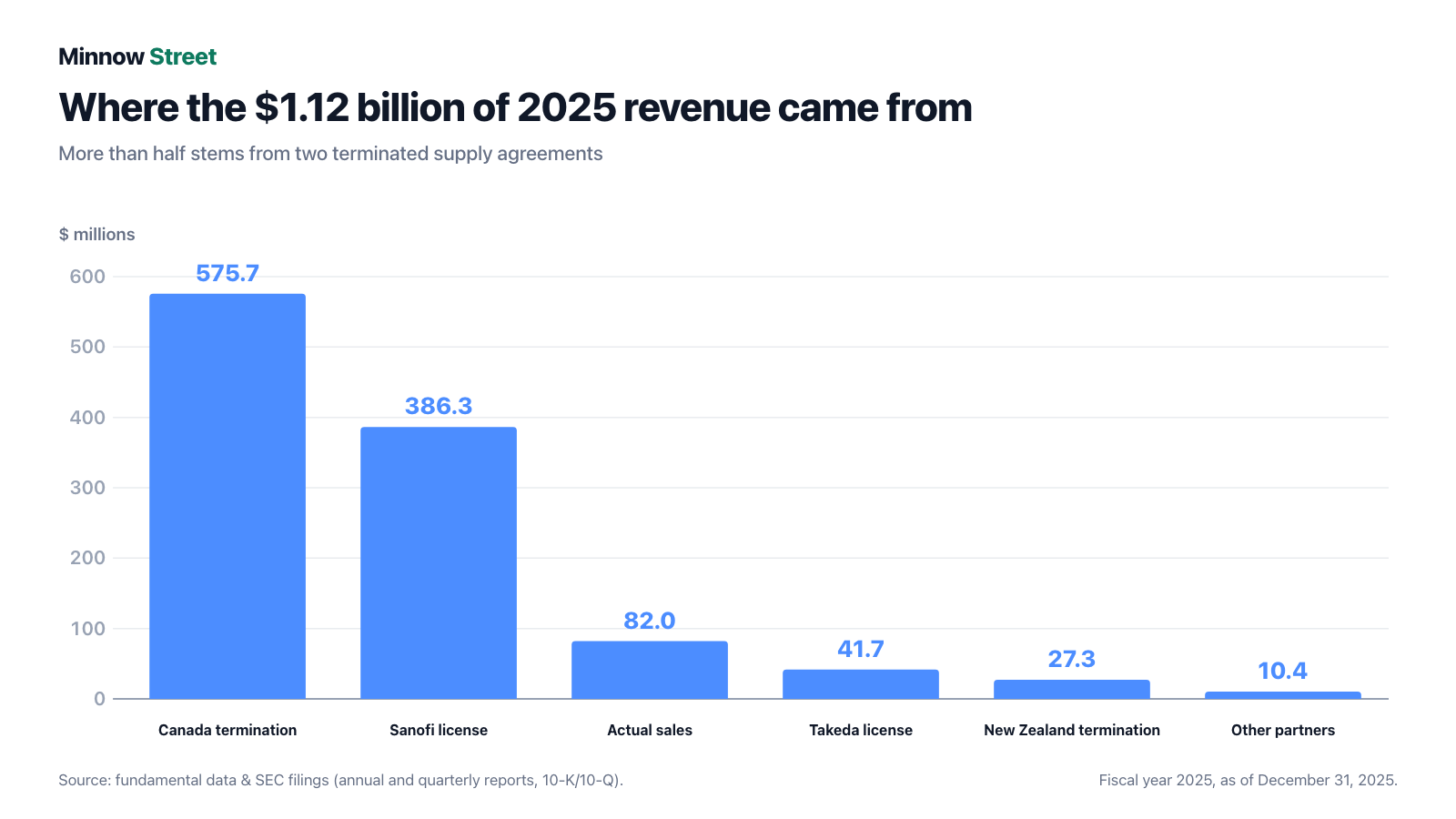
The annual report itself says where the $1.12 billion of revenue came from — you only have to read the second sentence:
"Revenue for the year ended December 31, 2025 was $1.1 billion as compared to $682.2 million for the year ended December 31, 2024, an increase of $441.3 million. Revenue for the year ended December 31, 2025 was primarily comprised of revenue from the termination of our APAs with Canada ("Canada APA") and New Zealand ("New Zealand APA") of $575.7 million and $27.3 million, respectively"
— Novavax, Inc., Form 10-K for 2025, Part II, Item 7

Let us take that apart. Product sales came to $685.0 million in 2025. Inside that number sit the $603.0 million from the terminated advance purchase agreements with Canada and New Zealand. What remains is roughly $82 million of vaccine, adjuvant and material actually sold. The other $438.4 million of annual revenue is licensing: $386.3 million from Sanofi (of which $225.0 million pure milestones, $91.6 million cost reimbursements, $63.9 million released deferred upfront and milestone amounts, and $5.75 million of genuine royalties), $41.7 million from Takeda and $10.4 million from other partners.
That is the core of this analysis: of $1,123.5 million in revenue, roughly $82 million came from selling goods. Everything else was payment for something being ended, transferred or licensed. A contract can only be cancelled once.
The first quarter of 2026 shows what is left once the termination payments stop: $139.5 million of revenue against $666.7 million in the prior-year quarter — down 79 percent. Product sales shrank from $621.7 million to $42.2 million, of which only $9.6 million from Nuvaxovid sales, because Sanofi now runs distribution. The bottom line was a loss of $9.5 million — and that only because Pfizer contributed a $30.0 million upfront payment. Genuine Sanofi royalties in the quarter came to $3.5 million. That is the yardstick the licensing model will have to be measured against.
Uncomfortable truth no. 2: record profit, record cash outflow
2025 was the first profitable year — and at the same time a year in which $244.6 million flowed out of the operating business. That is not a contradiction, it is accounting: a large part of reported revenue was money that had arrived earlier and was merely released into the income statement in 2025. The cash flow statement spells it out: deferred revenue fell by $622.9 million during the year.
An everyday picture: imagine a customer wired you $600 two years ago for ten cases of wine. This year he says he no longer wants the wine and you may keep the money. Your profit and loss account now shows $600 of revenue. Your bank account does not move, because the money has been sitting there all along. That is exactly the difference between $440.3 million of profit and $244.6 million of outflow.
The pattern continues: another $32.4 million left operations in the first quarter of 2026. For comparison, in the prior-year quarter — the one with $518.6 million of reported profit — the outflow was $185.5 million. Remember: profit is an opinion, cash is a fact.
Uncomfortable truth no. 3: shareholders’ equity is negative
At March 31, 2026 total assets of $1,043.2 million stood against total liabilities of $1,187.9 million. Shareholders’ equity is therefore negative: minus $144.8 million. The accumulated deficit stood at roughly $4.57 billion at December 31, 2025 — that is how much money this company has lost, net, since it was founded. For context: negative equity does not automatically mean insolvency risk, because a large part of the liabilities are customer prepayments that get settled with deliveries rather than with cash. But it does mean one thing clearly: there is no cushion. Any misstep hits liquidity immediately.
The interim episode is notable: at June 30, 2025 equity was briefly positive ($37.6 million) before slipping back into the red in the third quarter — driven by write-downs tied to the transfer of the 700 Quince Orchard Road site to AstraZeneca and by the exchange of the convertible notes. In October 2025 Novavax itself guided to non-cash charges of $125 million to $127 million for that quarter.
One point matters for the overall picture: the going-concern question that shadowed Novavax for years has been answered positively in the two most recent reports. Both the 2025 annual report and the quarterly report for the period ended March 31, 2026 conclude that the company expects to have sufficient capital for the next twelve months. The section is still headed "Liquidity and Going Concern" — but its conclusion today reads differently than it did in 2023.
Uncomfortable truth no. 4: pledged for the first time — the MidCap credit agreement
Novavax financed itself with equity and unsecured convertible notes for decades. That changed in February 2026: a senior secured term loan facility with MidCap Financial Trust provides up to $330.0 million across four tranches, of which $50.0 million was funded at closing. Interest runs at one-month SOFR plus 5.00 percent with a 2.00 percent floor — 8.7 percent at March 31, 2026; including issuance costs Novavax books an effective rate of 11.0 percent. The loan matures on March 1, 2031 and carries a 2.75 percent exit fee.
"The Credit Agreement also includes a financial covenant requiring the Company and its subsidiaries to maintain unrestricted cash of at least $100.0 million at all times."
— Novavax, Inc., Form 10-Q for the period ended March 31, 2026, Note 11

The lien is the real price. The facility is secured by a first-priority claim on substantially all assets; the Dutch subsidiary guarantees it, and the equity of Sweden-based Novavax AB — where the Matrix-M technology lives — is pledged. In plain language: the company’s most valuable asset is now collateral for a loan. At March 31, 2026 Novavax reported compliance with all covenants, and with $228.4 million of cash the distance to the $100 million threshold is comfortable. But the threshold is written into a contract now.
Total financial debt stood at $291.0 million at March 31, 2026: $26.5 million remaining of the 5.00 percent convertible notes due 2027, $225.0 million of the 4.625 percent convertible notes due 2031 issued in August 2025, and the $50.0 million MidCap term loan. Exchanging the old notes for the new ones cost a one-time non-cash charge of $28.7 million in 2025.
Uncomfortable truth no. 5: Australia could claw back $92.5 million
The notes to the quarterly report contain a sentence that never appeared in a headline:
"In the event that the Company does not, on or before the relevant contractual deadlines, receive regulatory approval for, and deliver, the seasonally updated COVID-19 Vaccine, up to $92.5 million of deferred revenue may become refundable."
— Novavax, Inc., Form 10-Q for the period ended March 31, 2026, Note 5
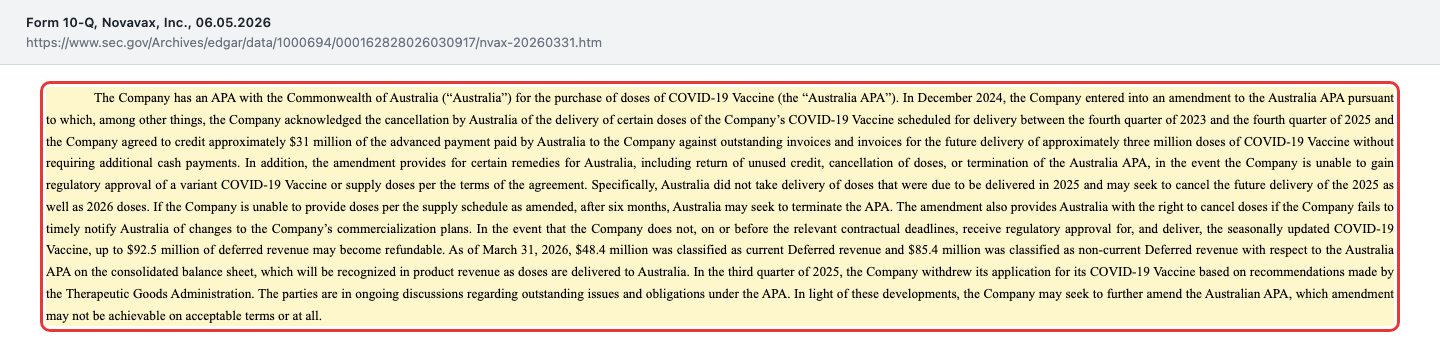
The background: Australia did not take delivery of the doses due in 2025 and may seek to cancel the 2025 and 2026 deliveries as well. In the third quarter of 2025 Novavax withdrew its Australian marketing application on the recommendation of the local regulator. At March 31, 2026 the agreement accounted for $48.4 million of current and $85.4 million of non-current deferred revenue. The report states openly that a further amendment may be required and "may not be achievable on acceptable terms or at all".
Here is the arithmetic: $92.5 million equals roughly 41 percent of the $228.4 million cash balance at March 31, 2026 — and the MidCap minimum cash covenant sits at $100.0 million. Those two numbers belong side by side.
What the stock costs — orders of magnitude, not day prices
As of July 25, 2026 (closing price of July 24, 2026: $7.46) Novavax carries a market value of roughly $1.23 billion, on 164,438,119 shares outstanding at April 30, 2026. The cross-check works out: price times share count produces exactly that market value. Against trailing twelve-month revenue of roughly $596 million that is a price-to-sales ratio of about 2.1; net of the cash pile, enterprise value comes to roughly $791 million. There is no meaningful price-to-earnings ratio: the 2025 profit was a one-off, and for 2026 the consensus expects a loss of $0.47 per share.
The more interesting order of magnitude is another one. Novavax holds $794.9 million in cash, restricted cash and marketable securities (March 31, 2026) — roughly 65 percent of the market value. Against that sit $291.0 million of financial debt and an accumulated deficit of $4.57 billion. In effect the market is paying for the cash plus an option on the licensing stream. That option is not small: the Sanofi agreement still carries up to $350 million of COVID-19 milestones (of which $75 million for completing the technology transfer), up to $350 million for the combination influenza-COVID product, plus up to $200 million for each of the first four adjuvant products and $210 million for each one thereafter. The Pfizer agreement adds up to $500 million.
The view of the professionals is as split as it gets. Of nine recorded analyst opinions as of July 25, 2026, five said strong buy, one hold, two sell and one strong sell, at an average target price of roughly $14. Such a spread is not a verdict in itself but it is information: even professionals reading the same documents reach opposite conclusions here. It fits that roughly 28 percent of the free float was sold short (data as of July 25, 2026) — unusually high, and a sign of how contested this stock is. If you want to understand the general shape of a licensing model with a finite clock, our Puma Biotechnology analysis offers a second example; for how an established group handles a core product in decline, see our Biogen analysis.
Opportunities and risks at a glance
Opportunities
- Two global groups as licensees. Sanofi and, since January 2026, Pfizer pay for Matrix-M. The Pfizer deal delivered $30.0 million up front and opens up to $500.0 million in milestones (8-K dated January 20, 2026).
- High royalty rates. On Sanofi’s sales of the licensed COVID-19 and combination products, the quarterly report puts royalties in the "high teens to low twenties percent" range — a rate few licenses reach.
- Radically lower costs. Selling, general and administrative expense came to only $157.5 million in 2025 after $468.9 million in 2023; quarterly losses have shrunk accordingly ($9.5 million in Q1 2026).
- Liquidity cushion. $794.9 million of cash, restricted cash and securities at March 31, 2026 equal roughly 65 percent of the market value, and the credit facility offers up to $280 million of undrawn capacity on top.
- Going concern resolved. Both the 2025 annual report and the Q1 2026 quarterly report confirm sufficient capital for the next twelve months.
Risks
- The selling business has all but disappeared. Nuvaxovid revenue fell from $608.0 million in Q1 2025 to $9.6 million in Q1 2026 because Sanofi now runs distribution.
- Negative equity. Minus $144.8 million at March 31, 2026 against an accumulated deficit of $4.57 billion — there is no cushion for missteps.
- Australian repayment risk. Up to $92.5 million of deferred revenue may become refundable; the Australian marketing application was withdrawn in the third quarter of 2025.
- Secured debt with covenants. First-priority lien on substantially all assets including the equity of Novavax AB, $100.0 million minimum cash, 11.0 percent effective interest rate.
- Dilution. 27.872 million potentially dilutive securities at March 31, 2026 against 5.349 million a year earlier — roughly 17 percent of shares outstanding.
- Milestones are not revenue. Actual Sanofi royalties came to $3.5 million in the first quarter of 2026. It is a long road from there to a self-supporting business.
A human conclusion
Back to the beat trap from the beginning. Five quarters in a row Novavax beat expectations — and every time for a different one-off reason: a contract termination, a regulatory milestone, a transfer, an upfront payment. The surprise was real every single time. It was never proof that the business is running better than expected. It was proof that nobody can seriously estimate when which counterparty writes which cheque.
At the same time it would be unfair to reduce this company to its accounting. Novavax has halved its cost base, cleaned up its balance sheet, won two global groups as licensees and answered the survival question for now. Anyone buying NVAX today is buying neither a vaccine manufacturer nor a turnaround story, but a bet on someone else’s sales force: on Sanofi and Pfizer turning Matrix-M into products that Novavax earns a cut of. That bet may pay off handsomely — the current report on the Pfizer license speaks of "billions of dollars" over the life of the agreement. It may also mean that a company with negative equity spends years waiting for milestones that others have to trigger.
What you make of that is your decision. And that is exactly as it should be.

Sources
- Novavax, Inc. — annual report on Form 10-K for 2025 (filed February 26, 2026, CIK 0001000694)
- Novavax, Inc. — quarterly report on Form 10-Q for the period ended March 31, 2026 (filed May 6, 2026)
- Current report on Form 8-K dated January 20, 2026 — license and option agreement with Pfizer
- Current report on Form 8-K dated October 22, 2025 — site transfer to AstraZeneca and material impairments
- Current report on Form 8-K dated August 21, 2025 — exchange of the 2027 convertible notes into the 2031 notes
- SEC EDGAR filing index for Novavax — filings after the latest quarterly report reviewed through July 24, 2026
- Fundamental data (key figures, earnings surprise history, analyst opinions, price series), data as of July 25, 2026
Disclaimer: this article is journalistic commentary on publicly available corporate filings. It is not investment advice, not a recommendation to buy or sell, and not a solicitation to buy or sell securities. Share prices can move sharply; a total loss of invested capital is possible. Every figure carries the as-of date stated in the text and may have changed since. The author holds no position in Novavax, Inc. at the time of publication.
Our Bottom Line at a Glance
- Earnings quality negative
- Of $1,123.5 million in 2025 revenue, $603.0 million came from terminating the advance purchase agreements with Canada and New Zealand; actual product sales were roughly $82 million. In the first quarter of 2026 revenue fell to $139.5 million (10-K 2025; 10-Q for the period ended March 31, 2026).
- Cash position & cost base positive
- $794.9 million of cash, restricted cash and marketable securities at March 31, 2026 against a market value of roughly $1.23 billion (data as of July 25, 2026); selling, general and administrative expense fell to $157.5 million in 2025 from $468.9 million in 2023 (10-K 2025).
- Balance sheet & leverage negative
- Negative equity of $144.8 million at March 31, 2026 against a $4.57 billion accumulated deficit; secured debt for the first time, with a first-priority lien on substantially all assets, an 11.0 percent effective interest rate and a $100.0 million minimum cash covenant (10-Q for the period ended March 31, 2026, Note 11).
- Licensing model neutral
- Sanofi and, since January 2026, Pfizer pay for Matrix-M; outstanding milestones run to $350 million (COVID-19), $350 million (combination vaccine) and $500 million (Pfizer). Actual royalties in the first quarter of 2026, however, came to just $3.5 million (10-Q for the period ended March 31, 2026, Note 5).
- Open contract risk negative
- Up to $92.5 million of deferred revenue from the Australian advance purchase agreement may become refundable; the local marketing application was withdrawn in the third quarter of 2025, and $133.8 million sat on the balance sheet as current and non-current deferred revenue at March 31, 2026 (10-Q, Note 5).
- Earnings surprise streak neutral
- Five consecutive quarters above consensus, most recently plus 83.8 percent in the first quarter of 2026 — but the beats stem from one-off payments no analyst can time, not from operating improvement; relative strength stands at 52 (data as of July 25, 2026).
Novavax has turned itself from a vaccine seller into a licensor and posted the first annual profit in company history in 2025 — $440.3 million. Yet more than half of the underlying revenue came from two terminated supply agreements, and in the same year $244.6 million of cash left the operating business. On the credit side stand a halved cost base, $794.9 million of liquidity and two global groups as licensees; on the debit side negative equity, assets pledged for the first time, and a recurring income stream that amounted to just $3.5 million in the first quarter of 2026. Not investment advice.
What Our Rating Means
Substance risk
We found at least one documented issue that threatens the company itself — regardless of how the stock is currently valued.
The red light here is about substance, not about the share price. Two documented findings hit the company itself: shareholders' equity was negative at minus $144.8 million on March 31, 2026, against an accumulated deficit of $4.57 billion — and operating cash flow was negative in 2023, 2024 and 2025, most recently with $244.6 million flowing out in the very first profitable year in company history. On top of that, substantially all assets have been pledged since February 2026, including the equity of Sweden-based Novavax AB, where the Matrix-M technology sits. There is a great deal on the other side: both of the most recent reports certify sufficient capital for the next twelve months, liquidity stood at $794.9 million on March 31, 2026, and selling, general and administrative expense fell from $468.9 million in 2023 to $157.5 million in 2025. This is therefore not a verdict of insolvency — but a company with no equity cushion, whose ongoing business still burns cash and whose recurring income most recently amounted to $3.5 million in a quarter, has not yet proven its quality: hence red. The decision is yours.
A journalistic assessment by our editorial team at the time of the deep dive, based on public sources — not investment advice and not a solicitation to buy or sell. Your personal circumstances (investment goals, risk capacity, taxes) cannot be taken into account. What our levels mean, how verdicts are formed, and what conflicts of interest exist →
Worth Noting
- NVAX reached our research list at rank 49 in our in-house Big Earnings Surprise scanner (U.S. selection, 81 hits, relative strength 52, data as of July 25, 2026); the scanner lists are recalculated daily.
- Identity verified against EDGAR: Novavax, Inc., CIK 0001000694, Nasdaq, no former names, no successor CIK, U.S. domestic filer reporting on Forms 10-K and 10-Q, fiscal year ending December 31.
- Easy to confuse: Novavax is not an mRNA manufacturer. Nuvaxovid is protein-based, and the Matrix-M platform is an adjuvant that also sits inside third-party vaccines such as the R21 malaria vaccine.
- Price and market value figures carry the data date July 25, 2026 (closing price of July 24, 2026: $7.46) and were cross-checked against the 164,438,119 shares outstanding reported as of April 30, 2026.
- Contrary to some summaries, Novavax has not carried out a reverse stock split: neither the 2025 annual report nor the quarterly report for the period ended March 31, 2026 mentions one.
Frequently Asked Questions
Novavax develops protein-based vaccines and the Matrix-M adjuvant, but largely leaves commercialization to partners. Sanofi has led distribution of the COVID-19 vaccine Nuvaxovid since the 2025-2026 season. Novavax supplies, keeps researching, and earns through milestones, cost reimbursements and royalties. As of December 31, 2025 it employed roughly 749 people in Gaithersburg, Maryland, and Uppsala, Sweden.
Because the profits came from payments analysts cannot time: contract terminations, regulatory milestones, transfers of marketing authorizations. In the first quarter of 2025 it was $575.7 million from ending the Canadian advance purchase agreement; in the first quarter of 2026 it was a $30 million upfront from Pfizer. A streak built on one-off payments ends when the one-off payments stop.
Of $1,123.5 million in 2025 revenue, roughly $82 million came from vaccine, adjuvant and material actually sold. The remaining $603.0 million of product sales stemmed from terminating the advance purchase agreements with Canada and New Zealand, and the other $438.4 million was licensing. In the first quarter of 2026 Nuvaxovid sales came to $9.6 million.
No. Both the 2025 annual report and the quarterly report for the period ended March 31, 2026 conclude that the company expects to have sufficient capital for the twelve months following publication. At March 31, 2026 it held $794.9 million of cash, restricted cash and marketable securities. The section is still headed "Liquidity and Going Concern", but its conclusion is positive.
Because liabilities exceed assets: $1,187.9 million against $1,043.2 million at March 31, 2026, leaving minus $144.8 million. The cause is more than four billion dollars of accumulated losses since 1987 plus large customer prepayments from supply agreements. Part of those liabilities will be settled with deliveries rather than cash — but there is still no cushion.
On January 15, 2026 Pfizer received a non-exclusive worldwide license to Matrix-M for one field initially and optionally a second. Novavax received a $30 million upfront payment in the first quarter of 2026 and is eligible for up to $500 million in milestones — $70 million in development and $180 million in sales milestones per field — plus tiered royalties in the high mid-single digit percentage range.
No. As of July 25, 2026 no Form 15 deregistration and no Form 25 delisting notice had been filed with the SEC; the stock trades on the Nasdaq Global Select Market under the symbol NVAX. No merger or acquisition agreement appears in any current report either. The most recent event filing was the disclosure of the annual meeting voting results on June 23, 2026.
Sanofi royalties. They came to $3.5 million in the first quarter of 2026 and are the only recurring income stream that does not depend on one-off payments. If that figure grows materially, the licensing model carries the company; if it stays small, Novavax keeps living on milestones that others have to trigger. The next quarterly report will show both.
Found an error?
Did you spot a factual error, an outdated number, or a typo in this deep dive? Let us know briefly — your report goes straight to the editorial team.