Worthington Steel: The Price-to-Earnings Ratio Rests on Earnings the Company Itself Withdrew
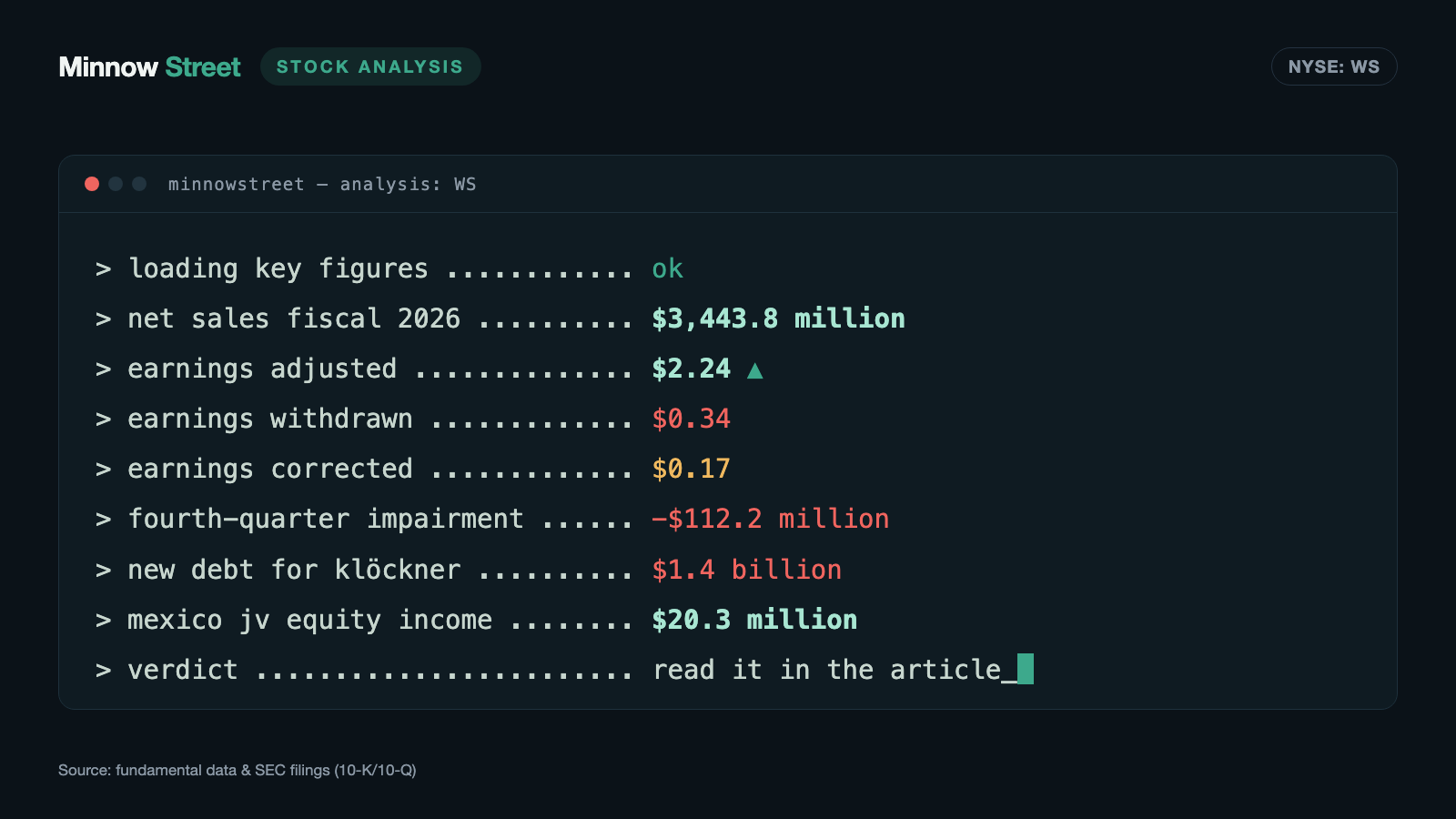
On June 24, 2026 Worthington Steel reported earnings of $0.34 per share for the fiscal year that ended May 31. Sixteen days later it replaced that release in its entirety: year-end closing work for the annual report had turned up further impairments, and $0.34 became $0.17. The business underneath is healthier than either number suggests — adjusted earnings came to $2.24 per share, more than the year before. At the same time the company borrowed $1.4 billion to buy Klöckner & Co, against a market value of about $1.84 billion (data as of July 28, 2026). Not investment advice — just the question of how old the number on your screen really is.
 Thomas Mücke
Founder & Publisher
Thomas Mücke
Founder & Publisher
Chart
Interactive price chart (TradingView).
Note: pure fact-based analysis, not investment advice and not a solicitation to buy or sell. All figures without guarantee.
There is an investor trap nobody sees coming, because it looks so friendly: the freshness trap. It works like this. You open a data portal, a brokerage account, an app. The price ticks, the date in the corner says today, everything feels brand new — and so you assume the number underneath is brand new too. But a financial metric carries no expiration date. At three weeks old it looks exactly like it does at three seconds old. Worthington Steel (NYSE: WS), a value-added metals processor from Columbus, Ohio, is a live demonstration. As of the data cut-off of July 28, 2026, our fundamental data showed a trailing price-to-earnings ratio of 108.1 — a figure resting on earnings the company itself withdrew on July 10, 2026 and replaced with a number half as large. So here is the deal: before you build a judgment out of any multiple, let us read together what this company actually told the U.S. securities regulator, the SEC — the quarterly report (10-Q) as of February 28, 2026, the annual report (10-K) for fiscal 2025, and the run of current reports (Form 8-K) from June and July 2026. A filing with the SEC is honest under threat of penalty. And this one tells the story of a sound operation, a vanished profit, a write-down on a business bought twelve months earlier, a joint venture in Mexico that rescues the year, and $1.4 billion of fresh debt for the largest acquisition in company history. In the end, the call is yours.
What Worthington Steel actually does — the step nobody sees
Worthington Steel is a steel processor. In everyday terms: the company sits between the mill and the factory. A mill ships enormous coils of flat-rolled steel — raw goods, like a bolt of cloth at a wholesaler. Worthington Steel slits, cold-reduces, galvanizes, pickles and welds that into exactly the part a car supplier, a farm equipment maker or a motor manufacturer can drop into its line. The filings describe it as processing steel coils "into the precise type, thickness, length, width, shape, and surface quality required by customer specifications" (10-Q, February 28, 2026). Three product families carry the business: carbon flat-rolled steel, electrical steel laminations (the stacked sheets inside every electric motor) and tailor welded blanks — bespoke blanks made from sheets of different thickness that let carmakers take out weight.
Two things matter from the start. First, the fiscal year ends May 31, not December 31. So "fiscal 2026" covers essentially June 2025 through May 2026 — compare it with calendar 2026 and you are comparing different periods. Second, the company is young on the exchange but old in the trade. It was incorporated in Ohio on February 28, 2023 and separated from Worthington Enterprises on December 1, 2023 — a spin-off the filings simply call "the Separation." In a spin-off, shareholders of the parent receive shares in the new subsidiary; the subsidiary then stands alone, with its own balance sheet and its own filings. That is why the history here is short, and why the earliest years are "combined" figures from the time inside the parent.
On size: roughly 6,000 employees and 37 facilities in seven states and 10 countries (financial release of July 10, 2026); the fiscal 2025 annual report counted about 4,800 employees at May 31, 2025 plus roughly 500 at the unconsolidated joint venture. Internally the whole thing runs as a single reportable segment — so there is no segment table in which you could set electrical steel against carbon steel. And that names the central tension of this analysis, which runs through every chapter: the operation works and reliably throws off cash, but what finally gets reported as profit is decided outside the plant — by impairments, by a joint venture in Mexico, by the lag between buying steel and selling it, and from now on by a billion-dollar takeover in Europe.
How the stock reached our desk
Not through a price move but through an oddity in the SEC paper trail. On July 10, 2026 Worthington Steel filed a Form 8-K/A — an amendment to an announcement it had already made. Amendments to earnings releases are rare, and this one is unusual even so: it supersedes the release of June 24, 2026 "in its entirety," in its own words. At the same time our fundamental data, as of July 28, 2026, showed a trailing price-to-earnings ratio of 108.1 for WS, a market value of about $1.84 billion across 49,920,298 shares, and trailing twelve-month revenue of $3.44 billion. A multiple of 108 on a company with $3.4 billion of revenue and a price-to-sales ratio of a little over 0.5 does not add up. Contradictions like that are a good place to start.
One note on the data that applies to the whole article: the annual report (10-K) for the fiscal year ended May 31, 2026 had not been filed as of the cut-off date — the prior-year report was filed on July 29, 2025. Every fiscal 2026 annual figure therefore comes from a financial release: unaudited, compiled by the company itself and, as we are about to see, corrected once already. Figures through fiscal 2025 come from the audited annual report, and the nine-month figures from the quarterly report as of February 28, 2026. We keep those apart below — not as a formality, but because it is the heart of the story.
The numbers over the years — given their due
First the case for Worthington Steel, which is stronger than the headline suggests. Net sales rose 11.3 percent to $3,443.8 million in fiscal 2026, from $3,093.3 million. And adjusted diluted earnings per share — the figure stripped of one-time items — came to $2.24, above the prior year's $2.16. Adjusted EBIT improved as well, from $149.1 million to $161.1 million. Operationally, fiscal 2026 was better than fiscal 2025, not worse. Read only the bottom line and you get the direction backwards.
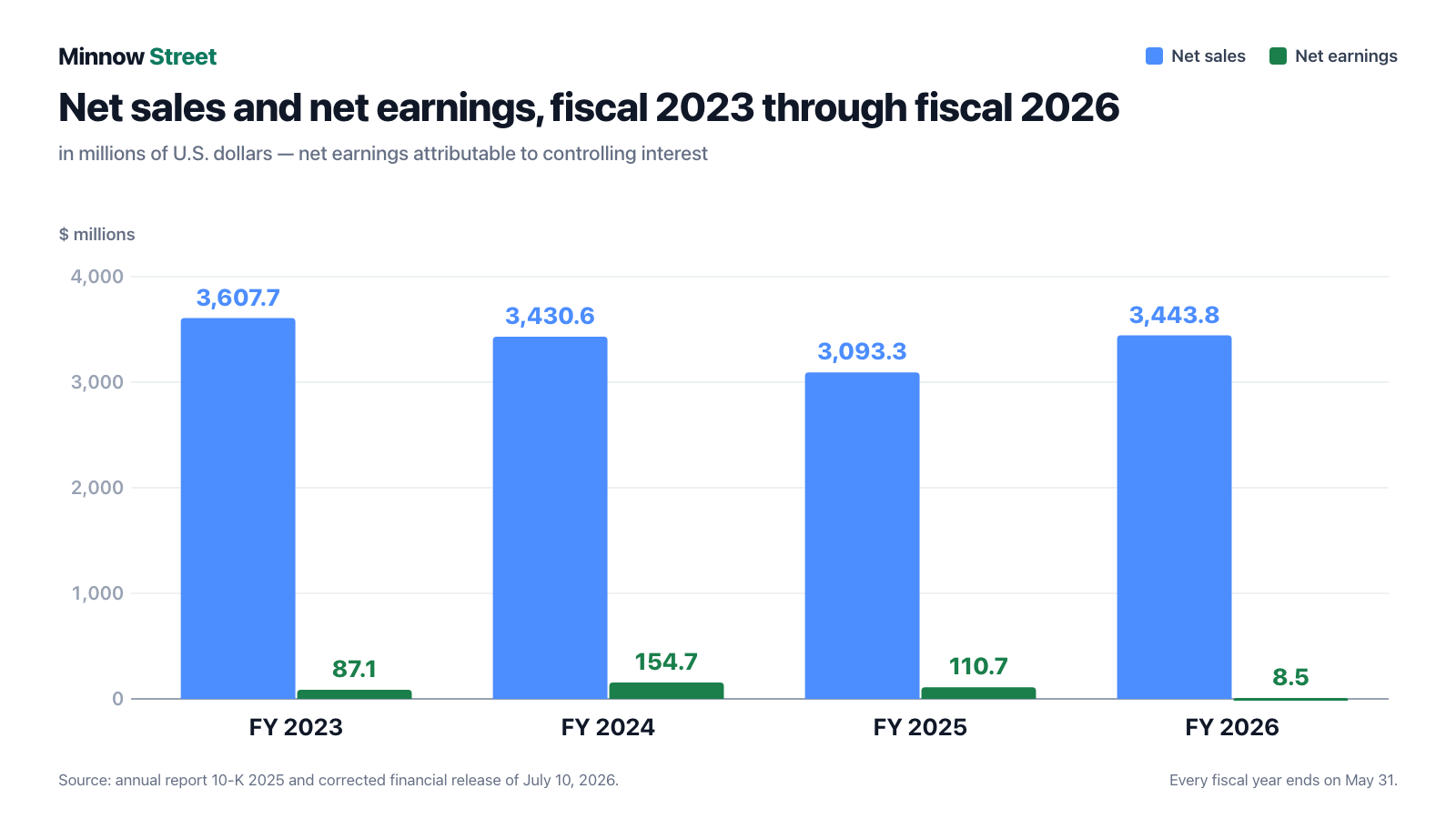
The cash side works too. Operations generated $201.2 million in fiscal 2026 (prior year: $230.3 million). After $121.2 million of investment in property, plant and equipment, free cash flow came to $80.0 million over the twelve months. The dividend of $0.64 per share cost $32.6 million — comfortably covered by cash flow even in a year in which reported profit nearly disappeared. That is the key finding of this chapter: impairments cost book value, not cash. Remember the image: a write-down is like marking down the price tag on a machine you paid for long ago — painful on the balance sheet, irrelevant to the bank account.
One more thing belongs in the credit column — though not quite the way the tonnage first suggests. The company processed 3,586,817 tons of steel in fiscal 2026, less than the 3,793,752 tons of the prior year and well below the 4,007,373 tons of fiscal 2024. Even so, the $350.5 million increase in net sales came mostly from volume. The company says so itself: the fourth-quarter gain was "driven primarily by higher direct volumes, including the $47.6 million impact of the addition of Sitem Group and, to a lesser extent, higher average direct selling prices" (corrected financial release of July 10, 2026). The nine-month discussion in the quarterly report as of February 28, 2026 puts the drivers in the same order, with direct volumes up 7 percent.
The apparent contradiction dissolves in the mix. Worthington Steel processes steel two ways: on its own account — it buys the coil, processes it and sells the part, so the full material value lands in revenue (direct business) — or as pure toll processing of someone else's steel, where only the processing fee shows up in revenue. That is exactly where the tons disappeared: toll volumes fell 23 percent over nine months, partly because a toll processing plant near Cleveland was closed in May 2025. Tons that carry almost no revenue dropped away while the revenue-heavy direct volumes grew. On top of that came the acquisition: the Sitem Group, bought in June 2025, entered the accounts for the first time and contributed $133.8 million of net sales in the first nine months alone, plus $47.6 million in the fourth quarter — together roughly half of the entire annual increase. A steel processor that shifts its mix toward the higher-value business while improving adjusted earnings is doing something right. A revenue gain that is half first-time consolidation is still not organic growth. Which brings us to the uncomfortable truths.
What the filings say — the uncomfortable truths
Uncomfortable truth No. 1: the profit that no longer exists in that form
On June 24, 2026 Worthington Steel published its fiscal 2026 results: operating income of $15.5 million, net earnings attributable to controlling interest of $17.3 million and $0.34 in diluted earnings per share. Sixteen days later, on July 10, 2026, the company filed an amendment and attached a corrected version of the same release. It replaces the first one completely:
"Subsequent to the Original Financial Release, we identified and corrected certain errors in the reported information, as described further below. A copy of the corrected financial release (the 'Corrected Financial Release') is attached hereto as Exhibit 99.1, is incorporated by reference, and supersedes the Original Financial Release in its entirety. Specifically, the Corrected Financial Release reflects additional long-lived asset impairment charges related to certain asset groups within the Electrical Steel reporting unit as well as additional Bridge nonrevolving loan commitment costs."
— Worthington Steel, Inc., Form 8-K/A of July 10, 2026, Item 2.02
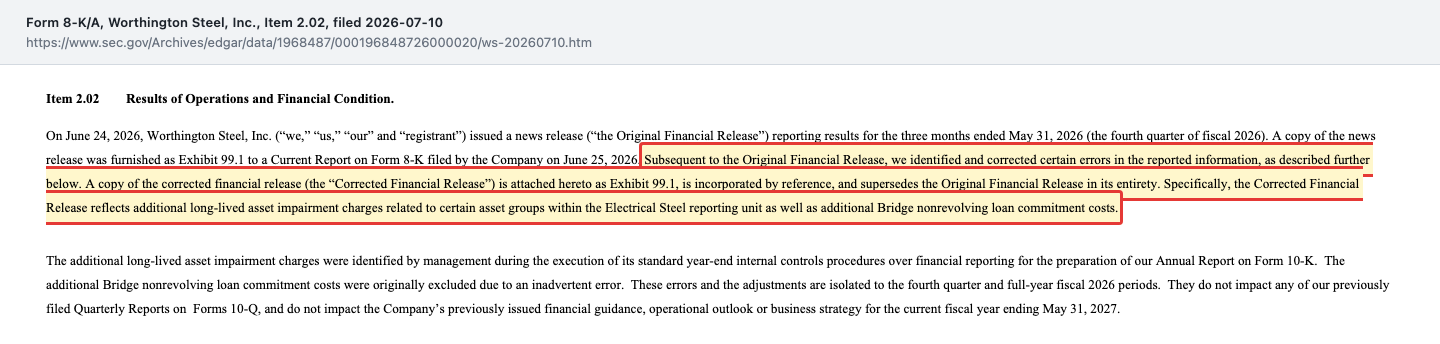
The change is substantial. Operating income of $15.5 million became an operating loss of $1.4 million. Net earnings of $17.3 million became $8.5 million. And $0.34 per share became $0.17. In the fourth quarter alone the operating loss moved from $57.6 million to $74.5 million and the net loss from $48.7 million to $57.5 million. Three points belong on the other side of the ledger: the company found the error itself, during its own year-end controls for the annual report. It disclosed it within 16 days. And it states plainly that the correction touches neither previously filed quarterly reports nor the outlook for the current fiscal year. That is the difference between an error reported cleanly and an error buried.
It was not the first correction of that release, though — it was the second. The very filing with which Worthington Steel put the numbers on the SEC record, on June 25, 2026, already attached a corrected version of the previous day's press release as Exhibit 99.1. The reason is spelled out: the original version contained a non-GAAP reconciliation table "in which footnote (2) to the table was erroneously duplicated from footnote (1)" (Form 8-K of June 25, 2026, Item 2.02). That was a blemish in a footnote, not a change to any figure — the filing states expressly that no other changes were made. Taken together with the July 10 amendment, though, the picture is worth knowing: the same financial release had to be corrected twice within 16 days — once in presentation, once in substance.
One fact from that first filing — Form 8-K of June 25, 2026, not the July 10 amendment — belongs alongside all this, with no document drawing any connection between the two: on June 23, 2026, the day before the financial release, Steven R. Witt announced his retirement from his position as Corporate Controller and Principal Accounting Officer — the executive who owns financial reporting inside the group — effective that same day, and the board appointed Gwen Joseph as his successor the same day; the filing states expressly that his retirement "is not the result of any disagreement with the Company on any matter relating to the Company's operations, policies or practices, including its accounting principles, practices or financial statement disclosures" (Form 8-K of June 25, 2026, Item 5.02). Whether the timing next to a figure that was halved three weeks later is more than coincidence is something no filing says — the question stays open.
For an investor, though, the freshness trap remains. A financial release under Item 2.02 is only furnished to the SEC, not formally filed — and data services usually grab the first announcement. That is why the data as of July 28, 2026 still carried $0.34, and why the arithmetic there produced a price-to-earnings ratio of 108.1. On the corrected $0.17 the same ratio is roughly twice as high. Remember the sentence: a multiple is only as fresh as the earnings in its denominator.
Uncomfortable truth No. 2: $112.2 million written off — in a business bought twelve months earlier
Why did earnings collapse at all? The answer sits inside a single quarter. In the fourth quarter of fiscal 2026 — March through May 2026 — Worthington Steel booked $112.2 million of impairments on goodwill and long-lived assets in its Electrical Steel reporting unit:
"During the fourth quarter of fiscal 2026, the Company recognized $112.2 million of impairments related to goodwill and long-lived assets within the Electrical Steel reporting unit. The impairments resulted from weakened demand in certain end markets, particularly industrial motors in both Europe and the United States, due to increased foreign competition, and in automotive, some delayed program launches."
— Worthington Steel, Inc., Form 8-K/A of July 10, 2026, Exhibit 99.1 (corrected financial release)

The timing is what stings. On June 3, 2025 — the third day of fiscal 2026 — Worthington Steel had used its Tempel Steel subsidiary to buy 52 percent of Italy's S.I.T.E.M. S.p.A., a maker of electric motor laminations. Total consideration, per the quarterly report: $66.3 million, of which $21.5 million was recorded as goodwill. Goodwill is the premium a buyer pays above the value of the individual machines, inventories and receivables — purchased hope, in effect. Twelve months later part of that hope was written back out: consolidated goodwill fell from $79.6 million (May 31, 2025) to $44.5 million (May 31, 2026), even though the Sitem deal had added new goodwill in between.
One detail reveals where the money sat: $29.1 million of the impairment was attributable to noncontrolling interests, not to Worthington Steel itself. Noncontrolling interests are the co-owners of a subsidiary — at Sitem they hold 48 percent. The consolidated accounts then show the subsidiary's full revenue but split the earnings. And Sitem has been running red: over the first nine months of fiscal 2026 the group contributed a net loss of $8.2 million on net sales of $133.8 million. How quickly an acquisition turns into a balance-sheet item with a question mark is something we also saw in our analysis of Titan Machinery — there it was inventory, here it is goodwill.
Uncomfortable truth No. 3: the profit came from Mexico
Now it gets interesting. Worthington Steel owns 50 percent of Serviacero Worthington, a steel service center in Mexico. Because the stake is exactly half, it is not consolidated; only one line appears, the share of earnings. In fiscal 2026 that line read $20.3 million, after $4.4 million in fiscal 2025 and $22.4 million in fiscal 2024. Set it beside the other figure: net earnings attributable to controlling interest were $8.5 million in fiscal 2026 and pre-tax earnings were $7.1 million.
Put differently: without the Mexican contribution, fiscal 2026 pre-tax earnings would have been negative. A sign flip resting on an affiliate the company does not run operationally, and whose figures arrive on a one-month lag. The quarterly report as of February 28, 2026 shows the swing: Serviacero earned $33.3 million of net income over nine months, after $0.9 million in the prior-year period. In February 2026 the venture distributed $35.0 million to its members, $17.5 million of it to Worthington Steel. That is real cash, not a paper gain. But it is also an earnings contribution that can quintuple in one year and fall to a fifth in the year before. Remember: when a single equity line decides the sign of the year, the year is not as stable as the bottom line suggests.
Uncomfortable truth No. 4: $1.4 billion of new debt — for the largest acquisition in company history
And then there is the item that dwarfs everything above. On January 15, 2026 Worthington Steel signed a business combination agreement with Klöckner & Co SE and launched a voluntary public cash takeover offer to the German company's shareholders at 11.00 euros per share. On March 10, 2026 the minimum acceptance threshold was cut from 65 to 57.5 percent; on March 31 the company announced it had cleared that bar. On June 3, 2026 the deal settled: 52,389,508 tendered shares for a total of 576,284,588 euros; together with shares held before, Worthington Steel now holds 60,710,791 shares, or roughly 60.86 percent of Klöckner's share capital.
At this point you trip over two percentages, both from the company and both correct — they simply have different denominators. The completion filing of June 3, 2026 measures the 60,710,791 shares against Klöckner's total outstanding share capital and arrives at roughly 60.86 percent. The corrected financial release of July 10, 2026 measures them against the outstanding shares and speaks of "securing approximately 62% of Kloeckner's outstanding shares." Arithmetically that means a denominator of roughly 99.8 million shares in one case and roughly 97.9 million in the other. So if you see the two figures side by side, do not read a further purchase into them — it is the same block of shares, put into a ratio two different ways. Chief executive Geoff Gilmore calls it "the largest acquisition in our history" in the fiscal 2026 financial release of June 24, 2026; in the completion release of June 3, 2026 itself he is more measured, calling the deal "an important milestone."
It was paid for with fresh debt. On June 1, 2026 the company issued secured notes:
"On June 1, 2026, the Company issued $700,000,000 aggregate principal amount of its 7.750% Senior Secured Notes due 2033 … The Company intends to use the net proceeds from the Note Offering, together with borrowings under the Term Loan Facility (as defined below) and cash on hand, to fund the consideration payable in connection with the Klöckner Acquisition, to repay certain existing indebtedness of the Company and Klöckner, to pay transaction fees and expenses related thereto and for general working capital purposes."
— Worthington Steel, Inc., Form 8-K of June 2, 2026, Item 1.01

Alongside it came a seven-year term loan B of another $700 million — a bank loan with a fixed term that is barely amortized along the way and repaid in one lump at the end — priced at the SOFR benchmark plus 4.00 percentage points — and expressly without a financial maintenance covenant, so no leverage test that a weak year could break. On June 25, 2026 the company also replaced its old working-capital line with a new asset-based facility of up to $550 million at another bank, with increase options of up to a further $650 million tied to Klöckner. That facility does carry a test, though: if remaining availability falls below the agreed threshold, the company has to show a fixed charge coverage ratio of at least 1.00 to 1.00 (Form 8-K of June 30, 2026).
And here the freshness trap springs a second time: none of this appears in the last published balance sheet. At May 31, 2026 Worthington Steel showed total debt of $256.8 million and cash of $84.6 million — net debt of $172.2 million, downright comfortable for a company this size. That balance sheet is unaudited, by the way: it sits in the financial release of July 10, 2026, not in an audited annual report. The $1.4 billion of new borrowings arose one day after the balance sheet date. Anyone computing "enterprise value" or "leverage" off that balance sheet is mixing an old statement with a new company. And the $1.4 billion is only the fresh part: consolidation also pulls Klöckner's own long-term debt of roughly $899.7 million onto the books.
What the combination looks like, the company has already worked out — in a place almost nobody checks. On May 26, 2026, a week before closing and in connection with the notes offering, Worthington Steel filed Klöckner's audited 2025 financial statements and an unaudited pro forma condensed combined set with the SEC: a combined balance sheet as of February 28, 2026 and combined statements of earnings for fiscal 2025, for nine months and for the trailing twelve months. They show combined total assets of $6,106.1 million (Worthington Steel alone: $2,315.5 million), total liabilities of $4,290.6 million (alone: $958.1 million), long-term debt of $2,274.9 million and total equity of $1,718.7 million — on trailing twelve-month pro forma net sales of $9,702.7 million (fiscal 2025: $9,216.1 million). That is not an estimate of ours but the company's own arithmetic. It is unaudited all the same — and it is worth knowing how long that stays true. The quarterly report for the first quarter of fiscal 2027 will bring the first reported, but still unaudited figures for the combined group; a quarterly report never carries audited statements, and its balance sheet says so on its face ("Consolidated Balance Sheets (Unaudited)"). Audited figures for the new group therefore arrive only with the annual report (10-K) for fiscal 2027 — that is, in the summer of 2027 at the earliest. And the formally filed version of the Klöckner statements is still outstanding as an amendment to the completion filing.
Uncomfortable truth No. 5: one industry, two customers — and a spread nobody controls
Two structural dependencies stand apart from everything else. The first is the customer side. The fiscal 2025 annual report names it:
"The automotive industry is the largest end market for the Company, which is largely driven by the production schedules of the Detroit Three Automakers."
— Worthington Steel, Inc., Annual report 10-K for fiscal 2025, Note 1 "Concentration of Net Sales"

In figures: 52 percent of net sales came from automotive in fiscal 2025, 33 points of that from the Detroit Three; two single customers accounted for 14 and 12 percent. In everyday terms: if your neighbor told you his business was thriving, but half his revenue hung on one industry and a seventh on one customer — would you swallow hard? Exactly.
The second dependency is even less controllable: the spread between buying and selling. A steel processor buys coils today and sells the finished parts weeks later, often at prices tied to lagging indexes. If steel prices rise in between, an inventory holding gain appears; if they fall, a holding loss. The company quantifies it itself: the fourth quarter of fiscal 2026 contained an estimated inventory holding gain of $14.7 million, against $20.8 million in the prior-year quarter; full fiscal 2025, by contrast, carried an estimated holding loss of $10.4 million after a $3.4 million loss in fiscal 2024. Those amounts are of the same order as the entire reported annual result — produced purely by timing. Remember the pattern: at a steel processor, reported profit always measures the last few months of steel prices as well as the work.
Valuation: three multiples, three answers
Which brings us back to the opening question. As of the data cut-off of July 28, 2026, Worthington Steel's market value stood at roughly $1.84 billion, spread across the 49,920,298 shares the May 31, 2026 balance sheet reports as issued and outstanding. From that come three very different multiples, depending on which earnings figure goes in the denominator:
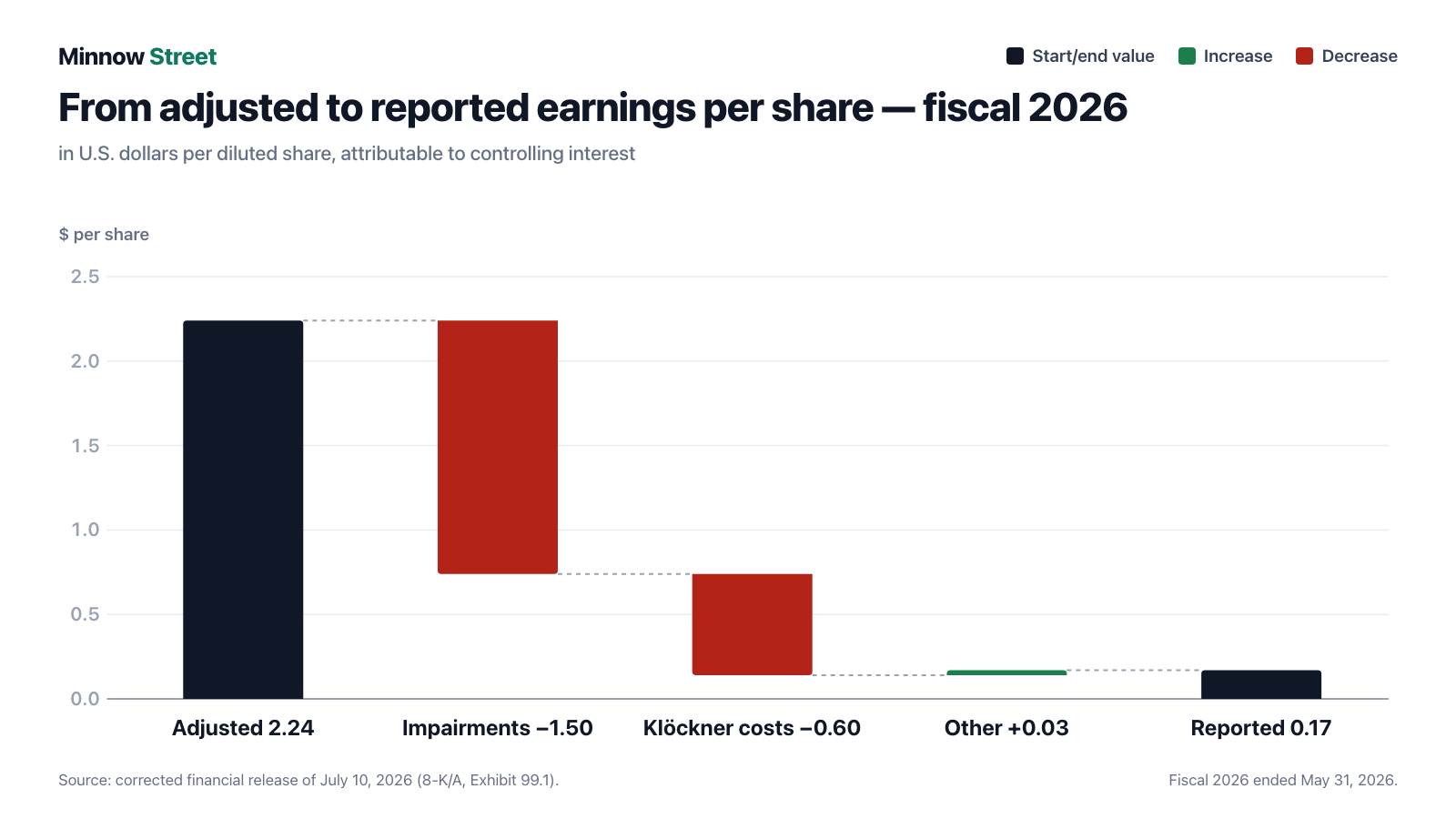
First, on fiscal 2026 reported earnings of $0.17 per share: a price-to-earnings ratio of roughly 216. Formally correct, but it mostly measures the impairment. Second, on adjusted earnings of $2.24: roughly 16. That is the figure the company works with, and for a cyclical supplier it is neither cheap nor expensive. Third, the number many screens showed: 108.1, computed off the withdrawn $0.34 — a value that belongs to neither picture. Two other measures round out the picture — with the same timing caveat. The price-to-sales ratio sits at a little over 0.5 ($1.84 billion of market value against $3.44 billion of revenue) — typical for a business with thin margins and heavy material throughput. Except that the market value belongs to the company with Klöckner and the $3.44 billion of revenue to the company without. Against the combined group's pro forma net sales of $9.70 billion (trailing twelve months to February 28, 2026), the ratio is only about 0.19. And the price-to-book ratio is about 1.7, measured against shareholders' equity attributable to controlling interest of $1,063.3 million at May 31, 2026. The dividend of $0.64 per share works out to a yield of roughly 1.7 percent at that market value.
A word on the professionals' view: the analyst estimates carried in our data (as of July 28, 2026) rest on just two opinions, with a mean target price of $46. With two voices, a "consensus" is more of an opinion than a consensus — a caution rather than a signpost. And the biggest caveat once more: an enterprise value — market value plus net debt — cannot be built from the last published balance sheet (May 31, 2026, unaudited). The market value belongs to the new company, enlarged by Klöckner; the net debt figure of $172.2 million reported there belongs to the old one. Add the two and you get a number that does not exist. An approximation is possible all the same, from the pro forma statements the company filed on May 26, 2026: $2,274.9 million of long-term debt as of February 28, 2026, on $6,106.1 million of total assets and $1,718.7 million of equity. Long-term debt alone therefore exceeds the market value of about $1.84 billion — a very different picture from the $172.2 million in the old balance sheet. Those pro forma figures are unaudited, though. How differently valuation anchors can behave in cyclical industries shows up across our other deep-dive analyses from the industrial sector.
Opportunities and risks at a glance
What speaks for Worthington Steel:
- The operation delivers: fiscal 2026 net sales up 11.3 percent to $3,443.8 million, adjusted earnings per share up from $2.16 to $2.24, adjusted EBIT up from $149.1 million to $161.1 million — a better year than fiscal 2025. Total tonnage did fall 5.5 percent, but that was the low-revenue toll processing business; the revenue-heavy direct volumes grew.
- The $112.2 million impairment costs book value, not cash: operations generated $201.2 million in fiscal 2026, leaving $80.0 million of free cash flow after capital spending — several times the $32.6 million paid out in dividends.
- The May 31, 2026 balance sheet was sound — unaudited, since it appears only in the financial release: $2,252.4 million of total assets, $1,197.6 million of equity, $256.8 million of total debt against $84.6 million of cash — net debt of only $172.2 million as the starting point for the takeover.
- The error was found and disclosed by the company itself: the additional impairments surfaced during its own year-end controls, the correction followed within 16 days, and previously filed quarterly reports and the outlook were unaffected.
- Klöckner creates a much larger, geographically broader metals processor; the company expects "greater scale, shared best practices and operational efficiency" from it (10-Q, February 28, 2026). The $700 million term loan carries no financial maintenance covenant; the new asset-based facility only tests a 1.00-to-1.00 fixed charge coverage ratio once remaining availability falls below the agreed threshold (Form 8-K of June 30, 2026).
What speaks against it:
- Reported earnings have become unreliable: $0.34 per share became $0.17, and $15.5 million of operating income became a $1.4 million operating loss — while the audited annual report (10-K) for fiscal 2026 had still not been filed as of July 28, 2026.
- Goodwill in Electrical Steel is under watch: $112.2 million written off twelve months after the $66.3 million Sitem purchase; consolidated goodwill is down to $44.5 million, and Sitem itself lost $8.2 million over nine months.
- The sign of the year hangs on one affiliate: the Mexican 50 percent joint venture contributed $20.3 million of equity income in fiscal 2026 against pre-tax earnings of $7.1 million — and that contribution swung between $4.4 million and $22.4 million over three years.
- $1.4 billion of new debt against a market value of about $1.84 billion (data as of July 28, 2026): $700 million of notes at 7.750 percent due 2033 plus a $700 million term loan at SOFR plus 4.00 percentage points. On top of that come roughly $899.7 million of Klöckner's own borrowings, which consolidation pulls onto the books: the company's pro forma statements show $2,274.9 million of long-term debt as of February 28, 2026 — more than the market value. The note coupon alone costs a little over $54 million a year, against free cash flow of $80.0 million.
- Concentration and cycle: 52 percent of net sales from automotive, 33 points of that from the Detroit Three, two customers at 14 and 12 percent; plus an earnings line tied directly to steel prices through inventory holding gains and losses (most recently a $14.7 million gain in the quarter, a $10.4 million loss across fiscal 2025).
A human conclusion
Back to the freshness trap. Its core is not that numbers lie — they rarely do. Its core is that a screen makes no distinction between a figure from today and a figure withdrawn three weeks ago. At Worthington Steel that distinction is worth half the profit. And if you keep digging, it does not stop at one number: the balance sheet on the web knows nothing of the $1.4 billion of new debt. The earnings history knows nothing of the European acquisition. Yesterday's goodwill is half written off today.
What is left once you subtract all of it? A sound, unspectacular operation: $3.4 billion of revenue, 3.6 million tons of steel, 6,000 people, $201 million of cash from operations, a covered dividend — and a management team that has just decided to turn a North American mid-cap into a transatlantic group through a debt-funded takeover. That can end brilliantly. It can also be the moment a company overreaches. So the honest question is not "is a price-to-earnings ratio of 108 too high?" but: do you want to own a company whose most important numbers only become visible in the next two filings — the audited annual report for fiscal 2026 and the first quarterly report with Klöckner on board? Wait for those two, and you may miss a good entry. Do not wait, and you are buying a company that has never yet been seen in this form. The decision is yours.
Sources
Every original document used in this analysis, so you can read it yourself:
- Worthington Steel, Inc. — Quarterly report 10-Q as of February 28, 2026 (filed April 9, 2026)
- Worthington Steel, Inc. — Annual report 10-K for fiscal 2025 (filed July 29, 2025)
- Worthington Steel, Inc. — Form 8-K of March 10, 2026 (minimum acceptance threshold cut from 65 to 57.5 percent)
- Worthington Steel, Inc. — Form 8-K of March 31, 2026 (results of the initial acceptance period)
- Worthington Steel, Inc. — Form 8-K of May 26, 2026 (Klöckner's audited 2025 financial statements, Exhibit 99.2) and its Exhibit 99.3 (unaudited pro forma condensed combined financial information as of February 28, 2026)
- Worthington Steel, Inc. — Form 8-K/A of July 10, 2026 (corrected financial release, Item 2.02) and its Exhibit 99.1
- Worthington Steel, Inc. — Form 8-K of June 25, 2026 (original financial release — itself already a corrected version, because of a duplicated footnote; dividend; change of Corporate Controller, Item 5.02)
- Worthington Steel, Inc. — Form 8-K of June 2, 2026 ($700 million notes offering, term loan)
- Worthington Steel, Inc. — Form 8-K of June 3, 2026 (completion of the Klöckner acquisition)
- Worthington Steel, Inc. — Form 8-K of June 30, 2026 (new credit agreement, termination of the former one)
- Worthington Steel, Inc. — Form 8-K of July 15, 2026 (delisting offer to remaining Klöckner shareholders)
- Complete SEC filing history of Worthington Steel, Inc.: EDGAR overview (sec.gov)
- Fundamental data (market value, share count, analyst estimates; data as of July 28, 2026), reconciled with the SEC filings.
Transparency & disclaimer: this analysis is journalistic commentary on publicly available information. It is not investment advice, not a financial analysis in the regulatory sense and not a solicitation to buy or sell securities. Equity investments carry substantial risk, up to and including total loss. All information without warranty; the data cut-off is stated in the text. The author holds no position in Worthington Steel shares at the time of publication.
Our Bottom Line at a Glance
- Operating substance positive
- The core business carries itself: net sales rose 11.3 percent to $3,443.8 million in fiscal 2026 (ended May 31, 2026), adjusted earnings per share went from $2.16 to $2.24 and adjusted EBIT from $149.1 million to $161.1 million. The company attributes the revenue gain primarily to higher direct volumes, including the first-time consolidation of the Sitem Group, and only then to prices; total tonnage fell 5.5 percent (3,586,817 tons after 3,793,752) because low-revenue toll processing collapsed. Operationally, 2026 was the better year.
- Earnings quality & reporting negative
- The financial release of June 24, 2026 was superseded in its entirety on July 10, 2026: $0.34 per share became $0.17, and $15.5 million of operating income became a $1.4 million operating loss. The trigger was additional impairments in Electrical Steel that only surfaced during year-end closing controls. It was already the second correction of the same release within 16 days — the June 25, 2026 filing had itself carried a corrected version because a footnote in the reconciliation table was erroneously duplicated. The audited annual report (10-K) for fiscal 2026 had not been filed as of July 28, 2026. One day before that first release the Corporate Controller and Principal Accounting Officer, the executive responsible for financial reporting, announced his retirement and left the same day — not, the filing states, as the result of any disagreement over accounting.
- Balance sheet & leverage neutral
- At May 31, 2026 the balance sheet was sound — unaudited, since it appears only in the financial release: $2,252.4 million of total assets, $1,197.6 million of equity, net debt of only $172.2 million. One day later $1.4 billion of new debt arrived for Klöckner ($700 million of notes at 7.750 percent due 2033 plus a $700 million term loan); consolidation also pulls roughly $899.7 million of Klöckner's own borrowings onto the books. The company's unaudited pro forma statements of May 26, 2026 show $2,274.9 million of long-term debt as of February 28, 2026 — more than the market value of about $1.84 billion — alongside $6,106.1 million of total assets, $1,718.7 million of equity and $9,702.7 million of trailing twelve-month net sales. The term loan carries no financial maintenance covenant. The quarterly report (10-Q) for the first quarter of fiscal 2027 brings the first reported, but still unaudited, figures for the combined group; audited figures only come with the annual report (10-K) for fiscal 2027.
- Dependencies negative
- Automotive accounted for 52 percent of fiscal 2025 net sales, 33 points of it from the Detroit Three; two individual customers stood at 14 and 12 percent. On top of that sits the Mexican 50 percent joint venture: $20.3 million of equity income in fiscal 2026 against pre-tax earnings of $7.1 million — without it, the year would have been negative before tax.
- Cash flow & dividend positive
- The impairment costs no liquidity: operations generated $201.2 million in fiscal 2026 (prior year $230.3 million), and after $121.2 million of capital spending $80.0 million of free cash flow remained. The dividend of $0.64 per share cost $32.6 million and is covered several times over; trailing twelve-month adjusted EBITDA was $245.3 million.
Worthington Steel is a sound steel processor with a reporting problem and a transformation risk. Operationally, fiscal 2026 was better than the year before — $3,443.8 million of net sales, $2.24 of adjusted earnings per share, $80.0 million of free cash flow. What was actually reported, however, came to just $0.17 per share, after $112.2 million was written off in Electrical Steel and the company had to replace its own financial release in its entirety sixteen days later. At the same time it has borrowed $1.4 billion to buy Klöckner & Co — against a market value of about $1.84 billion (data as of July 28, 2026) and a balance sheet that knows nothing about it yet. Not investment advice.
What Our Rating Means
Open questions
The business works in principle, but one material question is open. As long as it stays open, our findings do not carry a quality verdict.
The business model works and is not financially at risk: $201.2 million of cash from operations in fiscal 2026, $1,197.6 million of equity, only $172.2 million of net debt at the May 31, 2026 balance sheet date, and a dividend covered several times over. Nothing supports red — no going-concern doubt, no negative equity, no interest coverage below one, no listing risk. Yellow stands anyway, for two operating reasons that are both open. First, fiscal 2026 earnings had to be halved sixteen days after the first announcement because further impairments surfaced during the company's own year-end controls — that it found and disclosed the error itself speaks in its favor, but the audited version in the annual report (10-K) was still outstanding on July 28, 2026, as was the auditors' statement on the effectiveness of internal control. Second, the group has leaned out with $1.4 billion of debt for the largest acquisition in its history, and integrating a European company over which it does not even hold instruction rights during the transition period is unproven. Add to that a year whose sign depended on a single unconsolidated joint venture. None of this is a substance risk — but they are open operating questions, and open questions call for the more cautious grade. This light says nothing about price: whether a price-to-sales ratio of a little over 0.5 is cheap is for the scanners to decide, not for this assessment. The decision is yours.
A journalistic assessment by our editorial team at the time of the deep dive, based on public sources — not investment advice and not a solicitation to buy or sell. Your personal circumstances (investment goals, risk capacity, taxes) cannot be taken into account. What our levels mean, how verdicts are formed, and what conflicts of interest exist →
Worth Noting
- Worthington Steel reached our research list through the filing stream at the U.S. securities regulator, the SEC: on July 10, 2026 the company superseded its own financial release of June 24, 2026 in its entirety by amendment (Form 8-K/A). Amendments to earnings releases are rare. The striking contradiction in our data — a price-to-earnings ratio of 108.1 alongside a price-to-sales ratio of a little over 0.5, as of July 28, 2026 — has the same origin: it still carries the withdrawn $0.34 per share.
- Data cut-off and evidence chain: every figure through fiscal 2025 comes from the audited annual report (10-K, filed July 29, 2025), the nine-month figures from the quarterly report (10-Q) as of February 28, 2026, and all fiscal 2026 annual figures from the corrected financial release of July 10, 2026 — which is unaudited. The annual report for the fiscal year ended May 31, 2026 had not been filed as of July 28, 2026.
- Not to be confused: Worthington Steel, Inc. (NYSE: WS) has been independent since December 1, 2023 and is not the same company as its former parent, which today is called Worthington Enterprises, Inc. The fiscal year ends May 31; references to "fiscal 2026" cover essentially June 2025 through May 2026. Analyses here are evergreen, and a daily price is never a reason to buy.
Frequently Asked Questions
Because the earnings in the denominator have almost disappeared. In fiscal 2026, which ended May 31, 2026, only $8.5 million was attributable to shareholders, or $0.17 per diluted share, after $2.19 the year before. The causes: $112.2 million of impairments in Electrical Steel and the Klöckner acquisition costs. Many data services were still using the later-superseded $0.34 on July 28, 2026.
The entire fiscal 2026 financial release. On June 24, 2026 the company had reported $0.34; on July 10 it filed an amendment with a corrected version that "supersedes the Original Financial Release in its entirety." The reasons: additional impairments in Electrical Steel and bridge loan costs. The result: $0.17 instead of $0.34, and a $1.4 million operating loss instead of $15.5 million income. It was the second correction of the same release: the June 25, 2026 filing already carried a corrected version, because a footnote in the non-GAAP reconciliation table had been erroneously duplicated.
On May 31. Fiscal 2026 therefore ran essentially from June 2025 through May 2026, and the fourth quarter covered March through May 2026. Comparing these figures with calendar years compares different periods. As of July 28, 2026 the audited annual report (10-K) for fiscal 2026 had not yet been filed; the prior-year report was filed on July 29, 2025.
The Columbus, Ohio company processes steel: it buys flat-rolled coils from mills and slits, cold-reduces, galvanizes and welds them into parts made to customer specification. Three product families carry the business — carbon flat-rolled steel, electrical steel laminations and tailor welded blanks. In fiscal 2026 it processed 3,586,817 tons and generated $3,443.8 million of net sales.
Through a spin-off. The company was incorporated in Ohio on February 28, 2023 and took over the steel processing business of its former parent. The separation was completed on December 1, 2023, and Worthington Steel became an independent company listed on the New York Stock Exchange. The former parent is today called Worthington Enterprises, Inc.
It is the largest deal in company history and changes the balance sheet fundamentally. On June 3, 2026 Worthington Steel acquired 60,710,791 Klöckner & Co SE shares at 11.00 euros each — roughly 60.86 percent of the share capital; measured against the outstanding shares the company itself puts the stake at approximately 62 percent. Funding: two tranches of $700 million — notes at 7.750 percent and a term loan. Pro forma long-term debt stood at $2,274.9 million as of February 28, 2026.
Heavily. In fiscal 2025, 52 percent of net sales came from automotive (52 percent in 2024, 50 percent in 2023), of which 33 points came from the Detroit Three automakers. Two individual customers accounted for 14 and 12 percent. The annual report itself states that the business is "largely driven by the production schedules of the Detroit Three Automakers."
By cash flow yes, by reported earnings no. In fiscal 2026 the company paid $32.6 million in dividends ($0.64 per share) while operations generated $201.2 million and free cash flow after capital spending came to $80.0 million. Reported earnings of $8.5 million would not have covered it — they are weighed down by impairments that cost no cash.
Found an error?
Did you spot a factual error, an outdated number, or a typo in this deep dive? Let us know briefly — your report goes straight to the editorial team.