NESR Stock: Textbook Momentum From the Middle East — and One Customer Behind 49 Percent of Revenue
National Energy Services Reunited (NESR) runs frac fleets, drilling and well-testing crews for the oil states of the MENA region — and lights up 26 filters in our in-house stock scanner at once, from Weinstein stage 2 to EPS acceleration (data as of July 17, 2026). We read the first annual report on Form 10-K in the company's history, the quarterly report (10-Q) as of March 31, 2026, and the May 2026 resale prospectus: a quarter with 33 percent more revenue and 129 percent more profit, one customer paying nearly half the bill, an accounting past with a remediation stamp — and anchor shareholders who have registered 28.3 million shares for sale. Not investment advice — just the question of whom you are following when every signal points the same way.
 Thomas Mücke
Founder & Publisher
Thomas Mücke
Founder & Publisher
Chart
Interactive price chart (TradingView).
Note: pure fact-based analysis, not investment advice and not a solicitation to buy or sell. All figures without guarantee.
There is an investor trap that works best on the people who check most carefully: the unanimity trap. It goes like this: you look at a stock and everything points the same way — the trend, the earnings, the funds, the analysts. The more signals agree, the more redundant your own homework feels; at some point the brain mistakes unanimity for safety. Hardly any stock feeds that trap in the summer of 2026 as reliably as National Energy Services Reunited Corp. (Nasdaq: NESR), the oilfield services champion of the Middle East: 26 hits in our in-house stock scanner, from the Stan Weinstein stage-2 uptrend to EPS acceleration to institutional accumulation (data as of July 17, 2026). When that many lamps glow green at once, almost nobody checks the fuel gauge anymore. So let\'s make a deal: before you join the convoy, we read together what the company itself reported, under penalty of law, to the U.S. securities regulator, the SEC — the first annual report on Form 10-K in the company\'s history, the quarterly report (10-Q) as of March 31, 2026, and the resale prospectus from May 2026. And beside a genuine growth story, these filings tell of one customer paying nearly half the bill, of an accounting past that needed a remediation stamp — and of anchor shareholders who have just put up the exit signs. In the end, you decide for yourself.
What NESR actually does — and for whom
NESR is something like the contractor of the oil states: the company owns no oil wells — it does the work on them, on behalf of those who own the oil. The job list fills two segments. "Production Services" ($816.0 million of revenue in 2025) is above all hydraulic fracturing — cracking tight rock with water pressure so oil and gas can flow — plus coiled tubing, stimulation, cementing and specialty chemicals. "Drilling and Evaluation Services" ($508.0 million) supplies rigs, downhole tools, directional drilling and well testing, the measuring and proving of wells. The customers are almost exclusively national oil companies (NOCs) — the landlords of the cheapest oil fields on earth. NESR operates in 16 countries; per the annual report, 99 percent of revenue is generated in the MENA region (Middle East and North Africa), centered on Saudi Arabia, Oman, Kuwait, the UAE, Iraq, Egypt, Libya and Algeria. Roughly 7,352 people from more than 60 nations work for the company. The corporate history is unusual: founded in 2017 by former Schlumberger executive Sherif Foda as a blank-check company (SPAC), NESR bought the two regional service firms NPS and Gulf Energy in June 2018 — with the declared goal of building the first Nasdaq-listed oilfield services champion from the region for the region. The company is incorporated in the British Virgin Islands and headquartered in Houston. And since January 1, 2026, there is a break in the record that helps every reader of the numbers: NESR lost its foreign-private-issuer status and now reports like a U.S. company — quarterly reports (10-Q), insider filings (Form 4) and proxy rules included. The 10-K of March 6, 2026, is the first annual report of this format in the company\'s history. Which brings us to the central tension of this analysis, and it runs through every chapter: the momentum is real and the acceleration is in the books — but it rests on a single major customer, thin margins, and an ownership circle that is currently sorting its sale papers. How cyclical the frac-fleet business is, we dissected at the U.S. counterpart ProPetro — and what oil-price cycles do to balance sheets, at Gulf of Mexico producer W&T Offshore.
Where the stock shows up in our scanner
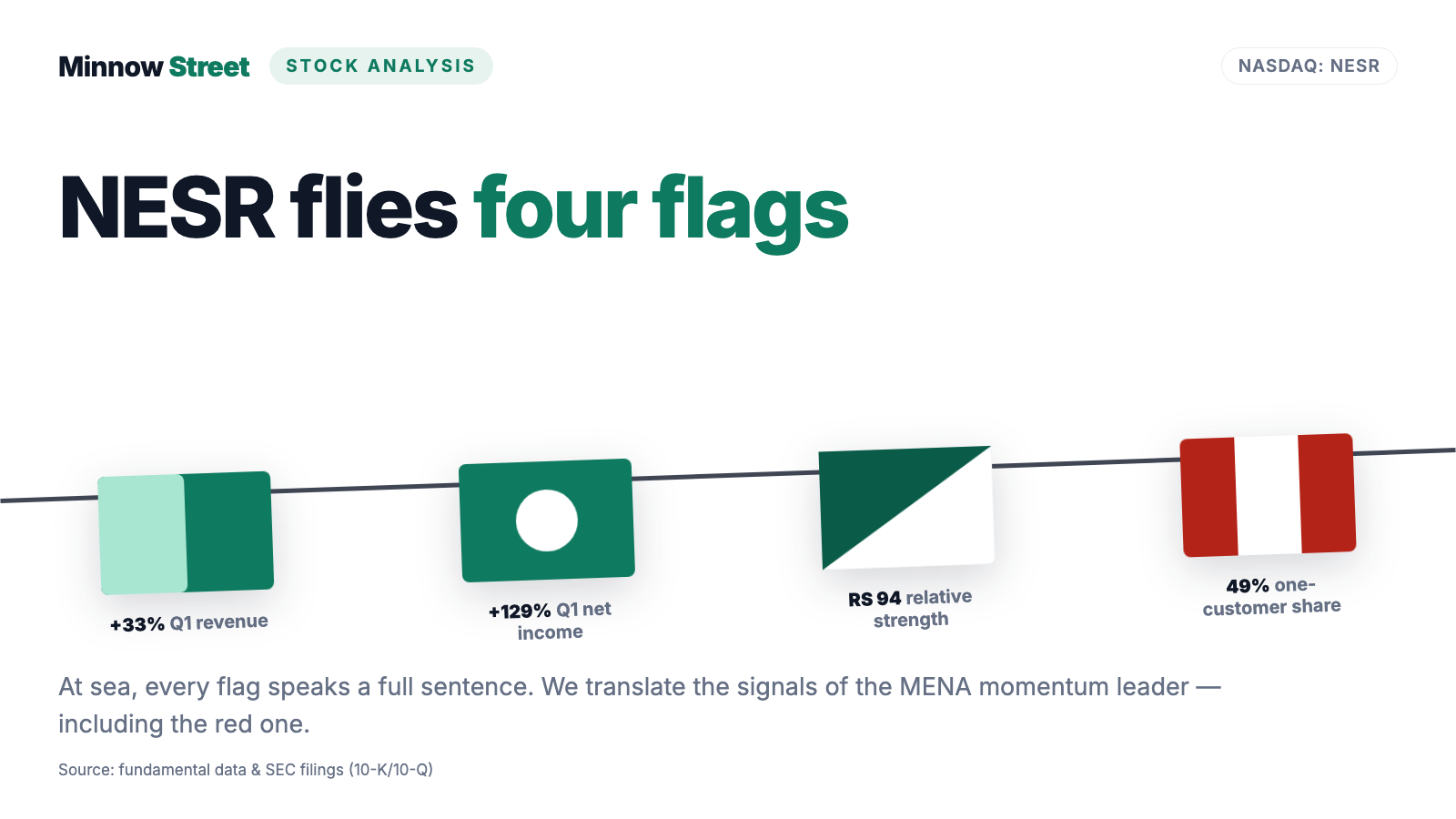
Every day we run about 3,500 stocks through our scanners. NESR reached the research list through the momentum run of July 17, 2026 — with a confluence that is rare even in this series: 26 hits. The five most striking: the stock sits in a Stan Weinstein stage-2 uptrend (price above a rising 200-day average — the stretch of a price cycle in which trend followers engage at all), belongs to the RS leaders above 90 with a relative strength rating of 94 (it beat 94 percent of all stocks over the trailing twelve months), trades roughly 6 percent below its all-time high, shows EPS acceleration (earnings per share growing faster than in prior quarters) and institutional accumulation — most recently 13 funds added while only 4 trimmed. Behind that stand plus 33 percent in three months, plus 89 percent in six and plus 340 percent in twelve (data as of July 17, 2026). Notably, unlike many momentum runners, the fundamental lens reports decent marks too: a fundamental grade of B, a Piotroski F-score of 7 of 9 (a nine-point test of the direction of the books; 7 means most metrics are improving) and an Altman Z-score around 4.8 (an early-warning gauge of insolvency risk; the danger zone historically starts below 1.8). Only the valuation has run ahead of itself: the trailing price-to-earnings ratio stands around 43. To replicate it yourself: open the NESR stock page or browse the stage-2 scanner. Remember this for everything that follows: a scanner measures how a stock runs — not what it depends on. What NESR depends on is in the filings.
The numbers over the years — honestly appraised
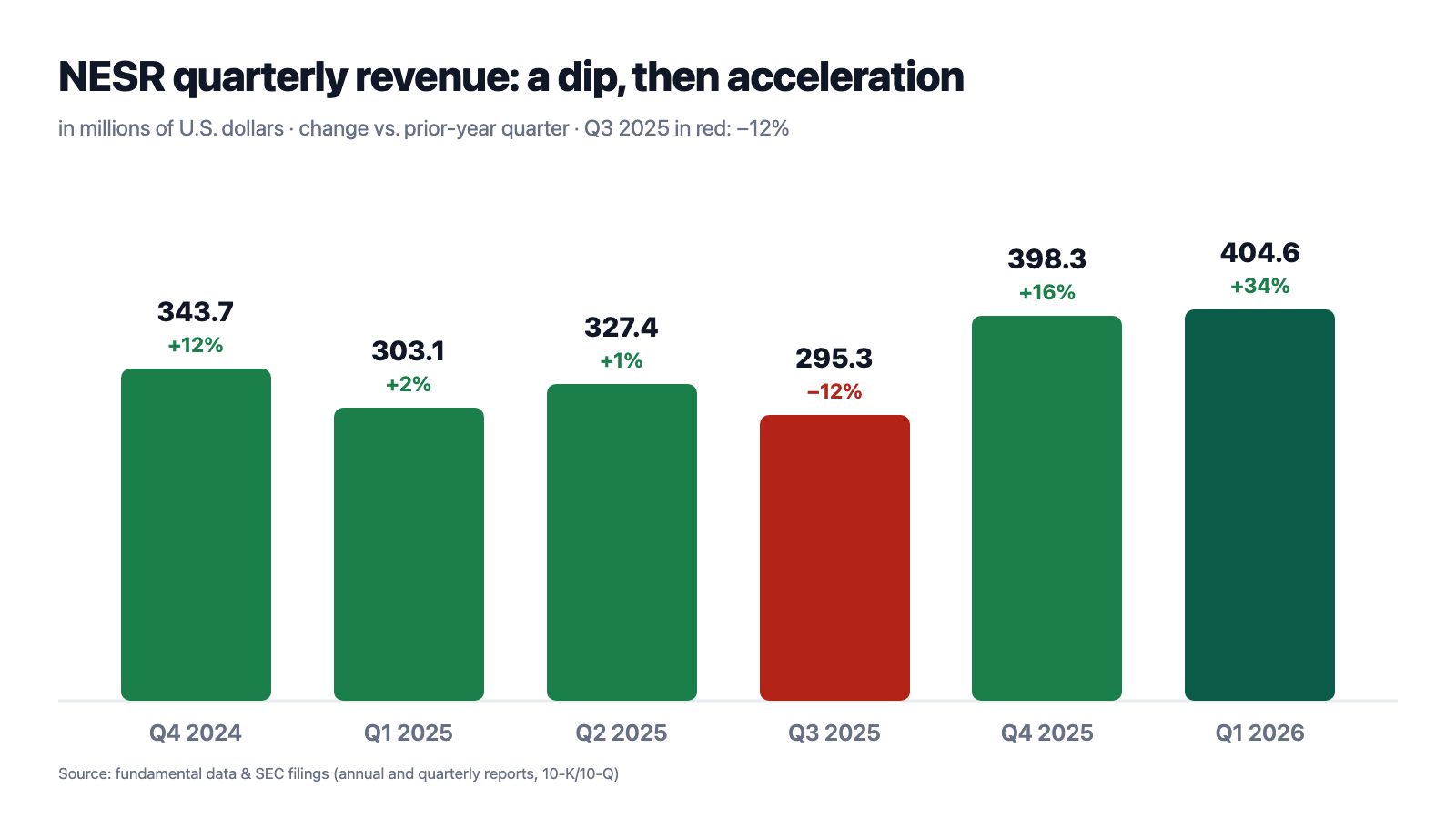
First, what genuinely impresses. Since the pandemic-era oil-price trough, NESR has built a remarkably steady growth staircase: $909.5 million of revenue in 2022, $1,145.9 million in 2023 (+26 percent), $1,301.7 million in 2024 (+14 percent). Net income jumped to $76.3 million in 2024 (after $12.6 million in 2023), and operating cash flow reached $264.2 million in 2025 — with a good $110 million left after investments. The balance sheet behind it is solid for a capital-intensive oil services firm: $93.0 million in cash against $287.4 million of borrowings (March 31, 2026), or roughly $194 million of net debt against $995.2 million of equity — and interest expense fell to $32.5 million in 2025 from $39.9 million. And then the first quarter of 2026 arrived and hit the turbo the scanners are smelling: $404.6 million of revenue, up 33 percent, net income of $23.8 million, up 129 percent — per the quarterly report "primarily due to increased hydraulic fracturing stages in Saudi Arabia" and more well testing in the same place.
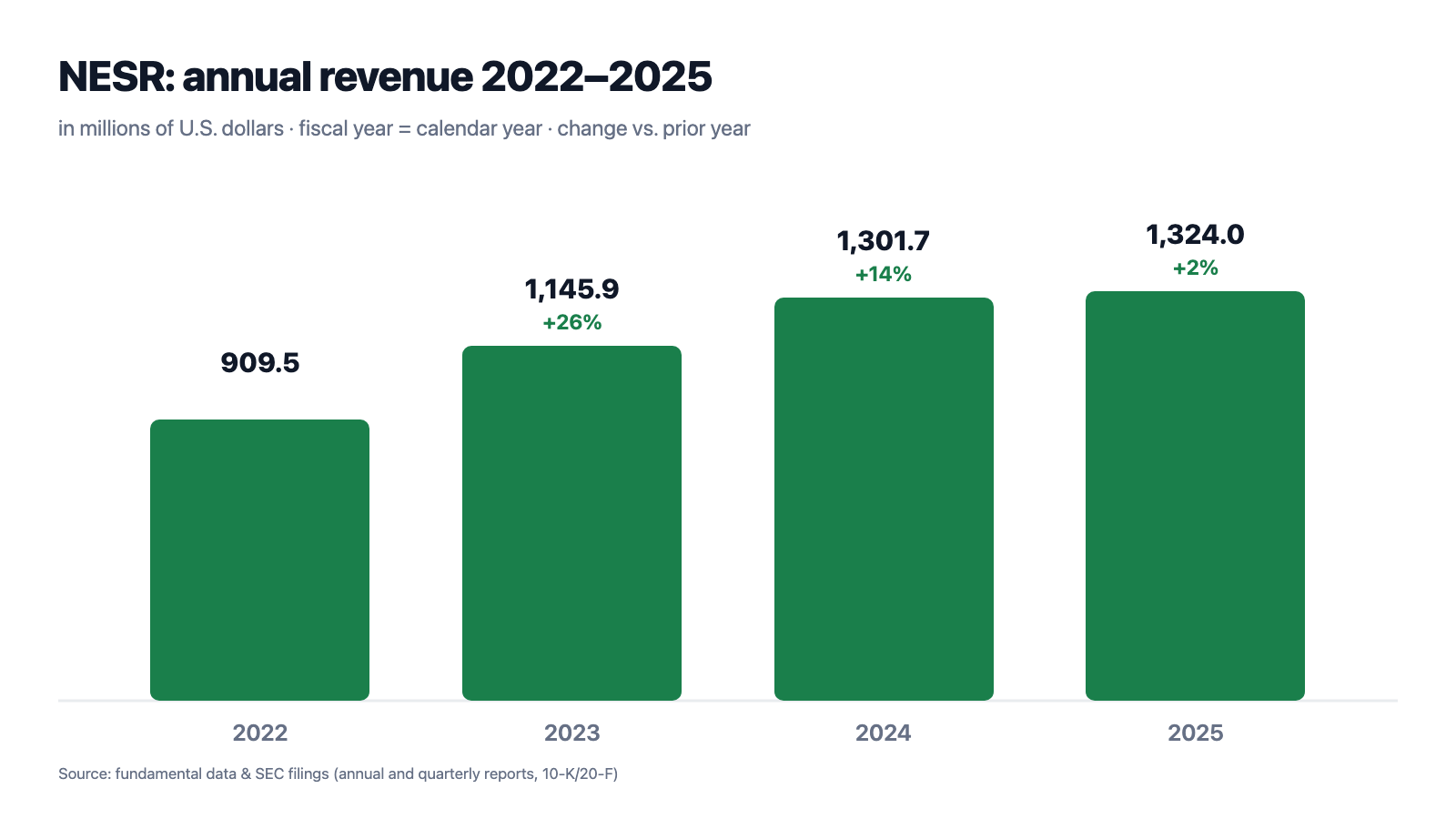
Now the whole truth about the flat step: in 2025, revenue grew only 2 percent to $1,324.0 million, gross margin fell from 16.0 to 12.4 percent, and net income shrank from $76.3 million to $51.1 million. The production business lost seven percent of revenue as fewer frac stages were pumped during a contract transition; the third quarter of 2025 came in twelve percent below the prior year. Holding the stock back then took nerves — the share price stood at $10.39 on October 1, 2025, as the annual report itself records. Only afterwards did the story turn: the report points to "the announcement of a major contract award in Saudi Arabia after October 1, 2025," the fourth quarter grew 16 percent again, the first quarter of 2026 grew 33 — and the share price has roughly tripled since. Remember the rhythm: at an oilfield services firm, it is not the market that orders but the client — and a single contract transition can shape an entire year, in either direction. Which brings us to the uncomfortable truths.
What the filings say — the uncomfortable truths
Uncomfortable truth no. 1: One customer pays nearly half the bill — and does not have to keep doing so
The risk-factor section of the annual report quantifies the dependence hiding behind the friendly phrase "NOC customer base" with disarming precision:
"Revenues from four customers individually accounted for 49%, 9%, 8% and 7% of the Company’s consolidated revenues in the year ended December 31, 2025, 54%, 9%, 7% and 4% of the Company’s consolidated revenues in the year ended December 31, 2024, and 44%, 8%, 7% and 5% of the Company’s consolidated revenues in the year ended December 31, 2023."
— National Energy Services Reunited Corp., SEC annual report 10-K for 2025, Item 1A "Risk Factors"
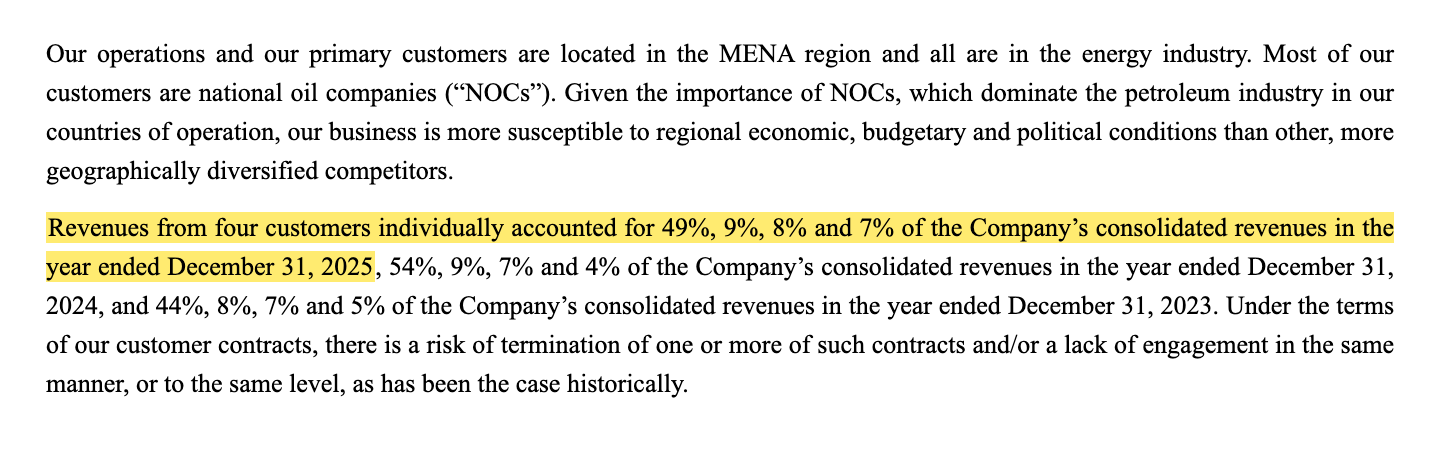
One customer, nearly half the bill: picture a repair shop whose biggest client puts every second car on the lift — and the report adds dryly that there is "a risk of termination of one or more of such contracts and/or a lack of engagement in the same manner, or to the same level, as has been the case historically" (10-K 2025). The 49-percent customer is not named in the report; lay a map of frac activity in Saudi Arabia beside it and you can guess. The fair counterargument: NOCs are the most solvent clients in the industry, they produce at the lowest costs in the world, and per the annual report they keep investing through downturns — that stability is exactly NESR’s home-field advantage over U.S. service firms whose customers live and die by the oil price. But a contract transition at this one customer was already enough in 2025 to compress the group’s gross margin by three and a half points. Concentration cuts both ways: it delivered the acceleration — it can switch it off just as fast.
Uncomfortable truth no. 2: The margin is thin — and the weak year 2025 was the price of the jump
Of every $100 in revenue in 2025, only $12.40 remained as gross profit after direct costs — the year before it was $16. The annual report explains why with remarkable openness:
"The change in cost of services as a percentage of total revenue is mainly due to an elevated cost structure expected to support higher activity levels going forward, particularly in Saudi Arabia."
— National Energy Services Reunited Corp., SEC annual report 10-K for 2025, Item 7 "Management’s Discussion and Analysis"
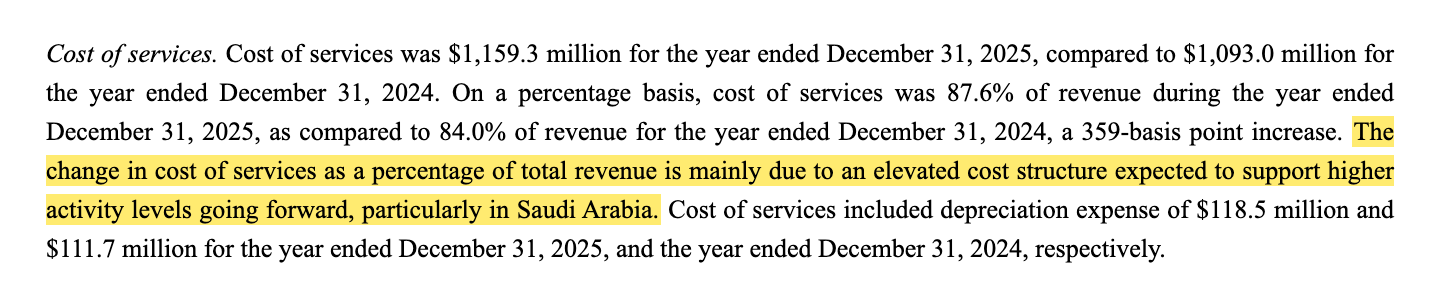
Translated into investor language: in 2025, NESR paid for crews and machines against contracts that would only earn money later — front-loading by design. The first quarter of 2026 shows how the lever is meant to work: revenue grew 33 percent, the cost ratio eased from 87.6 to 87.2 percent, and because overhead and interest barely grew along, net income more than doubled. Except: even after the jump, of every $100 in revenue just $12.80 remain as gross profit and $5.90 as net income — the reality of a services firm bidding against the world leaders Schlumberger, Halliburton and Baker Hughes for the contracts of the same state-owned giants. A price concession of a few points, a contract re-tender, a mobilization year like 2025 — and profit reacts multiplied. Remember the image: with thin margins, profit is a leveraged product on revenue — on the way up and on the way down. Which is precisely why the scanners are currently celebrating the upside of that lever.
Uncomfortable truth no. 3: The books were a construction site for years — until mid-2025
Whoever knows NESR only since the rally does not know the scar. Between 2022 and 2024 the company was an accounting turnaround case: the annual report for 2021 was not filed on time (notification of late filing dated May 3, 2022), and the next annual report (20-F) appeared only on December 29, 2023 — for 2022, bundled with a restatement of the already audited 2020 financials. In 2022 and 2023 the shareholder meeting was skipped altogether. And the root-cause analysis in the current annual report reads like a piece of self-testimony you rarely get to see:
"In connection with the audits of the Company’s financial statements for the years ended December 31, 2024, 2023, and 2022, management and the Company’s independent registered public accounting firm identified a material weakness in the Company’s internal control over financial reporting. Our executive officers failed to set an appropriate tone at the top sufficient to ensure a culture of compliance with the Company’s accounting, finance and internal control policies […]"
— National Energy Services Reunited Corp., SEC annual report 10-K for 2025, Item 9A "Controls and Procedures"
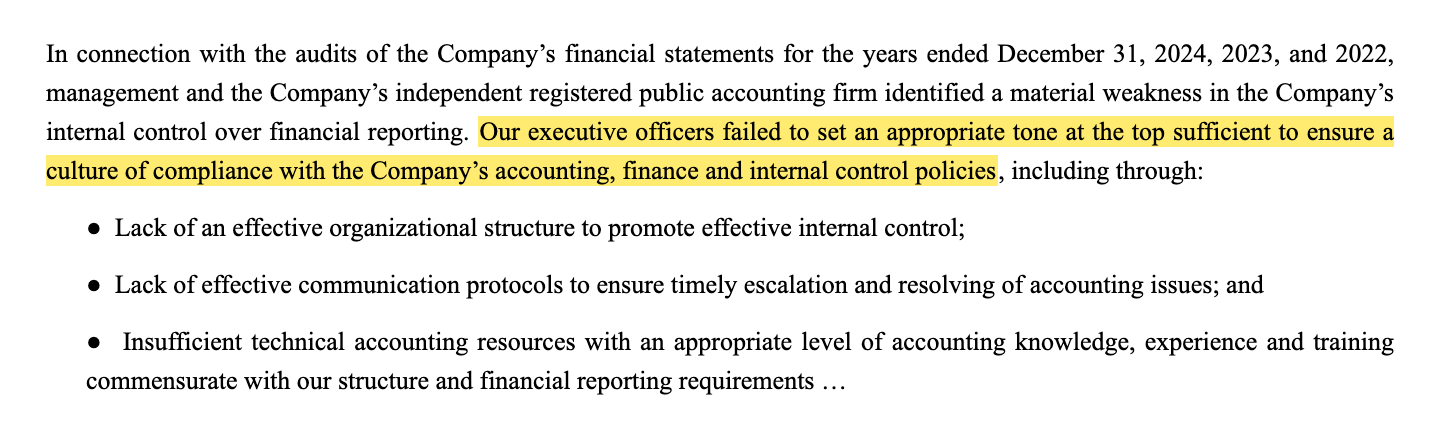
Honesty requires both halves. First, the all-clear: per the report, the remediation is complete — new independent directors (June 2024, May 2025), the CFO reports directly to the non-employee board members at least through the end of 2026, bonuses have been tied to internal-control compliance since 2023, and as of June 30, 2025, management declared the weakness remediated; the switch to U.S. domestic-filer status in January 2026 tightens the reins further. Second, the lasting lesson: the same leadership that tells today’s growth story — founder-CEO Sherif Foda included — had to write this testimony about itself. A "tone at the top" finding is not a footnote mishap; it is the most serious category of control weakness an auditor can issue. Whoever buys the stock also buys the assumption that this culture repair holds permanently — under the pressure of a growth spurt, which in most organizations strains discipline rather than strengthening it.
Uncomfortable truth no. 4: The anchor shareholders and the CEO have posted the exit signs
On May 26, 2026 — the share price had roughly quadrupled within twelve months — NESR filed an automatic shelf prospectus (S-3ASR) with the SEC. The decisive sentence:
"In addition, the selling shareholders named in this prospectus or their permitted transferees may sell up to 28,257,859 ordinary shares as described in this prospectus in one or more offerings."
— National Energy Services Reunited Corp., SEC resale prospectus S-3ASR of May 26, 2026, "About This Prospectus" and "Selling Shareholders"
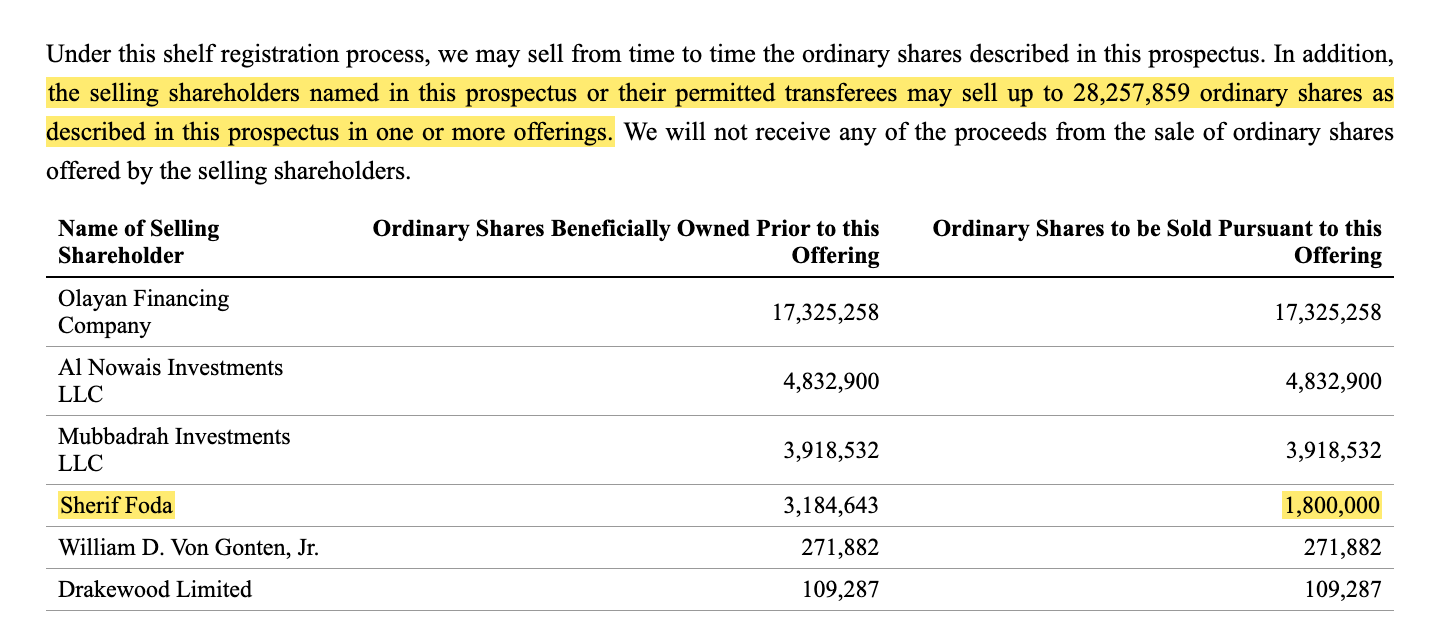
28,257,859 shares are roughly 28 percent of all shares outstanding (100.85 million as of May 22, 2026). The sellers’ list carries the anchors of the first hour: Saudi investment group Olayan (17.3 million), Al Nowais Investments of Abu Dhabi (4.8 million), Mubbadrah of Oman (3.9 million) — and CEO Sherif Foda himself with 1.8 of his 3.2 million shares. Important for perspective: a prospectus is a door-opener, not a sale; nobody is obliged to part with a single share, and a larger free float would actually improve the stock’s notoriously thin tradability. But the door is being used: seven notices of proposed sale (Form 144) reached the SEC in May 2026 alone, and board member Yousif Al Nowais reported sales on Form 4 as late as the end of June 2026. Remember the asymmetry: the buy side of this rally consists of funds and trend followers — the sell side may now consist of the people who have known the company longest. That proves nothing. But it belongs on the same sheet of paper as the 26 scanner hits.
Valuation: $2.7 billion in market value for the champion of a single region
In mid-July 2026 the NESR stock cost about $27, putting the market value at roughly $2.7 billion (data as of July 17, 2026). Measured against trailing earnings, that is sporty: a price-to-earnings ratio around 43 — the weak year 2025 is still baked into that number. Measured against revenue it is moderate: a price-to-sales ratio around 1.9 and about 2.7 times book value. The real bet sits in the estimates: analysts — though only a handful of firms cover the stock — expect roughly $1.65 in earnings per share for 2026 and about $2.41 for 2027 (data as of July 17, 2026). If that lands, today’s price pays 16 times the current and 11 times the coming year — no fantasy valuation for a services firm with a regular’s seat at the world’s largest oil company. Except everything in the uncomfortable truths hangs off this arithmetic: the estimates extrapolate the acceleration of precisely the customer who provides 49 percent of revenue, on a gross margin of 12 to 13 percent that forgives no price concession. Add a balance-sheet quirk: $645.1 million of goodwill — about a third of total assets — still stems from the founding-era acquisitions; if the business wobbles, so does that line. There is no dividend — the board considered a plan in 2025 but did not approve it; the cash ($93.0 million as of March 31, 2026) works against $287.4 million of borrowings and a capital program that consumed a good $150 million in 2025. Institutional investors hold about 85 percent of the shares, insiders just under 12 percent (data as of July 17, 2026) — the latter a number with a built-in expiry date after the May resale prospectus.
Opportunities and risks at a glance
What speaks for NESR:
- The acceleration is in the books, not just in the chart: revenue up 33 percent and net income up 129 percent in the first quarter of 2026, carried by frac and well-testing activity in Saudi Arabia; the fourth quarter of 2025 already grew 16 percent (quarterly report 10-Q as of 03/31/2026).
- Structural tailwind: the NOC customer base produces at the lowest costs in the world and, per the annual report, keeps investing through downturns; Saudi Arabia’s gas program (think unconventional fields) adds a second leg beside oil — the annual report explicitly expects the natural gas market to become an additional key performance indicator.
- A solid base under the momentum: $264.2 million in operating cash flow in 2025, net debt of roughly $194 million against $995.2 million of equity (March 31, 2026), falling interest expense, a Piotroski F-score of 7 of 9, an Altman Z-score around 4.8, fundamental grade B (data as of July 17, 2026).
- The governance construction site is officially closed: the material weakness was declared remediated as of June 30, 2025, new independent directors joined, the CFO reports directly to the board, and since January 2026 full U.S. reporting obligations apply as a domestic filer, with quarterly reports and insider filings.
- The technicals are first-rate: a Stan Weinstein stage-2 uptrend, a relative strength rating of 94, roughly 6 percent below the all-time high, 13 funds adding versus 4 trimming, 26 scanner hits (data as of July 17, 2026).
What speaks against it:
- Extreme concentration risk: one customer accounted for 49 percent of 2025 revenue, four customers for 73 percent — with no guarantee of engagement at historical levels; the 2025 contract transition alone cost three and a half points of gross margin (10-K 2025, Item 1A and Item 7).
- Thin margins with no safety net: gross margin of 12.4 percent (2025) and 12.8 percent (Q1 2026), net margin around 6 percent — bidding against Schlumberger, Halliburton and Baker Hughes, every price or utilization setback hits profit with leverage.
- Region and geopolitics concentration: 99 percent of revenue from MENA; the risk factors explicitly name war, sanctions and regional instability — diversification is the plan, but so far barely the reality.
- A scar from the past: a restatement of the audited 2020 financials, an annual report roughly 20 months late, skipped shareholder meetings in 2022/2023 and an attested "tone at the top" failure of leadership — remediated, but owned by the same leadership that runs the company today.
- Supply overhang from within: 28.3 million shares (roughly 28 percent) registered for resale via S-3ASR, including 1.8 million of the CEO’s; seven Form 144 notices in May 2026 alone and Form 4 sales by a board member as late as the end of June 2026.
A human conclusion
Back to the unanimity trap from the opening. Its core is not that the majority is always wrong — at NESR, the majority has been spectacularly right since October 2025, and the quarterly numbers have backfilled the rally with substance. Its core is that unanimity replaces the homework it should have earned. The homework here yields a double image. On one side, a real company with real acceleration: $404.6 million in quarterly revenue, a doubled profit, a regular’s seat at the most reliable client in the oil world, and a balance sheet that can carry the upswing. On the other side, three things no scanner measures: a customer who pays nearly half the bill and does not have to; a margin that turns every point of price pressure into a profit problem; and an ownership circle, CEO included, that registered 28 percent of the shares for sale after the multiplication — while the memory of skipped shareholder meetings and restated books is not yet half a decade old. So the honest question for you is not "Is the momentum real?" (it is, as of July 17, 2026), but: would you still hold this company if the convoy turns — if the 49-percent customer re-tenders, the margin loses a point, and the anchors actually put their registered shares on the market? If yes, you know what you own. If no, the momentum owns you. What you make of it is your decision. And that is exactly as it should be.
Sources
All original documents used in this analysis — to read for yourself:
- National Energy Services Reunited Corp. — SEC annual report 10-K for 2025 (filed March 6, 2026; first 10-K after the switch to domestic-filer status)
- National Energy Services Reunited Corp. — SEC quarterly report 10-Q as of March 31, 2026 (filed May 11, 2026)
- National Energy Services Reunited Corp. — SEC resale prospectus S-3ASR of May 26, 2026 (28,257,859 legacy-holder shares)
- National Energy Services Reunited Corp. — SEC annual report 20-F for 2024 (filed March 28, 2025)
- National Energy Services Reunited Corp. — SEC annual report 20-F for 2023 (filed April 30, 2024; shareholder-meeting and restatement history)
- National Energy Services Reunited Corp. — SEC notification of late filing NT 20-F of May 3, 2022 (annual report 2021)
- National Energy Services Reunited Corp.’s complete SEC filing history: EDGAR overview (sec.gov)
- Fundamental data (metrics, quarterly series, valuation; data as of July 17, 2026), reconciled with the SEC filings.
- Screener and rating data: in-house stock scanner (data as of July 17, 2026).
Transparency & disclaimer: This analysis is a journalistic contextualization of publicly available information and is not investment advice, not a financial analysis in the regulatory sense, and not a solicitation to buy or sell securities. Stock investments carry substantial risks up to total loss. All information without guarantee; the data cut-off is noted in the text in each case. The author holds no position in NESR stock at the time of publication.
Our Bottom Line at a Glance
- Growth & momentum positive
- Revenue up 33 percent to $404.6 million and net income up 129 percent in the first quarter of 2026, after plus 16 percent in the fourth quarter of 2025 — carried by frac and well-testing activity in Saudi Arabia (10-Q as of 03/31/2026). The technicals confirm it: stage-2 uptrend, relative strength 94, roughly 6 percent below the all-time high (data as of July 17, 2026).
- Customer & region concentration negative
- One customer accounted for 49 percent of 2025 revenue, four customers for 73 percent, and 99 percent of the business sits in the MENA region — with no contractual guarantee of engagement at historical levels; the 2025 contract transition alone cost three and a half points of gross margin (10-K 2025, Item 1A and Item 7).
- Margin & capital intensity neutral
- Gross margin of 12.4 (2025) to 12.8 percent (Q1 2026) while bidding against Schlumberger, Halliburton and Baker Hughes — every price concession hits with leverage. Against that stand $264.2 million of operating cash flow in 2025, moderate net debt around $194 million and falling interest expense (03/31/2026).
- Governance & the past neutral
- A restatement of the audited 2020 financials, an annual report roughly 20 months late, skipped shareholder meetings in 2022/2023 and an attested "tone at the top" failure — declared remediated as of June 30, 2025, with full U.S. reporting obligations since January 2026. The repair is convincing; the probation period runs — under the same leadership.
- Owners & supply pressure negative
- The resale prospectus (S-3ASR) of May 26, 2026, registers 28.26 million shares — roughly 28 percent — held by anchors Olayan, Al Nowais and Mubbadrah plus 1.8 million shares of the CEO; seven Form 144 notices in May and Form 4 sales by a board member at the end of June 2026 show the door is being used. A larger free float improves tradability, but the supply comes from the best informed.
NESR delivers the rare double of textbook momentum and genuine earnings acceleration: revenue up 33 percent and net income up 129 percent in the first quarter of 2026, a Piotroski F-score of 7 of 9, a solid balance sheet — and 26 hits in our in-house stock scanner (data as of July 17, 2026). Against that stand a customer with a 49 percent revenue share, gross margins of 12 to 13 percent, a financial-controls clean-up completed only in mid-2025, and 28.26 million shares registered for resale by the anchor circle, CEO included. Whoever invests here buys the continuation of a Saudi contract boom — at a price that already assumes the continuation. Not investment advice.
What Our Rating Means
- If you don't own the stock
- As long as the question raised in the bottom line stays open, we see no basis for an entry.
- If you hold it in your portfolio
- Our findings offer no acute reason to sell — the checkpoints named remain decisive.
A journalistic assessment by our editorial team at the time of the deep dive, based on public sources — not investment advice and not a solicitation to buy or sell. Your personal circumstances (investment goals, risk capacity, taxes) cannot be taken into account. What our categories mean, how verdicts are formed, and what conflicts of interest exist →
Worth Noting
- NESR reached the research list through the momentum/stage-2 run of our in-house stock scanner on July 17, 2026, with 26 hits — including Stan Weinstein stage 2, RS leaders above 90, near 52-week high, EPS acceleration and institutional accumulation.
- Scanner metrics (P/E, P/S, Piotroski, Altman Z, fundamental grade, relative strength) are computed on trailing twelve-month figures; the transition year 2025 is in them, the expected further acceleration naturally is not.
- Price and valuation figures are dated July 17, 2026 (about $27, roughly $2.7 billion in market value); analyses are evergreen, daily prices are not a buy argument. NESR's fiscal year equals the calendar year.
Frequently Asked Questions
National Energy Services Reunited Corp. (Nasdaq: NESR) is an oil and gas field services provider for the MENA region: hydraulic fracturing, coiled tubing, cementing and stimulation ("Production Services", $816.0 million of revenue in 2025) plus rigs, directional drilling, well testing and wireline ("Drilling and Evaluation", $508.0 million). Customers are mostly national oil companies; 99 percent of the $1,324.0 million in 2025 revenue is generated in the MENA region.
Per the annual report, the stock stood at $10.39 on October 1, 2025; afterwards a major contract award in Saudi Arabia and accelerating numbers became public. The fourth quarter of 2025 grew 16 percent, and the first quarter of 2026 grew 33 percent to $404.6 million in revenue with 129 percent more net income. By mid-July 2026 the stock traded roughly 340 percent above its level of twelve months earlier and about 6 percent below its all-time high (data as of July 17, 2026).
Very: 99 percent of revenue comes from the MENA region, and per the annual report (10-K) for 2025 a single customer accounted for 49 percent of consolidated revenue; the four largest customers combined for 73 percent. The contracts carry no guarantee of engagement at historical levels — the 2025 contract transition alone compressed gross margin from 16.0 to 12.4 percent.
NESR failed to file its annual report for 2021 on time; the next annual report (20-F) appeared only on December 29, 2023, for 2022 — including a restatement of the already audited 2020 financials. No shareholder meeting was held in 2022 or 2023. As the root cause, management and auditors identified a material weakness: executives had failed to set an appropriate "tone at the top". Remediation was declared complete as of June 30, 2025.
Through the end of 2025, NESR qualified as a foreign private issuer and reported only annually on Form 20-F plus 6-K submissions. Since January 1, 2026, the BVI-incorporated company is a U.S. domestic filer: quarterly reports (10-Q), insider filings (Form 4), proxy rules and Regulation FD now apply in full. The annual report on Form 10-K filed March 6, 2026, was the first of its format since the early SPAC days.
No. Per the annual report (10-K) for 2025, the board considered a dividend plan during 2025 but did not approve it. The money goes into growth: NESR invested a good $150 million in 2025, against $93.0 million in cash and $287.4 million of borrowings as of March 31, 2026.
Not on trailing earnings: the price-to-earnings ratio stood around 43 in mid-July 2026 because the weak year 2025 is still in the numbers. The price-to-sales ratio around 1.9 is moderate. Analysts expect roughly $1.65 in earnings per share for 2026 and $2.41 for 2027 (data as of July 17, 2026) — on that basis the price of about $27 equals 16 and 11 times earnings, respectively. Those estimates assume, however, that the acceleration at the 49-percent customer continues.
Found an error?
Did you spot a factual error, an outdated number, or a typo in this deep dive? Let us know briefly — your report goes straight to the editorial team.