NeOnc Stock: $138,601 in the Bank — and a $75 Million Share-Selling Program
NeOnc Technologies is one of only two hits in the sharpest signal combination of our own bankruptcy study: financial statements declared unreliable, an auditor who doubts the company can stay in business, and current liabilities larger than all current assets combined. We read the Form 10-Q for March 31, 2026 and the first audited annual report — plus every press release filed with the SEC since the listing. Read along before you mistake an announcement for a result.
 Thomas Mücke
Founder & Publisher
Thomas Mücke
Founder & Publisher
Chart
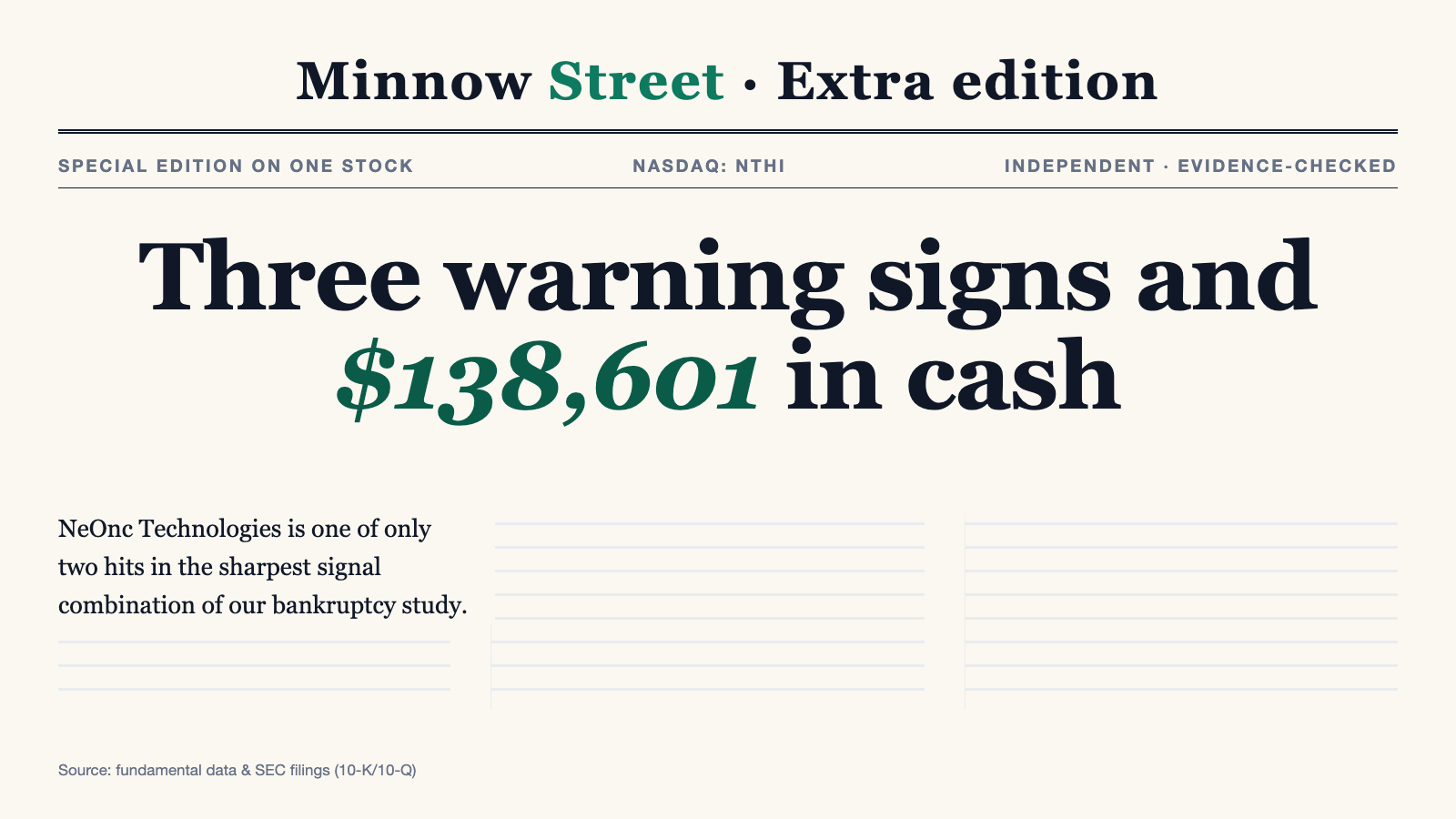
Interactive price chart (TradingView).
Note: pure fact-based analysis, not investment advice and not a solicitation to buy or sell. All figures without guarantee.
There is an investor trap that intelligence offers no protection against, because it does not operate on the intellect: the cure trap. Anyone who has sat beside a person with glioblastoma knows how little time medicine has to offer there. And anyone who knows that reads a headline like "approval in the Middle East" or "$50 million partnership" not as an announcement but as hope.
This is exactly where journalism parts ways with promotion. NeOnc Technologies Holdings, Inc. (NASDAQ: NTHI) is working on a real medical problem, with a mechanism that has been demonstrated inside a human being. And the same company held $138,601 in cash on March 31, 2026 — against current liabilities of $16,287,621.
Before we turn that into a verdict, here is the deal: we read together what NeOnc itself filed, under penalty of law, with the U.S. securities regulator, the SEC — the quarterly report (Form 10-Q) for March 31, 2026, the first audited annual report (Form 10-K), and every current report since. And we keep two things apart that get stubbornly mixed up in this stock: what was announced, and what actually happened.
What NeOnc actually does — the route through the nose
The brain is shielded by a wall called the blood-brain barrier. It keeps toxins out — and, unfortunately, most drugs as well. That is why many cancer drugs fail against brain tumours not because they do not work, but because they never arrive.
NeOnc goes around the wall. The compound is delivered as a nasal mist and travels along the olfactory nerve endings straight into the brain, bypassing both the liver and the blood-brain barrier. The everyday image: instead of going through the main gate and its security check, the delivery slips through a side window that opens directly into the right room.
The compound itself is called NEO100, a highly purified form of perillyl alcohol, a natural substance found in essential oils such as peppermint and lavender. The second candidate, NEO212, is a single molecule combining perillyl alcohol with temozolomide, the workhorse drug for brain tumours.
Two things need saying up front. First: the patents do not belong to the company. They are exclusively licensed from the University of Southern California (USC), originally on March 9, 2009 and most recently restated on November 19, 2023. The annual report puts it bluntly: "All patents are owned by USC and exclusively licensed to us from USC." If NeOnc breaches the agreement, in particular by missing payments, the rights revert to USC at no cost — together with all the clinical data NeOnc itself has generated.
Second: the company is tiny. As of March 30, 2026 it had five full-time employees. Four PhD-level scientists and one laboratory technician are employed by USC; NeOnc reimburses the cost. Not one product has ever been sold. The reported 2025 revenue of $39,990 came from individual doses supplied under a humanitarian programme; the filing says: "Such revenues are not part of our core business." A tiny revenue line is normal in clinical-stage oncology — our analysis of Erasca describes a company that has never reported a revenue line at all.
Which brings us to the central tension of this analysis, and it runs through every chapter: NeOnc produces news at the pace of a large company — 42 current reports in 16 months as a listed issuer — and financial reports at the pace that matches reality: one audited annual report and four quarterly reports. Read the news and you see a company on the move. Read the reports and you see one at the edge of solvency.
How the stock landed on our desk
We run roughly 3,500 stocks through our scanners every day. As of July 26, 2026 NeOnc is one of exactly two hits in the scanner "Bankruptcy study: the sharpest triple combination". To reproduce it: open the scanner and select the "confluence" section. The lists are recalculated daily, so the number of hits can change.
Behind it sits our own study of 792 U.S. bankruptcies. We measured which mandatory disclosures precede a collapse and combined the three sharpest:
- Signal 1 — "our numbers can no longer be relied upon." A company must tell the SEC when a published financial statement should no longer be used (Item 4.02 of a current report). NeOnc did so twice: on August 18, 2025 and, in amended form, on August 20, 2025.
- Signal 2 — the auditor doubts the company can continue. The audit report for fiscal 2025, dated March 30, 2026, carries a separate paragraph containing the words "substantial doubt."
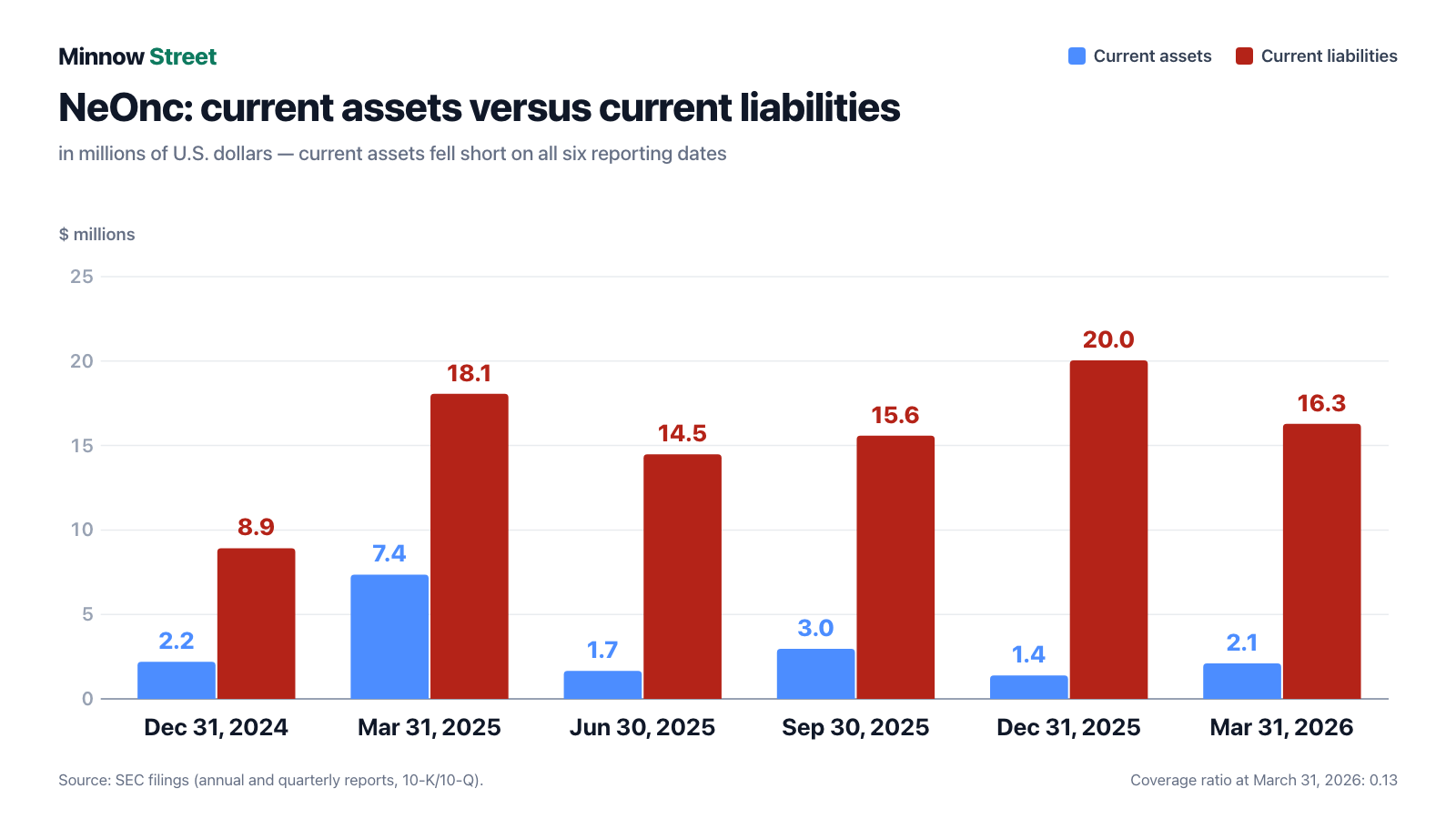
- Signal 3 — current liabilities exceed all current assets. On March 31, 2026: $2,095,163 against $16,287,621. Coverage ratio 0.13.
This combination has triggered 115 times since 2005, just under nine times a year. 52 percent of those stocks lost at least 30 percent within three months, against 11 percent in a control group matched on price, trading volume and distance from the 52-week high. It is the strongest edge we found in the study.
And now the sentence that matters just as much: four out of five of these companies survive the year. The model is a smoke detector, not a demolition order. A smoke detector also goes off when the toast burns.
On the clock: signals count for twelve months. The oldest of the three is the Item 4.02 filing of August 20, 2025 — on August 20, 2026 NeOnc drops out of this combination unless a new signal appears, without a single number on the balance sheet having to change.
The numbers over the years — and what genuinely impresses
Let us start with what is good. And there is more of it than the signal list suggests.
First: the mechanism has been demonstrated in a human being. In a Phase 1 cohort of 12 patients with recurrent glioblastoma, NEO100 was given through the nose. In one patient tumour tissue was later removed surgically — and the compound and its metabolite were detectable inside the tumour. That is precisely what earlier attempts with swallowed capsules never achieved. Of the 12 patients, 3 (25 percent) were still alive after three years — median survival in recurrent glioblastoma is roughly six months according to the company. On the two-year mark, though, the annual report contradicts itself: one passage reads "five patients (37%) were still alive", another "four patients (33%) survived for over two years" — and five of twelve would be 42 percent, not 37.
Second: the compound carries regulatory advantages. NEO100 has held orphan drug designation for malignant glioma since 2011 and fast-track status from the U.S. Food and Drug Administration since 2016. An investigational new drug application for NEO212 was cleared in May 2023.
Third: there is no serviceable financial debt left. The convertible notes were repaid in full in March 2026. The only long-term liability on March 31, 2026 is a lease of $273,705. Under "Defaults Upon Senior Securities" the quarterly report says "None." A company with no lenders cannot be pushed into bankruptcy by a loan being called — a structural difference from classic default candidates.
Fourth: insiders are buying. In the twelve months to July 2026 the insider filings (Form 4) show not a single sale. Chief executive Amir Heshmatpour bought in eleven tranches into falling prices, from $5.98 on November 21, 2025 down to $4.1592 on May 1, 2026, roughly 110,000 shares in total. In the quarterly release of May 18, 2026 he put the figure at "more than $500,000" himself. People who expect a collapse do not buy every month.
Fifth: the cost base is stretchable. Five full-time employees and research spending of $3.6 million a year. The company has already shown it can throttle: in the second and third quarters of 2025, research spending stayed below $0.72 million per quarter.
And now the numbers that tip the picture.
Uncomfortable truth no. 1: the treasury is a petty cash box
Six quarterly reporting dates, six cash balances: $64,893 (December 31, 2024), $5,439,210 (March 31, 2025), $125,039 (June 30, 2025), $1,513,224 (September 30, 2025), $58,729 (December 31, 2025), $138,601 (March 31, 2026). On four of six dates the balance was around $100,000 — the price of a mid-range car.
Now the burn: net cash used in operating activities was $6,991,773 in the first quarter of 2026 and $20,363,948 for the full year 2025. In its quarterly release of May 18, 2026 the company itself put "normalized" cash operating expenses at roughly $6.1 million per quarter — about $2.0 million a month.
The takeaway: $138,601 against a $2.0 million monthly burn is not a runway, it is two days. This company pays its bills out of whatever security sale comes next.
And the wider current assets do not help, because most of them never become money. Of the $2,095,163 on March 31, 2026, some $722,666 are capitalised offering and debt issuance costs — accounting items that will never reach the bank account but disappear later as expense.
The auditor says it like this:
"As more fully described in Note 1, the Company has a significant working capital deficiency, has incurred significant losses and needs to raise additional funds to meet its obligations and sustain its operations. These conditions raise substantial doubt about the Company's ability to continue as a going concern."
— CBIZ CPAs P.C. for NeOnc Technologies Holdings, Inc., Form 10-K for 2025, report of the independent registered public accounting firm, March 30, 2026

Honesty requires context: for a research company without a product this paragraph is the norm, not the exception. It appeared in the 2023 and 2024 statements and in the listing prospectus of March 25, 2025 — the company went public with an open going-concern paragraph and is still here. As a standalone signal it carries almost no information in this sector. It only becomes meaningful alongside the cash position. How far apart biotech balance sheets can be is clear from our analysis of Monte Rosa Therapeutics: same sector, no product revenue — and $666.2 million in the bank.
One figure from the company itself is worth writing down. In the release of May 18, 2026 it states that cash, the private placement proceeds and an undrawn credit line are expected to fund operations "into September 2026."
Uncomfortable truth no. 2: $7.2 million of payroll tax, withheld and not remitted
This is the item nobody talks about — and the hardest one on the balance sheet.
When restricted stock vests, income tax becomes due. The normal practice is for the company to hold back part of the shares and forward the tax to the authorities. NeOnc did the first part and not the second.
"As of March 31, 2026, the Company has not remitted the income taxes on behalf of the recipients, and therefore $6,077,719 is included in accrued restricted stock tax withholding obligations in the accompanying condensed consolidated balance sheets."
— NeOnc Technologies Holdings, Inc., Form 10-Q for March 31, 2026, Note 8

The balance sheet line rose from $2,769,482 (December 31, 2025) to $7,208,666 (March 31, 2026). The gap to the figure in the note is penalties and interest — $644,601 in the first quarter of 2026 alone, reported as other expense.
Why this weighs more than an unpaid supplier invoice: in the United States withheld payroll taxes are trust fund taxes. Failure to remit them triggers penalties automatically and can create personal liability for responsible officers. It is a debt to the state, not to a business partner you can negotiate with. On top of that sit $4,304,110 from a settlement with the Taiwanese partner Orient EuroPharma, which the company accrues and accrues interest on — but does not pay, because it disputes that its stock market debut was an "initial public offering." That precise wording was the settlement's payment trigger.
This is why signal 3 is no accounting artefact here. In research companies, current liabilities above current assets are often harmless — no inventory, no receivables. Here, however, the cash is not facing ordinary trade payables but $11.5 million of tax and court-ordered debt.
Uncomfortable truth no. 3: a $62 million loss — with $3.6 million of it for research
The 2025 net loss of $62,146,210 looks like a company doing research at full throttle. The income statement says otherwise.
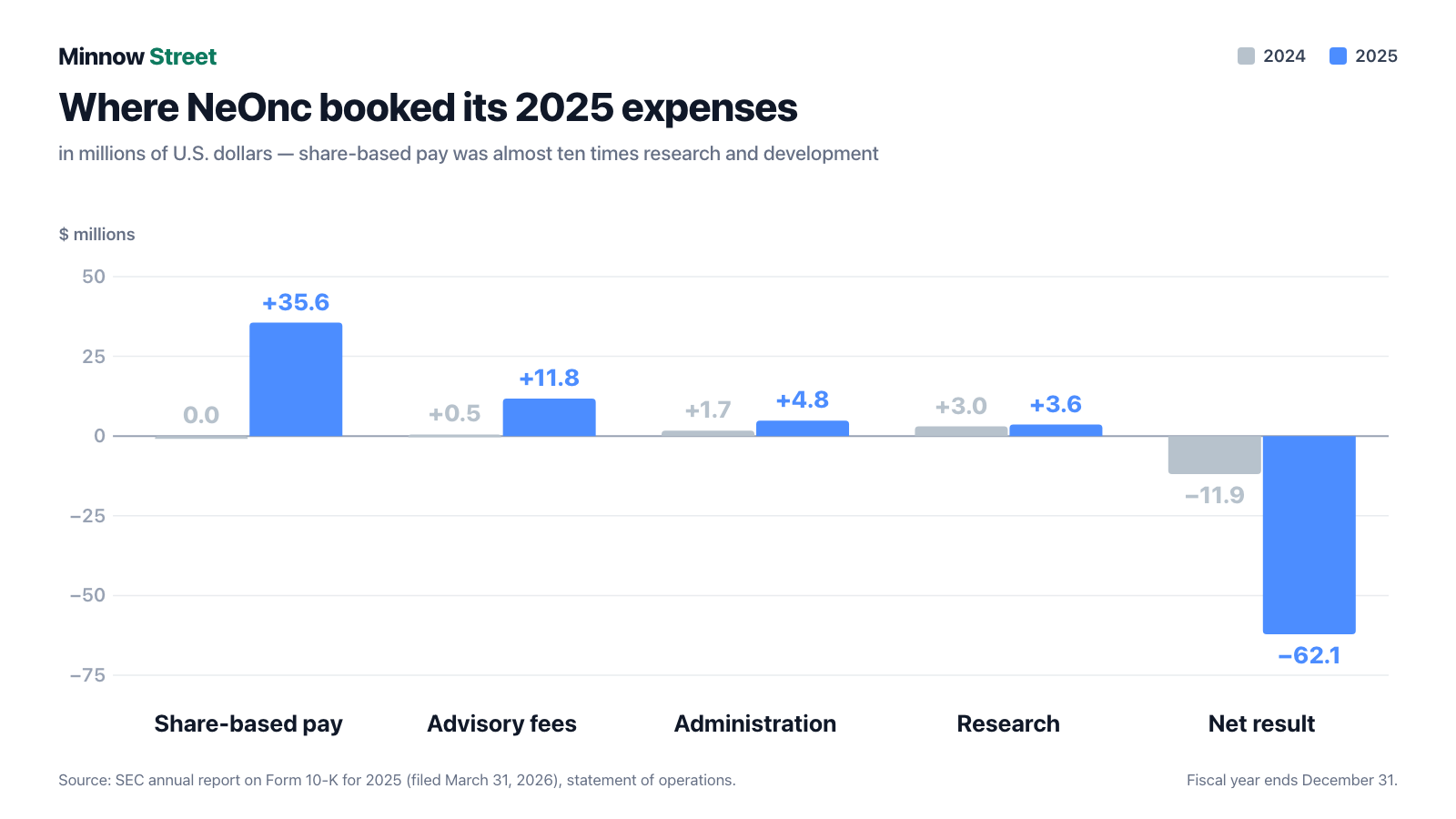
The audited 2025 figures against 2024:
- Share-based compensation: $35,555,059 against a dash in the prior year — 61 percent of total operating expenses, and non-cash.
- Advisory fees: $11,787,806 against $500,000. Of that, $11,328,565 went to AFH Holding and Advisory, LLC, the firm owned by today's chief executive — triggered on March 26, 2025 by the stock market listing itself.
- General and administrative: $4,817,900 against $1,679,660.
- Legal and professional: $2,481,413 against $2,000,623.
- Research and development: $3,638,257 against $3,045,239.
- Revenue: $39,990 against $83,000.
Put differently: for every dollar of research in 2025, NeOnc booked almost ten dollars of share-based compensation and a good three dollars of advisory fees.
And those fees were paid, in real money: $2,500,000 on the listing date, a further $7,071,424 in monthly instalments from April to December 2025, and the remaining $1,757,141 in January 2026 out of private placement proceeds. In the same breath the company agreed to a $900,000 bonus for the chief executive, payable in six instalments from March 1, 2026. The compensation table in the annual report shows $0 for him in every column; his salary is $1 per year.
A look backwards makes the pattern visible. The holding company now listed on Nasdaq was an empty shell at the end of 2022: "no operations or assets other than cash paid by its shareholders for their shares ($450 in the aggregate)". For preparing the market debut, AFH and its affiliates received 34.4 percent of the company (5,500,000 shares) in the share exchange of April 7, 2023. And when money was needed, the management team lent it: through HCWG LLC — owned by Heshmatpour, founder Thomas Chen, a former director, the former chief operating officer and an entity of the chief financial officer — funds arrived with a 50 percent original issue discount. A $7,116,335 drawdown became a repayment obligation of $11,748,462, converted in 2024 into 979,039 shares at $12.00; the company booked a $2,069,923 loss on the extinguishment.
Uncomfortable truth no. 4: the first quarterly report as a public company was wrong
This is signal 1 of our study — and it is not about a cash error but about the valuation of management's own stock awards.
"Management of the Company, after discussions with and among the Audit Committee of the Board of Directors and its independent auditors, concluded that the Company's unaudited consolidated financial statements as of and for quarter ended March 31, 2025 should no longer be relied upon and should be restated."
— NeOnc Technologies Holdings, Inc., Form 8-K/A dated August 20, 2025, Item 4.02

Fairness matters here: the error ran in the direction that flattered investors. The correction reduced first-quarter 2025 share-based compensation by $5,675,971 and thereby improved the reported result. Cash, debt and equity inflows were untouched. Reading this as "accounting fraud" is factually wrong.
The information value lies elsewhere — in three details:
- On August 14, 2025 the company filed a late-filing notification (Form NT 10-Q) because it needed more time for "non-cash expense charges" relating to previously granted restricted stock units. Same matter.
- The first filing was incomplete: it omitted the required statement that the matter had been discussed with the independent auditors. The SEC wrote to the chief financial officer on August 19, 2025; on August 20, 2025 exactly that sentence was added by amendment.
- A company that miscalculates the vesting period of its own executive stock awards has a control problem. And it confirms as much itself: as of December 31, 2025 internal control over financial reporting was not effective, because of material weaknesses in duties separation, company-wide risk and communication processes, major financial transactions, complex financial instruments, related party dealings and IT user access management. Disclosure controls were also not effective as of December 31, 2025 and March 31, 2026.
One date fits that picture. Six days after the listing, the auditor Marcum LLP resigned ("Marcum resigned", March 31, 2025). The same filing lists five material weaknesses in internal control, expressly including missing controls over related party transactions — at a company whose funding consisted almost entirely of such transactions. Successor CBIZ CPAs P.C. had bought Marcum's attest business effective November 1, 2024, which explains the change formally. It does not explain the word "resigned."
Uncomfortable truth no. 5: five times $50 million that never arrived
Here the central tension becomes datable. Between July 8 and October 6, 2025 NeOnc filed five press releases about a single arrangement. The headlines in sequence:
- July 8, 2025: "Signs $50 Million Non-Binding Strategic Term Sheet with Quazar Investment"
- July 22, 2025: "Executes Sub-License Agreement, Marking Key Milestone Toward Closing $50 Million Strategic Partnership"
- July 29, 2025: "Signs Definitive Agreement for $50 Million Strategic Partnership"
- August 11, 2025: "Finalizes All Contingencies for $50 Million Strategic Partnership as NuroMENA Holdings Receives ADGM Incorporation"
- October 6, 2025: "Set to Close $50 Million Strategic Partnership by October 23rd Following Final UAE Tax Approvals"
The plan was for the investor to source subscribers for up to $50 million at $25.00 per NeOnc share — a multiple of the market price. Before that, the investor was to subscribe 2.5 million shares of a new subsidiary for $400,000.
"As of the date of this filing, the Initial Investment has not yet occurred."
— NeOnc Technologies Holdings, Inc., Form 10-K for 2025, Note 1 (Investment and Joint Venture)
That is the audited annual report of March 31, 2026 — almost nine months after the first headline. The $400,000 had still not arrived by the quarterly report of May 15, 2026. The stock closed at $4.55 on June 10, 2026 according to the proxy statement.
The same pattern, in friendlier form: on June 16 and June 23, 2026 NeOnc announced that the Department of Health – Abu Dhabi had granted investigational new drug status for NEO212 and NEO100. The company's own releases name it correctly — an IND is permission to start a clinical trial, not approval to sell a medicine. It is real progress for building trials in the Gulf region. It is not an approval, and anyone reading the news as "drug approved" has misread it.
One more release belongs here because it is easily overrated: on July 15, 2026 the company said it had received written FDA feedback on the chemistry, manufacturing and controls programme for NEO212, and had therefore cancelled the Type B meeting scheduled for July 9, 2026 because the written answers were sufficient. Such releases fall under Item 7.01 and are formally "furnished", not part of the audited disclosure.
Uncomfortable truth no. 6: the compound already disappointed five times orally
Perillyl alcohol is not a new substance. In the 1990s and 2000s it was tested as a swallowed cancer drug in five Phase 2 trials: in ovarian, prostate, breast, pancreatic and colorectal cancer. The outcome is recorded in a 2021 review whose first author is NeOnc's own founder and current chief medical and scientific officer, Dr. Thomas C. Chen:
"Overall, however, the therapeutic activity of POH was unimpressive and mostly disappointing."
— Chen TC, da Fonseca CO, Levin D, Schönthal AH, Pharmaceutics 2021, 13(12), 2167
The same paper records: "so far, no Phase III clinical trials of orally administered POH have been initiated" — there was never a Phase 3 programme.
This is not a rebuttal of NeOnc but the foundation of its story: the company argues that when swallowed, the substance was broken down in the liver before it could work — through the nose it goes straight into the brain. The thesis is plausible and supported by the detection of the compound inside tumour tissue. You just need to know that efficacy itself is not yet proven. So what does the data behind the success announcements look like?
On November 12, 2025 NeOnc reported a "significant radiographic response" in 5 of 24 patients (21 percent). On December 17, 2025 that became 6 of 25 (24 percent). What happened in between is in the second release: "an additional patient has achieved both durable long-term survival and radiographic remission". A single patient lifted the headline rate by three percentage points.
The second metric, six-month progression-free survival of 44 percent, rests on 8 of 18 evaluable patients. And the cohort is mixed: 24 or 25 patients drawn from Phase 1 (5), Phase 2a (18) and one compassionate-use case. There is no control group; the comparison is with historical benchmarks of an 8 percent response rate and 21 to 31 percent progression-free survival.
The takeaway: with single-digit patient counts and no control arm, one extra patient is not a data point but a headline. The meaningful answer arrives with the interim readout of the fully enrolled NEO100 Phase 2a trial, which the company has scheduled for around August 2026. Until then the sentence NeOnc wrote into its own annual report applies: "These outcomes will have to be investigated with a larger number of patients to establish statistical significance."
Valuation — $89 million of market value against a $75 million selling program
Market capitalisation stood at roughly $89 million as of July 25, 2026. Against the 26,013,136 shares shown on the cover of the quarterly report dated May 15, 2026, that implies a price of about $3.40. For context: the last price expressly named in an SEC document was $4.75 on June 12, 2026, and closing prices over the past twelve months ranged from $3.005 to $12.99 (data as of July 25, 2026).
Conventional ratios are no help here: there is no profit, and with $39,990 of annual revenue a price-to-sales ratio would be a meaningless number. The Altman Z-score, a bankruptcy early warning gauge, also produces nothing but an artefact: total assets of $3,330,161 on March 31, 2026 are smaller than a single quarter's deficit, so every ratio explodes. The more telling figure is simpler: shareholders' equity was minus $13,231,165 and the accumulated deficit $121,574,587. The balance sheet does not report "equity" but "stockholders' deficit."
Valuation gets interesting in relation to the financing programmes. On April 10, 2026 NeOnc signed an agreement to sell its own shares into the market over time for up to $75.0 million — against a market value of roughly $89 million.
"On April 10, 2026, the Company entered into an Equity Distribution Agreement with BTIG, LLC and A.G.P./Alliance Global Partners (together, the 'Agents'), pursuant to which the Company may offer and sell, from time to time through the Agents, shares of its common stock having an aggregate offering price of up to $75,000,000. … As of the date these financial statements were issued, no shares of common stock have been sold under the ATM Offering."
— NeOnc Technologies Holdings, Inc., Form 10-Q for March 31, 2026, Note 13

What that means for existing shareholders is spelled out in the prospectus supplement itself. Dilution is the word everyone knows and hardly anyone calculates; the everyday image: the cake stays the same size but is cut into more slices. Your slice shrinks without you doing anything.
- Shares before the programme: 24,911,482
- Shares afterwards: up to 38,877,962 — assuming 13,966,480 shares are sold at the assumed price of $5.37 (the closing price on April 8, 2026)
- Use of the first proceeds: approximately $7.0 million for the outstanding payroll tax withholdings
That is a potential increase in share count of 56 percent — and the first use is not research but a tax debt. Three further sources sit alongside it:
- 2,093,305 warrants at $9.00 from the 2026 private placement (share price $7.20) — with down-round protection. Any future issue below $9.00 lowers their exercise price to that level. Their dilutive effect therefore grows as the share price falls.
- A convertible preferred share issued June 10, 2026 for up to $5.0 million: purchase price $833.34 against a stated value of $1,000. If the company does not redeem within four months, another $166.67 per share is added and conversion happens at 80 percent of the lowest closing price over the previous five trading days, floored at $1.00. That mechanism engages precisely when things go badly.
- A shelf registration for $300 million, effective since April 9, 2026, and a proposal at the annual meeting on August 14, 2026 to expand the incentive plan every year by 20 percent of outstanding shares, from 2027 through 2033. Market practice is 3 to 5 percent.
On the view of the professionals: on April 24, 2026 the securities firm BTIG initiated coverage with "Buy" and a $15.00 price target, against a closing price of $4.95. That is a serious opinion from an analyst with a scientific background — and it arrived 14 days after the same firm signed on as placement agent for the $75 million programme. The report discloses this itself: "BTIG LLC has received compensation for investment banking services in the past 12 months from: NeOnc Technologies (NTHI)" and "managed or co-managed a public offering of securities in the past 12 months". The second firm in the programme, A.G.P./Alliance Global Partners, holds the same dual role. Whoever writes about this stock also earns from placing it — disclosed and permitted, but worth remembering when you read a price target.
A final valuation anchor from the past: the 2024 IPO attempt envisaged 6,000,000 shares at $11.25 to $13.75, or roughly $75 million — of which $10.0 million was earmarked to repay the loan from the company's own management. It was withdrawn on June 12, 2024. The market debut came nine months later as a direct listing with no fresh capital and no lock-up for existing holders. On the listing date the company valued advisor shares using a closing price of $12.11; the last private placement before it had priced at $16.00. As of July 25, 2026 the stock stood at roughly $3.40.
Opportunities and risks at a glance
What argues for NeOnc:
- The mechanism is documented in a human being: NEO100 and its metabolite were detectable in the tumour tissue of a treated patient — exactly what oral trials never achieved.
- Orphan drug designation since 2011, fast track since 2016, a cleared investigational new drug application for NEO212 since May 2023, and an exclusively licensed portfolio of 28 issued U.S. patents and 65 issued international patents.
- No serviceable financial debt left; "Defaults Upon Senior Securities: None" in the quarterly report for March 31, 2026. Plus an undrawn $10.0 million credit line from an entity of the chief executive.
- No insider sale in twelve months, and eleven purchases by the chief executive into falling prices ($5.98 down to $4.1592); officers and directors together hold 53.9 percent (as of May 4, 2026).
- An interim readout of the fully enrolled NEO100 Phase 2a trial is scheduled for around August 2026 — a genuine turning point in either direction.
What argues against it:
- $138,601 of cash on March 31, 2026 against a monthly burn of roughly $2.0 million; the company itself cites a runway "into September 2026."
- Current assets of $2,095,163 against current liabilities of $16,287,621 (coverage ratio 0.13) — including $7,208,666 of unremitted payroll taxes and $4,304,110 from a litigation settlement.
- Shareholders' equity of minus $13,231,165 and an accumulated deficit of $121,574,587 (March 31, 2026); a going-concern paragraph in every audited report since 2023.
- Internal control and disclosure controls not effective by the company's own assessment; a restatement of the first quarterly report; an auditor resignation six days after the listing; nine late insider filings in fiscal 2025.
- Dilution from several sources at once: a $75.0 million selling programme (up to 38,877,962 shares from 24,911,482), warrants with down-round protection, a convertible preferred with a 20 percent discount to the five-day low, and a proposed 20 percent annual increase in the incentive plan to be voted on August 14, 2026.
- The efficacy story rests on small, uncontrolled numbers: 6 of 25 patients, 8 of 18 for progression-free survival, in a cohort mixing Phase 1, Phase 2a and compassionate use.
- All patents belong to USC; a breach returns them, together with all clinical data, at no cost. The company has already breached that agreement once and had to cure it in 2023 with a $230,000 payment.
A human conclusion
We opened with the cure trap, and it is also the most honest ending. The wish that someone finally defeats glioblastoma is a good wish. It is simply a poor guide to reading balance sheets — because it turns every announcement into a result.
NeOnc is both things at once. A company with a plausible mechanism demonstrated in a human being and a genuine medical goal. And a company that in 2025 booked ten dollars of compensation for every dollar of research, that does not remit withheld payroll taxes, whose auditor doubts it can continue, and whose first quarterly report had to be restated.
The decisive question with this stock is therefore not "will the company go bankrupt" — its costs are too small and its financing options too varied. The question is: what is left of a shareholder's stake if it survives? Every instrument available to NeOnc comes at the expense of existing holders: sales at market prices, warrants with down-round protection, a preferred share converting at the low, an incentive plan meant to grow by a fifth every year. The likelier damage is called dilution, not insolvency.
Two dates make the coming weeks unusually clear: the NEO100 interim readout around August 2026 — and August 20, 2026, when NeOnc mechanically drops out of our signal combination without a single number having changed.
What you make of that is your decision. And that is exactly as it should be.
Sources
- NeOnc Technologies Holdings, Inc., Form 10-Q for March 31, 2026 (filed May 15, 2026) — balance sheet, statement of operations, Note 1 (going concern), Note 7 (warrants), Note 8 (share-based compensation and tax withholdings), Note 13 (subsequent events), Item 4 (controls)
- Form 10-K for 2025 (filed March 31, 2026) — audit report dated March 30, 2026, Item 1 business and USC licence, Item 3 legal proceedings, Item 5, Item 9A (internal control), Notes 1, 5, 6, 8 and 14
- Form 10-K/A for 2025 (filed May 5, 2026) — officers, compensation, beneficial ownership, late insider filings
- Form 8-K/A dated August 20, 2025, Item 4.02 (original Form 8-K dated August 18, 2025) — the quarterly statements for March 31, 2025 should no longer be relied upon
- Form 8-K dated April 1, 2025, Item 4.01 — resignation of Marcum LLP on March 31, 2025 and five material weaknesses in internal control
- Prospectus supplement 424B5 dated April 10, 2026 — $75.0 million at-the-market programme, use of proceeds, 24,911,482 shares against up to 38,877,962
- Form 8-K dated May 18, 2026, Item 2.02 — quarterly figures, cash position, runway "into September 2026", insider purchases by the chief executive
- Form 8-K dated June 12, 2026 — Series A convertible preferred stock converting at 80 percent of the five-day low
- Proxy statement DEF 14A dated June 23, 2026 — proposal to expand the incentive plan by 20 percent annually, share price of $4.55 on June 10, 2026
- Form 8-K dated June 18, 2026 and dated June 23, 2026 — investigational new drug status from the Department of Health – Abu Dhabi for NEO212 and NEO100
- Form 8-K dated July 15, 2026 — written FDA feedback on the manufacturing programme for NEO212
- Free writing prospectus dated March 1, 2024 and withdrawal of the IPO attempt (Form RW) dated June 12, 2024 — a planned 6,000,000 shares at $11.25 to $13.75
- Prospectus 424B4 dated March 25, 2025 — direct listing without proceeds, no lock-up agreements, the history of the holding company and the share exchange
- Chen TC, da Fonseca CO, Levin D, Schönthal AH: "The Monoterpenoid Perillyl Alcohol", Pharmaceutics 2021, 13(12), 2167 — five Phase 2 trials with orally administered perillyl alcohol, no Phase 3 programme
- All NeOnc Technologies filings with the SEC (CIK 1979414) — including the five current reports on the Quazar arrangement dated July 10, July 25, August 1, August 13 and October 10, 2025, and Forms 3 and 4 through July 13, 2026
- Source: fundamental data & SEC filings (annual and quarterly reports, 10-K/10-Q) — market capitalisation, price ranges, free float, short interest, data as of July 25, 2026
- Origin of the idea: our in-house stock scanner, "Bankruptcy study: the sharpest triple combination", one of two hits, as of July 26, 2026
This article is journalistic commentary on publicly available company filings and is expressly not investment advice and not a solicitation to buy or sell securities. Shares of research companies with no approved product and a going-concern qualification can be extremely volatile; a total loss of invested capital is possible. All figures come from the primary documents named above and carry the reporting date stated with them; later developments are not reflected. The author holds no position in the stock discussed at the time of publication.
Our Bottom Line at a Glance
- Liquidity negative
- Cash stood at $138,601 on March 31, 2026 against $6,991,773 of net cash used in operating activities during the quarter. On four of six quarterly reporting dates since the end of 2024 the balance was around $100,000. On May 18, 2026 the company itself cited a runway "into September 2026."
- Balance sheet and maturities negative
- Current assets of $2,095,163 against current liabilities of $16,287,621 (coverage ratio 0.13, below 1 on all six reporting dates). Those liabilities include $7,208,666 of withheld but unremitted payroll taxes and $4,304,110 from a 2024 litigation settlement. Shareholders' equity was minus $13,231,165.
- Reporting quality and controls negative
- The first quarterly report as a public company was declared unreliable (August 18 and 20, 2025); the required statement about discussions with the auditors had to be added after an SEC letter. Internal control as of December 31, 2025 and disclosure controls as of March 31, 2026 were not effective by the company's own assessment. The auditor resigned six days after the listing.
- Dilution negative
- According to its own prospectus, the selling programme of April 10, 2026 can turn 24,911,482 shares into up to 38,877,962. Add 2,093,305 warrants with down-round protection, a convertible preferred converting at a 20 percent discount to the five-day low, and a proposal for the August 14, 2026 annual meeting to expand the incentive plan by 20 percent each year.
- Use of funds negative
- Of $58,280,435 of 2025 operating expenses, $35,555,059 was share-based compensation and $11,787,806 advisory fees — including $11,328,565 to the chief executive's own firm, triggered by the listing itself. Research and development cost $3,638,257. The first $7.0 million from the new selling programme is earmarked for the outstanding payroll taxes.
- Science and insiders positive
- The mechanism is documented: NEO100 and its metabolite were detectable in the tumour tissue of a treated patient. Orphan drug designation since 2011, fast track since 2016. No serviceable financial debt remains, and not a single insider sale was reported in twelve months — the chief executive bought in eleven tranches into falling prices.
NeOnc Technologies is working on a real medical problem and has a mechanism demonstrated in a human being: the compound is delivered as a nasal mist and was detectable inside tumour tissue. At the same time the company trips all three warning signals of our bankruptcy study — a quarterly report declared unreliable, a going-concern paragraph in the audit report, and current liabilities above current assets. Cash was $138,601 on March 31, 2026 against $16,287,621 of current liabilities, including $7.2 million of withheld payroll taxes that were never remitted. Of the 2025 net loss of $62.1 million, $35.6 million was share-based compensation and $11.8 million advisory fees, but only $3.6 million research. The likelier danger for shareholders is not insolvency but dilution. Not investment advice.
What Our Rating Means
Substance risk
We found at least one documented issue that threatens the company itself — regardless of how the stock is currently valued.
The substance finding is unambiguous and comes from the numbers alone, not from the share price: $138,601 of cash on March 31, 2026 against a monthly burn of roughly $2.0 million, a coverage ratio of 0.13 from $2,095,163 of current assets against $16,287,621 of current liabilities, shareholders' equity of minus $13,231,165, and an audit report that expressly doubts the company can continue. On top of that sit $7,208,666 of withheld but unremitted payroll taxes with penalties still accruing — a debt due immediately to tax authorities rather than to negotiable business partners — and internal controls the company itself calls not effective. None of this judges the value of the science: the mechanism is documented in a human being, orphan drug designation has been in place since 2011, and a Phase 2a interim readout is scheduled for around August 2026. This rating assesses the substance of the business, and that substance is demonstrably at risk. The decision is yours.
A journalistic assessment by our editorial team at the time of the deep dive, based on public sources — not investment advice and not a solicitation to buy or sell. Your personal circumstances (investment goals, risk capacity, taxes) cannot be taken into account. What our levels mean, how verdicts are formed, and what conflicts of interest exist →
Worth Noting
- NTHI reached our research list as one of exactly two hits in our in-house scanner "Bankruptcy study: the sharpest triple combination" (as of July 26, 2026). The combination of the three signals has triggered 115 times since 2005, just under nine times a year; 52 percent of those stocks lost at least 30 percent within three months against 11 percent in a control group matched on price, trading volume and distance from the 52-week high. Four out of five of these companies survive the year — the model is a smoke detector, not a demolition order. Scanner lists are recalculated daily.
- How the window works: signals count for twelve months. The oldest of the three is the Item 4.02 filing of August 20, 2025. Without a new signal, NeOnc drops out of this combination on August 20, 2026 even if nothing on the balance sheet changes.
- Ratio trap: price-to-earnings and price-to-sales are meaningless here (no profit, $39,990 of annual revenue). The Altman Z-score also produces nothing but an artefact, because total assets of $3,330,161 are smaller than a single quarter's deficit. The reliable measures are the simple ones: cash $138,601, coverage ratio 0.13, shareholders' equity minus $13,231,165 (all March 31, 2026).
- Currency note: the latest quarterly report (Form 10-Q) is dated May 15, 2026 and has been fully analysed. Every filing after it has been reviewed — current reports dated May 18, June 12, June 18, June 23, July 2 and July 15, 2026, a shelf registration dated June 15, 2026, a prospectus supplement and the proxy statement dated June 23, 2026, and insider filings through July 13, 2026. No financial statements exist yet for the quarter ended June 30, 2026; the deadline runs to mid-August 2026. There is no Form 15, no Form 25 and no listing deficiency notice.
- Easily confused: the market debut on March 25/26, 2025 was a direct listing, not an initial public offering — there was no offering price and no proceeds. That distinction is not cosmetic here: a $4.3 million dispute with former partner Orient EuroPharma turns on it, because the settlement tied payment to an "initial public offering." The withdrawn 2024 IPO attempt would have covered 6,000,000 shares at $11.25 to $13.75.
Frequently Asked Questions
NeOnc develops brain tumour drugs that are neither swallowed nor injected but delivered as a nasal mist. The compound travels along the olfactory nerve endings straight into the brain, bypassing the blood-brain barrier. The two candidates are NEO100 (perillyl alcohol) and NEO212 (perillyl alcohol combined with temozolomide). There is no approved product; the company had five full-time employees as of March 30, 2026.
Because all three signals of the sharpest combination are present at once. The company declared one of its own quarterly reports unreliable on August 18 and 20, 2025 (Item 4.02), the audit report dated March 30, 2026 contains a paragraph doubting the company can continue, and current liabilities of $16,287,621 exceed current assets of $2,095,163. This combination has triggered 115 times since 2005.
No. For research companies without a product this paragraph is the norm; at NeOnc it has appeared in every audited report since fiscal 2023 and was already in the listing prospectus. Four out of five companies with this signal combination survive the year. The paragraph only becomes meaningful alongside the cash position — and that was $138,601 on March 31, 2026.
In its release of May 18, 2026 the company itself cites a runway "into September 2026" — based on cash of $138,601, private placement proceeds and an undrawn $10.0 million credit line provided by an entity of the chief executive. Net cash used in operating activities was $6,991,773 in the first quarter of 2026.
It could raise the share count by more than half. The prospectus supplement of April 10, 2026 shows 24,911,482 shares before the programme and up to 38,877,962 afterwards, assuming 13,966,480 shares are sold at $5.37. The first $7.0 million of proceeds is not earmarked for research but for outstanding payroll tax withholdings. As of May 15, 2026 no share had been sold.
Promising but thin. The reported 24 percent radiographic remission rate rests on 6 of 25 patients, and the 44 percent six-month progression-free survival on 8 of 18 evaluable patients. The cohort mixes Phase 1, Phase 2a and one compassionate-use case, and there is no control group. The interim readout of the fully enrolled Phase 2a trial is scheduled for around August 2026.
When restricted stock vests for employees, NeOnc holds back shares to cover the income tax due. In the quarter to March 31, 2026 that was 394,204 shares worth $3,371,412. The tax was not remitted: the balance sheet line rose to $7,208,666, and penalties and interest of $644,601 accrued in the quarter alone. In the United States such withholdings are trust fund taxes.
No. All patents belong to the University of Southern California and are exclusively licensed to NeOnc, originally on March 9, 2009. The annual report states it verbatim: "All patents are owned by USC and exclusively licensed to us from USC." A breach returns the rights, together with all clinical data, to the university at no cost. The patents on the two lead products expire in 2031.
Found an error?
Did you spot a factual error, an outdated number, or a typo in this deep dive? Let us know briefly — your report goes straight to the editorial team.