Monte Rosa Stock: $666 Million in the Bank — and Not One Drug Ever Sold
Monte Rosa Therapeutics ranks 13th in our in-house Moglen weekly ranking (U.S. selection, as of July 25, 2026). The company, based in Boston and Basel, builds molecular glues that send disease-causing proteins to the cell's own garbage disposal — and has collected $320.0 million in upfront payments from Roche and Novartis for the effort. We read the Form 10-Q for March 31, 2026 and the Form 10-K for 2025: revenue fell 95 percent in a single year, although nothing about the business changed. Read along before you mistake a revenue line for a business.
 Thomas Mücke
Founder & Publisher
Thomas Mücke
Founder & Publisher
Chart
Interactive price chart (TradingView).
Note: pure fact-based analysis, not investment advice and not a solicitation to buy or sell. All figures without guarantee.
There is an investor trap that springs shut whenever a research company shows a revenue line for the first time: the slice trap. The table suddenly reads "revenue $123.7 million," the annual loss shrinks from $135.4 million to $38.6 million — and our brain concludes that the company has turned the corner.
It has not. Monte Rosa Therapeutics, Inc. (NASDAQ: GLUE) has never sold a drug. Every dollar in that revenue line is an upfront payment from Roche or Novartis that accounting slices across the years. How thin a slice can get was on display in the first quarter of 2026: $4.2 million instead of $84.9 million, down 95 percent — and a quarterly profit of $46.9 million turned into a loss of $44.5 million. Same company, same business, same contracts.
Before we build a judgment on that, here is the deal: we read together what Monte Rosa itself filed under penalty of perjury with the U.S. securities regulator, the SEC — the quarterly report (Form 10-Q) for March 31, 2026, the annual report (Form 10-K) for 2025, and every filing after them.
What Monte Rosa actually does — glue instead of keys
Every cell runs a garbage disposal service for proteins. It attaches a tag called ubiquitin to a protein, and to the cell that tag means: dispose of this.
Conventional drugs work differently. They are keys that have to fit a lock — a pocket on the surface of the target protein. The problem is that many of the most important disease proteins have no pocket at all. In the jargon they are called undruggable.
A molecular glue degrader needs no pocket. It is a drop of adhesive that holds the target protein and the cell\'s tagging machinery close enough together for the machinery to attach its tag. The cell then disposes of the protein itself. Monte Rosa describes the result as editing the human proteome.
"We are a clinical-stage biotechnology company developing a portfolio of novel and proprietary molecular glue degraders, or MGDs. MGDs are small molecule drugs that employ the body's natural protein destruction mechanisms to selectively degrade therapeutically relevant proteins, in effect editing the human proteome."
— Monte Rosa Therapeutics, Inc., Form 10-K for 2025, Item 1 Business
These glues are found with an in-house discovery engine called QuEEN. It pairs artificial intelligence and machine learning with laboratory automation and a proprietary library of more than 75,000 glue molecules built on over 1,000 chemical scaffolds. The company employed 150 people as of December 31, 2025, of whom 118 worked in research and development and 71 hold an M.D. or a Ph.D. Headquarters are in Boston; additional research runs in Basel through the Swiss subsidiary Monte Rosa Therapeutics AG.
The pipeline has four names. MRT-8102 targets NEK7 and is meant to dampen inflammation driven by the messengers IL-1 and IL-6 — currently the lead horse. MRT-6160 targets VAV1 in autoimmune disease and is licensed to Novartis. MRT-2359 attacks the MYC pathway in cancer. CCNE1 is still in discovery.
Which brings us to the central tension of this analysis, and it runs through every chapter: Monte Rosa today earns its money by selling molecules to two pharmaceutical groups, not by selling medicines to patients. That is a good business as long as the groups keep paying. But it turns the income statement into an accounting calendar that says almost nothing about the state of the business. For a company that does not even have a revenue line, see our analysis of Erasca, another clinical-stage developer funded entirely by the equity market.
How the stock landed on our desk
We run roughly 3,500 stocks through our scanners every day. As of July 25, 2026, Monte Rosa sits at number 13 in the U.S. selection of our Moglen weekly ranking (28 hits). To reproduce it: open the scanner, set the country filter to "US" — the list shows the strongest weekly gainers in scanner order. It is recalculated daily, so the position can move.
The ranking has three conditions, and all three are pure price mechanics: at least 15 percent gain over the last four trading days, average dollar volume of at least $10 million per day, and a relative strength rating of at least 70. Monte Rosa clears the measurable hurdles comfortably: average dollar volume over the last 50 days was around $28.8 million per day and the relative strength rating stood at 96, meaning the stock beat 96 percent of all others (data as of July 25, 2026).
Remember the most important sentence of this chapter right here: this scanner measures price movement, not company quality. It says a lot of people are buying the stock right now. It says nothing about whether the glue works.
The fundamental lens on the same data set shows a mixed picture (data as of July 25, 2026): a Piotroski F-Score of 5 out of 9 — a nine-point test for the direction of the balance sheet, on which a genuinely healthy company scores 8 or 9. Five is mid-table, not good. The Altman Z-Score of 4.62, an early warning indicator for insolvency, sits well above the 1.8 alarm threshold — hardly surprising with $666.2 million in the treasury and not a single interest-bearing liability. The equity ratio was 52.0 percent. For a company without product revenue, though, all three numbers deserve caution: several of their criteria assume profit or profit margin, and neither exists here in the form the formulas expect.
The numbers over the years — what genuinely impresses
Let us start with what is good. And there is a fair amount of it.
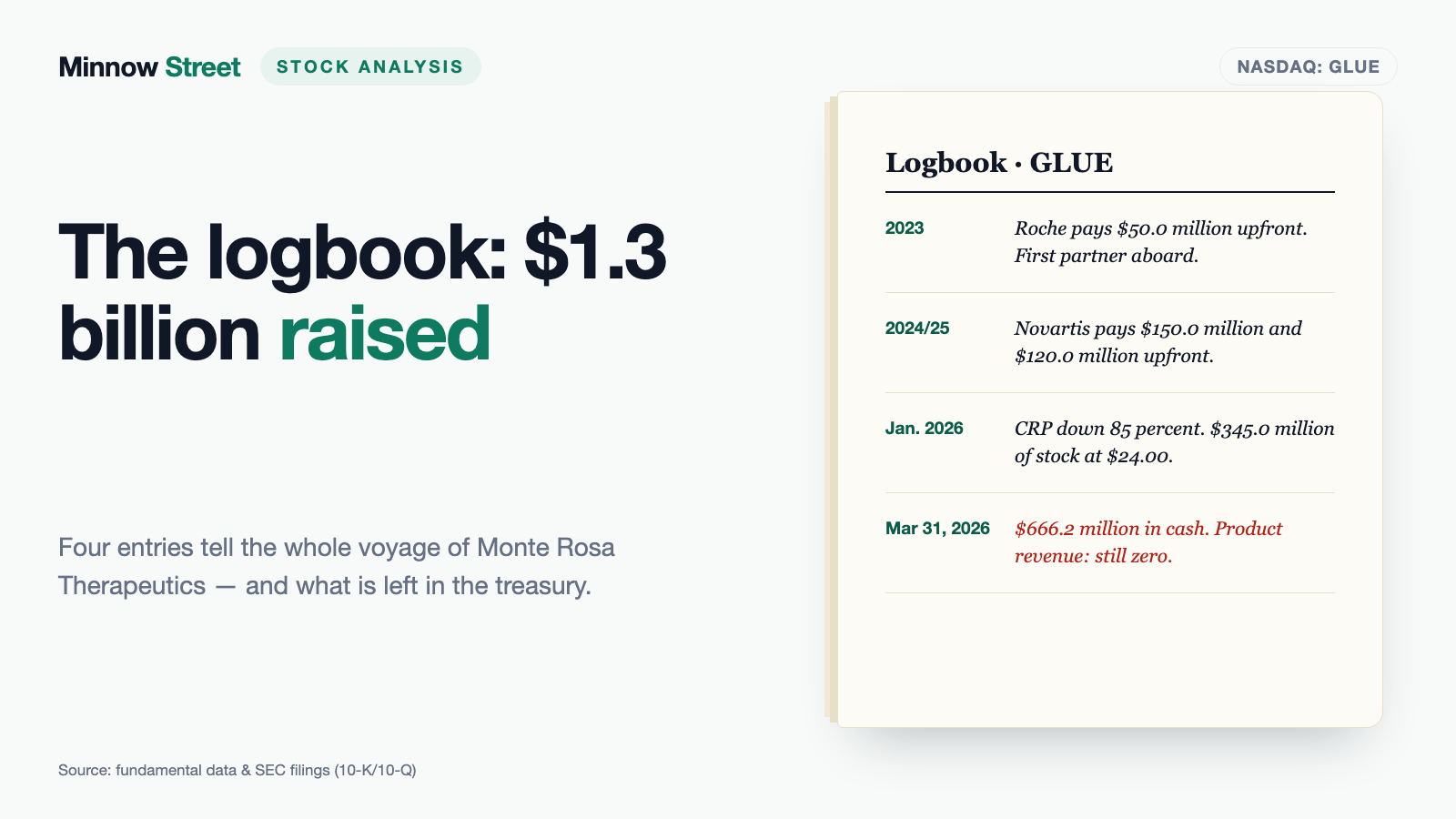
First, the treasury. As of March 31, 2026, the company held $666.2 million in cash and marketable securities ($159.9 million in cash, $506.4 million in securities), or $671.2 million including restricted cash. Total assets were $736.4 million and equity $521.9 million. Liabilities came to $214.5 million — and the largest item within them, $136.7 million of deferred revenue, is not debt in the usual sense but money already collected for services Monte Rosa still owes. The company carries no interest-bearing debt.
"We anticipate that our existing cash and cash equivalents and marketable securities support our cash runway into 2029."
— Monte Rosa Therapeutics, Inc., Form 10-Q for March 31, 2026, Liquidity and capital resources

Second, the partners. Roche signed in October 2023 and paid $50.0 million upfront that November; by March 31, 2026 a further $16.0 million of preclinical milestones and $3.0 million for replacement targets had followed. Novartis paid $150.0 million in December 2024 for the VAV1 degraders and another $120.0 million in September 2025 for one immunology program with options on two more. Together that is $320.0 million of upfront money from two of the largest pharmaceutical groups in the world — cash Monte Rosa does not have to repay and did not have to issue shares for.
Third, the clinical data. On January 7, 2026 Monte Rosa reported interim results from the Phase 1 study of MRT-8102 in people at elevated cardiovascular risk. The single-ascending-dose cohorts enrolled 48 subjects and the multiple-ascending-dose cohorts 40; in the third part of the study, 24 subjects had completed four weeks of dosing as of the December 23, 2025 data cutoff. The result: the inflammation marker hsCRP fell by 85 percent, 94 percent of subjects dropped below the 2 mg/L risk threshold, median IL-6 fell 55 percent, and the target protein NEK7 was degraded by 80 to 90 percent in T cells. On blinded data, adverse events were mild to moderate and self-resolving.
Fourth, the professional view: as of July 25, 2026 there were nine analyst ratings — six strong buys, two buys and one hold — with an average price target of $33.17. Anyone drawing comfort from that should know that in drug development an analyst is not valuing profits but estimating probabilities.
Uncomfortable truth No. 1: The revenue is a calendar, not a business
Look at what stood in the revenue line during the five years through 2025 — and what stood below it.
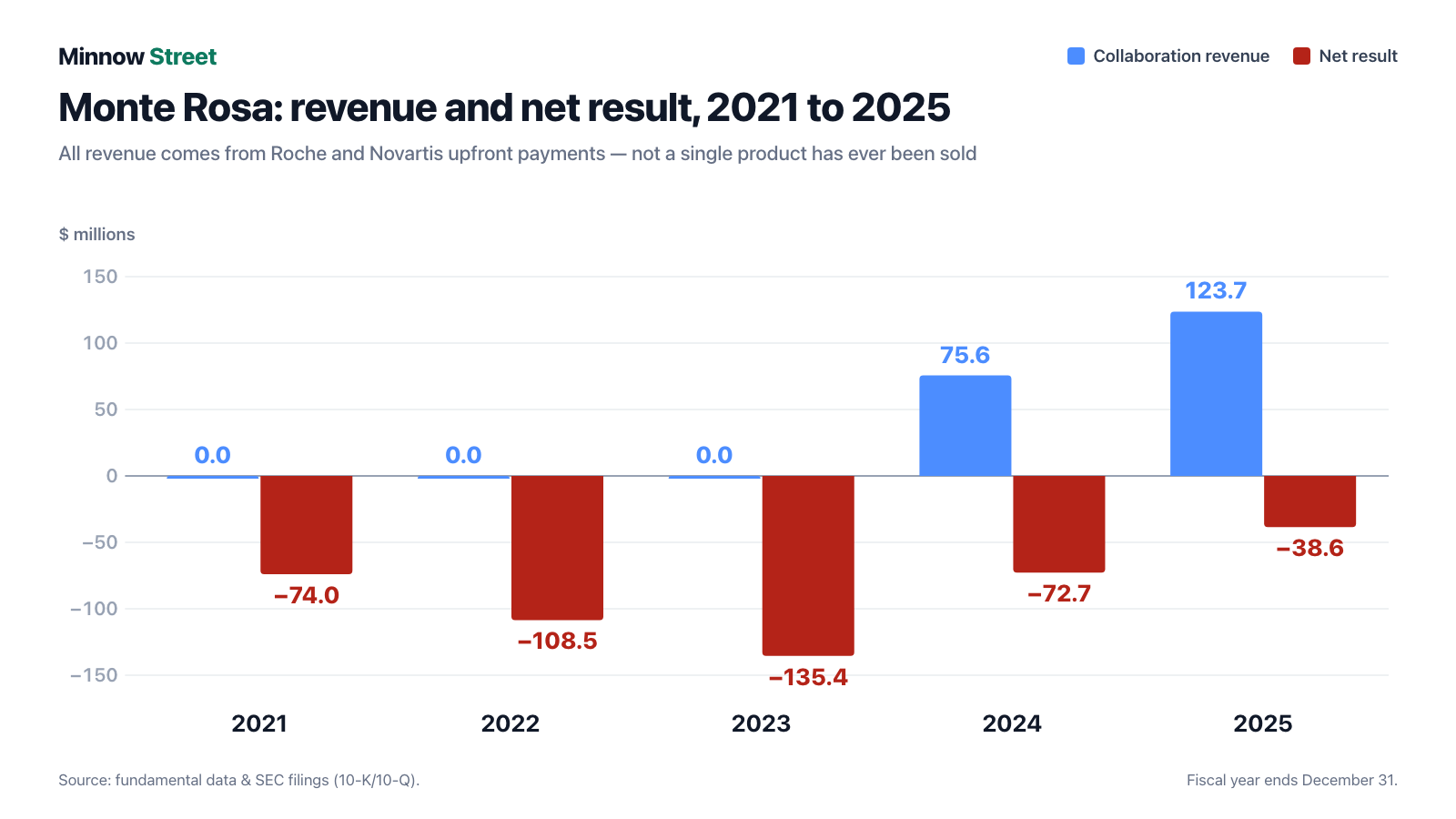
In 2021, 2022 and 2023 that line was a flat zero. In 2024 it showed $75.6 million ($34.0 million from the Roche agreement and $41.6 million from the Novartis agreement), and in 2025 $123.7 million. Over the same span the annual loss ran from $74.0 million in 2021 through $108.5 million in 2022 to a peak of $135.4 million in 2023 — and then shrank to $72.7 million in 2024 and $38.6 million in 2025. That looks like a company completing a turnaround.
It is not. Here is the same company one quarter later:
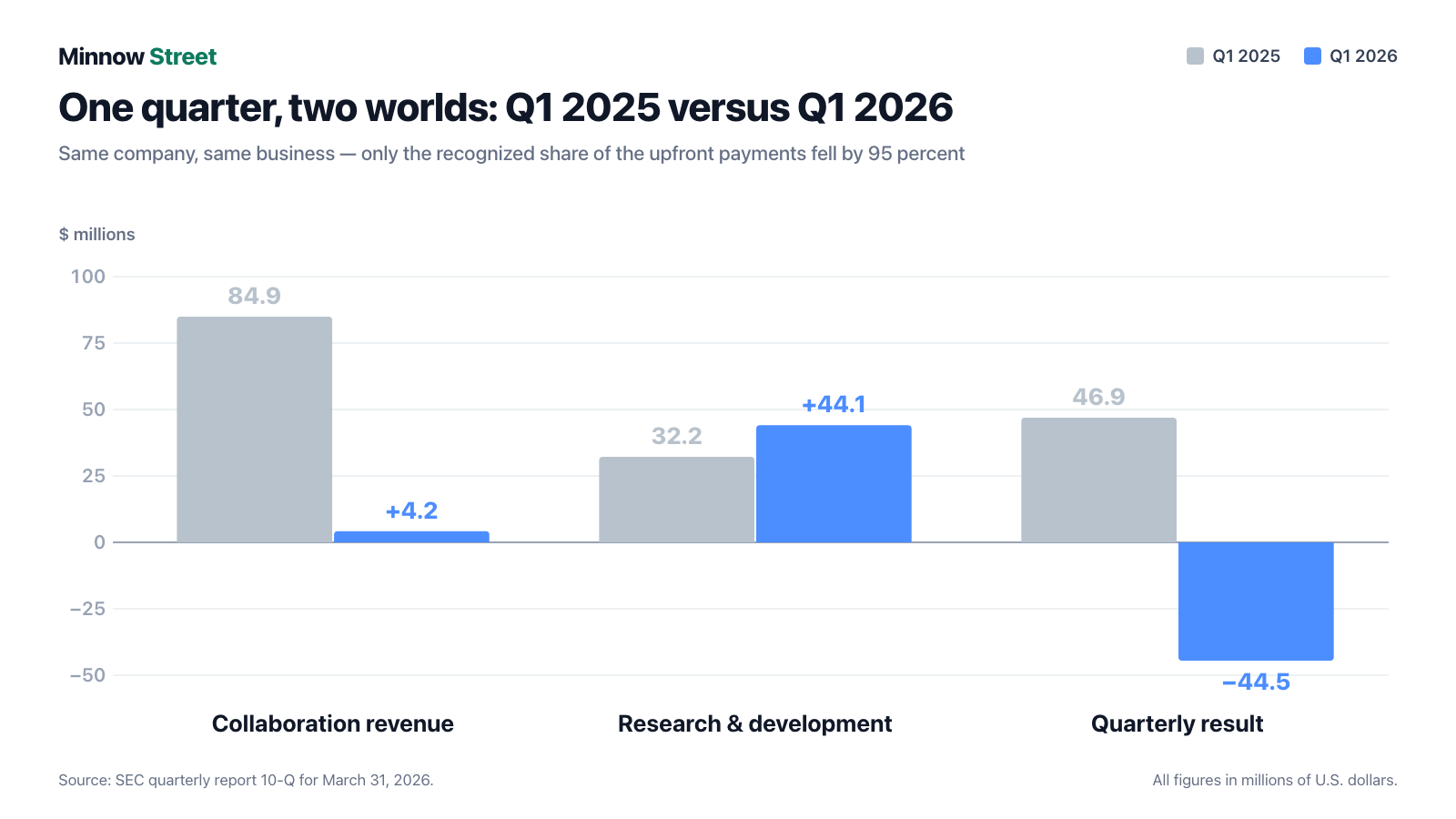
"Collaboration revenue of $4.2 million and $84.9 million for the three months ended March 31, 2026 and 2025, respectively, represents revenue recorded under our collaboration and license agreements with Roche and Novartis."
— Monte Rosa Therapeutics, Inc., Form 10-Q for March 31, 2026, Results of operations

What happened? Nothing. The 2024 Novartis agreement was fully recognized as of September 30, 2025 — the entire $150 million plus $1.2 million of cost reimbursements had run through the income statement. After that the slice was gone. Recognition on the Roche agreement continued, and recognition on the 2025 Novartis agreement had barely begun: of the $120.0 million, only $4.3 million had been recognized by March 31, 2026, leaving $115.7 million sitting on the balance sheet as deferred revenue.
The takeaway: revenue that does not come from a sale measures no demand. It only shows which page of the calendar the accounting department has open.
Two side observations sharpen the picture. First, in the first quarter of 2026 Monte Rosa earned more from interest income of $5.6 million than from its entire collaboration revenue of $4.2 million. Second, research spending rose over the same period from $32.2 million to $44.1 million and general and administrative expense from $8.7 million to $10.2 million. Costs are climbing while the revenue slice thins — which is precisely why the sign flipped.
Uncomfortable truth No. 2: The good data came in January — so did the offering
On January 7, 2026 Monte Rosa published the MRT-8102 data. On that same January 7 the company terminated its old at-the-market prospectus and filed a prospectus supplement; a second followed on January 9. That is not a scandal — it is the business model of a research company.
"In January 2026, we entered into an underwriting agreement with Jefferies LLC, or Jefferies, TD Securities (USA) LLC, and Piper Sandler & Co. as representative of the several underwriters, related to the underwritten public offering, or the 2026 Offering, of 13,000,000 shares of common stock at a price of $24.00 per share (…). Aggregate gross proceeds from the 2026 Offering were $345.0 million. Aggregate net proceeds from the 2026 Offering were $323.8 million after deducting the underwriter discounts, commissions, and other offering costs."
— Monte Rosa Therapeutics, Inc., Form 10-Q for March 31, 2026, Underwritten public offerings

Dilution is a word everyone knows and almost nobody recalculates. The everyday image: the cake stays the same size but gets cut into more slices. Your slice shrinks without you doing anything.
The numbers: as of December 31, 2025 there were 65,543,723 shares. As of March 31, 2026 there were 84,321,705 — up 28.6 percent in a single quarter. As of May 1, 2026 the company reported 84,479,418. Additional paid-in capital jumped over the same quarter from $714.1 million to $1,048.4 million.
The real point, though, is the price. In May 2024 the same company issued 10,638,476 shares at $4.70 for gross proceeds of $100.0 million. Twenty months later the offering price was $24.00 — more than five times as much. Anyone who subscribed in 2024 benefited. Anyone who subscribed in 2026 at $24.00 pays a multiple for the same pipeline because good news arrived in between.
And it is not over: on February 11, 2026 Monte Rosa registered a new at-the-market program of up to $100.0 million, under which not a single share was sold during the first quarter of 2026. Authorized capital stands at 500,000,000 common shares; on top of that, as of March 31, 2026 there were 16,997,266 pre-funded warrants, 15,989,324 stock options and 1,149,012 restricted stock units outstanding. The cake can still be cut a good deal finer.
Uncomfortable truth No. 3: The most advanced asset belongs to Novartis
When investors discuss Monte Rosa, the figure $2.1 billion comes up regularly. That is the total milestone money Novartis could pay for the VAV1 degraders. The sentence next to it gets quoted far less often.
"In December 2024, we received a $150 million non-refundable upfront payment. Pursuant to the 2024 Novartis Agreement, we are eligible to receive from Novartis up to $2.1 billion in development, regulatory, and sales milestones, beginning upon initiation of Phase 2 studies (…)."
— Monte Rosa Therapeutics, Inc., Form 10-Q for March 31, 2026, 2024 Novartis license agreement

Three things in that paragraph change a valuation. First, the $2.1 billion is a conditional ceiling, not a receivable. More than $1.5 billion of it only flows if multiple indications win approval in multiple territories. Second, the counter starts only when Phase 2 studies begin — and Novartis decides that, not Monte Rosa. In January 2026 the company itself wrote that it expects its collaborator to initiate multiple Phase 2 studies of MRT-6160 during 2026. Third, from Phase 3 onwards Monte Rosa may co-fund and would then share 30 percent of U.S. profits and losses.
An unremarkable table in the quarterly report shows how completely the asset has left the building. In-house research spending by program in the first quarter of 2026 versus the year-earlier quarter, in thousands of dollars:
- MRT-6160 (VAV1, licensed to Novartis): 11 against 3,981 — a decline of 99.7 percent
- MRT-8102 (NEK7, the in-house lead): 6,781 against 1,882
- MRT-2359 (MYC/GSPT1, oncology): 2,381 against 1,945
- CCNE1 (discovery stage): 1,703 against 762
- other development and discovery programs: 9,589 against 4,040
That is the honest reading of the partnership: Novartis pays and works, Monte Rosa waits for the mail. For the treasury that is good news. For the question of how much in-house value creation sits inside the share price, it is a limitation.
Uncomfortable truth No. 4: One study arm is already shut — and there is no CFO
On December 16, 2025 Monte Rosa reported interim data for MRT-2359 combined with enzalutamide in heavily pretreated men with metastatic castration-resistant prostate cancer. The headline sounded strong: disease control in 100 percent of patients carrying a particular mutation. The base was N = 4. Of 20 patients enrolled, 14 were evaluable under the standard criteria, and four of those 14 carried the AR mutation. Across all 14, the disease control rate was 64 percent.
The same document contains a sentence that drew less attention. For the six women with hormone-receptor-positive breast cancer who were also in the study, "results did not present sufficient evidence of activity to support further development in this population." One study arm was therefore shut down.
The second finding in this chapter sits in the signature block. Monte Rosa\'s quarterly and annual reports are signed by Markus Warmuth, M.D. — in a dual capacity, as "Principal Executive Officer and Principal Financial Officer." The 2025 annual report lists eight executives on whom the company describes itself as highly dependent: chief executive, chief data and information officer, chief scientific officer, chief medical officer, chief business and legal officer, chief operating officer, chief technology officer and chief investor relations and strategy officer. No chief financial officer appears among them. In addition, the corporate controller changed effective April 3, 2026, when Edmund Dunn retired and Matthew Bowen succeeded him.
This is not an accounting scandal — disclosure controls were assessed as effective as of March 31, 2026, the auditor is Deloitte & Touche LLP, and shareholders ratified that appointment on June 11, 2026 by 75,171,524 votes to 57,950. It is an observation about scale: a company holding $666.2 million in cash, $320.0 million of collected upfront payments and a multi-year recognition calendar runs its finances without a dedicated chief financial officer.
Valuation — what the market pays for the pipeline
Market capitalization stood at roughly $1.9 billion as of July 25, 2026 (closing price of $22.78 on July 24, 2026, on 84,479,418 shares). Counting the 16,997,266 pre-funded warrants — and economically one must, given their exercise price of $0.0001 — the figure is roughly $2.3 billion.
From that you can deduct the treasury: $666.2 million as of March 31, 2026. What remains is roughly $1.3 billion (or roughly $1.6 billion including the warrants) that the market pays for the pipeline — one Phase 1 asset with good interim data, one out-licensed asset, one oncology program on a thin data base, and a discovery engine.
Conventional multiples do not help here, and it is worth saying why. There is no price-earnings ratio because there are no earnings. A price-to-sales ratio could be calculated — roughly 45 times trailing twelve-month revenue of $43.0 million — but the number is worthless, because that revenue is not a sale, it is a slice of calendar. Price to book stood at 3.7.
What can be framed sensibly: the stock closed between $4.19 and $25.31 in the twelve months through July 24, 2026 — six times over from low to high. Year to date it was up roughly 45 percent (closing price on December 31, 2025: $15.68). And the market is split: nine analyst ratings averaged a $33.17 target, while 17,195,471 shares were sold short — roughly 20.7 percent of the float (data as of July 25, 2026).
Opportunities and risks at a glance
What speaks for Monte Rosa:
- $666.2 million in cash and securities as of March 31, 2026, no interest-bearing debt, and a stated cash runway "into 2029" — the company does not have to issue stock at any price for years.
- Two pharmaceutical groups have confirmed the technology with $320.0 million of upfront payments: Roche since October 2023, Novartis in two separate agreements in 2024 and 2025.
- The MRT-8102 interim data of January 7, 2026 are objectively measurable: 85 percent less hsCRP after four weeks in 24 subjects, 94 percent below the risk threshold, 80 to 90 percent target degradation. That is evidence of effect in humans, not in an animal model.
- Molecular glues address target proteins for which no medicines exist at all — an unoccupied market if the technology holds.
What speaks against it:
- No approved product, no product revenue, and an accumulated deficit of $521.7 million as of March 31, 2026. The first in-house Phase 2 study, GFORCE-2, was only due to start in the second half of 2026.
- The revenue line follows an accounting calendar rather than the business: down 95 percent in the first quarter of 2026, with the result flipping from plus $46.9 million to minus $44.5 million.
- Dilution: 65,543,723 shares as of December 31, 2025, 84,479,418 as of May 1, 2026, plus 16,997,266 pre-funded warrants, 15,989,324 options, 1,149,012 restricted stock units and a $100.0 million at-the-market program.
- Concentration risk: virtually all reported revenue comes from two customers. If one drops out, the revenue line drops with it.
- The most advanced clinical asset, MRT-6160, belongs to Novartis; in-house research spending on it was $11,000 in the first quarter of 2026.
- Roughly 20.7 percent of the float was sold short as of July 25, 2026 — part of the market is betting against this stock.
A human conclusion
We opened with the slice trap, and it is also the most honest way to close. Monte Rosa is not a company staging a turnaround whose loss is therefore shrinking. It is a research company whose accounting cuts upfront payments into slices — some thick, some thin. 2025 was a thick slice. The first quarter of 2026 was a thin one. Nothing about the business changed in between.
What genuinely did change sits elsewhere: one asset has shown in humans that it does what it is supposed to do. Two of the largest pharmaceutical groups in the world have paid for the technology. And the company used the share-price jump to raise $345.0 million — cleanly disclosed, readable in the prospectus, and a smaller slice of cake for every existing shareholder.
Whether that makes a good investment hangs on a question no balance sheet answers: does the Phase 1 evidence hold up in Phase 2, when the endpoint is no longer an inflammation marker but counted cardiovascular events? The answer arrives with the GFORCE studies at the earliest. Until then you are buying a treasury, two contracts and a hope.
What you make of that is your decision. And that is exactly as it should be.
Sources
- Monte Rosa Therapeutics, Inc., Form 10-Q for the quarter ended March 31, 2026 (filed May 7, 2026) — balance sheet, income statement, Note 3 (Roche and Novartis), Note 10 (equity and pre-funded warrants), Note 13 (dilutive securities), liquidity and capital resources
- Form 10-K for fiscal 2025 (filed March 17, 2026) — Item 1 Business and the QuEEN discovery engine, headcount, Item 1A Risk Factors, financial statements for 2025 and 2024
- Form 10-K for fiscal 2024 (filed March 20, 2025) — split of 2024 revenue between Roche and Novartis, and the statement "We did not recognize collaboration revenue for the year ended December 31, 2023."
- Form 8-K dated January 7, 2026 — interim Phase 1 data for MRT-8102 and the GFORCE study timetable
- Form 8-K dated December 16, 2025 — interim data for MRT-2359 in prostate cancer and discontinuation of the breast cancer arm
- Form 8-K dated February 10, 2026 — change of corporate controller effective April 3, 2026
- Form 8-K dated June 11, 2026 — annual meeting results and ratification of Deloitte & Touche LLP as auditor
- Schedule 13D/A No. 4 dated July 6, 2026 — in-kind distribution of 1,000,000 shares by New Enterprise Associates 17 on July 1, 2026, holding thereafter 7.9 percent
- All Monte Rosa Therapeutics filings with the SEC (CIK 1826457) — including the 424B5 prospectus supplement of January 9, 2026 and the S-3ASR shelf registration of February 11, 2026
- Source: fundamental data & SEC filings (annual and quarterly reports, 10-K/10-Q) — metrics, price and valuation data as of July 25, 2026
- Origin: our in-house stock scanner, Moglen weekly ranking (U.S. selection), 13th of 28, as of July 25, 2026
This article is journalistic commentary on publicly available company filings. It is expressly not investment advice and not a solicitation to buy or sell securities. Shares of research companies without an approved product can be highly volatile; a total loss of invested capital is possible. All figures come from the original documents named above and carry the date stated with them; later developments are not reflected. The author holds no position in the stock discussed at the time of publication.
Our Bottom Line at a Glance
- Balance sheet and liquidity positive
- As of March 31, 2026 the company held $666.2 million in cash and marketable securities against total assets of $736.4 million and equity of $521.9 million. There is no interest-bearing debt; the largest liability is $136.7 million of partner money already collected but not yet earned. Management states a cash runway "into 2029."
- Technology and partners positive
- Roche paid $50.0 million upfront in November 2023, Novartis a further $150.0 million in December 2024 and another $120.0 million in September 2025 — $320.0 million in total, with no repayment obligation and no shares issued. The MRT-8102 interim data of January 7, 2026 show effect in humans: hsCRP down 85 percent after four weeks in 24 subjects.
- Earning power negative
- There is no approved product and no product revenue; the accumulated deficit stood at $521.7 million as of March 31, 2026. Reported revenue follows an accounting calendar: $4.2 million in the first quarter of 2026 against $84.9 million a year earlier, down 95 percent — turning $46.9 million of profit into $44.5 million of loss.
- Dilution negative
- Share count rose from 65,543,723 on December 31, 2025 to 84,479,418 on May 1, 2026 — up 28.9 percent in four months, driven by the January 2026 placement of 13,000,000 shares at $24.00. On top of that sit 16,997,266 pre-funded warrants, 15,989,324 options, 1,149,012 restricted stock units and an untouched $100.0 million at-the-market program.
- Dependence on two customers negative
- All reported revenue comes from Roche and Novartis. The most advanced clinical asset, MRT-6160, has been licensed to Novartis since October 2024; in-house research spending on it fell to $11,000 in the first quarter of 2026 from $3.981 million a year earlier. The up to $2.1 billion of milestones only begins flowing once Phase 2 studies start, and Novartis decides that.
- Valuation neutral
- Roughly $1.9 billion of market capitalization ($22.78 on July 24, 2026) — around $2.3 billion including the pre-funded warrants — stands against $666.2 million of cash. The market therefore pays roughly $1.3 billion to $1.6 billion for the pipeline. Nine analyst ratings averaged a $33.17 target while 20.7 percent of the float was sold short (data as of July 25, 2026).
Monte Rosa Therapeutics builds molecular glues that send disease-causing proteins to the cell's garbage disposal, and has raised $1.3 billion from securities sales and partner agreements since inception — without ever selling a drug. Reported revenue is an accounting calendar: $123.7 million in 2025, then $4.2 million instead of $84.9 million in the first quarter of 2026, turning $46.9 million of profit into a $44.5 million loss. What is proven: a very solid treasury of $666.2 million with no interest-bearing debt, $320.0 million of upfront payments from Roche and Novartis, and measurable evidence of effect for MRT-8102 in humans. Against that stand dilution from 65.5 million to 84.5 million shares in four months, a lead asset handed to Novartis, and milestones that only start flowing once Phase 2 studies begin. Not investment advice.
What Our Rating Means
Open questions
The business works in principle, but one material question is open. As long as it stays open, our findings do not carry a quality verdict.
Red would require a finding against substance, and there is none: $666.2 million of cash as of March 31, 2026, no interest-bearing debt, $521.9 million of equity, an Altman Z of 4.62, effective disclosure controls and a runway the company itself puts "into 2029" against an operating cash outflow of $37.4 million per quarter. Green would require proof that the business carries itself: there is no approved product, no product revenue and an accumulated deficit of $521.7 million. All reported revenue comes from two customers and follows a recognition calendar rather than demand, and the most advanced clinical asset sits with Novartis, which also decides when Phase 2 begins. That is a weighty open operational question, but not a threat to substance — hence yellow. The decision is yours.
A journalistic assessment by our editorial team at the time of the deep dive, based on public sources — not investment advice and not a solicitation to buy or sell. Your personal circumstances (investment goals, risk capacity, taxes) cannot be taken into account. What our levels mean, how verdicts are formed, and what conflicts of interest exist →
Worth Noting
- GLUE reached our research list as number 13 of 28 U.S. hits in our in-house Moglen weekly ranking (as of July 25, 2026, relative strength rating 96) — part of our series filling the top 50 of that ranking with analyses. The scanner lists are recalculated daily.
- What the scanner measures: at least 15 percent price gain over four trading days, at least $10 million of average daily dollar volume and a relative strength rating of 70 or higher. Those are purely price-based criteria and say nothing about company quality.
- Metric trap: price-to-sales and price-earnings ratios are misleading for Monte Rosa. There are no earnings, and the reported revenue is not sales revenue but the recognized portion of upfront payments already collected. The Piotroski F-Score (5 of 9) and the Altman Z-Score (4.62) likewise assume profit and revenue quantities that do not exist here in that form.
- Currency note: the most recent quarterly report (Form 10-Q) is dated May 7, 2026 and has been fully analysed. Filings after it were reviewed — the Form 8-K of June 11, 2026 (annual meeting), the Schedule 13D/A of July 6, 2026, further Schedule 13G/A filings, and Form 4 insider filings and Form 144 sale notices through July 17, 2026. There is no merger, no take-private, no going-private transaction and no delisting.
- Risk of confusion: the ticker GLUE belongs to Monte Rosa Therapeutics, Inc. of Boston (CIK 1826457), not to an adhesives maker. The name refers to molecular glue degraders. The Swiss subsidiary Monte Rosa Therapeutics AG in Basel is not separately listed; it is the contracting party in the Roche and Novartis agreements.
Frequently Asked Questions
A molecular glue tethers a disease-causing protein to the cell's own disposal machinery so the cell destroys it. Unlike conventional drugs it needs no binding pocket in the target protein, which lets it reach targets considered undruggable. Monte Rosa finds such glues with an in-house discovery engine called QuEEN and a library of more than 75,000 molecules.
Because Monte Rosa sells no products. Reported revenue consists of upfront payments from Roche and Novartis that are recognized across the contract term. The 2024 Novartis agreement was fully recognized as of September 30, 2025, while the 2025 agreement is spread over roughly 54 months. That is why the line showed $4.2 million instead of $84.9 million.
The company itself states a runway "into 2029" in its Form 10-Q for March 31, 2026, based on $666.2 million in cash and marketable securities. Operating cash outflow was $37.4 million in the first quarter of 2026. There is no interest-bearing debt, and an at-the-market program of up to $100.0 million registered on February 11, 2026 was untouched at quarter end.
Only under conditions. The agreement provides for up to $2.1 billion in development, regulatory and sales milestones payable "beginning upon initiation of Phase 2 studies." More than $1.5 billion of that requires multiple indications to win approval in multiple territories. Novartis, not Monte Rosa, decides when the Phase 2 studies begin.
Monte Rosa issued 13,000,000 new shares at $24.00 plus pre-funded warrants for 1,375,000 shares, raising $345.0 million gross and $323.8 million net. Share count rose from 65,543,723 on December 31, 2025 to 84,321,705 on March 31, 2026, an increase of 28.6 percent in one quarter. Every existing holder now owns a correspondingly smaller share of the company.
They differ. For MRT-8102, 24 subjects had dosed for four weeks at the December 23, 2025 cutoff, and the measured effect on the inflammation marker hsCRP was a clear 85 percent reduction. For MRT-2359, the widely quoted 100 percent disease control rests on four patients with an AR mutation; across all 14 evaluable patients it was 64 percent. The breast cancer arm was discontinued for lack of activity.
Found an error?
Did you spot a factual error, an outdated number, or a typo in this deep dive? Let us know briefly — your report goes straight to the editorial team.