Natural Gas Services Stock: Nine Straight Earnings Beats — and Five Years of Spending More Cash Than It Takes In
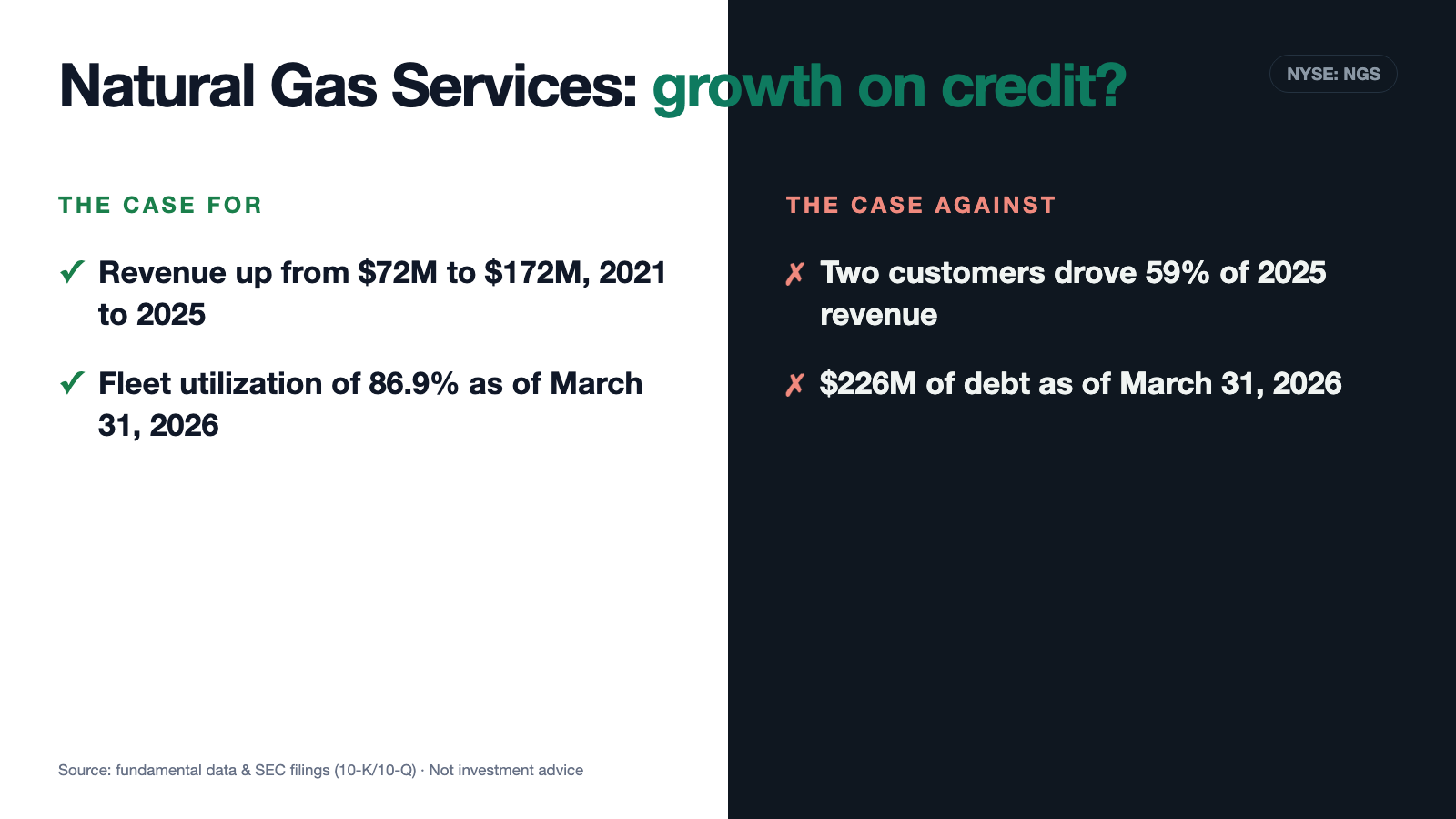
Natural Gas Services rents compressors to oil producers in the Permian Basin and sits at rank 28 in our Big Earnings Surprise scanner (U.S. selection, data as of July 25, 2026). We read the 2025 annual report (10-K), the quarterly report for the period ended March 31, 2026, and every current report filed through July 24, 2026: revenue up from $72 million to $172 million in four years, fleet utilization of 86.9 percent, a dividend raised by 36 percent — but also two customers supplying 59 percent of revenue, $226 million of debt and a $110 million cash acquisition closed in June. Numbers do not lie, but they rarely tell the whole story.
 Thomas Mücke
Founder & Publisher
Thomas Mücke
Founder & Publisher
Chart
Interactive price chart (TradingView).
Note: pure fact-based analysis, not investment advice and not a solicitation to buy or sell. All figures without guarantee.
There is a trap that closes quietly: the streak trap. When a company beats analyst estimates nine times in a row, our brain stops asking questions and starts extrapolating — "it will do it again." Yet a streak like that says something about the forecasters first and about the company second. Natural Gas Services Group, Inc. (NYSE: NGS) owns exactly such a streak: nine consecutive quarters above the consensus estimate. That put it at rank 28 in our Big Earnings Surprise scanner (U.S. selection, 81 hits, data as of July 25, 2026). Before we believe the streak, let us make a deal: we read the actual documents together — the 2025 annual report (10-K), the quarterly report (10-Q) for the period ended March 31, 2026, and every current report (8-K) filed with the U.S. securities regulator, the SEC, since then. They describe impressive growth. They also show that for five years more money has flowed into the rental fleet than the business produced. Remember this from the start: an earnings beat is a statement about expectations, not about cash.
What Natural Gas Services actually does — the rental car company of the oil patch
When oil and gas come out of a well, they do not come out with enough pressure. Without help, much of it would simply stay down there. That help comes from compressors: engine-driven pumps that compress the gas and push it into the pipeline. Depending on size, one unit costs several hundred thousand dollars, needs regular service and sits in the middle of nowhere. That is precisely why producers often rent rather than buy. Natural Gas Services is one of the landlords — the rental car company of the oil patch, if you like. It is based in Southlake, Texas, with administrative offices in Midland, an assembly facility in Tulsa, Oklahoma, and service locations across the major producing basins. As of December 31, 2025 it employed 259 people, none of them represented by a labor union.
The business model is remarkably plain, and that is its appeal: 95.4 percent of 2025 revenue came from rentals, the rest from sales and aftermarket services. Rentals mean recurring payments, often under multi-year contracts, largely independent of whether crude trades at 60 or 80 dollars this week. The company says so itself: it sells neither oil nor gas and therefore has no direct commodity price exposure. What matters is production volume, and that responds more slowly to price swings than drilling activity does. The catch lies elsewhere. Every compressor that gets rented out has to be bought and paid for first. Which brings us to the central tension of this analysis, running through every chapter: the rental model is only as good as the company\'s ability to finance it — and for five years it has been financed mostly by the bank.
How the stock landed on our desk
Our Big Earnings Surprise scanner looks for companies whose actual quarterly earnings came in well above the analyst consensus. As of July 25, 2026 Natural Gas Services sits at rank 28 out of 81 U.S. hits, with a relative strength reading of 80 — meaning the stock outperformed 80 percent of the comparison universe. To repeat the search yourself: open the scanner, set the country filter to "US," read down the ranking. One caveat: these lists are recalculated every day, so a rank is a snapshot, not an attribute of the company.
The pattern behind the rank is more interesting than the rank itself. Reported earnings per share beat expectations in nine consecutive quarters — most recently $0.53 diluted against $0.44 expected in the first quarter of 2026, and before that by margins of 49, 32 and even 71 percent (data as of July 25, 2026). When a streak runs that long, the honest reading is not that management performs superhuman feats, but that analyst models are lagging a structural shift. At NGS that shift has a name: the company has systematically rebuilt its fleet from small units to large ones, and large units command higher rents and better margins. Anyone modeling that transition too slowly underestimates the company every quarter. That is good news with an expiry date, because eventually the models catch up and the streak ends without the business deteriorating at all. Remember: a streak of earnings beats is not a business model.
The numbers over the years — what genuinely impresses
Let us start with what is good without qualification. Revenue rose from $72.4 million in 2021 through $84.8 million, $121.2 million and $156.7 million to $172.3 million in 2025 — a gain of 138 percent in four years. A net loss of $9.2 million in 2021 became net income of $19.9 million in 2025. That is not accounting cosmetics; it is the result of a real operational rebuild.
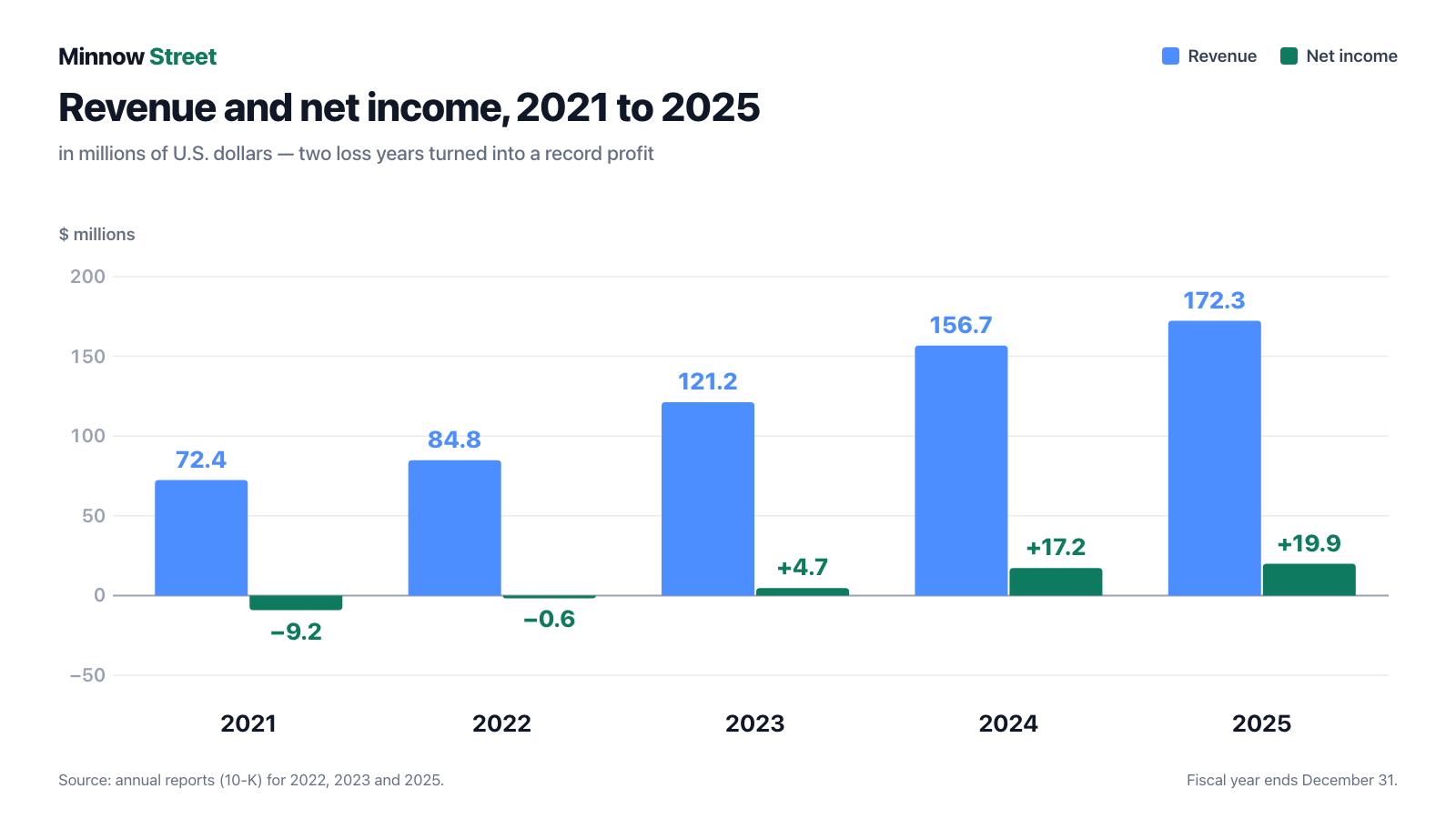
The engine behind that rebuild shows up in a single metric: fleet utilization measured in horsepower. It rose from 80.8 percent at the end of 2023 through 82.1 and 84.9 percent to 86.9 percent as of March 31, 2026. Over the same stretch the number of units in the fleet fell from 1,916 (March 31, 2025) to 1,801 (March 31, 2026), while rented horsepower grew from 492,679 to 574,969. Translated: the company retired small, old compressors and installed large, new ones. Fewer units, more horsepower, better utilization — textbook fleet management. Of those 574,969 rented horsepower, 465,638 sat under contracts expiring between 2026 and 2031 as of March 31, 2026, with only 109,331 on a month-to-month basis.
The funding side improved visibly too. The weighted average interest rate on drawn borrowings fell from 7.97 percent in the first quarter of 2025 to 6.62 percent in the first quarter of 2026. And since 2025 the company has paid a dividend — in May 2026 it raised the quarterly rate from $0.11 to $0.15 per share, a 36 percent increase, paid on June 3, 2026.
Uncomfortable truth No. 1: two customers carry almost two-thirds
Natural Gas Services had roughly 60 customers for its rental fleet as of December 31, 2025. Two of them determine the company\'s fate. The annual report names them:
"During the years ended December 31, 2025, 2024 and 2023 our revenues from Occidental Permian, LTD. ("Oxy") and Devon Energy Corporation ("Devon") amounted to 59 percent, 59 percent and 52 percent of our revenue on a combined basis, respectively."
— Natural Gas Services Group, Inc., SEC annual report on Form 10-K for 2025, Item 1 "Customers"

And the dependency grew along with the success: in the first quarter of 2026, roughly 64 percent of recurring revenues came from these two customers, along with 63 percent of outstanding receivables. The company states the consequence without any softening: losing either relationship would have a material adverse effect on its business, financial condition, results of operations and cash flows. Picture a contractor with two clients who buys half a billion dollars of equipment to serve both. As long as both keep paying, it is a dream business. If one drops out, the equipment sits in the yard and the payments keep coming due.
Two things soften the picture. Occidental and Devon are not shaky counterparties but large publicly traded producers, and in June 2026 the company actively addressed the issue — more on that below. The principle still holds: concentration risk does not disappear just because the concentration is solvent. For contrast it is worth looking at another Permian service provider we have covered: ProPetro shows how quickly a utilization story turns into a pricing story when producers tighten their budgets.
Uncomfortable truth No. 2: for five years more went into the fleet than came in
This truth is not in the narrative; it is in the statement of cash flows, the part of the annual report fewest people read. It shows what actually moved in cash rather than what was booked as profit. Across five years the comparison is unambiguous.
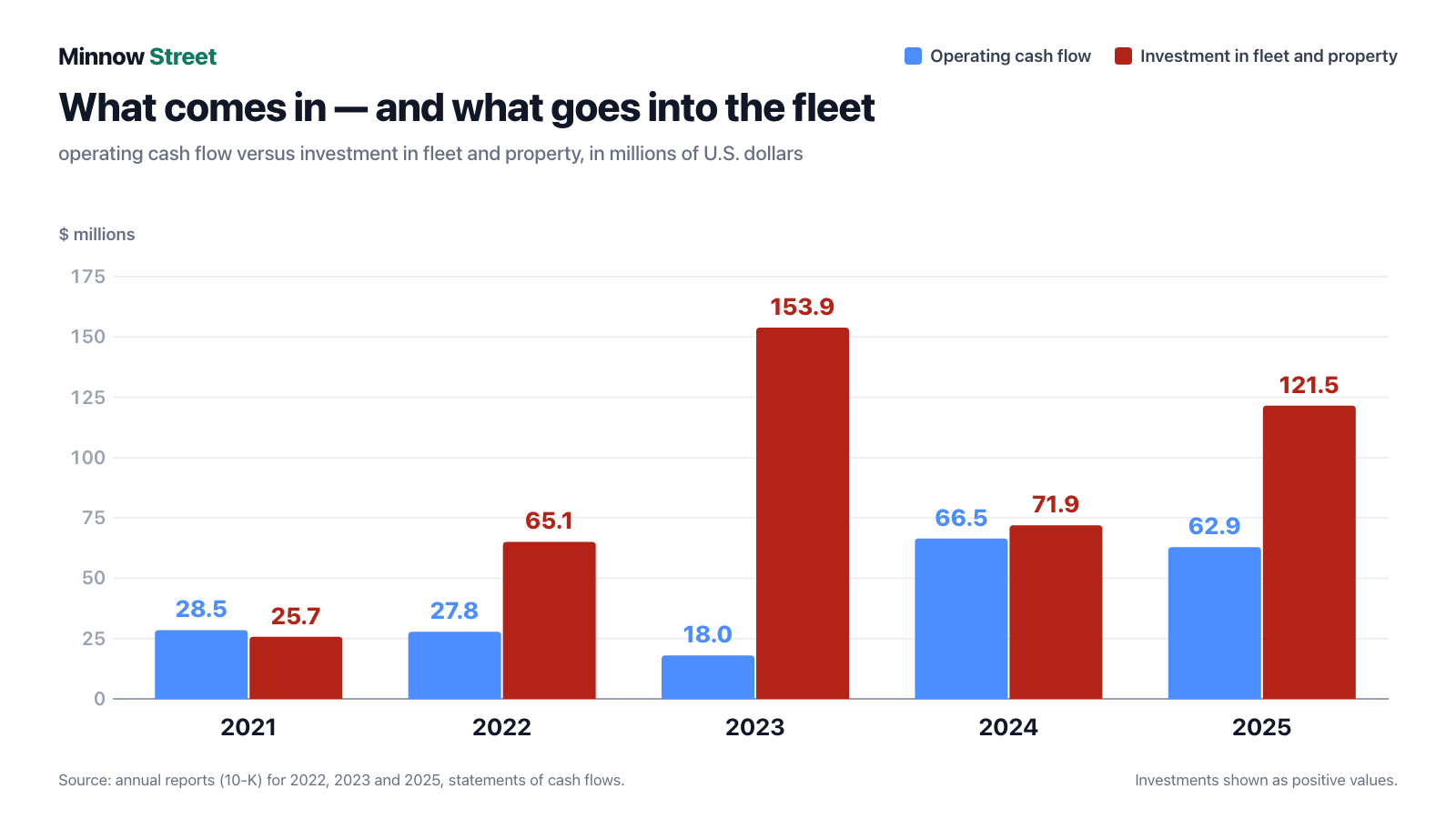
Add it up: from 2021 through 2025 operations generated roughly $204 million. Fleet, property and equipment absorbed roughly $438 million over the same period. Someone else filled the gap of about $234 million — the bank. That is not a scandal; it is the operating system of a rental business, where you buy today to collect for years. But it has a consequence worth knowing. Free cash flow — what remains after all investment — was negative in four of the last five years. Buying this stock does not buy a company that distributes cash; it buys one that invests cash and bets the rents come back later.
One term, briefly translated: depreciation is the accounting decline in the value of the fleet. It reduces profit but costs no cash in the current year, because the cash left when the equipment was bought. That is exactly why a company like NGS can report solid profits and still draw on its revolver: the profit is real and so is the cash position — they simply measure two different things.
Uncomfortable truth No. 3: from zero debt to $226 million — plus $110 million in June
In 2021 Natural Gas Services was effectively debt free. The evidence is unspectacular and therefore convincing: total interest expense for 2021 was $65,000. Four years later, in 2025, it was $13.6 million — two hundred times as much. As of March 31, 2026, $226.0 million was drawn on the revolving credit facility led by Texas Capital Bank, against stockholders\' equity of $280.5 million. The company itself calculates that a one percentage point rise in rates would cost it roughly $2.3 million per year.
On June 12, 2026 another cash payment was added. Which brings us to the most important news since the last quarterly report.
What happened after the last quarterly report: Flatrock, Texas and a new auditor
The most recent quarterly report is dated May 11, 2026 and covers the first quarter. Since then NGS has filed six current reports with the SEC — three of them change the picture.
1. The Flatrock acquisition (June 12, 2026)
NGS bought rival Flatrock Compression Holdings LLC — founded in 2001 and active in the Permian Basin and the Eagle Ford. The purchase agreement was signed and closed on the same day. The consideration is set out in the filing:
"… the Company acquired 100% of the issued and outstanding membership interests … of Flatrock from the Sellers in exchange for (i) 241,803 shares of common stock … (ii) $110 million in cash, subject to customary adjustments … and (iii) the right to receive certain royalty payments pursuant to the Royalty Agreement."
— Natural Gas Services Group, Inc., SEC current report on Form 8-K filed June 15, 2026, Item 1.01
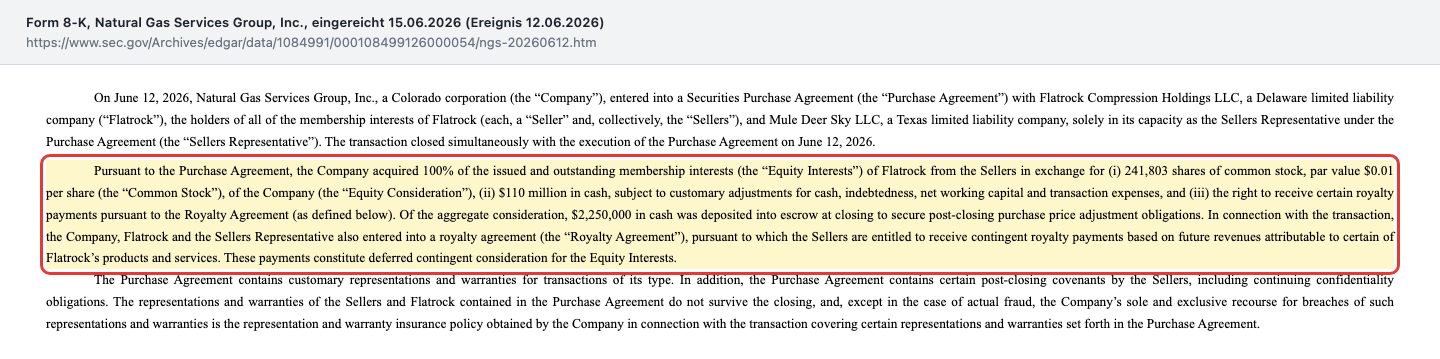
On the conference call held June 15, 2026, management gave the magnitudes: a total price of roughly $120 million, equal to 6.2 times annualized first-quarter 2026 earnings before interest, taxes, depreciation and amortization, before synergies. Flatrock adds roughly 86,000 rented horsepower at about 95 percent utilization, some 80 percent of it in the Permian Basin; roughly 20 percent of the Flatrock fleet is electric motor driven against about 7 percent at NGS. Combined rented horsepower comes to roughly 661,000. To fund the deal the revolving credit facility was expanded from $400 million to $500 million; pro forma leverage is expected at about three times adjusted earnings before interest, taxes, depreciation and amortization, with more than $130 million of borrowing capacity still available.
The most important strategic effect goes straight to uncomfortable truth No. 1: management says the combined share of Occidental and Devon falls from roughly 64 percent to about 54 percent, and two new large publicly traded producers become the third and fourth largest customer relationships. Concentration risk gets smaller, not small.
2. Redomestication to Texas (July 20, 2026)
On July 20, 2026 NGS converted from a Colorado corporation into a Texas one, following a shareholder vote on June 10, 2026. Ticker, exchange listing and CUSIP were unchanged, every share converted one for one, and no certificates had to be exchanged. One sentence from the filing still deserves attention:
"Certain rights of the Company\'s shareholders were changed as a result of the Redomestication."
— Natural Gas Services Group, Inc., SEC current report on Form 8-K filed July 24, 2026, Item 3.03

3. A new auditor (July 9, 2026)
The incumbent audit firm, Ham, Langston & Brezina, resigned because CohnReznick LLP acquired certain of its assets; CohnReznick was appointed for the fiscal year ending December 31, 2026. Context matters here: the audit reports for 2024 and 2025 were unqualified, and the filing states there were no disagreements on accounting matters. An auditor change is a warning sign only when it grows out of conflict — this one grew out of a transaction between accounting firms.
Uncomfortable truth No. 4: more than half of the quarter\'s cash inflow came from the tax authorities
For the first quarter of 2026 NGS reported operating cash flow of $23.0 million, up from $21.3 million a year earlier. The quarterly report explains where much of that came from:
"The net increase is primarily attributable to the receipt in January 2026 of $12.3 million of income tax refunds and related interest as well as the favorable effects of higher realized margins attributable to growth in our high horsepower unit rentals."
— Natural Gas Services Group, Inc., SEC quarterly report on Form 10-Q for the period ended March 31, 2026, "Cash Flows from Operating Activities"

Without that one-time item, roughly $10.7 million remains — against $15.2 million of investment in the same quarter. The year-earlier comparison confirms this is not seasonality: cash flow was $21.3 million in the first quarter of 2025 with no refund at all. The effect is real and non-recurring. Anyone assessing the company\'s self-funding capacity should wait for the second-quarter 2026 report.
What the stock costs — orders of magnitude, not a daily quote
As of July 25, 2026 the market capitalization stood at roughly $500 million. That implies a price-earnings ratio of about 21, a price-sales ratio of roughly 2.8, a price-book ratio of about 1.8 and an enterprise value near nine times earnings before interest, taxes, depreciation and amortization. As a sanity check: the equity portion of the Flatrock price — roughly $10 million for 241,803 shares, set by a 30-day volume-weighted average price formula — works out to just over $41 per share. The order of magnitude of the market value is therefore documented in a filing, not merely supplied by a data feed.
More interesting than any single multiple is how they compare with the price paid for Flatrock. NGS paid 6.2 times earnings before interest, taxes, depreciation and amortization for a competitor while trading at roughly nine times itself. That is exactly what management means by a "meaningful discount to NGS\'s current trading multiple" — as long as the arithmetic holds, every such acquisition creates value for existing shareholders on paper. The professional view is correspondingly friendly: of four recorded analyst ratings at the same data date, three were strong buy and one was buy, with an average price target of roughly $56. Four voices, however, are a thin base; that is normal for a company this size, but it also means a single change of mind moves the consensus noticeably.
For sector context, it is worth glancing at a company with a very different model in the same value chain: Delek US earns its money refining rather than renting — and shows how differently energy cycles land depending on where you sit.
Opportunities and risks at a glance
What speaks for the company:
- A rental model with recurring revenue: 95.4 percent of 2025 revenue from rentals, with 465,638 of 574,969 horsepower under multi-year contracts as of March 31, 2026.
- Utilization at a record: 86.9 percent as of March 31, 2026, up from 80.8 percent at the end of 2023 — achieved with fewer units in the fleet.
- A successful shift to large horsepower units with higher rents and margins, the underlying cause of nine consecutive earnings beats.
- The Flatrock acquisition at 6.2 times earnings before interest, taxes, depreciation and amortization, below the company\'s own multiple, cutting customer concentration from roughly 64 percent to about 54 percent.
- An emerging capital return policy: the quarterly dividend has stood at $0.15 per share since May 2026, up 36 percent.
What speaks against it:
- Concentration risk: two customers supplied 59 percent of 2025 revenue and 63 percent of receivables in the first quarter of 2026 — roughly 54 percent even after Flatrock.
- Free cash flow negative in four of five years, with a cumulative funding gap of roughly $234 million between 2021 and 2025.
- Debt up from effectively zero in 2021 to $226.0 million as of March 31, 2026, plus $110 million in cash for Flatrock; one percentage point of rate increase costs roughly $2.3 million a year.
- A cyclical end market: the company calls its own industry "highly cyclical" and notes that the short duration of many rental contracts lets market shifts hit quickly.
- The Flatrock price is not conclusively quantified — the royalty agreement continues as a revenue-linked payment.
- An effective shelf registration statement of up to $200 million allows new securities to be issued at any time; 30 million shares are authorized against only 13.9 million issued as of March 31, 2026.
A human conclusion
Back to the streak trap. Nine quarters above expectations is a strong signal, but it says something other than most people hear. It says a business changed faster than the models could track. That is a credit to management, and it has a natural half-life. At some point the estimates catch up, and then the beats stop without a single compressor running any worse.
What remains is the real question about this stock: whether a rental business that expands its fleet on credit reaches the point where the rents outrun the payments. So far it has not — the fleet grows, and so does the debt. That is a description, not an accusation: this is how the model works. But it makes the stock a bet on two things at once — steady production volumes in the Permian Basin, and continued access to cheap borrowed money.
And then there are those two customers. Occidental and Devon are good names. Still: anyone drawing 59 percent of revenue from two phone numbers does not have a customer portfolio, they have two partnerships. The Flatrock deal is the most honest answer a company can give to that — it bought itself customers. What you make of it is your decision. And that is exactly as it should be.
Sources
- Annual report on Form 10-K for 2025, filed March 16, 2026 (CIK 0001084991)
- Quarterly report on Form 10-Q for the period ended March 31, 2026, filed May 11, 2026
- Annual report on Form 10-K for 2023, filed April 1, 2024
- Annual report on Form 10-K for 2022, filed March 31, 2023
- Current report on Form 8-K filed May 11, 2026 — first-quarter 2026 results and dividend increase
- Current report on Form 8-K filed June 15, 2026 — Flatrock Compression purchase and fifth credit agreement amendment
- Conference call transcript of June 15, 2026 — Exhibit 99.1 to the current report on Form 8-K filed June 17, 2026
- Current report on Form 8-K filed July 10, 2026 — change of certifying accountant
- Current report on Form 8-K filed July 24, 2026 — redomestication from Colorado to Texas
- Current report on Form 8-K filed January 27, 2026 — retirement of Stephen C. Taylor from the board
- Fundamental data and our in-house stock scanner, data as of July 25, 2026
This article is journalistic analysis and is expressly not investment advice, not a recommendation to buy or sell, and not a solicitation to buy or sell securities. Stocks can lose substantial value, up to total loss. All figures come from the original sources linked above and carry the dates stated there; they may have changed since. The author holds no position in the stock discussed at the time of publication.
Our Bottom Line at a Glance
- Business model and utilization positive
- Rentals produced 95.4 percent of 2025 revenue, with 465,638 of 574,969 horsepower under contracts expiring between 2026 and 2031; utilization reached 86.9 percent on March 31, 2026, up from 80.8 percent at the end of 2023 — with fewer units in the fleet (10-K 2025; 10-Q for the period ended March 31, 2026).
- Growth and earnings turnaround positive
- Revenue rose from $72.4 million to $172.3 million between 2021 and 2025 and net income moved from minus $9.2 million to plus $19.9 million; earnings beat consensus in nine consecutive quarters, most recently $0.53 against $0.44 expected (Q1 2026, data as of July 25, 2026).
- Customer concentration negative
- Occidental Permian and Devon Energy supplied 59 percent of 2025 revenue and 62 percent of receivables, and 64 percent of recurring revenues plus 63 percent of receivables in Q1 2026; management expects roughly 54 percent after Flatrock (10-K 2025; 10-Q for the period ended March 31, 2026; conference call of June 15, 2026).
- Funding and leverage negative
- From effectively no debt in 2021 (interest expense of $65,000) to $226.0 million drawn on the revolver as of March 31, 2026, plus $110 million in cash for Flatrock; the cumulative gap between operating cash flow and investment from 2021 through 2025 comes to roughly $234 million.
- Flatrock acquisition neutral
- Bought at 6.2 times annualized first-quarter 2026 earnings before interest, taxes, depreciation and amortization and therefore below the company's own multiple; it lowers concentration risk and roughly triples the electric share of the fleet — but the price is not conclusively quantified because of the royalty agreement (8-K filed June 15, 2026).
- Cyclicality and capital market options neutral
- The company calls its own industry "highly cyclical" and points to the short duration of many rental contracts; at the same time an effective shelf registration of up to $200 million is in place, with 30 million shares authorized against only 13.9 million issued (10-K 2025; 10-Q for the period ended March 31, 2026).
Natural Gas Services is a rare combination: a dull rental business with spectacular numbers. Revenue and earnings turned around after 2021, fleet utilization sits at a record, and the June 2026 purchase of Flatrock reduces this company's single biggest risk — its dependence on two customers. The price of all that is a balance sheet that moved from effectively no debt to $226 million drawn plus $110 million paid in cash within four years, and free cash flow that was negative in four of the last five years. Investing here is not a bet on a streak of earnings beats; it is a bet that the rents catch up with the payments. Not investment advice.
What Our Rating Means
Open questions
The business works in principle, but one material question is open. As long as it stays open, our findings do not carry a quality verdict.
The next quarterly report is unusually informative for this stock. It will show Flatrock in the numbers for the first time, the fair value of the royalty obligation, operating cash flow without the $12.3 million tax refund, and the interest burden following the $110 million cash payment. Until then, two documented pictures sit side by side: a company running at 86.9 percent utilization with nine consecutive earnings beats, and one that has spent more than it earned for five straight years. Wait, and you get both pictures in a single document. The decision is yours.
A journalistic assessment by our editorial team at the time of the deep dive, based on public sources — not investment advice and not a solicitation to buy or sell. Your personal circumstances (investment goals, risk capacity, taxes) cannot be taken into account. What our levels mean, how verdicts are formed, and what conflicts of interest exist →
Worth Noting
- NGS reached our research list as rank 28 in our in-house Big Earnings Surprise scanner (U.S. selection, 81 hits, relative strength 80, data as of July 25, 2026); the scanner lists are recalculated daily.
- Easily confused: Natural Gas Services Group is neither a gas producer nor a utility — it sells no oil and no gas, it rents out the compressors other companies produce with.
- The July 20, 2026 move from Colorado to Texas was a conversion under a plan of conversion, not a merger and not a new registrant at the SEC: CIK 0001084991, ticker NGS and CUSIP 63886Q109 all stayed the same.
- Price and market value figures (roughly $500 million) carry a data date of July 25, 2026 and were cross-checked against the equity portion of the Flatrock purchase price (about $10 million for 241,803 shares, set by a 30-day average price formula).
Frequently Asked Questions
The company rents compressors — engine-driven pumps that compress natural gas and push it into pipelines — to oil and gas producers in the United States. Rentals produced 95.4 percent of 2025 revenue, with the rest from sales and aftermarket services. It is based in Southlake, Texas, and employed 259 people as of December 31, 2025.
The main reason is a fleet rebuild: Natural Gas Services retired small compressors and installed large ones that command higher rents and better margins. Utilization rose from 80.8 percent at the end of 2023 to 86.9 percent on March 31, 2026. Analyst models tracked that shift more slowly, and the streak followed.
Very. Occidental Permian and Devon Energy together accounted for 59 percent of 2025 revenue and 62 percent of receivables; in the first quarter of 2026 they made up 64 percent of recurring revenues. After the Flatrock acquisition in June 2026, management expects that share to fall to roughly 54 percent.
On June 12, 2026 the company acquired 100 percent of Flatrock Compression Holdings for roughly $120 million: $110 million in cash, 241,803 of its own shares and an ongoing revenue-linked royalty. Flatrock adds roughly 86,000 rented horsepower at about 95 percent utilization, mostly in the Permian Basin.
As of March 31, 2026, $226.0 million was drawn on the revolving credit facility against stockholders' equity of $280.5 million. The Flatrock deal added $110 million in cash, and the facility was expanded from $400 million to $500 million. In 2021 the company was effectively debt free, with annual interest expense of $65,000.
Yes, since 2025. In May 2026 the board raised the quarterly rate from $0.11 to $0.15 per share, an increase of 36 percent. The higher dividend was paid on June 3, 2026 to all shareholders of record as of May 20, 2026.
Since July 20, 2026 NGS has been a Texas corporation rather than a Colorado one. Ticker, exchange listing and CUSIP were unchanged, and every share converted one for one. The filing does note explicitly, however, that certain shareholder rights changed as a result of the change in governing law.
Because every compressor has to be bought before it can be rented out. From 2021 through 2025 operations generated roughly $204 million while about $438 million went into fleet and property. The difference came from the credit facility. Reported profit is real, but it includes depreciation, which costs no cash.
Found an error?
Did you spot a factual error, an outdated number, or a typo in this deep dive? Let us know briefly — your report goes straight to the editorial team.