Delek US: The Earnings Turn Came From the Regulator — and Shareholders Own $52 Million of Equity
Delek US Holdings runs four refineries with 302,000 barrels per day of capacity, and it shows up in two of our screens at once. The reason: a 105 percent earnings surprise for the first quarter of 2026. The filings with the U.S. securities regulator, the SEC, tell a different story. Most of the 2025 operating swing came from small refinery exemptions that cut cost of materials by $356.1 million. Under U.S. accounting rules the first quarter of 2026 produced a loss of $3.34 per share. And of the $302.0 million of equity on the balance sheet, $249.5 million belongs to the minority holders of the midstream affiliate — leaving $52.5 million for Delek shareholders. Let us read what is operations and what is a regulatory decision.
 Thomas Mücke
Founder & Publisher
Thomas Mücke
Founder & Publisher
Chart
Interactive price chart (TradingView).
Note: pure fact-based analysis, not investment advice and not a solicitation to buy or sell. All figures without guarantee.
There is an investor trap that springs precisely when you have finally shown some patience: the turnaround trap. It works like this. A stock has been a misery for years, then one number lands on the calendar — "earnings well above expectations" — and the price runs. Your brain fills in the rest: "The bottom is in, the business is turning." And there you have a thesis without having read a filing. Delek US Holdings (NYSE: DK) of Brentwood, Tennessee is exactly that case right now: four refineries, a midstream business of its own on the exchange, a share price a long way off its low — and an earnings surprise of roughly 105 percent for the first quarter of 2026. So let us make a deal. Before you buy the turn, we read together what the company itself told the U.S. securities regulator, the SEC — the annual report (10-K) for 2025, the quarterly report (10-Q) for the period ended March 31, 2026, and everything filed since. An SEC filing is honest under threat of penalty. And this one describes cost relief that came from an agency, equity that is nearly exhausted, and a dividend that was not earned in 2025. You decide at the end.
What Delek US actually does — four refineries and two thirds of a partnership
Delek US is a refiner — in everyday terms, a kitchen that buys crude oil and cooks it into gasoline, diesel, jet fuel and asphalt. The money is made on the gap between what the crude costs and what the finished products fetch. That gap is called the crack spread, and it is the blood pressure of the business: it moves with oil prices, with gasoline demand, and with the maintenance schedules of competitors. As of December 31, 2025 Delek operated four refineries: Tyler, Texas (75,000 barrels per day), El Dorado, Arkansas (80,000), Big Spring, Texas (73,000) and Krotz Springs, Louisiana (74,000) — a combined 302,000 barrels per day, all in the Gulf Coast region. Three biodiesel plants with 40 million gallons of annual capacity have been idled since the second quarter of 2024.
The second half of the company is unusual, and it drives everything that follows: the logistics segment consists mainly of Delek Logistics Partners, LP (NYSE: DKL), a separately listed partnership with pipelines, terminals, tankage and water handling in the Permian Basin. Delek US held a 63.3 percent interest at March 31, 2026 (33,868,203 common units plus the non-economic general partner interest) and therefore consolidates the partnership in full — DKL revenue, debt and assets appear in the Delek balance sheet in their entirety, even though a good third of them belongs to outside unitholders. In plain terms: the balance sheet shows a house you own two thirds of, while the rent from the whole house runs through your income statement. That is the central tension of this analysis, and it runs through every chapter: the group looks large in revenue and assets, what Delek shareholders actually own is far smaller, and the 2025 earnings swing came in large part from a regulatory decision rather than from operations.
Avigal Soreq is president and chief executive officer; Ezra Uzi Yemin chairs the board. Finance leadership changed effective July 1, 2026: Robert Wright, previously deputy chief financial officer, became chief financial officer, while his predecessor Mark Hobbs now runs the logistics business. At December 31, 2025 Delek employed 1,902 full-time staff, 26.6 percent of them (about 505) covered by a collective bargaining agreement.
Where the stock reached our desk — two screens at once
Delek US did not surface through a press release but through two separate runs of our in-house stock scanner, both as of July 25, 2026. In the Big Earnings Surprise list the stock sits at rank 27 of 81; in Richard Moglen: 1 Week Top Performers at rank 26 of 28. Both lists are recomputed daily, so the placements are a snapshot of that day, not a standing state. To repeat the exercise yourself: both screens are open in the scanner overview; the first sorts by the gap between reported and expected earnings, the second by the past week\'s price move.
What does that mean in plain terms? Two filters saying the same thing: something positive happened here recently. The earnings surprise comes from the report of April 29, 2026: the estimate was an adjusted loss of $1.61 per share, the reported figure an adjusted profit of $0.08 — a gap of $1.69, or roughly 105 percent (data as of July 24, 2026). The second filter simply measures price strength; the stock\'s relative strength rating stood at 80 out of 99 in both lists. And this is where the work begins, because an adjusted number is a calculated number. The audited number sits in the filing itself — and it looks different. Keep the principle in mind from the start: a surprise only becomes a turnaround once it also appears in the audited accounts.
The numbers over the years — given their due
First, what genuinely speaks for Delek, and it is more than the red bottom line suggests. Operationally, 2025 was the best year since 2022. Operating income swung from minus $491.5 million in 2024 to plus $301.0 million. Refining margin rose by $758.3 million, or 119.3 percent, and the refining margin rate went from 5.4 to 13.2 percent. The market backdrop helped: the Gulf Coast 5-3-2 crack spread averaged $20.42 per barrel in 2025 against $17.58 the year before, while WTI at Cushing fell from an average of $75.88 to $64.87 — cheaper input, better output. Segment EBITDA attributable to Delek reached $1,199.0 million (refining $803.4 million, logistics $395.6 million). And the midstream business is growing: revenue rose 7.7 percent to $1,013.3 million in 2025, carried by the Gravity water acquisition for $300.8 million that Delek Logistics closed on January 2, 2025.
Even so, the bottom line stayed negative. Here is the last six years of income attributable to Delek shareholders:
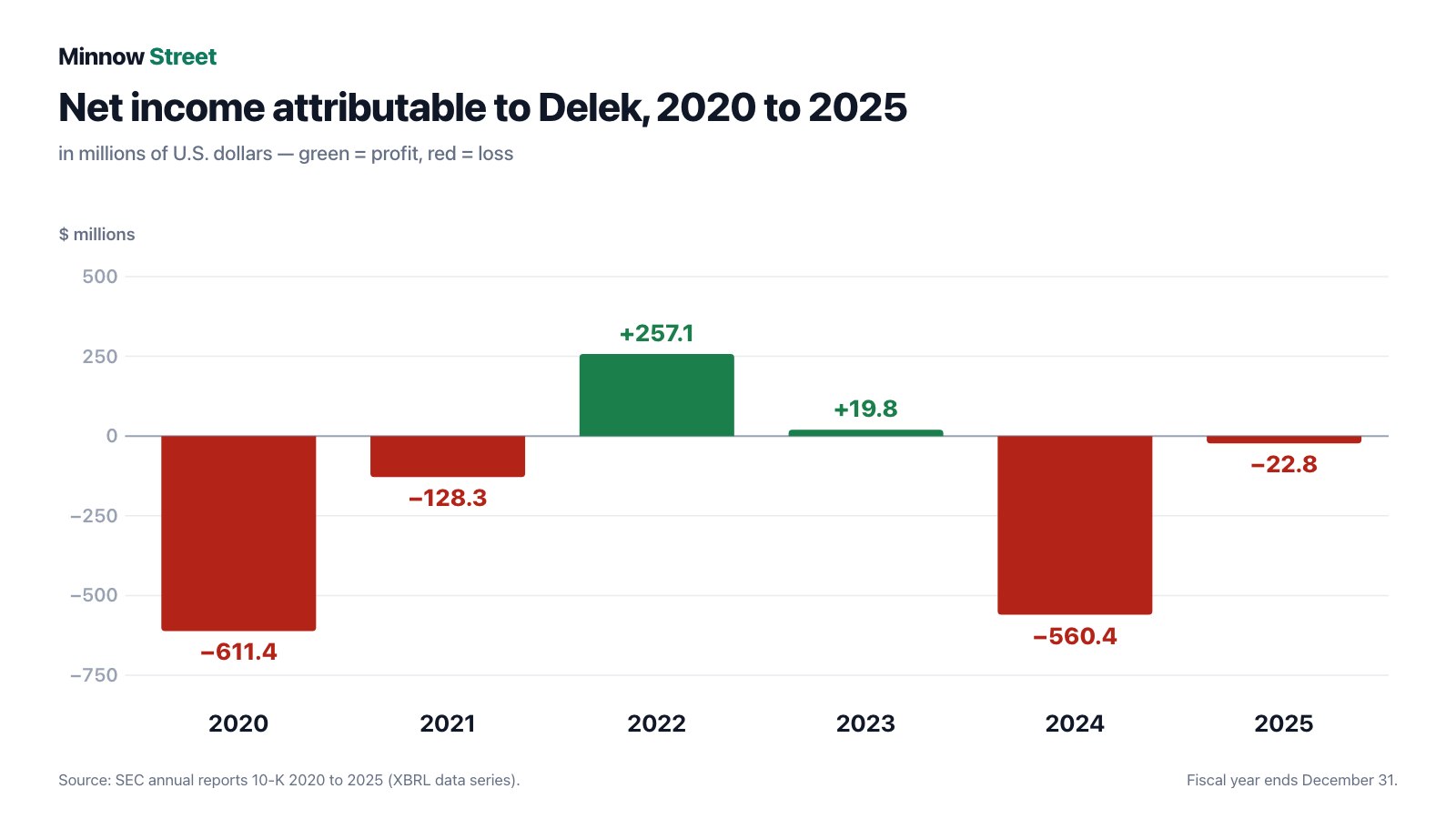
Revenue tells the same cyclical story: $7,301.8 million (2020), $10,648.2 million (2021), $19,801.0 million (2022), $16,467.2 million (2023), $11,852.2 million (2024), $10,722.9 million (2025). A refiner sells commodities, not brands — revenue follows the oil price, not management performance. Which makes revenue the least interesting number in the entire filing. It gets interesting one level down. Which brings us to the uncomfortable truths.
What the filings say — the uncomfortable truths
Uncomfortable truth No. 1: a large part of the 2025 swing came from the environmental regulator
U.S. refiners must blend biofuel into gasoline or buy credits that substitute for the proof — known as RINs under the Renewable Fuel Standard. In everyday terms: a compulsory levy per gallon sold, settled either physically or with purchased vouchers. Small refineries can be exempted. That is what happened in 2025 — and the annual report quantifies it:
"The SREs resulted in a reduction of our Consolidated Net RINs Obligation and therefore a reduction within cost of materials and other of approximately $356.1 million in 2025."
— Delek US Holdings, Inc., SEC annual report on Form 10-K for 2025, Item 7 Management\'s Discussion and Analysis

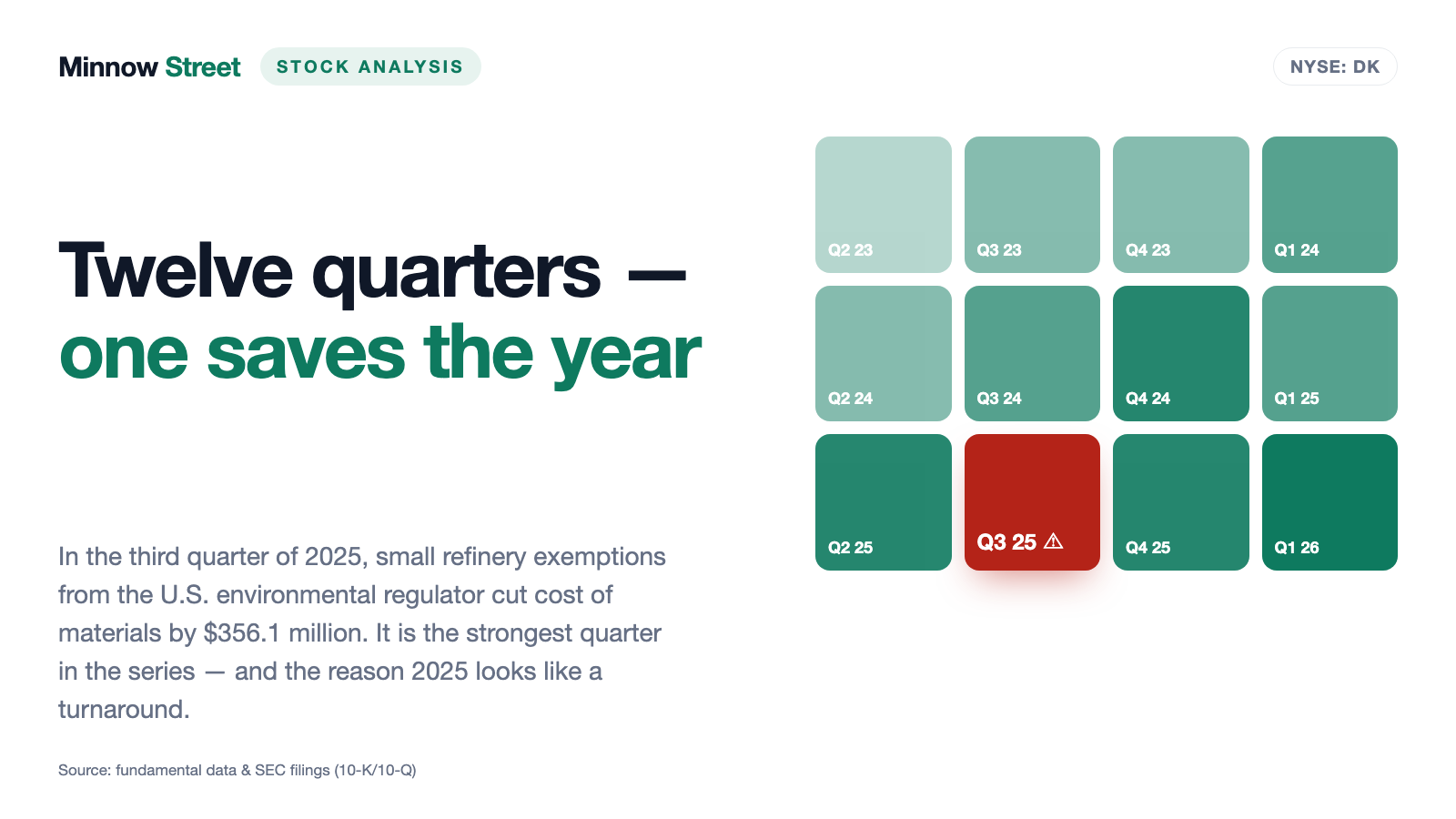
Run the arithmetic. Operating income improved by $792.5 million from 2024 to 2025. Roughly $356.1 million of that — about 45 percent of the entire improvement — came from this one-off relief. The remainder came from the better market (wider crack spreads, cheaper crude) and from the cost program. That does not make 2025 worthless, but it sets the frame: a large share of the "turnaround" is an administrative act, not an operating achievement. The effect landed mostly in the third quarter of 2025 — the only quarter in the last twelve with a clearly positive result ($178.0 million). And it is not finished: the quarterly report for the period ended March 31, 2026 cites an April 7, 2026 appellate ruling in favor of the Delek subsidiary in Krotz Springs, plus several further proceedings against the regulator. Valuing Delek means handicapping agency decisions too.
Uncomfortable truth No. 2: the earnings surprise is not in the audited accounts
Now the number that lifted the stock into both screens. For the first quarter of 2026 the estimate was an adjusted loss of $1.61 per share; the reported adjusted figure was a profit of $0.08 — a gap of $1.69 (data as of July 24, 2026). The quarterly report itself, prepared under U.S. accounting rules, says something else for the same quarter: an operating loss of $179.3 million and a loss of $3.34 per share (prior-year quarter: minus $2.78). Revenue of $2,653.1 million was essentially flat against $2,641.9 million. In everyday terms: the adjusted number is the photograph after editing; the audited accounts are the raw file. Both are permitted, both are published — but only one of them is audited.
First quarters are seasonally weak for refiners, because turnaround maintenance and softer gasoline demand coincide, so a quarterly loss here is not proof of a broken business. The prior-year check confirms it: the first quarter of 2025 was also deep in the red at minus $172.7 million. But that is exactly why the surprise carries less than the filter implies — the gap to the estimate widened, and so did the loss itself. What that does to the balance sheet is the next point.
Uncomfortable truth No. 3: shareholders own $52.5 million of equity — against $475.3 million of goodwill
This is the number worth reading twice. The balance sheet at March 31, 2026 shows total stockholders\' equity of $302.0 million. Of that, $249.5 million is non-controlling interests — essentially outside investors\' stakes in the midstream affiliate Delek Logistics. That leaves $52.5 million for holders of Delek US Holdings common stock. Across 61,287,542 shares outstanding (as of April 23, 2026) that is about $0.86 of book value per share. For comparison, the same balance sheet carries $475.3 million of goodwill — nearly nine times the shareholders\' equity — and an accumulated deficit of $528.6 million. In everyday terms: the house is still standing, but the bank holds almost all of it; what you own is the garden fence.
The pace is visible in the series: total equity was $959.7 million at the end of 2023, $575.2 million at the end of 2024, $547.3 million at the end of 2025 — and $302.0 million after the loss quarter ended March 31, 2026. On top of that sits negative working capital: current assets of $2,647.7 million against current liabilities of $3,494.6 million, a gap of $846.9 million. For refiners with their large crude payables that is not unusual, but in this equity position it is worth watching. Liquidity itself is adequate: $624.1 million of cash at quarter end, plus a revolving facility undrawn at that date.
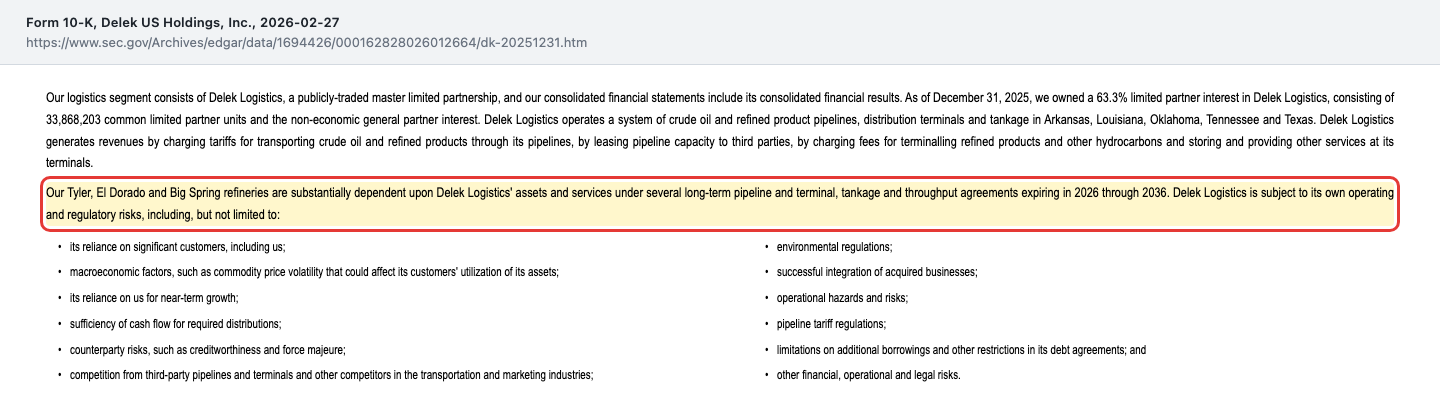
One more item belongs in this chapter: the dependence on the company\'s own affiliate. The annual report puts it bluntly:
"Our Tyler, El Dorado and Big Spring refineries are substantially dependent upon Delek Logistics' assets and services under several long-term pipeline and terminal, tankage and throughput agreements expiring in 2026 through 2036."
— Delek US Holdings, Inc., SEC annual report on Form 10-K for 2025, Item 1 Business
Uncomfortable truth No. 4: the 2025 payout was not earned
Now the calculation that matters most in a capital-intensive business: what is left after investment? In 2025 the group took in $535.8 million from operations. In the same year it spent $529.5 million on property, plant and equipment — maintenance, renewal, expansion. Free cash flow was therefore $6.3 million. On the same basis (total net cash from operating activities less purchases of property, plant and equipment), 2023 produced plus $621.1 million and 2024 minus $494.5 million. Delek nonetheless paid $62.0 million of dividends and $79.4 million of share buybacks in 2025 — the annual report states the total itself:
"As of December 31, 2025, we returned $141.4 million of capital in 2025 to shareholders through dividends and share buybacks."
— Delek US Holdings, Inc., SEC annual report on Form 10-K for 2025, Item 7 Management\'s Discussion and Analysis

On top of that, $87.1 million of distributions went to the minority holders of Delek Logistics and also left the group. The full-year picture looks like this:
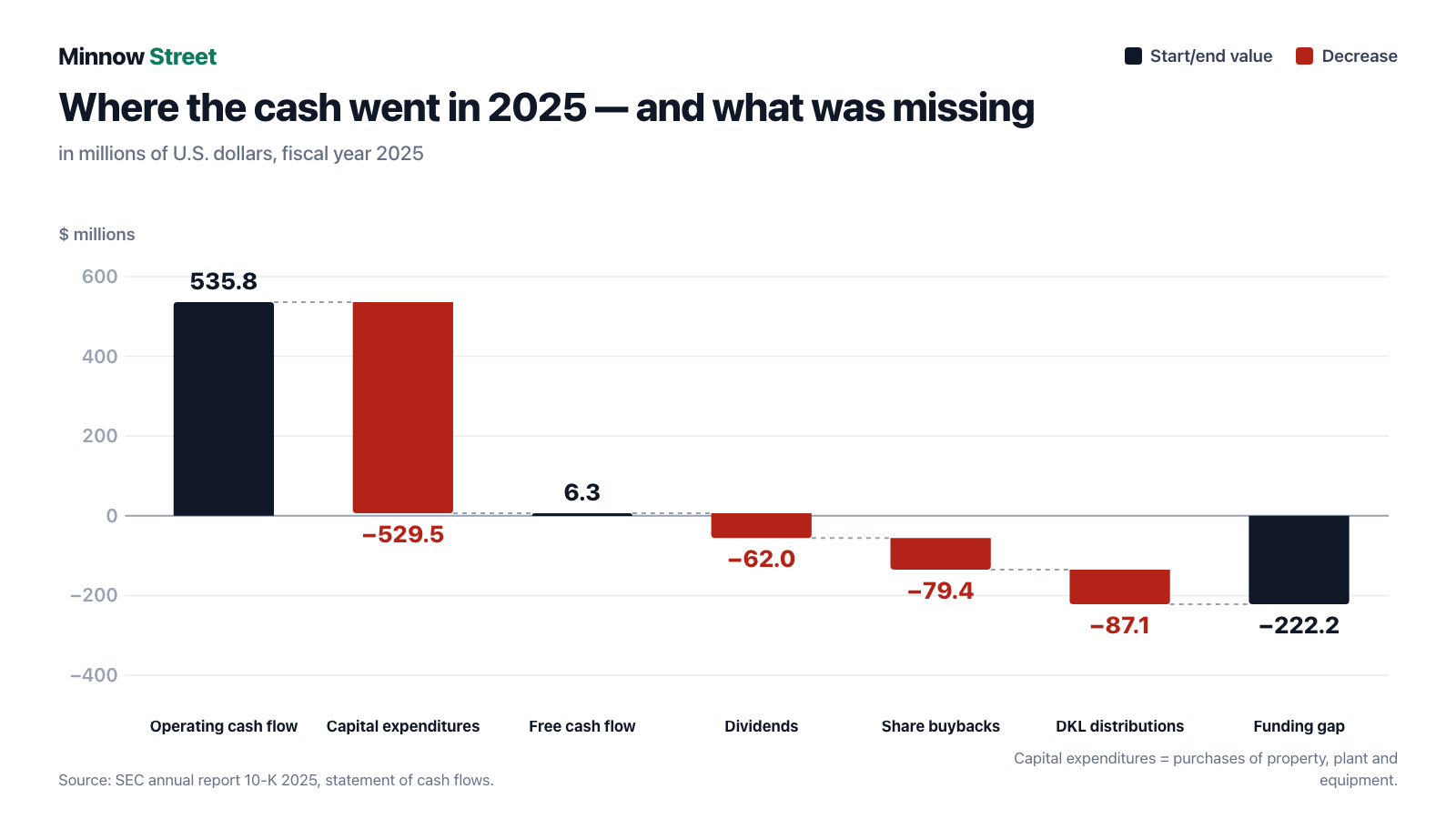
The $222.2 million gap was closed with borrowings and inventory financing. Above all of it sit the interest payments: Delek paid $341.7 million of cash interest in 2025 — more than the whole year\'s operating income. Remember the pattern: a dividend funded from the credit line is not a distribution, it is refinancing with a good feeling. In the first quarter of 2026 the company at least drew part of the conclusion: no shares were repurchased (prior-year quarter: $31.5 million), while the dividend of $15.6 million continued — and was declared again on July 23, 2026 at $0.255 per share, payable August 10, 2026. How quickly a refiner earns money in good years and burns it in bad ones we also saw at HF Sinclair; how durable the payout of an affiliated midstream partnership can be, at NGL Energy Partners.
Uncomfortable truth No. 5: the debt side has been reset — the good news after the quarterly report
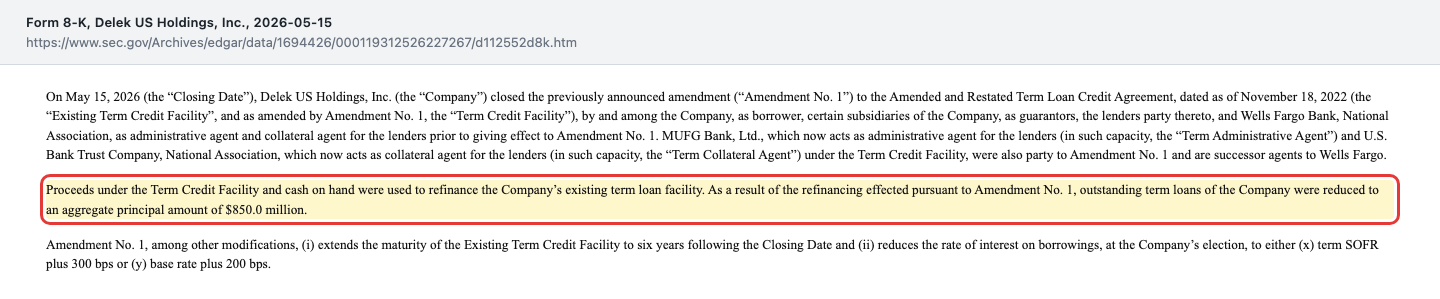
Fairness requires reading the latest filing rather than stopping at the quarter end. At March 31, 2026 total debt stood at $3,230.2 million of principal: $919.1 million of Delek term loan, $161.1 million drawn on the Delek Logistics revolver, and three Delek Logistics notes ($400.0 million, $1,050.0 million and $700.0 million); Delek\'s own revolving facility was undrawn at that date. After the quarter end the company improved terms twice. On April 9, 2026 the secured revolving facility was raised from $1,100.0 million to $1,250.0 million, its maturity extended from October 2027 to April 9, 2031, and the interest margin cut by 0.25 percentage points. On May 15, 2026 the term loan followed:
"Proceeds under the Term Credit Facility and cash on hand were used to refinance the Company's existing term loan facility. As a result of the refinancing effected pursuant to Amendment No. 1, outstanding term loans of the Company were reduced to an aggregate principal amount of $850.0 million."
— Delek US Holdings, Inc., SEC Form 8-K filed May 15, 2026, Item 1.01
That is genuine progress and belongs honestly in any assessment: Delek has bought itself time. The next significant maturity at the parent is now years away, and the rate is coming down. What the refinancing does not change: the debt load itself remains heavy, a large share of it sits at the midstream affiliate, and interest of $84.5 million in the first quarter of 2026 alone still consumes most of what the refining business earns in an ordinary quarter.
Valuation: measured against what, exactly?
At Delek the usual yardsticks fail one after another, and that is information in itself. A price-to-earnings ratio cannot be formed for 2025 — there were no earnings. A price-to-book ratio produces an absurd number: at roughly $0.86 of book value per share and a price of $63.20 (closing price of July 24, 2026, used here as a dated valuation anchor) it would be about 74 — which only tells you the book value no longer measures anything. Two orders of magnitude remain. First, price to sales: market capitalization at the same date was roughly $3.9 billion (61,287,542 shares per the cover page of the quarterly report, as of April 23, 2026), a good third of 2025 revenue of $10,722.9 million. For a refiner that is unremarkable — the industry has always traded at a fraction of revenue.
Second, enterprise value, that is market capitalization plus debt less cash: roughly $6.5 billion ($3.9 plus $3.2 less $0.6). Against earnings before interest, taxes, depreciation and amortization of a little over $0.7 billion that is eight to nine times — at the upper end of normal for a cyclical processor, especially since that figure contains the $356.1 million of exemptions. The professionals\' view: thirteen analysts cover the stock, four at strong buy, one at buy, seven at hold and one at sell; the average target price was $60.58 — below the July 24, 2026 price (data as of July 24, 2026). The estimate curve is telling too: consensus expects adjusted earnings of $7.17 per share for 2026, but only $3.05 for 2027. In plain terms: the market is pricing a strong 2026 — and the return of the cycle after it. Buy today and you are buying a peak year at a peak-year price.
Opportunities and risks at a glance
What speaks for Delek US:
- Operationally the best year since 2022: 2025 operating income of plus $301.0 million after minus $491.5 million; refining margin up 119.3 percent and the margin rate up from 5.4 to 13.2 percent.
- Valuable, hard-to-replace assets: four refineries with 302,000 barrels per day of capacity on the Gulf Coast — plants of this kind are effectively no longer built in the United States.
- A second leg with its own listing: Delek Logistics (63.3 percent interest at March 31, 2026) contributed $395.6 million of segment EBITDA attributable to Delek in 2025 and is expanding into Permian water handling through deals such as Gravity ($300.8 million, January 2025).
- Debt reset: the revolving facility was raised to $1,250.0 million and extended to 2031 on April 9, 2026; the term loan was cut to $850.0 million on May 15, 2026 with a six-year maturity at term SOFR plus 300 basis points.
- Adequate liquidity and a running payout: $624.1 million of cash at March 31, 2026, a quarterly dividend of $0.255 per share declared again on July 23, 2026, and $464.2 million remaining under the buyback authorization as of December 31, 2025.
What speaks against it:
- A large share of the 2025 swing came from small refinery exemptions granted by the environmental regulator: $356.1 million of cost relief, about 45 percent of the entire improvement over 2024 — an item that need not recur.
- Equity attributable to Delek shareholders of just $52.5 million at March 31, 2026, against $475.3 million of goodwill and a $528.6 million accumulated deficit in the same balance sheet; total equity fell from $959.7 million to $302.0 million in two years.
- The 2025 payout was not earned: $6.3 million of free cash flow after capital expenditures, but $141.4 million to shareholders and $87.1 million to the Delek Logistics minorities, alongside $341.7 million of cash interest.
- Four of six years with a net loss (2020 through 2025); the first quarter of 2026 also ended at minus $3.34 per share under U.S. accounting rules, even as the adjusted figure beat the estimate by 105 percent.
- Full exposure to the crack spread and to the company\'s own midstream affiliate: three of the four refineries are "substantially dependent" on Delek Logistics assets and services under agreements that begin expiring in 2026; the average analyst target of $60.58 sat below the price on July 24, 2026.
A human conclusion
Back to the turnaround trap. Its core is not that nothing improved at Delek — a good deal did: operating income turned, the margin rate more than doubled, the debt has been reset, and in those four refineries the company owns assets nobody builds anymore. Its core is that the word "turnaround" spares you the question of where the improvement came from. And the answer is in black and white in the company\'s own report: to a large degree from a regulator\'s decision worth $356.1 million, not from operations. Buy Delek today and you are buying three very concrete things: a cyclical commodity processor whose result hangs on the crack spread; a balance sheet in which $52.5 million of the $302.0 million of equity belongs to you; and a payout policy that recently distributed more than the business left after investment. That may be entirely fine for you — if you can sit through cycles and you are betting that margins hold in 2026. So the honest question is not "is the turn here?" but: would you buy a company at a price that assumes a peak year, when the last good year was almost half paid for by an agency? If yes, you have a thesis. If no, you had a screen hit. What you make of it is your decision. And that is exactly as it should be.
Sources
Every original document used in this analysis, for you to read yourself:
- Delek US Holdings, Inc. — SEC annual report on Form 10-K for 2025 (filed February 27, 2026)
- Delek US Holdings, Inc. — SEC quarterly report on Form 10-Q for the period ended March 31, 2026 (filed April 29, 2026)
- Delek US Holdings, Inc. — SEC Form 8-K filed May 15, 2026 (Amendment No. 1 to the term loan, Items 1.01 and 2.03)
- Delek US Holdings, Inc. — SEC Form 8-K filed July 2, 2026 (chief financial officer change effective July 1, 2026, Item 5.02)
- Delek US Holdings, Inc. — SEC Form 8-K filed July 23, 2026 (quarterly dividend of $0.255 per share, Item 8.01)
- Complete SEC filing history of Delek US Holdings, Inc.: EDGAR overview (sec.gov)
- Fundamental data (metrics, analyst consensus, earnings surprise, valuation; as of July 24, 2026), reconciled with the SEC filings and the SEC XBRL data series.
- Screens from our in-house stock scanner: Big Earnings Surprise (rank 27 of 81) and Richard Moglen: 1 Week Top Performers (rank 26 of 28), both as of July 25, 2026; the lists are recomputed daily.
Transparency & disclaimer: this analysis is journalistic commentary on publicly available information. It is not investment advice, not a regulated financial analysis and not a solicitation to buy or sell securities. Equity investments carry substantial risk, including total loss. All information without warranty; the data date is noted throughout the text. The author holds no position in Delek US shares at the time of publication.
Our Bottom Line at a Glance
- Operating recovery positive
- Operating income swung from minus $491.5 million to plus $301.0 million in 2025, refining margin rose 119.3 percent and the margin rate went from 5.4 to 13.2 percent. Segment EBITDA attributable to Delek reached $1,199.0 million (refining $803.4 million, logistics $395.6 million). Four refineries with 302,000 barrels per day of capacity are assets that are effectively no longer built in the United States.
- Earnings quality negative
- Roughly $356.1 million of the improvement came from small refinery exemptions granted by the U.S. environmental regulator — about 45 percent of the entire year-over-year gain, and not a recurring operating item. The bottom line was still a net loss of $22.8 million for 2025, and the first quarter of 2026 ended at minus $3.34 per share under U.S. accounting rules even though the adjusted figure beat the estimate by 105 percent.
- Balance sheet & equity negative
- Of $302.0 million of total equity at March 31, 2026, $249.5 million is non-controlling interests in Delek Logistics; $52.5 million — about $0.86 per share — is left for Delek shareholders, against $475.3 million of goodwill and a $528.6 million accumulated deficit in the same balance sheet. Total equity fell from $959.7 million to $302.0 million in two years.
- Payout & cash flow negative
- After capital expenditures of $529.5 million, the $535.8 million of operating cash flow left just $6.3 million of free cash flow in 2025. Delek paid $141.4 million to shareholders and $87.1 million to the Delek Logistics minorities, alongside $341.7 million of cash interest — the roughly $222 million gap was closed with borrowings. To its credit, no shares were repurchased in the first quarter of 2026.
- Funding & maturities positive
- Delek reset its debt after the quarter end: on April 9, 2026 the secured revolving facility rose to $1,250.0 million with a maturity to April 9, 2031 and a margin 0.25 points lower; on May 15, 2026 the term loan was cut to $850.0 million with a six-year maturity at term SOFR plus 300 basis points. Near-term maturity pressure is off the table.
- Valuation neutral
- At an anchor price of $63.20 (July 24, 2026) and 61,287,542 shares, market capitalization is about $3.9 billion and enterprise value about $6.5 billion — a good third of annual revenue and roughly eight to nine times earnings before interest, taxes, depreciation and amortization. The consensus of thirteen analysts carried an average target of $60.58, below the price; expectations run to $7.17 per share for 2026 but only $3.05 for 2027.
Delek US Holdings is the turnaround trap in pure form. Operating income swung from minus $491.5 million to plus $301.0 million in 2025, and a roughly 105 percent earnings surprise for the first quarter of 2026 lifted the stock into two of our screens at once. But the company's own annual report names the source of a large part of that improvement: roughly $356.1 million of cost relief from small refinery exemptions. Under U.S. accounting rules the first quarter of 2026 produced a loss of $3.34 per share, only $52.5 million of the $302.0 million of equity belongs to Delek shareholders, and the $141.4 million paid out in 2025 dwarfed the $6.3 million of free cash flow. Against that stand a reset debt structure and an asset base nobody builds anymore today. Not investment advice.
What Our Rating Means
Substance risk
We found at least one documented issue that threatens the company itself — regardless of how the stock is currently valued.
Buying today means betting that refining margins hold through 2026, that the regulator's exemptions repeat or are replaced, and that the balance sheet survives the next weak quarters without new equity — on $52.5 million of shareholder capital and $341.7 million of annual cash interest. The price already assumes a peak year: the average analyst target of $60.58 sat below the price on July 24, 2026, and the same consensus expects only $3.05 per share for 2027 against $7.17 for 2026. If you wait, check three lines in every filing: equity attributable to Delek shareholders, the "cost of materials and other" line for new or absent exemptions, and free cash flow after capital expenditures against the payout. The thin equity cushion is the dominant risk and the reason for caution. The decision is yours.
A journalistic assessment by our editorial team at the time of the deep dive, based on public sources — not investment advice and not a solicitation to buy or sell. Your personal circumstances (investment goals, risk capacity, taxes) cannot be taken into account. What our levels mean, how verdicts are formed, and what conflicts of interest exist →
Worth Noting
- Delek US reached our research list through two screens of our in-house stock scanner, both as of July 25, 2026: "Big Earnings Surprise" (rank 27 of 81) and "Richard Moglen: 1 Week Top Performers" (rank 26 of 28), each with a relative strength rating of 80. Both lists are recomputed daily, so the placements are a snapshot.
- The first-quarter 2026 earnings surprise ($0.08 against an estimate of minus $1.61 per share) is an adjusted consensus metric. The audited quarterly report shows a loss of $3.34 per share and an operating loss of $179.3 million for the same quarter. First quarters are seasonally weak for refiners — the first quarter of 2025 was also deep in the red at minus $172.7 million.
- On identity: the name on record with the SEC is Delek US Holdings, Inc. (CIK 0001694426); some data providers still carry the different name "Delek US Energy". The Form 15-12B of April 21, 2021 deregistered rights under an expired rights plan, not the common stock. Not to be confused with the affiliate Delek Logistics Partners, LP (NYSE: DKL) or with the Israeli Delek Group.
Frequently Asked Questions
Delek US Holdings, Inc. (NYSE: DK) of Brentwood, Tennessee is a refiner. It processes crude oil at four refineries — Tyler, Texas (75,000 barrels per day), El Dorado, Arkansas (80,000), Big Spring, Texas (73,000) and Krotz Springs, Louisiana (74,000), a combined 302,000 barrels per day as of December 31, 2025 — into gasoline, diesel, jet fuel and asphalt. It also runs a logistics segment built around the separately listed Delek Logistics Partners, LP (NYSE: DKL), in which Delek held a 63.3 percent interest at March 31, 2026.
Because the adjusted figure for the first quarter of 2026 far exceeded the estimate: $0.08 per share reported against an estimate of minus $1.61 — a gap of $1.69, or roughly 105 percent (reported April 29, 2026; data as of July 24, 2026). The audited quarterly report prepared under U.S. accounting rules shows a loss of $3.34 per share and an operating loss of $179.3 million for the same quarter.
U.S. refiners must blend biofuel or buy credits that substitute for the proof. Small refineries can be exempted. Delek was granted such exemptions for the 2019 through 2024 compliance years; according to the Form 10-K for 2025 that reduced the consolidated net obligation and with it cost of materials by roughly $356.1 million in 2025. That is about 45 percent of the entire improvement over 2024 — and not a recurring operating gain.
The balance sheet at March 31, 2026 shows total stockholders' equity of $302.0 million. Of that, $249.5 million is non-controlling interests, essentially outside stakes in Delek Logistics. That leaves $52.5 million attributable to holders of Delek US Holdings common stock — about $0.86 per share across 61,287,542 shares outstanding (as of April 23, 2026). The same balance sheet carries $475.3 million of goodwill and a $528.6 million accumulated deficit.
Not in 2025. Operating cash flow of $535.8 million was matched by capital expenditures of $529.5 million, leaving $6.3 million of free cash flow. Delek paid $62.0 million of dividends and $79.4 million of buybacks, plus $87.1 million of distributions to the minority holders of Delek Logistics. The gap was closed with borrowings. The quarterly dividend of $0.255 per share was declared again on July 23, 2026, payable August 10, 2026.
A double one. Delek Logistics Partners, LP (NYSE: DKL) is separately listed but fully consolidated into the Delek balance sheet — Delek held 63.3 percent at March 31, 2026. DKL revenue, debt and assets therefore appear in full in the group accounts even though a good third belongs to outside holders. At the same time the annual report states that the Tyler, El Dorado and Big Spring refineries are "substantially dependent" on Delek Logistics assets and services, under agreements expiring between 2026 and 2036.
At March 31, 2026 total principal stood at $3,230.2 million: a $919.1 million term loan, $161.1 million drawn on the Delek Logistics revolver, and three Delek Logistics notes of $400.0 million, $1,050.0 million and $700.0 million. Two improvements followed: on April 9, 2026 the revolving facility rose to $1,250.0 million with a maturity to April 9, 2031, and on May 15, 2026 the term loan was cut to $850.0 million with a six-year maturity at term SOFR plus 300 basis points.
The name on record with the U.S. securities regulator, the SEC, is Delek US Holdings, Inc. (CIK 0001694426). Some market data providers still carry the different name "Delek US Energy". The only former name in EDGAR is "Delek Holdco, Inc." from 2017. Do not confuse the company with its affiliate Delek Logistics Partners, LP (NYSE: DKL), which files its own reports, or with the Israeli Delek Group, which is not covered by this analysis.
Found an error?
Did you spot a factual error, an outdated number, or a typo in this deep dive? Let us know briefly — your report goes straight to the editorial team.