Monopar Stock: $736 Million for a Drug Alexion Walked Away From
Some drugs fail. Others get dropped. ALXN1840 belongs in the second group: the pivotal trial hit its primary endpoint, yet Alexion — the AstraZeneca subsidiary — shut the program down after two smaller studies could not show the hoped-for effect on copper balance. In October 2024 Monopar Therapeutics bought the worldwide rights, and since July 22, 2026 a rolling submission has been under way with the FDA. What sits on the other side of the ledger is in the filings with the U.S. securities regulator, the SEC: 22 employees, not one dollar of revenue since inception, $137.5 million of liquidity as of March 31, 2026 — and milestone payments of up to $94 million still owed to the very company that walked away. Let us count how much of that is already paid for, and how many shares really exist.
 Thomas Mücke
Founder & Publisher
Thomas Mücke
Founder & Publisher
Chart
Interactive price chart (TradingView).
Note: pure fact-based analysis, not investment advice and not a solicitation to buy or sell. All figures without guarantee.
There is an investor trap that works the same way in a hardware store as it does on the stock market — call it the curbside trap. When a large company throws something out, we jump straight to a verdict about its worth: either "it must be junk, otherwise they would have kept it" or, if we happen to be in a buying mood, the exact opposite: "a bargain, they simply failed to see the value." Both are the same mistake. Both replace reading with a feeling.
With Monopar Therapeutics Inc. (Nasdaq: MNPR) the reading is worth the effort, because something really was thrown out here. Alexion Pharmaceuticals, the rare-disease arm of AstraZeneca, terminated development of ALXN1840 for Wilson disease — even though the pivotal Phase 3 trial in 214 patients had met its most important measure. Monopar bought the worldwide rights in October 2024 and on July 22, 2026 began submitting its New Drug Application to the U.S. Food and Drug Administration.
Before we turn that into a market value of roughly $736 million, let us make a deal: we read together what Monopar itself has filed under penalty of law with the U.S. securities regulator, the SEC — the quarterly report (10-Q) for March 31, 2026, the annual report (10-K) for 2025 and every filing since. The decision at the end is yours.
What Monopar actually does — 22 people, one borrowed drug, three of its own
Monopar is a clinical-stage biopharmaceutical company: it develops medicines, it does not sell any. There is no approved product, no sales force, no pharmacy shelf — and therefore not one dollar of revenue since the company was founded in 2014. As of March 17, 2026 it employed 22 full-time staff, according to its annual report. Its home is one office floor in Wilmette, a suburb of Chicago.
At the center sits ALXN1840, generic name tiomolibdate choline. The target is Wilson disease, an inherited defect in the ATP7B gene: the body can no longer excrete copper properly, so it accumulates in the liver and brain and causes progressive damage. The everyday image is a blocked drain slowly overflowing a basin. ALXN1840 is a once-daily oral tablet that binds excess copper in a stable complex with albumin, rendering it chemically inert and preventing it from crossing the blood-brain barrier. According to the company, roughly 10,000 people in the United States live with Wilson disease, about 5,000 of them diagnosed and treated with the current standard of care. The condition affects roughly 1 in 30,000 live births.
Alongside that, Monopar runs three of its own radiopharmaceutical programs — medicines that attach a radioactive payload directly to tumor cells. All three build on the antibody MNPR-101, which binds a protein called uPAR: MNPR-101-Zr is in Phase 1 for imaging, MNPR-101-Lu in Phase 1a for treatment, and MNPR-101-Ac in late preclinical work. They are the reason this company exists at all — but they are not the reason it is worth $736 million today.
That sets the central tension of this analysis, and it runs through every chapter: the value of this company rests on a drug the company does not own — one its previous owner abandoned for reasons that have not been disproven, only reframed.
Where the stock landed on our desk
Through our in-house weekly ranking. On July 25, 2026 MNPR sat at rank 23 of 28 U.S. hits, with a relative strength rating of 87 — on a scale where 87 means 13 percent of all stocks ran harder over the comparison window and 87 percent ran weaker. You can reproduce it in two clicks: open the stock scanner, pick the "1 Week Top Performers" list and sort by the relative strength column. One thing to keep in mind: these lists are recalculated every day — what sits at rank 23 today can be missing entirely tomorrow.
What the list measures translates quickly, and it deserves an honest label: at least 15 percent price gain over four trading days, at least $10 million in average daily dollar volume, and a relative strength rating of 70 or better. Those are purely price criteria. They tell you that many people with a lot of money changed their minds in a short space of time — they say nothing about the quality of the business. Liquidity is not much of a hurdle here: average daily dollar volume was recently around $21.7 million (data as of July 26, 2026), a little more than twice the minimum.
And the usual quality metrics? They barely apply, and we would rather say so than paper over it with a pretty table. There is no price-to-earnings ratio, because there are no earnings; no price-to-sales ratio, because there are no sales. The Piotroski F-Score, a nine-point test of balance sheet quality, reads 4 out of 9 — several of its criteria assume profit or margin and fail automatically at a company with no income. The Altman Z-Score reads 152.7 and looks spectacular; at its core it measures assets against debt, and a company with no debt wins that test by default. Note the finding right at the start: at a clinical-stage biotech you measure with cash, burn, regulatory progress and share count — not with margin and profit.
The numbers over the years — honestly credited
Start with what genuinely impresses. First, the balance sheet. As of March 31, 2026 there was $52.5 million in cash and a further $84.9 million in short-dated U.S. Treasuries and money market instruments — $137.5 million combined. Against that sit $2.6 million of liabilities, consisting solely of trade payables, accruals and one lease obligation. There is no interest-bearing debt, and the equity ratio stands at roughly 98 percent. For a company with no revenue that is a remarkably calm position — and a completely different one from two years ago: on December 31, 2023 total equity was just $5.6 million.
Second, cost discipline. Total operating expense in 2025 was $16.70 million (2024: $16.16 million). The net loss actually fell from $15.59 million to $13.72 million, because interest income on the fresh cash rose from $0.40 million to $2.99 million. In the first quarter of 2026 interest income alone reached $1.33 million, covering close to a quarter of the quarterly expense.
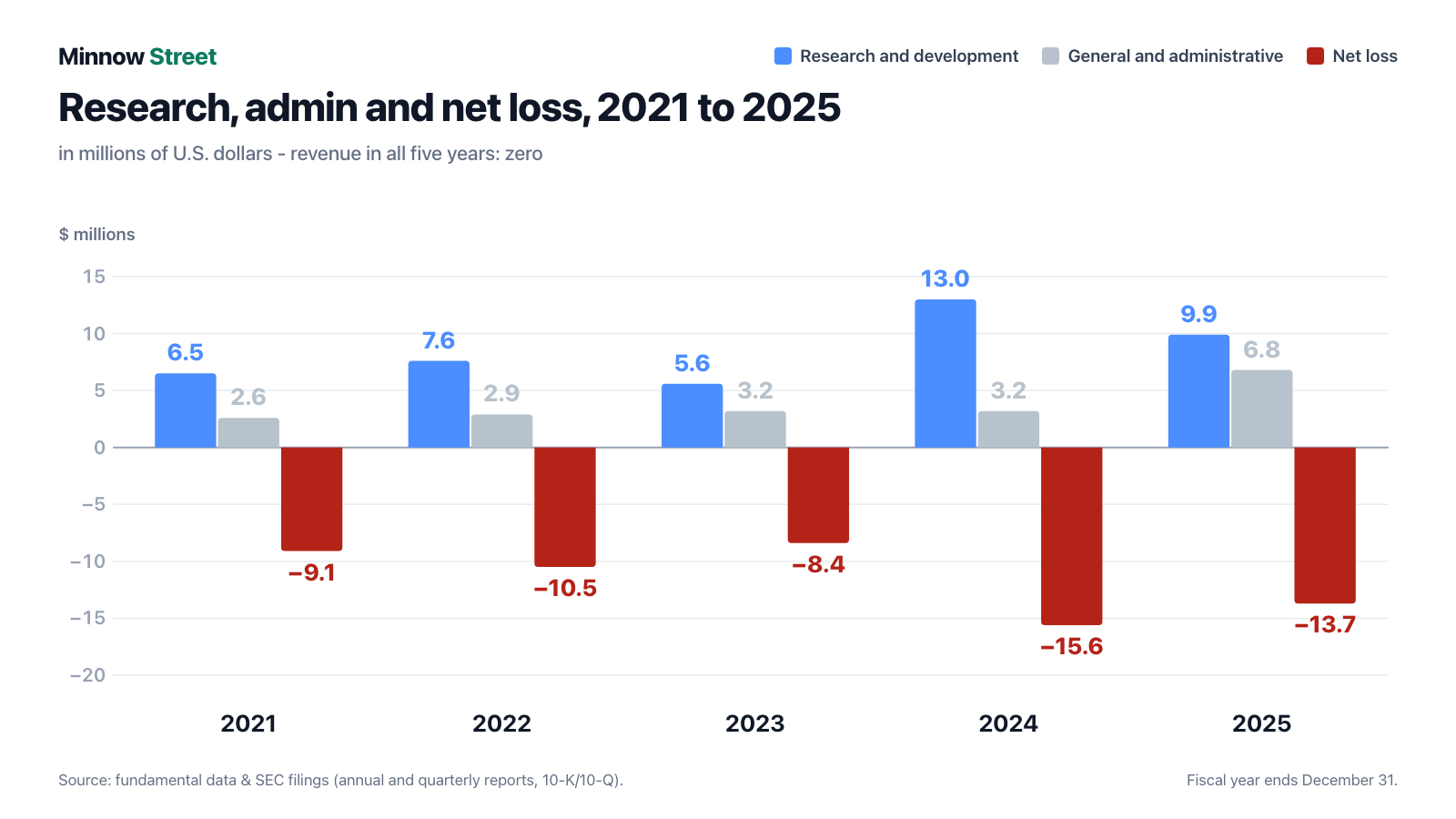
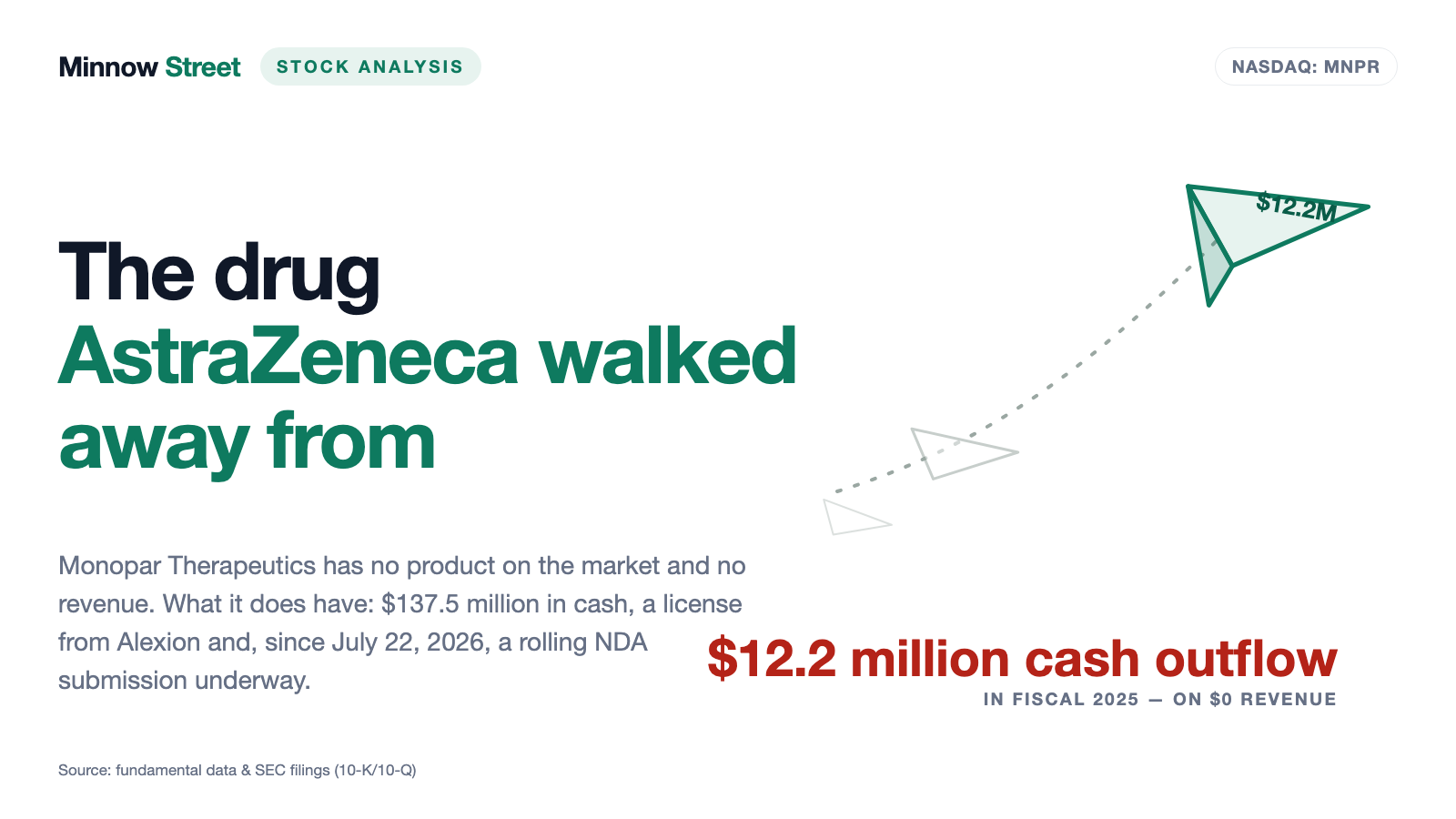
Third, the burn. Operating cash outflow was $12.20 million in 2025 (2024: $6.40 million, which did not yet include a full year of work on ALXN1840). In the first quarter of 2026 it was $3.47 million. Extend that rate and the liquidity lasts roughly ten years on paper. Monopar puts it more cautiously — and that caution has a reason we are about to meet:

Fourth, the regulatory steps. They are real and dated. On June 6, 2025 Alexion transferred the investigational new drug application to Monopar, which the FDA acknowledged on July 29, 2025. On June 30, 2026 the FDA granted Rare Pediatric Disease designation, opening the possibility of a tradable voucher for expedited review if the drug is approved. On July 22, 2026 the rolling submission began: completed sections go to the agency for review while the rest is still being written. On top of that sit Orphan Drug designation in the United States and the European Union, and FDA Fast Track status.
Now the other half of the same company.
Uncomfortable truth No. 1: Alexion did not stop because of the Phase 3 — it stopped in spite of it
The pivotal trial (WTX101-301) was randomized, rater-blinded and multi-centered, enrolling 214 patients aged 12 and over. It met its primary endpoint: measured over 48 weeks, ALXN1840 mobilized three times as much copper as standard of care (least-squares mean difference of 2.18 micromoles per liter, p below 0.0001) — including in patients who had been on standard therapy for an average of ten years. In the subgroup with an incomplete or intolerant response to prior treatment, neurological symptoms improved in 45 percent versus 20 percent and worsened in 5 percent versus 17 percent.
Alexion walked away regardless. The reason appears verbatim in the annual report:
"Alexion terminated the ALXN1840 program in Wilson disease based on its review of results from Phase 2 mechanistic trials and discussions with regulatory authorities. Their analysis of the Phase 2 mechanistic trials was that they failed to demonstrate a net-negative copper balance in Wilson disease patients during short-term treatment with ALXN1840 and to reduce hepatic copper concentration after treatment with ALXN1840. The decision not to progress the ALXN1840 program in Wilson disease was not related to any safety signals."
— Monopar Therapeutics Inc., SEC annual report 10-K for 2025, Item 1 "Business"
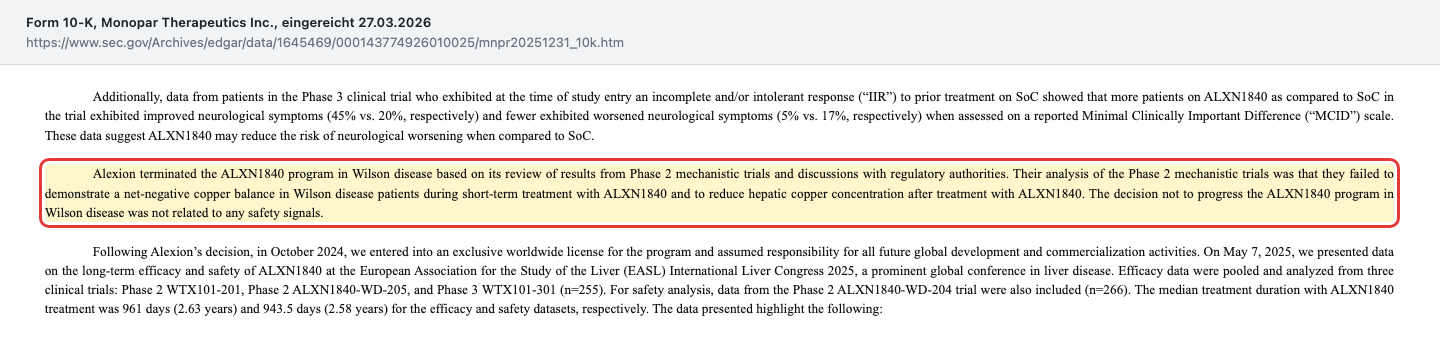
Translated: the trial showed that the drug mobilizes copper — pulls it out of tissue and makes it measurable in blood. What it could not show regulators to their satisfaction was that more copper subsequently leaves the body and that the liver holds less copper afterwards. A skeptic reads that as copper merely being relocated. Monopar has worked on exactly that gap ever since, presenting copper balance data from a Phase 2 study in May 2026 and a reanalysis of the Phase 3 neurological benefit in June 2026. Whether that is enough is decided by the FDA, not by the capital market. And that outcome is the whole case: a single regulatory decision separates a billion-dollar company from a firm with $137 million in the bank and three early cancer programs.
Uncomfortable truth No. 2: There are 49 percent more shares than the cover page reveals
Dilution in everyday terms means your slice of the cake gets thinner because new slices keep being cut. At Monopar the twist is that a large part of those slices has already been cut — it is simply not counted.
The cover page of the quarterly report shows 6,699,062 shares (as of April 30, 2026). The notes to the same report add 1,843,303 pre-funded warrants. Those are effectively pre-paid shares: the exercise price is $0.001, they are immediately exercisable, and they never expire. The only reason they are not carried as shares is a beneficial ownership cap of 9.99 percent per holder. Monopar itself counts them as shares in its earnings calculation: the weighted-average count for the first quarter of 2026 is 8,535,443.
"As of March 31, 2026, the Company had 6,699,062 shares of common stock issued and outstanding and 1,843,303 pre-funded warrants outstanding (including 882,761 issued in December 2024 and 960,542 issued in September 2025)."
— Monopar Therapeutics Inc., SEC quarterly report 10-Q for March 31, 2026, Note 4

On top of that come 842,973 options and restricted stock units outstanding as of March 31, 2026, plus 600,000 new shares Monopar registered on July 22, 2026 for its 2026 stock plan. Added up:
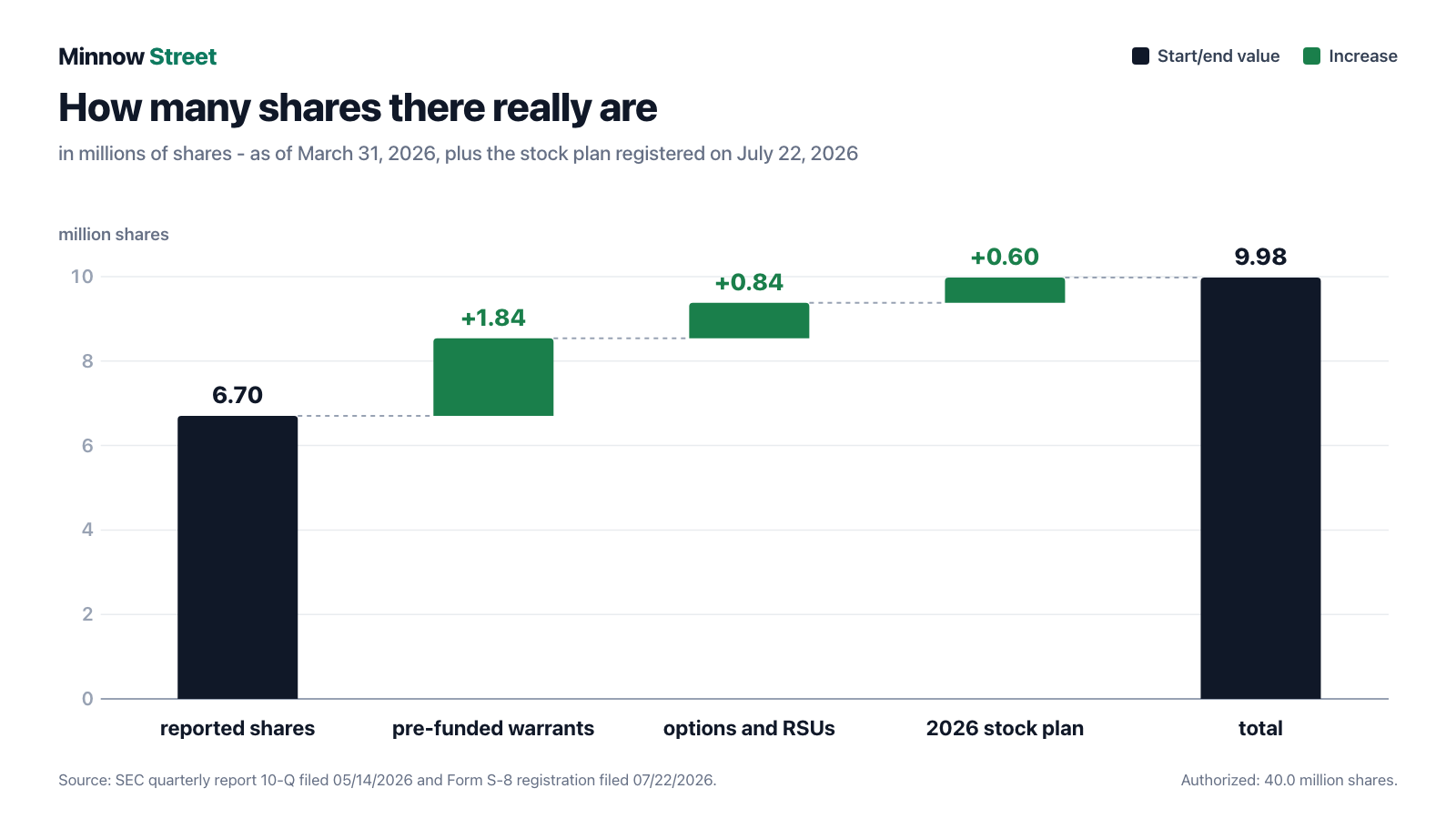
In fairness: this is the friendly version of dilution. It did not come out of distress at a knock-down price but out of an offering Monopar placed on September 23, 2025 at $67.67 per share — $135.0 million gross. If you want to see the same pattern in its harsher form, our analysis of SELLAS Life Sciences has it: there the share count grew more than sixfold in two and a half years.
A word on the backstory, because it makes the scale comprehensible. On August 28, 2023 Nasdaq notified Monopar that its bid price had closed below one dollar for 30 consecutive trading days; in February 2024 the deadline was extended to August 26, 2024. On August 12, 2024 the company executed a 1-for-5 reverse split to save the listing — 17,601,827 shares became 3,520,427. Every figure in this analysis is adjusted accordingly. Two months later the Alexion license arrived.
Uncomfortable truth No. 3: Up to $94 million is owed to the previous owner
The drug everything hangs on does not belong to Monopar. It is licensed — and the price of success is substantial. What has been paid so far looks cheap: $4.0 million in cash and 387,329 shares worth $4.6 million at the time, plus 157,188 additional shares from an anti-dilution clause. What is still to come is also in the report:
"Additionally, we are obligated to pay Alexion milestone payments of up to $94.0 million for the achievement of regulatory approval and sales-related milestones. In addition, the Company is obligated to pay tiered royalties based on net sales at rates falling within a range of 10% to 20%."
— Monopar Therapeutics Inc., SEC annual report 10-K for 2025, Item 1 "License, Development and Collaboration Agreements"
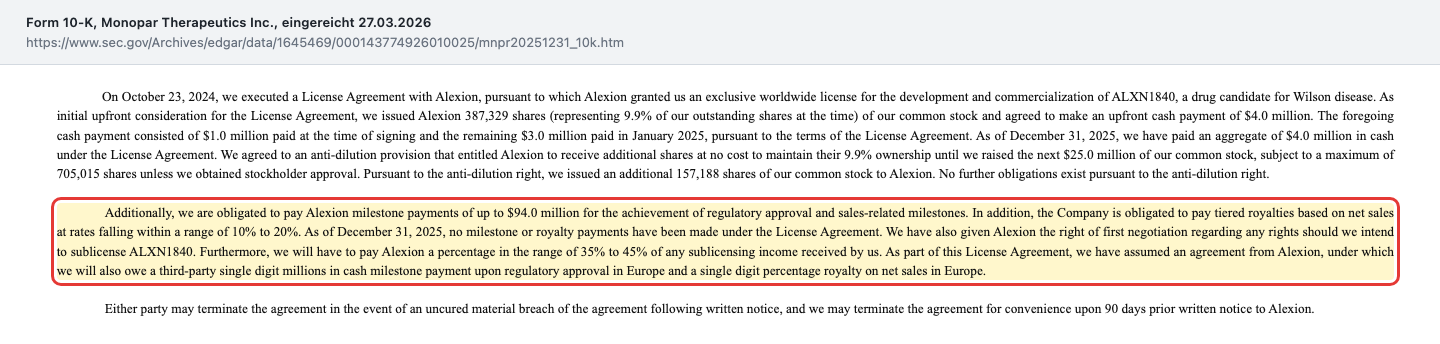
Put that into scale: the potential milestones alone equal 68 percent of total liquidity as of March 31, 2026. And they are triggered by the very event the stock is betting on. Approval would not only be a success for Monopar, it would also be an invoice — plus a permanent royalty of 10 percent to 20 percent of net sales. Investors who look only at cash and trial data at a clinical-stage biotech routinely miss exactly this line. For a contrast in how licensing chains can be structured, see our analysis of MBX Biosciences.
Uncomfortable truth No. 4: $35 million went to a firm the chief executive is invested in
The September 2025 offering was a success: 1,034,433 shares and 960,542 pre-funded warrants at $67.67 each, $135.0 million gross, roughly $126.9 million net of underwriting discounts. One day later, on September 24, 2025, Monopar used $35.0 million of it to repurchase 550,229 of its own shares at $63.6098 from Tactic Pharma LLC, a legacy holder with about 13.4 percent beforehand. The quarterly report names the connection in one sentence: chief executive and board member Chandler D. Robinson is a minority owner and non-controlling managing member of Tactic Pharma.
There is a good case for it — a large legacy holder selling into the open market pushes the price down, and buying the block back at the discounted offering price avoids that while shrinking the share count. There is also a simple set of numbers: of $126.9 million net proceeds, $91.9 million stayed with the company and 27.6 percent went to a seller connected to the chief executive. Both statements are true, and both belong on the same line. Remember the pattern: when a capital raise and a share repurchase happen on the same weekend, it pays to check who is on the other side.
Valuation — what is actually being paid for here
There is no price-to-earnings ratio and no price-to-sales ratio. What remains is a simple subtraction. Market value on July 26, 2026 was roughly $736 million (at $109.87 per share). Cross-checked against a filing: the fee table of the July 22, 2026 registration cites an average price of $107.66 for July 16, 2026, from a $110.00 high and a $105.32 low — times 6,699,062 shares that is $721 million, a difference of 2 percent. The order of magnitude holds.
Count the 1,843,303 pre-funded warrants as the company itself does in its earnings calculation, and the figure is roughly $939 million. Subtract the $137.5 million of tangible funds and about $800 million of paid-for expectation remains — for a medicine that is not approved, whose application is not yet fully filed, and whose approval would first trigger an invoice of up to $94 million.
On book value: $736 million of market value against $135.4 million of equity is 5.4 times (our own calculation from market value and the March 31, 2026 balance sheet). Five analyst opinions produce an average target price of $116.85 (data as of July 26, 2026) — that is the professional view, but it is not proof; it is an average of five opinions about the same undecided regulatory process. Weigh it accordingly.
One detail for scale: the free float is roughly 4.12 million shares, institutions hold 95.2 percent and insiders 23.4 percent (data as of July 26, 2026), with short interest at about 29.7 percent of the float. In a security this tight, small reallocations move the price a long way — which explains part of the price action, but says nothing about the company.
Opportunities and risks at a glance
What speaks for Monopar:
- The Phase 3 trial in 214 patients met its primary endpoint — three times greater copper mobilization than standard of care over 48 weeks, p below 0.0001.
- The balance sheet is essentially debt-free: $137.5 million of liquidity against $2.6 million of liabilities as of March 31, 2026, with management seeing funding at least through December 31, 2027.
- The drug carries Orphan Drug designation in the United States and the European Union, Fast Track status, and since June 30, 2026 Rare Pediatric Disease designation — the last of which opens the chance of a tradable review voucher upon approval.
- The safety database is unusually broad for an investigational medicine: 645 patient-years across 266 patients, with fewer than 1 percent experiencing a drug-related serious neurological event.
- The three radiopharmaceutical programs come free of charge in the price — the market is visibly not paying for them today.
What speaks against it:
- The previous owner shut the program down because two mechanistic trials failed to deliver the decisive proof. That objection has not been cleared; it is the subject of the ongoing review.
- No revenue since inception, a $93.4 million accumulated deficit and 22 employees — a workforce that would have to launch a product or find a partner if approval arrives.
- Up to $94.0 million in milestones and 10 percent to 20 percent royalties owed to Alexion, plus 35 percent to 45 percent of sublicensing income and an assumed third-party payment for Europe.
- The real share base is 49 percent above the reported count; any further capital raise adds to it, and only a quarter of the 40.0 million authorized shares is used.
- A $35.0 million repurchase from an entity the chief executive is invested in belongs on any governance checklist, however well it is justified.
- The security is tight and heavily shorted; swings in either direction say little about the underlying case.
A human verdict
Back to the curbside trap. It works so well because both answers are comfortable: "thrown out, therefore worthless" saves you the reading — and "thrown out, therefore underrated" saves you exactly the same reading. Monopar's filings allow neither shortcut. They describe a trial that hit its most important measure and a corporation that walked away anyway, because it lacked proof that the mobilized copper actually leaves the body. Both stand side by side, and neither cancels the other.
What can be said with confidence: since August 2024 this company has gone from delisting candidate to a business with $137.5 million in the bank and a live regulatory filing. And just as confidently: of roughly $736 million in market value, about $600 million — counting every unit honestly, closer to $800 million — is nothing other than the anticipated consent of an agency that has not yet decided. In between there is no revenue, no margin and no second leg to catch the fall.
What you make of that is your decision. And that is exactly as it should be.
Sources
- SEC quarterly report 10-Q for March 31, 2026 (filed May 14, 2026)
- SEC annual report 10-K for 2025 (filed March 27, 2026)
- SEC annual report 10-K for 2024 (filed March 31, 2025)
- SEC quarterly report 10-Q for September 30, 2025 · for June 30, 2025 · for March 31, 2025
- SEC Form 8-K of July 22, 2026 (start of the rolling NDA submission)
- SEC Form 8-K of June 30, 2026 (Rare Pediatric Disease designation)
- SEC Form 8-K of June 26, 2026 (Phase 3 neurological reanalysis) · of May 29, 2026 · of May 19, 2026 (copper balance data)
- SEC Form S-8 registration of July 22, 2026 (2026 stock plan, 600,000 shares)
- SEC Form 8-K of February 28, 2024 (Nasdaq minimum bid price deadline)
- Fundamental data (ratios, price and scanner data; as of July 26, 2026), ranking as of July 25, 2026
This analysis is journalistic commentary on publicly available information. It is not investment advice, not a recommendation to buy or sell, and not a solicitation to buy or sell securities. Shares of clinical-stage biotechnology companies without revenue can lose most of their value within hours; a total loss is possible. All figures come from the sources named above with the stated reporting dates and may have changed since. The author holds no position in the security discussed at the time of publication.
Our Bottom Line at a Glance
- Trial evidence neutral
- The pivotal trial in 214 patients met its primary endpoint — three times greater copper mobilization than standard of care over 48 weeks (difference 2.18 micromoles per liter, p below 0.0001). That is precisely what makes Alexion's exit so hard to read: two Phase 2 mechanistic trials could show neither a net-negative copper balance nor a reduction in hepatic copper. The objection is still part of the review, not settled.
- Balance sheet positive
- As of March 31, 2026 there is $137.5 million of liquidity against $2.589 million of liabilities and no interest-bearing debt at all; the equity ratio stands at 98.0 percent. Management sees funding at least through December 31, 2027; measured against the $12.2 million operating cash outflow of 2025, the runway would run into double-digit years.
- Dilution negative
- The 6,699,062 reported shares as of March 31, 2026 sit alongside 1,843,303 pre-funded warrants at $0.001, 842,973 options and restricted stock units, and 600,000 plan shares registered on July 22, 2026 — 9,985,338 in total, or 49 percent more. Only a quarter of the 40.0 million authorized shares has been used.
- License chain negative
- The lead asset does not belong to Monopar. Outstanding are milestones of up to $94.0 million — 68 percent of total liquidity as of March 31, 2026 — plus tiered royalties of 10 percent to 20 percent of net sales, 35 percent to 45 percent of any sublicensing income and an assumed third-party payment for Europe. All of it is triggered by the same event the stock is betting on.
- Governance negative
- One day after the September 23, 2025 offering raised $135.0 million gross, Monopar spent $35.0 million on September 24, 2025 repurchasing 550,229 of its own shares from Tactic Pharma LLC — an entity in which chief executive Chandler D. Robinson is a minority owner and non-controlling managing member. Roughly $91.9 million stayed with the company; 27.6 percent of net proceeds flowed out.
- Valuation negative
- Roughly $736 million of market value ($109.87, data as of July 26, 2026; cross-checked against the filing price of July 16, 2026: $721 million) stands against $137.5 million of tangible funds and zero revenue. Counting the pre-funded warrants brings it to roughly $939 million, leaving about $800 million of paid-for expectation — 5.4 times book value.
Monopar Therapeutics is a case you can tell in two sentences. The balance sheet is that of a healthy company: $137.5 million of liquidity as of March 31, 2026, $2.6 million of liabilities, no interest burden, a 98 percent equity ratio and, since July 22, 2026, a live approval filing for a drug whose Phase 3 trial met its primary endpoint. The business is a bet: no revenue since inception, 22 employees, a $93.4 million accumulated deficit, and a lead asset licensed from the very corporation that abandoned it — with up to $94.0 million of milestones and 10 percent to 20 percent royalties still to come. The road here was paid for in shares: 3,520,427 after the August 12, 2024 reverse split became 9,985,338 fully counted. Not investment advice.
What Our Rating Means
Open questions
The business works in principle, but one material question is open. As long as it stays open, our findings do not carry a quality verdict.
The substance holds up. As of March 31, 2026 there is $137.5 million of liquidity against $2.589 million of liabilities, no interest-bearing debt, no going-concern warning and a runway management itself puts at least through December 31, 2027 — measured against the $12.2 million outflow of 2025, that is years rather than quarters. What is open is an operating question, and it is the largest one available: the company has never earned revenue, and the entire outcome hangs on a single regulatory decision on ALXN1840 — a drug its previous owner discontinued and one that, if approved, triggers up to $94.0 million of milestone payments. Add a $35.0 million repurchase from an entity connected to the chief executive and a real share base 49 percent above the reported count. That is not a proven substance problem, but it is not proven quality either — hence yellow. The decision is yours.
A journalistic assessment by our editorial team at the time of the deep dive, based on public sources — not investment advice and not a solicitation to buy or sell. Your personal circumstances (investment goals, risk capacity, taxes) cannot be taken into account. What our levels mean, how verdicts are formed, and what conflicts of interest exist →
Worth Noting
- Hook: rank 23 of 28 U.S. hits in our in-house Moglen weekly ranking (as of July 25, 2026), relative strength rating 87. The list is recalculated daily, and its criteria are purely price-based (at least 15 percent over four trading days, at least $10 million in average daily dollar volume, relative strength rating of 70 or better).
- Data cut-off: balance sheet and earnings figures from the SEC quarterly report 10-Q for March 31, 2026 (filed May 14, 2026) and the annual report 10-K for 2025 (March 27, 2026); every filing through July 22, 2026 reviewed. Price, scanner and valuation data as of July 26, 2026.
- Possible confusion: ALXN1840 still carries the code of its former owner Alexion but has been licensed to Monopar since October 23, 2024. The compound is also called tiomolibdate choline or TMC and is not identical to the older development code WTX101 under which parts of the trial program were run.
- All share counts are adjusted for the 1-for-5 reverse split of August 12, 2024; 17,601,827 shares were outstanding before the split and 3,520,427 immediately after.
Frequently Asked Questions
Alexion, the AstraZeneca subsidiary, stopped the program after two Phase 2 mechanistic trials. Those trials could not demonstrate a net-negative copper balance during short-term treatment or a reduction in hepatic copper concentration. The 2025 annual report states explicitly that the decision was not related to any safety signal.
Monopar began a rolling submission with the FDA on July 22, 2026. The agency has authorized the company to file completed sections for review while the remaining ones are still being written. Whether the full application is accepted for filing and ultimately approved is open, and no target date has been published.
No. No filing with the U.S. securities regulator through July 22, 2026 reports a takeover, a merger, a take-private transaction or a delisting. Recent filings consist solely of Regulation FD disclosures on trial data and regulatory milestones, plus registrations for the 2026 stock plan.
The reported figure is 6,699,062 as of March 31, 2026. On top of that sit 1,843,303 pre-funded warrants with an exercise price of $0.001, 842,973 options and restricted stock units, and 600,000 shares registered on July 22, 2026 for the 2026 stock plan — 9,985,338 in total, or 49 percent more than reported.
As of March 31, 2026 the company held $52.5 million in cash and $84.9 million in short-term investments. Management states in the quarterly report that available funds are sufficient at least through December 31, 2027. Measured against the $12.2 million operating cash outflow of 2025, the arithmetic runway is closer to ten years.
To save its Nasdaq listing. On August 28, 2023 the exchange notified the company that its bid price had closed below one dollar for 30 consecutive trading days. On August 12, 2024 Monopar combined five shares into one, turning 17,601,827 shares into 3,520,427. All earlier share counts in filings and analyses are adjusted accordingly.
The FDA grants it for serious conditions that primarily affect children. It opens the possibility of receiving a voucher for expedited review if the drug is approved. That voucher can be used for a later application of the company's own or sold to another sponsor. Monopar received the designation on June 30, 2026.
Three proprietary radiopharmaceutical programs built on the antibody MNPR-101, which binds the uPAR protein found on aggressive tumors: MNPR-101-Zr in Phase 1 for imaging advanced cancers, MNPR-101-Lu in Phase 1a for treatment and MNPR-101-Ac in late preclinical work. All three are far earlier than the Wilson disease program.
Found an error?
Did you spot a factual error, an outdated number, or a typo in this deep dive? Let us know briefly — your report goes straight to the editorial team.