MBX Biosciences Stock: $440 Million in the Bank, Zero Revenue — and a Brand-New Management Team
MBX Biosciences ranks 8th in our in-house Moglen weekly ranking (U.S. selection, as of July 25, 2026). The peptide company from Carmel, Indiana has never booked a dollar of product revenue since 2018, yet it has raised $688.8 million. We read the Form 10-Q for the quarter ended March 31, 2026, the Form 10-K for 2025 and every filing since: a full, debt-free balance sheet, a sales agreement for another $250 million, and a management team replaced twice in five months. Here is what the filings say — and what they leave open.
 Thomas Mücke
Founder & Publisher
Thomas Mücke
Founder & Publisher
Chart
Interactive price chart (TradingView).
Note: pure fact-based analysis, not investment advice and not a solicitation to buy or sell. All figures without guarantee.
There is an investor trap nobody admits to and almost everybody falls into: the rear-view reflex. A stock has more than quintupled in twelve months, and our brain draws a conclusion the number simply does not support — "they must have proved something." At MBX Biosciences, Inc. (NASDAQ: MBX) the closing prices of the past twelve months ranged from $9.63 to $66.66; on July 24, 2026 the stock closed at $62.00.
That is impressive. It says nothing about whether the drug will be approved. Before we turn a price chart into a valuation of roughly $2.95 billion, let us make a deal: we read together what MBX itself has filed with the U.S. securities regulator, the SEC — the Form 10-Q for the quarter ended March 31, 2026, the Form 10-K for 2025 and every single filing since.
What MBX Biosciences actually does — drugs with a built-in timer
Many hormones are peptides: short protein chains the body breaks down within minutes or hours. For a drug that is a problem. Anyone who has to inject daily eventually forgets, and between two injections the drug level swings like a roller coaster.
So MBX builds prodrugs. The everyday image: you wrap the active molecule in a shell that dissolves slowly and evenly inside the body — a built-in timer. The company calls its technology the Precision Endocrine Peptide platform, or PEP. The goal is to turn a daily injection into a weekly one and a weekly one into a monthly one.
Three programs carry the house:
- Canvuparatide (MBX 2109) — a once-weekly parathyroid hormone replacement for chronic hypoparathyroidism. In this rare endocrine disease the hormone that regulates blood calcium is missing; the consequences range from muscle cramps and tingling to seizures and cardiac arrhythmias. MBX estimates roughly 120,000 people are affected in the United States and more than 250,000 in the United States and Europe combined.
- MBX 4291 — an obesity candidate that mimics two gut hormones at once (GLP-1 and GIP), with one goal: one injection a month instead of one a week.
- Imapextide (MBX 1416) — for low blood sugar after bariatric surgery. MBX shelved this program in May 2026; more on that below.
Two younger efforts sit behind them: MBX 5765, nominated as a development candidate in May 2026, combines four hormone activities in a single construct; a triple agonist is due to be nominated in the third quarter of 2026. How large the market they are aiming at really is we wrote up in our analysis of Eli Lilly — there the obesity injections are already a multi-billion-dollar business; here they are a hope in Phase 1.
Which brings us to the central tension of this analysis, running through every chapter below: MBX has a full, debt-free balance sheet and a drug that worked cleanly in Phase 2. But no customer ever filled that balance sheet — the capital market did, every single time. And the decisive registration trial has not even begun.
Where the stock landed on our desk
We run roughly 3,500 stocks through our scanners every day. As of July 25, 2026, MBX Biosciences ranks 8th in the U.S. selection of our Moglen weekly ranking (28 hits). To reproduce it: open the scanner, set the country filter to "US" — the list shows the strongest weekly gainers, sorted by relative strength rating. It is recalculated daily, so the rank can move.
The ranking has three conditions, and all three are pure price mechanics: at least 15 percent gain over the past four trading days, average dollar volume of at least $10 million a day and a relative strength rating of at least 70. At MBX the relative strength rating stood at 97 as of July 25, 2026 — meaning the stock has outrun 97 percent of all others — and average dollar volume at roughly $54 million a day.
Remember the most important sentence of this chapter right here: this scanner measures price movement, not company quality. It tells you many people are buying the stock right now. It tells you nothing about whether the drug will be approved.
The fundamental lens on the same data set shows that immediately (data as of July 25, 2026): a Piotroski F-Score of 3 out of 9 — a nine-point test for the direction of the balance sheet, on which a genuinely healthy company scores 8 or 9. At a company without revenue the test barely applies: four of its nine criteria require profit or a profit margin that simply does not exist here. Conversely the Altman Z-Score of 110.7, a bankruptcy early-warning measure, is distorted upward because MBX carries almost no liabilities. Both numbers say the same thing: this company is not going bankrupt any time soon. Neither says whether it will ever earn money.
The numbers over the years — what genuinely impresses
Let us start with what is good. And it is more than you would expect from a company without a single dollar of revenue.
First, the balance sheet. As of March 31, 2026 the company held $440.0 million in cash, cash equivalents and marketable securities ($45.2 million cash, $394.8 million short-term investments). Against that stood liabilities of only $14.9 million — essentially payables and accruals. MBX carries no interest-bearing debt. Stockholders' equity was $437.8 million on total assets of $452.7 million, an equity ratio of 96.7 percent. Balance sheets rarely look this clean.
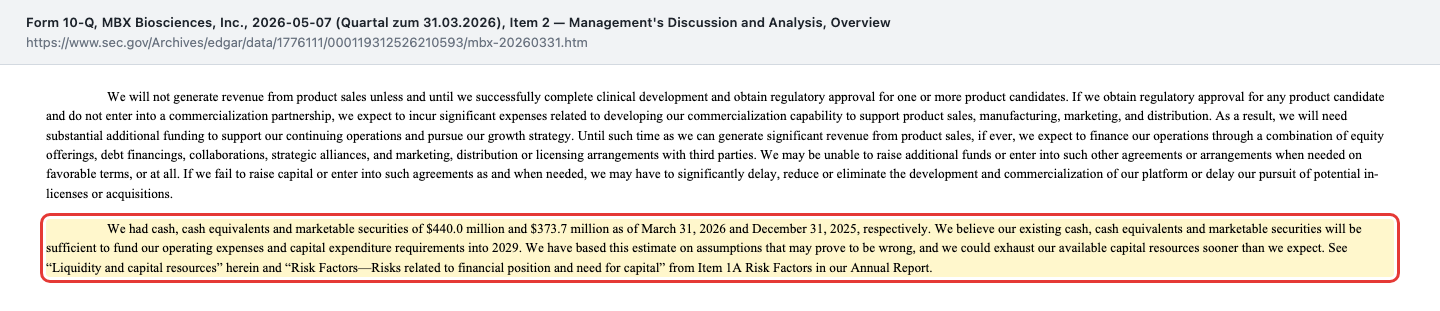
Second, the runway. MBX states how long the money is meant to last:
"We had cash, cash equivalents and marketable securities of $440.0 million and $373.7 million as of March 31, 2026 and December 31, 2025, respectively. We believe our existing cash, cash equivalents and marketable securities will be sufficient to fund our operating expenses and capital expenditure requirements into 2029."
— MBX Biosciences, Inc., Form 10-Q for the quarter ended March 31, 2026, Item 2
Run the counter-check: operating activities consumed $20.2 million in the first quarter of 2026 and $79.9 million in full-year 2025. At that pace $440.0 million would last about five and a half years. The "into 2029" guidance is therefore not optimistic but rather conservative — it already assumes the burn rate rises once the Phase 3 trial is running.
Third, the clinical data. In the Phase 2 Avail trial, 63 percent of treated patients (30 of 48) met the composite primary endpoint at twelve weeks, against 31 percent on placebo (5 of 16), with a statistically meaningful difference (p=0.042). On June 12, 2026 MBX added the one-year data:

"At One Year: 57% of evaluable patients (31/54) achieved responder status; zero contribution from rescue therapy (PRN) in the last week of the one-year treatment period."
— MBX Biosciences, Inc., Form 8-K of June 12, 2026, Item 8.01
Two further findings convince specialists more than any percentage: kidney function in treated patients improved from baseline and stayed improved through one year, and urine calcium excretion fell into the normal range. That is exactly the point of hormone replacement — the body should work normally again, not merely produce a prettier lab value. Tolerability: no treatment-related serious adverse events, injection site reactions in 10 percent of patients.
Fourth, the view of the professionals: as of July 25, 2026 five analyst opinions were on record — three "Strong Buy," two "Buy," not a single hold or sell. The average price target was $77. Anyone deriving comfort from that should know this unanimity is the norm for drug developers, because an analyst here is not valuing earnings but estimating probabilities.
Uncomfortable truth No. 1: expenses nearly quadrupled, revenue stayed at zero
A research company burns money — that is not news, that is the business model. What matters is the pace.
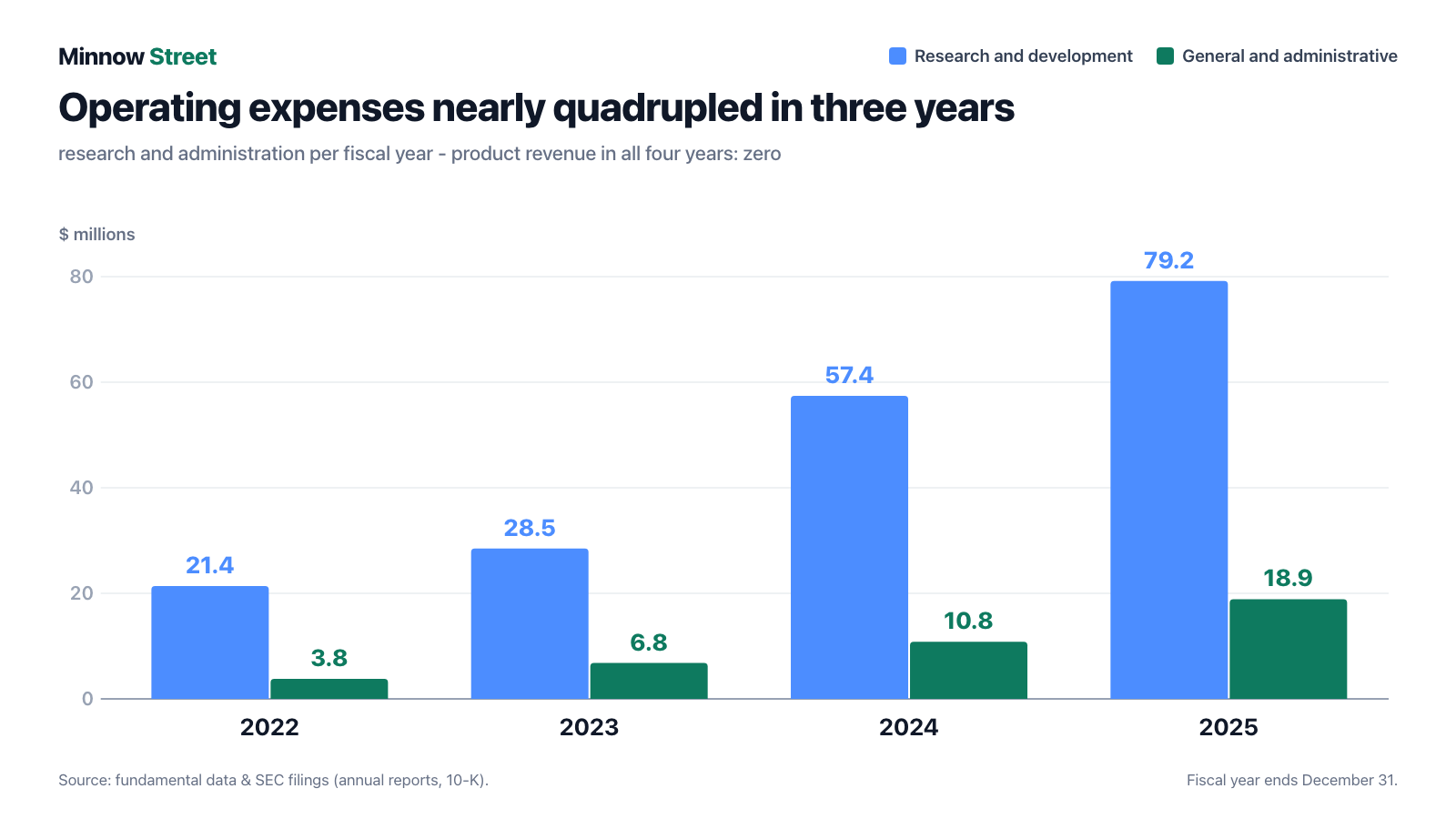
Research and development expense rose from $21.4 million (2022) through $28.5 million and $57.4 million to $79.2 million (2025). General and administrative expense grew from $3.8 million to $18.9 million over the same span. Together that is $98.1 million of operating expense in 2025 — nearly four times the 2022 figure. Net loss followed the same path: $26.1 million (2022), $32.6 million (2023), $61.9 million (2024), $87.0 million (2025). Accumulated deficit since inception: $248.0 million as of March 31, 2026.
Two first-quarter 2026 numbers deserve attention because they point in opposite directions. Research and development expense fell from $22.4 million to $18.5 million — the Phase 2 trial was largely complete. General and administrative expense, by contrast, rose from $4.1 million to $8.8 million, up 113 percent. The company cites higher personnel-related costs and, explicitly, "separation related costs." A rule of thumb: when administration grows faster than research at a research company, read the fine print.
And the capital requirement is not covered. MBX says so itself:

Uncomfortable truth No. 2: every piece of good news turns into new shares
Dilution is the word everyone knows and almost nobody recalculates. The everyday image: the cake stays the same size but gets cut into more slices. Your slice shrinks without you doing anything.
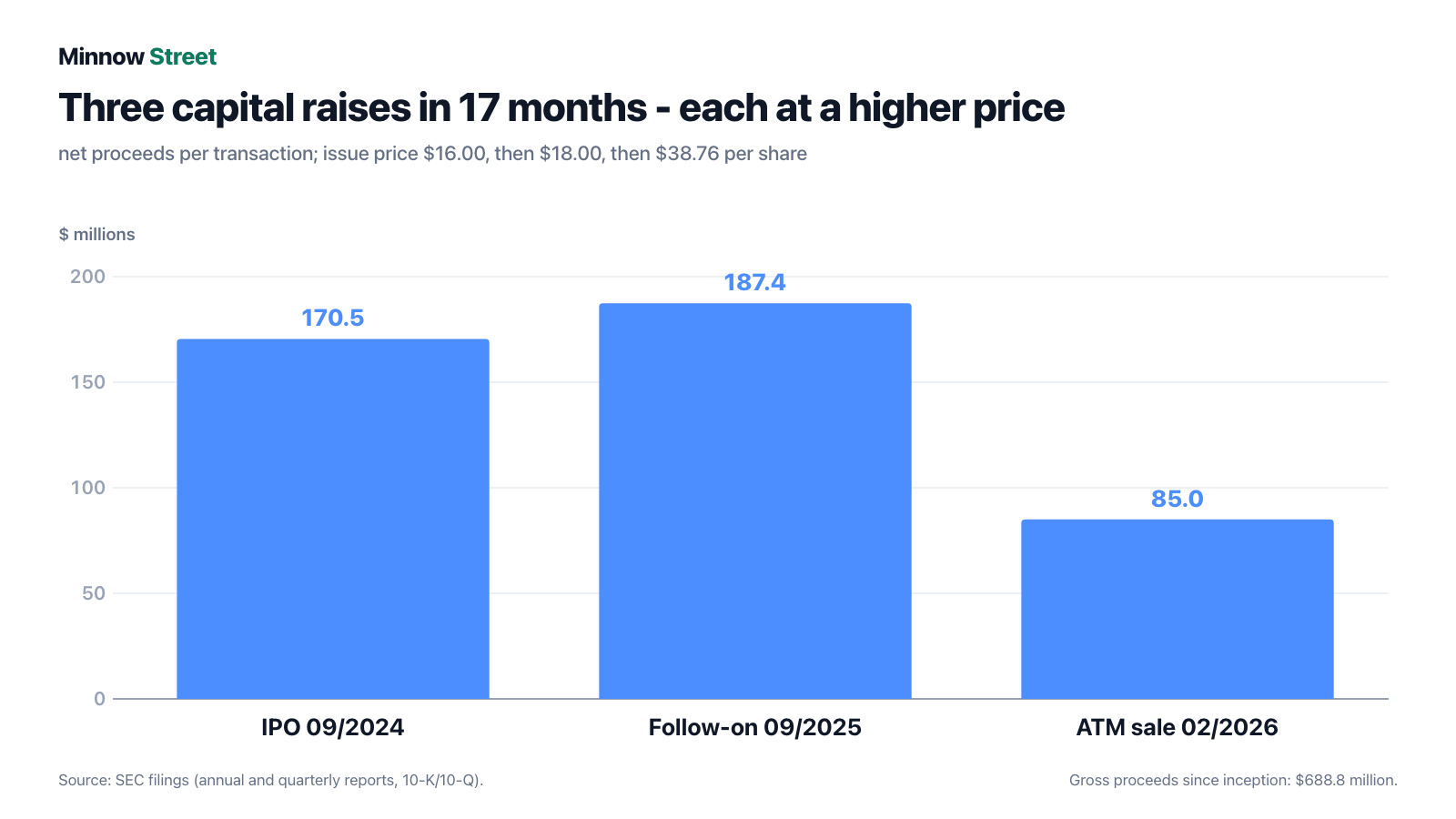
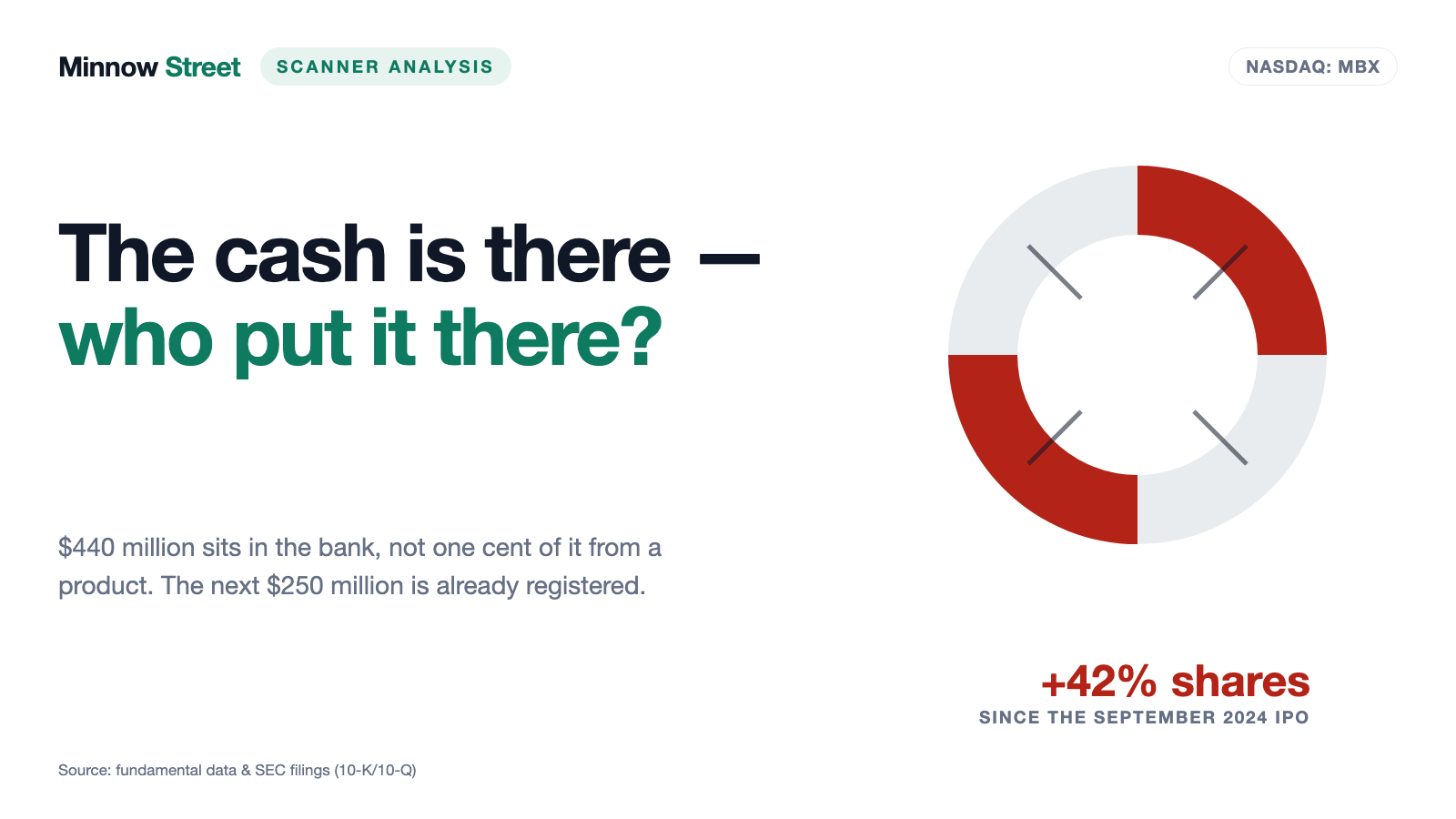
The sequence in plain words. At its initial public offering, completed September 16, 2024, MBX issued 11,730,000 shares at $16.00 and took in $170.5 million net, after $17.2 million of underwriting discounts, commissions and other costs. A year later, on September 26, 2025, came 11,108,055 shares at $18.00, $187.4 million net. And on February 4, 2026 the company sold 2,250,986 shares straight into regular trading at a volume weighted average price of $38.76, $85.0 million net.
The share count grew accordingly: 33,421,525 as of December 31, 2024, 44,927,953 as of December 31, 2025, 47,570,464 as of March 31, 2026 and 47,597,536 as of May 4, 2026 — the cover-page date of the most recent quarterly report. That is roughly 42 percent more shares in 17 months. In total MBX has raised $688.8 million in gross proceeds since inception.
And it is not over. In March 2026 the company filed an automatic shelf registration statement and increased its sales agreement:
"In March 2026, we filed an automatic shelf registration statement with the Securities and Exchange Commission (File No. 333-294237) and increased the amount available under the Open Market Sales Agreement with Jefferies, LLC (the “March 2026 Sales Agreement”), under which we may now, from time to time in one or more offerings, sell and issue shares of our common stock having an aggregate price of up to $250.0 million."
— MBX Biosciences, Inc., Form 10-Q for the quarter ended March 31, 2026, Liquidity and capital resources
For scale: $250.0 million equals roughly 8.5 percent of the market value of about $2.95 billion (data as of July 25, 2026). At the closing price of $62.00 on July 24, 2026 that would be roughly four million additional shares. On top of that sit 4,857,747 potentially dilutive securities as of March 31, 2026 — 4,694,011 outstanding options, 163,562 restricted stock units and a small remainder from early-exercised options. Authorized capital stands at 500 million shares; the cake can be sliced a great deal thinner.
Uncomfortable truth No. 3: the entire management team was replaced in five months
On February 25, 2026 chief financial officer Richard Bartram signed a separation agreement; he stayed in office through March 15, 2026, after which John Smither took over on an interim basis. Just under five months later it was the top job's turn.

"Kent P. Hawryluk will be stepping away from his role as the Company’s Chief Executive Officer and end his services as a member of the Board effective as of July 13, 2026. (…) Dr. Hawryluk’s departure is not due to a dispute or disagreement with the Company or the Company’s auditors."
— MBX Biosciences, Inc., Form 8-K of July 13, 2026, Item 5.02
The new chief executive is Steven Hoerter, until then chair of the board. One detail sits in the quarterly report and is rarely quoted: in May 2026 MBX entered into a consulting agreement with Hoerter for additional strategic advisory services, tied to 74,249 options and 11,938 restricted stock units. From the effective date of that agreement Hoerter is no longer considered an independent director under the Nasdaq listing rules. The man now running the company went from overseer to paid consultant two months before his appointment.
The pay package: a base salary of $665,000, a target bonus of 60 percent, plus 331,000 options and 71,000 restricted stock units on August 3, 2026. Chief financial officer John Smither receives $530,000, a 40 percent target bonus, a one-time relocation bonus of $150,000 and 130,000 options plus 28,000 units. Hawryluk gets twelve months of base salary, his target bonus, company-paid health coverage for up to twelve months and accelerated vesting through August 16, 2027; the post-termination exercise period for his vested options was extended from 90 days to July 13, 2027.
None of this is a scandal, and the disclosure is exemplary. But the sequence is worth knowing: both executive seats were refilled immediately before the most important trial in the company's history is due to start.
Uncomfortable truth No. 4: everything rides on a trial that has not started
On March 9, 2026 MBX announced it had completed an end-of-Phase 2 meeting with the U.S. Food and Drug Administration. From that feedback the company derives its trial plan: the Phase 3 trial is to begin in the third quarter of 2026, enroll roughly 160 patients randomized 3:1 against placebo — four weeks at a fixed dose of 600 micrograms, eighteen weeks of dose titration, four weeks of maintenance. The primary endpoint is assessed at week 26, followed by an open-label extension. Canvuparatide also received orphan drug designation from the European Medicines Agency.
Two things belong next to that. First: with this design, at least two years separate trial start from a possible approval — the primary assessment alone takes half a year per patient, before recruitment, analysis and the review process. Until then no revenue arrives; only money leaves.
Second: the field is not empty. Ascendis Pharma already sells Yorvipath (palopegteriparatide), an approved parathyroid hormone replacement, in the United States and the European Union. It is injected daily — precisely where MBX aims with a weekly shot. The advantage on offer is convenience, not potency, and the competitor has a head start of years and is already treating patients. The older product Natpara from Takeda was discontinued at the end of 2024 over unresolved supply issues and will not return.
And the obesity program? So far only preliminary, blinded Phase 1 data exist: in the first multiple-dose cohort, eight participants — two of them on placebo — lost a mean of 7 percent of body weight after eight weeks, with a range of 0 to 16 percent. Blinded means nobody knows who received the drug. The figure can move in either direction once the trial is unblinded. The more meaningful twelve-week data are expected in the fourth quarter of 2026.
Uncomfortable truth No. 5: a drug worked — and still gets no more money
On May 11, 2026 MBX reported that imapextide had achieved proof of concept in the Phase 2a STEADI trial in low blood sugar after bariatric surgery: average increases from baseline in glucose nadir of 17, 28 and 34 percent depending on dose, and average decreases in insulin peak of 11, 33 and 45 percent. In the same paragraph the company announced it would not commit further investment toward a Phase 2b trial.
By then $16.6 million of direct program expense had gone in — $11.561 million in 2024, $4.118 million in 2025 and $0.921 million in the first quarter of 2026. The 2024 share alone equaled roughly a fifth of that year's entire research and development expense.
This is not bad news; it is discipline. A company that stops a working but secondary program instead of throwing money after it treats other people's capital carefully. But the discipline has a flip side: the more the money concentrates on canvuparatide and the obesity portfolio, the fewer bets remain — and the heavier each one weighs.
What the company is worth — and what sits inside
At a company without revenue and without profit there is neither a price-earnings nor a price-sales ratio. You can only place two figures side by side.
On one side the market value: roughly $2.95 billion (data as of July 25, 2026). The cross-check holds: 47,597,536 shares as of May 4, 2026 multiplied by the closing price of $62.00 on July 24, 2026 also gives $2.95 billion.
On the other side the tangible substance: $437.8 million of stockholders' equity as of March 31, 2026, of which $440.0 million is cash and marketable securities. The market therefore values MBX at 6.75 times book value; book value per share was $9.20. Roughly $2.5 billion of the market value is pure expectation — a bet on a drug whose registration trial has not yet begun.
A benchmark helps with the framing: what such an arithmetic looks like when a clinical-stage company has years of cash in the bank but depends on a partner's decision, we wrote up in our analysis of Arcus Biosciences.
Two footnotes on market mechanics, both as of July 25, 2026: the free float covers roughly 27.1 million shares — a little over half the count; insiders hold 2.7 percent. And roughly 5.8 million shares were sold short, about 12 percent of all shares. Both explain why this price moves so fast: with a small tradable float, a handful of large orders can push it in either direction.
Opportunities and risks at a glance
What speaks in favor:
- The Phase 2 data are clean: 63 percent response at twelve weeks (30 of 48) against 31 percent on placebo (5 of 16), p=0.042; 57 percent (31 of 54) at one year.
- The effect is physically measurable, not merely statistical: improved kidney function and normalized urine calcium excretion through one year (announcement of June 12, 2026).
- The balance sheet is unusually clean: $440.0 million in cash and securities as of March 31, 2026, an equity ratio of 96.7 percent, no interest-bearing liabilities.
- The regulator has signed off on the plan: an aligned Phase 3 design after the end-of-Phase 2 meeting (announcement of March 9, 2026), plus European orphan drug designation.
- The obesity program targets a real gap — a monthly instead of a weekly injection; the half-life of roughly 26 days in the multiple-dose cohort supports it (announcement of May 11, 2026).
- The company stops programs instead of dragging them along: imapextide gets no Phase 2b budget despite achieving proof of concept.
What speaks against:
- Not one dollar of product revenue since inception in 2018; the accumulated deficit stood at $248.0 million as of March 31, 2026.
- The decisive Phase 3 trial is not due to start until the third quarter of 2026, with the primary endpoint at week 26 — revenue is not to be expected before the end of the decade.
- The share count rose from 33,421,525 (December 31, 2024) to 47,597,536 (May 4, 2026), roughly 42 percent; a sales agreement for up to $250.0 million is untouched and 4,857,747 further securities are potentially dilutive.
- Both executive seats were refilled within five months; the new chief executive was board chair and a paid consultant two months earlier and no longer counts as independent.
- General and administrative expense rose 113 percent to $8.8 million in the first quarter of 2026, explicitly including separation costs.
- A competing product is already approved in the United States and the European Union; MBX is selling convenience against a head start of years.
- Roughly $2.95 billion of market value stands against $437.8 million of equity; five of five analyst opinions are already positive.
A human conclusion
Back to the rear-view reflex from the opening. The price chart of the past twelve months is striking — and it is the one number in this analysis that says nothing about the company. What MBX Biosciences actually has to show is nonetheless considerable: a drug that measurably works in a controlled trial, a balance sheet almost free of liabilities, a trial design aligned with the regulator, and the willingness to stop a working side program rather than keep funding it out of pride.
But none of that is an approval. Between what stands in the filings today and a drug a health insurer pays for lie a trial with 160 patients, at least two years, a competitor with market authorization and a management team that has just refilled both top seats. And in between lies something worth knowing in advance: this company does not sell a product, it sells shares — and it does so when the price is high. In February 2026 that price was $38.76 apiece; the next $250 million is already registered.
Both facts sit in the same documents, signed by the same officers. Whether the 57 percent weighs more for you or the $250 million depends on whether you are looking at 2029 or at the next quarter. What you make of it is your decision. And that is exactly as it should be.
Sources
- Form 10-Q for the quarter ended March 31, 2026 (filed May 7, 2026) — balance sheet, results, cash flow, share count, capital raises, sales agreement, runway statement, Hoerter consulting agreement, Burlington lease
- Form 10-K for 2025 (March 12, 2026) — business model, pipeline, employees, competition, Indiana University license, risk factors, expense by program
- Form 8-K of July 13, 2026 — departure of Kent P. Hawryluk, appointment of Steven Hoerter and John Smither, compensation packages
- Form 8-K of June 12, 2026 — one-year data from Avail and the open-label extension, kidney function, tolerability
- Form 8-K of May 11, 2026 — obesity portfolio, Phase 1 data for MBX 4291, candidate MBX 5765, imapextide proof of concept and halt
- Form 8-K of March 9, 2026 — end-of-Phase 2 meeting with the FDA, Phase 3 design, European orphan drug designation
- Form 8-K of February 27, 2026 — Burlington lease, separation agreement with chief financial officer Richard Bartram
- SEC EDGAR filing index, CIK 0001776111 — recency gate: ownership and insider filings after May 7, 2026, no Form 15, no Form 25
- Fundamental data and in-house stock scanner, data as of July 25, 2026 — Moglen weekly ranking, relative strength rating, dollar volume, Piotroski, Altman Z, market value, analyst coverage, free float
Journalistic analysis, not investment advice and not a solicitation to buy or sell securities. Stocks can lose their entire value; a total loss is possible. All figures come from the original documents linked above and carry the as-of date stated there. The author holds no position in MBX Biosciences, Inc. at the time of publication.
Our Bottom Line at a Glance
- Clinical data positive
- In the controlled Phase 2 Avail trial, 63 percent of treated patients (30 of 48) met the primary endpoint at twelve weeks against 31 percent on placebo (5 of 16), p=0.042. The one-year read-out of June 12, 2026 showed 57 percent (31 of 54), improved kidney function and urine calcium in the normal range.
- Balance sheet and liquidity positive
- As of March 31, 2026 the company held $440.0 million in cash and marketable securities against $14.9 million of liabilities and not a single interest-bearing debt; the equity ratio was 96.7 percent. Operating activities consumed $20.2 million in the first quarter of 2026, and management's own runway estimate reads "into 2029."
- Earning power negative
- Not one dollar of product revenue since inception in 2018; the accumulated deficit stood at $248.0 million as of March 31, 2026. The Phase 3 trial is not due to start until the third quarter of 2026 and its primary endpoint is assessed at week 26 — product revenue is not to be expected before the end of the decade.
- Dilution negative
- The share count rose from 33,421,525 (December 31, 2024) to 47,597,536 (May 4, 2026), roughly 42 percent in 17 months. In February 2026 MBX sold 2,250,986 shares into the market at a volume weighted average of $38.76; since March 2026 a sales agreement for up to $250.0 million stands ready, plus 4,857,747 potentially dilutive securities.
- Leadership and oversight negative
- Both executive seats were refilled within five months: chief financial officer Richard Bartram left effective March 15, 2026 and co-founder Kent P. Hawryluk effective July 13, 2026. The new chief executive Steven Hoerter previously chaired the board and has not been considered an independent director since his consulting agreement of May 2026.
- Valuation neutral
- Roughly $2.95 billion of market value ($62.00 on July 24, 2026) stands against $437.8 million of stockholders' equity as of March 31, 2026 — 6.75 times book value. Price-earnings and price-sales ratios do not exist for lack of profit and revenue. Five of five analyst opinions were positive as of July 25, 2026, with an average price target of $77.
MBX Biosciences develops extended-release peptide drugs and has raised roughly $688.8 million since it was founded in 2018 — without ever booking a dollar of product revenue. Lead candidate canvuparatide worked cleanly in Phase 2: 63 percent response at twelve weeks against 31 percent on placebo, and 57 percent at one year. The balance sheet is unusually clean, with $440.0 million of cash and no interest-bearing debt. Against that stand a registration trial that has yet to begin, a competing product already approved, a share count up roughly 42 percent plus a sales agreement for another $250.0 million, and a complete turnover of the management team within five months. Not investment advice.
What Our Rating Means
Open questions
The business works in principle, but one material question is open. As long as it stays open, our findings do not carry a quality verdict.
The balance sheet gives no cause for concern: $440.0 million of cash as of March 31, 2026, no interest-bearing debt, an equity ratio of 96.7 percent and a runway the company itself puts "into 2029" — there is no sign of a threat to substance. Green would still be wrong: the business model has never produced a dollar of revenue, and the result of the coming years hangs on a single event — the Phase 3 trial of canvuparatide, which is only due to start in the third quarter of 2026 and whose primary endpoint is assessed at week 26. On top of that sits an open leadership question: both executive seats were refilled within five months, immediately before that trial. This is exactly what the yellow level exists for — a serious company with one large open operational question. The decision is yours.
A journalistic assessment by our editorial team at the time of the deep dive, based on public sources — not investment advice and not a solicitation to buy or sell. Your personal circumstances (investment goals, risk capacity, taxes) cannot be taken into account. What our levels mean, how verdicts are formed, and what conflicts of interest exist →
Worth Noting
- MBX reached our research list as rank 8 of 28 U.S. hits in our in-house Moglen weekly ranking (as of July 25, 2026, relative strength rating 97) — part of our series filling the top 50 of that ranking with analyses. The scanner lists are recalculated daily, so the rank can move.
- What the scanner measures: at least 15 percent price gain over four trading days, average dollar volume of at least $10 million a day and a relative strength rating of at least 70; the list is sorted by relative strength rating. Those are pure price criteria and say nothing about the quality of the company.
- Risk of confusion: the symbol MBX also belongs to Microbix Biosystems on the Toronto Stock Exchange — likewise a biotechnology company — and to My Foodie Box on the ASX. Every figure in this analysis comes from the Nasdaq security with ISIN US55287L1017 and SEC identifier CIK 0001776111; reporting and listing currency is the U.S. dollar.
- Ratio trap: the Piotroski F-Score and the Altman Z-Score barely apply to a company without revenue and without debt — one is pushed down (3 of 9) because four of its criteria require profit or a profit margin, the other distorted upward (110.7) because there are almost no liabilities to offset.
- Recency note: the most recent periodic report is the Form 10-Q filed May 7, 2026. Every filing after that date has been reviewed — the Current Reports on Form 8-K of May 11, June 5 and June 12, 2026 and of July 13, 2026, plus ownership and insider filings. The management change of July 13, 2026 alters the picture and is reflected throughout. There is no takeover, no merger and no delisting.
Frequently Asked Questions
MBX Biosciences develops peptide drugs for endocrine and metabolic disorders. The active molecule sits inside a shell that dissolves slowly in the body, turning a daily injection into a weekly or monthly one. The most advanced candidate is canvuparatide for chronic hypoparathyroidism. The company has no approved product.
Neither. The Form 10-Q for the quarter ended March 31, 2026 states: "The Company does not have any products approved for sale and has not generated any revenue from product sales." The 2025 net loss was $87.0 million and the first-quarter 2026 net loss $23.5 million. The accumulated deficit since inception stands at $248.0 million.
The company states in its quarterly report that the $440.0 million of cash and marketable securities held as of March 31, 2026 should last "into 2029." Operating activities consumed $20.2 million in the first quarter of 2026 and $79.9 million in full-year 2025. The burn rate will rise once the Phase 3 trial begins.
The share count rose from 33,421,525 as of December 31, 2024 to 47,597,536 as of May 4, 2026 — roughly 42 percent in 17 months. Shares were issued at $16.00 (September 2024 IPO), $18.00 (September 2025) and a volume weighted average of $38.76 (February 2026 open-market sale). A sales agreement for up to $250.0 million remains untouched.
Chief financial officer Richard Bartram left effective March 15, 2026 and co-founder and chief executive officer Kent P. Hawryluk effective July 13, 2026. The filing states Hawryluk's departure was not due to a dispute or disagreement with the company or its auditors. The successors are former board chair Steven Hoerter and former interim chief financial officer John Smither.
After an end-of-Phase 2 meeting with the U.S. Food and Drug Administration, MBX plans a start in the third quarter of 2026 (announcement of March 9, 2026). The design calls for roughly 160 patients randomized 3:1 against placebo, four weeks at a fixed dose of 600 micrograms, eighteen weeks of titration and four weeks of maintenance, with the primary endpoint assessed at week 26.
It comes from the open-label extension of the Phase 2 Avail trial: 31 of 54 evaluable patients achieved responder status after one year (announcement of June 12, 2026). Open-label means all participants received the drug and there was no comparator arm left. The evidence for an approval must come from the controlled Phase 3 trial.
In hypoparathyroidism, Ascendis Pharma already sells Yorvipath (palopegteriparatide), a hormone replacement approved in the United States and the European Union and injected daily. MBX aims to compete with a weekly injection — an advantage of convenience, not of potency. The older product Natpara from Takeda was discontinued at the end of 2024.
Found an error?
Did you spot a factual error, an outdated number, or a typo in this deep dive? Let us know briefly — your report goes straight to the editorial team.