Mohawk Industries: Sales Up 8 Percent — and Almost None of It Sold
The world's largest flooring manufacturer reported an 8.0 percent rise in first-quarter 2026 sales and a 61 percent jump in net earnings. Read the quarterly report down to the explanation and little of the turnaround survives: roughly $143 million of the increase came from additional shipping days, $127 million from exchange rates and $50 million from a year-earlier comparison — while the volume actually sold fell by roughly $100 million. The earnings jump, in turn, rests on an effective tax rate of negative 8.2 percent. Behind all that sits a remarkably solid company: a 60.8 percent equity ratio, interest expense cut to a quarter in two years and a share price below book value. Not investment advice — just the question of how much of this turn the calendar produced.
 Thomas Mücke
Founder & Publisher
Thomas Mücke
Founder & Publisher
Chart
Interactive price chart (TradingView).
Note: pure fact-based analysis, not investment advice and not a solicitation to buy or sell. All figures without guarantee.
There is an investor trap that catches us every spring: the first swallow. One warm day in March and the winter coat goes back in the closet. One swallow does not make a summer — everybody knows it, and nobody acts on it. On the stock market the same trap goes by the name “turnaround”: a single quarter with a plus sign, and the comeback story writes itself. That is exactly how Mohawk Industries, Inc. (NYSE: MHK) landed on our desk — as a turnaround candidate scoring 6 of 8 points on our own checklist. So let us make a deal: we will not celebrate the plus sign, we will read the explanation underneath it. The source is what Mohawk files with the U.S. securities regulator, the SEC — the annual report (10-K) for 2025, the quarterly report (10-Q) for April 4, 2026 and three current reports (Form 8-K) from May and June 2026. Those documents are honest under penalty of law. And they describe a company with a fortress balance sheet — and a quarterly increase that came mostly from the calendar. What you do with that is up to you.
Contents
- What Mohawk Industries actually does
- How the stock landed on our desk — rank 34 of 60 on the turnaround checklist
- The numbers over the years — honestly credited
- What the filings say — the uncomfortable truths
- What has happened since the last quarterly report
- Valuation: a company trading below its own book value
- Opportunities and risks at a glance
- A human conclusion
- Sources
What Mohawk Industries actually does
Mohawk makes whatever you are standing on. Carpet, ceramic and porcelain tile, laminate, vinyl, wood planks, plus insulation and panel boards — the company describes itself as the world's largest flooring manufacturer. The 2025 annual report puts it plainly: manufacturing in 19 countries, sales in roughly 180 countries, approximately 40,500 employees as of December 31, 2025 — 15,600 of them in the United States, 13,600 in Europe and 11,300 elsewhere. Headquarters sit in Calhoun, Georgia, in the middle of the American carpet belt; the shares have traded publicly since April 1992.
The business splits into three segments, and the difference between them is half the story:
- Global Ceramic — ceramic and porcelain tile, natural stone, quartz surfaces. Plants in the United States, Europe, Mexico, Brazil and Russia, among others. 2025 sales: $4,289.4 million, operating income $266.7 million.
- Flooring North America — carpet, carpet tile, laminate, vinyl and wood for the North American market. 2025 sales: $3,638.5 million, operating income $113.6 million.
- Flooring Rest of the World — the international non-ceramic business, grown largely out of Belgium's Unilin Group acquired in 2005: laminate, vinyl, wood, insulation boards. 2025 sales: $2,857.5 million, operating income $212.9 million.
Do the arithmetic: North America is the second-largest segment at a good third of sales — but carries an operating margin of just 3.1 percent ($113.6 million on $3,638.5 million). Global Ceramic runs at 6.2 percent, the rest of the world at 7.5 percent. The biggest home market is the weakest earner.
How does Mohawk make money? On the spread between raw materials and selling price. The inputs are chemistry and earth: nylon, polypropylene and polyester fibers for carpet; clay, talc and feldspar for tile; wood, paper and resins for laminate; PVC and plasticizers for vinyl. All of it is energy intensive — tile is fired, boards are pressed. That is why gas and power prices feed straight through, and why Mohawk is a cyclical business rather than a growth business. The cycle it hangs on is the housing market: people who do not move do not lay new floors. The 2025 annual report describes exactly that — persistently low U.S. housing turnover and new construction, deferred renovations, weak consumer confidence.
One point of context so nobody is caught out: Mohawk has never paid a dividend. The 2025 annual report records that no cash dividend has been paid or declared on the common stock since the initial public offering. Shareholder return here comes exclusively from buybacks.
How the stock landed on our desk — rank 34 of 60 on the turnaround checklist
The hook is a snapshot, not a permanent condition. Measured on July 27, 2026 — the underlying scanner run dates from July 26, 2026 — Mohawk Industries sits at rank 34 of 60 hits in our in-house turnaround scanner with the U.S. market filter. And here is the honest part right away: you will not see Mohawk on the scanner page itself. The list shows only the 25 strongest hits, sorted by the turnaround check — rank 34 falls outside. The lists are recalculated daily; tomorrow's rank and hit count will differ from today's.
What does the scanner test? Four pillars. The first two are mandatory: the price has to be at least 50 percent below its all-time high (the crash), and survival has to be secure — an Altman Z-score above 1.1, no more than one balance sheet warning flag, positive equity. Pillars three and four form an eight-point checklist covering the operating turn (sales stabilizing, margin turning, cash flow turning, balance sheet healing) and market confirmation (price back above the 50-day line, relative strength turning, insiders buying, institutions accumulating). Six points make a hit.
Mohawk's readings at this measurement: 6 of 8 points on the checklist, an Altman Z-score of 8.49 and a Piotroski F-Score of 8 out of 9. Translated: the Altman Z-score is an early warning system for insolvency; readings above 3 count as the safe zone, below roughly 1.1 as the distress zone. A score of 8.49 is not merely safe, it is a fortress. The Piotroski score runs nine yes-or-no tests on profit, cash flow, leverage and efficiency; 8 out of 9 is a very strong reading that few companies reach. What Mohawk does not collect are precisely the two points that matter most. First the margin point: the net margin ran at 4.3 percent in the first quarter of 2026, below the 5.2 percent of the second quarter of 2025 — the margin has not turned yet. Second the insider point: the twelve months before the measurement showed zero insider purchases against twenty insider sales (data as of July 27, 2026). The six points it does score come from stabilized sales, positive operating cash flow, a slightly improved Altman Z, a price above the 50-day line, turning relative strength and institutions accumulating.
A word on the mandatory pillar “at least 50 percent below the all-time high,” because we measured it ourselves. Our data set carries negative 58.19 percent. The price history suggests a slightly wider gap: the closing-price all-time high was $284.82 on December 1, 2017; against the closing price of $113.27 on July 24, 2026 that is a gap of roughly 60 percent. Either way the message holds: the stock has lost more than half its value since the 2017 peak. Whoever files this name under turnaround candidates has the crash part right.
At this measurement Mohawk also shows up in four other lists of ours — the price-to-sales ranking, the price-to-cash-flow ranking, the Altman Z balance sheet fortresses and the David Dreman contrarian screen. That confluence says a lot about the pattern: cheap and financially unassailable, but without momentum.
The numbers over the years — honestly credited
Start with what genuinely impresses. Mohawk did not merely survive the disaster year of 2023; it has systematically healed the balance sheet since.
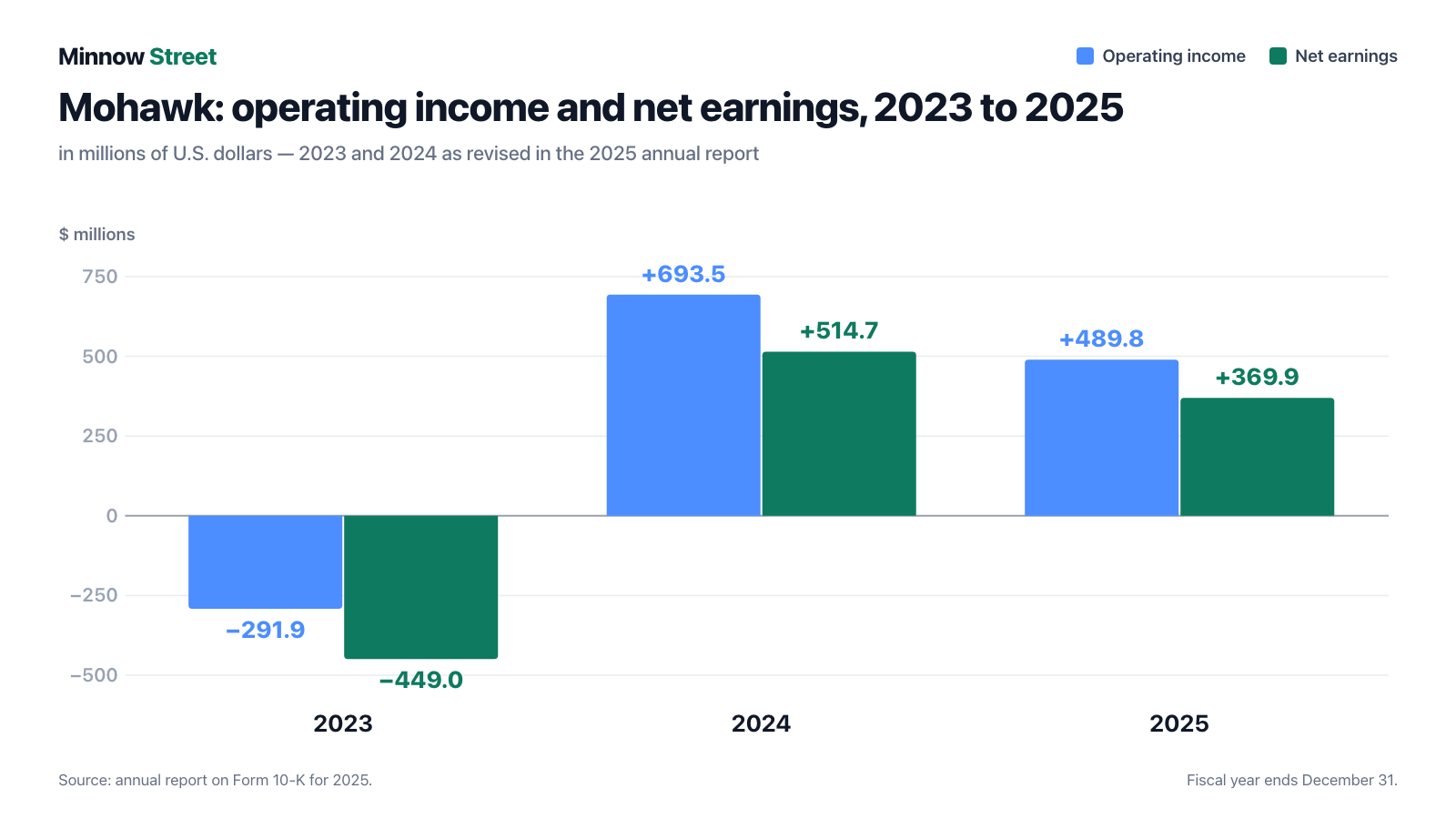
2023 was the break: sales fell to $11,135.1 million, and because the company had to write down goodwill and indefinite-lived intangibles by $877.7 million, operating income dropped to negative $291.9 million and the loss for the year to negative $449.0 million — a loss of $7.05 per share. The annual report cites the fall in market capitalization, a higher cost of capital and macroeconomic conditions.
2024 turned the picture: $10,836.9 million of sales, $693.5 million of operating income, $514.7 million of net earnings, $8.09 per share. 2025 gave part of it back: $10,785.4 million of sales (down 0.5 percent), $489.8 million of operating income (down 29 percent), $369.9 million of net earnings, $5.93 per share. That makes 2025 the third consecutive year of falling sales and the first year of falling profit since the recovery.
Now the genuinely strong side: the balance sheet. At April 4, 2026, $8,379.7 million of equity stands against total assets of $13,791.1 million — an equity ratio of 60.8 percent. For comparison, 30 to 40 percent already counts as solid at an industrial company. Financial liabilities total $2,111.3 million against $872.3 million of cash, putting net debt at roughly $1,239 million, or about 0.9 times annual EBITDA.
Interest expense tells the same story in one number: $77.5 million (2023) to $48.5 million (2024) to $17.8 million (2025). Cut to a quarter in two years. The reason is in the filings: on January 31, 2024 Mohawk prepaid the entire U.S. dollar portion of its term loan, $675.0 million, and on February 16, 2024 the euro portion of €220 million. In the first quarter of 2026 interest expense ran at $2.4 million after $6.4 million a year earlier.
Cash generation holds up too: $1,056.2 million from operations in 2025 after $1,133.9 million in 2024. Of that, $440 million went into capital spending — deliberately less than the $652.6 million of depreciation and amortization. The annual report calls it openly a reduction of roughly 30 percent below depreciation levels and attributes it to the absence of demand. Roughly $480 million is planned for 2026. Restructuring has been running for years: the actions initiated since 2022 are expected to deliver annualized benefits of roughly $365 million, the most recent steps roughly $30 million on their own.
What the filings say — the uncomfortable truths
Uncomfortable truth No. 1: the calendar produced the 8 percent
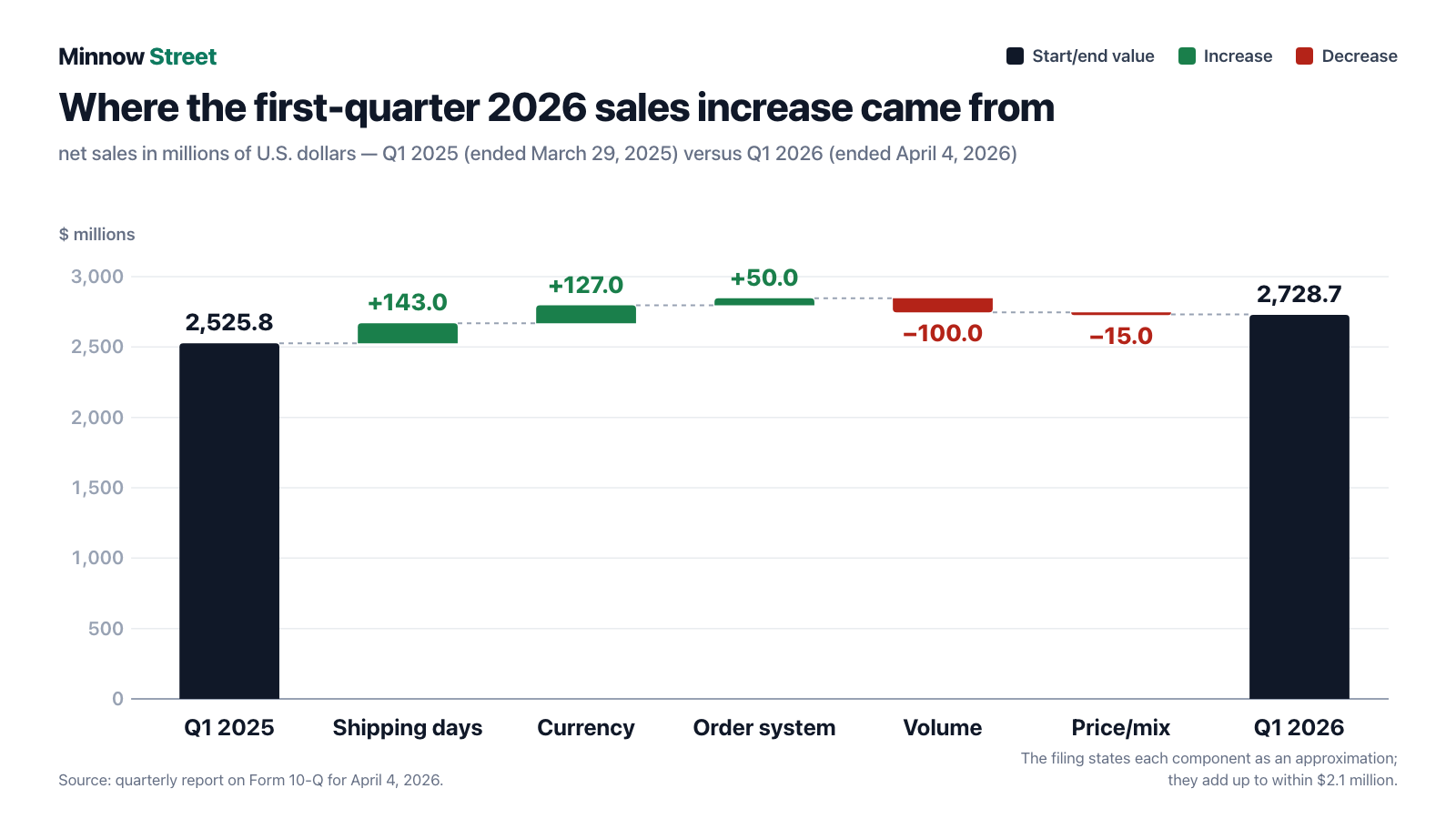
The first-quarter 2026 headline reads: sales of $2,728.7 million, up $202.9 million or 8.0 percent. After three years of declining sales that sounds like the turn. The quarterly report supplies the breakdown — and it is telling:
“The increase was primarily attributable to more shipping days for the quarter ended April 4, 2026, of approximately $143 million; the favorable net impact of foreign exchange rates of approximately $127 million and the $50 million favorable current year comparative impact of the order management system conversion, partially offset by lower sales volume of approximately $100 million and the unfavorable net impact of price and product mix of approximately $15 million.”
— Mohawk Industries, Inc., Form 10-Q for the quarter ended April 4, 2026, Item 2 MD&A, “Net sales”

Translate that. “More shipping days” means Mohawk's fiscal quarters end on a Saturday, and the first quarter of 2026 ran through April 4 while the prior-year quarter ended March 29. Six extra shipping days — that is the calendar, not demand. “Exchange rates” means the euro was stronger, so European sales convert into more dollars. That is not a tile sold either. The third item is a prior-year effect: a software conversion in North America cost roughly $50 million of sales in the first quarter of 2025, and that drag is now absent from the comparison.
What remains is the item that measures demand: volume fell by roughly $100 million, and price and product mix cost another $15 million. In the first quarter of 2026 Mohawk therefore sold less flooring than a year earlier — and still reported 8 percent more revenue.
Uncomfortable truth No. 2: the earnings jump comes from the tax line
The same caution applies to profit. Reported net earnings came to $117.1 million after $72.6 million a year earlier, up 61 percent, and diluted earnings per share to $1.90 after $1.15. Before tax the picture was far more sober: $108.2 million against $90.1 million, up 20 percent. The rest sits in the tax line.
“For the three months ended April 4, 2026, the Company recorded income tax benefit of $8.9 million on earnings before income taxes of $108.2 million for an effective tax rate of (8.2)%. For the three months ended March 29, 2025, the Company recorded income tax expense of $17.5 million on earnings before income taxes of $90.1 million, for an effective tax rate of 19.4%.”
— Mohawk Industries, Inc., Form 10-Q for the quarter ended April 4, 2026, Note 11 “Income Taxes”

The filing gives three reasons for the benefit: a one-time U.S. tax benefit tied to a legal entity restructuring, Brazilian tax credits relating to prior years and a foreign tax credit benefit recorded with a U.S. amended return. All three are non-repeating by nature. Run the quarter at the 21.1 percent full-year 2025 rate and roughly $85 million of net earnings would remain instead of $117.1 million — a gap of roughly $32 million, or a good quarter of the reported profit. Rule of thumb: an earnings jump you find in the tax line is not operating progress.
Uncomfortable truth No. 3: the home market barely earns anything
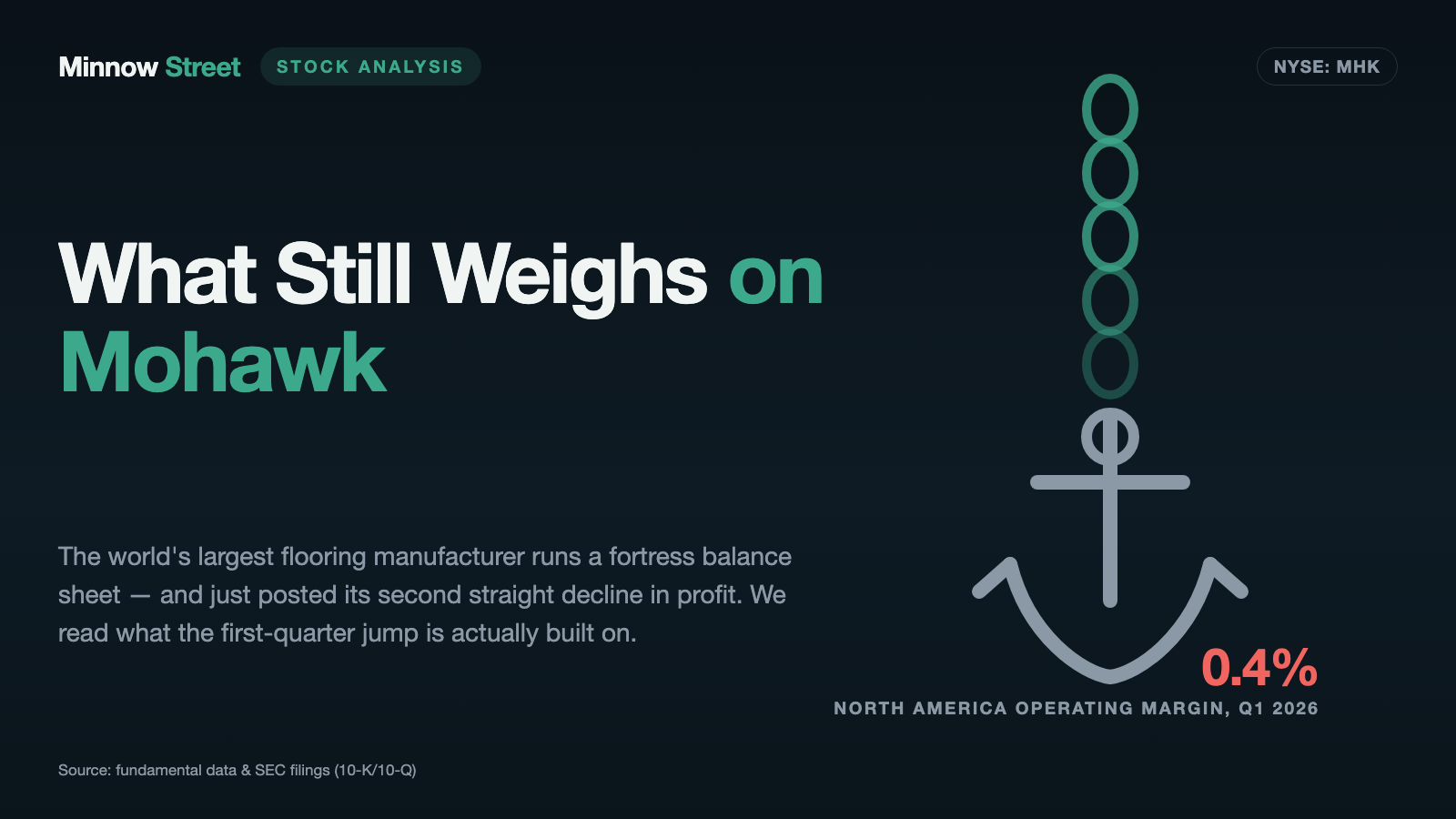
In the first quarter of 2026 Flooring North America generated $880.0 million of sales and turned that into operating income of $3.8 million. That is a margin of 0.4 percent — four tenths of a cent on every dollar sold. A year earlier it was $9.3 million on $862.4 million, or 1.1 percent. For comparison, Flooring Rest of the World earned $70.5 million on $751.3 million in the same quarter (9.4 percent) and Global Ceramic $51.2 million on $1,097.4 million (4.7 percent).
This is a trend, not a stumble. Across full-year 2025, Flooring North America's operating income fell from $237.3 million to $113.6 million — close to a halving. The annual report cites roughly $81 million of higher input costs, roughly $53 million of higher restructuring charges, roughly $42 million from temporary plant shutdowns and roughly $30 million from the software conversion. The largest segment by headcount thus contributes less than a quarter of segment operating income. If Mohawk is going to turn, it has to turn here.
Uncomfortable truth No. 4: one third of the cash sits in Russia
This figure does not appear in the balance sheet but in the risk factors — and it changes how Mohawk's cash should be read.
“As of December 31, 2025, the Company’s Russian operations accounted for 5% of the Company’s net sales and approximately 7% of the Company’s total assets. […] As of December 31, 2025, 30% of the Company’s cash and cash equivalents are held in Russia, and generated interest income of approximately $30 million in 2025.”
— Mohawk Industries, Inc., Form 10-K for fiscal 2025, Item 1A Risk Factors
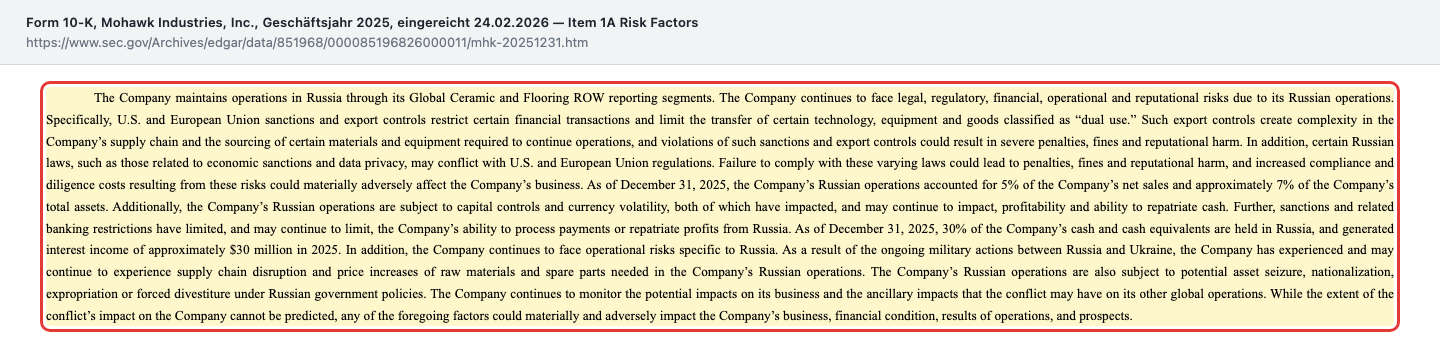
Do the math: at a cash balance of $856.1 million on December 31, 2025, 30 percent is roughly $257 million. The same paragraph names capital controls, currency volatility and sanctions-related banking restrictions that have already limited the company's ability to process payments and repatriate profits from Russia — and explicitly cites the risk of asset seizure, nationalization, expropriation or forced divestiture. On the balance sheet that money counts in full. For a buyback in Georgia it only counts once it crosses the border.
Uncomfortable truth No. 5: the 2023 and 2024 numbers were cut after the fact
In the fourth quarter of 2025 Mohawk found an error in its own books. It concerned intercompany activity affecting accounts receivable — money that group subsidiaries owed each other and that was carried twice. The company classified the error as immaterial but corrected it retroactively:
“The correction was achieved by reducing reported accounts receivable by $42.1 million over the prior periods affected. […] The Company has revised the 2023 and 2024 net earnings attributable to the Company by reducing it by $9.5 million and $3.0 million, respectively. The revised impact on basic and diluted earnings per share for 2023 and 2024 was a reduction of $0.15 and $0.05, respectively.”
— Mohawk Industries, Inc., Form 10-K for fiscal 2025, Note 18 “Immaterial Correction of Prior Period Financial Statements”

Keep a sense of proportion: $42.1 million against equity of a good $8.3 billion is half a percent, the immaterial classification is defensible, and auditor KPMG signed off on effective internal control over financial reporting as of December 31, 2025. Practically it means two things. First, older tear sheets and databases may still show the pre-revision figures for 2023 and 2024. Second, an error that goes undetected for several years and only surfaces once cumulated says something about the complexity of a group with plants in 19 countries — no more, but no less either.
What has happened since the last quarterly report
Between the quarterly report of May 1, 2026 and the cut-off date of this analysis, Mohawk disclosed two things that change the picture.
On May 12, 2026 the financing was rebuilt. Mohawk terminated the 2019 credit agreement led by Wells Fargo and entered into a new unsecured revolving facility of $1,500 million arranged by JPMorgan, maturing on May 12, 2031 with the option of two extensions. The applicable margin ranges from 0.750 to 1.250 percentage points over the reference rate, there is an accordion feature for a further $600 million, and the sole financial covenant is a consolidated interest coverage ratio of at least 3.50 to 1.00. For context: Mohawk's interest coverage most recently ran at roughly 37 — the covenant is over-covered tenfold. Together with the three outstanding note issues (1.750 percent due June 2027, 5.85 percent due September 2028, 3.625 percent due May 2030), funding is secured for years.
On June 11, 2026 the CEO transition was announced. Paul F. De Cock, 53, president and chief operating officer since February 2025, becomes chief executive officer effective September 30, 2026. He succeeds Jeffrey S. Lorberbaum, who has run the company since 2001 and will remain chairman of the board.

This is more than a personnel note. According to the proxy statement of April 3, 2026, Lorberbaum beneficially owned 10,078,475 shares, or 16.5 percent of the common stock as of March 27, 2026 — by far the largest single holder, ahead of BlackRock at 9.9 percent and Dimensional Fund Advisors at 5.1 percent. He therefore remains both owner and chairman while a manager from the Belgian Unilin tradition takes the operating helm. Anyone who wants to know whether the calendar effect becomes a real turn will have to read this new leadership's first capital allocation decisions closely.
What Mohawk did not disclose in that window matters too: no tender offer, no merger, no delisting. The stock continues to trade on the New York Stock Exchange.
Valuation: a company trading below its own book value
Let us talk orders of magnitude, not daily quotes. As of July 27, 2026, Mohawk carries a market value of roughly $6.9 billion — on 60,953,145 shares outstanding (as of April 29, 2026, per the cover page of the quarterly report) and a closing price of $113.27 on July 24, 2026.
The associated metrics, each as an order of magnitude:
- Price-to-book of roughly 0.82. Book value per share runs at roughly $137 — the share price sits a good sixth below it. Translated: the market values Mohawk's plants, brands and inventories below what they are carried at on its own balance sheet. That is not unusual for cyclical industrials, but it is a signal.
- Price-to-sales of roughly 0.63. You pay 63 cents for every dollar of annual revenue. At a net margin of 3.4 percent that is not a bargain but a fair price for a low-margin business.
- Price-to-earnings of roughly 17 on the trailing twelve months and roughly 13 on the consensus estimate for the current year. Careful: the trailing figure contains the tax-driven earnings jump of the first quarter — normalize it and the multiple lands closer to 19.
- Enterprise value to EBITDA of roughly 7.2. For an industrial with this balance sheet that is low rather than high.
And what do the professionals say? Of 18 analyst votes on record (as of July 27, 2026), 6 rate the stock strong buy, 3 buy and 9 hold — not one says sell. The mean price target sits at roughly $123, just above the last closing price. Translated: the profession sees no risk, but no story either. A hold consensus with a target at the current price is the politest way of saying the turn has not been proven.
If you want to see the same cyclical mechanism in another industry, our analysis of Carnival shows a company whose results depend entirely on whether customers currently feel like making a big-ticket purchase. And our analysis of Vail Resorts shows how quickly a cyclical business can hang on a single weather pattern.
Opportunities and risks at a glance
What speaks for Mohawk:
- Fortress balance sheet. A 60.8 percent equity ratio, an Altman Z-score of 8.49, a Piotroski score of 8 out of 9 and interest coverage of roughly 37 against a covenant of 3.50 (April 4, 2026 and data as of July 27, 2026).
- Funding secured to 2031. A new $1,500 million unsecured facility maturing in May 2031, three note issues due 2027, 2028 and 2030, and 2025 interest expense of only $17.8 million.
- Real cash generation. $1,056.2 million from operations in 2025 with capital spending deliberately held to $440 million — the company earns money even when the market stands still.
- Cost program with substance. Actions initiated since 2022 with expected annualized benefits of roughly $365 million.
- Cyclical upside. U.S. and European interest rates at their lowest since autumn 2022 (per the 2025 annual report) — if housing turnover picks up, the operating leverage works in both directions.
- Buybacks instead of a dividend. A $500 million program, $64.3 million of it deployed in the first quarter of 2026 alone and $355.0 million still authorized — at a price below book value the company is buying back below its own asset value.
What speaks against it:
- The turn is not proven. Volume fell by roughly $100 million in the first quarter of 2026; the sales increase came from shipping days, currency and a year-earlier comparison.
- The earnings jump is fiscal. An effective tax rate of negative 8.2 percent in the first quarter of 2026 against 21.1 percent for full-year 2025.
- The home market does not carry. Flooring North America at a 0.4 percent operating margin in the first quarter of 2026, segment income nearly halved in 2025.
- Russia concentration. 30 percent of cash, 5 percent of sales and roughly 7 percent of total assets in a sanctioned market with capital controls (December 31, 2025).
- Tariffs and energy. The annual report explicitly names higher import tariffs as a burden on cost of goods sold and as a risk to customers' discretionary spending.
- Intangible assets. $1,195.9 million of goodwill and $690.6 million of tradenames at April 4, 2026 — after $877.7 million of write-downs in 2023 and a further $19.9 million in 2025, that remains a line item exposed to any renewed valuation setback.
- No momentum. Zero insider purchases against twenty insider sales in the twelve months before July 27, 2026, and a relative strength rating of 36 out of 99, meaning the stock has beaten only a good third of all listings (data as of July 27, 2026).
A human conclusion
Back to the swallow. Mohawk Industries had a warm day in the first quarter of 2026: 8 percent more revenue, 61 percent more profit, a share price off its lows. Read only the headline and the winter coat goes away. Read the filing and underneath you find six extra shipping days, a stronger euro, a year-earlier comparison and a tax line with the sign reversed — plus a volume of flooring that is still falling.
None of that makes Mohawk a bad company. Quite the opposite: this is one of the most solid balance sheets we have met in this scanner. A 60.8 percent equity ratio, interest expense cut to a quarter in two years, more than a billion dollars of operating cash flow in a bad year, a credit facility running to 2031 and a share price below book value — this is a company that can wait for the housing market without getting poorer while it waits. That is the real case here: not whether Mohawk survives, but when its customers start moving house again.
Until then the rule of spring applies: one swallow does not make a summer, but it does not arrive without a reason either. The next quarterly report, the first capital allocation decisions of the new leadership from September 30, 2026, and the question of whether North America gets clear of the zero line — those are the three things that matter. What you do with that is your decision. And that is exactly as it should be.
Sources
- Mohawk Industries, Inc. — Form 10-K for fiscal year 2025 (filed February 24, 2026, CIK 0000851968)
- Form 10-Q for the quarter ended April 4, 2026 (filed May 1, 2026)
- Form 10-K for fiscal year 2024 (filed February 20, 2025)
- Form 8-K of May 13, 2026 — new $1,500 million credit facility
- Form 8-K of June 11, 2026 — CEO transition effective September 30, 2026
- Form 8-K of April 30, 2026 — first-quarter 2026 results
- Proxy statement DEF 14A of April 3, 2026 — beneficial ownership as of March 27, 2026
- Complete filing history on SEC EDGAR (CIK 0000851968)
- Fundamental data: valuation metrics, analyst votes, price history and share count, as of July 27, 2026
- Our in-house stock scanner: turnaround candidates, U.S. market filter — rank and hit count measured July 27, 2026, underlying scanner run of July 26, 2026
This analysis is journalistic commentary on publicly available documents. It is not investment advice, not a solicitation to buy or sell securities and not a recommendation of any particular investment strategy. Equities can result in total loss; price declines up to the complete loss of the capital invested are possible. All figures come from the sources named above with the stated as-of dates and may have changed since. The author holds no position in Mohawk Industries, Inc. at the time of publication.
Our Bottom Line at a Glance
- Balance sheet and funding positive
- At April 4, 2026, $8,379.7 million of equity stands against total assets of $13,791.1 million — an equity ratio of 60.8 percent. Interest expense fell from $77.5 million (2023) through $48.5 million (2024) to $17.8 million (2025). On May 12, 2026 a $1,500 million unsecured facility maturing in 2031 replaced the 2019 agreement; the sole financial covenant is interest coverage of 3.50, and the company runs at roughly 37.
- Earnings power negative
- Sales fell three years running: $11,135.1 million (2023), $10,836.9 million (2024), $10,785.4 million (2025). Operating income dropped 29 percent to $489.8 million in 2025, net earnings from $514.7 million to $369.9 million and earnings per share from $8.09 to $5.93. The 2025 net margin was 3.4 percent.
- Validity of the hook neutral
- The turnaround checklist scores 6 of 8 points at the July 27, 2026 measurement and rank 34 of 60 hits in the U.S. selection. The two missing points are the most telling ones: the net margin has not turned (4.3 percent in the first quarter of 2026 against 5.2 percent in the second quarter of 2025) and there is no net insider buying (zero purchases against twenty sales over twelve months). The mandatory pillars — a roughly 60 percent gap to the all-time closing high of $284.82 on December 1, 2017 and survival with an Altman Z of 8.49 — are met beyond argument.
- Quality of the quarterly result negative
- Of the $202.9 million sales increase in the first quarter of 2026, the quarterly report attributes roughly $143 million to more shipping days, roughly $127 million to exchange rates and $50 million to a year-earlier comparison; volume fell by roughly $100 million. The jump in net earnings to $117.1 million rests on an effective tax rate of negative 8.2 percent — at the 21.1 percent full-year 2025 rate, roughly $85 million would remain.
- Segment picture negative
- Flooring North America turned $880.0 million of first-quarter 2026 sales into just $3.8 million of operating income — a margin of 0.4 percent after 1.1 percent a year earlier. Across full-year 2025 the segment result nearly halved from $237.3 million to $113.6 million. Global Ceramic (4.7 percent) and Flooring Rest of the World (9.4 percent) carry the group.
- Valuation and shareholder returns positive
- At roughly $6.9 billion of market value (data as of July 27, 2026) the stock trades at a price-to-book of roughly 0.82, below book value of roughly $137 per share, and at an enterprise value to EBITDA of roughly 7.2. There is no dividend, but a $500 million repurchase program of which $64.3 million was deployed in the first quarter of 2026 alone and $355.0 million remains available.
Mohawk Industries is exceptionally solid financially and has not yet turned operationally. The balance sheet carries 60.8 percent equity, interest expense has been cut to a quarter in two years to $17.8 million, $1,056.2 million of operating cash came in during a poor year, and the stock trades below its own book value. Against that stands a quarterly increase that the filing itself explains three quarters of with shipping days, exchange rates and a year-earlier comparison, while volume fell by roughly $100 million and the earnings jump came from an effective tax rate of negative 8.2 percent. The leverage sits with the housing market and with Flooring North America, which managed an operating margin of just 0.4 percent in the first quarter of 2026. Not investment advice.
What Our Rating Means
Open questions
The business works in principle, but one material question is open. As long as it stays open, our findings do not carry a quality verdict.
Yellow here stands for earnings and cycle risk, not a threat to substance. Against red: a 60.8 percent equity ratio, an Altman Z-score of 8.49, a Piotroski score of 8 out of 9, $1,056.2 million of operating cash flow in 2025, a $1,500 million credit facility running to 2031 with its coverage covenant over-covered tenfold, and a price below book value. Against green, equally documented: the third consecutive decline in sales, operating income down 29 percent in 2025, a quarterly increase built on shipping days and currency while volume fell by roughly $100 million, an effective tax rate of negative 8.2 percent in the first quarter of 2026, and a home segment running at a 0.4 percent operating margin.
A journalistic assessment by our editorial team at the time of the deep dive, based on public sources — not investment advice and not a solicitation to buy or sell. Your personal circumstances (investment goals, risk capacity, taxes) cannot be taken into account. What our levels mean, how verdicts are formed, and what conflicts of interest exist →
Worth Noting
- Hook: rank 34 of 60 hits in our in-house turnaround scanner with the U.S. market filter, 6 of 8 points on the checklist, Altman Z of 8.49. The scanner page shows only the 25 strongest hits — Mohawk is not among them. Measured July 27, 2026, underlying scanner run of July 26, 2026; the lists are recalculated daily.
- Data basis: Form 10-K for fiscal 2025 (filed February 24, 2026), Form 10-Q for the quarter ended April 4, 2026 (filed May 1, 2026), current reports 8-K of April 30, May 13 and June 11, 2026, proxy statement DEF 14A of April 3, 2026; valuation metrics and analyst votes as of July 27, 2026.
- On the gap to the all-time high: our data set carries negative 58.19 percent, while the price history gives roughly negative 60 percent (all-time closing high $284.82 on December 1, 2017 against $113.27 on July 24, 2026). Both clear the scanner threshold of at least 50 percent; the article uses the figure we measured ourselves.
- Risk of confusion: the 2023 and 2024 figures here are stated as revised in the 2025 annual report after a correction of intercompany receivables (2023 net earnings −$449.0 million instead of −$439.5 million, 2024 $514.7 million instead of $517.7 million). Older data sets may still show the pre-revision values.
- Mind the calendar: Mohawk's quarters end on a Saturday. The first quarter of 2026 ran through April 4, 2026 while the prior-year quarter ended March 29, 2025 — six extra shipping days that the filing puts at roughly $143 million of sales.
Frequently Asked Questions
Mohawk Industries manufactures flooring: carpet, ceramic and porcelain tile, laminate, vinyl and wood planks, plus insulation and panel boards. By its own account it is the world's largest flooring manufacturer, with plants in 19 countries and sales in roughly 180 countries. It employed approximately 40,500 people at December 31, 2025 and reported 2025 sales of $10,785.4 million.
The share price sits roughly 60 percent below its all-time closing high of $284.82 on December 1, 2017 (closing price $113.27 on July 24, 2026), survival is secured by an Altman Z-score of 8.49 and a 60.8 percent equity ratio, and the stock scores 6 of 8 points on our turnaround checklist. Measured on July 27, 2026, that produced rank 34 of 60 hits in the U.S. selection.
Only in the smallest part. Of the $202.9 million increase, the quarterly report attributes roughly $143 million to additional shipping days, roughly $127 million to exchange rates and $50 million to a year-earlier comparison on a software conversion. The volume actually sold fell by roughly $100 million, and price and product mix cost another $15 million.
Because the tax line changed sign. Pretax earnings rose only about 20 percent to $108.2 million. Instead of tax expense the statement carried a tax benefit of $8.9 million — an effective rate of negative 8.2 percent after positive 19.4 percent a year earlier. The filing names three one-off causes: a legal entity restructuring, Brazilian tax credits and a U.S. amended return.
No. The 2025 annual report records that no cash dividend has been paid or declared on the common stock since the initial public offering. Shareholder return comes solely through buybacks: on July 24, 2025 the board authorized a $500 million program, of which $355.0 million remained available at April 4, 2026.
The 2025 annual report puts the Russian business at 5 percent of net sales and approximately 7 percent of total assets. More striking is the cash: 30 percent of cash and cash equivalents were held in Russia at December 31, 2025 — roughly $257 million of the $856.1 million total, subject to capital controls and sanctions.
Paul F. De Cock, 53, previously president and chief operating officer, becomes chief executive officer effective September 30, 2026. He succeeds Jeffrey S. Lorberbaum, who has led the company since 2001, will remain chairman of the board and beneficially owned 10,078,475 shares, or 16.5 percent of the common stock, as of March 27, 2026.
Mohawk's fiscal year ends on December 31, but its quarters end on a Saturday. The first quarter of 2026 therefore ran through April 4, 2026, while the prior-year quarter ended March 29, 2025. Those six extra shipping days added roughly $143 million of sales according to the quarterly report — a pure calendar effect.
Found an error?
Did you spot a factual error, an outdated number, or a typo in this deep dive? Let us know briefly — your report goes straight to the editorial team.