Methode Electronics Stock: The Industrial Segment Earned $114.6 Million — And the Group Still Posted a Loss
Methode Electronics builds busbars, user interface components, lighting and sensors for cars, commercial vehicles, construction equipment and data centers. In fiscal 2026 the Industrial segment produced $114.6 million of income from operations while the Automotive segment lost $30.1 million. Group operating income turned positive for the first time in three years at $8.8 million — and a $25.0 million tax charge wiped it out again. On top of that sits a credit agreement that runs to October 2027, caps dividends and demands monthly reporting to the lenders. We read the annual report line by line and separate the business that carries the group from the one being carried.
 Thomas Mücke
Founder & Publisher
Thomas Mücke
Founder & Publisher
Chart
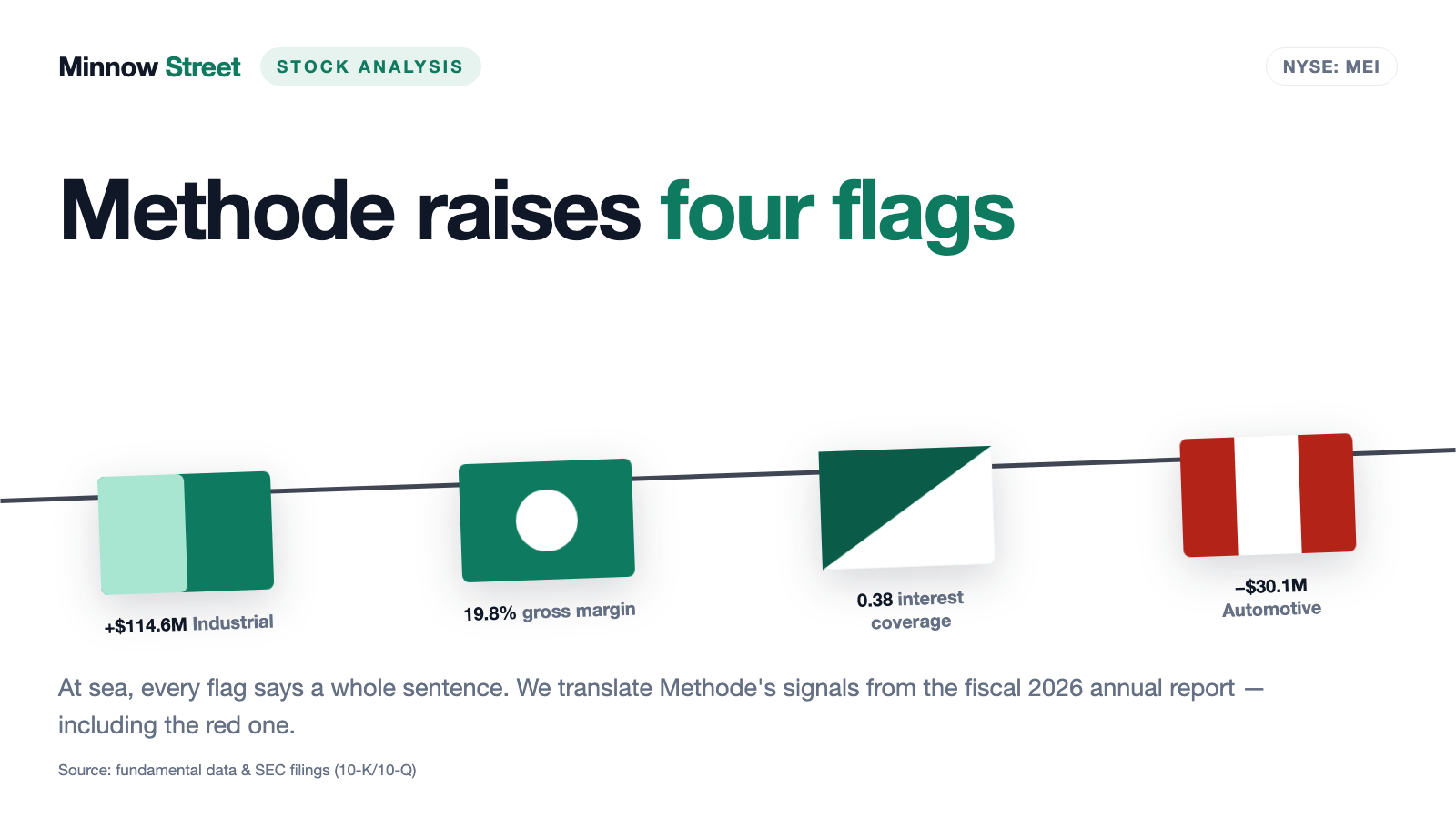
Interactive price chart (TradingView).
Note: pure fact-based analysis, not investment advice and not a solicitation to buy or sell. All figures without guarantee.
There is a thinking trap that catches investors in the supplier world with remarkable reliability, and it is the average trap. It works like this: you read one group-level number — "operating margin near zero" — and your mind paints a picture from it. A tired company barely getting by. At Methode Electronics, Inc. (NYSE: MEI) that picture is wrong, and wrong in both directions at once. In fiscal 2026 the group's Industrial segment produced income from operations of $114.6 million — 21.9 percent of its net sales, a margin any company would be happy to show. In the same year the Automotive segment lost $30.1 million. The average describes neither business.
So here is the deal. Before we talk about the stock, we read what Methode filed with the U.S. securities regulator, the SEC: the annual report (10-K) for the fiscal year ended May 2, 2026, the quarterly report (10-Q) as of January 31, 2026 and the current reports (8-K) in between. An SEC filing is honest under penalty of law. And this one describes a business that earns well, a second one that burns cash, a credit agreement that gives orders to both — and a tax bill that turned a nearly break-even year into a third consecutive annual loss.
What Methode Electronics actually does — busbars, lights and switches
Methode Electronics does not build anything you can buy in a store. It builds the parts inside other people's products. The technical term is mechatronics — mechanics and electronics combined in a single component. A plain picture: when you press the seat-heating switch in a car, you press a piece of mechanics that triggers an electrical signal. Methode designs and manufactures parts like that — and the thick copper bars that carry current through an electric vehicle or a data center. Those bars are called busbars; they replace wiring harnesses wherever a lot of current has to move through very little space.
The business has stood on three legs since fiscal 2025, after a fourth segment (Medical, pressure injury prevention) was discontinued in fiscal 2024:
- Automotive — user interface components, sensors, LED lighting, power distribution, battery disconnect units and integrated circuit boards for automakers and their tiered suppliers. Share of fiscal 2026 net sales: 45.9 percent (2025: 48.6 percent, 2024: 53.7 percent).
- Industrial — exterior and interior lighting, industrial safety radio remote controls, braided flexible cables, laminated busbars and the company's own PowerRail product family for aerospace, commercial vehicles, data centers, industrial equipment, military, power conversion and telecommunications. Share of fiscal 2026: 51.4 percent (2025: 46.5 percent).
- Interface — high-speed digital communication over copper media plus user interface panels for the appliance market. Share of fiscal 2026: 2.7 percent. Methode divested its dataMate business in the fourth quarter of fiscal 2026, and the consumer appliance business is winding down.
As of May 2, 2026 roughly 6,650 people plus 263 contractors worked for Methode, and one number here matters later: 93.9 percent of them are located outside the United States. The company runs 30 operating facilities, with the largest plants in Malta, Suzhou and Dongguan (China), Cairo, Monterrey (Mexico) and Lontzen (Belgium). Of fiscal 2026 net sales, $378.3 million came from the United States, $204.2 million from Malta, $124.9 million from Egypt, $124.3 million from China and $69.1 million from Finland. The corporate headquarters moved from Chicago to Southfield, Michigan during fiscal 2026; the old office is being sublet, which triggered a $0.6 million impairment of the right-of-use asset.
One detail you need in order to read the numbers correctly: Methode's fiscal year ends on the Saturday closest to April 30. Fiscal 2026 therefore ran from May 4, 2025 to May 2, 2026 and contained 52 weeks — while fiscal 2025 contained 53. Anyone comparing the two years is comparing 52 weeks with 53; a full trading week hides inside every percentage. The same calendar effect distorts comparability at another components maker we covered, in our analysis of Vishay.
Where the stock came across our desk — rank 19 on the weekly list
Methode did not reach us through a press release but through a ranking produced by our in-house stock scanner. On the list Richard Moglen: 1 Week Top Performers (U.S. selection) the stock sat at rank 19 of 28 on July 25, 2026, with a relative strength rating of 94 out of 100. The list is recalculated daily — the placement is a snapshot of that day, not a permanent state.
The three conditions behind the list, translated and judged: at least a 15 percent price gain over four trading days — pure momentum. It says nothing about the company, only about demand for its shares that week. Average daily dollar volume of at least $10 million — this filter screens out names you cannot get back out of; Methode came in at roughly $16.7 million as of July 25, 2026, comfortably above the line but not lavishly so. A relative strength rating of at least 70 — the metric measures on a scale to 100 how a price has performed against the broad market. A reading of 94 means only six percent of covered stocks did better.
And this is exactly where a second look pays. A relative strength rating of 94 measures the trailing twelve months — it does not measure the level the stock rose from. At Methode, it rose from a very low level. Keep the rule in mind from the start: a momentum scanner finds movement, not quality. So let us open the books.
The numbers over the years — what actually improved in 2026
First what genuinely speaks for Methode, and there is more of it than the red bottom line suggests. Fiscal 2026 was operationally the best year in three, in several places at once.
Gross margin jumped from 15.6 to 19.8 percent. In absolute terms, gross profit rose from $163.4 million to $202.2 million even though net sales fell 2.8 percent to $1,019.2 million. Cost of products sold dropped $67.7 million. The report names three causes: better operations in material, scrap and freight, lower inventory adjustments, and $22.5 million of customer recoveries in the Automotive segment. That last item matters: recoveries are a renegotiation, not a permanently better business.
Operating income turned positive. After minus $112.0 million in fiscal 2024 (including a $105.9 million goodwill impairment) and minus $23.9 million in fiscal 2025, fiscal 2026 delivered plus $8.8 million. That is not a large profit, but it is the first positive line in three years.
Cash came back in. Cash provided by operating activities rose from $26.4 million to $38.0 million, while capital expenditures were cut from $41.6 million to $22.4 million. That left roughly $15.6 million of free cash flow, after a year in which investment had swallowed the inflow whole. Cash grew from $103.6 million to $139.6 million, helped by $15.2 million from the dataMate divestiture and $5.3 million from sales of non-core assets.
And one shadow lifted. Methode had received SEC subpoenas in November 2024 and March 2025 covering, among other things, its operations in certain foreign countries, compliance with the Foreign Corrupt Practices Act, previously reported material weaknesses in internal control over financial reporting, and how the company had communicated targets and guidance. On May 15, 2026 it reported the outcome:
"As previously disclosed, the Company was subject to an investigation by the Securities and Exchange Commission. On May 14, 2026, the SEC Staff notified the Company that it has concluded its investigation and does not intend to recommend an enforcement action."
— Methode Electronics, Inc., Form 8-K dated May 15, 2026, Item 8.01

It fits the picture that Ernst & Young — auditor since 1966 — issued unqualified opinions on both the financial statements and internal control over financial reporting as of May 2, 2026. That is no small thing for a company that previously had to disclose material weaknesses. And in June 2026 Methode voluntarily repaid $20.0 million on the credit facility. So much for the good half. Now the other one.
Uncomfortable truth No. 1: the tax bill eats the progress
Operating income of plus $8.8 million, interest expense of $23.3 million, plus $3.8 million of other income produce a pre-tax loss of $10.7 million. Unpleasant, but manageable. Then comes the tax line: $25.0 million of income tax expense. Minus $10.7 million becomes minus $35.7 million — the third consecutive annual loss after $62.6 million (2025) and $123.3 million (2024).
How can a loss-making company pay $25 million in tax? The answer sits in the tax note and is about geography. Pre-tax income splits into a $90.7 million loss in the United States and $80.0 million of profit abroad. Profit is taxed where it arises — in Malta, China, Egypt, Finland, Belgium and Mexico. The U.S. loss provides almost no relief because Methode writes down most of the associated tax credits. A plain picture: you hold a voucher you can only redeem once you are profitable again, and the accountant writes it off because he does not expect that to happen soon.
That write-down is called a valuation allowance on deferred tax assets, and within two years it has grown from $5.8 million (end of fiscal 2024) through $20.7 million (2025) to $21.1 million. Cash taxes actually paid in fiscal 2026 came to $24.6 million net of refunds, including $9.3 million to the U.S. federal government and $7.5 million to China. The rule to remember for this stock: as long as the U.S. business runs at a loss, reported group earnings will structurally lag the operating business. The reverse holds too: if the U.S. business turns, part of that allowance can be released — and a reported annual profit would then look better than the underlying business warrants.
Uncomfortable truth No. 2: the credit agreement has a vote
Methode funds itself essentially through one credit facility, and that facility has shrunk in three steps: from $750 million to $500 million (Second Amendment, July 9, 2024) and on to $400 million (Third Amendment, July 7, 2025). As of May 2, 2026, $326.4 million was drawn — $299.4 million of it in euros (€255.3 million) and $27.0 million in U.S. dollars. Weighted-average interest rates were 7.2 percent on the dollar borrowings and 5.5 percent on the euro borrowings. During the Third Amendment period Methode pays a flat spread of 3.50 percent, regardless of how its leverage ratio looks. For context: a spread that is no longer tied to the leverage ratio is not a vote of confidence in credit markets.
What else the agreement demands reads like a list of chores: monthly financial statements to the lenders through maturity, a security interest in substantially all U.S. property and in the equity of subsidiaries, a $2.5 million per quarter cap on dividends and buybacks combined — and a clause against hoarding cash: if more than $65 million sits in the United States for ten consecutive business days, the excess must be repaid on the facility.
That these rules are not a formality became clear on September 8, 2025. On that day Methode signed a waiver letter that expressly acknowledges an event of default: in the quarter ended August 2, 2025 the company had made roughly $2.8 million of restricted payments against a $2.5 million basket. The default was waived and the basket for the following quarter cut to about $2.2 million.

Which leaves the question that overshadows everything else: what happens on October 31, 2027? That is when the facility matures, and with it roughly $324 million that the maturity schedule places in fiscal 2028. Methode puts it about as plainly as companies ever do:
"Our revolving credit facility matures on October 31, 2027. While we currently intend to refinance or extend our obligations under this revolving credit agreement, there can be no assurance that we will be able to do so on favorable terms."
— Methode Electronics, Inc., Form 10-K for fiscal 2026, Item 7 (MD&A)

The hard metric here is interest coverage: operating income divided by interest expense. It answers how many times a company earns its interest bill out of the running business. $8.8 million divided by $23.3 million is 0.38 — Methode earned roughly a third of its interest in fiscal 2026. The rest came from cash and from asset sales. For comparison, a reading above 3 is considered comfortable and below 1 gets tight. What it looks like when an entire balance sheet hangs on that number is something we described in our analysis of satellite operator Viasat, where interest coverage stood at 0.3.
Uncomfortable truth No. 3: two companies in one wrapper
Back to the average trap from the opening. This is what fiscal 2026 looked like by segment:
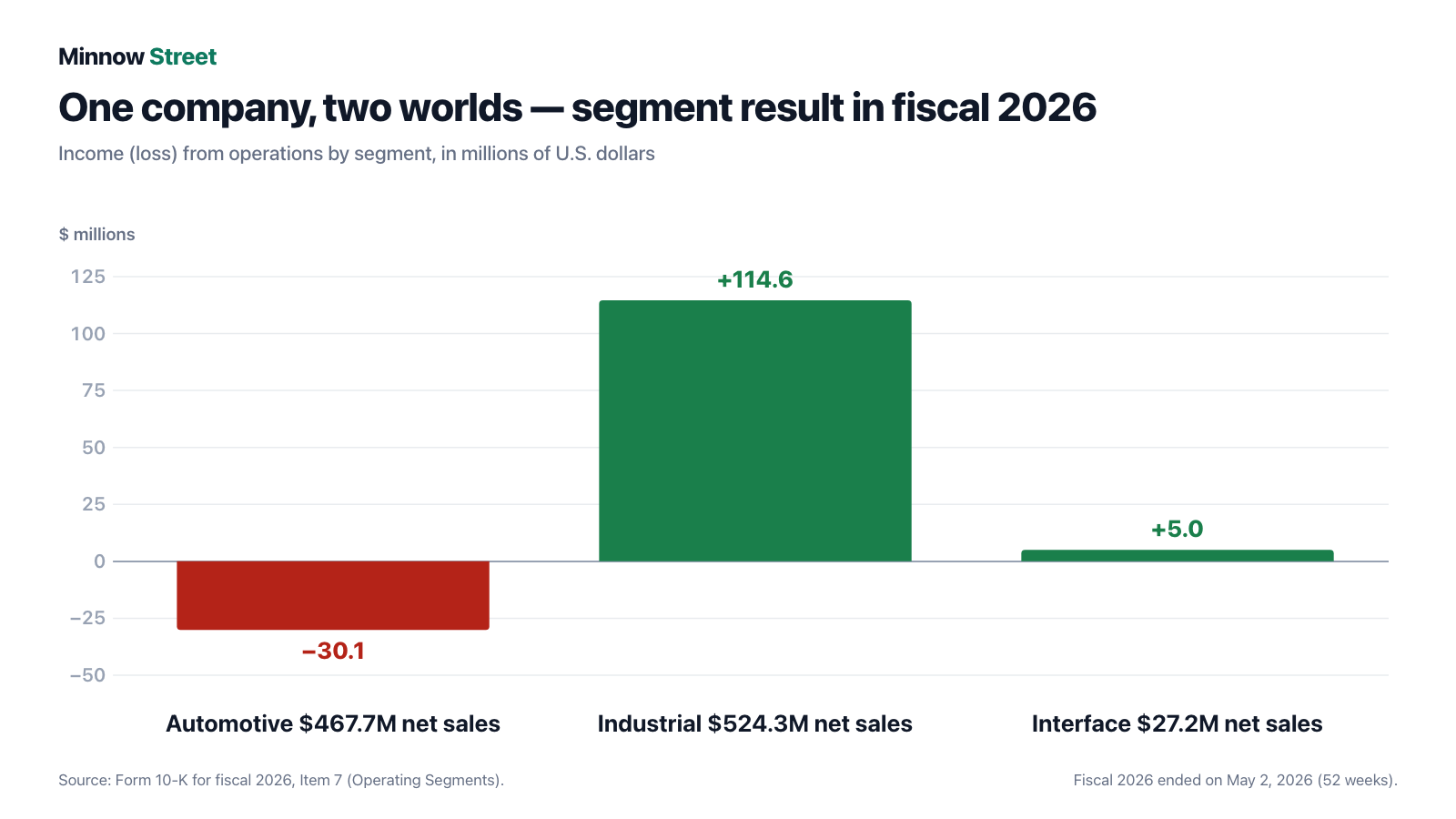
Industrial is the earner and, in fiscal 2026, also the larger segment for the first time: net sales rose 7.6 percent to $524.3 million, gross margin from 29.6 to 31.9 percent, and income from operations from $90.0 million to $114.6 million — 21.9 percent of net sales. Power distribution products and lighting for the off-highway market carried the growth; lighting for the commercial vehicle market declined.
Automotive is the problem child. Net sales fell 8.1 percent to $467.7 million and the result stayed deep in the red at minus $30.1 million — an improvement, at least, on minus $47.7 million the year before. North America took the worst of it: revenue there dropped $49.0 million to $188.1 million as series programs rolled off. Segment gross margin only rose from 0.9 to 5.9 percent because $22.5 million of customer recoveries came in during the same year. Without them the margin would have stayed near the prior-year level.
Why the programs are rolling off, and what comes next, is the real question — and Methode names one cause explicitly:
"The adoption of EVs has been slower than anticipated, in light of recent U.S. government policy changes, including the termination of certain consumer tax incentives for EV purchases and certain of our customers have announced shifts to their EV strategies."
— Methode Electronics, Inc., Form 10-K for fiscal 2026, Item 7 (Trends Affecting Our Business)
That hits Methode twice over: busbars and battery disconnect units are precisely the parts an electric vehicle needs and a combustion car does not. A company that built capacity for a ramp arriving more slowly than planned is sitting on underused plant — the risk report says as much in the company's own words.
Then there is the dependence on a handful of buyers. In fiscal 2026 the five largest customers accounted for roughly 41 percent of consolidated net sales and one alone for 10.9 percent — and none of them is obliged to buy anything:

The third segment, Interface, shrank 47.5 percent to $27.2 million and now represents 2.7 percent of the group. The sale of dataMate in the fourth quarter brought a $16.4 million purchase price and an $11.2 million book gain — a pleasant one-off that lands in other income, not in operating income.
Uncomfortable truth No. 4: the goodwill cushion has worn thin
Goodwill arises when a company pays more for an acquisition than the acquired assets are worth. It then sits on the balance sheet and must be tested every year: is the acquired business still worth what was assumed? If not, it is written down — and that hits earnings without a single dollar moving.
Methode knows the drill. In fiscal 2024 it wrote off $105.9 million of goodwill in Automotive; the balance there is now zero. What remains is $174.9 million, practically all of it in Industrial: $125.1 million at the Grakon Industrial reporting unit and $48.2 million at Nordic Lights. Together with other intangible assets of $218.9 million, that puts $393.8 million of untouchable assets on a balance sheet with $677.5 million of equity — roughly 58 percent.
The annual test at the beginning of the fourth quarter of fiscal 2026 found that every unit passes. By what margin is the interesting line:
"The fair value of the Nordic Lights reporting unit exceeded its carrying value by more than 10%, whereas the Grakon Industrial reporting unit exceeded its carrying value by less than 10%."
— Methode Electronics, Inc., Form 10-K for fiscal 2026, Item 7 (Critical Accounting Policies and Estimates)
In plain terms: at the unit carrying the largest goodwill balance, a setback of less than ten percent in estimated value is enough to trigger an impairment. The auditors declared exactly that judgment a critical audit matter — the item flagged in the opinion as especially challenging and subjective. A year earlier it was Nordic Lights that sat below the ten percent cushion; there, a hypothetical increase of more than 100 basis points in the discount rate could have caused a partial impairment. The thin cushion moves around, it does not go away.
Uncomfortable truth No. 5: $100 became $22
Every U.S. annual report contains a chart no management team enjoys showing when it looks like this one: the five-year shareholder return against an index and against a self-selected peer group. Methode's own figures:
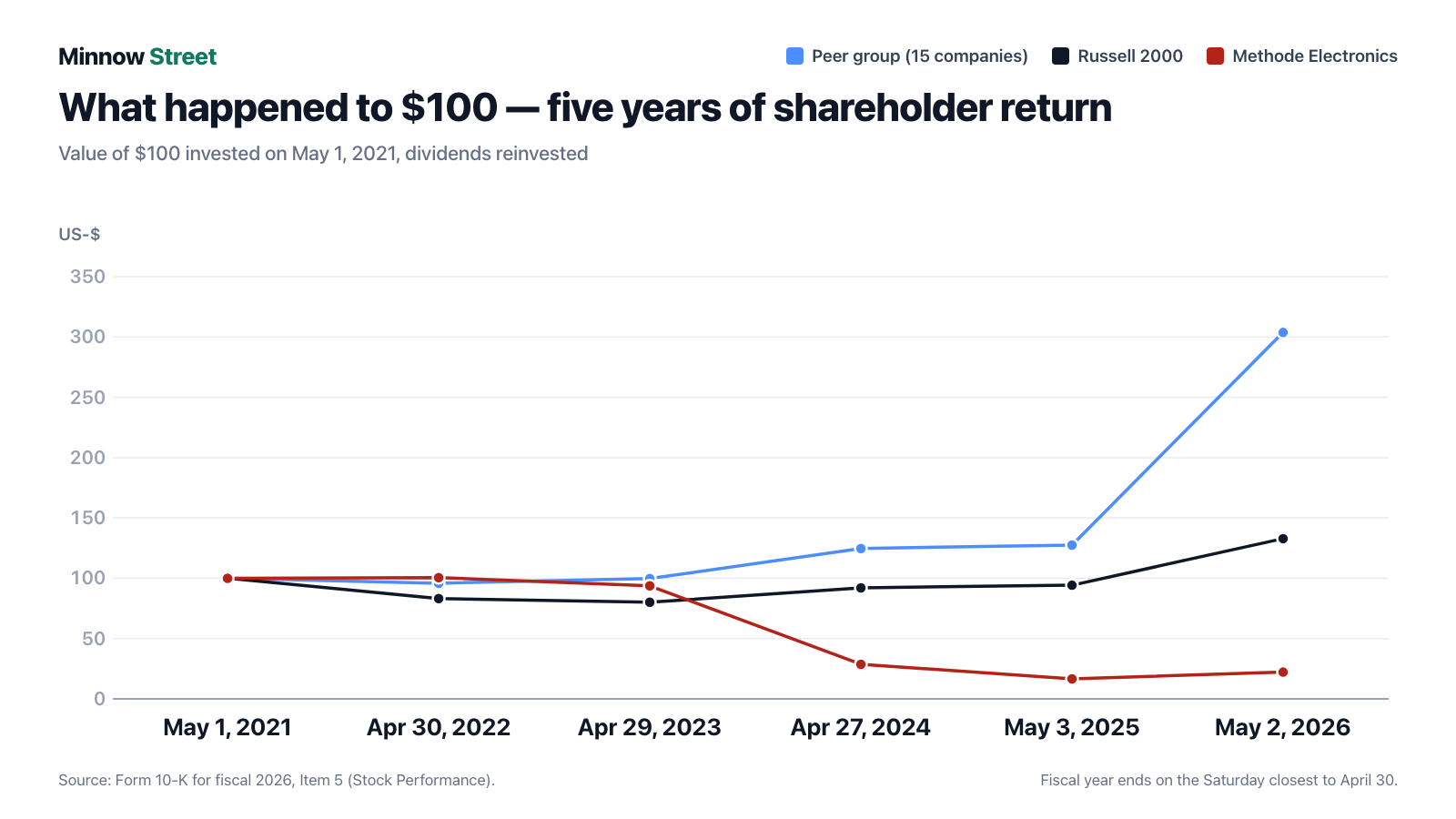
By May 2, 2026, $100 had become $22.18. In the Russell 2000 it would have been $132.84, and in the fifteen-company peer group — which includes Belden, Littelfuse, Gentherm, Stoneridge and Benchmark Electronics — $303.72. The collapse is visible between fiscal 2023 ($93.67) and fiscal 2025 ($16.64); the recovery to $22.18 in fiscal 2026 is a first exhale measured against that, not a comeback.
Three further decisions of the past two years fit the picture. First, the dividend fell from $0.56 to $0.22 per share and the total payout from $20.4 million to $8.3 million. Second, a $200 million buyback authorization expired on June 17, 2026 without a single share being purchased under it — even though the stock traded at an average of $6.94 to $7.56 in the final quarter of the fiscal year. Third, the shareholder suits filed in 2024 are still running. A court dismissed the consolidated class action on February 3, 2026 but allowed an amended complaint; the motion to dismiss that version remains pending. Two derivative suits against current and former directors are also outstanding. Methode states that it currently cannot estimate the possible loss.
What the stock costs — a framing, not a price target
First, what is fixed. As of June 18, 2026 there were 35,471,806 shares outstanding. Equity stood at $677.5 million as of May 2, 2026 — arithmetically about $19.11 of book value per share. Of that, $393.8 million is goodwill and other intangibles; strip those out and roughly $283.7 million remains, or about $8.00 per share of tangible substance. Net financial debt — $326.4 million drawn less $139.6 million of cash — was roughly $186.8 million; after the voluntary $20.0 million repayment in June 2026 the drawn balance stood at about $306.4 million.
We deliberately do not print a current market capitalization here, and there is a reason. The last price documented in a required filing comes from the buyback table in the annual report: $6.94 on average for shares surrendered for tax withholding between April 5 and May 2, 2026. On that basis market capitalization would be roughly $246 million — barely a quarter of annual net sales and around a third of book value. As of our fundamental data date of July 25, 2026, the price stood at $15.31 (closing price of July 24, 2026), more than twice as high. That is precisely why the stock shows up on a weekly top-performer list at all. As an order of magnitude, that means the ratio of market capitalization to annual revenue sits somewhere between roughly 0.25 and 0.55 depending on the anchor — very low for a technology name, normal to cheap for a supplier with a red bottom line. A price-to-earnings ratio cannot be formed, because there are no earnings.
The professionals' view, as of July 25, 2026: three analyst opinions were on file — one strong buy and two holds, with a mean target price of $19.33. With only three voices that is a mood reading rather than a consensus; small suppliers are thinly covered. From the same data set: the Altman Z-score, an early-warning measure for financial distress, stood at 2.15 — in the grey zone between unremarkable (above 3) and critical (below 1.8). The Piotroski score, a nine-part balance sheet checklist, came in at 5 of 9: middling, not alarming. The equity ratio was roughly 51.9 percent. Institutions held about 92 percent of the shares and insiders about 3 percent.
Opportunities and risks at a glance
What speaks for Methode:
- A genuinely good business inside the house. Industrial earned $114.6 million on $524.3 million of net sales in fiscal 2026 — a 21.9 percent margin, grown organically by 7.6 percent. If that segment were listed on its own, the valuation would look different.
- The operating turn has happened. After minus $112.0 million and minus $23.9 million, fiscal 2026 delivered plus $8.8 million; gross margin rose 4.2 percentage points to 19.8 percent.
- Cash flow carries again. $38.0 million from operations against $22.4 million of capital expenditure, after years in which the build-out cost more than came in. Cash grew to $139.6 million.
- The SEC investigation is over with no enforcement action recommended, and Ernst & Young issued unqualified opinions on both the statements and internal control as of May 2, 2026.
- Data centers as a second leg. Busbars and power distribution for data centers sit in the Industrial segment and are growing — an end market with no link to the automotive cycle.
What speaks against it:
- Interest coverage of 0.38. Operating income covers about a third of the interest bill. The facility matures on October 31, 2027, and the company explicitly does not rule out refinancing on worse terms.
- The tax trap persists as long as the U.S. business loses money: $25.0 million of tax expense on a $10.7 million pre-tax loss in fiscal 2026.
- Automotive keeps losing programs. Minus $49.0 million of revenue in North America alone, a $30.1 million segment loss, and the $22.5 million of customer recoveries are a one-off negotiating win, not a business model.
- The goodwill cushion at Grakon Industrial is below ten percent — on a $125.1 million balance in that single unit.
- The credit agreement constrains. $2.5 million per quarter for dividends and buybacks, monthly reporting to the lenders, security over U.S. property, mandatory prepayment above $65 million of U.S. cash. An event of default had to be waived in September 2025.
- Concentration without protection: five customers for 41 percent of net sales, no minimum volumes, programs cancellable at any time.
A human conclusion
Back to the average trap. Anyone who reads Methode Electronics as one company reads it wrongly. It is two: an industrial business running at a 21.9 percent margin and growing — and an automotive business losing programs because the electric ramp is arriving more slowly than planned. The trouble is that interest, taxes and loan covenants attach not to the good half but to the group. That is why an operationally better year still ends in a $35.7 million loss.
It is also fair to say that much of this points the right way. Gross margin is rising, cash is coming in again, the regulator is done, the audit opinion is clean, and the company is voluntarily repaying debt. To invest is to bet that Automotive has found its floor before the credit facility comes due on October 31, 2027 — and that the refinancing turns out to be uneventful. Not to invest is to point at interest coverage of 0.38 and at five years in which $100 became $22 while the peer group went to $304.
Both are defensible conclusions drawn from the same numbers. We have laid them out as they appear in the filings — dated, sourced, unsoftened. What you do with that is your decision. And that is exactly as it should be.
Sources and disclosure
- Annual report (Form 10-K) for fiscal 2026, period ended May 2, 2026, filed June 24, 2026 — Methode Electronics, Inc., CIK 0000065270
- Quarterly report (Form 10-Q) as of January 31, 2026, filed March 5, 2026
- Current report (Form 8-K) dated May 15, 2026, Item 8.01 — conclusion of the SEC investigation
- Current report (Form 8-K) dated June 24, 2026, Item 2.02 — fourth quarter and fiscal 2026 results
- Current report (Form 8-K) dated December 18, 2025, Item 5.02 — amendments to change in control agreements
- All Methode Electronics filings with the SEC (EDGAR)
- Fundamental data (metrics, quarterly series, analyst view) — data as of July 25, 2026, closing price of July 24, 2026
- In-house stock scanner, "Richard Moglen: 1 Week Top Performers" (U.S. selection) — rank 19 of 28, as of July 25, 2026. The lists are recalculated daily.
Disclosure. This article is journalistic analysis of publicly available filings. It is not investment advice, not a solicitation to buy or sell securities and not a personal recommendation. Stocks can go to zero; the figures shown relate to completed fiscal years and quarters and describe no future outcome. The author holds no position in Methode Electronics, Inc. at the time of publication. All information is given to the best of our knowledge; the original SEC filings alone are authoritative.
Our Bottom Line at a Glance
- Industrial business positive
- The Industrial segment lifted net sales 7.6 percent to $524.3 million in fiscal 2026, gross margin from 29.6 to 31.9 percent and income from operations from $90.0 million to $114.6 million — 21.9 percent of net sales. At 51.4 percent of consolidated net sales it is the largest segment for the first time. Power distribution for data centers and lighting for the off-highway market carried the growth.
- Automotive segment negative
- Automotive lost 8.1 percent of net sales in fiscal 2026, falling to $467.7 million, and posted minus $30.1 million (prior year: minus $47.7 million). In North America revenue dropped $49.0 million to $188.1 million as programs rolled off. Segment gross margin rose from 0.9 to 5.9 percent only because $22.5 million of customer recoveries came in — a negotiated outcome, not recurring income.
- Interest burden and maturity negative
- Operating income of $8.8 million met interest expense of $23.3 million in fiscal 2026 — interest coverage of 0.38. The revolving facility was cut from $750 million to $500 million and then $400 million, $326.4 million was drawn as of May 2, 2026, and maturity falls on October 31, 2027. The company itself does not rule out that refinancing succeeds only on less favorable terms.
- Earnings quality and taxes negative
- A pre-tax loss of $10.7 million became a net loss of $35.7 million through $25.0 million of income tax expense — the third consecutive annual loss after $62.6 million (2025) and $123.3 million (2024). The cause is the split between a $90.7 million U.S. loss and $80.0 million of foreign profit; the valuation allowance on deferred tax assets rose from $5.8 million to $21.1 million within two years.
- Balance sheet and goodwill neutral
- As of May 2, 2026 equity stood at $677.5 million against $1,306.1 million of total assets, cash rose to $139.6 million, and operating cash flow reached $38.0 million against $22.4 million of capital expenditure. Against that: $393.8 million of the balance sheet is goodwill and intangibles, and at the largest position — $125.1 million at Grakon Industrial — the impairment cushion is below ten percent.
- Regulator and governance neutral
- The SEC concluded its 2024 investigation on May 14, 2026 without recommending enforcement, and Ernst & Young issued unqualified opinions on the statements and on internal control as of May 2, 2026. Shareholder suits from 2024 remain open and the company cannot estimate the possible loss. An event of default under the credit agreement ($2.8 million of restricted payments against a $2.5 million basket) was waived on September 8, 2025.
Methode Electronics is two companies in one wrapper. The industrial business earned $114.6 million on a 21.9 percent margin in fiscal 2026 and grew 7.6 percent; the automotive business lost $30.1 million as series programs rolled off and the electric ramp arrived more slowly than planned. Operationally, 2026 was the best year in three: gross margin from 15.6 to 19.8 percent, operating income positive again at $8.8 million, $38.0 million of cash from operations, and the SEC investigation closed with no enforcement action. All of that rests on a balance sheet that puts $326.4 million of borrowings due on October 31, 2027 and whose interest bill is covered only 0.38 times by operating income — and on a tax charge that turned the progress into a third consecutive annual loss. Not investment advice.
What Our Rating Means
Substance risk
We found at least one documented issue that threatens the company itself — regardless of how the stock is currently valued.
This rating judges the company, not the share price — and here the substance findings outweigh the operating improvement. On the record: interest coverage of 0.38 in fiscal 2026, a revolving facility cut in three steps from $750 million to $400 million with $326.4 million drawn and maturity on October 31, 2027, an event of default acknowledged and waived on September 8, 2025, monthly reporting to the lenders through maturity, and a goodwill cushion below ten percent at the largest reporting unit. Against that stand real strengths: an industrial business at a 21.9 percent margin, an equity ratio of roughly 51.9 percent, $139.6 million of cash and free cash flow that is positive again. That rules out an existential scenario, but it does not lift the rating: interest coverage below one, combined with a refinancing the company itself will not guarantee, is a substance risk — and in case of doubt the more cautious grade applies. The decision is yours.
A journalistic assessment by our editorial team at the time of the deep dive, based on public sources — not investment advice and not a solicitation to buy or sell. Your personal circumstances (investment goals, risk capacity, taxes) cannot be taken into account. What our levels mean, how verdicts are formed, and what conflicts of interest exist →
Worth Noting
- Hook: in-house stock scanner, "Richard Moglen: 1 Week Top Performers" (U.S. selection), rank 19 of 28, RS rating 94, as of July 25, 2026. The lists are recalculated daily.
- Metrics as of July 25, 2026 (closing price of July 24, 2026). All business figures come from the Form 10-K for the fiscal year ended May 2, 2026, filed June 24, 2026.
- Market capitalization cross-check: the last price documented in a required filing is $6.94 (average for shares surrendered for tax withholding, April 5 to May 2, 2026); the price as of July 24, 2026 was more than twice as high. The analysis therefore gives a range for the price-to-sales ratio rather than a fixed market capitalization.
- Possible confusion: the Form 15-12G and 25-NSE filings from January 2014 under the same CIK relate to moving the listing from Nasdaq to the NYSE, not to a deregistration of the common stock. Methode remains listed on the NYSE and files 10-K and 10-Q reports.
- No pending transaction: filings through July 26, 2026 contain no indication of an acquisition, a take-private or a merger.
Frequently Asked Questions
Methode Electronics designs and manufactures mechatronic components — parts in which mechanics and electronics come together. These include busbars and battery disconnect units for power distribution, user interface components, LED lighting, sensors and industrial radio remote controls. Customers are automakers, commercial vehicle and construction equipment builders, and data center operators. The company reports in three segments: Automotive, Industrial and Interface.
Because interest and taxes consumed it. Operating income of $8.8 million met interest expense of $23.3 million, producing a pre-tax loss of $10.7 million. On that came $25.0 million of income tax expense, because $80.0 million of foreign profit was taxed where it arose while a $90.7 million U.S. loss provided almost no relief. The bottom line was minus $35.7 million.
On the Saturday closest to April 30. Fiscal 2026 ran from May 4, 2025 to May 2, 2026 and contained 52 weeks. Fiscal 2025 ended on May 3, 2025 and contained 53 weeks; fiscal 2024 ended on April 27, 2024 with 52 weeks. Comparing 2026 with 2025 therefore compares 52 weeks with 53 — a full trading week is missing from every growth rate.
As of May 2, 2026, $326.4 million was drawn on the revolving credit facility, $299.4 million of it in euros. The commitment has been $400 million since the Third Amendment of July 7, 2025, down from $500 million and originally $750 million. The facility matures on October 31, 2027. After a voluntary $20.0 million repayment in June 2026 the balance stood at roughly $306.4 million; cash was $139.6 million.
No acquisition, take-private or merger is announced in filings through July 26, 2026. Shareholder suits from 2024 remain open: a court dismissed the consolidated class action on February 3, 2026 but allowed an amended complaint, and the motion to dismiss that version is still pending. The SEC investigation was concluded on May 14, 2026 with no enforcement action.
Yes, but far less than before. In fiscal 2026 the dividend was $0.22 per share after $0.56 in each of the two prior years; the total payout fell from $20.4 million to $8.3 million. The credit agreement caps dividends and share repurchases together at $2.5 million per quarter for the duration of the Third Amendment period. A $200 million buyback authorization expired unused on June 17, 2026.
The Industrial segment. In fiscal 2026 it generated $524.3 million of net sales and $114.6 million of income from operations — a 21.9 percent margin. Automotive produced $467.7 million of net sales and a $30.1 million loss; Interface produced $27.2 million of net sales and $5.0 million of income. For the first time Industrial was the largest segment, at 51.4 percent of consolidated net sales.
In fiscal 2026 the five largest customers accounted for roughly 41 percent of consolidated net sales, and one customer for 10.9 percent — about $111 million. The annual report states explicitly that the blanket purchase orders are not firm orders: customers are not required to buy any minimum amount and can sunset a program at any time.
Found an error?
Did you spot a factual error, an outdated number, or a typo in this deep dive? Let us know briefly — your report goes straight to the editorial team.