MediaAlpha: $1.1 Billion of Revenue — and the 2025 Profit Came From the Tax Line
MediaAlpha runs the largest marketplace for insurance shoppers in the United States: if you compare car insurance online, you very likely pass through this system. In 2025, $1,113.6 million of revenue ran through the books, up 28.8 percent. What stayed was $167.5 million of gross profit — and, at the bottom, net income of $26.8 million that would not exist without an income tax benefit of $137.8 million: pre-tax, the company lost $111.1 million. Also on the balance sheet: a debt owed to its own pre-IPO owners, a $45 million settlement with the Federal Trade Commission, and a headline metric that simply stops being reported from the first quarter of 2026. Not investment advice — just the question of how much of a billion dollars in throughput the company actually owns.
 Thomas Mücke
Founder & Publisher
Thomas Mücke
Founder & Publisher

Chart
Interactive price chart (TradingView).
Note: pure fact-based analysis, not investment advice and not a solicitation to buy or sell. All figures without guarantee.
There is a thinking trap that needs no villain — it forms all by itself whenever a lot of something rushes past us. Call it the downspout illusion. Picture a summer cloudburst. An enormous amount of water comes down on the roof, the downspout roars for minutes on end, and your mind quietly books that as a lot of water. The next morning you lift the lid of the rain barrel — and there is a hand's width inside. The rest evaporated off the tiles, shot past the edge of the gutter, ran out of the overflow, soaked away into the flower bed. The roar comes free; the level you have to walk over and check. And whether the barrel carries you through the summer is decided long after the cloudburst.
At MediaAlpha, Inc. (NYSE: MAX) you can recalculate this illusion from a single row of figures. In 2025, $1,113.6 million of revenue ran through the books, 28.8 percent more than a year earlier. Of that, $167.5 million stayed as gross profit — 15.0 percent. And at the bottom stood net income of $26.8 million that would not exist without an income tax benefit of $137.8 million: on a pre-tax basis, MediaAlpha lost $111.1 million in 2025.
So let us make a deal. We will not look at headlines or share prices, only at what MediaAlpha filed under penalty of perjury with the U.S. securities regulator, the SEC: the annual report (10-K) for 2025 dated February 23, 2026, the quarterly report (10-Q) as of March 31, 2026 dated April 29, 2026, and everything filed since. And we put the central tension on the table early, because it runs through every chapter: the marketplace works and it is growing — but at the end of the chain there is no profit from the business. There is a chain of bookings: a tax effect as the source of income, a debt to the company's own pre-IPO owners that ranks second only to the bank borrowings, and an asset side that is half made of accounting values.
What MediaAlpha actually does — an exchange for people shopping for insurance
MediaAlpha is not an insurer. It sells prospects. The everyday picture: imagine a wholesale market where the goods are not fish but the attention of people who are, right now, looking for car insurance. On one side stand the Supply Partners — comparison sites, financial websites, carriers that do not want to serve a particular shopper themselves. They bring the prospects. On the other side stand the Demand Partners — carriers, brokers, agencies. They buy. MediaAlpha provides the marketplace, the pricing mechanism and the data, and takes a cut.
Three forms of goods are traded, called "Consumer Referrals" in the filings: clicks (someone clicks through to a carrier), calls (someone is connected by phone) and leads (completed contact details). Trading is real time and automated: per the annual report, a carrier can bid across more than 35 separate consumer attributes to decide what a given prospect is worth.
And there are two business models side by side, and the difference between them governs everything that follows. In the Open Marketplace, MediaAlpha is the principal: it buys the prospect, resells it, and books the full sale price as revenue — with the purchase price sitting in cost of revenue. In the Private Marketplace, buyer and seller contract directly and MediaAlpha only supplies the technology and charges a platform fee — tiny revenue, almost no cost. Remember this: a dollar of Open Marketplace revenue and a dollar of Private Marketplace revenue are not the same business. Which is why the revenue line on its own is nearly meaningless here.
The scale of it: in 2025 the platform handled $2.16 billion of volume — what the company called Transaction Value until recently — up 44.5 percent. It served more than 1,050 insurance partners, including, per the annual report, 16 of the 20 largest U.S. auto insurance carriers measured by customer acquisition spend. All of it with 147 full-time employees as of December 31, 2025. That is the genuinely impressive part of this company: the operating leverage is real.
How the stock landed on our desk — through the chatter, not through a metric
MediaAlpha did not reach our research list through a quality or momentum filter, but through the loudest place in the retail investing world: in our review of the most-discussed U.S. stocks in the large Reddit investing forums on July 27, 2026, the ticker MAX was on the list. That is explicitly not a quality judgment — it is an attention signal. So the usual rule applies: we do not examine what was written, we examine what was filed.
And because metrics without judgment are worthless, here are the four that matter for this business model, each with an assessment.
First, gross margin: 15.0 percent (2025). For a software company that would be a disaster; for a marketplace with a resale model it is normal — but the trend is what counts: 17.2 percent (2023), 16.6 percent (2024), 15.0 percent (2025). The margin falls while revenue climbs.
Second, operating cash flow: $65.6 million (2025) against capital expenditures of $0.3 million. That is the strongest number in the whole report. A business that produces real cash and needs almost no assets to do it is rare. In 2024 it was $45.9 million, in 2023 $20.2 million — three years of improvement.
Third, interest coverage. In 2025, income from operations of $22.1 million stood against $11.2 million of interest expense — a factor of 2.0. That is thin; a factor of 4 or more counts as comfortable. In the first quarter of 2026 it looked far better: $22.4 million against $2.4 million, a factor of 9.2. One quarter does not make a summer, but the direction is notable.
Fourth, equity: minus $29.1 million as of March 31, 2026. On the balance sheet the line reads, verbatim, "Total stockholders' deficit". We will come back to that in detail — for now, just note it: this company owes more than it owns.
The numbers over the years — given their due
Start with what genuinely impresses. MediaAlpha survived a brutal collapse. In 2021 revenue was $645.3 million. Then U.S. auto insurers turned off the tap: after the pandemic, repair costs and accident severity jumped, loss ratios exploded, and carriers that are losing money do not chase new customers. Revenue fell to $459.1 million (2022) and $388.1 million (2023) — down 40 percent in two years, with the company itself doing nothing wrong. Gross profit followed the same path: from $101.5 million (2021) to $70.1 million (2022) and $66.7 million (2023).
Then the cycle turned. 2024: $864.7 million. 2025: $1,113.6 million. That is nearly three times the 2023 figure. And gross profit — revenue less cost of revenue — rose from $66.7 million (2023) to $143.6 million (2024) and $167.5 million (2025).
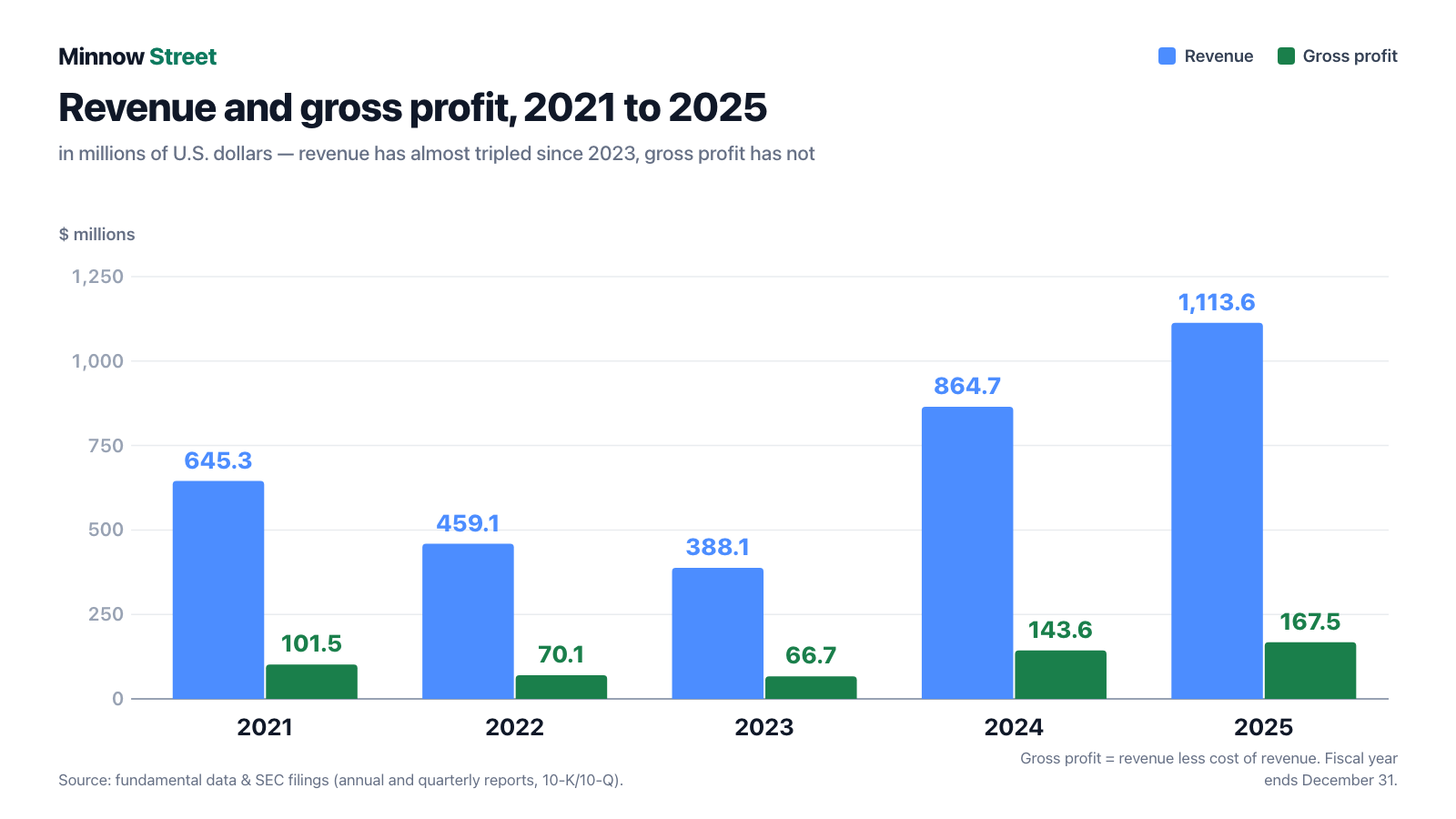
This is where the downspout illusion starts to bite. Revenue has almost tripled since 2023 (a factor of 2.9), gross profit only by a factor of 2.5 — and the margin fell from 17.2 to 15.0 percent. MediaAlpha explains it in the filing itself: the decline came from the shrunken health insurance business and from a higher mix of Private Marketplace transactions in property and casualty. The company's own metric "Contribution" — revenue less revenue share payments to suppliers and online advertising costs — rose 14.2 percent to $176.3 million in 2025, while the associated margin fell from 17.9 to 15.8 percent. Growth, yes, but slightly worse growth.
The second question is where the growth comes from. The answer is uncomfortably clear.
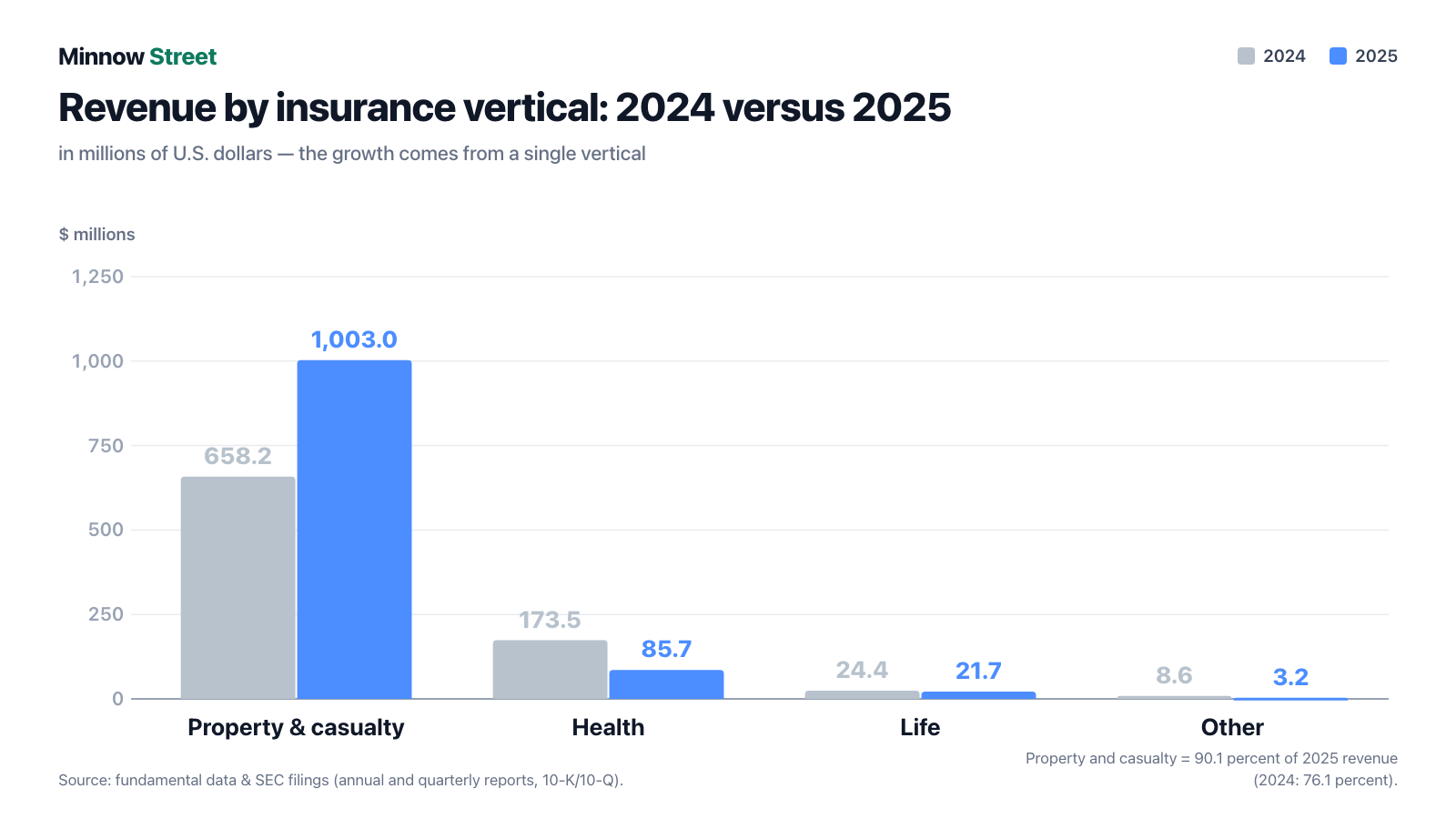
This is a one-legged stance. $1,003.0 million of the $1,113.6 million in revenue comes from property and casualty insurance — in practice, mostly auto. Health insurance halved from $173.5 million to $85.7 million, life shrank from $24.4 million to $21.7 million, "other" from $8.6 million to $3.2 million. The company names the risk plainly in its own report: auto insurance is a cyclical business in which carriers can change their customer acquisition budgets "rapidly and without warning". That is exactly what they did from 2021 through 2023.
And the first quarter of 2026? Revenue rose 17.3 percent to $310.0 million, income from operations went from $0.1 million to $22.4 million, and net income from minus $2.3 million to plus $14.0 million — $0.21 per share. That is a good quarter. It is also a quarter in which cash fell from $46.9 million to $26.1 million, because share repurchases ($20.3 million) and a TRA payment ($7.0 million) had to be funded.
What the filings say — the uncomfortable truths
Uncomfortable truth No. 1: the 2025 profit came from the tax line, not from the business
Read the 2025 income statement top to bottom and you see what happened. Revenue $1,113.6 million. After all costs, income from operations of $22.1 million — markedly less than the $42.7 million of the prior year, even though revenue grew by nearly $250 million. The reason: general and administrative expense jumped from $56.4 million to $89.6 million (including a $38.0 million reserve for the FTC matter), plus a $13.4 million write-off of intangible assets.
Then the line below: other expense, net: $121.9 million. Plus $11.2 million of interest. Result: a pre-tax loss of $111.1 million. And then, at the very bottom, an income tax benefit of $137.8 million — not an expense, a benefit. That is what produces the reported net income of $26.8 million.
Where the tax benefit comes from is visible on the balance sheet: as of December 31, 2025, the line "Deferred tax assets" appears for the first time, at $149.7 million; a year earlier it was empty. A deferred tax asset, translated into everyday terms, is a voucher at the tax office: you may offset it against future profits — but only if you make future profits. In 2025 MediaAlpha concluded that enough future profit is coming and recognized the voucher. That is permitted, it was audited (auditor: PricewaterhouseCoopers LLP, engaged since 2017, unqualified opinion and no going concern paragraph), and it is still an assumption about the future rather than money earned.
Readers who know this pattern will recognize it from 3D Systems, where the 2025 annual profit came from selling subsidiaries while the business itself burned cash. The underlying rule is simple: a profit that appears one line below a pre-tax loss is a booking, not a business result.
Uncomfortable truth No. 2: right after the bank debt comes a debt to the company's own pre-IPO owners
What caused the $121.9 million of "other expense"? $124.1 million of it came from a single item: the increase in the liability under the Tax Receivables Agreement (TRA). This construct dates from the 2020 IPO, and it is worth understanding, because it explains half the balance sheet.
MediaAlpha, Inc. is a holding company that does nothing itself. The operating business sits in subsidiary QL Holdings LLC. At the IPO, the founders, private equity investor Insignia and insurance group White Mountains retained part of their stake at that subsidiary level. When they exchange those units for shares, MediaAlpha gets a step-up in tax basis — and with it, future tax savings. The TRA settles who owns those savings: 85 percent go to the pre-IPO owners, not to public shareholders.
"Pursuant to the tax receivables agreement, we are required to pay Insignia and the Senior Executives 85% of the amount of the cash savings, if any, in U.S. federal, state and local income tax that we realize (or are deemed to realize) as a result of these possible increases in tax basis as well as certain other tax benefits attributable to payments under the tax receivables agreement itself."
— MediaAlpha, Inc., annual report 10-K for 2025, Item 1A Risk Factors, filed with the SEC on February 23, 2026
As long as MediaAlpha was posting losses, this stayed theoretical. In 2025 it became real: because the company concluded it would generate enough taxable income going forward, it had to classify the payments as probable and record a liability. Result: $131.1 million of TRA liability as of December 31, 2025 — up from $7.0 million a year earlier. That $124.1 million increase is precisely what consumed the operating result. The voucher at the tax office and the debt to the pre-IPO owners are two sides of the same booking.
As of March 31, 2026, the TRA liability stood at $123.4 million. And then came the most interesting transaction of the year: on June 25, 2026, MediaAlpha bought back Insignia's share of that claim — for $31.0 million in cash, against an estimated value of $68.7 million. A discount of $37.7 million, or 55 percent. The company estimates the remaining liability at roughly $55.0 million as of June 30, 2026.
For MediaAlpha that is a good deal. It is also a price signal: a professional pre-IPO owner, on board since 2020, prefers 45 cents now over 100 cents later. That cuts both ways — and it is the point at which this company resembles Fidelity National Financial, where the vault is full but the money in it belongs to others: part of what MediaAlpha earns in the future is already contractually spoken for.
Uncomfortable truth No. 3: two customers, 49 percent — and the buy side is tightening fast
Customer concentration is normal for marketplaces, but the magnitude here is considerable. The largest Demand Partner accounted for 25 percent of revenue in 2025 (2024: 23 percent), the second largest for 24 percent (2024: 18 percent). Together, roughly half. The notes put a precise figure on it: two customers above the ten percent threshold, together $540 million, or 49 percent of revenue (2024: two customers, $358 million, 41 percent). The 20 largest customers cover 82 percent, up from 72 percent a year earlier. The concentration risk has grown, not shrunk.
"Our largest Demand Partner represented 25% and 23% of our revenue for the years ended December 31, 2025 and 2024, respectively, and our next largest Demand Partner represented 24% and 18% of revenue for the years ended December 31, 2025 and 2024, respectively."
— MediaAlpha, Inc., annual report 10-K for 2025, Item 1A Risk Factors, filed with the SEC on February 23, 2026

The underrated side is purchasing. In 2024, one supplier crossed the ten percent threshold at $75 million, or 11 percent of purchases. In 2025 there were two, together at $236 million, or 25 percent. For a marketplace that is the more dangerous number: customers can be replaced as long as the goods are there — if the goods are missing, the best customer does not help. And the contracts offer little support. The filing states that most agreements contain no minimum volume commitments and that many partners can terminate without cause on 30 or 60 days' notice. If a neighbor told you his shop was thriving, but two customers produced half the revenue and could walk away in four weeks, would you not swallow hard for a second?
Uncomfortable truth No. 4: $45 million for a settlement with the Federal Trade Commission
On February 21, 2023, MediaAlpha received a civil investigative demand from the Federal Trade Commission. In October 2024 the FTC staff said it was prepared to recommend a complaint: the company had allegedly represented itself as affiliated with government entities, made misleading claims about health insurance products and about its use of consumers' personal information, and used deceptive advertising. Agreement was reached on July 3, 2025, and the court entered the consent order on October 16, 2025.
"Under the terms of the Consent Order, the Company agreed to pay $45.0 million as monetary relief, of which $33.5 million was paid in October 2025 and the remaining $11.5 million was paid in January 2026."
— MediaAlpha, Inc., annual report 10-K for 2025, Item 1A Risk Factors and notes, filed with the SEC on February 23, 2026
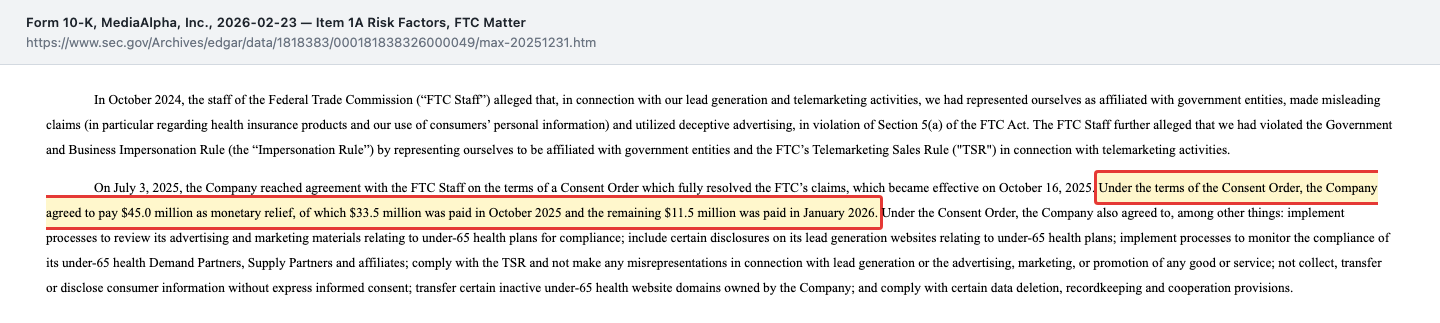
The settlement contains no admission of wrongdoing. More consequential than the money are the injunctive terms: MediaAlpha must review advertising for under-65 health plans for compliance, add disclosures on its lead generation websites, monitor its partners in that space, share consumer information only with express informed consent, and transfer certain inactive domains. The consequence is in the filing too: partners in that sub-vertical declined to comply or were terminated; volume in the under-65 health sub-vertical fell by $79 million in 2025, and the company expects the impact to continue "for the foreseeable future". That is the honest price: not $45 million once, but $45 million plus a permanently smaller business line.
Uncomfortable truth No. 5: the metric the company used to show its scale is no longer reported
Transaction Value — the total gross dollars transacted on the platform — was MediaAlpha's headline number for years: $2.16 billion in 2025, up 44.5 percent, almost twice reported revenue. In the quarterly report as of March 31, 2026 it appears one final time, in the form of its own abolition.
"Effective with the first quarter of 2026, we have discontinued reporting of Transaction Value to simplify our reporting structure."
— MediaAlpha, Inc., quarterly report 10-Q as of March 31, 2026, Item 2 MD&A, filed with the SEC on April 29, 2026

The stated reason is reasonable enough: revenue, contribution and adjusted earnings are said to be the more relevant measures. But Transaction Value did something those cannot — it made the Open versus Private Marketplace mix visible from the outside. And that mix is precisely why contribution margin fell from 17.9 to 15.8 percent in 2025. We are not claiming anything is being hidden. We are noting a fact: the metric that let you test the quality of the growth is gone — in the very year it started to become inconvenient.
Uncomfortable truth No. 6: the business starts with a search query — and search is changing
At the very beginning of MediaAlpha's value chain stands a person typing "compare car insurance" into a search engine. Without that person there is no prospect, no click, no revenue. The company names the risk in its annual report itself, and considerably more concretely than the usual boilerplate.
"Internet search engines may incorporate artificial intelligence into their platforms in ways that we cannot predict, and AI-based platforms may increasingly compete with such search engines. Such changes may adversely impact the volume and price of Consumer Referrals."
— MediaAlpha, Inc., annual report 10-K for 2025, Item 1A Risk Factors, filed with the SEC on February 23, 2026
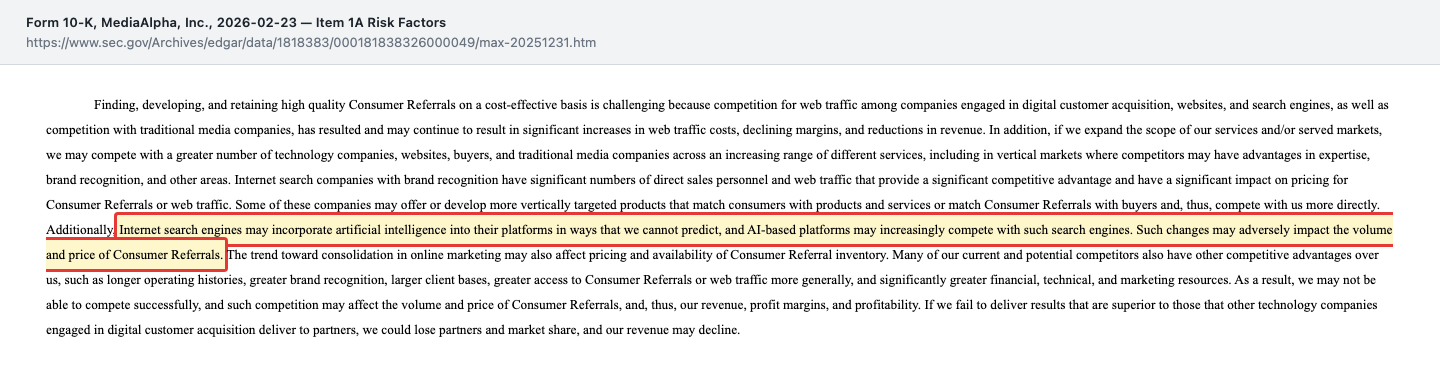
Elsewhere the filing is even more direct: changes in the usage and functioning of search engines, or a decline in consumer use of search engines, "for example, as a result of the continued development of artificial intelligence technology", could hurt its own and its third-party publishers' websites. At the same time, MediaAlpha uses artificial intelligence and machine learning inside its own platform, including large language models. That is the familiar double role: a tool on the inside, a threat from the outside. In our AI classification we therefore list MediaAlpha as "threatened" — AI is not a revenue source here, but it is a specifically named risk to the inflow the whole model depends on.
Valuation: what the market pays for a marketplace on a 15 percent margin
First, some clearing up, because two common metrics are useless here. The trailing price-to-earnings ratio is worthless, because the 2025 profit came from the tax line. And price-to-book is meaningless too: with negative equity there is no sensible book value per share.
What remains is order of magnitude. The most recent mandatory filing that states a share count is the Form 144 sale notice of July 16, 2026: 54,062,155 Class A shares outstanding (as of March 31, 2026 it was 54.6 million). Add 8.3 million Class B units exchangeable one-for-one into Class A and you get roughly 62.4 million economic units. Two dated price anchors come from mandatory filings: $12.95, the last reported sale price as of December 31, 2025 cited in the annual report, and $13.71 to $14.33 — the reported average prices at which a board member actually sold on July 20, 21 and 22, 2026, per the Form 4 filed July 22, 2026. That puts the market capitalization of the Class A shares in the range of $0.7 to $0.8 billion, and around $0.8 to $0.9 billion for all economic units.
Measured against trailing twelve-month revenue of roughly $1.16 billion, that is a price-to-sales ratio below 1. It sounds dirt cheap — and it is the downspout illusion in metric form. Measure the marketplace by its gross profit ($167.5 million for 2025) and you land at about five times; add net debt ($163.5 million of borrowings against $26.1 million of cash as of March 31, 2026) plus the remaining TRA liability of roughly $55.0 million, and enterprise value comes to roughly $1.0 to $1.1 billion — about nine times the 2025 adjusted operating result of $113.7 million. That is not a fire-sale price; it is a normal price for a cyclical referral business.
The professionals' view, expressly an outside opinion: eight analyst firms carry the stock with a consensus score of 4.1 on a scale to 5 (5 being best) and an average price target of $13.83 (data as of July 27, 2026). The consensus estimate for 2026 earnings per share is $1.29 — against the $13.71 to $14.33 band above, roughly eleven times. That is the bet: that 2026 finally produces a profit that does not come from the tax office.
And a signal from inside the house: a share repurchase program has been running since October 28, 2025, increased on February 18, 2026 from $50.0 million to $100.0 million. Through March 31, 2026, 3,173,374 shares had been bought back for $34.6 million. A company buying its own shares believes they are undervalued — though for a company with negative equity and $163.5 million of debt, it is also a decision against paying that debt down.
Opportunities and risks at a glance
What speaks for MediaAlpha:
- A real network effect, with evidence. 99 percent of the volume transacted in 2025 came from partners already in place in 2024; 16 of the 20 largest U.S. auto insurers use the platform. Switching costs here come from data integration, not from contracts.
- Extreme operating leverage. 147 full-time employees handled $2.16 billion of volume in 2025. Capital expenditures: $0.3 million. If volume rises, costs barely follow.
- Real cash generation. Operating cash flow rose three years running: $20.2 million (2023), $45.9 million (2024), $65.6 million (2025). That is cash, not accounting profit.
- Cleaned-up financing. On March 25, 2026, the old facility was replaced by a new $150.0 million term loan maturing March 25, 2031, plus a $60.0 million revolving facility. The interest rate was 5.97 percent as of March 31, 2026, and there is no near-term maturity wall.
- The TRA buyback. Purchasing Insignia's share on June 25, 2026 for $31.0 million removes a liability previously carried at $68.7 million — a 55 percent discount.
What speaks against it:
- One leg carries everything. 90.1 percent of 2025 revenue came from property and casualty insurance, in practice auto — a decidedly cyclical market that once already cost the company 40 percent of its revenue between 2021 and 2023.
- Negative equity. Minus $29.1 million as of March 31, 2026, reported as "Total stockholders' deficit"; 52.1 percent of total assets consist of deferred tax assets ($143.7 million) and goodwill ($47.7 million).
- The 2025 profit is not a business result. Pre-tax loss $111.1 million, income tax benefit $137.8 million. If the assumption of future profits fails, the effect reverses.
- Double concentration. Two customers equal 49 percent of revenue, two suppliers equal 25 percent of purchases (after 11 percent a year earlier), and many contracts are terminable on 30 or 60 days' notice.
- Regulation stays expensive. The FTC settlement cost $45.0 million and, lastingly, a smaller health insurance business (volume down $79 million in 2025).
- Less transparency. The headline metric Transaction Value disappears from the first quarter of 2026.
A human conclusion
Back to the rain barrel. The cloudburst was real, the downspout roared all day, and the amount that came off the roof is impressive. At MediaAlpha that amount is $1,113.6 million. Of that, $167.5 million stays as gross profit. Of that, after administration, sales and product development, $22.1 million stays as income from operations. And of that, after interest and the provision for the pre-IPO owners, nothing stays — instead there is a pre-tax loss of $111.1 million. The reported profit arrived one line later, out of a tax voucher.
This is not an accusation. A marketplace on a 15 percent gross margin is a legitimate business, and this one produces real money: $65.6 million of operating cash flow in 2025, with 147 people and virtually no capital spending. It is a serious company with a genuine network effect. It is also a company whose balance sheet is half accounting values, whose revenue depends 90 percent on a single cyclical market, and whose pre-IPO owners were willing to sell their claim on future profits at a 55 percent discount.
The downspout illusion is not stupidity, it is convenience: the big number is at the top and easy to remember, the small one is at the bottom and takes work. Anyone investing here should know they are not betting on $1.1 billion of revenue, but on two questions. Does the auto insurance cycle stay friendly? And does 2026 produce a profit that comes from the business rather than from a tax booking? Both answers will be in the next quarterly report, not in a forum. What you make of that is your decision. And that is exactly as it should be.
Sources
Every original document used in this analysis — for you to read yourself:
- MediaAlpha, Inc. — SEC annual report 10-K for 2025 (filed February 23, 2026)
- MediaAlpha, Inc. — SEC quarterly report 10-Q as of March 31, 2026 (filed April 29, 2026) — most recent periodic report
- MediaAlpha, Inc. — SEC annual report 10-K for 2024 (filed February 24, 2025) and 10-K for 2022 (February 27, 2023) — source of the 2021 and 2022 comparatives
- MediaAlpha, Inc. — SEC current report 8-K of June 29, 2026 (Item 1.01: buyback of Insignia's interest in the Tax Receivables Agreement)
- MediaAlpha, Inc. — SEC current report 8-K of May 18, 2026 (Item 5.02: appointment of Lauren StClair to the board) and 8-K of April 29, 2026 (Item 2.02: quarterly results)
- White Mountains Insurance Group, Ltd. — Schedule 13D/A (Amendment 6) of May 1, 2026, event date April 29, 2026: 17,856,614 shares, 33.03 percent of Class A
- MediaAlpha, Inc. — Form 144 of July 16, 2026 (notice of proposed sale of 28,000 shares, aggregate market value $406,000; 54,062,155 shares outstanding)
- MediaAlpha, Inc. — Form 4 insider filing of July 22, 2026 (sales on July 20, 21 and 22, 2026 at $13.71 to $14.33 per share) — the most recent price documented in a mandatory filing
- MediaAlpha's complete SEC filing history: EDGAR overview (sec.gov)
- Fundamental data (metrics, market capitalization, valuation, analyst consensus; data as of July 27, 2026), reconciled with the SEC filings. Where they diverge, the filing governs throughout this analysis.
- Hook: review of the most-discussed U.S. stocks in the large Reddit investing forums, as of July 27, 2026 — expressly an attention signal, not a quality judgment.
Transparency & disclaimer: This analysis is a journalistic contextualization of publicly available information and is not investment advice, not a financial analysis in the regulatory sense, and not a solicitation to buy or sell securities. Stock investments carry substantial risks up to total loss. All information without guarantee; the data cut-off is noted in the text in each case. The author holds no position in MediaAlpha stock at the time of publication.
Our Bottom Line at a Glance
- Business model and leverage positive
- A genuine marketplace with a documented network effect: $2.16 billion of volume ran across the platform in 2025, 99 percent of it from partners already in place in 2024, and 16 of the 20 largest U.S. auto insurers are Demand Partners. All of it moved by 147 full-time employees with capital expenditures of $0.3 million (annual report 10-K for 2025).
- Quality of earnings negative
- The reported 2025 net income of $26.8 million only appears below a pre-tax loss of $111.1 million — created by an income tax benefit of $137.8 million from releasing a valuation allowance on deferred tax assets. Income from operations fell from $42.7 million to $22.1 million despite revenue growth of 28.8 percent, weighed down by a $38.0 million FTC reserve and a $13.4 million write-off (10-K for 2025).
- Balance sheet and substance negative
- As of March 31, 2026, total assets of $367.7 million stood against total liabilities of $396.8 million; the quarterly report labels the line, verbatim, "Total stockholders' deficit", at minus $29.1 million. 52.1 percent of the asset side consists of deferred tax assets ($143.7 million) and goodwill ($47.7 million); cash was $26.1 million against $163.5 million of borrowings.
- Cash generation and financing positive
- Operating cash flow rose three years running to $65.6 million (2025; 2024: $45.9; 2023: $20.2). On March 25, 2026, financing was restructured: a $150.0 million term loan maturing March 25, 2031, a $60.0 million revolving facility, and an interest rate of 5.97 percent as of March 31, 2026 — no near-term maturity wall (10-Q as of March 31, 2026).
- Concentration and cyclicality negative
- 90.1 percent of 2025 revenue came from property and casualty insurance, in practice auto — a market whose advertising budgets once already cost the company 40 percent of its revenue between 2021 and 2023. Add two customers at 49 percent of revenue and two suppliers at 25 percent of purchases after 11 percent a year earlier; many contracts are terminable on 30 or 60 days' notice (10-K for 2025, Item 1A and notes).
- Claims of the pre-IPO owners neutral
- Under the 2020 Tax Receivables Agreement, 85 percent of future tax savings go to the pre-IPO owners; the liability rose by $124.1 million to $131.1 million in 2025. On the relief side: on June 25, 2026, MediaAlpha repurchased the Insignia interest for $31.0 million — 55 percent below its own $68.7 million carrying estimate — and puts the remaining liability at roughly $55.0 million as of June 30, 2026 (8-K of June 29, 2026).
MediaAlpha is a working marketplace with a genuine network effect, extreme operating leverage and $65.6 million of operating cash flow in 2025 — produced by 147 employees. But the chain does not end where the big number sits: $1,113.6 million of revenue left $167.5 million of gross profit, of which $22.1 million was income from operations, after which the increase in the debt owed to its own pre-IPO owners produced a pre-tax loss of $111.1 million. The reported profit of $26.8 million arrived one line later, from a $137.8 million income tax benefit. Add 90.1 percent of revenue from one cyclical vertical, 49 percent from two customers, a $45.0 million FTC settlement, and a headline metric that stops being reported in 2026. Not investment advice.
What Our Rating Means
Substance risk
We found at least one documented issue that threatens the company itself — regardless of how the stock is currently valued.
This rating judges the company, not the share price — and one red criterion is hard evidence: equity was negative at minus $29.1 million as of March 31, 2026; the quarterly report labels the line, verbatim, "Total stockholders' deficit", and it was negative as of December 31, 2025 too (minus $29.2 million). The composition of the asset side reinforces it: $143.7 million of deferred tax assets and $47.7 million of goodwill make up 52.1 percent of total assets. That deferred tax asset is the counterpart of the very $137.8 million tax benefit that turned a $111.1 million pre-tax loss into a 2025 profit — if the valuation allowance had to be re-established, equity would move toward minus $170 million on paper, with nothing changing in the business. Plenty stands on the other side: no going concern paragraph, an unqualified opinion from PricewaterhouseCoopers (engaged since 2017), $65.6 million of operating cash flow in 2025 and rising, financing secured to 2031 at 5.97 percent, and a first quarter of 2026 with $22.4 million of income from operations. The stock may look inexpensive against those numbers — that is a price argument and changes nothing about the substance. Under the tie-break rule, the more cautious level applies: red.
A journalistic assessment by our editorial team at the time of the deep dive, based on public sources — not investment advice and not a solicitation to buy or sell. Your personal circumstances (investment goals, risk capacity, taxes) cannot be taken into account. What our levels mean, how verdicts are formed, and what conflicts of interest exist →
Worth Noting
- MediaAlpha reached our research list through a review of the most-discussed U.S. stocks in the large Reddit investing forums, as of July 27, 2026. That is an attention signal, not a quality judgment — the analysis itself rests exclusively on the mandatory filings with the U.S. securities regulator, the SEC.
- Currency of the data: the most recent periodic report is the quarterly report 10-Q as of March 31, 2026 (filed April 29, 2026). It was followed by four 8-K filings (April 29, quarterly results; May 6, annual meeting results; May 18, a board appointment; June 29, 2026, the TRA buyback), a Schedule 13D/A (May 1, 2026) and ongoing insider filings (Form 4/Form 144, most recently July 22, 2026). The TRA buyback of June 25, 2026 is incorporated; the share count comes from the Form 144 notice of July 16, 2026 (54,062,155 Class A shares) and the most recent documented price from the Form 4 of July 22, 2026.
- Not to be confused: the ticker MAX belongs to MediaAlpha, Inc. — not MaxLinear (MXL) and not Max Financial Services. "Contribution" and "adjusted EBITDA" are company-defined measures outside U.S. GAAP and are not identical to audited figures. Valuation statements are evergreen: the only price anchors used are those documented in mandatory filings ($12.95 as of December 31, 2025 per the 10-K; $13.71 to $14.33 for insider sales of July 20 to 22, 2026 per Form 4), never daily quotes.
Frequently Asked Questions
MediaAlpha, Inc. (NYSE: MAX) of Los Angeles runs an online marketplace for insurance shoppers. Comparison sites, financial websites and carriers supply clicks, calls and contact details of people shopping for insurance; carriers, brokers and agencies buy those prospects in real time. In 2025 the platform handled $2.16 billion of volume, which produced $1,113.6 million of revenue — generated by 147 full-time employees.
Because it did not come from the business. Income from operations was $22.1 million in 2025; after $121.9 million of other expense — mostly a $124.1 million increase in the Tax Receivables Agreement liability — and $11.2 million of interest, the pre-tax result was a loss of $111.1 million. Only an income tax benefit of $137.8 million from releasing a valuation allowance turned that into net income of $26.8 million.
An agreement from the 2020 IPO. When the pre-IPO owners — private equity investor Insignia, senior executives and White Mountains — exchange their units in subsidiary QL Holdings for shares, MediaAlpha gains a tax benefit. It must pay 85 percent of the resulting tax savings to those pre-IPO owners. The recorded liability was $131.1 million as of December 31, 2025 and $123.4 million as of March 31, 2026.
To remove a long-running liability cheaply. On June 25, 2026, MediaAlpha repurchased private equity investor Insignia's claim for $31.0 million in cash even though it was valued at $68.7 million as of March 31, 2026 — a discount of $37.7 million, or 55 percent. The company estimates the remaining TRA liability at roughly $55.0 million as of June 30, 2026. The purchase was funded from cash on hand and the secured revolving credit facility (8-K of June 29, 2026).
Heavily. In 2025 the largest Demand Partner accounted for 25 percent of revenue and the second largest for 24 percent; together, two customers represented $540 million, or 49 percent of revenue. The 20 largest customers covered 82 percent, up from 72 percent a year earlier. On the buy side, concentration rose from one supplier at 11 percent of purchases (2024) to two suppliers at 25 percent (2025). Many contracts are terminable on 30 or 60 days' notice.
$45.0 million, paid in two installments: $33.5 million in October 2025 and $11.5 million in January 2026. The settlement with the Federal Trade Commission was entered by the court on October 16, 2025 and contains no admission of wrongdoing. More expensive than the money are the injunctive terms for the under-65 health insurance business: volume there fell by $79 million in 2025, and MediaAlpha expects that impact to continue.
In the quarterly report as of March 31, 2026 the company says it has discontinued reporting of Transaction Value to simplify its reporting structure, and that revenue, contribution and adjusted earnings are the more relevant metrics. For investors it removes the only figure that made the mix between the higher-margin Open Marketplace and the lower-margin Private Marketplace visible from outside — $2.16 billion of volume in 2025.
On revenue yes, on earnings not particularly. With roughly 62.4 million economic units and price anchors of $12.95 (December 31, 2025, per the annual report) and $13.71 to $14.33 (insider sales of July 20 to 22, 2026, per Form 4), the price-to-sales ratio is below 1 — but revenue in this business model is largely throughput. Measured against the 2025 adjusted operating result of $113.7 million, you pay roughly nine times.
Found an error?
Did you spot a factual error, an outdated number, or a typo in this deep dive? Let us know briefly — your report goes straight to the editorial team.