3D Systems: The 2025 Profit Came From Selling Subsidiaries — the Business Itself Burned $87.8 Million
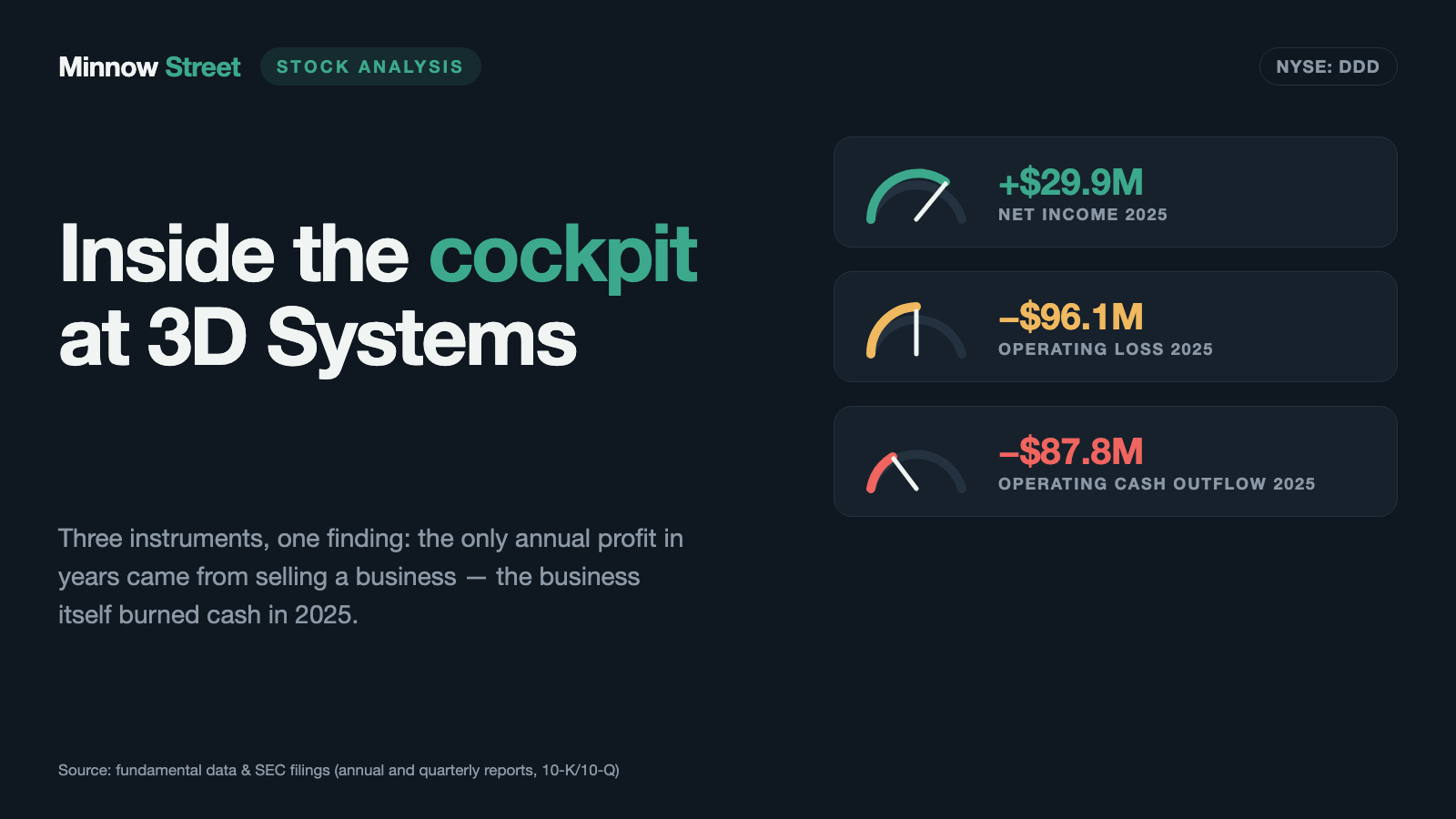
3D Systems invented industrial 3D printing and has been listed since 1990. For 2025 the company reported its first annual profit in years: $29.9 million. The same income statement shows a $96.1 million operating loss and a $139.6 million gain from selling the software units. Operations consumed $87.8 million in cash. On May 14, 2026 shareholders doubled authorized capital to 440 million shares; three weeks later the company sold 16.4 million new shares at $3.05 — 15.5 percent below the market price printed on the same prospectus cover. For 2025 the auditor declined to certify internal control over financial reporting. Not investment advice — just the arithmetic of who ends up paying for the new shares.
 Thomas Mücke
Founder & Publisher
Thomas Mücke
Founder & Publisher
Chart
Interactive price chart (TradingView).
Note: pure fact-based analysis, not investment advice and not a solicitation to buy or sell. All figures without guarantee.
There is an investing trap that catches the thrifty — the people who pride themselves on never chasing hype. Call it the bargain reflex. It works like this: you screen for low price-to-earnings ratios because you learned that cheap stocks win over time. And then a well-known company shows up with a P/E of 5.8 (data as of July 27, 2026). Five point eight! Your brain finishes the sentence for you: "the market forgot about this one." 3D Systems (NYSE: DDD) of Rock Hill, South Carolina, is exactly that kind of stock. The company invented industrial 3D printing, it has been listed since November 5, 1990, and its trailing twelve-month earnings per share stand at $0.44. So let us make a deal: before you buy that P/E, we read together where the profit came from. The basis is the annual report (Form 10-K) for 2025, filed March 9, 2026, the quarterly report (Form 10-Q) as of March 31, 2026, filed May 11, 2026, and the capital-markets documents from June 2026. A filing with the U.S. securities regulator, the SEC, is honest under penalty of law. And this one tells a different story than the screen.
What 3D Systems actually does — the inventor who could not keep its own market
3D Systems is the origin cell of an entire industry. Co-founder Charles W. Hull invented stereolithography in the 1980s. Translated into everyday terms: a laser sweeps across a vat of liquid resin and hardens it layer by layer exactly where the part should be. Instead of milling something out of a block, the part is built up out of nothing. Today it is called 3D printing, or additive manufacturing: material is added rather than removed. The company puts it this way in its quarterly report: "We provide comprehensive 3D printing and digital manufacturing solutions, including 3D printers for plastics and metals, materials, software, and services." The money is not only in the machine. The majority of the materials that run through those printers are proprietary. That is the razor-and-blades model — the device opens the door, the consumable pays the pension.
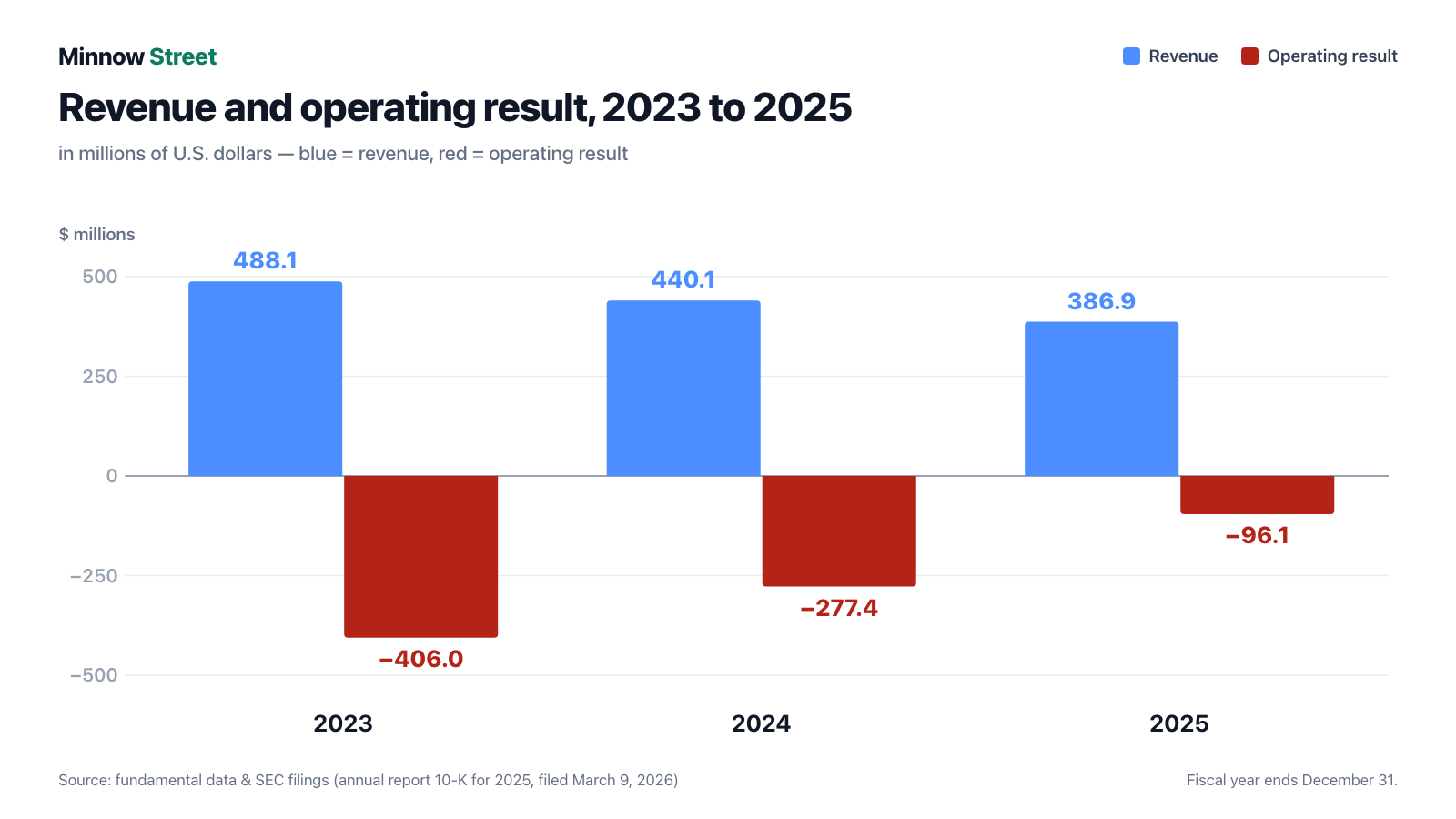
Sales run through two segments. Healthcare Solutions serves dental laboratories, medical devices, personalized health services and regenerative medicine; the segment generated $179.6 million of revenue in 2025. Industrial Solutions serves aerospace, defense, transportation and general manufacturing; that was $207.3 million in 2025. Together, $386.9 million — less than in 2024 ($440.1 million) and far less than in 2023 ($488.1 million). With 1,418 employees as of December 31, 2025, the company is also noticeably smaller than a year earlier, when it had 1,833.
Two divestitures explain part of that shrinkage — and they are the key to everything that follows. On April 1, 2025 3D Systems handed its software unit Geomagic to measurement-technology group Hexagon AB and received $119.4 million in cash. On October 31, 2025 the software businesses 3DXpert and Oqton followed, sold to Hubb Global Holdings for $3.3 million in cash plus a revenue-based royalty receivable with a present value of $7.1 million. That frames the central tension of this analysis, and it runs through every chapter: the company improves its numbers by selling businesses and cutting costs — not by selling more.
How this stock landed on our desk
3D Systems is not a hit from our in-house stock scanner. A live query on July 27, 2026 returned an empty scanner list for the ticker DDD — no momentum filter, no quality filter, no value screen carried the stock that day. The lists are recalculated daily, so that can change. The stock arrived by two other routes.
First, through the stream of mandatory SEC filings. In early summer 2026 that stream showed a conspicuous chain: a confidential shelf registration on April 17, a doubling of authorized capital on May 14, effectiveness of the registration on May 27 — and on June 3 the placement of 16.4 million new shares. When a company assembles the complete toolkit for an equity raise in seven weeks and then uses it, the balance sheet deserves a look.
Second, through the very metric from the opening. A P/E of 5.8 at a company that in the same data set carries an operating margin of minus 6.7 percent (both as of July 27, 2026) is a contradiction that wants resolving. Metrics are summaries — and a summary is only as good as what it leaves out. Remember the pattern right at the start: a profit that does not come from the business still shows up in the P/E. A much larger company where this looks almost identical is covered in our PTC analysis: there, $462.6 million of $590.7 million in quarterly profit came from a sale.
The numbers over the years — given honest credit
Start with what genuinely impresses, because there is more of it than the headline suggests. The operating loss at 3D Systems has shrunk by more than three quarters in two years: from $406.0 million in 2023 through $277.4 million in 2024 to $96.1 million in 2025. A large share of that was write-downs on goodwill and fixed assets — $302.8 million in 2023 and $145.0 million in 2024, against just $0.8 million in 2025. Such impairments are accounting entries, not cash outflows; the fact that they have dried up is still good news, because it means the balance sheet has largely been cleaned.
The first quarter of 2026 extends that line, and impressively so. Revenue came in at $95.5 million, up 1.1 percent from the prior-year quarter — after three years of decline, at least a stabilization. Gross margin rose from 34.6 percent to 35.9 percent. Healthcare Solutions grew 21.3 percent to $50.1 million, with segment gross profit up 39.1 percent. And the net loss shrank from $37.0 million to $4.4 million — roughly one ninth. As of March 31, 2026 the company held $85.1 million in cash, $234.3 million of equity and $513.1 million of total assets. It is neither illiquid nor over-indebted.
One legacy item is also finally closed. Over violations of U.S. export control law, 3D Systems agreed in February 2023 to pay $15.0 million in civil penalties to the Department of Justice and two agencies, plus a $10.0 million suspended penalty that had to be spent on compliance measures. On February 20, 2026 the responsible agency notified the company that it had closed the settlement agreement because all required terms were met. One construction site fewer.
What the filings say — the uncomfortable truths
Uncomfortable truth No. 1: the 2025 annual profit is a sale price
Now to the resolution of the P/E puzzle. The 2025 income statement contains a line that did not exist in prior years: "gain on disposition" — $139.6 million. That is the book gain from selling the software units, $125.7 million of it from Geomagic alone. Subtract the $96.1 million operating loss and $14.9 million of income tax from that amount, add the remaining financial items — interest, currency effects, equity method results — and what remains at the bottom is the reported $29.9 million of net income. Without the sale there would have been a loss of a magnitude similar to 2024.
The toughest cross-check is always the cash account, because cash cannot be booked, only counted. And the 2025 cash flow statement says operations consumed $87.8 million — after $44.9 million in 2024 and $80.7 million in 2023. The one year with a reported profit was also the year with the largest cash outflow of the three. Cash and cash equivalents fell accordingly from $171.3 million to $95.6 million: in came $122.7 million from asset and business sales and $92.0 million from the new convertible note; out went $170.0 million of debt repayment, $15.0 million of share repurchases and $9.9 million of capital expenditure. Remember this sentence — it holds far beyond 3D Systems: a profit that empties the cash account is not a profit, it is a reclassification.
Uncomfortable truth No. 2: the savings program reaches into research
The fact that the quarterly loss shrank from $37.0 million to $4.4 million is almost entirely a cost story. Revenue rose by $1.0 million; selling, general and administrative expense fell by $18.4 million, or 37.0 percent, and research and development expense fell by $10.0 million, or 51.0 percent — from $19.7 million to $9.6 million in the quarter. Across the full year 2025, research fell from $86.5 million to $65.0 million.
A supplier of consumables for an installed base can do that for a while. For a technology vendor competing against much larger manufacturing-automation players, halved research is a bet on the future — just pointed the other way. For contrast, our Teradyne analysis shows what a company looks like that keeps investing in its own technology through a cyclical industrial market. On top of that, headcount fell 22.6 percent from 1,833 to 1,418. And part of the first-quarter 2026 improvement did not come from operations at all, but from lines below the operating result: a $2.6 million book gain arose because the company’s stake in the NAMI joint venture was diluted from 49 percent to 34.3 percent when another investor came in, and a further $2.6 million was foreign exchange gains. Without those two items the quarterly loss would be roughly twice as large.
Uncomfortable truth No. 3: the share count grows faster than the business
Dilution means your slice of the cake gets smaller because new slices keep being cut — the cake itself does not grow from that. At 3D Systems the process runs in clearly dated steps.
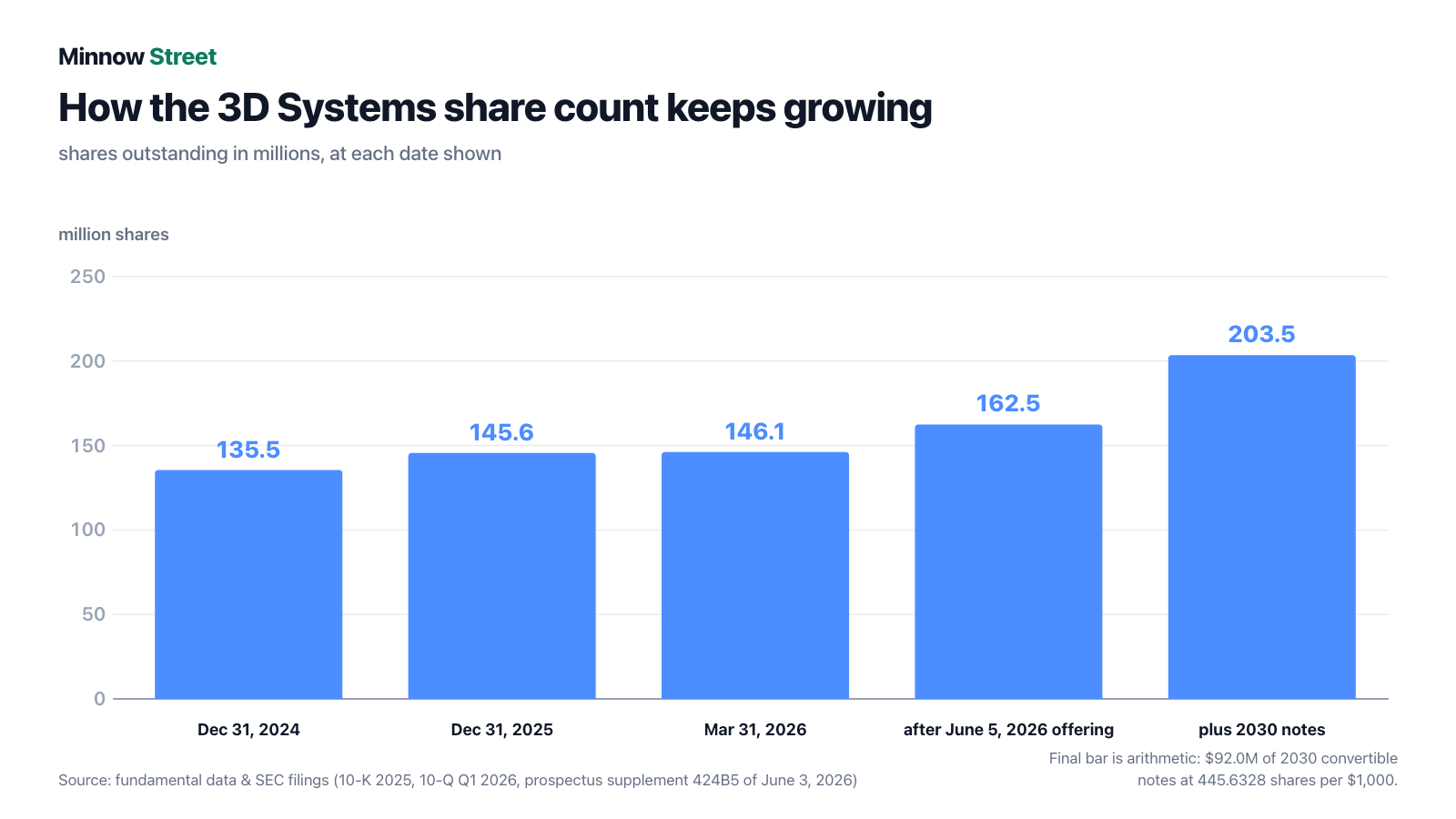
Step one ran in December 2025: the company exchanged $30.8 million principal of its old zero-coupon convertible note for 16.6 million new shares — debt gone, shares up. Step two was the annual meeting on May 14, 2026, where shareholders doubled authorized common stock from 220 million to 440 million shares; the same package added 4.0 million shares to the employee incentive plan. Step three followed on June 3, 2026. The prospectus supplement is hard to beat for plainness:
"We are offering 16,393,443 shares of our common stock, par value $0.001 per share ("common stock"). The public offering price is $3.05 per share. Our common stock trades on the New York Stock Exchange (the "NYSE") under the symbol "DDD." On June 3, 2026, the last reported sale price of our common stock on the NYSE was $3.61 per share."
— 3D Systems Corporation, SEC prospectus supplement 424B5 of June 5, 2026, cover page

Net proceeds were about $46.2 million; the underwriters additionally hold a 30-day option on a further 2,459,016 shares. And step four is still pending: the 2030 convertible note issued in June 2025, $92.0 million at 5.875 percent interest, carries a conversion price of roughly $2.24 — 445.6328 shares per $1,000 of principal. Fully converted, that would arithmetically create another 41.0 million shares. The company has already shown how heavy that effect is: for 2025 the basic share count was 129.2 million, the diluted count 175.5 million. Of the old zero-coupon note, originally $460.0 million, only $3.9 million remains, maturing November 15, 2026; its $35.92 conversion price is history from another era.
Uncomfortable truth No. 4: two customers, more than a quarter of revenue
Customer concentration is the kind of risk you only feel once it arrives. Picture a neighbor telling you enthusiastically about his business — and then you learn that two customers account for more than a quarter of his revenue. You would swallow hard. That is exactly where 3D Systems stands.

Across the full year 2025 it was 12.2 percent and 11.4 percent, so 23.6 percent; one of those customers alone stood at 16.0 percent in 2024 and 15.0 percent in 2023. The company flags the risk in its annual report and adds the credit exposure, because a significant portion of receivables may sit with those two customers. One more concentration deserves attention: revenue in Asia Pacific fell in the first quarter of 2026 from $9.2 million to $4.1 million — down 55 percent — while U.S. revenue rose. The business is not only getting smaller, it is getting narrower.
Uncomfortable truth No. 5: the auditor declines to certify internal control
This truth is the heaviest, because it touches every other number. U.S. companies must have their internal control over financial reporting audited annually — think of it as the roadworthiness test for the path a number travels from an invoice into the annual report. As of December 31, 2025 that test was failed. Deloitte & Touche LLP writes in its opinion:
"In our opinion, because of the effect of the material weaknesses identified below on the achievement of the objectives of the control criteria, the Company has not maintained effective internal control over financial reporting as of December 31, 2025."
— Deloitte & Touche LLP on 3D Systems Corporation, SEC annual report 10-K for 2025, Report of Independent Registered Public Accounting Firm on Internal Control over Financial Reporting

The report names both weaknesses precisely: controls were not designed and maintained within the revenue process — specifically around determining standalone selling price and allocating the transaction price to separate performance obligations — nor over the accounting treatment of market-based stock compensation awards. Management stresses that the financial statements are nonetheless fairly stated; the consolidated financial statements themselves received an unqualified opinion. But this is the sequel in a series: earlier weaknesses in valuing long-lived assets, in the financial reporting and close process and in technical accounting matters were partly remediated in 2025, but not fully. And the context makes it heavier: since April 15, 2022 the SEC has been running a formal investigation into the company; it took testimony from the former chief accounting officer in January 2025 and from the former chief financial officer in March 2025. A securities class action has been pending in Delaware since June 13, 2025, alongside eight shareholder derivative suits that are stayed until the class action is resolved. Since March 23, 2026 the company again has a permanent finance chief — Phyllis Nordstrom, previously chief people and administrative officer, who had held the role on an interim basis since August 2025.
Uncomfortable truth No. 6: the debt is small, but it has a ripcord
On paper the debt looks harmless: $96.0 million of principal as of March 31, 2026, of which $92.0 million is the 2030 convertible note and $3.9 million the remnant of the old zero-coupon note. Against $85.1 million of cash that nets out. The catch sits in the fine print. The 2030 note is senior secured — it reaches into essentially all assets of the U.S. subsidiaries — and it carries financial covenants. The quarterly report puts it plainly: the company must maintain at least $20.0 million of qualified cash at all times, plus a minimum of $75.0 million in accounts receivable and inventory; breach either threshold and the note can be accelerated.
How that threshold came about is worth noting. Originally the note required $40.0 million of qualified cash plus a restricted cash account of $16.8 million. In December 2025 3D Systems negotiated a second supplemental indenture that halved the threshold to $20.0 million and released the restricted account — in exchange for cash payments of roughly $1.8 million to the noteholders. A company that pays its creditors to loosen a liquidity covenant is saying something about its own view of liquidity. The $46.2 million from the June placement creates room here — which is why this truth ranks sixth rather than first.
Uncomfortable truth No. 7: two claims that appear in no balance sheet line
The last truth is not on the balance sheet but in the notes — where companies must disclose obligations that are not yet obligations. When 3D Systems acquired bioprinting company Volumetric in 2021, earnout payments of up to $355.0 million were agreed, tied to seven science-based milestones. Four were terminated in February 2024 after a research partner stopped funding; the remaining three, worth $175.0 million, lapsed in the company’s view when two key employees resigned on April 29, 2024. The former shareholders disagree and demand the full $355.0 million.

The reserve against that dispute is $1.8 million — the settlement offer of August 21, 2024, which the other side has never answered; the company has reported "no further developments" since January 10, 2025. For scale: equity stood at $234.3 million as of March 31, 2026. The second claim is smaller but dated: a lawsuit 3D Systems itself filed in 2021 against five former employees and their company Intrepid Automation was dismissed by the court in March 2025 — while the counterclaim seeking in excess of $20 million was allowed to proceed, with trial scheduled to begin July 27, 2026 according to the quarterly report. Neither is a reserve that comes due tomorrow. But both are lines that have to be re-read in every new filing.
Valuation — what the market pays for the inventor
Because a market capitalization from a data feed and a price documented in a prospectus differ by more than a fifth as of July 27, 2026, we anchor the valuation exclusively on figures evidenced in the filings. After the offering, 162,450,658 shares were outstanding. At the $3.05 offering price that equals a market value of roughly $495 million; at the $3.61 last reported sale price documented on that same June 3, 2026, roughly $586 million. Measured against 2025 revenue of $386.9 million, that is a price-to-sales ratio of about 1.3 to 1.5. For a supplier with a 33.9 percent gross margin (2025) and shrinking revenue, that is neither expensive nor cheap — it is the price of an open question.
The 5.8 P/E from the opening dissolves accordingly. It rests on trailing twelve-month earnings per share of $0.44 (data as of July 27, 2026), and that profit consists of the 2025 disposal gain plus the fact that the weak first quarter of 2025 has dropped out of the window. For the current and the coming year, analysts expect losses per share again. That is not a metric, it is a shadow.
The professionals are correspondingly reserved: of four covering firms, one rates the stock a buy and three a hold, none a sell; the average price target is $4.00 (data as of July 27, 2026). One more figure from the prospectus itself for context: net tangible book value per share stood at $1.39 as of March 31, 2026. Anyone buying today pays a multiple of tangible substance for the hope that saving turns back into growing.
Opportunities and risks at a glance
What speaks for 3D Systems:
- The operating loss has more than quartered in two years, from $406.0 million to $96.1 million; in the first quarter of 2026 it was only $6.6 million.
- Healthcare Solutions is growing again: revenue up 21.3 percent and gross profit up 39.1 percent in the first quarter of 2026 against the prior-year quarter.
- The balance sheet holds: $85.1 million of cash, $234.3 million of equity and only $96.0 million of financial debt as of March 31, 2026, plus roughly $46.2 million of fresh capital from the June 2026 placement.
- The cleanup is well advanced: only $0.8 million of impairments in 2025 after $145.0 million the year before; the export compliance settlement with U.S. agencies was closed on February 20, 2026.
- A high share of proprietary materials produces recurring revenue from an installed base built over more than 35 years.
What speaks against it:
- Revenue has been falling for years: $488.1 million (2023), $440.1 million (2024), $386.9 million (2025) — and the only reported annual profit came from a sale, not from the business.
- Operations consumed $87.8 million of cash in 2025, more than in either of the two prior years.
- The turnaround cuts into substance: research halved in the first quarter of 2026 (down 51.0 percent), headcount down 22.6 percent to 1,418 within a year.
- Dilution on several levels: authorized capital doubled to 440 million shares on May 14, 2026, 16.4 million new shares placed at a 15.5 percent discount, and an arithmetic 41.0 million more from the 2030 convertible note at $2.24.
- The auditor declined to certify internal control over financial reporting as of December 31, 2025; in parallel, a formal SEC investigation has run since April 2022, a securities class action since June 2025, plus eight shareholder derivative suits.
- Concentration risk: two customers at 17.4 percent and 10.0 percent of consolidated revenue in the first quarter of 2026; Asia Pacific revenue collapsed 55 percent in the same quarter.
- Open legacy items in the notes: a claim of up to $355.0 million from the Volumetric acquisition against which only $1.8 million is reserved, plus a counterclaim in excess of $20 million whose trial was set to begin July 27, 2026.
A human conclusion
Back to the bargain reflex from the opening. A P/E of 5.8 brought you here — and the filings showed that behind that number sits not a forgotten company but a one-time sale price. That is the real lesson, and it is worth more than any opinion about 3D Systems: a screen can tell you where to look. It cannot tell you what you are seeing.
So what about the company? There is an honest turnaround story here. A business that lost more than $400 million at the operating line in 2023 now loses less than seven in a quarter. That is real work, not cosmetics. Except: the work has so far been paid for out of substance — by selling the software division, by halving research, by every fifth job, and by 16.4 million new shares at a price the company’s own bankers had to set 15.5 percent below the market so that someone would take them. A company can shrink itself back to health. It can also cut itself to death. Which of the two is happening here will not be decided on the cost line but by whether revenue grows again — the first-quarter 2026 stabilization was a first sign, but a single quarter is not a trend.
Anyone buying the stock is buying three things at once: the installed base of an inventor, a turnaround with visible progress — and an SEC case file alongside an auditor who considers the company’s controls ineffective. What you make of that is your decision. And that is exactly as it should be.
Sources
- 3D Systems Corporation — SEC annual report 10-K for 2025 (filed March 9, 2026)
- 3D Systems Corporation — SEC quarterly report 10-Q as of March 31, 2026 (filed May 11, 2026)
- 3D Systems Corporation — SEC prospectus supplement 424B5 for the equity offering (filed June 5, 2026)
- 3D Systems Corporation — SEC Form 8-K of June 5, 2026, Item 1.01 (underwriting agreement for the offering)
- 3D Systems Corporation — SEC Form 8-K of May 15, 2026, Items 5.02/5.03/5.07 (annual meeting, doubling of authorized capital)
- 3D Systems Corporation — SEC Form 8-K of March 26, 2026, Item 5.02 (appointment of the chief financial officer)
- 3D Systems Corporation — SEC annual report 10-K for 2024 (filed March 27, 2025, comparative figures)
- Complete SEC filing history of 3D Systems Corporation: EDGAR overview (sec.gov)
- Fundamental data (metrics, analyst picture, valuation; data as of July 27, 2026), reconciled against the SEC filings.
Transparency & disclaimer: This analysis is journalistic commentary on publicly available information. It is not investment advice, not a regulated financial analysis and not a solicitation to buy or sell securities. Equity investments carry substantial risk up to and including total loss. All information without warranty; the data cut-off is noted throughout the text. The author holds no position in 3D Systems shares at the time of publication.
Our Bottom Line at a Glance
- Quality of earnings negative
- The only annual profit in years — $29.9 million for 2025 — rests on a "gain on disposition" line of $139.6 million from selling the software units. The operating result was negative $96.1 million and operations consumed $87.8 million of cash, more than in 2024 ($44.9 million) or 2023 ($80.7 million).
- Turnaround progress positive
- The operating loss shrank from $406.0 million (2023) through $277.4 million (2024) to $96.1 million (2025), and to $6.6 million in the first quarter of 2026; the net loss in that quarter fell from $37.0 million to $4.4 million. Gross margin rose to 35.9 percent and Healthcare Solutions grew 21.3 percent to $50.1 million (each Q1 2026 versus the prior-year quarter).
- Price of the progress negative
- The improvement was paid for out of substance: research halved to $9.6 million in the first quarter of 2026 (down 51.0 percent), selling and administrative expense cut 37.0 percent, headcount down 22.6 percent to 1,418 within a year, and the software division sold. On top of that, $2.6 million of the quarterly result came from a dilution book gain at the NAMI joint venture and $2.6 million from currency effects.
- Dilution & financing negative
- On May 14, 2026 shareholders doubled authorized capital to 440 million shares; on June 3, 2026 the company placed 16,393,443 new shares at $3.05 — 15.5 percent below the $3.61 price stated on the same prospectus. Shares outstanding rose to 162,450,658, and the 2030 convertible note at $2.24 could arithmetically create another 41.0 million.
- Governance & controls negative
- Deloitte & Touche declined to certify internal control over financial reporting as of December 31, 2025; two material weaknesses persist, one of them in the revenue process. A formal SEC investigation has run since April 15, 2022, a securities class action since June 13, 2025, alongside eight stayed shareholder derivative suits.
- Balance sheet & liquidity neutral
- As of March 31, 2026, $85.1 million of cash and $234.3 million of equity faced only $96.0 million of financial debt, with roughly $46.2 million of net proceeds arriving in June 2026. The 2030 note covenant — at least $20.0 million of qualified cash — was halved from $40.0 million in December 2025 in exchange for $1.8 million paid to the noteholders.
At 3D Systems a low price-to-earnings ratio and a loss-making business sit in the same data set — because the reported 2025 net income of $29.9 million comes from a $139.6 million book gain on sold software units, while the business lost $96.1 million at the operating line and burned $87.8 million of cash. The turnaround progress is real (an operating loss of just $6.6 million in the first quarter of 2026) but it was paid for with halved research, 22.6 percent fewer employees and 16.4 million new shares at a 15.5 percent discount. On top of that sits an auditor who considers internal control over financial reporting ineffective as of December 31, 2025. Not investment advice.
Worth Noting
- 3D Systems did not reach our research list through a scanner hit — a live query on July 27, 2026 returned an empty scanner list for the ticker DDD, and those lists are recalculated daily. The hooks were the chain of capital measures in the EDGAR stream (confidential shelf registration on April 17, doubling of authorized capital on May 14, offering on June 3, 2026) and the contradiction between a 5.8 price-to-earnings ratio and an operating margin of minus 6.7 percent (data as of July 27, 2026).
- Valuation is deliberately anchored on the filings rather than on the data feed: 162,450,658 shares after the offering, valued at the $3.05 offering price and at the $3.61 documented market price (both June 3, 2026), give roughly $495 million to $586 million of market value. The market capitalization from fundamental data deviates from that by more than a fifth and is therefore not used as an anchor here; the share count itself matches the filings.
- Easy to confuse: the "gain on disposition" line of $139.6 million appears only in 2025 and stems from the sale of Geomagic (to Hexagon AB) plus 3DXpert and Oqton (to Hubb Global Holdings) — it is not recurring income. Trailing earnings per share of $0.44, on which the low P/E rests, therefore cannot be extrapolated; analyst estimates for the current and the coming year are negative.
Frequently Asked Questions
3D Systems Corporation (NYSE: DDD) of Rock Hill, South Carolina, builds 3D printers for plastics and metals, supplies the matching — mostly proprietary — materials and provides maintenance, manufacturing and applications engineering services. Revenue splits into two segments: Healthcare Solutions (dental, medical devices, regenerative medicine) with $179.6 million in 2025 and Industrial Solutions (aerospace, defense, transportation, general manufacturing) with $207.3 million. Co-founder Charles W. Hull invented stereolithography, the original form of industrial 3D printing.
Because the profit came from divestitures. The 2025 income statement carries a "gain on disposition" line of $139.6 million — the book gain from selling the software units Geomagic (to Hexagon AB, $119.4 million in cash, closed April 1, 2025) plus 3DXpert and Oqton (to Hubb Global Holdings, October 31, 2025). The operating result was negative $96.1 million. After tax, $29.9 million of net income remained. Operations consumed $87.8 million of cash in the same year.
In several steps. As of March 31, 2026 there were 146,057,215 shares outstanding. On May 14, 2026 shareholders doubled authorized common stock from 220 million to 440 million shares. On June 3, 2026 the company sold 16,393,443 new shares at $3.05 — 15.5 percent below the $3.61 price stated on the same prospectus cover; afterwards 162,450,658 shares were outstanding. The 2030 convertible note of $92.0 million could arithmetically create another 41.0 million shares at its $2.24 conversion price.
Deloitte & Touche LLP concluded that as of December 31, 2025 the company had not maintained effective internal control over financial reporting. Two material weaknesses are named: missing controls in the revenue process around standalone selling price and allocation of the transaction price, and in the accounting for market-based stock compensation awards. The consolidated financial statements themselves received an unqualified opinion. In parallel, the U.S. securities regulator, the SEC, has run a formal investigation since April 15, 2022.
As of March 31, 2026 the books showed $96.0 million of principal: $92.0 million from the senior secured 2030 convertible note at 5.875 percent interest and $3.9 million from the remnant of the old zero-coupon note maturing November 15, 2026. The 2030 note requires at least $20.0 million of qualified cash plus a minimum of $75.0 million in accounts receivable and inventory. The cash threshold was originally $40.0 million; in December 2025 it was halved in exchange for roughly $1.8 million paid to the noteholders.
Considerably. In the first quarter of 2026 two customers within the Healthcare Solutions segment accounted for 17.4 percent and 10.0 percent of consolidated revenue — together more than a quarter. Across the full year 2025 it was 12.2 percent and 11.4 percent; one of those customers alone stood at 16.0 percent in 2024 and 15.0 percent in 2023. The annual report explicitly flags the associated credit risk on receivables.
The low price-to-earnings ratio of 5.8 (data as of July 27, 2026) rests on trailing earnings that came from selling subsidiaries; analysts expect losses per share again for the current and the coming year. The price-to-sales ratio is more reliable: with 162,450,658 shares after the offering, the $3.05 offering price implies roughly $495 million of market value and the $3.61 price documented on June 3, 2026 roughly $586 million — that is 1.3 to 1.5 times 2025 revenue of $386.9 million. Net tangible book value per share was $1.39 as of March 31, 2026.
In the first quarter of 2026 revenue rose slightly for the first time in a while: up 1.1 percent to $95.5 million, carried by Healthcare Solutions at plus 21.3 percent to $50.1 million. Industrial Solutions fell 14.7 percent to $45.4 million, partly because of the divestitures and weak jewelry demand; Asia Pacific revenue dropped from $9.2 million to $4.1 million. Across the full year 2025 revenue fell 12.1 percent. One quarter is therefore not yet a trend.
Found an error?
Did you spot a factual error, an outdated number, or a typo in this deep dive? Let us know briefly — your report goes straight to the editorial team.