Medallion Financial: Why This Stock's Cheapest Number Is the Wrong One
On paper Medallion Financial looks like a bargain: the market capitalization equals 1.7 times operating cash flow and 57 percent of book value. Except that at a lender this number measures the interest margin before the losses are paid — and the losses are the real story here: a $89.8 million credit loss provision in 2025 against $37.8 million in 2023. Add a corporate history with edges: the taxi lending business that gave the company its name accounts for less than 0.2 percent of the balance sheet, and in 2025 the U.S. securities regulator closed a case against the company and the man who is now its chief executive. Not a recommendation — just the question of what is left of an interest margin once the losses are paid.
 Thomas Mücke
Founder & Publisher
Thomas Mücke
Founder & Publisher
Chart
Interactive price chart (TradingView).
Note: pure fact-based analysis, not investment advice and not a solicitation to buy or sell. All figures without guarantee.
There is a reflex almost all of us know: we see a strikingly low number and take it for a find. Call it the bargain trap — not the error of thinking numbers lie, but the error of thinking a number always means the same thing. A market capitalization at 1.7 times cash flow means something entirely different at a software house than it does at a bank. Medallion Financial Corp. (NASDAQ: MFIN) is the textbook case, so instead of avoiding it we will work it through: we read the annual report (10-K) for 2025, the quarterly report (10-Q) as of March 31, 2026, and every current report filed since.
The central tension of this analysis runs through every chapter: one of the cheapest numbers in our entire U.S. universe happens, here, to measure the one thing that says nothing about a lender's earnings — and behind it sits a company whose figures are better than its reputation and whose reputation is worse than its figures.
Contents
- What Medallion Financial actually does
- How the stock landed on our desk — and what the number really measures
- The numbers over the years — given their due
- What the filings say — five uncomfortable truths
- What happened after the last quarterly report
- Valuation: what you get for your money
- Opportunities and risks at a glance
- A human conclusion
- Sources
What Medallion Financial actually does — and why the name misleads
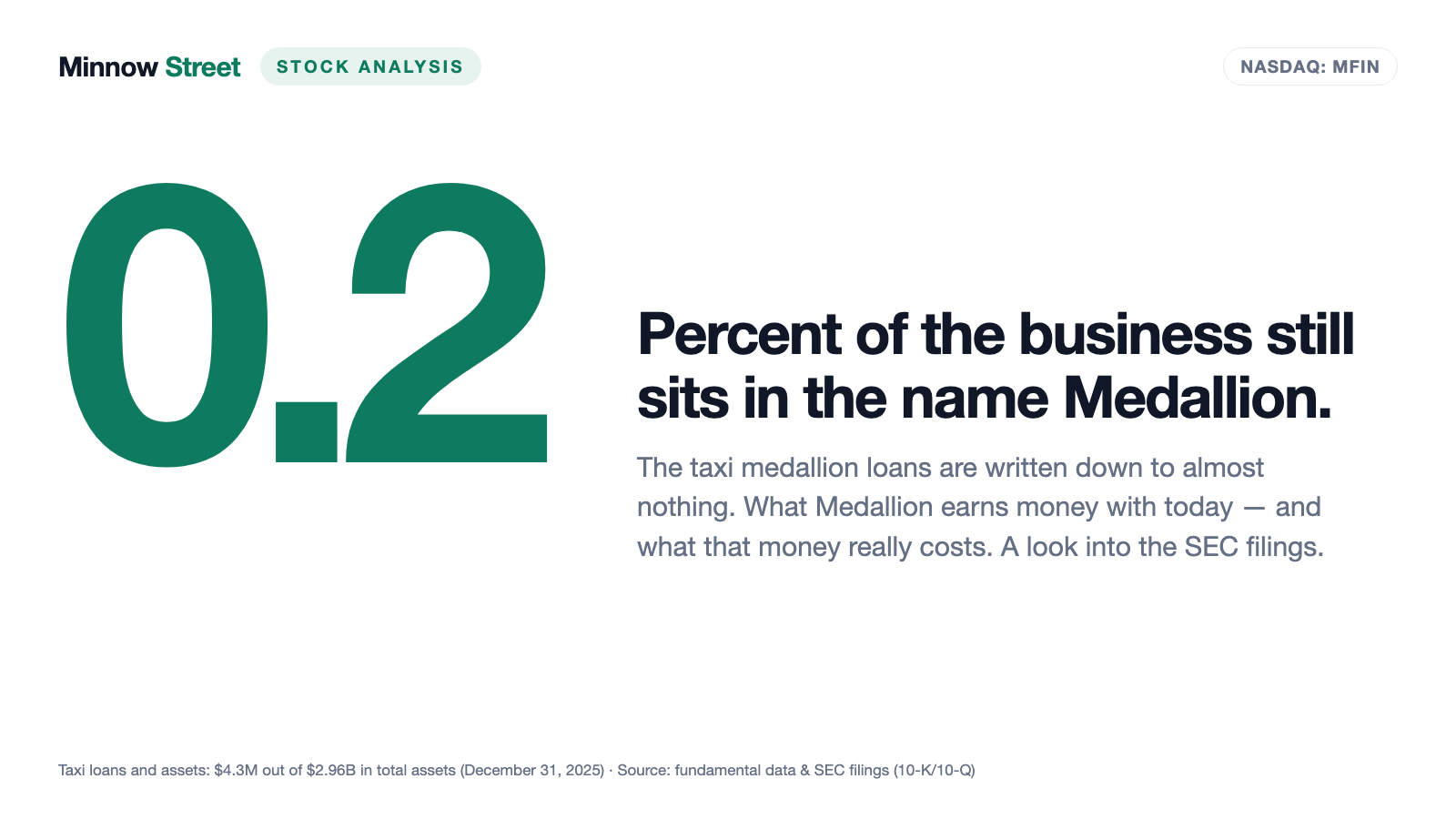
The name tells a story that no longer exists. A "medallion" is the New York taxi licence, the only plate that permits picking up street hails in Manhattan. Medallion Financial, public since 1996 and listed under the ticker TAXI until 2016, spent decades financing the purchase of those licences. When ride-hailing arrived, the market value of the medallions collapsed, and with it the collateral behind the loans.
How little of that is left now sits in two lines of the annual report.

What earns the money today comes from four segments. Recreation lending (motorhomes, boats, collector cars) accounts for $1,617.2 million or roughly 63 percent of the loan book and delivers 66 percent of interest income; Medallion works with about 3,400 dealers and financial service providers to source it. Home improvement lending — windows, roofs, siding, swimming pools — stands at $810.2 million or 32 percent; here it is roughly 700 contractors, and the business is usually written in the customer's living room when the contractor presents a bid with financing attached. Add commercial mezzanine lending through the subsidiary Medallion Capital ($123.1 million) and the taxi remnant ($1.2 million). All figures as of December 31, 2025.
The decisive structural fact: Medallion owns a bank in Utah, Medallion Bank, and funds itself largely through its deposits — $2,128.6 million as of March 31, 2026, or 72 percent of total assets. That is why the spread is so wide: you borrow at deposit rates and lend at consumer credit rates. Remember: a lender with its own bank earns on the difference between two interest rates — and loses on the share of loans that never comes back. More on both shortly.
A fifth, young leg is worth knowing because it shows up in none of the usual metrics: the strategic partnership business. Medallion originates loans for partners and sells them on immediately — $771.6 million of originations in 2025 after $203.6 million in 2024, with only $15.1 million held on its own balance sheet. The earnings come from program fees ($3.6 million in 2025). Volume is growing fast; the profit contribution is still small.
How the stock landed on our desk — and what the number really measures
Medallion reached our research list through our in-house stock scanner Price to Free Cash Flow Ranking. The scanner sorts stocks by how many years of free cash flow are priced into the market capitalization. To repeat it: open the scanner, set the market filter to the United States, look at the "market capitalization / free cash flow" column.
As of July 27, 2026 the scanner lists 545 hits in the U.S. selection — identical on both of our brands. Medallion appears there at a multiple of 1.73, in position 31. For context on the distribution: 18 names trade below a multiple of 1, another 19 between 1 and 2, 27 between 2 and 3 — and 385 of the 545 hits above 5. Medallion is therefore in the cheapest tenth. Only the 25 strongest names are displayed, however, and at rank 31 Medallion sits just outside the visible list. The stock came from the full hit list.
And now the reckoning that gives this analysis its title. At a lender this number does not measure what you think. Three reasons, in order:
First: the credit provision sits in the numerator. The statement of cash flows starts at profit and adds back every item that cost no money. The provision for credit losses is one of them — $89.8 million in 2025. Against operating cash flow of $126.3 million and income to shareholders of $43.0 million, almost the entire inflow is explained by a single added-back line. So the "cash flow" measures the interest margin before the losses are paid.
Second: the losses are real money anyway. The provision is an estimate; the charge-off is not. In 2025 Medallion charged off $97.2 million of loans and recovered $24.8 million — $72.4 million net, after $63.4 million in 2024. That money is gone. It simply never appears as an outflow in the cash flow statement, because it was never booked as an inflow.
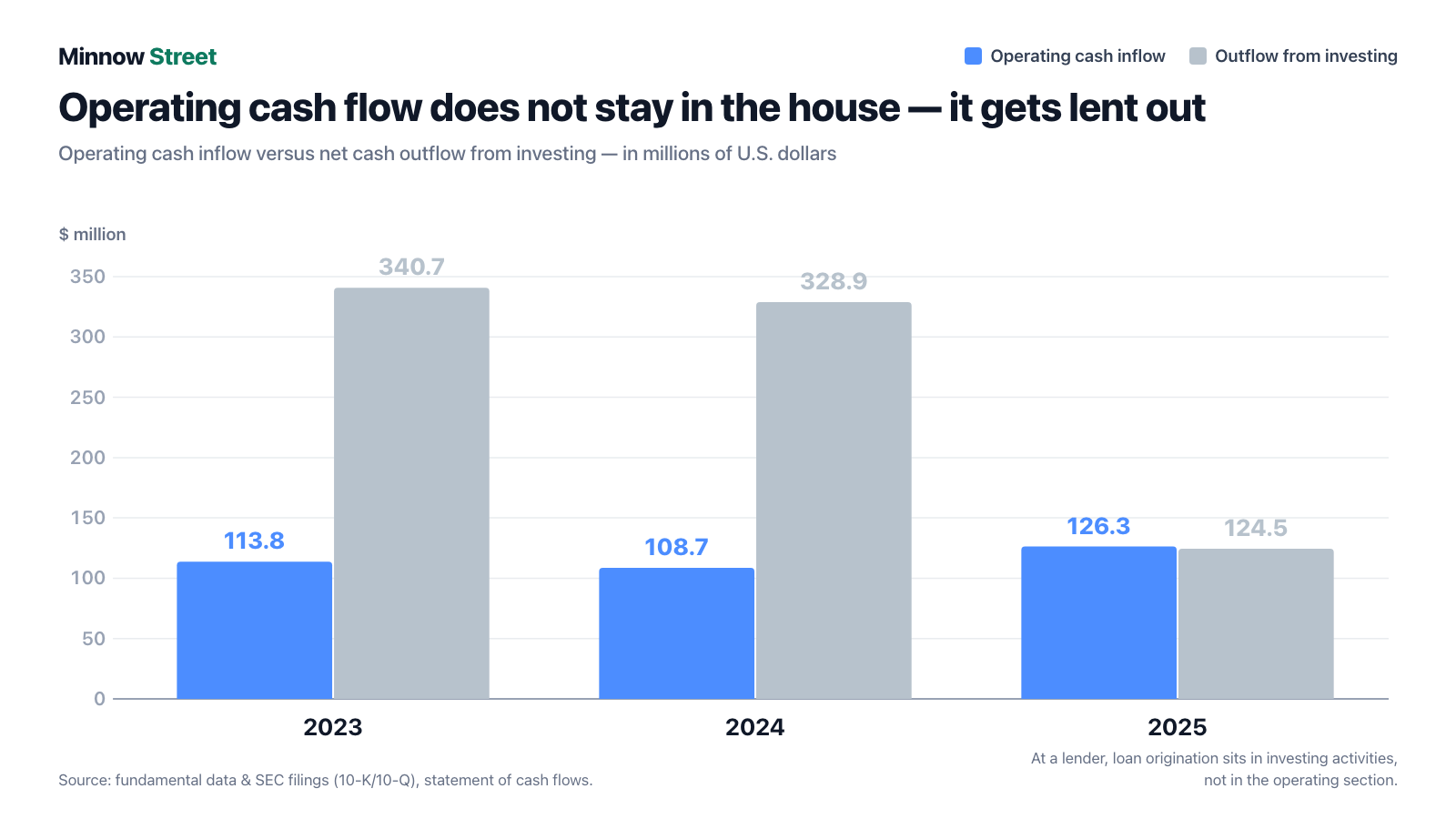
Third: what is left gets lent out, not paid out. At an industrial company free cash flow is what remains after investment. At a lender the investment is the loan — and in the cash flow statement it sits not in the operating section but in investing activities. In 2025, $126.3 million came in from operations and $124.5 million flowed out through investing. In the prior years the gap was far wider: $113.8 million against $340.7 million (2023), $108.7 million against $328.9 million (2024). In the first quarter of 2026, $41.3 million of operating inflow met $212.3 million of new originations; cash fell by $62.9 million over the quarter.
What actually reached shareholders is a much smaller number: $10.972 million of dividends in 2025. Anyone comparing lenders should therefore stay with book value, interest margin and loss rates — the way we worked it through in our OneMain Holdings analysis.
One more word on the Altman Z-score, which stands at −0.76 in our data set and therefore below the distress threshold of 1.1. That formula was not built for a company like Medallion. It was developed for manufacturers and works with current assets, inventories and sales. At a bank, loans outstanding are not current assets and customer deposits are not ordinary liabilities — the formula inevitably reads the normal structure of a bank balance sheet as distress. We therefore do not use it here. Four other numbers do the job at a lender, and we look at them two chapters on: equity ratio, allowance ratio, past-due loans and interest margin.
The numbers over the years — given their due
Start with what is going well, and that is more than this stock's reputation suggests. Interest income rose over three years from $251.0 million (2023) through $290.7 million (2024) to $315.3 million (2025) — up 26 percent. Net interest income, after what Medallion pays for its own money, climbed from $188.1 million through $202.5 million to $216.9 million. That is made possible by a margin most banks only dream of: loans yielded an average of 12.26 percent in 2025 while funding cost 4.22 percent — a net interest margin of 8.06 percent.
The first quarter of 2026 continued along the same track: interest income of $79.1 million (prior-year quarter $75.4 million) and net interest income of $54.1 million after $51.4 million, up 5.1 percent.
Now the other side, and it is the heart of this analysis.
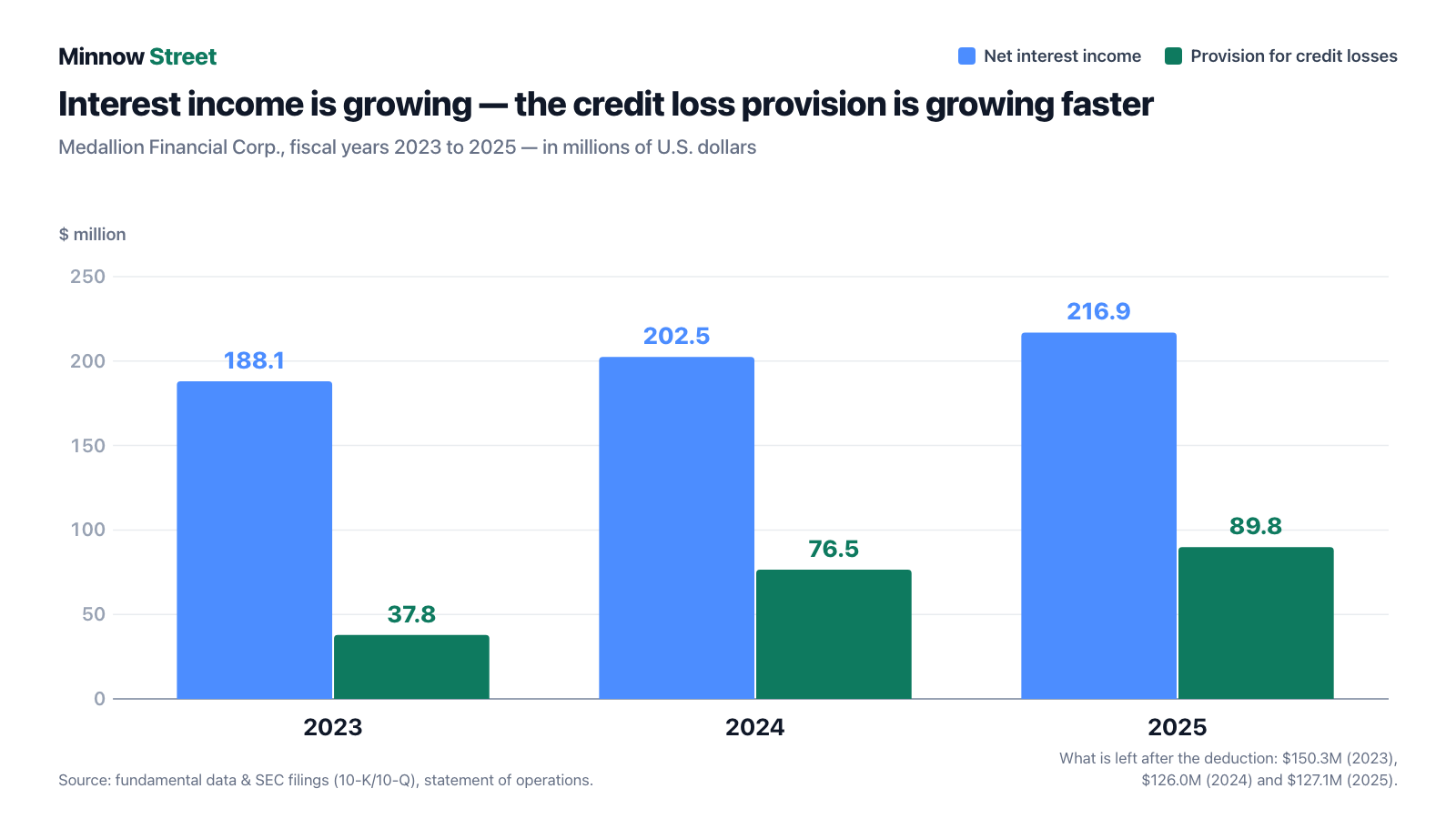
The credit loss provision rose from $37.8 million (2023) through $76.5 million (2024) to $89.8 million (2025). As a share of net interest income: from 20.1 percent to 41.4 percent. And so the bottom line of the lending business is smaller today than three years ago: $150.3 million (2023), $126.0 million (2024), $127.1 million (2025). A quarter less, on a quarter more interest income.
Reported income attributable to shareholders shows the same movement, overlaid with one-off items: $55.1 million (2023), $35.9 million (2024), $43.0 million (2025). The 2025 figure was supported by $24.6 million of gains on equity investments; the 2024 figure was burdened by the $3.0 million SEC penalty. Diluted earnings per share were $2.37, $1.52 and $1.78.
In the first quarter of 2026 income attributable to shareholders fell to $4.953 million from $12.014 million — a 59 percent drop that looks alarming at first glance. The reason is again a one-off: the prior-year quarter contained $9.430 million of gains on equity investments, this quarter only $0.313 million. Strip that item from both quarters and pre-tax income runs at $11.3 million against $10.8 million — up 4.6 percent. The operating business did not collapse; the windfalls simply failed to repeat.
What the filings say — five uncomfortable truths
Uncomfortable truth no. 1: The name is a monument to $171 million written off
The taxi business did not shrink; it was written off. The annual report names the sum.

How the remaining positions are valued is also in the report: Medallion carries a medallion value of $79,500 net of liquidation costs (as of December 31, 2025) and bases that on the prices actually observed by the New York Taxi and Limousine Commission during 2025. Still in foreclosure as of March 31, 2026 were 276 medallions in New York, 186 in Chicago, 22 in Newark and 31 in other markets — 515 in total, carried at $6.4 million as "loan collateral in process of foreclosure." Since 2020 the entire taxi portfolio has been on nonaccrual, so no interest is recognized on it. For you as an investor that means: the taxi piece can barely hurt any more, but it can no longer carry anything either — except as an occasional gain when a medallion sells above carrying value ($4.6 million in 2025, $1.1 million in the first quarter of 2026).
Uncomfortable truth no. 2: Losses are growing faster than the business
This is the number this stock hangs on. From 2023 to 2025 net interest income rose 15 percent — the credit loss provision rose 138 percent. Part of that is growth: a bigger loan book needs a bigger provision. But not all of it. The allowance now stands at 4.48 percent of the entire loan book (March 31, 2026; it was 4.50 percent at year-end 2025). In recreation lending alone it is 5.31 percent, in home improvement 2.41 percent, in commercial lending 7.36 percent (all as of December 31, 2025).
In plain terms: Medallion expects never to see roughly one in every twenty dollars it lends. That is the flip side of an eight percent interest margin — you earn it by serving customers who cannot borrow elsewhere. The average recreation borrower had a FICO score of 686 at origination in 2025, which counts in the United States as solidly mid-tier, not prime.
Uncomfortable truth no. 3: The balance sheet is better than the reputation suggests
Here the analysis falls in the company's favour, and that deserves saying just as plainly. Four numbers that actually describe a lender:
- Equity ratio 13.8 percent — $408.1 million of shareholders' equity against $2,950.5 million of total assets (March 31, 2026). Including the bank subsidiary's preferred stock it is $507.5 million and 17.2 percent. For a bank that is a lot; regulators require a fraction of it.
- Past-due loans 0.8 percent — $20.9 million of loans were more than 90 days past due as of March 31, 2026, after $24.5 million and 1.0 percent at year-end. The ratio fell, it did not rise.
- Allowance coverage 281 percent — the allowance covered nonaccrual loans almost three times over as of December 31, 2025.
- Net interest margin 8.06 percent — essentially unchanged from 8.05 percent in 2024, despite higher funding costs.
One detail worth knowing: of the $20.9 million of past-due loans, $10.3 million sits in an unchanged commercial position — the same figure as of December 31, 2025. A single stuck corporate loan therefore accounts for half of all past-due receivables.
Uncomfortable truth no. 4: The securities regulator pursued the company and the man who is now its chief executive
This part cannot be left out if one wants to be honest. On December 29, 2021 the U.S. Securities and Exchange Commission filed a civil complaint in the U.S. District Court for the Southern District of New York against the company and its President and Chief Operating Officer.
"On December 29, 2021, the SEC filed a civil complaint in the U.S. District Court for the Southern District of New York against the Company and its President and Chief Operating Officer alleging certain violations of the anti-fraud, books and records, internal controls and anti-touting provisions of the federal securities laws. The litigation related to certain issues that occurred during the period 2015 to 2017, including (i) the Company's retention of third parties in 2015 and 2016 concerning posting information about the Company on certain financial websites and (ii) the Company's financial reporting and disclosures concerning certain assets, including Medallion Bank, in 2016 and 2017…"
— Medallion Financial Corp., SEC annual report 10-K for 2025, Note 12 (SEC Litigation)
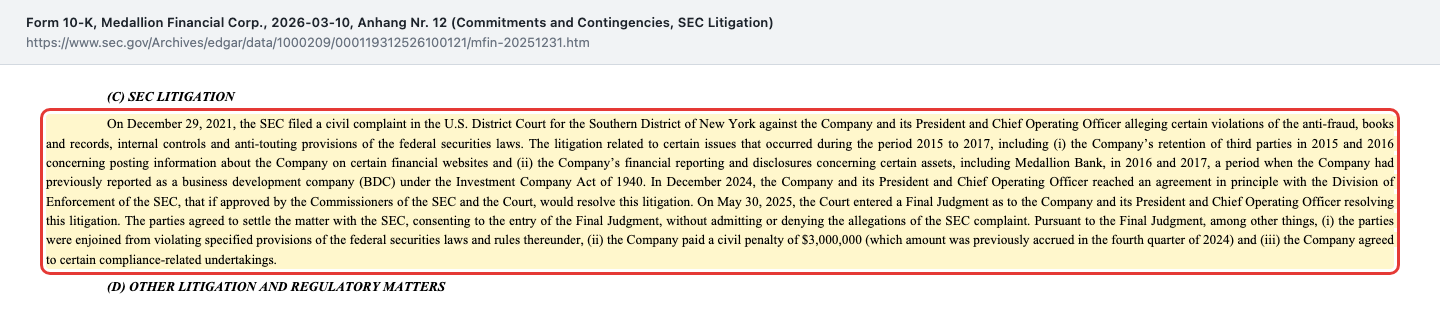
Three points, stated plainly. First: the case is over. The court entered a final judgment on May 30, 2025; the parties consented to it without admitting or denying the allegations. The company paid a $3,000,000 civil penalty, which had already been accrued in the fourth quarter of 2024 and shown there as its own expense line. Second: the allegations concerned conduct from 2015 to 2017 — a period when the company still reported under the rules for business development companies. Third, and this is the piece you have to assemble yourself: the co-defendant President and Chief Operating Officer is Andrew M. Murstein — and he signs both the 2025 annual report and the 2026 quarterly report today as President, Chief Executive Officer and Chief Operating Officer. His father Alvin Murstein is executive chairman of the board. That is not an accusation, but it is a fact that belongs in the judgment when you hand a company your money.
Uncomfortable truth no. 5: Part of the shareholder base does not want this leadership — for the third time running
The annual meeting took place on June 9, 2026, and for the third consecutive year it was a proxy contest: the investor BIMIZCI Fund LLC had again nominated its own board candidates. On the record date of April 13, 2026, 23,864,438 shares were entitled to vote; 17,419,949 shares or 73.0 percent were represented.
The outcome was clear but not unanimous. The company's nominees were elected: John Everets with 14,905,644 votes for and 2,476,122 withheld, Cynthia A. Hallenbeck with 13,199,033 to 4,182,873 and Alvin Murstein with 12,785,454 to 4,596,312. The dissident nominees did not get through — Eric Kelly on 3,384,358 votes, John Kiernan on 4,711,028. What stands out is the spread within the winning slate: for executive chairman Alvin Murstein more than 4.5 million votes were withheld — nearly twice as many as for the best-supported nominee. Translated: roughly a quarter of the votes cast declined to confirm the Murstein family. Investing here means buying a company with an unresolved dispute about its own leadership.
What happened after the last quarterly report
The most recent periodic report is the quarterly report (10-Q) as of March 31, 2026, filed May 5, 2026. Since then, an unusual amount has happened at this company.
- June 3 and June 11, 2026: the U.S. Small Business Administration (SBA) confirmed that a previously declared event of default at the subsidiary Medallion Capital had been cured. Background: on March 31, 2026 — the very day Medallion Capital submitted the required management team — the SBA declared an event of default on the outstanding debentures. $115.25 million was outstanding there as of March 31, 2026.
- June 9, 2026: the annual meeting, with the voting outcome described above.
"Medallion Capital submitted a management team for review through the SBA's licensing division on March 31, 2026 and on the same day, the SBA notified Medallion Capital that it has declared an event of default with respect to outstanding debentures and directed Medallion Capital, within 120 days, to identify and submit at least one qualified candidate for consideration as a full-time principal and investment committee member of Medallion Capital. The SBA's notice and event of default do not trigger any cross-default clauses in any of the Company's debt arrangements."
— Medallion Financial Corp., SEC quarterly report 10-Q as of March 31, 2026, Note 5

- June 11 and June 25, 2026: a leadership change at Medallion Bank. Donald Poulton stepped down as the bank's chief executive effective June 30, 2026 and joined its board; David Justin Haley took over on July 1, 2026 while remaining president of the bank. The compensation committee accelerated the vesting of Poulton's 92,978 unvested restricted shares in full and kept him eligible for an annual bonus.
- Filed June 18, 2026, effective July 1, 2026: a shelf registration for up to $100 million of common stock, preferred stock, debt securities, subscription rights and warrants. That is a supply, not an offering — but a large one against a market capitalization of roughly $233 million.
Valuation: what you get for your money
All figures below are computed by us, using 23,849,967 shares (cover page of the quarterly report, as of May 4, 2026) and a price of $9.77 (data as of July 24, 2026) — market capitalization therefore roughly $233 million. A note on the data: our data set and the common feeds carry about 23.1 million shares and therefore a market capitalization of $226 to $227 million. We use the figure from the filing.
First, book value. Equity attributable to shareholders was $408.1 million as of March 31, 2026 — $17.11 per share. At $9.77 the market therefore pays roughly 57 percent of book value. At a lender that is the central metric, and it is a hard statement: the market does not entirely trust the carrying value of the loan book — or it demands a discount for governance, illiquidity and credit risk.
Second, earnings. Over the last four quarters Medallion earned $36.0 million for its shareholders, or $1.48 per diluted share. That gives a price-to-earnings ratio of 6.6. Handle with care: the prior-year figures contain substantial gains on equity investments that do not recur every year.
Third, the payout. Medallion has paid a dividend again since 2022 and has raised it every year since: $7.5 million (2022), $7.7 million (2023), $9.4 million (2024) and $10.972 million (2025). Annualized that is currently $0.56 per share — a dividend yield of 5.7 percent at a payout ratio of roughly a third. Unlike cash flow, this number is what actually reaches the shareholder.
What we deliberately leave out. We do not quote enterprise value (market capitalization plus debt): at a bank, customer deposits are the raw material of the business, not debt in the usual sense — the metric would read $2.58 billion and explain nothing. Nor do we use the Altman Z-score, for the reasons set out in the scanner chapter. And the Piotroski score, which our data set puts at 6 of 9, is of limited value here because several of its criteria — current ratio, gross margin, asset turnover — carry no sensible meaning on a bank balance sheet.
What the professionals think — and one warning. Exactly two analysts cover this name, with an average price target of $11.00 (data as of July 24, 2026). More important in practice: daily turnover is roughly $0.8 million. That is very little. An order that would pass unnoticed in a large-cap moves the price here. Roughly 31 percent of the shares are held by insiders and 5.0 percent of the float is sold short. Over the twelve months to July 24, 2026 the stock traded between $7.85 and $11.00.
Opportunities and risks at a glance
Opportunities
- The interest margin is exceptional and stable: a 12.26 percent loan yield against 4.22 percent funding costs produced a net interest margin of 8.06 percent in 2025, versus 8.05 percent the year before.
- The stock trades at roughly 57 percent of book value of $17.11 per share (March 31, 2026) and pays a dividend of about 5.7 percent that has risen every year since 2022.
- The balance sheet carries: a 13.8 percent equity ratio (17.2 percent including the bank subsidiary's preferred stock), a 4.48 percent allowance ratio and 281 percent allowance coverage of nonaccrual loans.
- Past-due loans fell rather than rose: 0.8 percent of the loan book as of March 31, 2026, after 1.0 percent at year-end 2025.
- The partnership business grows fast and ties up almost no capital: $771.6 million of originations in 2025 after $203.6 million, with only $15.1 million retained on the balance sheet.
Risks
- The credit loss provision rose 138 percent in three years to $89.8 million while net interest income grew only 15 percent — what remains after the deduction fell from $150.3 million to $127.1 million.
- The business is cyclical and concentrated in two consumer goods: motorhomes, boats and home improvement projects are the first things households cut in a recession.
- The governance question is unresolved: a third consecutive proxy contest, with 4,596,312 votes withheld from the executive chairman.
- A shelf registration effective July 1, 2026 permits the issuance of up to $100 million of securities — 43 percent of the market capitalization, at a price below book value.
- The bank subsidiary's preferred stock costs 9.00 percent through July 2030; the minority interest in profit rose to $8.782 million in 2025 from $6.047 million.
- The name is very illiquid: roughly $0.8 million of daily turnover and just two covering analysts. Getting in and out can be expensive.
A human conclusion
Remember the bargain trap from the opening? Medallion Financial is the rare case where it snaps shut in both directions. The cheap cash-flow multiple that put this stock on our list really does measure the wrong thing — it shows the interest margin before the losses are paid, and those losses have more than doubled in three years. Anyone looking only at that number is buying an illusion.
But the opposite is just as false. This company is no longer a taxi lender; it is a consumer finance company with its own bank, an eight percent interest margin, an equity ratio close to fourteen percent and falling delinquencies — and it trades at 57 percent of book value. The discount is not invented: it pays for an open dispute about governance, a closed but not forgotten regulatory case, a cyclical customer base and a share that on some days barely trades.
What you make of it depends on which of those two sentences you weigh more heavily. Two comparisons worth reading, one for each side: for how a large consumer lender runs on the same mechanics, see our OneMain Holdings analysis. And for how quickly a small auto lender can tip over when losses rise, see our Consumer Portfolio Services analysis.
What you make of it is your decision. And that is exactly how it should be.
Sources
- Annual report 10-K for 2025, Medallion Financial Corp., filed March 10, 2026 (CIK 0001000209)
- Quarterly report 10-Q as of March 31, 2026, filed May 5, 2026
- Current report 8-K dated June 12, 2026 — voting results of the annual meeting of June 9, 2026 (Item 5.07)
- Current report 8-K dated June 12, 2026 — cure of the SBA event of default at Medallion Capital (Item 8.01)
- Current report 8-K dated June 12, 2026 — leadership change at Medallion Bank (Item 5.02)
- Current report 8-K dated June 26, 2026 — compensation decisions on Donald Poulton's departure (Item 5.02)
- Shelf registration Form S-3, filed June 18, 2026, effective July 1, 2026
- Source: fundamental data & SEC filings (annual and quarterly reports, 10-K/10-Q) — metrics, price history and analyst estimates as of July 24, 2026; scanner readings as of July 27, 2026
Journalistic analysis, not investment advice and not a solicitation to buy or sell securities. Share prices can move sharply; a total loss is possible. All figures come from the primary documents linked above and carry the reporting date stated there. The author holds no position in Medallion Financial Corp. at the time of publication.
Our Bottom Line at a Glance
- Earning power of the core business positive
- The interest margin is exceptional and stable: a 12.26 percent loan yield against 4.22 percent funding costs produced a net interest margin of 8.06 percent in 2025, after 8.05 percent the year before. Net interest income rose from $188.1 million (2023) through $202.5 million (2024) to $216.9 million, and gained a further 5.1 percent to $54.1 million in the first quarter of 2026.
- Credit quality negative
- The credit loss provision rose 138 percent in three years to $89.8 million — 41.4 percent of net interest income, against 20.1 percent in 2023. What remains after the deduction fell from $150.3 million to $127.1 million. Actual net charge-offs in 2025 were $72.4 million. On the other side: loans more than 90 days past due fell to 0.8 percent of the book.
- Balance sheet structure positive
- Solid for a lender: $408.1 million of shareholders' equity against $2,950.5 million of total assets (13.8 percent, or 17.2 percent including the bank subsidiary's preferred stock), an allowance equal to 4.48 percent of the loan book, 281 percent allowance coverage of nonaccrual loans, and funding drawn mainly from its own deposits ($2,128.6 million).
- Governance and compliance negative
- The SEC case against the company and its President and Chief Operating Officer ended on May 30, 2025 with a final judgment, injunctions and a $3,000,000 civil penalty — without admitting or denying the allegations. The same executive, Andrew M. Murstein, runs the company today as chief executive. At the annual meeting of June 9, 2026, the third consecutive proxy contest, 4,596,312 votes were withheld from the executive chairman.
- Capital allocation and dilution neutral
- The dividend has risen every year since 2022, most recently to $10.972 million at a payout ratio of roughly a third. Against that sits a shelf registration effective July 1, 2026 for up to $100 million — 43 percent of the market capitalization, at a price equal to 57 percent of book value. In addition, the bank subsidiary's preferred stock costs 9.00 percent; the minority interest in profit rose to $8.782 million in 2025.
- Tradability and data quality negative
- Roughly $0.8 million of daily turnover and only two covering analysts make the name hard to trade. On top of that: the market capitalization in our data set rests on 23.1 million shares while the quarterly report states 23,849,967 — every valuation figure in this analysis is therefore computed by us. The Altman Z-score and the Piotroski score carry no meaning on a bank balance sheet.
Medallion Financial is no longer the company its name claims. The taxi business accounts for less than 0.2 percent of the balance sheet and has been written down by a cumulative $171.1 million; the money today comes from motorhome, boat and home improvement loans made through its own bank, at a net interest margin of 8.06 percent and an equity ratio of 13.8 percent. The hook for this analysis does not hold, however: a market capitalization at 1.73 times operating cash flow measures, at a lender, the interest margin before the losses are paid — and the credit provision rose from $37.8 million (2023) to $89.8 million (2025), so that less is left after the deduction today than three years ago. What the market is pricing with a 43 percent discount to book value is exactly that mixture: a solid balance sheet, rising losses, a closed regulatory case against the man who is now chief executive, and a very thin market. Not investment advice.
What Our Rating Means
Open questions
The business works in principle, but one material question is open. As long as it stays open, our findings do not carry a quality verdict.
The core business carries itself: $315.3 million of interest income in 2025 at a net interest margin of 8.06 percent, $43.0 million of income attributable to shareholders, a dividend raised every year since 2022, a 13.8 percent equity ratio and an allowance covering nonaccrual loans at 281 percent. Loans more than 90 days past due fell to 0.8 percent. Red would require a substance finding, and there is none: no loss, no covenant breach at the bank, no going-concern doubt. Green is out of reach on too many counts. First the loss trend: the credit provision rose 138 percent in three years to $89.8 million, and income after the deduction fell from $150.3 million to $127.1 million. Second governance: an SEC case against the company and its current chief executive closed by final judgment on May 30, 2025, plus a third consecutive proxy contest with 4,596,312 votes withheld from the executive chairman. Third tradability: roughly $0.8 million of daily turnover and two analysts. The decision is yours.
A journalistic assessment by our editorial team at the time of the deep dive, based on public sources — not investment advice and not a solicitation to buy or sell. Your personal circumstances (investment goals, risk capacity, taxes) cannot be taken into account. What our levels mean, how verdicts are formed, and what conflicts of interest exist →
Worth Noting
- Medallion Financial reached our research list through our in-house stock scanner "Price to Free Cash Flow Ranking" (U.S. selection, as of July 27, 2026, 545 hits). The name appears there at a multiple of 1.73, in position 31 — only the 25 strongest names are displayed, so Medallion sits just outside the visible list. For context on the distribution: 18 names trade below a multiple of 1, another 19 between 1 and 2, 27 between 2 and 3, and 385 of the 545 hits above 5. The lists are recalculated daily. This analysis argues explicitly against its own hook: at a lender that number measures the interest margin before losses.
- Metric caveat: the Altman Z-score (−0.76 in our data set) is deliberately not used here — the formula was developed for manufacturers and inevitably reads the normal structure of a bank balance sheet as distress. The meaningful figures are the equity ratio (13.8 percent), the allowance ratio (4.48 percent), loans more than 90 days past due (0.8 percent), allowance coverage (281 percent) and the net interest margin (8.06 percent). For the same reason the Piotroski score (6 of 9 in our data set) is left out. Market capitalization is computed by us: 23,849,967 shares per the cover page of the quarterly report of May 4, 2026, against 23.1 million in the data set.
- Timing: the most recent periodic report is the quarterly report (10-Q) as of March 31, 2026, filed May 5, 2026. Several filings followed through July 27, 2026: the cure of an SBA event of default at the subsidiary Medallion Capital (June 3 and June 11), the annual meeting of June 9, a leadership change at Medallion Bank (June 11 and June 25) and a shelf registration for up to $100 million that became effective on July 1, 2026. Do not confuse the securities: MBNKO and MBNKP are preferred shares of the subsidiary Medallion Bank, not the company's common stock; MFIN traded under the ticker TAXI until 2016.
Frequently Asked Questions
Medallion Financial is a specialty finance company with its own bank in Utah. The business runs in four segments: recreation lending for motorhomes, boats and collector cars (63 percent of the loan book), home improvement lending for windows, roofs and swimming pools (32 percent), commercial mezzanine lending through the subsidiary Medallion Capital, and the taxi medallion business behind the name, which amounted to just $4.3 million, or less than 0.2 percent of total assets, as of December 31, 2025.
Because New York taxi licences lost most of their value after ride-hailing services arrived, and with them the collateral behind the loans. Medallion has charged off a cumulative $171.1 million net on that portfolio, including $106.3 million on loans secured by New York medallions. Since 2020 the entire taxi portfolio has been on nonaccrual; the company carries the remaining medallion value at $79,500 net of liquidation costs.
Because at a lender it measures the interest margin before losses. Operating cash flow carries the credit loss provision as an added-back, non-cash item — $89.8 million of the $126.3 million total in 2025. The actual investment, namely loan origination, sits not in the operating section of the cash flow statement but in investing activities: $124.5 million flowed out there in 2025, and $328.9 million and $340.7 million in the two years before that.
The credit loss provision rose from $37.8 million (2023) through $76.5 million (2024) to $89.8 million (2025). Actual gross charge-offs in 2025 were $97.2 million against $24.8 million of recoveries — $72.4 million net. The allowance stood at $116.7 million, or 4.48 percent of the loan book, as of March 31, 2026. Loans more than 90 days past due were $20.9 million, or 0.8 percent, after 1.0 percent at year-end 2025.
Solid for a lender. As of March 31, 2026, $408.1 million of shareholders' equity stood against $2,950.5 million of total assets — a ratio of 13.8 percent, or 17.2 percent including the bank subsidiary's preferred stock. The business is funded mainly through Medallion Bank deposits ($2,128.6 million). The allowance covered nonaccrual loans at 281 percent as of year-end 2025.
On December 29, 2021 the U.S. Securities and Exchange Commission filed a civil complaint against the company and its President and Chief Operating Officer over alleged violations of anti-fraud, books-and-records, internal-controls and anti-touting provisions between 2015 and 2017. The issues were the retention of third parties to post information about the company on financial websites, and the company's financial reporting on certain assets including Medallion Bank. A final judgment was entered on May 30, 2025: injunctions, a $3,000,000 civil penalty for the company and compliance-related undertakings, without admitting or denying the allegations. The co-defendant executive, Andrew M. Murstein, is the company's chief executive today.
Because the formula was not built for this business model. The Altman Z-score was developed for manufacturers and works with current assets, inventories and sales. At a lender with a bank subsidiary, loans outstanding are not current assets and customer deposits are not ordinary liabilities — the formula reads the normal structure of a bank balance sheet as distress. The meaningful figures here are the equity ratio (13.8 percent), the allowance ratio (4.48 percent), past-due loans (0.8 percent) and the net interest margin (8.06 percent).
Yes, again since 2022 and rising every year since: $7.5 million (2022), $7.7 million (2023), $9.4 million (2024) and $10.972 million (2025). Annualized that is currently $0.56 per share, which at a price of $9.77 (data as of July 24, 2026) equals a yield of roughly 5.7 percent, at a payout ratio of about a third of earnings.
Found an error?
Did you spot a factual error, an outdated number, or a typo in this deep dive? Let us know briefly — your report goes straight to the editorial team.