MaxLinear Stock: Up Fivefold on AI Optics — and a Billion-Dollar Arbitration With No Reserve
MaxLinear (Nasdaq: MXL) designs the communications chips that push data through broadband routers, 5G networks and the fiber-optic arteries of AI data centers. Exactly that optical business has driven the stock up more than fivefold within twelve months, and the name lights up green in 24 of our scanners. Yet revenue still sits below half of the 2022 boom, MaxLinear writes deeply red numbers under U.S. accounting rules (GAAP), cash keeps shrinking — and above it all hangs a Silicon Motion arbitration for which not a single dollar of reserve sits on the balance sheet. We read the annual report (10-K) and the quarterly report (10-Q). Not investment advice — just the sober question of whether a price can heal a company's wounds before the filings do.
 Thomas Mücke
Founder & Publisher
Thomas Mücke
Founder & Publisher
Chart
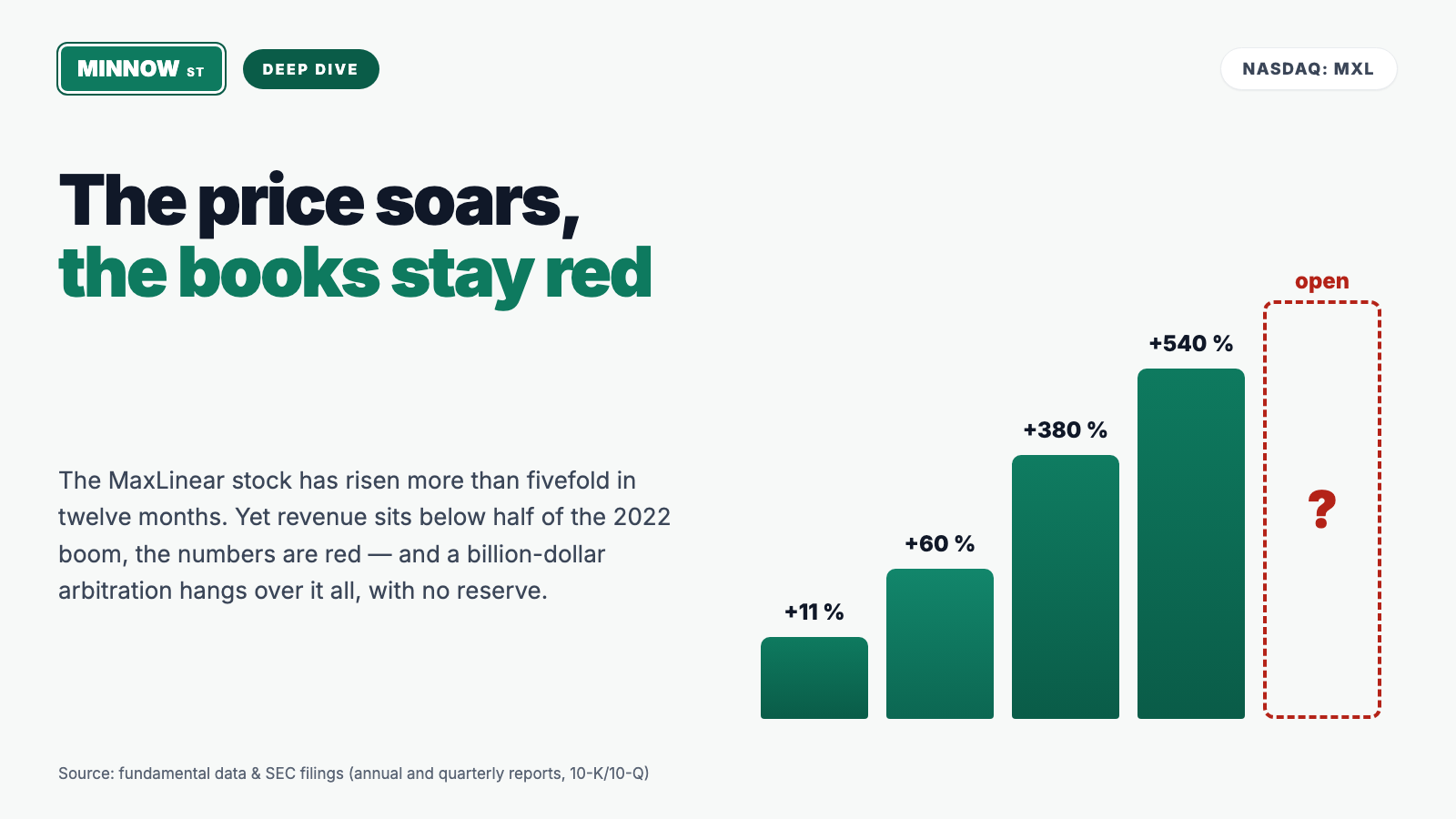
Interactive price chart (TradingView).
Note: pure fact-based analysis, not investment advice and not a solicitation to buy or sell. All figures without guarantee.
There is a quiet thinking error that grabs us whenever a stock climbs steeply. The price rises week after week, the charts point up, and at some point a switch flips inside us: if this many people are buying and the price runs this hard, the company must be fine. We take the price as proof. Call it the rally-as-proof trap: a rising price feels like a healed company — although at first it proves only one thing, namely that more people are currently buying than selling. At MaxLinear (Nasdaq: MXL) this trap is especially seductive. The stock has risen more than fivefold in twelve months, it lights up green in 24 of our scanners, and there is even a real, good story behind it: optical chips for AI data centers. Everything invites you to treat the price as proof that the company is over the hill. So let's make a deal: before you believe the price, we read together what MaxLinear must file, honestly and under penalty of law, with the U.S. securities regulator, the SEC — the annual report (10-K) and the latest quarterly report (10-Q). In the end, you decide.
So you know where this is heading, here is the central tension of this analysis right away: the recovery at MaxLinear is real — the optical data-center business is pulling hard, and that is not fantasy but stands in the filings. The question is not whether things are looking up, but whether that upswing justifies a price that has quintupled while the company still writes deeply red numbers under U.S. accounting rules — and while the legal section carries an arbitration for which not a single dollar of reserve sits on the balance sheet. Remember that arbitration; it is the thread of this piece.
What MaxLinear actually does — the chip designer that keeps data moving
Picture the internet as a gigantic road network for data. For the data packets to arrive everywhere — in the Wi-Fi router at home, in the 5G base station on the corner, in the fiber-optic line running between the server racks of a data center — every junction needs a tiny, highly specialized chip that receives the signal cleanly, conditions it and passes it on. MaxLinear designs exactly these chips — so-called systems-on-chip (SoCs) that combine radio, analog and digital signal processing on a single part. Important for understanding the stock: MaxLinear is a fabless company. It designs the chips but owns no factories — external foundries handle production. The advantage: low fixed costs. The drawback: nearly all the value sits in heads and patents, which is why development swallows enormous amounts of money — more on that below.
The business rests on four end markets, as MaxLinear reports them:
- Broadband — chips for cable and fiber modems and gateways that bring the internet into the house (roughly 44 percent of 2025 revenue and the strongest growth driver).
- Infrastructure — parts for 5G mobile networks and, increasingly important, optical transceiver chips for data centers. These are the "voice pipes" that connect the servers of an AI data center over fiber at maximum bandwidth (roughly 32 percent of 2025 revenue, already roughly 46 percent in the first quarter of 2026).
- Connectivity — Wi-Fi and Ethernet chips for networking in homes and businesses (roughly 17 percent in 2025).
- Industrial & multi-market — a mixed remainder of industrial and other applications (only about 8 percent in 2025, after 21 percent the year before — this market has outright collapsed).
Which brings us straight to the market story driving the price: the optical data-center business. MaxLinear supplies the chips that handle the traffic between servers in AI data centers — and demand there is exploding. Sounds like pure AI marketing? For once, it is not only that. In the annual report (10-K) MaxLinear describes its own products using "patented machine learning techniques" that sit in "next-generation communication and artificial intelligence systems", and in the quarterly 8-K the company explicitly attributes the latest revenue jump to production ramps "of our optical data center products at multiple hyperscale customers across scale-up and scale-out AI platforms". That is why our AI dossier files MaxLinear under "sells AI": not because the company builds AI software, but because it sells the chips that lay the arteries of AI data centers. Before we fall for the story, though, let's see where the stock shows up in our scanner — and what the numbers say.
Where the stock shows up in our scanner
Every day we run thousands of stocks through our in-house stock scanner. For MaxLinear the finding is unambiguous: 24 filters fire at once (data as of July 10, 2026) — but it is a very particular type of hit. Almost all are momentum and trend-strength filters: "RS Leader (≥90)", "Stan Weinstein: Stage 2", "Oliver Kell: Doublers", "Mark Minervini: Trend Criteria", "Qullamaggie: Episodic Pivot" and "Pros 80%". You can get there yourself: open one of these filters in the "Scanner" menu on minnowstreet.com and look for the MXL row.
Now the honest framing that fits the rally-as-proof trap: these 24 hits tell you one thing above all — that the price is running hard. A filter like "Doublers" simply means the stock has at least doubled (here it has more than quintupled). That is evidence of momentum, not of balance-sheet quality. The quality and profit filters are almost entirely absent — no surprise, because as we are about to see, the company still loses money under U.S. accounting rules. The scanner tells us: the market loves this stock right now. It does not tell us whether the price already prices the risks fairly. For that, we have to read the filings.
The numbers over the years
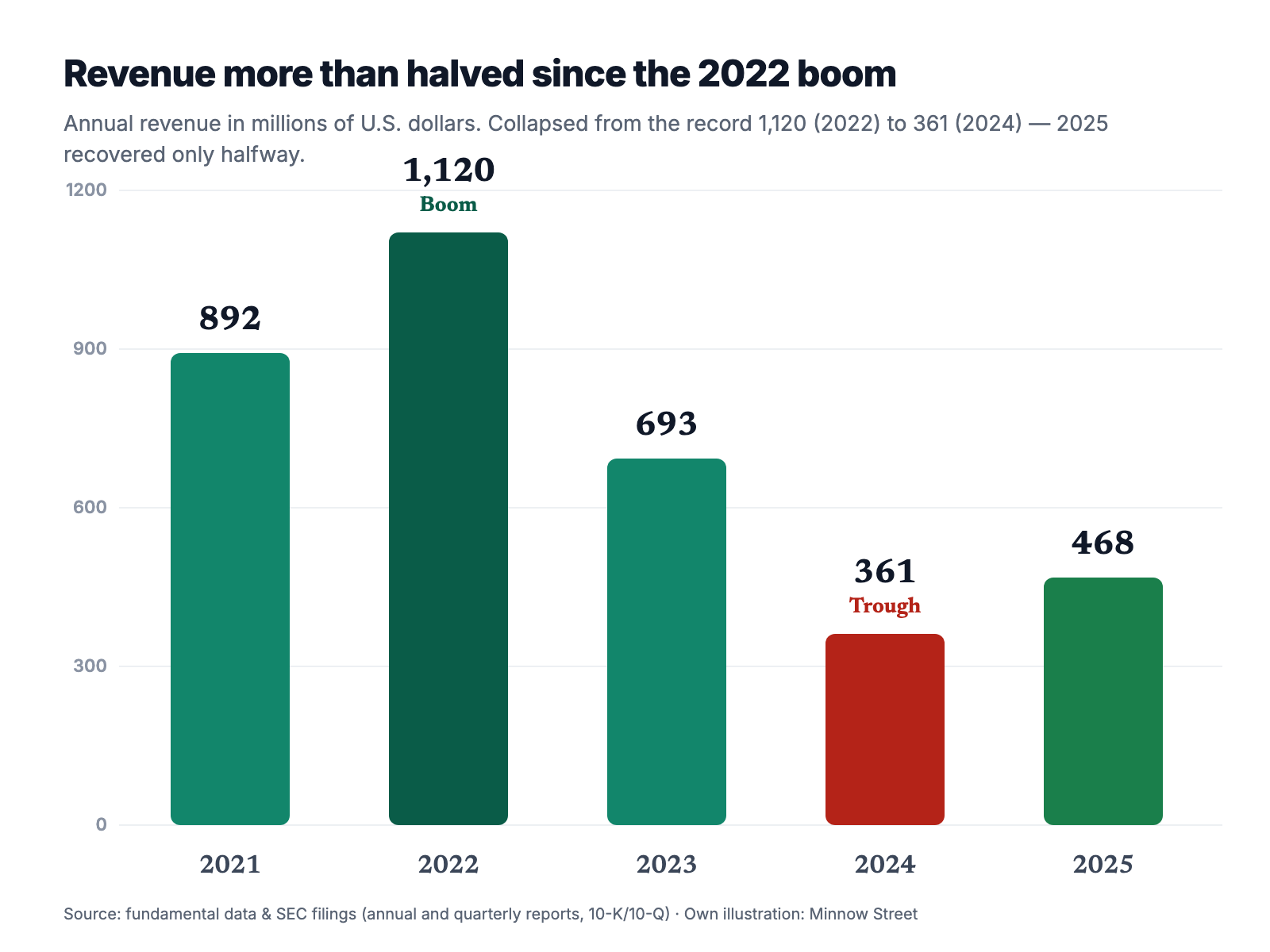
Let's start with what makes this stock so hard to place — the revenue series, which looks like a roller coaster. MaxLinear posted $892.4 million in revenue (2021), jumped to the record of $1.120 billion in the boom year 2022 — and then crashed: $693.3 million (2023), finally just $360.5 million (2024). From the peak, that is a collapse of roughly 68 percent; revenue far more than halved. In 2025 came the turn: up to $467.6 million (plus 29.7 percent), and the first quarter of 2026 came in at $137.2 million, 43 percent above the prior-year quarter. The chart shows the whole ride in one picture.
As encouraging as the revenue recovery is — the bottom line tells a sobering story. MaxLinear still earned money in 2021 and 2022 ($42 million and $125 million in profit), then slid deep into the red for three straight years: a $73.1 million loss (2023), $245.2 million (2024) and $136.7 million (2025) — each under U.S. GAAP. The first quarter of 2026 brought another GAAP loss of $45.1 million. The reason is not just the revenue collapse but the cost structure of a fabless chip designer: research and development cost roughly $208.6 million in 2025 — about 45 percent of total revenue. Whoever puts nearly half of every revenue dollar into development needs strongly growing revenue to reach the black. And while the losses ran, cash shrank: from $188 million (end of 2023) via $120 million to $72.8 million (end of 2025) and further to $61.1 million (end of Q1 2026).
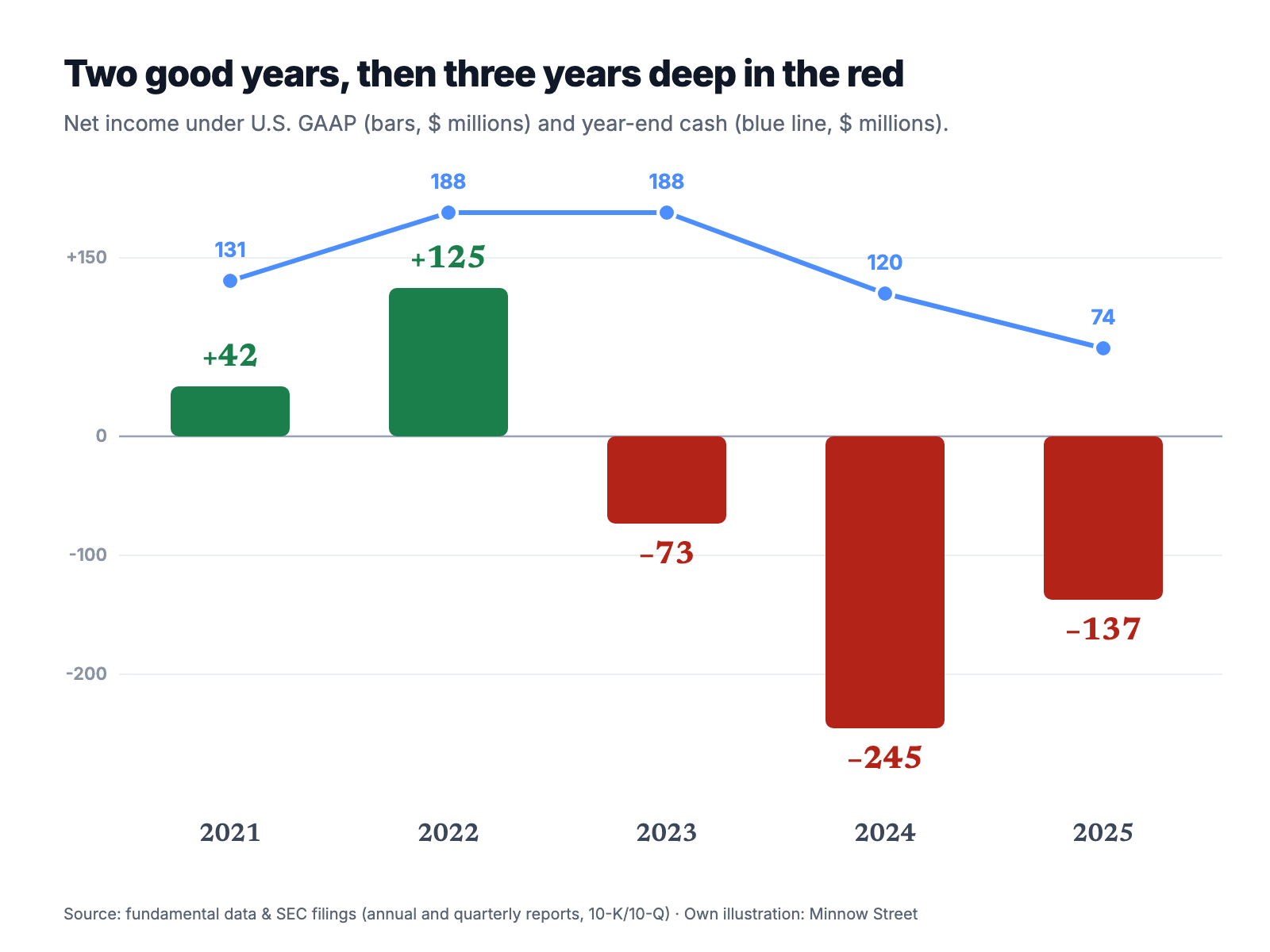
Fairness requires the other side of the accounting rules: on an adjusted non-GAAP basis — that is, excluding stock-based compensation, amortization of acquired assets and special charges — MaxLinear turned positive again in 2025 and reported an adjusted profit of $19.4 million for the first quarter of 2026. For the second quarter of 2026 the company guided for another jump: revenue of roughly $160 to $170 million. The recovery is real and accelerating. But exactly here lurks the rally-as-proof trap: an adjusted metric and one strong quarter in an upswing are no proof that the three uncomfortable truths have vanished. Let's look at them.
The uncomfortable truths
Uncomfortable truth no. 1: The business breathes in waves — semiconductor cyclicality
The first point is not a weakness of MaxLinear alone but the nature of the industry — yet you have to know it to place today's price. The chip market is cyclical: when customers order in waves, the order book fills abruptly; when they hold back, demand collapses just as fast. That is exactly what MaxLinear went through between 2022 and 2024 — from record to crater. The company states the cyclicality bluntly in its annual report:
"The semiconductor industry is highly cyclical and is characterized by constant and rapid technological change, rapid product obsolescence and price erosion, evolving technical standards, short product life cycles and wide fluctuations in product supply and demand."
— MaxLinear, Inc., SEC annual report 10-K for fiscal year 2025, Item 1 "Business" (Seasonality)
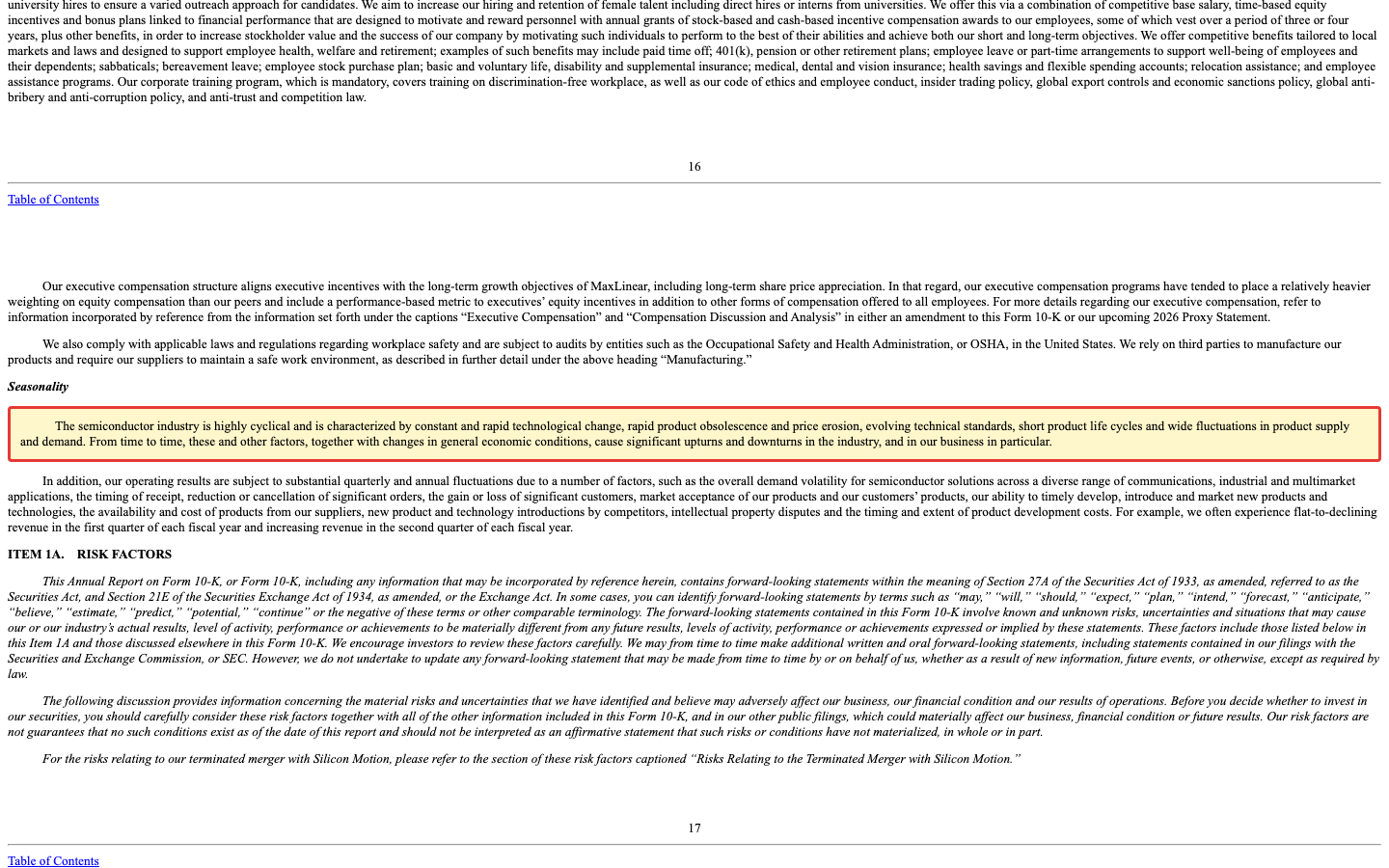
Why does this matter for today's investor? Because the stock is currently trading at the upper edge of such a wave. Whoever extends the 2025 recovery in a straight line makes exactly the mistake of the rally-as-proof trap. The same cyclicality shapes the whole chain of suppliers — you can see it at chip-test specialist Cohu or at equipment maker Lam Research, where the swings of the semiconductor cycle write the story just as forcefully.
Uncomfortable truth no. 2: The burst billion-dollar deal — Silicon Motion and the claim with no reserve
This is the core of this analysis, and it has nothing to do with the operating business. In 2022 MaxLinear agreed to acquire the memory-chip company Silicon Motion for roughly $3.8 billion — a giant deal by MaxLinear's standards. In July 2023 MaxLinear pulled the ripcord, terminated the merger agreement and declared itself no longer obligated to close. Silicon Motion saw it differently, accused MaxLinear of breach of contract and called on the arbitration court in Singapore (Singapore International Arbitration Centre, SIAC). Silicon Motion demands the termination fee agreed in the contract (a kind of contractual penalty, roughly $160 million) — and on top of it damages that, by its own account, clearly exceed that fee. MaxLinear itself puts it this way in the annual report:
"… MaxLinear is consequently liable for substantial monetary damages in excess of the termination fee as provided in the Merger Agreement. … Silicon Motion seeks payment of the termination fee, additional damages, fees, and costs. The arbitration is confidential."
— MaxLinear, Inc., SEC annual report 10-K for fiscal year 2025, Item 3 "Legal Proceedings" (Dispute with Silicon Motion)
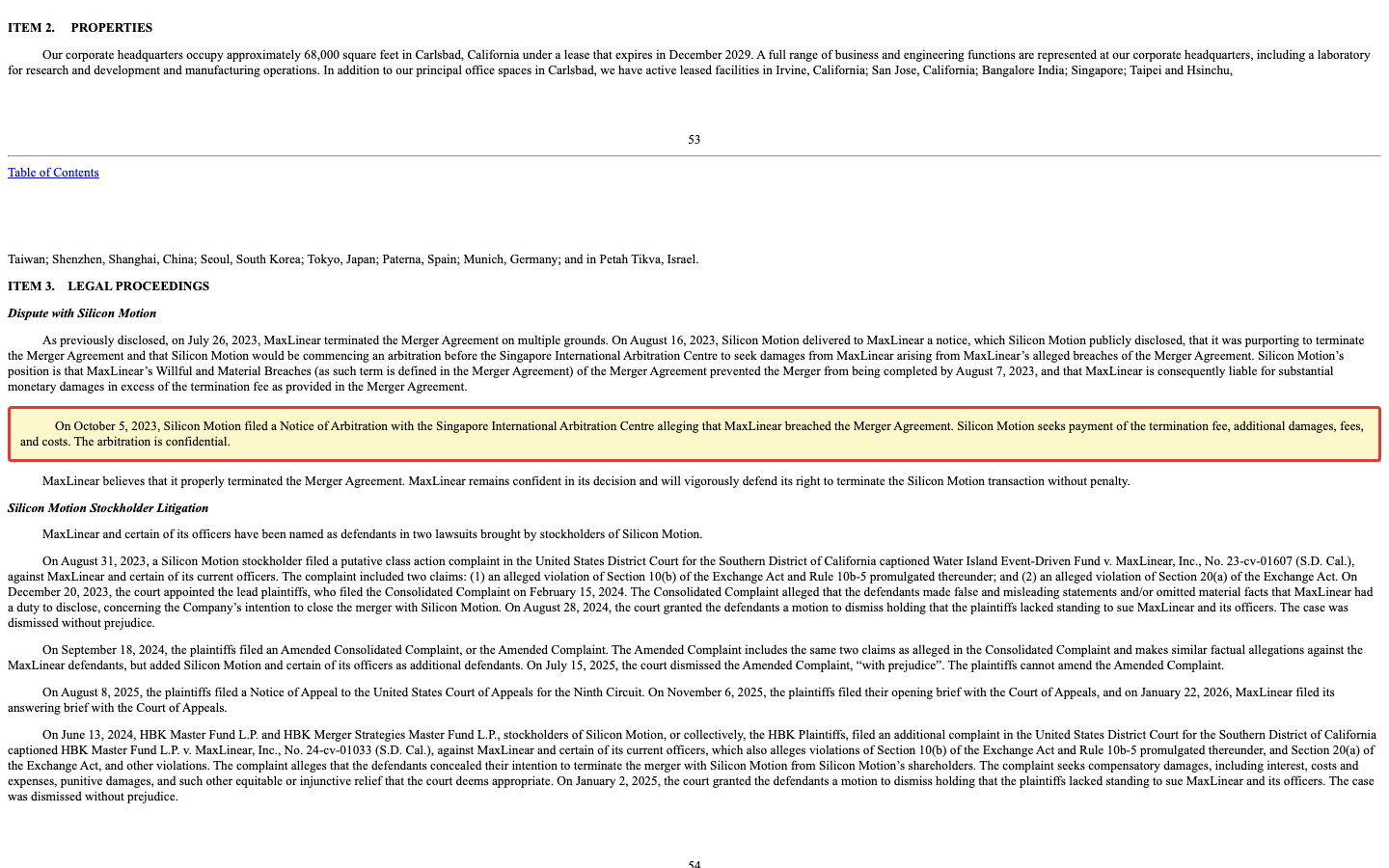
Now comes the part that turns this find from an ordinary legal dispute into a potential existential find — and that the rally completely drowns out. MaxLinear has reserved not a single cent for this risk. The report literally states that management currently does not consider an unfavorable outcome "probable", which is why no reserve was recorded — and that a reliable estimate of the possible amount cannot be made:
"As of December 31, 2025, no material loss contingencies have been accrued for litigation and other legal claims in our consolidated financial statements … An unfavorable outcome of these matters may be reasonably possible in excess of recorded amounts; however, a reasonable estimate of the amount or range of such loss cannot be made at this time."
— MaxLinear, Inc., SEC quarterly report 10-Q Q1 2026, note "Commitments and Contingencies"
Let's do the honest math (our materiality gate). On one side stands a claim whose amount nobody knows publicly, but which is said to clearly exceed the roughly $160 million termination fee — on a burst $3.8 billion deal, damage claims can quickly reach into the hundreds of millions or beyond. On the other side stand cash of just over $61 million and equity of roughly $452 million. MaxLinear itself writes that a damages event could force it to draw all credit lines and deploy cash that "may not be sufficient" — and that it might not obtain financing on reasonable terms. That is the definition of a structural-to-existential find: an unfavorable award could exceed cash and a large part of equity and force MaxLinear into substantial dilution (issuing many new shares) or worse. Fairness requires noting: MaxLinear considers itself in the right, is defending vigorously, and the timing of an award is open. But as long as this proceeding runs without a reserve, a question mark hangs over the pretty recovery story that no metric in the world can compute away.
Uncomfortable truth no. 3: Still red numbers — and a thin cash cushion
The third truth ties directly into the second, because it is what makes the litigation risk so explosive. MaxLinear is not over-indebted — the secured term loan stands at roughly $125 million, and the credit line (recently raised to $130 million) was unused at last report. The real problem is the thin cash position amid continuing GAAP losses. The annual report quantifies liquidity soberly:
"As of December 31, 2025, we had cash and cash equivalents of $72.8 million, restricted cash of $28.6 million and net accounts receivable of $46.1 million. Additionally, as of December 31, 2025, our working capital, which we define as current assets less current liabilities, was $62.8 million."
— MaxLinear, Inc., SEC annual report 10-K for fiscal year 2025, Item 7 "Liquidity and Capital Resources"
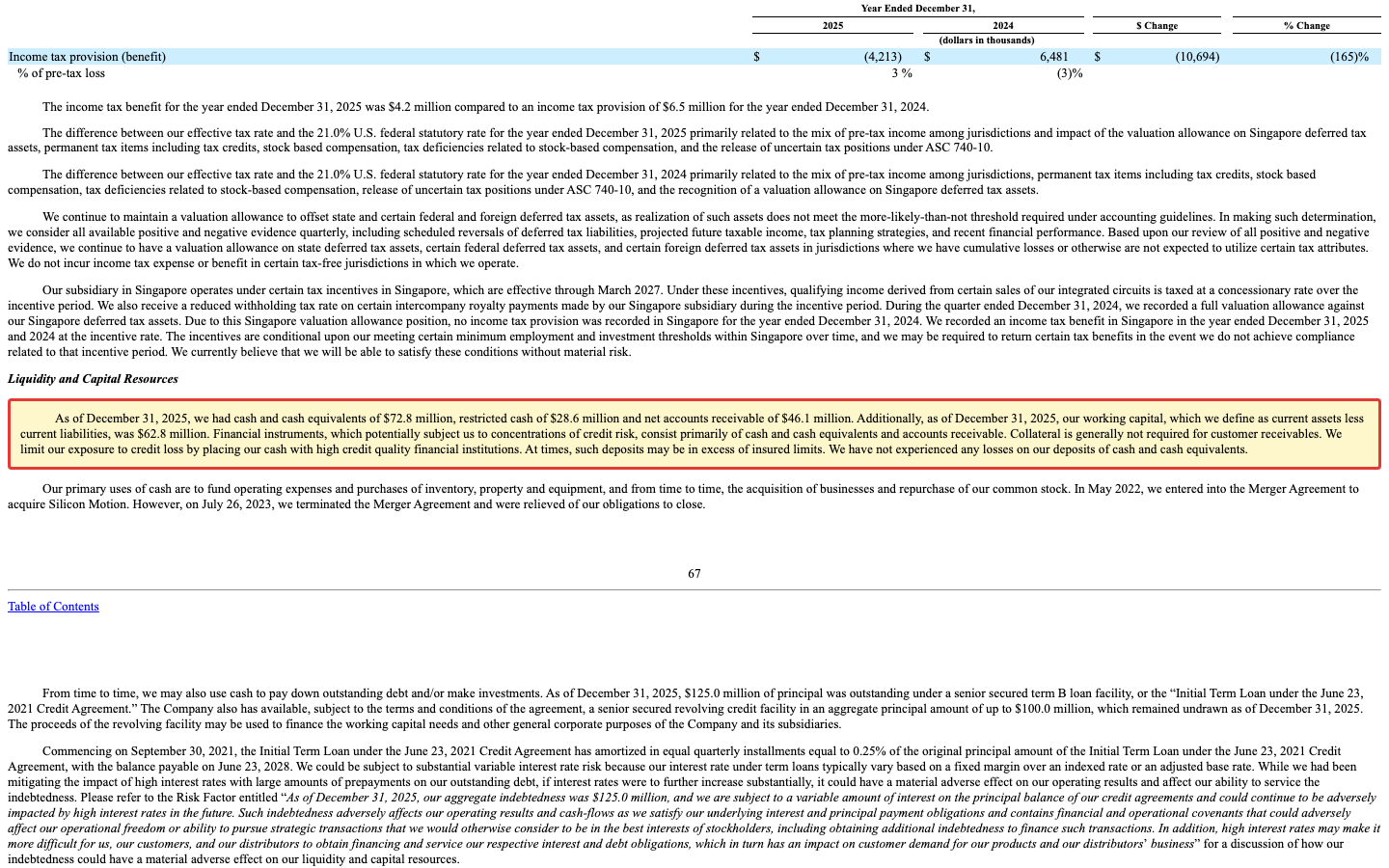
Two things soften this — and two sharpen it. Softening: the operating business is turning positive (non-GAAP profit, rising revenue, unused credit line), and a fabless model ties up little capital. Sharpening: cash shrank further in the current quarter, and it is exactly the cushion that, in the event of an unfavorable award, "may not be sufficient". A small cash cushion is no drama in calm times — under an unquantified billion-dollar proceeding, it becomes the sore spot.
Valuation — what the rally costs
Now to the core question. The recovery is real, the AI-optics story is real — but what do you pay for it after the stock has already flown? For scale, one hard, dated number from the annual report: as of June 30, 2025, the free float was worth $1.1 billion per the SEC cover page. In mid-2026 the market value sits in the order of roughly $8.5 billion — the stock has thus risen more than fivefold in about a year. That is the rally in numbers.
Against revenue of just over half a billion dollars, this valuation looks very high: enterprise value is roughly 15 times annual revenue, the price-to-sales ratio around 17. Because the company reports no GAAP profit, there is no meaningful current price-to-earnings ratio; computed on the profits analysts expect, it sits in the order of 65. Put differently: the market is not valuing MaxLinear on what the company earns today (nothing, under GAAP) but on a strong AI-optics recovery extended far into the future. A remarkable detail comes from the professionals' view: the mean analyst price target sits noticeably below the level the price has already climbed to — momentum has outrun the fundamental assessment. Remember: with a cyclical that has no current profit, no reported metric decides the case; what decides is how much future recovery is already in the price — and what happens if a billion-dollar proceeding cuts in on top.
Opportunities and risks at a glance
What speaks for MaxLinear:
- A real, accelerating recovery with AI tailwind: revenue up 29.7 percent in 2025, the first quarter of 2026 up 43 percent year over year; the driver is the optical data-center business for AI platforms (infrastructure segment roughly 46 percent of Q1 2026 revenue). Q2 2026 outlook of $160 to $170 million.
- A technologically relevant, broadly positioned chip designer across four end markets (broadband, connectivity, infrastructure/optical, industrial); high gross margin (roughly 57 percent), profitable again on a non-GAAP basis in 2025 (Q1 2026: plus $19.4 million).
- Not over-indebted: term loan of roughly $125 million, credit line ($130 million) unused; the fabless model ties up little capital.
- Very strong momentum and broad scanner confluence (24 hits) — the trend is intact, and analysts view the company mostly positively.
What speaks against it:
- The Silicon Motion arbitration without a reserve: Silicon Motion demands the termination fee (roughly $160 million) plus damages "in excess"; no reserve recorded as of March 31, 2026, cash just over $61 million — MaxLinear itself calls its means for a damages event "may not be sufficient". A potential existential find.
- Still deeply red GAAP numbers: a net loss of $136.7 million (2025), minus $45.1 million in Q1 2026; research eats roughly 45 percent of revenue; cash is shrinking.
- Pronounced cyclicality: revenue collapsed roughly 68 percent from 2022 through 2024 — one strong quarter in an upswing is no proof against the next downturn.
- A very high post-rally valuation: enterprise value roughly 15 times revenue, expected price-to-earnings around 65, the stock up more than fivefold; the mean analyst price target sits below the price. Add customer concentration (two customers 28 percent, top ten 65 percent of revenue).
A human conclusion
Remember the rally-as-proof trap from the beginning — the reflex to take a rising price as proof of a healed company? After the look into the filings you can now place MaxLinear with open eyes. The price has a real core: the business with optical chips for AI data centers is pulling hard, revenue is growing double digits, and on an adjusted basis the company is profitable again. That is the good half, and it explains why the stock looks so strong.
The other half is what the price drowns out: under U.S. accounting rules MaxLinear still sits deep in the red, revenue lies below half of the 2022 boom, cash has shrunk to just over $61 million — and above it all hangs a Silicon Motion arbitration that demands the termination fee plus unquantified damages and against which not a single dollar of reserve stands on the balance sheet. Exactly this last point is what a quintupled price makes invisible, and exactly this point is the most dangerous one. Our findings therefore argue for elevated caution: the documented strengths are real, but they give us no margin of safety as long as a potential existential find sits open without a reserve and the price already prices in a perfect recovery.
What you make of it is your decision. And that is exactly as it should be. What matters is only that you do not mistake the price for a free pass. A rising price is a signal from the market — not a verdict on the reserve that is missing. Whoever invests here bets that the AI-optics recovery stays strong enough and that the arbitration ends mildly. Both can happen. But it is a bet on two open questions at once — and the price answers neither of them.
Sources
- MaxLinear, Inc. — SEC annual report (10-K), fiscal year 2025 (as of December 31, 2025; filed January 29, 2026)
- MaxLinear, Inc. — SEC quarterly report (10-Q) Q1 2026 (as of March 31, 2026; filed April 23, 2026)
- MaxLinear, Inc. — SEC 8-K, Exhibit 99.1 (Q1 2026 results, GAAP/non-GAAP, Q2 guidance; April 23, 2026)
- MaxLinear, Inc. — SEC annual report (10-K), fiscal year 2024 (as of December 31, 2024; filed January 29, 2025)
- Fundamental data (metrics, valuation, annual and quarterly series, analysts); in-house stock scanner, data as of July 10, 2026.
Transparency & disclaimer: This analysis is a journalistic contextualization of publicly available information and is not investment advice, not a financial analysis in the regulatory sense, and not a solicitation to buy or sell securities. Stocks are subject to price swings; a total loss is possible. Make your investment decisions on your own responsibility and seek independent advice when in doubt. The author holds no position in MaxLinear stock at the time of publication.
Our Bottom Line at a Glance
- Business & AI tailwind positive
- A relevant fabless chip designer across four end markets, with a real, accelerating AI tailwind: the optical data-center business for AI platforms carries the recovery (revenue up 29.7 percent in 2025, Q1 2026 up 43 percent year over year; infrastructure segment roughly 46 percent of Q1 2026 revenue). High gross margin (roughly 57 percent), Q2 2026 outlook of $160 to $170 million. That is the documented strength.
- Silicon Motion dispute negative
- The potential existential find: before the arbitration court in Singapore, Silicon Motion demands the termination fee (roughly $160 million) plus damages "in excess of the termination fee" from the $3.8 billion deal that burst in 2023. As of March 31, 2026 no reserve stands against it; MaxLinear itself calls its cash (just over $61 million) "may not be sufficient" for a damages event. An unfavorable award could exceed cash and a large part of equity.
- Profitability & cash negative
- Still deeply red under U.S. GAAP: a net loss of $136.7 million (2025), minus $45.1 million in Q1 2026; research eats roughly 45 percent of revenue. Positive again on a non-GAAP basis (Q1 2026: plus $19.4 million), but cash shrank from $72.8 million to $61.1 million within one quarter — a thin cushion that the unquantified proceeding turns into the sore spot.
- Cyclicality & concentration neutral
- The business is pronouncedly cyclical: revenue collapsed roughly 68 percent from 2022 through 2024. One strong quarter in an upswing is no proof against the next downturn. Add noticeable customer concentration (two customers roughly 28 percent, top ten roughly 65 percent of revenue) — a cluster risk; in the worst case a dent, not an existential question.
- Valuation & momentum negative
- Very strong momentum (24 scanner hits, the price up roughly 540 percent in twelve months) but a very high valuation: enterprise value roughly 15 times revenue, price-to-sales around 17, expected price-to-earnings around 65 (no current P/E for lack of GAAP profit). The mean analyst price target sits below the accumulated price — momentum has outrun the fundamental assessment.
MaxLinear (MXL) has a real story — optical chips for AI data centers drive an accelerating revenue recovery, and the stock has risen more than fivefold in twelve months (24 scanner hits). But the price drowns out three documented burdens: still deeply red numbers under U.S. GAAP with shrinking cash, pronounced cyclicality (revenue down roughly 68 percent since 2022) — and above all a Silicon Motion arbitration that demands the termination fee plus unquantified damages and for which no reserve sits on the balance sheet. Our findings argue for elevated caution as long as this potential existential find stays open. Not investment advice.
What Our Rating Means
- If you don't own the stock
- In our view, the documented risks clearly outweigh — we see no basis for an entry.
- If you hold it in your portfolio
- In our view, the findings carry enough weight to warrant a critical look at your own position.
A journalistic assessment by our editorial team at the time of the deep dive, based on public sources — not investment advice and not a solicitation to buy or sell. Your personal circumstances (investment goals, risk capacity, taxes) cannot be taken into account. What our categories mean, how verdicts are formed, and what conflicts of interest exist →
Worth Noting
- Materiality gate (find by find, 07/10/2026): (1) Silicon Motion arbitration (SIAC Singapore) — termination fee of roughly $160 million plus damages "in excess of the termination fee" from the $3.8 billion deal that burst in 2023. Checked for existential character: no reserve as of 03/31/2026 ("no material loss contingencies have been accrued … a reasonable estimate … cannot be made"), cash just over $61 million, equity roughly $452 million; MaxLinear itself calls its means "may not be sufficient" → structural-to-existential find, may determine the rating on its own. (2) GAAP loss/cash burn — net loss $136.7 million (2025), Q1 2026 −$45.1 million, cash $72.8 → $61.1 million; non-GAAP positive, credit line unused → structural find that sharpens the thinness of the cash cushion and thus the existential find. (3) Cyclicality — revenue 2022–2024 −68 percent, profitable in the upswing → price find. (4) Valuation — EV/revenue ~15, P/S ~17, expected P/E ~65, price +540 percent, analyst target below → price find. (5) Customer concentration: two customers 28 percent, top ten 65 percent → cluster-risk dent. Result: one existential find (unquantified, without reserve) plus several price/structural finds and an unproven turnaround → "vorsicht" (not "beobachten", because an existential find is present; not "verkaufen", because there is no manipulation, no going-concern warning, and the operating recovery is documented).
- Valuation metrics are orders of magnitude as of mid-2026 (EV/revenue ~15, P/S ~17, expected P/E ~65). A current P/E does not exist for lack of GAAP profit. SEC-dated anchor: non-affiliate market value as of June 30, 2025 = $1.1 billion (10-K cover page); mid-2026 market value roughly $8.5 billion (the stock up more than fivefold). Analyses are evergreen; daily prices are not a buy argument.
- Revenue, result, cash and end-market series come from the annual report (10-K) 2025 (Items 1/1A/3/7, notes), the quarterly report (10-Q) Q1 2026 and the quarterly 8-K (Exhibit 99.1, GAAP/non-GAAP, Q2 guidance) and were cross-checked against the fundamental data. End markets 2025: broadband 44% (+75%), infrastructure 32% (+30%), connectivity 17% (+40%), industrial & multi-market 8% (−50%); Q1 2026 infrastructure already roughly 46%.
- Special-situations screening (EDGAR full index, CIK 1288469): the dominant special situation is the Silicon Motion deal that burst in 2023 (S-4/425/SC TO-T/DEFM from 2022/2023) and the ongoing SIAC arbitration plus shareholder suits (dismissed "with prejudice" at the district level, appeal pending before the Ninth Circuit). Institutional holders mostly passive (Schedule 13G), no activist SC 13D with strategic-review character, no takeover 8-K.
- AI dossier: category "sells AI" (rated 07/10/2026). Reasoning: the annual report (10-K) 2025 describes own products using "patented machine learning techniques" inside "next-generation communication and artificial intelligence systems"; the quarterly 8-K attributes the revenue jump directly to optical data-center products "across scale-up and scale-out AI platforms", and the optical data-center business is the fastest-growing revenue block (roughly 46 percent of Q1 2026). AI infrastructure is thus a documented, load-bearing revenue source — "sells" under the precedence rule (consistent with comparable optics-for-AI suppliers).
Frequently Asked Questions
MaxLinear, Inc. (Nasdaq: MXL) is a fabless semiconductor designer: the company designs communications chips (systems-on-chip) and has them manufactured externally. The parts sit in broadband and fiber modems, Wi-Fi and Ethernet devices, 5G infrastructure and — increasingly important — in the optical transceivers that connect the servers in AI data centers. Headquarters are in Carlsbad, California.
Mainly because of the optical data-center business: MaxLinear supplies chips for the fiber-optic connections in AI data centers, and that demand is booming. Revenue rose 29.7 percent in 2025 and 43 percent year over year in the first quarter of 2026. The stock has risen more than fivefold in twelve months — faster than the still deeply red GAAP numbers, which is why the valuation is high.
MaxLinear agreed in 2022 to acquire the memory-chip company Silicon Motion for roughly $3.8 billion but walked away in 2023. Silicon Motion alleges breach of contract and demands the termination fee (roughly $160 million) plus additional damages before the arbitration court in Singapore. The proceeding is confidential. The explosive part: as of March 31, 2026 MaxLinear has recorded no reserve for it and itself writes that its cash may not be sufficient for a damages event.
That depends on the accounting rule. Under U.S. GAAP, MaxLinear has posted losses since 2023 — $136.7 million (2025), minus $45.1 million in the first quarter of 2026. On an adjusted non-GAAP basis (excluding stock-based compensation, amortization of acquisitions and special charges) the result turned positive again in 2025 (Q1 2026: plus $19.4 million). Research and development costs roughly 45 percent of revenue.
Yes, and more directly than you might think. MaxLinear sells the optical chips that connect the servers in AI data centers. In its quarterly 8-K the company explicitly attributes the revenue jump to production ramps "at multiple hyperscale customers across scale-up and scale-out AI platforms". That is why our AI dossier files MaxLinear under "sells AI" — not as an AI software vendor, but as the supplier of the chips that wire up AI infrastructure in the first place.
Measured against revenue, yes: enterprise value is roughly 15 times annual revenue, and the price-to-sales ratio sits around 17 (as of mid-2026). A current price-to-earnings ratio does not exist for lack of GAAP profit; computed on expected future profits it sits around 65. The stock has risen more than fivefold and already prices in a strong recovery — the mean analyst price target even sits below the current level.
Found an error?
Did you spot a factual error, an outdated number, or a typo in this deep dive? Let us know briefly — your report goes straight to the editorial team.