Kulicke & Soffa Stock: A $6.9 Billion Valuation, $213,000 in Annual Profit — and a Chip Cycle Just Catching Fire
Wire-bonder specialist Kulicke & Soffa lights up 31 filters in our in-house stock scanner (momentum run as of July 17, 2026) — a Stan Weinstein stage-2 uptrend, relative strength of 97, almost a four-bagger in twelve months (data as of July 8, 2026). We read the annual reports (10-K) for fiscal years 2023 through 2025 and the quarterly reports (10-Q) through April 4, 2026: a revenue mountain that ran from $1.5 billion down to $654 million, a comeback quarter at plus 49.8 percent, an $86 million walk-away payment from an unnamed mega-customer, three buried business lines, a CFO who doubles as interim CEO — and 54.6 percent of revenue from customers headquartered in China. Not investment advice — just the math on what a flawless uptrend costs when a cyclical has to deliver it.
 Thomas Mücke
Founder & Publisher
Thomas Mücke
Founder & Publisher
Chart
Interactive price chart (TradingView).
Note: pure fact-based analysis, not investment advice and not a solicitation to buy or sell. All figures without guarantee.
There is an investor trap that catches the diligent ones of all people: the chase trap. It works like this: you discover a stock that has almost quadrupled, you read two headlines about the boom behind it — and your brain simply extrapolates the curve. “If only I had bought a year ago…” quietly turns into “so I’ll buy now.” The textbook term is performance chasing, and in the summer of 2026 hardly any stock feeds that reflex as reliably as Kulicke and Soffa Industries, Inc. (Nasdaq: KLIC): up 180 percent year to date, only about 3 percent below its all-time high, a relative strength of 97 out of 99 (data as of July 8, 2026) — and no fewer than 31 hits in our in-house stock scanner (momentum run as of July 17, 2026). So let’s make a deal: before you chase the curve, we read together what the company itself reported, under penalty of law, to the U.S. securities regulator, the SEC — the annual reports (10-K) for fiscal years 2023 through 2025 and the quarterly reports (10-Q) through April 4, 2026. And these filings tell a story far wilder than the momentum curve: of a boom that brought $1.5 billion in revenue, a trough in which exactly $213,000 of profit remained from a full year’s business, three buried business lines — and an upswing that is real but hangs on a handful of customers in one country. In the end, you decide for yourself.
What Kulicke & Soffa actually does — and for whom
A freshly fabricated chip is, at first, just a mute piece of silicon. For it to talk to the outside world, its microscopic contact pads must be connected to the leads of its package — and for most chips on earth that happens with hair-thin gold or copper wire, drawn and welded by machines called wire bonders. Kulicke & Soffa is something like the sewing-machine maker of the chip industry: it builds the machines that “stitch” billions of these wire bridges. The Ball Bonding segment is the core business; alongside it sit Wedge Bonding (thicker wires and ribbons, for power semiconductors in cars and industry), Advanced Solutions (including thermo-compression bonding for stacked, advanced-packaging chips) and APS — the spares, tools and services business that earns money in every phase of the cycle. Customers are chipmakers (IDMs), outsourced assembly and test providers (OSATs — factories that package and test chips under contract) and foundries. Two peculiarities belong right at the start. First, geography: the company has been incorporated in Pennsylvania since 1956 but is run from Singapore — manufacturing and more than 90 percent of revenue sit in Asia. Second, the calendar: the fiscal year ends in early October — “fiscal year 2025” ran through October 4, 2025, and the “second quarter of fiscal year 2026” covers January through April 2026. Which brings us to the central tension of this analysis: a genuine cyclical upswing with flawless technicals — priced like a growth stock, earning (so far) like a cyclical at the trough exit, led by an interim chief and dependent on a few customers in China. How the assembly end of the chip chain ticks from the equipment buyer’s perspective is something we dissected at metrology giant KLA — and how memory cycles stretch and crush valuations, in our Micron analysis.
Where the stock shows up in our scanner
Every day we run roughly 3,500 stocks through our scanners. Kulicke & Soffa landed on the research list via the momentum run of July 17, 2026 — with 31 hits, one of the highest confluences of the run. Through the trend lens the picture is almost flawless: a Stan Weinstein stage-2 uptrend (price above a rising 200-day line), a hit in the RS leader filter with a relative strength of 97 out of 99, the Mark Minervini trend template satisfied, near the 52-week high (about 3 percent below the all-time high), price above the 21-, 50- and 200-day lines, plus volume signals such as a pocket pivot and an up/down volume ratio of 2.1 — all data as of July 8, 2026. Institutions hold roughly 93 percent of the shares; KLIC also passes the “pros 80 percent” filter. Behind all this: plus 100 percent in three months and plus 180 percent year to date. So much for the freestyle program. Now the compulsories, and they are sobering: the EPS rating sits at 6 out of 99 — the trailing earnings trend ranks among the weakest in the entire universe, because the loss-and-restructuring years 2024/2025 still sit inside the twelve-month math. The Piotroski F-Score (a nine-point test for the direction of the books) stands at a middling 6 of 9, the trailing price-to-earnings ratio near 120. Only the substance shines: an Altman Z-Score around 14 (a bankruptcy early-warning gauge — the danger zone historically starts below 1.8; 14 means practically indestructible) and an equity ratio of 72 percent. Remember this split: when technicals and earnings history diverge this widely, the market is not betting on what the company has earned — it is betting on what the company is about to earn.
The numbers over the years — honestly appraised
First, what genuinely impresses — and this time it is the present. In the second quarter of fiscal year 2026 (January through April 2026), revenue jumped 49.8 percent to $242.6 million. The driver is no accounting trick but the core business: ball bonding grew 141.7 percent to $160.2 million, revenue in the memory end market rose elevenfold from $2.8 million to $31.3 million, and general semiconductor climbed from $90.7 million to $148.9 million — per the quarterly report “driven by customer technology transitions and improved demand conditions.” Gross margin came in at 49.3 percent (prior-year quarter: 24.9 percent, then ravaged by write-downs), and the bottom line showed $35.1 million of net income, or $0.66 per diluted share. The forward view supports the story too: already in fiscal year 2025, bookings rose 74 percent to $750.8 million and backlog climbed 65 percent to $245.3 million — though the annual report notes drily that a majority of orders can be cancelled with limited or no penalties. Read only this paragraph and the 31 scanner hits make instant sense. But now look at the whole mountain:
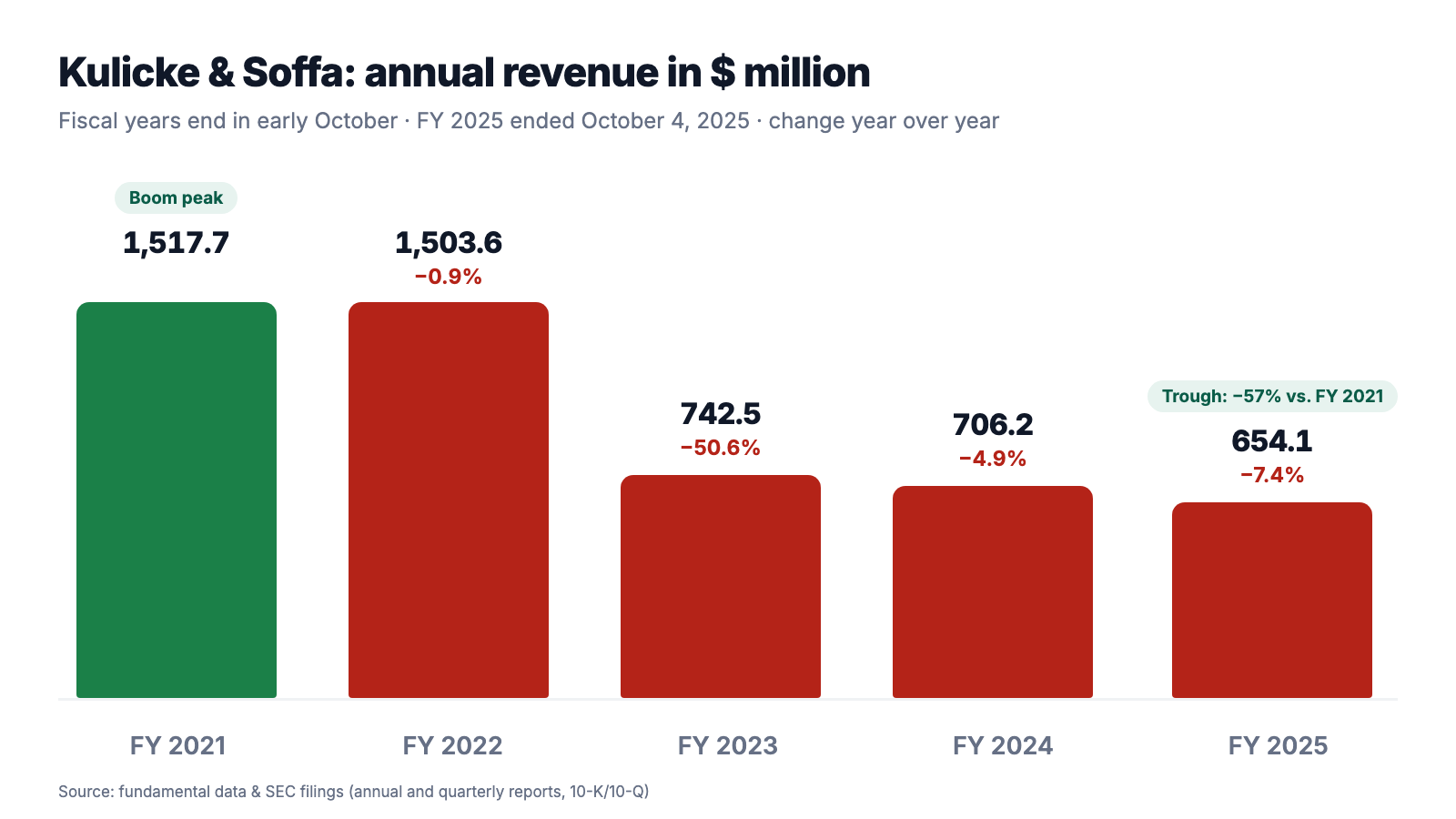
The descent behind it was long: the Covid-and-5G boom of fiscal years 2021 and 2022 (roughly $1.5 billion in revenue each, net income 2022: $433.5 million) was followed by fiscal 2023 at minus 50.6 percent, then 2024 at minus 4.9 percent with a net loss of $69.0 million, and finally 2025 at minus 7.4 percent with a net income of — hold on — $213,000. Not $213 million: two hundred thirteen thousand dollars, $0.004 per share, against a $6.9 billion market value (data as of July 8, 2026). Only the two most recent quarters flip the picture:
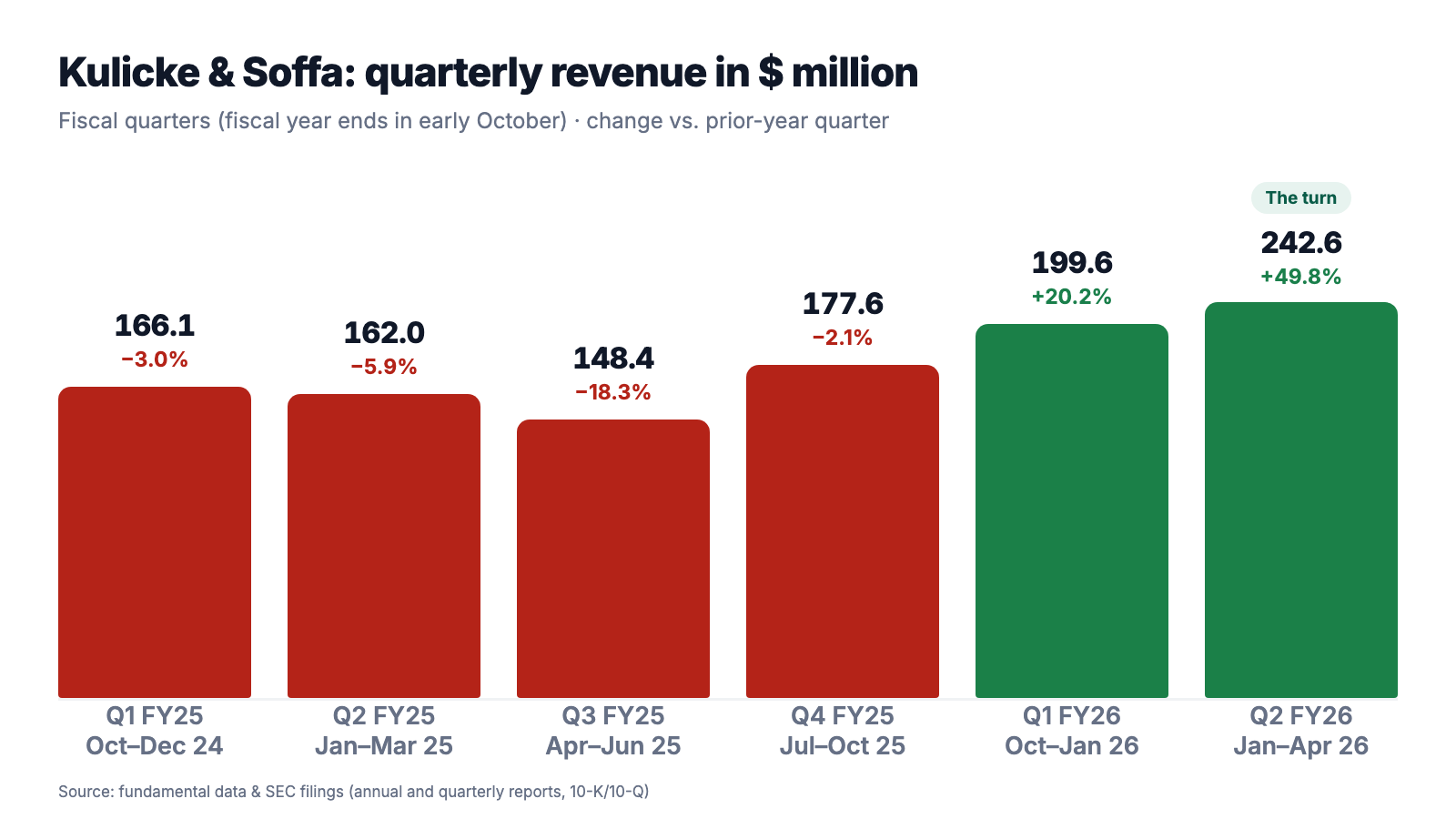
Let’s hold on to the honest interim verdict: the upswing is real, it comes from the core business, and it has two leading indicators — bookings and backlog — on its side. But it is two quarters old, measured against a descent that took three years. Remember the rhythm: an equipment maker’s customers order machines in herds — and cancel them in herds too. Which brings us to the uncomfortable truths.
What the filings say — the uncomfortable truths
Uncomfortable truth no. 1: more than half of revenue hangs on customers headquartered in China — and three names account for almost 40 percent
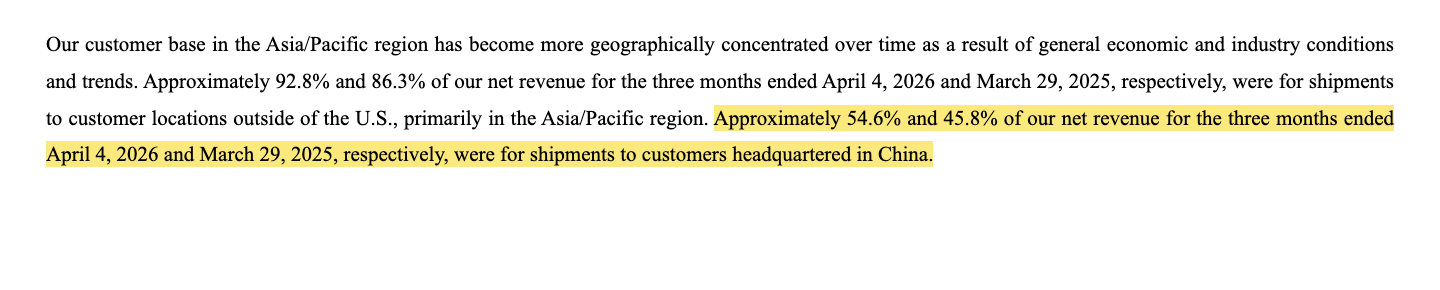
The quarterly report as of April 4, 2026 quantifies the geographic concentration with a precision that deserves credit:
“Approximately 54.6% and 45.8% of our net revenue for the three months ended April 4, 2026 and March 29, 2025, respectively, were for shipments to customers headquartered in China.”
— Kulicke and Soffa Industries, Inc., SEC quarterly report 10-Q as of April 4, 2026, “Business Environment”
Add the customer concentration: in the first half of fiscal year 2026, per the same filing, three customers accounted for roughly 39 percent of revenue — Tianshui Huatian Technology (16.9 percent), Haoseng Industrial (11.8 percent) and Changjin Technology Shanghai (10.7 percent), all names from China’s chip-assembly ecosystem. Huatian alone stood for 29.6 percent of accounts receivable. The annual report adds the general picture: the ten largest customers delivered 54.8 percent of fiscal 2025 revenue, and shipments to China customers are “subject to heightened risks and uncertainties related to the respective trade and export control policies of the governments of China and the U.S.” To be fair: chip assembly being concentrated in Asia is industry physics, not a Kulicke quirk — and the current boom comes precisely from this customer base. But that is exactly the point: the growth engine and the biggest political risk are the same customers. A new round of export controls, a tariff shock or simply a capex pause by the three big buyers would land straight in the revenue line — and, with 30 percent of receivables sitting with a single customer, in the balance sheet too.
Uncomfortable truth no. 2: the cycle is not an anecdote but a system property — the company explains it itself
Why does revenue halve within a year in this business, as it did in fiscal 2023? The annual report delivers the explanation right in its business chapter — as if it were an operating manual for the stock:
“In order to exploit these trends, semiconductor manufacturers, both IDMs and OSATs, periodically invest aggressively in the latest generation capital equipment. This buying pattern often leads to periods of excess supply and reduced capital spending — the so-called semiconductor cycle.”
— Kulicke and Soffa Industries, Inc., SEC annual report 10-K for fiscal year 2025, Item 1 “Business”

You saw the number series in the chart above: $1,517.7 → $1,503.6 → $742.5 → $706.2 → $654.1 million — and now steeply up again. Elsewhere the report adds: “Our visibility into future demand is generally limited and forecasting is difficult.” Translated into investor language: whoever buys KLIC is not buying a growth company but a position in the semiconductor cycle — with double leverage in both directions, because when end demand swings 10 percent, machine orders swing by a multiple. In the upswing that is glorious (see plus 49.8 percent). In the last downswing it meant: minus 57 percent of revenue from peak to trough. The technicals tell you where in the cycle the herd currently stands — they do not tell you how far it is to the next hairpin bend.
Uncomfortable truth no. 3: the recent earnings history is a debris field of one-offs — including an $86 million walk-away payment
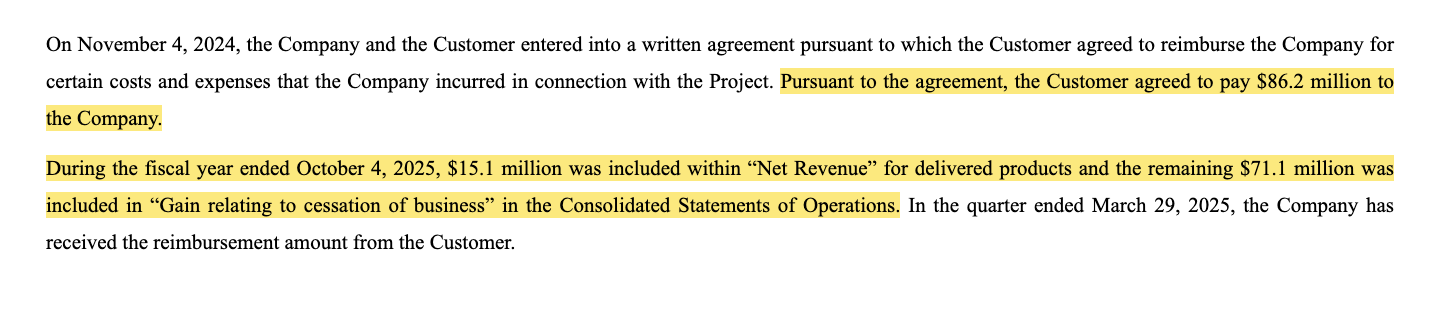
Between boom and comeback lie three buried business lines. First: “Project W” — a development project for advanced-display technology with a mega-customer the report steadfastly leaves unnamed (“the Customer”), which that customer cancelled in fiscal 2024. Cost to Kulicke & Soffa: $104.7 million in write-downs and impairments in fiscal 2024. Then the remarkable twist:
“Pursuant to the agreement, the Customer agreed to pay $86.2 million to the Company. […] During the fiscal year ended October 4, 2025, $15.1 million was included within ‘Net Revenue’ for delivered products and the remaining $71.1 million was included in ‘Gain relating to cessation of business’ in the Consolidated Statements of Operations.”
— Kulicke and Soffa Industries, Inc., SEC annual report 10-K for fiscal year 2025, Note 17 “Cessation of Business”
Second, in March 2025 the board resolved to wind down the electronics assembly (“EA”) equipment business — total charges per the annual report: $87.5 million, of which $31.5 million in inventory write-downs and $34.9 million on goodwill and intangibles, plus severance and penalties on non-cancelable purchase commitments. Third, in October 2024 the lithography subsidiary K&S Liteq was sold to Onto Innovation. What does this mean for you as a reader of numbers? Fiscal 2025 with its $213,000 of net income contains simultaneously a fat positive one-off (the $71.1 million walk-away gain) and fat negative ones (the $87.5 million EA wind-down) — operationally the year was better than the zero suggests, but far worse than any boom memory. Hence: the trailing price-to-earnings ratio near 120 is almost a random number here — it measures a transition year, not earning power. In fairness: management ended three loss-makers decisively instead of feeding them, and the restructuring was finished before the cycle turned. That is exactly what the margin is now profiting from. But a company that buries three business lines within 18 months has also proven that its growth bets can fail — and the next big bet (thermo-compression bonding for AI-era chips) is already running.
Uncomfortable truth no. 4: the rally runs under an interim chief who is also the CFO — and the SEC just asked pointed questions about reporting quality
Right into the cycle turn fell a leadership change that the annual report logs under subsequent events:
“Also, on October 28, 2025, the Board appointed Lester Wong, the Company’s current Executive Vice President and Chief Financial Officer, as the Company’s Interim Chief Executive Officer. The Board will conduct a search for a permanent successor among external and internal candidates.”
— Kulicke and Soffa Industries, Inc., SEC annual report 10-K for fiscal year 2025, Note 18 “Subsequent Events”
CEO Fusen Chen, who had led the company since 2016, retired effective December 1, 2025; since then Lester Wong has worn both hats — chief financial officer and interim CEO. He still signs in the dual role in the response letter to the SEC of March 19, 2026 and in the quarterly report of May 2026. The annual report itself lists the CEO’s departure explicitly as a risk factor for strategy and internal controls. And there is a second, quieter governance footnote: in March 2026 the SEC sent the company a comment letter on its latest quarterly report — among other things because one segment showed negative selling, general and administrative expenses (a consequence of the booked $71.1 million reimbursement) without the report explaining it, and because the revenue commentary did not quantify its drivers. Kulicke & Soffa promised improvement in future filings. None of this is a scandal — SEC comment letters are routine, and a CFO as interim solution beats a vacuum. But soberly: a stock pricing in a new cycle era at record levels is currently steered by a transition leadership whose reporting quality the regulator just had sharpened. Whoever buys is also buying the answer to an open personnel question.
Valuation: $6.9 billion for the cycle — the cash cushions, the price demands
In early July 2026 the stock cost about $131.50, for a market value of roughly $6.9 billion (data as of July 8, 2026). On trailing twelve months that is a price-to-earnings ratio near 120 and a price-to-sales ratio around 9 — historically expensive for a cyclical, but as truth no. 3 showed: the trailing number measures wreckage years. The forward view is more honest, and it goes like this: analyst estimates (five estimators, data as of July 8, 2026) see roughly $3.36 of earnings per share for the current fiscal year 2026 and about $4.24 for 2027 — a forward P/E around 39 and 31, respectively. Estimates were raised by a good 27 percent within four weeks, and the consensus sits near “buy.” For perspective: in boom fiscal year 2022 the company earned $7.09 per diluted share — whoever buys today already pays 18.5 times the best profit ever achieved. The cushion underneath is real, though: $487.9 million in cash and short-term investments, no bank debt, $857.5 million of equity against $1,186.0 million in total assets (April 4, 2026), plus a quarterly dividend of $0.205 ($0.82 in fiscal 2025) and a $300 million buyback program running through 2029. The piquant detail: in fiscal 2025 — at prices roughly between $30 and $46 — the company repurchased $97.1 million of its own shares; in the rally quarter from January through April 2026 it bought just about 3,000 shares for $0.1 million. Above $100, the in-house buyback machine evidently no longer found the stock compelling. Insider data points the same way: ten sales and no purchase most recently (fundamental data, as of July 8, 2026) — routine after a price surge, but no extra vote of confidence either.
Opportunities and risks at a glance
What speaks for Kulicke & Soffa:
- The cycle turn is documented, not asserted: revenue up 20.2 percent and 49.8 percent in the two latest quarters, ball bonding up 141.7 percent, memory revenue up elevenfold (quarterly report as of April 4, 2026); fiscal 2025 bookings up 74 percent to $750.8 million, backlog up 65 percent to $245.3 million.
- The margin is coming along: gross margin of 49.3 percent in the latest quarter, $35.1 million of net income — the restructuring (EA exit, lithography sale, Project W ending) was completed before the upswing began.
- Fortress balance sheet: $487.9 million in cash and investments, no bank debt, a 72 percent equity ratio, Altman Z around 14 (data as of July 8, 2026); a long-standing dividend and a $300 million buyback authorization through 2029.
- Flawless technicals: 31 hits in the momentum run (as of July 17, 2026), a Stan Weinstein stage-2 trend, relative strength of 97, the Minervini trend template, about 3 percent below the all-time high, institutional ownership around 93 percent (data as of July 8, 2026).
- Advanced-packaging option value: thermo-compression bonding including a fluxless process positions the company, per the annual report, for chiplet-based packages — the construction trend behind AI accelerators.
What speaks against it:
- Concentration squared: 54.6 percent of quarterly revenue from customers headquartered in China, three customers at roughly 39 percent of first-half revenue, a single one at 29.6 percent of receivables — squarely in the blast radius of U.S. export controls and tariffs (10-Q as of April 4, 2026; 10-K fiscal 2025).
- The cycle as a system property: minus 57 percent of revenue from peak (FY 2021) to trough (FY 2025), described by the company itself as the “so-called semiconductor cycle” with limited demand visibility; a majority of orders can be cancelled with limited or no penalties.
- A thin trailing earnings base: $213,000 of net income in fiscal 2025, minus $69.0 million the year before, an EPS rating of 6 out of 99; the trailing P/E near 120 works neither as a buy nor as a warning signal — it measures one-offs in both directions.
- Leadership in transition: an interim CEO doubling as CFO since December 2025, successor search open; plus an SEC comment letter (March 2026) about explanation gaps and missing quantification in the numbers work.
- The price demands delivery: a forward P/E around 39 (FY 2026) for a business whose best year ever brought $7.09 per share; the company’s own buybacks effectively stopped in the rally quarter, and insiders showed ten sales and no purchase most recently (data as of July 8, 2026).
A human conclusion
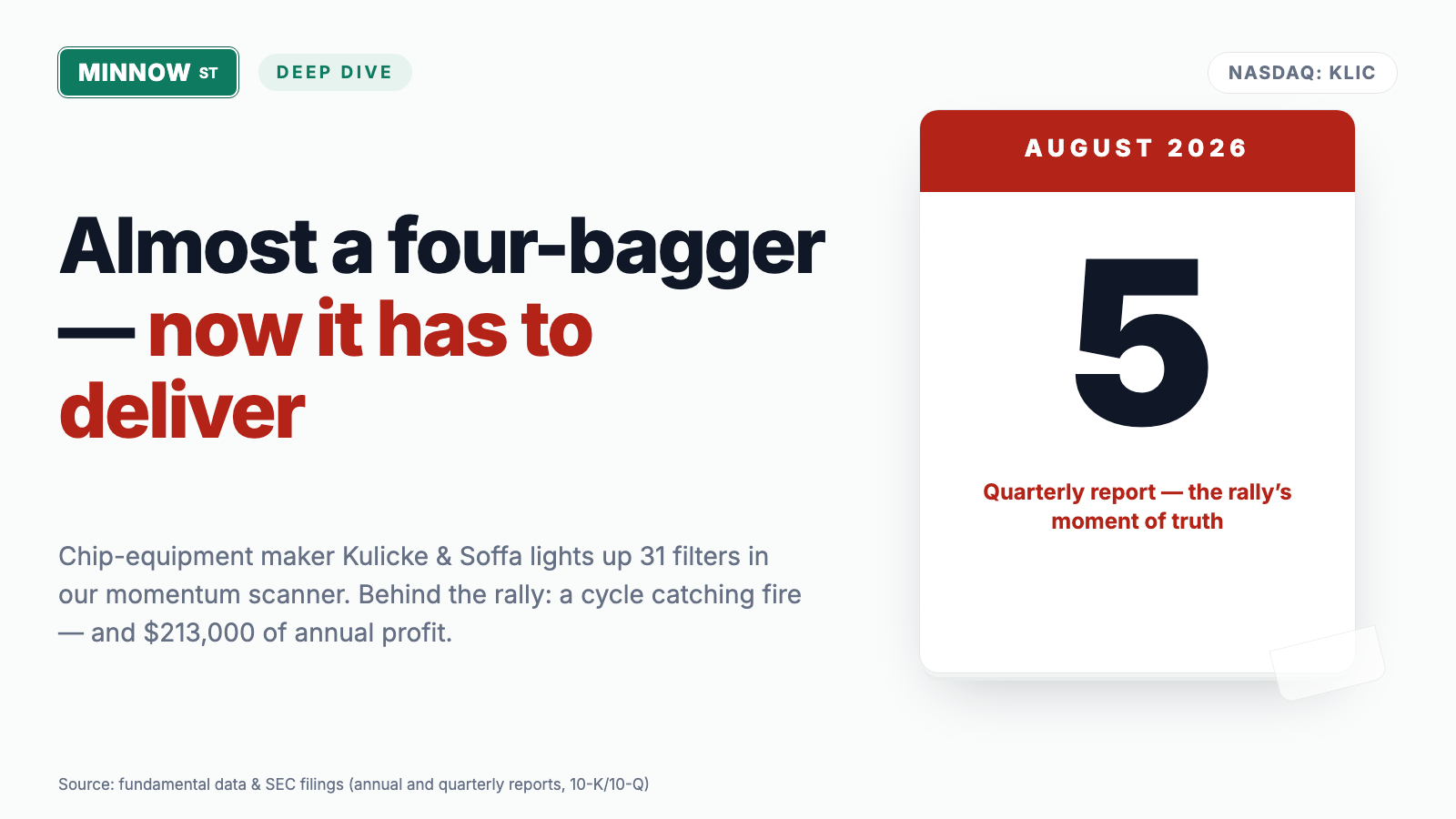
Back to the chase trap from the opening. Its trick is not luring you into bad companies — it is often precisely the good stories with the real upswings that run fastest. Its trick is letting you answer the entry question with the rear-view mirror: plus 180 percent feels like proof. The filings hand you a sober calculation instead. On the credit side: a genuine, core-business-driven cycle turn with 49.8 percent quarterly growth, an order cushion, a cleaned-up cost base, almost half a billion dollars of cash, and a world currently building memory and AI capacity like rarely before. On the debit side: a price that pre-pays 39 times an estimated profit, more than half of revenue caught between Washington and Beijing, three customers as the load-bearing wall, an open CEO search — and the certainty, from the company’s own annual report, that every “aggressive” customer investment phase so far has been followed by a phase of excess supply. On August 5, 2026 the next quarterly report is scheduled — not a day of destiny, but the first of many moments of truth at which this price has to prove it is not a rear-view-mirror product. You can take this bet; it is better underpinned than most momentum stories. But if you take it, take it because of the order books — not because of the curve. What you make of it is your decision. And that is exactly as it should be.
Sources
All original documents used in this analysis — for your own reading:
- Kulicke and Soffa Industries, Inc. — SEC annual report 10-K for fiscal year 2025 (ended October 4, 2025; filed November 20, 2025)
- Kulicke and Soffa Industries, Inc. — SEC annual report 10-K for fiscal year 2024 (ended September 28, 2024; filed November 14, 2024)
- Kulicke and Soffa Industries, Inc. — SEC annual report 10-K for fiscal year 2023 (ended September 30, 2023; filed November 16, 2023; fiscal 2021/2022 figures)
- Kulicke and Soffa Industries, Inc. — SEC quarterly report 10-Q as of April 4, 2026 (filed May 7, 2026)
- Kulicke and Soffa Industries, Inc. — SEC quarterly report 10-Q as of January 3, 2026 (filed February 5, 2026)
- Kulicke and Soffa Industries, Inc. — SEC quarterly report 10-Q as of June 28, 2025 (filed August 6, 2025)
- Kulicke and Soffa Industries, Inc. — SEC quarterly report 10-Q as of March 29, 2025 (filed May 7, 2025)
- Kulicke and Soffa Industries, Inc. — Response letter (CORRESP) to the SEC dated March 19, 2026 regarding Form 10-Q as of January 3, 2026
- Kulicke and Soffa Industries, Inc. — 2026 annual meeting proxy statement (DEF 14A; filed January 22, 2026; leadership history)
- Complete SEC filing history: EDGAR overview for Kulicke and Soffa Industries, Inc. (sec.gov)
- Fundamental data (metrics, quarterly series, valuation, analyst estimates; data as of July 8, 2026), reconciled against the SEC filings.
- Screener and rating data: in-house stock scanner, momentum run with 31 hits (as of July 17, 2026).
Transparency & disclaimer: This analysis is a journalistic contextualization of publicly available information and is not investment advice, not a financial analysis in the regulatory sense, and not a solicitation to buy or sell securities. Stock investments carry substantial risks up to and including total loss. All information without guarantee; the data cut-off is noted in the text throughout. The author holds no position in Kulicke & Soffa shares at the time of publication.
Our Bottom Line at a Glance
- Cycle turn & order intake positive
- Revenue up 49.8 percent to $242.6 million in the second quarter of fiscal year 2026, ball bonding up 141.7 percent, memory revenue up elevenfold; fiscal 2025 bookings up 74 percent, backlog up 65 percent (10-Q as of 04/04/2026, 10-K FY 2025) — the turn comes from the core business.
- Balance sheet & capital returns positive
- $487.9 million in cash and investments against zero bank debt, a 72 percent equity ratio, Altman Z around 14; a $0.205 quarterly dividend and a $300 million buyback frame — though the buyback machine effectively stopped in the rally quarter ($0.1 million).
- China & customer concentration negative
- 54.6 percent of quarterly revenue from customers headquartered in China, three customers at roughly 39 percent of first-half revenue, Huatian at 29.6 percent of receivables — squarely within the reach of U.S./China export-control policy (10-Q as of 04/04/2026; 10-K FY 2025, Item 1A).
- Cyclicality & earnings history negative
- Minus 57 percent of revenue from peak (FY 2021) to trough (FY 2025), fiscal 2025 net income of $213,000 shaped by one-offs in both directions (the $86.2 million walk-away payment, $87.5 million EA wind-down); an EPS rating of 6 out of 99 — the earnings base beneath the rally is young and thin.
- Leadership & governance neutral
- CEO retirement effective December 1, 2025; since then CFO Lester Wong has led in a dual role as interim CEO, with the successor search open (10-K FY 2025, Note 18); plus an SEC comment letter of March 2026 about explanation gaps in the numbers work — routine, but no tailwind.
- Valuation & technicals neutral
- 31 hits in the momentum run (as of July 17, 2026), a stage-2 trend, relative strength of 97, about 3 percent below the all-time high — against a forward P/E around 39 (FY 2026 estimates) and a P/S around 9 (data as of July 8, 2026): the market pays for the upswing’s continuation in advance.
Kulicke & Soffa delivers the rare combination of a genuine, core-business-driven cycle turn (quarterly revenue up 49.8 percent, bookings up 74 percent) and a fortress balance sheet with almost half a billion dollars of net cash. Against that stand a price that pre-pays the continuation at 39 times estimated earnings, more than half of revenue with customers headquartered in China, three names as the load-bearing wall of the growth, an open CEO succession — and the certainty, documented in the company’s own annual report, that every aggressive customer investment phase so far has been followed by a phase of excess supply. Not investment advice.
What Our Rating Means
- If you don't own the stock
- As long as the question raised in the bottom line stays open, we see no basis for an entry.
- If you hold it in your portfolio
- Our findings offer no acute reason to sell — the checkpoints named remain decisive.
A journalistic assessment by our editorial team at the time of the deep dive, based on public sources — not investment advice and not a solicitation to buy or sell. Your personal circumstances (investment goals, risk capacity, taxes) cannot be taken into account. What our categories mean, how verdicts are formed, and what conflicts of interest exist →
Worth Noting
- KLIC reached the research list via the momentum/stage-2 run of our in-house stock scanner on July 17, 2026 (31 hits, including Stan Weinstein stage 2, RS leader ≥90, the Minervini trend template and pros 80 percent) — not via news flow or forum hype.
- Scanner metrics (P/E, P/S, EPS rating, Piotroski, Altman Z) are computed on trailing twelve-month figures; they contain the one-off effects of the restructuring years (Project W reimbursement, EA wind-down) — and, by nature, not a possible further cycle push.
- Price and valuation figures dated July 8, 2026 (about $131.50, roughly $6.9 billion market value); analyses are evergreen, daily prices are not a buy argument. The fiscal year ends in early October — all quarterly references carry the fiscal-year offset.
Frequently Asked Questions
Kulicke and Soffa Industries, Inc. (Nasdaq: KLIC) builds assembly machines for the chip industry — above all wire bonders that electrically connect chips to their packages with hair-thin gold or copper wire (ball and wedge bonding), plus advanced-packaging systems (thermo-compression bonding) and a spares, tools and services business (APS). Customers are chipmakers (IDMs), outsourced assembly and test providers (OSATs) and foundries. Revenue in fiscal year 2025 (ended October 4, 2025): $654.1 million.
The fiscal year ends in early October — fiscal year 2025 ended on October 4, 2025, fiscal year 2024 on September 28, 2024. The "second quarter of fiscal year 2026" therefore covers January through April 2026. If you compare KLIC figures with calendar-year figures of other companies, keep this one-quarter offset in mind.
The semiconductor cycle has turned: in the second quarter of fiscal year 2026 (through April 4, 2026), revenue grew 49.8 percent to $242.6 million, the core ball bonding business 141.7 percent, and memory revenue rose elevenfold; already in fiscal 2025, bookings climbed 74 percent. The stock therefore appeared in 31 filters of our in-house stock scanner’s momentum run of July 17, 2026, with a relative strength of 97 (data as of July 8, 2026).
Heavily: 54.6 percent of revenue in the quarter ended April 4, 2026 came from customers headquartered in China, per the quarterly report (prior year: 45.8 percent). Three customers — Tianshui Huatian, Haoseng and Changjin Shanghai — accounted for roughly 39 percent of revenue in the first half of fiscal 2026; Huatian alone for 29.6 percent of receivables. The annual report explicitly names the trade and export control policies of the U.S. and China as a risk.
A development project for advanced-display technology with a mega-customer the filings never name. The customer cancelled the project in fiscal year 2024; Kulicke & Soffa wrote off $104.7 million and in return received a contractually agreed payment of $86.2 million — of which $71.1 million flowed into fiscal year 2025 as a "gain relating to cessation of business" (10-K, Note 17).
Very solid: as of April 4, 2026, the books showed $487.9 million in cash and short-term investments and no bank debt; equity stood at $857.5 million against $1,186.0 million in total assets (a 72 percent equity ratio). On top come a quarterly dividend of $0.205 per share and a $300 million share repurchase program running through December 2029.
By classic yardsticks, no: the trailing price-to-earnings ratio sits near 120 — distorted by one-off effects of the restructuring years — and the price-to-sales ratio around 9 (data as of July 8, 2026). On analyst estimates for fiscal years 2026/2027 ($3.36 and $4.24 per share), the forward P/E works out to roughly 39 and 31. The market is thus already paying for a vigorous continuation of the cycle upswing, not for the present.
Found an error?
Did you spot a factual error, an outdated number, or a typo in this deep dive? Let us know briefly — your report goes straight to the editorial team.