MasterCraft: Two Boatyards, One Stock — and 8.09 Million New Shares
MasterCraft builds recreational powerboats, and net sales from continuing operations fell from $609.9 million in fiscal 2023 to $284.2 million in fiscal 2025. On May 15, 2026, the company answered that decline by buying rival Marine Products, owner of the Chaparral and Robalo brands: 0.232 of its own shares plus $2.43 in cash for each Marine Products share, adding up to 8,088,387 new shares and $85.2 million out of the bank account. Shares outstanding rose from 16,279,890 to roughly 24.37 million — nearly half again as many. In the company's own pro forma math, earnings per share fall from $0.65 to $0.55 for fiscal 2025. The stock reached our desk at rank 47 in our in-house Big Earnings Surprise ranking (U.S. selection, as of July 25, 2026). Not investment advice — just the question of who owns how much of the company now.
 Thomas Mücke
Founder & Publisher
Thomas Mücke
Founder & Publisher
Chart
Interactive price chart (TradingView).
Note: pure fact-based analysis, not investment advice and not a solicitation to buy or sell. All figures without guarantee.
There is an investor trap that arrives disguised as good news: the bigger-feels-safer trap. It works like this. A company shrinks, which is uncomfortable to read about. Then it buys a competitor, and suddenly the press release talks about "more than doubling consumer reach," "complementary dealer networks," "a diversified portfolio of leading brands." The mind exhales and concludes: good, we are heading back up. The question that gets lost is a very simple one: what was it paid with? At MasterCraft Boat Holdings (NASDAQ: MCFT) of Vonore, Tennessee, the answer is $85.2 million out of the bank account and 8,088,387 newly issued shares — on top of 16,279,890 that already existed. So let us make a deal: before you read the merger announcement as a turning point, we will read together what the company itself told the U.S. securities regulator, the SEC — the annual report (10-K), the quarterly report (10-Q) as of March 29, 2026, and the four current reports (8-K) around the merger. An SEC filing is honest under penalty of law. What you do with it is your call.
What MasterCraft actually does — five boat brands and a dealer network
MasterCraft builds recreational powerboats. Not yachts, not freighters: boats for a Saturday on the lake. Until the merger there were two reportable segments. The MasterCraft segment builds ski and wake boats — heavy inboard craft with ballast tanks that shape a surfable wave at the push of a button; citing Statistical Surveys data as of March 2025, the annual report places the brand first in its category with a 19.2 percent share. The Pontoon segment builds pontoon boats under the Crest and Balise brands — flat family boats on aluminum floats; Crest ranks eleventh there with 3.0 percent. As of June 30, 2025 the company employed about 700 people, 500 of them in Tennessee and 200 in Michigan.
The boats are not sold to you directly but to independent dealers: 82 MasterCraft dealers across 129 locations and 126 pontoon dealers across 156 locations as of June 30, 2025. Those dealers do not pay out of pocket; they use floor plan financing, where a finance company pays for the boat and the dealer repays once it sells. For MasterCraft that carries a flip side spelled out in the annual report: if a dealer defaults, the manufacturer may have to repurchase the unsold boats, generally for up to 30 months from the date of financing. The report notes no material impact from repurchase events in fiscal 2023, 2024 or 2025. The ten largest dealers accounted for roughly 34 percent of net sales in fiscal 2025, with none individually above 10 percent.
One detail up front, because it causes confusion elsewhere: many data services still list the company as "MCBC Holdings." That is the old name. The annual report puts it plainly: "Effective November 7, 2018, the name of the Company was changed from MCBC Holdings, Inc. to MasterCraft Boat Holdings, Inc." — the SEC carries "MCBC Holdings, Inc." only as a former name. With that, the central tension of this analysis is on the table, and it runs through every chapter: a company whose revenue more than halved in two years buys a second company — and pays with nearly half of itself.
How the stock reached our desk
MasterCraft landed on the research list at rank 47 in our in-house Big Earnings Surprise ranking (U.S. selection), as of July 25, 2026 — you can retrace it in our in-house stock scanner for large earnings surprises. That filter looks for companies whose actual earnings per share came in well above the analyst consensus. These lists are recomputed daily, so the rank is a dated snapshot rather than a standing fact.
The trigger was the third quarter of fiscal 2026, which ended on March 29, 2026 and was reported on May 7, 2026: adjusted earnings came in at $0.45 per share against a consensus of $0.35 — a surprise of roughly 29 percent. And it was not a one-off: in each of the last nine reported quarters, adjusted earnings per share exceeded the consensus estimate (data as of July 25, 2026). What that metric does not measure is whether the business is growing. In the same quarter MasterCraft shipped 571 boats against 619 a year earlier — 7.8 percent fewer. Net sales still rose 3.0 percent to $78.2 million, because revenue per boat climbed from $123 thousand to $137 thousand. An earnings surprise therefore says: the company did better than feared. It does not say the company is growing. That distinction carries the rest of this analysis.
The numbers over the years — honestly credited
First, what genuinely impresses. MasterCraft rode out a brutal downturn without taking on debt. As of March 29, 2026 the balance sheet held $75.4 million of cash and $9.2 million of short-term investments — $84.6 million together — with nothing drawn under the revolving credit facility. Equity stood at $189.3 million, above the level twelve months earlier. And the margins are coming back: in the third quarter of fiscal 2026 gross margin reached 25.0 percent against 20.8 percent a year earlier, and 23.0 percent versus 18.8 percent across nine months. Adjusted earnings before interest, taxes, depreciation and amortization rose from $7.5 million to $10.7 million in the quarter, lifting that margin from 9.9 percent to 13.7 percent.
Now the curve that frames everything — net sales from continuing operations, meaning without the divested NauticStar and Aviara brands:
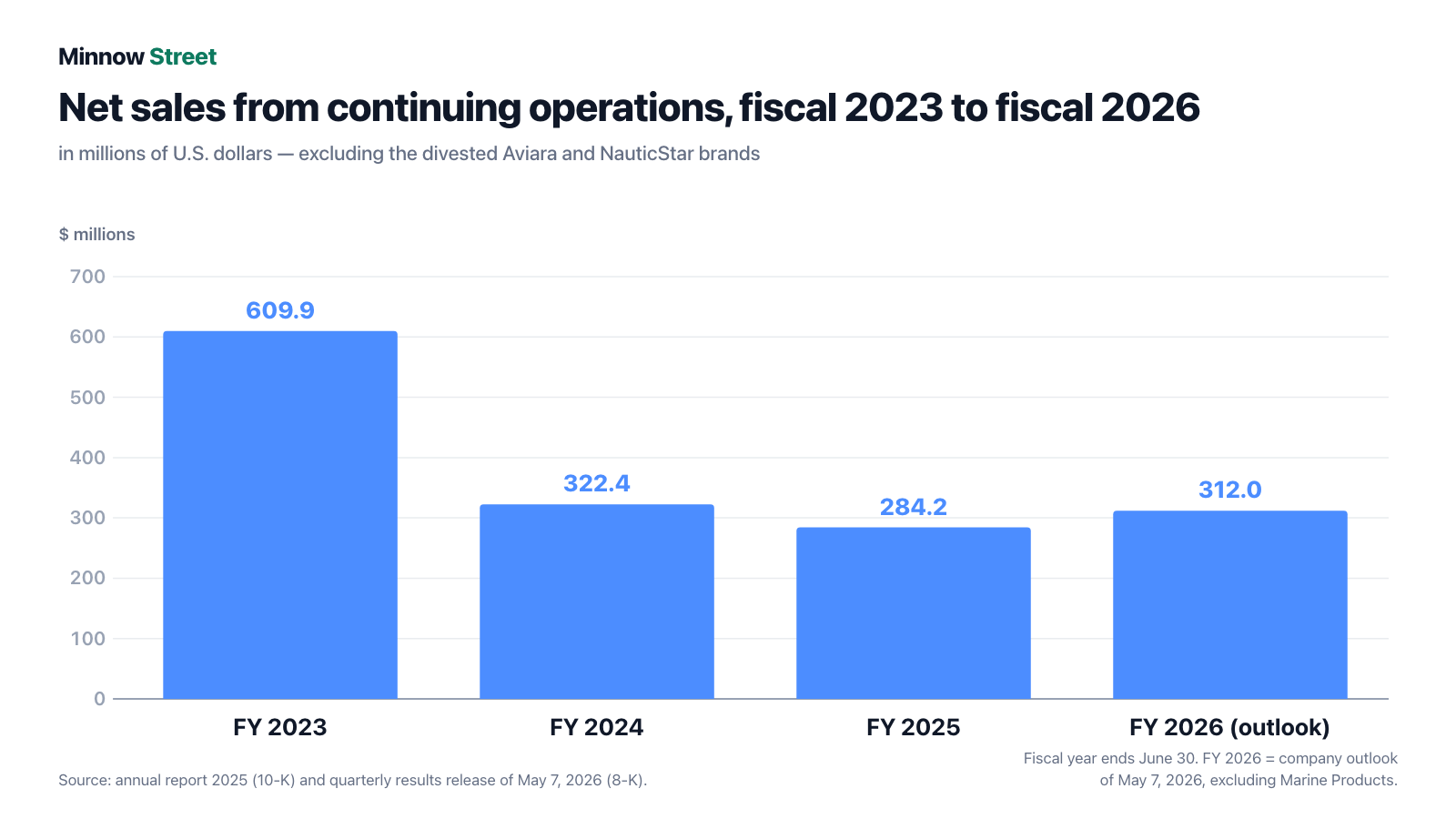
In plain terms: in fiscal 2023 MasterCraft sold $609.9 million of boats and earned $93.8 million from continuing operations — $5.28 per diluted share. Two years later it was $284.2 million of net sales and $10.7 million of earnings, or $0.65 per share. Unit volume fell from 2,996 boats in fiscal 2024 to 2,293 in fiscal 2025. That is the discretionary cycle in its purest form: anyone buying a $150,000 boat postpones the purchase the moment rates rise and sentiment turns. Over the same stretch the company shed two brands — NauticStar in fiscal 2023 at a $22.5 million loss on the sale, and the Aviara segment, which took a $9.8 million impairment in fiscal 2024 before the brand went to MarineMax in October 2024 and the facility was sold in December 2024 for $26.1 million net. Remember the picture: this company survived the downturn by getting smaller, not by borrowing. And then came the merger.
What the filings say — the uncomfortable truths
Uncomfortable truth no. 1: it was paid for with nearly half the company
On February 5, 2026, MasterCraft signed a merger agreement with Marine Products Corporation, maker of the Chaparral (recreational) and Robalo (sport fishing) brands out of Nashville, Georgia. The deal closed on May 15, 2026. The price is in the completion report:
"each share of Marine Products common stock issued and outstanding immediately prior to the First Effective Time … was converted automatically into the right to receive (i) 0.232 shares of MasterCraft common stock and (ii) $2.43 in cash, without interest"
— MasterCraft Boat Holdings, Inc., Form 8-K filed May 15, 2026, Item 2.01

The amendment filed June 12, 2026 does the arithmetic: 8,088,387 new MasterCraft shares, valued at the May 14, 2026 closing price of $24.64, come to $199.3 million of stock consideration, plus $85.2 million in cash. Preliminary total consideration: $284.5 million. Per the joint press release of February 5, 2026, legacy MasterCraft holders own 66.5 percent of the combined company afterwards and the Marine Products side 33.5 percent. In everyday terms: your slice of the pie is now only two-thirds the size it was — in exchange for a bigger pie. Whether that trade pays depends entirely on how much the acquired half earns.
Uncomfortable truth no. 2: in the company's own pro forma math, earnings per share fall
MasterCraft has to publish that math itself, and it sits in the June 12, 2026 amendment. It shows what the combined company would have looked like had it existed earlier. For fiscal 2025, net sales would have been $508.6 million instead of $284.2 million — an enormous step up. Earnings from continuing operations would have risen from $10.7 million to $13.6 million. And earnings per share? Those would have fallen from $0.65 to $0.55, because the share count rises from 16.4 million to 24.5 million. For the first nine months of fiscal 2026 the pattern repeats, only sharper: $0.23 diluted instead of $0.33.
Management does not dispute this. It promises improvement expressly on adjusted earnings per share and expressly only for fiscal 2027. The annual saving it names is roughly $6 million, and it comes from eliminating the costs Marine Products carried as a standalone public company. Manufacturing synergies are in neither number; the pro forma statements say themselves that they reflect neither synergies nor integration costs. The takeaway: revenue nearly doubles, earnings per share do not.
Uncomfortable truth no. 3: years of buybacks, more than undone in a single day
MasterCraft long did what shareholders like to see: it bought back its own stock. In fiscal 2024 that meant 750,943 shares for $16.3 million, in fiscal 2025 another 531,970 shares for $9.5 million — together 1,282,913 shares for $25.8 million. The first nine months of fiscal 2026 added 116,370 shares for $2.3 million, and the third quarter added none at all.

Then came May 15, 2026. On that one day MasterCraft issued 8,088,387 new shares — more than six times what it had repurchased across two fiscal years. The whole movement in one picture:
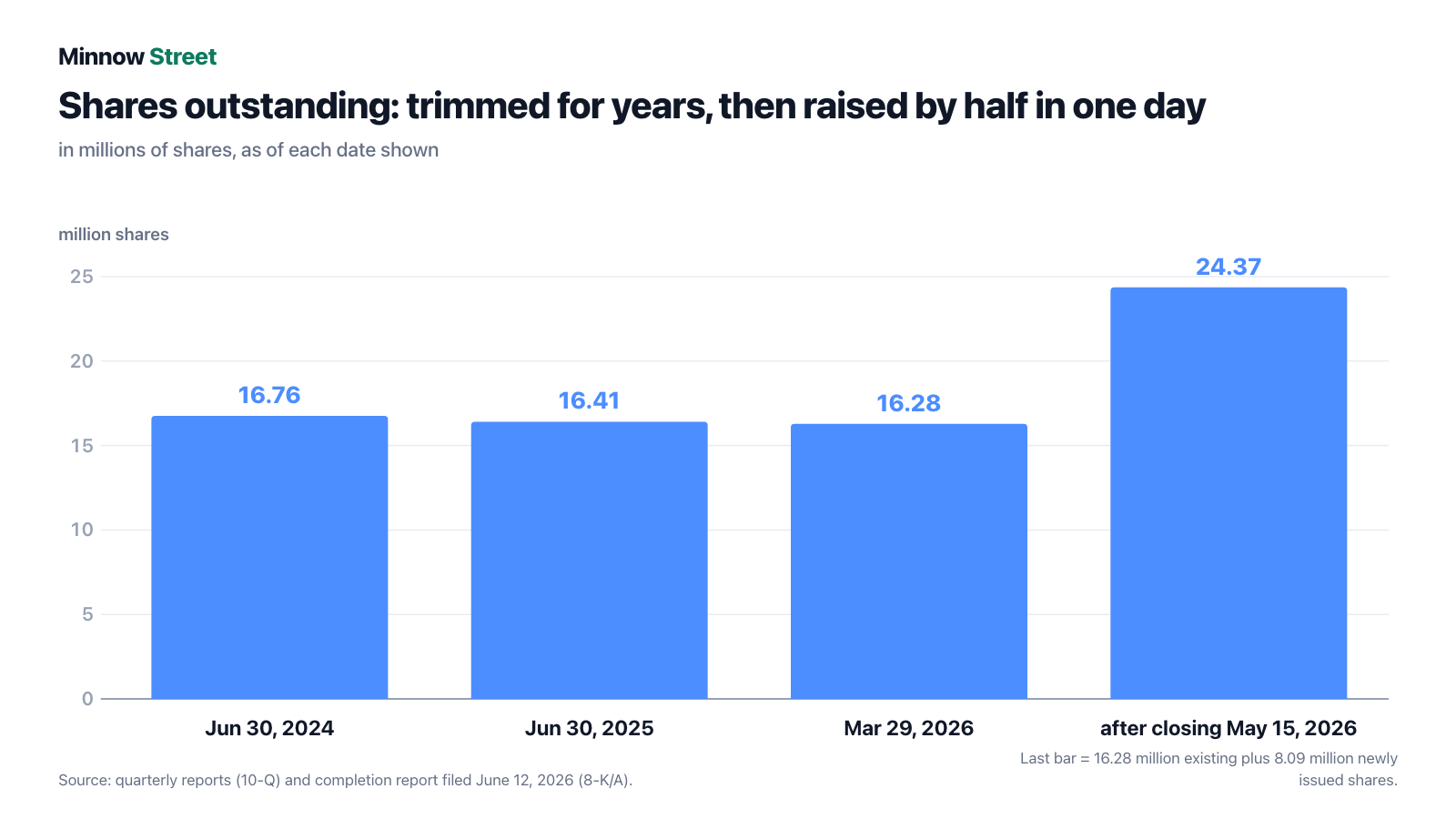
This is not an accusation — paying for an acquisition in stock can be smart when the target adds more value than the ownership it costs. But it is a reversal in capital allocation, and it deserves to be read consciously. The buyback program still had $23.5 million of authorization left as of March 29, 2026. After the merger, that authorization faces a considerably thinner bank account.
Uncomfortable truth no. 4: the cash is the real price
The $85.2 million cash component did not come from a bank; it came from the company's own account. The joint press release said so: "The transaction is expected to be financed through combined cash on hand." The pro forma balance sheet as of March 29, 2026 shows the result: cash falls from $75.4 million standalone to $30.5 million — even though Marine Products brought $45.8 million of its own cash. The amendment quantifies the outflow as $90.7 million for the cash consideration, $4.5 million of transaction costs and $1.0 million for a six-year prepaid tail policy covering Marine Products directors and officers.

At the same time MasterCraft reshaped its credit facility. The fifth amendment to the credit agreement, dated February 5, 2026, reduces the revolving commitments from $100 million to $75 million, extends the maturity to 2031, raises the uncommitted accordion capacity to as much as $100 million, and replaces one financial covenant with an interest coverage ratio of at least 3.00 to 1.00. The cushion therefore gets smaller on one side and more flexible on the other. If you carried "debt free with a fat bank account" in your head, update the second half: debt free yes — fat bank account only conditionally.
Uncomfortable truth no. 5: the fiscal year moves, and comparability moves with it
Six weeks after closing came a filing that is easy to miss but cuts through every time series:
"On June 30, 2026, the Board of Directors (the “Board”) of MasterCraft Boat Holdings, Inc. (“MasterCraft” or “the Company”) approved a change in the Company’s fiscal year end from June 30 to December 31. The fiscal year change will be effective July 1, 2026."
— MasterCraft Boat Holdings, Inc., Form 8-K filed June 30, 2026, Item 5.03

In practice: the fiscal year from July 1, 2025 to June 30, 2026 still gets a normal annual report on Form 10-K. After that comes a quarterly report for July 1 to October 4, 2026 and a transition report on Form 10-KT covering only six months, July 1 to December 31, 2026. The first full fiscal year under the new calendar is 2027, and the next annual meeting is scheduled for May 2027. Anyone comparing "annual revenue" going forward will, for one cycle, be comparing twelve months with six. There is nothing devious about it — aligning with the calendar year Marine Products already used is the obvious move. It is simply a trap for anyone who lines up numbers from two sources without checking.
One side note on the merger period: a shareholder sued in the Delaware Court of Chancery in February 2026 over a clause in the stockholders agreement. MasterCraft removed the clause in March, the court closed the action on May 19, 2026, and the company paid $425 thousand in plaintiff attorneys' fees without admitting any liability. Measured against the balance sheet the amount is small; as an indication of how tightly the governance commitments to the new shareholder group were drawn, it is worth reading.
Valuation — what the market pays for the new company
As of July 25, 2026 the market capitalization stood at roughly $588 million. Cross-check using numbers from primary documents: 24.37 million shares at the May 14, 2026 closing price documented in an SEC filing ($24.64) come to about $600 million — the two figures sit a little more than two percent apart, so the market capitalization holds up.
What matters now is what you divide it by, and this is where the biggest error creeps in:
- Against MasterCraft's own net sales ($284.2 million in fiscal 2025) the price-to-sales ratio is a little above 2.
- Against combined pro forma net sales for the same year ($508.6 million) it is only about 1.2.
- Against the roughly $560 million both companies expected for the twelve months ending June 30, 2026, it is about 1.05.
The same applies to earnings. The companies expected combined adjusted earnings before interest, taxes, depreciation and amortization of about $64 million. Subtract the $30.5 million of pro forma cash from the $588 million market capitalization, carry no financial debt, and enterprise value lands near $557 million — roughly 8.7 times that figure. For context: MasterCraft paid about 7.2 times for Marine Products itself. The market therefore values the combined company slightly above what the buyer paid for the target — no bargain, but no excess either.
A conventional price-to-earnings ratio, by contrast, is misleading right now: reported trailing earnings per share come almost entirely from the pre-merger period, while the share count is already half again as large. The forward view is more useful. Consensus for the fiscal year ending June 30, 2027 stands at $1.975 in earnings per share on $604.6 million of revenue (data as of July 25, 2026) — against the dated price anchor of $24.27 that implies a multiple of roughly 12. The professionals are notably reserved: five firms cover the stock, with one buy and four hold ratings, and an average price target of $27.60. Anyone who follows discretionary cyclicals knows why: near the trough the multiples look cheap because earnings are depressed, and expensive as soon as earnings return. We ran a comparable calculation for another consumer cyclical manufacturer in our Flexsteel analysis, and how tightly leisure spending tracks interest rates is laid out in our Vail Resorts analysis.
Opportunities and risks at a glance
Opportunities
- The combined company is roughly 80 percent larger by revenue than MasterCraft alone ($508.6 million versus $284.2 million on a pro forma basis for fiscal 2025), and the product range now spans four categories rather than two: ski and wake, pontoons, recreational boats (Chaparral) and sport fishing boats (Robalo).
- Margins are measurably recovering: gross margin of 25.0 percent versus 20.8 percent in the third quarter of fiscal 2026, adjusted EBITDA margin of 13.7 percent versus 9.9 percent — achieved with falling unit volume, so from price and cost discipline.
- No financial debt, a revolving facility of $75 million extended to 2031, and uncommitted accordion capacity of up to $100 million.
- Roughly $6 million of annual savings is already identified and comparatively safe, because it comes from eliminating Marine Products' public company costs rather than from manufacturing synergies that still have to be proven.
- Expectations are set low: in each of the last nine reported quarters, adjusted earnings per share exceeded the consensus estimate (data as of July 25, 2026).
Risks
- Earnings per share fall in the company's own pro forma math ($0.65 to $0.55 for fiscal 2025); improvement is promised only on the adjusted figure and only from fiscal 2027.
- Goodwill and other intangible assets together come to $235.8 million pro forma — 47 percent of the $504.3 million balance sheet. The allocation is preliminary and will be finalized within one year of closing. In fiscal 2023 and 2024 the company wrote off $22.5 million and $9.8 million respectively on divested brands.
- Pro forma cash drops from $75.4 million to $30.5 million. Further buybacks or acquisitions are unlikely for now, even though $23.5 million of authorization remains.
- Almost a fifth of the stock sits with a single ownership group (LOR, Inc.: 19.6 percent per the Schedule 13D of May 22, 2026), whose lock-ups expire after six and twelve months and for whom a resale registration is promised within 120 days of closing.
- The business stays cyclical and dealer-dependent: the ten largest dealers accounted for roughly 34 percent of fiscal 2025 net sales, and a dealer default can trigger an obligation to repurchase unsold boats.
- The time series breaks: after the fiscal 2026 annual report comes a transition report covering only six months, and only calendar 2027 is a full comparison year again.
A human conclusion
We started with the bigger-feels-safer trap: the reflex to read a merger announcement as a turning point. After working through the filings, a soberer picture remains. MasterCraft is a competently run boat builder that came through a hard cycle without debt, whose margins are recovering, and that bought two established brands in Chaparral and Robalo at a price that does not look stretched. That is more than many cyclicals in this position can show.
And at the same time, the very same transaction did three things that get lost in the applause. It raised the share count by nearly half, drained two-thirds of the cash, and converted almost half the balance sheet into items whose value depends on future demand for recreational boats. Earnings per share fall in the company's own model — not because the business got worse, but because the pie is now cut into more slices. Whether the new slices end up larger than the old ones will first be hinted at in the fiscal 2026 annual report and only become visible in the transition report for July to December 2026.
What you make of that is your decision. And that is exactly as it should be.
Sources
- Quarterly report on Form 10-Q as of March 29, 2026 (filed May 7, 2026) — most recent periodic report: net sales, margins, share count, buyback program, merger status
- Annual report on Form 10-K for fiscal 2025 (filed August 27, 2025) — business model, dealer network, employees, name change, discontinued operations
- Annual report on Form 10-K for fiscal 2024 (filed August 30, 2024)
- Form 8-K filed February 5, 2026 — merger agreement (Item 1.01), fifth credit agreement amendment (Item 2.03), executive severance plan (Item 5.02)
- Joint press release of February 5, 2026 (exhibit 99.2) — transaction value, ownership split, expected combined metrics
- Quarterly results release of May 7, 2026 (exhibit 99.1) — third quarter fiscal 2026 results and outlook
- Form 8-K filed May 15, 2026 — completion of the mergers (Item 2.01), board expansion (Item 5.02)
- Pro forma financial information in the Form 8-K/A of June 12, 2026 (exhibit 99.3) — combined balance sheet and statements of operations, purchase price allocation
- Form 8-K filed May 22, 2026 — closure of the Delaware Court of Chancery action
- Form 8-K filed June 30, 2026 — change of fiscal year end (Item 5.03)
- Schedule 13D filed May 22, 2026 — LOR, Inc. and the Rollins group
- Fundamental data: market capitalization, consensus estimates, analyst coverage and surprise history, data as of July 25, 2026
- Hook: rank 47 in our in-house Big Earnings Surprise ranking (U.S. selection), as of July 25, 2026 — the lists are recomputed daily
This article is journalistic analysis and not investment advice. It is not a solicitation to buy or sell securities. Share prices can move sharply and a total loss is possible. All figures come from the primary sources named above and carry the stated as-of dates; they are deliberately not real-time. The author holds no position in MasterCraft Boat Holdings, Inc. at the time of publication.
Our Bottom Line at a Glance
- Operating recovery positive
- Margins are coming back even as fewer boats ship: gross margin of 25.0 percent in the third quarter of fiscal 2026 against 20.8 percent a year earlier, and an adjusted EBITDA margin of 13.7 percent versus 9.9 percent — on 571 units shipped instead of 619. Net sales per boat rose from $123 thousand to $137 thousand.
- Balance sheet and financing capacity neutral
- As of March 29, 2026 nothing was drawn on credit lines, with $84.6 million of cash and short-term investments and $189.3 million of equity. After the merger, pro forma cash falls to $30.5 million and the revolving facility was cut from $100 million to $75 million, though extended to 2031. Debt free yes, cushion notably thinner.
- Dilution from the merger negative
- On May 15, 2026 the company issued 8,088,387 new shares, lifting the count from 16,279,890 to roughly 24.37 million. In its own pro forma statements, earnings per share from continuing operations fall from $0.65 to $0.55 for fiscal 2025 and from $0.33 to $0.23 diluted for the first nine months of fiscal 2026. For scale: fiscal 2024 and 2025 together retired 1,282,913 shares for $25.8 million.
- Balance sheet quality after the deal negative
- Goodwill and other intangible assets total $235.8 million pro forma, or 47 percent of the $504.3 million balance sheet. The purchase price allocation is expressly preliminary and will be finalized within one year of closing; the $92.8 million of goodwill is not expected to be deductible for tax purposes. The company booked a $22.5 million loss on the NauticStar sale in fiscal 2023 and a $9.8 million Aviara impairment in fiscal 2024.
- Valuation neutral
- A market capitalization of roughly $588 million (data as of July 25, 2026) equals a little more than two times MasterCraft's standalone net sales but only about 1.2 times the combined pro forma figure of $508.6 million. Enterprise value sits near 8.7 times the expected combined adjusted EBITDA of $64 million — slightly above the 7.2 times MasterCraft paid for Marine Products. Five firms cover the stock: one buy, four hold, price target $27.60.
- Comparability of the reporting negative
- On June 30, 2026 the board moved the fiscal year end from June 30 to December 31, effective July 1, 2026. The fiscal 2026 annual report is followed by a transition report covering only six months (July to December 2026); only calendar 2027 is a full comparison year again. Meanwhile the share count is already up by half while the acquired brands contribute only a fraction of their revenue.
MasterCraft rode out a hard cycle without debt — net sales from continuing operations fell from $609.9 million in fiscal 2023 to $284.2 million in fiscal 2025, and margins have been recovering noticeably through fiscal 2026. The company answered with the acquisition of Marine Products and its Chaparral and Robalo brands, completed on May 15, 2026 and paid for with $85.2 million of cash and 8,088,387 new shares. Pro forma revenue climbs to $508.6 million, but earnings per share fall from $0.65 to $0.55, cash drops from $75.4 million to $30.5 million, and 47 percent of the balance sheet now consists of goodwill and intangibles whose allocation is still preliminary. On top of that the fiscal year moves, which renders every time series unusable for one cycle. Not investment advice.
What Our Rating Means
Open questions
The business works in principle, but one material question is open. As long as it stays open, our findings do not carry a quality verdict.
The business carries its own weight: MasterCraft leads its category with a 19.2 percent share in ski and wake boats, rode the drop in net sales from $609.9 million to $284.2 million (fiscal 2023 to fiscal 2025) without ever drawing on a credit line, and reported $84.6 million of cash and short-term investments plus $189.3 million of equity as of March 29, 2026; margins are coming back, with gross margin at 25.0 percent against 20.8 percent in the third quarter of fiscal 2026. Nothing in the filings threatens the substance of the company. What is open is a clearly operational question: earnings per share from continuing operations fell from $5.28 in fiscal 2023 to $0.65 in fiscal 2025, and the third quarter of fiscal 2026 carried a reported loss of $0.7 million — the turnaround out of the cycle is not yet proven. On top of that sits the Marine Products acquisition: its earnings contribution has not appeared in any report so far, pro forma cash falls from $75.4 million to $30.5 million, and 47 percent of the balance sheet consists of goodwill and intangible assets whose allocation is expressly preliminary — at a company that already wrote off $22.5 million and $9.8 million on divested brands in fiscal 2023 and fiscal 2024. That is not a threat to substance, but it is not proven quality either — hence yellow. The decision is yours.
A journalistic assessment by our editorial team at the time of the deep dive, based on public sources — not investment advice and not a solicitation to buy or sell. Your personal circumstances (investment goals, risk capacity, taxes) cannot be taken into account. What our levels mean, how verdicts are formed, and what conflicts of interest exist →
Worth Noting
- Hook: rank 47 in our in-house Big Earnings Surprise ranking (U.S. selection), as of July 25, 2026 — based on adjusted earnings of $0.45 per share in the third quarter of fiscal 2026 against a consensus of $0.35. The scanner lists are recomputed daily.
- As-of dates: SEC figures as of June 30, 2025 (fiscal 2025), March 29, 2026 (third quarter of fiscal 2026) and May 15, 2026 (merger closing); market and consensus data as of July 25, 2026. Deliberately no daily prices.
- Risk of confusion: market data services partly still list MCFT as "MCBC Holdings Inc". The change of name to MasterCraft Boat Holdings, Inc. was effective November 7, 2018; the SEC carries MCBC Holdings, Inc. only as a former name.
- A second risk of confusion: share counts in data feeds lag the merger. The authoritative figures are 16,279,890 shares per the quarterly report cover page (as of May 1, 2026) plus the 8,088,387 new shares disclosed in the amendment of June 12, 2026.
- All revenue and earnings series in this analysis refer to continuing operations, meaning without the divested NauticStar and Aviara brands, exactly as the fiscal 2025 annual report restates them.
Frequently Asked Questions
MasterCraft Boat Holdings, Inc. (NASDAQ: MCFT) of Vonore, Tennessee, builds recreational powerboats. The MasterCraft segment makes ski and wake boats and, citing industry data as of March 2025 in its annual report, held the top spot in its category with a 19.2 percent share; the Pontoon segment builds pontoon boats under the Crest and Balise brands. Since the merger closed on May 15, 2026, the Chaparral and Robalo brands from Marine Products have been added. Boats are sold through independent dealers, and the company employed about 700 people as of June 30, 2025.
MasterCraft Boat Holdings, Inc. — the MCBC Holdings name is outdated. The annual report records that the company was incorporated in Delaware as MCBC Holdings, Inc. on January 28, 2000, completed its initial public offering in July 2015, and changed its name to MasterCraft Boat Holdings, Inc. effective November 7, 2018. The SEC lists MCBC Holdings, Inc. only as a former name, through November 2, 2018. Several market data services nonetheless still display the old name.
Each Marine Products share converted into 0.232 MasterCraft shares plus $2.43 in cash. That came to 8,088,387 new MasterCraft shares, valued at $199.3 million using the May 14, 2026 closing price of $24.64, plus $85.2 million in cash — preliminary total consideration of $284.5 million. The joint press release of February 5, 2026 described a transaction value of $232.2 million net of acquired cash, or roughly 7.2 times Marine Products' expected earnings before interest, taxes, depreciation and amortization for the twelve months ending June 30, 2026.
Shares outstanding rose from 16,279,890 as of May 1, 2026 to roughly 24.37 million, an increase of about 49 percent. Per the joint press release, legacy MasterCraft holders own 66.5 percent of the combined company and the Marine Products side 33.5 percent. In the company's pro forma statements, earnings per share from continuing operations therefore fall from $0.65 to $0.55 for fiscal 2025 and from $0.33 to $0.23 diluted for the first nine months of fiscal 2026.
Through fiscal 2026 it ends on June 30. On June 30, 2026 the board approved moving the fiscal year end to December 31, effective July 1, 2026. A quarterly report will cover July 1 to October 4, 2026, and a transition report on Form 10-KT will cover just the six months from July 1 to December 31, 2026. The first full fiscal year under the new calendar is 2027, and the next annual meeting of stockholders is expected in May 2027.
Because recreational powerboats are a discretionary, cyclical product. Net sales from continuing operations fell from $609.9 million in fiscal 2023 to $322.4 million in fiscal 2024 and $284.2 million in fiscal 2025, while unit volume dropped from 2,996 to 2,293 boats between fiscal 2024 and fiscal 2025. On top of that, two brands were divested: NauticStar in fiscal 2023 and the Aviara segment, whose brand went to MarineMax in October 2024 and whose facility was sold in December 2024 for $26.1 million net.
As of March 29, 2026 nothing was drawn under the revolving credit facility, and the balance sheet held $75.4 million of cash plus $9.2 million of short-term investments. The fifth amendment to the credit agreement, dated February 5, 2026, reduces the revolving commitments from $100 million to $75 million, extends the maturity to 2031 and permits an uncommitted increase of up to $100 million. The cash portion of the merger came from combined cash on hand: pro forma cash as of March 29, 2026 falls to $30.5 million.
The largest single block came out of the merger. The Schedule 13D filed May 22, 2026 reports 4,792,761 shares, or 19.6 percent, for LOR, Inc., and 4,872,448 shares, or 19.9 percent, for the wider attribution group around the Gary W. Rollins Voting Trust. The board was expanded from seven to ten members, and the stockholders agreement lets the group nominate two directors while it holds at least 15 percent of the voting power. The shares are locked up in equal halves for six and twelve months after closing.
Found an error?
Did you spot a factual error, an outdated number, or a typo in this deep dive? Let us know briefly — your report goes straight to the editorial team.