Flexsteel Bought a Quarter of Itself — $60.2 Million to the Founding Family, Out of Cash and the Revolver
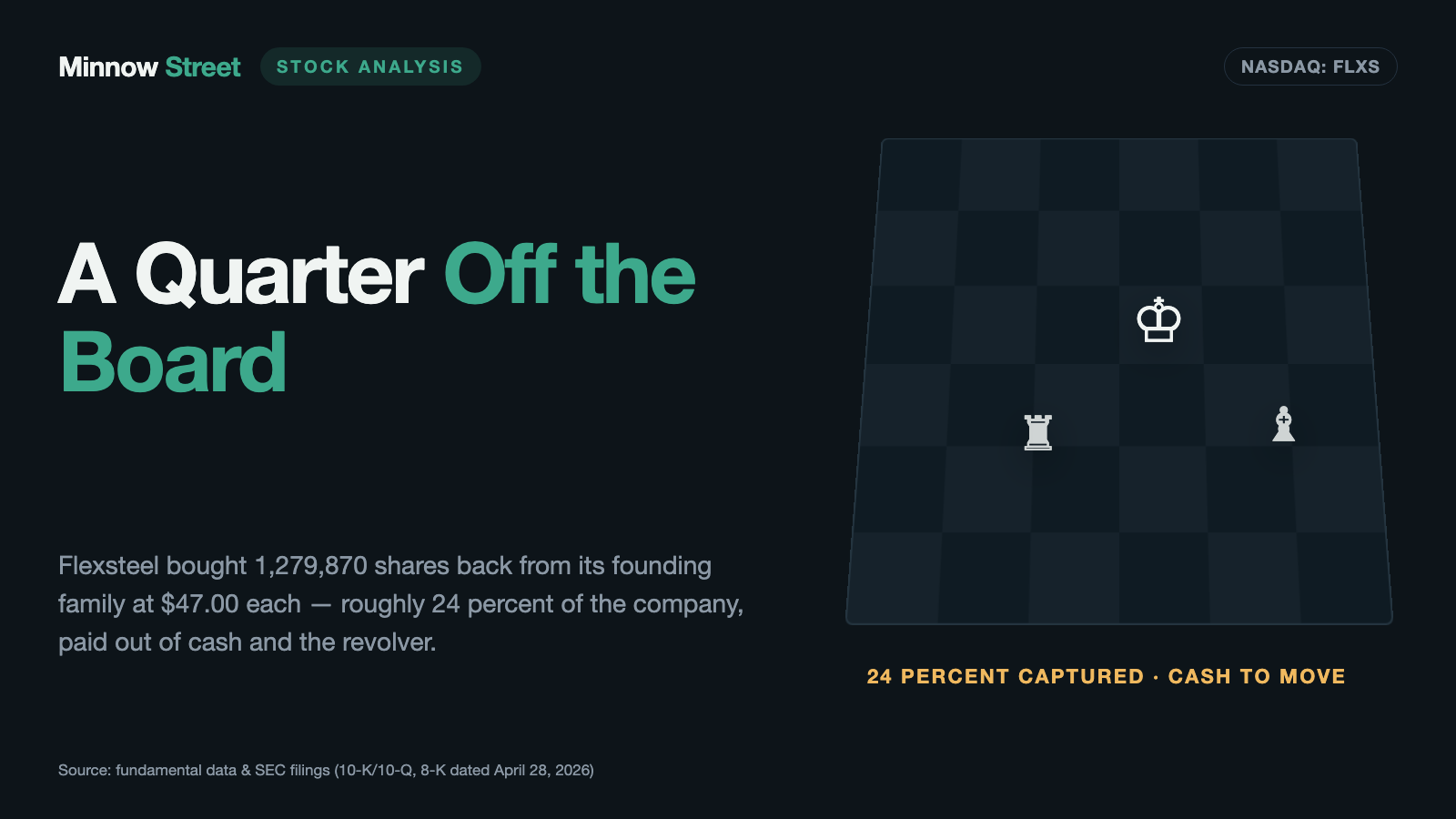
On April 26, 2026 Flexsteel signed an agreement that shrank the company by 24 percent in one stroke: 1,279,870 shares from the Bertsch founding family at $47.00 apiece, roughly $60.2 million — paid out of the cash pile and a credit line that had been untouched until then. Two days later the family's director stepped off the board. The Iowa furniture maker now faces an equation with two signs: earnings per share rise by roughly a quarter on paper, while the cushion against tariffs and soft demand has shrunk. We read the filings and sort out what is substance.
 Thomas Mücke
Founder & Publisher
Thomas Mücke
Founder & Publisher
Chart
Interactive price chart (TradingView).
Note: pure fact-based analysis, not investment advice and not a solicitation to buy or sell. All figures without guarantee.
There is an investor trap that feels like a virtue. Call it the buyback reflex. It works like this: you read that a company is repurchasing its own shares, and your mind immediately fills in "management thinks the stock is cheap." Sometimes that is true. Sometimes it only means somebody wanted out and the corporate treasury was the most convenient buyer. The difference turns on two questions that never make the headline: at what price? And: paid with what? Flexsteel Industries (NASDAQ: FLXS), a furniture maker in Dubuque, Iowa, signed an agreement on April 26, 2026 that poses both questions with unusual force: 1,279,870 shares from its own founding family, $47.00 apiece, roughly $60.2 million — by the company\'s own account about 24 percent of every share that existed immediately before. The stock reached us at rank 21 in our in-house Big Earnings Surprise ranking (U.S. selection, as of July 25, 2026). So here is the deal: before you file "24 percent bought back" under vote of confidence, let us read together what Flexsteel told the U.S. securities regulator, the SEC. The decision at the end is yours.
What Flexsteel Actually Does — Sofas, a Steel Spring and 130 Years of Dubuque
Flexsteel manufactures, imports and markets residential furniture: sofas, chairs, recliners, tables, bedroom and outdoor furniture. The everyday picture is unglamorous and, for that very reason, durable — it is the couch in the living room, bought at the local retailer or online. The name comes from a steel spring: the patented Blue Steel Spring has sat in the seating frame for generations and carries the promise that a sofa will not sag after three years. The company was founded in 1893 and describes itself as one of the largest manufacturers, importers and marketers of residential furniture in the United States.
The scale: roughly 1,400 employees as of June 30, 2025, of whom about 1,000 are in Mexico and around 30 in Asia. Production runs in three plants in Juárez, Mexico; a fourth leased plant in Mexicali sits idle — more on that shortly. Sourcing is concentrated in Vietnam, with China, Thailand and Mexico behind it. Flexsteel runs a single business segment, has minimal export sales and — a rare and welcome line — no single customer accounting for more than 10 percent of net sales. One word about the calendar, because otherwise every figure slips: the fiscal year ends June 30. "Fiscal 2025" means the twelve months to June 30, 2025; fiscal 2026 ended June 30, 2026, and the corresponding annual report is usually published in August and had not been filed when this analysis went to press.
That fixes the central tension of this analysis, and it runs through every chapter: Flexsteel bought a quarter of itself and paid for it with exactly the cushion that had absorbed its own risks so far — tariffs, swinging furniture demand, and a dead plant in Mexico.
Where the Stock Came Across Our Desk
Flexsteel sits at rank 21 in the U.S. selection of our in-house stock scanner for large earnings surprises (as of July 25, 2026), with a relative strength rating of 87 out of 100. To repeat the search: open the stock scanner section, pick the "Big Earnings Surprise" list, filter to the U.S. selection and read the ranking from the top. One thing to keep in mind: these lists are recalculated daily — today\'s rank is not tomorrow\'s.
What does the filter measure? It looks for companies whose actual earnings per share came in well above the analyst estimate. For Flexsteel, the quarter ended March 31, 2026 delivers a spectacular line: $1.14 in earnings per diluted share against a loss of $0.71 a year earlier. A textbook change of sign.
Now the translation, because naming a metric is not judging it. Two lines further down, the same press release gives the adjusted comparison: $1.14 versus $1.13 per share. One cent. Adjusted operating income was $8.2 million against $8.3 million — it fell 1 percent. The entire change of sign sits in a single prior-year figure, which we will come back to. Remember the sentence here: an earnings surprise measures the distance to the estimate, not the distance to last year — and certainly not operational improvement.
The Numbers Over the Years — Fairly Credited
First what genuinely impresses, and it is more than the base effect suggests. Flexsteel has been growing for three years, cleanly: $393.7 million in revenue in fiscal 2023, then $412.8 million (up 4.8 percent) and $441.1 million in fiscal 2025 (up 6.9 percent). The first nine months of fiscal 2026 brought $343.8 million, 5.3 percent more than the prior-year period. Rolled to twelve months through March 31, 2026 that is $458.4 million.
The earnings side looks better still. Operating income climbed from $10.5 million in fiscal 2023 through $17.1 million to $26.6 million in fiscal 2025 — and that despite the $14.1 million impairment booked in that year. Gross margin, what remains after materials and manufacturing, reached 22.9 percent of revenue in the nine months of fiscal 2026 against 21.6 percent a year earlier. Net income for the twelve months through March 31, 2026 works out at roughly $31.1 million. And cash from operating activities over the nine months, at $27.2 million, exceeded the accounting profit of $20.4 million — a good sign, because it means the earnings arrive as money.
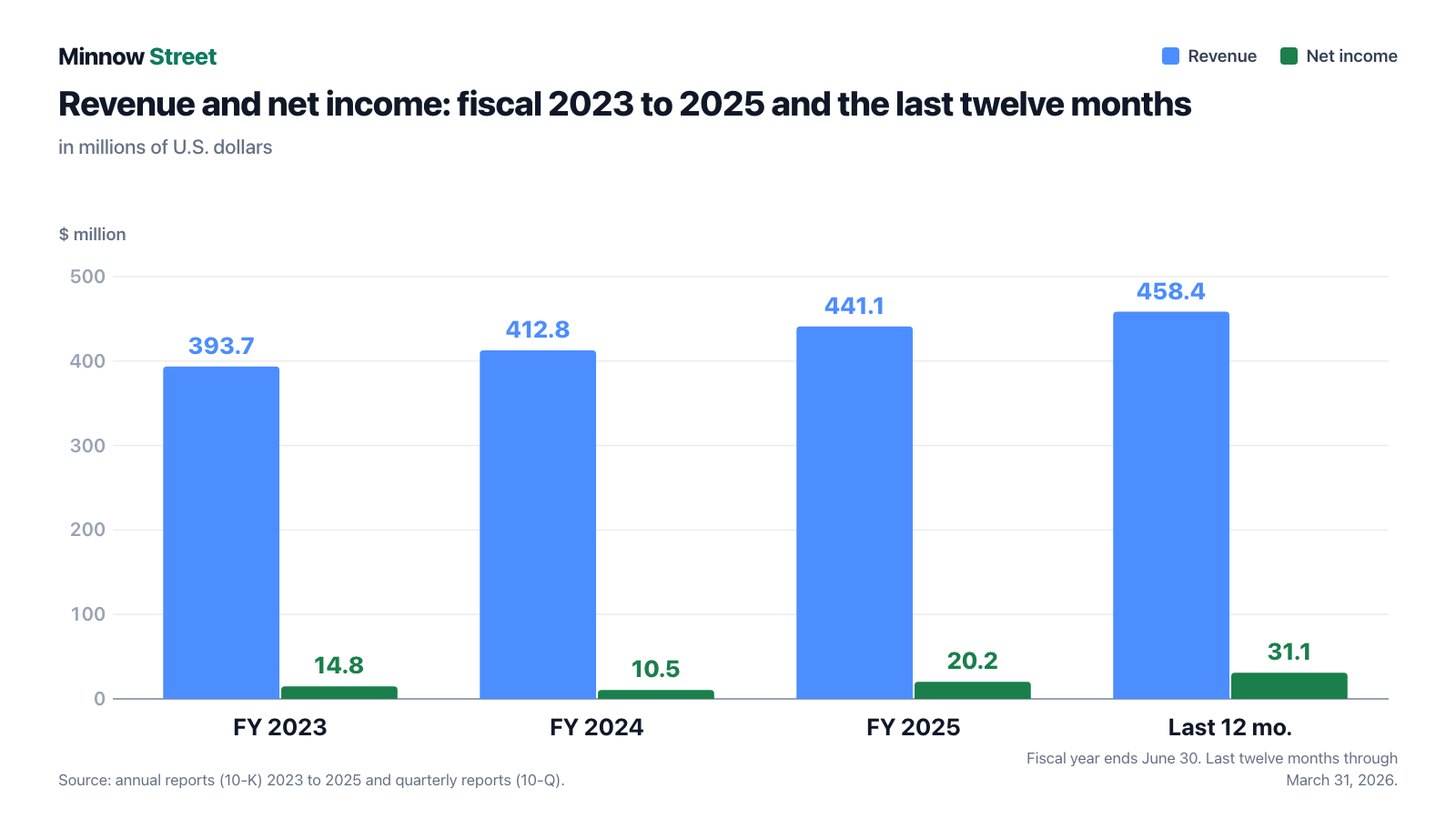
The balance sheet as of March 31, 2026 was the real treasure: $57.3 million in cash, no outstanding bank borrowings, plus $54.1 million of availability under the credit line. Shareholders\' equity stood at $185.3 million and working capital — current assets less current liabilities — at $142.2 million. That state of affairs is exactly why the next section is not a footnote.
Uncomfortable Truth No. 1: A Quarter of the Company, Paid Out of the Reserve
On April 26, 2026 Flexsteel signed an agreement with F. Brooks Bertsch, at the time a member of the board, and several family entities. The Form 8-K is as plain as SEC documents get:
"On April 26, 2026, Flexsteel Industries, Inc. (the "Company") entered into a stock repurchase agreement (the "Stock Repurchase Agreement") with F. Brooks Bertsch, a director of the Company, and certain family related entities listed on Schedule 1 thereto (the "Stockholders") for the purchase by the Company of 1,279,870 shares of the Company's common stock, $1.00 par value per share (the "Common Stock") from the Stockholders in a privately-negotiated transaction at a purchase price of $47.00 per share and for a total purchase price of approximately $60.2 million."
— Flexsteel Industries, Inc., Form 8-K dated April 28, 2026, Item 1.01

The next paragraph of the same filing gives the scale and the funding — and that is the part that counts:
"The purchase was funded through cash and available borrowings under the Company's revolving credit facility. The shares purchased by the Company represent approximately 24% of the issued and outstanding shares of Common Stock of the Company immediately prior to the transaction."
— Flexsteel Industries, Inc., Form 8-K dated April 28, 2026, Item 1.01

Let us do the arithmetic, because the real news is there. The cover page of the quarterly report still showed 5,355,531 shares on April 22, 2026. The Schedule 13D filed April 30, 2026 gives exactly 4,075,661 shares for April 28, 2026. That is the difference between a company and a company a quarter smaller — in six days.
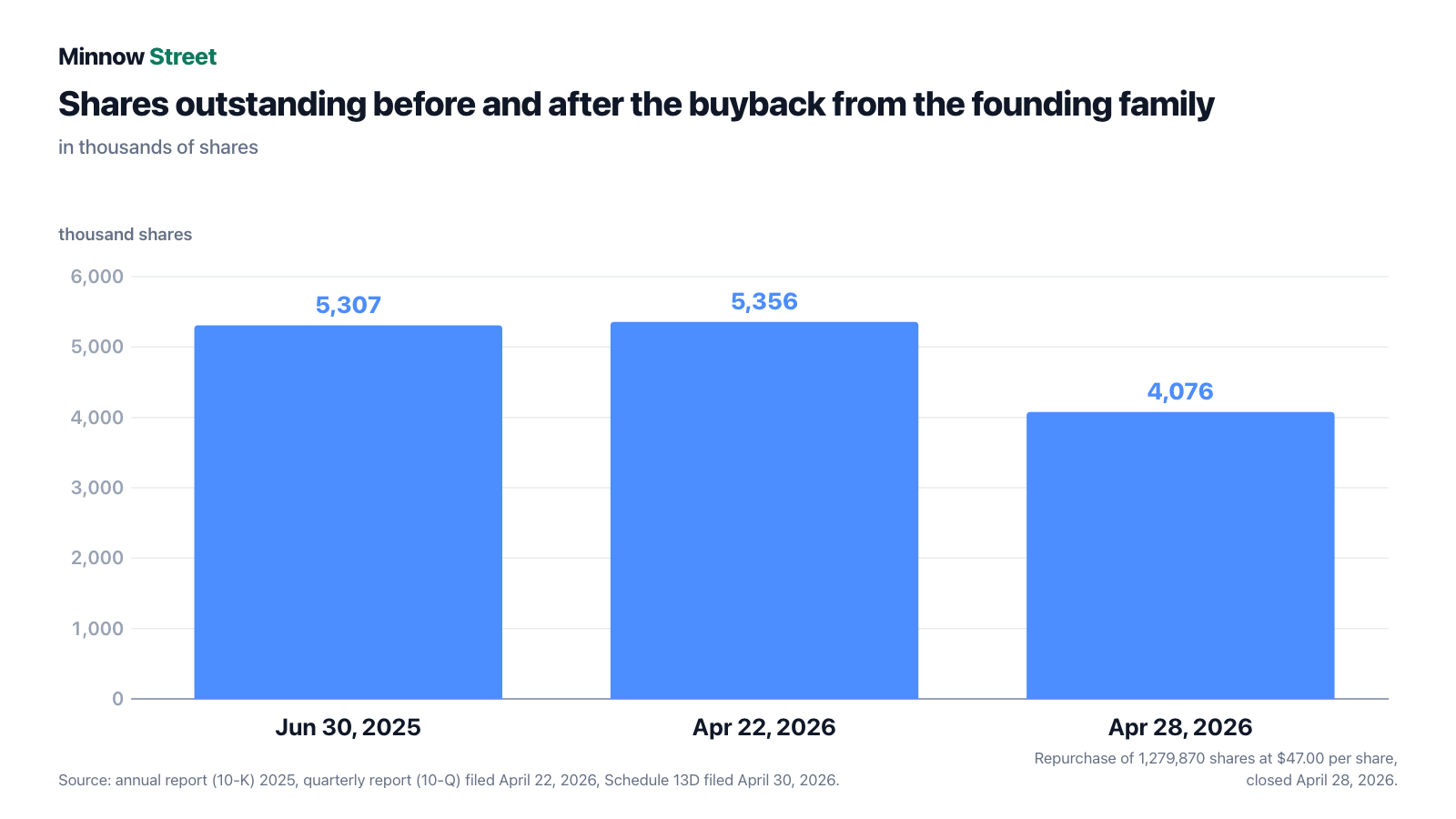
What does that mean for you as a shareholder? Two things, and they point in different directions.
The good side: the profit is divided among fewer heads. Take trailing twelve-month net income of roughly $31.1 million and spread it over the diluted share count after the buyback, and you land at roughly $7.00 per share instead of the reported $5.48. Subtract the financing cost — the $60.2 million no longer earns interest and sits partly as debt at a rate last reported at 4.99 percent — and roughly $6.50 remains after tax. That is an order-of-magnitude calculation with openly stated assumptions, not company guidance. A side effect: at 4.08 million shares and an annual rate of $0.85, the dividend costs Flexsteel about $1.1 million less per year.
The other side: the shares were bought above book value. As of March 31, 2026 the books carried $185.3 million of equity against 5.352 million shares — roughly $34.62 per share. The price paid was $47.00. That premium of just over $12 per share adds up to about $16 million leaving shareholders\' equity without any asset arriving in exchange. On paper, equity falls to roughly $125 million and book value per share to about $30.69. Book value here simply means what would notionally remain if everything were sold and every debt repaid.
And the cushion? Before the buyback there was $57.3 million in cash and $54.1 million of availability — $111.4 million together. Afterwards roughly half of that is gone on paper. How much came from cash and how much from the revolver appears in no filing published so far. That gap closes only with the annual report for fiscal 2026 — which is why that filing matters unusually much for Flexsteel shareholders.
Uncomfortable Truth No. 2: The Surprise Is a Base Effect
Back to the figure that put the stock on the list. The jump from minus $0.71 to plus $1.14 per share has a single main cause, and it sits in the prior year: in the quarter ended March 31, 2025 Flexsteel booked a non-cash impairment charge of $14.079 million against a right-of-use asset. Without that line the prior-year quarter would have shown operating income of $8.3 million instead of a $5.1 million loss.
The earnings release says as much if you read down to the adjusted line: adjusted operating income of $8.2 million, or 7.1 percent of net sales, against $8.3 million or 7.3 percent a year earlier — a decline of 1 percent. Adjusted earnings per diluted share: $1.14 versus $1.13. Revenue rose 1.0 percent, gross margin improved 40 basis points to 22.6 percent, and selling, general and administrative expenses rose 50 basis points to 15.5 percent of net sales.
None of this is manipulation — Flexsteel discloses both calculations side by side. It is an example of how a screen works: it sees the reported number, not the story behind it. And the story here reads: a steady quarter that looks spectacular next to a damaged one.
Uncomfortable Truth No. 3: A Plant in Mexicali That Never Ran
Where did the impairment come from? From a decision that looked sensible in 2022. The fiscal 2025 annual report tells it in one paragraph:
"In July 2022, Flexsteel commenced a 12-year lease for a manufacturing facility in Mexicali, Mexico to support strong demand growth which was elevated due to pandemic-driven buying at that time. Subsequently, U.S. furniture demand reverted to pre-pandemic norms, and the Company's plan for the facility pivoted to subleasing the space short-term while maintaining the option to utilize it longer term to support growth."
— Flexsteel Industries, Inc., Form 10-K for fiscal 2025, Note 2 (Leases)

Where matters stand: as of June 30, 2025 the plant had never been placed in operation, the right-of-use asset still carried $13.5 million, and the auditors flagged its valuation as a critical audit matter — the category reserved for items whose measurement leans heavily on assumptions. In the nine months ended March 31, 2026 subleasing produced $0; a year earlier it produced $0.594 million. By the calendar the lease runs to 2034. To be fair: this is not a liquidity hole, the rent is manageable and the write-down was non-cash. But it is a position that remains under review — and it shows that capacity decisions can go wrong at Flexsteel too.
Uncomfortable Truth No. 4: The Revenue Gain Comes From Tariffs, Not Units
Now to the figure most easily skimmed in the quarterly report. Flexsteel reported revenue of $115.1 million for the quarter ended March 31, 2026 against $114.0 million — up 1.0 percent. The filing explains it verbatim: the increase was "driven by higher pricing from tariff surcharges, offset by lower unit volume, particularly in our made-to-order, ready-to-assemble and case goods categories." Translated: fewer pieces of furniture were sold, they were simply more expensive.
Why that is so appears in the risk section of the annual report:
"On July 31, 2025, a further executive order was issued clarifying certain matters related to tariffs, including a country specific tariff of 20% on goods from Vietnam. Although the country specific tariffs and the global 10% baseline tariffs do not apply to our products imported from Mexico, that status could change at any time."
— Flexsteel Industries, Inc., Form 10-K for fiscal 2025, Item 1A (Risk Factors)

Tariff surcharges are a pass-through item with a side effect: they lift revenue but dilute the margin — the nine-month report says exactly that when it qualifies the 130-basis-point gross margin improvement as "partially offset by the dilutive impact of tariffs." And they hang on decisions nobody at the company makes. Sales order backlog, including estimated tariff surcharges, stood at $79.5 million on March 31, 2026, 1.5 percent above the prior-year figure of $78.3 million — stability, but no tailwind. Readers comparing consumer names with tariff exposure will find the same mechanics in our analysis of apparel retailer Tilly's, where a large percentage figure likewise rests on a low prior-year base.
On the outlook the company gives itself: on April 20, 2026 chief executive Derek Schmidt said fourth quarter sales were "likely flat to prior year levels" with operating margins "similar to third quarter performance." He explicitly cited softening demand, retail partners taking a more cautious approach to inventory, and rising fuel and petrochemical input costs. That is not an environment in which a cash pile is surplus to requirements.
What the Stock Costs — Valuation in Orders of Magnitude
First a clean valuation anchor, because intraday prices have no place in an analysis. The most recent price documented in an SEC filing is $74.48 — the value at which shares were withheld for tax purposes on June 30, 2026 (Form 4 filed July 2, 2026). Multiplied by the 4,075,661 shares outstanding, that gives a market value of roughly $304 million. Fundamental data show roughly $306 million as of July 24, 2026 — the two figures sit 1 percent apart, so the anchor holds.
From there the orders of magnitude follow. Against trailing twelve-month revenue of $458.4 million the price-to-sales ratio is roughly 0.7 — furniture makers have always traded low, so this is no outlier. The price-to-earnings ratio on reported earnings of $5.48 per share works out at about 13.7. Using the post-buyback range of $6.50 to $7.00 derived above, it falls to roughly 10.5 to 11.5. That is the real lever in this business: not more profit, but fewer shares.
Two things to know about that. First, the price-to-book ratio rises because of the buyback. Against the pre-buyback book value of $34.62 per share it would be about 2.2 — against the post-buyback figure of roughly $30.69 it is about 2.4. Metrics still using the old book value understate it. Second, the professional view, and it is thin here: our fundamental data record exactly one analyst house as of July 24, 2026, with a price target of $70.50 — below the anchor above. With just over four million shares outstanding that is not an oversight but the norm: after the buyback Flexsteel is a very small listed company, and few analysts also means little contradiction once a narrative sets in.
The dividend, finally, is small but dependable: $0.80 per share paid most recently, a forward annual rate of $0.85, and a payout ratio of roughly 17 percent of earnings (data as of July 24, 2026). Over the nine months ended March 31, 2026 Flexsteel paid $3.3 million in dividends.
Opportunities and Risks at a Glance
What speaks for Flexsteel:
- Three years of rising revenue and operating income that more than doubled, from $10.5 million in fiscal 2023 to $26.6 million in fiscal 2025.
- The buyback lifts earnings per share on paper from $5.48 to roughly $6.50 to $7.00 and cuts the annual dividend bill by about $1.1 million.
- Cash from operating activities over nine months, at $27.2 million, exceeded accounting profit of $20.4 million — earnings arrive as money.
- No customer accounts for more than 10 percent of net sales, and capital expenditures are very light at $3.5 million over nine months.
- The agreement was recommended by a special committee comprised solely of independent directors, with the interested director recusing himself — cleanly structured from a governance standpoint.
What speaks against it:
- The cushion has been drawn down: $60.2 million out of $57.3 million in cash and a $54.1 million line — the split has not been published.
- The credit agreement dated September 8, 2021 carries a five-year term per the filing; by the calendar it ends in September 2026, and the facility was already cut from $85 million to $55 million in 2025.
- The earnings surprise is mostly a base effect — adjusted operating income for the quarter ended March 31, 2026 fell 1 percent.
- The revenue gain comes from tariff surcharges against falling unit volume; Vietnamese goods have carried a 20 percent tariff since July 31, 2025, and the Mexican exemption could fall at any time per the filing.
- Company guidance for the closing quarter of fiscal 2026 calls for flat revenue and explicitly cites softening demand.
- A plant in Mexicali that never opened still carries $13.5 million on the books, produces no sublease income, and sits under a twelve-year lease that began in July 2022.
A Human Verdict
Back to the buyback reflex from the opening. With Flexsteel, the question "at what price, paid with what?" can be answered with unusual precision, and the answer is uncomfortably honest: at $47.00, out of cash and the revolver. Measured against the price at the end of June 2026 the purchase was cheap — measured against book value it was not. And it was paid out of exactly the reserve a furniture maker needs when tariffs and consumer sentiment turn at the same time.
There is a generous reading: the board saw an undervalued stock and a seller who wanted out for private reasons, and seized the opportunity on behalf of everyone who stayed. There is a skeptical one: the company took on debt to let a family exit, shortly before its own chief executive warned of softening demand. Both readings rest on the same documents. Which one holds turns on a figure nobody knows yet — the cash and borrowing position in the annual report for fiscal 2026.
What you make of that is your decision. And that is exactly as it should be.
Sources
- Form 10-Q for the quarter ended March 31, 2026 (filed April 22, 2026), CIK 0000037472
- Form 10-Q for the quarter ended December 31, 2025 (filed February 4, 2026)
- Form 10-K for fiscal 2025 (filed August 22, 2025)
- Form 10-K for fiscal 2024 (filed August 30, 2024)
- Form 8-K dated April 28, 2026 — Items 1.01 and 5.02: repurchase agreement and board resignation
- Form 8-K dated April 20, 2026 with the earnings release (Exhibit 99.1) for the quarter ended March 31, 2026
- Schedule 13D filed April 30, 2026 — the chief executive's ownership filing, share count as of April 28, 2026
- Form 4 filed July 2, 2026 — documented price of $74.48 as of June 30, 2026
- Source: fundamental data & SEC filings (annual and quarterly reports, 10-K/10-Q); metrics as of July 24, 2026
- Hook: rank 21 in the U.S. selection of our in-house "Big Earnings Surprise" stock scanner, as of July 25, 2026
This article is journalistic analysis and expressly not investment advice, not a buy or sell recommendation and not a solicitation to buy or sell securities. Stocks can lose their entire value; small caps with thin trading volume add the risk of price gaps and poor liquidity. All figures come from the primary documents linked above and carry the reporting date stated there. The author holds no position in the stock discussed at the time of publication.
Our Bottom Line at a Glance
- Operating trend positive
- Three years of rising revenue — $393.7 million, $412.8 million and $441.1 million in fiscal 2023 through 2025 — and operating income that more than doubled from $10.5 million to $26.6 million. Over the nine months ended March 31, 2026 revenue rose 5.3 percent to $343.8 million and gross margin improved from 21.6 to 22.9 percent. Cash from operating activities, at $27.2 million, exceeded accounting profit of $20.4 million.
- Quality of the earnings surprise negative
- The jump from minus $0.71 to plus $1.14 per share for the quarter ended March 31, 2026 comes mostly from the prior-year quarter, which carried a non-cash impairment charge of $14.079 million. On an adjusted basis the result was $1.14 versus $1.13, and adjusted operating income fell from $8.3 million to $8.2 million — a decline of 1 percent.
- Capital allocation neutral
- Repurchasing 1,279,870 shares at $47.00 lifts trailing twelve-month earnings per share on paper from $5.48 to roughly $6.50 to $7.00 and saves about $1.1 million of dividends per year. But the shares were bought well above the book value of $34.62 per share (March 31, 2026): roughly $16 million of premium leaves shareholders' equity with nothing arriving in return.
- Balance sheet and funding negative
- Before the buyback there was $57.3 million in cash, no outstanding bank borrowings and $54.1 million of availability (March 31, 2026). The $60.2 million came from both sources per the Form 8-K; the split has not been published. The credit agreement dated September 8, 2021 carries a five-year term per the filing — by the calendar to September 2026 — and the facility was cut from $85 million to $55 million on June 3, 2025.
- Tariffs and demand negative
- The 1.0 percent revenue gain for the quarter ended March 31, 2026 came from tariff surcharges against falling unit volume, per the filing. Goods from Vietnam, the main sourcing country, have carried a 20 percent tariff since July 31, 2025, and the annual report states the exemption for Mexican production could fall at any time. Company guidance dated April 20, 2026 calls for flat revenue in the closing quarter and explicitly cites softening demand.
- Valuation positive
- A market value of roughly $304 million (4,075,661 shares × $74.48, the documented price on June 30, 2026) equals about 0.7 times annual revenue and a price-to-earnings ratio of roughly 13.7 on reported earnings of $5.48 per share. On the post-buyback range it is roughly 10.5 to 11.5. One caveat: exactly one analyst house is on record, with a price target of $70.50 (data as of July 24, 2026).
On April 26, 2026 Flexsteel bought a quarter of itself: 1,279,870 shares from the Bertsch founding family at $47.00 apiece, roughly $60.2 million out of cash and the revolver. On paper that lifts earnings per share from $5.48 to roughly $6.50 to $7.00 — paid out of a cushion that until then consisted of $57.3 million in cash and $54.1 million of availability, and paid well above a book value of $34.62 per share. The operating business is solid (three years of rising revenue, operating income from $10.5 million to $26.6 million), but the revenue gain comes from tariff surcharges against falling unit volume, and the earnings surprise amounts to one cent on an adjusted basis. Not investment advice.
What Our Rating Means
Open questions
The business works in principle, but one material question is open. As long as it stays open, our findings do not carry a quality verdict.
The decisive figure is still outstanding and it has a date: the annual report (10-K) for the fiscal year ended June 30, 2026 is usually published in August. It has to answer three things nobody knows today. First: how much of the $60.2 million came from cash and how much from the revolver — the starting point is $57.3 million of cash and zero drawn debt on March 31, 2026. Second: what happens to the credit agreement dated September 8, 2021, whose five-year term ends in September 2026 by the calendar and whose size was already cut from $85 million to $55 million in 2025. Third: does the closing quarter deliver the company's own guidance of flat revenue at roughly 7 percent operating margin? Waiting means buying the low valuation with the answers in hand rather than blind. The decision is yours.
A journalistic assessment by our editorial team at the time of the deep dive, based on public sources — not investment advice and not a solicitation to buy or sell. Your personal circumstances (investment goals, risk capacity, taxes) cannot be taken into account. What our levels mean, how verdicts are formed, and what conflicts of interest exist →
Worth Noting
- Flexsteel reached our research list at rank 21 in our in-house Big Earnings Surprise ranking (U.S. selection, as of July 25, 2026, relative strength rating 87). The lists are recalculated daily — today's rank is not tomorrow's. The screen measures the gap between reported earnings and the analyst estimate; the adjusted figures in the same press release show only a one-cent difference from the prior year for the quarter ended March 31, 2026.
- Reporting-date trap: almost every balance sheet and earnings figure in this analysis dates from March 31, 2026 and therefore precedes the buyback of April 28, 2026. Metrics from data providers still using the book value of $34.62 per share, or a share count above 5.3 million, describe the state of affairs before the transaction. The only reliable post-buyback figure is the 4,075,661 shares from the Schedule 13D filed April 30, 2026.
- No take-private: despite the repurchase of a quarter of all shares and the family director's resignation, no acquisition is under way. The SEC record contains neither a merger proxy (DEFM14A or PREM14A) nor a Rule 13e-3 filing (SC 13E-3); the stock still trades on Nasdaq, and no Form 25 or Form 15 has been filed.
- Easily confused: Flexsteel Industries (FLXS, furniture, Dubuque, Iowa) has nothing to do with Flex Ltd. (FLEX, electronics contract manufacturer) and nothing to do with Flexsteel Pipeline Technologies (pipelines, not publicly traded). The ticker FLXS has belonged to the same company for decades; the SEC record shows no former names.
Frequently Asked Questions
On April 26, 2026 Flexsteel bought exactly 1,279,870 shares from the Bertsch founding family and its related entities at $47.00 per share — roughly $60.2 million in total. Per the filing that equals about 24 percent of all shares outstanding immediately prior. The transaction closed on April 28, 2026.
The Schedule 13D filed April 30, 2026 gives exactly 4,075,661 shares outstanding as of April 28, 2026. The cover page of the quarterly report still showed 5,355,531 shares on April 22, 2026. The share count therefore fell by almost a quarter within six days.
Partly. The Form 8-K states the purchase was funded through cash and available borrowings under the revolving credit facility. As of March 31, 2026 Flexsteel held $57.3 million in cash, had no outstanding bank borrowings and $54.1 million of availability. How the $60.2 million splits between the two sources has not been published.
For the quarter ended March 31, 2026 Flexsteel reported $1.14 in earnings per diluted share, after a loss of $0.71 a year earlier. That change of sign is largely driven by a $14.1 million impairment charge in the prior-year quarter. On an adjusted basis the figures were $1.14 versus $1.13, and adjusted operating income fell 1 percent.
On June 30. Fiscal 2025 covers the twelve months to June 30, 2025 and was filed as a Form 10-K on August 22, 2025. Fiscal 2026 ended June 30, 2026; the corresponding annual report is usually published in August and had not been filed when this analysis went to press.
Flexsteel sources finished goods mainly from Vietnam, where a country-specific tariff of 20 percent has applied since July 31, 2025; its own production sits in Mexico and has been exempt so far. The revenue gain in the quarter ended March 31, 2026 came from tariff surcharges per the filing, against lower unit volume.
Found an error?
Did you spot a factual error, an outdated number, or a typo in this deep dive? Let us know briefly — your report goes straight to the editorial team.