MannKind Stock: The FDA Says Yes — and the Same Day a $45 Million Bill Lands on the Table
In 2026 MannKind delivered what shareholders had waited years for: two FDA approvals in eight weeks. The second one, Furoscix ReadyFlow on July 23, 2026, triggered a $45.0 million cash payment under contingent value rights that very same day — and it was funded one day later with a stock sale of roughly $50.0 million. Behind it stands a company that grew revenue 22 percent to $349.0 million in 2025, drew $231.5 million of that from a single partner, and whose stockholders' equity stood at minus $59.2 million on March 31, 2026. We read the mandatory filings to the U.S. securities regulator line by line. Not investment advice — just the question of who ends up paying for the progress.
 Thomas Mücke
Founder & Publisher
Thomas Mücke
Founder & Publisher
Chart
Interactive price chart (TradingView).
Note: pure fact-based analysis, not investment advice and not a solicitation to buy or sell. All figures without guarantee.
There is a trap even patient investors walk into — and from the outside it looks like a reward: the milestone trap. It works like this. A company finally reaches the goal everyone has been waiting years for. A regulator says yes. The headline feels like money in the account. And the mind books it that way, as if somebody had made a deposit. At MannKind Corporation (Nasdaq: MNKD) you can read straight off the calendar why that is a thinking error. On July 23, 2026, the U.S. drug regulator, the FDA, approved Furoscix ReadyFlow. That same day, a payment obligation of $45.0 million in cash fell due. And one day later, on July 24, 2026, MannKind raised roughly $50.0 million by issuing new stock to pay exactly that bill. Both facts sit in one single filing to the U.S. securities regulator, the SEC — the 8-K of July 24, 2026, Item 8.01 and Item 3.02. Approval and dilution, two paragraphs apart.
So let's make a deal. We ignore the headlines and look only at what MannKind filed with the SEC under penalty of law: the annual report (10-K) for 2025 of February 26, 2026, the quarterly report (10-Q) as of March 31, 2026 filed on May 6, 2026, and the 8-K announcements since. And we put the central tension on the table right away, because it runs through every chapter: two out of every three revenue dollars are earned not with MannKind's own idea but as a supplier and licensor to a single partner — and that partner is publicly building the successor to their shared product. At the same time, the company's biggest success of the year immediately cost cash that could only be raised by issuing new shares. As with Outlook Therapeutics, where approval was what created the bill in the first place, the rule holds here too: good news is not yet a cash receipt.
What MannKind actually does — three products of its own and someone else's bakery
MannKind is a biopharma company from Danbury, Connecticut, founded in 1991, with 592 employees as of December 31, 2025 (591 of them full-time; by function, all 592 break down into 254 in manufacturing, 46 in research and 292 in sales and administration). The business has two halves, and the smaller one is the better known.
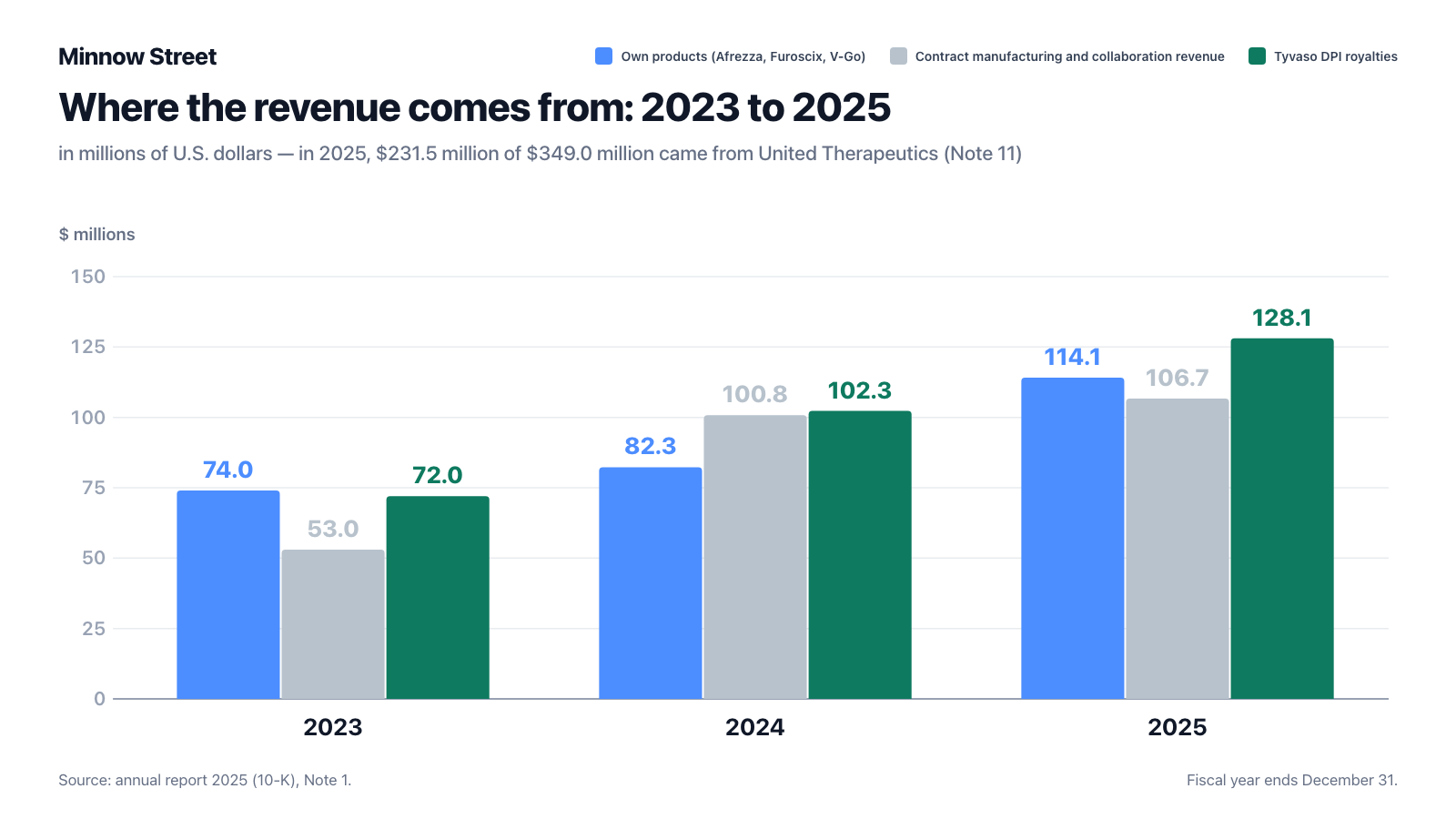
The company's own products. First, Afrezza, a mealtime insulin that is inhaled rather than injected — approved in 2014, the product the company is famous for. Second, Furoscix, a diuretic for heart-failure patients delivered under the skin through a small device instead of a hospital IV drip; it came in with the acquisition of scPharmaceuticals on October 7, 2025. Third, V-Go, an insulin patch pump whose sales have been shrinking for years. Together, those three brought in $114.1 million in 2025 (2024: $82.3 million, 2023: $74.0 million).
The bigger leg. MannKind manufactures the inhaled drug Tyvaso DPI for pulmonary hypertension on behalf of United Therapeutics — and additionally collects a royalty on its sales. Contractually that royalty is 10 percent, of which MannKind sold one percentage point to a financial investor in late 2023; so 9 percent flows in. The everyday image: MannKind runs the bakery, somebody else runs the shop. The other party decides how many rolls are ordered, how they are advertised and what they cost. The line "contract manufacturing and collaboration revenue" brought in $106.7 million in 2025 (2024: $100.8 million, 2023: $53.0 million) — $103.4 million of it from United Therapeutics, the rest from other collaboration partners. Royalties added $128.1 million (2024: $102.3 million, 2023: $72.0 million).
Everything is produced at one site: the company's own plant in Danbury, roughly 328,000 square feet. Afrezza and Tyvaso DPI are made there. An FDA inspection in October 2025 ended, per the annual report, without a single observation that would have required a Form 483. And one more detail that matters for the valuation later: MannKind reports only one single segment — the filings contain no margin calculation per product, not even for Afrezza. So if you want to know whether Afrezza pays for itself, no filing will tell you; you can only estimate it from the revenue mix.
Where the stock landed on our desk — twelve lists that contradict each other
MannKind reached our research list through our in-house stock scanner, and it did so in an unusual way: on July 27, 2026, MNKD appeared on twelve lists at once — and they contradict each other. Four of them measure strength and momentum (High Tight Flag, Power Trend, Liquid Movers Up, Top Performers 3/6 Month), three measure reversal patterns (Oops Reversal, Bullish Reversal Bar, Strong DCR ≥80), and five are warning lists: the going-concern distress proxy, the Altman Z distress zone, the Beneish M-Score, plus two downtrend lists in the Stan Weinstein tradition. Important context: these lists are recomputed daily — the reading is the one from July 27, 2026, not from today.
A stock showing up in momentum and downtrend lists simultaneously is not a filter bug. It is the picture of a share price that collapsed 36.8 percent in a single day on February 25, 2026 and has since recovered off the low without seeing the old high again. For us, that is the second layer of the central tension: the price filters say yes, the substance filters say no.
And because metrics are worthless without a rating, here are the three from the warning lists — with their caveats. The Piotroski F-Score, a nine-point test for the health of the books, stands at 2 of 9; a thoroughly healthy balance sheet scores 8 or 9, anything below 3 counts as weak. Our own fundamental rating comes out at 39 of 100, grade D, where 50 marks the average. The Altman Z″ sits at −9.77 against a distress threshold of 1.1 — but here the score mostly measures the past: the accumulated deficit of $3,212.6 million alone, set against total assets of $744.4 million, drags it roughly 14 points into negative territory. For a research-driven biotech it is a crude warning indicator, not a bankruptcy verdict. The Beneish M-Score — a filter that looks for conspicuous jumps between reporting years — sits at 0.377, above the flag threshold of −1.78, but the data series is broken by the acquisition of October 7, 2025: that is explicitly not an allegation of manipulation. If you want to retrace this yourself you do not need a scanner: the Piotroski score comes out of nine yes-or-no questions about profit, cash flow, leverage and margin — all four sit in the annual report we link below.
One point deserves emphasis because it is easily misread: the "going concern (distress proxy)" list is an in-house filter that estimates from balance-sheet metrics — it is not an auditor's note. In the 2025 annual report the terms "going concern" and "substantial doubt" appear zero times, and the Deloitte & Touche opinion is unqualified. Confusing the two means reading a warning that does not exist.
The numbers over the years — honestly appraised
Let's start with what genuinely impresses, because there is plenty of it. Revenue rose from $63.0 million in 2019 to $349.0 million in 2025 — plus 453 percent, an average of 33 percent a year. The last three years read: $199.0 million → $285.5 million → $349.0 million, most recently plus 22 percent. And MannKind achieved something shareholders had awaited for decades: a net profit. In 2024 it was $27.6 million, in 2025 still $5.9 million — after a loss of $11.9 million in 2023. Gross margin improved as well, from 68.5 percent (2023) via 73.2 percent (2024) to 73.7 percent (2025).
And then comes the break. The fourth quarter of 2025 and the first quarter of 2026 were both loss-making — minus $15.9 million (derived from full-year minus nine-month figures) and minus $16.6 million. Cash flowed out operationally in both quarters as well (minus $8.0 million and minus $5.4 million). Earnings per share swung from plus $0.04 in the first quarter of 2025 to minus $0.05 in the first quarter of 2026.
The cause is not a revenue problem. Revenue rose 15.1 percent to $90.2 million in the first quarter of 2026 (prior-year quarter: $78.4 million). Expenses rose 64 percent. Selling, general and administrative costs alone jumped from $25.0 million to $54.1 million (plus 116 percent) — that is 60 percent of group revenue, after 32 percent in the prior-year quarter. Research and development rose from $11.0 million to $17.2 million (plus 56 percent). An operating profit of $22.3 million turned into an operating loss of $1.7 million.
If you take one figure away from this chapter, take this one: revenue up 15 percent, expenses up 64 percent. The line to remember: one good quarter is not a turnaround — and two loss-making ones are not either. Which brings us to the filings themselves.
What the filings say — the uncomfortable truths
Uncomfortable truth no. 1: The largest customer is also the most dangerous competitor
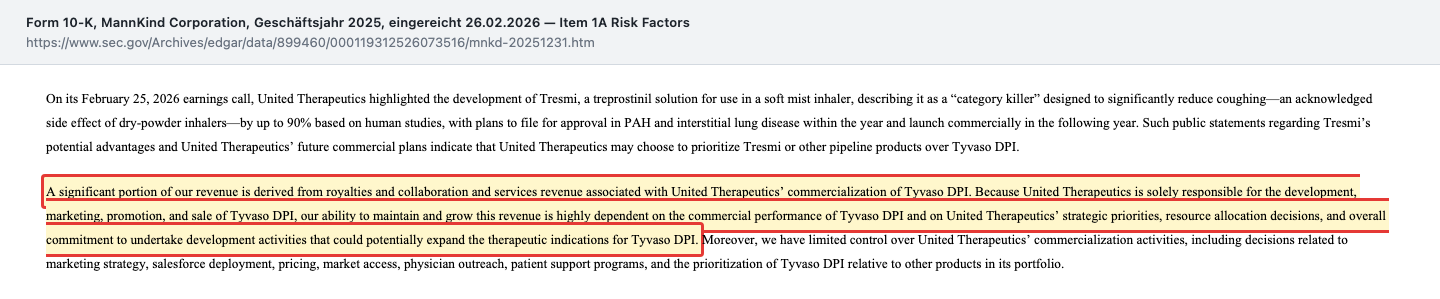
The reliable annual figure sits in Note 11 of the 2025 annual report: $231.5 million of $349.0 million in revenue — 66 percent — came from United Therapeutics in 2025 (2024: 70.6 percent, 2023: 62.7 percent). For the first quarter of 2026 the company itself puts the share at about 62 percent, after 75 percent in the prior-year quarter. Inside that number, something is shifting: royalties rose 9 percent in the quarter to $32.7 million, while manufacturing revenue fell 20 percent to $23.5 million. MannKind writes about it itself:
"A significant portion of our revenue is derived from royalties and collaboration and services revenue associated with United Therapeutics’ commercialization of Tyvaso DPI. Because United Therapeutics is solely responsible for the development, marketing, promotion, and sale of Tyvaso DPI, our ability to maintain and grow this revenue is highly dependent on the commercial performance of Tyvaso DPI and on United Therapeutics’ strategic priorities, resource allocation decisions, and overall commitment to undertake development activities that could potentially expand the therapeutic indications for Tyvaso DPI."
— MannKind Corporation, SEC annual report 10-K for 2025, Item 1A "Risk Factors"
Up to this point it is an ordinary customer-concentration story. The second part is not. In the same risk chapter, MannKind quotes how its own biggest customer talks about its successor product:
"On its February 25, 2026 earnings call, United Therapeutics highlighted the development of Tresmi, a treprostinil solution for use in a soft mist inhaler, describing it as a “category killer” designed to significantly reduce coughing—an acknowledged side effect of dry-powder inhalers—by up to 90% based on human studies, with plans to file for approval in PAH and interstitial lung disease within the year and launch commercially in the following year. Such public statements regarding Tresmi’s potential advantages and United Therapeutics’ future commercial plans indicate that United Therapeutics may choose to prioritize Tresmi or other pipeline products over Tyvaso DPI."
— MannKind Corporation, SEC annual report 10-K for 2025, Item 1A "Risk Factors"

Fairness belongs here, and in this case it falls in MannKind's favor: per the notes to the annual report, the supply agreement with United Therapeutics runs through December 31, 2031 and renews automatically for two years at a time — unless United Therapeutics objects 24 months in advance or MannKind 48 months in advance. Termination outside that rhythm is only provided for in case of a material, uncured breach or insolvency. So the sentence "the partner can walk away any time" would be wrong. What is right: this is a very large concentration with a long runway — but not a provable threat to the company's existence. What you need to watch is not the contract end date, but how hard the partner works to sell a product on which it earns less than on its own successor.
Uncomfortable truth no. 2: Negative equity, pledged patents — and interest the business does not earn
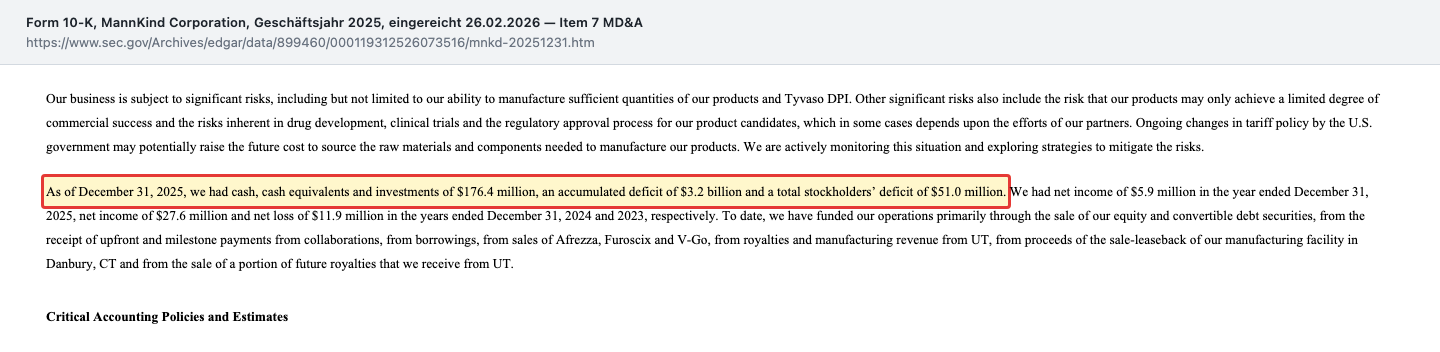
Now to the balance sheet, and it is unpleasant. Stockholders' equity was negative at minus $59.2 million as of March 31, 2026 — the balance-sheet line reads, verbatim, “Total stockholders’ deficit”. It is the third consecutive reporting date on which the figure is negative and worse: minus $44.6 million as of September 30, 2025, minus $51.0 million as of December 31, 2025, minus $59.2 million as of March 31, 2026. The accumulated deficit stands at $3,212.6 million — more than four times total assets of $744.4 million. Translated: over its lifetime this company has burned considerably more money than sits on its balance sheet today.
"As of December 31, 2025, we had cash, cash equivalents and investments of $176.4 million, an accumulated deficit of $3.2 billion and a total stockholders’ deficit of $51.0 million."
— MannKind Corporation, SEC annual report 10-K for 2025, Item 7 MD&A
How liquidity, debt and equity have moved relative to one another since 2023 is what the second chart shows — and it is the real core of this analysis:
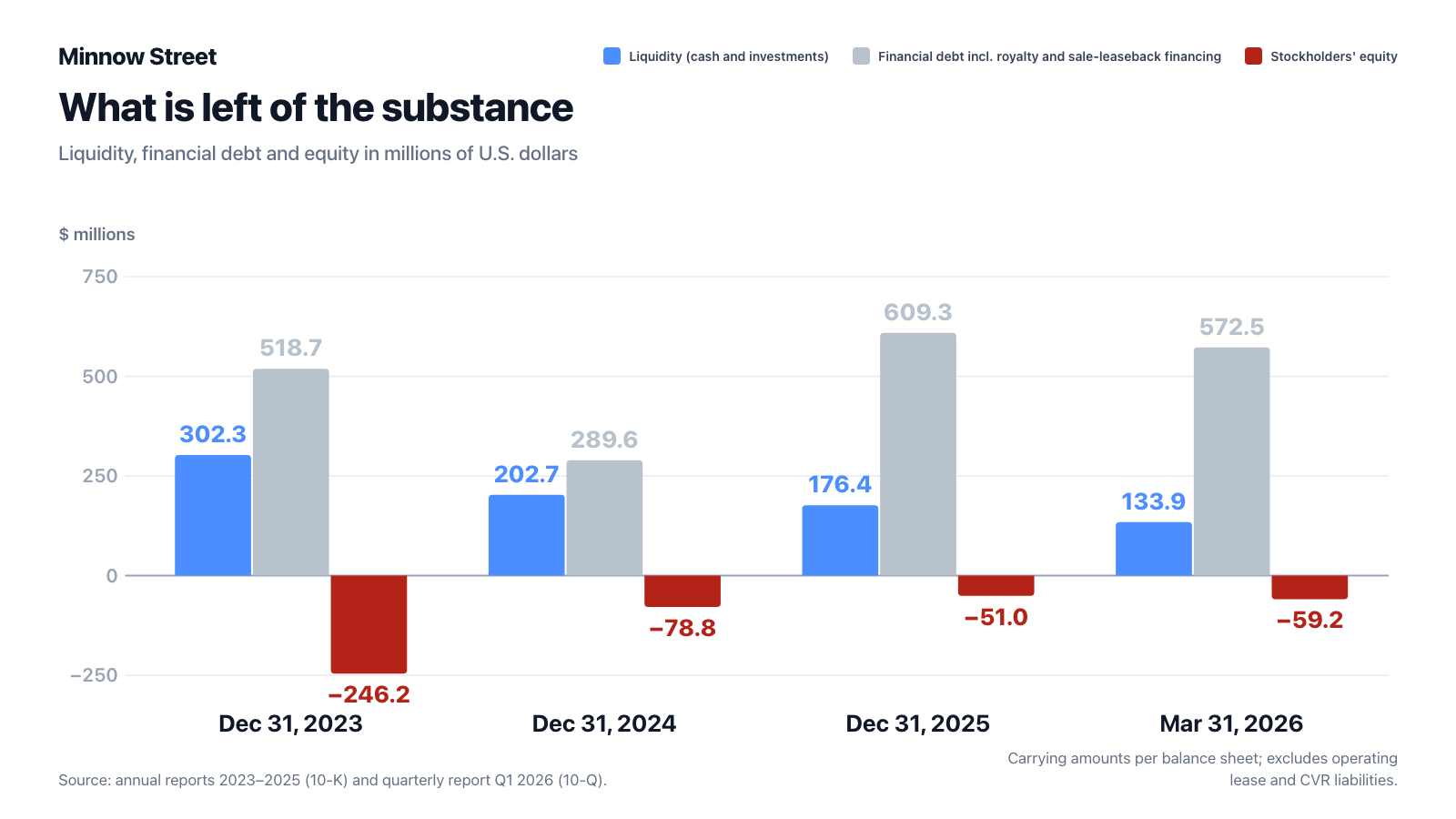
The series behind it, in numbers: as of December 31, 2023, $302.3 million of liquidity stood against $518.7 million of financing-type obligations, with equity at minus $246.2 million. A year later it was $202.7 million against $289.6 million, with equity at minus $78.8 million. As of December 31, 2025, after the scPharmaceuticals acquisition, $176.4 million of liquidity stood against $609.3 million — and as of March 31, 2026 it is $133.9 million against $572.5 million. Short version: the blue column has been shrinking for three years, the gray one jumped back to its 2023 level in 2025, and the red one was above zero on none of the four dates.
The second figure in this chapter is the more important one. Interest coverage asks: how many times over does the operating business earn the interest it has to pay? Below 1 means it does not earn it. In the trailing twelve months through March 31, 2026, MannKind had operating income of $14.8 million against interest expense of $39.8 million — interest coverage of 0.37. In fiscal year 2025 it was $38.8 million against $38.0 million, so 1.02 — which is not a cushion either, but a pinpoint landing. And the pressure is rising: cash interest paid climbed from $3.0 million to $9.7 million in the first quarter of 2026, plus 224 percent; for 2026 MannKind budgets $27.7 million of cash interest for the large loan alone. We ran the same calculation on Paysafe, where operating profit likewise fails to cover the interest — it is one of the most honest metrics there is, because it cannot be dressed up.
Where does the interest burden come from? Above all from a loan of nominally $325.0 million (carrying amount $318.7 million) that financed the Furoscix acquisition. As of March 31, 2026 it cost 9.09 percent a year — the rate floats — and it is due in a single bullet payment on August 6, 2030. On top of that come $150.6 million from the sale of future royalties and $103.2 million from the sale and leaseback of the Danbury plant — together $572.5 million of financing-type obligations against $133.9 million of liquidity. Per the notes, the loan is secured by a first-priority interest "on substantially all of the assets of the Company and the subsidiary guarantors, including intellectual property" — that is, by the very patents the whole business rests on.
And now the honest counter-argument that belongs here. There is no going-concern warning. The loan covenants were met as of December 31, 2025 and March 31, 2026. Operating cash flow was positive in 2023, 2024 and 2025 ($34.1 million / $42.5 million / $18.3 million) and is positive on a trailing twelve-month basis through March 31, 2026 as well, at plus $19.3 million. The company itself writes in the quarterly report that it believes its resources "will be sufficient to fund our operations for at least the next 12 months". But the arithmetic has to be done in full. At the average operating outflow of the last two quarters ($6.7 million per quarter), $133.9 million of liquidity covers roughly 20 quarters on paper. Cash in the narrow sense, however, is only $52.8 million of that — roughly 8 quarters. And the credit agreement requires at every quarter-end at least $40.0 million of unrestricted cash under a control agreement in favor of the lender; short-term investments do not count toward it. Above that threshold, total liquidity leaves roughly 14 quarters — and pure cash at most about two. Even that is an upper bound: no filing says how much of the $52.8 million actually sits in the contractually designated accounts.
Uncomfortable truth no. 3: The 2025 annual profit is a partial-year effect
Reported for 2025 is a net profit of $5.9 million. That is the number that made the press. Right beside it in the notes sits what the year would have looked like had scPharmaceuticals, acquired in October 2025, been on board from the start — so-called pro forma figures, published by the company itself:
"The following unaudited pro forma summary presents consolidated total revenue and net losses of MannKind as if the scPharma business combination had occurred on January 1, 2024 (in thousands)."
— MannKind Corporation, SEC annual report 10-K for 2025, Note 3 "Business Combinations"
The figures in that summary: $396.2 million in revenue and minus $27.1 million in earnings for 2025, and for 2024 $321.8 million in revenue and minus $57.6 million. So the reported profit largely arises because the acquired company only counts for barely three months ($23.2 million in revenue, $9.9 million in operating losses) — and on top of that from a tax item: pre-tax income of roughly $1.4 million became $5.9 million of net profit because $5.0 million of a tax valuation allowance was released. A profit that would not exist without a calendar effect and a tax entry is not yet earning power. If you want to draw a trend line, use the trailing twelve months: $360.8 million in revenue and minus $23.9 million in earnings.
Uncomfortable truth no. 4: The approval cost $45.0 million the same day — paid for with new shares
Back to the milestone trap from the opening, now with numbers. When it bought scPharmaceuticals, MannKind gave the sellers contingent value rights. The everyday image: a success bonus in installments, payable once certain targets are hit. Target number one was FDA approval of Furoscix ReadyFlow. It arrived on July 23, 2026. Price: $45.0 million in cash. As of March 31, 2026, MannKind had accrued, probability-weighted, only $29.0 million for both milestones combined — roughly $16 million too little for the first one alone. For scale: $45.0 million equals 85 percent of the cash on hand as of March 31, 2026 ($52.8 million). Measured against that last published figure, the payment would have consumed the entire cushion above the $40 million cash covenant — though the covenant is tested only on the last business day of a fiscal quarter, and the payment fell mid-quarter.
"The closing of the Private Placement occurred on July 24, 2026 (the “Closing”). The total gross proceeds received by the Company from the Private Placement, before expenses, were approximately $50.0 million. The Company intends to use the net proceeds from the Private Placement for general corporate purposes, including funding the Company’s $45.0 million contingent value rights payment obligation triggered by the U.S. Food and Drug Administration’s approval of Furoscix ReadyFlow™ (furosemide injection)."
— MannKind Corporation, SEC current report 8-K of July 24, 2026, Item 3.02

The price of that refinancing: 10,440,838 new shares at $3.89 plus pre-funded warrants on 2,412,632 shares at $3.88. Dilution, in everyday terms, means your slice of the cake gets smaller because the cake is cut into more pieces. Concretely, the share count rose from 308,950,166 (per the quarterly report cover page, as of April 24, 2026) to at least 319,391,004 on paper, fully diluted to 321,803,636. No filing states a count as of July 24, 2026; smaller movements from insider filings (Form 4) come on top. Measured against the old share count, dilution is 3.4 percent (shares only) or 4.2 percent including the warrants — measured against the new, fully diluted count, existing holders are left with 96.0 percent. That happened on a single day. Over the years the pattern adds up: at the end of 2019 there were 211.8 million shares, after the placement of July 24, 2026 there are 321.8 million fully diluted — about half again as many. Of the authorized capital of 800 million common shares, 40.2 percent is now used up.
And a postscript worth knowing: the contingent value rights are not settled with the $45.0 million. Milestone 2 is still open — up to roughly $15 million more if Furoscix and ReadyFlow reach at least $110.0 million in worldwide net sales over twelve consecutive months ending no later than December 31, 2026 (the full amount from $120.0 million). The maximum for both milestones together is $59.7 million.
Uncomfortable truth no. 5: The company's own idea stays small — and its own pipeline has shrunk
Afrezza is the product MannKind stands for. It was approved in 2014. In 2025 it brought in $74.6 million — 21 percent of group revenue. In the first quarter of 2026 net sales rose 3 percent to $15.3 million. Look closer and you see where that increase came from: gross revenue fell 5 percent, "driven primarily by lower demand" — what was left came solely from smaller rebates (gross-to-net deduction of 31 percent, after 36 percent). V-Go shrank 23 percent in the same quarter.
At the same time, the company's own research pipeline has grown thinner — and that news is not in the business section but in a subordinate clause of the cost discussion:
"Research and development expenses increased by $20.5 million, or 45%, for the year ended December 31, 2025 compared to the prior year. The increase was primarily attributable to the ICoN-1 clinical study for MNKD-101, which was discontinued in the fourth quarter of 2025, clinical production scale-up for MNKD-201, personnel costs…"
— MannKind Corporation, SEC annual report 10-K for 2025, Item 7 MD&A
A year earlier the same program still appeared in the annual report as a "global registrational Phase 3 study" with orphan drug, QIDP and fast track status — in other words, as the big hope. Research spending rose 45 percent in 2025 to $66.3 million because of that study, and by the end of the year it was over. What remains is the second half of the equation: the money was spent, the program is gone.
Valuation: what the market asks for $349 million in revenue
We work in orders of magnitude here, not daily prices — and we show the basis, because two different share counts are easily mixed up at this point. Fundamental data put market capitalization at roughly $1,276.0 million as of July 27, 2026, computed on the 308,950,166 shares outstanding before the placement — that works out to $4.13 per share at that data cut-off. On the at-least 319,391,004 shares outstanding afterwards it is roughly $1,319.1 million, and that is the basis we use from here. The cross-check against the only price documented in a filing (319,391,004 × $3.89 = $1,242.4 million) sits 5.8 percent below that — close enough to carry the order of magnitude. Against trailing-twelve-month revenue of $360.8 million, that gives a price-to-sales ratio of roughly 3.7. Add the debt and you arrive at an enterprise value of $1,503.9 million (narrow: market cap plus loan minus liquidity) to $1,757.7 million (wide, including the royalty and financing liabilities) — that is 4.2 to 4.9 times revenue.
Two common metrics drop out, and not out of convenience. There is no price-to-earnings ratio, because trailing-twelve-month earnings are negative at minus $23.9 million. And there is no price-to-book ratio either, because equity is negative — any number you see quoted there is a computational artifact. For the same reason, return on equity is meaningless at MannKind.
The only price documented in a filing is the placement price of July 24, 2026: $3.89 per share, at which institutional investors bought in. That sits roughly 4 percent below the prices at which insiders sold in the market on July 17, 2026 ($4.05 and $4.06 per Form 4 insider filings; two days earlier, shares withheld for taxes on vesting had been valued at $4.09).
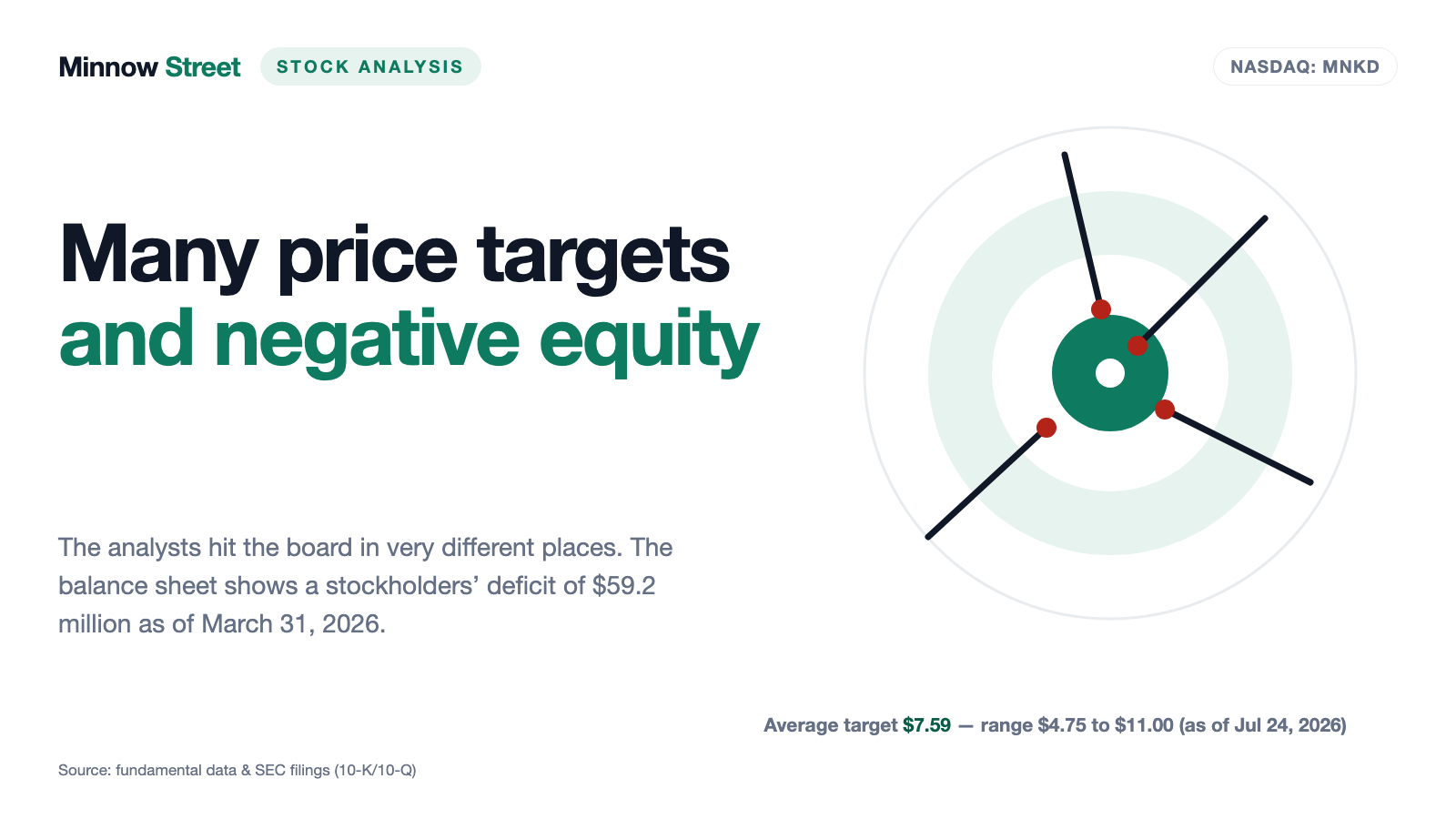
The "professionals' view", expressly labeled as an outside opinion: as of July 24, 2026 the analyst consensus was "Strong Buy" from eight firms, with an average price target of $7.59 and a range of $4.75 to $11.00. That range is the real information: between the lowest and the highest target lies more than a factor of two — that is not conviction, that is bafflement. And the same firms first cut and later raised their targets after the Tresmi announcement. As a counterweight: as of the July 15, 2026 settlement date, 9.37 percent of the free float was sold short — every eleventh freely tradable share. Elevated, but far from the extremes at which forced buy-ins occur.
Opportunities and risks at a glance
Read the two lists below side by side rather than one after the other — both are meant equally seriously, and you decide which side weighs more for you.
What speaks for MannKind:
- Revenue is growing — in every single one of the twelve quarters we reviewed, measured against the prior-year quarter; in 2025 it was plus 22 percent to $349.0 million, in the first quarter of 2026 plus 15.1 percent to $90.2 million.
- Two FDA approvals in eight weeks: Afrezza for children aged 6 and up on May 29, 2026 and Furoscix ReadyFlow on July 23, 2026 — and on May 27, 2026 the FDA dropped the mandated five-year safety study with 8,000 to 10,000 patients, a cost block in the hundreds of millions that thereby disappears.
- No going-concern warning, an unqualified opinion from Deloitte & Touche (auditor since 2001, including on internal controls), loan covenants met as of December 31, 2025 and March 31, 2026.
- No maturity before August 6, 2030, plus a committed but undrawn $50.0 million credit tranche and a completely unused $200.0 million at-the-market stock sale program.
- Operating cash flow positive three years running ($34.1 million / $42.5 million / $18.3 million) and positive on a trailing twelve-month basis through March 31, 2026 at plus $19.3 million.
- A second molecule for the same partner (MNKD-1501): $5.0 million already received, up to $35.0 million of development milestones possible, roughly $10.0 million of which is classified as probable — plus a royalty rate of 10 percent, higher than on Tyvaso DPI.
What speaks against it:
- 66 percent of 2025 revenue comes from a partner that is developing the successor to their shared product itself and has publicly called it a "category killer".
- Negative equity of $59.2 million as of March 31, 2026 — negative on three consecutive reporting dates and worse each time; accumulated deficit of $3,212.6 million against total assets of $744.4 million.
- Interest coverage of 0.37 over the trailing twelve months; cash interest paid more than tripled in the first quarter of 2026 to $9.7 million, and $27.7 million of cash interest is budgeted for the loan alone in 2026.
- The 2025 net profit of $5.9 million is a partial-year effect: on a pro forma basis it would read minus $27.1 million.
- Permanent dilution: about half again as many shares as at the end of 2019, most recently plus 4.2 percent on a single day — and the credit agreement requires $40.0 million of cash at every quarter-end, against which only $52.8 million stood as of March 31, 2026.
- Virtually all assets are pledged, including the patents; the company's own pipeline has shrunk since the Phase 3 program MNKD-101 was discontinued in the fourth quarter of 2025.
A human conclusion
Let's return to the milestone trap. Its core is not that the good news is false — it is real. The FDA approved, twice in eight weeks. The mandated study is gone. Revenue has been growing for years. The core of the trap is that we automatically book good news as a cash receipt, even though in this case it was an invoice: $45.0 million in cash, raised with roughly $50.0 million of new stock. Anyone who read the headline in July 2026 and not the filing beneath it celebrated the success and missed the bill.
What someone holding the stock is betting on: that Furoscix and ReadyFlow hit the self-set target of $110 to $120 million for 2026, and that the revenue block from United Therapeutics carries longer than the partner signals with its own successor product. What someone buying in additionally bets on: that a company with negative equity and interest coverage of 0.37 finances its next growth step out of the running business — and not, once again, out of new shares.
Both can work out. Both can go wrong. You just have to know what you are betting on: not on a drug, but on a balance sheet that has to pay for every further success before anything else. What you make of that is your decision. And that is exactly as it should be.
Sources
All original documents used in this analysis — for you to read yourself:
- MannKind Corporation — SEC annual report 10-K for 2025 (filed February 26, 2026)
- MannKind Corporation — SEC annual report 10-K for 2024 (filed February 26, 2025)
- MannKind Corporation — SEC quarterly report 10-Q as of March 31, 2026 (filed May 6, 2026) — most recent periodic report
- MannKind Corporation — SEC quarterly report 10-Q as of September 30, 2025 (filed November 5, 2025)
- MannKind Corporation — SEC current report 8-K of July 24, 2026 (Items 3.02 and 8.01: private placement and FDA approval of Furoscix ReadyFlow)
- MannKind Corporation — SEC current report 8-K of June 2, 2026 (Afrezza for children aged 6 and up) and 8-K of May 28, 2026 (release from the FDA-mandated safety study)
- MannKind Corporation — SEC current report 8-K of May 6, 2026 (quarterly results, product revenue) and 8-K of May 22, 2026 (annual meeting)
- MannKind Corporation — SEC proxy statement DEF 14A 2026 (filed April 7, 2026)
- MannKind's complete SEC filing history: EDGAR overview (sec.gov)
- Fundamental data (metrics, market capitalization, valuation; data as of July 27, 2026), reconciled with the SEC filings. Where they diverge, the filing governs throughout this analysis.
- List memberships and metrics such as the Piotroski score, Altman Z″, Beneish M-Score and fundamental rating: in-house stock scanner, queried on July 27, 2026; the lists are recomputed daily.
- Analyst consensus and short interest: publicly available market data services, as of July 24, 2026 and the July 15, 2026 settlement date respectively — expressly outside opinions, not filing data.
Transparency & disclaimer: This analysis is a journalistic contextualization of publicly available information and is not investment advice, not a financial analysis in the regulatory sense, and not a solicitation to buy or sell securities. Stock investments carry substantial risks up to total loss. All information without guarantee; the data cut-off is noted in the text in each case. The author holds no position in MannKind stock at the time of publication.
Our Bottom Line at a Glance
- Dependence on United Therapeutics negative
- $231.5 million of $349.0 million in 2025 revenue (66 percent) and about 62 percent in the first quarter of 2026 come from one single partner; in that same quarter royalties rose 9 percent to $32.7 million while manufacturing revenue fell 20 percent to $23.5 million. The same partner described its successor product Tresmi as a "category killer" on the February 25, 2026 earnings call — MannKind lists this as a risk factor itself (10-K 2025, Item 1A; revenue shares from Note 11 and 10-Q Note 4). The supply agreement, however, runs through at least December 31, 2031 (10-K 2025, Note 11): concentration, but no proven threat to the company's existence.
- Balance sheet and substance negative
- Stockholders' equity was negative at minus $59.2 million as of March 31, 2026 and worse on three consecutive reporting dates (minus $44.6 million / minus $51.0 million / minus $59.2 million); the accumulated deficit of $3,212.6 million is more than four times total assets of $744.4 million. The loan of nominally $325.0 million at 9.09 percent is secured by substantially all assets, including intellectual property (10-Q as of March 31, 2026, Note 9; 10-K 2025, Note 10).
- Interest burden and earning power negative
- In the trailing twelve months through March 31, 2026, operating income of $14.8 million stood against $39.8 million of interest expense — interest coverage of 0.37; in fiscal year 2025 it was 1.02. Cash interest paid rose to $9.7 million in the first quarter of 2026 from $3.0 million (plus 224 percent), and $27.7 million of cash interest is budgeted for the loan alone in 2026 (10-K 2025, Item 7; 10-Q as of March 31, 2026).
- Growth and approvals positive
- Revenue rose 22 percent in 2025 to $349.0 million and 15.1 percent in the first quarter of 2026 to $90.2 million. Two FDA approvals were added in 2026 — Afrezza for children aged 6 and up on May 29, 2026 and Furoscix ReadyFlow on July 23, 2026 — and on May 27, 2026 the FDA dropped the mandated five-year safety study with 8,000 to 10,000 patients (8-K of May 28, June 2 and July 24, 2026).
- Funding position negative
- In mitigation: no going-concern warning in the annual or quarterly report, an unqualified opinion from Deloitte & Touche (engaged since 2001), loan covenants met as of December 31, 2025 and March 31, 2026, no maturity before August 6, 2030, and a $200.0 million stock sale program entirely unused. Against that, and decisive: the credit agreement requires at least $40.0 million of unrestricted cash under a control agreement at every quarter-end — only $52.8 million stood against that as of March 31, 2026; and the $45.0 million for the triggered contingent value rights payment did not come from the business but from a placement of roughly $50.0 million on July 24, 2026 (10-Q as of March 31, 2026, Note 9 and Note 12; 8-K of July 24, 2026).
- Dilution negative
- The share count rose from 211.8 million (end of 2019) to at least 319,391,004 after the private placement of July 24, 2026, fully diluted 321,803,636 — about half again as many. The placement alone, 12,853,470 securities at $3.89 and $3.88 respectively, diluted by 4.2 percent and expressly served to fund the $45.0 million contingent value rights payment (8-K of July 24, 2026, Item 3.02).
MannKind delivered in 2026: two FDA approvals in eight weeks, a mandated study dropped, and revenue that grew 22 percent in 2025 to $349.0 million. The substance does not carry that progress, though: equity was negative at minus $59.2 million as of March 31, 2026 and worse on three consecutive reporting dates, and over the trailing twelve months operating income of $14.8 million stood against $39.8 million of interest expense. Two out of every three revenue dollars come from a partner that is building the successor to their shared product itself. And the biggest success of the year, the approval of Furoscix ReadyFlow on July 23, 2026, triggered a $45.0 million cash payment that very same day — funded one day later with new shares. Not investment advice.
What Our Rating Means
Substance risk
We found at least one documented issue that threatens the company itself — regardless of how the stock is currently valued.
This light rates the substance of the company, not the share price — and two red criteria are hard evidence. First, stockholders' equity was negative at minus $59.2 million as of March 31, 2026 and worse on three consecutive reporting dates; the balance-sheet line in the quarterly report reads, verbatim, “Total stockholders’ deficit”. Second, interest coverage over the trailing twelve months stands at 0.37 (operating income $14.8 million against $39.8 million of interest expense); in fiscal year 2025 it was 1.02, so also without a cushion. On top of that come two thirds of revenue from a partner that publicly calls the successor to their shared product a "category killer" — in substance the leading argument, but formally the yellow tier, because the supply agreement runs through at least December 31, 2031. Honestly set against all this: no going-concern warning, an unqualified audit opinion, covenants met, no maturity before 2030, and operating cash flow of plus $19.3 million over twelve months. The $133.9 million of liquidity stretches far on paper — but above the $40.0 million cash covenant, pure cash covers at most about two quarters, and the $45.0 million for the approval came in July 2026 out of a capital raise, not out of the business. Hence red — as a verdict on the substance, not on the price of the stock. The decision is yours.
A journalistic assessment by our editorial team at the time of the deep dive, based on public sources — not investment advice and not a solicitation to buy or sell. Your personal circumstances (investment goals, risk capacity, taxes) cannot be taken into account. What our levels mean, how verdicts are formed, and what conflicts of interest exist →
Worth Noting
- MannKind reached our research list through our in-house stock scanner: on July 27, 2026, MNKD appeared on twelve lists at once — four for strength and momentum, three for reversal patterns and five warning lists (going concern distress proxy, Altman Z distress zone, Beneish M-Score, two downtrend lists in the Stan Weinstein tradition). These lists are recomputed daily; the reading quoted is the one from July 27, 2026.
- The filing cut-offs of this analysis are December 31, 2025 (annual report 10-K, filed February 26, 2026) and March 31, 2026 (quarterly report 10-Q, filed May 6, 2026); the 8-K announcements of May 6, May 22, May 28, June 2 and July 24, 2026 were reviewed on top of that. Cash, equity and the accrual for the contingent value rights each refer to March 31, 2026 — there is no published figure after that date. Market data are as of July 27, 2026.
- Do not confuse them: MannKind has two different obligations of $45.0 million each. One is the contingent value rights from the scPharmaceuticals acquisition, triggered by the FDA approval of July 23, 2026 (payable in cash). The other is the milestone rights outstanding since 2013 from an old loan, of an original $90.0 million, carried at $2.5 million.
- The "going concern (distress proxy)" list in our in-house stock scanner is a metrics filter and expressly not an auditor's going-concern note: the terms "going concern" and "substantial doubt" do not appear once in the annual report 10-K for 2025. Likewise, Altman Z″ (−9.77) and the Beneish M-Score (0.377) are in-house metrics with documented distortions — the Altman value through the accumulated deficit, the Beneish value through the data break caused by the acquisition of October 7, 2025. No allegation of manipulation.
Frequently Asked Questions
MannKind Corporation (Nasdaq: MNKD) of Danbury, Connecticut, is a biopharma company with 592 employees (as of December 31, 2025). It sells three products of its own: the inhaled mealtime insulin Afrezza, the subcutaneously delivered diuretic Furoscix and the V-Go insulin patch pump. In addition, MannKind manufactures the inhaled drug Tyvaso DPI on behalf of United Therapeutics and earns royalties on it. Revenue in 2025 was $349.0 million.
Very dependent. Per Note 11 of the annual report 10-K for 2025, $231.5 million of $349.0 million in revenue — about 66 percent — came from United Therapeutics; for the first quarter of 2026 MannKind puts the share at about 62 percent, after 75 percent in the prior-year quarter. The supply agreement, however, runs through at least December 31, 2031 and renews automatically unless one side objects in time. So it is a large concentration, but not a provable threat to the company's existence.
Because over its history the company has accumulated far more losses than it holds in assets on the balance sheet today: the accumulated deficit was $3,212.6 million as of March 31, 2026, against total assets of $744.4 million. Equity therefore stood at minus $59.2 million — after minus $51.0 million as of December 31, 2025 and minus $44.6 million as of September 30, 2025. Negative book equity is not the same as legal insolvency; no filing asserts anything of the kind.
Interest coverage shows how many times over the operating business earns the interest that falls due. At MannKind, the trailing twelve months through March 31, 2026 showed operating income of $14.8 million against $39.8 million of interest expense — that gives 0.37. A value below 1 means the interest is not earned from ongoing operations but served from liquidity, asset sales or new capital. In fiscal year 2025 the ratio was 1.02, so also without any cushion.
When it acquired scPharmaceuticals in October 2025, MannKind granted the sellers contingent value rights — success payments that fall due on defined events. The FDA approval of Furoscix ReadyFlow on July 23, 2026 triggered the first milestone: $45.0 million in cash. Only $29.0 million had been accrued for both milestones combined as of March 31, 2026. The amount was funded through a private placement on July 24, 2026 with gross proceeds of roughly $50.0 million.
MannKind issued 10,440,838 new shares at $3.89, plus pre-funded warrants on 2,412,632 shares at $3.88. The share count thereby rose from 308,950,166 (as of April 24, 2026) to at least 319,391,004, and fully diluted to 321,803,636. That equals 3.4 percent dilution on the shares alone and 4.2 percent including the warrants, each measured against the old share count; measured against the new, fully diluted count, existing holders retain 96.0 percent. Of the authorized capital of 800 million shares, 40.2 percent is now used.
No. The terms "going concern" and "substantial doubt" do not appear once in the annual report 10-K for 2025, and the auditor Deloitte & Touche (engaged since 2001) issued an unqualified opinion, including on internal controls. In the quarterly report as of March 31, 2026 MannKind writes that its resources "will be sufficient to fund our operations for at least the next 12 months". A list in our in-house stock scanner named "going concern (distress proxy)" is a metrics filter and expressly not an auditor's note.
As of the July 27, 2026 data cut-off, fundamental data show roughly $1,276.0 million — computed on the 308,950,166 shares outstanding before the placement. On the at-least 319,391,004 shares outstanding afterwards it is roughly $1,319.1 million. Against trailing-twelve-month revenue of $360.8 million that gives a price-to-sales ratio of about 3.7; enterprise value works out at 4.2 to 4.9 times revenue. A price-to-earnings ratio cannot be formed because trailing-twelve-month earnings are negative at minus $23.9 million, and a price-to-book ratio cannot be formed either because equity is negative.
Found an error?
Did you spot a factual error, an outdated number, or a typo in this deep dive? Let us know briefly — your report goes straight to the editorial team.