Paysafe Stock: $2.6 Billion of Debt — and Operating Income That Does Not Cover the Interest
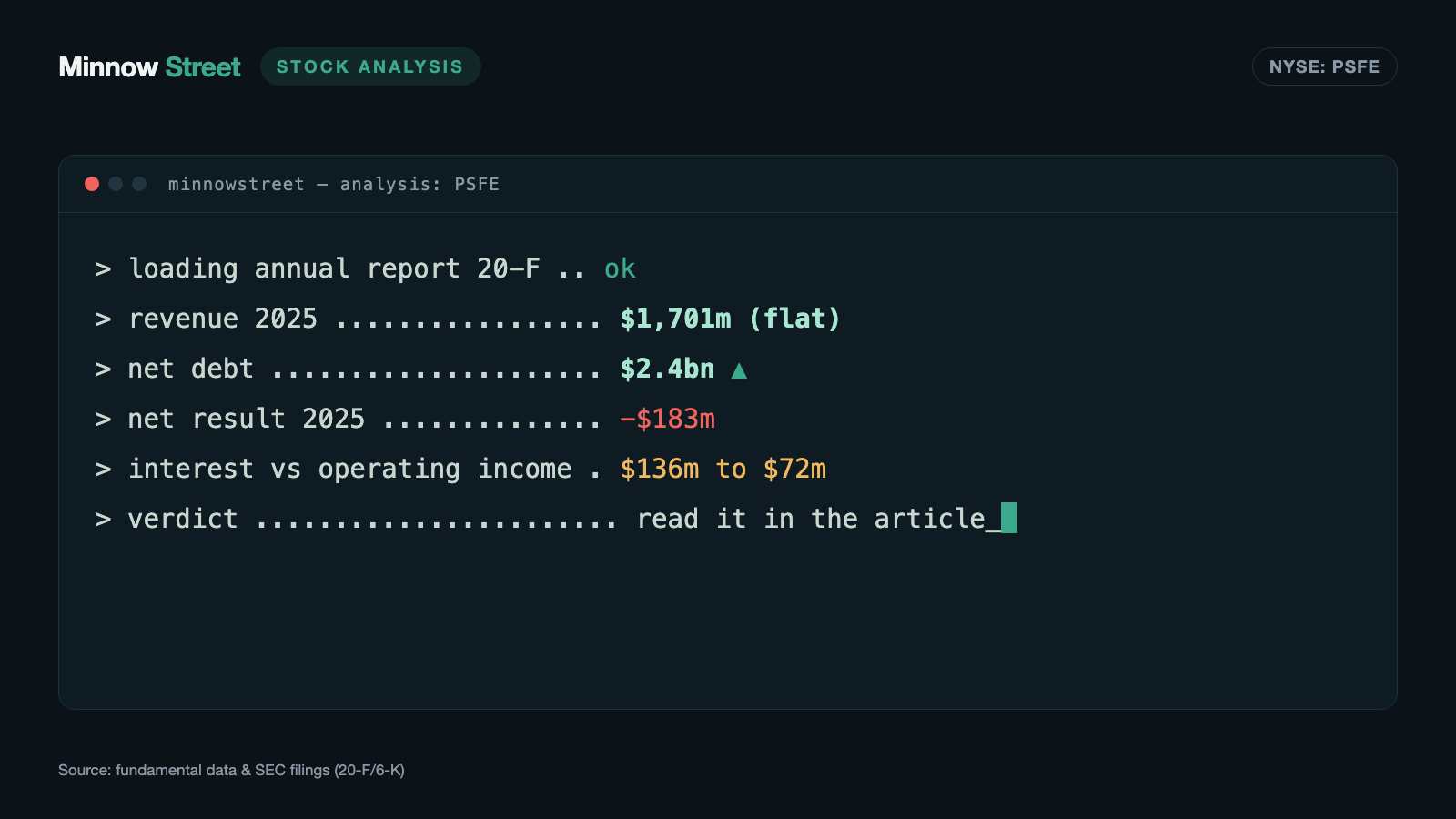
Paysafe processes payments for online casinos, merchants and digital wallets, and it looks dirt cheap in our valuation scanner. We read the Form 20-F for 2025: $71.9 million of operating income faces $136.4 million of interest expense, and net debt stands at $2.4 billion. The free cash flow that makes the stock look cheap halves the moment you count capitalized software as what it is — investment.
 Thomas Mücke
Founder & Publisher
Thomas Mücke
Founder & Publisher
Chart
Interactive price chart (TradingView).
Note: pure fact-based analysis, not investment advice and not a solicitation to buy or sell. All figures without guarantee.
There is one number investors reach for reflexively: a price-to-free-cash-flow ratio below 3. Loosely translated it says the purchase price of the whole company could be recovered from ongoing cash in three years. Read that and you think bargain. Read on and you sometimes think something else.
Paysafe carries exactly such a number in our valuation scanner. The group processes payments — for online betting, for merchants, through digital wallets — and is worth roughly $413 million on the market. It books $1.7 billion of revenue. The deal for the next few minutes: we read the annual report together and work out who owns the money that comes in every year.
What this covers
- What Paysafe actually does
- How the stock reached our desk
- The numbers over the years — fairly appraised
- Uncomfortable truth no. 1: operating income does not cover the interest
- Uncomfortable truth no. 2: free cash flow halves
- Uncomfortable truth no. 3: tangible equity is negative
- Two segments, two directions
- Valuation — what the market pays
- Opportunities and risks at a glance
- A human verdict
- Sources
What Paysafe actually does
Paysafe earns money at both ends of the same payment. At one end sit Merchant Solutions: any business that wants to accept cards online or in store gets the technology and the processing from Paysafe, which charges a fee per transaction. At the other end sit the Digital Wallets — brands such as Skrill, Neteller and paysafecard, which let consumers load, hold and spend money, very often with betting and gaming operators.
In 2025, $167 billion of payment volume ran through those pipes. Revenue — the part Paysafe keeps — was $1,701.4 million. Roughly 2,900 people work for the group.
Its origins explain its balance sheet. Paysafe Limited was incorporated in Bermuda on November 23, 2020 as a shell for a transaction. On March 30, 2021 the blank-check company Foley Trasimene Acquisition Corp. II merged with the operating business, which until then belonged to private equity firms CVC and Blackstone. Trading on the New York Stock Exchange began a day later. The debt from before stayed exactly where it was: on the balance sheet.
A note on sources, because it makes the reading easier: Paysafe is a foreign private issuer. Such companies file no annual report on Form 10-K and no quarterly report on Form 10-Q with the U.S. securities regulator, the SEC. They file an annual report on Form 20-F and interim reports on Form 6-K. Every figure in this analysis comes from the 20-F for 2025 dated March 3, 2026 and the two most recent 6-K releases.
That names the central tension of this analysis: Paysafe earns decent money from operations — but the first creditor sits closer to the till than the shareholder does.
How the stock reached our desk
We run roughly 3,500 stocks through our scanners every day. Paysafe surfaced in the P/FCF ranking, which lists every stock with positive free cash flow and a ratio of no more than 10, sorted ascending.
The honest disclosure belongs right here: on July 27, 2026 Paysafe sat at rank 41 of 545 hits in the U.S. selection, with a displayed ratio of 2.03. The page shows only the 25 strongest rows — so Paysafe does not appear there. To reproduce it: open the scanner, set the country filter to "US", sort the P/FCF column ascending and use the search to jump to the name. The last visible row carried a ratio of 1.4 that day. The lists are recalculated daily.
What is striking is the company the stock keeps there. Alongside the valuation screens P/S ranking and P/CF ranking, our data set flags several warning filters for Paysafe: Weinstein stage 4 (downtrend), price below both the 50-day and the 200-day line, and a weakness cluster. The relative strength rating stands at 12 out of 99 — weaker than 87 percent of all stocks. Remember the principle: cheap and falling is not a combination that resolves itself.
The quality side judges accordingly: a fundamental grade of D, a Piotroski F-score of 4 out of 9 (a nine-point test of the direction of the books; genuinely healthy starts at 8) and an Altman Z reading of 2.12. That figure has to be read on the right scale: we carry the book-value variant Altman Z″, on which the distress zone starts below 1.1 and a balance sheet only counts as safe from 2.6 up. Paysafe therefore sits in the grey band — not in acute trouble, but not on the safe side either. (All scanner values: data as of July 27, 2026.)
The numbers over the years — fairly appraised
First what works. Revenue rose from $1,601.1 million in 2023 to $1,704.8 million in 2024 and came in essentially flat at $1,701.4 million in 2025. The standstill is deceptive: organically the business grew 5 percent in 2025; a divested business line and currency effects cost roughly $99.1 million.
The operating cash also arrives reliably: $234.0 million, $253.8 million and $236.2 million across the three years, each after interest paid. Adjusted operating earnings, the measure the group reports itself, came to $428.8 million in 2025 after $452.1 million the year before — a 5 percent decline.
And then the other side of the page. Net income was minus $20.3 million, plus $22.2 million and minus $182.5 million. The 2025 collapse has two causes, both stated in the filing: $48.4 million of restructuring costs (after $5.2 million) and a $110.4 million tax charge on a pre-tax loss — in essence the write-down of recognized tax assets, whose carrying value fell from $91.3 million to $14.2 million.
Per share that came to a loss of $3.14. For scale: the share price stood at $8.00 on July 24, 2026.
Uncomfortable truth no. 1: operating income does not cover the interest
The most important line of this analysis sits inconspicuously in the middle of the income statement. Operating income — everything left of revenue after costs, administration and depreciation — was $71.9 million in 2025. Interest expense in the same year: $136.4 million.
The ratio is called interest coverage and works out at 0.53. In everyday terms: for every dollar of interest Paysafe owes, the operating business earns about 53 cents. Something else has to carry the rest.
Fairness is due here, because that "something else" is not a trick. Inside the $71.9 million of operating income sit $274.1 million of depreciation and amortization — largely the scheduled amortization of the intangibles that landed on the balance sheet in the blank-check transaction. That is accounting, not cash leaving the building. On a cash basis the picture therefore differs: operating cash flow of $236.2 million is struck after interest paid and was clearly positive in all three reported years.
The honest summary reads: Paysafe pays its interest, but it does not earn it. As long as the amortization runs and revenue holds, the arithmetic works. The cushion is simply thin.
The debt itself is sorted and dated. As of December 31, 2025 the balance sheet carried $2,615.2 million, roughly $2.4 billion net of cash, split as follows:
- Revolving credit facility of $305.0 million, maturing December 28, 2027, priced at the reference rate plus 2.25 percent
- First lien term loans of $819 million (reference rate plus 2.75 percent) and €586 million (plus 3.00 percent), both maturing June 28, 2028
- Secured notes of $337 million at 4.00 percent and €421 million at 3.00 percent, maturing June 15, 2029

That is the good news in this analysis: nothing falls due before the end of 2027. Paysafe has time — and is using it. In the first quarter of 2026 the group repaid a net $104.3 million and reported a leverage ratio of 5.2 times adjusted operating earnings, with a stated aim of getting below 5 by year end.
Uncomfortable truth no. 2: free cash flow halves
Now to the number that put Paysafe into our scanner in the first place. Free cash flow means operating cash less investment. The only question is — which investment?
The cash flow statement in the annual report carries three lines side by side. $12.6 million for property and equipment. $21.2 million for purchasing merchant portfolios. And $94.2 million for other intangible assets — essentially in-house software development, which is not expensed immediately but capitalized and written down over years.
A payments processor without software is not a payments processor. Those $94.2 million are not optional extras but the upkeep of the business — and the line ran steadily between $89.3 million and $95.8 million across all three reported years. Count it, and the picture changes:
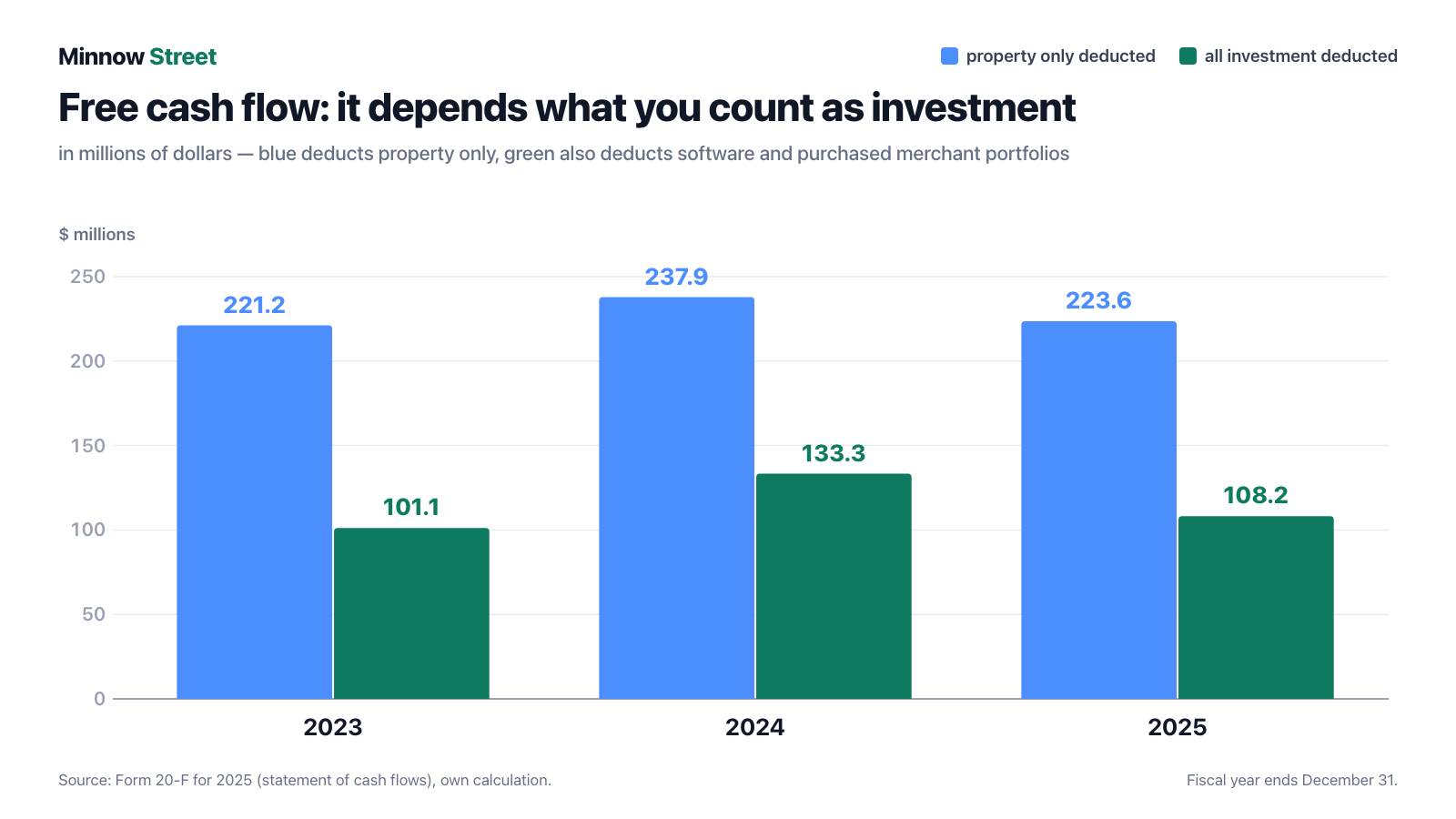
$223.6 million becomes $108.2 million. And a price-to-free-cash-flow ratio of roughly 1.8 becomes one of roughly 3.8. Still not expensive — but something entirely different from what the scanner row suggests.
Remember the principle, it holds for every software-heavy business: a free cash flow that does not deduct capitalized development measures not what is left over, but what would be left if the company stopped investing.
Measured against the debt, even the honest number is small: $108.2 million against $2,615.2 million. That covers the interest but not the principal — repaying it will require refinancing in 2028. How heavily such a debt pile weighs on an otherwise functioning business is something we also saw in our FIS analysis, another payments company from the same valuation scanner.
Uncomfortable truth no. 3: tangible equity is negative
The balance sheet as of December 31, 2025 shows $2,076.3 million of goodwill and $874.1 million of intangible assets on the asset side. Together $2,950.4 million — roughly 61 percent of total assets of $4,803.6 million.
Against that stands equity of $655.0 million. Goodwill and intangibles therefore exceed it more than fourfold. Strip both out and tangible equity comes to roughly minus $2.3 billion.
For companies created through a debt-financed buyout that is not an outlier but the pattern: the purchase price of the day still sits in the books as goodwill. What is more remarkable is how little of it has been written down — impairments in the three reported years came to just $1.3 million, $0.8 million and $1.4 million. Goodwill actually rose in 2025, from $1,976.9 million to $2,076.3 million, mostly on currency effects.
For the investor that means nothing dramatic but something important: the equity ratio of 13.6 percent is the optimistic figure. Were goodwill to be written down, it would evaporate quickly — costing no cash, but weakening the negotiating position at the 2028 refinancing.
Two segments, two directions
Treat Paysafe as one block and you miss the most interesting part. The two segments ran against each other in 2025.
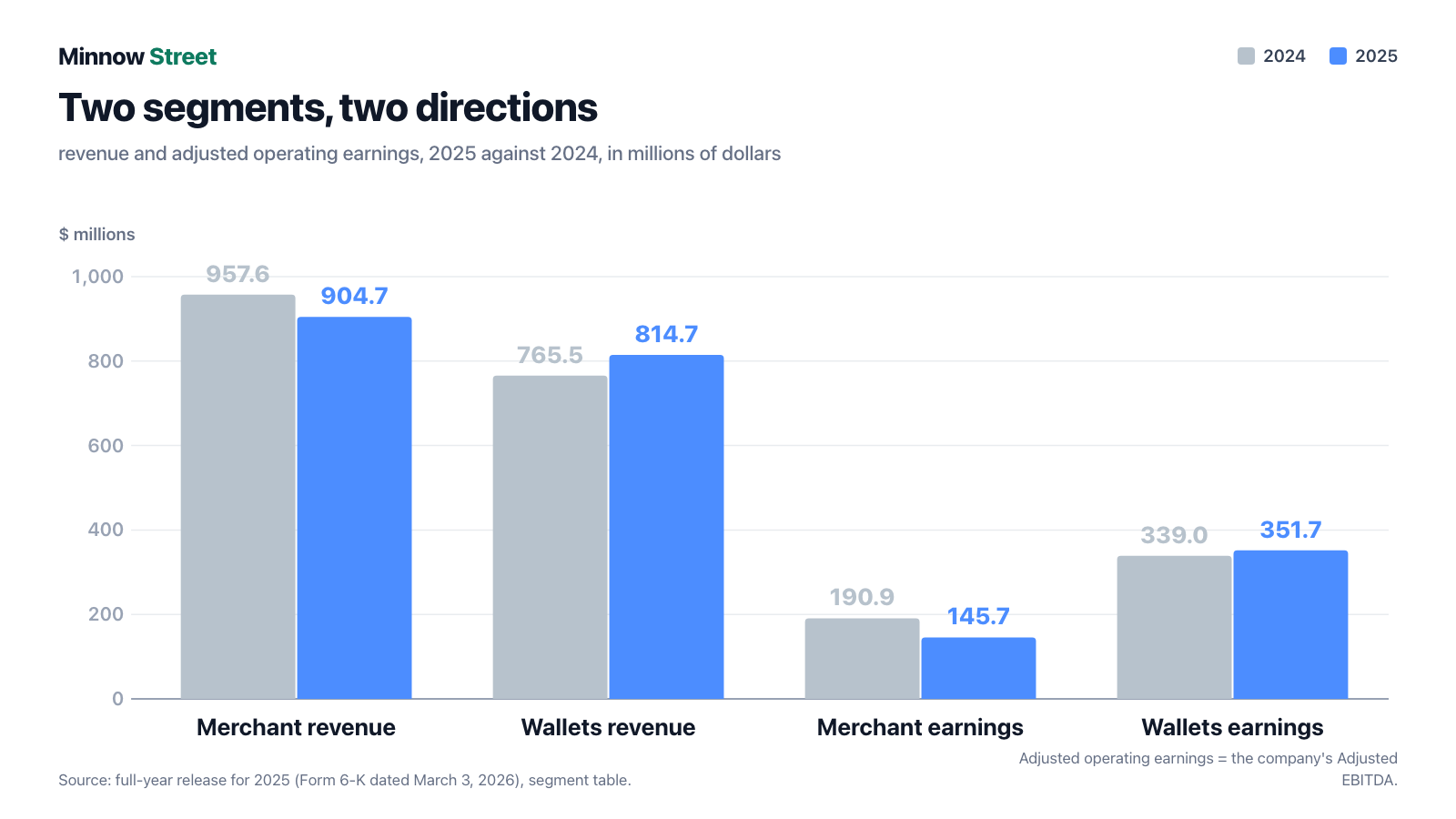
Merchant Solutions lost 6 percent of revenue, falling to $904.7 million — and 24 percent of its earnings contribution, falling to $145.7 million. Its margin dropped from 19.9 to 16.1 percent. Digital Wallets added 6 percent of revenue, reaching $814.7 million, and 4 percent of earnings, reaching $351.7 million, at a margin of 43.2 percent.
Translated: the smaller segment earns the money. Of the $428.8 million of adjusted operating earnings, $351.7 million come from the wallets — whose customers sit to a substantial degree in the betting and gaming market. That is a high-margin business with regulatory risk in every single country.
The first quarter of 2026 reads more kindly: revenue rose 10 percent to $442.7 million, organically 8 percent, with an $18.9 million currency tailwind. Both segments grew — wallets by 15 percent, merchant by 6 percent. The net loss nonetheless widened from $19.5 million to $36.5 million, mainly on a one-time share award to employees ($9.9 million) and higher credit losses ($9.7 million).
Valuation — what the market pays
First a note on honesty in the measurement, and with this name it matters more than usual. On December 12, 2022 Paysafe combined every twelve shares into one. Anyone using a price history that has not been restated for it will think the stock is twelve times cheaper than it is.
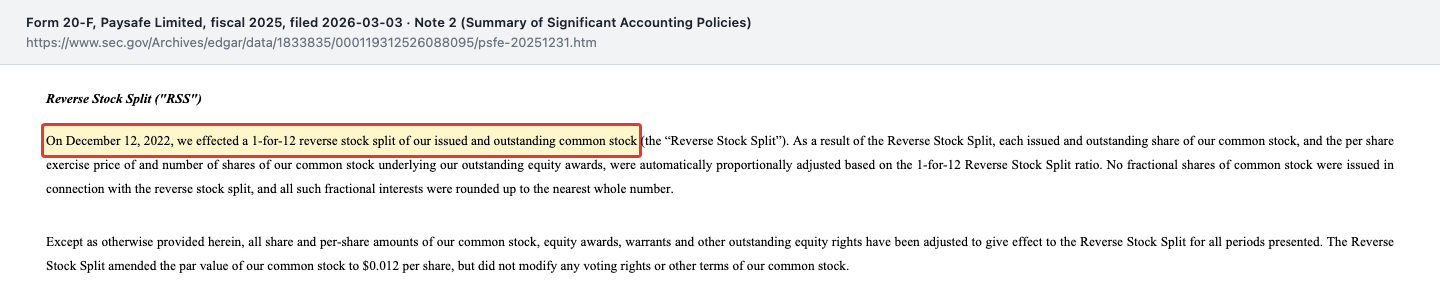
We checked: the data set is adjusted, price and share count are consistent. One value is not, however — the stored market value of roughly $354 million. The annual report states 51,676,354 shares outstanding as of December 31, 2025 (63,676,383 issued less twelve million treasury shares). At the anchor price of $8.00 (data as of July 24, 2026) that gives roughly $413 million; the fundamental data itself reports $411 million. Every metric below rests on that own calculation.
Measured against revenue the stock therefore costs about 0.24 times — the market pays 24 cents for every dollar of annual revenue. Price-to-book is about 0.63. A price-to-earnings ratio does not exist for lack of earnings.
The most honest arithmetic again runs through enterprise value: $413 million of equity value plus $2,615.2 million of debt less $250.2 million of cash comes to roughly $2.78 billion — about 6.5 times adjusted operating earnings of $428.8 million. Put differently: the shareholder owns roughly 15 percent of the enterprise value; the other 85 percent belongs to the lenders. Which is exactly why every move in the business hits the share price so hard, in both directions.
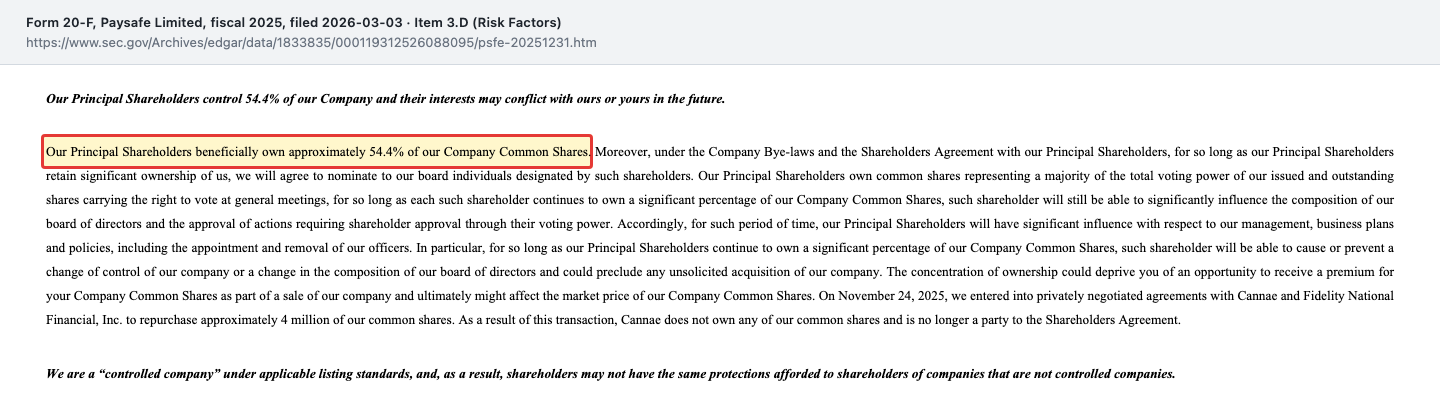
One more point belongs in the valuation even though it rarely shows up in ratios: the principal shareholders hold roughly 54.4 percent. An acquisition of more than half by a third party would make the entire debt immediately due under the credit agreement.
For 2026 the group guides to $1,790 million to $1,830 million of revenue, $449 million to $464 million of adjusted operating earnings and adjusted earnings per share of $2.12 to $2.32 — explicitly reaffirmed after the first quarter.
Opportunities and risks at a glance
What speaks for Paysafe:
- Operating cash arrives reliably. $234.0 million, $253.8 million and $236.2 million over three years, each after interest paid. Adjusted operating earnings came to $428.8 million in 2025.
- The wallets grow and carry the margin. $814.7 million of revenue (+6 percent) at a 43.2 percent adjusted margin; in the first quarter of 2026 growth reached 15 percent.
- Nothing falls due before the end of 2027. The revolver runs to December 28, 2027, the term loans to June 28, 2028, the notes to June 15, 2029 — at coupons of only 4.00 and 3.00 percent.
- Deleveraging has started. $104.3 million of net repayments in the first quarter of 2026 and a leverage ratio of 5.2 with a target below 5.0 by year end.
- The valuation is low. Price-to-sales about 0.24, price-to-book about 0.63, enterprise value about 6.5 times adjusted operating earnings.
What speaks against Paysafe:
- Operating income does not cover the interest. $71.9 million against $136.4 million of interest expense in fiscal 2025 — coverage of 0.53.
- Free cash flow halves on an honest calculation. $223.6 million without, $108.2 million with the $94.2 million of capitalized software development.
- The larger segment is shrinking. Merchant Solutions lost 6 percent of revenue and 24 percent of its earnings contribution in fiscal 2025.
- Tangible equity is negative. $2,950.4 million of goodwill and intangibles against $655.0 million of equity; the 13.6 percent equity ratio is the optimistic figure.
- The market disagrees. Weinstein stage 4, price below both the 50-day and the 200-day line, relative strength 12 out of 99 (data as of July 27, 2026).
- Earnings concentrated around gaming. Most of the earnings come from the digital wallets, whose users frequently fund accounts with betting and gaming operators — a business whose rules every country can change on its own.
A human verdict
Remember the price-to-free-cash-flow ratio below 3 from the opening? It is real. It simply does not describe what most people read into it. At Paysafe the low valuation does not stand for an overlooked treasure but for a very precisely calculated order of precedence: interest first, then software development, then repayment — and whatever is left after that belongs to the shareholder.
It can work out. $2.4 billion of net debt at a group delivering more than $400 million of adjusted operating earnings every year is a heavy load but not an impossible one, and the calendar leaves room until 2028. It can also go wrong, if the merchant segment keeps shrinking or a regulator in an important market throttles the wallets.
Anyone buying in here is not buying a payments company. They are buying the residual left after the lenders — with all the leverage that implies, upward and downward. That is a bet one can take. One should simply know that one is taking it.
What you make of it is your decision. And that is exactly as it should be.
Sources
- Paysafe Limited, Annual Report (Form 20-F) for the fiscal year ended December 31, 2025, filed March 3, 2026 (SEC EDGAR, CIK 0001833835)
- Paysafe Limited, first quarter 2026 results (Form 6-K, Exhibit 99.1), filed May 13, 2026 (SEC EDGAR)
- Paysafe Limited, full-year 2025 results (Form 6-K, Exhibit 99.1), filed March 3, 2026 (SEC EDGAR)
- Complete filing history of Paysafe with the U.S. securities regulator, the SEC
- Fundamental data (metrics and valuation, data as of July 24, 2026) and our in-house stock scanner (data as of July 27, 2026)
This analysis is journalism and explicitly not investment advice and not a solicitation to buy or sell securities. Stocks can fall to a total loss; that is especially true of heavily indebted single names where the equity share of enterprise value is small. All figures come from the primary documents linked above and carry their respective reporting dates. The author holds no position in Paysafe at the time of publication.
Our Bottom Line at a Glance
- Interest coverage negative
- Fiscal 2025 put $71.9 million of operating income against $136.4 million of interest expense — coverage of 0.53. On a cash basis, operating cash flow of $236.2 million carries the interest; in accounting terms the company does not earn it.
- Leverage negative
- $2,615.2 million of debt as of December 31, 2025, $2.4 billion net — 5.5 times adjusted operating earnings of $428.8 million. The largest maturity block falls on June 28, 2028. In the first quarter of 2026 Paysafe repaid a net $104.3 million and reported a leverage ratio of 5.2.
- Segments neutral
- Digital Wallets grew 6 percent to $814.7 million of revenue in 2025 and contributes $351.7 million of the adjusted operating earnings. Merchant Solutions lost 6 percent of revenue and 24 percent of its earnings contribution. Both grew again in the first quarter of 2026 (wallets 15 percent, merchant 6 percent).
- Balance sheet substance negative
- Goodwill of $2,076.3 million and intangibles of $874.1 million face equity of $655.0 million (December 31, 2025). On a tangible basis equity is roughly minus $2.3 billion. Impairments in the reported years stayed small at $1.4 / $0.8 / $1.3 million.
- Valuation positive
- Roughly $413 million of market value for $1,701.4 million of revenue and $428.8 million of adjusted operating earnings: price-to-sales about 0.24, price-to-book about 0.63. Even on enterprise value (about $2.78 billion, roughly 6.5 times adjusted earnings) this is not an expensive stock.
- Ownership neutral
- The principal shareholders hold roughly 54.4 percent and Paysafe counts as a controlled company. An acquisition of more than 50 percent by a third party would make the entire debt immediately due and payable (20-F 2025, Item 3.D) — which caps the takeover speculation this valuation would otherwise invite.
Paysafe is a profitable payments processor working under the debt load of its pre-listing life. On every revenue and cash flow measure the stock is cheap — and that is precisely the question: whether cheap here means opportunity, or simply describes the price of the fact that lenders get paid first out of every dollar earned. June 28, 2028 is the date on which that gets settled. Not investment advice.
What Our Rating Means
Open questions
The business works in principle, but one material question is open. As long as it stays open, our findings do not carry a quality verdict.
Positive operating cash flow, a growing wallets segment and no maturity before 2028 stand against operating income that does not cover the interest, leverage of 5.5 times, tangible equity deep in the red and a shrinking merchant segment. Open questions, not an acute substance risk.
A journalistic assessment by our editorial team at the time of the deep dive, based on public sources — not investment advice and not a solicitation to buy or sell. Your personal circumstances (investment goals, risk capacity, taxes) cannot be taken into account. What our levels mean, how verdicts are formed, and what conflicts of interest exist →
Worth Noting
- The hook was our in-house stock scanner: P/FCF ranking, U.S. selection, rank 41 of 545 hits with a displayed ratio of 2.03 (as of July 27, 2026). The page shows only the 25 strongest rows; Paysafe sits below them. The lists are recalculated daily.
- Our data set carries a market value of roughly $354 million for Paysafe. We instead use the 51,676,354 shares outstanding from the Form 20-F as of December 31, 2025 and arrive at roughly $413 million; the fundamental data itself reports $411 million. Every valuation metric in this article rests on that own calculation.
- The Form 25 of November 17, 2025 covers only the warrants from the blank-check transaction (exercise price $138.00), not the common shares. Those continue to trade on the New York Stock Exchange.
- Do not confuse Paysafe Limited (PSFE) with the former Paysafe Group plc taken private in 2017, nor with Payoneer (PAYO) or Paysign (PAYS).
Frequently Asked Questions
Because Paysafe Limited is a foreign private issuer: the company is registered in Bermuda and run from London. Such companies file an annual report on Form 20-F with the U.S. securities regulator, the SEC, and report during the year on Form 6-K. A quarterly report on Form 10-Q does not exist.
Not any time soon. Counting all investment, roughly $108.2 million was left in 2025 — against $2,615.2 million of debt. The interest bill is covered by operating cash flow of $236.2 million, but repaying the principal will require refinancing.
The $305.0 million revolving credit facility runs to December 28, 2027. The first lien term loans — $819 million and €586 million as of December 31, 2025 — mature on June 28, 2028, and the secured notes ($337 million and €421 million) on June 15, 2029.
On December 12, 2022 Paysafe combined every twelve shares into one, lifting par value to $0.012 per share. All share and per-share figures in the annual report are restated, and the price and market-value data set is adjusted as well — share count and market value are consistent.
Digital Wallets. Its revenue rose 6 percent to $814.7 million in 2025 and its adjusted operating earnings 4 percent to $351.7 million. Merchant Solutions lost 6 percent of revenue, falling to $904.7 million, and 24 percent of earnings, falling to $145.7 million.
The Altman Z reading is 2.12 (data as of July 27, 2026). We carry the book-value variant Altman Z″: on that scale the distress zone starts below 1.1 and a balance sheet only counts as safe from 2.6 up. Paysafe therefore sits in the grey band — not in acute trouble, but not on the safe side either.
The principal shareholders — funds managed by CVC and Blackstone — hold roughly 54.4 percent according to the annual report, which makes Paysafe a controlled company under listing standards. On November 24, 2025 Paysafe repurchased about four million shares from Cannae and Fidelity National Financial; Cannae no longer holds any shares.
Because the scanner divides market value by free cash flow and adopts the data source's definition of investment. On July 27, 2026 Paysafe sat at rank 41 of 545 hits in the U.S. selection, with a displayed ratio of 2.03. The lists are recalculated daily.
Found an error?
Did you spot a factual error, an outdated number, or a typo in this deep dive? Let us know briefly — your report goes straight to the editorial team.